

An Overview of Credit Risk Management practices - A Banker’s perspective Sumant A. Palwankar Credit Risk Analyst 8 th  October 2009.
What do Banks do for their Customers ??? Intermediation  (Deposit & Lending function) Payment Systems   (Retail, Corporates, Govt business) Other financial services . (Off-balance sheet activities, Insurance, Trust services)
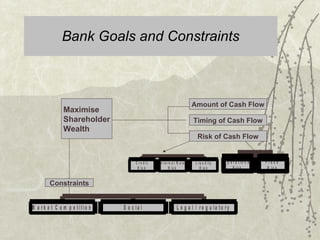
Bank Goals and Constraints Maximise  Shareholder Wealth Amount of Cash Flow Timing of Cash Flow Risk of Cash Flow Constraints
Risk ???? Why Probability? Can we accurately predict the future? The future is uncertain. We can only predict with varying degrees of certainty the ability of various parties to honour their commitments. Even with borrowers which have the highest credit quality (eg. AAA rated corporates) there will always be some uncertainty, especially in a long term relationship. This uncertainty associated with timing & amount of cash flows is the risk. The key strategy is to Identify, Measure, Monitor and Control the Risk.
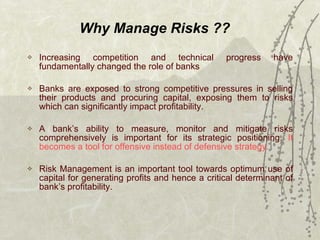
Why Manage Risks ?? Increasing competition and technical progress have fundamentally changed the role of banks Banks are exposed to strong competitive pressures in selling their products and procuring capital, exposing them to risks which can significantly impact profitability.  A bank’s ability to measure, monitor and mitigate risks comprehensively is important for its strategic positioning.  It becomes a tool for offensive instead of defensive strategy. Risk Management is an important tool towards optimum use of capital for generating profits and hence a critical determinant of bank’s profitability.
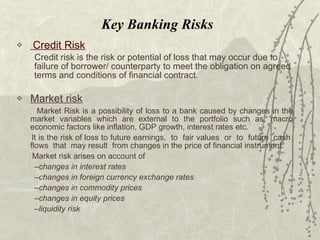
Key Banking Risks Credit Risk Credit risk is the risk or potential of loss that may occur due to failure of borrower/ counterparty to meet the obligation on agreed terms and conditions of financial contract. Market risk   Market Risk is a possibility of loss to a bank caused by changes in the market variables which are external to the portfolio such as, macro economic factors like inflation, GDP growth, interest rates etc.  It is the risk of loss to future earnings,  to  fair values  or  to  future  cash  flows  that  may result  from changes in the price of financial instrument. Market risk arises on account of  changes in interest rates changes in foreign currency exchange rates changes in commodity prices changes in equity prices liquidity risk
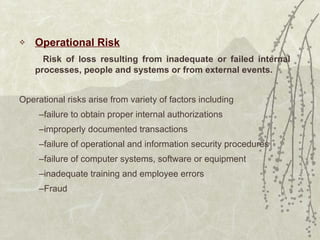
Operational Risk   Risk of loss resulting from inadequate or failed internal processes, people and systems or from external events. Operational risks arise from variety of factors including failure to obtain proper internal authorizations improperly documented transactions failure of operational and information security procedures failure of computer systems, software or equipment inadequate training and employee errors Fraud
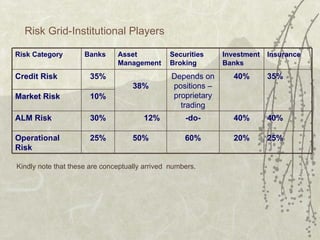
Kindly note that these are conceptually arrived  numbers. Risk Grid-Institutional Players 20% 40% 40% Investment Banks 25% 60% 50% 25% Operational Risk  40% -do- 12% 30% ALM Risk  38% 10% Market Risk  Depends on positions –proprietary trading Securities Broking 35% 35% Credit Risk  Insurance  Asset Management Banks Risk Category
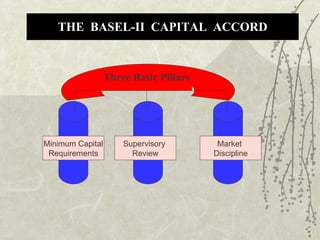
THE  BASEL-II  CAPITAL  ACCORD Minimum Capital Requirements Supervisory  Review Market  Discipline Three Basic Pillars
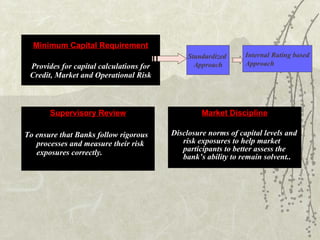
Minimum Capital Requirement Provides for capital calculations for Credit, Market and Operational Risk Supervisory Review To ensure that Banks follow rigorous processes and measure their risk exposures correctly. Market Discipline Disclosure norms of capital levels and risk exposures to help market participants to better assess the bank’s ability to remain solvent.. Standardized  Approach Internal Rating based Approach
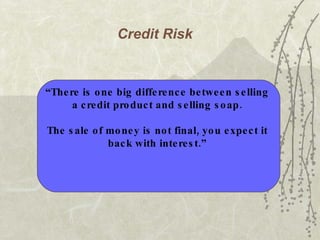
Credit Risk   “ There is one big difference between selling  a credit product and selling soap.  The sale of money is not final, you expect it  back with interest.”
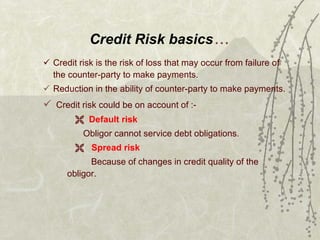
Credit Risk basics … Credit risk is the risk of loss that may occur from failure of the counter-party to make payments. Reduction in the ability of counter-party to make payments. Credit risk could be on account of :- Default risk Obligor cannot service debt obligations. Spread risk   Because of changes in credit quality of the  obligor.
Anyone who is uncomfortable in drilling  holes in the middle of the North Sea probably  does not belong to the oil exploration business. Likewise, anyone who is unprepared to take  credit risk should not be a banker.
Contributors to Credit Risk   Credit Corporate assets. Retail assets. Non SLR portfolio Trading book and banking book. Inter bank transactions. Derivatives. Settlement, etc. Liabilities of a Bank are very credit –sensitive as compared to that of a  typical industrial firm.
Basel Committee on Banking Supervision has issued broad guidelines for best practices in credit risk management. Establishing an appropriate credit risk environment. Operating under a sound credit granting process. Maintaining an appropriate credit administration, risk  measurement and monitoring process. Ensuring adequate controls over credit risk. Role of bank supervisors in ensuring that banks have a effective system in place to identify, measure, monitor and control credit risk. Broad Principles of Credit Risk Management in Banks
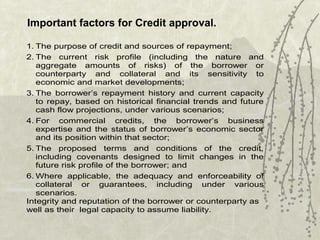
Important factors for Credit approval.
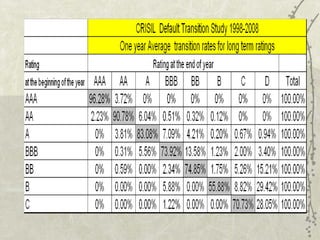
Traditional approaches to Credit Risk Measurement Expert Systems (Your Credit analyst is best judge) . Five Cs of Lending :- Character, Capital, Capacity, Collateral and Cycle (economic  conditions). Credit Rating Systems (Internal / External) Capture all relevant information about the borrower and assign a grade through a risk rating process.eg. CRISIL, ICRA rated Bonds / Debentures AAA, AA, A etc. Limits Systems Prudential norms for single borrower/ group, rating linked exposures, industry level caps, delegation of powers
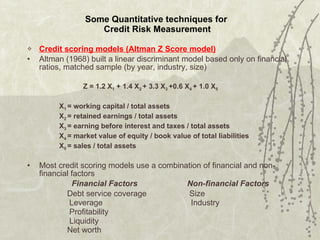
Some Quantitative techniques for  Credit Risk Measurement Credit scoring models (Altman Z Score model) Altman (1968) built a linear discriminant model based only on financial ratios, matched sample (by year, industry, size) Z = 1.2 X 1  + 1.4 X 2  + 3.3 X 3  +0.6 X 4  + 1.0 X 5 X 1  = working capital / total assets X 2  = retained earnings / total assets X 3  = earning before interest and taxes / total assets X 4  = market value of equity / book value of total liabilities X 5  = sales / total assets Most credit scoring models use a combination of financial and non-financial factors   Financial Factors   Non-financial Factors Debt service coverage  Size   Leverage   Industry   Profitability   Liquidity     Net worth
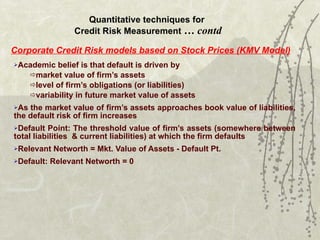
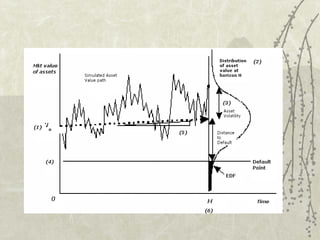
Quantitative techniques for  Credit Risk Measurement  … contd Academic belief is that default is driven by  market value of firm’s assets level of firm’s obligations (or liabilities) variability in future market value of assets As the market value of firm’s assets approaches book value of liabilities, the default risk of firm increases Default Point: The threshold value of firm’s assets (somewhere between total liabilities  & current liabilities) at which the firm defaults Relevant Networth = Mkt. Value of Assets - Default Pt. Default: Relevant Networth = 0 Corporate Credit Risk models based on Stock Prices (KMV Model)
 
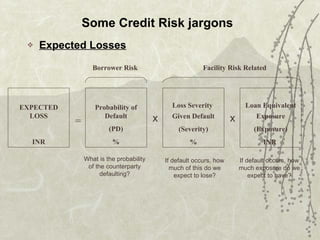
Some Credit Risk jargons Expected Losses EXPECTED LOSS INR = Probability of Default (PD) % x Loss Severity  Given Default (Severity) % Loan Equivalent Exposure (Exposure) INR  x What is the probability of the counterparty defaulting? If default occurs, how much of this do we expect to lose? If default occurs, how much exposure do we expect to have? Borrower Risk   Facility Risk Related
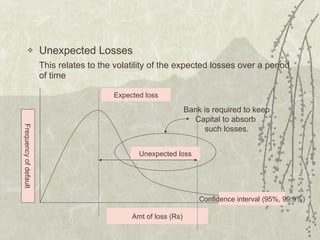
Unexpected Losses This relates to the volatility of the expected losses over a period of time Amt of loss (Rs) Frequency of default Expected loss Unexpected loss Confidence interval (95%, 99.9%) Bank is required to keep Capital to absorb  such losses.
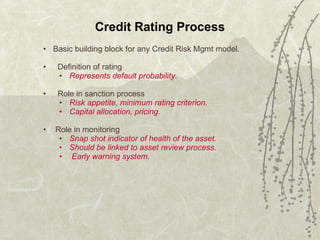
Credit Rating Process Basic building block for any Credit Risk Mgmt model. Definition of rating Represents default probability. Role in sanction process Risk appetite, minimum rating criterion. Capital allocation, pricing. Role in monitoring Snap shot indicator of health of the asset. Should be linked to asset review process. Early warning system.
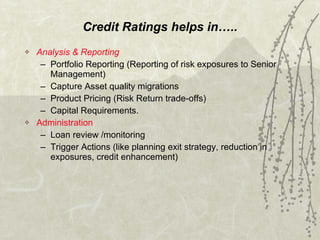
Credit Ratings helps in….. Analysis & Reporting Portfolio Reporting (Reporting of risk exposures to Senior Management) Capture Asset quality migrations  Product Pricing (Risk Return trade-offs) Capital Requirements. Administration Loan review /monitoring  Trigger Actions (like planning exit strategy, reduction in exposures, credit enhancement)
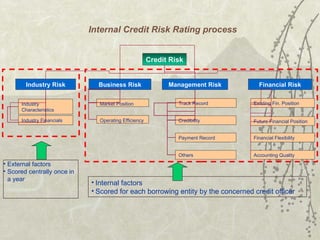
Internal Credit Risk Rating process Credit Risk Industry Risk Business Risk Management Risk Financial Risk Industry Characteristics Industry Financials Market Position Operating Efficiency Track Record Credibility Payment Record Others Existing Fin. Position Future Financial Position Financial Flexibility Accounting Quality External factors Scored centrally once in a year Internal factors  Scored for each borrowing entity by the concerned credit officer
 
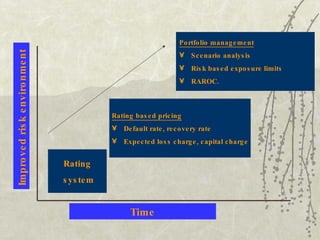
Rating system Rating based pricing Default rate, recovery rate Expected loss charge, capital charge Portfolio management Scenario analysis Risk based exposure limits RAROC. Improved risk environment Time
But after all this, Institutions  with best risk management systems failed…………….!!! What went wrong and learnings from these ???
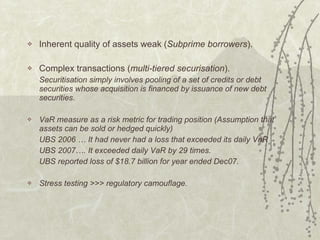
Inherent quality of assets weak ( Subprime borrowers ). Complex transactions ( multi-tiered securisation ).  Securitisation simply involves pooling of a set of credits or debt securities whose acquisition is financed by issuance of new debt securities. VaR measure as a risk metric for trading position (Assumption that assets can be sold or hedged quickly) UBS 2006 … It had never had a loss that exceeded its daily VaR UBS 2007…. It exceeded daily VaR by 29 times. UBS reported loss of $18.7 billion for year ended Dec07. Stress testing >>> regulatory camouflage.
Some afterthoughts …. Effective management of funding liquidity, capital & balance sheet ( contingency plans). Informative and responsive risk measurement & management reporting and practices. Senior Mgmt role in understanding and acting on existing and emerging risks is extremely important.
Case Study…. Drivers of credit risk. Risk mitigation strategies.
Thanks for your attention . . .

Credit Risk Management Presentation

  • 1.
    An Overview ofCredit Risk Management practices - A Banker’s perspective Sumant A. Palwankar Credit Risk Analyst 8 th October 2009.
  • 2.
    What do Banksdo for their Customers ??? Intermediation (Deposit & Lending function) Payment Systems (Retail, Corporates, Govt business) Other financial services . (Off-balance sheet activities, Insurance, Trust services)
  • 3.
    Bank Goals andConstraints Maximise Shareholder Wealth Amount of Cash Flow Timing of Cash Flow Risk of Cash Flow Constraints
  • 4.
    Risk ???? WhyProbability? Can we accurately predict the future? The future is uncertain. We can only predict with varying degrees of certainty the ability of various parties to honour their commitments. Even with borrowers which have the highest credit quality (eg. AAA rated corporates) there will always be some uncertainty, especially in a long term relationship. This uncertainty associated with timing & amount of cash flows is the risk. The key strategy is to Identify, Measure, Monitor and Control the Risk.
  • 5.
    Why Manage Risks?? Increasing competition and technical progress have fundamentally changed the role of banks Banks are exposed to strong competitive pressures in selling their products and procuring capital, exposing them to risks which can significantly impact profitability. A bank’s ability to measure, monitor and mitigate risks comprehensively is important for its strategic positioning. It becomes a tool for offensive instead of defensive strategy. Risk Management is an important tool towards optimum use of capital for generating profits and hence a critical determinant of bank’s profitability.
  • 6.
    Key Banking RisksCredit Risk Credit risk is the risk or potential of loss that may occur due to failure of borrower/ counterparty to meet the obligation on agreed terms and conditions of financial contract. Market risk Market Risk is a possibility of loss to a bank caused by changes in the market variables which are external to the portfolio such as, macro economic factors like inflation, GDP growth, interest rates etc. It is the risk of loss to future earnings, to fair values or to future cash flows that may result from changes in the price of financial instrument. Market risk arises on account of changes in interest rates changes in foreign currency exchange rates changes in commodity prices changes in equity prices liquidity risk
  • 7.
    Operational Risk Risk of loss resulting from inadequate or failed internal processes, people and systems or from external events. Operational risks arise from variety of factors including failure to obtain proper internal authorizations improperly documented transactions failure of operational and information security procedures failure of computer systems, software or equipment inadequate training and employee errors Fraud
  • 8.
    Kindly note thatthese are conceptually arrived numbers. Risk Grid-Institutional Players 20% 40% 40% Investment Banks 25% 60% 50% 25% Operational Risk 40% -do- 12% 30% ALM Risk 38% 10% Market Risk Depends on positions –proprietary trading Securities Broking 35% 35% Credit Risk Insurance Asset Management Banks Risk Category
  • 9.
    THE BASEL-II CAPITAL ACCORD Minimum Capital Requirements Supervisory Review Market Discipline Three Basic Pillars
  • 10.
    Minimum Capital RequirementProvides for capital calculations for Credit, Market and Operational Risk Supervisory Review To ensure that Banks follow rigorous processes and measure their risk exposures correctly. Market Discipline Disclosure norms of capital levels and risk exposures to help market participants to better assess the bank’s ability to remain solvent.. Standardized Approach Internal Rating based Approach
  • 11.
    Credit Risk “ There is one big difference between selling a credit product and selling soap. The sale of money is not final, you expect it back with interest.”
  • 12.
    Credit Risk basics… Credit risk is the risk of loss that may occur from failure of the counter-party to make payments. Reduction in the ability of counter-party to make payments. Credit risk could be on account of :- Default risk Obligor cannot service debt obligations. Spread risk Because of changes in credit quality of the obligor.
  • 13.
    Anyone who isuncomfortable in drilling holes in the middle of the North Sea probably does not belong to the oil exploration business. Likewise, anyone who is unprepared to take credit risk should not be a banker.
  • 14.
    Contributors to CreditRisk Credit Corporate assets. Retail assets. Non SLR portfolio Trading book and banking book. Inter bank transactions. Derivatives. Settlement, etc. Liabilities of a Bank are very credit –sensitive as compared to that of a typical industrial firm.
  • 15.
    Basel Committee onBanking Supervision has issued broad guidelines for best practices in credit risk management. Establishing an appropriate credit risk environment. Operating under a sound credit granting process. Maintaining an appropriate credit administration, risk measurement and monitoring process. Ensuring adequate controls over credit risk. Role of bank supervisors in ensuring that banks have a effective system in place to identify, measure, monitor and control credit risk. Broad Principles of Credit Risk Management in Banks
  • 16.
    Important factors forCredit approval.
  • 17.
    Traditional approaches toCredit Risk Measurement Expert Systems (Your Credit analyst is best judge) . Five Cs of Lending :- Character, Capital, Capacity, Collateral and Cycle (economic conditions). Credit Rating Systems (Internal / External) Capture all relevant information about the borrower and assign a grade through a risk rating process.eg. CRISIL, ICRA rated Bonds / Debentures AAA, AA, A etc. Limits Systems Prudential norms for single borrower/ group, rating linked exposures, industry level caps, delegation of powers
  • 18.
    Some Quantitative techniquesfor Credit Risk Measurement Credit scoring models (Altman Z Score model) Altman (1968) built a linear discriminant model based only on financial ratios, matched sample (by year, industry, size) Z = 1.2 X 1 + 1.4 X 2 + 3.3 X 3 +0.6 X 4 + 1.0 X 5 X 1 = working capital / total assets X 2 = retained earnings / total assets X 3 = earning before interest and taxes / total assets X 4 = market value of equity / book value of total liabilities X 5 = sales / total assets Most credit scoring models use a combination of financial and non-financial factors Financial Factors Non-financial Factors Debt service coverage Size Leverage Industry Profitability Liquidity Net worth
  • 19.
    Quantitative techniques for Credit Risk Measurement … contd Academic belief is that default is driven by market value of firm’s assets level of firm’s obligations (or liabilities) variability in future market value of assets As the market value of firm’s assets approaches book value of liabilities, the default risk of firm increases Default Point: The threshold value of firm’s assets (somewhere between total liabilities & current liabilities) at which the firm defaults Relevant Networth = Mkt. Value of Assets - Default Pt. Default: Relevant Networth = 0 Corporate Credit Risk models based on Stock Prices (KMV Model)
  • 20.
  • 21.
    Some Credit Riskjargons Expected Losses EXPECTED LOSS INR = Probability of Default (PD) % x Loss Severity Given Default (Severity) % Loan Equivalent Exposure (Exposure) INR x What is the probability of the counterparty defaulting? If default occurs, how much of this do we expect to lose? If default occurs, how much exposure do we expect to have? Borrower Risk Facility Risk Related
  • 22.
    Unexpected Losses Thisrelates to the volatility of the expected losses over a period of time Amt of loss (Rs) Frequency of default Expected loss Unexpected loss Confidence interval (95%, 99.9%) Bank is required to keep Capital to absorb such losses.
  • 23.
    Credit Rating ProcessBasic building block for any Credit Risk Mgmt model. Definition of rating Represents default probability. Role in sanction process Risk appetite, minimum rating criterion. Capital allocation, pricing. Role in monitoring Snap shot indicator of health of the asset. Should be linked to asset review process. Early warning system.
  • 24.
    Credit Ratings helpsin….. Analysis & Reporting Portfolio Reporting (Reporting of risk exposures to Senior Management) Capture Asset quality migrations Product Pricing (Risk Return trade-offs) Capital Requirements. Administration Loan review /monitoring Trigger Actions (like planning exit strategy, reduction in exposures, credit enhancement)
  • 25.
    Internal Credit RiskRating process Credit Risk Industry Risk Business Risk Management Risk Financial Risk Industry Characteristics Industry Financials Market Position Operating Efficiency Track Record Credibility Payment Record Others Existing Fin. Position Future Financial Position Financial Flexibility Accounting Quality External factors Scored centrally once in a year Internal factors Scored for each borrowing entity by the concerned credit officer
  • 26.
  • 27.
    Rating system Ratingbased pricing Default rate, recovery rate Expected loss charge, capital charge Portfolio management Scenario analysis Risk based exposure limits RAROC. Improved risk environment Time
  • 28.
    But after allthis, Institutions with best risk management systems failed…………….!!! What went wrong and learnings from these ???
  • 29.
    Inherent quality ofassets weak ( Subprime borrowers ). Complex transactions ( multi-tiered securisation ). Securitisation simply involves pooling of a set of credits or debt securities whose acquisition is financed by issuance of new debt securities. VaR measure as a risk metric for trading position (Assumption that assets can be sold or hedged quickly) UBS 2006 … It had never had a loss that exceeded its daily VaR UBS 2007…. It exceeded daily VaR by 29 times. UBS reported loss of $18.7 billion for year ended Dec07. Stress testing >>> regulatory camouflage.
  • 30.
    Some afterthoughts ….Effective management of funding liquidity, capital & balance sheet ( contingency plans). Informative and responsive risk measurement & management reporting and practices. Senior Mgmt role in understanding and acting on existing and emerging risks is extremely important.
  • 31.
    Case Study…. Driversof credit risk. Risk mitigation strategies.
  • 32.
    Thanks for yourattention . . .