

DEVTECH FINANCE
CREDIT MANAGEMENT
BASEL NORMS
INTRODUCTION
• Basel norms were introduced by Basel Committee to have a standardized
prudential norms for capital adequacy
• The prudential norms defined components of capital, assigned risk
weights to different types of assets and stipulated the minimum Capital
Adequacy to aggregate Risk weighted Assets (CRAR)
• The minimum standard of capital to be kept with commercial banks was
fixed 8% of RWA under Basel 1 & Basel 2 norms which was increased to
9% of RWA under Basel 3
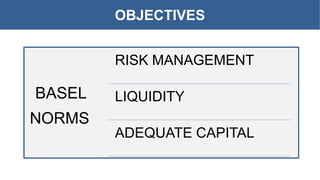
OBJECTIVES
BASEL
NORMS
RISK MANAGEMENT
LIQUIDITY
ADEQUATE CAPITAL
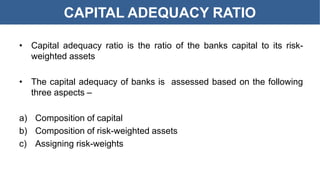
CAPITAL ADEQUACY RATIO
• Capital adequacy ratio is the ratio of the banks capital to its risk-
weighted assets
• The capital adequacy of banks is assessed based on the following
three aspects –
a) Composition of capital
b) Composition of risk-weighted assets
c) Assigning risk-weights
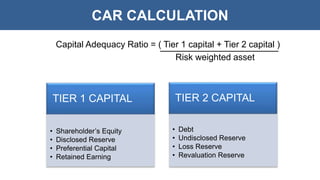
CAR CALCULATION
Capital Adequacy Ratio = ( Tier 1 capital + Tier 2 capital )
Risk weighted asset
TIER 1 CAPITAL
• Shareholder’s Equity
• Disclosed Reserve
• Preferential Capital
• Retained Earning
TIER 2 CAPITAL
• Debt
• Undisclosed Reserve
• Loss Reserve
• Revaluation Reserve
BASEL 1
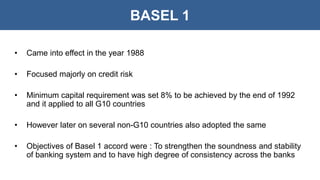
• Came into effect in the year 1988
• Focused majorly on credit risk
• Minimum capital requirement was set 8% to be achieved by the end of 1992
and it applied to all G10 countries
• However later on several non-G10 countries also adopted the same
• Objectives of Basel 1 accord were : To strengthen the soundness and stability
of banking system and to have high degree of consistency across the banks
BASEL 2
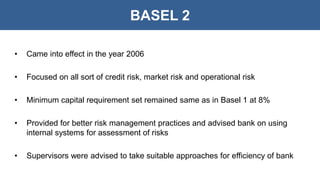
• Came into effect in the year 2006
• Focused on all sort of credit risk, market risk and operational risk
• Minimum capital requirement set remained same as in Basel 1 at 8%
• Provided for better risk management practices and advised bank on using
internal systems for assessment of risks
• Supervisors were advised to take suitable approaches for efficiency of bank
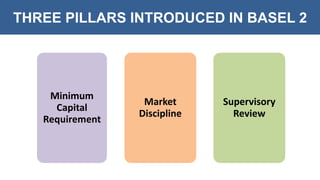
THREE PILLARS INTRODUCED IN BASEL 2
Minimum
Capital
Requirement
Market
Discipline
Supervisory
Review
BASEL 3
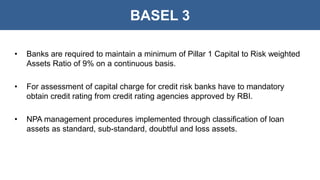
• Banks are required to maintain a minimum of Pillar 1 Capital to Risk weighted
Assets Ratio of 9% on a continuous basis.
• For assessment of capital charge for credit risk banks have to mandatory
obtain credit rating from credit rating agencies approved by RBI.
• NPA management procedures implemented through classification of loan
assets as standard, sub-standard, doubtful and loss assets.
THANK YOU FOR WATCHING
DEVTECH
FINANCE

Basel norms

  • 1.
  • 2.
    INTRODUCTION • Basel normswere introduced by Basel Committee to have a standardized prudential norms for capital adequacy • The prudential norms defined components of capital, assigned risk weights to different types of assets and stipulated the minimum Capital Adequacy to aggregate Risk weighted Assets (CRAR) • The minimum standard of capital to be kept with commercial banks was fixed 8% of RWA under Basel 1 & Basel 2 norms which was increased to 9% of RWA under Basel 3
  • 3.
  • 4.
    CAPITAL ADEQUACY RATIO •Capital adequacy ratio is the ratio of the banks capital to its risk- weighted assets • The capital adequacy of banks is assessed based on the following three aspects – a) Composition of capital b) Composition of risk-weighted assets c) Assigning risk-weights
  • 5.
    CAR CALCULATION Capital AdequacyRatio = ( Tier 1 capital + Tier 2 capital ) Risk weighted asset TIER 1 CAPITAL • Shareholder’s Equity • Disclosed Reserve • Preferential Capital • Retained Earning TIER 2 CAPITAL • Debt • Undisclosed Reserve • Loss Reserve • Revaluation Reserve
  • 6.
    BASEL 1 • Cameinto effect in the year 1988 • Focused majorly on credit risk • Minimum capital requirement was set 8% to be achieved by the end of 1992 and it applied to all G10 countries • However later on several non-G10 countries also adopted the same • Objectives of Basel 1 accord were : To strengthen the soundness and stability of banking system and to have high degree of consistency across the banks
  • 7.
    BASEL 2 • Cameinto effect in the year 2006 • Focused on all sort of credit risk, market risk and operational risk • Minimum capital requirement set remained same as in Basel 1 at 8% • Provided for better risk management practices and advised bank on using internal systems for assessment of risks • Supervisors were advised to take suitable approaches for efficiency of bank
  • 8.
    THREE PILLARS INTRODUCEDIN BASEL 2 Minimum Capital Requirement Market Discipline Supervisory Review
  • 9.
    BASEL 3 • Banksare required to maintain a minimum of Pillar 1 Capital to Risk weighted Assets Ratio of 9% on a continuous basis. • For assessment of capital charge for credit risk banks have to mandatory obtain credit rating from credit rating agencies approved by RBI. • NPA management procedures implemented through classification of loan assets as standard, sub-standard, doubtful and loss assets.
  • 10.
    THANK YOU FORWATCHING DEVTECH FINANCE