K 
h 
a 
r 
g 
h 
a 
r 
SMBA 
30-B 
Group 
-2- 
… The Operational Risk management (ORM) in Banking Sector … 
ITM 
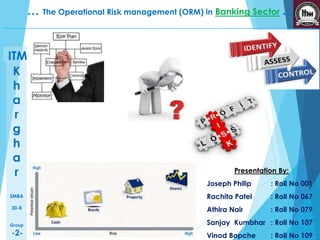
Presentation By: 
Joseph Philip : Roll No 001 
Rachita Patel : Roll No 067 
Athira Nair : Roll No 079 
Sanjay Kumbhar : Roll No 107 
Vinod Bopche : Roll No 109
K 
h 
a 
r 
g 
h 
a 
r 
SMBA 
30-B 
Group 
-2- 
… The Operational Risk management (ORM) in Banking Sector … 
ITM 
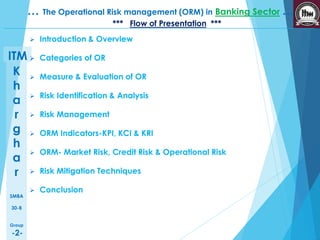
*** Flow of Presentation *** 
 Introduction & Overview 
 Categories of OR 
 Measure & Evaluation of OR 
 Risk Identification & Analysis 
 Risk Management 
 ORM Indicators-KPI, KCI & KRI 
 ORM- Market Risk, Credit Risk & Operational Risk 
 Risk Mitigation Techniques 
 Conclusion
K 
h 
a 
r 
g 
h 
a 
r 
SMBA 
30-B 
Group 
-2- 
… The Operational Risk management (ORM) in Banking Sector … 
ITM 
*** Flow of Presentation *** 
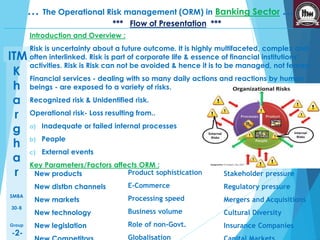
Introduction and Overview : 
Risk is uncertainty about a future outcome. It is highly multifaceted, complex and 
often interlinked. Risk is part of corporate life & essence of financial institutions' 
activities. Risk is Risk can not be avoided & hence it is to be managed, not feared. 
Financial services - dealing with so many daily actions and reactions by human 
beings - are exposed to a variety of risks. 
Recognized risk & Unidentified risk. 
Operational risk- Loss resulting from.. 
a) Inadequate or failed internal processes 
b) People 
c) External events 
Key Parameters/Factors affects ORM : 
New products 
New distbn channels 
New markets 
New technology 
New legislation 
New Competitors 
Product sophistication 
E-Commerce 
Processing speed 
Business volume 
Role of non-Govt. 
Globalisation 
Stakeholder pressure 
Regulatory pressure 
Mergers and Acquisitions 
Cultural Diversity 
Insurance Companies 
Capital Markets
K 
h 
a 
r 
g 
h 
a 
r 
SMBA 
30-B 
Group 
-2- 
… The Operational Risk management (ORM) in Banking Sector … 
ITM 
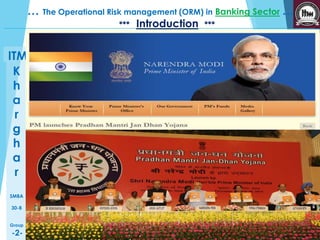
*** Introduction ***
K 
h 
a 
r 
g 
h 
a 
r 
SMBA 
30-B 
Group 
-2- 
… The Operational Risk management (ORM) in Banking Sector … 
ITM 
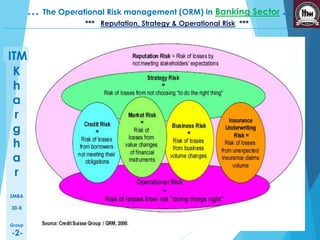
*** Reputation, Strategy & Operational Risk ***
K 
h 
a 
r 
g 
h 
a 
r 
SMBA 
30-B 
Group 
-2- 
… The Operational Risk management (ORM) in Banking Sector … 
ITM 
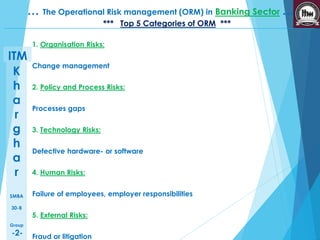
1. Organisation Risks: 
Change management 
2. Policy and Process Risks: 
Processes gaps 
3. Technology Risks: 
Defective hardware- or software 
4. Human Risks: 
Failure of employees, employer responsibilities 
5. External Risks: 
Fraud or litigation 
*** Top 5 Categories of ORM ***
K 
h 
a 
r 
g 
h 
a 
r 
SMBA 
30-B 
Group 
-2- 
… The Operational Risk management (ORM) in Banking Sector … 
ITM 
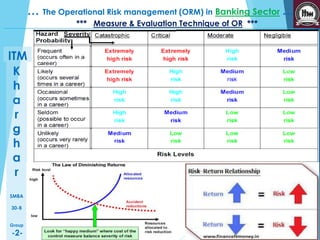
*** Measure & Evaluation Technique of OR ***
K 
h 
a 
r 
g 
h 
a 
r 
SMBA 
30-B 
Group 
-2- 
… The Operational Risk management (ORM) in Banking Sector … 
ITM 
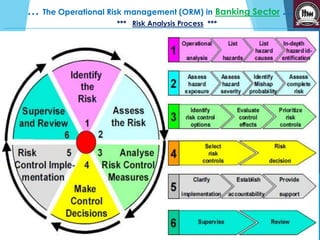
*** Risk Analysis Process ***
K 
h 
a 
r 
g 
h 
a 
r 
SMBA 
30-B 
Group 
-2- 
… The Operational Risk management (ORM) in Banking Sector … 
ITM 
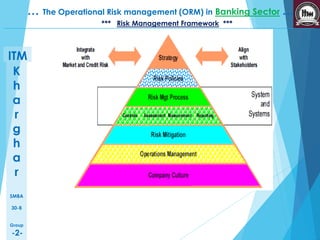
*** Risk Management Framework ***
K 
h 
a 
r 
g 
h 
a 
r 
SMBA 
30-B 
Group 
-2- 
… The Operational Risk management (ORM) in Banking Sector … 
ITM 
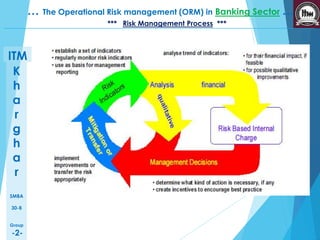
*** Risk Management Process ***
K 
h 
a 
r 
g 
h 
a 
r 
SMBA 
30-B 
Group 
-2- 
… The Operational Risk management (ORM) in Banking Sector … 
ITM 
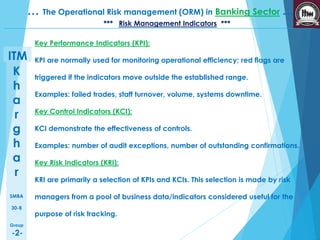
*** Risk Management Indicators *** 
Key Performance Indicators (KPI): 
KPI are normally used for monitoring operational efficiency; red flags are 
triggered if the indicators move outside the established range. 
Examples: failed trades, staff turnover, volume, systems downtime. 
Key Control Indicators (KCI): 
KCI demonstrate the effectiveness of controls. 
Examples: number of audit exceptions, number of outstanding confirmations. 
Key Risk Indicators (KRI): 
KRI are primarily a selection of KPIs and KCIs. This selection is made by risk 
managers from a pool of business data/indicators considered useful for the 
purpose of risk tracking.
K 
h 
a 
r 
g 
h 
a 
r 
SMBA 
30-B 
Group 
-2- 
… The Operational Risk management (ORM) in Banking Sector … 
ITM 
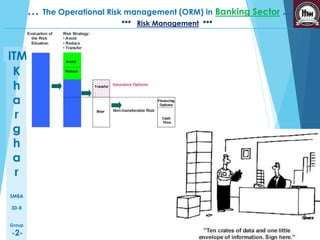
*** Risk Management *** 
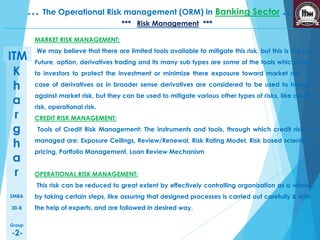
MARKET RISK MANAGEMENT: 
We may believe that there are limited tools available to mitigate this risk, but this is not so. 
Future, option, derivatives trading and its many sub types are some of the tools which help 
to investors to protect the investment or minimize there exposure toward market risk. In 
case of derivatives as in broader sense derivatives are considered to be used to hedge 
against market risk, but they can be used to mitigate various other types of risks, like credit 
risk, operational risk. 
CREDIT RISK MANAGEMENT: 
Tools of Credit Risk Management: The instruments and tools, through which credit risk is 
managed are: Exposure Ceilings, Review/Renewal, Risk Rating Model, Risk based scientific 
pricing, Portfolio Management, Loan Review Mechanism 
OPERATIONAL RISK MANAGEMENT: 
This risk can be reduced to great extent by effectively controlling organization as a whole 
by taking certain steps, like assuring that designed processes is carried out carefully & with 
the help of experts, and are followed in desired way.
K 
h 
a 
r 
g 
h 
a 
r 
SMBA 
30-B 
Group 
-2- 
… The Operational Risk management (ORM) in Banking Sector … 
ITM 
*** Risk Management ***
K 
h 
a 
r 
g 
h 
a 
r 
SMBA 
30-B 
Group 
-2- 
… The Operational Risk management (ORM) in Banking Sector … 
ITM 
*** Risk Mitigation Management *** 
Principle 1: The board of directors should take the lead in establishing a 
strong risk management culture. The board & senior management should 
establish a corporate culture- guided by strong risk management and that 
supports and provides appropriate standards and incentives for professional 
and responsible behaviour. on. 
Principle 2: Banks should develop, implement and maintain a framework that 
is fully integrated into the bank’s overall risk management processes. The 
Framework for operational risk management chosen by an individual bank will 
depend on a range of factors, including its nature, size, complexity and risk 
profile. 
Principle 3: Governance: 
The board of directors should establish, approve and periodically review the 
Framework. The board of directors should oversee senior management to 
ensure that the policies, processes and systems are implemented effectively 
at all decision levels. 
Principle 4: The board of directors should approve and review a risk appetite 
and tolerance statement for operational risk that articulates the nature, types 
and levels of operational risk that the bank is willing to assume.
K 
h 
a 
r 
g 
h 
a 
r 
SMBA 
30-B 
Group 
-2- 
… The Operational Risk management (ORM) in Banking Sector … 
ITM 
*** Risk Mitigation Management *** 
Principle 5: Senior Management: 
Senior management should develop for approval by the board of directors a 
clear, effective and robust governance structure with well defined, 
transparent and consistent lines of responsibility. Senior management is 
responsible for consistently implementing and maintaining throughout the 
organisation policies, processes and systems for managing operational risk in 
all of the bank’s material products, activities, processes and systems 
consistent with the risk appetite and tolerance. 
Principle 6: Identification and Assessment: 
Senior management should ensure the identification and assessment of the 
operational risk inherent in all material products, activities, 
processes and systems to make sure the inherent risks and incentives are well 
understood. 
Principle 7: Senior management should ensure that there is an approval 
process for all new products, activities, processes and systems that fully 
assesses operational risk.
K 
h 
a 
r 
g 
h 
a 
r 
SMBA 
30-B 
Group 
-2- 
… The Operational Risk management (ORM) in Banking Sector … 
ITM 
*** Risk Mitigation Management *** 
Principle 8: Monitoring and Reporting: 
Senior management should implement a process to regularly monitor 
operational risk profiles and material exposures to losses. Appropriate 
reporting mechanisms should be in place at the board, senior management, 
and reporting mechanisms should be in place at the board, senior 
management, and 
Principle 9: Control and Mitigation: 
Banks should have a strong control environment that utilises policies, 
processes and systems; appropriate internal controls; and appropriate risk 
mitigation and/or transfer strategies. 
Principle 10: Business Resiliency and Continuity: 
Banks should have business resiliency and continuity plans in place to ensure 
an ability to operate on an ongoing basis and limit losses in the event of 
severe business disruption. 
Principle 11: Role of Disclosure: 
A bank’s public disclosures should allow stakeholders to assess its approach to 
operational risk management.
K 
h 
a 
r 
g 
h 
a 
r 
SMBA 
30-B 
Group 
-2- 
… The Operational Risk management (ORM) in Banking Sector … 
ITM 
*** The Way Forward *** 
Let’s make a difference: Managing compliance and operational 
risk in the new environment 
Banks are facing expanding compliance expectations that are pushing 
compliance programs to the brink. The scope and nature of compliance have 
evolved and are no longer limited to rules-based banking regulations. 
Operational and compliance risks have become more complex and entwined, 
increasing the potential for failed processes that cause customer confusion and 
compliance control breakdowns. Without a new approach to compliance and 
operational risk management, many banks will continue to face high costs and 
losses in the form of escalating litigation, penalties, and staffing needs. 
Given the major changes in the compliance and regulatory landscape and the 
resulting long-term impact on banks, incremental adjustments will simply not be 
enough. To start, we recommend that banks take a look at six innovative 
approaches to drive change: 
•Integrate relevant aspects of operational and compliance risk management 
•Simplify products and channels 
•Leverage analytics 
•Standardize compliance testing 
•Adopt lean principles 
•Manage change
K 
h 
a 
r 
g 
h 
a 
r 
SMBA 
30-B 
Group 
-2- 
… The Operational Risk management (ORM) in Banking Sector … 
ITM

Operation Risk Management in Banking Sector

  • 1.
    K h a r g h a r SMBA 30-B Group -2- … The Operational Risk management (ORM) in Banking Sector … ITM Presentation By: Joseph Philip : Roll No 001 Rachita Patel : Roll No 067 Athira Nair : Roll No 079 Sanjay Kumbhar : Roll No 107 Vinod Bopche : Roll No 109
  • 2.
    K h a r g h a r SMBA 30-B Group -2- … The Operational Risk management (ORM) in Banking Sector … ITM *** Flow of Presentation ***  Introduction & Overview  Categories of OR  Measure & Evaluation of OR  Risk Identification & Analysis  Risk Management  ORM Indicators-KPI, KCI & KRI  ORM- Market Risk, Credit Risk & Operational Risk  Risk Mitigation Techniques  Conclusion
  • 3.
    K h a r g h a r SMBA 30-B Group -2- … The Operational Risk management (ORM) in Banking Sector … ITM *** Flow of Presentation *** Introduction and Overview : Risk is uncertainty about a future outcome. It is highly multifaceted, complex and often interlinked. Risk is part of corporate life & essence of financial institutions' activities. Risk is Risk can not be avoided & hence it is to be managed, not feared. Financial services - dealing with so many daily actions and reactions by human beings - are exposed to a variety of risks. Recognized risk & Unidentified risk. Operational risk- Loss resulting from.. a) Inadequate or failed internal processes b) People c) External events Key Parameters/Factors affects ORM : New products New distbn channels New markets New technology New legislation New Competitors Product sophistication E-Commerce Processing speed Business volume Role of non-Govt. Globalisation Stakeholder pressure Regulatory pressure Mergers and Acquisitions Cultural Diversity Insurance Companies Capital Markets
  • 4.
    K h a r g h a r SMBA 30-B Group -2- … The Operational Risk management (ORM) in Banking Sector … ITM *** Introduction ***
  • 5.
    K h a r g h a r SMBA 30-B Group -2- … The Operational Risk management (ORM) in Banking Sector … ITM *** Reputation, Strategy & Operational Risk ***
  • 6.
    K h a r g h a r SMBA 30-B Group -2- … The Operational Risk management (ORM) in Banking Sector … ITM 1. Organisation Risks: Change management 2. Policy and Process Risks: Processes gaps 3. Technology Risks: Defective hardware- or software 4. Human Risks: Failure of employees, employer responsibilities 5. External Risks: Fraud or litigation *** Top 5 Categories of ORM ***
  • 7.
    K h a r g h a r SMBA 30-B Group -2- … The Operational Risk management (ORM) in Banking Sector … ITM *** Measure & Evaluation Technique of OR ***
  • 8.
    K h a r g h a r SMBA 30-B Group -2- … The Operational Risk management (ORM) in Banking Sector … ITM *** Risk Analysis Process ***
  • 9.
    K h a r g h a r SMBA 30-B Group -2- … The Operational Risk management (ORM) in Banking Sector … ITM *** Risk Management Framework ***
  • 10.
    K h a r g h a r SMBA 30-B Group -2- … The Operational Risk management (ORM) in Banking Sector … ITM *** Risk Management Process ***
  • 11.
    K h a r g h a r SMBA 30-B Group -2- … The Operational Risk management (ORM) in Banking Sector … ITM *** Risk Management Indicators *** Key Performance Indicators (KPI): KPI are normally used for monitoring operational efficiency; red flags are triggered if the indicators move outside the established range. Examples: failed trades, staff turnover, volume, systems downtime. Key Control Indicators (KCI): KCI demonstrate the effectiveness of controls. Examples: number of audit exceptions, number of outstanding confirmations. Key Risk Indicators (KRI): KRI are primarily a selection of KPIs and KCIs. This selection is made by risk managers from a pool of business data/indicators considered useful for the purpose of risk tracking.
  • 12.
    K h a r g h a r SMBA 30-B Group -2- … The Operational Risk management (ORM) in Banking Sector … ITM *** Risk Management *** MARKET RISK MANAGEMENT: We may believe that there are limited tools available to mitigate this risk, but this is not so. Future, option, derivatives trading and its many sub types are some of the tools which help to investors to protect the investment or minimize there exposure toward market risk. In case of derivatives as in broader sense derivatives are considered to be used to hedge against market risk, but they can be used to mitigate various other types of risks, like credit risk, operational risk. CREDIT RISK MANAGEMENT: Tools of Credit Risk Management: The instruments and tools, through which credit risk is managed are: Exposure Ceilings, Review/Renewal, Risk Rating Model, Risk based scientific pricing, Portfolio Management, Loan Review Mechanism OPERATIONAL RISK MANAGEMENT: This risk can be reduced to great extent by effectively controlling organization as a whole by taking certain steps, like assuring that designed processes is carried out carefully & with the help of experts, and are followed in desired way.
  • 13.
    K h a r g h a r SMBA 30-B Group -2- … The Operational Risk management (ORM) in Banking Sector … ITM *** Risk Management ***
  • 14.
    K h a r g h a r SMBA 30-B Group -2- … The Operational Risk management (ORM) in Banking Sector … ITM *** Risk Mitigation Management *** Principle 1: The board of directors should take the lead in establishing a strong risk management culture. The board & senior management should establish a corporate culture- guided by strong risk management and that supports and provides appropriate standards and incentives for professional and responsible behaviour. on. Principle 2: Banks should develop, implement and maintain a framework that is fully integrated into the bank’s overall risk management processes. The Framework for operational risk management chosen by an individual bank will depend on a range of factors, including its nature, size, complexity and risk profile. Principle 3: Governance: The board of directors should establish, approve and periodically review the Framework. The board of directors should oversee senior management to ensure that the policies, processes and systems are implemented effectively at all decision levels. Principle 4: The board of directors should approve and review a risk appetite and tolerance statement for operational risk that articulates the nature, types and levels of operational risk that the bank is willing to assume.
  • 15.
    K h a r g h a r SMBA 30-B Group -2- … The Operational Risk management (ORM) in Banking Sector … ITM *** Risk Mitigation Management *** Principle 5: Senior Management: Senior management should develop for approval by the board of directors a clear, effective and robust governance structure with well defined, transparent and consistent lines of responsibility. Senior management is responsible for consistently implementing and maintaining throughout the organisation policies, processes and systems for managing operational risk in all of the bank’s material products, activities, processes and systems consistent with the risk appetite and tolerance. Principle 6: Identification and Assessment: Senior management should ensure the identification and assessment of the operational risk inherent in all material products, activities, processes and systems to make sure the inherent risks and incentives are well understood. Principle 7: Senior management should ensure that there is an approval process for all new products, activities, processes and systems that fully assesses operational risk.
  • 16.
    K h a r g h a r SMBA 30-B Group -2- … The Operational Risk management (ORM) in Banking Sector … ITM *** Risk Mitigation Management *** Principle 8: Monitoring and Reporting: Senior management should implement a process to regularly monitor operational risk profiles and material exposures to losses. Appropriate reporting mechanisms should be in place at the board, senior management, and reporting mechanisms should be in place at the board, senior management, and Principle 9: Control and Mitigation: Banks should have a strong control environment that utilises policies, processes and systems; appropriate internal controls; and appropriate risk mitigation and/or transfer strategies. Principle 10: Business Resiliency and Continuity: Banks should have business resiliency and continuity plans in place to ensure an ability to operate on an ongoing basis and limit losses in the event of severe business disruption. Principle 11: Role of Disclosure: A bank’s public disclosures should allow stakeholders to assess its approach to operational risk management.
  • 17.
    K h a r g h a r SMBA 30-B Group -2- … The Operational Risk management (ORM) in Banking Sector … ITM *** The Way Forward *** Let’s make a difference: Managing compliance and operational risk in the new environment Banks are facing expanding compliance expectations that are pushing compliance programs to the brink. The scope and nature of compliance have evolved and are no longer limited to rules-based banking regulations. Operational and compliance risks have become more complex and entwined, increasing the potential for failed processes that cause customer confusion and compliance control breakdowns. Without a new approach to compliance and operational risk management, many banks will continue to face high costs and losses in the form of escalating litigation, penalties, and staffing needs. Given the major changes in the compliance and regulatory landscape and the resulting long-term impact on banks, incremental adjustments will simply not be enough. To start, we recommend that banks take a look at six innovative approaches to drive change: •Integrate relevant aspects of operational and compliance risk management •Simplify products and channels •Leverage analytics •Standardize compliance testing •Adopt lean principles •Manage change
  • 18.
    K h a r g h a r SMBA 30-B Group -2- … The Operational Risk management (ORM) in Banking Sector … ITM