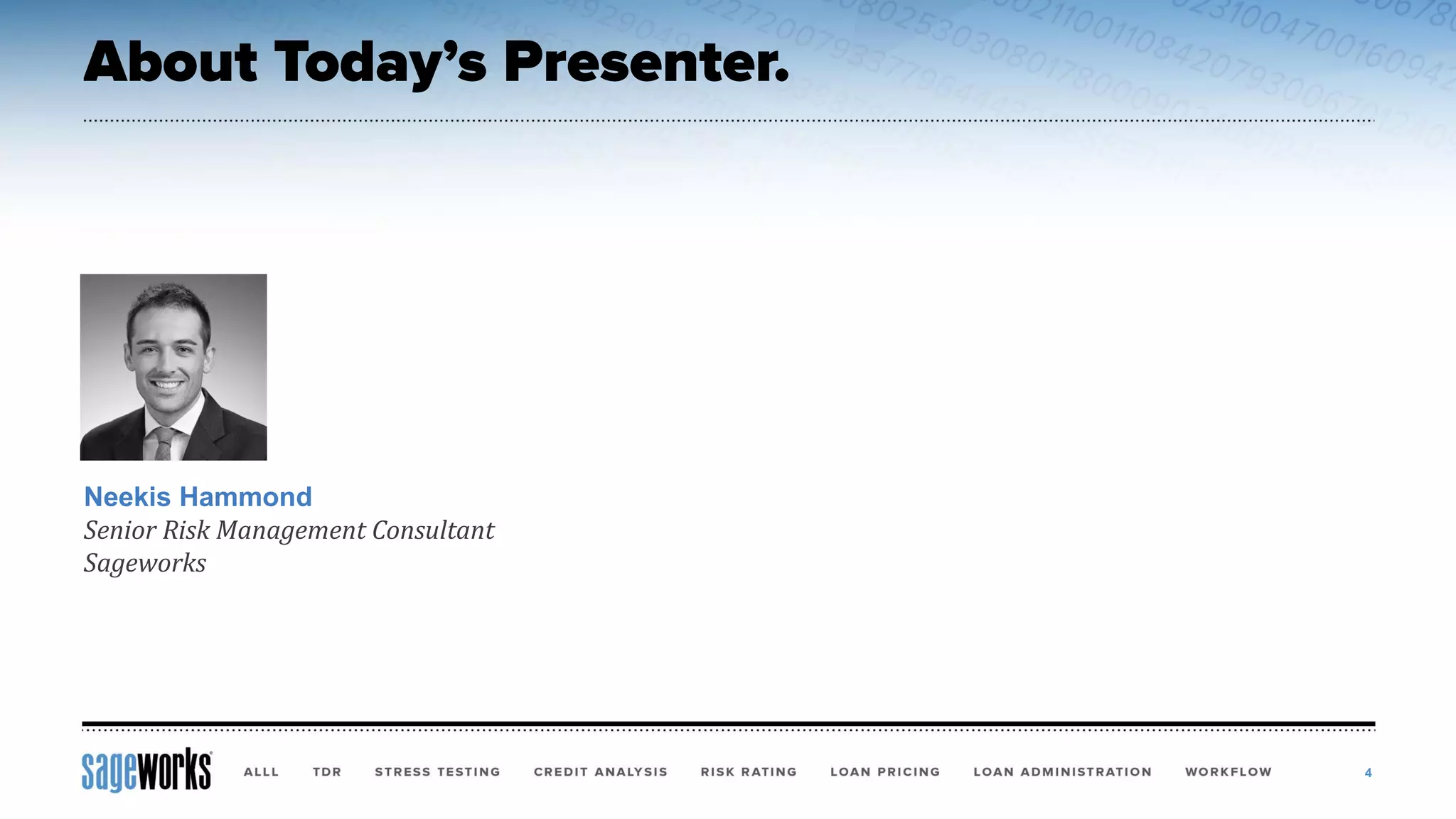
Neekis Hammond
Senior Risk Management Consultant
Sageworks
P R E S E N T E D B Y
2
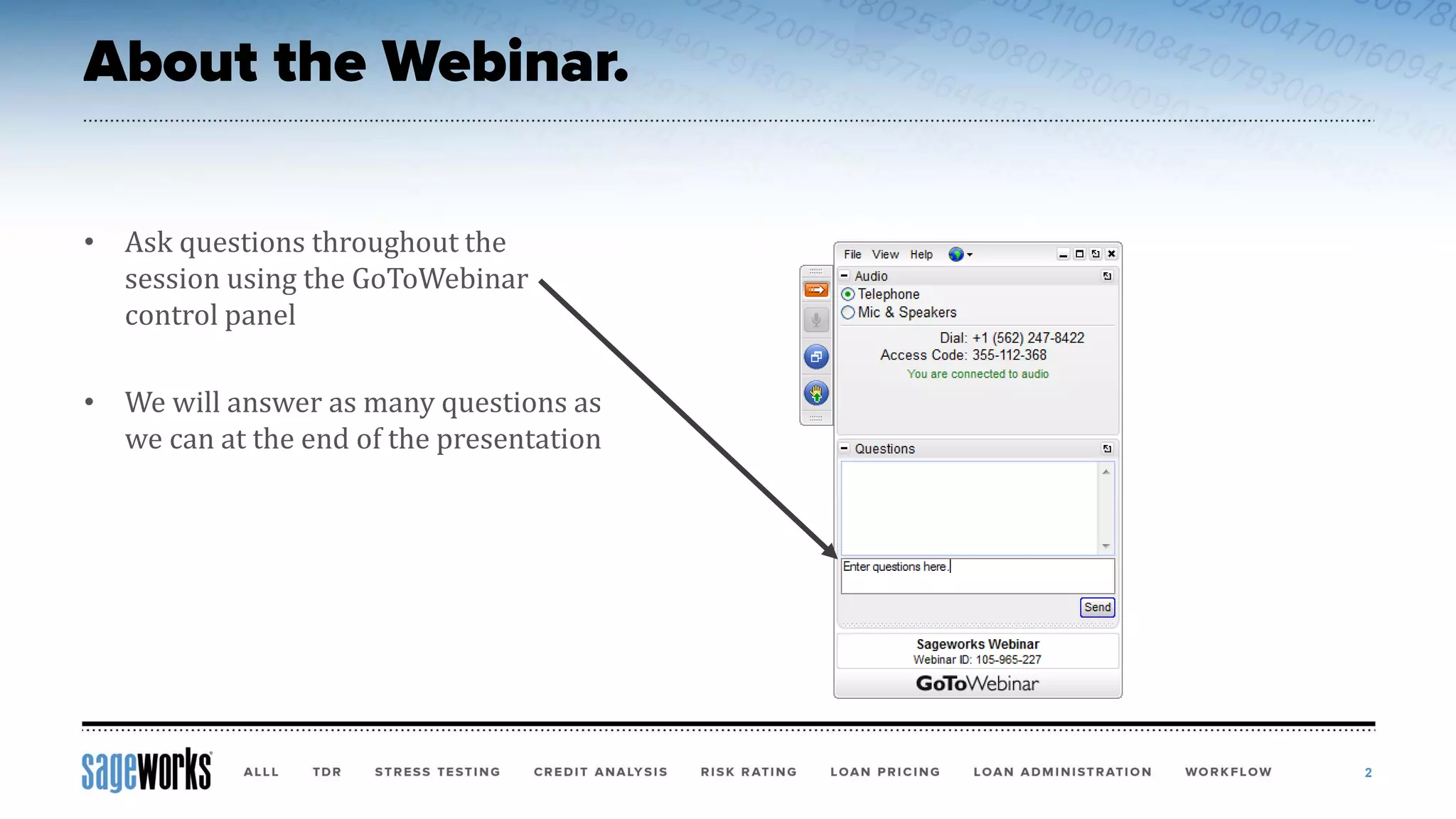
• Ask questions throughout the
session using the GoToWebinar
control panel
• We will answer as many questions as
we can at the end of the presentation
3
• Risk management thought leader
for institutions and examiners
• Regularly featured in national and
trade media
• Loan portfolio and risk
management solutions
• More than 1,000 financial
institution clients
• Founded in 1998
4
Neekis Hammond
Senior Risk Management Consultant
Sageworks
5
This presentation may include statements that constitute “forward-looking statements” relative to publicly available
industry data. Forward-looking statements often contain words such as “believe,” “expect,” “plans,” “project,” “target,”
“anticipate,” “will,” “should,” “see,” “guidance,” “confident” and similar terms. There can be no assurance that any of the future
events discussed will occur as anticipated, if at all, or that actual results on the industry will be as expected. Sageworks is not
responsible for the accuracy or validity of this publicly available industry data, or the outcome of the use of this data relative
to business or investment decisions made by the recipients of this data. Sageworks disclaims all representations and
warranties, express or implied. Risks and uncertainties include risks related to the effect of economic conditions and
financial market conditions; fluctuation in commodity prices, interest rates and foreign currency exchange rates. No
Sageworks employee is authorized to make recommendations or give advice as to any course of action that should be made
as an outcome of this data. The forward-looking statements and data speak only as of the date of this presentation and we
undertake no obligation to update or revise this information as of a later date.
Part 1: How financial institutions can maintain credit quality
» Why monitor quality during growth periods
» Who is responsible for credit quality?
» How each department can help maintain credit quality
Part 2: Measuring credit quality
» Tracking credit quality trends of the loan portfolio
» Drawing insights from credit quality reports
» Updating strategy based on data
6
9
10
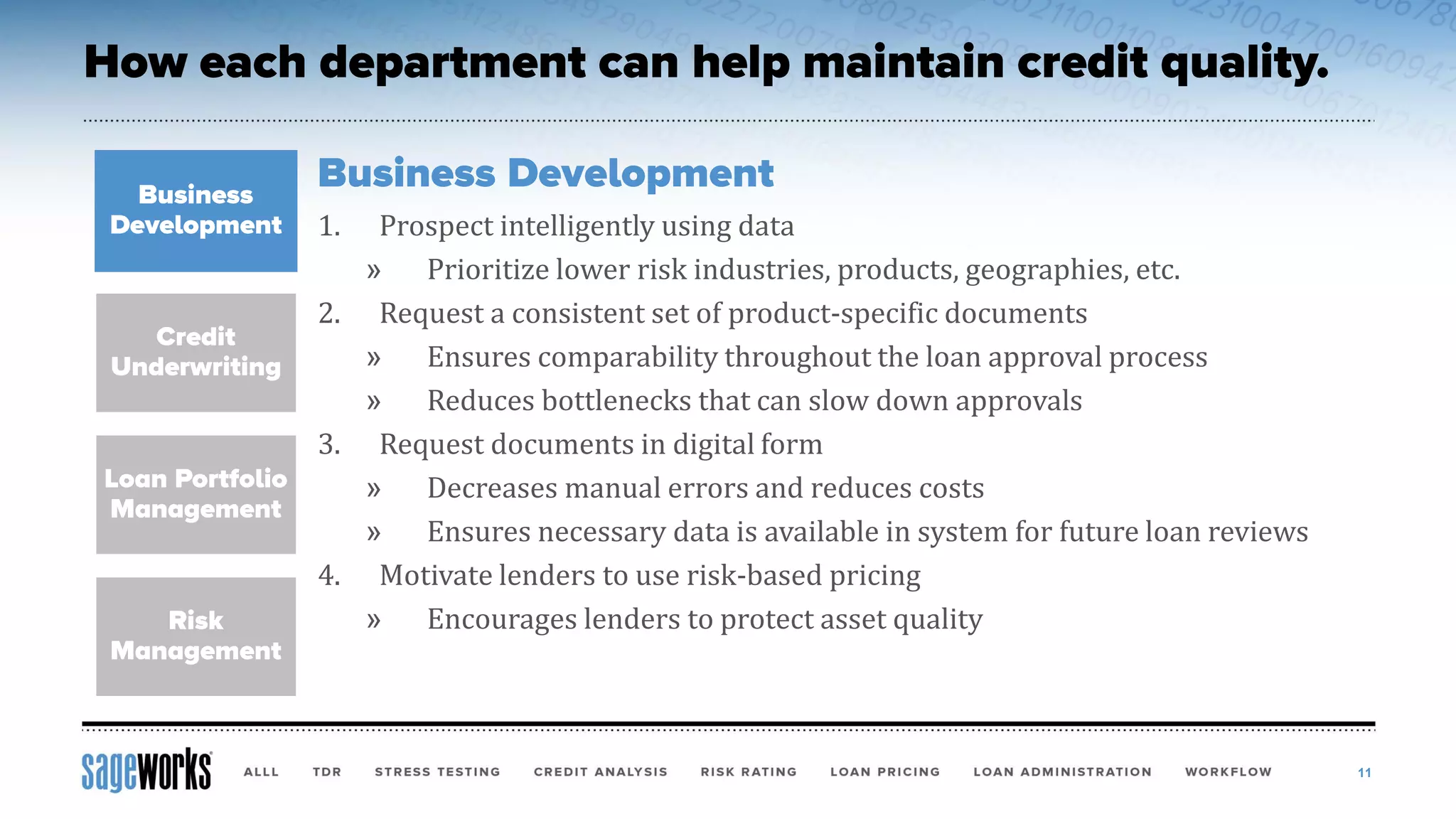
Goal is to reduce subjectivity and improve documentation in all departments
1. Prospect intelligently using data
» Prioritize lower risk industries, products, geographies, etc.
2. Request a consistent set of product-specific documents
» Ensures comparability throughout the loan approval process
» Reduces bottlenecks that can slow down approvals
3. Request documents in digital form
» Decreases manual errors and reduces costs
» Ensures necessary data is available in system for future loan reviews
4. Motivate lenders to use risk-based pricing
» Encourages lenders to protect asset quality
11
1. Require consistent spreading and cash flow analysis
» Consider using automated systems for analysis
» Avoids double-counting and reduces subjectivity
2. Standardize the risk rating process
» Directly impacts the allowance calculation
» Sets the stage for when and how loans will be reviewed
» Creates template-specific measures and thresholds for risk
3. Compare borrower to peer set
» Shows strengths and weaknesses of borrower ratios
12
1. Update and manage loan documents
» Provides leading indicator of future credit risk
» Automated system creates standard practices, improves efficiency and
reduces the likelihood of human error
2. Improve the stress testing process
» Excellent way to forecast issues that may impact your allowance as well
as your capital ratios
3. Use probability of default models to inform decisions
» Uses historical data and trends to inform underwriting and strategy
decisions
13
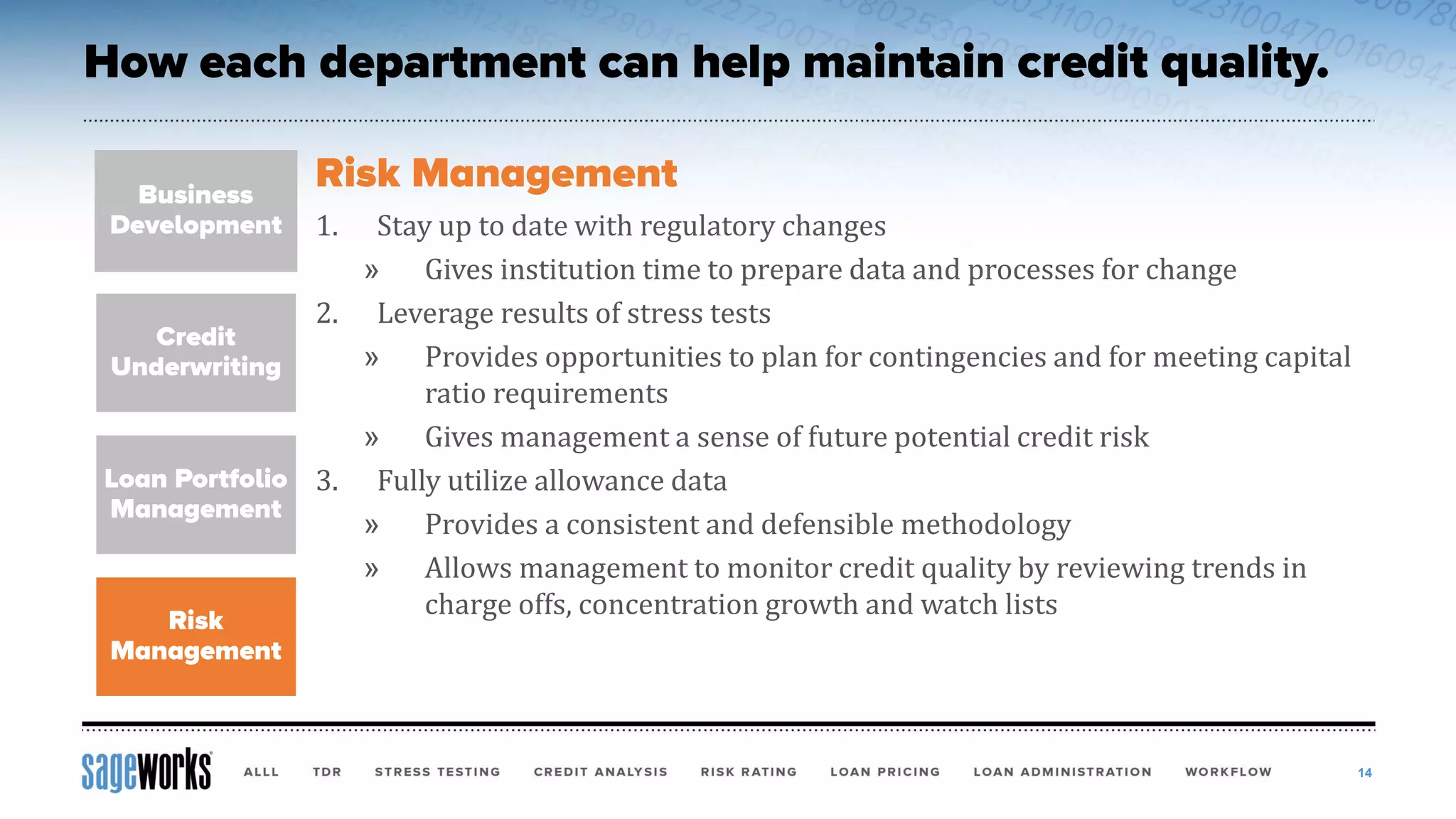
1. Stay up to date with regulatory changes
» Gives institution time to prepare data and processes for change
2. Leverage results of stress tests
» Provides opportunities to plan for contingencies and for meeting capital
ratio requirements
» Gives management a sense of future potential credit risk
3. Fully utilize allowance data
» Provides a consistent and defensible methodology
» Allows management to monitor credit quality by reviewing trends in
charge offs, concentration growth and watch lists
14
17
18
Review risk grade experience to ensure proper correlation with losses.
0.00% 0.00% 0.00% 0.18%
2.56%
1.36%
4.35%
7.31%
0.00%
0.00%
1.00%
2.00%
3.00%
4.00%
5.00%
6.00%
7.00%
8.00%
0 1 2 3 4 5 6 7 8
LossRate
Risk Rating
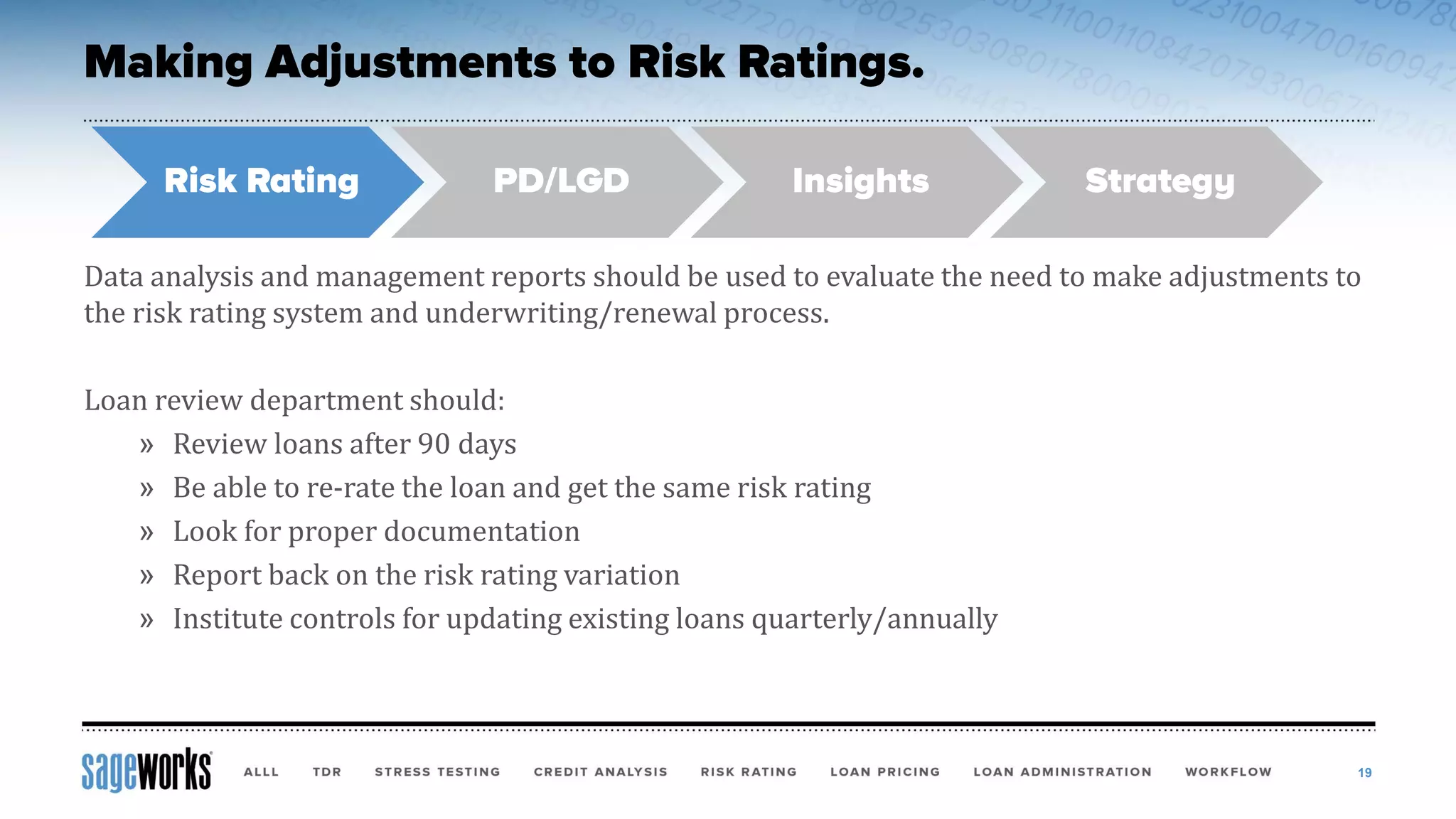
Data analysis and management reports should be used to evaluate the need to make adjustments to
the risk rating system and underwriting/renewal process.
Loan review department should:
» Review loans after 90 days
» Be able to re-rate the loan and get the same risk rating
» Look for proper documentation
» Report back on the risk rating variation
» Institute controls for updating existing loans quarterly/annually
19
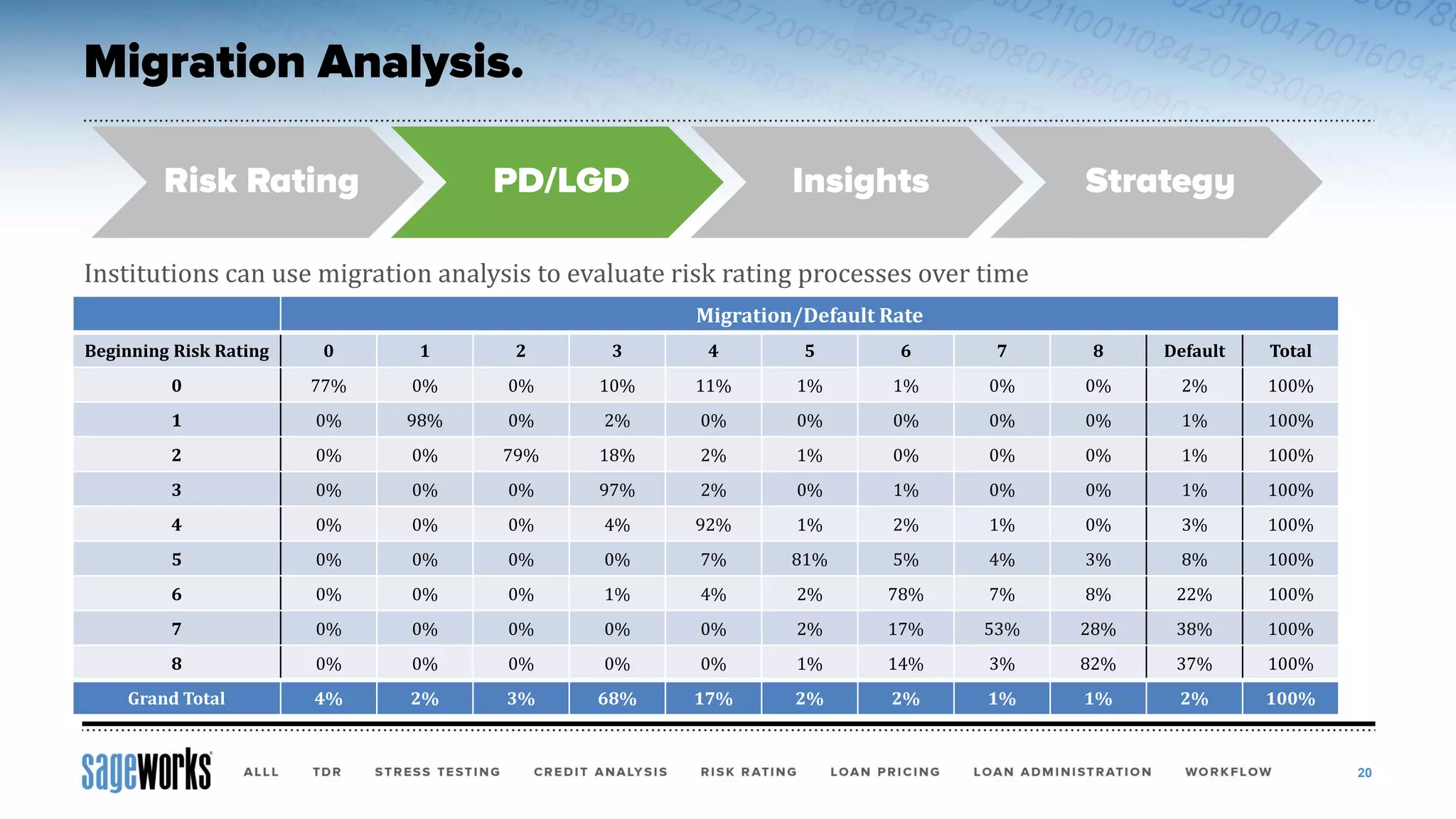
Institutions can use migration analysis to evaluate risk rating processes over time
20
Migration/Default Rate
Beginning Risk Rating 0 1 2 3 4 5 6 7 8 Default Total
0 77% 0% 0% 10% 11% 1% 1% 0% 0% 2% 100%
1 0% 98% 0% 2% 0% 0% 0% 0% 0% 1% 100%
2 0% 0% 79% 18% 2% 1% 0% 0% 0% 1% 100%
3 0% 0% 0% 97% 2% 0% 1% 0% 0% 1% 100%
4 0% 0% 0% 4% 92% 1% 2% 1% 0% 3% 100%
5 0% 0% 0% 0% 7% 81% 5% 4% 3% 8% 100%
6 0% 0% 0% 1% 4% 2% 78% 7% 8% 22% 100%
7 0% 0% 0% 0% 0% 2% 17% 53% 28% 38% 100%
8 0% 0% 0% 0% 0% 1% 14% 3% 82% 37% 100%
Grand Total 4% 2% 3% 68% 17% 2% 2% 1% 1% 2% 100%
Institutions can use Probability of Default to analyze risk rating performance over time.
21
Beginning Risk Rating
Note Type 0 1 2 3 4 5 6 7 8 Total
C & I 0% 1% 1% 5% 10% 23% 37% 57% 0% 4%
Construction 0% 0% 1% 4% 13% 28% 64% 37% 0% 6%
Multifamily 1% 0% 1% 2% 8% 18% 52% 27% 0% 1%
Non-Owner 0% 0% 5% 0% 1% 3% 19% 15% 0% 3%
Owner 0% 0% 0% 1% 3% 9% 17% 50% 0% 2%
Personal Credit Lines 0% 0% 2% 1% 5% 5% 15% 29% 0% 2%
Residential Real Estate 0% 0% 0% 2% 3% 26% 41% 38% 0% 1%
Total Default Rate 0% 1% 2% 4% 8% 22% 38% 36% 0% 2%
LGD adds impact to the equation and allows institutions to make strategic decisions about Probability of Default.
22
Note Type Net Charge Off Exposure at Default LGD
C & I 9,200,000 51,000,000 18%
Construction 3,500,000 7,500,000 47%
Multifamily 250,000 1,000,000 25%
Non-Owner 3,600,000 158,000,000 2%
Owner 1,100,000 10,000,000 11%
Personal Credit Lines 710,000 860,000 83%
Residential Real Estate 1,600,000 13,000,000 12%
Total 19,960,000 241,360,000 8%
Loss Rates combine PD and LGD to give an overall rate of loss for each risk rating and product.
23
Beginning Risk Rating
Note Type 0 1 2 3 4 5 6 7 8 Total LGD
C & I 0.0% 0.2% 0.2% 0.9% 1.8% 4.1% 6.7% 10.2% 0.0% 0.7% 18%
Construction 0.0% 0.0% 0.5% 1.9% 6.1% 13.2% 30.2% 17.5% 0.0% 2.8% 47%
Multifamily 0.0% 0.0% 0.0% 0.0% 0.2% 0.4% 1.2% 0.6% 0.0% 0.0% 2%
Non-Owner 0.0% 0.0% 1.2% 0.0% 0.2% 0.7% 4.4% 3.5% 0.0% 0.7% 23%
Owner 0.0% 0.0% 0.0% 0.1% 0.3% 1.0% 1.9% 5.5% 0.0% 0.2% 11%
Personal Credit Lines 0.0% 0.0% 1.6% 0.8% 4.1% 4.1% 12.4% 23.9% 0.0% 1.6% 82%
Residential Real Estate 0.0% 0.0% 0.0% 0.2% 0.4% 3.1% 4.9% 4.5% 0.0% 0.1% 12%
Total Default Rate 0.0% 0.2% 0.4% 0.8% 1.7% 4.6% 8.0% 7.6% 0.0% 0.4% 21%
Red Flags:
» Inconsistent loss curve when evaluating risk rating performance.
» Inconsistent default or loss characteristics within the same risk rating across business lines.
» Dramatic shifts in upgrades or downgrades.
» Lack or shifts in upgrades or downgrades.
24
Takeaways and Action Items:
» Evenly distributed loss curve provides for risk rating support and defensibility
» Consistent loss rates across products and risk ratings provides for institution utilization
» Risk ratings outperforming expectations may indicate growth and yield opportunities
» Products with positive migration movement may provide for customer retention initiatives
» Compare PD, LGD, Yield and WAM for pricing opportunities
25
Once your institution is comfortable with your risk rating system and PD/LGD reporting, you can
use this to make strategic decisions.
26
Strategies PD LGD WAM WAY Growth
Strategy 1
Strategy 2
Strategy 3
Over time, you should standardize your reporting into a consistent Portfolio Credit Quality Report
27
Note Type Balance WAY WAM PD LGD
C & I 150,000,000 5% 3 4% 18%
Construction 50,000,000 5% 2 6% 47%
Multifamily 50,000,000 4% 5 1% 25%
Non-Owner 200,000,000 4% 5 3% 2%
Owner 250,000,000 4% 6 2% 11%
Personal Credit Lines 100,000,000 6% 4 2% 83%
Residential Real Estate 200,000,000 4% 8 1% 12%
Total 1,000,000,000 4% 4 2% 8%
Run a peer analysis report to see how your institution compares to your peers
28
3.98%
3.73%3.00%
3.50%
4.00%
4.50%
5.00%
5.50%
6.00%
6.50%
Average of
12/31/2006
Yield on Earning
Assets
Average of
12/31/2007
Yield on Earning
Assets
Average of
12/31/2008
Yield on Earning
Assets
Average of
12/31/2009
Yield on Earning
Assets
Average of
12/31/2010
Yield on Earning
Assets
Average of
12/31/2011
Yield on Earning
Assets
Average of
12/31/2012
Yield on Earning
Assets
Average of
12/31/2013
Yield on Earning
Assets
Average of
12/31/2014
Yield on Earning
Assets
Average of
12/31/2015
Yield on Earning
Assets
Above Avg. C&I Below Avg. C&I
4.53%
2.21%
0.00%
1.00%
2.00%
3.00%
4.00%
5.00%
Average of 12/31/2011 Loan Growth
Rate
Average of 12/31/2012 Loan Growth
Rate
Average of 12/31/2013 Loan Growth
Rate
Average of 12/31/2014 Loan Growth
Rate
Average of 12/31/2015 Loan Growth
Rate
Above Avg. C&I Below Avg. C&I
0.65%
0.11%
0.32%
0.02%
0.00%
0.10%
0.20%
0.30%
0.40%
0.50%
0.60%
0.70%
Average of
12/31/2006 Net
Charge-Offs to
Loans
Average of
12/31/2007 Net
Charge-Offs to
Loans
Average of
12/31/2008 Net
Charge-Offs to
Loans
Average of
12/31/2009 Net
Charge-Offs to
Loans
Average of
12/31/2010 Net
Charge-Offs to
Loans
Average of
12/31/2011 Net
Charge-Offs to
Loans
Average of
12/31/2012 Net
Charge-Offs to
Loans
Average of
12/31/2013 Net
Charge-Offs to
Loans
Average of
12/31/2014 Net
Charge-Offs to
Loans
Average of
12/31/2015 Net
Charge-Offs to
Loans
Above Avg. C&I Below Avg. C&I
1.29%
0.82%
0.60%
0.80%
1.00%
1.20%
1.40%
1.60%
Average of
12/31/2006 Loss
Allowance to
Loans
Average of
12/31/2007 Loss
Allowance to
Loans
Average of
12/31/2008 Loss
Allowance to
Loans
Average of
12/31/2009 Loss
Allowance to
Loans
Average of
12/31/2010 Loss
Allowance to
Loans
Average of
12/31/2011 Loss
Allowance to
Loans
Average of
12/31/2012 Loss
Allowance to
Loans
Average of
12/31/2013 Loss
Allowance to
Loans
Average of
12/31/2014 Loss
Allowance to
Loans
Average of
12/31/2015 Loss
Allowance to
Loans
Above Avg. C&I Below Avg. C&I
29
Neekis Hammond
Senior Risk Management Consultant
neekis.hammond@sageworks.com
SAGEWORKS LENDING SOLUTIONS
 Eliminate data entry with the Electronic Tax Return Reader, core integrations &
credit bureau debt
 Integrated platform for the customer lifecycle
 Exclusive benchmarks & risk models to support decision-making
 Thought leader to help you navigate changing regulatory landscape
 Responsive service & support from product experts
 Insight into the best practices & templates used at 1,000+ financial institutions
30
• Sageworksanalyst.com – Learn about Sageworks’ risk management suite
» Sageworks Credit Analysis
» Sageworks Loan Pricing
» Sageworks ALLL
• Bank Information – Customized bank analysis and targeting intelligence tool
• Interested in talking with a specialist?
» Email us now: sales@sageworks.com

Maintaining Credit Quality in Banks and Credit Unions

  • 1.
    Neekis Hammond Senior RiskManagement Consultant Sageworks P R E S E N T E D B Y
  • 2.
    2 • Ask questionsthroughout the session using the GoToWebinar control panel • We will answer as many questions as we can at the end of the presentation
  • 3.
    3 • Risk managementthought leader for institutions and examiners • Regularly featured in national and trade media • Loan portfolio and risk management solutions • More than 1,000 financial institution clients • Founded in 1998
  • 4.
    4 Neekis Hammond Senior RiskManagement Consultant Sageworks
  • 5.
    5 This presentation mayinclude statements that constitute “forward-looking statements” relative to publicly available industry data. Forward-looking statements often contain words such as “believe,” “expect,” “plans,” “project,” “target,” “anticipate,” “will,” “should,” “see,” “guidance,” “confident” and similar terms. There can be no assurance that any of the future events discussed will occur as anticipated, if at all, or that actual results on the industry will be as expected. Sageworks is not responsible for the accuracy or validity of this publicly available industry data, or the outcome of the use of this data relative to business or investment decisions made by the recipients of this data. Sageworks disclaims all representations and warranties, express or implied. Risks and uncertainties include risks related to the effect of economic conditions and financial market conditions; fluctuation in commodity prices, interest rates and foreign currency exchange rates. No Sageworks employee is authorized to make recommendations or give advice as to any course of action that should be made as an outcome of this data. The forward-looking statements and data speak only as of the date of this presentation and we undertake no obligation to update or revise this information as of a later date.
  • 6.
    Part 1: Howfinancial institutions can maintain credit quality » Why monitor quality during growth periods » Who is responsible for credit quality? » How each department can help maintain credit quality Part 2: Measuring credit quality » Tracking credit quality trends of the loan portfolio » Drawing insights from credit quality reports » Updating strategy based on data 6
  • 9.
  • 10.
    10 Goal is toreduce subjectivity and improve documentation in all departments
  • 11.
    1. Prospect intelligentlyusing data » Prioritize lower risk industries, products, geographies, etc. 2. Request a consistent set of product-specific documents » Ensures comparability throughout the loan approval process » Reduces bottlenecks that can slow down approvals 3. Request documents in digital form » Decreases manual errors and reduces costs » Ensures necessary data is available in system for future loan reviews 4. Motivate lenders to use risk-based pricing » Encourages lenders to protect asset quality 11
  • 12.
    1. Require consistentspreading and cash flow analysis » Consider using automated systems for analysis » Avoids double-counting and reduces subjectivity 2. Standardize the risk rating process » Directly impacts the allowance calculation » Sets the stage for when and how loans will be reviewed » Creates template-specific measures and thresholds for risk 3. Compare borrower to peer set » Shows strengths and weaknesses of borrower ratios 12
  • 13.
    1. Update andmanage loan documents » Provides leading indicator of future credit risk » Automated system creates standard practices, improves efficiency and reduces the likelihood of human error 2. Improve the stress testing process » Excellent way to forecast issues that may impact your allowance as well as your capital ratios 3. Use probability of default models to inform decisions » Uses historical data and trends to inform underwriting and strategy decisions 13
  • 14.
    1. Stay upto date with regulatory changes » Gives institution time to prepare data and processes for change 2. Leverage results of stress tests » Provides opportunities to plan for contingencies and for meeting capital ratio requirements » Gives management a sense of future potential credit risk 3. Fully utilize allowance data » Provides a consistent and defensible methodology » Allows management to monitor credit quality by reviewing trends in charge offs, concentration growth and watch lists 14
  • 17.
  • 18.
    18 Review risk gradeexperience to ensure proper correlation with losses. 0.00% 0.00% 0.00% 0.18% 2.56% 1.36% 4.35% 7.31% 0.00% 0.00% 1.00% 2.00% 3.00% 4.00% 5.00% 6.00% 7.00% 8.00% 0 1 2 3 4 5 6 7 8 LossRate Risk Rating
  • 19.
    Data analysis andmanagement reports should be used to evaluate the need to make adjustments to the risk rating system and underwriting/renewal process. Loan review department should: » Review loans after 90 days » Be able to re-rate the loan and get the same risk rating » Look for proper documentation » Report back on the risk rating variation » Institute controls for updating existing loans quarterly/annually 19
  • 20.
    Institutions can usemigration analysis to evaluate risk rating processes over time 20 Migration/Default Rate Beginning Risk Rating 0 1 2 3 4 5 6 7 8 Default Total 0 77% 0% 0% 10% 11% 1% 1% 0% 0% 2% 100% 1 0% 98% 0% 2% 0% 0% 0% 0% 0% 1% 100% 2 0% 0% 79% 18% 2% 1% 0% 0% 0% 1% 100% 3 0% 0% 0% 97% 2% 0% 1% 0% 0% 1% 100% 4 0% 0% 0% 4% 92% 1% 2% 1% 0% 3% 100% 5 0% 0% 0% 0% 7% 81% 5% 4% 3% 8% 100% 6 0% 0% 0% 1% 4% 2% 78% 7% 8% 22% 100% 7 0% 0% 0% 0% 0% 2% 17% 53% 28% 38% 100% 8 0% 0% 0% 0% 0% 1% 14% 3% 82% 37% 100% Grand Total 4% 2% 3% 68% 17% 2% 2% 1% 1% 2% 100%
  • 21.
    Institutions can useProbability of Default to analyze risk rating performance over time. 21 Beginning Risk Rating Note Type 0 1 2 3 4 5 6 7 8 Total C & I 0% 1% 1% 5% 10% 23% 37% 57% 0% 4% Construction 0% 0% 1% 4% 13% 28% 64% 37% 0% 6% Multifamily 1% 0% 1% 2% 8% 18% 52% 27% 0% 1% Non-Owner 0% 0% 5% 0% 1% 3% 19% 15% 0% 3% Owner 0% 0% 0% 1% 3% 9% 17% 50% 0% 2% Personal Credit Lines 0% 0% 2% 1% 5% 5% 15% 29% 0% 2% Residential Real Estate 0% 0% 0% 2% 3% 26% 41% 38% 0% 1% Total Default Rate 0% 1% 2% 4% 8% 22% 38% 36% 0% 2%
  • 22.
    LGD adds impactto the equation and allows institutions to make strategic decisions about Probability of Default. 22 Note Type Net Charge Off Exposure at Default LGD C & I 9,200,000 51,000,000 18% Construction 3,500,000 7,500,000 47% Multifamily 250,000 1,000,000 25% Non-Owner 3,600,000 158,000,000 2% Owner 1,100,000 10,000,000 11% Personal Credit Lines 710,000 860,000 83% Residential Real Estate 1,600,000 13,000,000 12% Total 19,960,000 241,360,000 8%
  • 23.
    Loss Rates combinePD and LGD to give an overall rate of loss for each risk rating and product. 23 Beginning Risk Rating Note Type 0 1 2 3 4 5 6 7 8 Total LGD C & I 0.0% 0.2% 0.2% 0.9% 1.8% 4.1% 6.7% 10.2% 0.0% 0.7% 18% Construction 0.0% 0.0% 0.5% 1.9% 6.1% 13.2% 30.2% 17.5% 0.0% 2.8% 47% Multifamily 0.0% 0.0% 0.0% 0.0% 0.2% 0.4% 1.2% 0.6% 0.0% 0.0% 2% Non-Owner 0.0% 0.0% 1.2% 0.0% 0.2% 0.7% 4.4% 3.5% 0.0% 0.7% 23% Owner 0.0% 0.0% 0.0% 0.1% 0.3% 1.0% 1.9% 5.5% 0.0% 0.2% 11% Personal Credit Lines 0.0% 0.0% 1.6% 0.8% 4.1% 4.1% 12.4% 23.9% 0.0% 1.6% 82% Residential Real Estate 0.0% 0.0% 0.0% 0.2% 0.4% 3.1% 4.9% 4.5% 0.0% 0.1% 12% Total Default Rate 0.0% 0.2% 0.4% 0.8% 1.7% 4.6% 8.0% 7.6% 0.0% 0.4% 21%
  • 24.
    Red Flags: » Inconsistentloss curve when evaluating risk rating performance. » Inconsistent default or loss characteristics within the same risk rating across business lines. » Dramatic shifts in upgrades or downgrades. » Lack or shifts in upgrades or downgrades. 24
  • 25.
    Takeaways and ActionItems: » Evenly distributed loss curve provides for risk rating support and defensibility » Consistent loss rates across products and risk ratings provides for institution utilization » Risk ratings outperforming expectations may indicate growth and yield opportunities » Products with positive migration movement may provide for customer retention initiatives » Compare PD, LGD, Yield and WAM for pricing opportunities 25
  • 26.
    Once your institutionis comfortable with your risk rating system and PD/LGD reporting, you can use this to make strategic decisions. 26 Strategies PD LGD WAM WAY Growth Strategy 1 Strategy 2 Strategy 3
  • 27.
    Over time, youshould standardize your reporting into a consistent Portfolio Credit Quality Report 27 Note Type Balance WAY WAM PD LGD C & I 150,000,000 5% 3 4% 18% Construction 50,000,000 5% 2 6% 47% Multifamily 50,000,000 4% 5 1% 25% Non-Owner 200,000,000 4% 5 3% 2% Owner 250,000,000 4% 6 2% 11% Personal Credit Lines 100,000,000 6% 4 2% 83% Residential Real Estate 200,000,000 4% 8 1% 12% Total 1,000,000,000 4% 4 2% 8%
  • 28.
    Run a peeranalysis report to see how your institution compares to your peers 28 3.98% 3.73%3.00% 3.50% 4.00% 4.50% 5.00% 5.50% 6.00% 6.50% Average of 12/31/2006 Yield on Earning Assets Average of 12/31/2007 Yield on Earning Assets Average of 12/31/2008 Yield on Earning Assets Average of 12/31/2009 Yield on Earning Assets Average of 12/31/2010 Yield on Earning Assets Average of 12/31/2011 Yield on Earning Assets Average of 12/31/2012 Yield on Earning Assets Average of 12/31/2013 Yield on Earning Assets Average of 12/31/2014 Yield on Earning Assets Average of 12/31/2015 Yield on Earning Assets Above Avg. C&I Below Avg. C&I 4.53% 2.21% 0.00% 1.00% 2.00% 3.00% 4.00% 5.00% Average of 12/31/2011 Loan Growth Rate Average of 12/31/2012 Loan Growth Rate Average of 12/31/2013 Loan Growth Rate Average of 12/31/2014 Loan Growth Rate Average of 12/31/2015 Loan Growth Rate Above Avg. C&I Below Avg. C&I 0.65% 0.11% 0.32% 0.02% 0.00% 0.10% 0.20% 0.30% 0.40% 0.50% 0.60% 0.70% Average of 12/31/2006 Net Charge-Offs to Loans Average of 12/31/2007 Net Charge-Offs to Loans Average of 12/31/2008 Net Charge-Offs to Loans Average of 12/31/2009 Net Charge-Offs to Loans Average of 12/31/2010 Net Charge-Offs to Loans Average of 12/31/2011 Net Charge-Offs to Loans Average of 12/31/2012 Net Charge-Offs to Loans Average of 12/31/2013 Net Charge-Offs to Loans Average of 12/31/2014 Net Charge-Offs to Loans Average of 12/31/2015 Net Charge-Offs to Loans Above Avg. C&I Below Avg. C&I 1.29% 0.82% 0.60% 0.80% 1.00% 1.20% 1.40% 1.60% Average of 12/31/2006 Loss Allowance to Loans Average of 12/31/2007 Loss Allowance to Loans Average of 12/31/2008 Loss Allowance to Loans Average of 12/31/2009 Loss Allowance to Loans Average of 12/31/2010 Loss Allowance to Loans Average of 12/31/2011 Loss Allowance to Loans Average of 12/31/2012 Loss Allowance to Loans Average of 12/31/2013 Loss Allowance to Loans Average of 12/31/2014 Loss Allowance to Loans Average of 12/31/2015 Loss Allowance to Loans Above Avg. C&I Below Avg. C&I
  • 29.
    29 Neekis Hammond Senior RiskManagement Consultant neekis.hammond@sageworks.com SAGEWORKS LENDING SOLUTIONS  Eliminate data entry with the Electronic Tax Return Reader, core integrations & credit bureau debt  Integrated platform for the customer lifecycle  Exclusive benchmarks & risk models to support decision-making  Thought leader to help you navigate changing regulatory landscape  Responsive service & support from product experts  Insight into the best practices & templates used at 1,000+ financial institutions
  • 30.
    30 • Sageworksanalyst.com –Learn about Sageworks’ risk management suite » Sageworks Credit Analysis » Sageworks Loan Pricing » Sageworks ALLL • Bank Information – Customized bank analysis and targeting intelligence tool • Interested in talking with a specialist? » Email us now: sales@sageworks.com