



CAPITAL ADEQUACY
SEM 3 TM
Minimum Capital
• Should be enough to absorb maximum losses
Capital for Credit Risk
• Standardised Approach
• IRB Foundation Approach
• IRB Advanced Approach
Capital for Operational risk
• Basic Indicator Approach
• Standardised Approach
• Advanced Measurement Approach
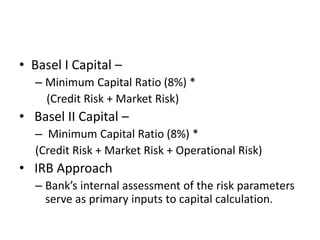
• Basel I Capital –
– Minimum Capital Ratio (8%) *
(Credit Risk + Market Risk)
• Basel II Capital –
– Minimum Capital Ratio (8%) *
(Credit Risk + Market Risk + Operational Risk)
• IRB Approach
– Bank’s internal assessment of the risk parameters
serve as primary inputs to capital calculation.
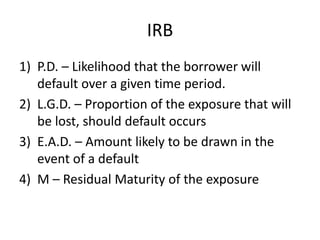
IRB
1) P.D. – Likelihood that the borrower will
default over a given time period.
2) L.G.D. – Proportion of the exposure that will
be lost, should default occurs
3) E.A.D. – Amount likely to be drawn in the
event of a default
4) M – Residual Maturity of the exposure
• Operational Risk – BIA – 15% of average gross
income over three years
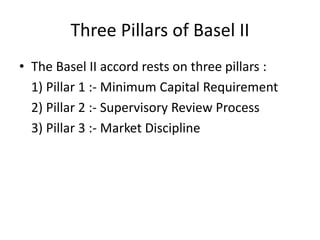
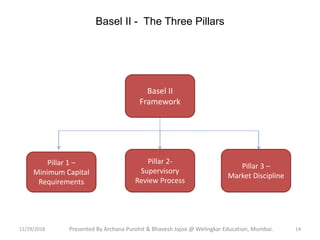
Three Pillars of Basel II
• The Basel II accord rests on three pillars :
1) Pillar 1 :- Minimum Capital Requirement
2) Pillar 2 :- Supervisory Review Process
3) Pillar 3 :- Market Discipline
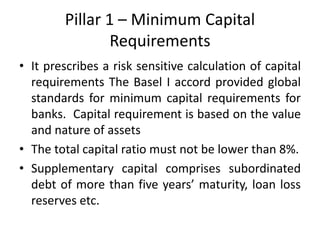
Pillar 1 – Minimum Capital
Requirements
• It prescribes a risk sensitive calculation of capital
requirements The Basel I accord provided global
standards for minimum capital requirements for
banks. Capital requirement is based on the value
and nature of assets
• The total capital ratio must not be lower than 8%.
• Supplementary capital comprises subordinated
debt of more than five years’ maturity, loan loss
reserves etc.
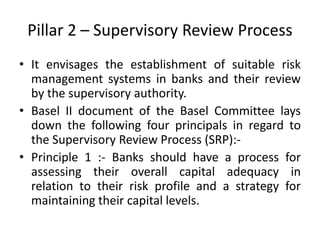
Pillar 2 – Supervisory Review Process
• It envisages the establishment of suitable risk
management systems in banks and their review
by the supervisory authority.
• Basel II document of the Basel Committee lays
down the following four principals in regard to
the Supervisory Review Process (SRP):-
• Principle 1 :- Banks should have a process for
assessing their overall capital adequacy in
relation to their risk profile and a strategy for
maintaining their capital levels.
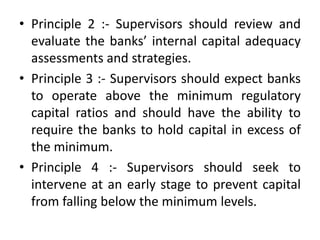
• Principle 2 :- Supervisors should review and
evaluate the banks’ internal capital adequacy
assessments and strategies.
• Principle 3 :- Supervisors should expect banks
to operate above the minimum regulatory
capital ratios and should have the ability to
require the banks to hold capital in excess of
the minimum.
• Principle 4 :- Supervisors should seek to
intervene at an early stage to prevent capital
from falling below the minimum levels.
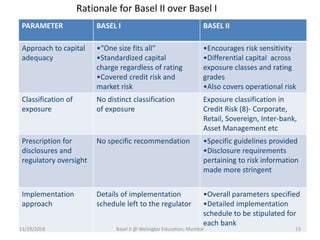
PARAMETER BASEL I BASEL II
Approach to capital
adequacy
•“One size fits all”
•Standardized capital
charge regardless of rating
•Covered credit risk and
market risk
•Encourages risk sensitivity
•Differential capital across
exposure classes and rating
grades
•Also covers operational risk
Classification of
exposure
No distinct classification
of exposure
Exposure classification in
Credit Risk (8)- Corporate,
Retail, Sovereign, Inter-bank,
Asset Management etc
Prescription for
disclosures and
regulatory oversight
No specific recommendation •Specific guidelines provided
•Disclosure requirements
pertaining to risk information
made more stringent
Implementation
approach
Details of implementation
schedule left to the regulator
•Overall parameters specified
•Detailed implementation
schedule to be stipulated for
each bank
Rationale for Basel II over Basel I
11/29/2018 13Basel II @ Welingkar Education, Mumbai
Basel II - The Three Pillars
Basel II
Framework
Pillar 3 –
Market Discipline
Pillar 2-
Supervisory
Review Process
Pillar 1 –
Minimum Capital
Requirements
11/29/2018 14Presented By Archana Purohit & Bhavesh Jajoo @ Welingkar Education, Mumbai.
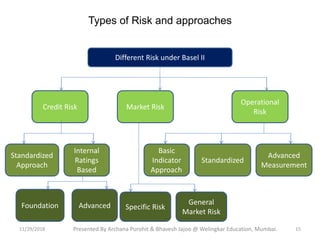
Types of Risk and approaches
Different Risk under Basel II
Internal
Ratings
Based
Credit Risk Market Risk
Standardized
Approach
Basic
Indicator
Approach
Standardized
Specific Risk
General
Market Risk
AdvancedFoundation
Advanced
Measurement
11/29/2018 15
Operational
Risk
Presented By Archana Purohit & Bhavesh Jajoo @ Welingkar Education, Mumbai.
Other Risks…
• Business Strategy Risk
• Environment Risk
• Group Risk
• Control Risk
• Liquidity Risk
• Reputation Risk
11/29/2018 16Presented By Archana Purohit & Bhavesh Jajoo @ Welingkar Education, Mumbai.
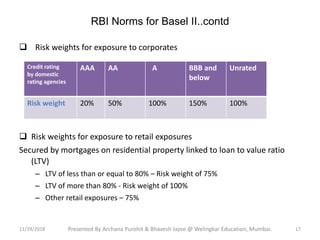
RBI Norms for Basel II..contd
 Risk weights for exposure to corporates
 Risk weights for exposure to retail exposures
Secured by mortgages on residential property linked to loan to value ratio
(LTV)
– LTV of less than or equal to 80% – Risk weight of 75%
– LTV of more than 80% - Risk weight of 100%
– Other retail exposures – 75%
Credit rating
by domestic
rating agencies
AAA AA A BBB and
below
Unrated
Risk weight 20% 50% 100% 150% 100%
11/29/2018 17Presented By Archana Purohit & Bhavesh Jajoo @ Welingkar Education, Mumbai.
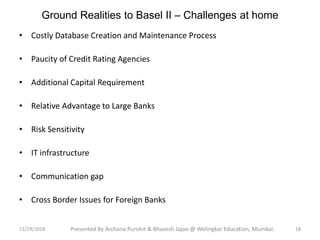
Ground Realities to Basel II – Challenges at home
• Costly Database Creation and Maintenance Process
• Paucity of Credit Rating Agencies
• Additional Capital Requirement
• Relative Advantage to Large Banks
• Risk Sensitivity
• IT infrastructure
• Communication gap
• Cross Border Issues for Foreign Banks
11/29/2018 18Presented By Archana Purohit & Bhavesh Jajoo @ Welingkar Education, Mumbai.
• ICAAP ( Internal Capital Adequacy Assessment
Process) and SREP (Supervisory Review and
Evaluation Process) are the two important
components of Pillar 2.
• The ICAAP comprises a bank’s procedure and
measures designed to ensure the following :-
(a) An appropriate identification and
measurement of risks.
(b) An appropriate level of internal capital in
relation to the bank’s risk profile.
(c) Application and further development of
suitable risk management systems in the
bank.
• The SREP consists of :
– a review and evaluation process adopted by the
supervisor.
– These include the review and evaluation of the
bank’s ICAAP, conducting an independent
assessment of the bank’s risk profile.
ICAAP To Be A Forward-Looking
Process
• The ICAAP should be forward looking in nature.
• It should take into account the expected /
estimated future developments.
• The banks shall have an explicit, board approved
capital plan. The plan shall outline :
- the bank’s capital needs
- the bank’s anticipated capital utilization
- the bank’s desired level of capital
- limits related to capital
- a general contingency plan for dealing with
divergences and unexpected events.
ICAAP To Be A Risk-Based Process
• Banks shall set their capital targets, which are
consistent with their risk profile and operating
environment.
• A Bank shall have in place a sound ICAAP,
which shall include all material risk exposures
incurred by the bank.
Pillar 3 – Market Discipline
• It seeks to achieve increased transparency
through expanded disclosure requirements for
banks.
• Market Discipline is to compliment the Pillar 1
and Pillar 2.
• It provides disclosure requirements for banks
using Basel-II framework.
Qualitative & Quantitative Disclosures
1. Scope of application
2. Capital structure
3. Capital adequacy
4. Credit Risk – general disclosures
5. Credit Risk – disclosures for portfolios, under
standardized approach
6. Credit Risk – disclosures for portfolios, under
IRB approaches
Constituents Of Capital
• Tier I Capital
• Tier II Capital
• Tier III Capital
Tier I Capital
• Consists of superior quality instruments and is
the mainstay of the capital of a bank.
• Innovative instruments like perpetual debt can
also form a part of Tier I capital.
Tier I Capital - Constituents
• Permanent shareholders’ equity (paid up
capital)
• Statutory reserves and Disclosed free Reserves
• Innovative Tier I capital
Tier II Capital
• Consists of revaluation reserves, general
reserves, hybrid debt capital and subordinated
term debt and investment reserve.
Tier II Capital - Constituents
• Revaluation Reserves
• General Provisions / general loan-loss
Reserves
• Hybrid debt capital instruments
• Subordinated debt
Tier II Capital - Constituents
• Revaluation Reserves
• General Provisions / general loan-loss
Reserves
• Hybrid debt capital instruments
• Subordinated debt
Treatment of Market Risks
• The capital requirements for market risk are
subdivided into following two subcomponents of
market risk:-
Specific Risk – defined as the risk of loss caused
by an adverse price movement of a security due
principally to factors related to the issuer of the
security. It includes the risk that an individual
debt or equity security moves by more or less
than the general market in day-to-day trading and
event risk. It exists for both long and short
positions, as it is essentially price risk.
• General Market risk – defined as the risk of
loss caused by an adverse market movement
unrelated to any specific security or issuer.
Both general market and specific risks cause
changes in the market price of an instruments.
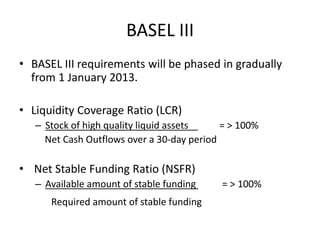
BASEL III
• BASEL III requirements will be phased in gradually
from 1 January 2013.
• Liquidity Coverage Ratio (LCR)
– Stock of high quality liquid assets = > 100%
Net Cash Outflows over a 30-day period
• Net Stable Funding Ratio (NSFR)
– Available amount of stable funding = > 100%
Required amount of stable funding
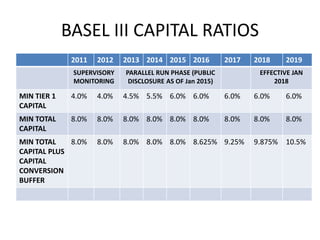
BASEL III CAPITAL RATIOS
2011 2012 2013 2014 2015 2016 2017 2018 2019
SUPERVISORY
MONITORING
PARALLEL RUN PHASE (PUBLIC
DISCLOSURE AS OF Jan 2015)
EFFECTIVE JAN
2018
MIN TIER 1
CAPITAL
4.0% 4.0% 4.5% 5.5% 6.0% 6.0% 6.0% 6.0% 6.0%
MIN TOTAL
CAPITAL
8.0% 8.0% 8.0% 8.0% 8.0% 8.0% 8.0% 8.0% 8.0%
MIN TOTAL
CAPITAL PLUS
CAPITAL
CONVERSION
BUFFER
8.0% 8.0% 8.0% 8.0% 8.0% 8.625% 9.25% 9.875% 10.5%
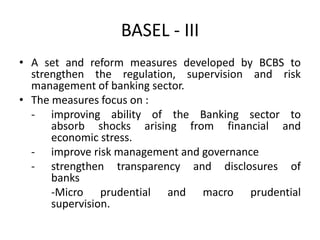
BASEL - III
• A set and reform measures developed by BCBS to
strengthen the regulation, supervision and risk
management of banking sector.
• The measures focus on :
- improving ability of the Banking sector to
absorb shocks arising from financial and
economic stress.
- improve risk management and governance
- strengthen transparency and disclosures of
banks
-Micro prudential and macro prudential
supervision.
BASEL - III
• Seeks to address four key aspects identified as
the main cause of global crisis.
- Quality and composition of capital
(Enhancing Tier I capital requirement and
introduction of capital buffers, strict
definition of capital).
- Liquidity crunch due to borrowing short and
lending long (Introduction of ratios to stress
testing of a financial institutions ability to
withstand liquidity pressures).
BASEL - III
• Balance sheet leveraging (Introduction of
Leverage ratios to improve balance sheet
structure).
• Inconsistencies in Accounting and valuation
practices (Computation of capital charges
based on covered international accounting
standards).
Reverse Repo Rate
• Definition of 'Reverse Repo Rate'
•
Definition: Reverse repo rate is the rate at which the
central bank of a country (Reserve Bank of India in case of
India) borrows money from commercial banks within the
country. It is a monetary policy instrument which can be
used to control the money supply in the country.
Description: An increase in the reverse repo rate will
decrease the money supply and vice-versa, other things
remaining constant. An increase in reverse repo rate means
that commercial banks will get more incentives to park
their funds with the RBI, thereby decreasing the supply of
money in the market.
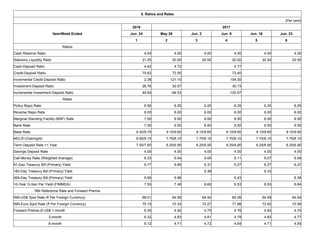
5. Ratios and Rates
(Per cent)
Item/Week Ended
2016 2017
Jun. 24 May 26 Jun. 2 Jun. 9 Jun. 16 Jun. 23
1 2 3 4 5 6
Ratios
Cash Reserve Ratio 4.00 4.00 4.00 4.00 4.00 4.00
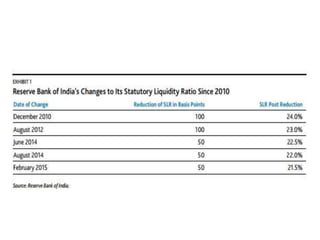
Statutory Liquidity Ratio 21.25 20.50 20.50 20.50 20.50 20.50
Cash-Deposit Ratio 4.82 4.72 .. 4.77 .. ..
Credit-Deposit Ratio 75.62 72.00 .. 72.40 .. ..
Incremental Credit-Deposit Ratio 2.36 121.10 .. 104.30 .. ..
Investment-Deposit Ratio 28.76 30.57 .. 30.73 .. ..
Incremental Investment-Deposit Ratio 49.93 -94.53 .. -120.57 .. ..
Rates
Policy Repo Rate 6.50 6.25 6.25 6.25 6.25 6.25
Reverse Repo Rate 6.00 6.00 6.00 6.00 6.00 6.00
Marginal Standing Facility (MSF) Rate 7.00 6.50 6.50 6.50 6.50 6.50
Bank Rate 7.00 6.50 6.50 6.50 6.50 6.50
Base Rate 9.30/9.70 9.10/9.60 9.10/9.60 9.10/9.60 9.10/9.60 9.10/9.60
MCLR (Overnight) 8.90/9.15 7.75/8.10 7.75/8.10 7.75/8.10 7.75/8.10 7.75/8.10
Term Deposit Rate >1 Year 7.00/7.60 6.25/6.90 6.25/6.90 6.25/6.90 6.25/6.90 6.25/6.90
Savings Deposit Rate 4.00 4.00 4.00 4.00 4.00 4.00
Call Money Rate (Weighted Average) 6.33 6.04 6.05 6.11 6.07 6.08
91-Day Treasury Bill (Primary) Yield 6.77 6.85 6.31 6.27 6.27 6.27
182-Day Treasury Bill (Primary) Yield .. .. 6.39 .. 6.33 ..
364-Day Treasury Bill (Primary) Yield 6.90 6.96 .. 6.43 .. 6.38
10-Year G-Sec Par Yield (FIMMDA) 7.55 7.49 6.65 6.53 6.53 6.64
RBI Reference Rate and Forward Premia
INR-US$ Spot Rate (₹ Per Foreign Currency) 68.01 64.59 64.42 64.26 64.59 64.54
INR-Euro Spot Rate (₹ Per Foreign Currency) 75.10 72.33 72.27 71.98 72.05 72.08
Forward Premia of US$ 1-month 6.35 4.92 4.75 4.76 4.83 4.74
3-month 6.32 4.83 4.81 4.79 4.83 4.77
6-month 6.12 4.71 4.72 4.64 4.71 4.65

Capital adequacy (final)

  • 1.
  • 3.
    Minimum Capital • Shouldbe enough to absorb maximum losses
  • 4.
    Capital for CreditRisk • Standardised Approach • IRB Foundation Approach • IRB Advanced Approach
  • 5.
    Capital for Operationalrisk • Basic Indicator Approach • Standardised Approach • Advanced Measurement Approach
  • 6.
    • Basel ICapital – – Minimum Capital Ratio (8%) * (Credit Risk + Market Risk) • Basel II Capital – – Minimum Capital Ratio (8%) * (Credit Risk + Market Risk + Operational Risk) • IRB Approach – Bank’s internal assessment of the risk parameters serve as primary inputs to capital calculation.
  • 7.
    IRB 1) P.D. –Likelihood that the borrower will default over a given time period. 2) L.G.D. – Proportion of the exposure that will be lost, should default occurs 3) E.A.D. – Amount likely to be drawn in the event of a default 4) M – Residual Maturity of the exposure
  • 8.
    • Operational Risk– BIA – 15% of average gross income over three years
  • 9.
    Three Pillars ofBasel II • The Basel II accord rests on three pillars : 1) Pillar 1 :- Minimum Capital Requirement 2) Pillar 2 :- Supervisory Review Process 3) Pillar 3 :- Market Discipline
  • 10.
    Pillar 1 –Minimum Capital Requirements • It prescribes a risk sensitive calculation of capital requirements The Basel I accord provided global standards for minimum capital requirements for banks. Capital requirement is based on the value and nature of assets • The total capital ratio must not be lower than 8%. • Supplementary capital comprises subordinated debt of more than five years’ maturity, loan loss reserves etc.
  • 11.
    Pillar 2 –Supervisory Review Process • It envisages the establishment of suitable risk management systems in banks and their review by the supervisory authority. • Basel II document of the Basel Committee lays down the following four principals in regard to the Supervisory Review Process (SRP):- • Principle 1 :- Banks should have a process for assessing their overall capital adequacy in relation to their risk profile and a strategy for maintaining their capital levels.
  • 12.
    • Principle 2:- Supervisors should review and evaluate the banks’ internal capital adequacy assessments and strategies. • Principle 3 :- Supervisors should expect banks to operate above the minimum regulatory capital ratios and should have the ability to require the banks to hold capital in excess of the minimum. • Principle 4 :- Supervisors should seek to intervene at an early stage to prevent capital from falling below the minimum levels.
  • 13.
    PARAMETER BASEL IBASEL II Approach to capital adequacy •“One size fits all” •Standardized capital charge regardless of rating •Covered credit risk and market risk •Encourages risk sensitivity •Differential capital across exposure classes and rating grades •Also covers operational risk Classification of exposure No distinct classification of exposure Exposure classification in Credit Risk (8)- Corporate, Retail, Sovereign, Inter-bank, Asset Management etc Prescription for disclosures and regulatory oversight No specific recommendation •Specific guidelines provided •Disclosure requirements pertaining to risk information made more stringent Implementation approach Details of implementation schedule left to the regulator •Overall parameters specified •Detailed implementation schedule to be stipulated for each bank Rationale for Basel II over Basel I 11/29/2018 13Basel II @ Welingkar Education, Mumbai
  • 14.
    Basel II -The Three Pillars Basel II Framework Pillar 3 – Market Discipline Pillar 2- Supervisory Review Process Pillar 1 – Minimum Capital Requirements 11/29/2018 14Presented By Archana Purohit & Bhavesh Jajoo @ Welingkar Education, Mumbai.
  • 15.
    Types of Riskand approaches Different Risk under Basel II Internal Ratings Based Credit Risk Market Risk Standardized Approach Basic Indicator Approach Standardized Specific Risk General Market Risk AdvancedFoundation Advanced Measurement 11/29/2018 15 Operational Risk Presented By Archana Purohit & Bhavesh Jajoo @ Welingkar Education, Mumbai.
  • 16.
    Other Risks… • BusinessStrategy Risk • Environment Risk • Group Risk • Control Risk • Liquidity Risk • Reputation Risk 11/29/2018 16Presented By Archana Purohit & Bhavesh Jajoo @ Welingkar Education, Mumbai.
  • 17.
    RBI Norms forBasel II..contd  Risk weights for exposure to corporates  Risk weights for exposure to retail exposures Secured by mortgages on residential property linked to loan to value ratio (LTV) – LTV of less than or equal to 80% – Risk weight of 75% – LTV of more than 80% - Risk weight of 100% – Other retail exposures – 75% Credit rating by domestic rating agencies AAA AA A BBB and below Unrated Risk weight 20% 50% 100% 150% 100% 11/29/2018 17Presented By Archana Purohit & Bhavesh Jajoo @ Welingkar Education, Mumbai.
  • 18.
    Ground Realities toBasel II – Challenges at home • Costly Database Creation and Maintenance Process • Paucity of Credit Rating Agencies • Additional Capital Requirement • Relative Advantage to Large Banks • Risk Sensitivity • IT infrastructure • Communication gap • Cross Border Issues for Foreign Banks 11/29/2018 18Presented By Archana Purohit & Bhavesh Jajoo @ Welingkar Education, Mumbai.
  • 19.
    • ICAAP (Internal Capital Adequacy Assessment Process) and SREP (Supervisory Review and Evaluation Process) are the two important components of Pillar 2. • The ICAAP comprises a bank’s procedure and measures designed to ensure the following :- (a) An appropriate identification and measurement of risks. (b) An appropriate level of internal capital in relation to the bank’s risk profile. (c) Application and further development of suitable risk management systems in the bank.
  • 20.
    • The SREPconsists of : – a review and evaluation process adopted by the supervisor. – These include the review and evaluation of the bank’s ICAAP, conducting an independent assessment of the bank’s risk profile.
  • 21.
    ICAAP To BeA Forward-Looking Process • The ICAAP should be forward looking in nature. • It should take into account the expected / estimated future developments. • The banks shall have an explicit, board approved capital plan. The plan shall outline : - the bank’s capital needs - the bank’s anticipated capital utilization - the bank’s desired level of capital - limits related to capital - a general contingency plan for dealing with divergences and unexpected events.
  • 22.
    ICAAP To BeA Risk-Based Process • Banks shall set their capital targets, which are consistent with their risk profile and operating environment. • A Bank shall have in place a sound ICAAP, which shall include all material risk exposures incurred by the bank.
  • 23.
    Pillar 3 –Market Discipline • It seeks to achieve increased transparency through expanded disclosure requirements for banks. • Market Discipline is to compliment the Pillar 1 and Pillar 2. • It provides disclosure requirements for banks using Basel-II framework.
  • 24.
    Qualitative & QuantitativeDisclosures 1. Scope of application 2. Capital structure 3. Capital adequacy 4. Credit Risk – general disclosures 5. Credit Risk – disclosures for portfolios, under standardized approach 6. Credit Risk – disclosures for portfolios, under IRB approaches
  • 25.
    Constituents Of Capital •Tier I Capital • Tier II Capital • Tier III Capital
  • 26.
    Tier I Capital •Consists of superior quality instruments and is the mainstay of the capital of a bank. • Innovative instruments like perpetual debt can also form a part of Tier I capital.
  • 27.
    Tier I Capital- Constituents • Permanent shareholders’ equity (paid up capital) • Statutory reserves and Disclosed free Reserves • Innovative Tier I capital
  • 28.
    Tier II Capital •Consists of revaluation reserves, general reserves, hybrid debt capital and subordinated term debt and investment reserve.
  • 29.
    Tier II Capital- Constituents • Revaluation Reserves • General Provisions / general loan-loss Reserves • Hybrid debt capital instruments • Subordinated debt
  • 30.
    Tier II Capital- Constituents • Revaluation Reserves • General Provisions / general loan-loss Reserves • Hybrid debt capital instruments • Subordinated debt
  • 31.
    Treatment of MarketRisks • The capital requirements for market risk are subdivided into following two subcomponents of market risk:- Specific Risk – defined as the risk of loss caused by an adverse price movement of a security due principally to factors related to the issuer of the security. It includes the risk that an individual debt or equity security moves by more or less than the general market in day-to-day trading and event risk. It exists for both long and short positions, as it is essentially price risk.
  • 32.
    • General Marketrisk – defined as the risk of loss caused by an adverse market movement unrelated to any specific security or issuer. Both general market and specific risks cause changes in the market price of an instruments.
  • 33.
    BASEL III • BASELIII requirements will be phased in gradually from 1 January 2013. • Liquidity Coverage Ratio (LCR) – Stock of high quality liquid assets = > 100% Net Cash Outflows over a 30-day period • Net Stable Funding Ratio (NSFR) – Available amount of stable funding = > 100% Required amount of stable funding
  • 34.
    BASEL III CAPITALRATIOS 2011 2012 2013 2014 2015 2016 2017 2018 2019 SUPERVISORY MONITORING PARALLEL RUN PHASE (PUBLIC DISCLOSURE AS OF Jan 2015) EFFECTIVE JAN 2018 MIN TIER 1 CAPITAL 4.0% 4.0% 4.5% 5.5% 6.0% 6.0% 6.0% 6.0% 6.0% MIN TOTAL CAPITAL 8.0% 8.0% 8.0% 8.0% 8.0% 8.0% 8.0% 8.0% 8.0% MIN TOTAL CAPITAL PLUS CAPITAL CONVERSION BUFFER 8.0% 8.0% 8.0% 8.0% 8.0% 8.625% 9.25% 9.875% 10.5%
  • 35.
    BASEL - III •A set and reform measures developed by BCBS to strengthen the regulation, supervision and risk management of banking sector. • The measures focus on : - improving ability of the Banking sector to absorb shocks arising from financial and economic stress. - improve risk management and governance - strengthen transparency and disclosures of banks -Micro prudential and macro prudential supervision.
  • 36.
    BASEL - III •Seeks to address four key aspects identified as the main cause of global crisis. - Quality and composition of capital (Enhancing Tier I capital requirement and introduction of capital buffers, strict definition of capital). - Liquidity crunch due to borrowing short and lending long (Introduction of ratios to stress testing of a financial institutions ability to withstand liquidity pressures).
  • 37.
    BASEL - III •Balance sheet leveraging (Introduction of Leverage ratios to improve balance sheet structure). • Inconsistencies in Accounting and valuation practices (Computation of capital charges based on covered international accounting standards).
  • 44.
    Reverse Repo Rate •Definition of 'Reverse Repo Rate' • Definition: Reverse repo rate is the rate at which the central bank of a country (Reserve Bank of India in case of India) borrows money from commercial banks within the country. It is a monetary policy instrument which can be used to control the money supply in the country. Description: An increase in the reverse repo rate will decrease the money supply and vice-versa, other things remaining constant. An increase in reverse repo rate means that commercial banks will get more incentives to park their funds with the RBI, thereby decreasing the supply of money in the market.
  • 45.
    5. Ratios andRates (Per cent) Item/Week Ended 2016 2017 Jun. 24 May 26 Jun. 2 Jun. 9 Jun. 16 Jun. 23 1 2 3 4 5 6 Ratios Cash Reserve Ratio 4.00 4.00 4.00 4.00 4.00 4.00 Statutory Liquidity Ratio 21.25 20.50 20.50 20.50 20.50 20.50 Cash-Deposit Ratio 4.82 4.72 .. 4.77 .. .. Credit-Deposit Ratio 75.62 72.00 .. 72.40 .. .. Incremental Credit-Deposit Ratio 2.36 121.10 .. 104.30 .. .. Investment-Deposit Ratio 28.76 30.57 .. 30.73 .. .. Incremental Investment-Deposit Ratio 49.93 -94.53 .. -120.57 .. .. Rates Policy Repo Rate 6.50 6.25 6.25 6.25 6.25 6.25 Reverse Repo Rate 6.00 6.00 6.00 6.00 6.00 6.00 Marginal Standing Facility (MSF) Rate 7.00 6.50 6.50 6.50 6.50 6.50 Bank Rate 7.00 6.50 6.50 6.50 6.50 6.50 Base Rate 9.30/9.70 9.10/9.60 9.10/9.60 9.10/9.60 9.10/9.60 9.10/9.60 MCLR (Overnight) 8.90/9.15 7.75/8.10 7.75/8.10 7.75/8.10 7.75/8.10 7.75/8.10 Term Deposit Rate >1 Year 7.00/7.60 6.25/6.90 6.25/6.90 6.25/6.90 6.25/6.90 6.25/6.90 Savings Deposit Rate 4.00 4.00 4.00 4.00 4.00 4.00 Call Money Rate (Weighted Average) 6.33 6.04 6.05 6.11 6.07 6.08 91-Day Treasury Bill (Primary) Yield 6.77 6.85 6.31 6.27 6.27 6.27 182-Day Treasury Bill (Primary) Yield .. .. 6.39 .. 6.33 .. 364-Day Treasury Bill (Primary) Yield 6.90 6.96 .. 6.43 .. 6.38 10-Year G-Sec Par Yield (FIMMDA) 7.55 7.49 6.65 6.53 6.53 6.64 RBI Reference Rate and Forward Premia INR-US$ Spot Rate (₹ Per Foreign Currency) 68.01 64.59 64.42 64.26 64.59 64.54 INR-Euro Spot Rate (₹ Per Foreign Currency) 75.10 72.33 72.27 71.98 72.05 72.08 Forward Premia of US$ 1-month 6.35 4.92 4.75 4.76 4.83 4.74 3-month 6.32 4.83 4.81 4.79 4.83 4.77 6-month 6.12 4.71 4.72 4.64 4.71 4.65