Strategic Metrics


Selena Killick
Library Quality Officer

Leadership Seminar on Strategy,
Assessment and Service Development.
University of Lund
19th September 2012.
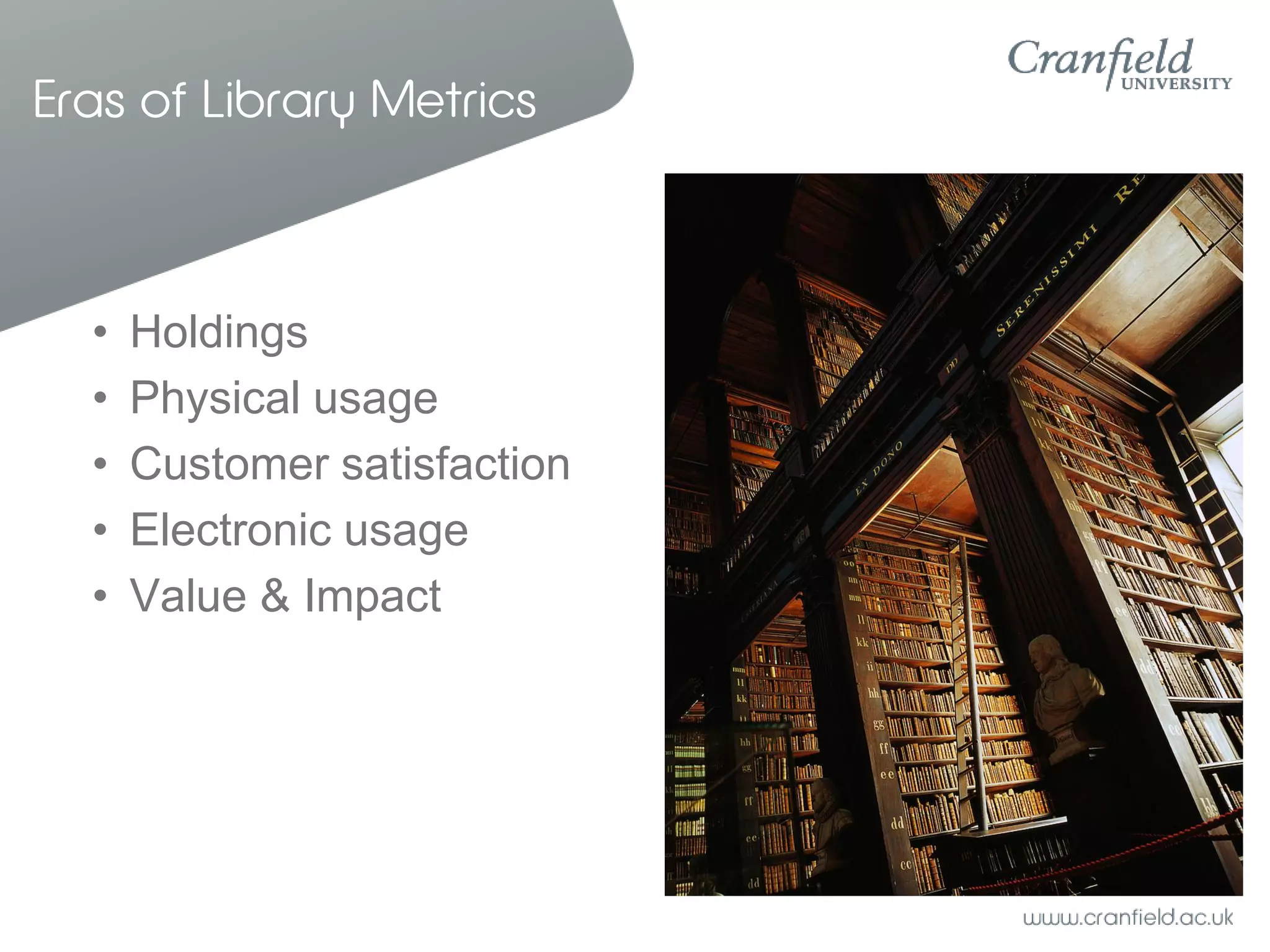
Eras of Library Metrics


  •   Holdings
  •   Physical usage
  •   Customer satisfaction
  •   Electronic usage
  •   Value & Impact
Few libraries exist in a vacuum,
accountable only to themselves. There is
always a larger context for assessing
library quality, that is, what and how well
does the library contribute to achieving the
overall goals of the parent constituencies?

                                (S. Pritchard 1996)
Value & Impact Metrics


  • Based on what matters the most to your key
    stakeholders
  • Identify where the Library impacts upon the goals of
    the parent organisation
  • Demonstrate how the library is contributing to the
    mission of your institution
Strategic Metrics


  • Start by defining your outcomes
       • What do you want to demonstrate?
       • What does your institution care about?
  • SMART outcomes:
       • Specific
       • Measureable
       • Attainable
       • Relevant
       • Time-bound
  • If in doubt, KISS.
Good Strategic Metrics


  •   Linked to the University/Library mission & goals
  •   Provide useful information
  •   Reasonably accurate within the data limitations
  •   Ethical
  •   Cost effective
Mixed-Methods
Approach


Quantitative               Qualitative
• Library Data             •   Customer Surveys
• Institutional Data       •   Focus groups
• National/International   •   Observational Studies
  Data                     •   Interviews
• Activity analysis
• Return on Investment
• Cost benefit
Quantitative Data


  • Be prepared to take a fresh look at your data
    collection
  • Look beyond the Library
  • Talk to other data providers in your institution
  • Combine data sets
      • Local (Library & student data), national,
        international
  • Check to see what is available before you start to
    count things
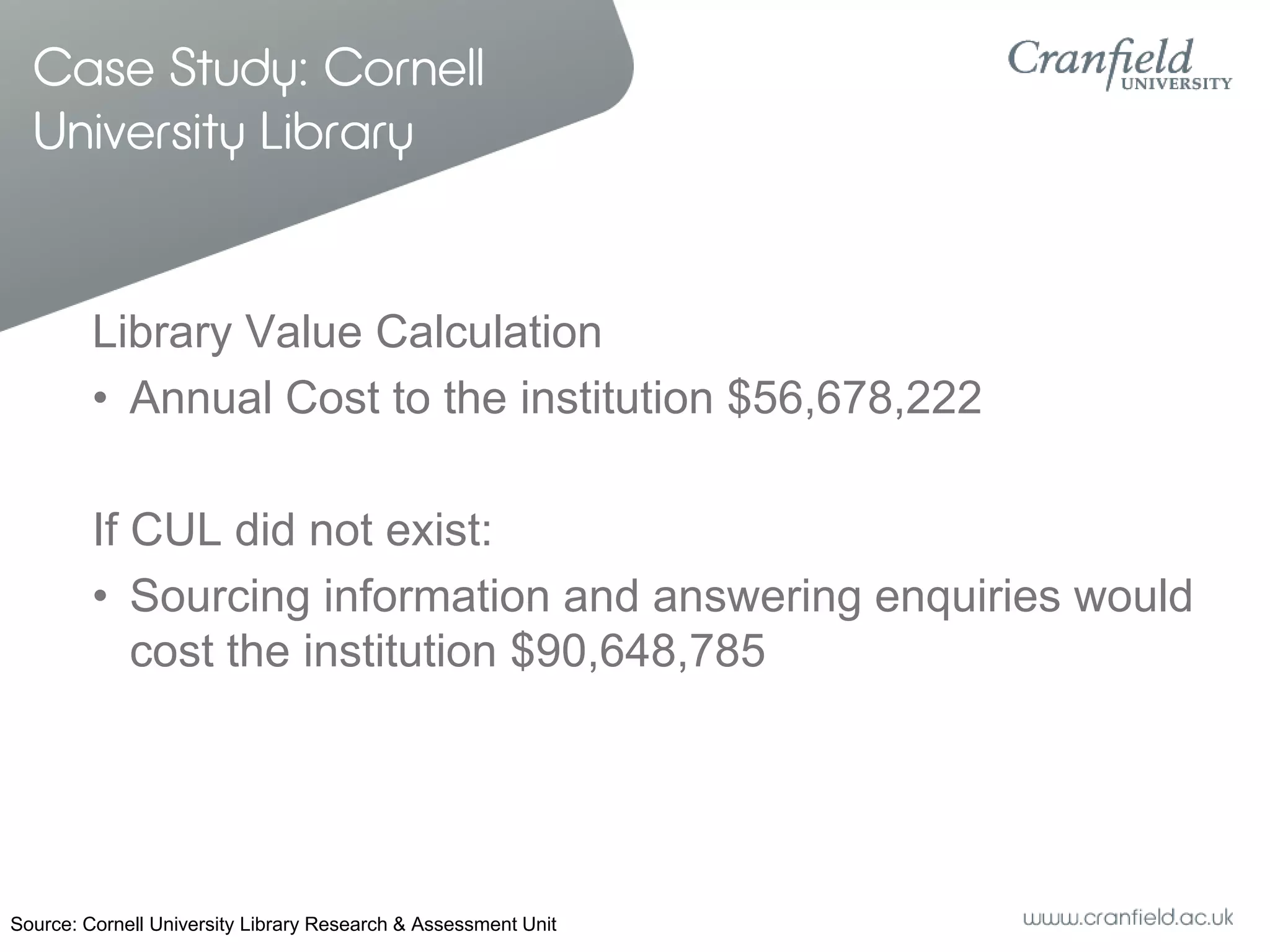
Case Study: Cornell
  University Library


         Library Value Calculation
         • Annual Cost to the institution $56,678,222

         If CUL did not exist:
         • Sourcing information and answering enquiries would
            cost the institution $90,648,785


Source: Cornell University Library Research & Assessment Unit
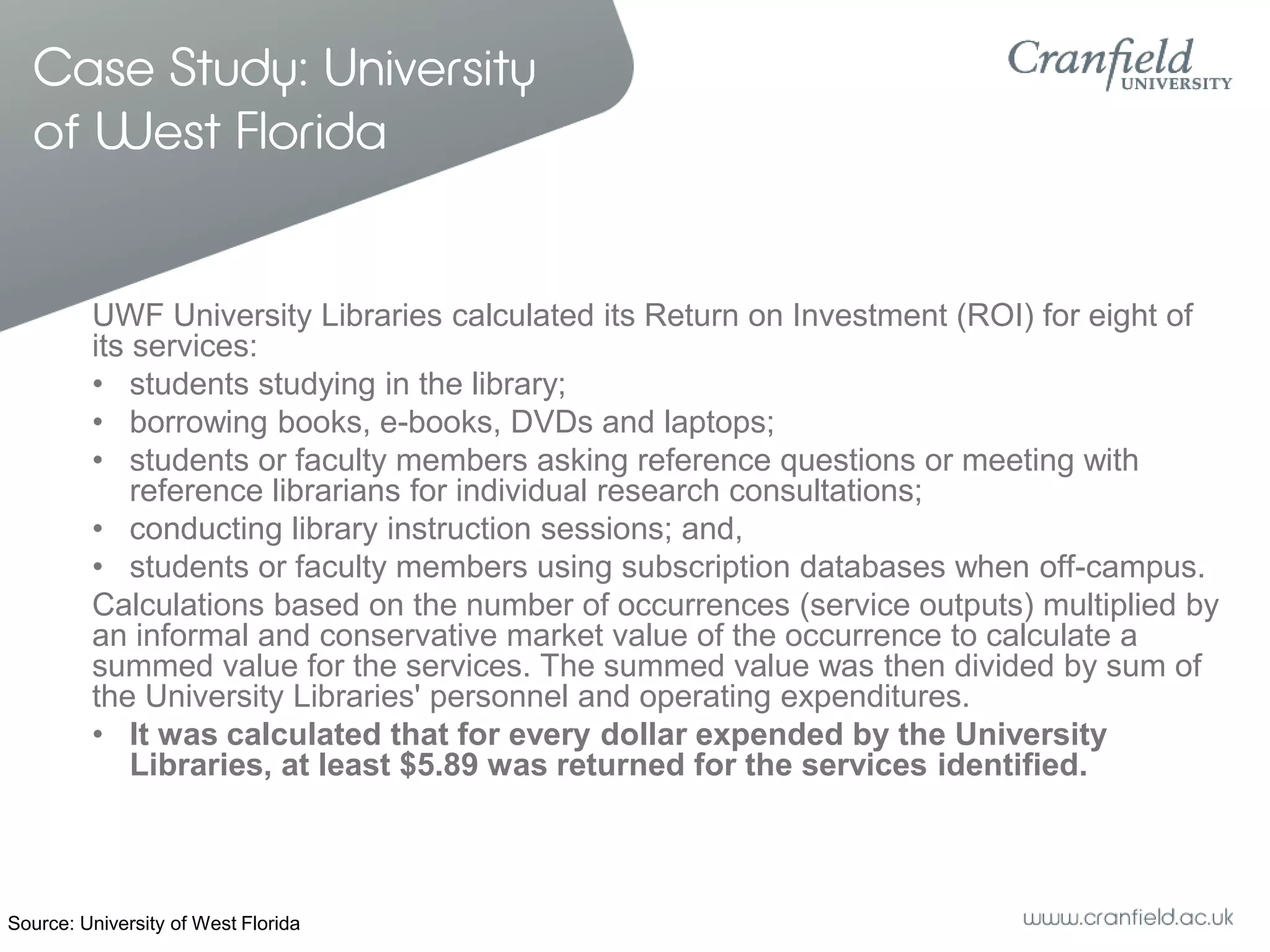
Case Study: University
  of West Florida


         UWF University Libraries calculated its Return on Investment (ROI) for eight of
         its services:
         • students studying in the library;
         • borrowing books, e-books, DVDs and laptops;
         • students or faculty members asking reference questions or meeting with
             reference librarians for individual research consultations;
         • conducting library instruction sessions; and,
         • students or faculty members using subscription databases when off-campus.
         Calculations based on the number of occurrences (service outputs) multiplied by
         an informal and conservative market value of the occurrence to calculate a
         summed value for the services. The summed value was then divided by sum of
         the University Libraries' personnel and operating expenditures.
         • It was calculated that for every dollar expended by the University
             Libraries, at least $5.89 was returned for the services identified.


Source: University of West Florida
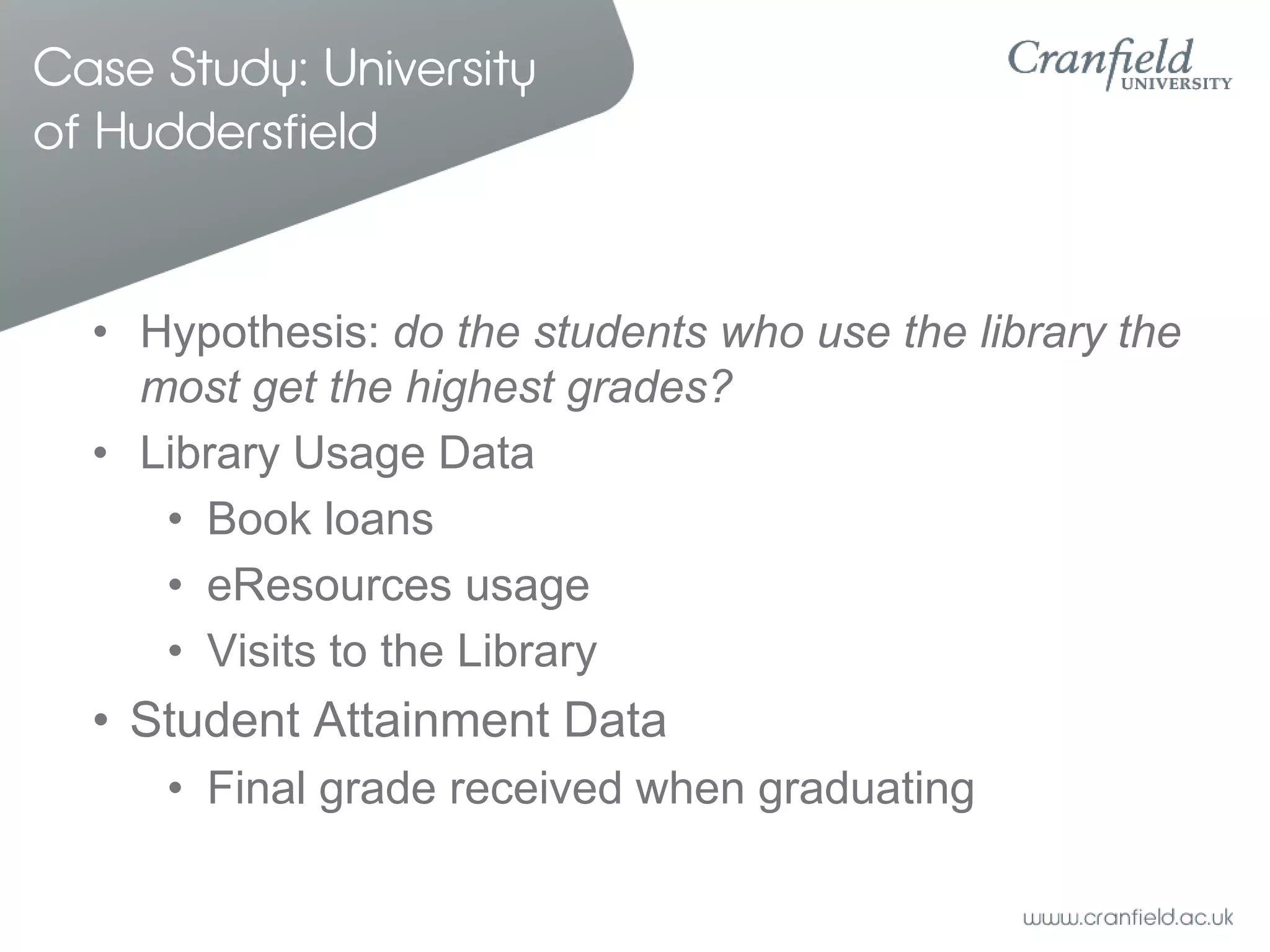
Case Study: University
of Huddersfield


  • Hypothesis: do the students who use the library the
    most get the highest grades?
  • Library Usage Data
     • Book loans
     • eResources usage
     • Visits to the Library
  • Student Attainment Data
     • Final grade received when graduating
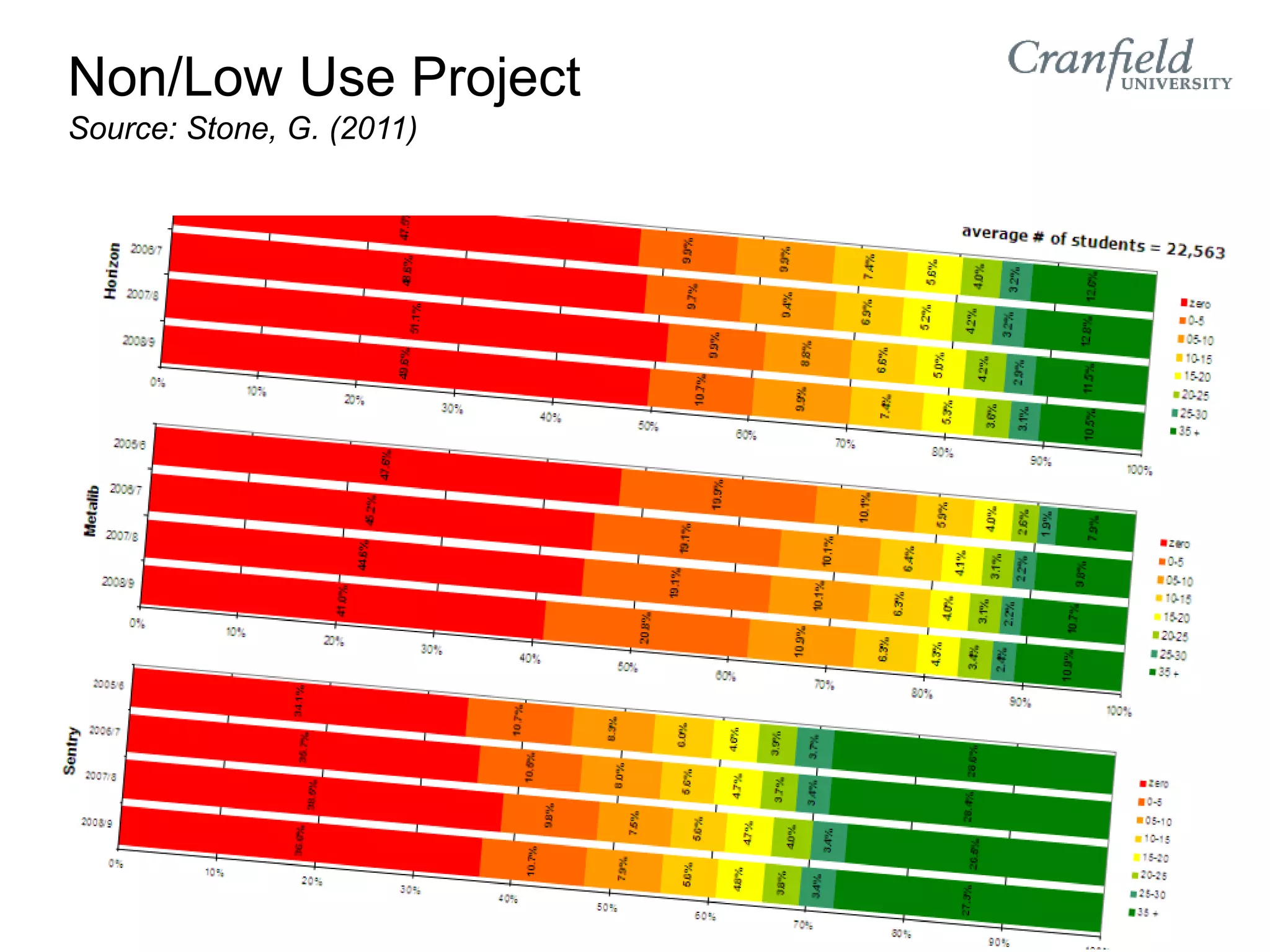
Non/Low Use Project
Source: Stone, G. (2011)


                           13
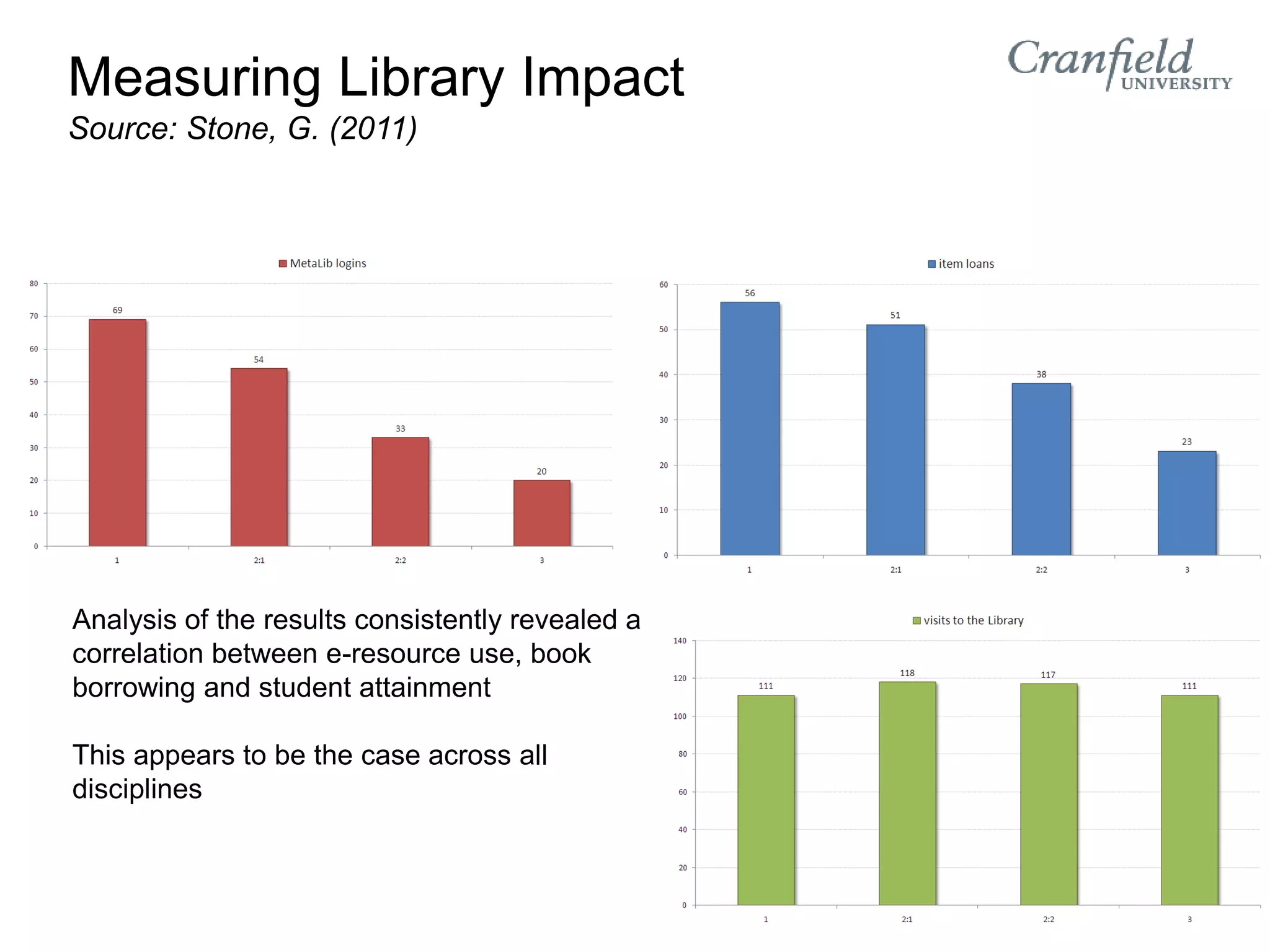
Measuring Library Impact
Source: Stone, G. (2011)


Analysis of the results consistently revealed a
correlation between e-resource use, book
borrowing and student attainment

This appears to be the case across all
disciplines
Thoughts


  • Does correlation equal causation?

  • Do our stakeholders like this impact data?
Qualitative Assessment


  • Numbers are only ever half of the story
  • Customer feedback can provide more insight that
    data alone
  • Customer quotes can have great impact on
    stakeholders
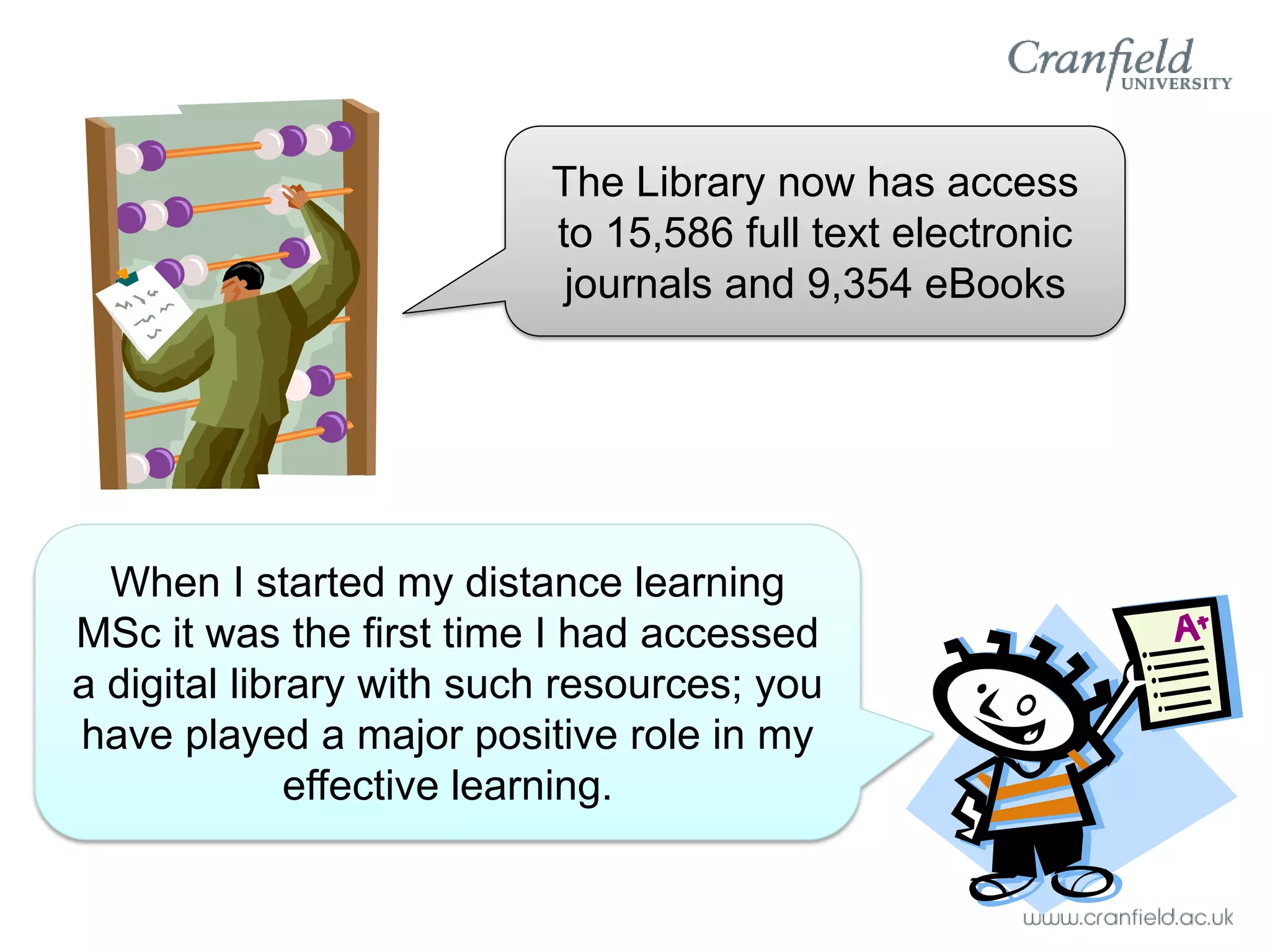
The Library now has access
                          to 15,586 full text electronic
                           journals and 9,354 eBooks


  When I started my distance learning
MSc it was the first time I had accessed
a digital library with such resources; you
have played a major positive role in my
              effective learning.
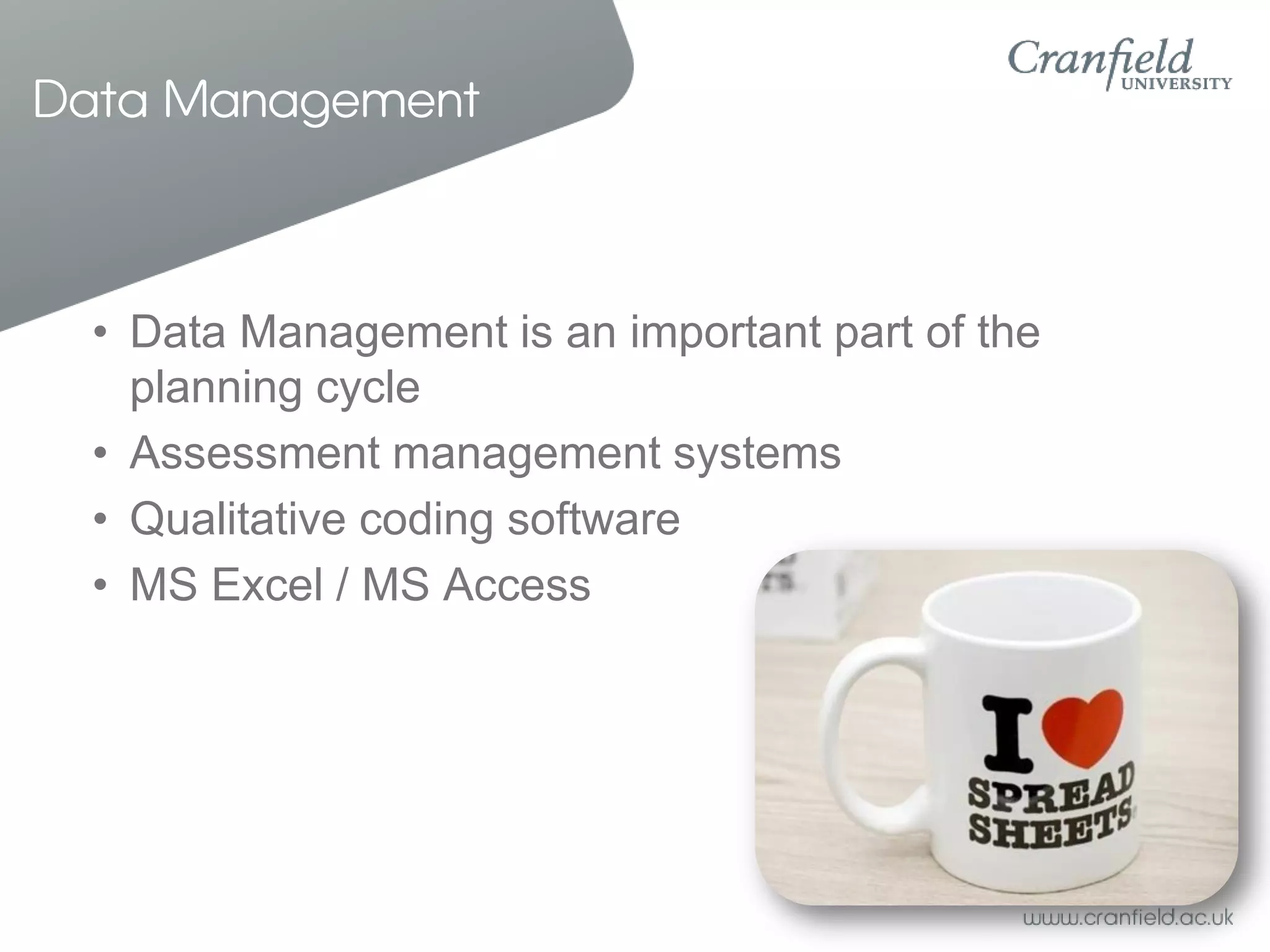
Data Management


 • Data Management is an important part of the
   planning cycle
 • Assessment management systems
 • Qualitative coding software
 • MS Excel / MS Access
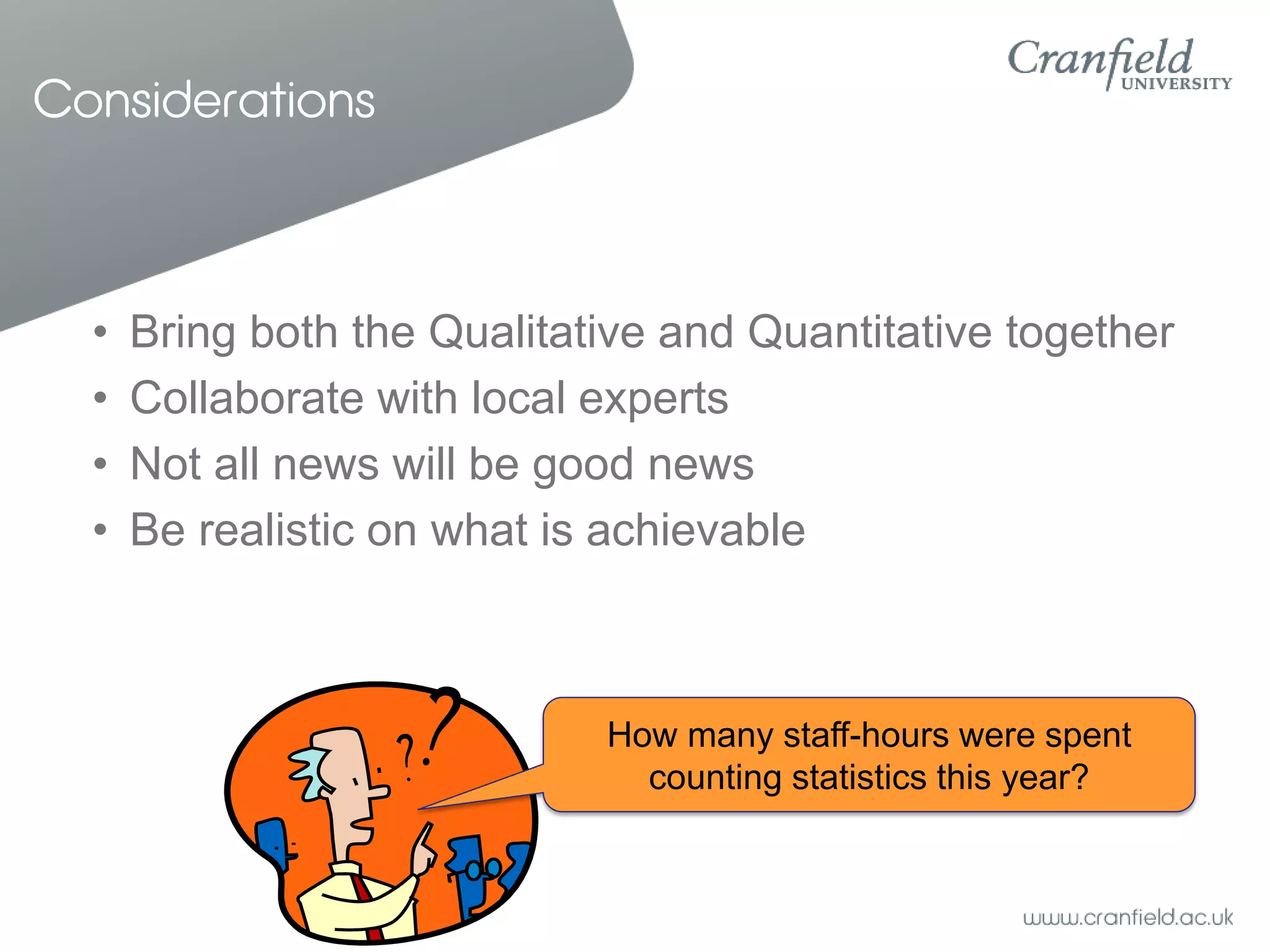
Considerations


  •   Bring both the Qualitative and Quantitative together
  •   Collaborate with local experts
  •   Not all news will be good news
  •   Be realistic on what is achievable


                             How many staff-hours were spent
                               counting statistics this year?
Common Challenges


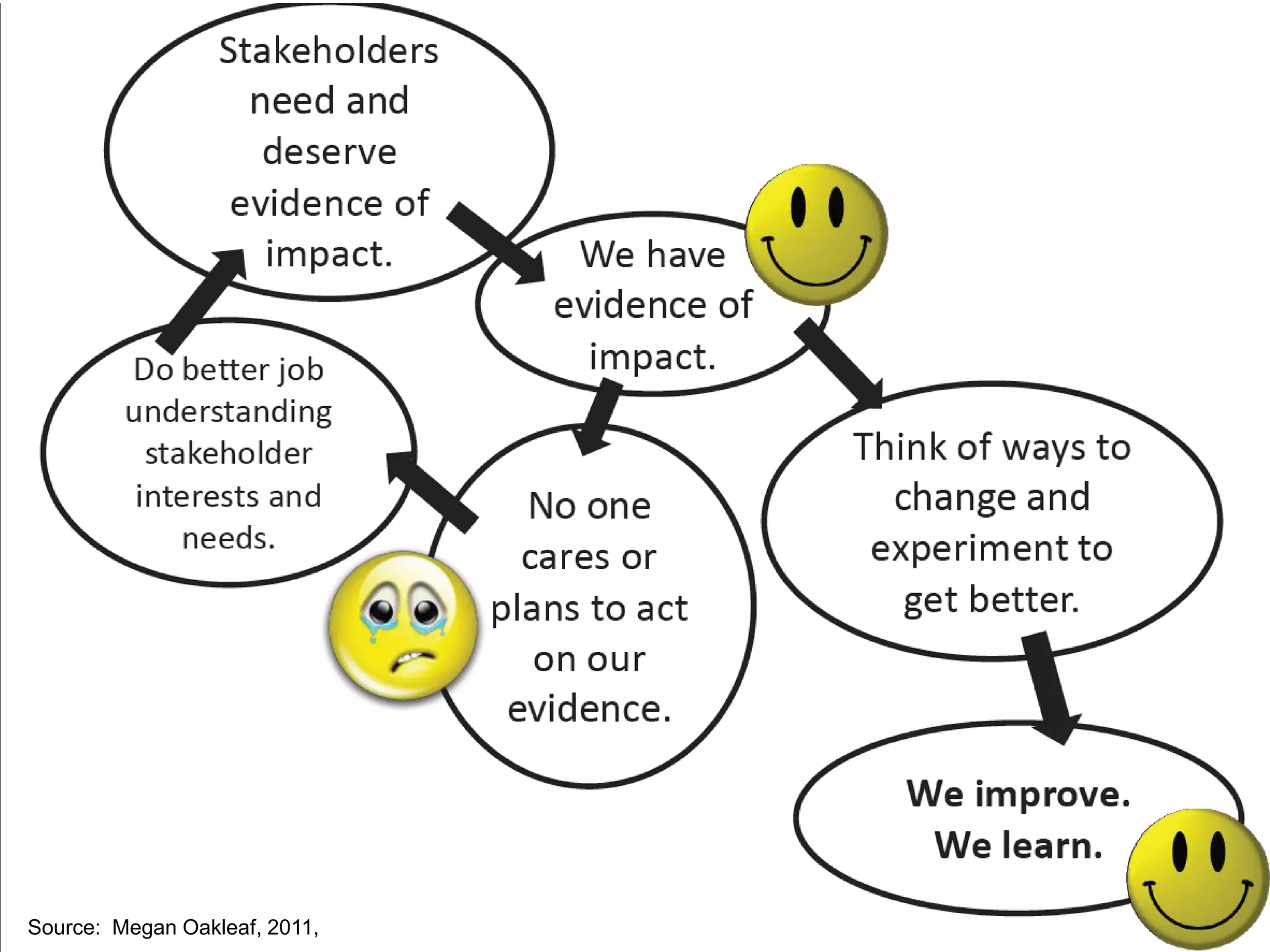
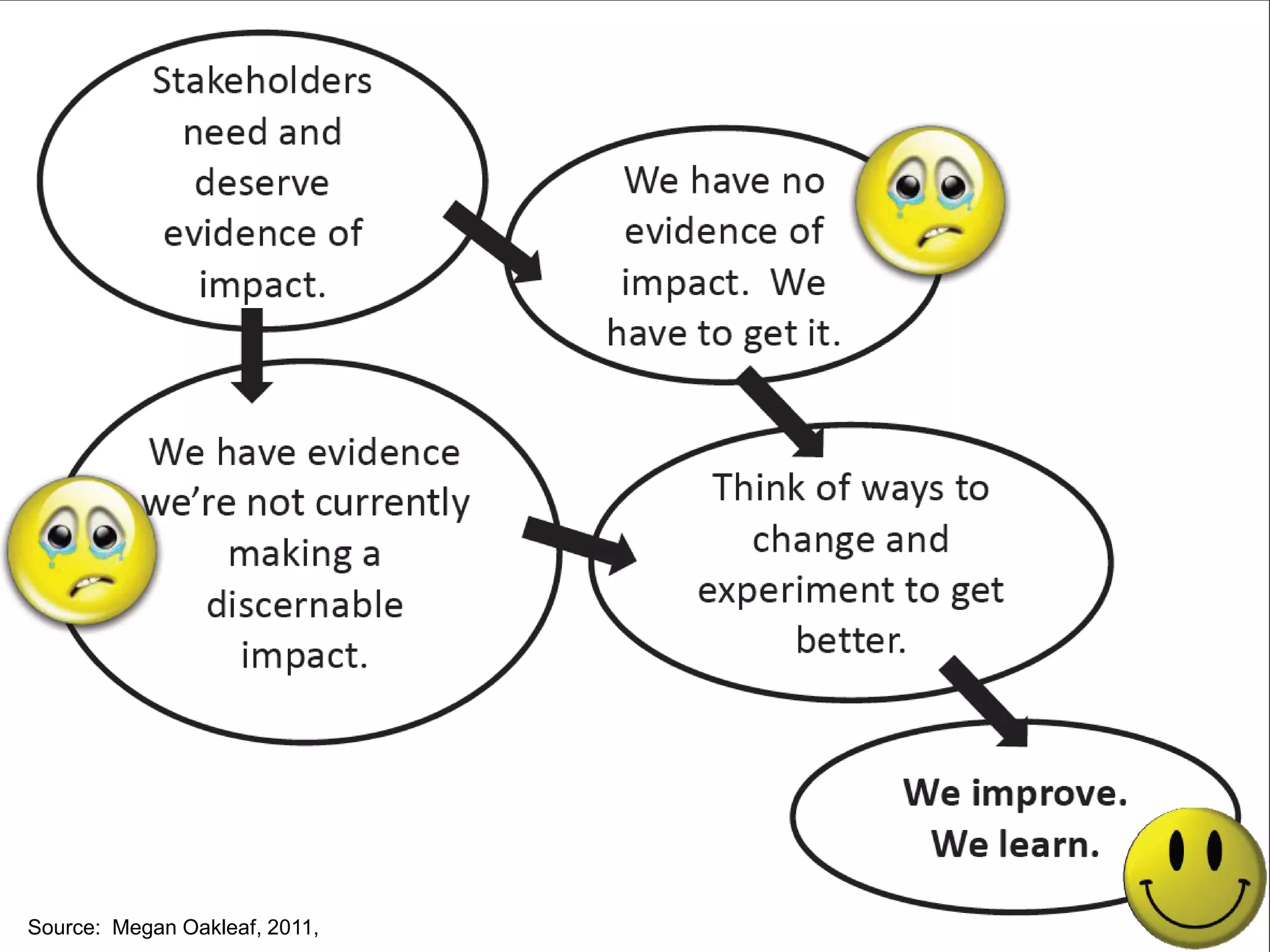
  •   Where do I start?!
  •   Finding the time
  •   Getting support from all Library staff
  •   Requesting data from other units
  •   Finding other data sets
  •   Difficulty in analysing and interpreting data
  •   Fear of change
  •   What if I fail?
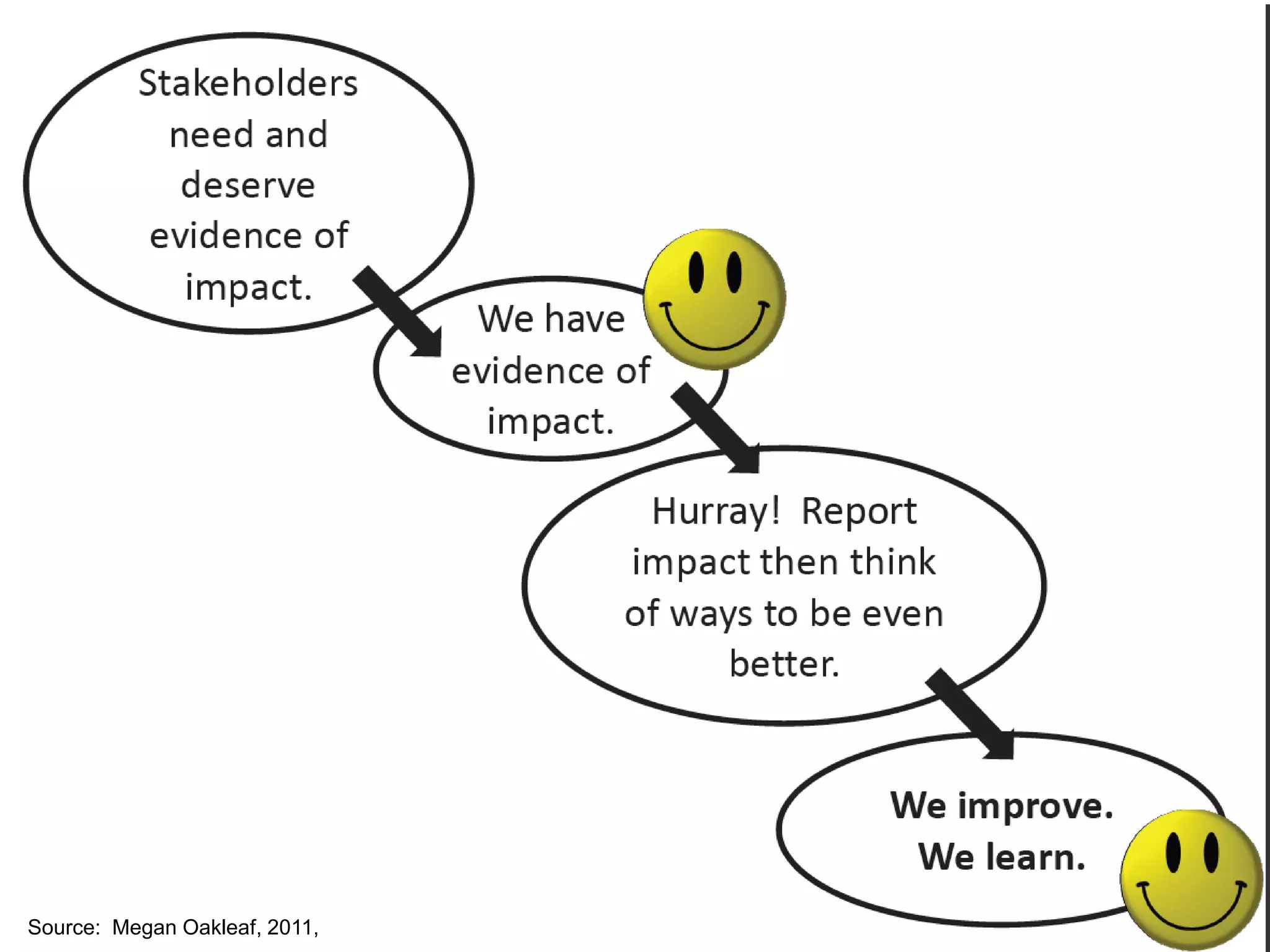
Source: Megan Oakleaf, 2011,
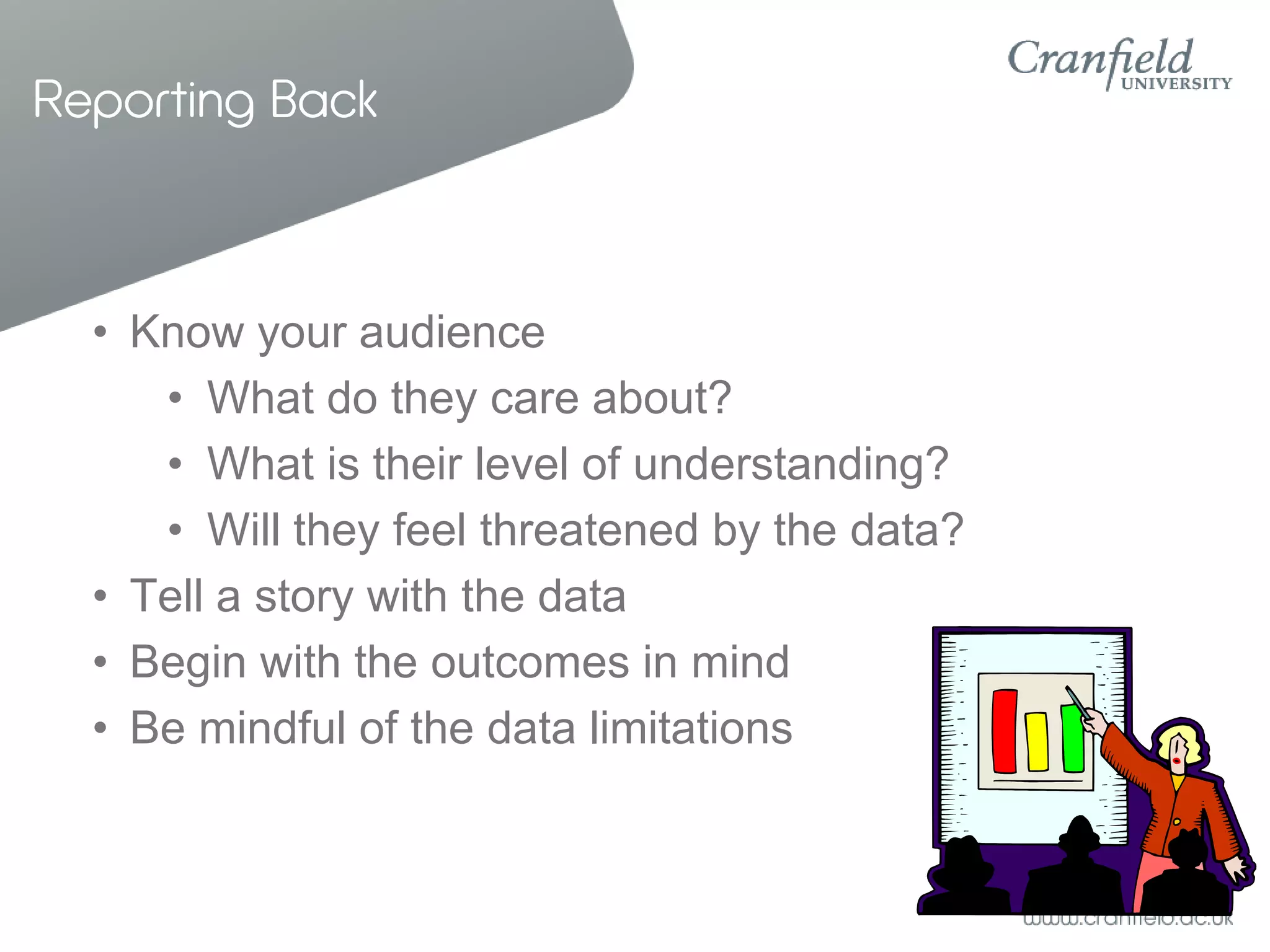
Reporting Back


  • Know your audience
     • What do they care about?
     • What is their level of understanding?
     • Will they feel threatened by the data?
  • Tell a story with the data
  • Begin with the outcomes in mind
  • Be mindful of the data limitations
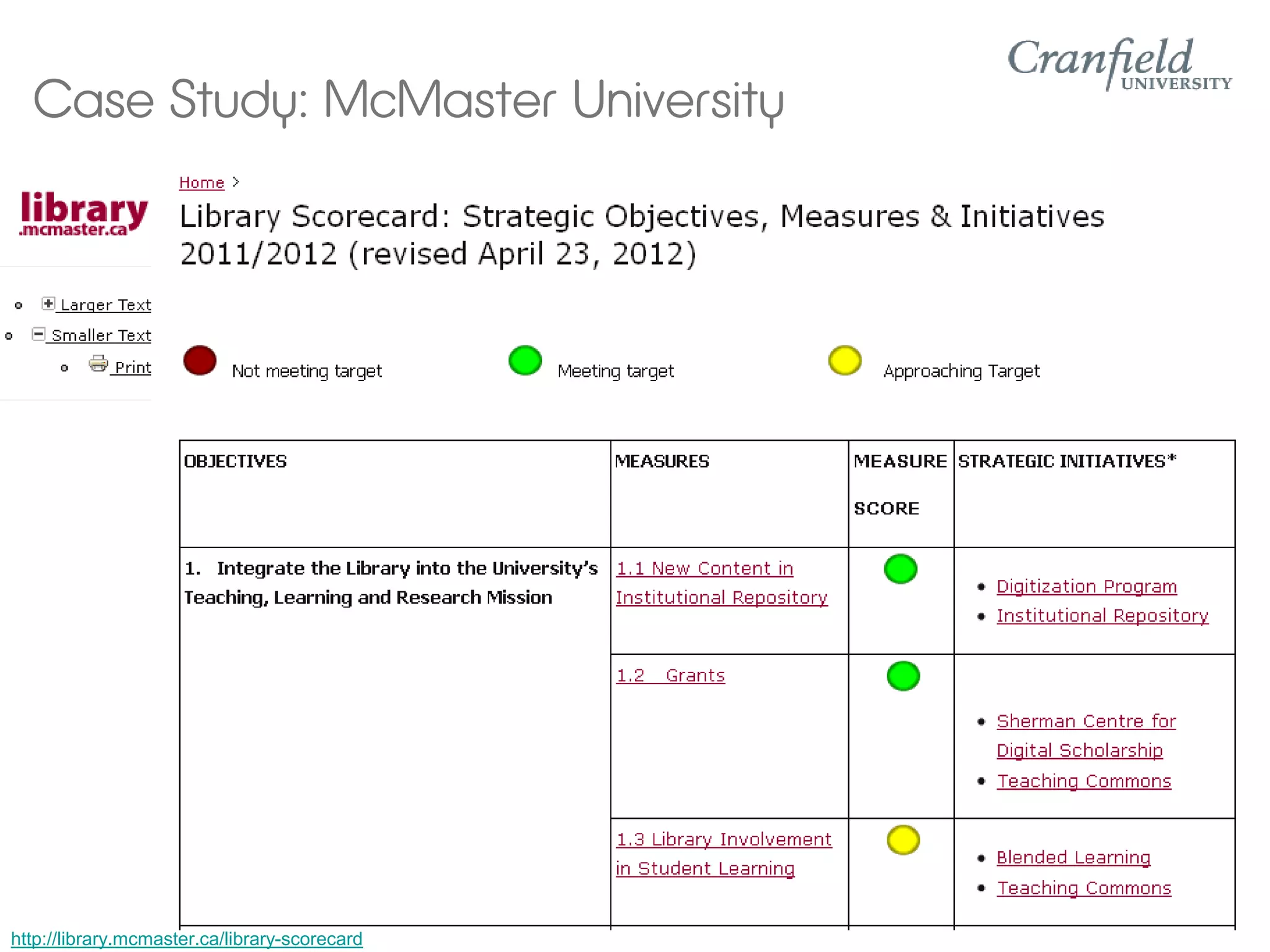
Case Study: McMaster University


http://library.mcmaster.ca/library-scorecard
References


  • Institutional Return on Investment. University of West Florida.
    http://libguides.uwf.edu/content.php?pid=188487&sid=2184200
  • Library Scorecard: Strategic Objectives, Measures & Initiatives 2011/2012. McMaster
    University Library, revised April 23, 2012, http://library.mcmaster.ca/library-scorecard
  • Library Value Calculations. Cornell University Library Research & Assessment Unit.
    http://research.library.cornell.edu/value
  • Oakleaf, M. and Matthews, J. (2011). Assessing the Impact of the Academic Library.
    Presented at the 9th Northumbria International Conference on Performance
    Measurement in Libraries and Information Services. York, England. 22nd – 26th August.
  • Stone, G. (2011). The Library Impact Data Project: hit, miss or maybe. Presented at the
    9th Northumbria International Conference on Performance Measurement in Libraries
    and Information Services. York, England. 22nd – 26th August.
Thank you!


Selena Killick
s.a.killick@cranfield.ac.uk
Twitter: @SelenaKillick
Tel: +44(0)1793 785561

Strategic Metrics

  • 1.
    Strategic Metrics Selena Killick LibraryQuality Officer Leadership Seminar on Strategy, Assessment and Service Development. University of Lund 19th September 2012.
  • 2.
    Eras of LibraryMetrics • Holdings • Physical usage • Customer satisfaction • Electronic usage • Value & Impact
  • 3.
    Few libraries existin a vacuum, accountable only to themselves. There is always a larger context for assessing library quality, that is, what and how well does the library contribute to achieving the overall goals of the parent constituencies? (S. Pritchard 1996)
  • 4.
    Value & ImpactMetrics • Based on what matters the most to your key stakeholders • Identify where the Library impacts upon the goals of the parent organisation • Demonstrate how the library is contributing to the mission of your institution
  • 5.
    Strategic Metrics • Start by defining your outcomes • What do you want to demonstrate? • What does your institution care about? • SMART outcomes: • Specific • Measureable • Attainable • Relevant • Time-bound • If in doubt, KISS.
  • 6.
    Good Strategic Metrics • Linked to the University/Library mission & goals • Provide useful information • Reasonably accurate within the data limitations • Ethical • Cost effective
  • 7.
    Mixed-Methods Approach Quantitative Qualitative • Library Data • Customer Surveys • Institutional Data • Focus groups • National/International • Observational Studies Data • Interviews • Activity analysis • Return on Investment • Cost benefit
  • 8.
    Quantitative Data • Be prepared to take a fresh look at your data collection • Look beyond the Library • Talk to other data providers in your institution • Combine data sets • Local (Library & student data), national, international • Check to see what is available before you start to count things
  • 9.
    Case Study: Cornell University Library Library Value Calculation • Annual Cost to the institution $56,678,222 If CUL did not exist: • Sourcing information and answering enquiries would cost the institution $90,648,785 Source: Cornell University Library Research & Assessment Unit
  • 10.
    Case Study: University of West Florida UWF University Libraries calculated its Return on Investment (ROI) for eight of its services: • students studying in the library; • borrowing books, e-books, DVDs and laptops; • students or faculty members asking reference questions or meeting with reference librarians for individual research consultations; • conducting library instruction sessions; and, • students or faculty members using subscription databases when off-campus. Calculations based on the number of occurrences (service outputs) multiplied by an informal and conservative market value of the occurrence to calculate a summed value for the services. The summed value was then divided by sum of the University Libraries' personnel and operating expenditures. • It was calculated that for every dollar expended by the University Libraries, at least $5.89 was returned for the services identified. Source: University of West Florida
  • 11.
    Case Study: University ofHuddersfield • Hypothesis: do the students who use the library the most get the highest grades? • Library Usage Data • Book loans • eResources usage • Visits to the Library • Student Attainment Data • Final grade received when graduating
  • 12.
    Non/Low Use Project Source:Stone, G. (2011) 13
  • 13.
    Measuring Library Impact Source:Stone, G. (2011) Analysis of the results consistently revealed a correlation between e-resource use, book borrowing and student attainment This appears to be the case across all disciplines
  • 14.
    Thoughts •Does correlation equal causation? • Do our stakeholders like this impact data?
  • 15.
    Qualitative Assessment • Numbers are only ever half of the story • Customer feedback can provide more insight that data alone • Customer quotes can have great impact on stakeholders
  • 16.
    The Library nowhas access to 15,586 full text electronic journals and 9,354 eBooks When I started my distance learning MSc it was the first time I had accessed a digital library with such resources; you have played a major positive role in my effective learning.
  • 17.
    Data Management •Data Management is an important part of the planning cycle • Assessment management systems • Qualitative coding software • MS Excel / MS Access
  • 18.
    Considerations • Bring both the Qualitative and Quantitative together • Collaborate with local experts • Not all news will be good news • Be realistic on what is achievable How many staff-hours were spent counting statistics this year?
  • 19.
    Common Challenges • Where do I start?! • Finding the time • Getting support from all Library staff • Requesting data from other units • Finding other data sets • Difficulty in analysing and interpreting data • Fear of change • What if I fail?
  • 21.
  • 22.
  • 23.
  • 24.
    Reporting Back • Know your audience • What do they care about? • What is their level of understanding? • Will they feel threatened by the data? • Tell a story with the data • Begin with the outcomes in mind • Be mindful of the data limitations
  • 25.
    Case Study: McMasterUniversity http://library.mcmaster.ca/library-scorecard
  • 27.
    References •Institutional Return on Investment. University of West Florida. http://libguides.uwf.edu/content.php?pid=188487&sid=2184200 • Library Scorecard: Strategic Objectives, Measures & Initiatives 2011/2012. McMaster University Library, revised April 23, 2012, http://library.mcmaster.ca/library-scorecard • Library Value Calculations. Cornell University Library Research & Assessment Unit. http://research.library.cornell.edu/value • Oakleaf, M. and Matthews, J. (2011). Assessing the Impact of the Academic Library. Presented at the 9th Northumbria International Conference on Performance Measurement in Libraries and Information Services. York, England. 22nd – 26th August. • Stone, G. (2011). The Library Impact Data Project: hit, miss or maybe. Presented at the 9th Northumbria International Conference on Performance Measurement in Libraries and Information Services. York, England. 22nd – 26th August.
  • 28.