Student research behavior — prototype application   From research conducted at the University of Maryland, 2005-2006 Computers in Libraries, March 2009 Dan Wendling, MLS, & Neal Kaske, PhD [email_address] http://ponder-matic.com
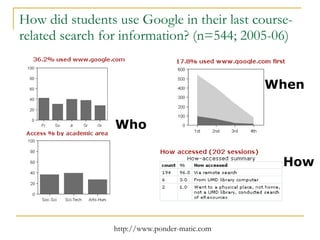
How did students use Google in their last course-related search for information? (n=544; 2005-06) Who When How
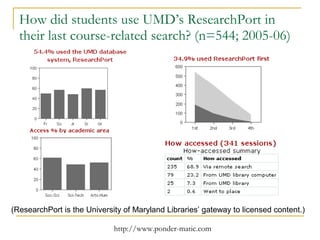
How did students use UMD’s ResearchPort in their last course-related search? (n=544; 2005-06) (ResearchPort is the University of Maryland Libraries’ gateway to licensed content.)
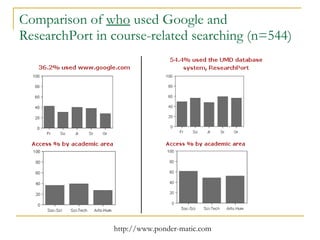
Comparison of  who  used Google and ResearchPort in course-related searching (n=544)
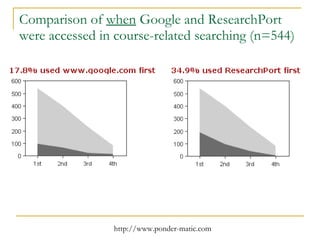
Comparison of  when  Google and ResearchPort were accessed in course-related searching (n=544)
This presentation How should we describe information-seeking behavior? Project research questions / methodology Demonstration of the application prototype at  http://www.ponder-matic.com Results, conclusions, next steps More information: Conference book, page 43
Foudy, Johnson, & Kaske 2005 research questions What are contemporary university students’ information-seeking behaviors and what role(s), if any, do libraries and/or librarians play in these behaviors? What are contemporary students’ mental models of the tasks performed by librarians? Do these behaviors or mental models differ according to level of matriculation, from freshmen through graduate students?
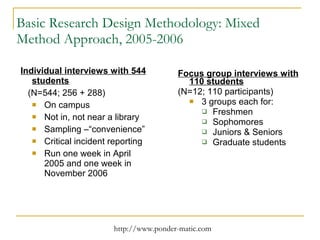
Basic Research Design Methodology: Mixed Method Approach, 2005-2006 Individual interviews with 544 students   (N=544; 256 + 288) On campus Not in, not near a library Sampling –“convenience” Critical incident reporting Run one week in April 2005 and one week in November 2006 Focus group interviews with 110 students   (N=12; 110 participants) 3 groups each for:  Freshmen Sophomores Juniors & Seniors Graduate students
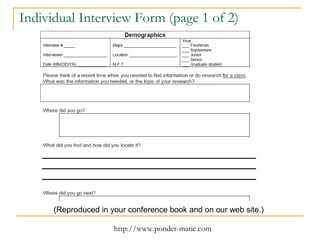
Individual Interview Form (page 1 of 2) (Reproduced in your conference book and on our web site.)
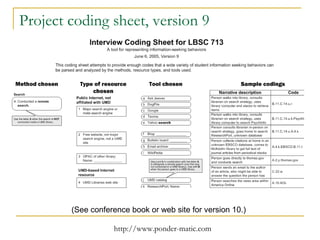
Project coding sheet, version 9 (See conference book or web site for version 10.)
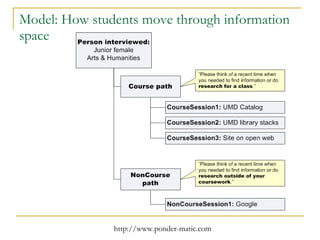
Model: How students move through information space
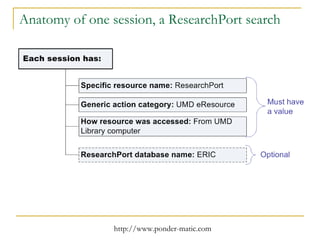
Anatomy of one session, a ResearchPort search
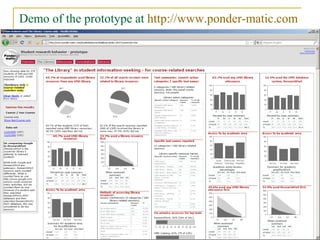
Demo of the prototype at  http://www.ponder-matic.com
What makes projects like this work Selected bullets from the book  Competing on Analytics,  by Davenport and Harris, “Signposts of effective IT”: Information workers spend their time analyzing data and understanding its implications rather than collecting and formatting data. Managers focus on improving processes and business performance, not culling data. A hypothesis can be quickly analyzed and tested without a lot of manual behind-the-scenes preparation beforehand. Analysts have direct, nearly instantaneous access to data.
Where to go for more background Your conference book LOEX Library Instruction Conference Procedings 2006: “Is Google God? How do students look for information today?” ( description ) Paper for ARL’s 2008 Library Assessment Conference,  Student research behavior: Quantitative and qualitative research findings presented with visualizations .
Key influences Competing on Analytics , a business book by Tom Davenport and Jeanne Harris A ‘good Google’ Also the podcast “ Competing on Analytics ” by Jeanne Harris A  presentation on information visualization  by Ben Shneiderman The ideas about the importance of  assessing libraries locally Our bibliography has more information
Acknowledgements University of Maryland students of the College of Information Studies, LBSC 713: Planning & Evaluating Library Services, two classes: Spring semester 2005 Fall semester 2006 Initial project funding from the University of Maryland Libraries
Contact Information Web site:  http ://www.ponder-matic.com   Dan Wendling, MLS:  [email_address] Neal K. Kaske, PhD:  [email_address] The contents of this presentation reflect the views of the authors who are responsible for the opinions, facts, and the accuracy of the data presented. The contents do not necessarily reflect the official views or policies of the author’s employers or of the University of Maryland Libraries.
Questions?

Student research behavior — prototype application (at CIL)

  • 1.
    Student research behavior— prototype application From research conducted at the University of Maryland, 2005-2006 Computers in Libraries, March 2009 Dan Wendling, MLS, & Neal Kaske, PhD [email_address] http://ponder-matic.com
  • 2.
    How did studentsuse Google in their last course-related search for information? (n=544; 2005-06) Who When How
  • 3.
    How did studentsuse UMD’s ResearchPort in their last course-related search? (n=544; 2005-06) (ResearchPort is the University of Maryland Libraries’ gateway to licensed content.)
  • 4.
    Comparison of who used Google and ResearchPort in course-related searching (n=544)
  • 5.
    Comparison of when Google and ResearchPort were accessed in course-related searching (n=544)
  • 6.
    This presentation Howshould we describe information-seeking behavior? Project research questions / methodology Demonstration of the application prototype at http://www.ponder-matic.com Results, conclusions, next steps More information: Conference book, page 43
  • 7.
    Foudy, Johnson, &Kaske 2005 research questions What are contemporary university students’ information-seeking behaviors and what role(s), if any, do libraries and/or librarians play in these behaviors? What are contemporary students’ mental models of the tasks performed by librarians? Do these behaviors or mental models differ according to level of matriculation, from freshmen through graduate students?
  • 8.
    Basic Research DesignMethodology: Mixed Method Approach, 2005-2006 Individual interviews with 544 students (N=544; 256 + 288) On campus Not in, not near a library Sampling –“convenience” Critical incident reporting Run one week in April 2005 and one week in November 2006 Focus group interviews with 110 students (N=12; 110 participants) 3 groups each for: Freshmen Sophomores Juniors & Seniors Graduate students
  • 9.
    Individual Interview Form(page 1 of 2) (Reproduced in your conference book and on our web site.)
  • 10.
    Project coding sheet,version 9 (See conference book or web site for version 10.)
  • 11.
    Model: How studentsmove through information space
  • 12.
    Anatomy of onesession, a ResearchPort search
  • 13.
    Demo of theprototype at http://www.ponder-matic.com
  • 14.
    What makes projectslike this work Selected bullets from the book Competing on Analytics, by Davenport and Harris, “Signposts of effective IT”: Information workers spend their time analyzing data and understanding its implications rather than collecting and formatting data. Managers focus on improving processes and business performance, not culling data. A hypothesis can be quickly analyzed and tested without a lot of manual behind-the-scenes preparation beforehand. Analysts have direct, nearly instantaneous access to data.
  • 15.
    Where to gofor more background Your conference book LOEX Library Instruction Conference Procedings 2006: “Is Google God? How do students look for information today?” ( description ) Paper for ARL’s 2008 Library Assessment Conference, Student research behavior: Quantitative and qualitative research findings presented with visualizations .
  • 16.
    Key influences Competingon Analytics , a business book by Tom Davenport and Jeanne Harris A ‘good Google’ Also the podcast “ Competing on Analytics ” by Jeanne Harris A presentation on information visualization by Ben Shneiderman The ideas about the importance of assessing libraries locally Our bibliography has more information
  • 17.
    Acknowledgements University ofMaryland students of the College of Information Studies, LBSC 713: Planning & Evaluating Library Services, two classes: Spring semester 2005 Fall semester 2006 Initial project funding from the University of Maryland Libraries
  • 18.
    Contact Information Website: http ://www.ponder-matic.com Dan Wendling, MLS: [email_address] Neal K. Kaske, PhD: [email_address] The contents of this presentation reflect the views of the authors who are responsible for the opinions, facts, and the accuracy of the data presented. The contents do not necessarily reflect the official views or policies of the author’s employers or of the University of Maryland Libraries.
  • 19.