Data-informed decision making:
Research data that can inform library
procurement and investment in the
student learning experience
By Yaz El Hakim and Emma Warren-Jones
Session Objectives
• To consider the history and future of data within HE e.g. IoT
• Discuss the concept and benefit of Learner Analytics
• To outline and discuss some of the ethical considerations and
suggested good practice principles
• To collect some raw data and illustrate the insights that could
be drawn from these data at both the library and individual
levels.
Workshop Outline
0-15 mins:
Introduction and presentation of key concepts around learner analytics, big data and ethics.
15-35 mins:
The group will be asked to participate in the collection of some raw data in order to consider
ways in which currently uncollected and under-utilised data sets may facilitate future decisions
within the library and other departments.  What may be defined as engagement, as opposed to
monitoring, will also be discussed in relation to the JISC publication (Sclater, 2014).
35-50 mins:
Discussion and Concluding points.
50-60 mins:
Q&A
Code of practice for Learning Analytics
Responsibility of educational
institutions to ensure Learning
Analytics are conducted
responsibly, appropriately &
effectively
Transparency, privacy & validity of
data.
Monitoring vs improving learning
experience
So why are Learning Analytics
so important?
• Their value…
• Not in the money sense (that too) but in their ability to improve
the student’s learning experience.
• To realise the learning potential of a student within the context
of mass higher education, learning analytics can enhance the
quantity and depth of feedback that can be achieved by
teaching staff.
• Students who had opportunities to seek and give peer
feedback were clearer of the expected standards and had
greater self-awareness of their performance
Ice Breakers…
• What types of data do you currently collect in your libraries?
• What are you doing with these data? (analysed in isolation / in
combination)
• What decisions are these data being used to make?
• Are there better datasets that you could benefit from?
• What are the datasets you use to currently make library investment
decisions.
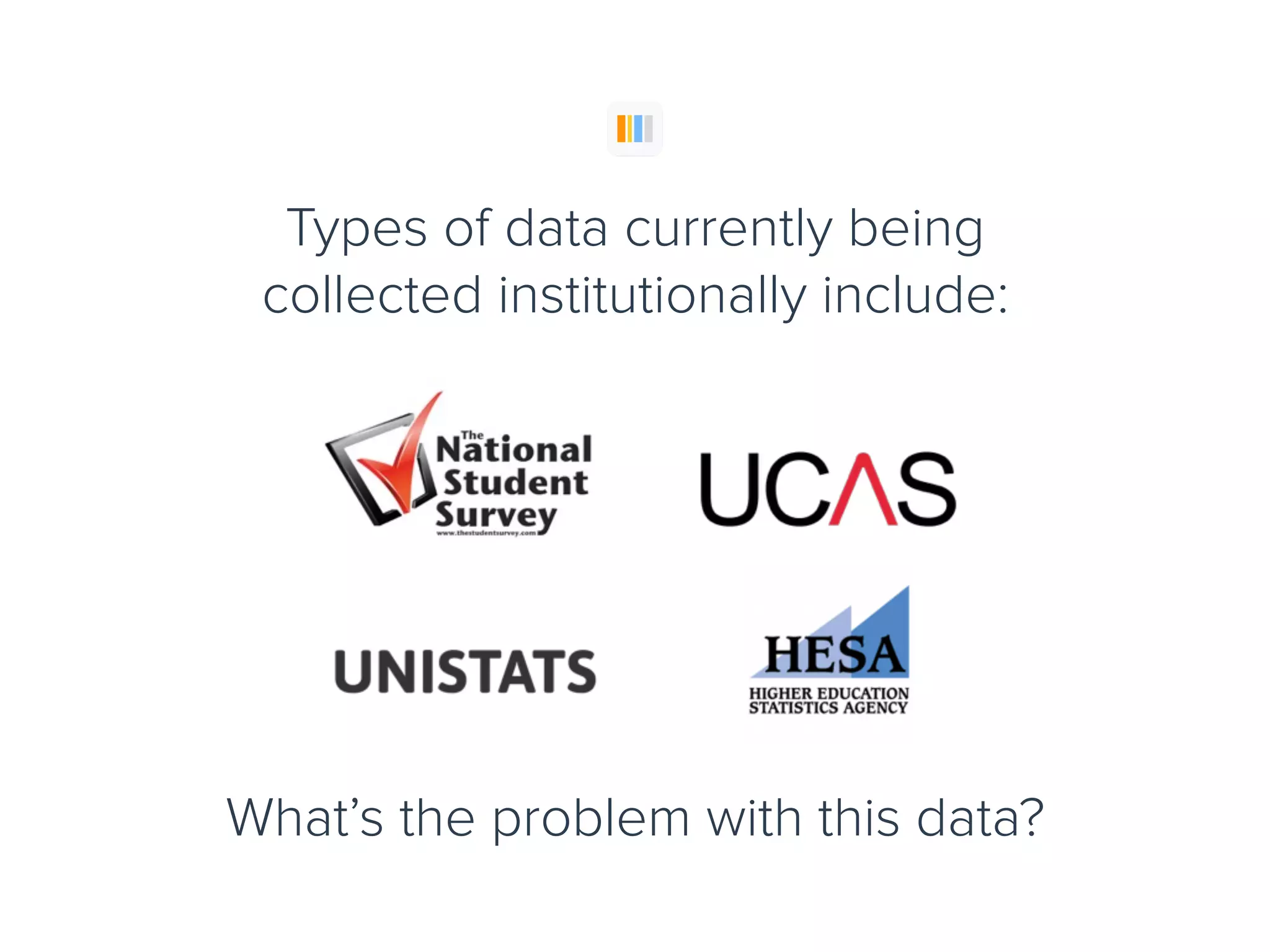
Types of data currently being
collected institutionally include:
What’s the problem with this data?
The Teaching Excellence Framework
(Chapter 3)
Common metrics
• 12. After informal discussions with the sector, we believe at present there are three common
metrics (suitably benchmarked) that would best inform TEF judgements. We propose initially
to base the common metrics on existing data collections:
• Employment/destination: from the Destination of Leavers from Higher Education Surveys
(outcomes), and, from early 2017, make use of the results of the HMRC data match.
• Retention/continuation: from the UK Performance Indicators which are published by
Higher Education Statistics Agency (HESA) (outcomes)
• Student satisfaction indicators: from the National Student Survey (teaching quality and
learning environment)
NSSE is close, Attendance is closer, but
very little Actual Learning Data is utilised.
• Ironically, the library or more specifically, what the library provides and
how students engage with it is the central point of any degree and
arguably the most explicit learning data available!!!
• So why haven’t we been leading the way with real learning analytics …
More actual data that flows into the Analytics
and Improve Predictive Modelling of the future.
Let’s collect some data:
1. Provide email addresses.
2. Add your favourite book to the RefME
project - ISBN is the most accurate source.
3. If you remember a specific quote – please
add it.
Actual Data Collection…
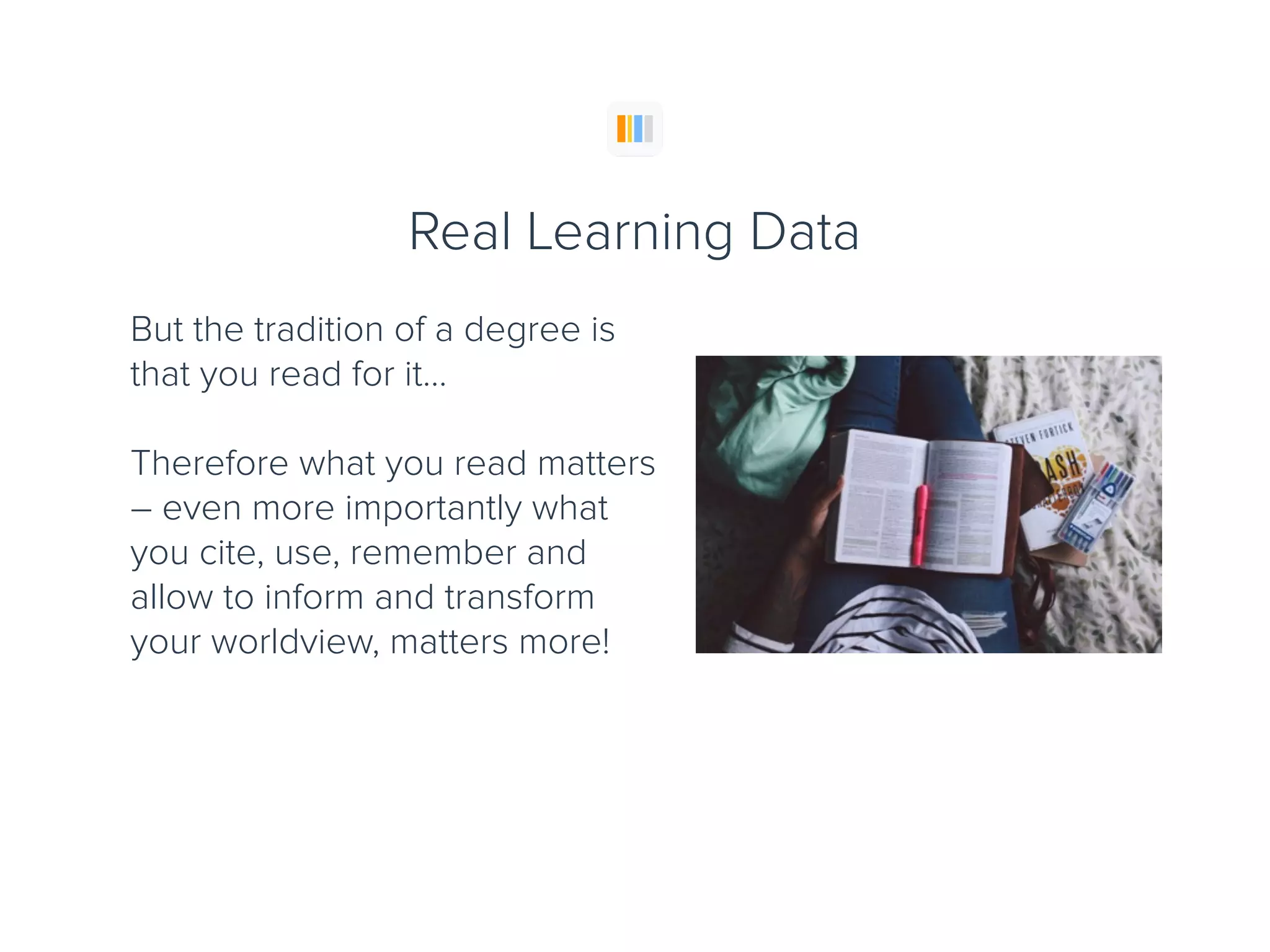
But the tradition of a degree is
that you read for it…
Therefore what you read matters
– even more importantly what
you cite, use, remember and
allow to inform and transform
your worldview, matters more!
Real Learning Data
Citation
Generator
Reference
Manager
API /
Widget
Citation
Style
Access time
Citation
Page
Edits
Course
Institution
Level of
study
Field
AnnotationQuote
User
Author
Title
Edition
Publisher
Publication
Full text
Date
Source
Institution
User
Library resource management
Learner analytics
Research impact
Drive content usage (via RefME to discovery service)
Data Link Structure
User analytics/bibliometrics
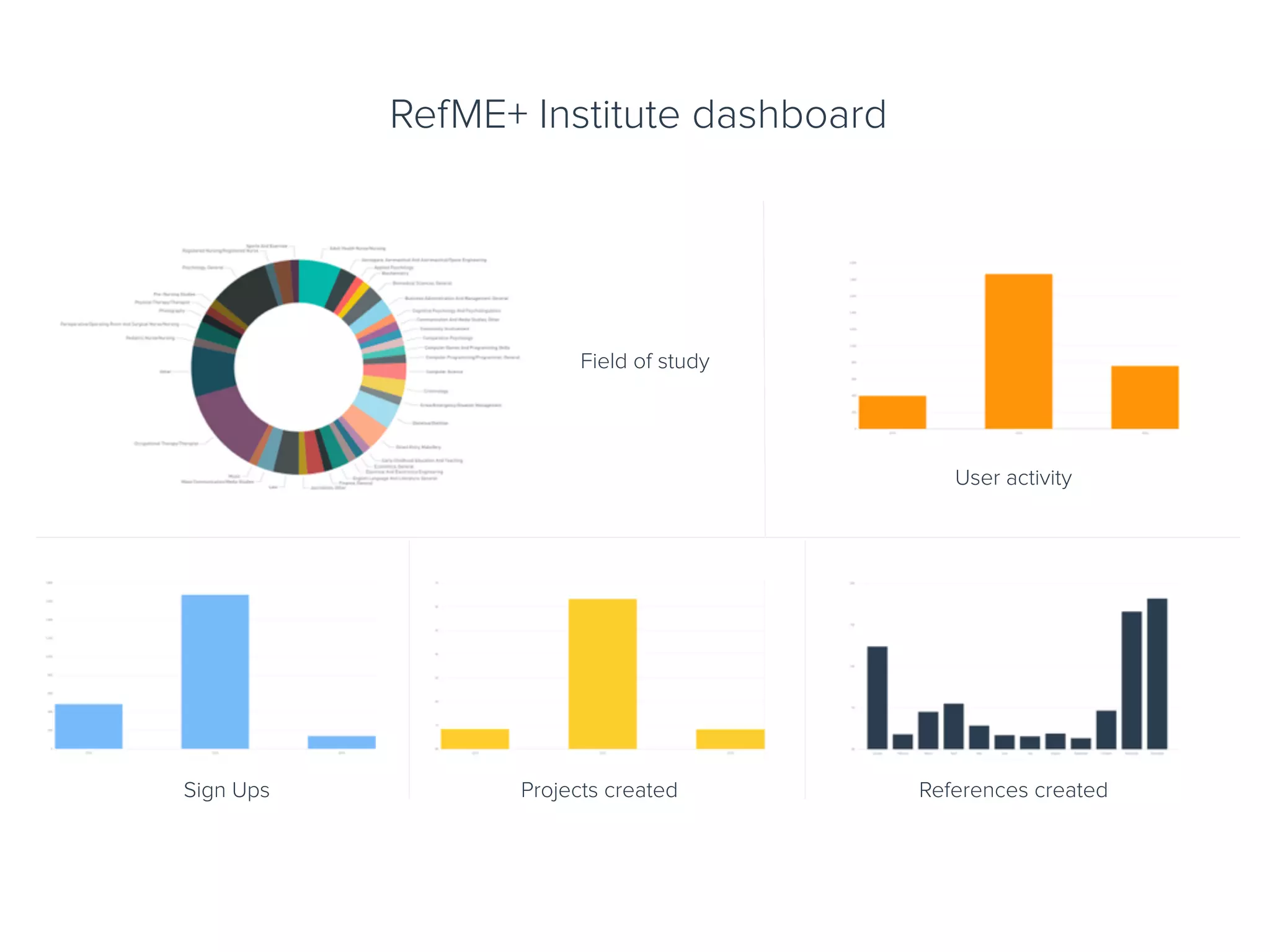
Sign Ups Projects created References created
User activity
Field of study
RefME+ Institute dashboard
Journal Article dashboard
Publishers
Container titles
Reference Types Reference creation
Conclusion
• Institutional libraries/librarians have a huge role to play in the leadership of
learning analytics.
• Use of data is delicate and needs to be well prepared for, both in its
collection and utilisation.
• Development of reports and interventions at institutional and individual
levels will transform much of how we support learning and research
journeys.
References
Data intelligence notes - estates management (2011), Available from:
https://www.hesa.ac.uk/intel?name=bds_emr [Accessed: 1.02.16].
King, J.H. & Richards, N.M. (2014) Big data ethics, Available from: http://
papers.ssrn.com/sol3/papers.cfm?abstract_id=2384174 [Accessed:
1.02.16].
Kuh, G.D. (2003) What we’re learning about student engagement from
NSSE: Benchmarks for effective educational practices, Change: The
Magazine of Higher Learning, 35, (2), 24–32.
Sclater, N. (2014) Code of practice for learning analytics A literature review
of the ethical and legal issues, http://repository.jisc.ac.uk/5661/1/
Learning_Analytics_A-_Literature_Review.pdf.
www.refme.com hello@refme.com
@GetRefME /RefME

Data informed decision making - Yaz El Hakim

  • 2.
    Data-informed decision making: Researchdata that can inform library procurement and investment in the student learning experience By Yaz El Hakim and Emma Warren-Jones
  • 3.
    Session Objectives • Toconsider the history and future of data within HE e.g. IoT • Discuss the concept and benefit of Learner Analytics • To outline and discuss some of the ethical considerations and suggested good practice principles • To collect some raw data and illustrate the insights that could be drawn from these data at both the library and individual levels.
  • 4.
    Workshop Outline 0-15 mins: Introductionand presentation of key concepts around learner analytics, big data and ethics. 15-35 mins: The group will be asked to participate in the collection of some raw data in order to consider ways in which currently uncollected and under-utilised data sets may facilitate future decisions within the library and other departments.  What may be defined as engagement, as opposed to monitoring, will also be discussed in relation to the JISC publication (Sclater, 2014). 35-50 mins: Discussion and Concluding points. 50-60 mins: Q&A
  • 5.
    Code of practicefor Learning Analytics Responsibility of educational institutions to ensure Learning Analytics are conducted responsibly, appropriately & effectively Transparency, privacy & validity of data. Monitoring vs improving learning experience
  • 6.
    So why areLearning Analytics so important? • Their value… • Not in the money sense (that too) but in their ability to improve the student’s learning experience. • To realise the learning potential of a student within the context of mass higher education, learning analytics can enhance the quantity and depth of feedback that can be achieved by teaching staff. • Students who had opportunities to seek and give peer feedback were clearer of the expected standards and had greater self-awareness of their performance
  • 7.
    Ice Breakers… • Whattypes of data do you currently collect in your libraries? • What are you doing with these data? (analysed in isolation / in combination) • What decisions are these data being used to make? • Are there better datasets that you could benefit from? • What are the datasets you use to currently make library investment decisions.
  • 8.
    Types of datacurrently being collected institutionally include: What’s the problem with this data?
  • 9.
    The Teaching ExcellenceFramework (Chapter 3) Common metrics • 12. After informal discussions with the sector, we believe at present there are three common metrics (suitably benchmarked) that would best inform TEF judgements. We propose initially to base the common metrics on existing data collections: • Employment/destination: from the Destination of Leavers from Higher Education Surveys (outcomes), and, from early 2017, make use of the results of the HMRC data match. • Retention/continuation: from the UK Performance Indicators which are published by Higher Education Statistics Agency (HESA) (outcomes) • Student satisfaction indicators: from the National Student Survey (teaching quality and learning environment)
  • 10.
    NSSE is close,Attendance is closer, but very little Actual Learning Data is utilised. • Ironically, the library or more specifically, what the library provides and how students engage with it is the central point of any degree and arguably the most explicit learning data available!!! • So why haven’t we been leading the way with real learning analytics …
  • 11.
    More actual datathat flows into the Analytics and Improve Predictive Modelling of the future. Let’s collect some data: 1. Provide email addresses. 2. Add your favourite book to the RefME project - ISBN is the most accurate source. 3. If you remember a specific quote – please add it. Actual Data Collection…
  • 12.
    But the traditionof a degree is that you read for it… Therefore what you read matters – even more importantly what you cite, use, remember and allow to inform and transform your worldview, matters more! Real Learning Data
  • 14.
    Citation Generator Reference Manager API / Widget Citation Style Access time Citation Page Edits Course Institution Levelof study Field AnnotationQuote User Author Title Edition Publisher Publication Full text Date Source Institution User Library resource management Learner analytics Research impact Drive content usage (via RefME to discovery service) Data Link Structure User analytics/bibliometrics
  • 15.
    Sign Ups Projectscreated References created User activity Field of study RefME+ Institute dashboard
  • 16.
    Journal Article dashboard Publishers Containertitles Reference Types Reference creation
  • 17.
    Conclusion • Institutional libraries/librarianshave a huge role to play in the leadership of learning analytics. • Use of data is delicate and needs to be well prepared for, both in its collection and utilisation. • Development of reports and interventions at institutional and individual levels will transform much of how we support learning and research journeys.
  • 18.
    References Data intelligence notes- estates management (2011), Available from: https://www.hesa.ac.uk/intel?name=bds_emr [Accessed: 1.02.16]. King, J.H. & Richards, N.M. (2014) Big data ethics, Available from: http:// papers.ssrn.com/sol3/papers.cfm?abstract_id=2384174 [Accessed: 1.02.16]. Kuh, G.D. (2003) What we’re learning about student engagement from NSSE: Benchmarks for effective educational practices, Change: The Magazine of Higher Learning, 35, (2), 24–32. Sclater, N. (2014) Code of practice for learning analytics A literature review of the ethical and legal issues, http://repository.jisc.ac.uk/5661/1/ Learning_Analytics_A-_Literature_Review.pdf.
  • 19.