
Intelligent Library Presentation
Intelligent Library is one that uses a variety of data to make
decisions about collections, services, staffing, and facilities
Intelligent Library may also be know as one that uses
Evidence-based Librarianship
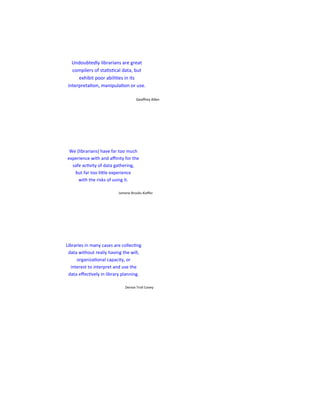
Some interesting quotes about libraries, their abilities in
collecting data and how they use data.
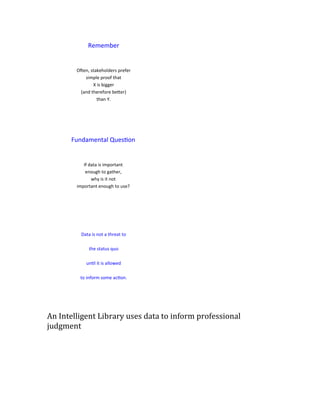
An Intelligent Library uses data to inform professional
judgment
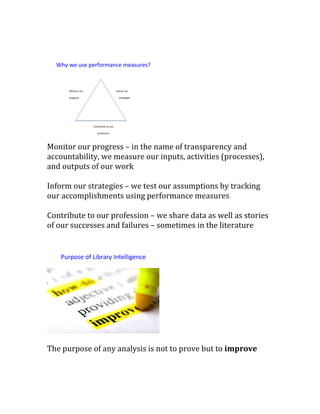
Monitor our progress – in the name of transparency and
accountability, we measure our inputs, activities (processes),
and outputs of our work
Inform our strategies – we test our assumptions by tracking
our accomplishments using performance measures
Contribute to our profession – we share data as well as stories
of our successes and failures – sometimes in the literature
The purpose of any analysis is not to prove but to improve
Why we use performance measures?
Monitor our
progress
Inform our
strategies
Contribute to our
profession
Purpose of Library Intelligence
Library Intelligence = Gates Foundation calls Actionable
Measurement
Communication with stakeholders can often be planned –
monthly, quarterly, annual reports; completion of surveys, etc.
However, we often must respond to request for information
We can do this with immediate online access to . . .
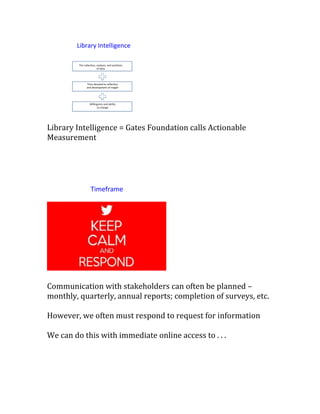
Library Intelligence
The collec on, analysis, and synthesis
of data
Time devoted to reflec on
and development of insight
Willingness and ability
to change
Timeframe
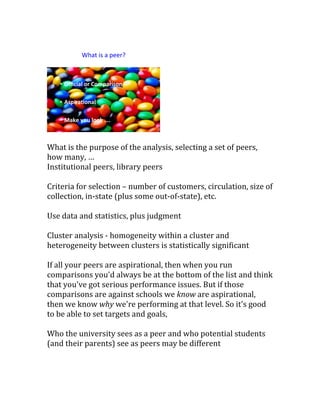
What is the purpose of the analysis, selecting a set of peers,
how many, …
Institutional peers, library peers
Criteria for selection – number of customers, circulation, size of
collection, in-state (plus some out-of-state), etc.
Use data and statistics, plus judgment
Cluster analysis - homogeneity within a cluster and
heterogeneity between clusters is statistically significant
If all your peers are aspirational, then when you run
comparisons you'd always be at the bottom of the list and think
that you've got serious performance issues. But if those
comparisons are against schools we know are aspirational,
then we know why we're performing at that level. So it's good
to be able to set targets and goals,
Who the university sees as a peer and who potential students
(and their parents) see as peers may be different
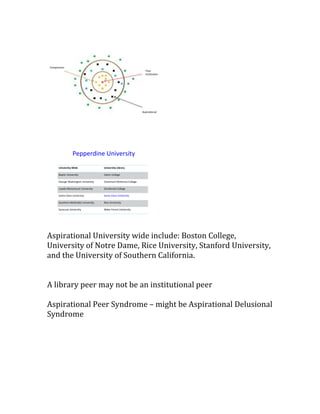
Aspirational University wide include: Boston College,
University of Notre Dame, Rice University, Stanford University,
and the University of Southern California.
A library peer may not be an institutional peer
Aspirational Peer Syndrome – might be Aspirational Delusional
Syndrome
Pepperdine University
University-Wide University Library
Baylor University Calvin College
George Washington University Claremont McKenna College
Loyola Marymount University Occidental College
Santa Clara University Santa Clara University
Southern Methodist University Rice University
Syracuse University Wake Forest University
What is an Intelligent Library?
More concerned about trends and the direction of the trend
than the value of the data at any one point in time
More concerned about trends than data at one point in time
Use data to drive improvement in processes
Trends
Process Improvement
Listens – constantly, using many different tools
Is focused on productivity improvements
Voice of the Customer
Produc vity Improvements
Customer “Quotes” + Data
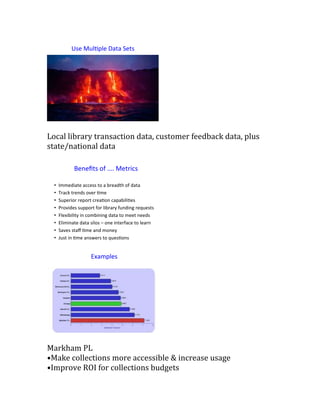
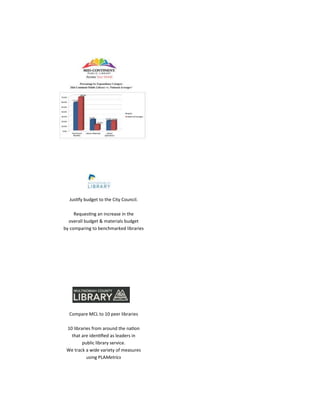
Local library transaction data, customer feedback data, plus
state/national data
Markham PL
•Make collections more accessible & increase usage
•Improve ROI for collections budgets
Examples
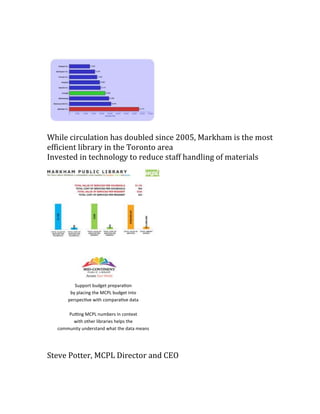
While circulation has doubled since 2005, Markham is the most
efficient library in the Toronto area
Invested in technology to reduce staff handling of materials
Steve Potter, MCPL Director and CEO
Bob Dugan, Univ of West Florida “Talking points” with the
Provost for both peers and aspirants
University of West Florida
Annual Comparisons
Measure Peer Review Comparison to Avg
Services
Total circula on/FTE Highest of 8 Above
Reference transac ons/FTE Highest of 8 Above
ILL loaned/FTE 3 of 8 Above
ILL borrowed/FTE 5 of 8 Below
Ra o of loaned:borrowed 3 of 8 Above
Collec ons
Volumes held/FTE Highest of 8 Above
Titles held/FTE 2 of 8 Above
Journal subscrip ons/FTE 5 of 8 Below
Measures Peer Rank Comparison to Avg.
Expenditures
Total expenditures/FTE Highest of 8 Above
Total resource expend/FTE 6 of 8 Below
Monograph expenditures/FTE 7 of 8 Below
Journal expenditures/FTE 4 of 8 Above
Total eResource expend/FTE 5 of 8 Below
Other expenditures/FTE Tied for last Below
Total staff expenditures/FTE 4 of 8 Below
Salaries of prof staff/FTE 6 of 8 Below
Annual Comparisons
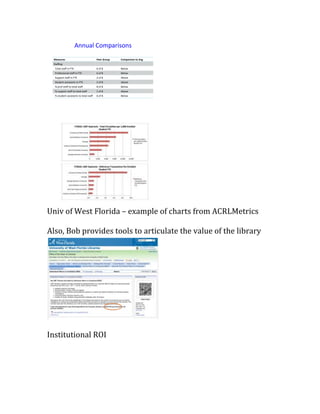
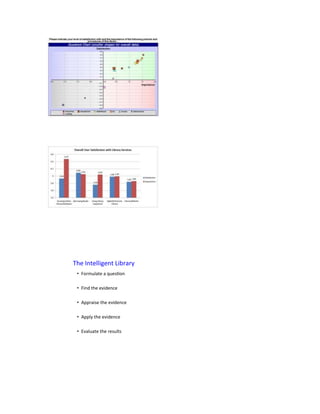
Univ of West Florida – example of charts from ACRLMetrics
Also, Bob provides tools to articulate the value of the library
Institutional ROI
Measures Peer Group Comparison to Avg
Staffing
Total staff in FTE 6 of 8 Below
Professional staff in FTE 6 of 8 Below
Support staff in FTE 2 of 8 Above
Student assistants in FTE 5 of 8 Above
% prof staff to total staff 8 of 8 Below
% support staff to total staff 1 of 8 Above
% student assistants to total staff 6 of 8 Below
Annual Comparisons
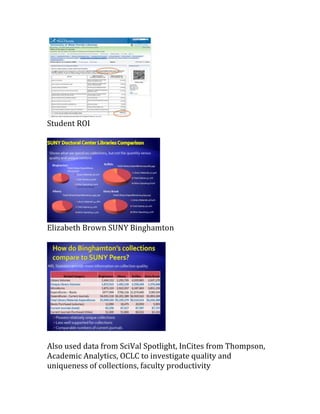
Student ROI
Elizabeth Brown SUNY Binghamton
Also used data from SciVal Spotlight, InCites from Thompson,
Academic Analytics, OCLC to investigate quality and
uniqueness of collections, faculty productivity
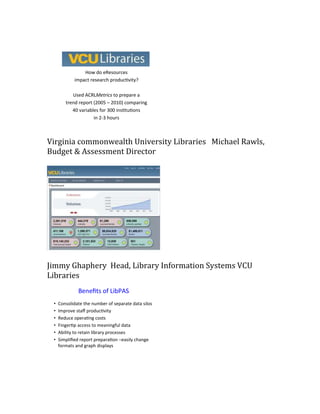
Virginia commonwealth University Libraries Michael Rawls,
Budget & Assessment Director
Jimmy Ghaphery Head, Library Information Systems VCU
Libraries
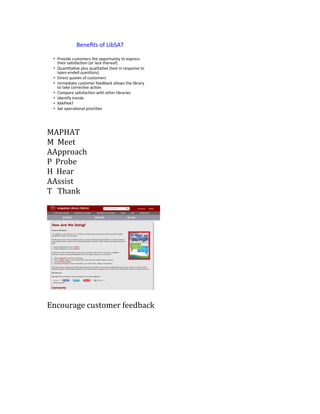
MAPHAT
M Meet
AApproach
P Probe
H Hear
AAssist
T Thank
Encourage customer feedback
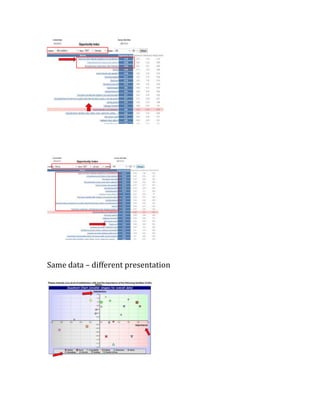
Same data – different presentation
What measures of library success will resonate in your
organizational setting?
Be visible with your funding decision makers – build personal
connections
In your environment, how is value defined, measured &
communicated?
Alignment Organization’s mission and goals
What is a valuable library? One that contributes to reaching
the goals and objectives of the organization.
What is an Intelligent Library? One that not only collects data
but uses it to inform its actions and communicates its value to
stakeholders
Use charts and graphs rather than showing lots of data (but
have the data to back up your charts)
May not be necessary to specialize as this organization has
Funding for libraries is a reflection of public or campus support
Support (in the form of your budget) reflects the perceived
value of the library to each family, student, faculty member –
In short, to your community
However, the value is judged in the context of today’s
economy and today’s society
Tell your story in numbers and stories
Your message – “We have contributed towards YOUR goals by
….”
Or “We have contributed towards OUR goals by ….”
Stories + Stats = Success
Use lots of color and excitement to convey both written and
spoken stories of the value of the library
These quotes bear repeating
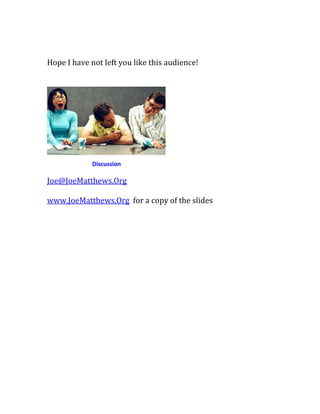
Hope I have not left you like this audience!
Joe@JoeMatthews.Org
www.JoeMatthews.Org for a copy of the slides
Discussion

Intelligent library presentation

  • 1.
    Intelligent Library Presentation IntelligentLibrary is one that uses a variety of data to make decisions about collections, services, staffing, and facilities Intelligent Library may also be know as one that uses Evidence-based Librarianship Some interesting quotes about libraries, their abilities in collecting data and how they use data.
  • 3.
    An Intelligent Libraryuses data to inform professional judgment
  • 4.
    Monitor our progress– in the name of transparency and accountability, we measure our inputs, activities (processes), and outputs of our work Inform our strategies – we test our assumptions by tracking our accomplishments using performance measures Contribute to our profession – we share data as well as stories of our successes and failures – sometimes in the literature The purpose of any analysis is not to prove but to improve Why we use performance measures? Monitor our progress Inform our strategies Contribute to our profession Purpose of Library Intelligence
  • 5.
    Library Intelligence =Gates Foundation calls Actionable Measurement Communication with stakeholders can often be planned – monthly, quarterly, annual reports; completion of surveys, etc. However, we often must respond to request for information We can do this with immediate online access to . . . Library Intelligence The collec on, analysis, and synthesis of data Time devoted to reflec on and development of insight Willingness and ability to change Timeframe
  • 7.
    What is thepurpose of the analysis, selecting a set of peers, how many, … Institutional peers, library peers Criteria for selection – number of customers, circulation, size of collection, in-state (plus some out-of-state), etc. Use data and statistics, plus judgment Cluster analysis - homogeneity within a cluster and heterogeneity between clusters is statistically significant If all your peers are aspirational, then when you run comparisons you'd always be at the bottom of the list and think that you've got serious performance issues. But if those comparisons are against schools we know are aspirational, then we know why we're performing at that level. So it's good to be able to set targets and goals, Who the university sees as a peer and who potential students (and their parents) see as peers may be different
  • 8.
    Aspirational University wideinclude: Boston College, University of Notre Dame, Rice University, Stanford University, and the University of Southern California. A library peer may not be an institutional peer Aspirational Peer Syndrome – might be Aspirational Delusional Syndrome Pepperdine University University-Wide University Library Baylor University Calvin College George Washington University Claremont McKenna College Loyola Marymount University Occidental College Santa Clara University Santa Clara University Southern Methodist University Rice University Syracuse University Wake Forest University
  • 9.
    What is anIntelligent Library? More concerned about trends and the direction of the trend than the value of the data at any one point in time More concerned about trends than data at one point in time Use data to drive improvement in processes Trends Process Improvement
  • 10.
    Listens – constantly,using many different tools Is focused on productivity improvements Voice of the Customer Produc vity Improvements Customer “Quotes” + Data
  • 11.
    Local library transactiondata, customer feedback data, plus state/national data Markham PL •Make collections more accessible & increase usage •Improve ROI for collections budgets Examples
  • 12.
    While circulation hasdoubled since 2005, Markham is the most efficient library in the Toronto area Invested in technology to reduce staff handling of materials Steve Potter, MCPL Director and CEO
  • 14.
    Bob Dugan, Univof West Florida “Talking points” with the Provost for both peers and aspirants University of West Florida Annual Comparisons Measure Peer Review Comparison to Avg Services Total circula on/FTE Highest of 8 Above Reference transac ons/FTE Highest of 8 Above ILL loaned/FTE 3 of 8 Above ILL borrowed/FTE 5 of 8 Below Ra o of loaned:borrowed 3 of 8 Above Collec ons Volumes held/FTE Highest of 8 Above Titles held/FTE 2 of 8 Above Journal subscrip ons/FTE 5 of 8 Below Measures Peer Rank Comparison to Avg. Expenditures Total expenditures/FTE Highest of 8 Above Total resource expend/FTE 6 of 8 Below Monograph expenditures/FTE 7 of 8 Below Journal expenditures/FTE 4 of 8 Above Total eResource expend/FTE 5 of 8 Below Other expenditures/FTE Tied for last Below Total staff expenditures/FTE 4 of 8 Below Salaries of prof staff/FTE 6 of 8 Below Annual Comparisons
  • 15.
    Univ of WestFlorida – example of charts from ACRLMetrics Also, Bob provides tools to articulate the value of the library Institutional ROI Measures Peer Group Comparison to Avg Staffing Total staff in FTE 6 of 8 Below Professional staff in FTE 6 of 8 Below Support staff in FTE 2 of 8 Above Student assistants in FTE 5 of 8 Above % prof staff to total staff 8 of 8 Below % support staff to total staff 1 of 8 Above % student assistants to total staff 6 of 8 Below Annual Comparisons
  • 16.
    Student ROI Elizabeth BrownSUNY Binghamton Also used data from SciVal Spotlight, InCites from Thompson, Academic Analytics, OCLC to investigate quality and uniqueness of collections, faculty productivity
  • 17.
    Virginia commonwealth UniversityLibraries Michael Rawls, Budget & Assessment Director Jimmy Ghaphery Head, Library Information Systems VCU Libraries
  • 18.
    MAPHAT M Meet AApproach P Probe HHear AAssist T Thank Encourage customer feedback
  • 19.
    Same data –different presentation
  • 21.
    What measures oflibrary success will resonate in your organizational setting? Be visible with your funding decision makers – build personal connections In your environment, how is value defined, measured & communicated?
  • 22.
    Alignment Organization’s missionand goals What is a valuable library? One that contributes to reaching the goals and objectives of the organization. What is an Intelligent Library? One that not only collects data but uses it to inform its actions and communicates its value to stakeholders Use charts and graphs rather than showing lots of data (but have the data to back up your charts) May not be necessary to specialize as this organization has
  • 23.
    Funding for librariesis a reflection of public or campus support Support (in the form of your budget) reflects the perceived value of the library to each family, student, faculty member – In short, to your community However, the value is judged in the context of today’s economy and today’s society Tell your story in numbers and stories Your message – “We have contributed towards YOUR goals by ….” Or “We have contributed towards OUR goals by ….” Stories + Stats = Success
  • 24.
    Use lots ofcolor and excitement to convey both written and spoken stories of the value of the library These quotes bear repeating
  • 25.
    Hope I havenot left you like this audience! Joe@JoeMatthews.Org www.JoeMatthews.Org for a copy of the slides Discussion