Using LibQUAL+® to Identify 
Commonalities in 
Customer Satisfaction: 
The Secret to Success? 
Selena Killick 
Cranfield University 
Anne van Weerden 
Utrecht University
LibQUAL+ 
Internationally Renown 
Web based 
Standardised 
Expectations & Perceptions 
LibQUAL+®
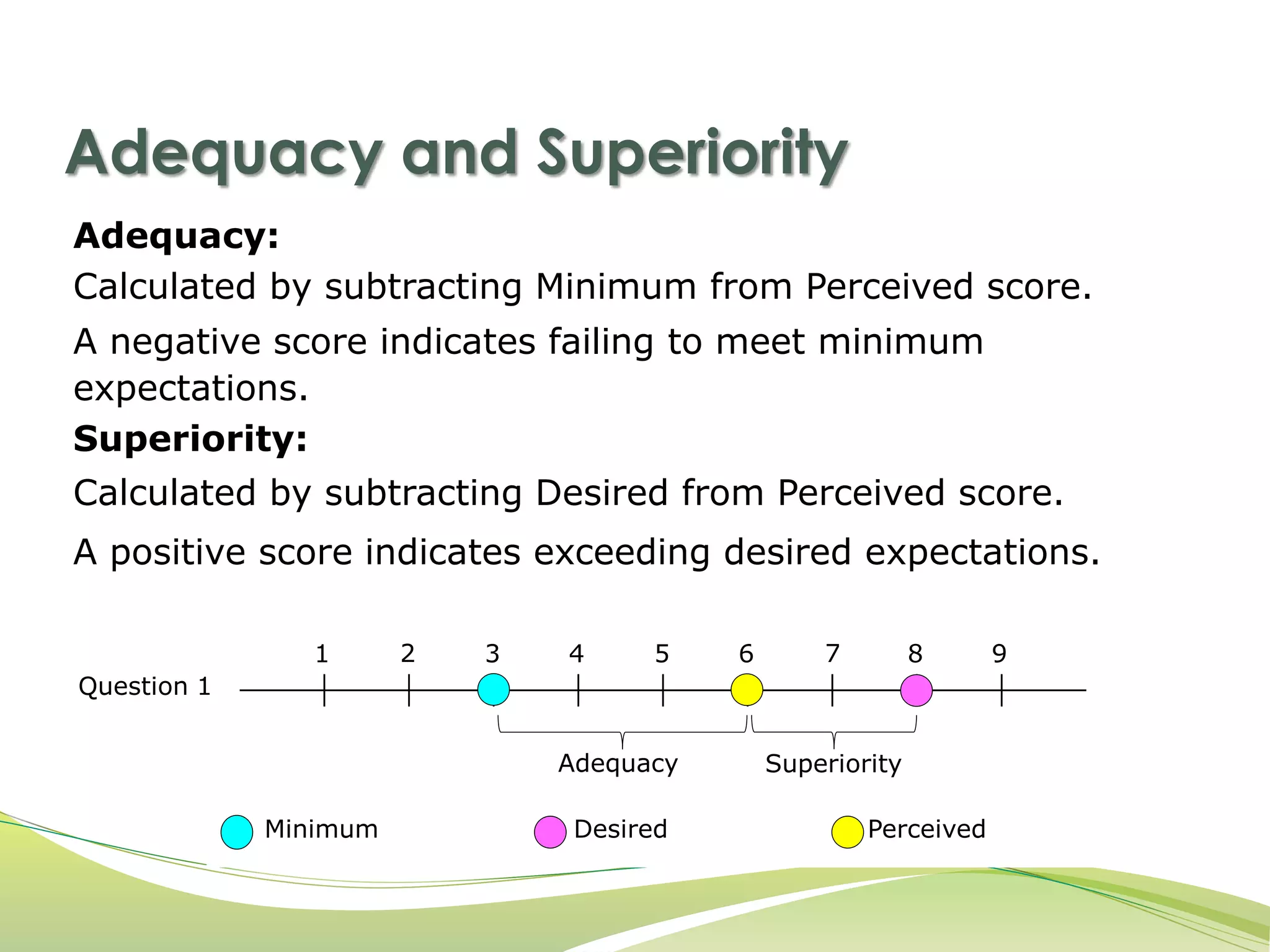
Adequacy and Superiority 
Adequacy: 
Calculated by subtracting Minimum from Perceived score. 
A negative score indicates failing to meet minimum 
expectations. 
Superiority: 
Calculated by subtracting Desired from Perceived score. 
A positive score indicates exceeding desired expectations. 
Question 1 
1 2 3 4 5 6 7 8 9 
Adequacy Superiority 
Minimum Desired Perceived
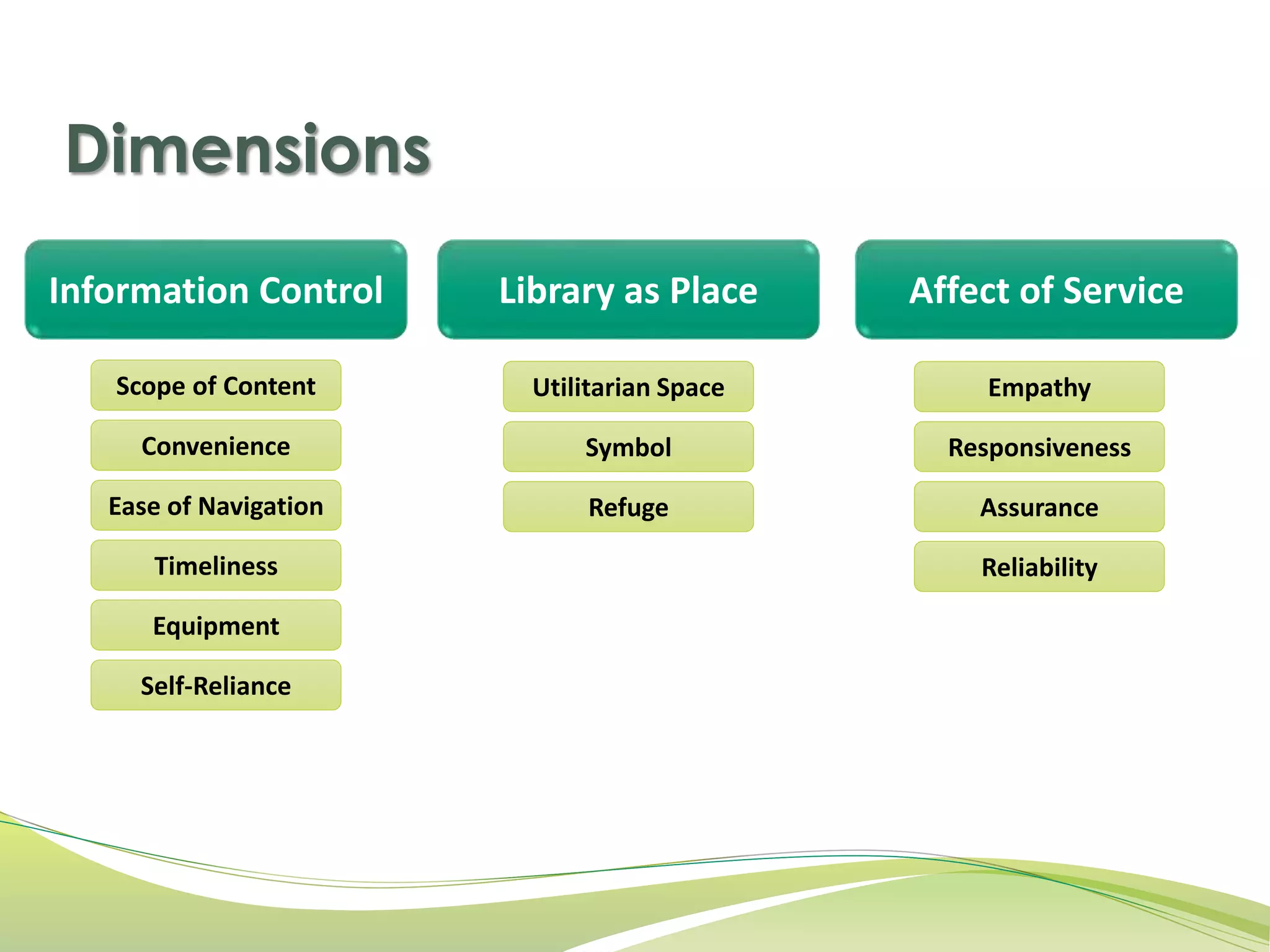
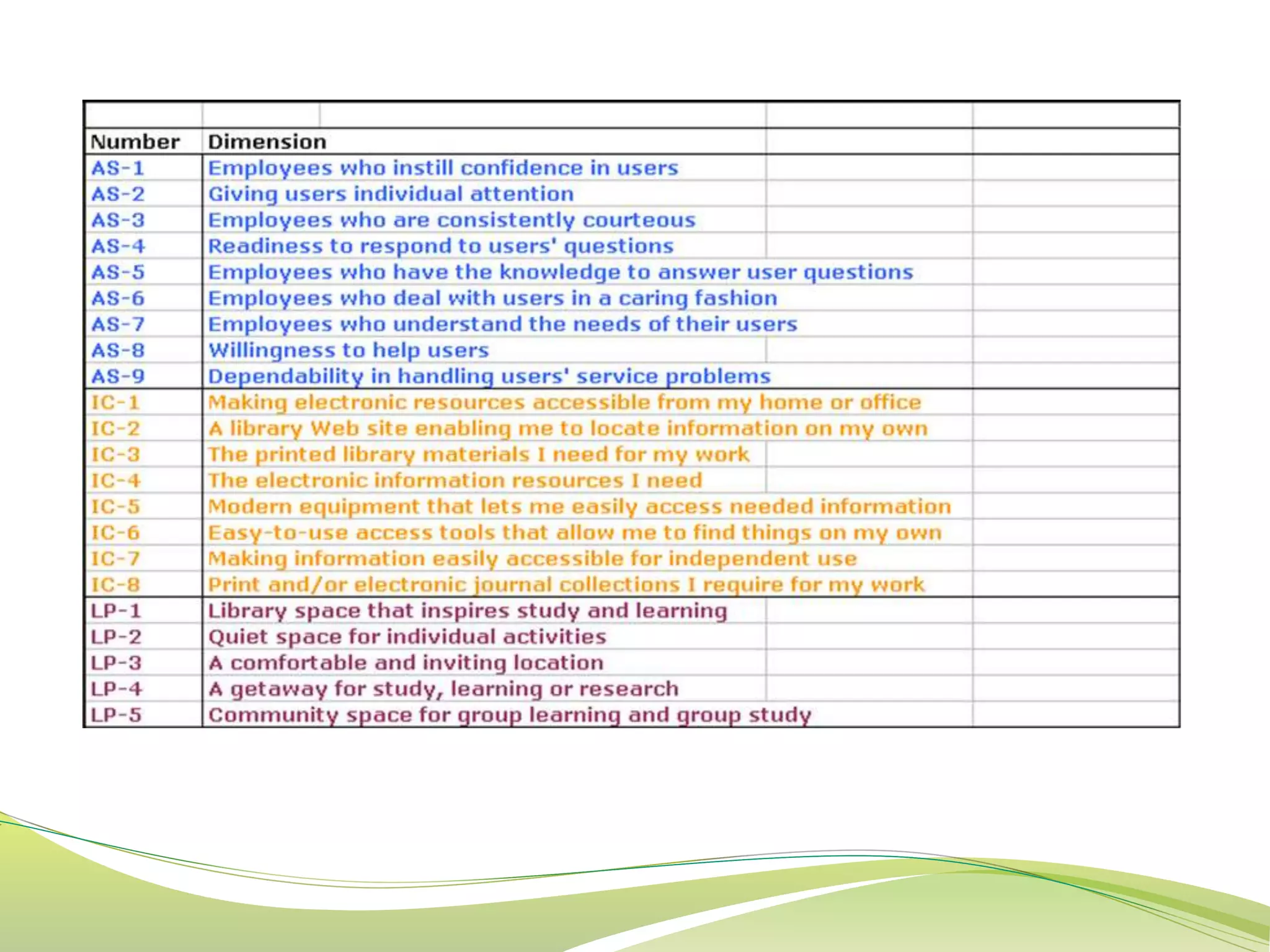
Dimensions 
Affect of Service 
Empathy 
Responsiveness 
Assurance 
Reliability 
Information Control 
Scope of Content 
Convenience 
Ease of Navigation 
Timeliness 
Equipment 
Self-Reliance 
Library as Place 
Utilitarian Space 
Symbol 
Refuge
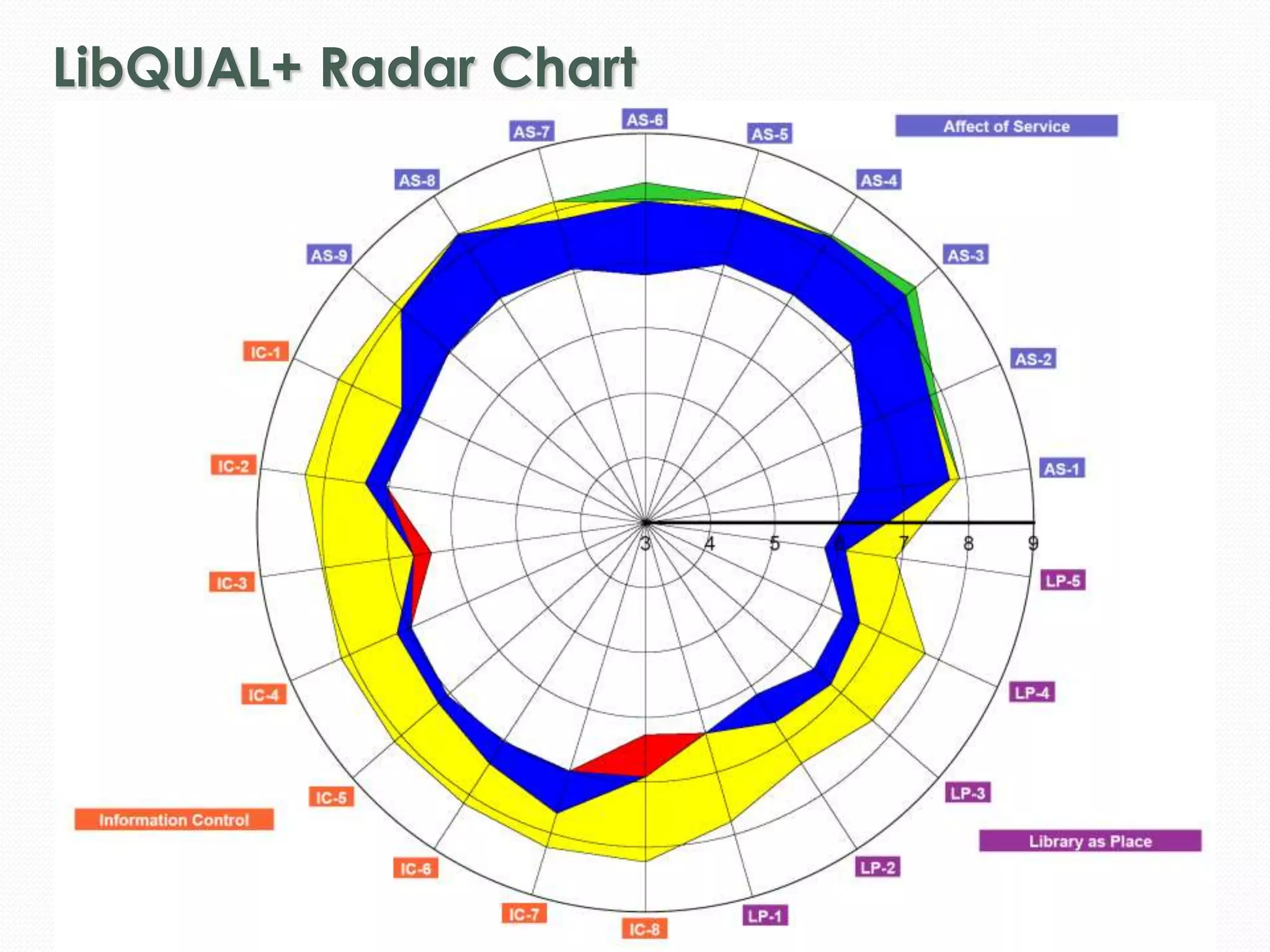
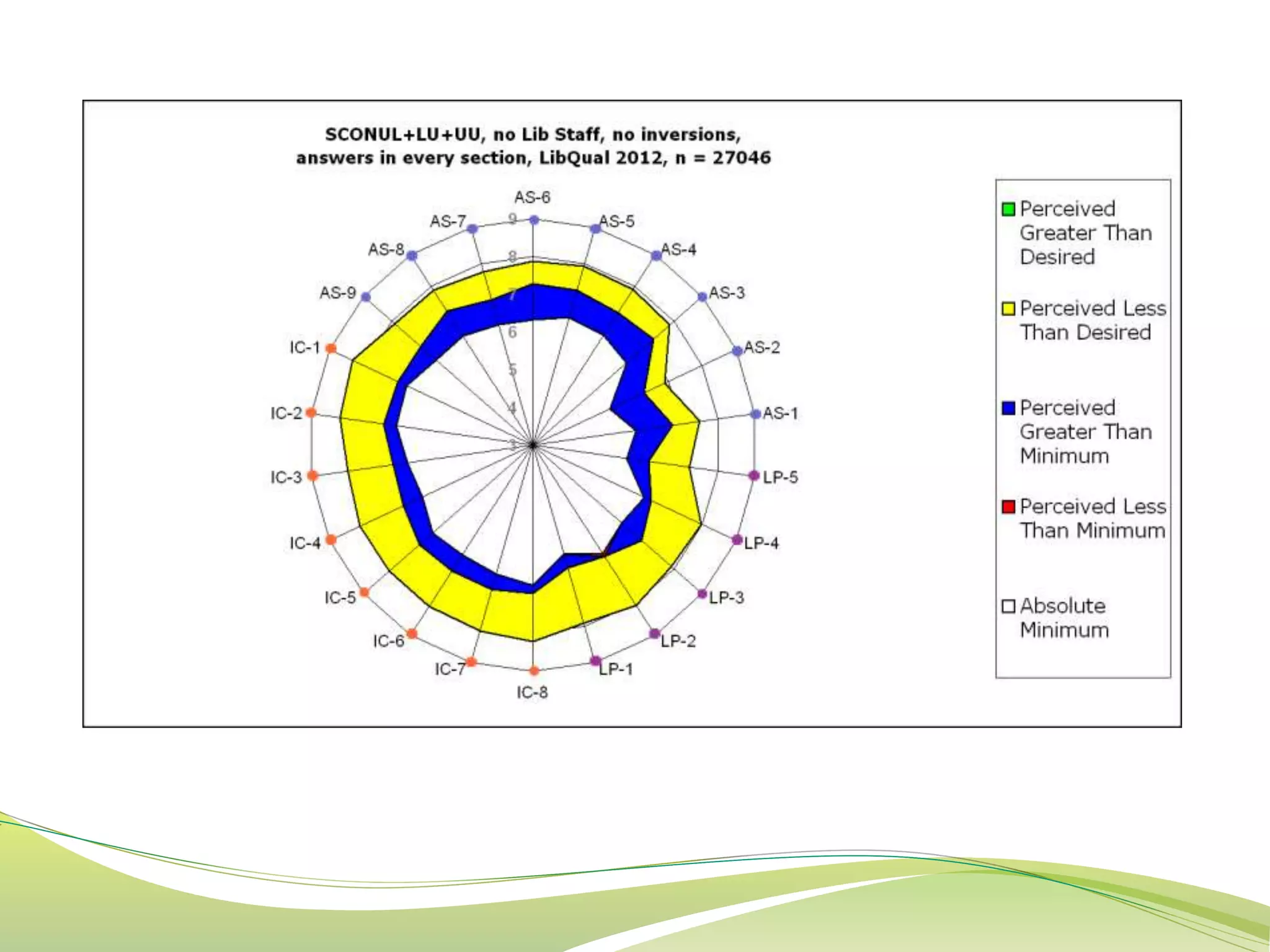
LibQUAL+ Radar Chart
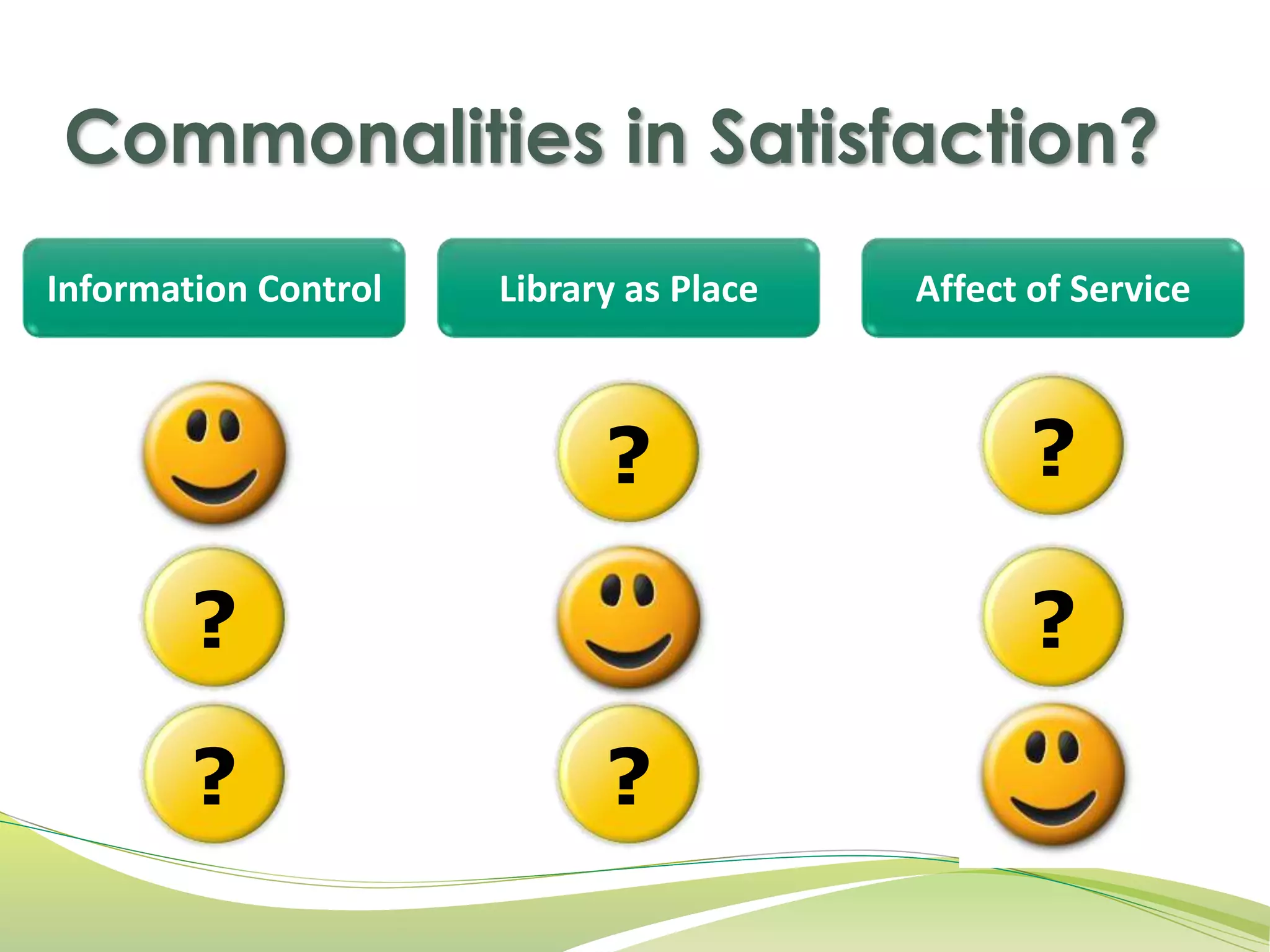
Commonalities in Satisfaction? 
Information Control Library as Place Affect of Service 
? ? 
? 
? 
? 
?
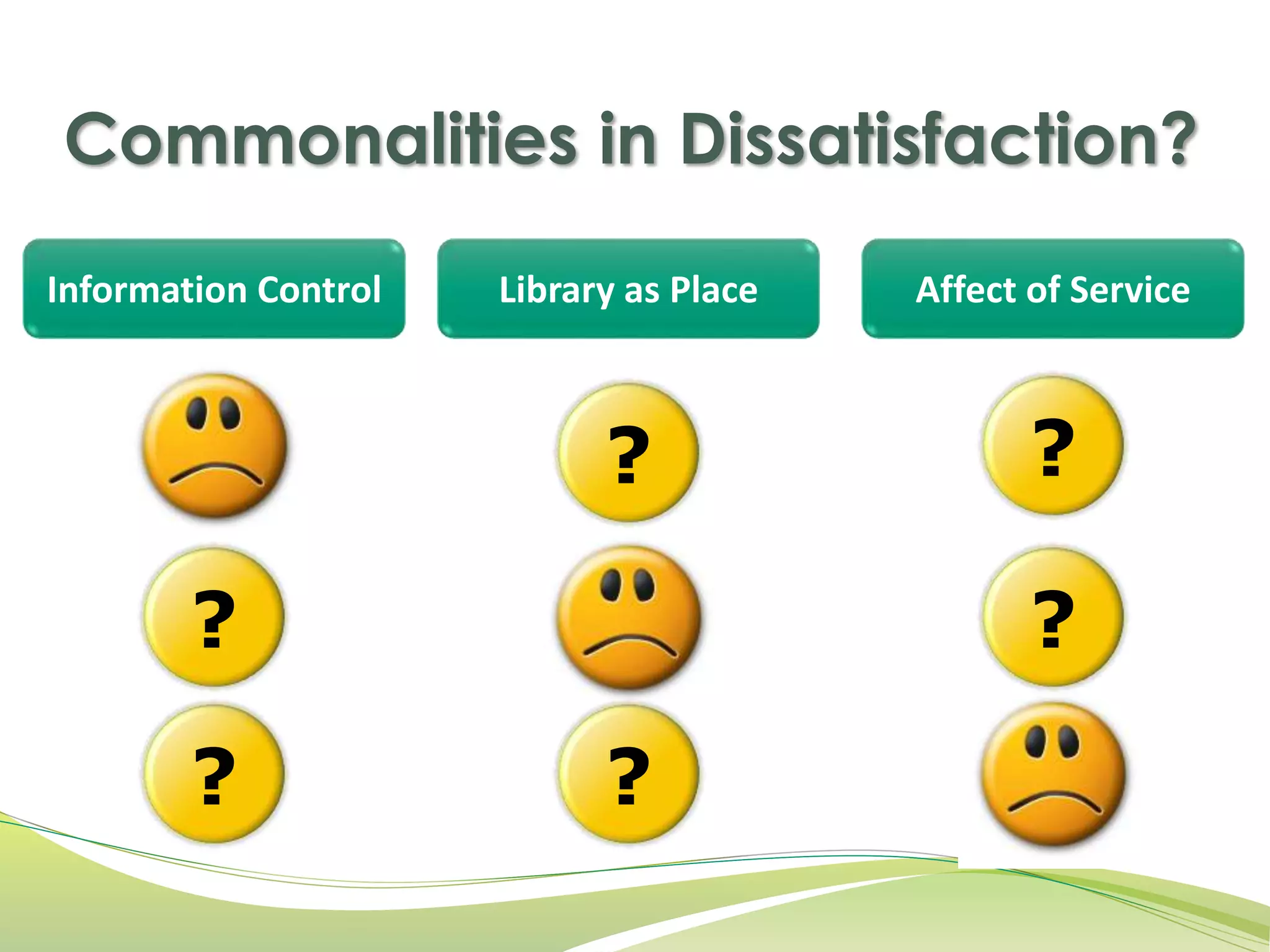
Commonalities in Dissatisfaction? 
Information Control Library as Place Affect of Service 
? ? 
? 
? ? 
?
Sample Group 
Utrecht University, Netherlands 
 n = 1,851 (long) 
Leiden University, Netherlands 
 n = 3,761 (lite) 
SCONUL Consortium 
 17 Higher Education Institutions from the UK 
and Ireland 
 n = 28,208 (lite/long) 
All surveys conducted Jan-Dec 2012
Methodology
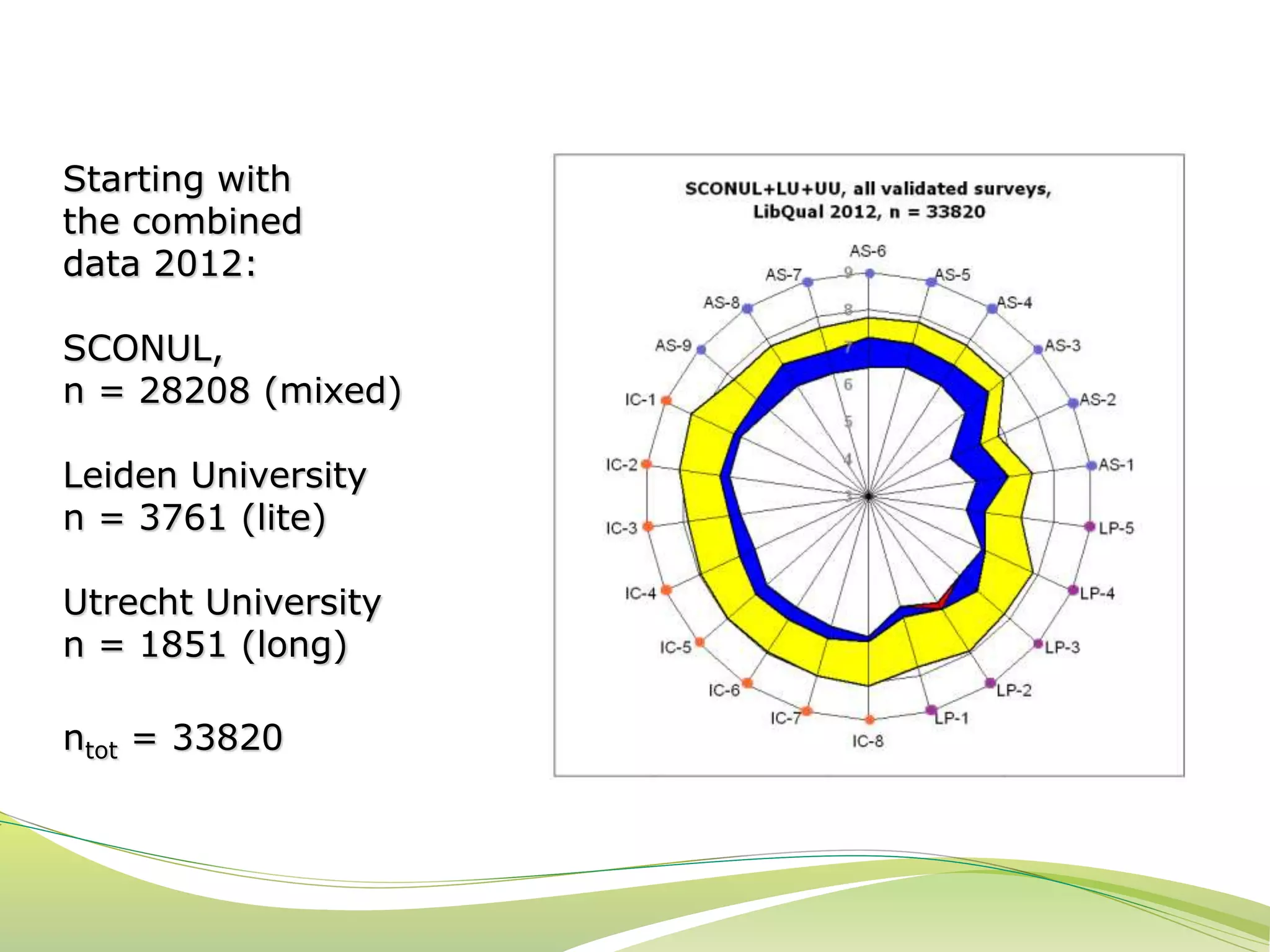
Starting with 
the combined 
data 2012: 
SCONUL, 
n = 28208 (mixed) 
Leiden University 
n = 3761 (lite) 
Utrecht University 
n = 1851 (long) 
ntot = 33820
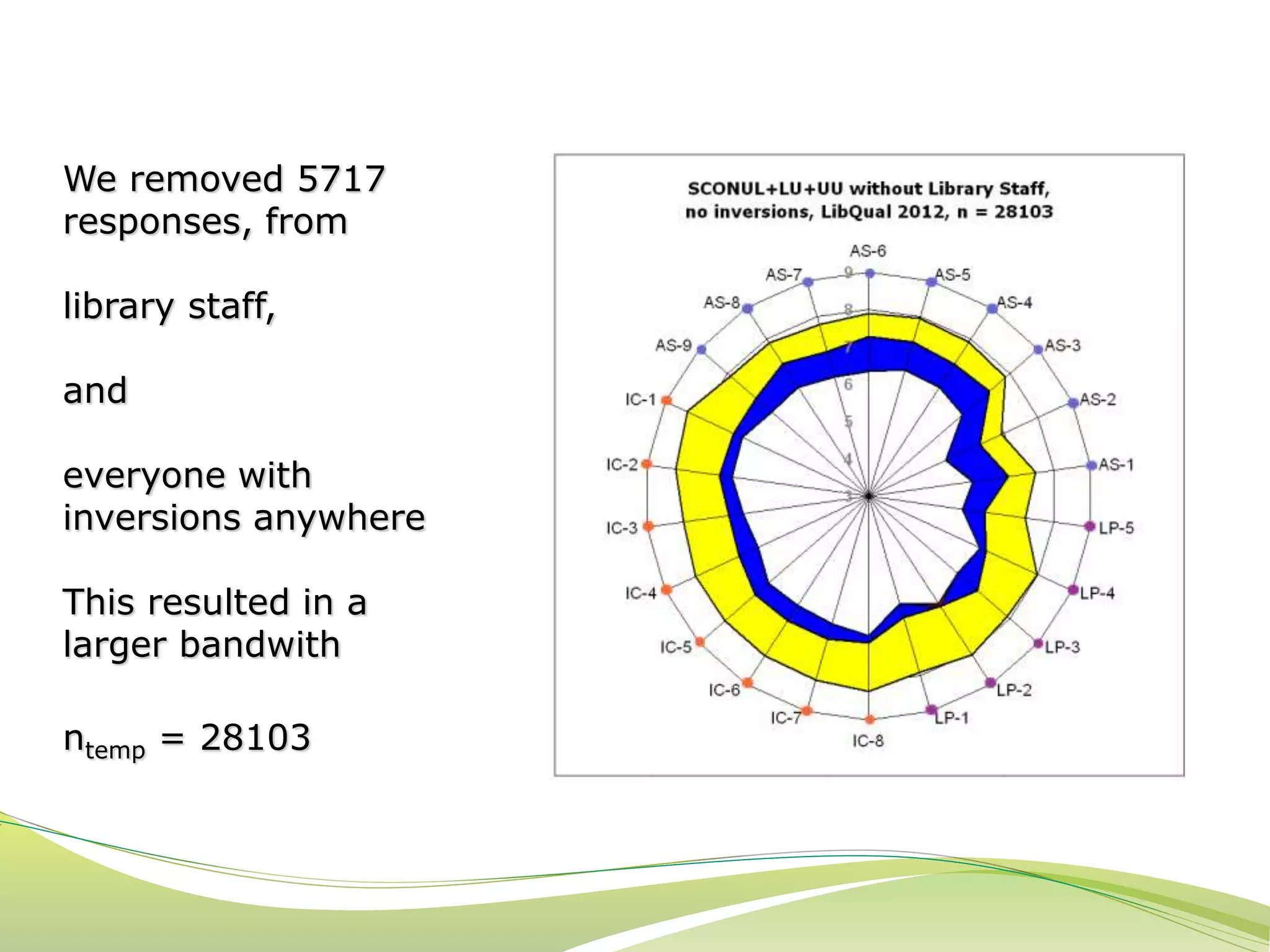
We removed 5717 
responses, from 
library staff, 
and 
everyone with 
inversions anywhere 
This resulted in a 
larger bandwith 
ntemp = 28103
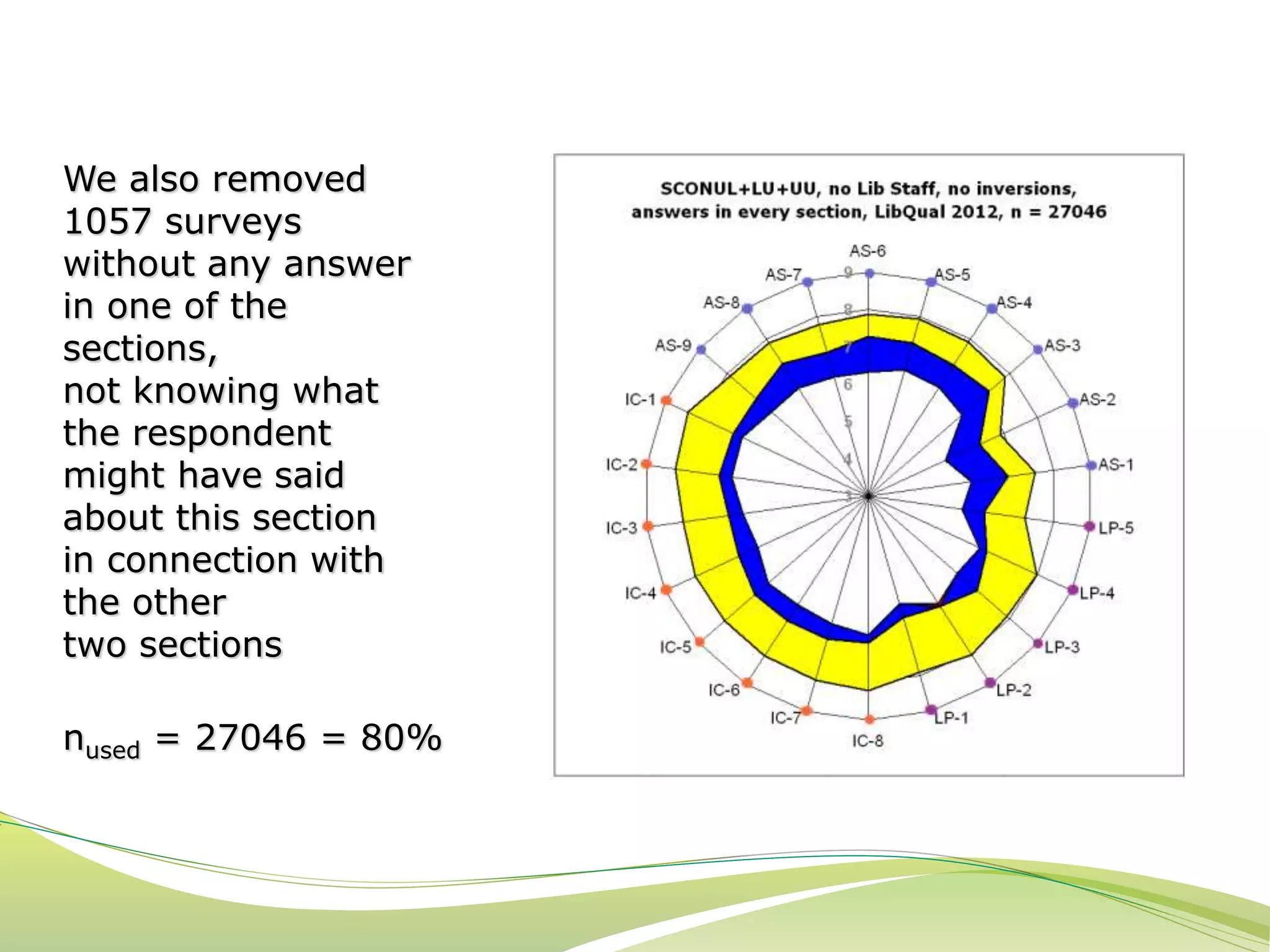
We also removed 
1057 surveys 
without any answer 
in one of the 
sections, 
not knowing what 
the respondent 
might have said 
about this section 
in connection with 
the other 
two sections 
nused = 27046 = 80%
Definitions of satisfied/dissatisfied
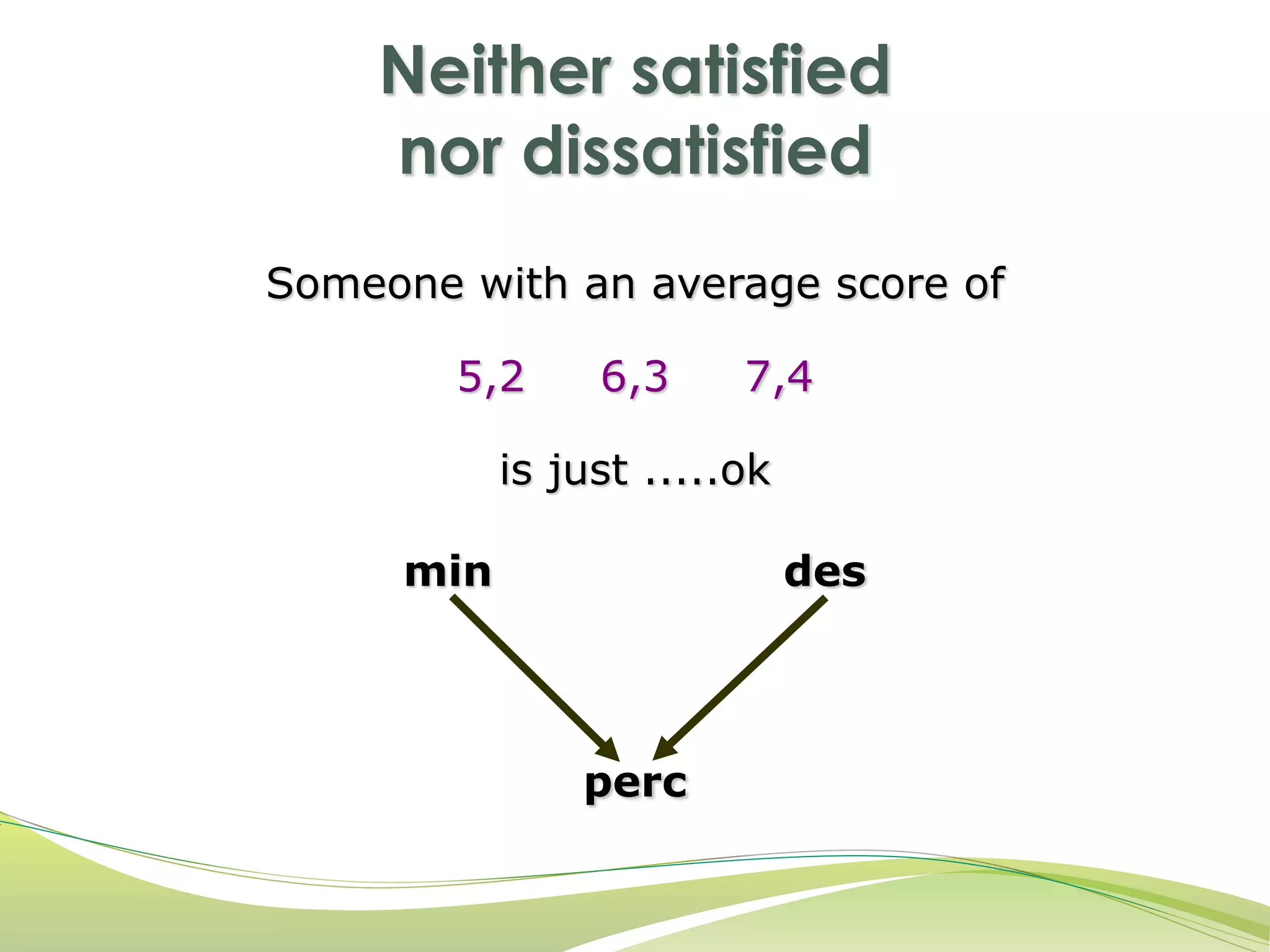
Neither satisfied 
nor dissatisfied 
Someone with an average score of 
5,2 6,3 7,4 
is just .....ok 
min des 
perc
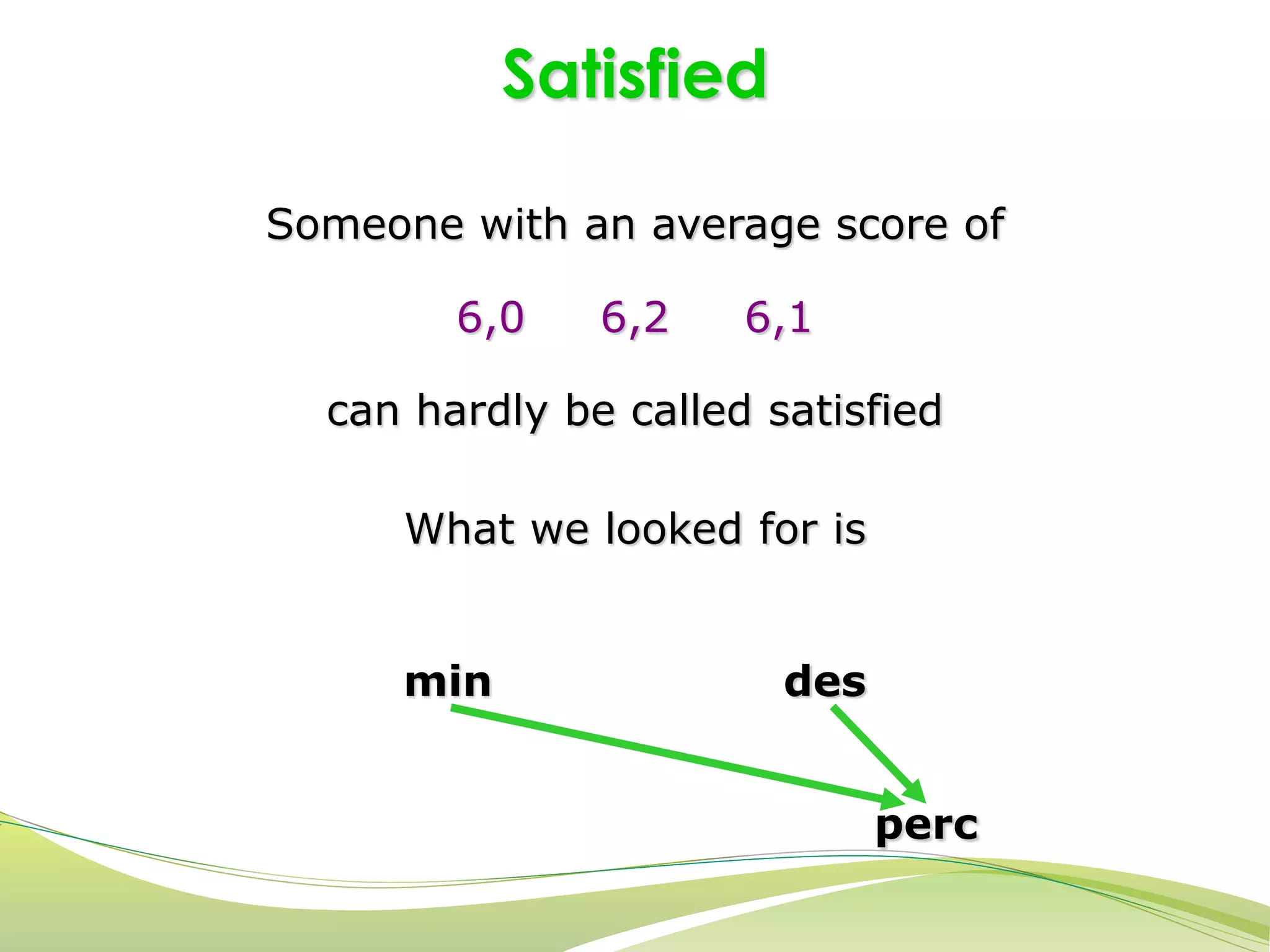
Satisfied 
Someone with an average score of 
6,0 6,2 6,1 
can hardly be called satisfied 
What we looked for is 
min des 
perc
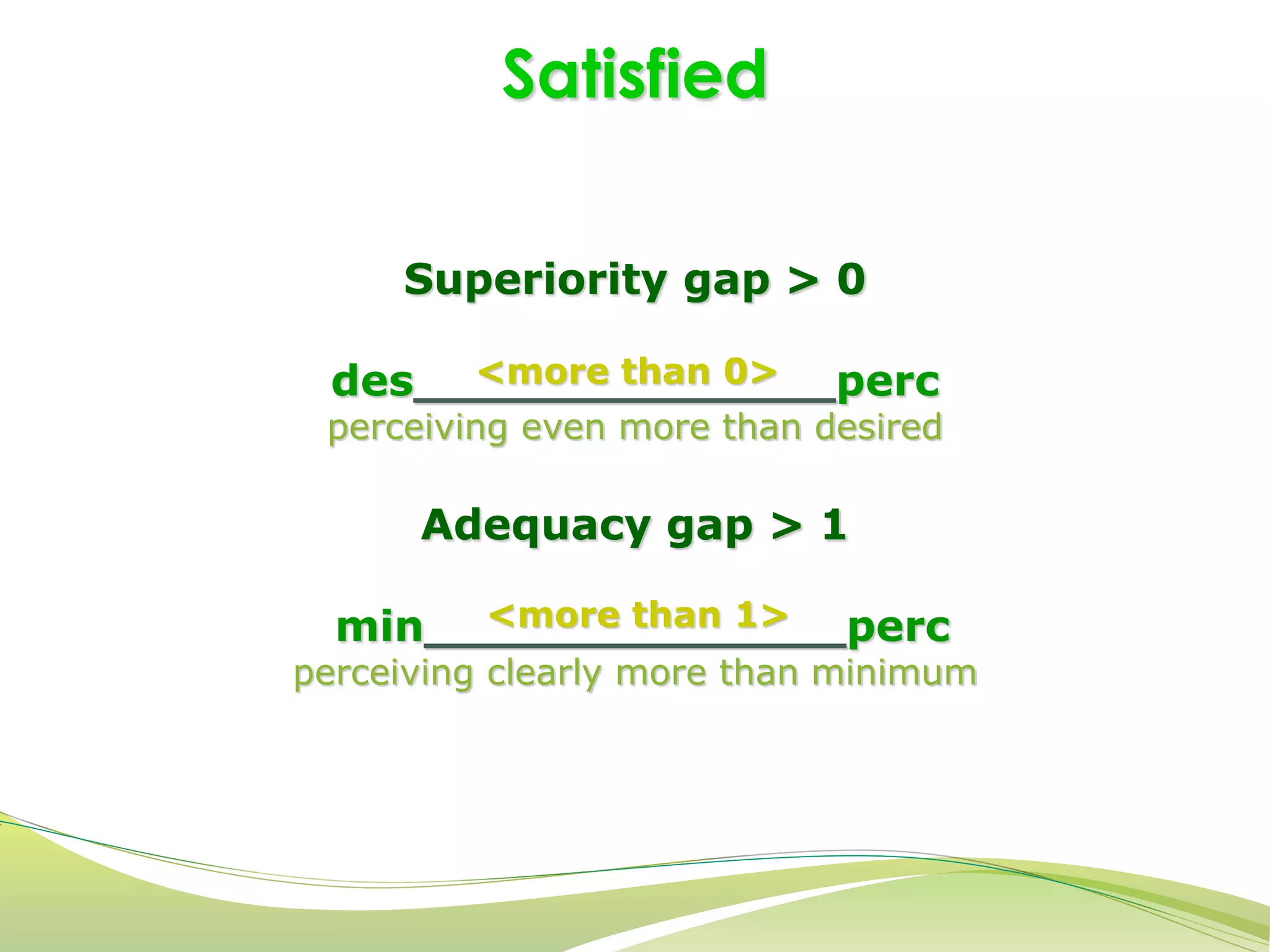
Satisfied 
Superiority gap > 0 
<more than 0> 
des______________perc 
perceiving even more than desired 
xxxxxxxxxxxxxxxxxxxxxxxxxxxx 
Adequacy gap > 1 
<more than 1> 
min______________perc 
perceiving clearly more than minimum
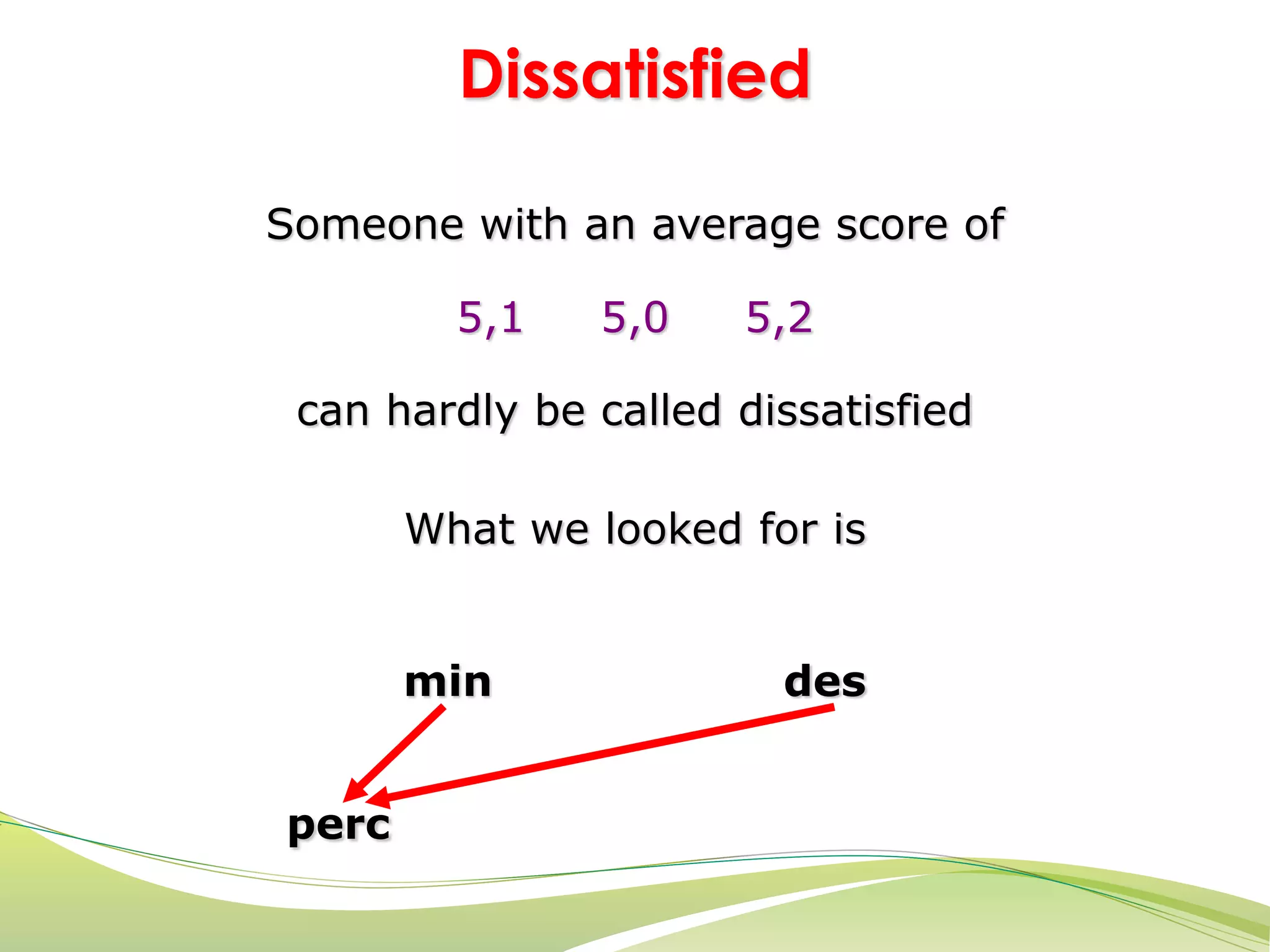
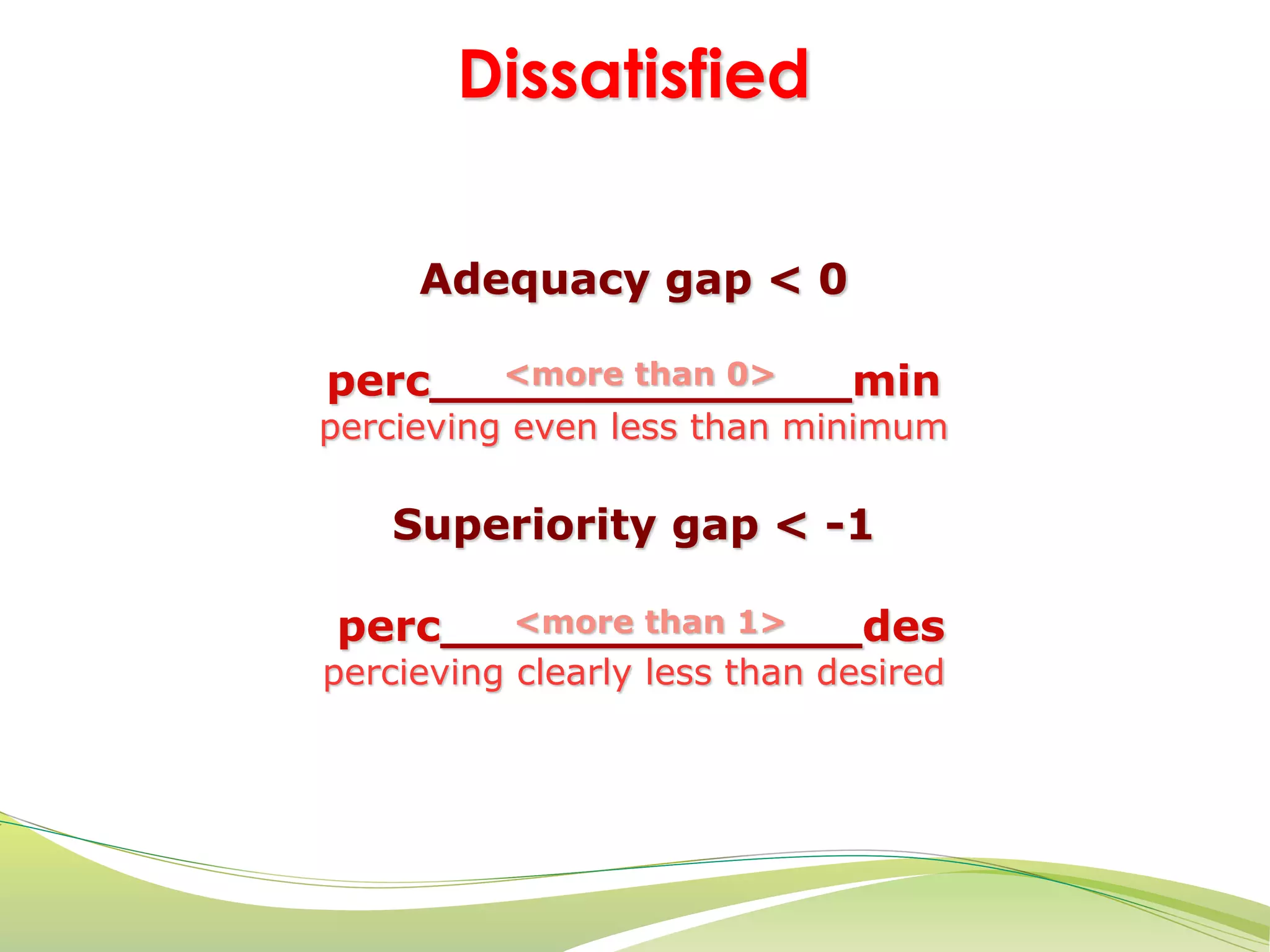
Dissatisfied 
Someone with an average score of 
5,1 5,0 5,2 
can hardly be called dissatisfied 
What we looked for is 
min des 
perc xxxxxxxxx
Dissatisfied 
Adequacy gap < 0 
<more than 0> 
perc______________min 
percieving even less than minimum 
xxxxxxxxxxxxxxxxxxxxxxxxxxxx 
Superiority gap < -1 
perc______________<more than 1> 
des 
percieving clearly less than desired
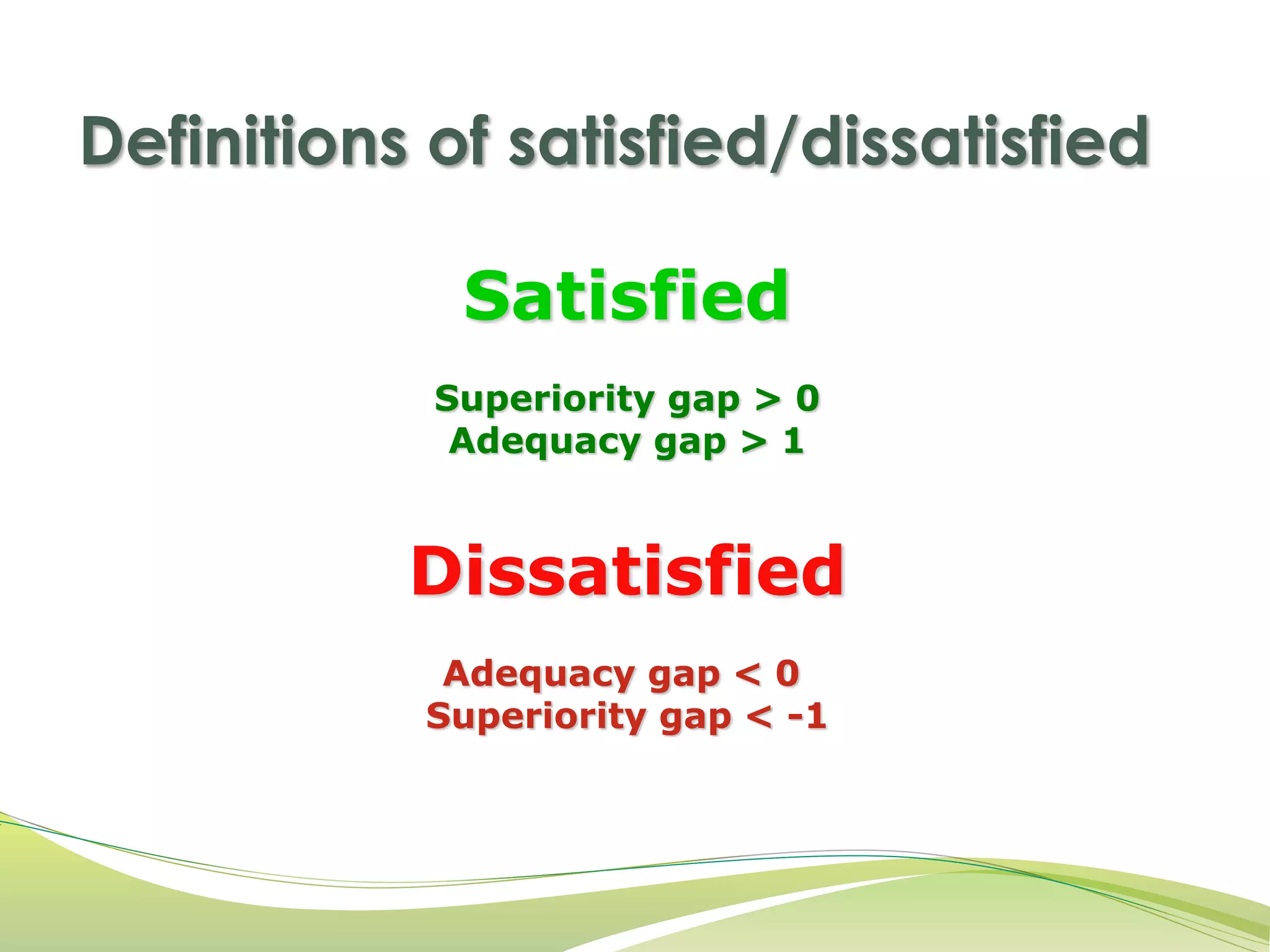
Definitions of satisfied/dissatisfied 
Satisfied 
Superiority gap > 0 
Adequacy gap > 1 
Dissatisfied 
Adequacy gap < 0 
Superiority gap < -1
Outcomes
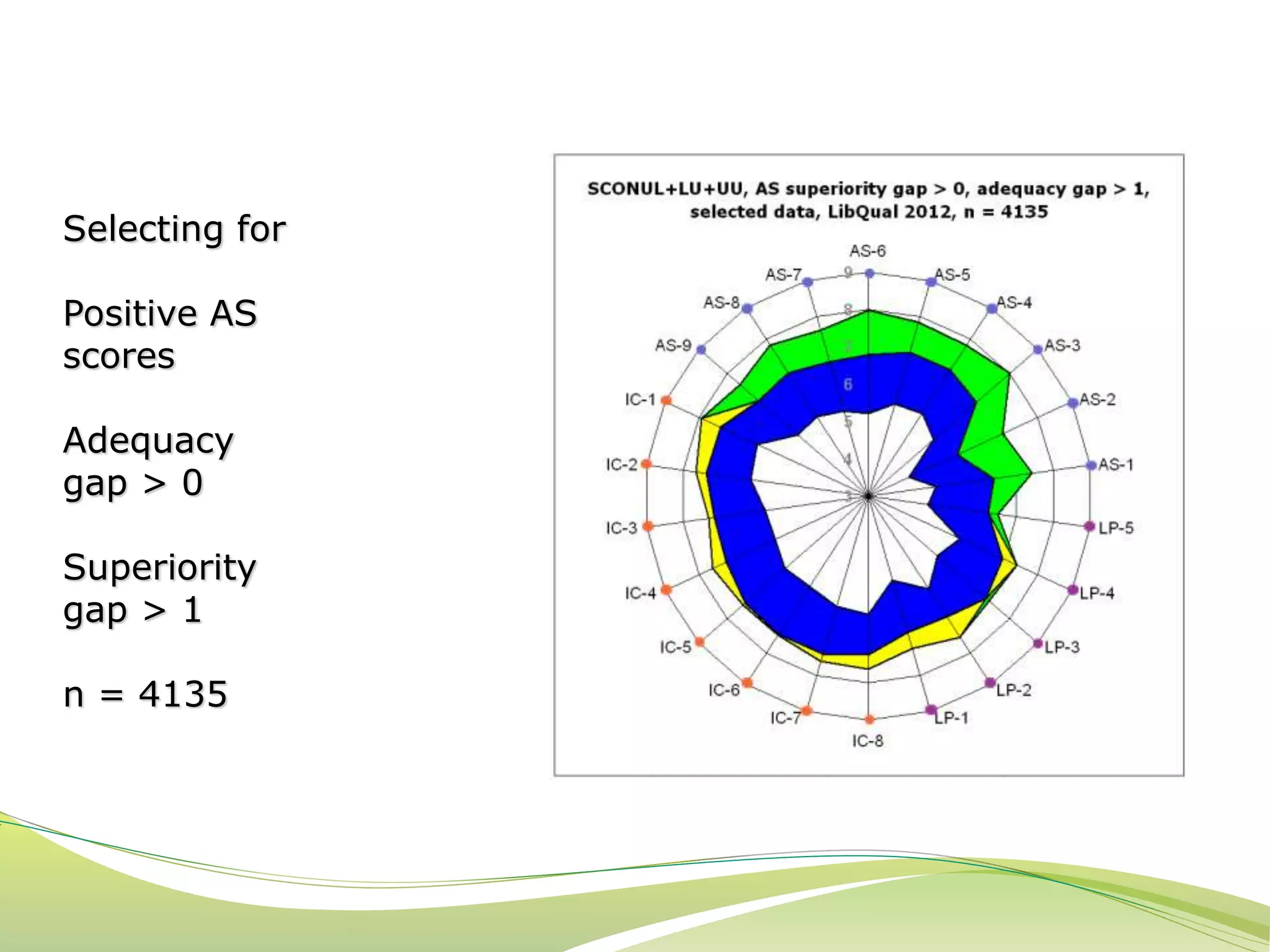
Selecting for 
Positive AS 
scores 
Adequacy 
gap > 0 
Superiority 
gap > 1 
n = 4135
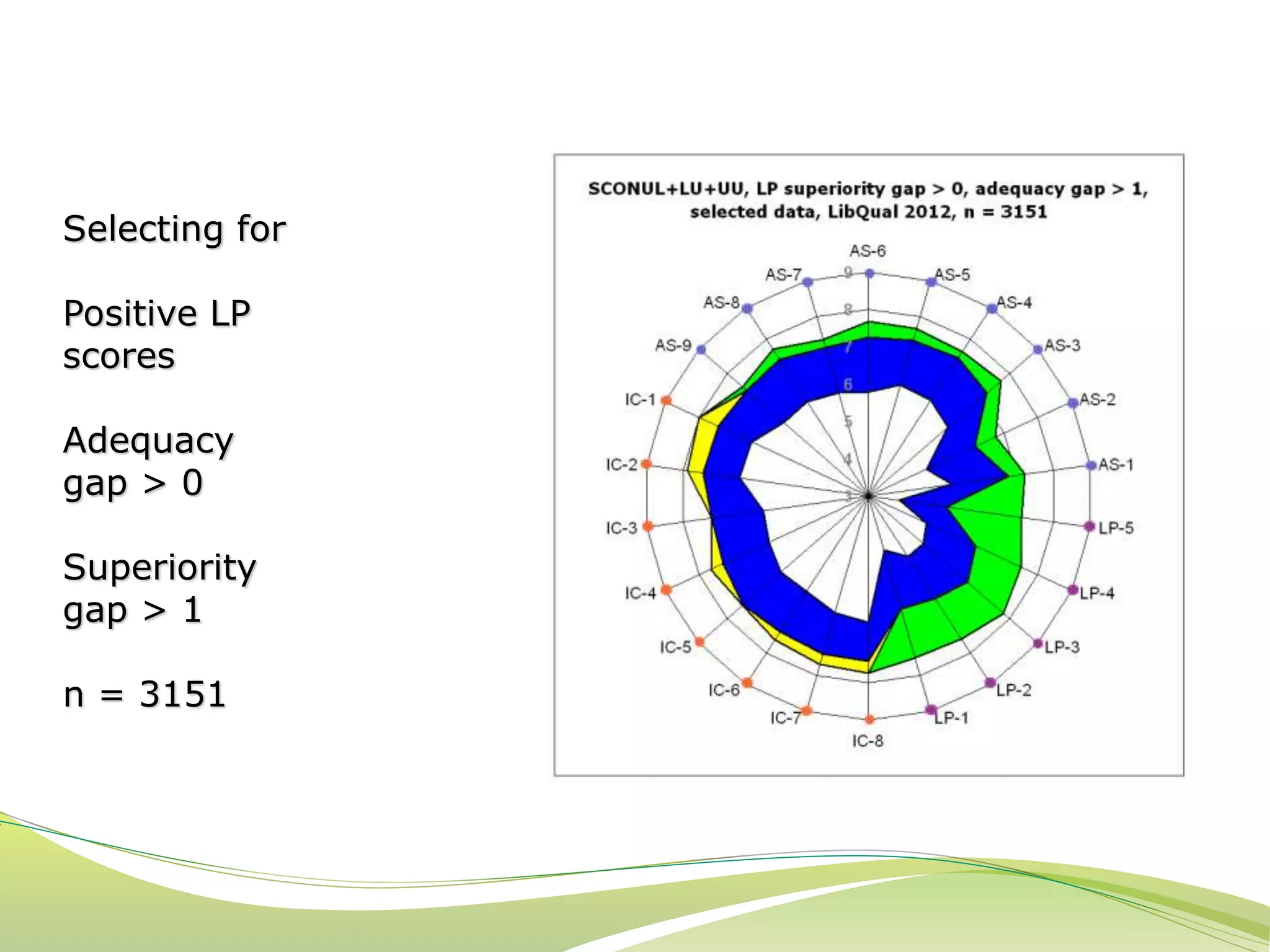
Selecting for 
Positive LP 
scores 
Adequacy 
gap > 0 
Superiority 
gap > 1 
n = 3151
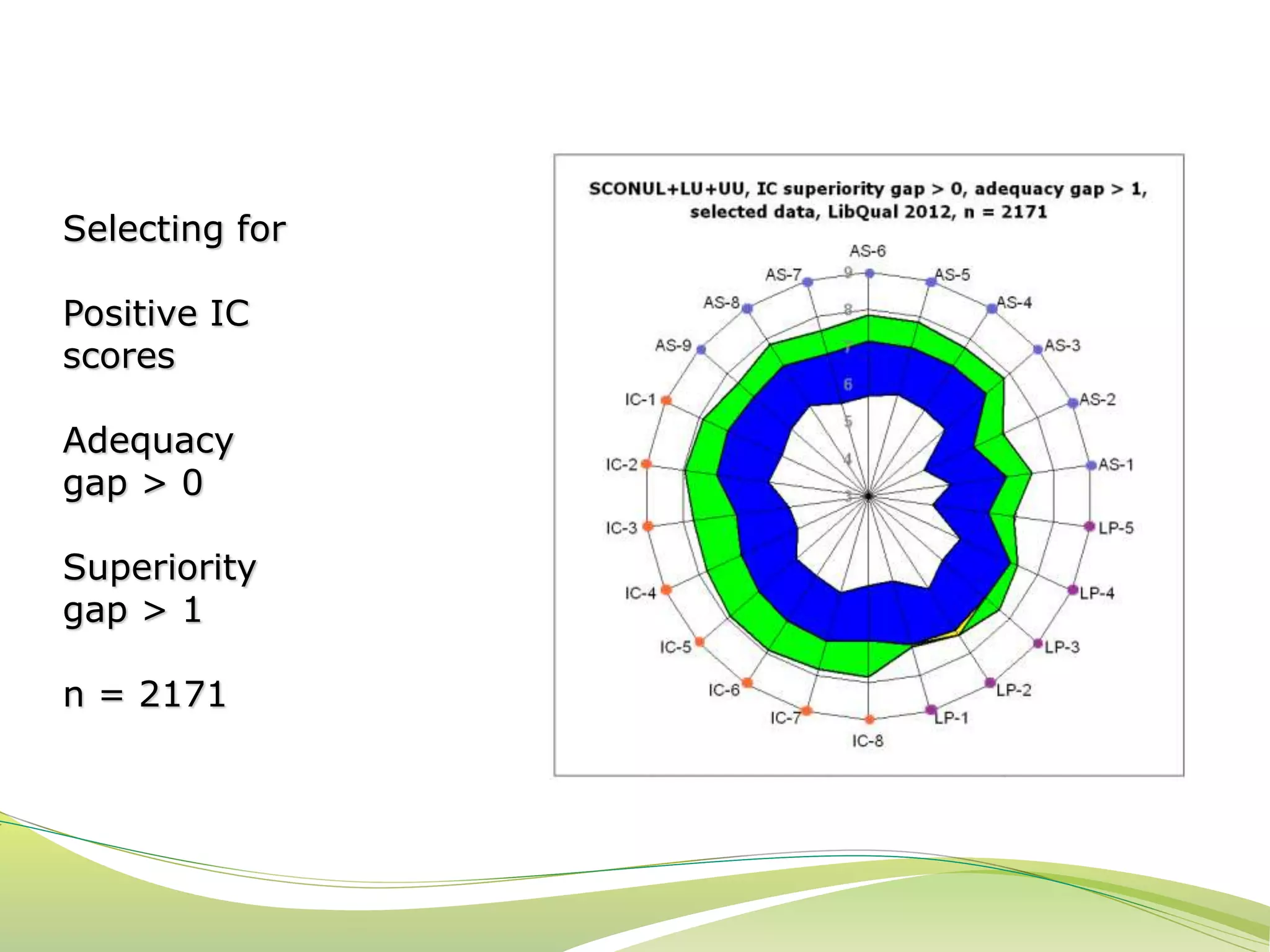
Selecting for 
Positive IC 
scores 
Adequacy 
gap > 0 
Superiority 
gap > 1 
n = 2171
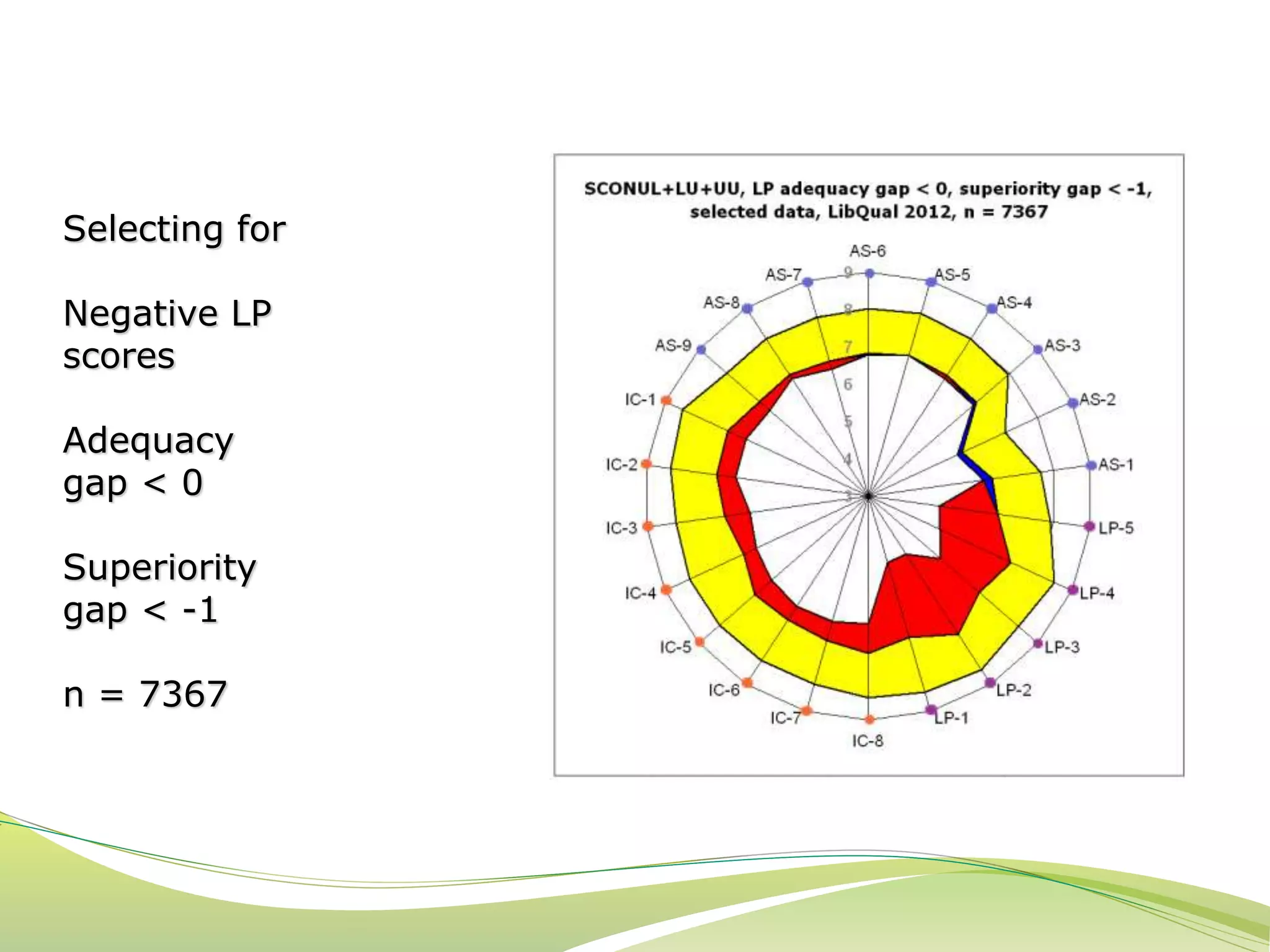
Selecting for 
Negative LP 
scores 
Adequacy 
gap < 0 
Superiority 
gap < -1 
n = 7367
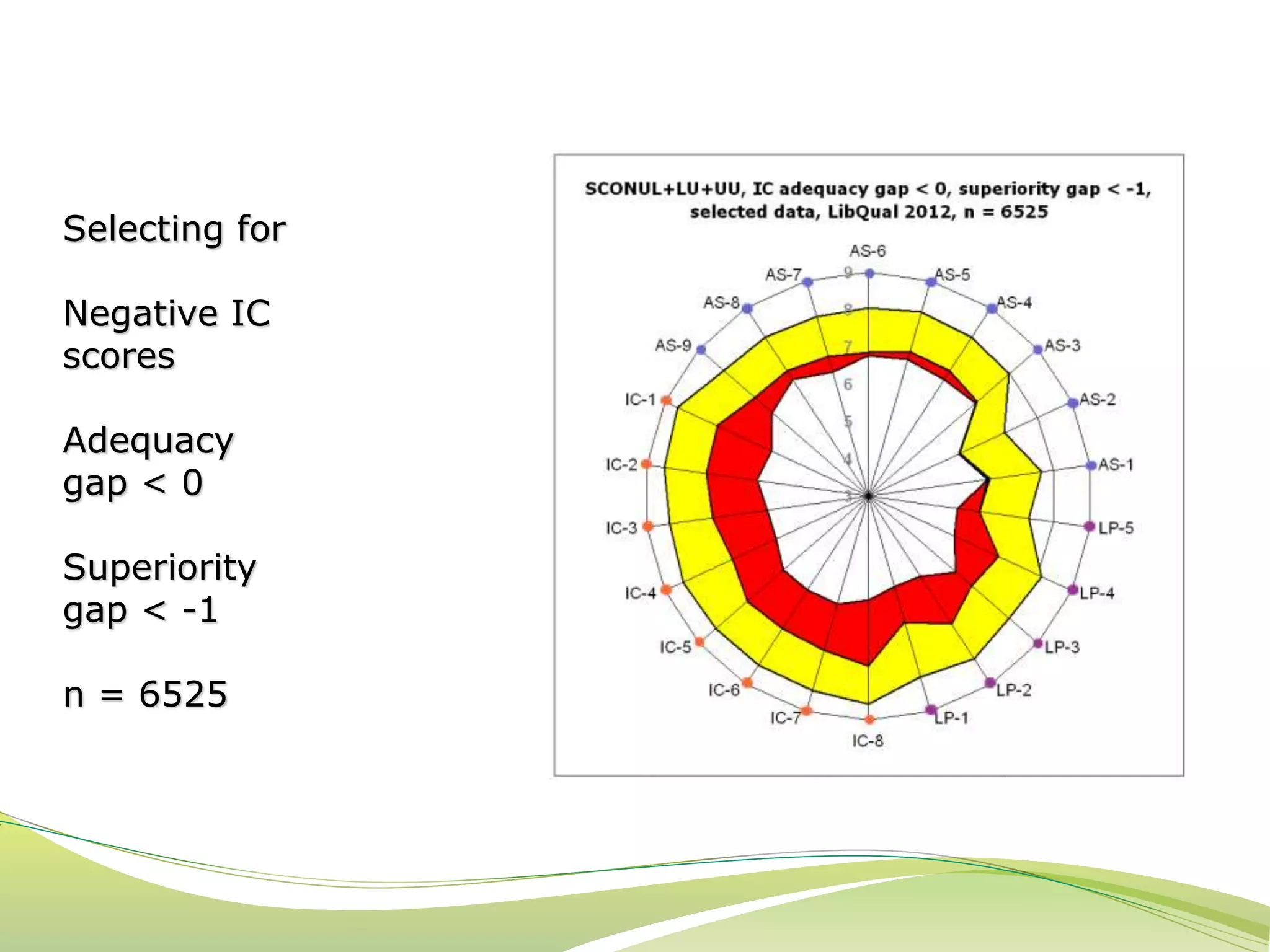
Selecting for 
Negative IC 
scores 
Adequacy 
gap < 0 
Superiority 
gap < -1 
n = 6525
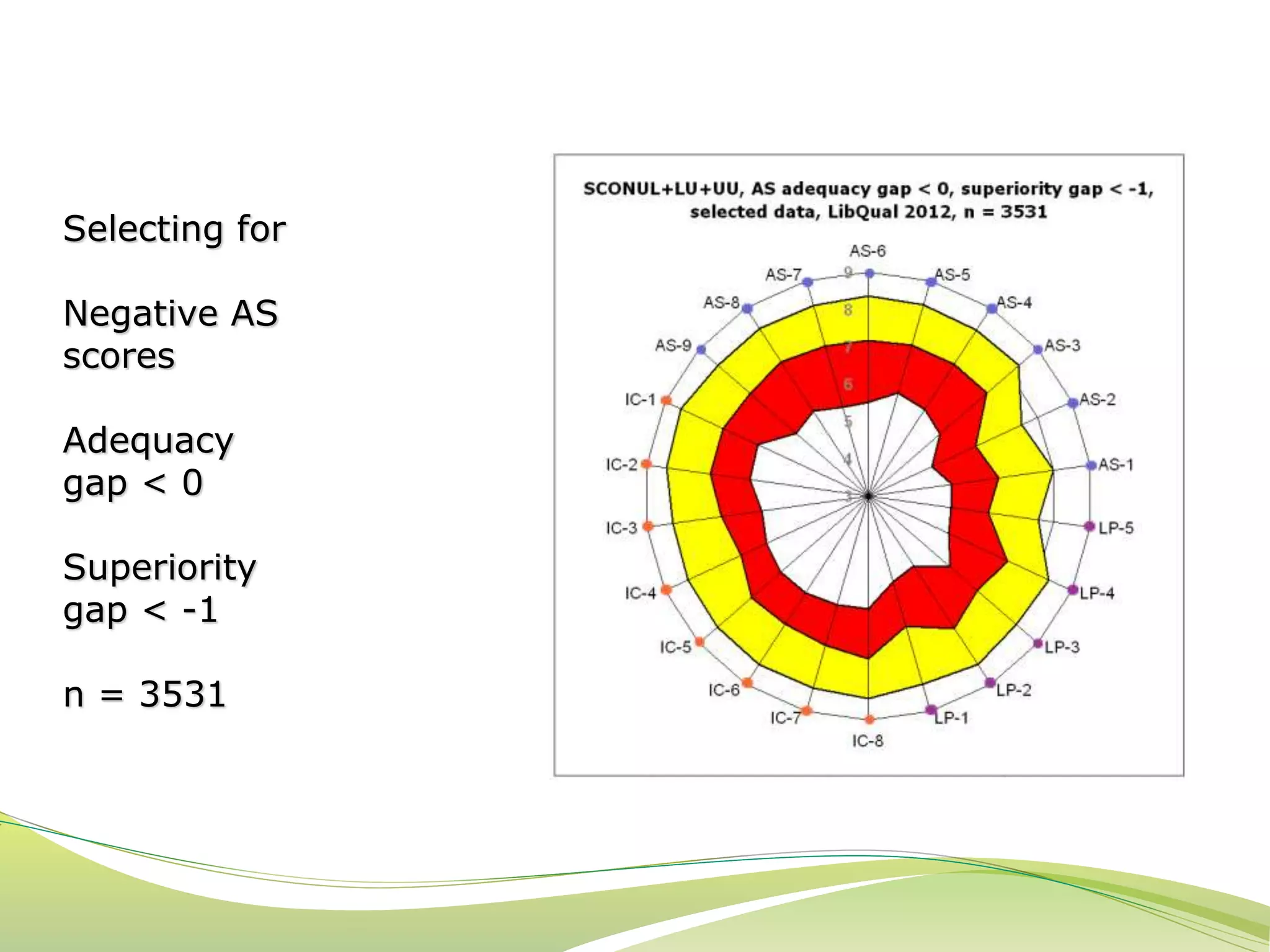
Selecting for 
Negative AS 
scores 
Adequacy 
gap < 0 
Superiority 
gap < -1 
n = 3531
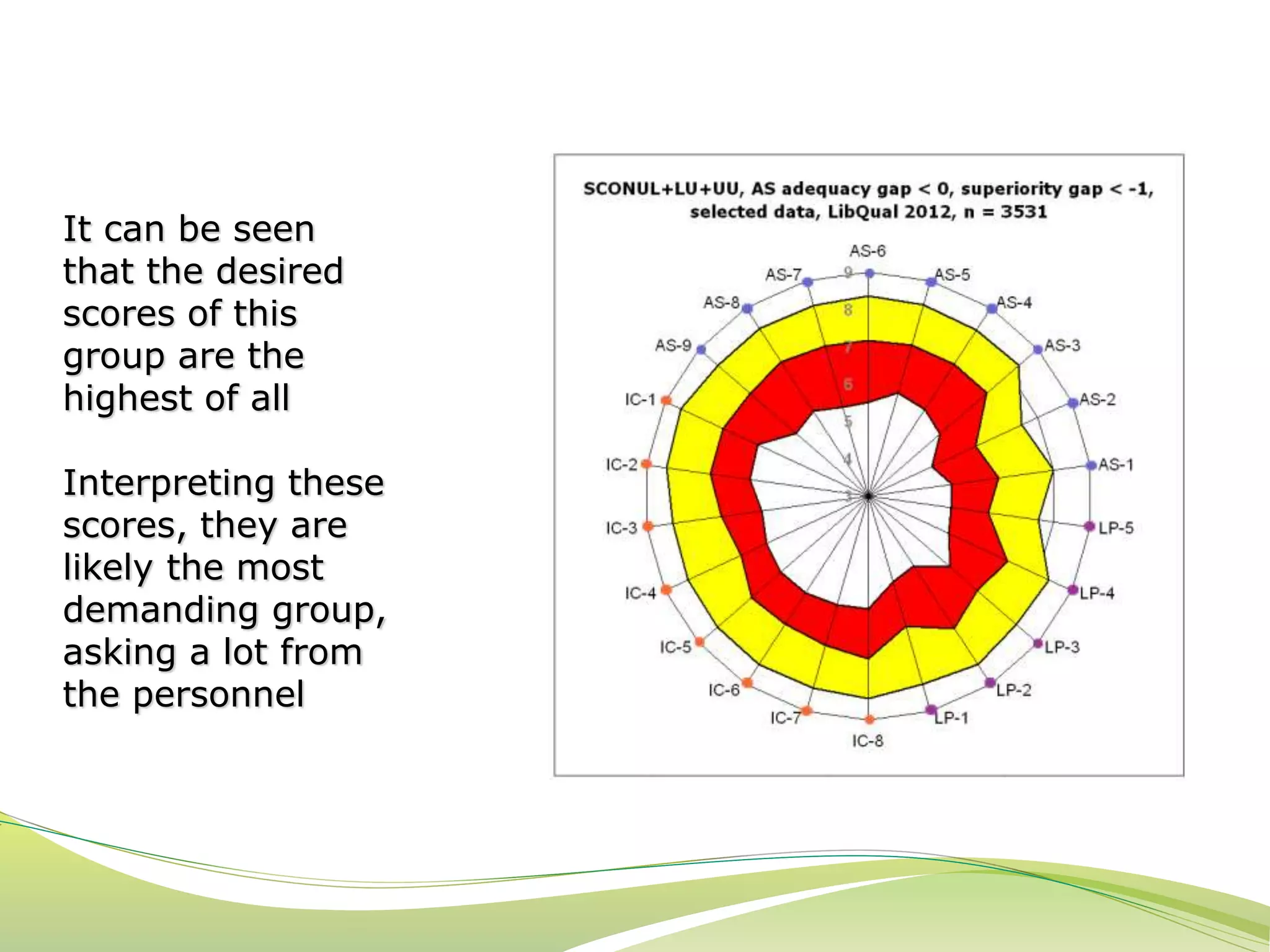
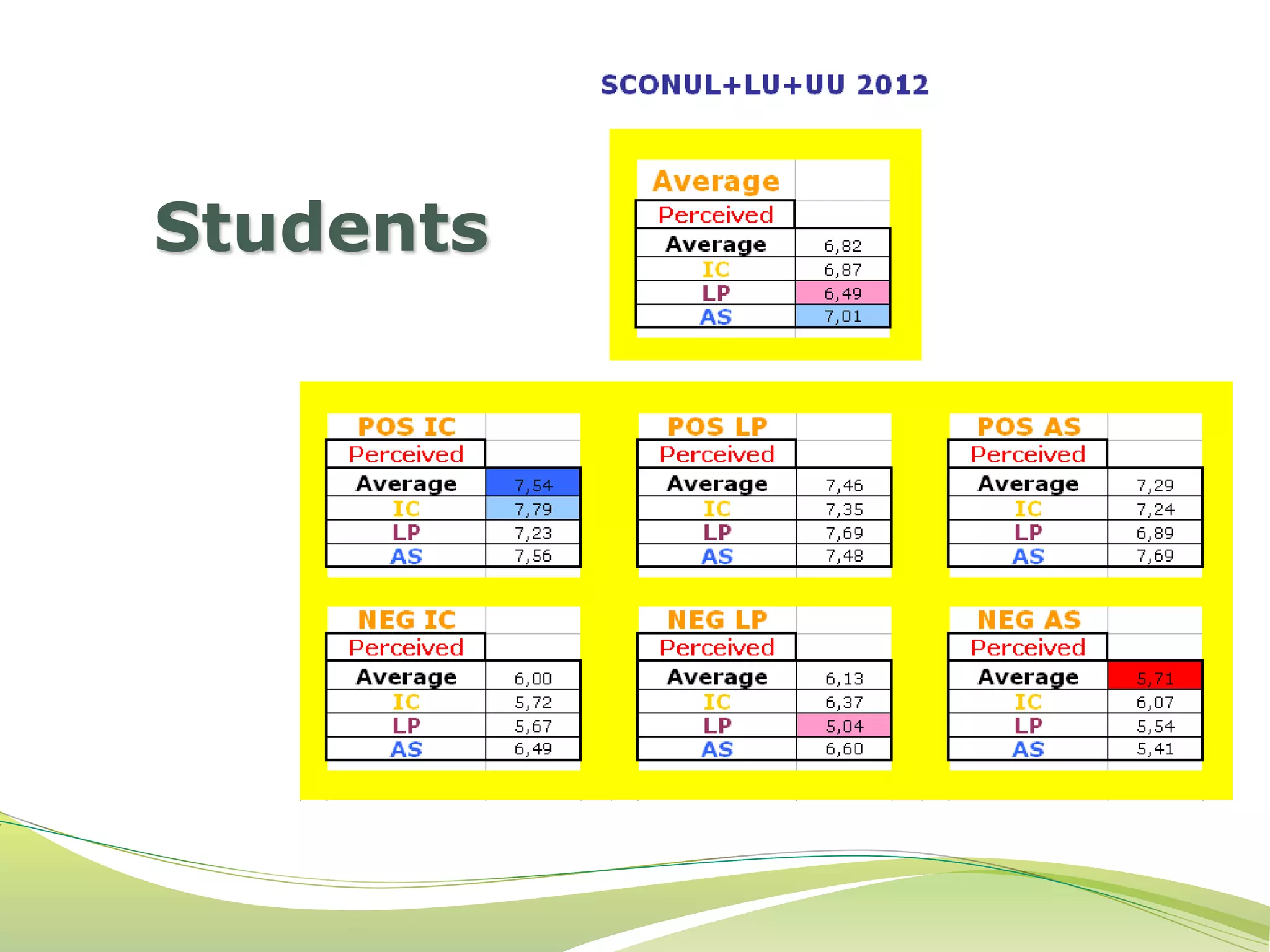
It can be seen 
that the desired 
scores of this 
group are the 
highest of all 
Interpreting these 
scores, they are 
likely the most 
demanding group, 
asking a lot from 
the personnel
Next, we wanted to know what the 
differences were between the 
Average Respondents (All) 
and the various roles, 
Students (Undergraduates) 
Postgraduates 
Staff 
Academic staff (Faculty)
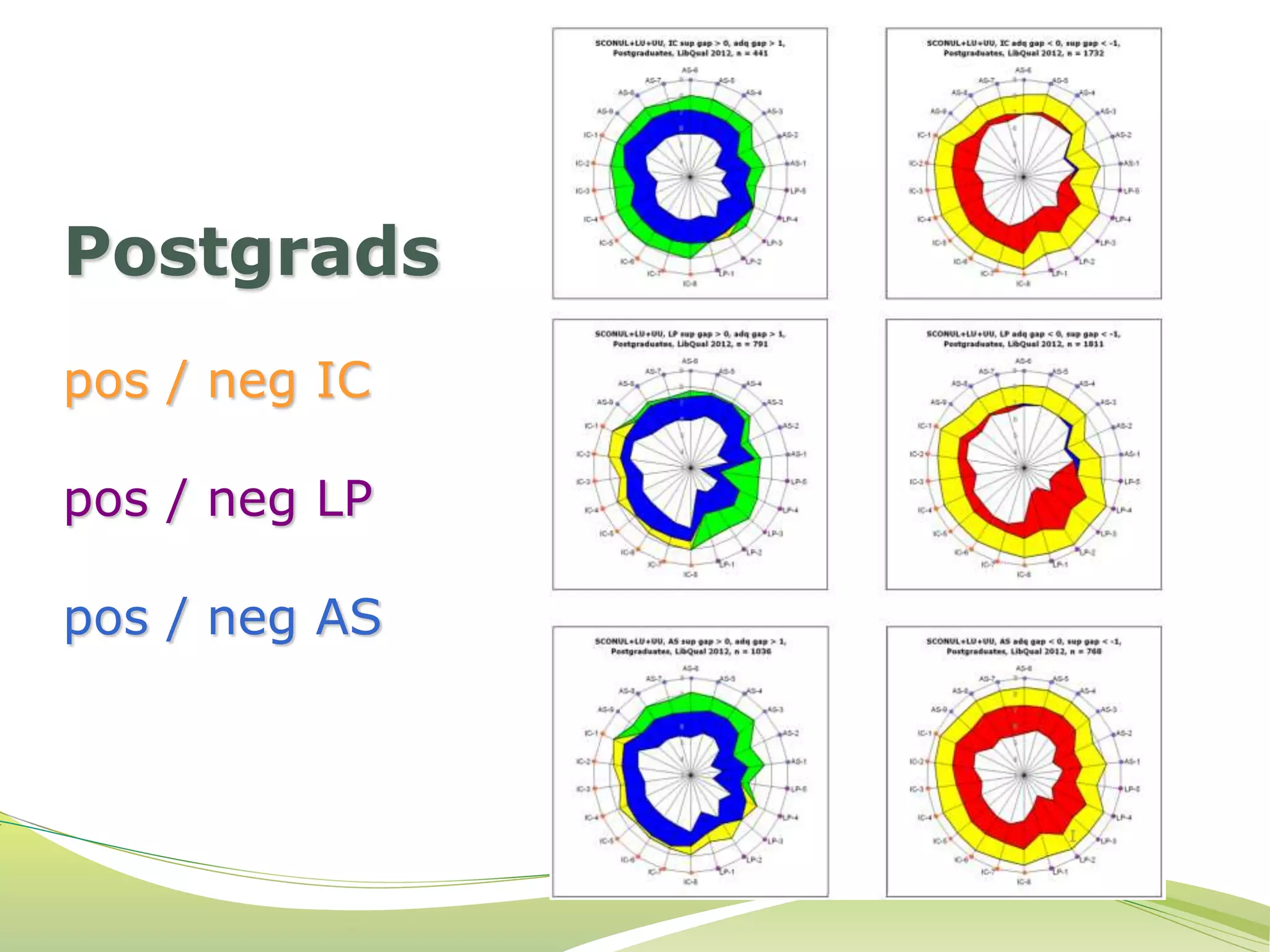
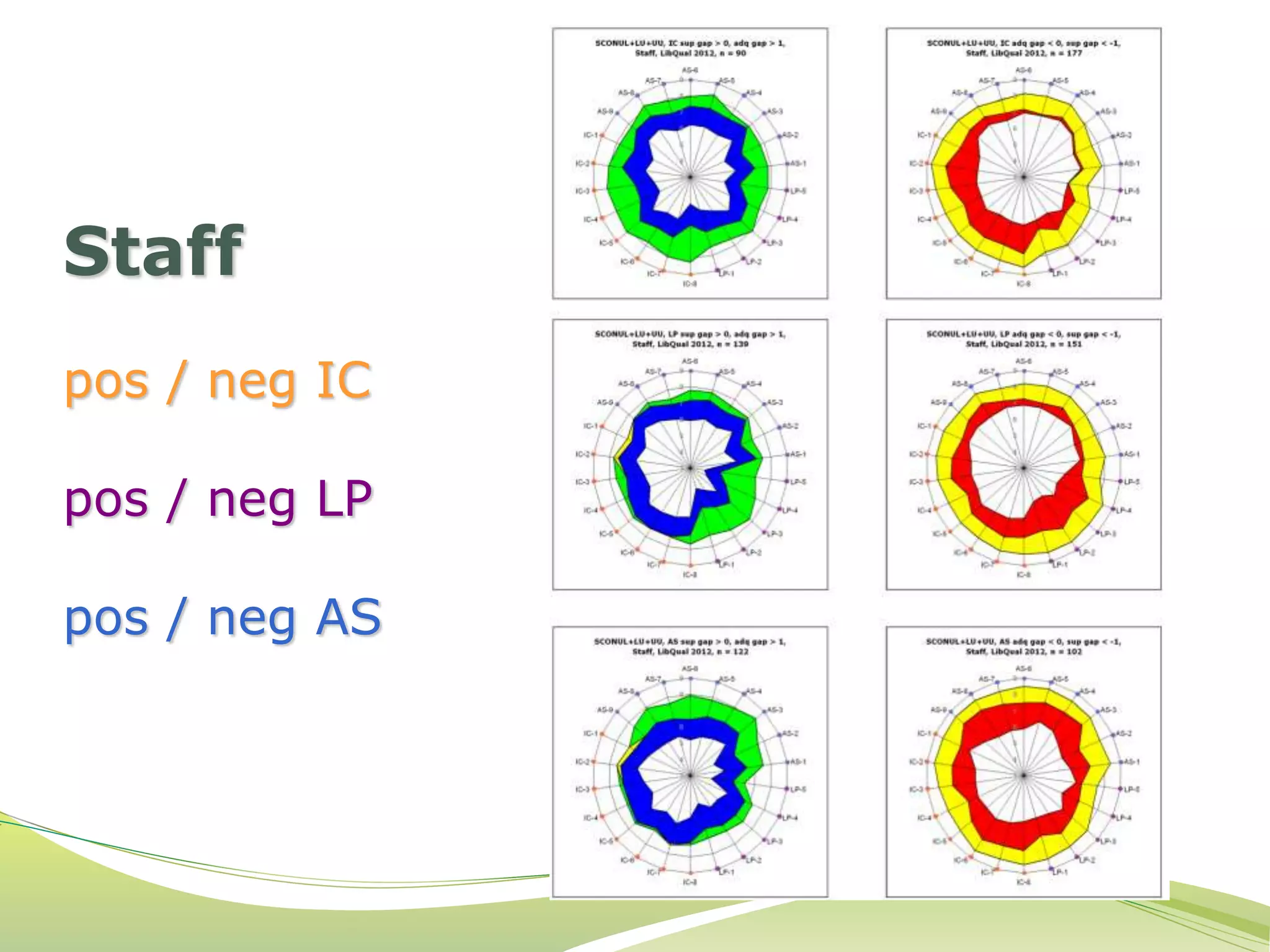
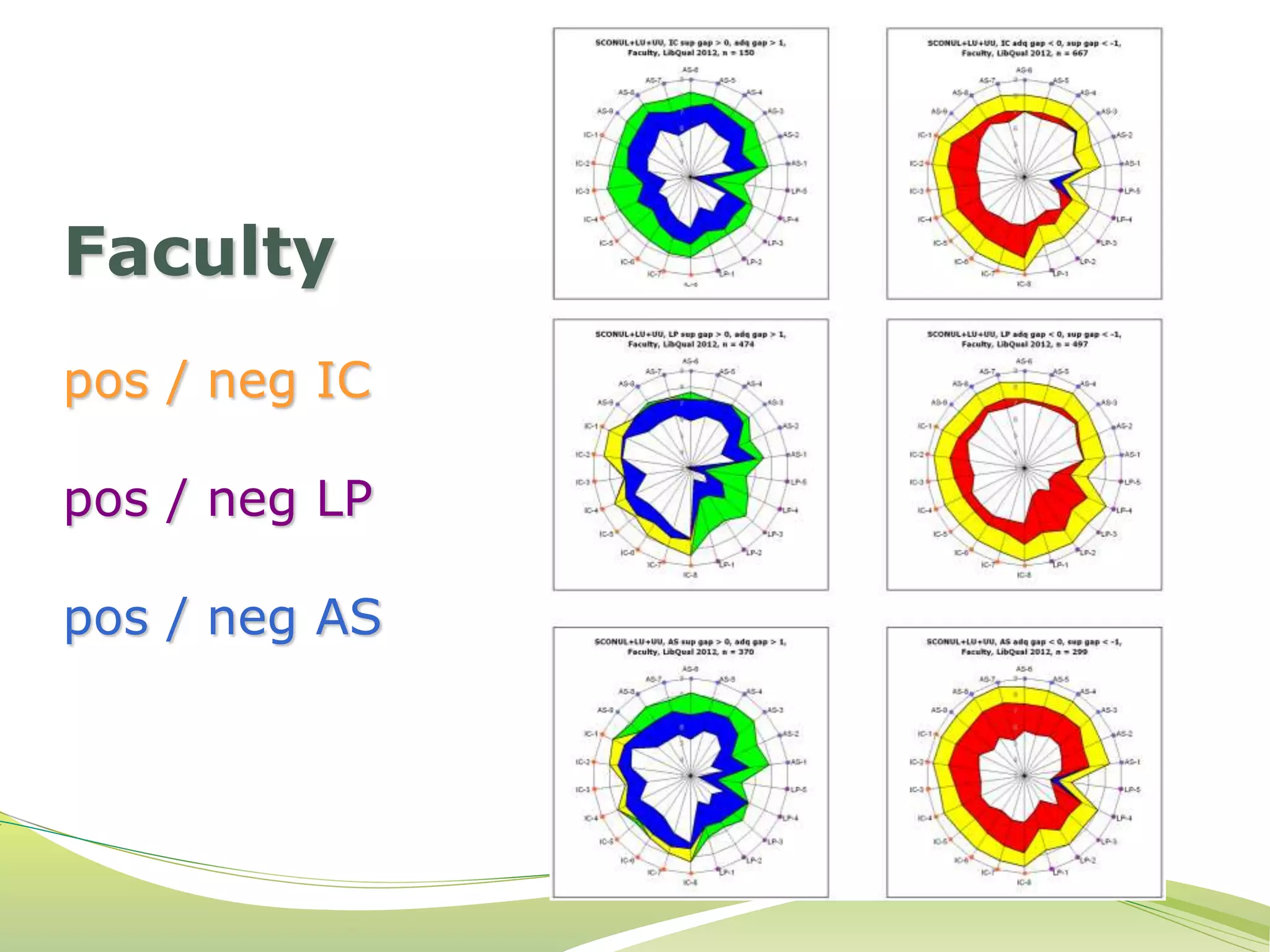
We expected to find different outcomes for 
faculty and students, 
such as 
students have a lot to ask, 
faculty just want their literature quickly
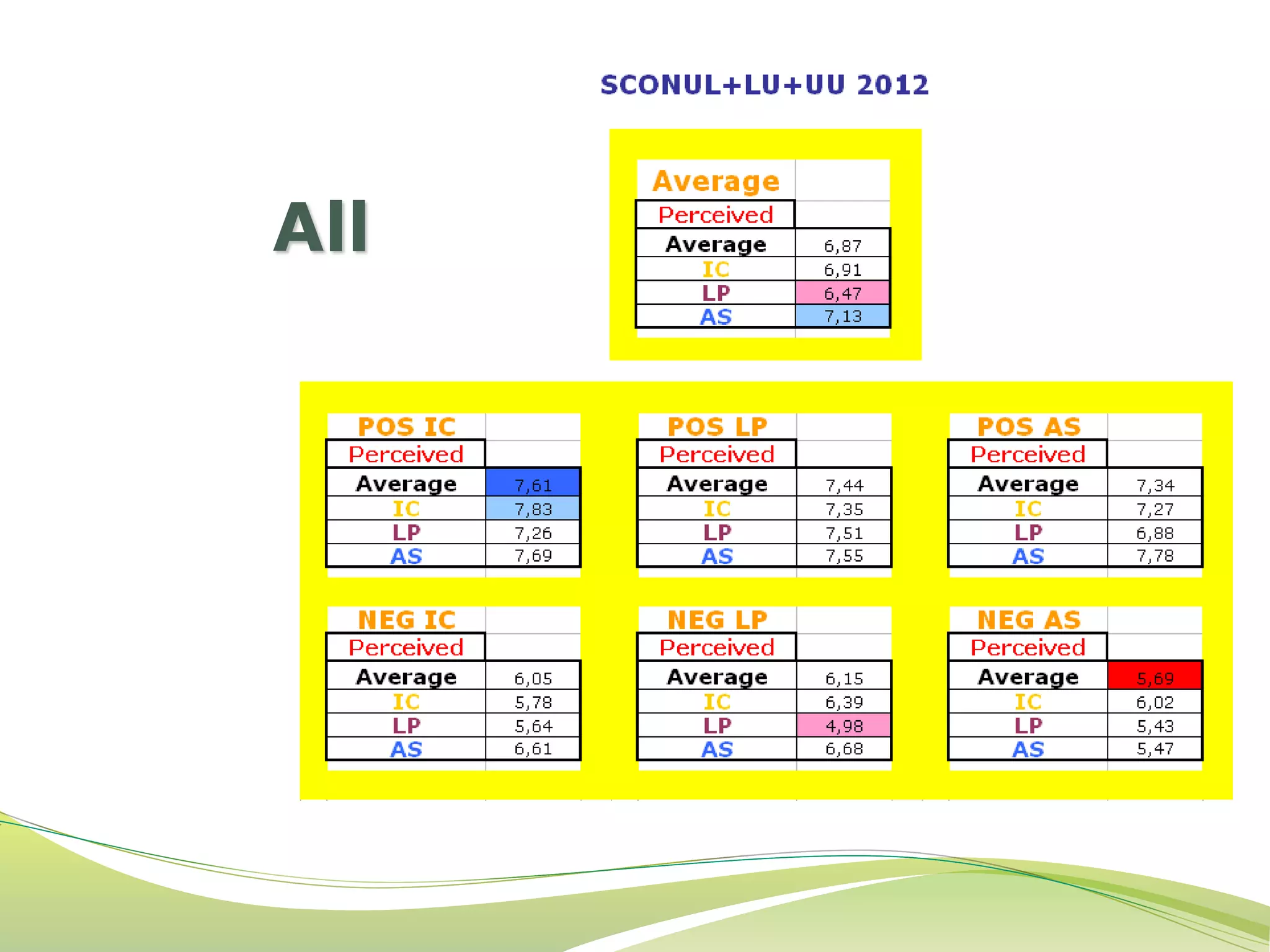
Surprisingly, 
the outcomes 
are always 
almost the same
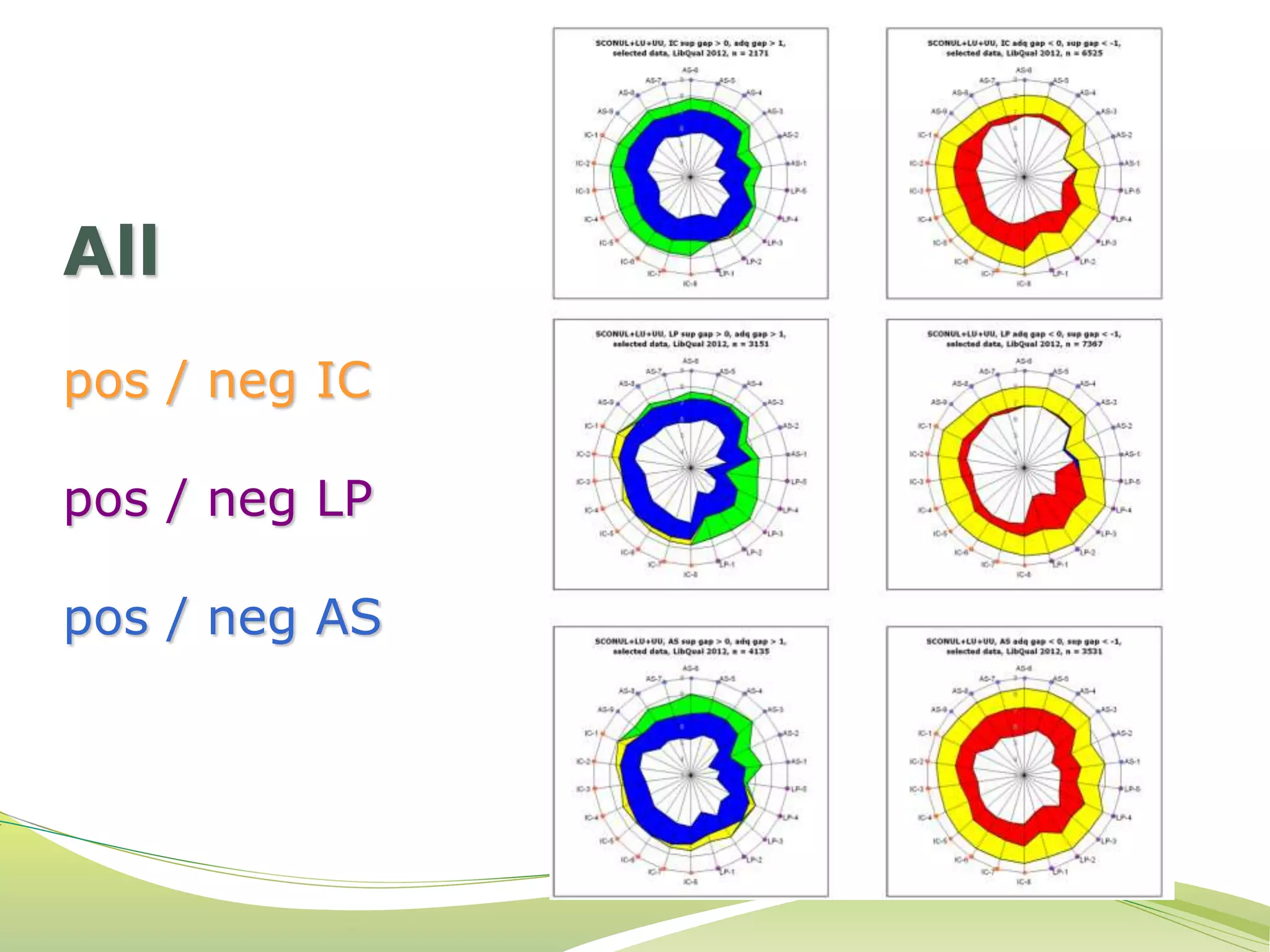
All 
pos / neg IC 
pos / neg LP 
pos / neg AS
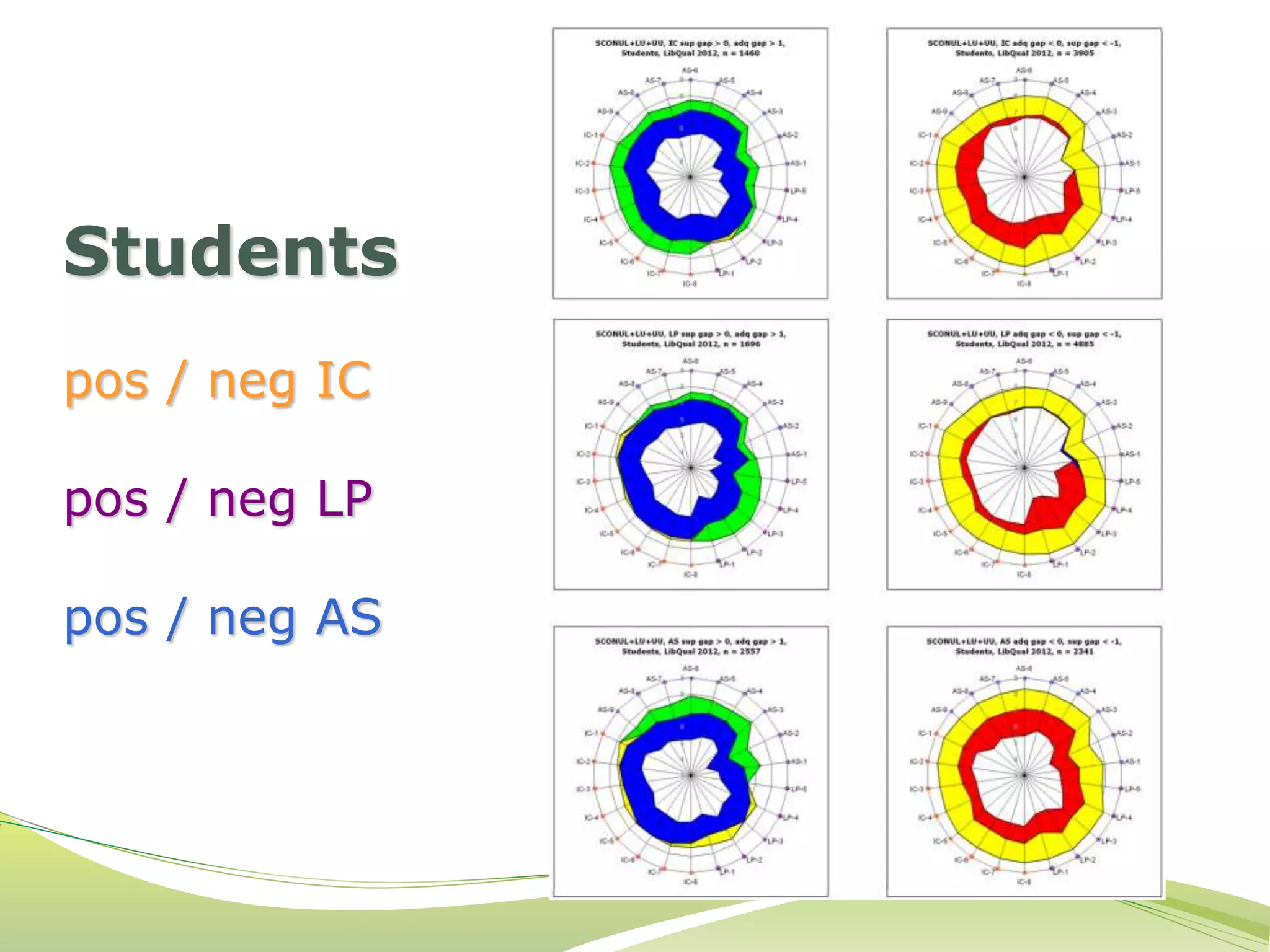
Students 
pos / neg IC 
pos / neg LP 
pos / neg AS
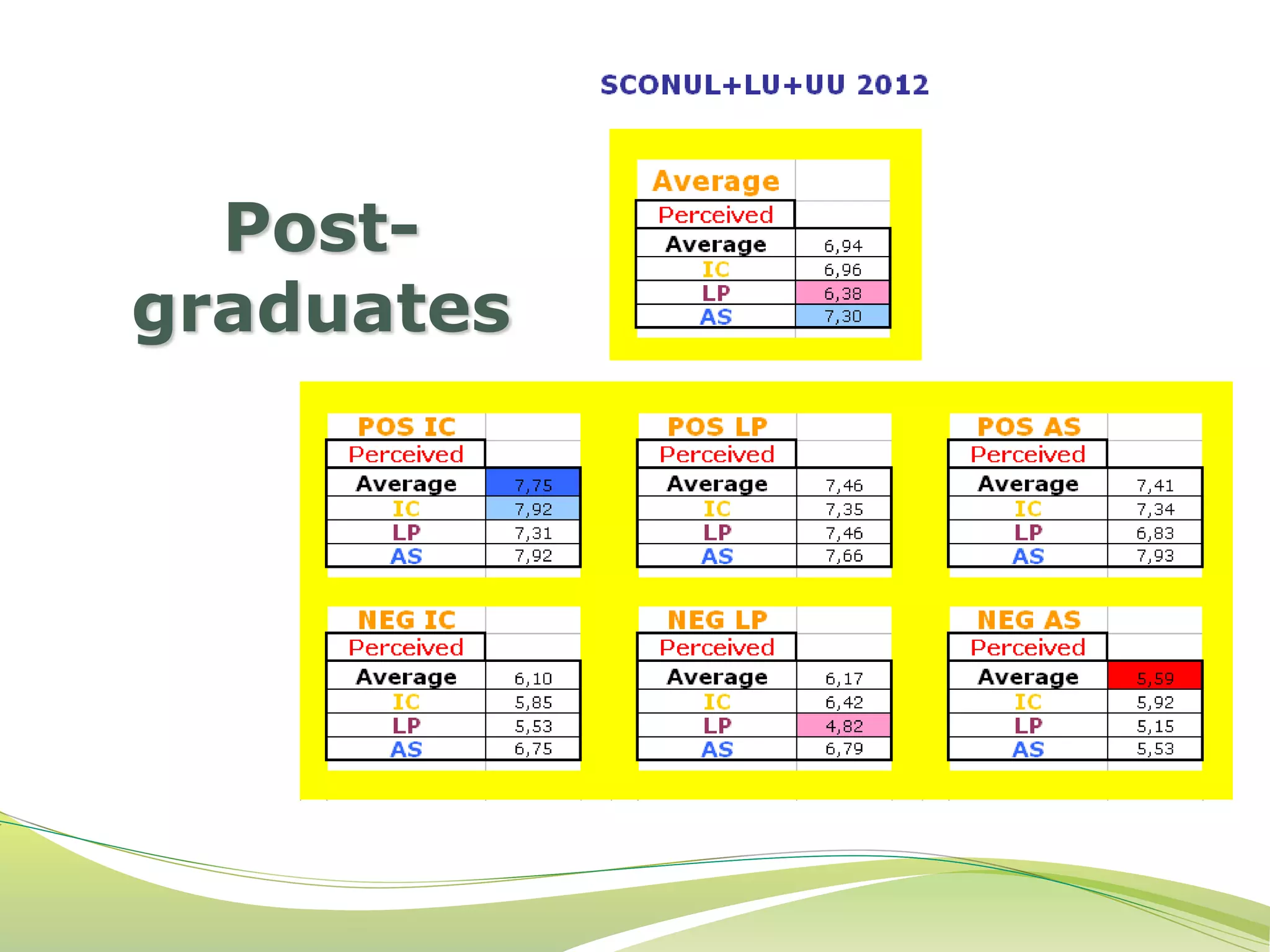
Postgrads 
pos / neg IC 
pos / neg LP 
pos / neg AS
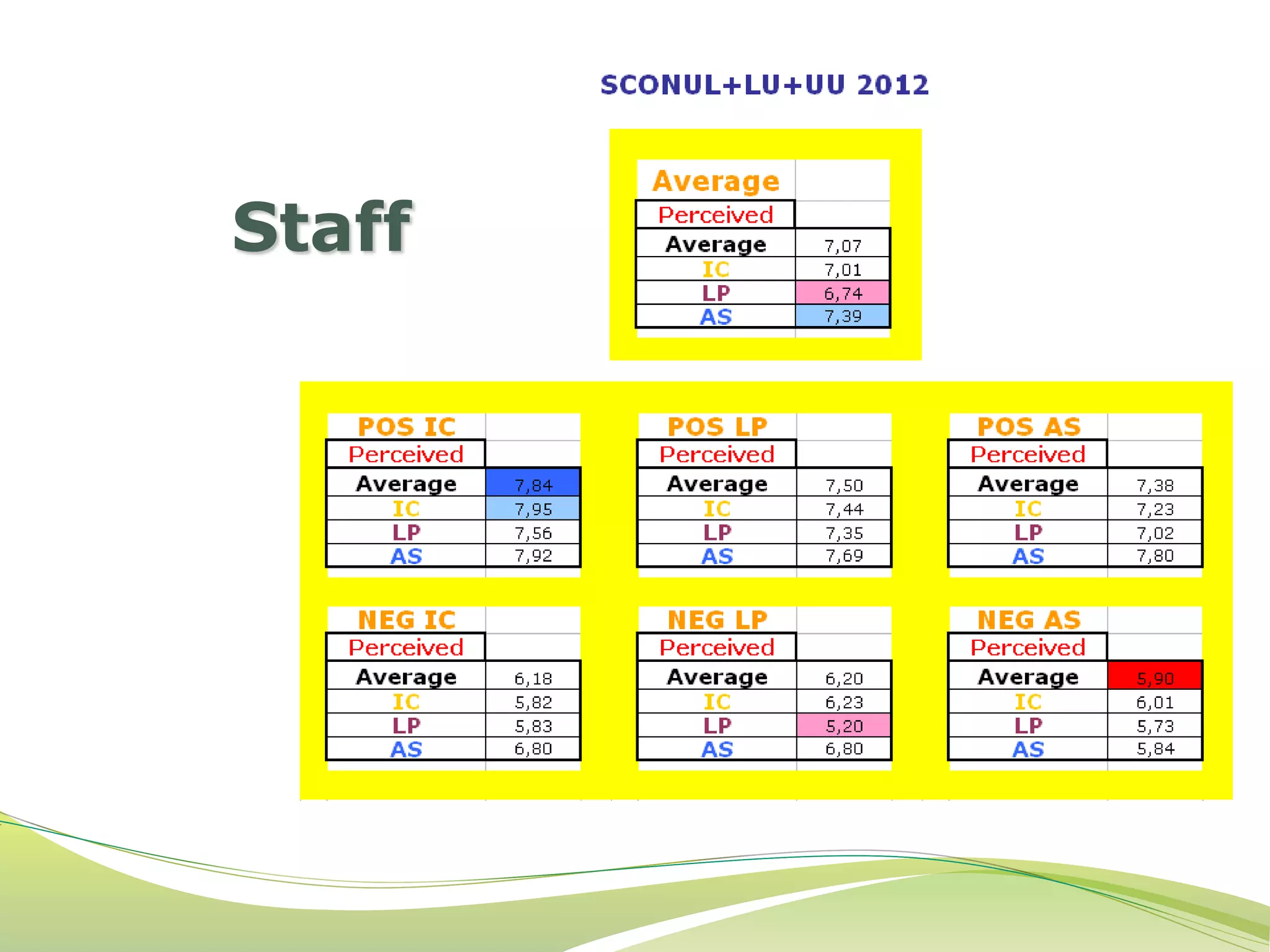
Staff 
pos / neg IC 
pos / neg LP 
pos / neg AS
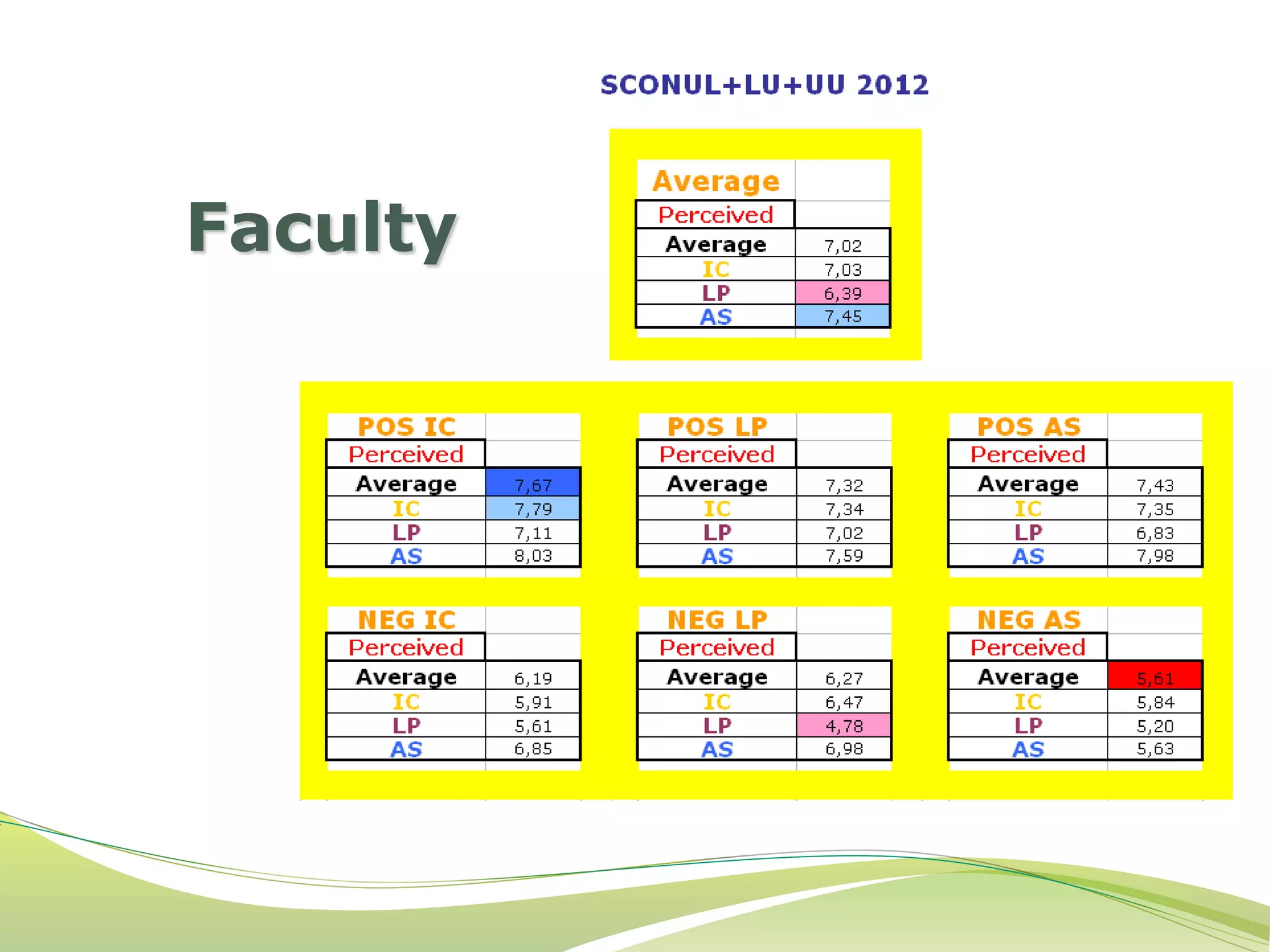
Faculty 
pos / neg IC 
pos / neg LP 
pos / neg AS
For certainty...., 
or just 
amazing:
All
Students
Post-graduates
Staff
Faculty
Some statistics 
to see if our claims 
are significant
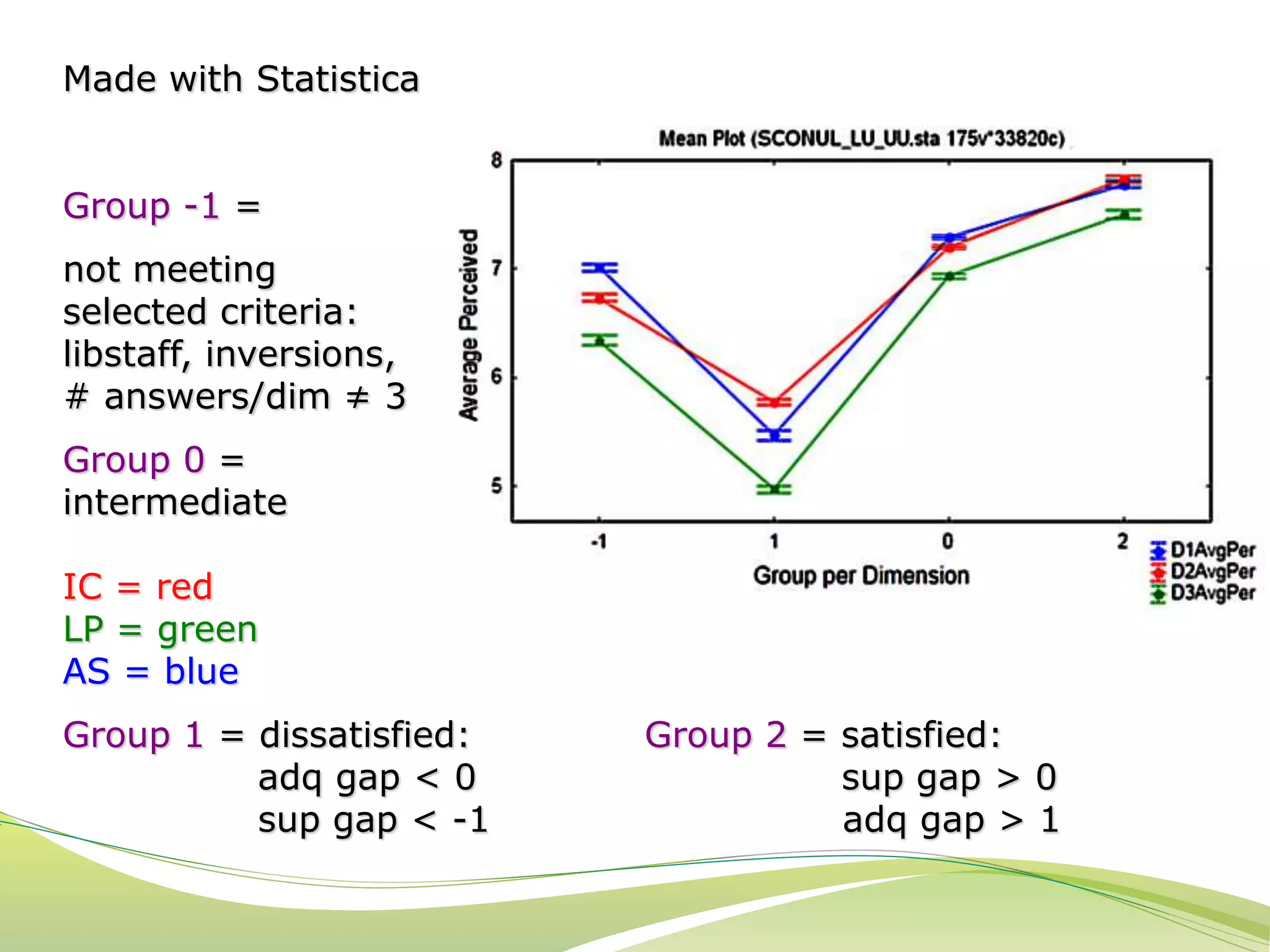
Made with Statistica 
Group -1 = 
not meeting 
selected criteria: 
libstaff, inversions, 
# answers/dim ≠ 3 
Group 0 = 
intermediate 
IC = red 
LP = green 
AS = blue 
Group 1 = dissatisfied: Group 2 = satisfied: 
adq gap < 0 xxsup gap > 0 
sup gap < -1 xxadq gap > 1
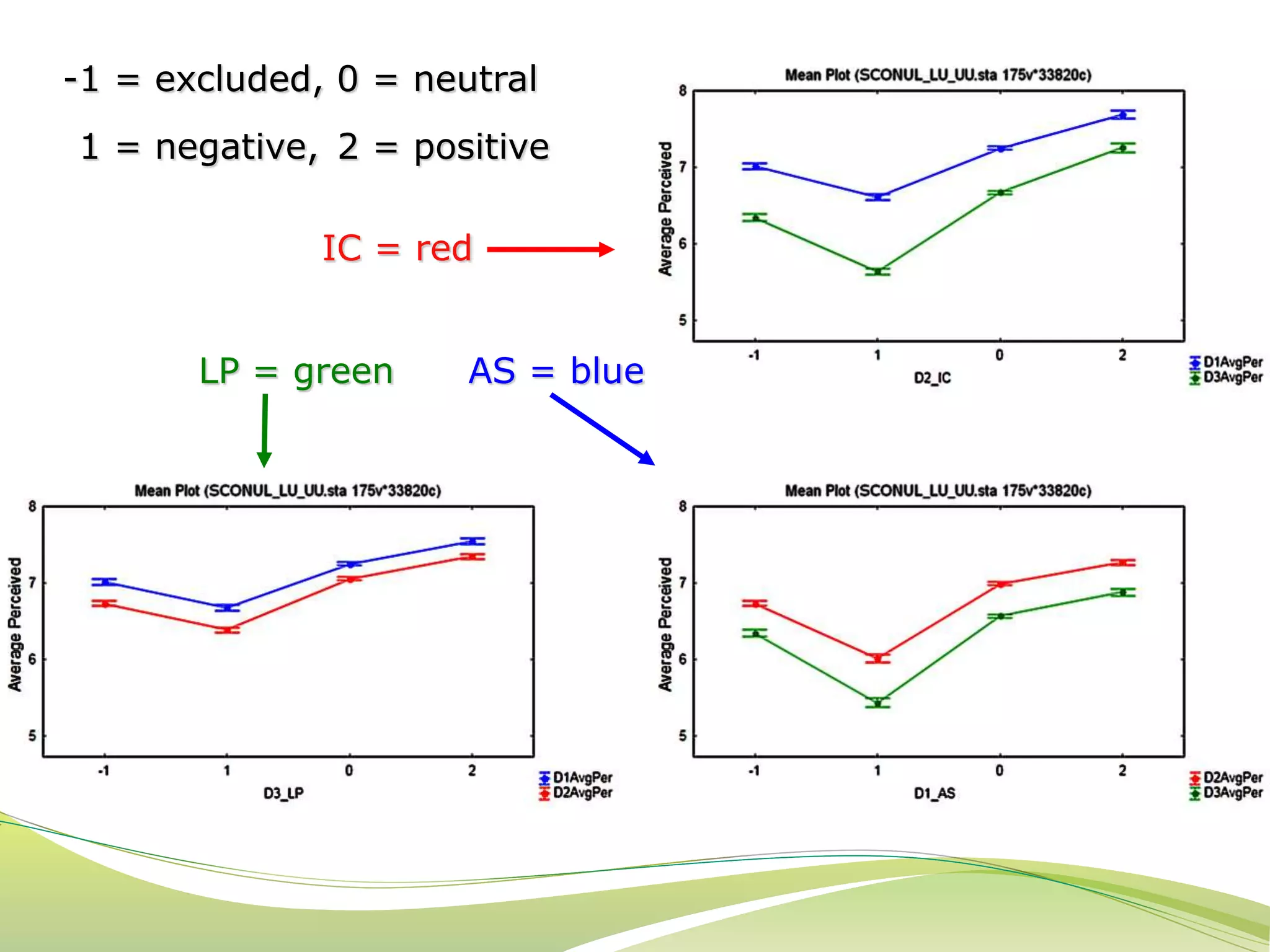
-1 = excluded, 0 = neutral 
-1 = negative, 2 = positive 
IC = red 
LP = green AS = blue
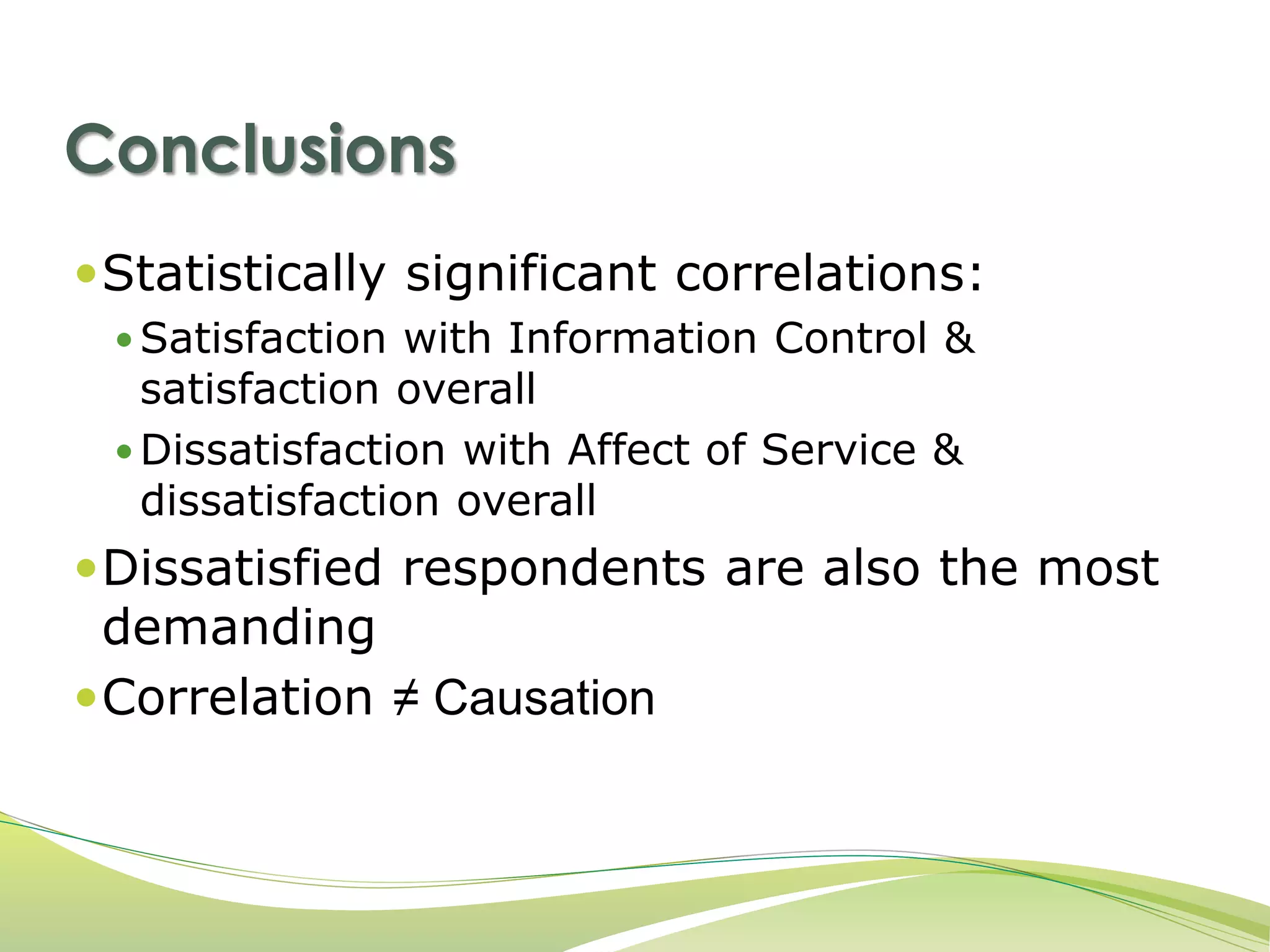
Conclusions
Conclusions 
Statistically significant correlations: 
 Satisfaction with Information Control & 
satisfaction overall 
 Dissatisfaction with Affect of Service & 
dissatisfaction overall 
Dissatisfied respondents are also the most 
demanding 
Correlation ≠ Causation
Thank You. 
Selena Killick 
Cranfield University 
s.a.killick@cranfield.ac.uk 
Anne van Weerden 
Utrecht University 
a.vanweerden@uu.nl

Using LibQUAL+® to Identify Commonalities in Customer Satisfaction: The Secret to Success?

  • 1.
    Using LibQUAL+® toIdentify Commonalities in Customer Satisfaction: The Secret to Success? Selena Killick Cranfield University Anne van Weerden Utrecht University
  • 2.
    LibQUAL+ Internationally Renown Web based Standardised Expectations & Perceptions LibQUAL+®
  • 3.
    Adequacy and Superiority Adequacy: Calculated by subtracting Minimum from Perceived score. A negative score indicates failing to meet minimum expectations. Superiority: Calculated by subtracting Desired from Perceived score. A positive score indicates exceeding desired expectations. Question 1 1 2 3 4 5 6 7 8 9 Adequacy Superiority Minimum Desired Perceived
  • 4.
    Dimensions Affect ofService Empathy Responsiveness Assurance Reliability Information Control Scope of Content Convenience Ease of Navigation Timeliness Equipment Self-Reliance Library as Place Utilitarian Space Symbol Refuge
  • 5.
  • 6.
    Commonalities in Satisfaction? Information Control Library as Place Affect of Service ? ? ? ? ? ?
  • 7.
    Commonalities in Dissatisfaction? Information Control Library as Place Affect of Service ? ? ? ? ? ?
  • 8.
    Sample Group UtrechtUniversity, Netherlands  n = 1,851 (long) Leiden University, Netherlands  n = 3,761 (lite) SCONUL Consortium  17 Higher Education Institutions from the UK and Ireland  n = 28,208 (lite/long) All surveys conducted Jan-Dec 2012
  • 9.
  • 10.
    Starting with thecombined data 2012: SCONUL, n = 28208 (mixed) Leiden University n = 3761 (lite) Utrecht University n = 1851 (long) ntot = 33820
  • 11.
    We removed 5717 responses, from library staff, and everyone with inversions anywhere This resulted in a larger bandwith ntemp = 28103
  • 12.
    We also removed 1057 surveys without any answer in one of the sections, not knowing what the respondent might have said about this section in connection with the other two sections nused = 27046 = 80%
  • 13.
  • 14.
    Neither satisfied nordissatisfied Someone with an average score of 5,2 6,3 7,4 is just .....ok min des perc
  • 15.
    Satisfied Someone withan average score of 6,0 6,2 6,1 can hardly be called satisfied What we looked for is min des perc
  • 16.
    Satisfied Superiority gap> 0 <more than 0> des______________perc perceiving even more than desired xxxxxxxxxxxxxxxxxxxxxxxxxxxx Adequacy gap > 1 <more than 1> min______________perc perceiving clearly more than minimum
  • 17.
    Dissatisfied Someone withan average score of 5,1 5,0 5,2 can hardly be called dissatisfied What we looked for is min des perc xxxxxxxxx
  • 18.
    Dissatisfied Adequacy gap< 0 <more than 0> perc______________min percieving even less than minimum xxxxxxxxxxxxxxxxxxxxxxxxxxxx Superiority gap < -1 perc______________<more than 1> des percieving clearly less than desired
  • 19.
    Definitions of satisfied/dissatisfied Satisfied Superiority gap > 0 Adequacy gap > 1 Dissatisfied Adequacy gap < 0 Superiority gap < -1
  • 20.
  • 23.
    Selecting for PositiveAS scores Adequacy gap > 0 Superiority gap > 1 n = 4135
  • 24.
    Selecting for PositiveLP scores Adequacy gap > 0 Superiority gap > 1 n = 3151
  • 25.
    Selecting for PositiveIC scores Adequacy gap > 0 Superiority gap > 1 n = 2171
  • 26.
    Selecting for NegativeLP scores Adequacy gap < 0 Superiority gap < -1 n = 7367
  • 27.
    Selecting for NegativeIC scores Adequacy gap < 0 Superiority gap < -1 n = 6525
  • 28.
    Selecting for NegativeAS scores Adequacy gap < 0 Superiority gap < -1 n = 3531
  • 29.
    It can beseen that the desired scores of this group are the highest of all Interpreting these scores, they are likely the most demanding group, asking a lot from the personnel
  • 30.
    Next, we wantedto know what the differences were between the Average Respondents (All) and the various roles, Students (Undergraduates) Postgraduates Staff Academic staff (Faculty)
  • 31.
    We expected tofind different outcomes for faculty and students, such as students have a lot to ask, faculty just want their literature quickly
  • 32.
    Surprisingly, the outcomes are always almost the same
  • 33.
    All pos /neg IC pos / neg LP pos / neg AS
  • 34.
    Students pos /neg IC pos / neg LP pos / neg AS
  • 35.
    Postgrads pos /neg IC pos / neg LP pos / neg AS
  • 36.
    Staff pos /neg IC pos / neg LP pos / neg AS
  • 37.
    Faculty pos /neg IC pos / neg LP pos / neg AS
  • 38.
    For certainty...., orjust amazing:
  • 39.
  • 40.
  • 41.
  • 42.
  • 43.
  • 44.
    Some statistics tosee if our claims are significant
  • 45.
    Made with Statistica Group -1 = not meeting selected criteria: libstaff, inversions, # answers/dim ≠ 3 Group 0 = intermediate IC = red LP = green AS = blue Group 1 = dissatisfied: Group 2 = satisfied: adq gap < 0 xxsup gap > 0 sup gap < -1 xxadq gap > 1
  • 46.
    -1 = excluded,0 = neutral -1 = negative, 2 = positive IC = red LP = green AS = blue
  • 47.
  • 48.
    Conclusions Statistically significantcorrelations:  Satisfaction with Information Control & satisfaction overall  Dissatisfaction with Affect of Service & dissatisfaction overall Dissatisfied respondents are also the most demanding Correlation ≠ Causation
  • 53.
    Thank You. SelenaKillick Cranfield University s.a.killick@cranfield.ac.uk Anne van Weerden Utrecht University a.vanweerden@uu.nl