Product
            Prepared By,
          Sagar Gadekar
What is a Product?
 Anything  that can be offered to a
 market for attention, acquisition, use,
 or consumption and that might
 satisfy a want or need.
  Includes:  physical objects, services,
  events, persons, places, organizations,
  ideas, or some combination thereof.
Meaning and Definition Of Product
    A Product can referred as a
    “Set of tangible offering made available to the consumer to satisfy his/
     her needs.”

 According to George Fisk,
“ Product is cluster of psychological satisfactions.”

    According to W. Alderson,
    “ A product is a bundle of utilities consisting of various features and
     accompanying services.”

    According Philp Kotler,
    “ A product is a bundle of physical services and symbolic particulars
     expected to the yield satisfactions or benefits to the buyer.”
Features of the Product


 Tangibility.
 Intangible attributes.
 Associated attributes.
 Exchange values.
 C onsum er Satisfaction.
Levels of a Product
   Basic Product Level.
      This core level of a product explains the reasons for which a given
    customer has made purchase. This layer mainly includes the generic
    ingredients of a product.
Example- A customer buying a vehicle for transportation.
            A customer buying a mobile for communication.

   Formal Product Level.
    In addition to core product a customer expects many other things. One
    can satisfy this needs with physical attributes, brands name, packaging,
    color, style, aesthetic look and quality. This helps the seller to give a
    distinctive appeal differentiate between the formal from the core product.
Levels of a Product
   Augmented Product Level
    The intangible components of products of a product along with the formal
    and core components is called Augmented Products. The augmented part
    of product is nothing but the associated services like-
•   Home Delivery.
•   Installations.
•   After Sales Services.
•   Customer Education and Training.
•   Customer care.
•   Financing.
   Free check-ups and consultations.
   Warranty and Guarantees.
   Replacement policy etc.
Levels of a Product
   Potential Product Level (Future Product)
     The potential products consists of every relevant thing
    that one seller can offer to attract and retain customers.
    At this level of the product, all possible augmentation and
    transformation may be adopted to differentiate the offer
    on the basis of product features and services.
Levels of a Product
Classification of Products
   On the basis of user type, products are classified as Consumer
    Goods and Industrial Goods.
   Consumer Goods
 Convenience products
 Shopping products
 Specialty products
 Unsought products
 Other types of products
       Organizations, persons, places, ideas
   Convenience Goods
      The consumer with little purchasing efforts
    frequently purchase convenience goods. They
    do not shop extensively for such a products.
    These products are brought as per the
    convenience of customer without much
    planning. The customer do have strong brand
    preference for such a convenience goods,
    which ultimately results in fasts and repeat
    purchase(s).(Generally Non Durable)
Example-Newspapers, Cigarettes, Soft Drinks
   Shopping products
    The shopping goods are those on which customer
 which spends generally spends reasonable time on
 collecting the information by searching various
 sources, comparing the prices and quality with the
 other seller, bargain and then ultimately purchase.
 The shopping goods are far more expensive than
 convenience goods and are available at fewer outlets.
 For shopping goods along with price and quality, the
 customer also give importance to style, variety, range,
 color, patterns etc. (Durable in Nature)
Example- Watches, Garments, Shoes etc.
   Specialty Products
     There are consumable products which can only be
    purchase from specialist retailers and which consumer
    select deliberately.
Example- Medicines, alcoholic beverages, audio sound system,
    Jewellery, painting etc.
   Unsought Goods
   Unsought goods are unknown to potential customers. Many
 times, customer are not even aware of the existence of such
 products. The need for such product arises normally when
 customer see and hear about it. That is the reason why such
 unsought goods demand extensive advertising and personal
 selling.
Example- Smoke detectors, insurance, glass coating films,
 encyclopedia. etc
Classification of Products
   Industrial Goods.

 Raw  Material
 Components Parts
 Installation
 Accessory and Equipment
 Operating Supplies
Classification of Products
 Classification on the basis of Durability and Tangibility
 Durable Products

 Eg. TV, washing machines, Refrigerator.
 Non Durable products

  Eg. Cold Drinks, tooth paste
 Services

  Eg. Banking Services, Entertainment Services, Insurance,
  Mobile Services, Courier Services, tour travel Services,
  Advertising Services, Logistic Services, Airline Services
  etc.
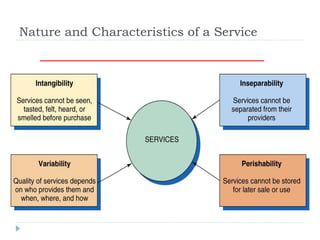
What is a Service?


   A form of product that consists of activities,
    benefits, or satisfactions offered for sale that
    are essentially intangible and do not result in
    the ownership of anything.
       Examples: banking, hotel,    airline,   retail,   tax
        preparation, home repairs.
Nature and Characteristics of a Service
Product Classification
1.   Based on the nature.
2.   Based on the Consumer intention.
3.   Based On Social Benefit.
    Based on the nature.
•    Goods
•    Services
•    Ideas
•    Experiences
•    Events
•    Persons
•    Places
•    Properties
•    Organization
 Based on the Consumer intentions
2. Consumer Product.
• Convenience products
• Shopping Products
• Specialty Products.
• Unsought Products.
7. Industrial Product.
• Raw Material.
• Capital Equipment.
• Accessory Equipment.
• Component Parts.
• Process Material Supplies.
• Industrial Services.
 Based   on the Social Benefits.

•   Pleasing Products
•   Deficient Products
•   Salutary Products
•   Desirable Products
Product Mix Decisions
  Product Mix: All of the product lines and
   items that a particular seller offers for sale.
  Width: The number of different product
   lines the company carries.
  Depth: The number of versions offered of
   each product in the line.
  Consistency: How closely related the various
   lines are.
Product Line Appraisal
   A growing firm which always intends to succeeds, do
    product line appraisal(s) regularly with reference to,
   New product launching.
   Product Differentiation.
   Product withdrawal or removal.
   Customer preference.
   Level of competition.
   Pricing Strategies.
   Quality improvement.
   Market Coverage.
   Sales Volume.
   Market share.
Product Line Appraisal
   Stretching Up
Example:-Launch of Bajaj Eliminator, Introduction of Swift and SX4 is
 stretching up strategy.
   Stretching Down
 Examples:- Bajaj Boxer, Tata Nano.
• The strategy is manly using for reasons like
 Covering Untapped lower end market.
 Increase the competition in existing segments.
 Economic Slowdown.
 Emphasis on affordability aspects of products.

   Line filling
Examples:-Launce of Maruti Aulto in Between two existing brands like Maruti 800 and
  Maruti Zen
   Line Trimming
The strategy is manly using for reasons like
• Better offering from nearest competitors.
• Incapable of adapting to current technological up
  gradation.
• Changing needs, likes-dislikes, tastes, habits, and
  performances of target segments.
• Scarcity of inputs raw materials.
• Improper support of channel members.

Examples:-Bajaj Sunny. Nokia 3310 etc.
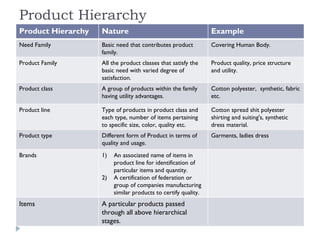
Product Hierarchy
Product Hierarchy   Nature                                      Example
Need Family         Basic need that contributes product         Covering Human Body.
                    family.
Product Family      All the product classes that satisfy the    Product quality, price structure
                    basic need with varied degree of            and utility.
                    satisfaction.
Product class       A group of products within the family       Cotton polyester, synthetic, fabric
                    having utility advantages.                  etc.

Product line        Type of products in product class and       Cotton spread shit polyester
                    each type, number of items pertaining       shirting and suiting's, synthetic
                    to specific size, color, quality etc.       dress material.
Product type        Different form of Product in terms of       Garments, ladies dress
                    quality and usage.
Brands              1)   An associated name of items in
                         product line for identification of
                         particular items and quantity.
                    2)   A certification of federation or
                         group of companies manufacturing
                         similar products to certify quality.
Items               A particular products passed
                    through all above hierarchical
                    stages.

Product

  • 1.
    Product Prepared By, Sagar Gadekar
  • 2.
    What is aProduct?  Anything that can be offered to a market for attention, acquisition, use, or consumption and that might satisfy a want or need.  Includes: physical objects, services, events, persons, places, organizations, ideas, or some combination thereof.
  • 3.
    Meaning and DefinitionOf Product  A Product can referred as a “Set of tangible offering made available to the consumer to satisfy his/ her needs.”  According to George Fisk, “ Product is cluster of psychological satisfactions.”  According to W. Alderson, “ A product is a bundle of utilities consisting of various features and accompanying services.”  According Philp Kotler, “ A product is a bundle of physical services and symbolic particulars expected to the yield satisfactions or benefits to the buyer.”
  • 4.
    Features of theProduct  Tangibility.  Intangible attributes.  Associated attributes.  Exchange values.  C onsum er Satisfaction.
  • 5.
    Levels of aProduct  Basic Product Level. This core level of a product explains the reasons for which a given customer has made purchase. This layer mainly includes the generic ingredients of a product. Example- A customer buying a vehicle for transportation. A customer buying a mobile for communication.  Formal Product Level. In addition to core product a customer expects many other things. One can satisfy this needs with physical attributes, brands name, packaging, color, style, aesthetic look and quality. This helps the seller to give a distinctive appeal differentiate between the formal from the core product.
  • 6.
    Levels of aProduct  Augmented Product Level The intangible components of products of a product along with the formal and core components is called Augmented Products. The augmented part of product is nothing but the associated services like- • Home Delivery. • Installations. • After Sales Services. • Customer Education and Training. • Customer care. • Financing.  Free check-ups and consultations.  Warranty and Guarantees.  Replacement policy etc.
  • 7.
    Levels of aProduct  Potential Product Level (Future Product) The potential products consists of every relevant thing that one seller can offer to attract and retain customers. At this level of the product, all possible augmentation and transformation may be adopted to differentiate the offer on the basis of product features and services.
  • 8.
    Levels of aProduct
  • 9.
    Classification of Products  On the basis of user type, products are classified as Consumer Goods and Industrial Goods.  Consumer Goods  Convenience products  Shopping products  Specialty products  Unsought products  Other types of products  Organizations, persons, places, ideas
  • 10.
    Convenience Goods The consumer with little purchasing efforts frequently purchase convenience goods. They do not shop extensively for such a products. These products are brought as per the convenience of customer without much planning. The customer do have strong brand preference for such a convenience goods, which ultimately results in fasts and repeat purchase(s).(Generally Non Durable) Example-Newspapers, Cigarettes, Soft Drinks
  • 11.
    Shopping products The shopping goods are those on which customer which spends generally spends reasonable time on collecting the information by searching various sources, comparing the prices and quality with the other seller, bargain and then ultimately purchase. The shopping goods are far more expensive than convenience goods and are available at fewer outlets. For shopping goods along with price and quality, the customer also give importance to style, variety, range, color, patterns etc. (Durable in Nature) Example- Watches, Garments, Shoes etc.
  • 12.
    Specialty Products There are consumable products which can only be purchase from specialist retailers and which consumer select deliberately. Example- Medicines, alcoholic beverages, audio sound system, Jewellery, painting etc.  Unsought Goods Unsought goods are unknown to potential customers. Many times, customer are not even aware of the existence of such products. The need for such product arises normally when customer see and hear about it. That is the reason why such unsought goods demand extensive advertising and personal selling. Example- Smoke detectors, insurance, glass coating films, encyclopedia. etc
  • 13.
    Classification of Products  Industrial Goods.  Raw Material  Components Parts  Installation  Accessory and Equipment  Operating Supplies
  • 14.
    Classification of Products Classification on the basis of Durability and Tangibility  Durable Products Eg. TV, washing machines, Refrigerator.  Non Durable products Eg. Cold Drinks, tooth paste  Services Eg. Banking Services, Entertainment Services, Insurance, Mobile Services, Courier Services, tour travel Services, Advertising Services, Logistic Services, Airline Services etc.
  • 15.
    What is aService?  A form of product that consists of activities, benefits, or satisfactions offered for sale that are essentially intangible and do not result in the ownership of anything.  Examples: banking, hotel, airline, retail, tax preparation, home repairs.
  • 16.
  • 17.
    Product Classification 1. Based on the nature. 2. Based on the Consumer intention. 3. Based On Social Benefit.  Based on the nature. • Goods • Services • Ideas • Experiences • Events • Persons • Places • Properties • Organization
  • 18.
     Based onthe Consumer intentions 2. Consumer Product. • Convenience products • Shopping Products • Specialty Products. • Unsought Products. 7. Industrial Product. • Raw Material. • Capital Equipment. • Accessory Equipment. • Component Parts. • Process Material Supplies. • Industrial Services.
  • 19.
     Based on the Social Benefits. • Pleasing Products • Deficient Products • Salutary Products • Desirable Products
  • 20.
    Product Mix Decisions  Product Mix: All of the product lines and items that a particular seller offers for sale.  Width: The number of different product lines the company carries.  Depth: The number of versions offered of each product in the line.  Consistency: How closely related the various lines are.
  • 21.
    Product Line Appraisal  A growing firm which always intends to succeeds, do product line appraisal(s) regularly with reference to,  New product launching.  Product Differentiation.  Product withdrawal or removal.  Customer preference.  Level of competition.  Pricing Strategies.  Quality improvement.  Market Coverage.  Sales Volume.  Market share.
  • 23.
    Product Line Appraisal  Stretching Up Example:-Launch of Bajaj Eliminator, Introduction of Swift and SX4 is stretching up strategy.  Stretching Down Examples:- Bajaj Boxer, Tata Nano. • The strategy is manly using for reasons like  Covering Untapped lower end market.  Increase the competition in existing segments.  Economic Slowdown.  Emphasis on affordability aspects of products.  Line filling Examples:-Launce of Maruti Aulto in Between two existing brands like Maruti 800 and Maruti Zen
  • 24.
    Line Trimming The strategy is manly using for reasons like • Better offering from nearest competitors. • Incapable of adapting to current technological up gradation. • Changing needs, likes-dislikes, tastes, habits, and performances of target segments. • Scarcity of inputs raw materials. • Improper support of channel members. Examples:-Bajaj Sunny. Nokia 3310 etc.
  • 25.
    Product Hierarchy Product Hierarchy Nature Example Need Family Basic need that contributes product Covering Human Body. family. Product Family All the product classes that satisfy the Product quality, price structure basic need with varied degree of and utility. satisfaction. Product class A group of products within the family Cotton polyester, synthetic, fabric having utility advantages. etc. Product line Type of products in product class and Cotton spread shit polyester each type, number of items pertaining shirting and suiting's, synthetic to specific size, color, quality etc. dress material. Product type Different form of Product in terms of Garments, ladies dress quality and usage. Brands 1) An associated name of items in product line for identification of particular items and quantity. 2) A certification of federation or group of companies manufacturing similar products to certify quality. Items A particular products passed through all above hierarchical stages.