Store Layout, Design &
Visual Merchandising
Objectives of the Store Environment
   Get customers into the store (store image)
       Serves a critical role in the store selection process
       Important criteria include cleanliness, labeled prices, accurate and pleasant
        checkout clerks, and well-stocked shelves
       The store itself makes the most significant and last impression

   Once they are inside the store, convert them into customers
    buying merchandise (space productivity)
       The more merchandise customers are exposed to that is presented in an
        orderly manner, the more they tend to buy
       Retailers focusing more attention on in-store marketing – marketing dollars
        spent in the store, in the form of store design, merchandise presentation,
        visual displays, and in-store promotions, should lead to greater sales and
        profits (bottom line: it is easier to get a consumer in your store to buy more
        merchandise than planned than to get a new consumer to come into your
        store)
Objectives of Good Store Design
   Design should:

       be consistent with image and strategy
       positively influence consumer behavior
       consider costs versus value
       be flexible
       recognize the needs of the disabled
Types of Floor Space in Store
   Back Room – receiving area, stockroom
     Department stores (50%)

     Small specialty and convenience stores (10%)

     General merchandise stores (15-20%)


   Offices and Other Functional Space – employee break room,
    store offices, cash office, restrooms

   Aisles, Service Areas and Other Non-Selling Areas
     Moving shoppers through the store, dressing rooms, layaway
       areas, service desks, customer service facilities

   Merchandise Space
     Floor

     Wall
Store Layout (and Traffic Flow)
   Conflicting objectives:

       Ease of finding merchandise versus varied and
        interesting layout

       Giving customers adequate space to shop versus
        use expensive space productively
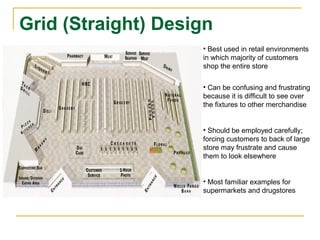
Grid (Straight) Design
                    • Best used in retail environments
                    in which majority of customers
                    shop the entire store

                    • Can be confusing and frustrating
                    because it is difficult to see over
                    the fixtures to other merchandise


                    • Should be employed carefully;
                    forcing customers to back of large
                    store may frustrate and cause
                    them to look elsewhere


                    • Most familiar examples for
                    supermarkets and drugstores
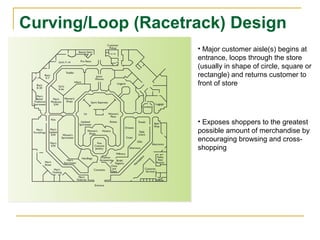
Curving/Loop (Racetrack) Design
                    • Major customer aisle(s) begins at
                    entrance, loops through the store
                    (usually in shape of circle, square or
                    rectangle) and returns customer to
                    front of store


                    • Exposes shoppers to the greatest
                    possible amount of merchandise by
                    encouraging browsing and cross-
                    shopping
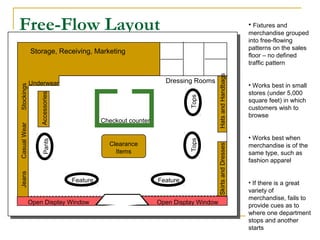
Free-Flow Layout                                                                                        • Fixtures and
                                                                                                        merchandise grouped
                                                                                                        into free-flowing
                                                                                                        patterns on the sales
              Storage, Receiving, Marketing
                                                                                                        floor – no defined
                                                                                                        traffic pattern


                                                                                   Hats and Handbags
              Underwear                                        Dressing Rooms
                                                                                                        • Works best in small
Stockings


                                                                                                        stores (under 5,000
                  Accessories


                                                                       Tops
                                                                                                        square feet) in which
                                                                                                        customers wish to
                                                                                                        browse
                                          Checkout counter
Casual Wear


                                                                                                        • Works best when


                                                                       Tops
                    Pants


                                            Clearance                                                   merchandise is of the


                                                                                   Skirts and Dresses
                                              Items                                                     same type, such as
                                                                                                        fashion apparel
Jeans


                                Feature                      Feature                                    • If there is a great
                                                                                                        variety of
                                                                                                        merchandise, fails to
              Open Display Window                            Open Display Window
                                                                                                        provide cues as to
                                                                                                        where one department
                                                                                                        stops and another
                                                                                                        starts
Spine Layout   • Variation of grid, loop and free-form
               layouts

               • Based on single main aisle running from
               the front to the back of the store
               (transporting customers in both directions)


               • On either side of spine, merchandise
               departments branch off toward the back or
               side walls


               • Heavily used by medium-sized specialty
               stores ranging from 2,000 – 10,000 square
               feet


               • In fashion stores the spine is often subtly
               offset by a change in floor coloring or
               surface and is not perceived as an aisle
Location of Departments
   Relative location advantages

   Impulse products

   Demand/destination areas

   Seasonal needs

   Physical characteristics of merchandise

   Adjacent departments
Feature Areas
   The areas within a store designed to get the
    customer’s attention which include:

       End caps – displays located at the end of the
        aisles
       Promotional aisle/area
       Freestanding fixtures
       Windows
       Walls
       Point-of-sale (POS) displays/areas
Fixture Types
   Straight Rack – long pipe suspended
    with supports to the floor or attached to
    a wall

   Gondola – large base with a vertical
    spine or wall fitted with sockets or
    notches into which a variety of
    shelves, peghooks, bins, baskets and
    other hardware can be inserted.


   Four-way Fixture – two crossbars that
    sit perpendicular to each other on a
    pedestal


   Round Rack – round fixture that sits on
    pedestal

   Other common fixtures: tables, large
    bins, flat-based decks
Fixture Types
   Wall Fixtures
       To make store’s wall
        merchandisable, wall usually
        covered with a skin that is fitted
        with vertical columns of notches
        similar to those on a gondola,
        into which a variety of hardware
        can be inserted
       Can be merchandised much
        higher than floor fixtures (max
        of 42” on floor for round racks
        on wall can be as high as 72”
Merchandise Display Planning
   Shelving – flexible, easy to maintain

   Hanging

   Pegging – small rods inserted into gondolas or wall systems – can be labor
    intensive to display/maintain but gives neat/orderly appearance

   Folding – for softlines can be folded and stacked on shelves or tables - creates
    high fashion image

   Stacking – for large hardlines can be stacked on shelves, base decks of
    gondolas or flats – easy to maintain and gives image of high volume and low
    price

   Dumping – large quantities of small merchandise can be dumped into baskets or
    bins – highly effective for softlines (socks, wash cloths) or hardlines (batteries,
    candy, grocery products) – creates high volume, low cost image
Three Psychological Factors to
Consider in Merchandising Stores
   Value/fashion image
     Trendy, exclusive, pricy vs value-oriented


   Angles and Sightlines
     Customers view store at 45 degree angles from the path they
      travel as they move through the store
     Most stores set up at right angles because it’s easier and
      consumes less space

   Vertical color blocking
     Merchandise should be displayed in vertical bands of color
      wherever possible – will be viewed as rainbow of colors if each
      item displayed vertically by color
     Creates strong visual effect that shoppers are exposed to more
      merchandise (which increases sales)
POS Displays
   Assortment display – open and
    closed assortment

   Theme-setting display

   Ensemble display

   Rack display

   Case display

   Cut case

   Dump bin
Visual Merchandising
   The artistic display of merchandise and theatrical props used as
    scene-setting decoration in the store

   Several key characteristics
     Not associated with shop-able fixture but located as a focal point
      or other area remote from the on-shelf merchandising (and
      perhaps out of the reach of customers)
     Use of props and elements in addition to merchandise – visuals
      don’t always include merchandise; may just be interesting display
      of items related to merchandise or to mood retailer wishes to
      create
     Visuals should incorporate relevant merchandise to be most
      effective
     Retailers should make sure displays don’t create walls that make
      it difficult for shoppers to reach other areas of the store
StoreFront Design

   Storefronts must:
       Clearly identify the name and general nature of
        the store
       Give some hint as to the merchandise inside
       Includes all exterior signage
       In many cases includes store windows – an
        advertising medium for the store – window
        displays should be changed often, be fun/exciting,
        and reflect merchandise offered inside
Atmospherics
   The design of an environment via:

       visual communications
       lighting
       color
       sound
       scent

    to stimulate customers’ perceptual and emotional responses and
    ultimately influence their purchase behavior
Visual Communications
   Name, logo and retail identity

   Institutional signage

   Directional, departmental and category signage

   Point-of-Sale (POS) Signage

   Lifestyle Graphics
Visual Communications
   Coordinate signs and graphics with store’s
    image
   Inform the customer
   Use signs and graphics as props
   Keep signs and graphics fresh
   Limit sign copy
   Use appropriate typefaces on signs
   Create theatrical effects
Lighting
   Important but often overlooked element in
    successful store design

       Highlight merchandise

       Capture a mood

       Level of light can make a difference
           Blockbuster
           Fashion Departments
Color

   Can influence behavior

       Warm colors increase blood pressure, respiratory rate
        and other physiological responses – attract customers
        and gain attention but can also be distracting

       Cool colors are relaxing, peaceful, calm and pleasant
        – effective for retailers selling anxiety-causing
        products
Sound & Scent
   Sound
       Music viewed as valuable marketing tool
       Often customized to customer demographics - AIE (
        http://www.aeimusic.com)
       Can use volume and tempo for crowd control

   Scent
       Smell has a large impact on our emotions
       Victoria Secret, The Magic Kingdom, The Knot Shop
       Can be administered through time release atomizers or via
        fragrance-soaked pellets placed on light fixtures

Store design layout_visual_merchandising

  • 1.
    Store Layout, Design& Visual Merchandising
  • 2.
    Objectives of theStore Environment  Get customers into the store (store image)  Serves a critical role in the store selection process  Important criteria include cleanliness, labeled prices, accurate and pleasant checkout clerks, and well-stocked shelves  The store itself makes the most significant and last impression  Once they are inside the store, convert them into customers buying merchandise (space productivity)  The more merchandise customers are exposed to that is presented in an orderly manner, the more they tend to buy  Retailers focusing more attention on in-store marketing – marketing dollars spent in the store, in the form of store design, merchandise presentation, visual displays, and in-store promotions, should lead to greater sales and profits (bottom line: it is easier to get a consumer in your store to buy more merchandise than planned than to get a new consumer to come into your store)
  • 3.
    Objectives of GoodStore Design  Design should:  be consistent with image and strategy  positively influence consumer behavior  consider costs versus value  be flexible  recognize the needs of the disabled
  • 4.
    Types of FloorSpace in Store  Back Room – receiving area, stockroom  Department stores (50%)  Small specialty and convenience stores (10%)  General merchandise stores (15-20%)  Offices and Other Functional Space – employee break room, store offices, cash office, restrooms  Aisles, Service Areas and Other Non-Selling Areas  Moving shoppers through the store, dressing rooms, layaway areas, service desks, customer service facilities  Merchandise Space  Floor  Wall
  • 5.
    Store Layout (andTraffic Flow)  Conflicting objectives:  Ease of finding merchandise versus varied and interesting layout  Giving customers adequate space to shop versus use expensive space productively
  • 6.
    Grid (Straight) Design • Best used in retail environments in which majority of customers shop the entire store • Can be confusing and frustrating because it is difficult to see over the fixtures to other merchandise • Should be employed carefully; forcing customers to back of large store may frustrate and cause them to look elsewhere • Most familiar examples for supermarkets and drugstores
  • 7.
    Curving/Loop (Racetrack) Design • Major customer aisle(s) begins at entrance, loops through the store (usually in shape of circle, square or rectangle) and returns customer to front of store • Exposes shoppers to the greatest possible amount of merchandise by encouraging browsing and cross- shopping
  • 8.
    Free-Flow Layout • Fixtures and merchandise grouped into free-flowing patterns on the sales Storage, Receiving, Marketing floor – no defined traffic pattern Hats and Handbags Underwear Dressing Rooms • Works best in small Stockings stores (under 5,000 Accessories Tops square feet) in which customers wish to browse Checkout counter Casual Wear • Works best when Tops Pants Clearance merchandise is of the Skirts and Dresses Items same type, such as fashion apparel Jeans Feature Feature • If there is a great variety of merchandise, fails to Open Display Window Open Display Window provide cues as to where one department stops and another starts
  • 9.
    Spine Layout • Variation of grid, loop and free-form layouts • Based on single main aisle running from the front to the back of the store (transporting customers in both directions) • On either side of spine, merchandise departments branch off toward the back or side walls • Heavily used by medium-sized specialty stores ranging from 2,000 – 10,000 square feet • In fashion stores the spine is often subtly offset by a change in floor coloring or surface and is not perceived as an aisle
  • 10.
    Location of Departments  Relative location advantages  Impulse products  Demand/destination areas  Seasonal needs  Physical characteristics of merchandise  Adjacent departments
  • 11.
    Feature Areas  The areas within a store designed to get the customer’s attention which include:  End caps – displays located at the end of the aisles  Promotional aisle/area  Freestanding fixtures  Windows  Walls  Point-of-sale (POS) displays/areas
  • 12.
    Fixture Types  Straight Rack – long pipe suspended with supports to the floor or attached to a wall  Gondola – large base with a vertical spine or wall fitted with sockets or notches into which a variety of shelves, peghooks, bins, baskets and other hardware can be inserted.  Four-way Fixture – two crossbars that sit perpendicular to each other on a pedestal  Round Rack – round fixture that sits on pedestal  Other common fixtures: tables, large bins, flat-based decks
  • 13.
    Fixture Types  Wall Fixtures  To make store’s wall merchandisable, wall usually covered with a skin that is fitted with vertical columns of notches similar to those on a gondola, into which a variety of hardware can be inserted  Can be merchandised much higher than floor fixtures (max of 42” on floor for round racks on wall can be as high as 72”
  • 14.
    Merchandise Display Planning  Shelving – flexible, easy to maintain  Hanging  Pegging – small rods inserted into gondolas or wall systems – can be labor intensive to display/maintain but gives neat/orderly appearance  Folding – for softlines can be folded and stacked on shelves or tables - creates high fashion image  Stacking – for large hardlines can be stacked on shelves, base decks of gondolas or flats – easy to maintain and gives image of high volume and low price  Dumping – large quantities of small merchandise can be dumped into baskets or bins – highly effective for softlines (socks, wash cloths) or hardlines (batteries, candy, grocery products) – creates high volume, low cost image
  • 15.
    Three Psychological Factorsto Consider in Merchandising Stores  Value/fashion image  Trendy, exclusive, pricy vs value-oriented  Angles and Sightlines  Customers view store at 45 degree angles from the path they travel as they move through the store  Most stores set up at right angles because it’s easier and consumes less space  Vertical color blocking  Merchandise should be displayed in vertical bands of color wherever possible – will be viewed as rainbow of colors if each item displayed vertically by color  Creates strong visual effect that shoppers are exposed to more merchandise (which increases sales)
  • 16.
    POS Displays  Assortment display – open and closed assortment  Theme-setting display  Ensemble display  Rack display  Case display  Cut case  Dump bin
  • 17.
    Visual Merchandising  The artistic display of merchandise and theatrical props used as scene-setting decoration in the store  Several key characteristics  Not associated with shop-able fixture but located as a focal point or other area remote from the on-shelf merchandising (and perhaps out of the reach of customers)  Use of props and elements in addition to merchandise – visuals don’t always include merchandise; may just be interesting display of items related to merchandise or to mood retailer wishes to create  Visuals should incorporate relevant merchandise to be most effective  Retailers should make sure displays don’t create walls that make it difficult for shoppers to reach other areas of the store
  • 18.
    StoreFront Design  Storefronts must:  Clearly identify the name and general nature of the store  Give some hint as to the merchandise inside  Includes all exterior signage  In many cases includes store windows – an advertising medium for the store – window displays should be changed often, be fun/exciting, and reflect merchandise offered inside
  • 19.
    Atmospherics  The design of an environment via:  visual communications  lighting  color  sound  scent to stimulate customers’ perceptual and emotional responses and ultimately influence their purchase behavior
  • 20.
    Visual Communications  Name, logo and retail identity  Institutional signage  Directional, departmental and category signage  Point-of-Sale (POS) Signage  Lifestyle Graphics
  • 21.
    Visual Communications  Coordinate signs and graphics with store’s image  Inform the customer  Use signs and graphics as props  Keep signs and graphics fresh  Limit sign copy  Use appropriate typefaces on signs  Create theatrical effects
  • 22.
    Lighting  Important but often overlooked element in successful store design  Highlight merchandise  Capture a mood  Level of light can make a difference  Blockbuster  Fashion Departments
  • 23.
    Color  Can influence behavior  Warm colors increase blood pressure, respiratory rate and other physiological responses – attract customers and gain attention but can also be distracting  Cool colors are relaxing, peaceful, calm and pleasant – effective for retailers selling anxiety-causing products
  • 24.
    Sound & Scent  Sound  Music viewed as valuable marketing tool  Often customized to customer demographics - AIE ( http://www.aeimusic.com)  Can use volume and tempo for crowd control  Scent  Smell has a large impact on our emotions  Victoria Secret, The Magic Kingdom, The Knot Shop  Can be administered through time release atomizers or via fragrance-soaked pellets placed on light fixtures