PRODUCT LIFE
CYCLE
DEFINITION
“ The stages through which the individual products
  develop over a period of time is known as product
  life cycle.”

 The product life cycle concept is derived from the
  fact that a given product’s volume and revenue
  follow a typical pattern of four –phases cycle.
  This life cycle is the representative fact of the
  existence of every product.
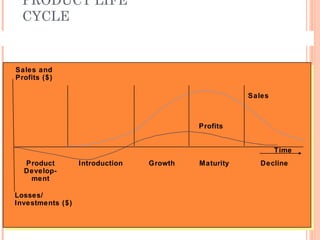
 If we plot a graph of sales volume versus time for
  a product, generally, the PLC represents a bell-
  shaped or s-shaped curve.
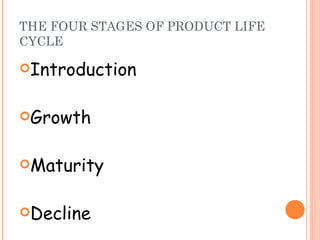
THE FOUR STAGES OF PRODUCT LIFE
CYCLE

Introduction


Growth


Maturity


Decline
PRODUCT LIFE
  CYCLE


Sales and
Profits ($)

                                                     Sales


                                          Profits


                                                             Time
  Product         Introduction   Growth   Maturity      Decline
  Develop-
   ment

Losses/
Investments ($)
INTRODUCTION STAGE OF THE
PLC


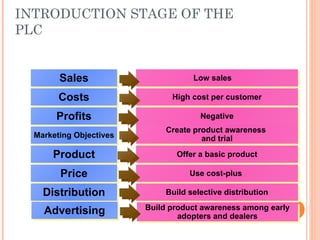
        Sales                        Low sales

        Costs                  High cost per customer

       Profits                         Negative
                              Create product awareness
  Marketing Objectives                 and trial

      Product                   Offer a basic product

        Price                       Use cost-plus

    Distribution              Build selective distribution

    Advertising          Build product awareness among early
                                 adopters and dealers
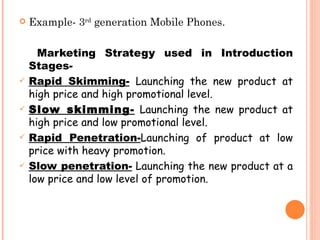
   Example- 3rd generation Mobile Phones.

      Marketing Strategy used in Introduction
    Stages-
   Rapid Skimming- Launching the new product at
    high price and high promotional level.
   Slow skimming- Launching the new product at
    high price and low promotional level.
   Rapid Penetration-Launching of product at low
    price with heavy promotion.
   Slow penetration- Launching the new product at a
    low price and low level of promotion.
Growth Stage of the PLC


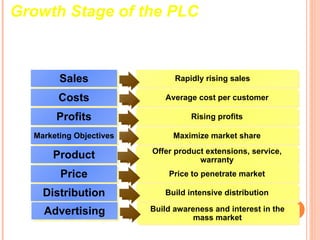
        Sales                  Rapidly rising sales

        Costs               Average cost per customer

       Profits                     Rising profits

  Marketing Objectives        Maximize market share
                         Offer product extensions, service,
      Product                        warranty
        Price                Price to penetrate market

    Distribution            Build intensive distribution

    Advertising          Build awareness and interest in the
                                    mass market
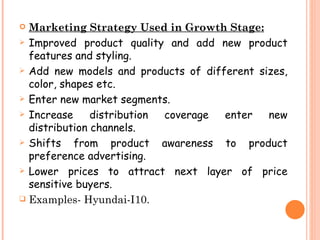
 Marketing Strategy Used in Growth Stage:
 Improved product quality and add new product
  features and styling.
 Add new models and products of different sizes,
  color, shapes etc.
 Enter new market segments.

 Increase     distribution coverage enter   new
  distribution channels.
 Shifts   from product awareness to product
  preference advertising.
 Lower prices to attract next layer of price
  sensitive buyers.
 Examples- Hyundai-I10.
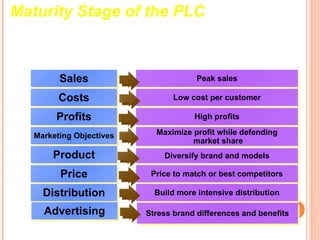
Maturity Stage of the PLC


         Sales                         Peak sales

         Costs                   Low cost per customer

        Profits                       High profits

   Marketing Objectives     Maximize profit while defending
                                     market share
       Product                Diversify brand and models

         Price             Price to match or best competitors

     Distribution           Build more intensive distribution

     Advertising          Stress brand differences and benefits
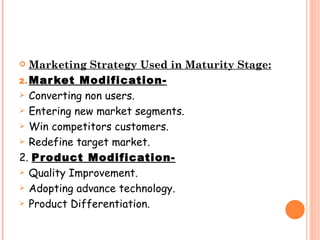
  Marketing Strategy Used in Maturity Stage:
2. Mar ket Modification-
 Converting non users.

 Entering new market segments.

 Win competitors customers.

 Redefine target market.

2. Product Modification-
 Quality Improvement.

 Adopting advance technology.

 Product Differentiation.
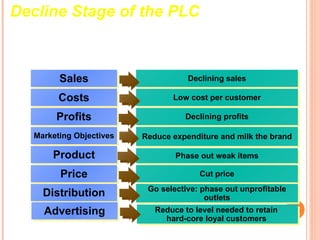
Decline Stage of the PLC


         Sales                       Declining sales

         Costs                   Low cost per customer

        Profits                     Declining profits

   Marketing Objectives   Reduce expenditure and milk the brand

       Product                    Phase out weak items

         Price                          Cut price
                           Go selective: phase out unprofitable
     Distribution                         outlets
     Advertising             Reduce to level needed to retain
                               hard-core loyal customers
MARKETING STRATEGY USED IN DECLINE
STAGES
 Increase the given firms investment to dominate
  the market or strengthen its competitive
  position.
 Maintaining the given firms investment level
  until the uncertainties about the industry are
  resolved.
 Decrease the firms investment selectively, by
  dropping the unprofitable customers group, while
  simultaneously     strengthening      the  firms
  investment niche segments.
 Harvesting the firms investment to recover cash
  quickly.
 Divesting the business quickly by dropping off its
  assets as advantageously as possible.
PLC CONCEPT IS BASED ON FOLLOWING
ASSUMPTIONS-
   Not all product introduced in the market essentially
    pass through all stages of its life cycle. It is also
    possible that the product may attain introduction
    stage and then get phased out.
   There is no definite line of demarcation between the
    various stages of product life cycle.
   At the same time, a product may be in different
    stages of its life cycle in different segment of the
    market. For example, the product concerned may be
    in the introduction stage in Asian market while facing
    decline in western countries.
   The time span of each stage in product life cycle in
    respect of each product may vary. Thus, a product
    may experience longer period in growth stage and
    relatively short period in maturity stage.

Product life cycle

  • 1.
  • 2.
    DEFINITION “ The stagesthrough which the individual products develop over a period of time is known as product life cycle.”  The product life cycle concept is derived from the fact that a given product’s volume and revenue follow a typical pattern of four –phases cycle. This life cycle is the representative fact of the existence of every product.  If we plot a graph of sales volume versus time for a product, generally, the PLC represents a bell- shaped or s-shaped curve.
  • 3.
    THE FOUR STAGESOF PRODUCT LIFE CYCLE Introduction Growth Maturity Decline
  • 4.
    PRODUCT LIFE CYCLE Sales and Profits ($) Sales Profits Time Product Introduction Growth Maturity Decline Develop- ment Losses/ Investments ($)
  • 5.
    INTRODUCTION STAGE OFTHE PLC Sales Low sales Costs High cost per customer Profits Negative Create product awareness Marketing Objectives and trial Product Offer a basic product Price Use cost-plus Distribution Build selective distribution Advertising Build product awareness among early adopters and dealers
  • 6.
    Example- 3rd generation Mobile Phones. Marketing Strategy used in Introduction Stages-  Rapid Skimming- Launching the new product at high price and high promotional level.  Slow skimming- Launching the new product at high price and low promotional level.  Rapid Penetration-Launching of product at low price with heavy promotion.  Slow penetration- Launching the new product at a low price and low level of promotion.
  • 7.
    Growth Stage ofthe PLC Sales Rapidly rising sales Costs Average cost per customer Profits Rising profits Marketing Objectives Maximize market share Offer product extensions, service, Product warranty Price Price to penetrate market Distribution Build intensive distribution Advertising Build awareness and interest in the mass market
  • 8.
     Marketing StrategyUsed in Growth Stage:  Improved product quality and add new product features and styling.  Add new models and products of different sizes, color, shapes etc.  Enter new market segments.  Increase distribution coverage enter new distribution channels.  Shifts from product awareness to product preference advertising.  Lower prices to attract next layer of price sensitive buyers.  Examples- Hyundai-I10.
  • 9.
    Maturity Stage ofthe PLC Sales Peak sales Costs Low cost per customer Profits High profits Marketing Objectives Maximize profit while defending market share Product Diversify brand and models Price Price to match or best competitors Distribution Build more intensive distribution Advertising Stress brand differences and benefits
  • 10.
     MarketingStrategy Used in Maturity Stage: 2. Mar ket Modification-  Converting non users.  Entering new market segments.  Win competitors customers.  Redefine target market. 2. Product Modification-  Quality Improvement.  Adopting advance technology.  Product Differentiation.
  • 11.
    Decline Stage ofthe PLC Sales Declining sales Costs Low cost per customer Profits Declining profits Marketing Objectives Reduce expenditure and milk the brand Product Phase out weak items Price Cut price Go selective: phase out unprofitable Distribution outlets Advertising Reduce to level needed to retain hard-core loyal customers
  • 12.
    MARKETING STRATEGY USEDIN DECLINE STAGES  Increase the given firms investment to dominate the market or strengthen its competitive position.  Maintaining the given firms investment level until the uncertainties about the industry are resolved.  Decrease the firms investment selectively, by dropping the unprofitable customers group, while simultaneously strengthening the firms investment niche segments.  Harvesting the firms investment to recover cash quickly.  Divesting the business quickly by dropping off its assets as advantageously as possible.
  • 13.
    PLC CONCEPT ISBASED ON FOLLOWING ASSUMPTIONS-  Not all product introduced in the market essentially pass through all stages of its life cycle. It is also possible that the product may attain introduction stage and then get phased out.  There is no definite line of demarcation between the various stages of product life cycle.  At the same time, a product may be in different stages of its life cycle in different segment of the market. For example, the product concerned may be in the introduction stage in Asian market while facing decline in western countries.  The time span of each stage in product life cycle in respect of each product may vary. Thus, a product may experience longer period in growth stage and relatively short period in maturity stage.

Editor's Notes

  • #5 The Product Life-Cycle This CTR corresponds to Figure 9-2 on p. 288 and relates to the material on pp. 287-293. Instructor’s Note: This CTR can be used to overview the life cycle concept. Strategies appropriate for each stage are discussed on the following CTRs. Product Life Cycle Stages Product Development. Development begins when the company finds and develops a new product idea. During development the product has costs but no sales. Development costs must be strategically weighed against the projected length of the product's PLC. Introduction. During the introduction of new products initial sales growth is slow as the market is just becoming aware of the product. Profits are usually nonexistent at this stage due to heavy promotional spending. Growth. This stage is characterized by rapid market acceptance of the product and increasing profits. Maturity . In maturity there is a slowdown in sales growth as the product has achieved acceptance by most potential customers. Profits may level off or decline as marketing costs increase to defend existing market share. Decline. In this period sales begin to fall off and profits decline dramatically.
  • #6 Introduction. In this stage marketers spend heavily on promotions to inform the target market about the new product's benefits. Low or negative profits may encourage the company to price the product high to help offset expenses. companies can concentrate on skimming strategies to generate high profits now or on penetration strategies to build market share and dominant the market for larger profits once the market stabilizes. Product Life Cycle Strategies Product Life-Cycle Strategies This CTR relates to the material on pp. 289 and 293.
  • #8 Product Life-Cycle Strategies This CTR relates to the material on pp. 289-290 and 293. Product Life-Cycle Strategies Growth. In this stage the company experiences both increasing sales and competition. Promotion costs are spread over larger volume and strategic decisions focus on growth strategies. Strategies include adding new features, improving quality, increasing distribution, and entering new market segments.
  • #10 Product Life Cycle Strategies Maturity. In this stage the company must manage slower growth over a longer period of time. Strategic decisions made in the growth stage may limit choices now. Marketing managers must proactively seek advantage by either market modification to increase consumption, product modification to attract new users (quality, feature, and style improvements), or marketing mix modification in an attempt to improve competitive position. Product Life-Cycle Strategies This CTR relates to the material on pp. 290-292 and 293.
  • #12 Product Life-Cycle Strategies This CTR relates to the material on pp. 292-293. Product Life Cycle Strategies Decline. In this stage the costs of managing the product may eventually exceed profits. Rate of decline is a major factor in setting strategy. Management may maintain the brand as competitors drop out, harvest the brand by reducing costs of support for short term profit increases, or drop the product (divest) altogether.