Storage
What is storage?
• Storage holds data, instructions, and information for future use.
• Storage medium is physical material used for storage.
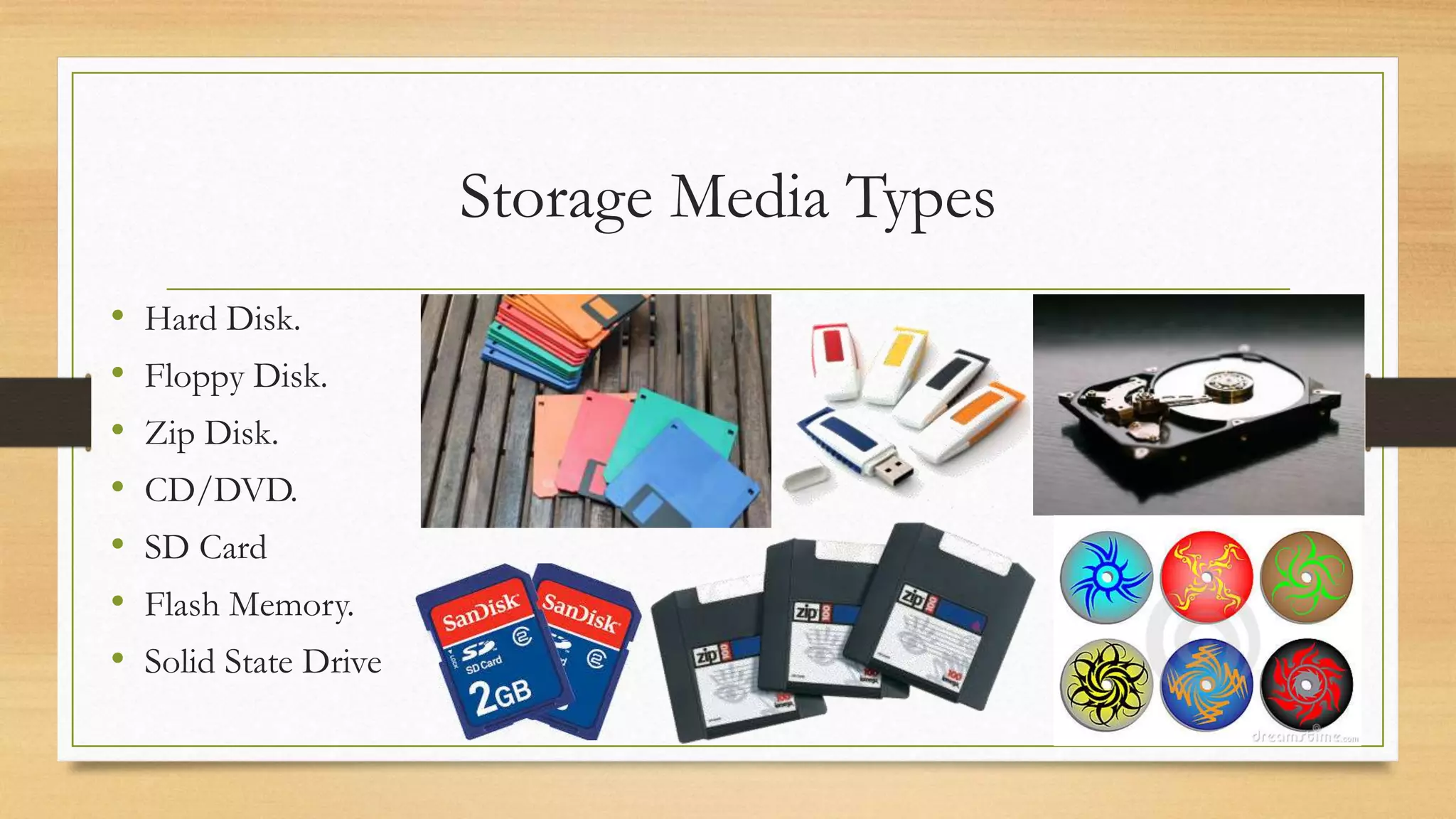
Storage Media Types
• Hard Disk.
• Floppy Disk.
• Zip Disk.
• CD/DVD.
• SD Card
• Flash Memory.
• Solid State Drive
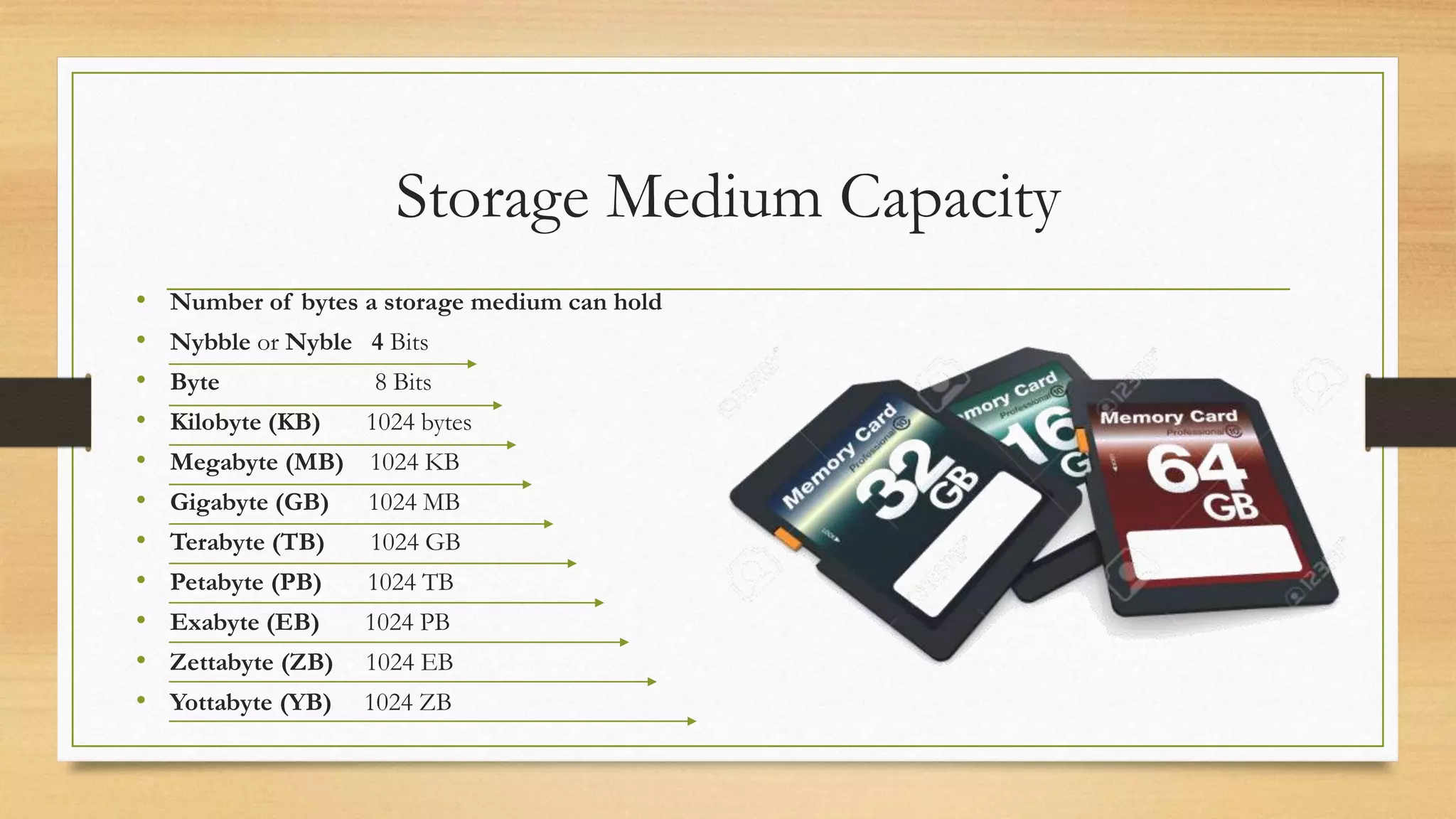
Storage Medium Capacity
• Number of bytes a storage medium can hold
• Nybble or Nyble 4 Bits
• Byte 8 Bits
• Kilobyte (KB) 1024 bytes
• Megabyte (MB) 1024 KB
• Gigabyte (GB) 1024 MB
• Terabyte (TB) 1024 GB
• Petabyte (PB) 1024 TB
• Exabyte (EB) 1024 PB
• Zettabyte (ZB) 1024 EB
• Yottabyte (YB) 1024 ZB
Storage Device
Hardware
that records
data
Writes
items from
memory to
storage media
Reads
items from storage
media to memory
Drive Types
Hard Disk Drive (HDD) Solid State Drive (SSD)
What is a Hard Disk Drive ?
• It was invented in 1954 by IBM.
• High capacity storage.
• Consists of several inflexible,
circular platters that store items
electronically.
• Components enclosed in airtight,
sealed case for protection.
• The operating system, software
and most other files are stored in
the HDD.
Hard Disk Drive Interfaces
• Parallel Advance Technology Attachment (PATA).
• Small Computer System Interface (SCSI).
• Serial AT Attachment (SATA).
• Serial Attached SCSI (SAS).
Parallel Advance Technology
Attachment (PATA)
• It has a 40 Pins Data Connector.
• It has 4 Pins Power connector.
• Data transfer rate is 133.3 MB/S.
• If you have two devices connected to one IDE
controller, one must be set master and the other must
be set to slave using jumpers and IDE cable.
• Max of two drives per controller.
• Developed by Western Digital under the name
Integrated Drive Electronics (IDE).
Small Computer System Interface (SCSI)
• SCSI are high performance storage drives.
• SCSI drives are commonly found in servers were
real time performance or 24/7 operation is
required.
• It has 40 Pins Data Connector and 4 Pins Power
connector.
• Data transfer rate is 320 MB/S for SCSI-3 Wide
Ultra3.
• Max of 15/16 drives per controller.
SATA Drive Interface
• It is the latest high speed type of hard
drive connectors.
• It has a 7 pin Data connector.
• It has 15 pin Power connector.
• Data transfer rate is 22.5 GB/S for
SATA V4 at 2017
• Max of 15 with a port multiplier.
The Serial Attached SCSI (SAS)
• It has a 7 pin Data connector.
• It has 15 pin Power connector.
• Data transfer rate is 6 GB/S
• Max of 8 drives per controller.
Basic components of a hard drive
• Disk platters.
• Read/write heads.
• Spindle motor.
• Stepper motor.
• Logic board.
• Cables & connectors.
• Configuration items (such as jumpers &switches).
Hard Disk Platters
• 3 1/2 inch drives are the most popular for desktop &
some portables.
• Max number of platters in a 3 1/2 inch drive is 11.
• Traditionally made from a magnetic material, in the flat
disk part of the drive.
• The data stored in the platter.
• Desire for higher density has led to the use of platters
made of glass (glass ceramic composite).
Glass platters offer greater rigidity & mores table
thermally.
Read/Write Heads
• A hard disk has one read/write head for each side of the platter.
• The heads are connected on a single movement mechanism.
• They move in same manner and direction.
• Each head is on an actuator arm that is spring-loaded to force the head into contact
with a platter .
• The heads float only a very slight distance above the platter .
• When the drive is at rest, the heads are forced into direct contact with the platters by
spring tension.
Spindle motor
• Motor that spins the platters.
• Connected directly to the drive.
• This motor rotates at a speed of 3600 to
15,000 RPM.
• All the platter moves in the same
direction.
Stepper motor
• Use stepper motors for
controlling read/write head
position.
• Stepper motors usually use
+12V power, but some new
low-power drives use +5V
power source.
Logic Boards
• Mounted on the hard drive.
• Contain electronics that
control the drive’s spindle,
head actuator systems, and
present the data to the
controller.
Cables & Connectors
• Connectors for interfacing to the computer,
receiving power.
• Data cables:
SATA cable.
SCSI cable.
IDE cable.
SAS cable.
Disk structures
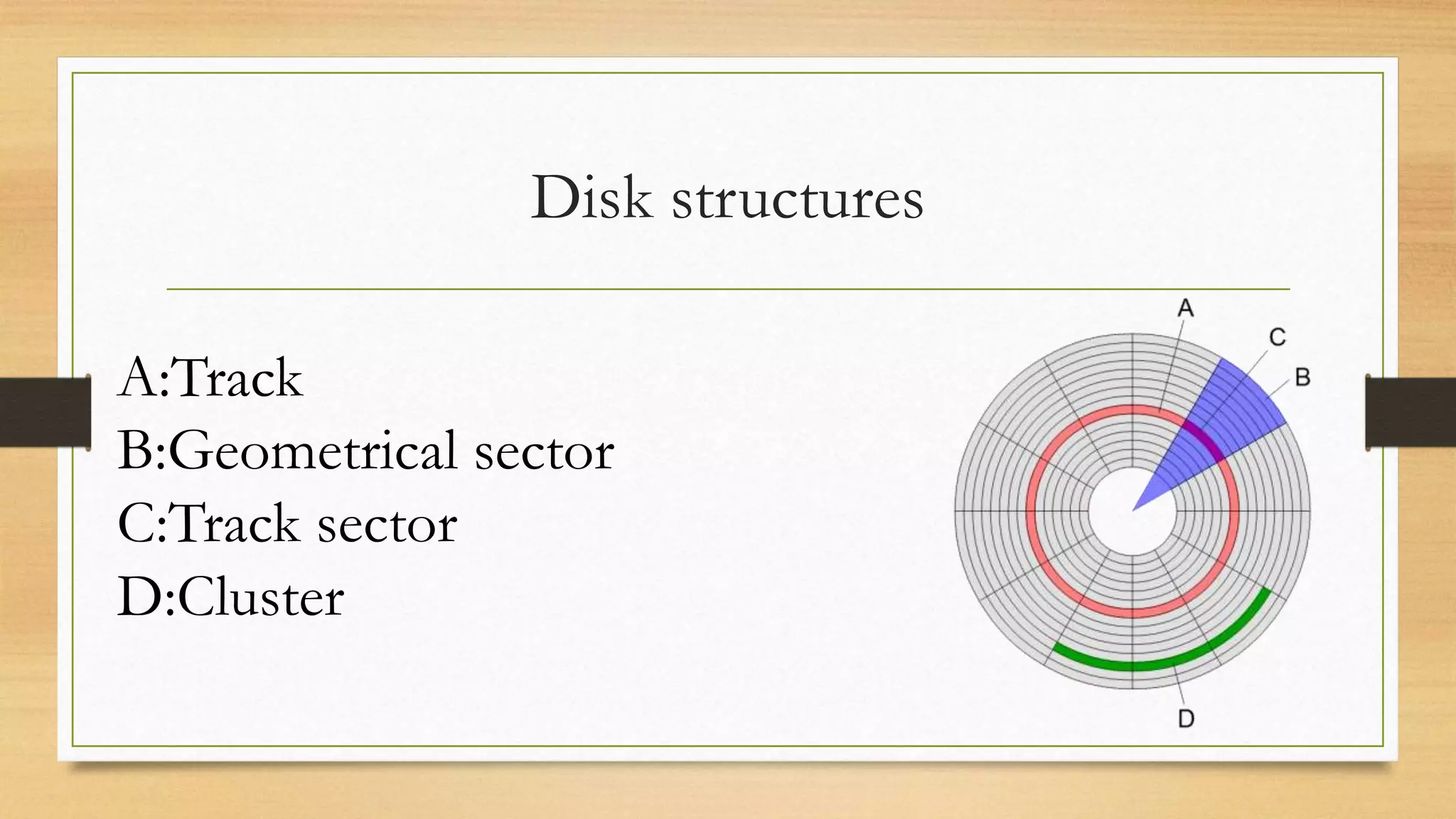
A:Track
B:Geometrical sector
C:Track sector
D:Cluster
• Track : The HDD is divided into number of concentric circulars called
tracks.
• Sector: Data storage area in one track multiple divided into the
multiple block. Each sector can have 512 bytes of the data.
• Cylinder: A set corresponding tracks in all sides of a hard disk.
• Storage capacity: its having a formula show below:
Storage capacity= number of cylinder's * tracks per cylinder *sector per tracks * bytes per sector.
Disk structures
HDD Problems
• No operating system.
• Disk boot Failure
(cable problem) OR (HDD Not Detect).
Solid State Drive
• It was invented in 1995 by M-systems.
• It’s a data storage device that uses solid state
memory to store persistent data.
• SSDs use NAND based flash memory or
DRAM to store data.
• The SSD need external power supply or battery
pack.
Advantages Disadvantages
High performance They are more expensive than
traditional hard drive
Faster than a standard HDD They currently offer less storage
space than traditional hard drive
Faster seek time upto 60* faster
than HDD
Lower power
Silent operation
Lighter weight
Wider operating temp 0c- 70c
Hard Disk DriveSolid State Drive
Random access time 5 -10 M/SRandom access time 0.1 M/S
Read latency time highRead latency time very low
Low ReliabilityHigh Reliability
HDDs have moving partsSSDs have no moving parts
Relatively large and heavySmall and light in weight
In 2020 HDDs were available in
size up to 40 TB
In 2018 SSDs were available in
size up to 128 TB
Power consumption 12 wattsPower consumption 2 watts
RAID 0
• Minimum 2 disks.
• Excellent performance (as blocks are
striped).
• No redundancy (no mirror, no parity).
• Don’t use this for any critical system.
RAID 1
• Minimum 2 disks.
• Good performance (no striping. no parity).
• Excellent redundancy (as blocks are mirrored).
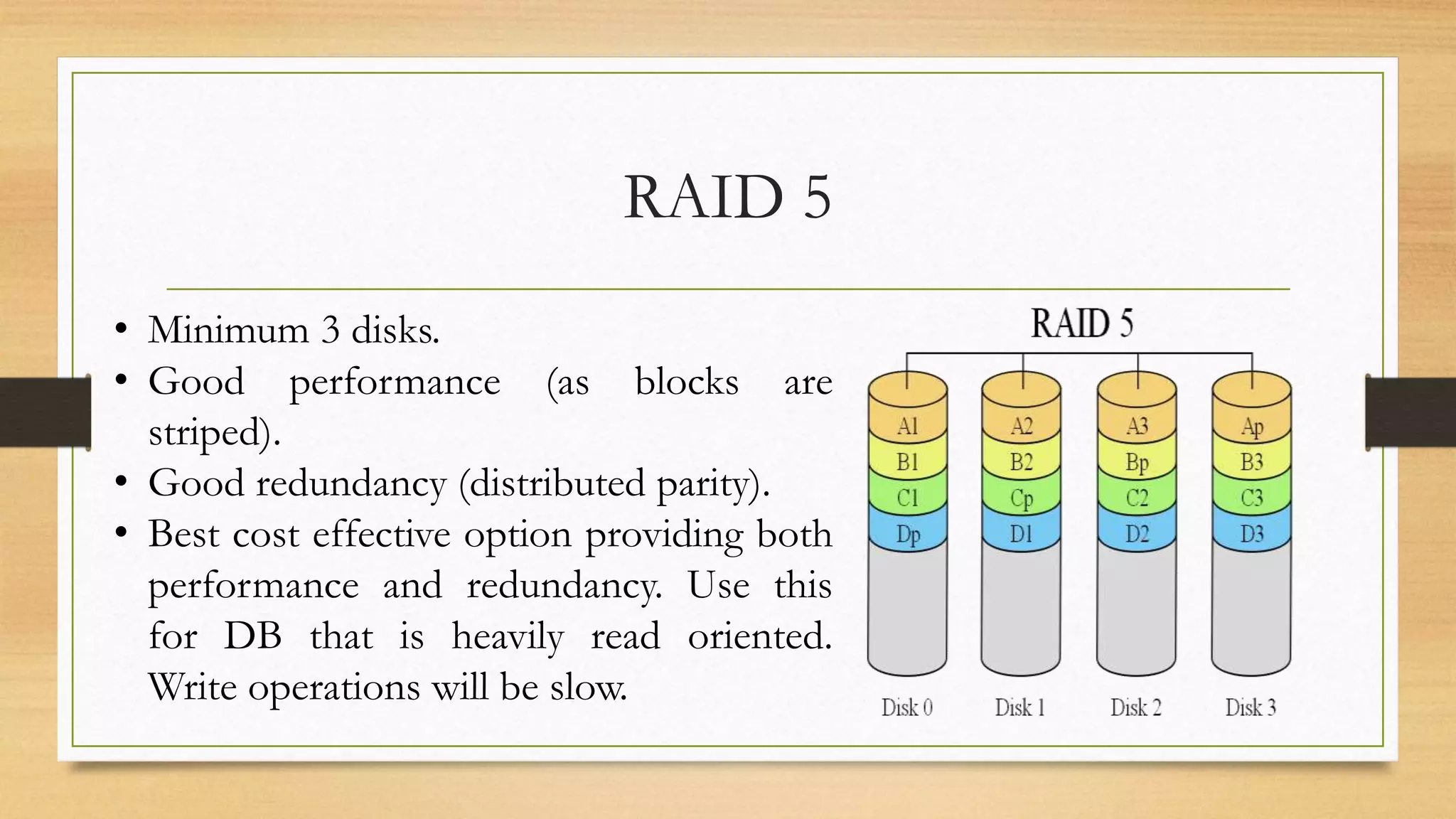
RAID 5
• Minimum 3 disks.
• Good performance (as blocks are
striped).
• Good redundancy (distributed parity).
• Best cost effective option providing both
performance and redundancy. Use this
for DB that is heavily read oriented.
Write operations will be slow.
RAID 1+0
• Minimum 4 disks.
• This is also called as “stripe of mirrors”.
• Excellent redundancy (as blocks are
mirrored).
• Excellent performance (as blocks are
striped).
• If you can afford the dollar, this is the
BEST option for any mission critical.
Thanks for your attention

Storage (Hard disk drive)

  • 1.
  • 2.
    What is storage? •Storage holds data, instructions, and information for future use. • Storage medium is physical material used for storage.
  • 3.
    Storage Media Types •Hard Disk. • Floppy Disk. • Zip Disk. • CD/DVD. • SD Card • Flash Memory. • Solid State Drive
  • 4.
    Storage Medium Capacity •Number of bytes a storage medium can hold • Nybble or Nyble 4 Bits • Byte 8 Bits • Kilobyte (KB) 1024 bytes • Megabyte (MB) 1024 KB • Gigabyte (GB) 1024 MB • Terabyte (TB) 1024 GB • Petabyte (PB) 1024 TB • Exabyte (EB) 1024 PB • Zettabyte (ZB) 1024 EB • Yottabyte (YB) 1024 ZB
  • 5.
    Storage Device Hardware that records data Writes itemsfrom memory to storage media Reads items from storage media to memory
  • 6.
    Drive Types Hard DiskDrive (HDD) Solid State Drive (SSD)
  • 7.
    What is aHard Disk Drive ? • It was invented in 1954 by IBM. • High capacity storage. • Consists of several inflexible, circular platters that store items electronically. • Components enclosed in airtight, sealed case for protection. • The operating system, software and most other files are stored in the HDD.
  • 8.
    Hard Disk DriveInterfaces • Parallel Advance Technology Attachment (PATA). • Small Computer System Interface (SCSI). • Serial AT Attachment (SATA). • Serial Attached SCSI (SAS).
  • 9.
    Parallel Advance Technology Attachment(PATA) • It has a 40 Pins Data Connector. • It has 4 Pins Power connector. • Data transfer rate is 133.3 MB/S. • If you have two devices connected to one IDE controller, one must be set master and the other must be set to slave using jumpers and IDE cable. • Max of two drives per controller. • Developed by Western Digital under the name Integrated Drive Electronics (IDE).
  • 10.
    Small Computer SystemInterface (SCSI) • SCSI are high performance storage drives. • SCSI drives are commonly found in servers were real time performance or 24/7 operation is required. • It has 40 Pins Data Connector and 4 Pins Power connector. • Data transfer rate is 320 MB/S for SCSI-3 Wide Ultra3. • Max of 15/16 drives per controller.
  • 11.
    SATA Drive Interface •It is the latest high speed type of hard drive connectors. • It has a 7 pin Data connector. • It has 15 pin Power connector. • Data transfer rate is 22.5 GB/S for SATA V4 at 2017 • Max of 15 with a port multiplier.
  • 12.
    The Serial AttachedSCSI (SAS) • It has a 7 pin Data connector. • It has 15 pin Power connector. • Data transfer rate is 6 GB/S • Max of 8 drives per controller.
  • 13.
    Basic components ofa hard drive • Disk platters. • Read/write heads. • Spindle motor. • Stepper motor. • Logic board. • Cables & connectors. • Configuration items (such as jumpers &switches).
  • 14.
    Hard Disk Platters •3 1/2 inch drives are the most popular for desktop & some portables. • Max number of platters in a 3 1/2 inch drive is 11. • Traditionally made from a magnetic material, in the flat disk part of the drive. • The data stored in the platter. • Desire for higher density has led to the use of platters made of glass (glass ceramic composite). Glass platters offer greater rigidity & mores table thermally.
  • 15.
    Read/Write Heads • Ahard disk has one read/write head for each side of the platter. • The heads are connected on a single movement mechanism. • They move in same manner and direction. • Each head is on an actuator arm that is spring-loaded to force the head into contact with a platter . • The heads float only a very slight distance above the platter . • When the drive is at rest, the heads are forced into direct contact with the platters by spring tension.
  • 18.
    Spindle motor • Motorthat spins the platters. • Connected directly to the drive. • This motor rotates at a speed of 3600 to 15,000 RPM. • All the platter moves in the same direction.
  • 19.
    Stepper motor • Usestepper motors for controlling read/write head position. • Stepper motors usually use +12V power, but some new low-power drives use +5V power source.
  • 20.
    Logic Boards • Mountedon the hard drive. • Contain electronics that control the drive’s spindle, head actuator systems, and present the data to the controller.
  • 21.
    Cables & Connectors •Connectors for interfacing to the computer, receiving power. • Data cables: SATA cable. SCSI cable. IDE cable. SAS cable.
  • 22.
  • 23.
    • Track :The HDD is divided into number of concentric circulars called tracks. • Sector: Data storage area in one track multiple divided into the multiple block. Each sector can have 512 bytes of the data. • Cylinder: A set corresponding tracks in all sides of a hard disk. • Storage capacity: its having a formula show below: Storage capacity= number of cylinder's * tracks per cylinder *sector per tracks * bytes per sector. Disk structures
  • 24.
    HDD Problems • Nooperating system. • Disk boot Failure (cable problem) OR (HDD Not Detect).
  • 25.
    Solid State Drive •It was invented in 1995 by M-systems. • It’s a data storage device that uses solid state memory to store persistent data. • SSDs use NAND based flash memory or DRAM to store data. • The SSD need external power supply or battery pack.
  • 26.
    Advantages Disadvantages High performanceThey are more expensive than traditional hard drive Faster than a standard HDD They currently offer less storage space than traditional hard drive Faster seek time upto 60* faster than HDD Lower power Silent operation Lighter weight Wider operating temp 0c- 70c
  • 27.
    Hard Disk DriveSolidState Drive Random access time 5 -10 M/SRandom access time 0.1 M/S Read latency time highRead latency time very low Low ReliabilityHigh Reliability HDDs have moving partsSSDs have no moving parts Relatively large and heavySmall and light in weight In 2020 HDDs were available in size up to 40 TB In 2018 SSDs were available in size up to 128 TB Power consumption 12 wattsPower consumption 2 watts
  • 28.
    RAID 0 • Minimum2 disks. • Excellent performance (as blocks are striped). • No redundancy (no mirror, no parity). • Don’t use this for any critical system.
  • 29.
    RAID 1 • Minimum2 disks. • Good performance (no striping. no parity). • Excellent redundancy (as blocks are mirrored).
  • 30.
    RAID 5 • Minimum3 disks. • Good performance (as blocks are striped). • Good redundancy (distributed parity). • Best cost effective option providing both performance and redundancy. Use this for DB that is heavily read oriented. Write operations will be slow.
  • 31.
    RAID 1+0 • Minimum4 disks. • This is also called as “stripe of mirrors”. • Excellent redundancy (as blocks are mirrored). • Excellent performance (as blocks are striped). • If you can afford the dollar, this is the BEST option for any mission critical.
  • 32.
    Thanks for yourattention

Editor's Notes

  • #3 التأكد من رقم 3
  • #6 At the HDD the head do the read and the Writes But at SDD the command do the write and the read
  • #13 SAS uses a mechanically identical data and power connector to standard 3.5-inch SATA1/SATA2 HDDs and many server-oriented SAS RAID controllers are also capable of addressing SATA hard drives. SATA drives can be attached to a SAS drive controller and they will work perfectly because they are compatible but not SAS drive connected to a SATA controller this configuration will not work.