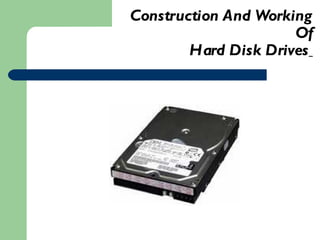
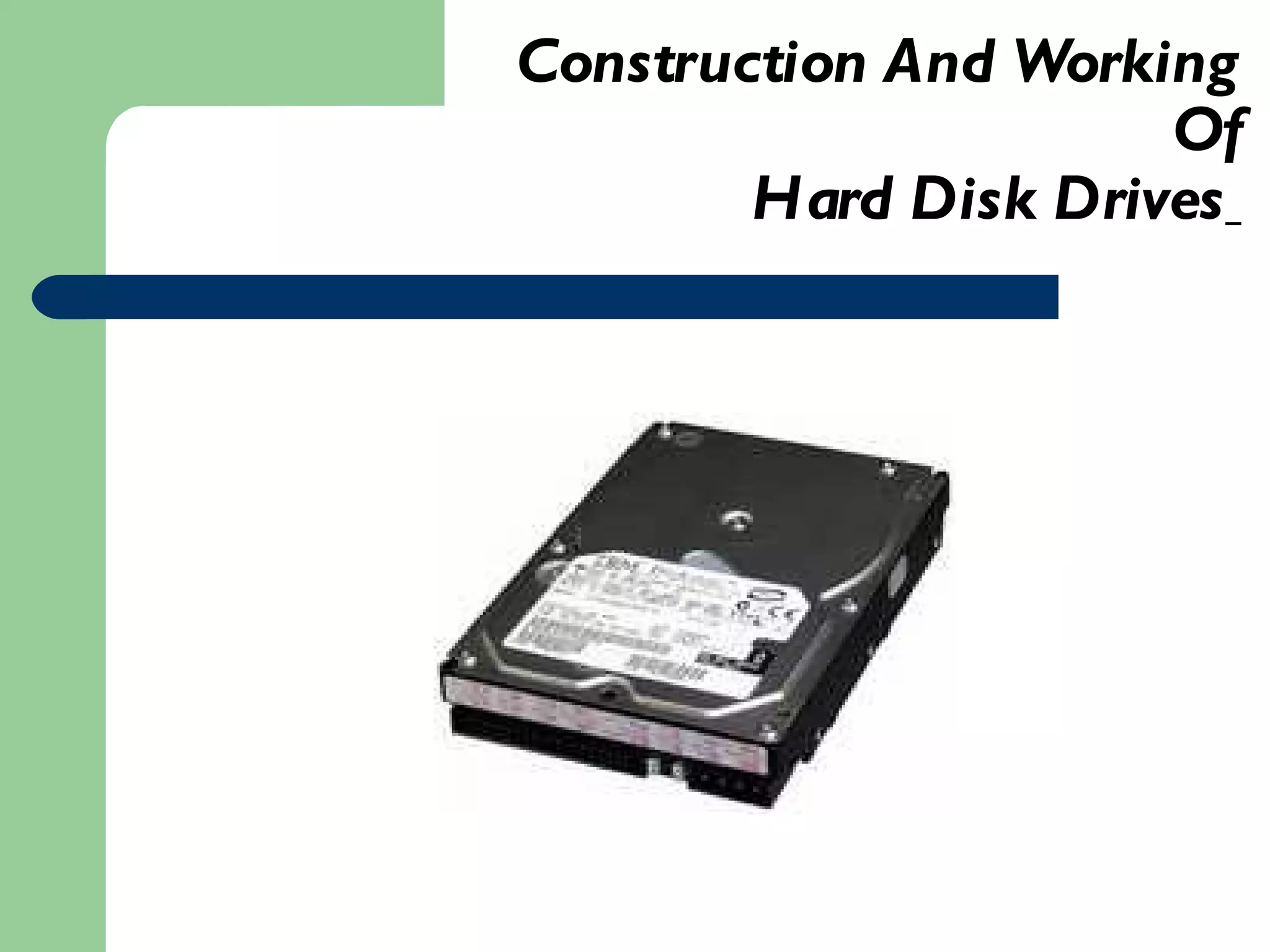
Construction And Working Of Hard Disk Drives
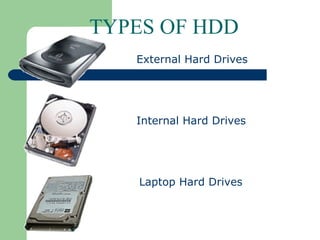
TYPES OF HDD External Hard Drives Internal Hard Drives Laptop Hard Drives
Hard Disks Sizes Available are: 20 GB 40 GB 80 GB 120 GB 180 GB
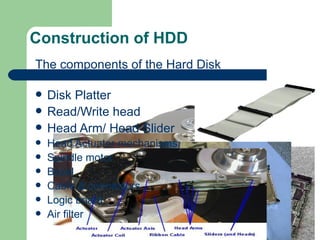
Construction of HDD The components of the Hard Disk Disk Platter Read/Write head Head Arm/ Head Slider Head Actuator mechanisms Spindle motor Bezel Cable & connectors Logic board Air filter
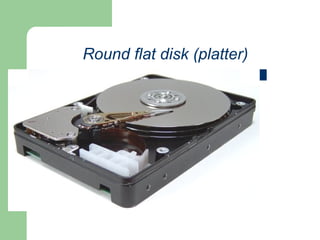
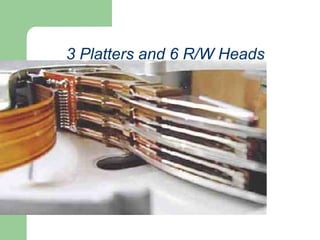
What's Inside a Hard Drive? The Platters One or more round, flat disks used to actually hold the data in the drive  Each platter has two surfaces (top & bottom) that are capable of holding data;  Each surface has one  read /write head  (Each platter has two heads,  one on the top of the platter and one on the bottom,) Hard disk with three platters has six surfaces and six total heads. Normally both surfaces of each platter are used The outer surface of top and bottom disk cannot be used.
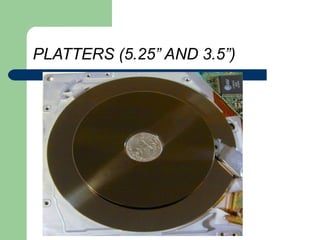
PLATTERS (contd..) Platter size is the form factor Disks are sometimes referred to by a size specification for example "3.5-inch hard disk".  The first PCs used hard disks that had a nominal size of 5.25".  Today, by far the most common hard disk platter size is 3.5“ Laptop drives are usually smaller, The platters on these drives are usually 2.5" in diameter or less; 2.5" is the standard form factor, but drives with 1.8" and even 1.0" platters are becoming more common. PCs  usually have 1 to 5 platters
PLATTERS (5.25” AND 3.5”)
Round flat disk (platter)
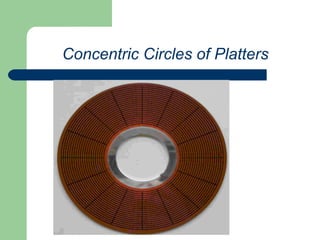
Concentric Circles of Platters
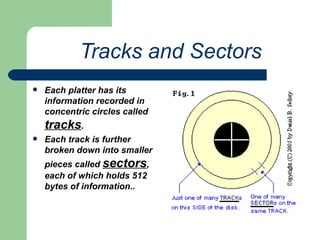
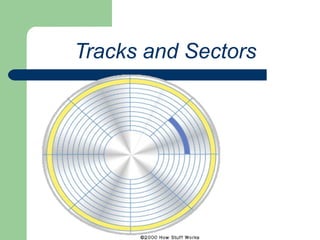
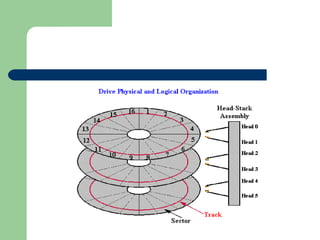
Tracks and Sectors Each platter has its information recorded in concentric circles called  tracks .  Each track is further broken down into smaller pieces called  sectors , each of which holds 512 bytes of information..
Tracks and Sectors
STORAGE OF DATA in Platters A sector contains a fixed number of bytes -- for example, 256 or 512. Each track typically holds between 100 and 300 sectors.  Larger outer tracks hold more sectors than the smaller inner ones.  All information stored on a hard disk is recorded in tracks.  The tracks are numbered, starting from zero, starting at the outside of the platter.   A hard disk has several thousand tracks on each platter.  Either at the drive or the operating system level, sectors are often grouped together into  clusters.
 
STORAGE OF DATA in Platters (contd..) They are made of Al alloy ( Light wt., strong) They are coated with magnetic media which stores information magnetically Two types of recording media used in HDD Iron oxide media Thin film media
Iron oxide media The HDD platter surface is coated with iron oxide compound Its recording density is less & it is very soft. Crash of drive head on the platter makes a permanent defect on the media coating
Thin Film Media It is thinner in comparison to iron oxide coating It provides very hard and perfectly coated media which can withstand head crash without destroying the coating After the coating , the coating is cured and polished
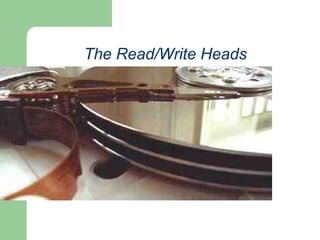
The Read/Write Heads The read/write heads read and write data to the platters.  They are usually one of the more expensive parts of the HD
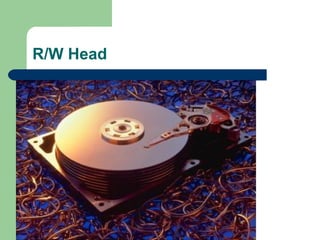
R/W Head
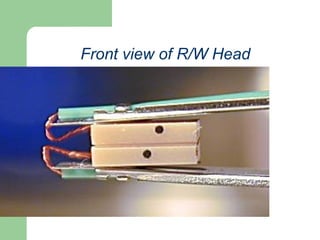
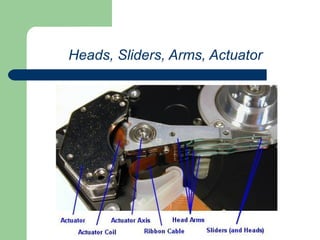
The Read/Write Heads The read/write heads do not make contact with the media  ( or the disk) but float over the surface of the disk and do all of their work without physically touching the platters. Each platter has two heads which are mounted onto sliders and used to either record information onto the disk or read information from it.  The sliders are mounted onto arms, The arms are controlled using a device called an  actuator. Actuator positions the arms to the appropriate track on the disk.
The Read/Write Heads
Front view of R/W Head
3 Platters and 6 R/W Heads
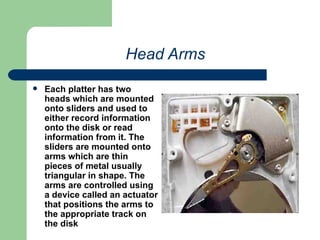
Head Arms Each platter has two heads which are mounted onto sliders and used to either record information onto the disk or read information from it. The sliders are mounted onto arms which are thin pieces of metal usually triangular in shape. The arms are controlled using a device called an actuator that positions the arms to the appropriate track on the disk
Heads, Sliders, Arms, Actuator
Head Crash The actuator is the device used to position the  head arms  to different tracks on the surface of the platter  All R/W heads are lined up and mounted on the Actuator. So when one head is over a track, all the other heads will also move and they will  be at the same location over their respective surfaces . Typically, only one of the heads is active at a time, i.e., reading or writing data , When not in use, the heads rest on the stationary platters.  If the heads contact the surface of the disk while it is at operational speed, the result can be loss of data, damage to the heads, damage to the surface of the disk, or all three. This is usually called a  head crash
Head Actuator Head actuators come in two general varieties:  Stepper Motor Actuator Voice Coil Actuator
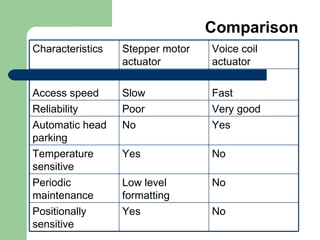
Comparison Characteristics Stepper motor actuator Voice coil actuator Access speed Slow Fast Reliability Poor Very good Automatic head parking No Yes Temperature sensitive Yes No Periodic maintenance Low level formatting No Positionally sensitive Yes No
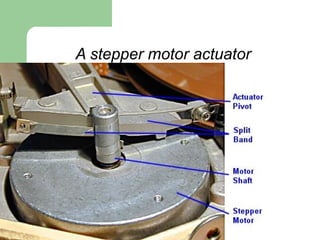
A stepper motor actuator
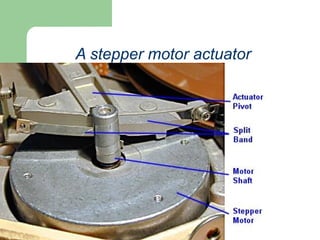
A stepper motor actuator   Stepper Motors :   A stepper motor is a special type of dc motor used to accurately position the magnetic heads. A hard drive attaches the arms to the motor, and each time the motor steps one  position clockwise or counterclockwise, the arms move  in or out one position which in turn moves the heads .  Each position defines a track on the surface of the disk.  Stepper motor actuators are  not used in modern drives  because they are prone to alignment problems and are highly sensitive to heat.
A stepper motor actuator
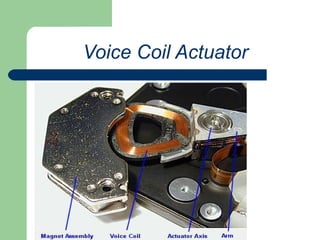
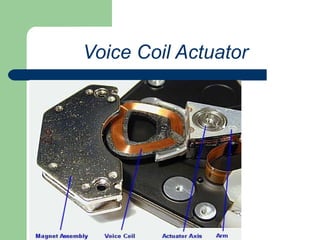
Voice Coil Actuator
Voice Coil Actuator Modern hard drives uses a  voice coil actuator . It uses a device called a  voice coil  to move the head arms in and out over the surface of the platters.  The voice coil actuator is not only far more adaptable and insensitive to thermal issues, it is much faster and more reliable than a stepper motor.
Types of Voice coil In Linear Voice coil actuator system, the head is moved in and out over the disk surface in a straight line In rotary Voice coil uses a rotatory arm to move the R/W head
Voice Coil Actuator
Spindle Motor
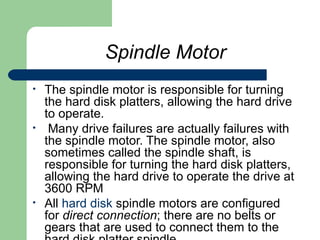
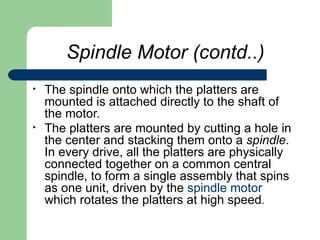
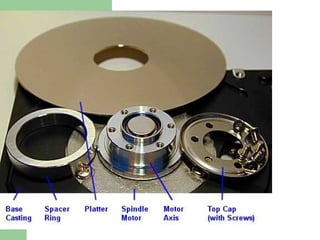
Spindle Motor The spindle motor is responsible for turning the hard disk platters, allowing the hard drive to operate. Many drive failures are actually failures with the spindle motor. The spindle motor, also sometimes called the spindle shaft, is responsible for turning the hard disk platters, allowing the hard drive to operate the drive at 3600 RPM  All  hard disk  spindle motors are configured for  direct connection ; there are no belts or gears that are used to connect them to the hard disk platter spindle.
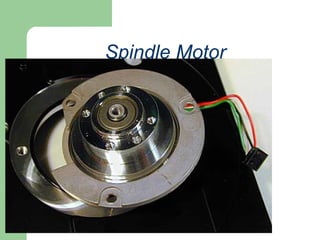
Spindle Motor (contd..) The spindle onto which the platters are mounted is attached directly to the shaft of the motor.  The platters are mounted by cutting a hole in the center and stacking them onto a  spindle . In every drive, all the platters are physically connected together on a common central spindle, to form a single assembly that spins as one unit, driven by the  spindle motor  which rotates the platters at high speed .
 
Air filter The R/W head requires air to float on the disk surface These filters are permanently sealed . They are of two types: Recirculating  and breathe filter
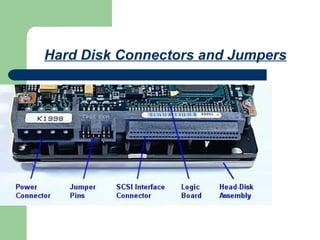
Hard Disk Connectors and Jumpers
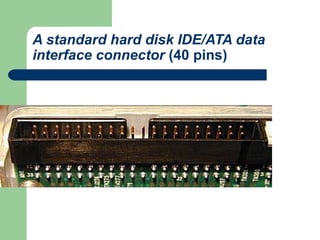
A standard hard disk IDE/ATA data interface connector   (40 pins)
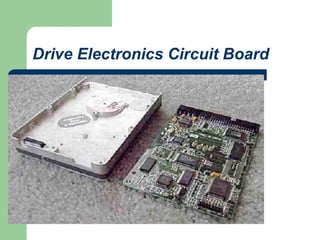
Drive Electronics Circuit Board

Chap2 hdd1

  • 1.
    Construction And WorkingOf Hard Disk Drives
  • 2.
    TYPES OF HDDExternal Hard Drives Internal Hard Drives Laptop Hard Drives
  • 3.
    Hard Disks SizesAvailable are: 20 GB 40 GB 80 GB 120 GB 180 GB
  • 4.
    Construction of HDDThe components of the Hard Disk Disk Platter Read/Write head Head Arm/ Head Slider Head Actuator mechanisms Spindle motor Bezel Cable & connectors Logic board Air filter
  • 5.
    What's Inside aHard Drive? The Platters One or more round, flat disks used to actually hold the data in the drive Each platter has two surfaces (top & bottom) that are capable of holding data; Each surface has one read /write head (Each platter has two heads, one on the top of the platter and one on the bottom,) Hard disk with three platters has six surfaces and six total heads. Normally both surfaces of each platter are used The outer surface of top and bottom disk cannot be used.
  • 6.
    PLATTERS (contd..) Plattersize is the form factor Disks are sometimes referred to by a size specification for example "3.5-inch hard disk". The first PCs used hard disks that had a nominal size of 5.25". Today, by far the most common hard disk platter size is 3.5“ Laptop drives are usually smaller, The platters on these drives are usually 2.5" in diameter or less; 2.5" is the standard form factor, but drives with 1.8" and even 1.0" platters are becoming more common. PCs usually have 1 to 5 platters
  • 7.
  • 8.
    Round flat disk(platter)
  • 9.
  • 10.
    Tracks and SectorsEach platter has its information recorded in concentric circles called tracks . Each track is further broken down into smaller pieces called sectors , each of which holds 512 bytes of information..
  • 11.
  • 12.
    STORAGE OF DATAin Platters A sector contains a fixed number of bytes -- for example, 256 or 512. Each track typically holds between 100 and 300 sectors. Larger outer tracks hold more sectors than the smaller inner ones. All information stored on a hard disk is recorded in tracks. The tracks are numbered, starting from zero, starting at the outside of the platter. A hard disk has several thousand tracks on each platter. Either at the drive or the operating system level, sectors are often grouped together into clusters.
  • 13.
  • 14.
    STORAGE OF DATAin Platters (contd..) They are made of Al alloy ( Light wt., strong) They are coated with magnetic media which stores information magnetically Two types of recording media used in HDD Iron oxide media Thin film media
  • 15.
    Iron oxide mediaThe HDD platter surface is coated with iron oxide compound Its recording density is less & it is very soft. Crash of drive head on the platter makes a permanent defect on the media coating
  • 16.
    Thin Film MediaIt is thinner in comparison to iron oxide coating It provides very hard and perfectly coated media which can withstand head crash without destroying the coating After the coating , the coating is cured and polished
  • 17.
    The Read/Write HeadsThe read/write heads read and write data to the platters. They are usually one of the more expensive parts of the HD
  • 18.
  • 19.
    The Read/Write HeadsThe read/write heads do not make contact with the media ( or the disk) but float over the surface of the disk and do all of their work without physically touching the platters. Each platter has two heads which are mounted onto sliders and used to either record information onto the disk or read information from it. The sliders are mounted onto arms, The arms are controlled using a device called an actuator. Actuator positions the arms to the appropriate track on the disk.
  • 20.
  • 21.
    Front view ofR/W Head
  • 22.
    3 Platters and6 R/W Heads
  • 23.
    Head Arms Eachplatter has two heads which are mounted onto sliders and used to either record information onto the disk or read information from it. The sliders are mounted onto arms which are thin pieces of metal usually triangular in shape. The arms are controlled using a device called an actuator that positions the arms to the appropriate track on the disk
  • 24.
  • 25.
    Head Crash Theactuator is the device used to position the head arms to different tracks on the surface of the platter All R/W heads are lined up and mounted on the Actuator. So when one head is over a track, all the other heads will also move and they will be at the same location over their respective surfaces . Typically, only one of the heads is active at a time, i.e., reading or writing data , When not in use, the heads rest on the stationary platters. If the heads contact the surface of the disk while it is at operational speed, the result can be loss of data, damage to the heads, damage to the surface of the disk, or all three. This is usually called a head crash
  • 26.
    Head Actuator Headactuators come in two general varieties: Stepper Motor Actuator Voice Coil Actuator
  • 27.
    Comparison Characteristics Steppermotor actuator Voice coil actuator Access speed Slow Fast Reliability Poor Very good Automatic head parking No Yes Temperature sensitive Yes No Periodic maintenance Low level formatting No Positionally sensitive Yes No
  • 28.
  • 29.
    A stepper motoractuator Stepper Motors : A stepper motor is a special type of dc motor used to accurately position the magnetic heads. A hard drive attaches the arms to the motor, and each time the motor steps one position clockwise or counterclockwise, the arms move in or out one position which in turn moves the heads . Each position defines a track on the surface of the disk. Stepper motor actuators are not used in modern drives because they are prone to alignment problems and are highly sensitive to heat.
  • 30.
  • 31.
  • 32.
    Voice Coil ActuatorModern hard drives uses a voice coil actuator . It uses a device called a voice coil to move the head arms in and out over the surface of the platters. The voice coil actuator is not only far more adaptable and insensitive to thermal issues, it is much faster and more reliable than a stepper motor.
  • 33.
    Types of Voicecoil In Linear Voice coil actuator system, the head is moved in and out over the disk surface in a straight line In rotary Voice coil uses a rotatory arm to move the R/W head
  • 34.
  • 35.
  • 36.
    Spindle Motor Thespindle motor is responsible for turning the hard disk platters, allowing the hard drive to operate. Many drive failures are actually failures with the spindle motor. The spindle motor, also sometimes called the spindle shaft, is responsible for turning the hard disk platters, allowing the hard drive to operate the drive at 3600 RPM All hard disk spindle motors are configured for direct connection ; there are no belts or gears that are used to connect them to the hard disk platter spindle.
  • 37.
    Spindle Motor (contd..)The spindle onto which the platters are mounted is attached directly to the shaft of the motor. The platters are mounted by cutting a hole in the center and stacking them onto a spindle . In every drive, all the platters are physically connected together on a common central spindle, to form a single assembly that spins as one unit, driven by the spindle motor which rotates the platters at high speed .
  • 38.
  • 39.
    Air filter TheR/W head requires air to float on the disk surface These filters are permanently sealed . They are of two types: Recirculating and breathe filter
  • 40.
  • 41.
    A standard harddisk IDE/ATA data interface connector (40 pins)
  • 42.