HARD DISK DRIVE
HARD DISK DRIVE
HARD DISK DRIVE
HARD DISK DRIVE
• It is a data storage device in a computer.
It is a data storage device in a computer.
• It is a secondary storage device.
It is a secondary storage device.
• Its stored in 0 (or) 1.
Its stored in 0 (or) 1.
• The
The operating system, software and most
, software and most
other files are stored in the HDD.
• Its invented in 1954 by ibm.
Its invented in 1954 by ibm.
• Nowaday,HDD with3.5 inch or 5.25 inch
Nowaday,HDD with3.5 inch or 5.25 inch
platters in different capacities, such as
10GB,20GB,40GB,80GB etc.
Main components for Hard disk drive
• Disk platter
• Stepper motor
• Spindle motor
• Read and write head
• Arm
DISK PLATTER
1. The platter is made up of a magnetic material, in the flat disk
part of the drive.
2. The data stored in the platter.
3. New hard-drive technology uses thin-film metals and glass
platters to increase efficiency and drive storage capacity.
STEPPER MOTOR
1. Use stepper motors for controlling read/write head position.
2. Stepper motors usually use +12V power, but some new low-
power drives use +5V power source.
SPINDLE MOTOR
1. It control the platter.
2. This motor rotates at a speed of 3600 to 10,000 r.p.m.
3. All the platter moves in the same direction.
READ AND WRITE HEAD
1. The heads read and write the information to the drive platter.
2. The head writes magnetic information on the platter.
HEAD ARM
HEAD ARM
1. Used for read and write operations.
Disk structures
(A) Track
(B sector
(C) Cylinder
(D) Storage capacity
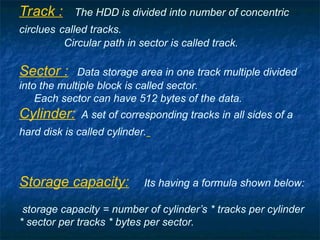
Track : The HDD is divided into number of concentric
circlues called tracks.
Circular path in sector is called track.
Sector : Data storage area in one track multiple divided
into the multiple block is called sector.
Each sector can have 512 bytes of the data.
Cylinder: A set of corresponding tracks in all sides of a
hard disk is called cylinder.
Storage capacity: Its having a formula shown below:
storage capacity = number of cylinder’s * tracks per cylinder
* sector per tracks * bytes per sector.
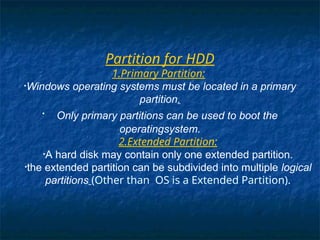
Partition for HDD
1.Primary Partition:
•Windows operating systems must be located in a primary
partition.
• Only primary partitions can be used to boot the
operatingsystem.
2.Extended Partition:
•A hard disk may contain only one extended partition.
•the extended partition can be subdivided into multiple logical
partitions (Other than OS is a Extended Partition).
File system in HDD
1.FAT (File Allocation Table)
2.NTFS (New Technology File System
FAT NTFS
Its not a security Its a security
Partition size is max 32GB Partition size is 1 (Tera Bytes)
Does not support data
compersion
It support data compersion
Window os conformability
(95,98.ms-dos)
Window os conformability
( 2000,xp ,vista,win 7 )
IDE data cable and
connector
in HDD
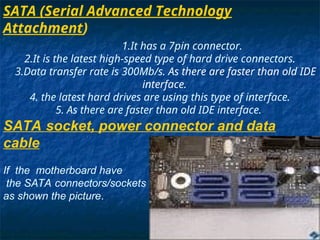
SATA (Serial Advanced Technology
Attachment)
1.It has a 7pin connector.
2.It is the latest high-speed type of hard drive connectors.
3.Data transfer rate is 300Mb/s. As there are faster than old IDE
interface.
4. the latest hard drives are using this type of interface.
5. As there are faster than old IDE interface.
SATA socket, power connector and data
cable
If the motherboard have
the SATA connectors/sockets
as shown the picture.
SATA HDD power connector.
.
SATA Data cable for HDD
SCSI (Small Computer System Interface)
1.It has a 50 or 68 pin connector.
2.The data transfer rate is 600Mb/s .
3.These require a SCSI adapter card connected into
the system.
4.Nowadays, most desktop computers did not use the
SCSI.
Main Problem Created in HDD
•No Operating System
(No operating system in Hard Disk)
•Disk boot Failure
(Cable Problem) OR (HDD Not Detect)
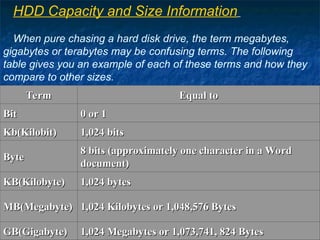
HDD Capacity and Size Information
When pure chasing a hard disk drive, the term megabytes,
gigabytes or terabytes may be confusing terms. The following
table gives you an example of each of these terms and how they
compare to other sizes.
Term
Term Equal to
Equal to
Bit
Bit 0 or 1
0 or 1
Kb(Kilobit)
Kb(Kilobit) 1,024 bits
1,024 bits
Byte
Byte
8 bits (approximately one character in a Word
document)
document)
KB(Kilobyte)
KB(Kilobyte) 1,024 bytes
1,024 bytes
MB(Megabyte)
MB(Megabyte) 1,024 Kilobytes or 1,048,576 Bytes
1,024 Kilobytes or 1,048,576 Bytes
GB(Gigabyte)
GB(Gigabyte) 1,024 Megabytes or 1,073,741, 824 Bytes
1,024 Megabytes or 1,073,741, 824 Bytes
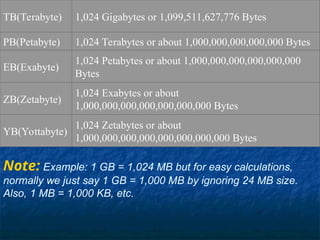
TB(Terabyte) 1,024 Gigabytes or 1,099,511,627,776 Bytes
PB(Petabyte) 1,024 Terabytes or about 1,000,000,000,000,000 Bytes
EB(Exabyte)
1,024 Petabytes or about 1,000,000,000,000,000,000
Bytes
ZB(Zetabyte)
1,024 Exabytes or about
1,000,000,000,000,000,000,000 Bytes
YB(Yottabyte)
1,024 Zetabytes or about
1,000,000,000,000,000,000,000,000 Bytes
Note: Example: 1 GB = 1,024 MB but for easy calculations,
normally we just say 1 GB = 1,000 MB by ignoring 24 MB size.
Also, 1 MB = 1,000 KB, etc.
It is a  data storage device in a computer.

It is a data storage device in a computer.

  • 1.
  • 2.
    HARD DISK DRIVE HARDDISK DRIVE • It is a data storage device in a computer. It is a data storage device in a computer. • It is a secondary storage device. It is a secondary storage device. • Its stored in 0 (or) 1. Its stored in 0 (or) 1. • The The operating system, software and most , software and most other files are stored in the HDD. other files are stored in the HDD. • Its invented in 1954 by ibm. Its invented in 1954 by ibm. • Nowaday,HDD with3.5 inch or 5.25 inch Nowaday,HDD with3.5 inch or 5.25 inch platters in different capacities, such as platters in different capacities, such as 10GB,20GB,40GB,80GB etc. 10GB,20GB,40GB,80GB etc.
  • 4.
    Main components forHard disk drive • Disk platter • Stepper motor • Spindle motor • Read and write head • Arm
  • 5.
    DISK PLATTER 1. Theplatter is made up of a magnetic material, in the flat disk part of the drive. 2. The data stored in the platter. 3. New hard-drive technology uses thin-film metals and glass platters to increase efficiency and drive storage capacity. STEPPER MOTOR 1. Use stepper motors for controlling read/write head position. 2. Stepper motors usually use +12V power, but some new low- power drives use +5V power source. SPINDLE MOTOR 1. It control the platter. 2. This motor rotates at a speed of 3600 to 10,000 r.p.m. 3. All the platter moves in the same direction.
  • 6.
    READ AND WRITEHEAD 1. The heads read and write the information to the drive platter. 2. The head writes magnetic information on the platter. HEAD ARM HEAD ARM 1. Used for read and write operations. Disk structures (A) Track (B sector (C) Cylinder (D) Storage capacity
  • 7.
    Track : TheHDD is divided into number of concentric circlues called tracks. Circular path in sector is called track. Sector : Data storage area in one track multiple divided into the multiple block is called sector. Each sector can have 512 bytes of the data. Cylinder: A set of corresponding tracks in all sides of a hard disk is called cylinder. Storage capacity: Its having a formula shown below: storage capacity = number of cylinder’s * tracks per cylinder * sector per tracks * bytes per sector.
  • 8.
    Partition for HDD 1.PrimaryPartition: •Windows operating systems must be located in a primary partition. • Only primary partitions can be used to boot the operatingsystem. 2.Extended Partition: •A hard disk may contain only one extended partition. •the extended partition can be subdivided into multiple logical partitions (Other than OS is a Extended Partition).
  • 9.
    File system inHDD 1.FAT (File Allocation Table) 2.NTFS (New Technology File System FAT NTFS Its not a security Its a security Partition size is max 32GB Partition size is 1 (Tera Bytes) Does not support data compersion It support data compersion Window os conformability (95,98.ms-dos) Window os conformability ( 2000,xp ,vista,win 7 )
  • 10.
    IDE data cableand connector in HDD
  • 11.
    SATA (Serial AdvancedTechnology Attachment) 1.It has a 7pin connector. 2.It is the latest high-speed type of hard drive connectors. 3.Data transfer rate is 300Mb/s. As there are faster than old IDE interface. 4. the latest hard drives are using this type of interface. 5. As there are faster than old IDE interface. SATA socket, power connector and data cable If the motherboard have the SATA connectors/sockets as shown the picture.
  • 12.
    SATA HDD powerconnector. . SATA Data cable for HDD
  • 13.
    SCSI (Small ComputerSystem Interface) 1.It has a 50 or 68 pin connector. 2.The data transfer rate is 600Mb/s . 3.These require a SCSI adapter card connected into the system. 4.Nowadays, most desktop computers did not use the SCSI.
  • 14.
    Main Problem Createdin HDD •No Operating System (No operating system in Hard Disk) •Disk boot Failure (Cable Problem) OR (HDD Not Detect)
  • 15.
    HDD Capacity andSize Information When pure chasing a hard disk drive, the term megabytes, gigabytes or terabytes may be confusing terms. The following table gives you an example of each of these terms and how they compare to other sizes. Term Term Equal to Equal to Bit Bit 0 or 1 0 or 1 Kb(Kilobit) Kb(Kilobit) 1,024 bits 1,024 bits Byte Byte 8 bits (approximately one character in a Word 8 bits (approximately one character in a Word document) document) KB(Kilobyte) KB(Kilobyte) 1,024 bytes 1,024 bytes MB(Megabyte) MB(Megabyte) 1,024 Kilobytes or 1,048,576 Bytes 1,024 Kilobytes or 1,048,576 Bytes GB(Gigabyte) GB(Gigabyte) 1,024 Megabytes or 1,073,741, 824 Bytes 1,024 Megabytes or 1,073,741, 824 Bytes
  • 16.
    TB(Terabyte) 1,024 Gigabytesor 1,099,511,627,776 Bytes PB(Petabyte) 1,024 Terabytes or about 1,000,000,000,000,000 Bytes EB(Exabyte) 1,024 Petabytes or about 1,000,000,000,000,000,000 Bytes ZB(Zetabyte) 1,024 Exabytes or about 1,000,000,000,000,000,000,000 Bytes YB(Yottabyte) 1,024 Zetabytes or about 1,000,000,000,000,000,000,000,000 Bytes Note: Example: 1 GB = 1,024 MB but for easy calculations, normally we just say 1 GB = 1,000 MB by ignoring 24 MB size. Also, 1 MB = 1,000 KB, etc.