Presented by:
Tristan Marcellana
What is A
?
The Hard drive is the computer’s main
storage media device that permanently
stores all data on the computer.
The hard drive was first introduced on
September 13, 1956 .
Used for storing and retrieving digital
information using rapidly rotating disks
(platters) coated with magnetic material.
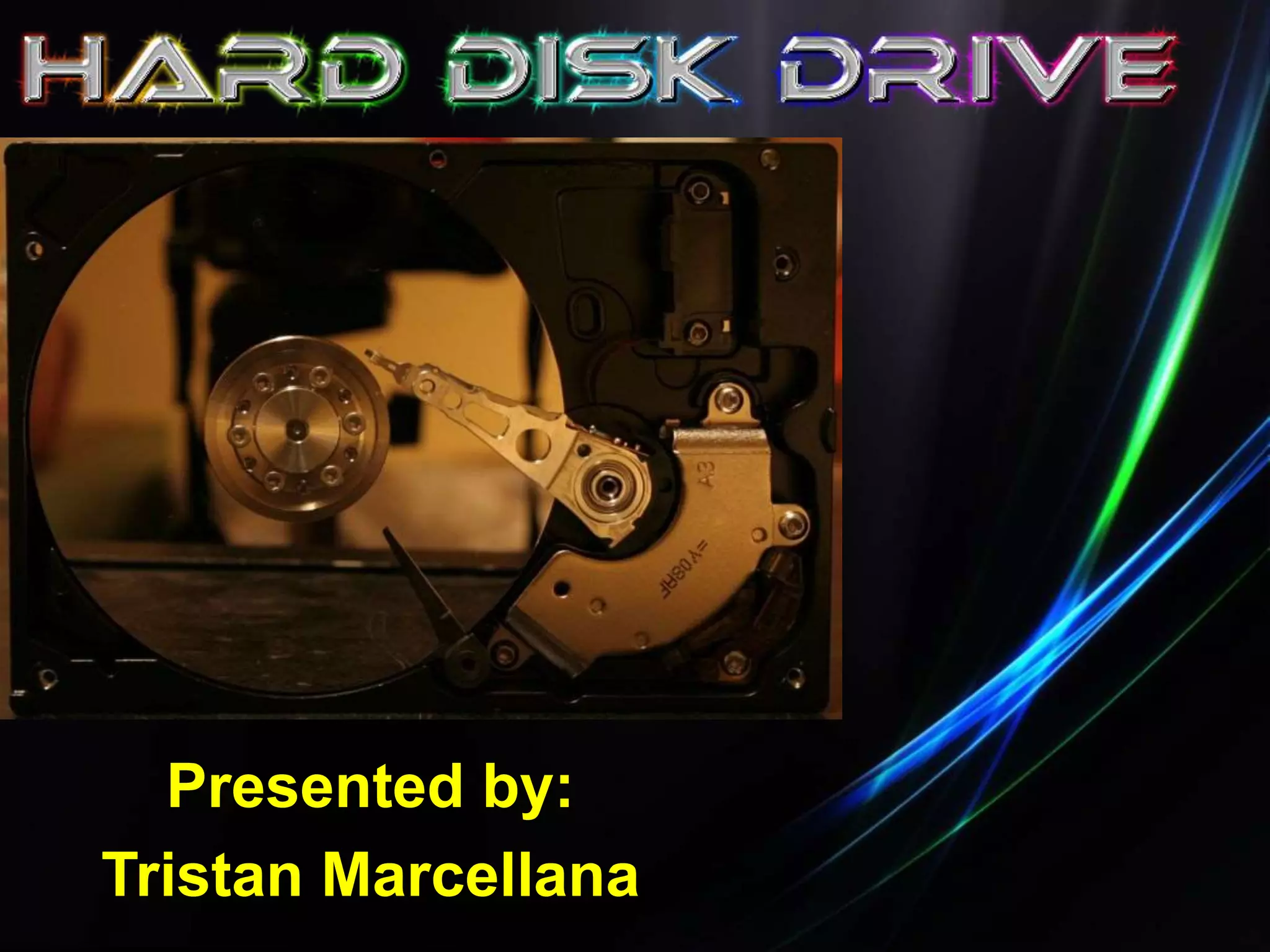
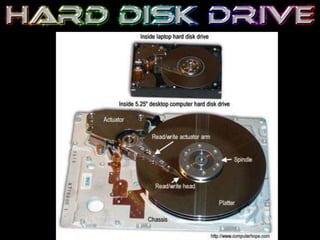
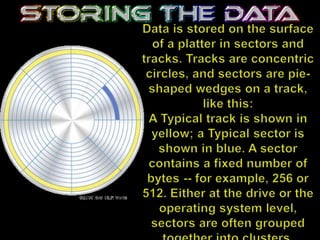
A Hard disk is really a set of stacked "disks,"
each of which, like phonograph records, has
data recorded electromagnetically in
concentric circles or "tracks" on the disk. A
"head" (something like a phonograph arm but
in a relatively fixed position) records (writes)
or reads the information on the tracks. Two
heads, one on each side of a disk, read or
write the data as the disk spins. Each read or
write operation requires that data be located,
which is an operation called a "seek."
A hard disk/drive unit comes with a set
rotation speed varying from 4500 to 7200
rpm. Disk access time is measured in
milliseconds.
The physical location can be identified
with cylinder, track, and sector locations,
these are actually mapped to a logical
block address (LBA).
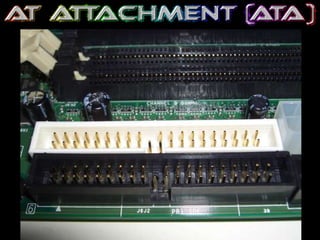
AT Attachment (ATA)
AT Attachment (ATA), was by far the most
common hard disk interface used in PCs
from the early 1990s through 2003. ATA
is sometimes called Parallel ATA or
PATA, to differentiate it from the newer
Serial ATA (SATA) interface. ATA is still
used in new systems, although it is being
superseded by SATA. ATA is also often
called IDE (Integrated Drive Electronics).
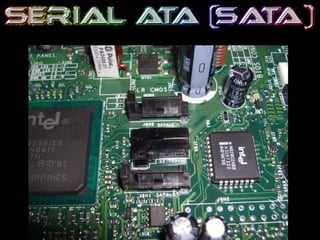
Serial ATA (SATA)
Serial ATA (SATA) is a newer technology that
is replacing ATA. SATA has several
advantages over ATA, including smaller
cables and connectors, higher bandwidth,
and greater reliability.
SATA is generally compatible with ATA at
the software level, which means that the
operating system ATA drivers work with
either SATA or ATA interfaces and hard
drives.
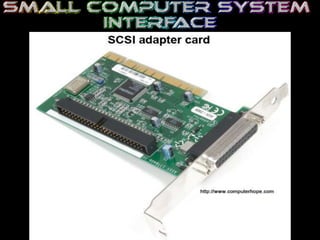
Small Computer System Interface
(SCSI)
SCSI is used in servers and high-end
workstations, where it provides two
advantages: Improved performance
relative to ATA and SATA in
multitasking, multiuser environments,
and the ability to daisy-chain many
drives on one interface. High
performance desktop systems.
1.) Original term for Hard Disk Drive.
2.) The Hard Drive was First
Introduced on _____ .
Nos. (3-4) Two ways to Measure the
Performance of a Hard Disk .
5.) Standard Term for [SCSI]
6.) Platters is Coated with __________
which is used to Store and Retrieve
Digital Information.
7.) A Hard Drive Disk Unit has a Rotation
Speed Varying from ________ RPM.
8.) Standard Term for [LBA].
9.) The Number of Bytes per Second that
the Drive can Deliver to the CPU.
10.) Amount of Time Between when the
CPU Requests a File.
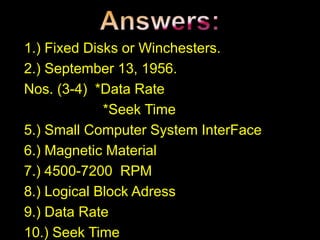
1.) Fixed Disks or Winchesters.
2.) September 13, 1956.
Nos. (3-4) *Data Rate
*Seek Time
5.) Small Computer System InterFace
6.) Magnetic Material
7.) 4500-7200 RPM
8.) Logical Block Adress
9.) Data Rate
10.) Seek Time

Hard Disk Drive

  • 1.
  • 2.
  • 3.
    The Hard driveis the computer’s main storage media device that permanently stores all data on the computer. The hard drive was first introduced on September 13, 1956 . Used for storing and retrieving digital information using rapidly rotating disks (platters) coated with magnetic material.
  • 5.
    A Hard diskis really a set of stacked "disks," each of which, like phonograph records, has data recorded electromagnetically in concentric circles or "tracks" on the disk. A "head" (something like a phonograph arm but in a relatively fixed position) records (writes) or reads the information on the tracks. Two heads, one on each side of a disk, read or write the data as the disk spins. Each read or write operation requires that data be located, which is an operation called a "seek."
  • 6.
    A hard disk/driveunit comes with a set rotation speed varying from 4500 to 7200 rpm. Disk access time is measured in milliseconds. The physical location can be identified with cylinder, track, and sector locations, these are actually mapped to a logical block address (LBA).
  • 11.
    AT Attachment (ATA) ATAttachment (ATA), was by far the most common hard disk interface used in PCs from the early 1990s through 2003. ATA is sometimes called Parallel ATA or PATA, to differentiate it from the newer Serial ATA (SATA) interface. ATA is still used in new systems, although it is being superseded by SATA. ATA is also often called IDE (Integrated Drive Electronics).
  • 13.
    Serial ATA (SATA) SerialATA (SATA) is a newer technology that is replacing ATA. SATA has several advantages over ATA, including smaller cables and connectors, higher bandwidth, and greater reliability. SATA is generally compatible with ATA at the software level, which means that the operating system ATA drivers work with either SATA or ATA interfaces and hard drives.
  • 15.
    Small Computer SystemInterface (SCSI) SCSI is used in servers and high-end workstations, where it provides two advantages: Improved performance relative to ATA and SATA in multitasking, multiuser environments, and the ability to daisy-chain many drives on one interface. High performance desktop systems.
  • 18.
    1.) Original termfor Hard Disk Drive. 2.) The Hard Drive was First Introduced on _____ . Nos. (3-4) Two ways to Measure the Performance of a Hard Disk . 5.) Standard Term for [SCSI]
  • 19.
    6.) Platters isCoated with __________ which is used to Store and Retrieve Digital Information. 7.) A Hard Drive Disk Unit has a Rotation Speed Varying from ________ RPM. 8.) Standard Term for [LBA]. 9.) The Number of Bytes per Second that the Drive can Deliver to the CPU. 10.) Amount of Time Between when the CPU Requests a File.
  • 20.
    1.) Fixed Disksor Winchesters. 2.) September 13, 1956. Nos. (3-4) *Data Rate *Seek Time 5.) Small Computer System InterFace 6.) Magnetic Material 7.) 4500-7200 RPM 8.) Logical Block Adress 9.) Data Rate 10.) Seek Time