Hard Disk Drive
By massoud asadi
definition
A hard disk drive (HDD), hard disk, hard drive
or fixed disk is a data storage device used for
storing and retrieving digital information using
one or more rigid rapidly rotating disks
(platters) coated with magnetic material. The
platters are paired with magnetic heads
arranged on a moving actuator arm, which
read and write data to the platter surfaces.
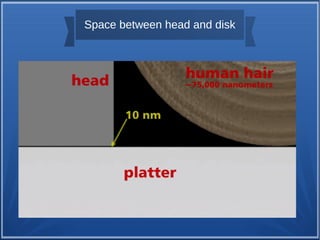
Magnetic heads
Disk read/write heads are the small parts of a
disk drive, that move above the disk platter
and transform the platter's magnetic field into
electrical current (read the disk) or vice versa
– transform electrical current into magnetic
field (write the disk).The heads have gone
through a number of changes over the years.
Space between head and disk
History
Hard disk drives were introduced in 1956 as data
storage for an IBM real-time transaction processing
computer and were developed for use with general-
purpose mainframe and minicomputers. The first IBM
drive, the 350 RAMAC, was approximately the size of
two medium-sized refrigerators and stored five million
six-bit characters (3.75 megabytes) on a stack of 50
disks.
IBM 350 in US Army
Technology
A modern HDD records data by magnetizing a thin film
of ferromagnetic material on a disk. Sequential
changes in the direction of magnetization represent
binary data bits. The data is read from the disk by
detecting the transitions in magnetization. User data is
encoded using an encoding scheme, such as run-
length limited encoding, which determines how the
data is represented by the magnetic transitions.
Revolutions per minute
The platters in contemporary HDDs are spun at
speeds varying from 4,200 rpm in energy-efficient
portable devices, to 15,000 rpm for high-performance
servers. The first HDDs spun at 1,200 rpm and, for
many years, 3,600 rpm was the norm. As of December
2013, the platters in most consumer-grade HDDs spin
at either 5,400 rpm or 7,200 rpm.
Time to access data
The factors that limit the time to access the data on an
HDD are mostly related to the mechanical nature of the
rotating disks and moving heads. Seek time is a
measure of how long it takes the head assembly to
travel to the track of the disk that contains data.
Rotational latency is incurred because the desired disk
sector may not be directly under the head when data
transfer is requested. These two delays are on the order
of milliseconds each. The bit rate or data transfer rate
(once the head is in the right position) creates delay
which is a function of the number of blocks transferred;
typically relatively small, but can be quite long with the
transfer of large contiguous files. Delay may also occur if
the drive disks are stopped to save energy.
capacity
The capacity of a hard disk drive, as reported by an
operating system to the end user, is smaller than the
amount stated by the manufacturer, which has several
reasons: the operating system using some space, use
of some space for data redundancy, and space use for
file system structures.
latency
Latency is the delay for the rotation of the disk to bring
the required disk sector under the read-write
mechanism. It depends on rotational speed of a disk,
measured in revolutions per minute (rpm). Average
rotational latency is shown in the table on the right,
based on the statistical relation that the average
latency in milliseconds for such a drive is one-half the
rotational period. Average latency (in milliseconds) is
computed as 30,000 divided by rotational speed (in
rpm).
failure
Due to the extremely close spacing between the
heads and the disk surface, HDDs are vulnerable to
being damaged by a head crash-a failure of the disk in
which the head scrapes across the platter surface,
often grinding away the thin magnetic film and causing
data loss. Head crashes can be caused by electronic
failure, a sudden power failure, physical shock,
contamination of the drive's internal enclosure, wear
and tear, corrosion, or poorly manufactured platters
and heads.
External hard disk drives
External hard disk drives typically connect via USB;
variants using USB 2.0 interface generally have slower
data transfer rates when compared to internally
mounted hard drives connected through SATA. Plug
and play drive functionality offers system compatibility
and features large storage options and portable
design. As of March 2015, available capacities for
external hard disk drives ranged from 500 GB to 8 TB.
video

Hard Disk Drive

  • 1.
    Hard Disk Drive Bymassoud asadi
  • 2.
    definition A hard diskdrive (HDD), hard disk, hard drive or fixed disk is a data storage device used for storing and retrieving digital information using one or more rigid rapidly rotating disks (platters) coated with magnetic material. The platters are paired with magnetic heads arranged on a moving actuator arm, which read and write data to the platter surfaces.
  • 3.
    Magnetic heads Disk read/writeheads are the small parts of a disk drive, that move above the disk platter and transform the platter's magnetic field into electrical current (read the disk) or vice versa – transform electrical current into magnetic field (write the disk).The heads have gone through a number of changes over the years.
  • 4.
  • 5.
    History Hard disk driveswere introduced in 1956 as data storage for an IBM real-time transaction processing computer and were developed for use with general- purpose mainframe and minicomputers. The first IBM drive, the 350 RAMAC, was approximately the size of two medium-sized refrigerators and stored five million six-bit characters (3.75 megabytes) on a stack of 50 disks.
  • 6.
    IBM 350 inUS Army
  • 7.
    Technology A modern HDDrecords data by magnetizing a thin film of ferromagnetic material on a disk. Sequential changes in the direction of magnetization represent binary data bits. The data is read from the disk by detecting the transitions in magnetization. User data is encoded using an encoding scheme, such as run- length limited encoding, which determines how the data is represented by the magnetic transitions.
  • 8.
    Revolutions per minute Theplatters in contemporary HDDs are spun at speeds varying from 4,200 rpm in energy-efficient portable devices, to 15,000 rpm for high-performance servers. The first HDDs spun at 1,200 rpm and, for many years, 3,600 rpm was the norm. As of December 2013, the platters in most consumer-grade HDDs spin at either 5,400 rpm or 7,200 rpm.
  • 9.
    Time to accessdata The factors that limit the time to access the data on an HDD are mostly related to the mechanical nature of the rotating disks and moving heads. Seek time is a measure of how long it takes the head assembly to travel to the track of the disk that contains data. Rotational latency is incurred because the desired disk sector may not be directly under the head when data transfer is requested. These two delays are on the order of milliseconds each. The bit rate or data transfer rate (once the head is in the right position) creates delay which is a function of the number of blocks transferred; typically relatively small, but can be quite long with the transfer of large contiguous files. Delay may also occur if the drive disks are stopped to save energy.
  • 10.
    capacity The capacity ofa hard disk drive, as reported by an operating system to the end user, is smaller than the amount stated by the manufacturer, which has several reasons: the operating system using some space, use of some space for data redundancy, and space use for file system structures.
  • 11.
    latency Latency is thedelay for the rotation of the disk to bring the required disk sector under the read-write mechanism. It depends on rotational speed of a disk, measured in revolutions per minute (rpm). Average rotational latency is shown in the table on the right, based on the statistical relation that the average latency in milliseconds for such a drive is one-half the rotational period. Average latency (in milliseconds) is computed as 30,000 divided by rotational speed (in rpm).
  • 12.
    failure Due to theextremely close spacing between the heads and the disk surface, HDDs are vulnerable to being damaged by a head crash-a failure of the disk in which the head scrapes across the platter surface, often grinding away the thin magnetic film and causing data loss. Head crashes can be caused by electronic failure, a sudden power failure, physical shock, contamination of the drive's internal enclosure, wear and tear, corrosion, or poorly manufactured platters and heads.
  • 13.
    External hard diskdrives External hard disk drives typically connect via USB; variants using USB 2.0 interface generally have slower data transfer rates when compared to internally mounted hard drives connected through SATA. Plug and play drive functionality offers system compatibility and features large storage options and portable design. As of March 2015, available capacities for external hard disk drives ranged from 500 GB to 8 TB.
  • 14.