THEORIES OF STOMATAL
MOVEMENT
Dr. Vimal Mohan
MECHANISM OF STOMATAL OPENING
1. Water potential of guard cell falls off
2. OP of guard cell increases
3. Water enters guard cell from surrounding cells.
4. This increase turgidity of guard cell
5. Due to high turgidity guard cell swells
6. The thin outer wall get extended and thick inner wall get
pulled apart
7. This widens stomatal pore – stoma.
MECHANISM OF STOMATAL CLOSING
1. Water potential of guard cell increases
2. OP of guard cell decreases
3. Water moves out of guard cell to surrounding cells.
4. This reduce turgidity of guard cell
5. Due to reduction in turgidity guard cell becomes flaccid
6. The thin outer wall get relaxed and thick inner wall revert
back to original nature
7. This closes stomatal pore – stoma.
Photosynthetic production theory
• Von Mohl 1856
• Chloroplast of the guard cell produce osmotically active
substance by photosynthesis.
• This increase OP of guard cell and reduce water potential.
• Water moves in and stomata opens.
Starch – Sugar hypothesis
Lloyd 1908, Sayre 1923, Scarth 1932
• OPENING
Photosynthesis in day time consumes CO2 which reduce CO2
concentration in guard cells.
Increase pH of guard cell.
At high pH starch get hydrolyzed to sugar.
This increase OP of guard cell and reduce water potential.
Water enters guard cell and stomata opens
Starch – Sugar hypothesis
Lloyd 1908, Sayre 1923, Scarth 1932
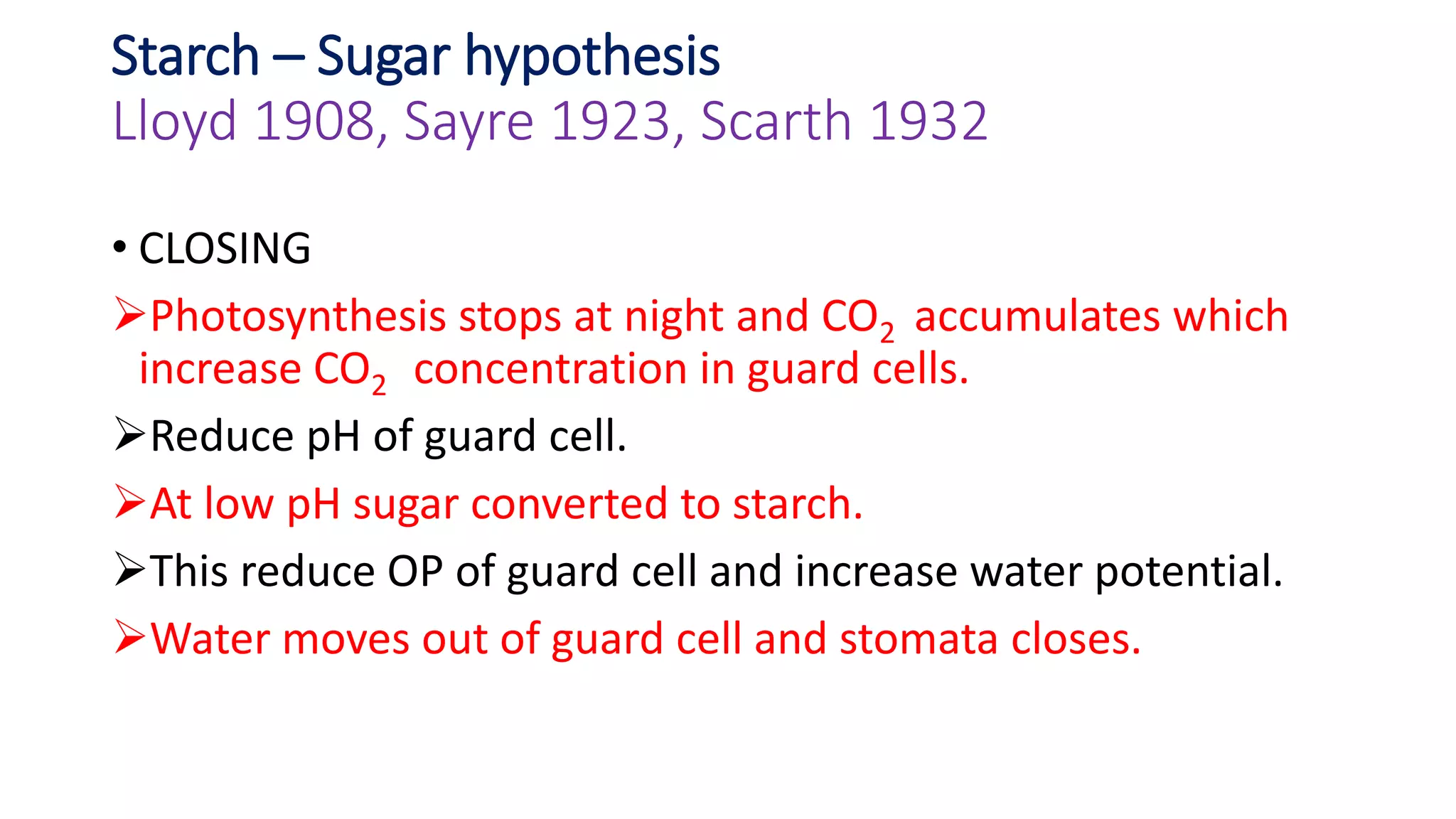
• CLOSING
Photosynthesis stops at night and CO2 accumulates which
increase CO2 concentration in guard cells.
Reduce pH of guard cell.
At low pH sugar converted to starch.
This reduce OP of guard cell and increase water potential.
Water moves out of guard cell and stomata closes.
Starch – Sugar hypothesis
Lloyd 1908, Sayre 1923, Scarth 1932
• Demerits
The slow process of starch sugar interconversion cannot explain the
rapid stomatal movement
In Onion there is no starch or other polysaccharide in guard cell, but
stomatal movement occurs.
Glucose is not reported in the guard cell of open stomata.
Some guard cells which lack chlorophyll also shows movement
Scoto active stomata open during night when carbon dioxide
accumulates in cytoplasm.
The theory could not explain extra effectiveness of blue light in opening
and closing of stomata
Hormonal regulation theory
Levitt 1974, Raschke 1975, Bowling 1976
Opening and closing of stomata result from exchange
of ions between guard cells and subsidiary cells.
Also known as K+ transport theory or malate pump
theory
Opening is an active process and closing is a passive
process
Stomatal movement is brought about by reversible
uptake of potassium ions by guard cells.
Hormonal regulation theory
Levitt 1974, Raschke 1975, Bowling 1976
Opening during day
In the presence of light starch breaks in to PEP
PEP + CO2 → OAA
OAA → Malic acid
Malic acid → malate anion and H+ ion
H+ ions are pumped out and K+ ions pumped in.- active process – require
ATP
Cl- ions are taken in to maintain pH.
Accumulation of K+ and Cl- decrease water potential of guard cell.
Water moves in and stomata opens.
Hormonal regulation theory
Levitt 1974, Raschke 1975, Bowling 1976
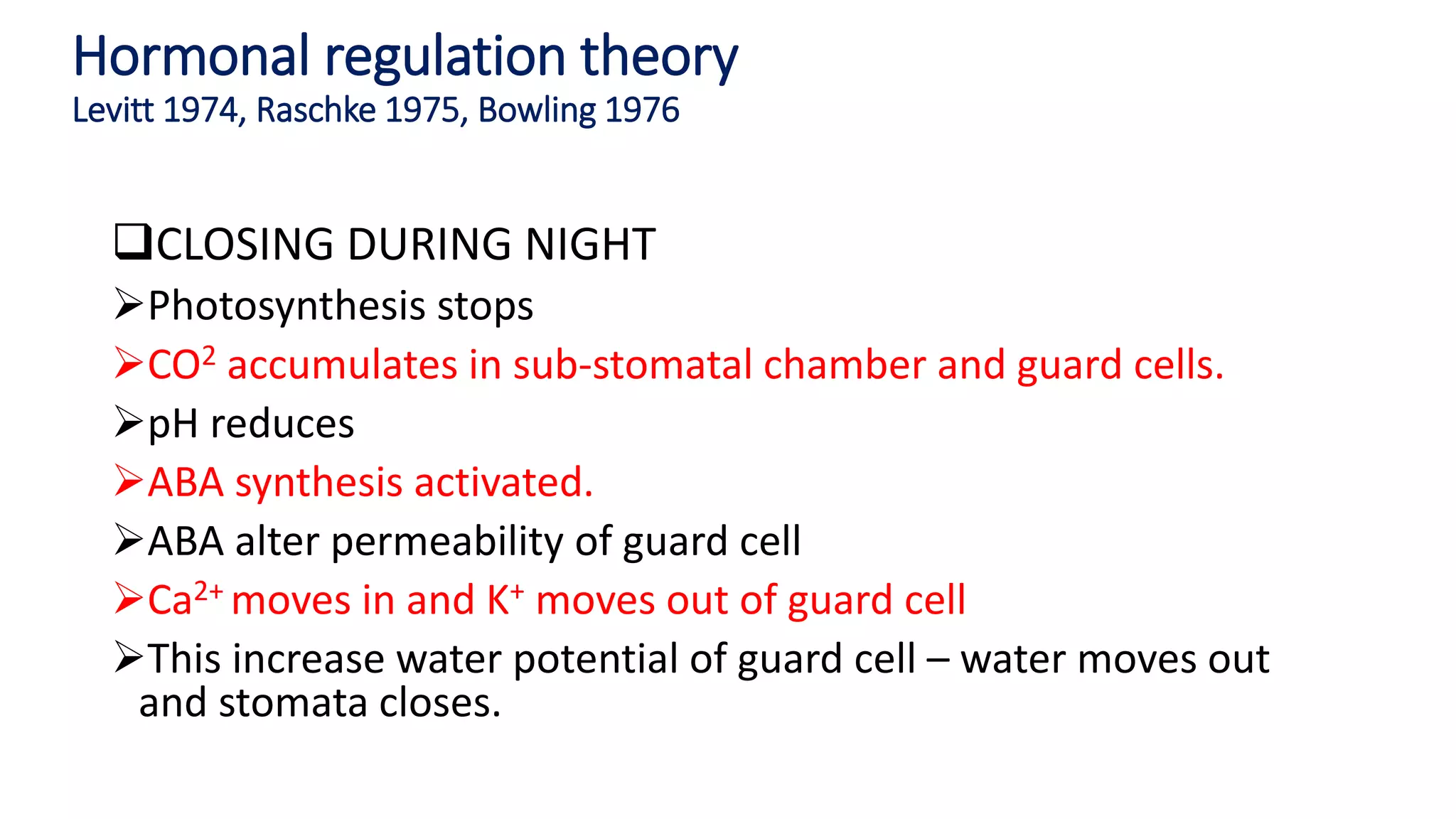
CLOSING DURING NIGHT
Photosynthesis stops
CO2 accumulates in sub-stomatal chamber and guard cells.
pH reduces
ABA synthesis activated.
ABA alter permeability of guard cell
Ca2+ moves in and K+ moves out of guard cell
This increase water potential of guard cell – water moves out
and stomata closes.
Thank you….

Theories of stomatal movement

  • 1.
  • 2.
    MECHANISM OF STOMATALOPENING 1. Water potential of guard cell falls off 2. OP of guard cell increases 3. Water enters guard cell from surrounding cells. 4. This increase turgidity of guard cell 5. Due to high turgidity guard cell swells 6. The thin outer wall get extended and thick inner wall get pulled apart 7. This widens stomatal pore – stoma.
  • 3.
    MECHANISM OF STOMATALCLOSING 1. Water potential of guard cell increases 2. OP of guard cell decreases 3. Water moves out of guard cell to surrounding cells. 4. This reduce turgidity of guard cell 5. Due to reduction in turgidity guard cell becomes flaccid 6. The thin outer wall get relaxed and thick inner wall revert back to original nature 7. This closes stomatal pore – stoma.
  • 4.
    Photosynthetic production theory •Von Mohl 1856 • Chloroplast of the guard cell produce osmotically active substance by photosynthesis. • This increase OP of guard cell and reduce water potential. • Water moves in and stomata opens.
  • 5.
    Starch – Sugarhypothesis Lloyd 1908, Sayre 1923, Scarth 1932 • OPENING Photosynthesis in day time consumes CO2 which reduce CO2 concentration in guard cells. Increase pH of guard cell. At high pH starch get hydrolyzed to sugar. This increase OP of guard cell and reduce water potential. Water enters guard cell and stomata opens
  • 6.
    Starch – Sugarhypothesis Lloyd 1908, Sayre 1923, Scarth 1932 • CLOSING Photosynthesis stops at night and CO2 accumulates which increase CO2 concentration in guard cells. Reduce pH of guard cell. At low pH sugar converted to starch. This reduce OP of guard cell and increase water potential. Water moves out of guard cell and stomata closes.
  • 7.
    Starch – Sugarhypothesis Lloyd 1908, Sayre 1923, Scarth 1932 • Demerits The slow process of starch sugar interconversion cannot explain the rapid stomatal movement In Onion there is no starch or other polysaccharide in guard cell, but stomatal movement occurs. Glucose is not reported in the guard cell of open stomata. Some guard cells which lack chlorophyll also shows movement Scoto active stomata open during night when carbon dioxide accumulates in cytoplasm. The theory could not explain extra effectiveness of blue light in opening and closing of stomata
  • 8.
    Hormonal regulation theory Levitt1974, Raschke 1975, Bowling 1976 Opening and closing of stomata result from exchange of ions between guard cells and subsidiary cells. Also known as K+ transport theory or malate pump theory Opening is an active process and closing is a passive process Stomatal movement is brought about by reversible uptake of potassium ions by guard cells.
  • 9.
    Hormonal regulation theory Levitt1974, Raschke 1975, Bowling 1976 Opening during day In the presence of light starch breaks in to PEP PEP + CO2 → OAA OAA → Malic acid Malic acid → malate anion and H+ ion H+ ions are pumped out and K+ ions pumped in.- active process – require ATP Cl- ions are taken in to maintain pH. Accumulation of K+ and Cl- decrease water potential of guard cell. Water moves in and stomata opens.
  • 10.
    Hormonal regulation theory Levitt1974, Raschke 1975, Bowling 1976 CLOSING DURING NIGHT Photosynthesis stops CO2 accumulates in sub-stomatal chamber and guard cells. pH reduces ABA synthesis activated. ABA alter permeability of guard cell Ca2+ moves in and K+ moves out of guard cell This increase water potential of guard cell – water moves out and stomata closes.
  • 11.