OUTELINES
 1. Definition of stomata .
 2. Structure of stomata .
 3.Processes of opening and
closing of stomata.
 4. factors affecting of
movement.
WHAT IS STOMATA ?
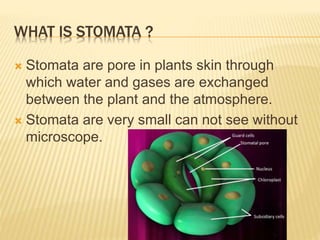
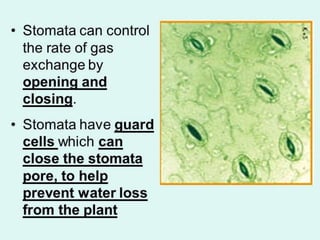
 Stomata are pore in plants skin through
which water and gases are exchanged
between the plant and the atmosphere.
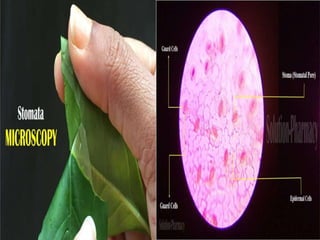
 Stomata are very small can not see without
microscope.
STRUCTURE OF STOMATA
 The structure of stomata consists of
minute pores called stoma ,
surrounded by guard cells.
 Guard cells are specialisied
parenchyma cells , savings the
plants from water loss.
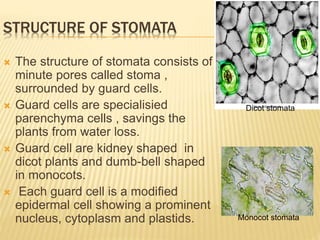
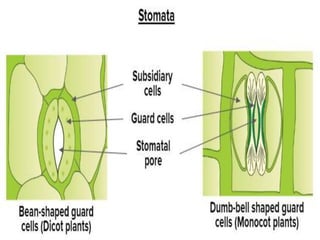
 Guard cell are kidney shaped in
dicot plants and dumb-bell shaped
in monocots.
 Each guard cell is a modified
epidermal cell showing a prominent
nucleus, cytoplasm and plastids.
Dicot stomata
Monocot stomata
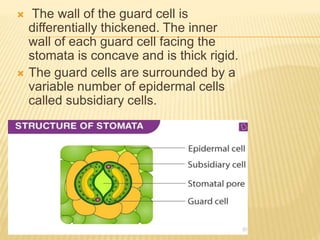
 The wall of the guard cell is
differentially thickened. The inner
wall of each guard cell facing the
stomata is concave and is thick rigid.
 The guard cells are surrounded by a
variable number of epidermal cells
called subsidiary cells.
OPENING AND CLOSING OF STOMATA
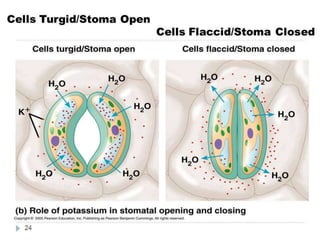
 Opening and closing of stomata takes place
due to changes in turgor pressure of guard
cells.
 During the day water from subsidiary cell
enters the guard cell making the guard cells
fully turgid and the stomata open.
 During night time water from guard cells
enters the subsidiary cells and as a result the
guard cells become flaccid due to decrease in
turgor pressure and the stomata close.
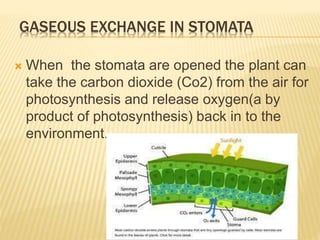
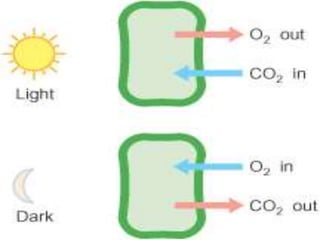
GASEOUS EXCHANGE IN STOMATA
 When the stomata are opened the plant can
take the carbon dioxide (Co2) from the air for
photosynthesis and release oxygen(a by
product of photosynthesis) back in to the
environment.
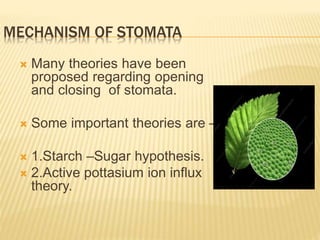
MECHANISM OF STOMATA
 Many theories have been
proposed regarding opening
and closing of stomata.
 Some important theories are –
 1.Starch –Sugar hypothesis.
 2.Active pottasium ion influx
theory.
STARCH-SUGAR HYPOTHESIS
 Lloyed(1908) suggested that in the guard cells
starch is converted into sugar during day time.
 As a result the osmotic concentration
increases causing endosmosis and opening of
stomata.
 During night sugar is converted back into
starch leading to exosmosis and closure of
stomata.
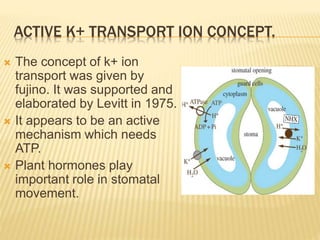
ACTIVE K+ TRANSPORT ION CONCEPT.
 The concept of k+ ion
transport was given by
fujino. It was supported and
elaborated by Levitt in 1975.
 It appears to be an active
mechanism which needs
ATP.
 Plant hormones play
important role in stomatal
movement.
In this theory during day time in the stomata-
 Decreases in starch contents of guard cells.
 Increases concentration of malic acid in guard
cell.
 Influx of K+ ions in guard cells.
 Efflux of H+ ions from guard cells.
CONCENTRATION
 Intake of cl+ ions by guard cells.
 Low Co2 concentration in an around guard
cells.
 High pH(more than 7) in guard cells.
 High T.P in guard cells due to endosmosis.
CLOSING OF STOMATA IN ABSENCE OF LIGHT.
 In this theory during night-
 Decreased concentration of malic acid in
guard cells.
 Efflux of k+ ions from guard cells.
 Acidic medium of the cell sap in guard cells.
 Loss of Cl- ions from guard cells.
CONCENTRATION
 Increase Co2 concentration in and around
the guard cells.
 Presence of plant growth inhibiting hormone
abscissic acid.
FACTORS AFFECTING STOMATAL MOVEMENT.
 1. Light
 2.Temperature
 3.Potassium chloride
 4.Organic acid
 5.Carbondioxide conc.
 6.Water
 7. Abscisic acid
CONCLUSION
 We know that the stomata is a pore in a
plants skin and usually it is limited on the
lower side of the leaves.
 In monocot leaves the stomata are equally
distributed on both sides and in dicot lower
side of the leaves provided with stomata.
 So it is concluded that stomata is very
important for plants.
Morphological_identification_of_ stomata _ by subhashree.pptx

Morphological_identification_of_ stomata _ by subhashree.pptx

  • 3.
    OUTELINES  1. Definitionof stomata .  2. Structure of stomata .  3.Processes of opening and closing of stomata.  4. factors affecting of movement.
  • 4.
    WHAT IS STOMATA?  Stomata are pore in plants skin through which water and gases are exchanged between the plant and the atmosphere.  Stomata are very small can not see without microscope.
  • 6.
    STRUCTURE OF STOMATA The structure of stomata consists of minute pores called stoma , surrounded by guard cells.  Guard cells are specialisied parenchyma cells , savings the plants from water loss.  Guard cell are kidney shaped in dicot plants and dumb-bell shaped in monocots.  Each guard cell is a modified epidermal cell showing a prominent nucleus, cytoplasm and plastids. Dicot stomata Monocot stomata
  • 8.
     The wallof the guard cell is differentially thickened. The inner wall of each guard cell facing the stomata is concave and is thick rigid.  The guard cells are surrounded by a variable number of epidermal cells called subsidiary cells.
  • 10.
    OPENING AND CLOSINGOF STOMATA  Opening and closing of stomata takes place due to changes in turgor pressure of guard cells.  During the day water from subsidiary cell enters the guard cell making the guard cells fully turgid and the stomata open.  During night time water from guard cells enters the subsidiary cells and as a result the guard cells become flaccid due to decrease in turgor pressure and the stomata close.
  • 11.
    GASEOUS EXCHANGE INSTOMATA  When the stomata are opened the plant can take the carbon dioxide (Co2) from the air for photosynthesis and release oxygen(a by product of photosynthesis) back in to the environment.
  • 13.
    MECHANISM OF STOMATA Many theories have been proposed regarding opening and closing of stomata.  Some important theories are –  1.Starch –Sugar hypothesis.  2.Active pottasium ion influx theory.
  • 14.
    STARCH-SUGAR HYPOTHESIS  Lloyed(1908)suggested that in the guard cells starch is converted into sugar during day time.  As a result the osmotic concentration increases causing endosmosis and opening of stomata.  During night sugar is converted back into starch leading to exosmosis and closure of stomata.
  • 15.
    ACTIVE K+ TRANSPORTION CONCEPT.  The concept of k+ ion transport was given by fujino. It was supported and elaborated by Levitt in 1975.  It appears to be an active mechanism which needs ATP.  Plant hormones play important role in stomatal movement.
  • 16.
    In this theoryduring day time in the stomata-  Decreases in starch contents of guard cells.  Increases concentration of malic acid in guard cell.  Influx of K+ ions in guard cells.  Efflux of H+ ions from guard cells.
  • 17.
    CONCENTRATION  Intake ofcl+ ions by guard cells.  Low Co2 concentration in an around guard cells.  High pH(more than 7) in guard cells.  High T.P in guard cells due to endosmosis.
  • 18.
    CLOSING OF STOMATAIN ABSENCE OF LIGHT.  In this theory during night-  Decreased concentration of malic acid in guard cells.  Efflux of k+ ions from guard cells.  Acidic medium of the cell sap in guard cells.  Loss of Cl- ions from guard cells.
  • 19.
    CONCENTRATION  Increase Co2concentration in and around the guard cells.  Presence of plant growth inhibiting hormone abscissic acid.
  • 21.
    FACTORS AFFECTING STOMATALMOVEMENT.  1. Light  2.Temperature  3.Potassium chloride  4.Organic acid  5.Carbondioxide conc.  6.Water  7. Abscisic acid
  • 22.
    CONCLUSION  We knowthat the stomata is a pore in a plants skin and usually it is limited on the lower side of the leaves.  In monocot leaves the stomata are equally distributed on both sides and in dicot lower side of the leaves provided with stomata.  So it is concluded that stomata is very important for plants.