Transpiration
1. Definition
• Transpiration is the evaporation of water
from the aerial parts of plants.
Of all the water plant absorbs, over 95-99%
is transpired to the air as water vapor.
4. From where water is transpired?
• Aerial parts of whole young plant
• Lenticels (lenticular transpiration) 0.1%
• Cutin (cuticular transpiration) 3%~10%
Stomatum (stomatal transpiration) ~ 90%
What is most likely leaving through the
stomata of the leaf picture here?
• Water (H2O)
What is this process called?
 Stomatal Transpiration
Cuticle
Cuticle
Mesophyll
Stomata Guard cells
Prevents
water loss
Site of
photosynthesis
Openings allow gases
and water to move in
and out of leaf
Open and close
the stomata
Stomatal transpiration
Stoma Open
Stoma Closed
Guard Cells
Stoma
Importance of transpiration
Guard Cells
CO2
O2 H2O
What
goes
in?
What
goes
out?
What process involves
using CO2 and H2O
releasing O2 as a waste
product?
• Photosynthesis
What is the plant using this
process to make?
• Carbohydrates-glucose
If the plant needs water for
photosynthesis, why is
water coming out of the
Stoma Open Stoma Closed
Function of Stomata
Guard Cells
• These stomata (leaf
openings) naturally allow
water to evaporate out.
Why would the plant close
stomata with guard cells?
• Prevent excess water loss
through transpiration.
(conserve water)
So what is the point of having
stomata?
• Allows gas exchange for
photosynthesis
How do the
guard cells react
to the availability
of water?
 Dry – guard
cells CLOSE
 lots of H2O –
guard cells
OPEN
http://www.ualr.edu/~botany/images.html
Function of Guard Cells
Guard Cells
4. Guard cells:
• cells that open and
close the stoma
4. Stomata: openings in
leaf’s surface; when
open:
• GAS EXCHANGE:
Allows CO2 in & O2 out
of leaf
• TRANSPIRATION:
Stomata
5. Characteristics of guard cells
Guard cell properties and their
relationship with stomatal control
• Thickness of CW varies in the ventral and dorsal
part of the guard cells.
• Contains chloroplast and can perform light
reaction. (not dark reaction for the lack of key
enzymes)
• Structurally isolated from epidermal cells for the
lack of plasmodesmata (water and ions transmit
only through cellular pathway, thus helps to build
up water gradient)
• Little volume, little amount of water absorption or
loss controls stomtal aperture.
6. Mechanism of stomatal opening
----K+
absorption theory
H
+
light
K +
H
+
K +
Mal
Mal -
 
+ H+
V
PM
H
+
H
+
Cl-Cl-
H+
-ATPase in PM is light activated
Its function is out-pumping H+
Inward rectifier K+
channel is
voltage dependent, PM
hyperpolarization activates
the channel and carry K+
inward
Cl- is transported through
Cl-
/H+
symport or Cl-
/OH-
antiport
HCO3
-
+PEP
When the stomatum is opening, the [K+
] rises to 0.5M, anions
rise to 0.2-0.5M, the osmotic potential drops 2MPa, thus bring
water in.
7. Factors influencing stomatal
aperture
• Light
• Temp.
• CO2
• Water content
• Plant hormone
(1). Light
• Stomata of most plant open in the day and
close at night, while CAM plants are just
the opposite.
• Stomata opening are sensitive to red light
and blue light, and blue light is more
effective, it stimulates opening by a blue-
light receptor: zeaxanthin.
(2) Temperature
• Stomatal aperture increase with Temp,
within 20- 30 (the optimal).℃
(3). CO2
• Low CO2 conc. promotes stomatal opening,
while high CO2 conc. inhibits stomatal
opening through its acidification of the
guard cell thus inhibits PM
hyperpolarization.
(4) Water content
• Stomta open when the leaf contain
enough water. When there is a water
shortage, they close.
(6) Plant hormones
• CTK promotes opening
• ABA inhibits
Factors that influence transpiration
Transpiration from the leaf depends on
two major factors:
1. Difference in water vapor gradient
2. Diffusional resistance
The driving force
of transpiration is
the “vapor
pressure
gradient.” This is
the difference in
vapor pressure
between the
internal spaces in
the leaf and the
atmosphere
around the leaf
Diffusional resistance comprises
stomatal resistance and boundary
layer resistance
Transpiration rate=Driving force/resistance
water vapor inside the leaf - water vapor of the air
=
stomatal resistance + boundary layer resistance
Environmental factors that affect
the rate of transpiration
1. Light
Plants transpire more rapidly in the light
than in the dark. This is largely because
light stimulates the opening of the
stomata , Light also speeds up
transpiration by warming the leaf .
2. Temperature
Plants transpire more rapidly at higher
temperatures because water evaporates
more rapidly as the temperature rises.
3. Humidity
When the surrounding air is dry, diffusion
of water out of the leaf goes on more
rapidly.
• 4. Wind
When a breeze is present, the humid air is
carried away and replaced by drier air.
• 5. Soil water
A plant cannot continue to transpire rapidly if its
water loss is not made up by replacement from
the soil. When absorption of water by the roots
fails to keep up with the rate of transpiration,
loss of turgor occurs, and the stomata close.
This immediately reduces the rate of
transpiration. If the loss of turgor extends to the
rest of the leaf and stem, the plant wilts.
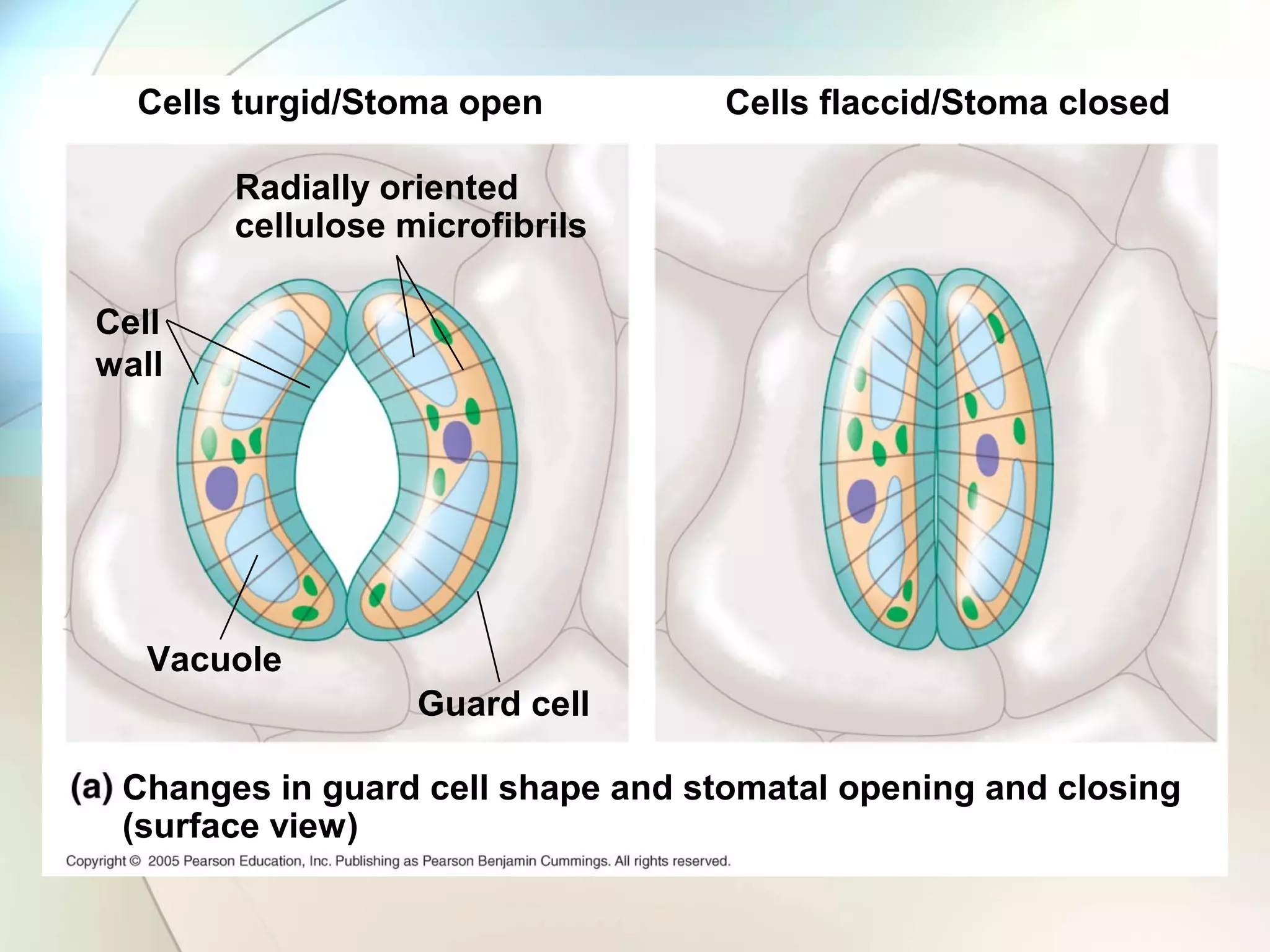
Cells turgid/Stoma open
Changes in guard cell shape and stomatal opening and closing
(surface view)
Radially oriented
cellulose microfibrils
Vacuole
Cell
wall
Guard cell
Cells flaccid/Stoma closed

Transpiration 1

  • 1.
  • 2.
    1. Definition • Transpirationis the evaporation of water from the aerial parts of plants. Of all the water plant absorbs, over 95-99% is transpired to the air as water vapor.
  • 3.
    4. From wherewater is transpired? • Aerial parts of whole young plant • Lenticels (lenticular transpiration) 0.1% • Cutin (cuticular transpiration) 3%~10% Stomatum (stomatal transpiration) ~ 90%
  • 4.
    What is mostlikely leaving through the stomata of the leaf picture here? • Water (H2O) What is this process called?  Stomatal Transpiration
  • 5.
    Cuticle Cuticle Mesophyll Stomata Guard cells Prevents waterloss Site of photosynthesis Openings allow gases and water to move in and out of leaf Open and close the stomata Stomatal transpiration
  • 6.
    Stoma Open Stoma Closed GuardCells Stoma Importance of transpiration Guard Cells CO2 O2 H2O What goes in? What goes out? What process involves using CO2 and H2O releasing O2 as a waste product? • Photosynthesis What is the plant using this process to make? • Carbohydrates-glucose If the plant needs water for photosynthesis, why is water coming out of the
  • 7.
    Stoma Open StomaClosed Function of Stomata Guard Cells • These stomata (leaf openings) naturally allow water to evaporate out. Why would the plant close stomata with guard cells? • Prevent excess water loss through transpiration. (conserve water) So what is the point of having stomata? • Allows gas exchange for photosynthesis
  • 8.
    How do the guardcells react to the availability of water?  Dry – guard cells CLOSE  lots of H2O – guard cells OPEN http://www.ualr.edu/~botany/images.html Function of Guard Cells
  • 9.
    Guard Cells 4. Guardcells: • cells that open and close the stoma 4. Stomata: openings in leaf’s surface; when open: • GAS EXCHANGE: Allows CO2 in & O2 out of leaf • TRANSPIRATION: Stomata
  • 11.
  • 12.
    Guard cell propertiesand their relationship with stomatal control • Thickness of CW varies in the ventral and dorsal part of the guard cells. • Contains chloroplast and can perform light reaction. (not dark reaction for the lack of key enzymes) • Structurally isolated from epidermal cells for the lack of plasmodesmata (water and ions transmit only through cellular pathway, thus helps to build up water gradient) • Little volume, little amount of water absorption or loss controls stomtal aperture.
  • 13.
    6. Mechanism ofstomatal opening ----K+ absorption theory H + light K + H + K + Mal Mal -   + H+ V PM H + H + Cl-Cl- H+ -ATPase in PM is light activated Its function is out-pumping H+ Inward rectifier K+ channel is voltage dependent, PM hyperpolarization activates the channel and carry K+ inward Cl- is transported through Cl- /H+ symport or Cl- /OH- antiport HCO3 - +PEP
  • 14.
    When the stomatumis opening, the [K+ ] rises to 0.5M, anions rise to 0.2-0.5M, the osmotic potential drops 2MPa, thus bring water in.
  • 15.
    7. Factors influencingstomatal aperture • Light • Temp. • CO2 • Water content • Plant hormone
  • 16.
    (1). Light • Stomataof most plant open in the day and close at night, while CAM plants are just the opposite. • Stomata opening are sensitive to red light and blue light, and blue light is more effective, it stimulates opening by a blue- light receptor: zeaxanthin.
  • 18.
    (2) Temperature • Stomatalaperture increase with Temp, within 20- 30 (the optimal).℃
  • 19.
    (3). CO2 • LowCO2 conc. promotes stomatal opening, while high CO2 conc. inhibits stomatal opening through its acidification of the guard cell thus inhibits PM hyperpolarization.
  • 20.
    (4) Water content •Stomta open when the leaf contain enough water. When there is a water shortage, they close.
  • 21.
    (6) Plant hormones •CTK promotes opening • ABA inhibits
  • 22.
    Factors that influencetranspiration Transpiration from the leaf depends on two major factors: 1. Difference in water vapor gradient 2. Diffusional resistance
  • 23.
    The driving force oftranspiration is the “vapor pressure gradient.” This is the difference in vapor pressure between the internal spaces in the leaf and the atmosphere around the leaf Diffusional resistance comprises stomatal resistance and boundary layer resistance
  • 24.
    Transpiration rate=Driving force/resistance watervapor inside the leaf - water vapor of the air = stomatal resistance + boundary layer resistance
  • 25.
    Environmental factors thataffect the rate of transpiration 1. Light Plants transpire more rapidly in the light than in the dark. This is largely because light stimulates the opening of the stomata , Light also speeds up transpiration by warming the leaf .
  • 26.
    2. Temperature Plants transpiremore rapidly at higher temperatures because water evaporates more rapidly as the temperature rises. 3. Humidity When the surrounding air is dry, diffusion of water out of the leaf goes on more rapidly.
  • 27.
    • 4. Wind Whena breeze is present, the humid air is carried away and replaced by drier air. • 5. Soil water A plant cannot continue to transpire rapidly if its water loss is not made up by replacement from the soil. When absorption of water by the roots fails to keep up with the rate of transpiration, loss of turgor occurs, and the stomata close. This immediately reduces the rate of transpiration. If the loss of turgor extends to the rest of the leaf and stem, the plant wilts.
  • 28.
    Cells turgid/Stoma open Changesin guard cell shape and stomatal opening and closing (surface view) Radially oriented cellulose microfibrils Vacuole Cell wall Guard cell Cells flaccid/Stoma closed

Editor's Notes

  • #8 Guard cells open by inflating with extra water. They do this by pumping K+ ions into the cell, which causes water to rush in via osmosis to diffuse the high ion concentration.