
Fundamental of Crop Physiology
Dr. Shailendra Bhalawe
Assistant Professor
College of Agriculture Balaghat
Jawaharlal Nehru Krashi Vishwavidyalaya Jabalpur
(M.P.)
Stomatal Physiology
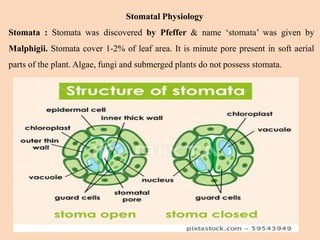
Stomata : Stomata was discovered by Pfeffer & name ‘stomata’ was given by
Malphigii. Stomata cover 1-2% of leaf area. It is minute pore present in soft aerial
parts of the plant. Algae, fungi and submerged plants do not possess stomata.
Characteristics of stomata
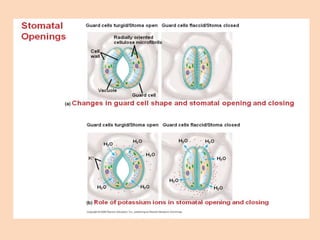
(a) Stomata are minute pores of elliptical shape, consists of two specialized epidermal
cell called guard cells.
(b) The guard cells are kidney shape in dicotyledonous and dumbbell shape in
monocotyledon.
(c) The wall of the guard cell surrounding the pore is thicken and inelastic due to rest
of the walls are thin, elastic and semi-permeable.
(d) Each guard cell has a cytoplasmic lining, central vacuole. Its cytoplasm contains
single nucleus and number of chloroplast. The chloroplast of guard cell is capable of
very poor photosynthesis, because the absence of RUBISCO enzyme.
(e) Guard cells are surrounded by modified epidermal cells, known as subsidiary cells
or accessory cells, which supports in the movement of guard cells.
(f) The Size and shape of stoma and guard cell vary from plant to plant. When fully
open, the stomata pore measures 3-12 µ in width and 10-40 µ in length.
(g) In many gymnosperms and xerophytic plants (plants growing in desert), the
stomata are present embedded deeply in the leaves, so that they are not exposed to
sunlight directly. Such deeply embedded stomata are called sunken stomata. This is
an adaptation to check excessive transpiration in these plants.
Number of Stomata (Stomatal Frequency) :
The number of stomata in a definite area of leaf varies from plant to plant.
Xerophytes possess larger number of stomata than mesophytes.
Number of stomata/sq cm. is 1000-60,000 in different plant species.
The number of stomta per unit area of leaf is called Stomatal Frequency. Stomata
frequency of trees and shrubs is higher than herbs.
Stomata occupy nearly one to two percent of total leaf area when fully open.
In isobilateral leaves (in monocots).
approximately the same number of stomata are found on upper surface (adaxial)
and lower (abaxial) surface.
But in dorsiventral leaves (indicots) the number of stomata on the upper surface is
much less in comparison to those found on the lower surface.
Distribution and Types of Stomata : A. Depending upon the distribution and
arrangement of stomata in the leaves five categories of stomatal distribution have
been recognized in plants (shown in fig).
Apple or mulberry (hypostomatic) type: Stomata are found distributed only on
the lower surface of leaves, e.g., apple, peach, mulberry, walnut, etc.
 Potato type: Stomata are found distributed more on the lower surface and less on
its upper surface, e.g., potato, cabbage, bean, tomato, pea, etc.
Oat (amphistomatic) type: Stomata are found distributed equally upon the two
surfaces, e.g. maize, oats, grasses, etc.
 Water lily (epistomatic) type: Stomata are found distributed only on the upper
surface of leaf, e.g., water lily, Nymphaea and many aquatic plants.
Potamogeton (astomatic) type: Stomata are altogether absent or if present they are
vestigeal. e.g., Potamogeton and submerged aquatics.
B. Types of Stomata based on Movement:
Loftfield (1856) classified three main groups of stomata in accordance with their
daily movement:
1. Alfalfa Type: The stomata remain open throughout the day and closed all night, eg.,
peas, bean, mustard etc.
2. Potato Type: The stomata will open throughout the day and night except for few
hours in the evening, eg., Allium, cabbage, pumpkin, etc.
3. Barley Type: The stomata open only for a few hours in a day, eg., Barley and other
cereals
C. Types of Stomata based on Behavior:Considering the behavior of the stomatal
movements, five categories have been recognized:
1. Photo-active movements: Light directly or indirectly controls stomatal
movements. Such stomata remain open during day time and closed in nights (dark).
2. Skoto-active movements: Stomata remain closed during day time and open
during night. Such cases are found in succulent plants and other CAM Plants.
3. Hydro-active movements: In some cases, stomata open due to excessive loss of
water from the epidermal cells and close due to turgid conditions of epidermal cells.
This is usually found during mid-day.
4. Autonomous movements: In certain cases, stomata open and close at a rate of 10-
15 minutes showing diurnal or rhythmic pulsation.
5. Passive and Active movements: Opening of stomata is considered as active
process and closing is the passive process and this is caused by the turgor changes in
the guard cells.
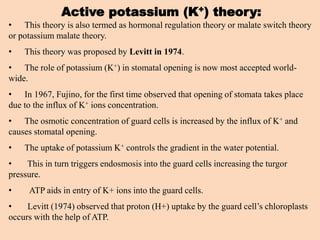
Active potassium (K+) theory:
• This theory is also termed as hormonal regulation theory or malate switch theory
or potassium malate theory.
• This theory was proposed by Levitt in 1974.
• The role of potassium (K+) in stomatal opening is now most accepted world-
wide.
• In 1967, Fujino, for the first time observed that opening of stomata takes place
due to the influx of K+ ions concentration.
• The osmotic concentration of guard cells is increased by the influx of K+ and
causes stomatal opening.
• The uptake of potassium K+ controls the gradient in the water potential.
• This in turn triggers endosmosis into the guard cells increasing the turgor
pressure.
• ATP aids in entry of K+ ions into the guard cells.
• Levitt (1974) observed that proton (H+) uptake by the guard cell’s chloroplasts
occurs with the help of ATP.
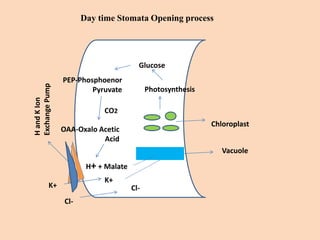
Vacuole
Chloroplast
Photosynthesis
Glucose
PEP-Phosphoenor
Pyruvate
CO2
OAA-Oxalo Acetic
Acid
H+ + Malate
K+
K+ Cl-
Cl-
H
and
K
Ion
Exchange
Pump
Day time Stomata Opening process
This leads to rise of pH in guard cells.
Increase in pH converts starch into organic acid, such as malic acid.
Malic acid again dissociates to form H+ and malate anion.
The absorption of potassium K+ ions is balanced by one of the following:
Uptake of Cl-
Transport of H+ ions from organic acids, such as malic acid
By negative charges of organic acids when they lose H+ ions
The accumulation of large concentration of K+ ions in guard cells is
ionically balanced by the uptake of negatively charged ions, i.e., chloride
and malate.
The hydrolysis of starch causes the accumulation of high amount of
malate in guard cells of open stomata.
A passive or highly catalyzed excretion of K+ and Cl from the guard cells
to the epidermal tissue results in stomatal closure in general and subsidiary
cells in particular.
It is considered that subsidiary cells have an active re-absorption
mechanism of K+.
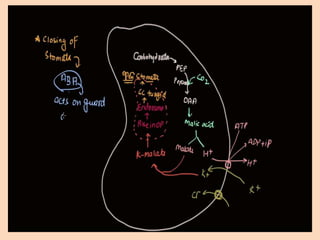
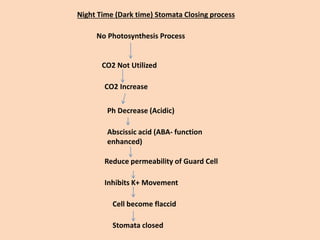
Night Time (Dark time) Stomata Closing process
No Photosynthesis Process
CO2 Not Utilized
CO2 Increase
Ph Decrease (Acidic)
Abscissic acid (ABA- function
enhanced)
Reduce permeability of Guard Cell
Inhibits K+ Movement
Cell become flaccid
Stomata closed
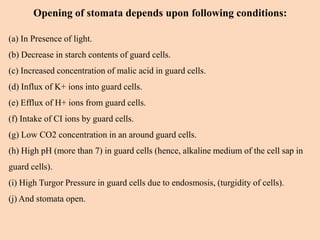
Opening of stomata depends upon following conditions:
(a) In Presence of light.
(b) Decrease in starch contents of guard cells.
(c) Increased concentration of malic acid in guard cells.
(d) Influx of K+ ions into guard cells.
(e) Efflux of H+ ions from guard cells.
(f) Intake of CI ions by guard cells.
(g) Low CO2 concentration in an around guard cells.
(h) High pH (more than 7) in guard cells (hence, alkaline medium of the cell sap in
guard cells).
(i) High Turgor Pressure in guard cells due to endosmosis, (turgidity of cells).
(j) And stomata open.
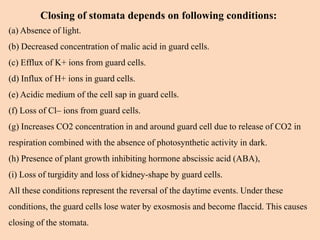
Closing of stomata depends on following conditions:
(a) Absence of light.
(b) Decreased concentration of malic acid in guard cells.
(c) Efflux of K+ ions from guard cells.
(d) Influx of H+ ions in guard cells.
(e) Acidic medium of the cell sap in guard cells.
(f) Loss of Cl– ions from guard cells.
(g) Increases CO2 concentration in and around guard cell due to release of CO2 in
respiration combined with the absence of photosynthetic activity in dark.
(h) Presence of plant growth inhibiting hormone abscissic acid (ABA),
(i) Loss of turgidity and loss of kidney-shape by guard cells.
All these conditions represent the reversal of the daytime events. Under these
conditions, the guard cells lose water by exosmosis and become flaccid. This causes
closing of the stomata.
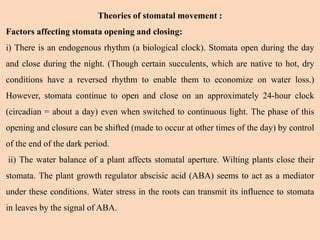
Theories of stomatal movement :
Factors affecting stomata opening and closing:
i) There is an endogenous rhythm (a biological clock). Stomata open during the day
and close during the night. (Though certain succulents, which are native to hot, dry
conditions have a reversed rhythm to enable them to economize on water loss.)
However, stomata continue to open and close on an approximately 24-hour clock
(circadian = about a day) even when switched to continuous light. The phase of this
opening and closure can be shifted (made to occur at other times of the day) by control
of the end of the dark period.
ii) The water balance of a plant affects stomatal aperture. Wilting plants close their
stomata. The plant growth regulator abscisic acid (ABA) seems to act as a mediator
under these conditions. Water stress in the roots can transmit its influence to stomata
in leaves by the signal of ABA.
iii) Low concentrations of CO2 cause stomata to open. If CO2 free air is blown
across stomata in darkness, their stomata open. High CO2 causes stomata to close.
iv) Light causes stomata to open. The minimum light level for opening of stomata in
most plants is 1/1000 to 1/30 of full sunlight, just enough to cause some net
photosynthesis. Blue light (430-460nm) is nearly 10 times as effective as red light
(630-680nm).
The wavelengths that are effective in the red part of the spectrum are the same as
those that are effective in photosynthesis that is absorbed by chlorophyll. However,
the blue light effect is quite independent of photosynthesis.
Photosynthesis will change intercellular CO2 concentrations and may have its effect
through the mechanism written in point iii) above.
Thank You

Stomatal Physiology.pptx

  • 1.
    Fundamental of CropPhysiology Dr. Shailendra Bhalawe Assistant Professor College of Agriculture Balaghat Jawaharlal Nehru Krashi Vishwavidyalaya Jabalpur (M.P.)
  • 2.
    Stomatal Physiology Stomata :Stomata was discovered by Pfeffer & name ‘stomata’ was given by Malphigii. Stomata cover 1-2% of leaf area. It is minute pore present in soft aerial parts of the plant. Algae, fungi and submerged plants do not possess stomata.
  • 3.
    Characteristics of stomata (a)Stomata are minute pores of elliptical shape, consists of two specialized epidermal cell called guard cells. (b) The guard cells are kidney shape in dicotyledonous and dumbbell shape in monocotyledon. (c) The wall of the guard cell surrounding the pore is thicken and inelastic due to rest of the walls are thin, elastic and semi-permeable. (d) Each guard cell has a cytoplasmic lining, central vacuole. Its cytoplasm contains single nucleus and number of chloroplast. The chloroplast of guard cell is capable of very poor photosynthesis, because the absence of RUBISCO enzyme.
  • 4.
    (e) Guard cellsare surrounded by modified epidermal cells, known as subsidiary cells or accessory cells, which supports in the movement of guard cells. (f) The Size and shape of stoma and guard cell vary from plant to plant. When fully open, the stomata pore measures 3-12 µ in width and 10-40 µ in length. (g) In many gymnosperms and xerophytic plants (plants growing in desert), the stomata are present embedded deeply in the leaves, so that they are not exposed to sunlight directly. Such deeply embedded stomata are called sunken stomata. This is an adaptation to check excessive transpiration in these plants.
  • 5.
    Number of Stomata(Stomatal Frequency) : The number of stomata in a definite area of leaf varies from plant to plant. Xerophytes possess larger number of stomata than mesophytes. Number of stomata/sq cm. is 1000-60,000 in different plant species. The number of stomta per unit area of leaf is called Stomatal Frequency. Stomata frequency of trees and shrubs is higher than herbs. Stomata occupy nearly one to two percent of total leaf area when fully open. In isobilateral leaves (in monocots). approximately the same number of stomata are found on upper surface (adaxial) and lower (abaxial) surface. But in dorsiventral leaves (indicots) the number of stomata on the upper surface is much less in comparison to those found on the lower surface.
  • 6.
    Distribution and Typesof Stomata : A. Depending upon the distribution and arrangement of stomata in the leaves five categories of stomatal distribution have been recognized in plants (shown in fig). Apple or mulberry (hypostomatic) type: Stomata are found distributed only on the lower surface of leaves, e.g., apple, peach, mulberry, walnut, etc.  Potato type: Stomata are found distributed more on the lower surface and less on its upper surface, e.g., potato, cabbage, bean, tomato, pea, etc. Oat (amphistomatic) type: Stomata are found distributed equally upon the two surfaces, e.g. maize, oats, grasses, etc.  Water lily (epistomatic) type: Stomata are found distributed only on the upper surface of leaf, e.g., water lily, Nymphaea and many aquatic plants. Potamogeton (astomatic) type: Stomata are altogether absent or if present they are vestigeal. e.g., Potamogeton and submerged aquatics.
  • 7.
    B. Types ofStomata based on Movement: Loftfield (1856) classified three main groups of stomata in accordance with their daily movement: 1. Alfalfa Type: The stomata remain open throughout the day and closed all night, eg., peas, bean, mustard etc. 2. Potato Type: The stomata will open throughout the day and night except for few hours in the evening, eg., Allium, cabbage, pumpkin, etc. 3. Barley Type: The stomata open only for a few hours in a day, eg., Barley and other cereals
  • 8.
    C. Types ofStomata based on Behavior:Considering the behavior of the stomatal movements, five categories have been recognized: 1. Photo-active movements: Light directly or indirectly controls stomatal movements. Such stomata remain open during day time and closed in nights (dark). 2. Skoto-active movements: Stomata remain closed during day time and open during night. Such cases are found in succulent plants and other CAM Plants. 3. Hydro-active movements: In some cases, stomata open due to excessive loss of water from the epidermal cells and close due to turgid conditions of epidermal cells. This is usually found during mid-day. 4. Autonomous movements: In certain cases, stomata open and close at a rate of 10- 15 minutes showing diurnal or rhythmic pulsation. 5. Passive and Active movements: Opening of stomata is considered as active process and closing is the passive process and this is caused by the turgor changes in the guard cells.
  • 9.
    Active potassium (K+)theory: • This theory is also termed as hormonal regulation theory or malate switch theory or potassium malate theory. • This theory was proposed by Levitt in 1974. • The role of potassium (K+) in stomatal opening is now most accepted world- wide. • In 1967, Fujino, for the first time observed that opening of stomata takes place due to the influx of K+ ions concentration. • The osmotic concentration of guard cells is increased by the influx of K+ and causes stomatal opening. • The uptake of potassium K+ controls the gradient in the water potential. • This in turn triggers endosmosis into the guard cells increasing the turgor pressure. • ATP aids in entry of K+ ions into the guard cells. • Levitt (1974) observed that proton (H+) uptake by the guard cell’s chloroplasts occurs with the help of ATP.
  • 10.
    Vacuole Chloroplast Photosynthesis Glucose PEP-Phosphoenor Pyruvate CO2 OAA-Oxalo Acetic Acid H+ +Malate K+ K+ Cl- Cl- H and K Ion Exchange Pump Day time Stomata Opening process
  • 12.
    This leads torise of pH in guard cells. Increase in pH converts starch into organic acid, such as malic acid. Malic acid again dissociates to form H+ and malate anion. The absorption of potassium K+ ions is balanced by one of the following: Uptake of Cl- Transport of H+ ions from organic acids, such as malic acid By negative charges of organic acids when they lose H+ ions The accumulation of large concentration of K+ ions in guard cells is ionically balanced by the uptake of negatively charged ions, i.e., chloride and malate. The hydrolysis of starch causes the accumulation of high amount of malate in guard cells of open stomata. A passive or highly catalyzed excretion of K+ and Cl from the guard cells to the epidermal tissue results in stomatal closure in general and subsidiary cells in particular. It is considered that subsidiary cells have an active re-absorption mechanism of K+.
  • 13.
    Night Time (Darktime) Stomata Closing process No Photosynthesis Process CO2 Not Utilized CO2 Increase Ph Decrease (Acidic) Abscissic acid (ABA- function enhanced) Reduce permeability of Guard Cell Inhibits K+ Movement Cell become flaccid Stomata closed
  • 14.
    Opening of stomatadepends upon following conditions: (a) In Presence of light. (b) Decrease in starch contents of guard cells. (c) Increased concentration of malic acid in guard cells. (d) Influx of K+ ions into guard cells. (e) Efflux of H+ ions from guard cells. (f) Intake of CI ions by guard cells. (g) Low CO2 concentration in an around guard cells. (h) High pH (more than 7) in guard cells (hence, alkaline medium of the cell sap in guard cells). (i) High Turgor Pressure in guard cells due to endosmosis, (turgidity of cells). (j) And stomata open.
  • 15.
    Closing of stomatadepends on following conditions: (a) Absence of light. (b) Decreased concentration of malic acid in guard cells. (c) Efflux of K+ ions from guard cells. (d) Influx of H+ ions in guard cells. (e) Acidic medium of the cell sap in guard cells. (f) Loss of Cl– ions from guard cells. (g) Increases CO2 concentration in and around guard cell due to release of CO2 in respiration combined with the absence of photosynthetic activity in dark. (h) Presence of plant growth inhibiting hormone abscissic acid (ABA), (i) Loss of turgidity and loss of kidney-shape by guard cells. All these conditions represent the reversal of the daytime events. Under these conditions, the guard cells lose water by exosmosis and become flaccid. This causes closing of the stomata.
  • 16.
    Theories of stomatalmovement : Factors affecting stomata opening and closing: i) There is an endogenous rhythm (a biological clock). Stomata open during the day and close during the night. (Though certain succulents, which are native to hot, dry conditions have a reversed rhythm to enable them to economize on water loss.) However, stomata continue to open and close on an approximately 24-hour clock (circadian = about a day) even when switched to continuous light. The phase of this opening and closure can be shifted (made to occur at other times of the day) by control of the end of the dark period. ii) The water balance of a plant affects stomatal aperture. Wilting plants close their stomata. The plant growth regulator abscisic acid (ABA) seems to act as a mediator under these conditions. Water stress in the roots can transmit its influence to stomata in leaves by the signal of ABA.
  • 17.
    iii) Low concentrationsof CO2 cause stomata to open. If CO2 free air is blown across stomata in darkness, their stomata open. High CO2 causes stomata to close. iv) Light causes stomata to open. The minimum light level for opening of stomata in most plants is 1/1000 to 1/30 of full sunlight, just enough to cause some net photosynthesis. Blue light (430-460nm) is nearly 10 times as effective as red light (630-680nm). The wavelengths that are effective in the red part of the spectrum are the same as those that are effective in photosynthesis that is absorbed by chlorophyll. However, the blue light effect is quite independent of photosynthesis. Photosynthesis will change intercellular CO2 concentrations and may have its effect through the mechanism written in point iii) above.
  • 19.