Valuation of Bonds and
Equities
   The value of any business asset
    depends on its expected future cash
    flows.
   If you buy a bond you are effectively
    buying a stream of cash flows.
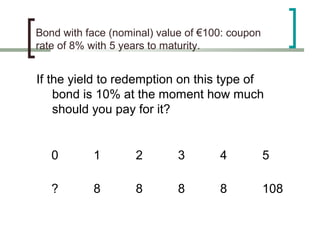
Bond with face (nominal) value of €100: coupon
rate of 8% with 5 years to maturity.


If the yield to redemption on this type of
    bond is 10% at the moment how much
    should you pay for it?


   0       1        2        3       4           5

   ?       8        8        8       8           108
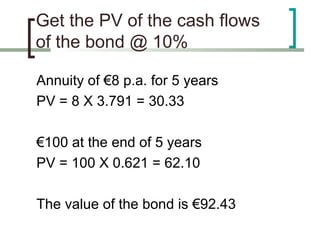
Get the PV of the cash flows
of the bond @ 10%

Annuity of €8 p.a. for 5 years
PV = 8 X 3.791 = 30.33

€100 at the end of 5 years
PV = 100 X 0.621 = 62.10

The value of the bond is €92.43
Topics Covered


    How To Value Common Stock
    Capitalization Rates
    Stock Prices and EPS
Stocks & Stock Market

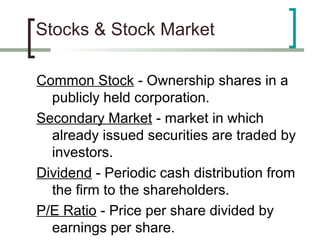
Common Stock - Ownership shares in a
  publicly held corporation.
Secondary Market - market in which
  already issued securities are traded by
  investors.
Dividend - Periodic cash distribution from
  the firm to the shareholders.
P/E Ratio - Price per share divided by
  earnings per share.
Stocks & Stock Market

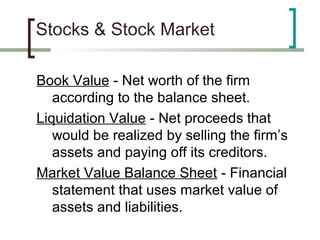
Book Value - Net worth of the firm
   according to the balance sheet.
Liquidation Value - Net proceeds that
   would be realized by selling the firm’s
   assets and paying off its creditors.
Market Value Balance Sheet - Financial
   statement that uses market value of
   assets and liabilities.
Valuing Common Stocks

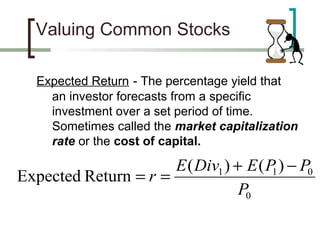
   Expected Return - The percentage yield that
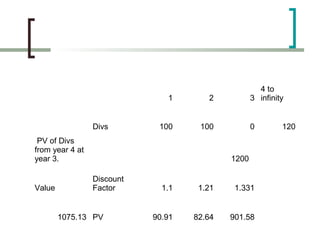
     an investor forecasts from a specific
     investment over a set period of time.
     Sometimes called the market capitalization
     rate or the cost of capital.

                      E ( Div1 ) + E ( P ) − P0
Expected Return = r =                   1
                                  P0
Valuing Common Stocks

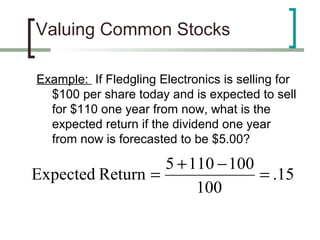
Example: If Fledgling Electronics is selling for
  $100 per share today and is expected to sell
  for $110 one year from now, what is the
  expected return if the dividend one year
  from now is forecasted to be $5.00?

                  5 + 110 − 100
Expected Return =               = .15
                       100
Valuing Common Stocks

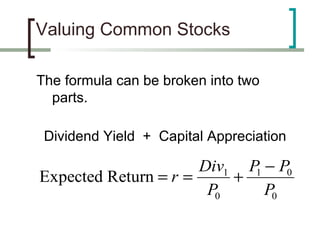
The formula can be broken into two
  parts.

 Dividend Yield + Capital Appreciation

                      Div1 P − P0
Expected Return = r =     + 1
                       P0     P0
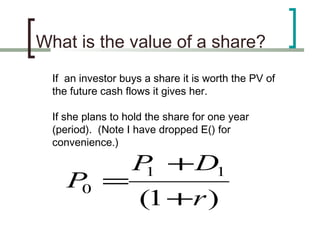
What is the value of a share?
  If an investor buys a share it is worth the PV of
  the future cash flows it gives her.

  If she plans to hold the share for one year
  (period). (Note I have dropped E() for
  convenience.)

                   P + D1
                    1
     P =
      0
                     (1 +r )
Valuing Common Stocks

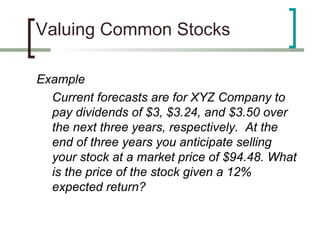
Example
  Current forecasts are for XYZ Company to
  pay dividends of $3, $3.24, and $3.50 over
  the next three years, respectively. At the
  end of three years you anticipate selling
  your stock at a market price of $94.48. What
  is the price of the stock given a 12%
  expected return?
Valuing Common Stocks

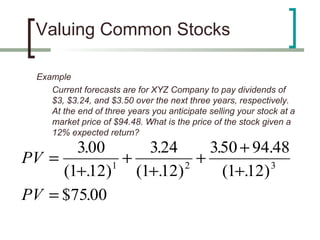
  Example
     Current forecasts are for XYZ Company to pay dividends of
     $3, $3.24, and $3.50 over the next three years, respectively.
     At the end of three years you anticipate selling your stock at a
     market price of $94.48. What is the price of the stock given a
     12% expected return?
       3.00     3.24     350 + 94.48
                          .
PV =          +        +
     (1+.12) (1+.12)
            1        2
                            (1+.12) 3


PV = $75.00
Value of Shareholders Funds
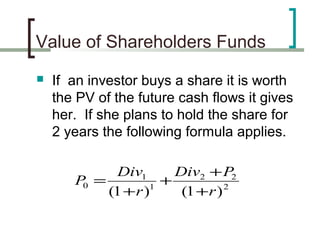
   If an investor buys a share it is worth
    the PV of the future cash flows it gives
    her. If she plans to hold the share for
    2 years the following formula applies.

             Div1       Div2 + P2
       P0 =           +
            (1 + r )1
                         (1 + r ) 2
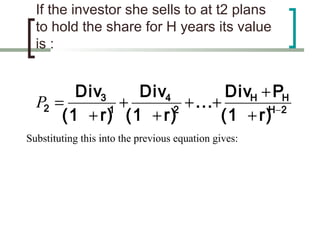
If the investor she sells to at t2 plans
  to hold the share for H years its value
  is :


        Div3     Div4          DivH + PH
  P2 =       1
               +      2
                        + ...+       H−2
      (1 + r) (1 + r)         (1 + r)
Substituting this into the previous equation gives:
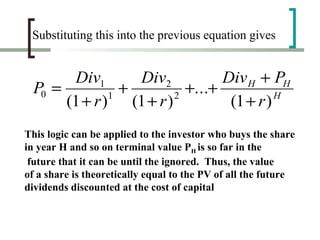
Substituting this into the previous equation gives


       Div1       Div2          Div H + PH
 P0 =           +         +...+
      (1 + r ) (1 + r )
              1         2
                                 (1 + r ) H


This logic can be applied to the investor who buys the share
in year H and so on terminal value PH is so far in the
 future that it can be until the ignored. Thus, the value
of a share is theoretically equal to the PV of all the future
dividends discounted at the cost of capital
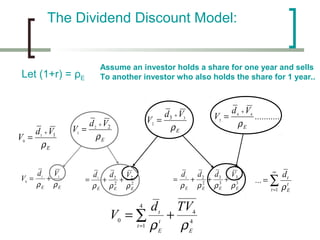
The Dividend Discount Model:


                          Assume an investor holds a share for one year and sells
 Let (1+r) = ρE           To another investor who also holds the share for 1 year..


                                             d 3 + V3         d 4 + V4
                                        V2 =             V3 =          ...........
                      d 2 + V2                 ρE               ρE
       d1 + V1   V1 =
V0 =                     ρE
        ρE

    d   V                                                                      ∞
                      d   d   V                  d   d   d   V                       dt
V0 = 1 + 1
    ρE ρE
                     = 1 + 2 + 22               = 1 + 2 + 3 + 3         ... = ∑
                      ρE ρE ρE
                            2
                                                 ρE ρE ρE ρE
                                                       2   3   3
                                                                              t =1   ρE
                                                                                      t


                                    4  d t TV4
                             V0 = ∑ t + 4
                                  t =1 ρ    ρE
                                         E
The Basic Dividend Valuation
   Model is:
                ~ ]
       ∞
          E t [ d t+τ
Pt = ∑           τ
                                            (PVED)
     τ =1
               RF

   The value of a share is the present value of all
   the dividends that It pays to infinity.
Valuing Common Stocks

Dividend Discount Model - Computation of
   today’s stock price which states that share
   value equals the present value of all
   expected future dividends.
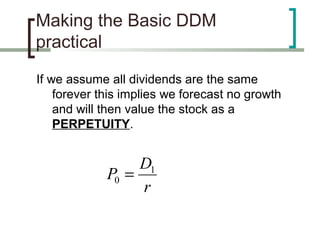
Making the Basic DDM
practical

If we assume all dividends are the same
    forever this implies we forecast no growth
    and will then value the stock as a
    PERPETUITY.


                  D1
             P0 =
                  r
Valuing Common Stocks
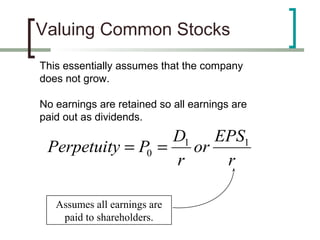
This essentially assumes that the company
does not grow.

No earnings are retained so all earnings are
paid out as dividends.
                   D1 EPS1
 Perpetuity = P0 =   or
                   r    r

   Assumes all earnings are
    paid to shareholders.
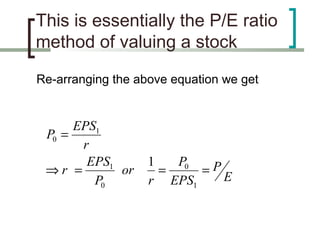
This is essentially the P/E ratio
method of valuing a stock

Re-arranging the above equation we get


      EPS1
 P0 =
       r
        EPS1       1   P0
 ⇒r =        or      =    =P
         P0        r EPS1    E
Constant Dividend Model
   This is obviously unrealistic since it
    assumes that no earnings are retained
    and there is no growth.
   Accordingly, we need to adjust this
    formula for the value of growth.
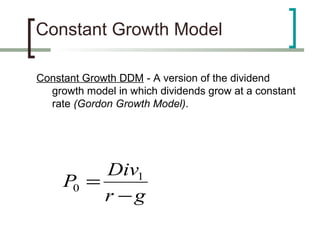
Constant Growth Model

Constant Growth DDM - A version of the dividend
  growth model in which dividends grow at a constant
  rate (Gordon Growth Model).


          Div1
     P0 =
          r −g
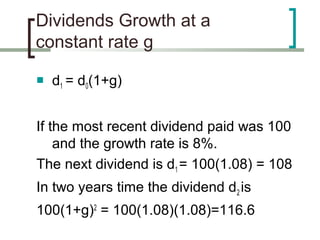
Dividends Growth at a
constant rate g

   d1 = d0(1+g)


If the most recent dividend paid was 100
    and the growth rate is 8%.
The next dividend is d1 = 100(1.08) = 108
In two years time the dividend d2 is
100(1+g)2 = 100(1.08)(1.08)=116.6
Where does g come from?
   It come from retained earnings which
    are reinvested at the cost of capital.
   This increases subsequent earnings
    and dividends.
Valuing Common Stocks

   If a firm elects to pay a lower dividend, and
    reinvest the funds, the stock price may
    increase because future dividends may be
    higher.

Payout Ratio - Fraction of earnings paid out as
   dividends
Plowback (Ploughback) Ratio - Fraction of
   earnings retained by the firm.
Valuing Common Stocks

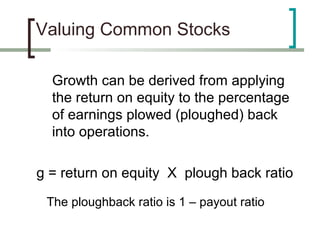
  Growth can be derived from applying
  the return on equity to the percentage
  of earnings plowed (ploughed) back
  into operations.

g = return on equity X plough back ratio

 The ploughback ratio is 1 – payout ratio
g is a sustainable growth level
   Sustainable Growth Rate - Steady rate
    at which a firm can grow: plowback
    ratio X return on equity
Notation

BVP: Book value per share
Payout Ratio: The proportion of earnings paid
  out. DPS=EPS X Payout Ratio
REPS: Retained Earnings Per Share: that part
  of earnings per share not paid in dividends
  and ploughed back into the business = EPS
  X Ploughback Ratio
ROE: Return on Equity = EPS/BVP
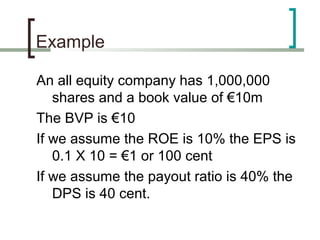
Example

An all equity company has 1,000,000
   shares and a book value of €10m
The BVP is €10
If we assume the ROE is 10% the EPS is
   0.1 X 10 = €1 or 100 cent
If we assume the payout ratio is 40% the
   DPS is 40 cent.
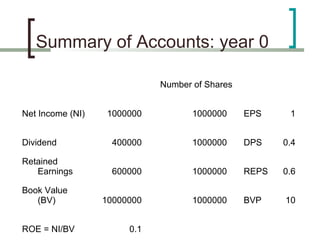
Summary of Accounts: year 0

                             Number of Shares


Net Income (NI)   1000000           1000000     EPS     1


Dividend            400000          1000000     DPS    0.4

Retained
   Earnings         600000          1000000     REPS   0.6

Book Value
   (BV)           10000000          1000000     BVP    10


ROE = NI/BV            0.1
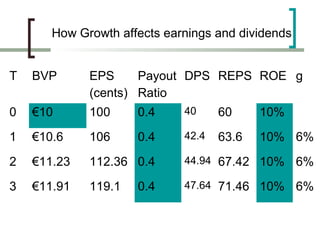
How Growth affects earnings and dividends


T   BVP      EPS     Payout DPS REPS ROE g
             (cents) Ratio
0   €10      100     0.4     40     60     10%
1   €10.6    106     0.4     42.4   63.6   10% 6%
2   €11.23   112.36 0.4      44.94 67.42 10%       6%
3   €11.91   119.1   0.4     47.64 71.46 10%       6%
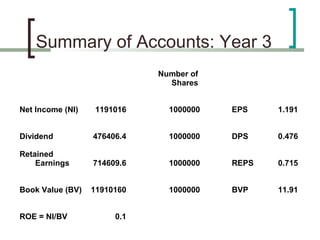
Summary of Accounts: Year 3
                             Number of
                               Shares


Net Income (NI)   1191016      1000000   EPS    1.191


Dividend          476406.4     1000000   DPS    0.476

Retained
    Earnings      714609.6     1000000   REPS   0.715


Book Value (BV)   11910160     1000000   BVP    11.91


ROE = NI/BV            0.1
Valuing Common Stocks

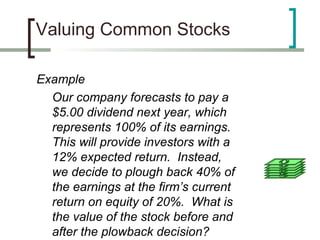
Example
  Our company forecasts to pay a
  $5.00 dividend next year, which
  represents 100% of its earnings.
  This will provide investors with a
  12% expected return. Instead,
  we decide to plough back 40% of
  the earnings at the firm’s current
  return on equity of 20%. What is
  the value of the stock before and
  after the plowback decision?
Valuing Common Stocks

  Example
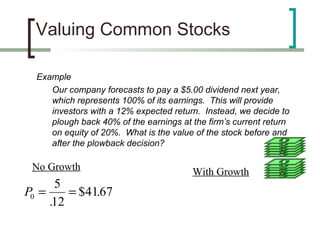
     Our company forecasts to pay a $5.00 dividend next year,
     which represents 100% of its earnings. This will provide
     investors with a 12% expected return. Instead, we decide to
     plough back 40% of the earnings at the firm’s current return
     on equity of 20%. What is the value of the stock before and
     after the plowback decision?

 No Growth                              With Growth
      5
P0 =     = $41.67
     .12
Valuing Common Stocks

 Example
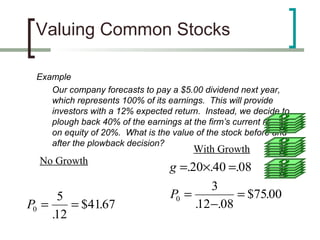
    Our company forecasts to pay a $5.00 dividend next year,
    which represents 100% of its earnings. This will provide
    investors with a 12% expected return. Instead, we decide to
    plough back 40% of the earnings at the firm’s current return
    on equity of 20%. What is the value of the stock before and
    after the plowback decision?
                                        With Growth
  No Growth
                                  g =.20×.40 =.08
                                           3
      5                           P0 =          = $75.00
P0 =     = $41.67                      .12 −.08
     .12
Valuing Common Stocks

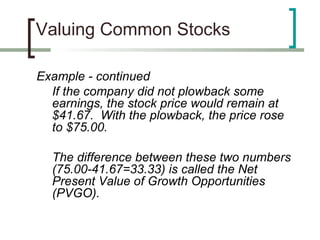
Example - continued
  If the company did not plowback some
  earnings, the stock price would remain at
  $41.67. With the plowback, the price rose
  to $75.00.

  The difference between these two numbers
  (75.00-41.67=33.33) is called the Net
  Present Value of Growth Opportunities
  (PVGO).
Valuing Common Stocks

Net Present Value of Growth
  Opportunities (PVGO) - Net present
  value of a firm’s future investments.
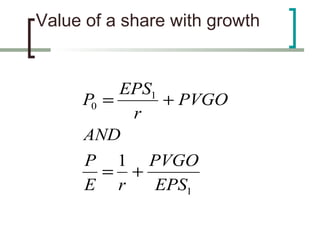
Value of a share with growth


          EPS1
     P0 =      + PVGO
           r
     AND
      P 1 PVGO
       = +
      E r  EPS1
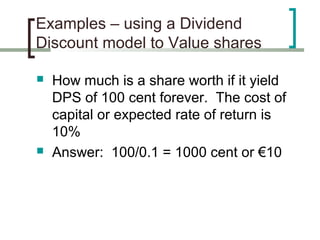
Examples – using a Dividend
Discount model to Value shares

   How much is a share worth if it yield
    DPS of 100 cent forever. The cost of
    capital or expected rate of return is
    10%
   Answer: 100/0.1 = 1000 cent or €10
Suppose the company did not
pay a Div in year 3
   It reinvests the 100 cent per share at
    10%.
   What happens to the value of the share?
   First need to consider what happens to
    dividends
   Assume that dividends are reinvested at
    the cost of capital i.e. 10%
Reinvestment of Profits in year 3

   Dividends in year three are zero
   Dividends from year 4 onwards
    increase to 110 cent per annum. (The
    100 cent yields are return of 10%)
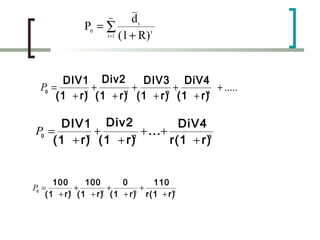
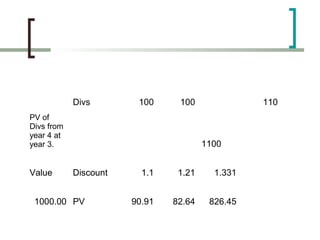
   Accordingly we have dividends of 100
    cent for years one and two. Zero divs
    for year 3 and a perpetuity of 110 cent
    from year 4 onwards.
∞      dt
              P0 = ∑
                   t =1 (1 + R)
                                t


        DIV1 Div2       DIV3 DiV4
  P0 =        +       +       +        + .....
      (1 + r) (1 + r) (1 + r) (1 + r)
            1       2       3        4


      DIV1 Div2               DiV4
P0 =        +       + ... +
    (1 + r) (1 + r)
          1       2
                            r(1 + r)3


      100     100       0       110
P0 =        +       +        +
    (1 + r) (1 + r)2 (1 + r)3 r(1 + r)3
          1
Divs        100     100              110
PV of
Divs from
year 4 at
year 3.                                1100


Value       Discount     1.1    1.21     1.331


 1000.00 PV            90.91   82.64    826.45
Why is there no change in
value?
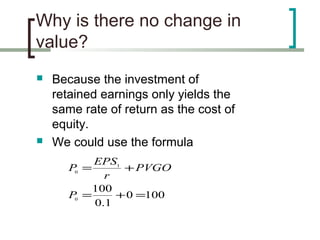
   Because the investment of
    retained earnings only yields the
    same rate of return as the cost of
    equity.
   We could use the formula
            EPS1
       P0 =       + PVGO
               r
            100
       P0 =      + 0 =100
            0 .1
Real Growth Opportunity


   What if the company did not pay any
    Divs in year three but invested in a
    positive NPV project
   For example a project yielding 20 cent
    per share per annum forever
    beginning in year 4
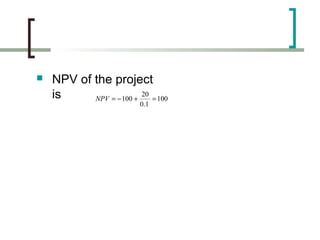
   NPV of the project
    is     NPV = − 100 +
                         20
                            = 100
                          0.1
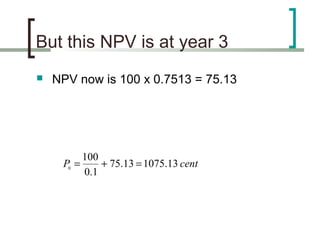
But this NPV is at year 3
   NPV now is 100 x 0.7513 = 75.13


            100
     P0 =       + 75.13 = 1075.13 cent
            0.1
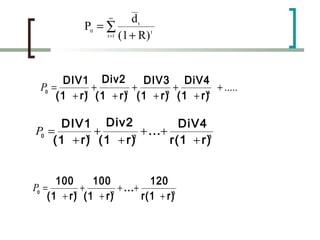
∞      dt
             P0 = ∑
                  t =1 (1 + R)
                               t


        DIV1 Div2       DIV3 DiV4
  P0 =        +       +       +        + .....
      (1 + r) (1 + r) (1 + r) (1 + r)
            1       2       3        4


      DIV1 Div2               DiV4
P0 =        +       + ... +
    (1 + r) (1 + r)
          1       2
                            r(1 + r)3


      100     100             120
P0 =        +       + ... +
    (1 + r) (1 + r)
          1       2
                            r(1 + r)3
4 to
                               1       2           3 infinity


                 Divs        100     100           0        120
 PV of Divs
from year 4 at
year 3.                                     1200

                 Discount
Value            Factor       1.1    1.21    1.331


        1075.13 PV          90.91   82.64   901.58

Stocks&bonds2214 1

  • 1.
    Valuation of Bondsand Equities  The value of any business asset depends on its expected future cash flows.  If you buy a bond you are effectively buying a stream of cash flows.
  • 2.
    Bond with face(nominal) value of €100: coupon rate of 8% with 5 years to maturity. If the yield to redemption on this type of bond is 10% at the moment how much should you pay for it? 0 1 2 3 4 5 ? 8 8 8 8 108
  • 3.
    Get the PVof the cash flows of the bond @ 10% Annuity of €8 p.a. for 5 years PV = 8 X 3.791 = 30.33 €100 at the end of 5 years PV = 100 X 0.621 = 62.10 The value of the bond is €92.43
  • 4.
    Topics Covered  How To Value Common Stock  Capitalization Rates  Stock Prices and EPS
  • 5.
    Stocks & StockMarket Common Stock - Ownership shares in a publicly held corporation. Secondary Market - market in which already issued securities are traded by investors. Dividend - Periodic cash distribution from the firm to the shareholders. P/E Ratio - Price per share divided by earnings per share.
  • 6.
    Stocks & StockMarket Book Value - Net worth of the firm according to the balance sheet. Liquidation Value - Net proceeds that would be realized by selling the firm’s assets and paying off its creditors. Market Value Balance Sheet - Financial statement that uses market value of assets and liabilities.
  • 7.
    Valuing Common Stocks Expected Return - The percentage yield that an investor forecasts from a specific investment over a set period of time. Sometimes called the market capitalization rate or the cost of capital. E ( Div1 ) + E ( P ) − P0 Expected Return = r = 1 P0
  • 8.
    Valuing Common Stocks Example:If Fledgling Electronics is selling for $100 per share today and is expected to sell for $110 one year from now, what is the expected return if the dividend one year from now is forecasted to be $5.00? 5 + 110 − 100 Expected Return = = .15 100
  • 9.
    Valuing Common Stocks Theformula can be broken into two parts. Dividend Yield + Capital Appreciation Div1 P − P0 Expected Return = r = + 1 P0 P0
  • 10.
    What is thevalue of a share? If an investor buys a share it is worth the PV of the future cash flows it gives her. If she plans to hold the share for one year (period). (Note I have dropped E() for convenience.) P + D1 1 P = 0 (1 +r )
  • 11.
    Valuing Common Stocks Example Current forecasts are for XYZ Company to pay dividends of $3, $3.24, and $3.50 over the next three years, respectively. At the end of three years you anticipate selling your stock at a market price of $94.48. What is the price of the stock given a 12% expected return?
  • 12.
    Valuing Common Stocks Example Current forecasts are for XYZ Company to pay dividends of $3, $3.24, and $3.50 over the next three years, respectively. At the end of three years you anticipate selling your stock at a market price of $94.48. What is the price of the stock given a 12% expected return? 3.00 3.24 350 + 94.48 . PV = + + (1+.12) (1+.12) 1 2 (1+.12) 3 PV = $75.00
  • 13.
    Value of ShareholdersFunds  If an investor buys a share it is worth the PV of the future cash flows it gives her. If she plans to hold the share for 2 years the following formula applies. Div1 Div2 + P2 P0 = + (1 + r )1 (1 + r ) 2
  • 14.
    If the investorshe sells to at t2 plans to hold the share for H years its value is : Div3 Div4 DivH + PH P2 = 1 + 2 + ...+ H−2 (1 + r) (1 + r) (1 + r) Substituting this into the previous equation gives:
  • 15.
    Substituting this intothe previous equation gives Div1 Div2 Div H + PH P0 = + +...+ (1 + r ) (1 + r ) 1 2 (1 + r ) H This logic can be applied to the investor who buys the share in year H and so on terminal value PH is so far in the future that it can be until the ignored. Thus, the value of a share is theoretically equal to the PV of all the future dividends discounted at the cost of capital
  • 16.
    The Dividend DiscountModel: Assume an investor holds a share for one year and sells Let (1+r) = ρE To another investor who also holds the share for 1 year.. d 3 + V3 d 4 + V4 V2 = V3 = ........... d 2 + V2 ρE ρE d1 + V1 V1 = V0 = ρE ρE d V ∞ d d V d d d V dt V0 = 1 + 1 ρE ρE = 1 + 2 + 22 = 1 + 2 + 3 + 3 ... = ∑ ρE ρE ρE 2 ρE ρE ρE ρE 2 3 3 t =1 ρE t 4 d t TV4 V0 = ∑ t + 4 t =1 ρ ρE E
  • 17.
    The Basic DividendValuation Model is: ~ ] ∞ E t [ d t+τ Pt = ∑ τ (PVED) τ =1 RF The value of a share is the present value of all the dividends that It pays to infinity.
  • 18.
    Valuing Common Stocks DividendDiscount Model - Computation of today’s stock price which states that share value equals the present value of all expected future dividends.
  • 19.
    Making the BasicDDM practical If we assume all dividends are the same forever this implies we forecast no growth and will then value the stock as a PERPETUITY. D1 P0 = r
  • 20.
    Valuing Common Stocks Thisessentially assumes that the company does not grow. No earnings are retained so all earnings are paid out as dividends. D1 EPS1 Perpetuity = P0 = or r r Assumes all earnings are paid to shareholders.
  • 21.
    This is essentiallythe P/E ratio method of valuing a stock Re-arranging the above equation we get EPS1 P0 = r EPS1 1 P0 ⇒r = or = =P P0 r EPS1 E
  • 22.
    Constant Dividend Model  This is obviously unrealistic since it assumes that no earnings are retained and there is no growth.  Accordingly, we need to adjust this formula for the value of growth.
  • 23.
    Constant Growth Model ConstantGrowth DDM - A version of the dividend growth model in which dividends grow at a constant rate (Gordon Growth Model). Div1 P0 = r −g
  • 24.
    Dividends Growth ata constant rate g  d1 = d0(1+g) If the most recent dividend paid was 100 and the growth rate is 8%. The next dividend is d1 = 100(1.08) = 108 In two years time the dividend d2 is 100(1+g)2 = 100(1.08)(1.08)=116.6
  • 25.
    Where does gcome from?  It come from retained earnings which are reinvested at the cost of capital.  This increases subsequent earnings and dividends.
  • 26.
    Valuing Common Stocks  If a firm elects to pay a lower dividend, and reinvest the funds, the stock price may increase because future dividends may be higher. Payout Ratio - Fraction of earnings paid out as dividends Plowback (Ploughback) Ratio - Fraction of earnings retained by the firm.
  • 27.
    Valuing Common Stocks Growth can be derived from applying the return on equity to the percentage of earnings plowed (ploughed) back into operations. g = return on equity X plough back ratio The ploughback ratio is 1 – payout ratio
  • 28.
    g is asustainable growth level  Sustainable Growth Rate - Steady rate at which a firm can grow: plowback ratio X return on equity
  • 29.
    Notation BVP: Book valueper share Payout Ratio: The proportion of earnings paid out. DPS=EPS X Payout Ratio REPS: Retained Earnings Per Share: that part of earnings per share not paid in dividends and ploughed back into the business = EPS X Ploughback Ratio ROE: Return on Equity = EPS/BVP
  • 30.
    Example An all equitycompany has 1,000,000 shares and a book value of €10m The BVP is €10 If we assume the ROE is 10% the EPS is 0.1 X 10 = €1 or 100 cent If we assume the payout ratio is 40% the DPS is 40 cent.
  • 31.
    Summary of Accounts:year 0 Number of Shares Net Income (NI) 1000000 1000000 EPS 1 Dividend 400000 1000000 DPS 0.4 Retained Earnings 600000 1000000 REPS 0.6 Book Value (BV) 10000000 1000000 BVP 10 ROE = NI/BV 0.1
  • 32.
    How Growth affectsearnings and dividends T BVP EPS Payout DPS REPS ROE g (cents) Ratio 0 €10 100 0.4 40 60 10% 1 €10.6 106 0.4 42.4 63.6 10% 6% 2 €11.23 112.36 0.4 44.94 67.42 10% 6% 3 €11.91 119.1 0.4 47.64 71.46 10% 6%
  • 33.
    Summary of Accounts:Year 3 Number of Shares Net Income (NI) 1191016 1000000 EPS 1.191 Dividend 476406.4 1000000 DPS 0.476 Retained Earnings 714609.6 1000000 REPS 0.715 Book Value (BV) 11910160 1000000 BVP 11.91 ROE = NI/BV 0.1
  • 34.
    Valuing Common Stocks Example Our company forecasts to pay a $5.00 dividend next year, which represents 100% of its earnings. This will provide investors with a 12% expected return. Instead, we decide to plough back 40% of the earnings at the firm’s current return on equity of 20%. What is the value of the stock before and after the plowback decision?
  • 35.
    Valuing Common Stocks Example Our company forecasts to pay a $5.00 dividend next year, which represents 100% of its earnings. This will provide investors with a 12% expected return. Instead, we decide to plough back 40% of the earnings at the firm’s current return on equity of 20%. What is the value of the stock before and after the plowback decision? No Growth With Growth 5 P0 = = $41.67 .12
  • 36.
    Valuing Common Stocks Example Our company forecasts to pay a $5.00 dividend next year, which represents 100% of its earnings. This will provide investors with a 12% expected return. Instead, we decide to plough back 40% of the earnings at the firm’s current return on equity of 20%. What is the value of the stock before and after the plowback decision? With Growth No Growth g =.20×.40 =.08 3 5 P0 = = $75.00 P0 = = $41.67 .12 −.08 .12
  • 37.
    Valuing Common Stocks Example- continued If the company did not plowback some earnings, the stock price would remain at $41.67. With the plowback, the price rose to $75.00. The difference between these two numbers (75.00-41.67=33.33) is called the Net Present Value of Growth Opportunities (PVGO).
  • 38.
    Valuing Common Stocks NetPresent Value of Growth Opportunities (PVGO) - Net present value of a firm’s future investments.
  • 39.
    Value of ashare with growth EPS1 P0 = + PVGO r AND P 1 PVGO = + E r EPS1
  • 40.
    Examples – usinga Dividend Discount model to Value shares  How much is a share worth if it yield DPS of 100 cent forever. The cost of capital or expected rate of return is 10%  Answer: 100/0.1 = 1000 cent or €10
  • 41.
    Suppose the companydid not pay a Div in year 3  It reinvests the 100 cent per share at 10%.  What happens to the value of the share?  First need to consider what happens to dividends  Assume that dividends are reinvested at the cost of capital i.e. 10%
  • 42.
    Reinvestment of Profitsin year 3  Dividends in year three are zero  Dividends from year 4 onwards increase to 110 cent per annum. (The 100 cent yields are return of 10%)  Accordingly we have dividends of 100 cent for years one and two. Zero divs for year 3 and a perpetuity of 110 cent from year 4 onwards.
  • 43.
    dt P0 = ∑ t =1 (1 + R) t DIV1 Div2 DIV3 DiV4 P0 = + + + + ..... (1 + r) (1 + r) (1 + r) (1 + r) 1 2 3 4 DIV1 Div2 DiV4 P0 = + + ... + (1 + r) (1 + r) 1 2 r(1 + r)3 100 100 0 110 P0 = + + + (1 + r) (1 + r)2 (1 + r)3 r(1 + r)3 1
  • 44.
    Divs 100 100 110 PV of Divs from year 4 at year 3. 1100 Value Discount 1.1 1.21 1.331 1000.00 PV 90.91 82.64 826.45
  • 45.
    Why is thereno change in value?  Because the investment of retained earnings only yields the same rate of return as the cost of equity.  We could use the formula EPS1 P0 = + PVGO r 100 P0 = + 0 =100 0 .1
  • 46.
    Real Growth Opportunity  What if the company did not pay any Divs in year three but invested in a positive NPV project  For example a project yielding 20 cent per share per annum forever beginning in year 4
  • 47.
    NPV of the project is NPV = − 100 + 20 = 100 0.1
  • 48.
    But this NPVis at year 3  NPV now is 100 x 0.7513 = 75.13 100 P0 = + 75.13 = 1075.13 cent 0.1
  • 49.
    dt P0 = ∑ t =1 (1 + R) t DIV1 Div2 DIV3 DiV4 P0 = + + + + ..... (1 + r) (1 + r) (1 + r) (1 + r) 1 2 3 4 DIV1 Div2 DiV4 P0 = + + ... + (1 + r) (1 + r) 1 2 r(1 + r)3 100 100 120 P0 = + + ... + (1 + r) (1 + r) 1 2 r(1 + r)3
  • 50.
    4 to 1 2 3 infinity Divs 100 100 0 120 PV of Divs from year 4 at year 3. 1200 Discount Value Factor 1.1 1.21 1.331 1075.13 PV 90.91 82.64 901.58