Portfolio Management
               LECTURE SIX


              Share Valuation


               Prepared By:
         Noorulhadi Qureshi
Lecturer Govt College of Management Sciences
                   Peshawar
Share Valuation
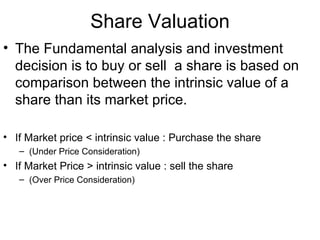
• The Fundamental analysis and investment
  decision is to buy or sell a share is based on
  comparison between the intrinsic value of a
  share than its market price.

• If Market price < intrinsic value : Purchase the share
   – (Under Price Consideration)
• If Market Price > intrinsic value : sell the share
   – (Over Price Consideration)
What is Value?
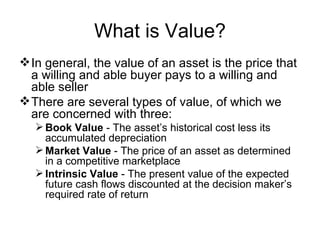
 In general, the value of an asset is the price that
  a willing and able buyer pays to a willing and
  able seller
 There are several types of value, of which we
  are concerned with three:
    Book Value - The asset’s historical cost less its
     accumulated depreciation
    Market Value - The price of an asset as determined
     in a competitive marketplace
    Intrinsic Value - The present value of the expected
     future cash flows discounted at the decision maker’s
     required rate of return
Concept of Present Value
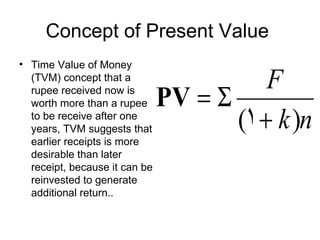
• Time Value of Money
  (TVM) concept that a
                                          F
  rupee received now is
  worth more than a rupee      PV = Σ
  to be receive after one
  years, TVM suggests that            (1 + k )n
  earlier receipts is more
  desirable than later
  receipt, because it can be
  reinvested to generate
  additional return..
F
             PV = Σ
                    (1 + k )n
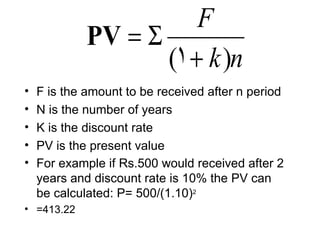
•   F is the amount to be received after n period
•   N is the number of years
•   K is the discount rate
•   PV is the present value
•   For example if Rs.500 would received after 2
    years and discount rate is 10% the PV can
    be calculated: P= 500/(1.10)2
• =413.22
Common Stocks
• A share of common stock represents an
  ownership position in the firm. Typically,
  the owners are entitled to vote on
  important matters regarding the firm, to
  vote on the membership of the board of
  directors, and (often) to receive dividends.
• In the event of liquidation of the firm, the
  common shareholders will receive a pro-
  rata share of the assets remaining after
  the creditors and preferred stockholders
  have been paid off.
Preferred Stock
• Preferred stock represents an ownership
  claim on the firm that is superior to
  common stock in the event of liquidation.
  Typically, preferred stock pays a fixed
  dividend periodically and the preferred
  stockholders are usually not entitled to
  vote as are the common shareholders.
Share Valuation Model
• The valuation model used to estimate the
  intrinsic value of a share is the present
  value model.
• The intrinsic value of a share is the
  present value of future amount to be
  received in form dividend and resale of
  share.
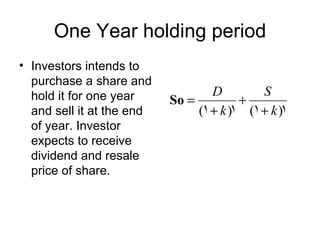
One Year holding period
• Investors intends to
  purchase a share and
  hold it for one year             D         S
                           So =          +
  and sell it at the end        (1 + k )1 (1 + k )1
  of year. Investor
  expects to receive
  dividend and resale
  price of share.
D        S
   So =        +
       (1 + )
           k 1  (1 + )
                     k 1

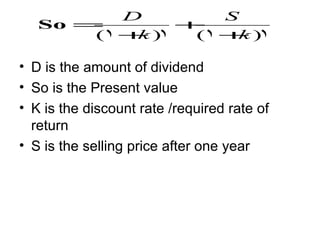
• D is the amount of dividend
• So is the Present value
• K is the discount rate /required rate of
  return
• S is the selling price after one year
D        S
   So =        +
       (1 + )
           k 1  (1 + )
                     k 1

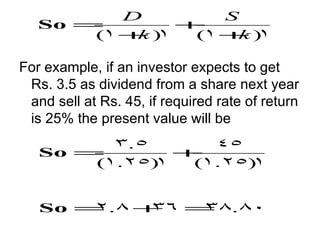
For example, if an investor expects to get
 Rs. 3.5 as dividend from a share next year
 and sell at Rs. 45, if required rate of return
 is 25% the present value will be
         3.5      45
   So =        +
       (1.25)1  (1.25)1


   So = .8 +
       2    36 = .80
                38
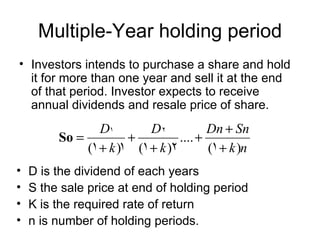
Multiple-Year holding period
• Investors intends to purchase a share and hold
  it for more than one year and sell it at the end
  of that period. Investor expects to receive
  annual dividends and resale price of share.
                 D1        D2            Dn + Sn
         So =          +          .... +
              (1 + k )1 (1 + k )2        (1 + k )n
•   D is the dividend of each years
•   S the sale price at end of holding period
•   K is the required rate of return
•   n is number of holding periods.
D1       D2           Dn +Sn
         So =             +         .... +
                  (1 +k )1 (1 +k )2        (1 +k )n

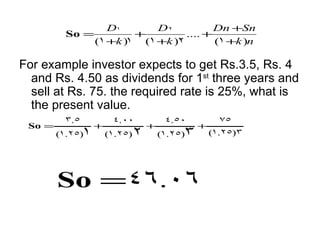
For example investor expects to get Rs.3.5, Rs. 4
  and Rs. 4.50 as dividends for 1st three years and
  sell at Rs. 75. the required rate is 25%, what is
  the present value.
         3.5           4.00          4.50            75
 So =             +             +             +
        (1.25)1       (1.25)2       (1.25)3       (1.25)3


        So =46.06
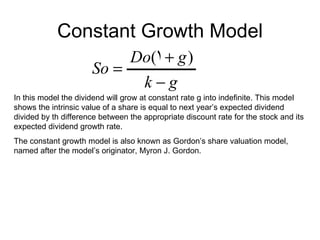
Constant Growth Model
                           Do(1 + g )
                      So =
                            k−g
In this model the dividend will grow at constant rate g into indefinite. This model
shows the intrinsic value of a share is equal to next year’s expected dividend
divided by th difference between the appropriate discount rate for the stock and its
expected dividend growth rate.
The constant growth model is also known as Gordon’s share valuation model,
named after the model’s originator, Myron J. Gordon.
Constant Growth Model
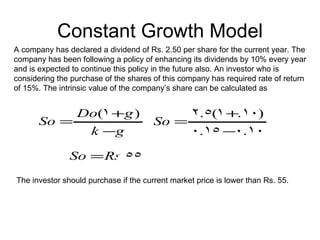
A company has declared a dividend of Rs. 2.50 per share for the current year. The
company has been following a policy of enhancing its dividends by 10% every year
and is expected to continue this policy in the future also. An investor who is
considering the purchase of the shares of this company has required rate of return
of 15%. The intrinsic value of the company’s share can be calculated as


           Do(1 +g )                              2.5(1 +.10)
      So =                             So =
            k −g                                 0.15 −0.10

               So = Rs.55
The investor should purchase if the current market price is lower than Rs. 55.
Multiple Growth Model
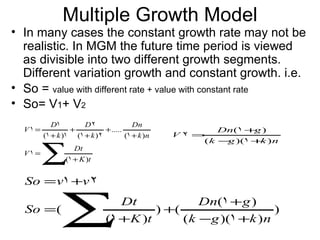
• In many cases the constant growth rate may not be
  realistic. In MGM the future time period is viewed
  as divisible into two different growth segments.
  Different variation growth and constant growth. i.e.
• So = value with different rate + value with constant rate
• So= V1+ V2
            D1        D2                Dn
  V1 =            +          + .....                    Dn(1 + )
                                                              g
         (1 + k )1 (1 + k )2         (1 + k )n   V2=
                                                    ( k − )(1 + ) n

         ∑
                                                         g     k
                   Dt
  V1 =
                (1 + K )t


  So = v1 +v 2

  So = (
               ∑                 Dt
                              (1 +K )t
                                       ) +(
                                                Dn(1 + g )
                                            ( k −g )(1 +k ) n
                                                              )
Multiple Growth Model
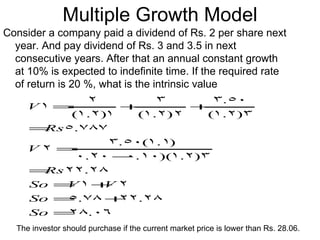
Consider a company paid a dividend of Rs. 2 per share next
  year. And pay dividend of Rs. 3 and 3.5 in next
  consecutive years. After that an annual constant growth
  at 10% is expected to indefinite time. If the required rate
  of return is 20 %, what is the intrinsic value
           2        3      3.50
     V1 =       +        +
         (1.2)1  (1.2) 2  (1.2)3
     = 5.787
      Rs
                            3.50(1.1)
     V2 =
          0.20 − .10)(1.2)3
                0
     =Rs 22.28
     So = 1 + 2
         V   V
     So = .78 + .28
         5     22
     So = .06
         28
  The investor should purchase if the current market price is lower than Rs. 28.06.
06 share valuation
06 share valuation
06 share valuation

06 share valuation

  • 1.
    Portfolio Management LECTURE SIX Share Valuation Prepared By: Noorulhadi Qureshi Lecturer Govt College of Management Sciences Peshawar
  • 2.
    Share Valuation • TheFundamental analysis and investment decision is to buy or sell a share is based on comparison between the intrinsic value of a share than its market price. • If Market price < intrinsic value : Purchase the share – (Under Price Consideration) • If Market Price > intrinsic value : sell the share – (Over Price Consideration)
  • 3.
    What is Value? In general, the value of an asset is the price that a willing and able buyer pays to a willing and able seller  There are several types of value, of which we are concerned with three:  Book Value - The asset’s historical cost less its accumulated depreciation  Market Value - The price of an asset as determined in a competitive marketplace  Intrinsic Value - The present value of the expected future cash flows discounted at the decision maker’s required rate of return
  • 4.
    Concept of PresentValue • Time Value of Money (TVM) concept that a F rupee received now is worth more than a rupee PV = Σ to be receive after one years, TVM suggests that (1 + k )n earlier receipts is more desirable than later receipt, because it can be reinvested to generate additional return..
  • 5.
    F PV = Σ (1 + k )n • F is the amount to be received after n period • N is the number of years • K is the discount rate • PV is the present value • For example if Rs.500 would received after 2 years and discount rate is 10% the PV can be calculated: P= 500/(1.10)2 • =413.22
  • 6.
    Common Stocks • Ashare of common stock represents an ownership position in the firm. Typically, the owners are entitled to vote on important matters regarding the firm, to vote on the membership of the board of directors, and (often) to receive dividends. • In the event of liquidation of the firm, the common shareholders will receive a pro- rata share of the assets remaining after the creditors and preferred stockholders have been paid off.
  • 7.
    Preferred Stock • Preferredstock represents an ownership claim on the firm that is superior to common stock in the event of liquidation. Typically, preferred stock pays a fixed dividend periodically and the preferred stockholders are usually not entitled to vote as are the common shareholders.
  • 8.
    Share Valuation Model •The valuation model used to estimate the intrinsic value of a share is the present value model. • The intrinsic value of a share is the present value of future amount to be received in form dividend and resale of share.
  • 9.
    One Year holdingperiod • Investors intends to purchase a share and hold it for one year D S So = + and sell it at the end (1 + k )1 (1 + k )1 of year. Investor expects to receive dividend and resale price of share.
  • 10.
    D S So = + (1 + ) k 1 (1 + ) k 1 • D is the amount of dividend • So is the Present value • K is the discount rate /required rate of return • S is the selling price after one year
  • 11.
    D S So = + (1 + ) k 1 (1 + ) k 1 For example, if an investor expects to get Rs. 3.5 as dividend from a share next year and sell at Rs. 45, if required rate of return is 25% the present value will be 3.5 45 So = + (1.25)1 (1.25)1 So = .8 + 2 36 = .80 38
  • 12.
    Multiple-Year holding period •Investors intends to purchase a share and hold it for more than one year and sell it at the end of that period. Investor expects to receive annual dividends and resale price of share. D1 D2 Dn + Sn So = + .... + (1 + k )1 (1 + k )2 (1 + k )n • D is the dividend of each years • S the sale price at end of holding period • K is the required rate of return • n is number of holding periods.
  • 13.
    D1 D2 Dn +Sn So = + .... + (1 +k )1 (1 +k )2 (1 +k )n For example investor expects to get Rs.3.5, Rs. 4 and Rs. 4.50 as dividends for 1st three years and sell at Rs. 75. the required rate is 25%, what is the present value. 3.5 4.00 4.50 75 So = + + + (1.25)1 (1.25)2 (1.25)3 (1.25)3 So =46.06
  • 14.
    Constant Growth Model Do(1 + g ) So = k−g In this model the dividend will grow at constant rate g into indefinite. This model shows the intrinsic value of a share is equal to next year’s expected dividend divided by th difference between the appropriate discount rate for the stock and its expected dividend growth rate. The constant growth model is also known as Gordon’s share valuation model, named after the model’s originator, Myron J. Gordon.
  • 15.
    Constant Growth Model Acompany has declared a dividend of Rs. 2.50 per share for the current year. The company has been following a policy of enhancing its dividends by 10% every year and is expected to continue this policy in the future also. An investor who is considering the purchase of the shares of this company has required rate of return of 15%. The intrinsic value of the company’s share can be calculated as Do(1 +g ) 2.5(1 +.10) So = So = k −g 0.15 −0.10 So = Rs.55 The investor should purchase if the current market price is lower than Rs. 55.
  • 16.
    Multiple Growth Model •In many cases the constant growth rate may not be realistic. In MGM the future time period is viewed as divisible into two different growth segments. Different variation growth and constant growth. i.e. • So = value with different rate + value with constant rate • So= V1+ V2 D1 D2 Dn V1 = + + ..... Dn(1 + ) g (1 + k )1 (1 + k )2 (1 + k )n V2= ( k − )(1 + ) n ∑ g k Dt V1 = (1 + K )t So = v1 +v 2 So = ( ∑ Dt (1 +K )t ) +( Dn(1 + g ) ( k −g )(1 +k ) n )
  • 17.
    Multiple Growth Model Considera company paid a dividend of Rs. 2 per share next year. And pay dividend of Rs. 3 and 3.5 in next consecutive years. After that an annual constant growth at 10% is expected to indefinite time. If the required rate of return is 20 %, what is the intrinsic value 2 3 3.50 V1 = + + (1.2)1 (1.2) 2 (1.2)3 = 5.787 Rs 3.50(1.1) V2 = 0.20 − .10)(1.2)3 0 =Rs 22.28 So = 1 + 2 V V So = .78 + .28 5 22 So = .06 28 The investor should purchase if the current market price is lower than Rs. 28.06.