CENTRE FOR POLICY STUDIES
   UNIVERSITY COLLEGE CORK
           EC2204
         TUTORIAL 3
       WS 29102012


    Academic Year:    2012/2013
Instructors: Brenda Lynch and P.J. Hunt
               Contact:
  brendalynch@ucc.ie or p.hunt@ucc.ie
Elasticity
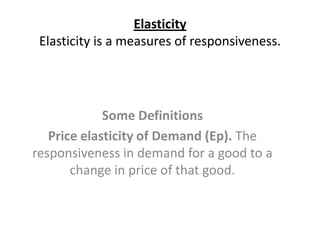
 Elasticity is a measures of responsiveness.


             Some Definitions
   Price elasticity of Demand (Ep). The
responsiveness in demand for a good to a
       change in price of that good.
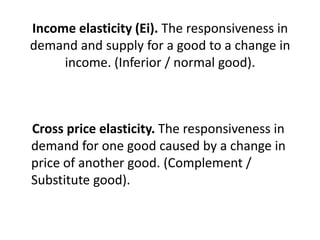
Income elasticity (Ei). The responsiveness in
demand and supply for a good to a change in
     income. (Inferior / normal good).


Cross price elasticity. The responsiveness in
demand for one good caused by a change in
price of another good. (Complement /
Substitute good).
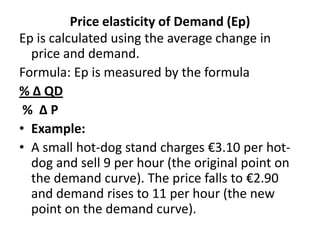
Price elasticity of Demand (Ep)
Ep is calculated using the average change in
  price and demand.
Formula: Ep is measured by the formula
% ∆ QD
 % ∆P
• Example:
• A small hot-dog stand charges €3.10 per hot-
  dog and sell 9 per hour (the original point on
  the demand curve). The price falls to €2.90
  and demand rises to 11 per hour (the new
  point on the demand curve).
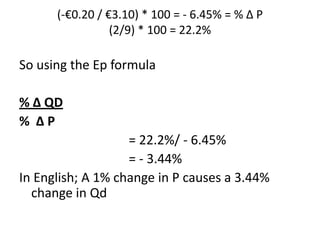
(-€0.20 / €3.10) * 100 = - 6.45% = % ∆ P
                 (2/9) * 100 = 22.2%

So using the Ep formula

% ∆ QD
% ∆P
                   = 22.2%/ - 6.45%
                   = - 3.44%
In English; A 1% change in P causes a 3.44%
  change in Qd
Three categories:
   Ep > -1 (demand is elastic, big response)
  Ep < -1 (demand is inelastic, small response)
         Ep = -1 (demand is unit elastic)

What affects elasticity?
 Substitutes: The closer the substitute for a
 good or service, the more elastic the demand
 for it. Is petrol elastic or inelastic?
Necessities tend to have inelastic demand (bread,
heating oil, electricity) luxury goods tend to be elastic
(4 by 4’s, long haul holidays, private swimming pools)


Total expenditure on the good: How much is it
  worth looking for substitutes? Example; a new
  car and a packet of crisps. If the price of both
  doubled which item would most likely suffer a
  sizeable drop in demand?
Adjustment time (short run and the long run).
The greater the time lapse since a price change
  the greater the chance of finding effectives
 substitutes and the more elastic is demand.
               Home heating oil.
Total Revenue (TR) and Price Elasticities
TR from the sale of a good equals the price of
  the good multiplied by the quantity sold or....
               TR = P * Q
Questions


 If a price cut increases TR demand is
 __________. Why?

 If a price cut decreases TR demand is
 __________. Why?

 If a price cut leaves TR unchanged demand
 is __________. Why?

Ec2204 tutorial 3(1)

  • 1.
    CENTRE FOR POLICYSTUDIES UNIVERSITY COLLEGE CORK EC2204 TUTORIAL 3 WS 29102012 Academic Year: 2012/2013 Instructors: Brenda Lynch and P.J. Hunt Contact: brendalynch@ucc.ie or p.hunt@ucc.ie
  • 2.
    Elasticity Elasticity isa measures of responsiveness. Some Definitions Price elasticity of Demand (Ep). The responsiveness in demand for a good to a change in price of that good.
  • 3.
    Income elasticity (Ei).The responsiveness in demand and supply for a good to a change in income. (Inferior / normal good). Cross price elasticity. The responsiveness in demand for one good caused by a change in price of another good. (Complement / Substitute good).
  • 4.
    Price elasticity ofDemand (Ep) Ep is calculated using the average change in price and demand. Formula: Ep is measured by the formula % ∆ QD % ∆P • Example: • A small hot-dog stand charges €3.10 per hot- dog and sell 9 per hour (the original point on the demand curve). The price falls to €2.90 and demand rises to 11 per hour (the new point on the demand curve).
  • 5.
    (-€0.20 / €3.10)* 100 = - 6.45% = % ∆ P (2/9) * 100 = 22.2% So using the Ep formula % ∆ QD % ∆P = 22.2%/ - 6.45% = - 3.44% In English; A 1% change in P causes a 3.44% change in Qd
  • 6.
    Three categories: Ep > -1 (demand is elastic, big response) Ep < -1 (demand is inelastic, small response) Ep = -1 (demand is unit elastic) What affects elasticity? Substitutes: The closer the substitute for a good or service, the more elastic the demand for it. Is petrol elastic or inelastic?
  • 7.
    Necessities tend tohave inelastic demand (bread, heating oil, electricity) luxury goods tend to be elastic (4 by 4’s, long haul holidays, private swimming pools) Total expenditure on the good: How much is it worth looking for substitutes? Example; a new car and a packet of crisps. If the price of both doubled which item would most likely suffer a sizeable drop in demand?
  • 8.
    Adjustment time (shortrun and the long run). The greater the time lapse since a price change the greater the chance of finding effectives substitutes and the more elastic is demand. Home heating oil. Total Revenue (TR) and Price Elasticities TR from the sale of a good equals the price of the good multiplied by the quantity sold or.... TR = P * Q
  • 9.
    Questions If aprice cut increases TR demand is __________. Why? If a price cut decreases TR demand is __________. Why? If a price cut leaves TR unchanged demand is __________. Why?