NPV.
IRR.
MIRR.
PAYBACK.
DISCOUNTED PAYBACK.
 Net present value is the sum of all the
discounted cash flows.
 Net Present Value (NPV) is the difference
between the present value of cash inflows and
the present value of cash outflows. NPV is used
in capital budgeting to analyze the profitability
of a projected investment or project.
 Positive npv presents earning
negative npv presents deficit
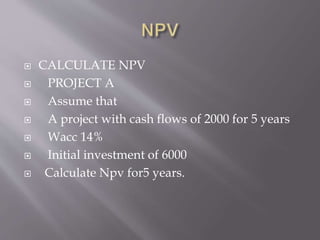
 CALCULATE NPV
 PROJECT A
 Assume that
 A project with cash flows of 2000 for 5 years
 Wacc 14%
 Initial investment of 6000
 Calculate Npv for5 years.
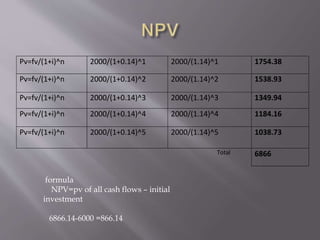
Pv=fv/(1+i)^n 2000/(1+0.14)^1 2000/(1.14)^1 1754.38
Pv=fv/(1+i)^n 2000/(1+0.14)^2 2000/(1.14)^2 1538.93
Pv=fv/(1+i)^n 2000/(1+0.14)^3 2000/(1.14)^3 1349.94
Pv=fv/(1+i)^n 2000/(1+0.14)^4 2000/(1.14)^4 1184.16
Pv=fv/(1+i)^n 2000/(1+0.14)^5 2000/(1.14)^5 1038.73
Total 6866
formula
NPV=pv of all cash flows – initial
investment
6866.14-6000 =866.14
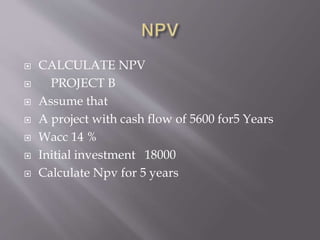
 CALCULATE NPV
 PROJECT B
 Assume that
 A project with cash flow of 5600 for5 Years
 Wacc 14 %
 Initial investment 18000
 Calculate Npv for 5 years
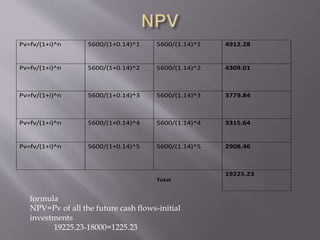
Pv=fv/(1+i)^n 5600/(1+0.14)^1 5600/(1.14)^1 4912.28
Pv=fv/(1+i)^n 5600/(1+0.14)^2 5600/(1.14)^2 4309.01
Pv=fv/(1+i)^n 5600/(1+0.14)^3 5600/(1.14)^3 3779.84
Pv=fv/(1+i)^n 5600/(1+0.14)^4 5600/(1.14)^4 3315.64
Pv=fv/(1+i)^n 5600/(1+0.14)^5 5600/(1.14)^5 2908.46
Total
19225.23
formula
NPV=Pv of all the future cash flows-initial
investments
19225.23-18000=1225.23
 IRR is another commonly used as an NPV
alternative.
 Internal rate of return (IRR) is the interest rate
at which the net present value of all the cash
flows (both positive and negative) from a
project or investment equal zero.
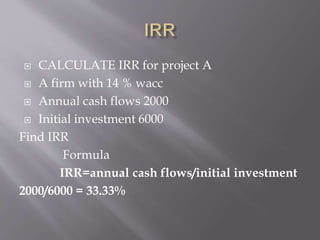
 CALCULATE IRR for project A
 A firm with 14 % wacc
 Annual cash flows 2000
 Initial investment 6000
Find IRR
Formula
IRR=annual cash flows/initial investment
2000/6000 = 33.33%
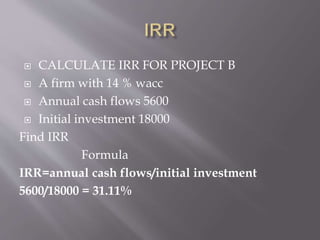
 CALCULATE IRR FOR PROJECT B
 A firm with 14 % wacc
 Annual cash flows 5600
 Initial investment 18000
Find IRR
Formula
IRR=annual cash flows/initial investment
5600/18000 = 31.11%
 IRR=A+{C/C-D]*(B-A).
 Suppose
 A=low discount rate
 B=high discount rate
 C=npv @ low discount rate
 D=npv @high discount rate.
 WACC 10%
 A 10%
 B 20%
 C 78.8
 D -10.1
 IRR = 10% +[78.8/78.8-(-10.1) * (20%-10%)
 IRR = 10%+[78.8/78.8+10.1] * (20%-10%)
 IRR = 10%+[78.8/88.9] * (20%-10%)
 IRR =10% + 8.86
 IRR = 18.86
 IF IRR > MINIMUM DESIREDTHE RATE OF RETURN ACCEPTED.
 IF IRR < MINIMUM DESIREDTHE RATE OF RETURN.
 REJECTED.
 IF IRR =MINIMUM DESIREDTHE RATE OF RETURN. ACCEPTED
 MIRR is the internal rate of return of an
investment that is modified to account for the
difference between re-investment rate and
investment return.
 The decision rule for MIRR is very similar to
IRR, i.e. an investment should be accepted if
the MIRR is greater than the cost of capital.
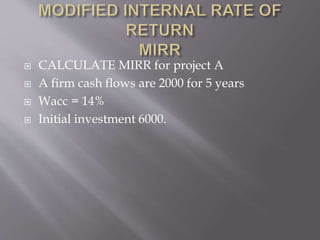
 CALCULATE MIRR for project A
 A firm cash flows are 2000 for 5 years
 Wacc = 14%
 Initial investment 6000.
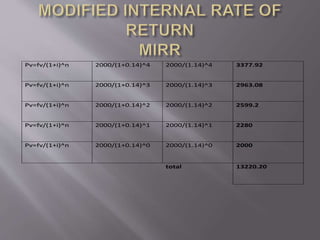
Pv=fv/(1+i)^n 2000/(1+0.14)^4 2000/(1.14)^4 3377.92
Pv=fv/(1+i)^n 2000/(1+0.14)^3 2000/(1.14)^3 2963.08
Pv=fv/(1+i)^n 2000/(1+0.14)^2 2000/(1.14)^2 2599.2
Pv=fv/(1+i)^n 2000/(1+0.14)^1 2000/(1.14)^1 2280
Pv=fv/(1+i)^n 2000/(1+0.14)^0 2000/(1.14)^0 2000
total 13220.20
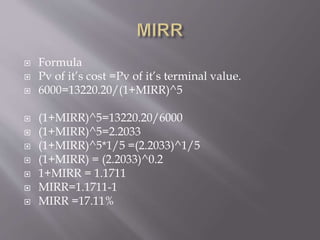
 Formula
 Pv of it’s cost =Pv of it’s terminal value.
 6000=13220.20/(1+MIRR)^5
 (1+MIRR)^5=13220.20/6000
 (1+MIRR)^5=2.2033
 (1+MIRR)^5*1/5 =(2.2033)^1/5
 (1+MIRR) = (2.2033)^0.2
 1+MIRR = 1.1711
 MIRR=1.1711-1
 MIRR =17.11%
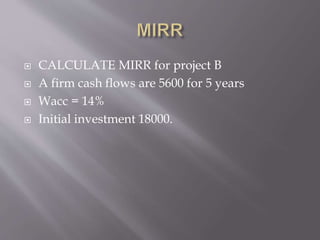
 CALCULATE MIRR for project B
 A firm cash flows are 5600 for 5 years
 Wacc = 14%
 Initial investment 18000.
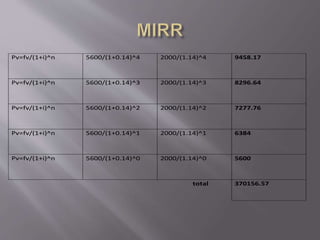
Pv=fv/(1+i)^n 5600/(1+0.14)^4 2000/(1.14)^4 9458.17
Pv=fv/(1+i)^n 5600/(1+0.14)^3 2000/(1.14)^3 8296.64
Pv=fv/(1+i)^n 5600/(1+0.14)^2 2000/(1.14)^2 7277.76
Pv=fv/(1+i)^n 5600/(1+0.14)^1 2000/(1.14)^1 6384
Pv=fv/(1+i)^n 5600/(1+0.14)^0 2000/(1.14)^0 5600
total 370156.57
 Formula
 Pv of it’s cost =Pv of it’s terminal value.
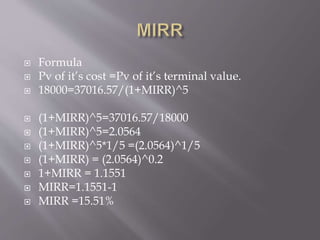
 18000=37016.57/(1+MIRR)^5
 (1+MIRR)^5=37016.57/18000
 (1+MIRR)^5=2.0564
 (1+MIRR)^5*1/5 =(2.0564)^1/5
 (1+MIRR) = (2.0564)^0.2
 1+MIRR = 1.1551
 MIRR=1.1551-1
 MIRR =15.51%
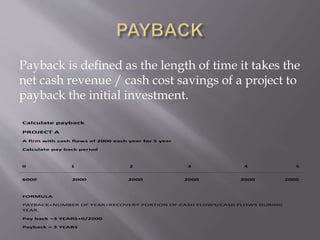
Payback is defined as the length of time it takes the
net cash revenue / cash cost savings of a project to
payback the initial investment.
Calculate payback
PROJECT A
A firm with cash flows of 2000 each year for 5 year
Calculate pay back period
0 1 2 3 4 5
6000 2000 2000 2000 2000 2000
FORMULA
PAYBACK=NUMBER OF YEAR+RECOVERY PORTION OF CASH FLOWS/CASH FLOWS DURING
YEAR.
Pay back =3 YEARS+0/2000
Payback = 3 YEARS
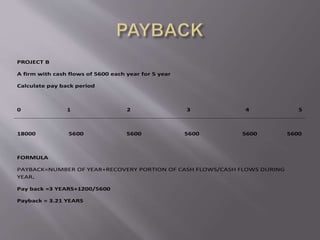
PROJECT B
A firm with cash flows of 5600 each year for 5 year
Calculate pay back period
0 1 2 3 4 5
18000 5600 5600 5600 5600 5600
FORMULA
PAYBACK=NUMBER OF YEAR+RECOVERY PORTION OF CASH FLOWS/CASH FLOWS DURING
YEAR.
Pay back =3 YEARS+1200/5600
Payback = 3.21 YEARS
 The discounted payback is defined as the
length of time it takes the discounted net cash
revenue/cost savings of a project to payback
the initial investment.
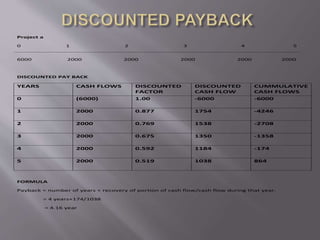
Project a
0 1 2 3 4 5
6000 2000 2000 2000 2000 2000
DISCOUNTED PAY BACK
YEARS CASH FLOWS DISCOUNTED
FACTOR
DISCOUNTED
CASH FLOW
CUMMULATIVE
CASH FLOWS
0 (6000) 1.00 -6000 -6000
1 2000 0.877 1754 -4246
2 2000 0.769 1538 -2708
3 2000 0.675 1350 -1358
4 2000 0.592 1184 -174
5 2000 0.519 1038 864
FORMULA
Payback = number of years + recovery of portion of cash flow/cash flow during that year.
= 4 years+174/1038
= 4.16 year
Project b
0 1 2 3 4 5
18000 5600 5600 5600 5600 5600
YEARS CASH FLOWS DISCOUNTED
FACTOR
DISCOUNTED
CASH FLOWS
CUMMULATIVE
CASH FLOWS
0 (18000) 1.00 -18000 -18000
1 5600 0.877 4911.2 -13088.8
2 5600 0.769 4306.4 -8782.4
3 5600 0.675 3740 -5002.4
4 5600 0.592 3315.2 -1687.2
5 5600 0.519 2906.4 1219.2
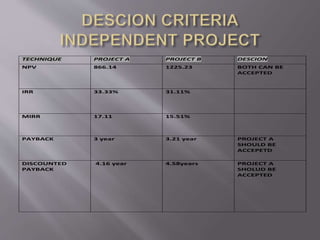
TECHNIQUE PROJECT A PROJECT B DESCION
NPV 866.14 1225.23 BOTH CAN BE
ACCEPTED
IRR 33.33% 31.11%
MIRR 17.11 15.51%
PAYBACK 3 year 3.21 year PROJECT A
SHOULD BE
ACCEPETD
DISCOUNTED
PAYBACK
4.16 year 4.58years PROJECT A
SHOLUD BE
ACCEPTED
TECHNIQUE PROJECT A PROJECT B DESCION
NPV 866.14 1225.23 PROJECT“B”HAS
NPV GREAATER
THEN “B” PROJECT
“A” “B”SHOULD BE
ACCEPETED
IRR 33.33% 31.11% ON BASIS OF IRR
PROJECT A SHOULD
BE ACCEPETED
MIRR 17.11% 15.51% MIRR OF PROJECT
“A” IS HIGHER THEN
PROJECT “B”
PROJECT “B”
SHOULD BE
ACCEPTED
PAYBACK 3 year 3.21 year PROJECT “A”
SHOULD BE
ACCEPETD IT WILL
GIVES RETURN IN
LESS TIME THEN “B”
PROJECT
DISCOUNTED
PAYBACK
4.16 year 4.58years PROJECT “A”
SHOLUD BE
ACCEPTED IT
RECOVERS INITIAL
INVESTMENT IN
LESS TIME THEN “B”
PROJECT
 THANK YOU
 ANY QUESTIONS

Capital budgeting

  • 1.
  • 2.
     Net presentvalue is the sum of all the discounted cash flows.  Net Present Value (NPV) is the difference between the present value of cash inflows and the present value of cash outflows. NPV is used in capital budgeting to analyze the profitability of a projected investment or project.  Positive npv presents earning negative npv presents deficit
  • 3.
     CALCULATE NPV PROJECT A  Assume that  A project with cash flows of 2000 for 5 years  Wacc 14%  Initial investment of 6000  Calculate Npv for5 years.
  • 4.
    Pv=fv/(1+i)^n 2000/(1+0.14)^1 2000/(1.14)^11754.38 Pv=fv/(1+i)^n 2000/(1+0.14)^2 2000/(1.14)^2 1538.93 Pv=fv/(1+i)^n 2000/(1+0.14)^3 2000/(1.14)^3 1349.94 Pv=fv/(1+i)^n 2000/(1+0.14)^4 2000/(1.14)^4 1184.16 Pv=fv/(1+i)^n 2000/(1+0.14)^5 2000/(1.14)^5 1038.73 Total 6866 formula NPV=pv of all cash flows – initial investment 6866.14-6000 =866.14
  • 5.
     CALCULATE NPV PROJECT B  Assume that  A project with cash flow of 5600 for5 Years  Wacc 14 %  Initial investment 18000  Calculate Npv for 5 years
  • 6.
    Pv=fv/(1+i)^n 5600/(1+0.14)^1 5600/(1.14)^14912.28 Pv=fv/(1+i)^n 5600/(1+0.14)^2 5600/(1.14)^2 4309.01 Pv=fv/(1+i)^n 5600/(1+0.14)^3 5600/(1.14)^3 3779.84 Pv=fv/(1+i)^n 5600/(1+0.14)^4 5600/(1.14)^4 3315.64 Pv=fv/(1+i)^n 5600/(1+0.14)^5 5600/(1.14)^5 2908.46 Total 19225.23 formula NPV=Pv of all the future cash flows-initial investments 19225.23-18000=1225.23
  • 7.
     IRR isanother commonly used as an NPV alternative.  Internal rate of return (IRR) is the interest rate at which the net present value of all the cash flows (both positive and negative) from a project or investment equal zero.
  • 8.
     CALCULATE IRRfor project A  A firm with 14 % wacc  Annual cash flows 2000  Initial investment 6000 Find IRR Formula IRR=annual cash flows/initial investment 2000/6000 = 33.33%
  • 9.
     CALCULATE IRRFOR PROJECT B  A firm with 14 % wacc  Annual cash flows 5600  Initial investment 18000 Find IRR Formula IRR=annual cash flows/initial investment 5600/18000 = 31.11%
  • 10.
     IRR=A+{C/C-D]*(B-A).  Suppose A=low discount rate  B=high discount rate  C=npv @ low discount rate  D=npv @high discount rate.  WACC 10%  A 10%  B 20%  C 78.8  D -10.1
  • 11.
     IRR =10% +[78.8/78.8-(-10.1) * (20%-10%)  IRR = 10%+[78.8/78.8+10.1] * (20%-10%)  IRR = 10%+[78.8/88.9] * (20%-10%)  IRR =10% + 8.86  IRR = 18.86  IF IRR > MINIMUM DESIREDTHE RATE OF RETURN ACCEPTED.  IF IRR < MINIMUM DESIREDTHE RATE OF RETURN.  REJECTED.  IF IRR =MINIMUM DESIREDTHE RATE OF RETURN. ACCEPTED
  • 12.
     MIRR isthe internal rate of return of an investment that is modified to account for the difference between re-investment rate and investment return.  The decision rule for MIRR is very similar to IRR, i.e. an investment should be accepted if the MIRR is greater than the cost of capital.
  • 13.
     CALCULATE MIRRfor project A  A firm cash flows are 2000 for 5 years  Wacc = 14%  Initial investment 6000.
  • 14.
    Pv=fv/(1+i)^n 2000/(1+0.14)^4 2000/(1.14)^43377.92 Pv=fv/(1+i)^n 2000/(1+0.14)^3 2000/(1.14)^3 2963.08 Pv=fv/(1+i)^n 2000/(1+0.14)^2 2000/(1.14)^2 2599.2 Pv=fv/(1+i)^n 2000/(1+0.14)^1 2000/(1.14)^1 2280 Pv=fv/(1+i)^n 2000/(1+0.14)^0 2000/(1.14)^0 2000 total 13220.20
  • 15.
     Formula  Pvof it’s cost =Pv of it’s terminal value.  6000=13220.20/(1+MIRR)^5  (1+MIRR)^5=13220.20/6000  (1+MIRR)^5=2.2033  (1+MIRR)^5*1/5 =(2.2033)^1/5  (1+MIRR) = (2.2033)^0.2  1+MIRR = 1.1711  MIRR=1.1711-1  MIRR =17.11%
  • 16.
     CALCULATE MIRRfor project B  A firm cash flows are 5600 for 5 years  Wacc = 14%  Initial investment 18000.
  • 17.
    Pv=fv/(1+i)^n 5600/(1+0.14)^4 2000/(1.14)^49458.17 Pv=fv/(1+i)^n 5600/(1+0.14)^3 2000/(1.14)^3 8296.64 Pv=fv/(1+i)^n 5600/(1+0.14)^2 2000/(1.14)^2 7277.76 Pv=fv/(1+i)^n 5600/(1+0.14)^1 2000/(1.14)^1 6384 Pv=fv/(1+i)^n 5600/(1+0.14)^0 2000/(1.14)^0 5600 total 370156.57
  • 18.
     Formula  Pvof it’s cost =Pv of it’s terminal value.  18000=37016.57/(1+MIRR)^5  (1+MIRR)^5=37016.57/18000  (1+MIRR)^5=2.0564  (1+MIRR)^5*1/5 =(2.0564)^1/5  (1+MIRR) = (2.0564)^0.2  1+MIRR = 1.1551  MIRR=1.1551-1  MIRR =15.51%
  • 19.
    Payback is definedas the length of time it takes the net cash revenue / cash cost savings of a project to payback the initial investment. Calculate payback PROJECT A A firm with cash flows of 2000 each year for 5 year Calculate pay back period 0 1 2 3 4 5 6000 2000 2000 2000 2000 2000 FORMULA PAYBACK=NUMBER OF YEAR+RECOVERY PORTION OF CASH FLOWS/CASH FLOWS DURING YEAR. Pay back =3 YEARS+0/2000 Payback = 3 YEARS
  • 20.
    PROJECT B A firmwith cash flows of 5600 each year for 5 year Calculate pay back period 0 1 2 3 4 5 18000 5600 5600 5600 5600 5600 FORMULA PAYBACK=NUMBER OF YEAR+RECOVERY PORTION OF CASH FLOWS/CASH FLOWS DURING YEAR. Pay back =3 YEARS+1200/5600 Payback = 3.21 YEARS
  • 21.
     The discountedpayback is defined as the length of time it takes the discounted net cash revenue/cost savings of a project to payback the initial investment.
  • 22.
    Project a 0 12 3 4 5 6000 2000 2000 2000 2000 2000 DISCOUNTED PAY BACK YEARS CASH FLOWS DISCOUNTED FACTOR DISCOUNTED CASH FLOW CUMMULATIVE CASH FLOWS 0 (6000) 1.00 -6000 -6000 1 2000 0.877 1754 -4246 2 2000 0.769 1538 -2708 3 2000 0.675 1350 -1358 4 2000 0.592 1184 -174 5 2000 0.519 1038 864 FORMULA Payback = number of years + recovery of portion of cash flow/cash flow during that year. = 4 years+174/1038 = 4.16 year
  • 23.
    Project b 0 12 3 4 5 18000 5600 5600 5600 5600 5600 YEARS CASH FLOWS DISCOUNTED FACTOR DISCOUNTED CASH FLOWS CUMMULATIVE CASH FLOWS 0 (18000) 1.00 -18000 -18000 1 5600 0.877 4911.2 -13088.8 2 5600 0.769 4306.4 -8782.4 3 5600 0.675 3740 -5002.4 4 5600 0.592 3315.2 -1687.2 5 5600 0.519 2906.4 1219.2
  • 25.
    TECHNIQUE PROJECT APROJECT B DESCION NPV 866.14 1225.23 BOTH CAN BE ACCEPTED IRR 33.33% 31.11% MIRR 17.11 15.51% PAYBACK 3 year 3.21 year PROJECT A SHOULD BE ACCEPETD DISCOUNTED PAYBACK 4.16 year 4.58years PROJECT A SHOLUD BE ACCEPTED
  • 26.
    TECHNIQUE PROJECT APROJECT B DESCION NPV 866.14 1225.23 PROJECT“B”HAS NPV GREAATER THEN “B” PROJECT “A” “B”SHOULD BE ACCEPETED IRR 33.33% 31.11% ON BASIS OF IRR PROJECT A SHOULD BE ACCEPETED MIRR 17.11% 15.51% MIRR OF PROJECT “A” IS HIGHER THEN PROJECT “B” PROJECT “B” SHOULD BE ACCEPTED PAYBACK 3 year 3.21 year PROJECT “A” SHOULD BE ACCEPETD IT WILL GIVES RETURN IN LESS TIME THEN “B” PROJECT DISCOUNTED PAYBACK 4.16 year 4.58years PROJECT “A” SHOLUD BE ACCEPTED IT RECOVERS INITIAL INVESTMENT IN LESS TIME THEN “B” PROJECT
  • 27.
  • 28.