Sample Questions Of Capital Budgeting
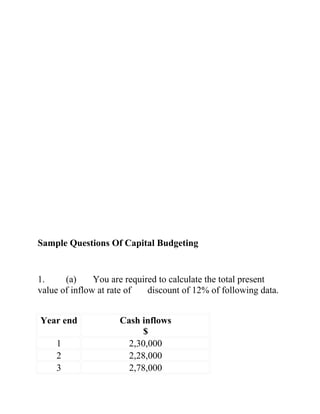
1. (a) You are required to calculate the total present
value of inflow at rate of discount of 12% of following data.
Year end Cash inflows
$
1 2,30,000
2 2,28,000
3 2,78,000
4 2,83,000
5 2,73,000
6 80,000
(Scrap value)
(b) Considering the data given in the above. Calculate the
total present value of inflows and outflows if the rate of discount
is 10% assuming that $ 10,00,000 of outflows would be spent as
follows:
Beginning of year 1 $ 2,50,000
Beginning of year 2 $ 2,50,000
Beginning of year 3 $ 2,50,000
Beginning of year 4 $ 2,50,000
2. Work out the internal rates of return of the project given
in Self-examination question 1 (a) and (b)
Answer to sample questions
1. (a) Present value of cash inflows
YearsCash inflows
$
Discount factor @
12%
Present value
$
1 2,30,000 0.893 2,05,390
2 2,28,000 0.797 1,81,716
3 2,78,000 0.712 1,97,936
4 2,83,000 0.636 1,79,988
5 2,73,000 0.567 1,54,791
6 80,000 0.507 40,560
Total present value 9,60,381
The student should note that the total present value is lower in
this case than 10% rate as used earlier.
(b) Present value of cash inflows
YearsCash inflows
$
Discount factor @
10%
Present value
$
1 2,30,000 0.909 2,09,070
2 2,28,000 0.826 1,88,328
3 2,78,000 0.751 2,08,778
4 2,83,000 0.683 1,93,289
5 2,73,000 0.621 1,69,533
6 80,000 0.564 45,120
Total present value 10,14,118
Present value of cash outflows
YearsCash inflows
$
Discount factor @
10%
Present value
$
1 2,50,000 0.909 2,27,250
2 2,50,000 0.826 2,06,500
3 2,50,000 0.751 1,87,750
6,21,500
It may be noted that the year-end of first year and beginning of
year two are the same. There is no need to discount the sum of $
2,50,000 spent at the beginning of year one since the money is
immediately spent. The total present value of outflows would
therefore be $ 6,21,500 + $ 2,50,000. i.e. $ 8,71,500.
2. (a) At 8% rate of discount the total present value is $
1,23,026; at 10% it is $ 10,14,118. Hence the internal rate of
return would be 9.62%.
(b) In this case the sum of the discounted values of outflows
at 10% is $ 8,71,500 and that of inflows is $ 10,14,118. If we
increase the rate to 15% the results would be as follows.
Outflows
Years
end
Cash inflows
$
Discount factor @
15%
Present value
$
0 2,50,000 1.000 2,50,000
1 2,50,000 0.870 2,17,500
2 2,50,000 0.756 1,89,000
3 2,50,000 0.658 1,65,500
8,21,000
Inflows
Years
end
Cash inflows
$
Discount factor @
15%
Present value
$
1 2,30,000 0.870 2,00,100
2 2,28,000 0.756 1,72,368
3 2,78,000 0.658 1,82,924
4 2,83,000 0.572 1,61,876
5 2,73,000 0.497 1,35,681
6 80,000 0.432 34,560
8,87,509
Since the difference between the discounted outflows and
inflows is still there we shall have to use a higher rate say 18%.
Outflows
Years
end
Cash inflows
$
Discount factor @
15%
Present value
$
0 2,50,000 1.000 2,50,000
1 2,50,000 0.847 2,11,750
2 2,50,000 0.718 1,79,500
3 2,50,000 0.609 1,52,250
7,93,500
Inflows
Years
end
Cash inflows
$
Discount factor @
18%
Present value
$
1 2,30,000 0.847 1,94,810
2 2,28,000 0.718 1,63,704
3 2,78,000 0.609 1,69,302
4 2,83,000 0.516 1,46,028
5 2,73,000 0.437 1,19,301
6 80,000 0.370 29,600
8,22,745
The internal rate of return is approximately 19%.
Capital Budgeting Techniques Practice
Questions
1.Is it possible for a project to have a payback
period of 2 years and yet have a negative net
present value? Explain.
2.What is the decision-criteria for the profitability
index? Does this criteria agree with that of the
net present value technique?
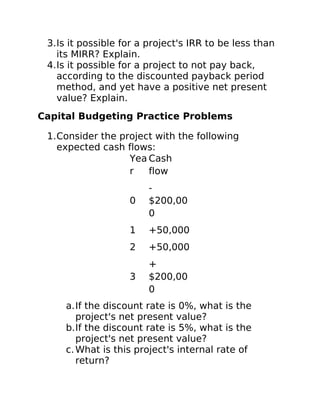
3.Is it possible for a project's IRR to be less than
its MIRR? Explain.
4.Is it possible for a project to not pay back,
according to the discounted payback period
method, and yet have a positive net present
value? Explain.
Capital Budgeting Practice Problems
1.Consider the project with the following
expected cash flows:
Yea
r
Cash
flow
0
-
$200,00
0
1 +50,000
2 +50,000
3
+
$200,00
0
a.If the discount rate is 0%, what is the
project's net present value?
b.If the discount rate is 5%, what is the
project's net present value?
c.What is this project's internal rate of
return?
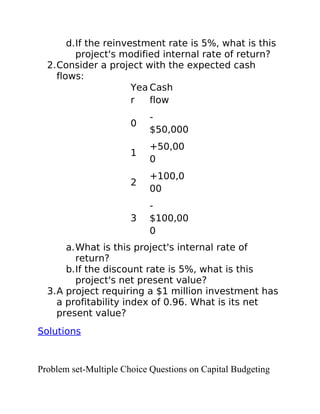
d.If the reinvestment rate is 5%, what is this
project's modified internal rate of return?
2.Consider a project with the expected cash
flows:
Yea
r
Cash
flow
0
-
$50,000
1
+50,00
0
2
+100,0
00
3
-
$100,00
0
a.What is this project's internal rate of
return?
b.If the discount rate is 5%, what is this
project's net present value?
3.A project requiring a $1 million investment has
a profitability index of 0.96. What is its net
present value?
Solutions
Problem set-Multiple Choice Questions on Capital Budgeting
2. The term mutually exclusive investments mean:
a. Choose only the best investments.
b. Selection of one investment precludes the selection of an
alternative.
c. The elite investment opportunities will get chosen.
d. There are no investment options available.
ABC Company is considering two investments both of which
cost $10,000. The cash flows are as follows:
Year Project A Project B
1 $6,000 $5,000
2 4,000 3,000
3 3,000 8,000
3. Based on the payback method, which of the two projects
should be chosen?
a. Project A which has a payback period of 2.0 years.
b. Project A which has a payback period of 2.25 years.
c. Project B which has a payback period of 2.0 years.
d. Project B which has a payback period of 2.25 years.
4. Based on the net present value method, assuming a cost of
capital of 10%, which of the two projects should be chosen?
a. Project A which has a net present value of $11,011.
b. Project A which has a net present value of $1,011.
c. Project B which has a net present value of $13,031
d. Project B which has a net present value of $3,031.
5. Which method provides more confidence, the payback
method or the net present value method?
a. Payback because it provides a good timetable.
b. Payback because it tells you when you break even.
c. Net present value because it considers all inflows and
outflows and the time value of money.
d. Net present value because it does not need to use cost of
capital.
The Pan American Bottling Co. is considering the purchase of a
new machine that would increase the speed of bottling and save
money. The net cost of this machine is $45,000. The annual cash
flows have the following projections.
Year Cash Flow
1 $15,000
2 20,000
3 25,000
4 10,000
5 5,000
6. What is the net present value of selecting the new machine,
assuming cost of capital of 10%?
a. $11,883
b. $13,883
c. $15,883
d. $17,883
7. What is the internal rate of return?
a. About 7%
b. About 10%
c. About 23%
d. About 27%
8. Should Pan American buy the machine?
a. Yes. NPV is positive and IRR exceeds cost of capital.
b. Yes. NPV is positive and IRR is less than cost of capital.
c. No. NPV does not provide enough information.
d. No. IRR is higher than the cost of capital.
Big Sky Construction Company is considering two new
investments. Project E calls for the purchase of earth-moving
equipment. Project H represents the investment in a hydraulic
lift. Big Sky wishes to use a new present value profile in
comparing the projects. The investment and cash flow patterns
are as follows:
Project E
($20,000 investment) Project H
($20,000 investment)
Year Cash Flow
1 $ 5,000
2 6,000
3 7,000
4 10,000 Year Cash Flow
1 $16,000
2 5,000
3 4,000
9. What is the NPV of both projects using zero discount rate?
a. $8,000 for project E and $5,000 for project H
b. $8,000 for project H and $5,000 for project E
c. $28,000 for project E and $25,000 for project H
d. $20,000 for both projects.
10. What is the NPV of both projects using 9% discount rate?
a. $22,121 for project E and $21,970 for project H
b. $20,000 for both projects.
c. $2,121 for project E and $1,970 for project H
d. $8,000 for project E and $5,000 for project H
11. The IRR of project E is _______
a. About 9%
b. About 13%
c. About 16%
d. About 20%
12. If the two projects are mutually exclusive, which project
would you accept using NPV, assuming cost of capital of 18%.
a. Project E
b. Project H
c. Both
d. Neither
13. Risk-averse managers will generally require _____ return
from risky investments.
a. Lower
b. Zero
c. Higher
d. Negative
14. The concept of risk can be incorporated into the capital
budgeting process by using higher discount rates for riskier
investments.
a. True
b. False
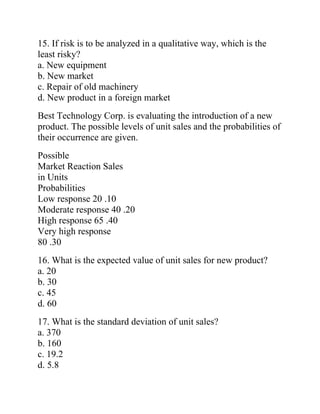
15. If risk is to be analyzed in a qualitative way, which is the
least risky?
a. New equipment
b. New market
c. Repair of old machinery
d. New product in a foreign market
Best Technology Corp. is evaluating the introduction of a new
product. The possible levels of unit sales and the probabilities of
their occurrence are given.
Possible
Market Reaction Sales
in Units
Probabilities
Low response 20 .10
Moderate response 40 .20
High response 65 .40
Very high response
80 .30
16. What is the expected value of unit sales for new product?
a. 20
b. 30
c. 45
d. 60
17. What is the standard deviation of unit sales?
a. 370
b. 160
c. 19.2
d. 5.8
18. Project A has an expected return of $1,000 and a standard
deviation of $590. Project B has expected return of $3,000 and a
standard deviation of $750. Using coefficient of variation, which
has a lower risk?
a. Project A, because coefficient of variation is higher.
b. Project A, because coefficient of variation is lower.
c. Project B, because coefficient of variation is higher.
d. Project B, because coefficient of variation is lower.
19. A company with a beta of 1.50 is considered to have lower
level of risk than the stock market in general.
a. True
b. False
20. A company is considering the purchase one of two
companies. Both of these companies have an expected return of
15% with the same standard deviation of returns. Company 1
has a positive correlation of returns with the acquiring company,
while company 2 has a negative correlation. Which company
should the acquiring company purchase if it must purchase one
of them?
a. Company 1 because it reduces risk
b. Company 1 because it increases return
c. Company 2 because it reduces risk
d. Company 2 because it increases return
Cash Budgets Page 2: Solution and Question
The Cash Budget Solution Pictures
Here's a question that is remarkably like the exercise you've just
worked through on Cash Budgets Page 1. Do your best and use
the forms and pictures from page 1 to help you.
The opening balance of cash is to be £5,000 (that's the balance
b/d for Month 1).
For this business, the sales plans and debtors details are as
follows:
Credit Sales
Month
1
Month
2
Month 3
42,000 22,000 36,000
Month
4
Month
5
Month 6
45,500 38,000 44,000
The business has three classes of debtor: Debtors 1, 2 and 3 and
they pay their debts according to this table
Payment History of Debtors
Which
Debtors
When They Pay How Many of
Them Pay at This
Time
Debtors 1 within the month of sale 60%
Debtors 2 in the month after sale 30%
Debtors 3 in the second month after sale 10%
For this business, the purchase plans and creditors details are as
follows:
Payment History for Creditors
Month 1Month 2 Month 3
29,000 26,750 38,500
Month 4Month 5 Month 6
22,000 20,000 31,000
The business has three classes of creditor: Creditors 1, 2 and 3
and we pay our debts according to this table
Payment History for Creditors
Which
Creditors
When We Pay How We
Pay at This Time
Creditors 1 within the month of sale 75%
Creditors 2 in the month after sale 20%
Creditors 3 in the second month after sale 5%
Final words from me are that the balance c/d of the cash budget
at the end of Month 3 is £5,113; the Total Receipts from Debtors
for Month 6 is £42,350; and the Total Payments to Creditors for
Month 6 is £28,350.

75985278 sample-questions-of-capital-budgeting

  • 1.
    Sample Questions OfCapital Budgeting 1. (a) You are required to calculate the total present value of inflow at rate of discount of 12% of following data. Year end Cash inflows $ 1 2,30,000 2 2,28,000 3 2,78,000
  • 2.
    4 2,83,000 5 2,73,000 680,000 (Scrap value) (b) Considering the data given in the above. Calculate the total present value of inflows and outflows if the rate of discount is 10% assuming that $ 10,00,000 of outflows would be spent as follows: Beginning of year 1 $ 2,50,000 Beginning of year 2 $ 2,50,000 Beginning of year 3 $ 2,50,000 Beginning of year 4 $ 2,50,000 2. Work out the internal rates of return of the project given in Self-examination question 1 (a) and (b) Answer to sample questions
  • 3.
    1. (a) Presentvalue of cash inflows YearsCash inflows $ Discount factor @ 12% Present value $ 1 2,30,000 0.893 2,05,390 2 2,28,000 0.797 1,81,716 3 2,78,000 0.712 1,97,936 4 2,83,000 0.636 1,79,988 5 2,73,000 0.567 1,54,791 6 80,000 0.507 40,560 Total present value 9,60,381 The student should note that the total present value is lower in this case than 10% rate as used earlier. (b) Present value of cash inflows YearsCash inflows $ Discount factor @ 10% Present value $ 1 2,30,000 0.909 2,09,070 2 2,28,000 0.826 1,88,328 3 2,78,000 0.751 2,08,778 4 2,83,000 0.683 1,93,289 5 2,73,000 0.621 1,69,533 6 80,000 0.564 45,120 Total present value 10,14,118
  • 4.
    Present value ofcash outflows YearsCash inflows $ Discount factor @ 10% Present value $ 1 2,50,000 0.909 2,27,250 2 2,50,000 0.826 2,06,500 3 2,50,000 0.751 1,87,750 6,21,500 It may be noted that the year-end of first year and beginning of year two are the same. There is no need to discount the sum of $ 2,50,000 spent at the beginning of year one since the money is immediately spent. The total present value of outflows would therefore be $ 6,21,500 + $ 2,50,000. i.e. $ 8,71,500. 2. (a) At 8% rate of discount the total present value is $ 1,23,026; at 10% it is $ 10,14,118. Hence the internal rate of return would be 9.62%. (b) In this case the sum of the discounted values of outflows at 10% is $ 8,71,500 and that of inflows is $ 10,14,118. If we increase the rate to 15% the results would be as follows. Outflows
  • 5.
    Years end Cash inflows $ Discount factor@ 15% Present value $ 0 2,50,000 1.000 2,50,000 1 2,50,000 0.870 2,17,500 2 2,50,000 0.756 1,89,000 3 2,50,000 0.658 1,65,500 8,21,000 Inflows Years end Cash inflows $ Discount factor @ 15% Present value $ 1 2,30,000 0.870 2,00,100 2 2,28,000 0.756 1,72,368 3 2,78,000 0.658 1,82,924 4 2,83,000 0.572 1,61,876 5 2,73,000 0.497 1,35,681 6 80,000 0.432 34,560 8,87,509 Since the difference between the discounted outflows and inflows is still there we shall have to use a higher rate say 18%. Outflows Years end Cash inflows $ Discount factor @ 15% Present value $ 0 2,50,000 1.000 2,50,000 1 2,50,000 0.847 2,11,750
  • 6.
    2 2,50,000 0.7181,79,500 3 2,50,000 0.609 1,52,250 7,93,500 Inflows Years end Cash inflows $ Discount factor @ 18% Present value $ 1 2,30,000 0.847 1,94,810 2 2,28,000 0.718 1,63,704 3 2,78,000 0.609 1,69,302 4 2,83,000 0.516 1,46,028 5 2,73,000 0.437 1,19,301 6 80,000 0.370 29,600 8,22,745 The internal rate of return is approximately 19%. Capital Budgeting Techniques Practice Questions 1.Is it possible for a project to have a payback period of 2 years and yet have a negative net present value? Explain. 2.What is the decision-criteria for the profitability index? Does this criteria agree with that of the net present value technique?
  • 7.
    3.Is it possiblefor a project's IRR to be less than its MIRR? Explain. 4.Is it possible for a project to not pay back, according to the discounted payback period method, and yet have a positive net present value? Explain. Capital Budgeting Practice Problems 1.Consider the project with the following expected cash flows: Yea r Cash flow 0 - $200,00 0 1 +50,000 2 +50,000 3 + $200,00 0 a.If the discount rate is 0%, what is the project's net present value? b.If the discount rate is 5%, what is the project's net present value? c.What is this project's internal rate of return?
  • 8.
    d.If the reinvestmentrate is 5%, what is this project's modified internal rate of return? 2.Consider a project with the expected cash flows: Yea r Cash flow 0 - $50,000 1 +50,00 0 2 +100,0 00 3 - $100,00 0 a.What is this project's internal rate of return? b.If the discount rate is 5%, what is this project's net present value? 3.A project requiring a $1 million investment has a profitability index of 0.96. What is its net present value? Solutions Problem set-Multiple Choice Questions on Capital Budgeting
  • 9.
    2. The termmutually exclusive investments mean: a. Choose only the best investments. b. Selection of one investment precludes the selection of an alternative. c. The elite investment opportunities will get chosen. d. There are no investment options available. ABC Company is considering two investments both of which cost $10,000. The cash flows are as follows: Year Project A Project B 1 $6,000 $5,000 2 4,000 3,000 3 3,000 8,000 3. Based on the payback method, which of the two projects should be chosen? a. Project A which has a payback period of 2.0 years. b. Project A which has a payback period of 2.25 years. c. Project B which has a payback period of 2.0 years. d. Project B which has a payback period of 2.25 years. 4. Based on the net present value method, assuming a cost of capital of 10%, which of the two projects should be chosen? a. Project A which has a net present value of $11,011. b. Project A which has a net present value of $1,011. c. Project B which has a net present value of $13,031 d. Project B which has a net present value of $3,031. 5. Which method provides more confidence, the payback method or the net present value method? a. Payback because it provides a good timetable.
  • 10.
    b. Payback becauseit tells you when you break even. c. Net present value because it considers all inflows and outflows and the time value of money. d. Net present value because it does not need to use cost of capital. The Pan American Bottling Co. is considering the purchase of a new machine that would increase the speed of bottling and save money. The net cost of this machine is $45,000. The annual cash flows have the following projections. Year Cash Flow 1 $15,000 2 20,000 3 25,000 4 10,000 5 5,000 6. What is the net present value of selecting the new machine, assuming cost of capital of 10%? a. $11,883 b. $13,883 c. $15,883 d. $17,883 7. What is the internal rate of return? a. About 7% b. About 10% c. About 23% d. About 27%
  • 11.
    8. Should PanAmerican buy the machine? a. Yes. NPV is positive and IRR exceeds cost of capital. b. Yes. NPV is positive and IRR is less than cost of capital. c. No. NPV does not provide enough information. d. No. IRR is higher than the cost of capital. Big Sky Construction Company is considering two new investments. Project E calls for the purchase of earth-moving equipment. Project H represents the investment in a hydraulic lift. Big Sky wishes to use a new present value profile in comparing the projects. The investment and cash flow patterns are as follows: Project E ($20,000 investment) Project H ($20,000 investment) Year Cash Flow 1 $ 5,000 2 6,000 3 7,000 4 10,000 Year Cash Flow 1 $16,000 2 5,000 3 4,000 9. What is the NPV of both projects using zero discount rate? a. $8,000 for project E and $5,000 for project H b. $8,000 for project H and $5,000 for project E c. $28,000 for project E and $25,000 for project H d. $20,000 for both projects.
  • 12.
    10. What isthe NPV of both projects using 9% discount rate? a. $22,121 for project E and $21,970 for project H b. $20,000 for both projects. c. $2,121 for project E and $1,970 for project H d. $8,000 for project E and $5,000 for project H 11. The IRR of project E is _______ a. About 9% b. About 13% c. About 16% d. About 20% 12. If the two projects are mutually exclusive, which project would you accept using NPV, assuming cost of capital of 18%. a. Project E b. Project H c. Both d. Neither 13. Risk-averse managers will generally require _____ return from risky investments. a. Lower b. Zero c. Higher d. Negative 14. The concept of risk can be incorporated into the capital budgeting process by using higher discount rates for riskier investments. a. True b. False
  • 13.
    15. If riskis to be analyzed in a qualitative way, which is the least risky? a. New equipment b. New market c. Repair of old machinery d. New product in a foreign market Best Technology Corp. is evaluating the introduction of a new product. The possible levels of unit sales and the probabilities of their occurrence are given. Possible Market Reaction Sales in Units Probabilities Low response 20 .10 Moderate response 40 .20 High response 65 .40 Very high response 80 .30 16. What is the expected value of unit sales for new product? a. 20 b. 30 c. 45 d. 60 17. What is the standard deviation of unit sales? a. 370 b. 160 c. 19.2 d. 5.8
  • 14.
    18. Project Ahas an expected return of $1,000 and a standard deviation of $590. Project B has expected return of $3,000 and a standard deviation of $750. Using coefficient of variation, which has a lower risk? a. Project A, because coefficient of variation is higher. b. Project A, because coefficient of variation is lower. c. Project B, because coefficient of variation is higher. d. Project B, because coefficient of variation is lower. 19. A company with a beta of 1.50 is considered to have lower level of risk than the stock market in general. a. True b. False 20. A company is considering the purchase one of two companies. Both of these companies have an expected return of 15% with the same standard deviation of returns. Company 1 has a positive correlation of returns with the acquiring company, while company 2 has a negative correlation. Which company should the acquiring company purchase if it must purchase one of them? a. Company 1 because it reduces risk b. Company 1 because it increases return c. Company 2 because it reduces risk d. Company 2 because it increases return Cash Budgets Page 2: Solution and Question The Cash Budget Solution Pictures
  • 15.
    Here's a questionthat is remarkably like the exercise you've just worked through on Cash Budgets Page 1. Do your best and use the forms and pictures from page 1 to help you. The opening balance of cash is to be £5,000 (that's the balance b/d for Month 1). For this business, the sales plans and debtors details are as follows: Credit Sales Month 1 Month 2 Month 3 42,000 22,000 36,000 Month 4 Month 5 Month 6 45,500 38,000 44,000
  • 16.
    The business hasthree classes of debtor: Debtors 1, 2 and 3 and they pay their debts according to this table Payment History of Debtors Which Debtors When They Pay How Many of Them Pay at This Time Debtors 1 within the month of sale 60% Debtors 2 in the month after sale 30% Debtors 3 in the second month after sale 10% For this business, the purchase plans and creditors details are as follows: Payment History for Creditors Month 1Month 2 Month 3 29,000 26,750 38,500 Month 4Month 5 Month 6 22,000 20,000 31,000 The business has three classes of creditor: Creditors 1, 2 and 3 and we pay our debts according to this table Payment History for Creditors Which Creditors When We Pay How We Pay at This Time Creditors 1 within the month of sale 75% Creditors 2 in the month after sale 20% Creditors 3 in the second month after sale 5%
  • 17.
    Final words fromme are that the balance c/d of the cash budget at the end of Month 3 is £5,113; the Total Receipts from Debtors for Month 6 is £42,350; and the Total Payments to Creditors for Month 6 is £28,350.