Seminar onMUTUAL FUND AND ITS TYPESPresented by: Gurmeet Singh      M.B.A.   Sem.1st  {2009-10}      Roll no.- M0914by: Gurmeet Singh
by: Gurmeet Singh            FOLLOWING  ARE THE CONTENTS OF MY                                                      PRESENTATION  Meaning of Mutual Fund
  History of Mutual Fund
  Flow chart of Mutual Fund
  Types of Mutual Funds
  Advantages of Mutual Fund
  Name of the companies who    launched various Mutual Funds
What Is Mutual Fund?A Mutual Fund is a trust that pools together the savings of a number of investors who share a common financial goal. The money thus collected is then invested in capital market instruments such as shares, debentures and other securities. by: Gurmeet Singh
History of the Indian Mutual Fund IndustryThe mutual fund industry in India started in 1963 with the formation of Unit Trust of India, at the initiative of the Government of India and Reserve Bank. The history of mutual funds in India can be broadly divided into four distinct phases:by: Gurmeet Singh
First Phase – 1964-87Unit Trust of India (UTI) was established on 1963 by an Act of Parliament. It was set up by the Reserve Bank of India and functioned under the Regulatory and administrative control of the Reserve Bank of India.The first scheme launched by UTI was Unit Scheme 1964. At the end of 1988 UTI had Rs.6,700 crores of assets under management.  by: Gurmeet Singh
Second Phase – 1987-1993 (Entry of Public Sector Funds)1987 marked the entry of non- UTI, public sector mutual funds set up by public sector banks and Life Insurance Corporation of India (LIC) and General Insurance Corporation of India (GIC). SBI Mutual Fund was the first non- UTI Mutual Fund established in June 1987.by: Gurmeet Singh
Third Phase – 1993-2003 (Entry of Private Sector Funds)With the entry of private sector funds in 1993, a new era started in the Indian mutual fund industry, giving the Indian investors a wider choice of fund families. In 1993 was the year in which the first Mutual Fund Regulations came into being, under which all mutual funds, except UTI were to be registered and governed. by: Gurmeet Singh
Fourth Phase – since February 2003In February 2003, following the repeal of the Unit Trust of India Act 1963 UTI was divided into two separate entities. One is the Specified Undertaking of the Unit Trust of India with assets under management of Rs.29,835 crores as at the end of January 2003. The second is the UTI Mutual Fund Ltd, sponsored by SBI, PNB, BOB and LIC. It is registered with SEBI and functions under the Mutual Fund Regulations. by: Gurmeet Singh
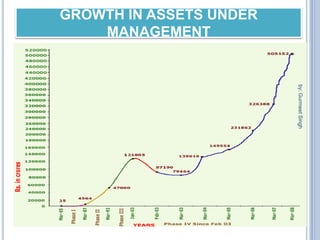
GROWTH IN ASSETS UNDER MANAGEMENTby: Gurmeet Singh
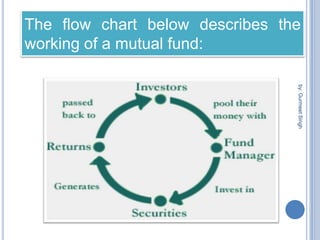
The flow chart below describes the working of a mutual fund:by: Gurmeet Singh
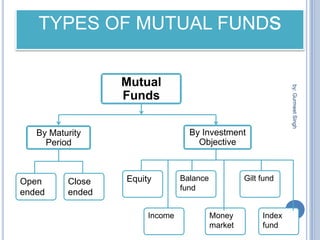
TYPES OF MUTUAL FUNDsMutual FundsBy Maturity PeriodBy Investment Objectiveby: Gurmeet SinghEquity Balance fundGilt fundClose ended Open ended Index fundIncome Money market
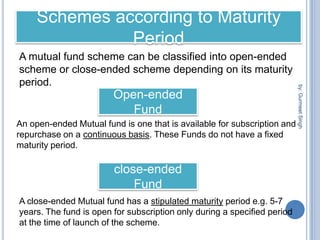
Schemes according to Maturity PeriodA mutual fund scheme can be classified into open-ended scheme or close-ended scheme depending on its maturity period. Open-ended Fund An open-ended Mutual fund is one that is available for subscription and repurchase on a continuous basis. These Funds do not have a fixed maturity period. close-ended Fund A close-ended Mutual fund has a stipulated maturity period e.g. 5-7 years. The fund is open for subscription only during a specified period at the time of launch of the scheme. by: Gurmeet Singh
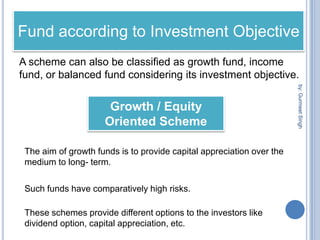
Fund according to Investment ObjectiveA scheme can also be classified as growth fund, income fund, or balanced fund considering its investment objective.Growth / Equity Oriented SchemeThe aim of growth funds is to provide capital appreciation over the medium to long- term. Such funds have comparatively high risks. These schemes provide different options to the investors like dividend option, capital appreciation, etc.by: Gurmeet Singh
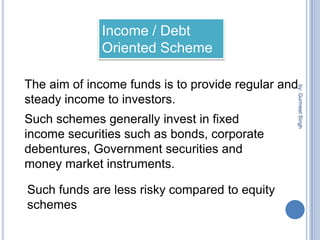
Income / Debt Oriented Scheme The aim of income funds is to provide regular and steady income to investors.Such schemes generally invest in fixed income securities such as bonds, corporate debentures, Government securities and money market instruments. Such funds are less risky compared to equity schemesby: Gurmeet Singh
Balanced Fund The aim of balanced funds is to provide both growth and regular income as such schemes invest both in equities and fixed income securities in the proportion indicated in their offer documents. These are appropriate for investors looking for moderate growth. by: Gurmeet Singh
Money MarketThese funds are also income funds and their aim is to provide easy liquidity, preservation of capital and moderate income. These schemes invest exclusively in safer short-term instruments such as treasury bills, commercial paper and government securities, etc. These funds are appropriate for corporate and individual investors as a means to park their surplus funds for short periods. by: Gurmeet Singh
   Gilt Funds These funds invest exclusively in government securities. Government securities have no default risk.Index Funds This schemes invest in the securities in the same weightage comprising of an index. This schemes would rise or fall in accordance with the rise or fall in the indexby: Gurmeet Singh

Presentation On Mutual funds and its types

  • 1.
    Seminar onMUTUAL FUNDAND ITS TYPESPresented by: Gurmeet Singh M.B.A. Sem.1st {2009-10} Roll no.- M0914by: Gurmeet Singh
  • 2.
    by: Gurmeet Singh FOLLOWING ARE THE CONTENTS OF MY PRESENTATION Meaning of Mutual Fund
  • 3.
    Historyof Mutual Fund
  • 4.
    Flowchart of Mutual Fund
  • 5.
    Typesof Mutual Funds
  • 6.
    Advantagesof Mutual Fund
  • 7.
    Nameof the companies who launched various Mutual Funds
  • 8.
    What Is MutualFund?A Mutual Fund is a trust that pools together the savings of a number of investors who share a common financial goal. The money thus collected is then invested in capital market instruments such as shares, debentures and other securities. by: Gurmeet Singh
  • 9.
    History of theIndian Mutual Fund IndustryThe mutual fund industry in India started in 1963 with the formation of Unit Trust of India, at the initiative of the Government of India and Reserve Bank. The history of mutual funds in India can be broadly divided into four distinct phases:by: Gurmeet Singh
  • 10.
    First Phase –1964-87Unit Trust of India (UTI) was established on 1963 by an Act of Parliament. It was set up by the Reserve Bank of India and functioned under the Regulatory and administrative control of the Reserve Bank of India.The first scheme launched by UTI was Unit Scheme 1964. At the end of 1988 UTI had Rs.6,700 crores of assets under management.  by: Gurmeet Singh
  • 11.
    Second Phase –1987-1993 (Entry of Public Sector Funds)1987 marked the entry of non- UTI, public sector mutual funds set up by public sector banks and Life Insurance Corporation of India (LIC) and General Insurance Corporation of India (GIC). SBI Mutual Fund was the first non- UTI Mutual Fund established in June 1987.by: Gurmeet Singh
  • 12.
    Third Phase –1993-2003 (Entry of Private Sector Funds)With the entry of private sector funds in 1993, a new era started in the Indian mutual fund industry, giving the Indian investors a wider choice of fund families. In 1993 was the year in which the first Mutual Fund Regulations came into being, under which all mutual funds, except UTI were to be registered and governed. by: Gurmeet Singh
  • 13.
    Fourth Phase –since February 2003In February 2003, following the repeal of the Unit Trust of India Act 1963 UTI was divided into two separate entities. One is the Specified Undertaking of the Unit Trust of India with assets under management of Rs.29,835 crores as at the end of January 2003. The second is the UTI Mutual Fund Ltd, sponsored by SBI, PNB, BOB and LIC. It is registered with SEBI and functions under the Mutual Fund Regulations. by: Gurmeet Singh
  • 14.
    GROWTH IN ASSETSUNDER MANAGEMENTby: Gurmeet Singh
  • 15.
    The flow chartbelow describes the working of a mutual fund:by: Gurmeet Singh
  • 16.
    TYPES OF MUTUALFUNDsMutual FundsBy Maturity PeriodBy Investment Objectiveby: Gurmeet SinghEquity Balance fundGilt fundClose ended Open ended Index fundIncome Money market
  • 17.
    Schemes according toMaturity PeriodA mutual fund scheme can be classified into open-ended scheme or close-ended scheme depending on its maturity period. Open-ended Fund An open-ended Mutual fund is one that is available for subscription and repurchase on a continuous basis. These Funds do not have a fixed maturity period. close-ended Fund A close-ended Mutual fund has a stipulated maturity period e.g. 5-7 years. The fund is open for subscription only during a specified period at the time of launch of the scheme. by: Gurmeet Singh
  • 18.
    Fund according toInvestment ObjectiveA scheme can also be classified as growth fund, income fund, or balanced fund considering its investment objective.Growth / Equity Oriented SchemeThe aim of growth funds is to provide capital appreciation over the medium to long- term. Such funds have comparatively high risks. These schemes provide different options to the investors like dividend option, capital appreciation, etc.by: Gurmeet Singh
  • 19.
    Income / DebtOriented Scheme The aim of income funds is to provide regular and steady income to investors.Such schemes generally invest in fixed income securities such as bonds, corporate debentures, Government securities and money market instruments. Such funds are less risky compared to equity schemesby: Gurmeet Singh
  • 20.
    Balanced Fund Theaim of balanced funds is to provide both growth and regular income as such schemes invest both in equities and fixed income securities in the proportion indicated in their offer documents. These are appropriate for investors looking for moderate growth. by: Gurmeet Singh
  • 21.
    Money MarketThese fundsare also income funds and their aim is to provide easy liquidity, preservation of capital and moderate income. These schemes invest exclusively in safer short-term instruments such as treasury bills, commercial paper and government securities, etc. These funds are appropriate for corporate and individual investors as a means to park their surplus funds for short periods. by: Gurmeet Singh
  • 22.
    Gilt Funds These funds invest exclusively in government securities. Government securities have no default risk.Index Funds This schemes invest in the securities in the same weightage comprising of an index. This schemes would rise or fall in accordance with the rise or fall in the indexby: Gurmeet Singh