Academic Year:     2012/2013
Instructors: Brenda Lynch and PJ Hunt
           Contact: brendalynch@ucc.ie
                         p.hunt@ucc.ie
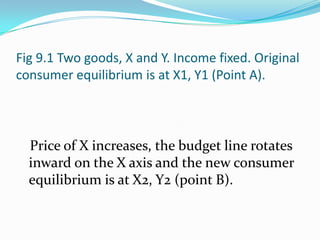
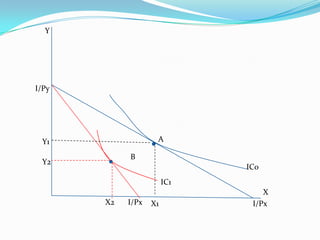
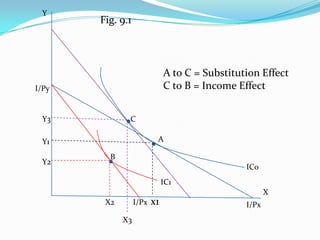
Fig 9.1 Two goods, X and Y. Income fixed. Original
consumer equilibrium is at X1, Y1 (Point A).


  Price of X increases, the budget line rotates
  inward on the X axis and the new consumer
  equilibrium is at X2, Y2 (point B).
Y


I/Py


 Y1                 A

            B
 Y2
                              IC0
                        IC1
                                  X
       X2   I/Px   X1          I/Px
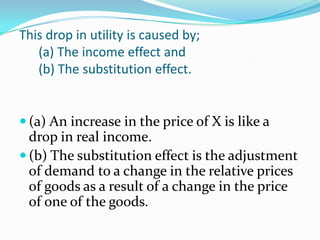
This drop in utility is caused by;
   (a) The income effect and
   (b) The substitution effect.


 (a) An increase in the price of X is like a
  drop in real income.
 (b) The substitution effect is the adjustment
  of demand to a change in the relative prices
  of goods as a result of a change in the price
  of one of the goods.
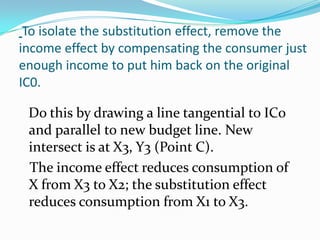
To isolate the substitution effect, remove the
income effect by compensating the consumer just
enough income to put him back on the original
IC0.

 Do this by drawing a line tangential to IC0
 and parallel to new budget line. New
 intersect is at X3, Y3 (Point C).
 The income effect reduces consumption of
 X from X3 to X2; the substitution effect
 reduces consumption from X1 to X3.
Y
       Fig. 9.1


                              A to C = Substitution Effect
I/Py                          C to B = Income Effect


 Y3           C

 Y1                       A

         B
 Y2
                                                IC0
                              IC1
                                                       X
        X2        I/Px   x1                     I/Px
             X3
Hicks and Slutsky.
Inflation increases, how much do you
compensate workers?
Two ways (we only look at one way);

 1. Compensation Variation in Income
 Hicks, compensate workers at new prices to
 allow them obtain original level of utility.
 Slutsky, compensate workers at new prices
 to obtain original bundle of goods.
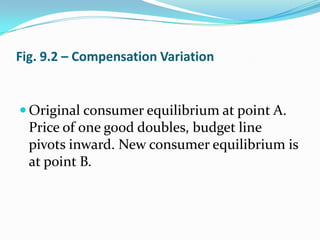
Fig. 9.2 – Compensation Variation


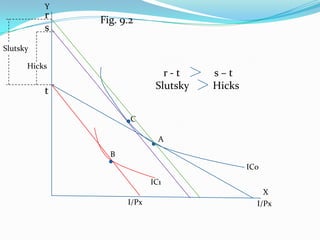
 Original consumer equilibrium at point A.
  Price of one good doubles, budget line
  pivots inward. New consumer equilibrium is
  at point B.
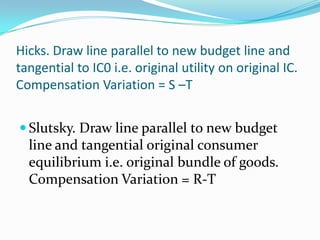
Hicks. Draw line parallel to new budget line and
tangential to IC0 i.e. original utility on original IC.
Compensation Variation = S –T


 Slutsky. Draw line parallel to new budget
  line and tangential original consumer
  equilibrium i.e. original bundle of goods.
  Compensation Variation = R-T
Y
          r   Fig. 9.2
          s
Slutsky

      Hicks
                              r-t     s–t
          t                 Slutsky   Hicks


                     C

                             A
                B
                                              IC0
                           IC1
                                                  X
                    I/Px                        I/Px

Ec2204 tutorial 6(1)

  • 1.
    Academic Year: 2012/2013 Instructors: Brenda Lynch and PJ Hunt Contact: brendalynch@ucc.ie p.hunt@ucc.ie
  • 2.
    Fig 9.1 Twogoods, X and Y. Income fixed. Original consumer equilibrium is at X1, Y1 (Point A). Price of X increases, the budget line rotates inward on the X axis and the new consumer equilibrium is at X2, Y2 (point B).
  • 3.
    Y I/Py Y1 A B Y2 IC0 IC1 X X2 I/Px X1 I/Px
  • 4.
    This drop inutility is caused by; (a) The income effect and (b) The substitution effect.  (a) An increase in the price of X is like a drop in real income.  (b) The substitution effect is the adjustment of demand to a change in the relative prices of goods as a result of a change in the price of one of the goods.
  • 5.
    To isolate thesubstitution effect, remove the income effect by compensating the consumer just enough income to put him back on the original IC0. Do this by drawing a line tangential to IC0 and parallel to new budget line. New intersect is at X3, Y3 (Point C). The income effect reduces consumption of X from X3 to X2; the substitution effect reduces consumption from X1 to X3.
  • 6.
    Y Fig. 9.1 A to C = Substitution Effect I/Py C to B = Income Effect Y3 C Y1 A B Y2 IC0 IC1 X X2 I/Px x1 I/Px X3
  • 7.
    Hicks and Slutsky. Inflationincreases, how much do you compensate workers? Two ways (we only look at one way);  1. Compensation Variation in Income  Hicks, compensate workers at new prices to allow them obtain original level of utility.  Slutsky, compensate workers at new prices to obtain original bundle of goods.
  • 8.
    Fig. 9.2 –Compensation Variation  Original consumer equilibrium at point A. Price of one good doubles, budget line pivots inward. New consumer equilibrium is at point B.
  • 9.
    Hicks. Draw lineparallel to new budget line and tangential to IC0 i.e. original utility on original IC. Compensation Variation = S –T  Slutsky. Draw line parallel to new budget line and tangential original consumer equilibrium i.e. original bundle of goods. Compensation Variation = R-T
  • 10.
    Y r Fig. 9.2 s Slutsky Hicks r-t s–t t Slutsky Hicks C A B IC0 IC1 X I/Px I/Px