PART III: METALORGANIC
CHEMICAL VAPOR DEPOSITION
 Description of the MOCVD equipment
 Analysis of the MOCVD growth process
 Growth modes in MOCVD
Metalorgenic Chemical Vapor Deposition (MOCVD)
[Metalorganic Vapor Phase Epitaxy (MOVPE),
OMCVD, OMVPE]
 One of the premier techniques for epitaxial growth of thin layer
structures (semiconductors, oxides, superconductors)
 Introduced around 25 years ago as the most versatile technique for
growing semiconductor films.
 Wide application for devices such Lasers, LEDs, solar cells,
photodetectors, HBTs, FETs.
 Principle of operation: transport of precursor molecules (group-III
metalorganics + group-V hydrides or alkyls) by a carrier gas (H2, N2)
onto a heated substrate; surface chemical reactions.
 Complex transport phenomena and reactions, complicated models to
determine reactor designs,growth modes and rates.
 In-situ diagnostics less common than in MBE.
Description of the MOCVD equipment
• R. L. Moon and Y.-M. Houng, in Chemical vapor deposition -
Principles and applications, edited by M. L. Hitchman and K. F.
Jensen (Academic Press, London, 1993).
• G. B. Stringfellow, Organometallic vapor phase epitaxy: theory
and practice (Academic Press, Boston, 1989).
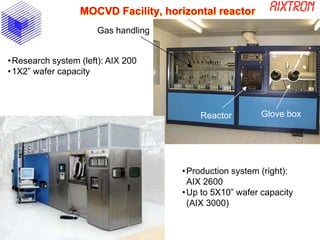
MOCVD Facility, horizontal reactor
•Research system (left): AIX 200
•1X2” wafer capacity
•Production system (right):
AIX 2600
•Up to 5X10” wafer capacity
(AIX 3000)
Gas handling
Reactor Glove box
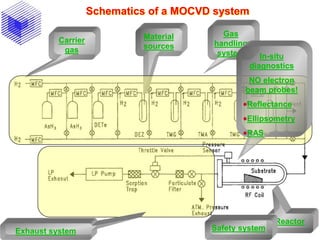
Schematics of a MOCVD system
Carrier
gas
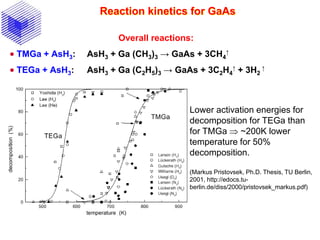
Material
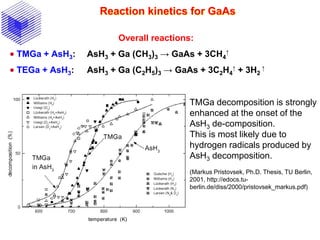
sources
Gas
handling
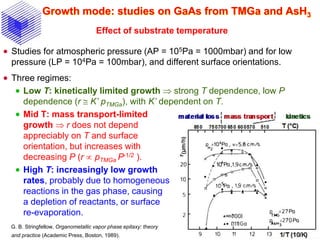
system
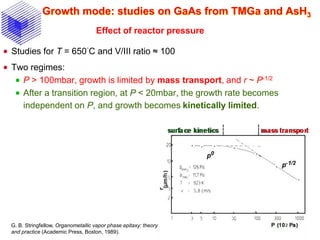
Reactor
Exhaust system Safety system
In-situ
diagnostics
NO electron
beam probes!
Reflectance
Ellipsometry
RAS
Gas handling system
 The function of gas handling system is mixing and metering of the
gas that will enter the reactor. Timing and composition of the gas
entering the reactor will determine the epilayer structure.
 Leak-tight of the gas panel is essential, because the oxygen
contamination will degrade the growing films’ properties.
 Fast switch of valve system is very important for thin film and abrupt
interface structure growth,
 Accurate control of flow rate, pressure and temperature can ensure
stability and repeatability.
Carrier gas
 “Inert” carrier gas constitutes about 90 % of the gas phase 
stringent purity requirements.
 H2 traditionally used, simple to purify by being passed through a
palladium foil heated to 400 °C. Problem: H2 is highly explosive in
contact with O2  high safety costs.
 Alternative precursor : N2: safer, recently with similar purity, more
effective in cracking precursor molecules (heavier).
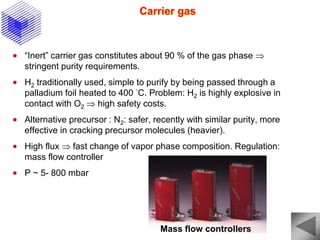
 High flux  fast change of vapor phase composition. Regulation:
mass flow controller
 P ~ 5- 800 mbar
Mass flow controllers
Material sources
 Volatile precursor molecules transported by the carrier
gas
 Growth of III-V semiconductors:
 Group III: generally metalorganic molecules (trimethyl-
or triethyl- species)
 Group V: generally toxic hydrides (AsH3; PH3
flammable as well); alternative: alkyls (TBAs, TBP).
Hidrides and dopants
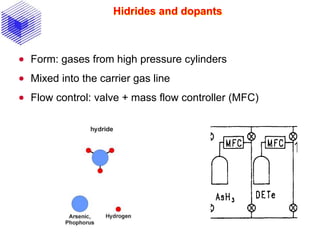
 Form: gases from high pressure cylinders
 Mixed into the carrier gas line
 Flow control: valve + mass flow controller (MFC)
Metalorganics
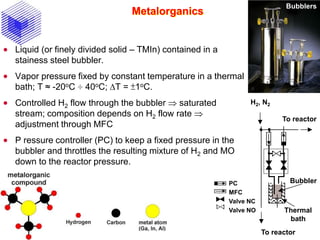
 Liquid (or finely divided solid – TMIn) contained in a
stainess steel bubbler.
 Vapor pressure fixed by constant temperature in a thermal
bath; T ≈ -20oC ÷ 40oC; DT = ±1oC.
 Controlled H2 flow through the bubbler  saturated
stream; composition depends on H2 flow rate 
adjustment through MFC
 P ressure controller (PC) to keep a fixed pressure in the
bubbler and throttles the resulting mixture of H2 and MO
down to the reactor pressure.
PC
MFC
Valve NC
Valve NO
H2, N2
To reactor
To reactor
Bubbler
Thermal
bath
Bubblers
Metalorganic compounds
 Optimal thermal decomposition temperature between 300 and 500°C 
availability of transported reactant at the substrate surface.
 The vapor pressure of the MO source is an important consideration in
MOCVD, since it determines the concentration of source material in the
reactor and the deposition rate. Too low a vapor pressure makes it
difficult to transport the source into the deposition zone and to achieve
reasonable growth rates. Too high a vapor pressure may raise safety
concerns if the compound is toxic.
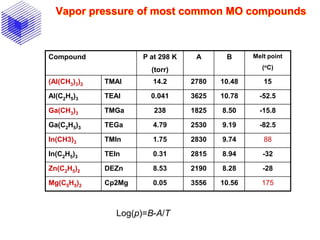
 Vapor pressures of Metalorganic compounds are calculated in terms of
the expression
Log(p)=B-A/T
Vapor pressure of most common MO compounds
Compound P at 298 K
(torr)
A B Melt point
(oC)
(Al(CH3)3)2 TMAl 14.2 2780 10.48 15
Al(C2H5)3 TEAl 0.041 3625 10.78 -52.5
Ga(CH3)3 TMGa 238 1825 8.50 -15.8
Ga(C2H5)3 TEGa 4.79 2530 9.19 -82.5
In(CH3)3 TMIn 1.75 2830 9.74 88
In(C2H5)3 TEIn 0.31 2815 8.94 -32
Zn(C2H5)2 DEZn 8.53 2190 8.28 -28
Mg(C5H5)2 Cp2Mg 0.05 3556 10.56 175
Log(p)=B-A/T
Flow rate of MO sources
 
    
 
 
      
 
 KT
molK
J
mbarP
mbarP
molQmbarTP
molQ
mol
l
NKT
K
J
k
ml
t
V
mbarTP
mol
tN
N
TkNVp
bub
B
BbubMO
MO
AbubB
bubMO
A
i
Bii






















4
standard
4
10314.8
min/
min/
10
min/
min/
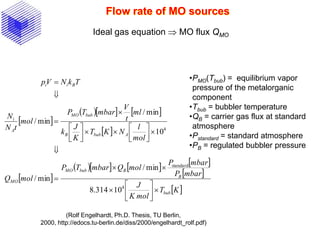
Ideal gas equation  MO flux QMO
•PMO(Tbub) = equilibrium vapor
pressure of the metalorganic
component
•Tbub = bubbler temperature
•QB = carrier gas flux at standard
atmosphere
•Pstandard = standard atmosphere
•PB = regulated bubbler pressure
(Rolf Engelhardt, Ph.D. Thesis, TU Berlin,
2000, http://edocs.tu-berlin.de/diss/2000/engelhardt_rolf.pdf)
Partial pressure of MO sources
 
      
 
   
 mbarP
mbarP
molQ
mbarP
mbarP
molQmbarTP
mbarP
reactor
tot
B
BbubMO
reactorMO
standard
standard
min/
min/



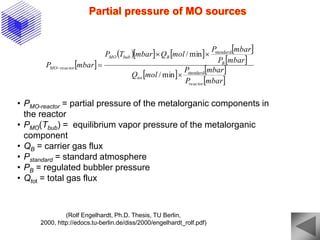
• PMO-reactor = partial pressure of the metalorganic components in
the reactor
• PMO(Tbub) = equilibrium vapor pressure of the metalorganic
component
• QB = carrier gas flux
• Pstandard = standard atmosphere
• PB = regulated bubbler pressure
• Qtot = total gas flux
(Rolf Engelhardt, Ph.D. Thesis, TU Berlin,
2000, http://edocs.tu-berlin.de/diss/2000/engelhardt_rolf.pdf)
MOCVD reactors
 Different orientations and geometries.
 Most common:
 Horizontal reactors: gases inserted laterally with
respect to sample standing horizontally on a slowly-
rotating (~60RPM) susceptor plate.
 Vertical reactors: gases enter from top, sample
mounted horizontally on a fast-rotating (~500-
1000RPM) susceptor plate.
Horizontal reactors
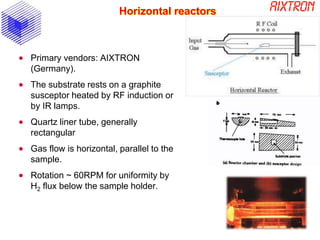
 Primary vendors: AIXTRON
(Germany).
 The substrate rests on a graphite
susceptor heated by RF induction or
by IR lamps.
 Quartz liner tube, generally
rectangular
 Gas flow is horizontal, parallel to the
sample.
 Rotation ~ 60RPM for uniformity by
H2 flux below the sample holder.
Horizontal reactors
 Advantages
 Common reactor  high experience.
 Uniform epitaxial growth provided the gas velocity is large enough, and
attention is paid to hydrodynamic flow.
 Small height above the wafer  the effect of natural convection is
minimized.
 Quite large gas velocity  very rapid changes in the gas phase
composition.
 Disadvantages
 Uniformity can either be achieved by very high gas flow, ( inefficient
deposition), or by implementing rotation, which is tricky in this type of
design.
 Throughput: difficult to scale this design up to accommodate large
volume production.
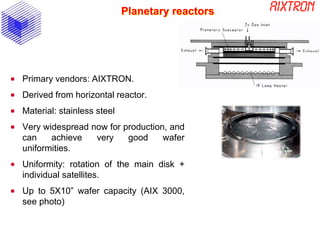
Planetary reactors
 Primary vendors: AIXTRON.
 Derived from horizontal reactor.
 Material: stainless steel
 Very widespread now for production, and
can achieve very good wafer
uniformities.
 Uniformity: rotation of the main disk +
individual satellites.
 Up to 5X10” wafer capacity (AIX 3000,
see photo)
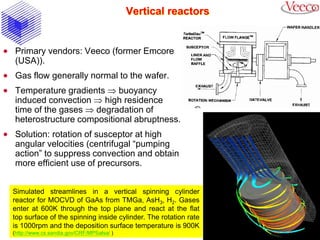
Vertical reactors
 Primary vendors: Veeco (former Emcore
(USA)).
 Gas flow generally normal to the wafer.
 Temperature gradients  buoyancy
induced convection  high residence
time of the gases  degradation of
heterostructure compositional abruptness.
 Solution: rotation of susceptor at high
angular velocities (centrifugal “pumping
action” to suppress convection and obtain
more efficient use of precursors.
Simulated streamlines in a vertical spinning cylinder
reactor for MOCVD of GaAs from TMGa, AsH3, H2. Gases
enter at 600K through the top plane and react at the flat
top surface of the spinning inside cylinder. The rotation rate
is 1000rpm and the deposition surface temperature is 900K
(http://www.cs.sandia.gov/CRF/MPSalsa/ )
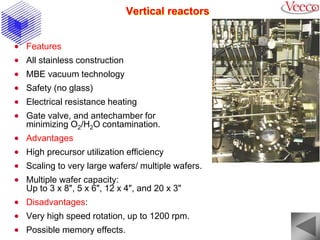
Vertical reactors
 Features
 All stainless construction
 MBE vacuum technology
 Safety (no glass)
 Electrical resistance heating
 Gate valve, and antechamber for
minimizing O2/H2O contamination.
 Advantages
 High precursor utilization efficiency
 Scaling to very large wafers/ multiple wafers.
 Multiple wafer capacity:
Up to 3 x 8", 5 x 6", 12 x 4", and 20 x 3"
 Disadvantages:
 Very high speed rotation, up to 1200 rpm.
 Possible memory effects.
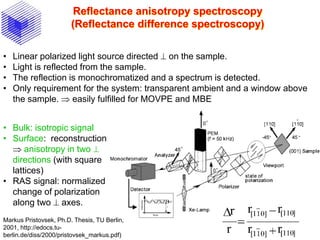
Reflectance anisotropy spectroscopy
(Reflectance difference spectroscopy)
• Linear polarized light source directed  on the sample.
• Light is reflected from the sample.
• The reflection is monochromatized and a spectrum is detected.
• Only requirement for the system: transparent ambient and a window above
the sample.  easily fulfilled for MOVPE and MBE
• Bulk: isotropic signal
• Surface: reconstruction
 anisotropy in two 
directions (with square
lattices)
• RAS signal: normalized
change of polarization
along two  axes.
Markus Pristovsek, Ph.D. Thesis, TU Berlin,
2001, http://edocs.tu-
berlin.de/diss/2000/pristovsek_markus.pdf)
Reflectance anisotropy spectroscopy
(Reflectance difference spectroscopy)
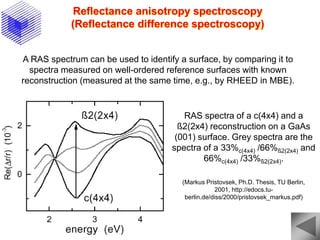
A RAS spectrum can be used to identify a surface, by comparing it to
spectra measured on well-ordered reference surfaces with known
reconstruction (measured at the same time, e.g., by RHEED in MBE).
RAS spectra of a c(4x4) and a
ß2(2x4) reconstruction on a GaAs
(001) surface. Grey spectra are the
spectra of a 33%c(4x4) /66%ß2(2x4) and
66%c(4x4) /33%ß2(2x4).
(Markus Pristovsek, Ph.D. Thesis, TU Berlin,
2001, http://edocs.tu-
berlin.de/diss/2000/pristovsek_markus.pdf)
Exhaust system
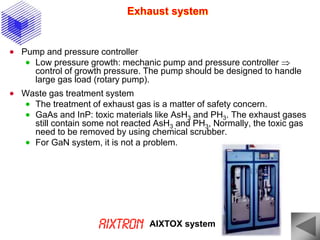
 Pump and pressure controller
 Low pressure growth: mechanic pump and pressure controller 
control of growth pressure. The pump should be designed to handle
large gas load (rotary pump).
 Waste gas treatment system
 The treatment of exhaust gas is a matter of safety concern.
 GaAs and InP: toxic materials like AsH3 and PH3. The exhaust gases
still contain some not reacted AsH3 and PH3, Normally, the toxic gas
need to be removed by using chemical scrubber.
 For GaN system, it is not a problem.
AIXTOX system
Safety issues
 Concerns:
 Flammable gases (H2)
 Toxic gases (AsH3, PH3)
 Safety measures:
 Lab underpressurization.
 Design of hydrides cylinders.
 Extensive gas monitoring systems placed in different
locations, able to detect the presence of gas as small as parts
per billion.
 Alarms located in different parts of the buildings + beeper
calls to operators.
 Immediate shut down of the system to a failsafe condition in
case of leakages and other severe failures.
 Alternatives: use of alternate gases
 N2 carrier
 TBAs, TBP (toxic but liquid  low vaopr pressure)
Analysis of the MOCVD growth
process
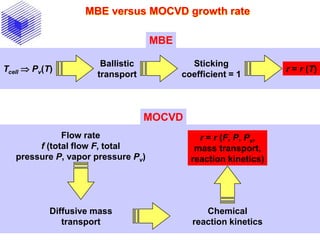
MBE versus MOCVD growth rate
Tcell  Pv(T)
Ballistic
transport
Sticking
coefficient = 1
r = r (T)
MBE
MOCVD
Flow rate
f (total flow F, total
pressure P, vapor pressure Pv)
Diffusive mass
transport
Chemical
reaction kinetics
r = r (F, P, Pv,
mass transport,
reaction kinetics)
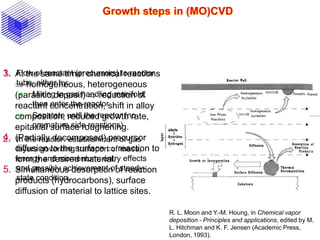
3. At the same time: chemical reactions
 homogeneous, heterogeneous
(parasitic deposit)  reduction of
reactant concentration, shift in alloy
composition, reduced growth rate,
epitaxial surface roughening.
4. (Partially decomposed) precursor
diffusion to the surface  reaction to
form the desired material.
5. Simultaneous desorption of reaction
products (hydrocarbons), surface
diffusion of material to lattice sites.
1. Flow of reactant (precursors) to reactor
tube, either by:
 Mixing in gas handling manifold,
then enter the reactor
 Separate until the reactor (no
premature side reactions)
2. In the reactor: establishment of gas
layers governing transport of mass,
energy and momentum: entry effects
and possibly achievement of steady-
state condition.
Growth steps in (MO)CVD
R. L. Moon and Y.-M. Houng, in Chemical vapor
deposition - Principles and applications, edited by M.
L. Hitchman and K. F. Jensen (Academic Press,
London, 1993).
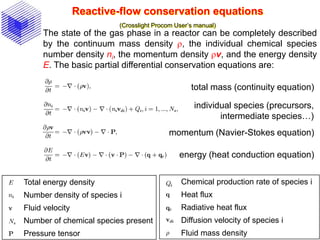
Reactive-flow conservation equations
(Crosslight Procom User’s manual)
The state of the gas phase in a reactor can be completely described
by the continuum mass density r, the individual chemical species
number density ni, the momentum density rv, and the energy density
E. The basic partial differential conservation equations are:
total mass (continuity equation)
individual species (precursors,
intermediate species…)
momentum (Navier-Stokes equation)
energy (heat conduction equation)
Total energy density
Number density of species i
Fluid velocity
Number of chemical species present
Pressure tensor
Chemical production rate of species i
Heat flux
Radiative heat flux
Diffusion velocity of species i
Fluid mass density
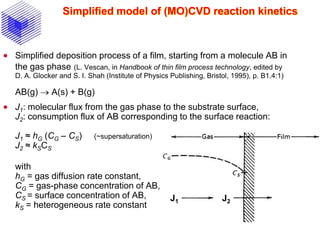
Simplified model of (MO)CVD reaction kinetics
 Simplified deposition process of a film, starting from a molecule AB in
the gas phase (L. Vescan, in Handbook of thin film process technology, edited by
D. A. Glocker and S. I. Shah (Institute of Physics Publishing, Bristol, 1995), p. B1.4:1)
AB(g)  A(s) + B(g)
 J1: molecular flux from the gas phase to the substrate surface,
J2: consumption flux of AB corresponding to the surface reaction:
J1 ≈ hG (CG – CS) (~supersaturation)
J2 ≈ kSCS
with
hG = gas diffusion rate constant,
CG = gas-phase concentration of AB,
CS = surface concentration of AB,
kS = heterogeneous rate constant
J1 J2
Simplified model of (MO)CVD reaction kinetics
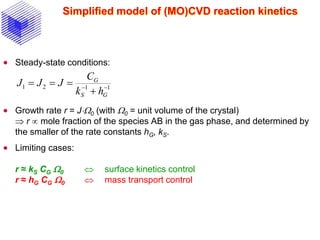
 Steady-state conditions:
 Growth rate r = J0 (with 0 = unit volume of the crystal)
 r  mole fraction of the species AB in the gas phase, and determined by
the smaller of the rate constants hG, kS.
 Limiting cases:
r ≈ kS CG 0  surface kinetics control
r ≈ hG CG 0  mass transport control
1121 


GS
G
hk
C
JJJ
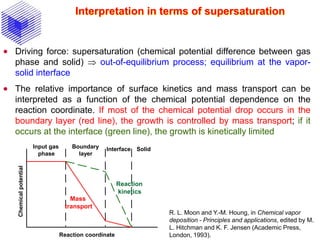
Interpretation in terms of supersaturation
 Driving force: supersaturation (chemical potential difference between gas
phase and solid)  out-of-equilibrium process; equilibrium at the vapor-
solid interface
 The relative importance of surface kinetics and mass transport can be
interpreted as a function of the chemical potential dependence on the
reaction coordinate. If most of the chemical potential drop occurs in the
boundary layer (red line), the growth is controlled by mass transport; if it
occurs at the interface (green line), the growth is kinetically limited
Input gas
phase
Boundary
layer
Interface Solid
Chemicalpotential
Reaction coordinate
Mass
transport
Reaction
kinetics
R. L. Moon and Y.-M. Houng, in Chemical vapor
deposition - Principles and applications, edited by M.
L. Hitchman and K. F. Jensen (Academic Press,
London, 1993).
Mass transport
Fundamental and very complex aspect in reactor design
Factors influencing gas flow in a reactor:
 temperature
 concentration and momentum gradients
 gravity ( convection)
 homogeneous, heterogeneous chemical reactions ( parasitic nucleation)
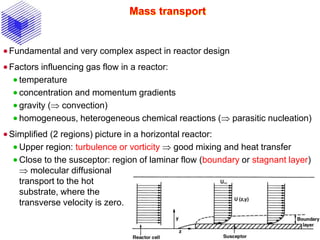
Simplified (2 regions) picture in a horizontal reactor:
 Upper region: turbulence or vorticity  good mixing and heat transfer
 Close to the susceptor: region of laminar flow (boundary or stagnant layer)
 molecular diffusional
transport to the hot
substrate, where the
transverse velocity is zero.
Mass transport
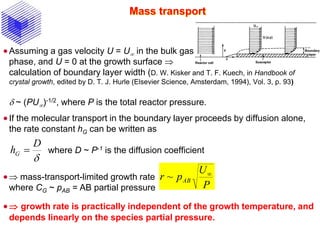
Assuming a gas velocity U = U in the bulk gas
phase, and U = 0 at the growth surface 
calculation of boundary layer width (D. W. Kisker and T. F. Kuech, in Handbook of
crystal growth, edited by D. T. J. Hurle (Elsevier Science, Amsterdam, 1994), Vol. 3, p. 93)
d ~ (PU)-1/2, where P is the total reactor pressure.
If the molecular transport in the boundary layer proceeds by diffusion alone,
the rate constant hG can be written as
where D ~ P-1 is the diffusion coefficient
 mass-transport-limited growth rate
where CG ~ pAB = AB partial pressure
 growth rate is practically independent of the growth temperature, and
depends linearly on the species partial pressure.
d
D
hG 
P
U
pr AB

~
Reaction kinetics
 Two kinds of thermally-activated reactions
 Reactions in the gas phase (homogeneous reactions)
 Reactions at the surface (heterogeneous reactions)
 Forward and reverse rates are characterized by rate constants that
can be expressed in an Arrhenius form:
k = A exp (-E/kBT),
where E is the activation energy for the process.
 Surface kinetics are poorly known processes, in which a number of
sub-processes can be identified. Among them:
 adsorption of reactant species,
 heterogeneous decomposition reactions,
 surface migration,
 incorporation and desorption of products.
Reaction kinetics
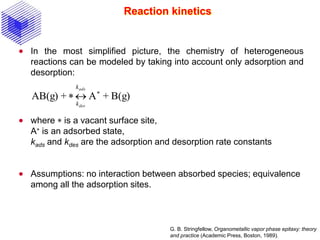
 In the most simplified picture, the chemistry of heterogeneous
reactions can be modeled by taking into account only adsorption and
desorption:
 where  is a vacant surface site,
A is an adsorbed state,
kads and kdes are the adsorption and desorption rate constants
 Assumptions: no interaction between absorbed species; equivalence
among all the adsorption sites.
B(g)+A+AB(g) 

ads
des
k
k
G. B. Stringfellow, Organometallic vapor phase epitaxy: theory
and practice (Academic Press, Boston, 1989).
Reaction kinetics
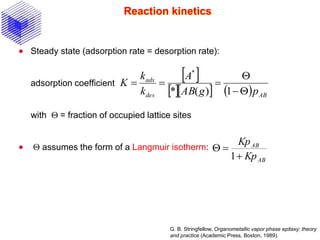
 Steady state (adsorption rate = desorption rate):
adsorption coefficient
with Q = fraction of occupied lattice sites
 Q assumes the form of a Langmuir isotherm:
AB
AB
Kp
Kp

Q
1
G. B. Stringfellow, Organometallic vapor phase epitaxy: theory
and practice (Academic Press, Boston, 1989).
 
     ABdes
ads
pgAB
A
k
k
K
Q
Q

1)(*
*
Reaction kinetics
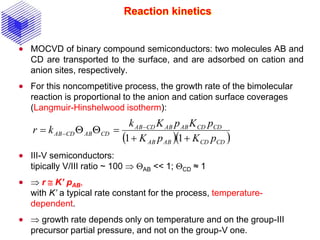
 MOCVD of binary compound semiconductors: two molecules AB and
CD are transported to the surface, and are adsorbed on cation and
anion sites, respectively.
 For this noncompetitive process, the growth rate of the bimolecular
reaction is proportional to the anion and cation surface coverages
(Langmuir-Hinshelwood isotherm):
 III-V semiconductors:
tipically V/III ratio ~ 100  QAB << 1; QCD ≈ 1
  r  K’ pAB,
with K’ a typical rate constant for the process, temperature-
dependent.
  growth rate depends only on temperature and on the group-III
precursor partial pressure, and not on the group-V one.
  CDCDABAB
CDCDABABCDAB
CDABCDAB
pKpK
pKpKk
kr

QQ 

11
Reaction kinetics for GaAs
Overall reactions:
 TMGa + AsH3: AsH3 + Ga (CH3)3 → GaAs + 3CH4
↑
 TEGa + AsH3: AsH3 + Ga (C2H5)3 → GaAs + 3C2H4
↑ + 3H2
↑
Lower activation energies for
decomposition for TEGa than
for TMGa  ~200K lower
temperature for 50%
decomposition.
(Markus Pristovsek, Ph.D. Thesis, TU Berlin,
2001, http://edocs.tu-
berlin.de/diss/2000/pristovsek_markus.pdf)
Reaction kinetics for GaAs
Overall reactions:
 TMGa + AsH3: AsH3 + Ga (CH3)3 → GaAs + 3CH4
↑
 TEGa + AsH3: AsH3 + Ga (C2H5)3 → GaAs + 3C2H4
↑ + 3H2
↑
TMGa decomposition is strongly
enhanced at the onset of the
AsH3 de-composition.
This is most likely due to
hydrogen radicals produced by
AsH3 decomposition.
(Markus Pristovsek, Ph.D. Thesis, TU Berlin,
2001, http://edocs.tu-
berlin.de/diss/2000/pristovsek_markus.pdf)
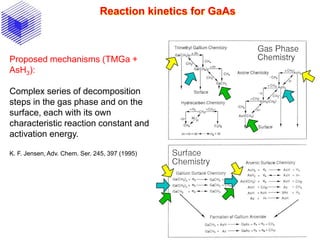
Reaction kinetics for GaAs
Proposed mechanisms (TMGa +
AsH3):
Complex series of decomposition
steps in the gas phase and on the
surface, each with its own
characteristic reaction constant and
activation energy.
K. F. Jensen, Adv. Chem. Ser. 245, 397 (1995)
Growth modes in MOCVD
Growth mode: studies on GaAs from TMGa and AsH3
 Studies for atmospheric pressure (AP = 105Pa = 1000mbar) and for low
pressure (LP = 104Pa = 100mbar), and different surface orientations.
 Three regimes:
 Low T: kinetically limited growth  strong T dependence, low P
dependence (r  K’ pTMGa), with K’ dependent on T.
 Mid T: mass transport-limited
growth  r does not depend
appreciably on T and surface
orientation, but increases with
decreasing P (r  pTMGa P-1/2 ).
 High T: increasingly low growth
rates, probably due to homogeneous
reactions in the gas phase, causing
a depletion of reactants, or surface
re-evaporation.
G. B. Stringfellow, Organometallic vapor phase epitaxy: theory
and practice (Academic Press, Boston, 1989).
Effect of substrate temperature
Growth mode: studies on GaAs from TMGa and AsH3
 Studies for T = 650°C and V/III ratio ≈ 100
 Two regimes:
 P > 100mbar, growth is limited by mass transport, and r ~ P-1/2
 After a transition region, at P < 20mbar, the growth rate becomes
independent on P, and growth becomes kinetically limited.
Effect of reactor pressure
G. B. Stringfellow, Organometallic vapor phase epitaxy: theory
and practice (Academic Press, Boston, 1989).
Growth mode: studies on GaAs from TMGa and AsH3
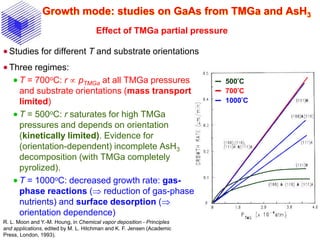
 Studies for different T and substrate orientations
 Three regimes:
 T = 700oC: r  pTMGa at all TMGa pressures
and substrate orientations (mass transport
limited)
 T = 500oC: r saturates for high TMGa
pressures and depends on orientation
(kinetically limited). Evidence for
(orientation-dependent) incomplete AsH3
decomposition (with TMGa completely
pyrolized).
 T = 1000oC: decreased growth rate: gas-
phase reactions ( reduction of gas-phase
nutrients) and surface desorption (
orientation dependence)
Effect of TMGa partial pressure
R. L. Moon and Y.-M. Houng, in Chemical vapor deposition - Principles
and applications, edited by M. L. Hitchman and K. F. Jensen (Academic
Press, London, 1993).
500°C
700°C
1000°C

Part III. Metal-Organic Chemical Vapor Deposition

  • 1.
    PART III: METALORGANIC CHEMICALVAPOR DEPOSITION  Description of the MOCVD equipment  Analysis of the MOCVD growth process  Growth modes in MOCVD
  • 2.
    Metalorgenic Chemical VaporDeposition (MOCVD) [Metalorganic Vapor Phase Epitaxy (MOVPE), OMCVD, OMVPE]  One of the premier techniques for epitaxial growth of thin layer structures (semiconductors, oxides, superconductors)  Introduced around 25 years ago as the most versatile technique for growing semiconductor films.  Wide application for devices such Lasers, LEDs, solar cells, photodetectors, HBTs, FETs.  Principle of operation: transport of precursor molecules (group-III metalorganics + group-V hydrides or alkyls) by a carrier gas (H2, N2) onto a heated substrate; surface chemical reactions.  Complex transport phenomena and reactions, complicated models to determine reactor designs,growth modes and rates.  In-situ diagnostics less common than in MBE.
  • 3.
    Description of theMOCVD equipment • R. L. Moon and Y.-M. Houng, in Chemical vapor deposition - Principles and applications, edited by M. L. Hitchman and K. F. Jensen (Academic Press, London, 1993). • G. B. Stringfellow, Organometallic vapor phase epitaxy: theory and practice (Academic Press, Boston, 1989).
  • 4.
    MOCVD Facility, horizontalreactor •Research system (left): AIX 200 •1X2” wafer capacity •Production system (right): AIX 2600 •Up to 5X10” wafer capacity (AIX 3000) Gas handling Reactor Glove box
  • 5.
    Schematics of aMOCVD system Carrier gas Material sources Gas handling system Reactor Exhaust system Safety system In-situ diagnostics NO electron beam probes! Reflectance Ellipsometry RAS
  • 6.
    Gas handling system The function of gas handling system is mixing and metering of the gas that will enter the reactor. Timing and composition of the gas entering the reactor will determine the epilayer structure.  Leak-tight of the gas panel is essential, because the oxygen contamination will degrade the growing films’ properties.  Fast switch of valve system is very important for thin film and abrupt interface structure growth,  Accurate control of flow rate, pressure and temperature can ensure stability and repeatability.
  • 7.
    Carrier gas  “Inert”carrier gas constitutes about 90 % of the gas phase  stringent purity requirements.  H2 traditionally used, simple to purify by being passed through a palladium foil heated to 400 °C. Problem: H2 is highly explosive in contact with O2  high safety costs.  Alternative precursor : N2: safer, recently with similar purity, more effective in cracking precursor molecules (heavier).  High flux  fast change of vapor phase composition. Regulation: mass flow controller  P ~ 5- 800 mbar Mass flow controllers
  • 8.
    Material sources  Volatileprecursor molecules transported by the carrier gas  Growth of III-V semiconductors:  Group III: generally metalorganic molecules (trimethyl- or triethyl- species)  Group V: generally toxic hydrides (AsH3; PH3 flammable as well); alternative: alkyls (TBAs, TBP).
  • 9.
    Hidrides and dopants Form: gases from high pressure cylinders  Mixed into the carrier gas line  Flow control: valve + mass flow controller (MFC)
  • 10.
    Metalorganics  Liquid (orfinely divided solid – TMIn) contained in a stainess steel bubbler.  Vapor pressure fixed by constant temperature in a thermal bath; T ≈ -20oC ÷ 40oC; DT = ±1oC.  Controlled H2 flow through the bubbler  saturated stream; composition depends on H2 flow rate  adjustment through MFC  P ressure controller (PC) to keep a fixed pressure in the bubbler and throttles the resulting mixture of H2 and MO down to the reactor pressure. PC MFC Valve NC Valve NO H2, N2 To reactor To reactor Bubbler Thermal bath Bubblers
  • 11.
    Metalorganic compounds  Optimalthermal decomposition temperature between 300 and 500°C  availability of transported reactant at the substrate surface.  The vapor pressure of the MO source is an important consideration in MOCVD, since it determines the concentration of source material in the reactor and the deposition rate. Too low a vapor pressure makes it difficult to transport the source into the deposition zone and to achieve reasonable growth rates. Too high a vapor pressure may raise safety concerns if the compound is toxic.  Vapor pressures of Metalorganic compounds are calculated in terms of the expression Log(p)=B-A/T
  • 12.
    Vapor pressure ofmost common MO compounds Compound P at 298 K (torr) A B Melt point (oC) (Al(CH3)3)2 TMAl 14.2 2780 10.48 15 Al(C2H5)3 TEAl 0.041 3625 10.78 -52.5 Ga(CH3)3 TMGa 238 1825 8.50 -15.8 Ga(C2H5)3 TEGa 4.79 2530 9.19 -82.5 In(CH3)3 TMIn 1.75 2830 9.74 88 In(C2H5)3 TEIn 0.31 2815 8.94 -32 Zn(C2H5)2 DEZn 8.53 2190 8.28 -28 Mg(C5H5)2 Cp2Mg 0.05 3556 10.56 175 Log(p)=B-A/T
  • 13.
    Flow rate ofMO sources                      KT molK J mbarP mbarP molQmbarTP molQ mol l NKT K J k ml t V mbarTP mol tN N TkNVp bub B BbubMO MO AbubB bubMO A i Bii                       4 standard 4 10314.8 min/ min/ 10 min/ min/ Ideal gas equation  MO flux QMO •PMO(Tbub) = equilibrium vapor pressure of the metalorganic component •Tbub = bubbler temperature •QB = carrier gas flux at standard atmosphere •Pstandard = standard atmosphere •PB = regulated bubbler pressure (Rolf Engelhardt, Ph.D. Thesis, TU Berlin, 2000, http://edocs.tu-berlin.de/diss/2000/engelhardt_rolf.pdf)
  • 14.
    Partial pressure ofMO sources                 mbarP mbarP molQ mbarP mbarP molQmbarTP mbarP reactor tot B BbubMO reactorMO standard standard min/ min/    • PMO-reactor = partial pressure of the metalorganic components in the reactor • PMO(Tbub) = equilibrium vapor pressure of the metalorganic component • QB = carrier gas flux • Pstandard = standard atmosphere • PB = regulated bubbler pressure • Qtot = total gas flux (Rolf Engelhardt, Ph.D. Thesis, TU Berlin, 2000, http://edocs.tu-berlin.de/diss/2000/engelhardt_rolf.pdf)
  • 15.
    MOCVD reactors  Differentorientations and geometries.  Most common:  Horizontal reactors: gases inserted laterally with respect to sample standing horizontally on a slowly- rotating (~60RPM) susceptor plate.  Vertical reactors: gases enter from top, sample mounted horizontally on a fast-rotating (~500- 1000RPM) susceptor plate.
  • 16.
    Horizontal reactors  Primaryvendors: AIXTRON (Germany).  The substrate rests on a graphite susceptor heated by RF induction or by IR lamps.  Quartz liner tube, generally rectangular  Gas flow is horizontal, parallel to the sample.  Rotation ~ 60RPM for uniformity by H2 flux below the sample holder.
  • 17.
    Horizontal reactors  Advantages Common reactor  high experience.  Uniform epitaxial growth provided the gas velocity is large enough, and attention is paid to hydrodynamic flow.  Small height above the wafer  the effect of natural convection is minimized.  Quite large gas velocity  very rapid changes in the gas phase composition.  Disadvantages  Uniformity can either be achieved by very high gas flow, ( inefficient deposition), or by implementing rotation, which is tricky in this type of design.  Throughput: difficult to scale this design up to accommodate large volume production.
  • 18.
    Planetary reactors  Primaryvendors: AIXTRON.  Derived from horizontal reactor.  Material: stainless steel  Very widespread now for production, and can achieve very good wafer uniformities.  Uniformity: rotation of the main disk + individual satellites.  Up to 5X10” wafer capacity (AIX 3000, see photo)
  • 19.
    Vertical reactors  Primaryvendors: Veeco (former Emcore (USA)).  Gas flow generally normal to the wafer.  Temperature gradients  buoyancy induced convection  high residence time of the gases  degradation of heterostructure compositional abruptness.  Solution: rotation of susceptor at high angular velocities (centrifugal “pumping action” to suppress convection and obtain more efficient use of precursors. Simulated streamlines in a vertical spinning cylinder reactor for MOCVD of GaAs from TMGa, AsH3, H2. Gases enter at 600K through the top plane and react at the flat top surface of the spinning inside cylinder. The rotation rate is 1000rpm and the deposition surface temperature is 900K (http://www.cs.sandia.gov/CRF/MPSalsa/ )
  • 20.
    Vertical reactors  Features All stainless construction  MBE vacuum technology  Safety (no glass)  Electrical resistance heating  Gate valve, and antechamber for minimizing O2/H2O contamination.  Advantages  High precursor utilization efficiency  Scaling to very large wafers/ multiple wafers.  Multiple wafer capacity: Up to 3 x 8", 5 x 6", 12 x 4", and 20 x 3"  Disadvantages:  Very high speed rotation, up to 1200 rpm.  Possible memory effects.
  • 21.
    Reflectance anisotropy spectroscopy (Reflectancedifference spectroscopy) • Linear polarized light source directed  on the sample. • Light is reflected from the sample. • The reflection is monochromatized and a spectrum is detected. • Only requirement for the system: transparent ambient and a window above the sample.  easily fulfilled for MOVPE and MBE • Bulk: isotropic signal • Surface: reconstruction  anisotropy in two  directions (with square lattices) • RAS signal: normalized change of polarization along two  axes. Markus Pristovsek, Ph.D. Thesis, TU Berlin, 2001, http://edocs.tu- berlin.de/diss/2000/pristovsek_markus.pdf)
  • 22.
    Reflectance anisotropy spectroscopy (Reflectancedifference spectroscopy) A RAS spectrum can be used to identify a surface, by comparing it to spectra measured on well-ordered reference surfaces with known reconstruction (measured at the same time, e.g., by RHEED in MBE). RAS spectra of a c(4x4) and a ß2(2x4) reconstruction on a GaAs (001) surface. Grey spectra are the spectra of a 33%c(4x4) /66%ß2(2x4) and 66%c(4x4) /33%ß2(2x4). (Markus Pristovsek, Ph.D. Thesis, TU Berlin, 2001, http://edocs.tu- berlin.de/diss/2000/pristovsek_markus.pdf)
  • 23.
    Exhaust system  Pumpand pressure controller  Low pressure growth: mechanic pump and pressure controller  control of growth pressure. The pump should be designed to handle large gas load (rotary pump).  Waste gas treatment system  The treatment of exhaust gas is a matter of safety concern.  GaAs and InP: toxic materials like AsH3 and PH3. The exhaust gases still contain some not reacted AsH3 and PH3, Normally, the toxic gas need to be removed by using chemical scrubber.  For GaN system, it is not a problem. AIXTOX system
  • 24.
    Safety issues  Concerns: Flammable gases (H2)  Toxic gases (AsH3, PH3)  Safety measures:  Lab underpressurization.  Design of hydrides cylinders.  Extensive gas monitoring systems placed in different locations, able to detect the presence of gas as small as parts per billion.  Alarms located in different parts of the buildings + beeper calls to operators.  Immediate shut down of the system to a failsafe condition in case of leakages and other severe failures.  Alternatives: use of alternate gases  N2 carrier  TBAs, TBP (toxic but liquid  low vaopr pressure)
  • 25.
    Analysis of theMOCVD growth process
  • 26.
    MBE versus MOCVDgrowth rate Tcell  Pv(T) Ballistic transport Sticking coefficient = 1 r = r (T) MBE MOCVD Flow rate f (total flow F, total pressure P, vapor pressure Pv) Diffusive mass transport Chemical reaction kinetics r = r (F, P, Pv, mass transport, reaction kinetics)
  • 27.
    3. At thesame time: chemical reactions  homogeneous, heterogeneous (parasitic deposit)  reduction of reactant concentration, shift in alloy composition, reduced growth rate, epitaxial surface roughening. 4. (Partially decomposed) precursor diffusion to the surface  reaction to form the desired material. 5. Simultaneous desorption of reaction products (hydrocarbons), surface diffusion of material to lattice sites. 1. Flow of reactant (precursors) to reactor tube, either by:  Mixing in gas handling manifold, then enter the reactor  Separate until the reactor (no premature side reactions) 2. In the reactor: establishment of gas layers governing transport of mass, energy and momentum: entry effects and possibly achievement of steady- state condition. Growth steps in (MO)CVD R. L. Moon and Y.-M. Houng, in Chemical vapor deposition - Principles and applications, edited by M. L. Hitchman and K. F. Jensen (Academic Press, London, 1993).
  • 28.
    Reactive-flow conservation equations (CrosslightProcom User’s manual) The state of the gas phase in a reactor can be completely described by the continuum mass density r, the individual chemical species number density ni, the momentum density rv, and the energy density E. The basic partial differential conservation equations are: total mass (continuity equation) individual species (precursors, intermediate species…) momentum (Navier-Stokes equation) energy (heat conduction equation) Total energy density Number density of species i Fluid velocity Number of chemical species present Pressure tensor Chemical production rate of species i Heat flux Radiative heat flux Diffusion velocity of species i Fluid mass density
  • 29.
    Simplified model of(MO)CVD reaction kinetics  Simplified deposition process of a film, starting from a molecule AB in the gas phase (L. Vescan, in Handbook of thin film process technology, edited by D. A. Glocker and S. I. Shah (Institute of Physics Publishing, Bristol, 1995), p. B1.4:1) AB(g)  A(s) + B(g)  J1: molecular flux from the gas phase to the substrate surface, J2: consumption flux of AB corresponding to the surface reaction: J1 ≈ hG (CG – CS) (~supersaturation) J2 ≈ kSCS with hG = gas diffusion rate constant, CG = gas-phase concentration of AB, CS = surface concentration of AB, kS = heterogeneous rate constant J1 J2
  • 30.
    Simplified model of(MO)CVD reaction kinetics  Steady-state conditions:  Growth rate r = J0 (with 0 = unit volume of the crystal)  r  mole fraction of the species AB in the gas phase, and determined by the smaller of the rate constants hG, kS.  Limiting cases: r ≈ kS CG 0  surface kinetics control r ≈ hG CG 0  mass transport control 1121    GS G hk C JJJ
  • 31.
    Interpretation in termsof supersaturation  Driving force: supersaturation (chemical potential difference between gas phase and solid)  out-of-equilibrium process; equilibrium at the vapor- solid interface  The relative importance of surface kinetics and mass transport can be interpreted as a function of the chemical potential dependence on the reaction coordinate. If most of the chemical potential drop occurs in the boundary layer (red line), the growth is controlled by mass transport; if it occurs at the interface (green line), the growth is kinetically limited Input gas phase Boundary layer Interface Solid Chemicalpotential Reaction coordinate Mass transport Reaction kinetics R. L. Moon and Y.-M. Houng, in Chemical vapor deposition - Principles and applications, edited by M. L. Hitchman and K. F. Jensen (Academic Press, London, 1993).
  • 32.
    Mass transport Fundamental andvery complex aspect in reactor design Factors influencing gas flow in a reactor:  temperature  concentration and momentum gradients  gravity ( convection)  homogeneous, heterogeneous chemical reactions ( parasitic nucleation) Simplified (2 regions) picture in a horizontal reactor:  Upper region: turbulence or vorticity  good mixing and heat transfer  Close to the susceptor: region of laminar flow (boundary or stagnant layer)  molecular diffusional transport to the hot substrate, where the transverse velocity is zero.
  • 33.
    Mass transport Assuming agas velocity U = U in the bulk gas phase, and U = 0 at the growth surface  calculation of boundary layer width (D. W. Kisker and T. F. Kuech, in Handbook of crystal growth, edited by D. T. J. Hurle (Elsevier Science, Amsterdam, 1994), Vol. 3, p. 93) d ~ (PU)-1/2, where P is the total reactor pressure. If the molecular transport in the boundary layer proceeds by diffusion alone, the rate constant hG can be written as where D ~ P-1 is the diffusion coefficient  mass-transport-limited growth rate where CG ~ pAB = AB partial pressure  growth rate is practically independent of the growth temperature, and depends linearly on the species partial pressure. d D hG  P U pr AB  ~
  • 34.
    Reaction kinetics  Twokinds of thermally-activated reactions  Reactions in the gas phase (homogeneous reactions)  Reactions at the surface (heterogeneous reactions)  Forward and reverse rates are characterized by rate constants that can be expressed in an Arrhenius form: k = A exp (-E/kBT), where E is the activation energy for the process.  Surface kinetics are poorly known processes, in which a number of sub-processes can be identified. Among them:  adsorption of reactant species,  heterogeneous decomposition reactions,  surface migration,  incorporation and desorption of products.
  • 35.
    Reaction kinetics  Inthe most simplified picture, the chemistry of heterogeneous reactions can be modeled by taking into account only adsorption and desorption:  where  is a vacant surface site, A is an adsorbed state, kads and kdes are the adsorption and desorption rate constants  Assumptions: no interaction between absorbed species; equivalence among all the adsorption sites. B(g)+A+AB(g)   ads des k k G. B. Stringfellow, Organometallic vapor phase epitaxy: theory and practice (Academic Press, Boston, 1989).
  • 36.
    Reaction kinetics  Steadystate (adsorption rate = desorption rate): adsorption coefficient with Q = fraction of occupied lattice sites  Q assumes the form of a Langmuir isotherm: AB AB Kp Kp  Q 1 G. B. Stringfellow, Organometallic vapor phase epitaxy: theory and practice (Academic Press, Boston, 1989).        ABdes ads pgAB A k k K Q Q  1)(* *
  • 37.
    Reaction kinetics  MOCVDof binary compound semiconductors: two molecules AB and CD are transported to the surface, and are adsorbed on cation and anion sites, respectively.  For this noncompetitive process, the growth rate of the bimolecular reaction is proportional to the anion and cation surface coverages (Langmuir-Hinshelwood isotherm):  III-V semiconductors: tipically V/III ratio ~ 100  QAB << 1; QCD ≈ 1   r  K’ pAB, with K’ a typical rate constant for the process, temperature- dependent.   growth rate depends only on temperature and on the group-III precursor partial pressure, and not on the group-V one.   CDCDABAB CDCDABABCDAB CDABCDAB pKpK pKpKk kr  QQ   11
  • 38.
    Reaction kinetics forGaAs Overall reactions:  TMGa + AsH3: AsH3 + Ga (CH3)3 → GaAs + 3CH4 ↑  TEGa + AsH3: AsH3 + Ga (C2H5)3 → GaAs + 3C2H4 ↑ + 3H2 ↑ Lower activation energies for decomposition for TEGa than for TMGa  ~200K lower temperature for 50% decomposition. (Markus Pristovsek, Ph.D. Thesis, TU Berlin, 2001, http://edocs.tu- berlin.de/diss/2000/pristovsek_markus.pdf)
  • 39.
    Reaction kinetics forGaAs Overall reactions:  TMGa + AsH3: AsH3 + Ga (CH3)3 → GaAs + 3CH4 ↑  TEGa + AsH3: AsH3 + Ga (C2H5)3 → GaAs + 3C2H4 ↑ + 3H2 ↑ TMGa decomposition is strongly enhanced at the onset of the AsH3 de-composition. This is most likely due to hydrogen radicals produced by AsH3 decomposition. (Markus Pristovsek, Ph.D. Thesis, TU Berlin, 2001, http://edocs.tu- berlin.de/diss/2000/pristovsek_markus.pdf)
  • 40.
    Reaction kinetics forGaAs Proposed mechanisms (TMGa + AsH3): Complex series of decomposition steps in the gas phase and on the surface, each with its own characteristic reaction constant and activation energy. K. F. Jensen, Adv. Chem. Ser. 245, 397 (1995)
  • 41.
  • 42.
    Growth mode: studieson GaAs from TMGa and AsH3  Studies for atmospheric pressure (AP = 105Pa = 1000mbar) and for low pressure (LP = 104Pa = 100mbar), and different surface orientations.  Three regimes:  Low T: kinetically limited growth  strong T dependence, low P dependence (r  K’ pTMGa), with K’ dependent on T.  Mid T: mass transport-limited growth  r does not depend appreciably on T and surface orientation, but increases with decreasing P (r  pTMGa P-1/2 ).  High T: increasingly low growth rates, probably due to homogeneous reactions in the gas phase, causing a depletion of reactants, or surface re-evaporation. G. B. Stringfellow, Organometallic vapor phase epitaxy: theory and practice (Academic Press, Boston, 1989). Effect of substrate temperature
  • 43.
    Growth mode: studieson GaAs from TMGa and AsH3  Studies for T = 650°C and V/III ratio ≈ 100  Two regimes:  P > 100mbar, growth is limited by mass transport, and r ~ P-1/2  After a transition region, at P < 20mbar, the growth rate becomes independent on P, and growth becomes kinetically limited. Effect of reactor pressure G. B. Stringfellow, Organometallic vapor phase epitaxy: theory and practice (Academic Press, Boston, 1989).
  • 44.
    Growth mode: studieson GaAs from TMGa and AsH3  Studies for different T and substrate orientations  Three regimes:  T = 700oC: r  pTMGa at all TMGa pressures and substrate orientations (mass transport limited)  T = 500oC: r saturates for high TMGa pressures and depends on orientation (kinetically limited). Evidence for (orientation-dependent) incomplete AsH3 decomposition (with TMGa completely pyrolized).  T = 1000oC: decreased growth rate: gas- phase reactions ( reduction of gas-phase nutrients) and surface desorption ( orientation dependence) Effect of TMGa partial pressure R. L. Moon and Y.-M. Houng, in Chemical vapor deposition - Principles and applications, edited by M. L. Hitchman and K. F. Jensen (Academic Press, London, 1993). 500°C 700°C 1000°C