INTRODUCTION:
Laser are presently used for a variety of applications
in the medical field. This is the interaction between
the laser radiation and human tissue.
Success of this depends on:
*Radiation
*Wavelength
*Ability of the tissue to absorb
*Total energy incident on the tissue and area to be
treated.
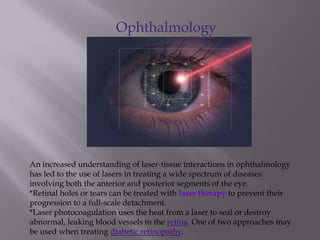
Ophthalmology
An increased understanding of laser-tissue interactions in ophthalmology
has led to the use of lasers in treating a wide spectrum of diseases
involving both the anterior and posterior segments of the eye.
*Retinal holes or tears can be treated with laser therapy to prevent their
progression to a full-scale detachment.
*Laser photocoagulation uses the heat from a laser to seal or destroy
abnormal, leaking blood vessels in the retina. One of two approaches may
be used when treating diabetic retinopathy.
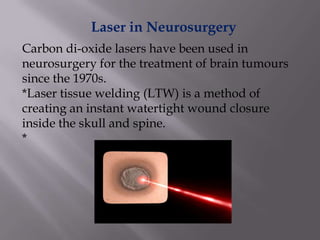
Laser in Neurosurgery
Carbon di-oxide lasers have been used in
neurosurgery for the treatment of brain tumours
since the 1970s.
*Laser tissue welding (LTW) is a method of
creating an instant watertight wound closure
inside the skull and spine.
*
Gastroenterology
The removal of lower gastro intestinal fats. Nd
YAG lasers are mostly used. It is also used to
cure cancers. The temperature of the tissue does
not increase.
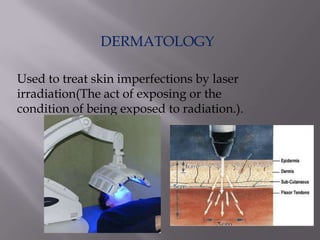
DERMATOLOGY
Used to treat skin imperfections by laser
irradiation(The act of exposing or the
condition of being exposed to radiation.).
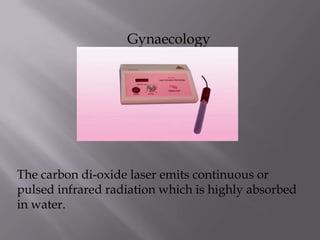
Gynaecology
The carbon di-oxide laser emits continuous or
pulsed infrared radiation which is highly absorbed
in water.
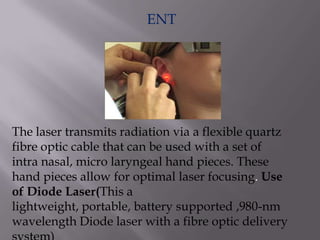
The laser transmits radiation via a flexible quartz
fibre optic cable that can be used with a set of
intra nasal, micro laryngeal hand pieces. These
hand pieces allow for optimal laser focusing. Use
of Diode Laser(This a
lightweight, portable, battery supported ,980-nm
wavelength Diode laser with a fibre optic delivery
ENT
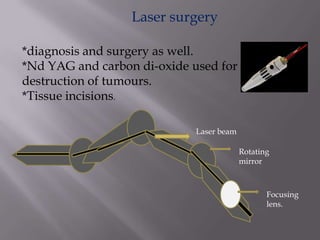
Laser surgery
*diagnosis and surgery as well.
*Nd YAG and carbon di-oxide used for
destruction of tumours.
*Tissue incisions.
Laser beam
Rotating
mirror
Focusing
lens.
Advantages:
•Painless and bloodless surgery
•No side effects.
•Sterile.
•Heals fast.
Disadvantage:
•Highly expensive
Bundle of Fibre Optics
An optical fibre is a flexible, transparent fibre made
of glass (silica) or plastic, slightly thicker than a
human hair. It functions as a “light pipe” to transmit
light between the two ends of the fibre. Fibre
optics, though used extensively in the modern
world, is a fairly simple, and relatively
old, technology. Guiding of light by refraction, the
principle that makes fibre optics possible, was first
demonstrated by Daniel Colladon and Jacques
Babinet in Paris in the early 1840s
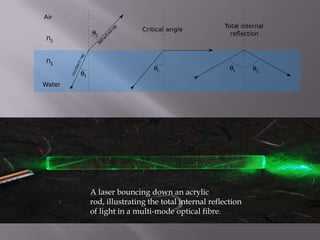
A laser bouncing down an acrylic
rod, illustrating the total internal reflection
of light in a multi-mode optical fibre.
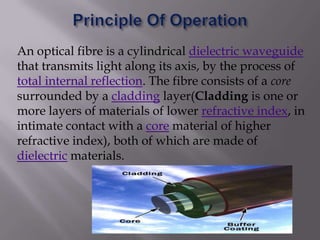
An optical fibre is a cylindrical dielectric waveguide
that transmits light along its axis, by the process of
total internal reflection. The fibre consists of a core
surrounded by a cladding layer(Cladding is one or
more layers of materials of lower refractive index, in
intimate contact with a core material of higher
refractive index), both of which are made of
dielectric materials.

Medical applications

  • 2.
    INTRODUCTION: Laser are presentlyused for a variety of applications in the medical field. This is the interaction between the laser radiation and human tissue. Success of this depends on: *Radiation *Wavelength *Ability of the tissue to absorb *Total energy incident on the tissue and area to be treated.
  • 3.
    Ophthalmology An increased understandingof laser-tissue interactions in ophthalmology has led to the use of lasers in treating a wide spectrum of diseases involving both the anterior and posterior segments of the eye. *Retinal holes or tears can be treated with laser therapy to prevent their progression to a full-scale detachment. *Laser photocoagulation uses the heat from a laser to seal or destroy abnormal, leaking blood vessels in the retina. One of two approaches may be used when treating diabetic retinopathy.
  • 4.
    Laser in Neurosurgery Carbondi-oxide lasers have been used in neurosurgery for the treatment of brain tumours since the 1970s. *Laser tissue welding (LTW) is a method of creating an instant watertight wound closure inside the skull and spine. *
  • 5.
    Gastroenterology The removal oflower gastro intestinal fats. Nd YAG lasers are mostly used. It is also used to cure cancers. The temperature of the tissue does not increase.
  • 6.
    DERMATOLOGY Used to treatskin imperfections by laser irradiation(The act of exposing or the condition of being exposed to radiation.).
  • 7.
    Gynaecology The carbon di-oxidelaser emits continuous or pulsed infrared radiation which is highly absorbed in water.
  • 8.
    The laser transmitsradiation via a flexible quartz fibre optic cable that can be used with a set of intra nasal, micro laryngeal hand pieces. These hand pieces allow for optimal laser focusing. Use of Diode Laser(This a lightweight, portable, battery supported ,980-nm wavelength Diode laser with a fibre optic delivery ENT
  • 9.
    Laser surgery *diagnosis andsurgery as well. *Nd YAG and carbon di-oxide used for destruction of tumours. *Tissue incisions. Laser beam Rotating mirror Focusing lens.
  • 10.
    Advantages: •Painless and bloodlesssurgery •No side effects. •Sterile. •Heals fast. Disadvantage: •Highly expensive
  • 12.
    Bundle of FibreOptics An optical fibre is a flexible, transparent fibre made of glass (silica) or plastic, slightly thicker than a human hair. It functions as a “light pipe” to transmit light between the two ends of the fibre. Fibre optics, though used extensively in the modern world, is a fairly simple, and relatively old, technology. Guiding of light by refraction, the principle that makes fibre optics possible, was first demonstrated by Daniel Colladon and Jacques Babinet in Paris in the early 1840s
  • 13.
    A laser bouncingdown an acrylic rod, illustrating the total internal reflection of light in a multi-mode optical fibre.
  • 14.
    An optical fibreis a cylindrical dielectric waveguide that transmits light along its axis, by the process of total internal reflection. The fibre consists of a core surrounded by a cladding layer(Cladding is one or more layers of materials of lower refractive index, in intimate contact with a core material of higher refractive index), both of which are made of dielectric materials.