SRI AUROBINDO COLLEGE OF
DENTISTRY
DEPARTMENT OF PEDODONTICS
AND PREVENTIVE DENTISTRY
STERILIZATION
GUIDED BY:-
1. Dr. Bharath Bhushan Sir
2. Dr. Khushboo Barjatya Ma’am
3. Dr. Binti Rani Chand Ma’am
4. Dr. Preene Juneja Ma’am
5. Dr. Abhilasha M. Tripathi Ma’am
6. Dr. Hariom Meena Sir
SUBMITTED BY:-
Purva Bairagi ( 2017-2018) Batch
Roll no. 52
CONTENTS
• Introduction
• Definition of sterilization
• Factor influencing efficacy of sterilization
• Methods of sterilization
• Physical method
• Chemical method
• Sterilization control
• Spaulding’s classification of medical devices.
INTRODUCTION
• Sterilization, disinfection, asepsis,and
decontamination are four separate but interrelated
terminologies, all aiming at removing or destroying
the microorganisms from materials or from body
surfaces.
DEFINITION
Sterilization is a process by which all living microorganisms,
either in vegetative or in viable spores form destroy/
removed from article, body surfaces or medium.
FACTOR INFLUENCEING EFFICACY OF
STERILIZATION
• Organism load: Larger microbial population , required more time to die.
• Nature of organisms: Resistant or susceptible.
• Concentration: of chemical agent
• Temperature: of heat sterilization
• Exposure time: is more ,better is the efficacy.
METHODS OF STERILIZATION
• Physical methods
1. Heat
2. Radiation
3. Filtration
4. Ultrasonic sterilization
• Chemical methods
1. Aldehydes
2. Oxidizing methods
3. Plasma sterilization
4. Gas sterilization
5. Chemical Vapour pressure
Sterilization (Chemiclaving)
HEAT
DRY HEAT
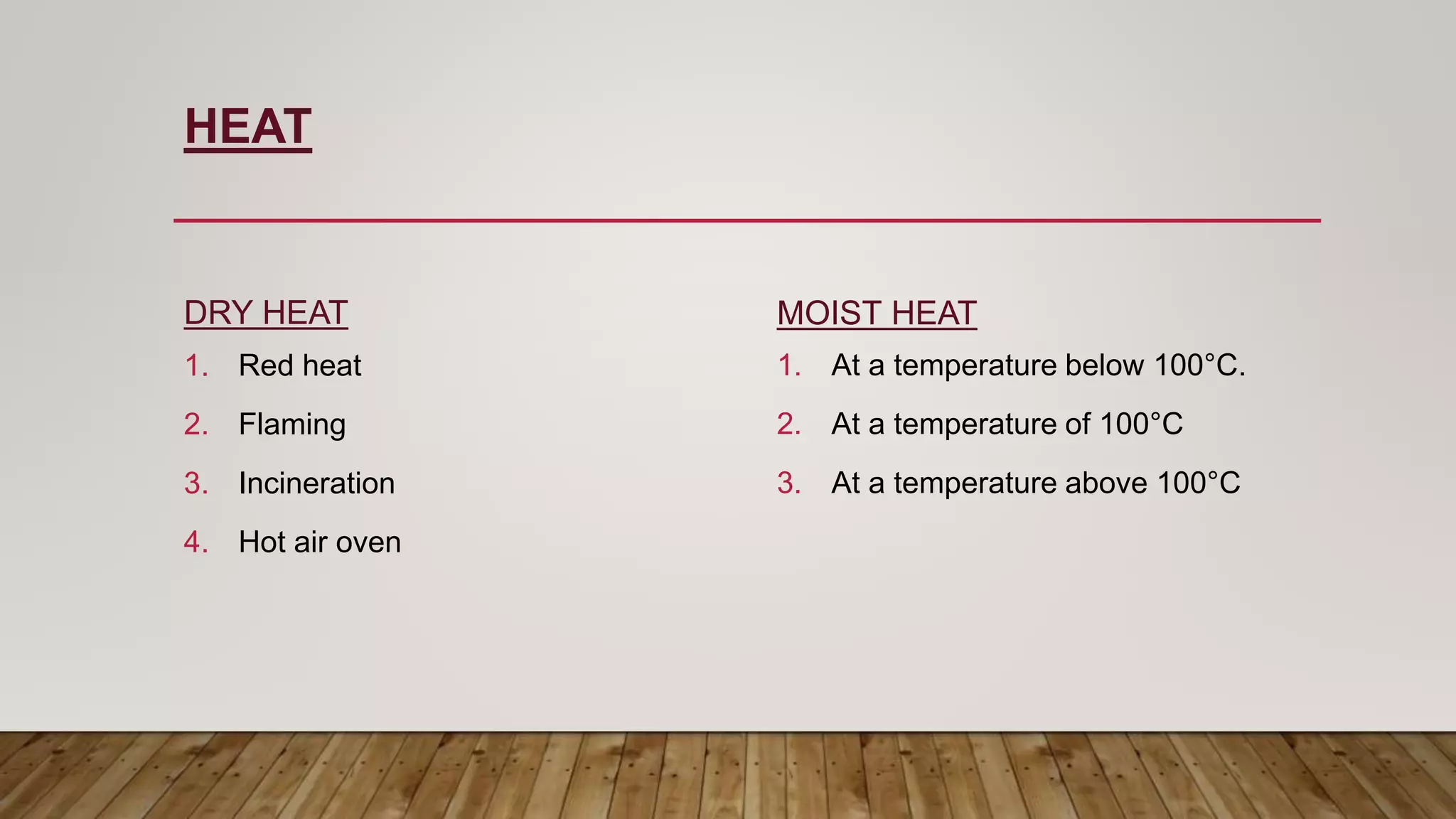
1. Red heat
2. Flaming
3. Incineration
4. Hot air oven
MOIST HEAT
1. At a temperature below 100°C.
2. At a temperature of 100°C
3. At a temperature above 100°C
DRY HEAT: KILLS ORGANISMS BY DENATURATION OF PROTEIN OXIDATIVE DAMAGE OR BY
TOXIC EFFECT OF ELEVATED ELECTROLYTES.
• Red heat.: Long time exposure in flame till they
become red hot.
Inoculation wire/loops, tips of forcep
• Flaming: Short time exposure without allowing items
to become red hot.
Mouth of test tube.
• Incineration: converting the waste into ashes.
Incinerator (870°-1200°)is used.
Disposal of biomedical waste.
DRY HEAT
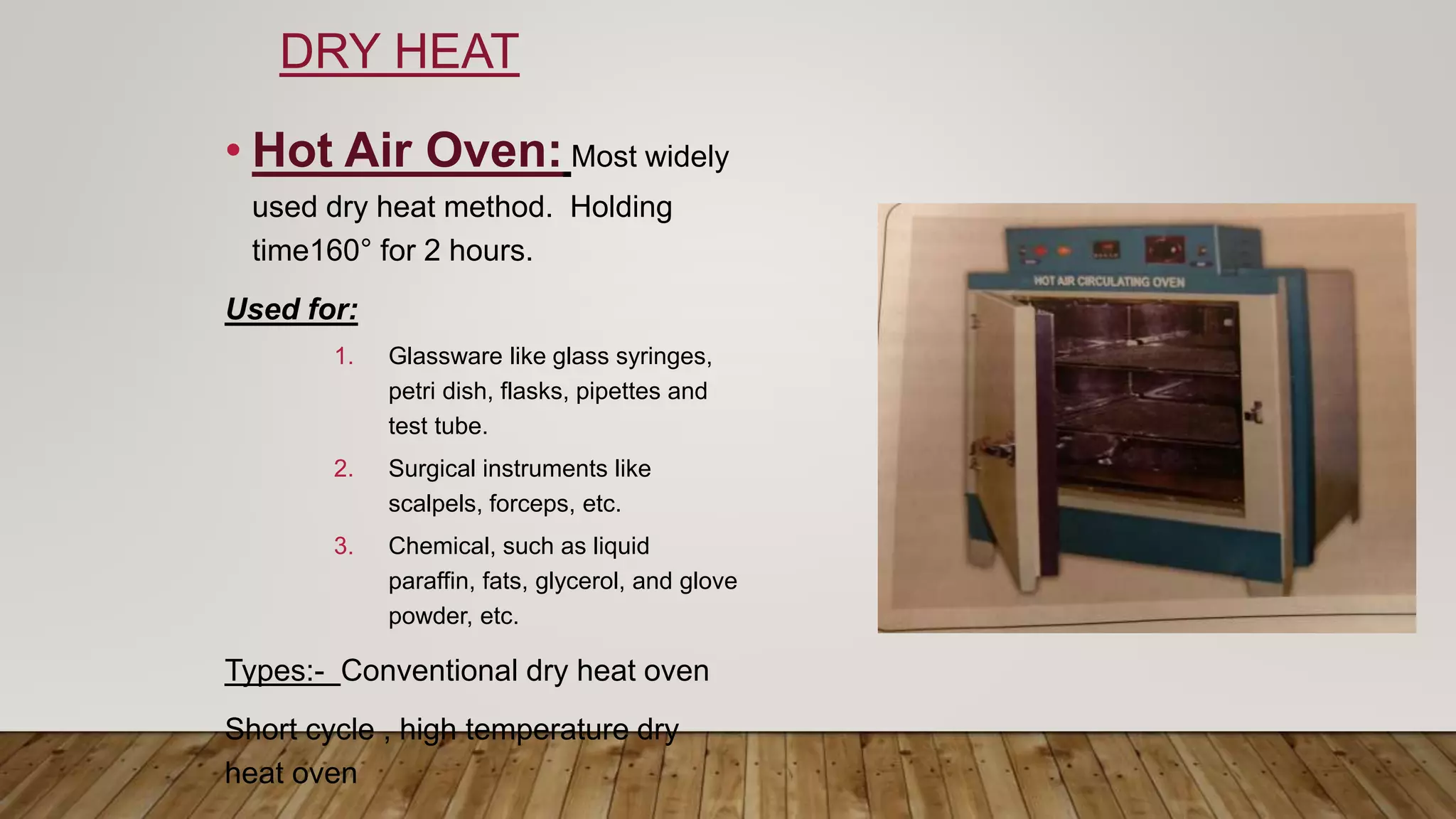
• Hot Air Oven: Most widely
used dry heat method. Holding
time160° for 2 hours.
Used for:
1. Glassware like glass syringes,
petri dish, flasks, pipettes and
test tube.
2. Surgical instruments like
scalpels, forceps, etc.
3. Chemical, such as liquid
paraffin, fats, glycerol, and glove
powder, etc.
Types:- Conventional dry heat oven
Short cycle , high temperature dry
heat oven
MOIST HEAT: KILLS ORGANISM BY DENATURATION AND
COAGULATION OF PROTEIN.
• At temperature below 100°C
• Pasteurization: used for control of microorganisms from milk.
Two methods:-
• Holder method:- 63°C for 30 minutes
• Flash method:- 72°C for 20 seconds and then rapid cooling to13°Cor lower.
Water bath:- used for serum body fluid and vaccines (60°C for 1 hour)
MOIST HEAT
Inspissation:- process of heating an
article at 80-85°C for 30 minutes.
• Inspissator use.
• Principle: first exposure kills all the
vegetative forms , and in the
intervals between the heating the
remaining spores germinate into
vegetative forms which are then
killed on subsequent heating.
• Ues for: sterilization of egg based
media LJ media and serum based
media loeffler’s serum slop.
MOIST HEAT
AT TEMPERATURE OF 100°C
• Boiling: Boiling of water for 15 minutes. Mainly used as household measure .
Not effective.
• Steaming: exposure of items which get decompose at high temperature .
Steam at 100°C for 90 minutes.
• Tyndallization or intermittent sterilization:- 100°C for 20 minutes for 3
consecutive days.
Same as inspissation but it occur at 100°C.
Used for serum egg and sugar containing media.
MOIST HEAT
AT TEMPERATURE ABOVE 100°C
AUTOCLAVE
• Most widely used, rapid and effective method.
• Works on the principle of pressure cooker.
• Water boils when vapour pressure is equal to that of
the surrounding atmosphere . So , when atmosphere
raised the boiling temperature also raised.
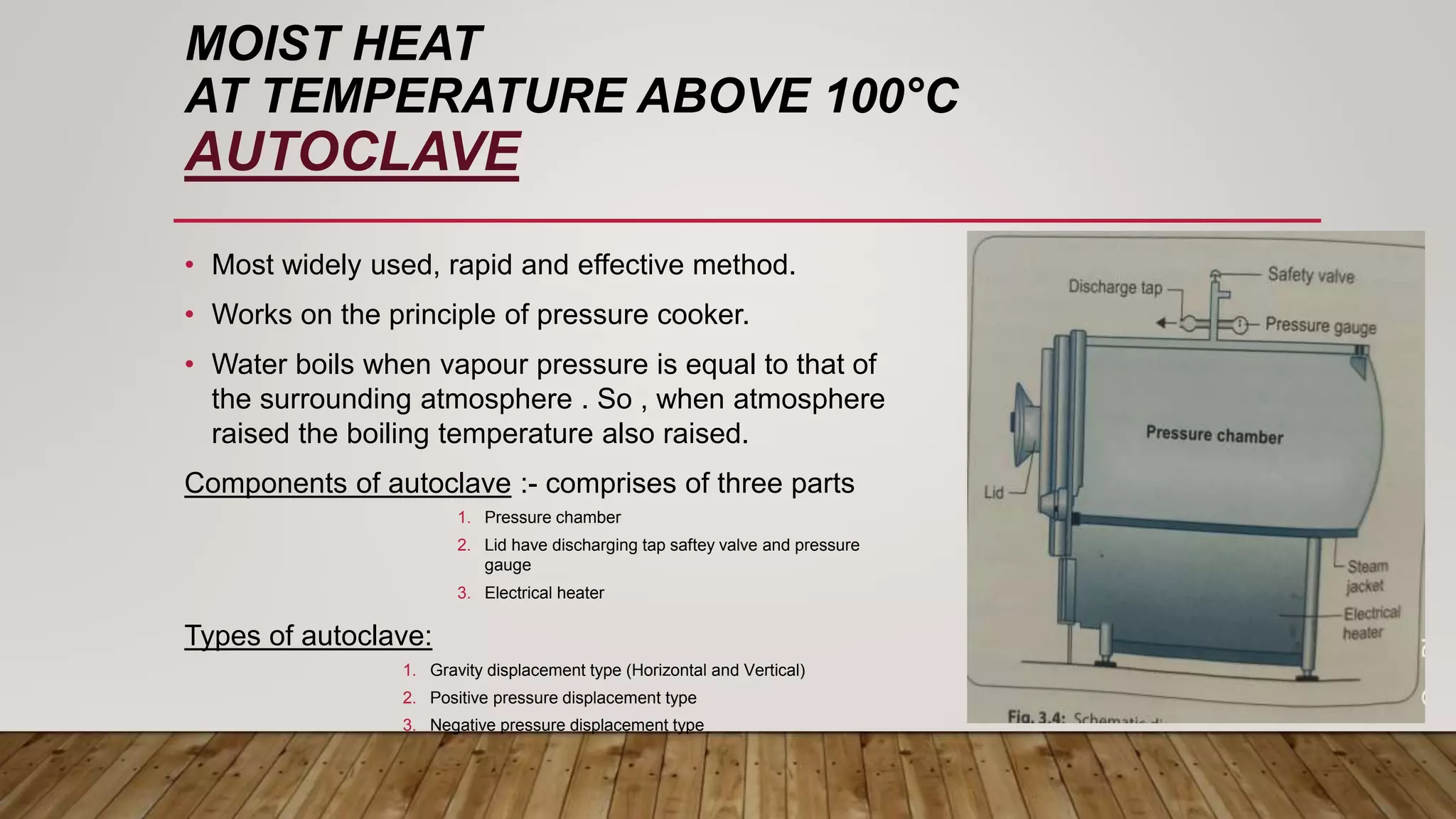
Components of autoclave :- comprises of three parts
1. Pressure chamber
2. Lid have discharging tap saftey valve and pressure
gauge
3. Electrical heater
Types of autoclave:
1. Gravity displacement type (Horizontal and Vertical)
2. Positive pressure displacement type
3. Negative pressure displacement type
MOIST HEAT
AUTOCLAVE
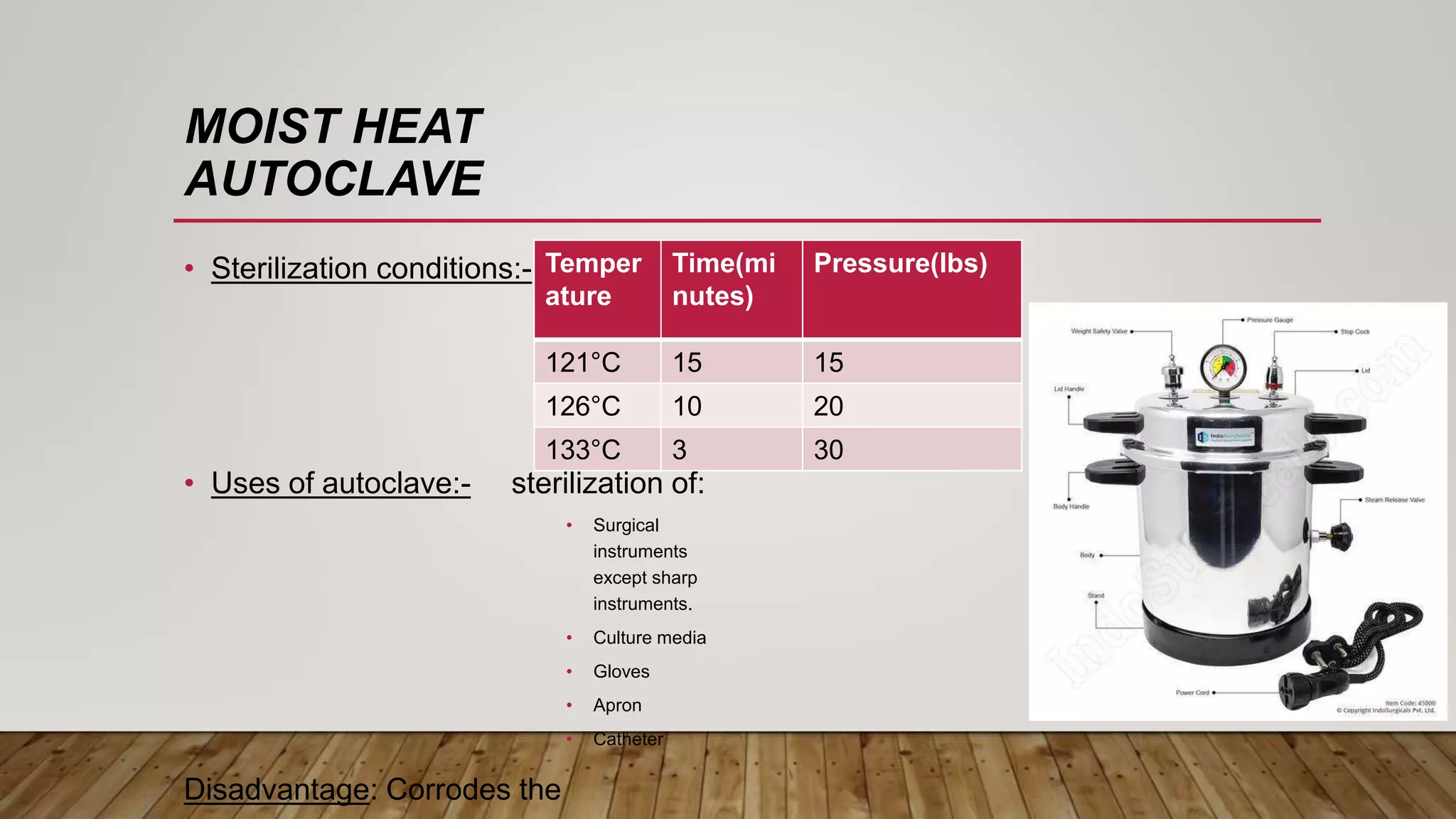
• Sterilization conditions:-
• Uses of autoclave:- sterilization of:
• Surgical
instruments
except sharp
instruments.
• Culture media
• Gloves
• Apron
• Catheter
Disadvantage: Corrodes the
Temper
ature
Time(mi
nutes)
Pressure(lbs)
121°C 15 15
126°C 10 20
133°C 3 30
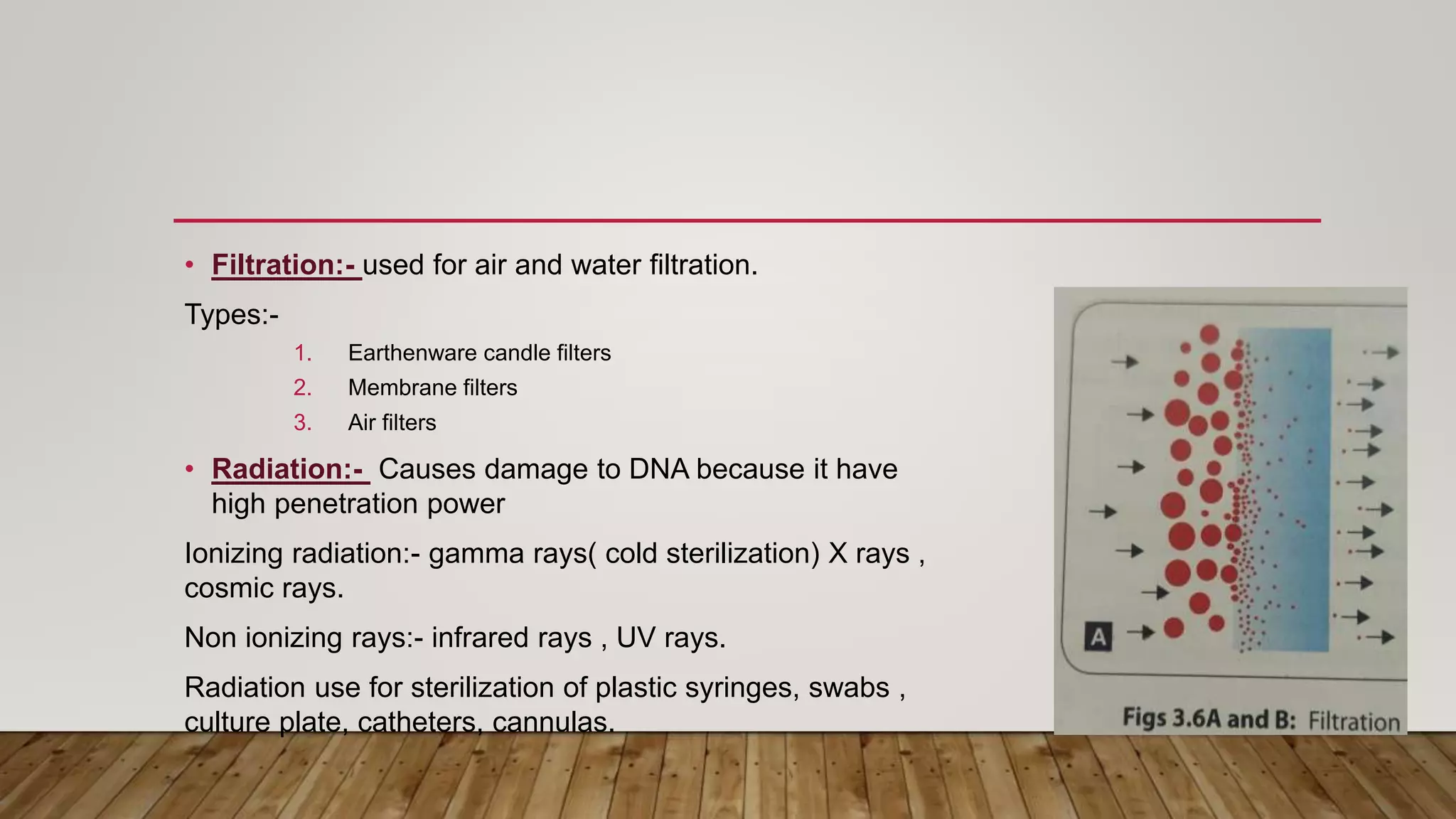
• Filtration:- used for air and water filtration.
Types:-
1. Earthenware candle filters
2. Membrane filters
3. Air filters
• Radiation:- Causes damage to DNA because it have
high penetration power
Ionizing radiation:- gamma rays( cold sterilization) X rays ,
cosmic rays.
Non ionizing rays:- infrared rays , UV rays.
Radiation use for sterilization of plastic syringes, swabs ,
culture plate, catheters, cannulas.
Ultrasonic sterilization
• It’s a safe and moder method for sterilization.
• Usually from 20 -40 kHz.
• Remove most tenacious deposits, in shortest time possible
• Less risk of cross contamination.
• Used for:- equipment of dental surgeries, hospital , chemical laboratories.
CHEMICAL METHODS OF STERILIZATION
. CHEMICAL STERILANT
• Classified into four group:- Chemical sterilant ,Low level disinfection
,Intermediate disinfectio, High level disinfections
• ALDEHYDES:- They are sporicidal.
Combine with protein and nuclei acid , inactive them
Formaldehydes, most commonly used as formalin. Used for preservation of
anatomical specimen, also formaldehydes used for fumigation of operation theaters
.
Glutaraldehydes is less toxic and less irritant than formaldehyde . So , it is used as
best steriliant for endoscopes , bronchoscopes, cytoscopes, tracheoscops.
CHEMICAL STERILANTS
OXIDIZING AGENTS
• Hydrogen peroxide act on DNA, Lipid , membrane.
• Effective concentration 3-6%, for spores10%
• Used in ventilator and contact lenses
• Paracetic Acid , more active, less than 1% is sporicidal.
• Used in hemodialyzer, also used to sterilize endoscopes
• Both also used as in plasma sterilization
Plasma sterilization:-
• Plasma refers to gases state consisting of ion , photon, free electron, and neutral
particle . These active agents kill microorganisms as well as spores.
• Plasma sterilizer is a device use to create a plasma state.
• Used for sterlization of surgical instruments.
Gaseous sterilization:-
• Ethylene oxide (ETO) widely used, combined with cell
protein . Have both microcidal and sporicidal activity.
High penetration power but highly inflammable and
carcinogenic.
Used for sterilization of petri dishes , syringes , sutures ,
catheters, respiratory and dental equipments.
• Betapropiolactone (BPL) also have sporicidal effect , it
is not used due to carcinogenic effect .
May be use for inactivation of vaccines.
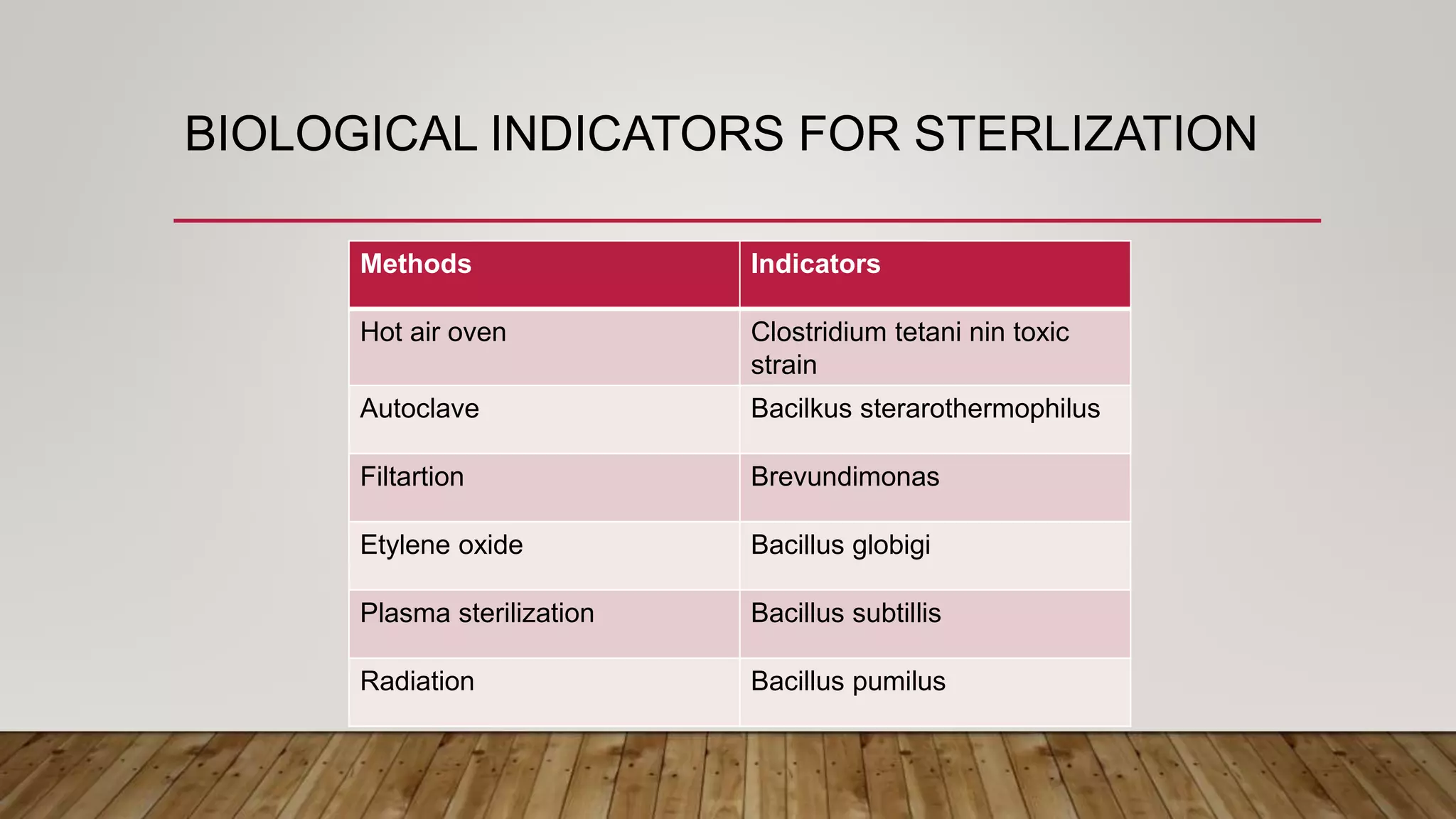
BIOLOGICAL INDICATORS FOR STERLIZATION
Methods Indicators
Hot air oven Clostridium tetani nin toxic
strain
Autoclave Bacilkus sterarothermophilus
Filtartion Brevundimonas
Etylene oxide Bacillus globigi
Plasma sterilization Bacillus subtillis
Radiation Bacillus pumilus
Chemical vapour sterilization (Chemiclave)
• Uses special chemical solution, containing formaldehyde and
alchol.
• Operate at 131°C at20 pounds for 30 minutes.
• Used for carbon steel bur , pliers
• Does not cause corrosion.
SPAULDING’S CLASSIFICATION OF MEDICAL
DEVICES
Medical Devices Defination Examples Recommended
sterilization
Critical devices Penetration of soft
tissue or bone
Forceps , scalpels,
bone chisels, scalers,
and burs
Heat based
sterilization
Chemical steriliant
Semi-critical devices Comes in contact
with mucus
membranes or minor
skin breaches
Mouth mirror.
Amalgam condensor,
probe, endoscopes.
Chemical steriliant
High degree of
disinfection
Non critical devices Comes in contact
with intact skin
BP cuffs,
thermometer,
stethoscope, X-rays
heads
Intermediate or low
degree of
disinfection.
THANK YOU
• Reference:-
1. A.S. Sastry , Sandhya Bhat
2. CP Baveja
3. Soben Peter
4. Sturdevant’s operatives dentistry.

sterilization

  • 1.
    SRI AUROBINDO COLLEGEOF DENTISTRY DEPARTMENT OF PEDODONTICS AND PREVENTIVE DENTISTRY
  • 2.
    STERILIZATION GUIDED BY:- 1. Dr.Bharath Bhushan Sir 2. Dr. Khushboo Barjatya Ma’am 3. Dr. Binti Rani Chand Ma’am 4. Dr. Preene Juneja Ma’am 5. Dr. Abhilasha M. Tripathi Ma’am 6. Dr. Hariom Meena Sir SUBMITTED BY:- Purva Bairagi ( 2017-2018) Batch Roll no. 52
  • 3.
    CONTENTS • Introduction • Definitionof sterilization • Factor influencing efficacy of sterilization • Methods of sterilization • Physical method • Chemical method • Sterilization control • Spaulding’s classification of medical devices.
  • 4.
    INTRODUCTION • Sterilization, disinfection,asepsis,and decontamination are four separate but interrelated terminologies, all aiming at removing or destroying the microorganisms from materials or from body surfaces.
  • 5.
    DEFINITION Sterilization is aprocess by which all living microorganisms, either in vegetative or in viable spores form destroy/ removed from article, body surfaces or medium.
  • 6.
    FACTOR INFLUENCEING EFFICACYOF STERILIZATION • Organism load: Larger microbial population , required more time to die. • Nature of organisms: Resistant or susceptible. • Concentration: of chemical agent • Temperature: of heat sterilization • Exposure time: is more ,better is the efficacy.
  • 7.
    METHODS OF STERILIZATION •Physical methods 1. Heat 2. Radiation 3. Filtration 4. Ultrasonic sterilization • Chemical methods 1. Aldehydes 2. Oxidizing methods 3. Plasma sterilization 4. Gas sterilization 5. Chemical Vapour pressure Sterilization (Chemiclaving)
  • 8.
    HEAT DRY HEAT 1. Redheat 2. Flaming 3. Incineration 4. Hot air oven MOIST HEAT 1. At a temperature below 100°C. 2. At a temperature of 100°C 3. At a temperature above 100°C
  • 9.
    DRY HEAT: KILLSORGANISMS BY DENATURATION OF PROTEIN OXIDATIVE DAMAGE OR BY TOXIC EFFECT OF ELEVATED ELECTROLYTES. • Red heat.: Long time exposure in flame till they become red hot. Inoculation wire/loops, tips of forcep • Flaming: Short time exposure without allowing items to become red hot. Mouth of test tube. • Incineration: converting the waste into ashes. Incinerator (870°-1200°)is used. Disposal of biomedical waste.
  • 10.
    DRY HEAT • HotAir Oven: Most widely used dry heat method. Holding time160° for 2 hours. Used for: 1. Glassware like glass syringes, petri dish, flasks, pipettes and test tube. 2. Surgical instruments like scalpels, forceps, etc. 3. Chemical, such as liquid paraffin, fats, glycerol, and glove powder, etc. Types:- Conventional dry heat oven Short cycle , high temperature dry heat oven
  • 11.
    MOIST HEAT: KILLSORGANISM BY DENATURATION AND COAGULATION OF PROTEIN. • At temperature below 100°C • Pasteurization: used for control of microorganisms from milk. Two methods:- • Holder method:- 63°C for 30 minutes • Flash method:- 72°C for 20 seconds and then rapid cooling to13°Cor lower. Water bath:- used for serum body fluid and vaccines (60°C for 1 hour)
  • 12.
    MOIST HEAT Inspissation:- processof heating an article at 80-85°C for 30 minutes. • Inspissator use. • Principle: first exposure kills all the vegetative forms , and in the intervals between the heating the remaining spores germinate into vegetative forms which are then killed on subsequent heating. • Ues for: sterilization of egg based media LJ media and serum based media loeffler’s serum slop.
  • 13.
    MOIST HEAT AT TEMPERATUREOF 100°C • Boiling: Boiling of water for 15 minutes. Mainly used as household measure . Not effective. • Steaming: exposure of items which get decompose at high temperature . Steam at 100°C for 90 minutes. • Tyndallization or intermittent sterilization:- 100°C for 20 minutes for 3 consecutive days. Same as inspissation but it occur at 100°C. Used for serum egg and sugar containing media.
  • 14.
    MOIST HEAT AT TEMPERATUREABOVE 100°C AUTOCLAVE • Most widely used, rapid and effective method. • Works on the principle of pressure cooker. • Water boils when vapour pressure is equal to that of the surrounding atmosphere . So , when atmosphere raised the boiling temperature also raised. Components of autoclave :- comprises of three parts 1. Pressure chamber 2. Lid have discharging tap saftey valve and pressure gauge 3. Electrical heater Types of autoclave: 1. Gravity displacement type (Horizontal and Vertical) 2. Positive pressure displacement type 3. Negative pressure displacement type
  • 15.
    MOIST HEAT AUTOCLAVE • Sterilizationconditions:- • Uses of autoclave:- sterilization of: • Surgical instruments except sharp instruments. • Culture media • Gloves • Apron • Catheter Disadvantage: Corrodes the Temper ature Time(mi nutes) Pressure(lbs) 121°C 15 15 126°C 10 20 133°C 3 30
  • 16.
    • Filtration:- usedfor air and water filtration. Types:- 1. Earthenware candle filters 2. Membrane filters 3. Air filters • Radiation:- Causes damage to DNA because it have high penetration power Ionizing radiation:- gamma rays( cold sterilization) X rays , cosmic rays. Non ionizing rays:- infrared rays , UV rays. Radiation use for sterilization of plastic syringes, swabs , culture plate, catheters, cannulas.
  • 17.
    Ultrasonic sterilization • It’sa safe and moder method for sterilization. • Usually from 20 -40 kHz. • Remove most tenacious deposits, in shortest time possible • Less risk of cross contamination. • Used for:- equipment of dental surgeries, hospital , chemical laboratories.
  • 18.
    CHEMICAL METHODS OFSTERILIZATION . CHEMICAL STERILANT • Classified into four group:- Chemical sterilant ,Low level disinfection ,Intermediate disinfectio, High level disinfections • ALDEHYDES:- They are sporicidal. Combine with protein and nuclei acid , inactive them Formaldehydes, most commonly used as formalin. Used for preservation of anatomical specimen, also formaldehydes used for fumigation of operation theaters . Glutaraldehydes is less toxic and less irritant than formaldehyde . So , it is used as best steriliant for endoscopes , bronchoscopes, cytoscopes, tracheoscops.
  • 19.
    CHEMICAL STERILANTS OXIDIZING AGENTS •Hydrogen peroxide act on DNA, Lipid , membrane. • Effective concentration 3-6%, for spores10% • Used in ventilator and contact lenses • Paracetic Acid , more active, less than 1% is sporicidal. • Used in hemodialyzer, also used to sterilize endoscopes • Both also used as in plasma sterilization
  • 20.
    Plasma sterilization:- • Plasmarefers to gases state consisting of ion , photon, free electron, and neutral particle . These active agents kill microorganisms as well as spores. • Plasma sterilizer is a device use to create a plasma state. • Used for sterlization of surgical instruments.
  • 21.
    Gaseous sterilization:- • Ethyleneoxide (ETO) widely used, combined with cell protein . Have both microcidal and sporicidal activity. High penetration power but highly inflammable and carcinogenic. Used for sterilization of petri dishes , syringes , sutures , catheters, respiratory and dental equipments. • Betapropiolactone (BPL) also have sporicidal effect , it is not used due to carcinogenic effect . May be use for inactivation of vaccines.
  • 22.
    BIOLOGICAL INDICATORS FORSTERLIZATION Methods Indicators Hot air oven Clostridium tetani nin toxic strain Autoclave Bacilkus sterarothermophilus Filtartion Brevundimonas Etylene oxide Bacillus globigi Plasma sterilization Bacillus subtillis Radiation Bacillus pumilus
  • 23.
    Chemical vapour sterilization(Chemiclave) • Uses special chemical solution, containing formaldehyde and alchol. • Operate at 131°C at20 pounds for 30 minutes. • Used for carbon steel bur , pliers • Does not cause corrosion.
  • 24.
    SPAULDING’S CLASSIFICATION OFMEDICAL DEVICES Medical Devices Defination Examples Recommended sterilization Critical devices Penetration of soft tissue or bone Forceps , scalpels, bone chisels, scalers, and burs Heat based sterilization Chemical steriliant Semi-critical devices Comes in contact with mucus membranes or minor skin breaches Mouth mirror. Amalgam condensor, probe, endoscopes. Chemical steriliant High degree of disinfection Non critical devices Comes in contact with intact skin BP cuffs, thermometer, stethoscope, X-rays heads Intermediate or low degree of disinfection.
  • 25.
    THANK YOU • Reference:- 1.A.S. Sastry , Sandhya Bhat 2. CP Baveja 3. Soben Peter 4. Sturdevant’s operatives dentistry.