Department of Chemical Sciences, UENR , Sunyani, Ghana
KNOWLEDGE INTEGRITY IMPACT
ORGANOMETTALLIC REACTIONS
-
1,1 AND 1,2 MIGRATORY REACTIONS
BOAKYE EMMANUEL GYAU
Department of Chemical Sciences, UENR , Sunyani, Ghana
KNOWLEDGE INTEGRITY IMPACT
TABLE OF CONTENT
 Introduction
 General fearures
 Types of Migratory Insertions
 Migration vs. Insertion
 Mechanism of 1,1 Migratory Insertion
 Mechanism of 1,2 Migratory Insertion
 Conclusion
 References
 A migratory insertion reaction is when a cisoidal anionic and
neutral ligand on a metal complex couple together to generate
a new coordinated anionic ligand.
 This new anionic ligand is composed of the original neutral and
anionic ligands now bonded to one another.
 There is NO change in the oxidation state or d electron- count
of the metal center
Migratory Insertion
3
Wednesday, July 3, 2024 Department of Chemical Sciences, UENR
 Ligand Insertions is reversible
 No change in formal oxidation state of the metal
 The two groups that react must be cisoidal to one another
 A vacant coordination site is generated by the migratory insertion.
Therefore, a vacant site is required for the back elimination reaction. A
trapping ligand is often needed to coordinate to the empty site formed
from a migratory insertion in order to stop the back elimination
reaction.
General Featuresof Migratory Insertion
4
Wednesday, July 3, 2024 Department of Chemical Sciences, UENR
 Migratory insertions are usually favored on more electron-deficient
metal centers.
 Ligands that undergo must have pi bonds present (eg- CO)
 Common anionic and neutral ligands that can do migratory insertion
reactions with one another:
 Anionic: H-, R- (alkyl), Ar- (aryl), acyl-, O2- (oxo)
 Neutral: CO, alkenes, alkynes, carbenes
 No change in overall charge of the complex
 If 2 akyle groups are attached to the metal, the electron rich group is
migrated.
General Features of Migratory Insertion
5
Wednesday, July 3, 2024 Department of Chemical Sciences, UENR
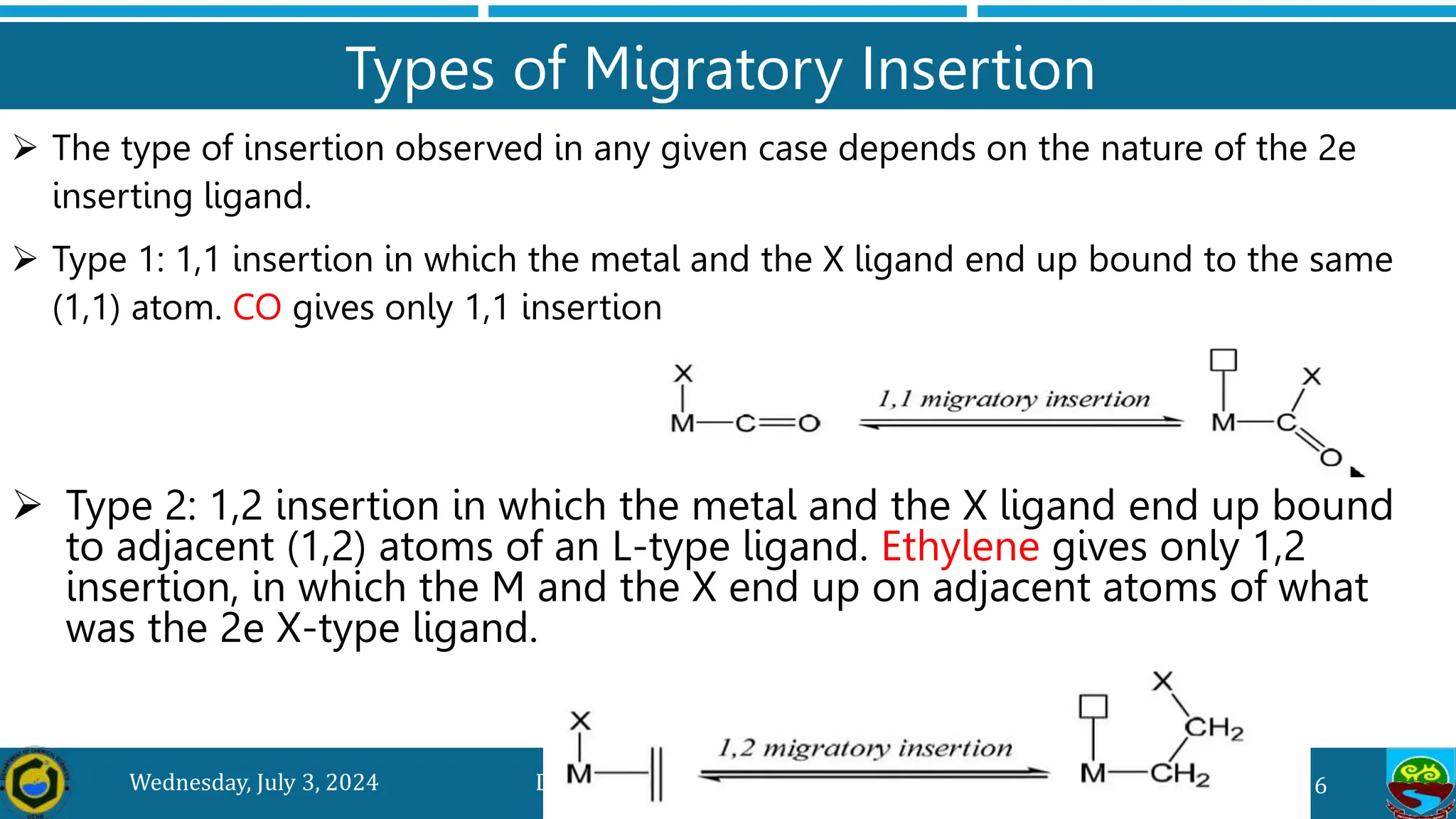
 The type of insertion observed in any given case depends on the nature of the 2e
inserting ligand.
 Type 1: 1,1 insertion in which the metal and the X ligand end up bound to the same
(1,1) atom. CO gives only 1,1 insertion
 Type 2: 1,2 insertion in which the metal and the X ligand end up bound
to adjacent (1,2) atoms of an L-type ligand. Ethylene gives only 1,2
insertion, in which the M and the X end up on adjacent atoms of what
was the 2e X-type ligand.
Types of Migratory Insertion
6
Wednesday, July 3, 2024 Department of Chemical Sciences, UENR
 There are two different “directions” that a migratory insertion
can occur.
 A migration is when the anionic ligand moves and performs a
nucleophillic-like intramolecular attack on the electrophillic
neutral ligand.
 An insertion is when the neutral ligand moves and “inserts” into
the bond between the metal and anionic ligand. Both of these
pathways are illustrated below
Migration vs. Insertion
7
Wednesday, July 3, 2024 Department of Chemical Sciences, UENR
KNOWLEDGE INTEGRITY IMPACT
Wednesday, July 3, 2024 Department of Chemical Sciences, UENR 8
Department of Chemical Sciences, UENR , Sunyani, Ghana
KNOWLEDGE INTEGRITY IMPACT
Wednesday, July 3, 2024
Department of Chemical Sciences, UENR 9
 Principle- the migrating group will migrate to the cis ligand attached to it
 Steps
 The reaction starts with a metal complex where the metal (M) is bonded to an alkyl or
aryl group (R) and an unsaturated ligand (L), such as an alkene, alkyne, or CO
 The alkyl or aryl group (R) migrates to the same ligand site of the unsaturated ligand
(L) leading to the formation of a new bond between R and L at the same metal center.
Reaction Mechanism of 1,1 Migratory Insertion
10
Wednesday, July 3, 2024 Department of Chemical Sciences, UENR
Reaction Mechanisms of 1,1 Migratory Insertion
11
Wednesday, July 3, 2024 Department of Chemical Sciences, UENR
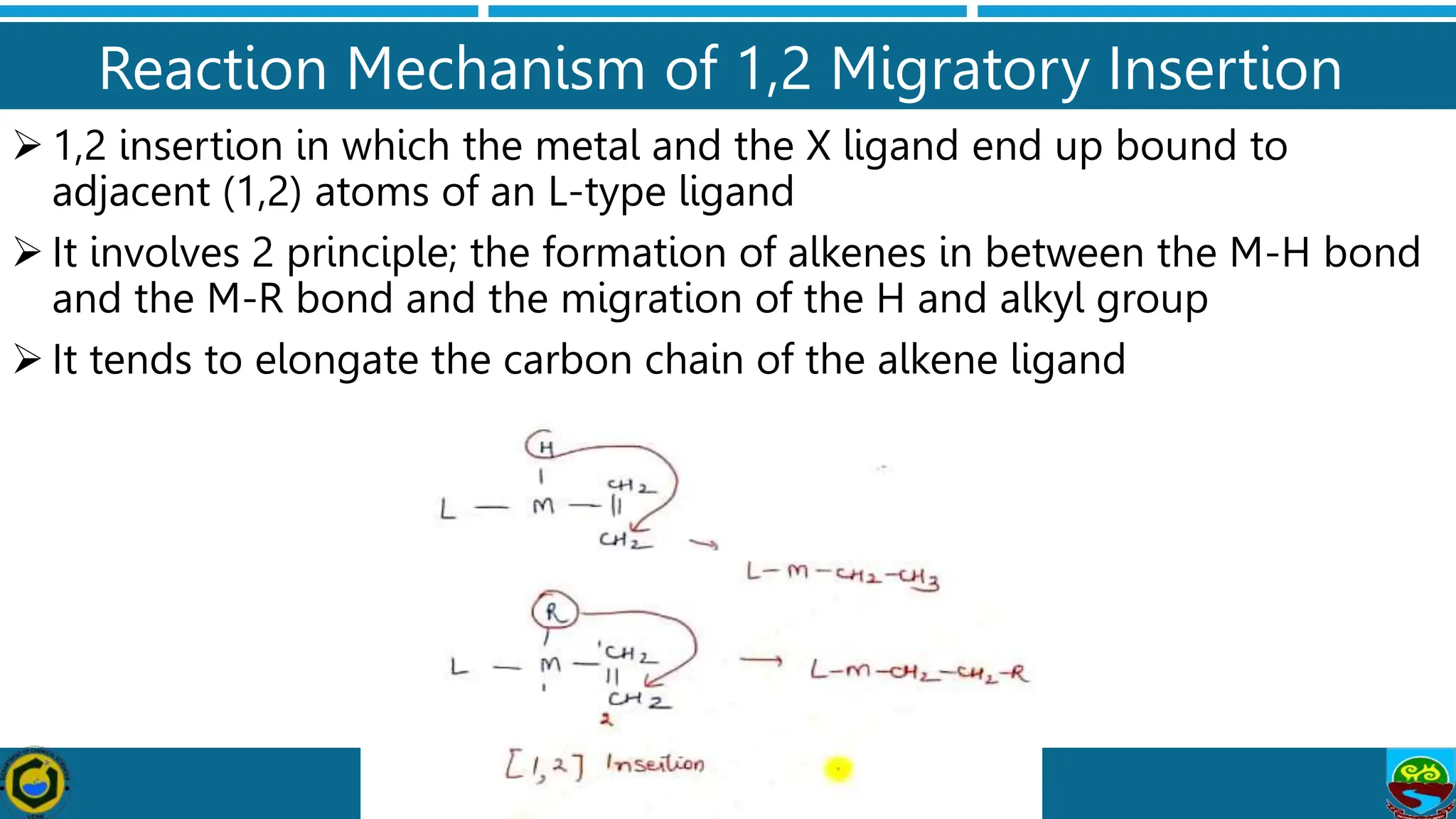
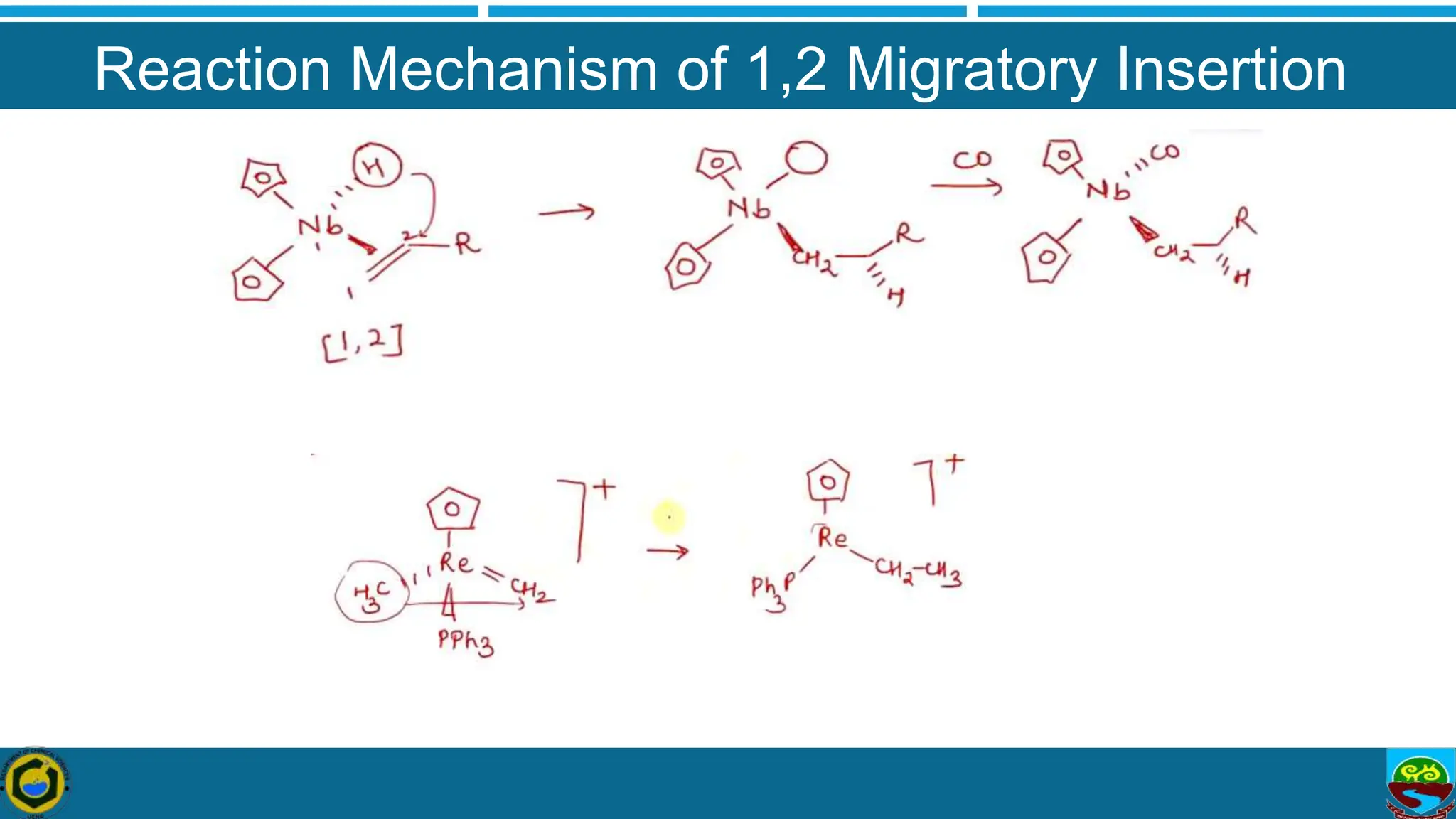
 1,2 insertion in which the metal and the X ligand end up bound to
adjacent (1,2) atoms of an L-type ligand
 It involves 2 principle; the formation of alkenes in between the M-H bond
and the M-R bond and the migration of the H and alkyl group
 It tends to elongate the carbon chain of the alkene ligand
Reaction Mechanism of 1,2 Migratory Insertion
 Fristrup, Peter; Kreis, Michael; Palmelund, Anders; Norrby, Per-Ola; Madsen, Robert (2008). "The
Mechanism for the Rhodium-Catalyzed Decarbonylation of Aldehydes: A Combined Experimental and
Theoretical Study". J. Am. Chem. Soc. 130 (15): 5206–5215. doi:10.1021/ja710270
 Hartwig, J. F. (2010). Organotransition Metal Chemistry, from Bonding to Catalysis. New York, NY:
University Science Books. ISBN 978-1-891389-53-5.
 Burger, B. J.; Thompson, M. E.; Cotter, W. D.; Bercaw, J. E. (1990). "Ethylene Insertion and β-
hydrogen Elimination for Permethylscandocene Alkyl Complexes. A Study of the Chain Propagation
and Termination Steps in Ziegler-Natta Polymerization of Ethylene". J. Am. Chem. Soc. 112 (4): 1566–
1577.
REFERENCES
Thank You

1,1 and 1,2 Migratory insertion reactions.pptx

  • 1.
    Department of ChemicalSciences, UENR , Sunyani, Ghana KNOWLEDGE INTEGRITY IMPACT ORGANOMETTALLIC REACTIONS - 1,1 AND 1,2 MIGRATORY REACTIONS BOAKYE EMMANUEL GYAU
  • 2.
    Department of ChemicalSciences, UENR , Sunyani, Ghana KNOWLEDGE INTEGRITY IMPACT TABLE OF CONTENT  Introduction  General fearures  Types of Migratory Insertions  Migration vs. Insertion  Mechanism of 1,1 Migratory Insertion  Mechanism of 1,2 Migratory Insertion  Conclusion  References
  • 3.
     A migratoryinsertion reaction is when a cisoidal anionic and neutral ligand on a metal complex couple together to generate a new coordinated anionic ligand.  This new anionic ligand is composed of the original neutral and anionic ligands now bonded to one another.  There is NO change in the oxidation state or d electron- count of the metal center Migratory Insertion 3 Wednesday, July 3, 2024 Department of Chemical Sciences, UENR
  • 4.
     Ligand Insertionsis reversible  No change in formal oxidation state of the metal  The two groups that react must be cisoidal to one another  A vacant coordination site is generated by the migratory insertion. Therefore, a vacant site is required for the back elimination reaction. A trapping ligand is often needed to coordinate to the empty site formed from a migratory insertion in order to stop the back elimination reaction. General Featuresof Migratory Insertion 4 Wednesday, July 3, 2024 Department of Chemical Sciences, UENR
  • 5.
     Migratory insertionsare usually favored on more electron-deficient metal centers.  Ligands that undergo must have pi bonds present (eg- CO)  Common anionic and neutral ligands that can do migratory insertion reactions with one another:  Anionic: H-, R- (alkyl), Ar- (aryl), acyl-, O2- (oxo)  Neutral: CO, alkenes, alkynes, carbenes  No change in overall charge of the complex  If 2 akyle groups are attached to the metal, the electron rich group is migrated. General Features of Migratory Insertion 5 Wednesday, July 3, 2024 Department of Chemical Sciences, UENR
  • 6.
     The typeof insertion observed in any given case depends on the nature of the 2e inserting ligand.  Type 1: 1,1 insertion in which the metal and the X ligand end up bound to the same (1,1) atom. CO gives only 1,1 insertion  Type 2: 1,2 insertion in which the metal and the X ligand end up bound to adjacent (1,2) atoms of an L-type ligand. Ethylene gives only 1,2 insertion, in which the M and the X end up on adjacent atoms of what was the 2e X-type ligand. Types of Migratory Insertion 6 Wednesday, July 3, 2024 Department of Chemical Sciences, UENR
  • 7.
     There aretwo different “directions” that a migratory insertion can occur.  A migration is when the anionic ligand moves and performs a nucleophillic-like intramolecular attack on the electrophillic neutral ligand.  An insertion is when the neutral ligand moves and “inserts” into the bond between the metal and anionic ligand. Both of these pathways are illustrated below Migration vs. Insertion 7 Wednesday, July 3, 2024 Department of Chemical Sciences, UENR
  • 8.
    KNOWLEDGE INTEGRITY IMPACT Wednesday,July 3, 2024 Department of Chemical Sciences, UENR 8
  • 9.
    Department of ChemicalSciences, UENR , Sunyani, Ghana KNOWLEDGE INTEGRITY IMPACT Wednesday, July 3, 2024 Department of Chemical Sciences, UENR 9
  • 10.
     Principle- themigrating group will migrate to the cis ligand attached to it  Steps  The reaction starts with a metal complex where the metal (M) is bonded to an alkyl or aryl group (R) and an unsaturated ligand (L), such as an alkene, alkyne, or CO  The alkyl or aryl group (R) migrates to the same ligand site of the unsaturated ligand (L) leading to the formation of a new bond between R and L at the same metal center. Reaction Mechanism of 1,1 Migratory Insertion 10 Wednesday, July 3, 2024 Department of Chemical Sciences, UENR
  • 11.
    Reaction Mechanisms of1,1 Migratory Insertion 11 Wednesday, July 3, 2024 Department of Chemical Sciences, UENR
  • 12.
     1,2 insertionin which the metal and the X ligand end up bound to adjacent (1,2) atoms of an L-type ligand  It involves 2 principle; the formation of alkenes in between the M-H bond and the M-R bond and the migration of the H and alkyl group  It tends to elongate the carbon chain of the alkene ligand Reaction Mechanism of 1,2 Migratory Insertion
  • 13.
    Reaction Mechanism of1,2 Migratory Insertion
  • 14.
     Fristrup, Peter;Kreis, Michael; Palmelund, Anders; Norrby, Per-Ola; Madsen, Robert (2008). "The Mechanism for the Rhodium-Catalyzed Decarbonylation of Aldehydes: A Combined Experimental and Theoretical Study". J. Am. Chem. Soc. 130 (15): 5206–5215. doi:10.1021/ja710270  Hartwig, J. F. (2010). Organotransition Metal Chemistry, from Bonding to Catalysis. New York, NY: University Science Books. ISBN 978-1-891389-53-5.  Burger, B. J.; Thompson, M. E.; Cotter, W. D.; Bercaw, J. E. (1990). "Ethylene Insertion and β- hydrogen Elimination for Permethylscandocene Alkyl Complexes. A Study of the Chain Propagation and Termination Steps in Ziegler-Natta Polymerization of Ethylene". J. Am. Chem. Soc. 112 (4): 1566– 1577. REFERENCES
  • 15.