AIR POLLUTION AND GREEN HOUSE
EFFECT
Dr. Nilesh R. Thakare
Department of chemistry
Shri Shivaji Science College,
Amravati.
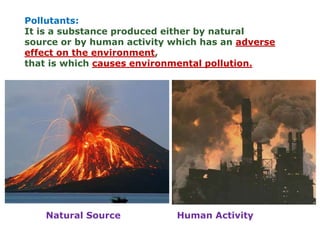
Pollutants:
It is a substance produced either by natural
source or by human activity which has an adverse
effect on the environment,
that is which causes environmental pollution.
Natural Source Human Activity
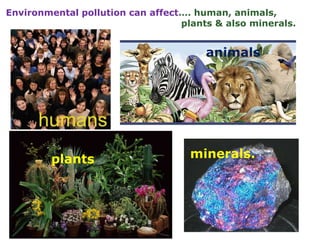
Environmental pollution can affect…. human, animals,
plants & also minerals.
plants
animals
minerals.
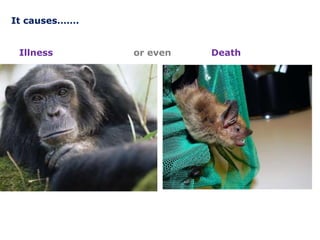
It causes…….
Illness or even Death
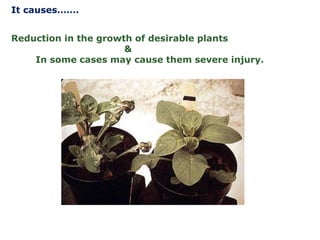
Reduction in the growth of desirable plants
&
In some cases may cause them severe injury.
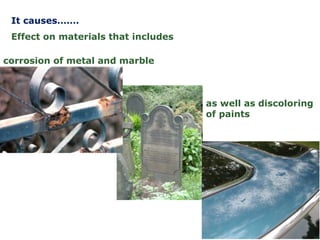
It causes…….
Effect on materials that includes
as well as discoloring
of paints
It causes…….
corrosion of metal and marble
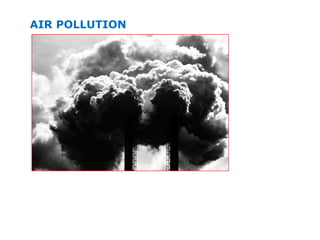
AIR POLLUTION
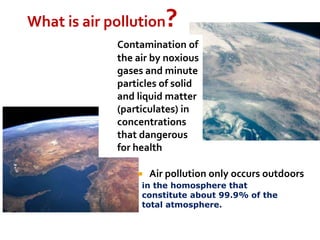
What is air pollution?
 Air pollution only occurs outdoors
in the homosphere that
constitute about 99.9% of the
total atmosphere.
Contamination of
the air by noxious
gases and minute
particles of solid
and liquid matter
(particulates) in
concentrations
that dangerous
for health
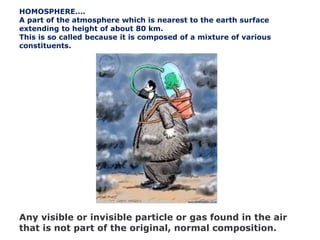
Any visible or invisible particle or gas found in the air
that is not part of the original, normal composition.
HOMOSPHERE….
A part of the atmosphere which is nearest to the earth surface
extending to height of about 80 km.
This is so called because it is composed of a mixture of various
constituents.
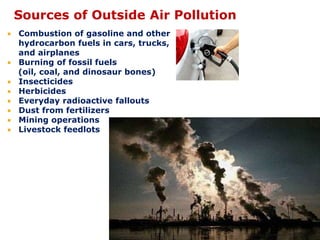
Sources of Outside Air Pollution
 Combustion of gasoline and other
hydrocarbon fuels in cars, trucks,
and airplanes
 Burning of fossil fuels
(oil, coal, and dinosaur bones)
 Insecticides
 Herbicides
 Everyday radioactive fallouts
 Dust from fertilizers
 Mining operations
 Livestock feedlots
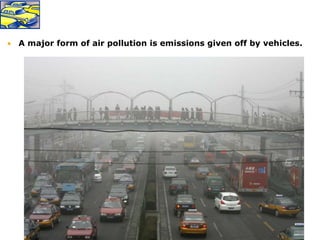
 A major form of air pollution is emissions given off by vehicles.
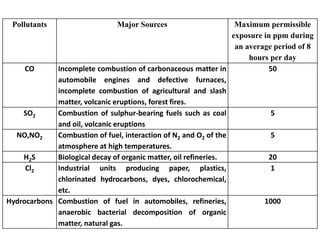
Pollutants Major Sources Maximum permissible
exposure in ppm during
an average period of 8
hours per day
CO Incomplete combustion of carbonaceous matter in
automobile engines and defective furnaces,
incomplete combustion of agricultural and slash
matter, volcanic eruptions, forest fires.
50
SO2 Combustion of sulphur-bearing fuels such as coal
and oil, volcanic eruptions
5
NO,NO2 Combustion of fuel, interaction of N2 and O2 of the
atmosphere at high temperatures.
5
H2S Biological decay of organic matter, oil refineries. 20
Cl2 Industrial units producing paper, plastics,
chlorinated hydrocarbons, dyes, chlorochemical,
etc.
1
Hydrocarbons Combustion of fuel in automobiles, refineries,
anaerobic bacterial decomposition of organic
matter, natural gas.
1000
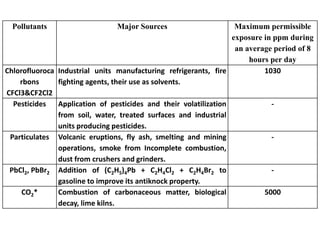
Pollutants Major Sources Maximum permissible
exposure in ppm during
an average period of 8
hours per day
Chlorofluoroca
rbons
CFCl3&CF2Cl2
Industrial units manufacturing refrigerants, fire
fighting agents, their use as solvents.
1030
Pesticides Application of pesticides and their volatilization
from soil, water, treated surfaces and industrial
units producing pesticides.
-
Particulates Volcanic eruptions, fly ash, smelting and mining
operations, smoke from Incomplete combustion,
dust from crushers and grinders.
-
PbCl2, PbBr2 Addition of (C2H5)4Pb + C2H4Cl2 + C2H4Br2 to
gasoline to improve its antiknock property.
-
CO2* Combustion of carbonaceous matter, biological
decay, lime kilns.
5000
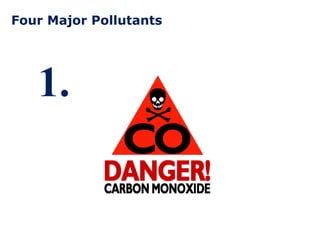
1.
Four Major Pollutants
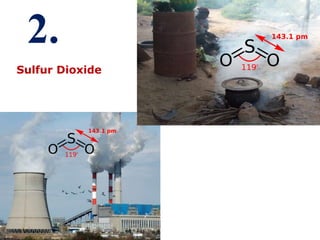
Sulfur Dioxide
2.
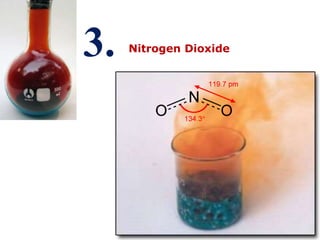
Nitrogen Dioxide3.
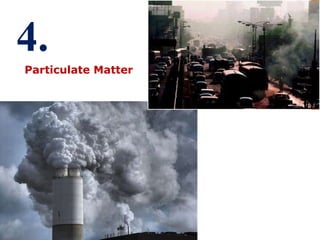
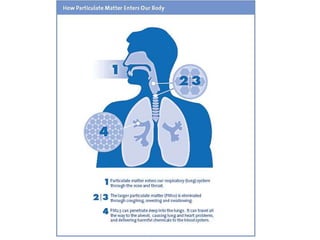
Particulate Matter
4.
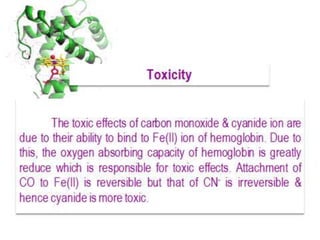
•Colorless, odorless gas
•Originates from incomplete combustion of
carbonaceous matter in automobile engine and
defective furnace.
•Present in car exhaust
Carbon Monoxide
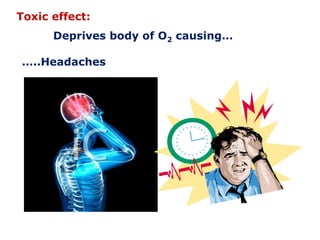
…..Headaches
Toxic effect:
Deprives body of O2 causing…
…..Fatigue
……Impaired vision..
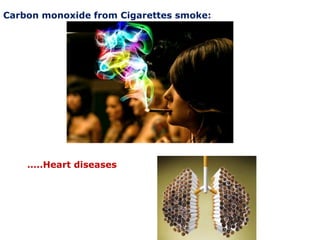
Carbon monoxide from Cigarettes smoke:
…..Heart diseases
Sulfur Dioxide
•a heavy, colorless gas with an odor like a struck match.
•Most harmful gas released into atmosphere through Volcanic
eruption (natural activity)
•Produced when coal and fuel oil are burned(human activity)
•Roasting of sulphide ores
•Present in power plant exhaust
•Narrows the airway, causing wheezing and shortness of breath,
especially in those with asthma.
•Sulfur Dioxide Ninety-five percent of pollution related sulfur oxide emissions
are in the form of sulfur dioxide (SO2),
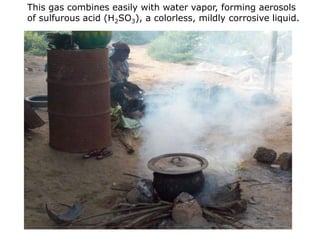
This gas combines easily with water vapor, forming aerosols
of sulfurous acid (H2SO3), a colorless, mildly corrosive liquid.

Health Effects of Sulfur Oxides :
Irritate the respiratory system.
Exposure to high concentrations for short periods
of time can constrict the bronchi and increase
mucous flow, making breathing difficult.
Children, the elderly, those with chronic lung
disease, and asthmatics are especially
susceptible to these effects.
•Narrows the airway, causing wheezing and
shortness of breath, especially in those with asthma
Avoid This
Follow
Follow this
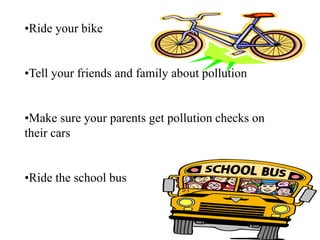
•Ride your bike
•Tell your friends and family about pollution
•Make sure your parents get pollution checks on
their cars
•Ride the school bus
•Learn more; stay up to date
•Join a group to stop pollution
•Encourage your parents to carpool to work
•Switch off lights, fan, heat, etc. when you
leave the room
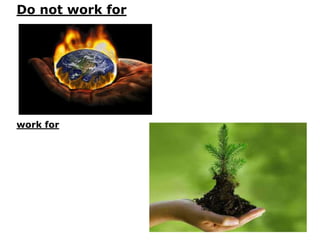
Do not work for
work for
 What is Acid Rain
 What is Photochemical Smog
 What are theToxic Effects of Air pollution
 What are the Major Sources of Air Pollution
 What we can do to reduce Air Pollution
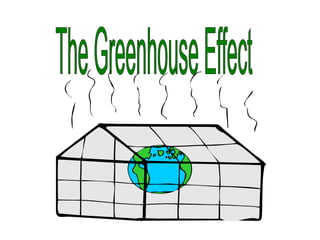
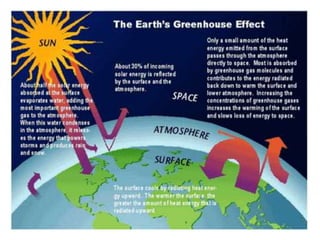
 What is Green House effect
 What are Green House Gases
 How Acid Rain affects our surroundings
THANKS

Nrt air pollution 1

  • 1.
    AIR POLLUTION ANDGREEN HOUSE EFFECT Dr. Nilesh R. Thakare Department of chemistry Shri Shivaji Science College, Amravati.
  • 2.
    Pollutants: It is asubstance produced either by natural source or by human activity which has an adverse effect on the environment, that is which causes environmental pollution. Natural Source Human Activity
  • 3.
    Environmental pollution canaffect…. human, animals, plants & also minerals. plants animals minerals.
  • 4.
  • 5.
    Reduction in thegrowth of desirable plants & In some cases may cause them severe injury. It causes…….
  • 6.
    Effect on materialsthat includes as well as discoloring of paints It causes……. corrosion of metal and marble
  • 7.
  • 8.
    What is airpollution?  Air pollution only occurs outdoors in the homosphere that constitute about 99.9% of the total atmosphere. Contamination of the air by noxious gases and minute particles of solid and liquid matter (particulates) in concentrations that dangerous for health
  • 9.
    Any visible orinvisible particle or gas found in the air that is not part of the original, normal composition. HOMOSPHERE…. A part of the atmosphere which is nearest to the earth surface extending to height of about 80 km. This is so called because it is composed of a mixture of various constituents.
  • 10.
    Sources of OutsideAir Pollution  Combustion of gasoline and other hydrocarbon fuels in cars, trucks, and airplanes  Burning of fossil fuels (oil, coal, and dinosaur bones)  Insecticides  Herbicides  Everyday radioactive fallouts  Dust from fertilizers  Mining operations  Livestock feedlots
  • 11.
     A majorform of air pollution is emissions given off by vehicles.
  • 12.
    Pollutants Major SourcesMaximum permissible exposure in ppm during an average period of 8 hours per day CO Incomplete combustion of carbonaceous matter in automobile engines and defective furnaces, incomplete combustion of agricultural and slash matter, volcanic eruptions, forest fires. 50 SO2 Combustion of sulphur-bearing fuels such as coal and oil, volcanic eruptions 5 NO,NO2 Combustion of fuel, interaction of N2 and O2 of the atmosphere at high temperatures. 5 H2S Biological decay of organic matter, oil refineries. 20 Cl2 Industrial units producing paper, plastics, chlorinated hydrocarbons, dyes, chlorochemical, etc. 1 Hydrocarbons Combustion of fuel in automobiles, refineries, anaerobic bacterial decomposition of organic matter, natural gas. 1000
  • 13.
    Pollutants Major SourcesMaximum permissible exposure in ppm during an average period of 8 hours per day Chlorofluoroca rbons CFCl3&CF2Cl2 Industrial units manufacturing refrigerants, fire fighting agents, their use as solvents. 1030 Pesticides Application of pesticides and their volatilization from soil, water, treated surfaces and industrial units producing pesticides. - Particulates Volcanic eruptions, fly ash, smelting and mining operations, smoke from Incomplete combustion, dust from crushers and grinders. - PbCl2, PbBr2 Addition of (C2H5)4Pb + C2H4Cl2 + C2H4Br2 to gasoline to improve its antiknock property. - CO2* Combustion of carbonaceous matter, biological decay, lime kilns. 5000
  • 14.
  • 15.
  • 16.
  • 17.
  • 19.
    •Colorless, odorless gas •Originatesfrom incomplete combustion of carbonaceous matter in automobile engine and defective furnace. •Present in car exhaust Carbon Monoxide
  • 21.
  • 22.
  • 23.
  • 24.
    Carbon monoxide fromCigarettes smoke: …..Heart diseases
  • 25.
    Sulfur Dioxide •a heavy,colorless gas with an odor like a struck match. •Most harmful gas released into atmosphere through Volcanic eruption (natural activity) •Produced when coal and fuel oil are burned(human activity) •Roasting of sulphide ores •Present in power plant exhaust •Narrows the airway, causing wheezing and shortness of breath, especially in those with asthma. •Sulfur Dioxide Ninety-five percent of pollution related sulfur oxide emissions are in the form of sulfur dioxide (SO2),
  • 26.
    This gas combineseasily with water vapor, forming aerosols of sulfurous acid (H2SO3), a colorless, mildly corrosive liquid.
  • 27.
    Health Effects ofSulfur Oxides : Irritate the respiratory system. Exposure to high concentrations for short periods of time can constrict the bronchi and increase mucous flow, making breathing difficult. Children, the elderly, those with chronic lung disease, and asthmatics are especially susceptible to these effects. •Narrows the airway, causing wheezing and shortness of breath, especially in those with asthma
  • 35.
  • 36.
  • 37.
  • 38.
    •Ride your bike •Tellyour friends and family about pollution •Make sure your parents get pollution checks on their cars •Ride the school bus
  • 39.
    •Learn more; stayup to date •Join a group to stop pollution •Encourage your parents to carpool to work •Switch off lights, fan, heat, etc. when you leave the room
  • 41.
    Do not workfor work for
  • 42.
     What isAcid Rain  What is Photochemical Smog  What are theToxic Effects of Air pollution  What are the Major Sources of Air Pollution  What we can do to reduce Air Pollution  What is Green House effect  What are Green House Gases  How Acid Rain affects our surroundings
  • 43.