
• Recognized as most critical for development
• Most commonly used metals in the world
• Steel, the most recycled material in the
world today
• Produced in more than 50 countries
• Rapid industrialization created a huge
demand for Steel
• Major Steel producing countries
• China 31%
• Japan 10%
• USA 8%
• Russia 6%
• South Korea 4%
Source: CBR
• Production range 2 million tons to 3 million
tons per year in last 9 years
• Demand has increased at rapid rate recently
Source: CBR
0
1000
2000
3000
4000
5000
6000
7000
8000
9000
2004 2005 2006 2007 2008 2009 2010 2011 2012 2013 2014 2015
Domestic Production Imports Total Consumption
Avg. Growth Rate: 5%
Source: Engineering Pakistan
In 000 Tones
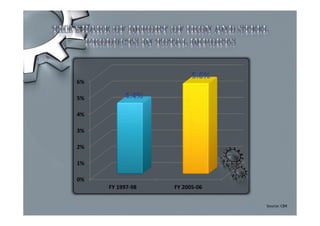
0%
1%
2%
3%
4%
5%
6%
FY 1997-98 FY 2005-06
Source: CBR
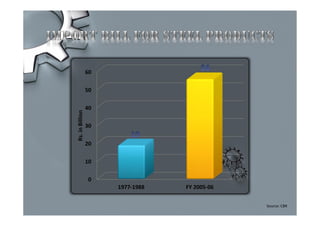
0
10
20
30
40
50
60
1977-1988 FY 2005-06
Rs.inBillion
Source: CBR
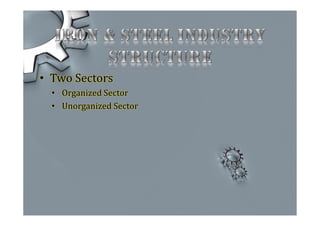
• Two Sectors
• Organized Sector
• Unorganized Sector
• Major Players
• Pakistan Steel (PS)
• Pakistan Steel Mill (PSM)
• Steel Pipe Mills
Source: Engineering Pakistan
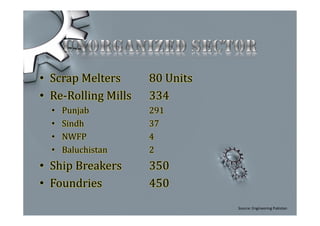
• Scrap Melters 80 Units
• Re-Rolling Mills 334
• Punjab 291
• Sindh 37
• NWFP 4
• Baluchistan 2
• Ship Breakers 350
• Foundries 450
Source: Engineering Pakistan
• Ship Breaking
• Steel Melters
• Steel Rollers
• Steel Pipe Industry
• Provides ship plates for re-rolling industry
• Based in Gadani, Balochistan
• Annual production ranges between 50,000 –
100,000 metric tons
• The number of employees working are up to
4000
• Produce and sell ingots and cast billets
• Produced by melting Steel scrap in Electric
Furnaces
• Currently about 120 Steel furnaces are
operating
• 15000 labor force is employed
• Production 3 million metric tons in 2005-06
• These units roll billets/ingots
• Raw Materials: Steel billets, ingots, cast
billets and ship plates
• Products: Steel bars, flat, tee Iron, channels,
girders and wires etc
• Installed Capacity is around 4 million tons
• 20,000 labor force is employed
• Non-existent at the time of independence
• Currently its installed capacity is 525,000
tons per year
• Able to produce seamless, seam welded,
spiral welded and arc-welded pipes
• Approximately 3500 people are employed
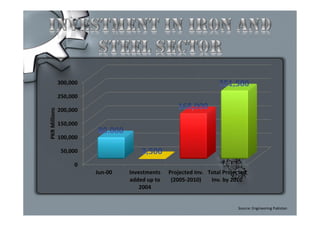
0
50,000
100,000
150,000
200,000
250,000
300,000
Jun-00 Investments
added up to
2004
Projected Inv.
(2005-2010)
Total Projected
Inv. by 2010
PKRMillions
Source: Engineering Pakistan
0
50
100
150
200
250
300
350
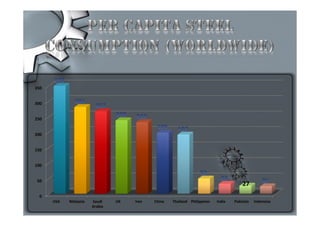
USA Malaysia Saudi
Arabia
UK Iran China Thailand Philippines India Pakistan Indonesia
27
0
5
10
15
20
25
30
35
40
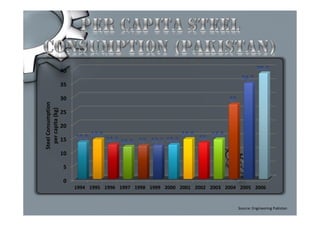
1994 1995 1996 1997 1998 1999 2000 2001 2002 2003 2004 2005 2006
SteelConsumption
percapita(kg)
Source: Engineering Pakistan
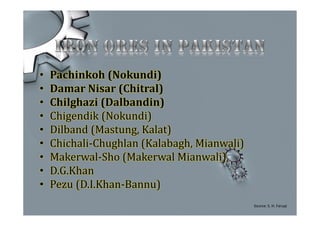
• Pachinkoh (Nokundi)
• Damar Nisar (Chitral)
• Chilghazi (Dalbandin)
• Chigendik (Nokundi)
• Dilband (Mastung, Kalat)
• Chichali-Chughlan (Kalabagh, Mianwali)
• Makerwal-Sho (Makerwal Mianwali)
• D.G.Khan
• Pezu (D.I.Khan-Bannu)
Source: S. H. Faruqi
• Manufacturing Sector
• Construction Sector
• Employment Generation
• Taxes
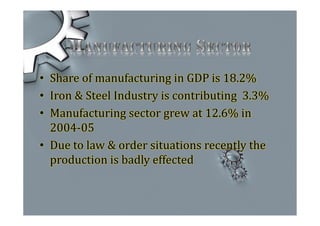
• Share of manufacturing in GDP is 18.2%
• Iron & Steel Industry is contributing 3.3%
• Manufacturing sector grew at 12.6% in
2004-05
• Due to law & order situations recently the
production is badly effected
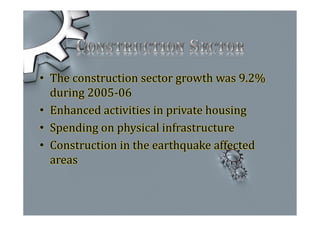
• The construction sector growth was 9.2%
during 2005-06
• Enhanced activities in private housing
• Spending on physical infrastructure
• Construction in the earthquake affected
areas
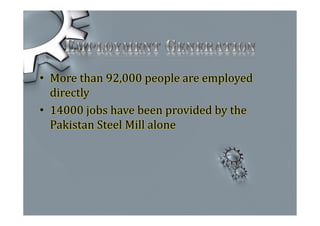
• More than 92,000 people are employed
directly
• 14000 jobs have been provided by the
Pakistan Steel Mill alone
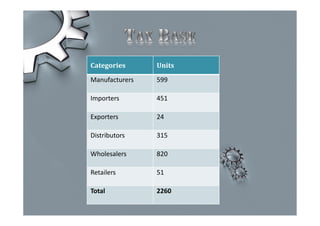
Categories Units
Manufacturers 599
Importers 451
Exporters 24
Distributors 315
Wholesalers 820
Retailers 51
Total 2260
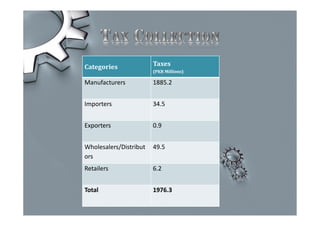
Categories Taxes
(PKR Millions)
Manufacturers 1885.2
Importers 34.5
Exporters 0.9
Wholesalers/Distribut
ors
49.5
Retailers 6.2
Total 1976.3
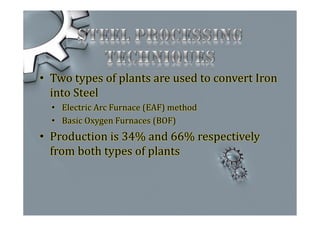
• Two types of plants are used to convert Iron
into Steel
• Electric Arc Furnace (EAF) method
• Basic Oxygen Furnaces (BOF)
• Production is 34% and 66% respectively
from both types of plants
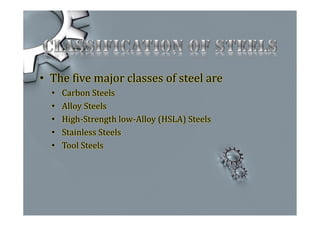
• The five major classes of steel are
• Carbon Steels
• Alloy Steels
• High-Strength low-Alloy (HSLA) Steels
• Stainless Steels
• Tool Steels
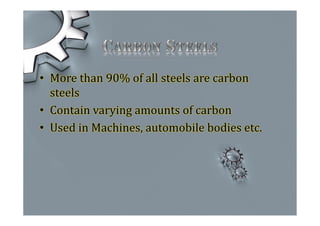
• More than 90% of all steels are carbon
steels
• Contain varying amounts of carbon
• Used in Machines, automobile bodies etc.
• Containing certain larger amounts of
Manganese Silicone and Copper
• More strengthen then carbon steels
• Have much more strength than carbon &
Alloy Steel of same weight
• Buildings are now being constructed with
frameworks of HSLA steels
• Contains Chromium, Nickel and other
alloying elements
• Used in pipes, chemical plants, trucks etc.
• Contain Tungsten, Molybdenum and other
alloying elements
• They have extra strength, hardness, and
resistance to wear
• 15% GST is levied both at domestic and import
stages
• Steel bars are subjected to fixed tax rate @
Rs.1000/ per metric ton
• Ship plate of ½ inch thickness and above 40%
• Ship plate of 3/8 inch thickness and above but
below ½ inch 20%
• Re-roll able scrap & Small irregular pieces and
re-melt able scrap 15%
• Direct Products:
• By-products
• Billets
• Hot Rolled Products
• Cold Rolled Products
• Galvanized Products
• Chequered Plates & Formed Sections
• Pig Iron
• Coke
• Produced to tight tolerances, high surface
finish and superior quality
• In the shape of steel bars or rods
• Used for
• Plain and twisted bars
• Rails
• Wire rods
• Machine components
• Seamless pipes etc.
• Produced at Hot Rolling Strip Mill
• Used for
• Pipes
• Tanks
• Floating Structures
• Wheel Rims etc
• Flat Steel Products
• Used In
• Automobiles
• Roofing
• Shuttering
• Paneling etc
• Used for industrial flooring
• Liquid Iron
• Mainly used to produce steel
• Two types are…
• Foundry Grade Pig Iron
• Conversion Grade Pig Iron
• Produced at the Coke Oven and By-products
Plant
• Cellular, infusible and heterogeneous in
both physical and chemical properties
• Used in manufacturing Pig Iron, sugar mills,
pharmaceutical industries etc.
• Oxygen & Nitrogen
• Refractory Bricks
• Coal Tar
• Granulated Blast Furnace Slag
• Boulder Slag
• Ammonium Sulphate
• High Demand
• From Government Side
• From Automobile Side
• From Private Sector
• From Housing Sector
• Demand Growth
• Iron Ores
• Coal Availability
• By-products
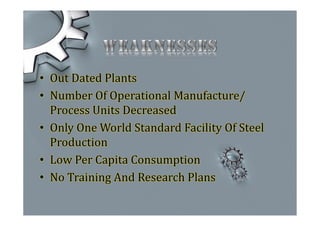
• Out Dated Plants
• Number Of Operational Manufacture/
Process Units Decreased
• Only One World Standard Facility Of Steel
Production
• Low Per Capita Consumption
• No Training And Research Plans
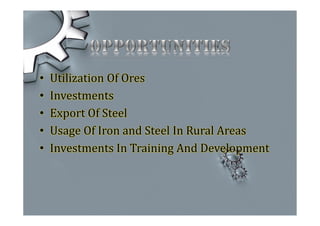
• Utilization Of Ores
• Investments
• Export Of Steel
• Usage Of Iron and Steel In Rural Areas
• Investments In Training And Development
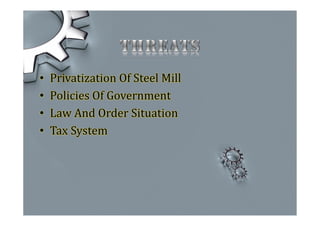
• Privatization Of Steel Mill
• Policies Of Government
• Law And Order Situation
• Tax System
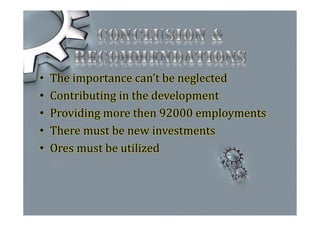
• The importance can’t be neglected
• Contributing in the development
• Providing more then 92000 employments
• There must be new investments
• Ores must be utilized
Iron & Steel Industry Of Pakistan

Iron & Steel Industry Of Pakistan

  • 3.
    • Recognized asmost critical for development • Most commonly used metals in the world • Steel, the most recycled material in the world today
  • 4.
    • Produced inmore than 50 countries • Rapid industrialization created a huge demand for Steel • Major Steel producing countries • China 31% • Japan 10% • USA 8% • Russia 6% • South Korea 4% Source: CBR
  • 5.
    • Production range2 million tons to 3 million tons per year in last 9 years • Demand has increased at rapid rate recently Source: CBR
  • 6.
    0 1000 2000 3000 4000 5000 6000 7000 8000 9000 2004 2005 20062007 2008 2009 2010 2011 2012 2013 2014 2015 Domestic Production Imports Total Consumption Avg. Growth Rate: 5% Source: Engineering Pakistan In 000 Tones
  • 7.
  • 8.
  • 9.
    • Two Sectors •Organized Sector • Unorganized Sector
  • 10.
    • Major Players •Pakistan Steel (PS) • Pakistan Steel Mill (PSM) • Steel Pipe Mills Source: Engineering Pakistan
  • 11.
    • Scrap Melters80 Units • Re-Rolling Mills 334 • Punjab 291 • Sindh 37 • NWFP 4 • Baluchistan 2 • Ship Breakers 350 • Foundries 450 Source: Engineering Pakistan
  • 12.
    • Ship Breaking •Steel Melters • Steel Rollers • Steel Pipe Industry
  • 13.
    • Provides shipplates for re-rolling industry • Based in Gadani, Balochistan • Annual production ranges between 50,000 – 100,000 metric tons • The number of employees working are up to 4000
  • 14.
    • Produce andsell ingots and cast billets • Produced by melting Steel scrap in Electric Furnaces • Currently about 120 Steel furnaces are operating • 15000 labor force is employed • Production 3 million metric tons in 2005-06
  • 15.
    • These unitsroll billets/ingots • Raw Materials: Steel billets, ingots, cast billets and ship plates • Products: Steel bars, flat, tee Iron, channels, girders and wires etc • Installed Capacity is around 4 million tons • 20,000 labor force is employed
  • 16.
    • Non-existent atthe time of independence • Currently its installed capacity is 525,000 tons per year • Able to produce seamless, seam welded, spiral welded and arc-welded pipes • Approximately 3500 people are employed
  • 17.
    0 50,000 100,000 150,000 200,000 250,000 300,000 Jun-00 Investments added upto 2004 Projected Inv. (2005-2010) Total Projected Inv. by 2010 PKRMillions Source: Engineering Pakistan
  • 18.
    0 50 100 150 200 250 300 350 USA Malaysia Saudi Arabia UKIran China Thailand Philippines India Pakistan Indonesia 27
  • 19.
    0 5 10 15 20 25 30 35 40 1994 1995 19961997 1998 1999 2000 2001 2002 2003 2004 2005 2006 SteelConsumption percapita(kg) Source: Engineering Pakistan
  • 20.
    • Pachinkoh (Nokundi) •Damar Nisar (Chitral) • Chilghazi (Dalbandin) • Chigendik (Nokundi) • Dilband (Mastung, Kalat) • Chichali-Chughlan (Kalabagh, Mianwali) • Makerwal-Sho (Makerwal Mianwali) • D.G.Khan • Pezu (D.I.Khan-Bannu) Source: S. H. Faruqi
  • 21.
    • Manufacturing Sector •Construction Sector • Employment Generation • Taxes
  • 22.
    • Share ofmanufacturing in GDP is 18.2% • Iron & Steel Industry is contributing 3.3% • Manufacturing sector grew at 12.6% in 2004-05 • Due to law & order situations recently the production is badly effected
  • 23.
    • The constructionsector growth was 9.2% during 2005-06 • Enhanced activities in private housing • Spending on physical infrastructure • Construction in the earthquake affected areas
  • 24.
    • More than92,000 people are employed directly • 14000 jobs have been provided by the Pakistan Steel Mill alone
  • 25.
    Categories Units Manufacturers 599 Importers451 Exporters 24 Distributors 315 Wholesalers 820 Retailers 51 Total 2260
  • 26.
    Categories Taxes (PKR Millions) Manufacturers1885.2 Importers 34.5 Exporters 0.9 Wholesalers/Distribut ors 49.5 Retailers 6.2 Total 1976.3
  • 27.
    • Two typesof plants are used to convert Iron into Steel • Electric Arc Furnace (EAF) method • Basic Oxygen Furnaces (BOF) • Production is 34% and 66% respectively from both types of plants
  • 28.
    • The fivemajor classes of steel are • Carbon Steels • Alloy Steels • High-Strength low-Alloy (HSLA) Steels • Stainless Steels • Tool Steels
  • 29.
    • More than90% of all steels are carbon steels • Contain varying amounts of carbon • Used in Machines, automobile bodies etc.
  • 30.
    • Containing certainlarger amounts of Manganese Silicone and Copper • More strengthen then carbon steels
  • 31.
    • Have muchmore strength than carbon & Alloy Steel of same weight • Buildings are now being constructed with frameworks of HSLA steels
  • 32.
    • Contains Chromium,Nickel and other alloying elements • Used in pipes, chemical plants, trucks etc.
  • 33.
    • Contain Tungsten,Molybdenum and other alloying elements • They have extra strength, hardness, and resistance to wear
  • 34.
    • 15% GSTis levied both at domestic and import stages • Steel bars are subjected to fixed tax rate @ Rs.1000/ per metric ton • Ship plate of ½ inch thickness and above 40% • Ship plate of 3/8 inch thickness and above but below ½ inch 20% • Re-roll able scrap & Small irregular pieces and re-melt able scrap 15%
  • 35.
  • 36.
    • Billets • HotRolled Products • Cold Rolled Products • Galvanized Products • Chequered Plates & Formed Sections • Pig Iron • Coke
  • 37.
    • Produced totight tolerances, high surface finish and superior quality • In the shape of steel bars or rods • Used for • Plain and twisted bars • Rails • Wire rods • Machine components • Seamless pipes etc.
  • 38.
    • Produced atHot Rolling Strip Mill • Used for • Pipes • Tanks • Floating Structures • Wheel Rims etc
  • 39.
    • Flat SteelProducts • Used In • Automobiles • Roofing • Shuttering • Paneling etc
  • 40.
    • Used forindustrial flooring
  • 41.
    • Liquid Iron •Mainly used to produce steel • Two types are… • Foundry Grade Pig Iron • Conversion Grade Pig Iron
  • 42.
    • Produced atthe Coke Oven and By-products Plant • Cellular, infusible and heterogeneous in both physical and chemical properties • Used in manufacturing Pig Iron, sugar mills, pharmaceutical industries etc.
  • 43.
    • Oxygen &Nitrogen • Refractory Bricks • Coal Tar • Granulated Blast Furnace Slag • Boulder Slag • Ammonium Sulphate
  • 45.
    • High Demand •From Government Side • From Automobile Side • From Private Sector • From Housing Sector • Demand Growth • Iron Ores • Coal Availability • By-products
  • 46.
    • Out DatedPlants • Number Of Operational Manufacture/ Process Units Decreased • Only One World Standard Facility Of Steel Production • Low Per Capita Consumption • No Training And Research Plans
  • 47.
    • Utilization OfOres • Investments • Export Of Steel • Usage Of Iron and Steel In Rural Areas • Investments In Training And Development
  • 48.
    • Privatization OfSteel Mill • Policies Of Government • Law And Order Situation • Tax System
  • 49.
    • The importancecan’t be neglected • Contributing in the development • Providing more then 92000 employments • There must be new investments • Ores must be utilized