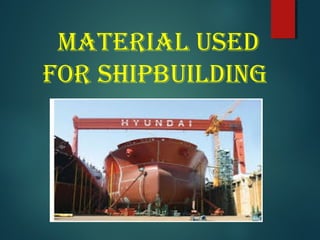
MATERIAL USED
foR SHIPBUILDING
INTRODUCTION
 There is a wide range of materials used in
shipbuilding comprising ferrous metals, non- ferrous
metals, plastics, GRP (Glass Reinforced Plastics/
fiber glass) and wood.
 The most widely used material in ship building
remains steel especially plan carbon or mild steel
approximately 90%.
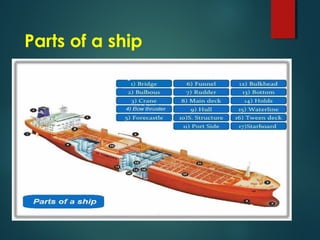
Parts of a ship
Material issues relating to
construction of ship
 Strength
 Weldability
 Toughness
 Marine Corrosion
 Formability
 The Cost
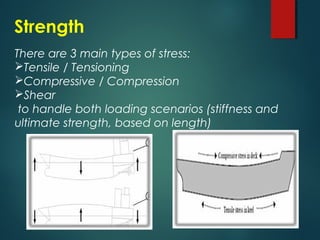
Strength
There are 3 main types of stress:
Tensile / Tensioning
Compressive / Compression
Shear
to handle both loading scenarios (stiffness and
ultimate strength, based on length)
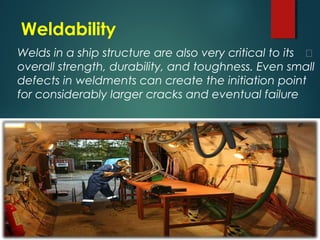
Weldability
Welds in a ship structure are also very critical to its 
overall strength, durability, and toughness. Even small
defects in weldments can create the initiation point
for considerably larger cracks and eventual failure
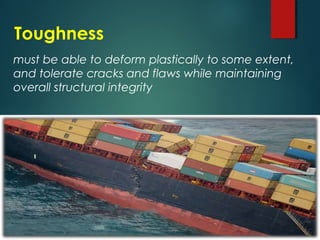
Toughness
must be able to deform plastically to some extent,
and tolerate cracks and flaws while maintaining
overall structural integrity
Marine Corrosion
There are various materials options, design strategies, 
coating, and cathodic protection technologies
available to the designer and shipbuilder
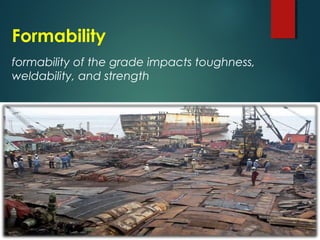
Formability
formability of the grade impacts toughness,
weldability, and strength
The Cost
Choosing the cheapest material in the construction
phase cannot be a considered a success if the
decision requires a significant increase in
construction labor or creates a maintenance
nightmare during the 30 to 50 year
Properties of Steel
 Good metallurgical properties – to
overcome Brittle fracture and fatigue
 Reasonable good mechanical properties
Low carbon steel (mild steel) have tensile
strength of 400 to 490 MN/m2
and Yield
strength of 235 MN/m2
, and elongation of
15 to 20 %
 Susceptibility ease to join process by
welding with good control over weld
defects
Cont-
 Reasonable cost
 Reasonably ease to cast
 Ability to be heat treated. Alloy elements can
also be use to change the character of steel:
- Carbon (0.18% to 0.28%) increases hardness
and strength but reduces ductility.
- Manganese (0.6% to 15%) increase tensile
strength, ductility and notch toughness
- Silicon (< 0.5%) increase hardness and tensile
strength without making welding difficult.
- Sulphur (>0.04 or 0.05%) improves weldability
and welding stresses
- Phosphorus (> 0.04 or 0.05%) reduces ductility
and toughness
Grades of steel
 Grade A - White
 Grade B - Green
 Grade D - Red
 Grade E - Yellow
Cont-
Grade A
 A mild steel used in the majority of the ship
structures of less than 20 mm thickness
such as bulkheads, tank top, non strength
decks and superstructures
Grade B
 A mild steel used for strength members of
20 to 25 mm thickness
Grade D
 A ‘Notch-tough’ steel which resists the spread of
cracks and has higher strength.
 It is used for structure greater than 25 mm thick
Grade E
 An ‘Extra Notch tough’ steel because this is a
heat treated Grade D steel used for very thick
plating in excess of 50mm thick.
 It is used for sheer strakes, bilge strakes, keels I.e.
all high stress regions of the ship
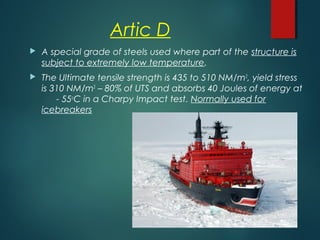
Artic D
 A special grade of steels used where part of the structure is
subject to extremely low temperature.
 The Ultimate tensile strength is 435 to 510 NM/m2
, yield stress
is 310 NM/m2
– 80% of UTS and absorbs 40 Joules of energy at
- 55o
C in a Charpy Impact test. Normally used for
icebreakers
Materials used in ships sea water systems
90/10 Cupro-nickel:
1. Resistant to high sea water velocities allowing
reduced tube diameters
2. Resistant to corrosion under stagnant flow
conditions and pitting
3. Resistant to clogging from marine growth
4. Ease of manufacture and welding
5. Reasonable cost
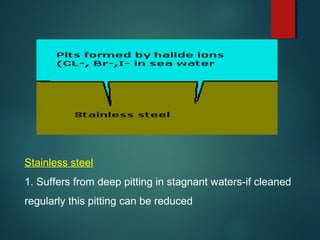
Stainless steel
1. Suffers from deep pitting in stagnant waters-if cleaned
regularly this pitting can be reduced
Expected life spans of some
materials in sea water:
 Galvanised steel- 6 to 9 years
 Copper- Maximum velocity (water flow) 4ft/sec
 90/10 Cupro-Nickel- 10yrs+
 70/30 Cupro-Nickel- 22 yrs+

Materials Used for Shipbuilding

  • 1.
  • 2.
    INTRODUCTION  There isa wide range of materials used in shipbuilding comprising ferrous metals, non- ferrous metals, plastics, GRP (Glass Reinforced Plastics/ fiber glass) and wood.  The most widely used material in ship building remains steel especially plan carbon or mild steel approximately 90%.
  • 3.
  • 4.
    Material issues relatingto construction of ship  Strength  Weldability  Toughness  Marine Corrosion  Formability  The Cost
  • 5.
    Strength There are 3main types of stress: Tensile / Tensioning Compressive / Compression Shear to handle both loading scenarios (stiffness and ultimate strength, based on length)
  • 6.
    Weldability Welds in aship structure are also very critical to its  overall strength, durability, and toughness. Even small defects in weldments can create the initiation point for considerably larger cracks and eventual failure
  • 7.
    Toughness must be ableto deform plastically to some extent, and tolerate cracks and flaws while maintaining overall structural integrity
  • 8.
    Marine Corrosion There arevarious materials options, design strategies,  coating, and cathodic protection technologies available to the designer and shipbuilder
  • 9.
    Formability formability of thegrade impacts toughness, weldability, and strength
  • 10.
    The Cost Choosing thecheapest material in the construction phase cannot be a considered a success if the decision requires a significant increase in construction labor or creates a maintenance nightmare during the 30 to 50 year
  • 11.
    Properties of Steel Good metallurgical properties – to overcome Brittle fracture and fatigue  Reasonable good mechanical properties Low carbon steel (mild steel) have tensile strength of 400 to 490 MN/m2 and Yield strength of 235 MN/m2 , and elongation of 15 to 20 %  Susceptibility ease to join process by welding with good control over weld defects Cont-
  • 12.
     Reasonable cost Reasonably ease to cast  Ability to be heat treated. Alloy elements can also be use to change the character of steel: - Carbon (0.18% to 0.28%) increases hardness and strength but reduces ductility. - Manganese (0.6% to 15%) increase tensile strength, ductility and notch toughness - Silicon (< 0.5%) increase hardness and tensile strength without making welding difficult. - Sulphur (>0.04 or 0.05%) improves weldability and welding stresses - Phosphorus (> 0.04 or 0.05%) reduces ductility and toughness
  • 13.
    Grades of steel Grade A - White  Grade B - Green  Grade D - Red  Grade E - Yellow Cont-
  • 14.
    Grade A  Amild steel used in the majority of the ship structures of less than 20 mm thickness such as bulkheads, tank top, non strength decks and superstructures
  • 15.
    Grade B  Amild steel used for strength members of 20 to 25 mm thickness
  • 16.
    Grade D  A‘Notch-tough’ steel which resists the spread of cracks and has higher strength.  It is used for structure greater than 25 mm thick
  • 17.
    Grade E  An‘Extra Notch tough’ steel because this is a heat treated Grade D steel used for very thick plating in excess of 50mm thick.  It is used for sheer strakes, bilge strakes, keels I.e. all high stress regions of the ship
  • 18.
    Artic D  Aspecial grade of steels used where part of the structure is subject to extremely low temperature.  The Ultimate tensile strength is 435 to 510 NM/m2 , yield stress is 310 NM/m2 – 80% of UTS and absorbs 40 Joules of energy at - 55o C in a Charpy Impact test. Normally used for icebreakers
  • 19.
    Materials used inships sea water systems 90/10 Cupro-nickel: 1. Resistant to high sea water velocities allowing reduced tube diameters 2. Resistant to corrosion under stagnant flow conditions and pitting 3. Resistant to clogging from marine growth 4. Ease of manufacture and welding 5. Reasonable cost
  • 20.
    Stainless steel 1. Suffersfrom deep pitting in stagnant waters-if cleaned regularly this pitting can be reduced
  • 21.
    Expected life spansof some materials in sea water:  Galvanised steel- 6 to 9 years  Copper- Maximum velocity (water flow) 4ft/sec  90/10 Cupro-Nickel- 10yrs+  70/30 Cupro-Nickel- 22 yrs+