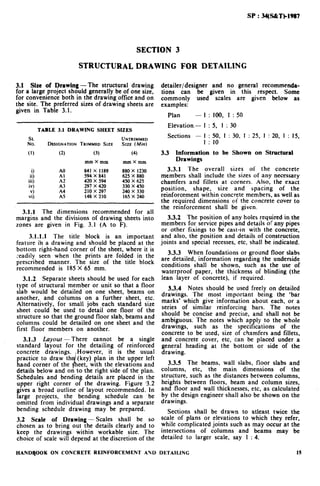
HANDBOOK
ON
REINFORCEMENT
AND DETNLING
BUREAU OF INDIAN STANDARDS
MANAK BHAVAN. 9 BAHADUR 8HAH 2AFAR MARG
NEW DELHI110 002
SP 34 : 1987
FIRST PUBLISHED AUGUST 1987
FIRST REPRINT DECEMBER 1992
SECOND REPRINT NOVEMBER 1995
THIRD REPRINT DECEMBER 1996
FOURTH REPRINT JULY 1997
FIFTH REPRINT MARCH 1999
0 BUREAU OF INDIAN STAND.4RDS
UDC 666.982.24(021)
ISBN 81-7061-006-O
PRICE Rs.600.00
t
I
PRINTED IN INDIA
AT NUTAN PRINTERS, F-89/12, OKHLA INDUSTRIAL AREA, PHASE-I, NEW DELHI-110020
AND PUBLISHED KY
BUREAU OF INDIAN STANDARDS, NEW DELHI-110 002
FOREWORD
Users of various civil engineering codes have been feeling the need for explanatory
handbooks and other compilations based on Indian Standards. The need has been
further emphasized in view of the publication of the National Building Code of India in
1970 and its implementation. The Expert Group set up in 1972 by the Department of
Science and Technology, Government of India carried out in-depth studies in various
areas of civil engineering and construction practices. During the preparation of the Fifth
Five-Year Plan in 1975, the Group was assigned the task of producing a Science and
Technology plan for research, development and extension work in the sector of housing
and construction technology. One of the items of this plan was the production of design
handbooks, explanatory handbooks and design aids based on the National Building
Code and various Indian Standards and other activities in the promotion of the National
Building Code. The Expert Group gave high priority to this item and on the
recommendation of the Department of Science and Technology, the Planning
Commission approved the following two projects which were assigned to the Bureau of
Indian Standards :
a) Development programmc on code implementation for building and civil
engineering construction, and
b) Typification for industrial buildings.
A Special Committee for Implementation of Science and Technology Projects (SCIP)
consisting of experts connected with different aspects was set up in 1974 to advise the BlS
Directorate General in identification and for guiding the development of the work. Under
the first programme, the Committee has so far identified subjects for several explanatory
handbooks/compilations covering appropriate Indian Standards codes specifications
which include the following :
Design Aids for Reinforced Concrete to IS : 456-1978 (SP : 16-1980)
Explanatory Handbook on Masonry Code (SP : 20-1981)
Explanatory Handbook
on Codes of Earthquake Engineering (IS : 1893-1975 and
IS : 4326-1976) (SP : 22-1982)
Handbook on Concrete Mixes (SP : 23-1982)
Explanatory Handbook on Indian Standard Code of Practice for Plain and Reinforced
Concrete (IS : 456-1978) (SP : 24-1983)
Handbook ‘on Causes and Prevention of Cracks in Buildings (SP : 25-1984)
Summaries of Indian Standards for Building Materials (SP : 2 -I 983)
Functional Requirements of industrial Buildings (Lighting and Ventilation)
(SP : 32-1986)
ng (SP : 35-1987)
Timber Engineering (SP : 33-1986)
Water Supply and Drainage with Special Emphasis on Plumbir
Functional Requirements of Buildings*
Foundation of Buildings
Steel Code (IS : 800-1984)
Building Construction Practices
Bulk St,orage Structures in Steel
Formwork
Fire Safety
Construction Safety Practices
(iii)
Tall Buildings
Loading Code
This Handbook provides information on properties of reinforcing steel and &ta-iling
requirements, including storage, fabrication, assembly, welding and placing of reinforce-
ment in accordance with IS : 456-1978. ‘As a result of the introduction of limit state
method ‘of design for reinforced concrete structures and the concept of development
length, detailing has become extremely important as many of the design requirements are
to be’met through detailing. This Handbook is expected to guide the designer in detailing
which include correct positioning of bare for a particular type of structural element and
preparation of bar bending schedule. The detailing requirements as specified in IS : 456-
1978 have. been brought out as applicable to different structural elements in a building
and explamed, wherever necessary. The relevant Indian Standards and other literature
available on the subject have been taken into consideration in preparing the Handbook.
The Handbook will be useful to concrete design engineers, field engineers and students of
civil engineering.
Some of the important points to be kept in view in the use of the Handbook are :
a) The reinforcement has to cater to forces (bending moment, shear force, direct
compression or direct te,nsion) at sections consistant with development length re-
quirements at the particular section. Sound engineering judgement shall be exerci-
zed while applying the provisions herein and detailing should be such that the struc-
tural element satisfies the requirements of performance for which it is meant.
Typical detailing drawings are included to illustrate one possible method of
arrangement of bars for a particular condition. They should not be construde as the
only possible method.
b)
4
Considering the importance of ductility requirements in structures subjected to
severe earthquakes, a separate section is included on the detailing requirements for
buildings in severe earthquake zones (Zones IV and V of IS : 1893-1984).
International Standard IS0 4066-1977 ‘Buildings and civil engineering drawings---
Bar scheduling’ is reproduced
in the Handbook.
iri Appendix B as a supplement to what is contained
4
e)
The Handbook does nor .forrn part CI/at?,* Indian SratdarJ OIIIhe srrhjwr ant/ does
not have the status of an Indian Standard. In case o/‘&~pllte ahour A~rc~rpretarion
or opinion expressed in the Handbook. the provisions o/‘relr~atlt Irdiatl Startckartjs
only shall app!bP. The provisions yf’ the Hwdbo~~k I>nrricyrIarI,l,tho.s~~reIaritlSq I(.
other literature should be considererl as on(,, .sy~i~t~~t)rc~,rtor1’ iflfi~rt~iuri~~ti
The Handbook is expected to serve as a companion document to the three hand-
books already published on the subject of reinforced concrete, namely, SP : 16-1980,
SP : 23-1982 and SP : 24-1983.
f) AlI dimensions are in mm unless otherwise specified.
The Handbook is based on the first draft prepared by the Central Public Works
Depart-ment, New Delhi. Shri B. R. Narayanappa. Deputy Director, and Shri P. S.
Chadha, Officer on Special Duty, Bureau of Indian Standards (BIS). were associated
with the work. The assistance rendered by Shri A. C. Gupta, Assistant Chief Design
Engineer, National Thermal Pdwer Corporation (NTPC), New Delhi, in the preparation
of this Handbook specially in the formulation of drawings is acknowledged.
The draft Handbook was circulated for review to National Council for Cement and
Building Materials, New Delhi; Structural Engineering Research Centre, Madras; Indian
institute of Technology, Madras; Indian Institute of Technology, New Delhi; Andhra
Pradesh Engineering Research Laboratories, Hyderabad; Engmeering Construction
Corporation Ltd. Madras; Engineer-in-Chiefs Branch, Army Headquarters, New Delhi;
Engmeering Consultants (India) Limited, New Delhi; Gammon lndia Ltd, Bombay;
M/s C. R. Narayana Rae, Architects & Engineers, Madras; STUP Consultants Ltd,
Bombay; Research, Design and Standards Organization, Ministry of Railways,
Luclcnow; Irrigation Department, Government of Gujarat; M/s H. K. Sen and
Associates, Calcutta; Siddharth Shankar and Associates (Consulting Engineers), New
Delhi; Roy and Partners (Architects & Engineers), New Delhi; Shrish Malpani
(Architects & Engineers), New Delhi; and the views received were taken into
consideration while finalizing the Handbook.
d
CONTENTS
Page
Section 1 Steel for reinforcement 1
Section 2 Detailing functions 9
Section 3 Structural drawing for detailing 13
Section 4 Gcncral detailing requirements 2?
Section 5 Bar bending schcdulc (including do’s and doni’s in
dclailing) 53
Section 6 Foundations 67
Section 7 Columns x3
Section 8 Beams 97
Section 9 Floor slabs 119
Section 10 Stairs 143
Section 11 Special structurcs--dccp beams, walls, shells and
folded plates, water tanks, RC hinges, concrete pipes,
machine foundations, and shear walls 153
Section 12 Ductility requirements of earthquake resistant
building 187
Section I3 Transport, storage, fabrication, assembly and
placing of steel reinforcement 193
Section 14 Typical strucrurai drawings 205
Appendix A Welding 209
Appendix B IS0 4066-1977 Building and civil cnginccring
drawings-bar scheduling 221
Appendix C Dimensions and properties of hard-drawn steel wire
fabric and other bars 227
SECTION I
Steel for Reinforcement
As in the Original Standard, this Page is Intentionally Left Blank
SP : 34(!3&T)-1987
SE‘CTION 1
STEEL FOR REINFORCEMENT
1.0 Reinforcing bars/ wires for concrete
reinforcement shall be any of the following
conforming to accepted standards:
b)
4
Mild steel and medium tensile steel bars
[IS : 432 (Part I)-1982 S cification for
mild steel and medium tensi e steel bars andf”
hard-drawn steel wire for concrete rein-
forcement : Part I Mild steel and medium
tensile steel bars (third revision)].
High strength deformed steel bars/ wires
[IS : 1786-1985 Specification for high
strength deformed steel bars and
wires for concrete reinforcement
(third revision).
Hard-drawn steel wire fabric [IS : 1566-1982
Specification for hard-drawn steel wire
fabric for concrete reinforcement (second
re+ision)].
The requirements for manufacture and supply
of different types of steel reinforcement are briefly
highlighted in 1.1 to 13.43.
NOTE- Different types of reinforcing bars, such as plain
bars and deformed bars of various grades, say Fe415
(N/mm,) and Fe500 (N/mm*), should not be used side by
side as this practice will lead to confusion and error at site.
Howwcr.secondaryrcinforamcnt such as ties and stirrups,
may be of’mild steel throughout even though the main steel
may be of high strength deformed bars.
1.1 Mild Steel and Medium Tensile Steel Bars
11.1 Reinforcement supplied shall be classi-
fied into the following types:
a) mild steel bars, and
b) medium tensile steel bars.
1.1.1.1 Mild steel bars shall be supplied in
the following two grades:
a) mild steel ba;s, Grade 1; and
b) mild steel bars, Grade II.
Non!- In all cases where the design seismic coefficient
[src IS : 1893-1984 Critetja for earthquake resistant desir
of structures ~ourrh rrvisiun)] chosenfor the structure is0. 3
or more (which include earthquake zanes IV and V) and for
8tructures subjected to dynamic loading. use of
Grade II bars is not recommended.
1.1.2 Physical/ Mechanical Properties - The
requirements for physical/ mechanical properties
of mild steel and medium tensile steel bars are
given in Table I. 1.
1.1.3 Tolerance - The rolling and cutting
tolerances shall be as specified in 1.1.3.1 and
1.1.3.2.
1.1.3.1 Bars in straight lengths
a) The tolerance on diameter shall be as follows:
Diameter Tolerance,
A
r Over Up to and’
percent
including
mm mm mm
- 25 kO.5
25 35 kO.6
35 50 kO.8
50 80 k1.0
80 100 f1.3
100 - + 1.6
b) The permissible ovality measured as the
difference between the maximum and mini-
mum diameter shall be 75 percent of the
tolerance (k) specified on diameter.
c) The tolerance on weight per m length shall
be as follows:
Diameter Tolerance,
’ Over
A
Up to and’
percent
including
mm mm
- IO f7
10 16 +5
16 - f3
1J.3.2 Coiled bars
a) The tolerance on diameter shall be kO.5 mm
for diameters up to and including I2 mm.
b) The difference between the maximum and
minimum diameter at any cross-section shall
not exceed 0.65 IW:.
NATE- No weight tokrana is specified for coikd ban.
1.2 High Strength Deformed Steel Bars
13.1 Deformed steel bars/ wires for use as
reinforcement in concrete shall be in the following
three grades:
a) Fkl5,
b) Fe500, and
c) Fe550.
HANDBOOK ON CONCRETE REINFORCEMENT AND DETAILING
TABLE 1.1 REQUIREMENTS FOR REINFORCING BARS
(Clausfs 1.1.4. 1.2.2, 1.25 und 1.3.1)
NOMINALSIZE
OF BARS
CHARACl?mlSTtC MINIMUM ULTIMAIX
STRENGTH TENSILE ST&
(Yield Stress or
IS No. TYPE OF
REINFORCEMENT
CCN$QSQSE3
CONFORMING
TO tS
(6)
MINIMUM ELONE
ATION ON GUAGE
LENGTH OF
5.65-
(7)
(percent)
23
2 Pegterc)ProoC t
(4)
(N/mm*)
250 .
240 1
225
215
I
350
1
340
330
415
(for Fe 415)
g Fe SOD)
(1) (2) (3)
(mm)
5.6.8.10.12.16.20
22.25.28.32.36,
40.4550
5.6.8, IO.12.16.20
22.25.28.32.36,
40.4550
5,6.8.10,12,16
20.22.25.28.32
36.40.45.50
(5)
(N/mmz)
lS19~~~ (Part !)- Mild steel (Grade I)
410
370
IS : 2261975t
Mild steel (Grade II) Fe 410.0 of
IS : 1977-19753
23
Medium tensile steel Fe 540 W-HT of
IS : 961-19750
20
540
510 do 20
IS : 1786l9tq High strenSth 4.5.6.7,8,10,12.16.
dcformad bars/ 18.20,22.25,28.32.
wim 36.40.45.50
IO pcrccnt more than
the actual 0.2
percent proof stress
but not less than
485.0 N/mm*
:
- 0.30
- 0.06
sp+P3!!
C - 0.3
;
- 0.055
- 0.055
s+P-o.105
14.5
8 percent more than
the actual 0.2
pcrccot proof stress
but not less than
545.0 N/mm’
12.0
IS No. TYPEOF
REINFORCEMENT
CIIARACTERISTIC
STRENGTH
(Yield Stress or
(1) (2) 0)
(mm)
2 Perrcets)Proof
(4)
(N/mm*)
;f: Fe 550)
IS : r566-IWI “arrMl&tcc’ (See Note I) 480
MINIMUM ULTIMATE
TENSILE STREET
hdlNlMUM ELONG-
ATION ON GUAGE
5.65
(5)
(N/mm*)
6 g=n~~o;2~*
rrcent proif stress
ut not kss than
585 N/mmr
570
(6) (7)
(percent)
C - 0.3
:
- 0.055
- 0.050
s + P - 0.10
8.0
S
1 t;:
7.5
P . (over 8
length oP.?$)
NOTE 1--The mesh sixes 8nd sizes of wire for squsre as well as oblong welded wire fabric commonly manufactured in the country arc given in
Appendix C .
NOTE2-The might 8ttd area of different sizea of bars are given in Appendix C.
NOTE3 -GcneraUy lv8ikbk ex stock:
Mild sieel bars-#6,&O. 612, 416, #2O. #25, &32
Ddort& sted bus-Ml, #IO,112. #16. #20, #22. #25, #g. #32
The maximum kngth of t&forcing bars avaikbk ex stock is 13 m.
NIP 4 - FW clrch bttndk/coil of ban/wires, a tag shall be attached indicating cast No./ lot No., grade and sire bf the manufacturer or the supplier.
steel and medium tcnsik steel bars and harddrawn steel wit for concrete reinforcement:Part I Mild steel and medium tensik steel
reinforcement (third’ revlcion).
(seco& rev&ion).
ln
SP : 34(S&T)_1987
N?TE - >e figures following the symbol Fe indicates the.
S
Is”’
ud tmntmum 0.2 percent proof stress or yield stress in
/ mmz.
1.2.3 Tolerance
1.2.3.1. Cutting tolerance on length - The
cutting tolerances on length shall be as specified
below:
a) When the specified length is +75 mm
not stated to be either a -25 mm
maximum or a minimum
b) When the minimum length is +50 mm
specified - 0 mm
NOTE- These are tolerances for manufacture and supply
and are not applicable for fabrication. For allowable toler-
anees for bending and cutting during fabrication SPC
Section 13.
1.2.3.2 Mass - For the purpose of checking
the nominal mass, the density of steel shall be
taken as 0.785 kg/cm* of the cross-sectional area
per metre run. Toleran’ces on nominal mass shall
be as follows:
Nominal Size Tolerance on the Nominal Mass,
mm Percent whex Checked in
r Batch lndivi- Indivi- ’
(each dual dual
Specimen Sample Sample
not less (not less for
than than Coils*
0.5 m) 0.5 m)
Up to and f7 -8 *8
including 10
over 10 up to +5 -6 f6
and includ-
ing 16
Over 16 +3 -4 24
I+4 Physicall Mechanical Properties - The
requirement for physical/mechanical properties of
high strength deformed steel bars are given in
Table 1.1.
NOTE I --the nominal diameter or size of a deformed
bar/wire is equivalent diameter or size of a plain round
bar/wire having the same mass per metre length as the
deformed bar/ wire.
NOTE 2-The effective diameter, #, of a deformed
bar/wire is determined as follows, using a bar/ wire not less
than 0.5 m in length:
w = mass in kg weighed to a precision of +O.S percent, and
L = length in m measured to a precision of f0.5 percent.
*For coils. batch tolerance is not applicable. At least 2
samples of minimum one metre length shall be taken from
each end of the coil.
1.3 Hard-drawn Steel Wire Fabric
1.3.1 General- Hard-drawn steel wire fabric
consists of longitudinal and transverse wires (at
right angles to one another) joined by resistance
spot welding. Fabrication of wire fabric by
welding has the quality of factory fabrication and
reduces cost of labour and fabrication in the field.
1.3.2 Types - Hard-drawn steel wire fabric
shall be made in the following two types:
a) square mesh, and
b) oblong mesh.
‘The diameter of wires in the square mesh varies
from 3 to 10 mm; the diameter being same in both
longitudinal and transverse directions. In this case
both longitudinal and transverse bars may serve
as main reinforcement. The diameter of wire in
the oblong mesh varies from S to 8 mm in the
longitudinal direction and 4.2 to 6 mm in the
transverse direction. The wires in the direction of
larger diameter can serve as main reinforcement
and the wires in the cross direction can serve as
distribution steel.
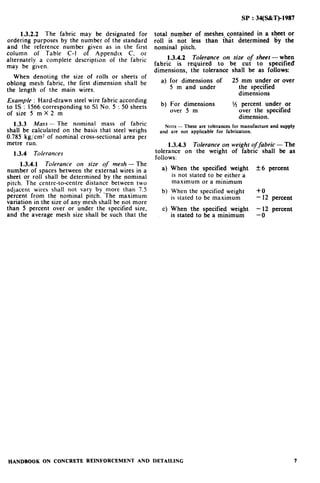
1.3.2.1 The maximum width of wire fabric
in rolls is 3.5 m; the length of this type of fabric is
limited by the weight of rolls which may range
from 100 to 500 kg. The maximum width of fabric
in the form of sheets is 2.5 m and the maximum
length is 9.0 m. The dimension of width is to be
taken as centre-to-centre distance between outside
longitudinal wires. The width of wires fabric in
rolls or sheets shall be such as to fit in with the
modular size of IO cm module and length in
suitable intervals (see Fig. (1.1).
FIG. 1.1 WELDED WIRE FABRIC
/
I.IA Rolls
I. IB Sheets
6 HANDBOOK ON CONCRETE REINFORCEMENT AND DETAILING
SP : 34(S&T)-1987
1.3.2.2 The fabric may be designated for total number of meshes contained in a sheet or
ordering purposes by the number of the standard roll is not less than ih& determined by the
and the reference number given as in the first
column of Table C-l of Appendtx C, or
nominal pitch.
alternately a complete description of the fabric 1.3.4.2 Tolerance on size of sheet-when
may be given. fabric is required to be cut to specified
dimensions, the tolerance shall be as follows:
When denoting the size of rolls or sheets of
oblong mesh fabric, the first dimension shall be a) for dimensions of 25 mm under or over
the length of the main wires.
5 m and under the specified
dimensions
Example : Hard-drawn steel wire fabric according
to IS : 1566 corresponding to Sl No. 5 : 50 sheets
of size 5 m X 2 m
b) For dimensions
over 5 m
th percent under or
over the specified
dimension.
1.3.3 Mass-The nominal mass of fabric
shall be calculated on the basis that steel weighs
NOTE - These are tolerances for manufacture and supply
0.785 kg/cm* of nominal cross-sectional area per
and are not applicable for fabrication.
metre run. 1.3.4.3 Tolerance on weight of fabric - The
1.3.4 Tolerances tolerance on the weight of fabric shall be as
follows:
1.3.4.1 Tolerance on size of mesh -The
number of spaces between the external wires in a
sheet or roll shall be determined by the nominal
pitch, The centre-to-centre distance between two
adjacent wires shall not vary by more than 7.5
percent from the nominal pitch. -The maximum
variation in the size of any mesh shall be not more
than 5 percent over or under the specified size,
and the average mesh size shall be such that the
a)
b)
c)
When the specified weight +_6 percent
is not stated to be either a
maximum or a minimum
When the specified weight +O
is stated to be maximum - 12 percent
When the specified weight - 12 percent
is stated to be a minimum -0
HANDBOOK ON CONCRETE REINFORCEMENT AND DETAlLlNG
As in the Original Standard, this Page is Intentionally Left Blank
SECTION 2
Detailing Functions
As in the Original Standard, this Page is Intentionally Left Blank
DETAILING FUNCTIONS
2.1 General- In preparing drawings and
bending schedules, the following factors shall be
The system of bar-referencing should be coherent
kept in view:
and systematic, and should lend itself to easy
identification and to use in computer systems, if
a) The engineer’s design and the design
necessary.
requirements; 2.4 Placing and Wiring in Position - Ensure
b) The cutting and bending of the rein- that drawings arc simple, pictorially clear, and
forcement; adequately detaiied to enable the fixer to place
c) The placing and wiring in position of rein-
bars exactly where required. Avoid crowding
forcement;
drawings with information by detailing by
components and also if necessary by preparing
d) The maintaining of the position of rein-
separate details for bottom and top steel in slabs.
forcement;
Ensure that reinforcing steel that connects
elements to be cast at different times is so detailed
e) The preassembly of cages; that it is included with the portion to be cast first,
f) Concreting;
for example, splice bars for columns. continuity
reinforcing for beams and slabs to be cast in
g) The accommodation of other trades and portions. If the order of casting is not clear, detail
services; splices in one of the sections with suitable cross-
h) The measurement of quantities; and
references. Where the complexity of the detail is
such that an, out of the ordinary sequence is
j) Economy in the use of steel.
required to place the reinforcement, ensure that
such sequence is shown on the detail.
2.2 Design -The following requirements of the. .. . . .
designer Shall be borne In mind:
2.5 Maintaining Position of Reinforcement -
Reinforcement that has been placed and wired in
4 The quantity, location and cover of steel position should not be displaced before or during
reinforcement should be simply, correctly the concreting operation. Ensure that bar
and clearly shown. supports and cover b!ocks are so scheduled or
b)
specified as to maintain correct bottom and side
The placing drawings and bending schedules
should be adequately cross-referenced, easily
cover and that high chairs and stools are detailed
read and capable of easy checking
to support upper reinforcement mats at the
in the correct level.
drawing office and on site.
cl It should be possible to locate a detail
2.6 Preassembly of Cages and Mats - Where
required, so detail the reinforcement to
readily, should a doubt arrse. components such as columns, foundations,
d) One detailer should be able to take over
beams, and walls that it can be conveniently
from another with a minimum of delay and
preassembled before being placed in position.
direction.
Ensure that assembled units are sturdy enough to
e) Detailing should be done in such a way that
stand up to handling and erection, and that they
secondary streses caused by support con-
are not so heavy that they cannot be lifted by the
ditions, shri kage, tempera:ure variations,
men or equipment available for the work.
bursting ef cts
y”
of laps i;nd splices, and 2.7 Concreting Ensure that the reinforcement
stress conc,‘ntrations arising froirr hooks can be so spaced as to allow placing and efficient
and bends are counteracted. consolidation of the concrete.
2.3 Cutting and Bending - Prepare bending 2.8 Other Trades and Services -- Take note of
schedules on standard size sheets small enough to the positions of down pipes (especially inlets and
facilitate handling by clerical, fabrication and outlets), sleeves, pipes, and electrical conduits,
placing personnel. whether shown on the structural layout or not. To
Standardize cutting lengths and ensure that
avoid site difficulties, show them on the
bending details are simple and easy to read. So
reinforcement details where necessary.
compile the schedules that delivery of the required
reinforcement for each component can be effected
2;9 Measurement of Quantities -- It is
without the need for abstracting from schedules.
important that the quantity surveyor and the
contractor should be able to compute the mass of
SECTION 2
HANDBOOK ON CONCRETE REINFORCEMkINT AND DETAIIJNC; II
SP : 34(S&T)-1987
SP : 34(S&T)-11987
steel used at any stage in a contract. Bending
schedules prepared as recommended in 2.3 will
assist in meeting this requirement. Ensure that
placing drawings and bending schedules are
adequately cross-referenced and that all revisions
are suitably recorded. If. in the case of a levision,
there is any possibility of doubt, prepare separate
schedules showing only the revision, with
adequate cross-referencing.
2.10 Economy in Use of Steel -The type of
steel used is generally specified by the designer but
bear in mind that up to one-third of the mass of
steel can be saved by using high tensile steel
instead of mild steel. The saving can be
considerable as the difference of cost between the
rates for mild steel and high tensile steel placed in
position is relatively small. Furthermore, as the
rates for small diameters are higher than those for
large diameters, it is desirabl! ‘9 USCthe largest
available size of bar wlthln the design
requirements. Larger bars also. produce Stiffer
cages and are not easily displaced.
SECTION 3
Structural Drawing for Detailing
As in the Original Standard, this Page is Intentionally Left Blank
3.1
for
for
Size of Drawing - The structural drawing
a large project should generally be of one size,
convenience both in the drawing office and on
the site. The preferred sizes of drawing sheets are
given in Table 3.1.
SP : 34(s&TH987
SECTION 3
STRUCTURAL DRAWING FOR DETAILING
TABLE 3.1 DRAWING SHEET SIZES
SL UNTRIMMED
No. DESIGNATION TRIMMED SIZE SIZE (Min)
(1) (2) (3) (4)
mmxmm mmXmm
i) A0 841 X 1189
ii)
2
594 X 841 “6;: :: iGo
iii) 420 X 594 450 X 625
iv) A3 297 X 420 330 x 450
v) A4 210 X 297 240 X 330
vi) AS 148 X 210 165 X 240
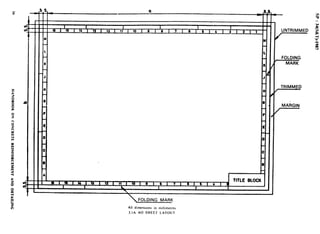
3.1.1 The dimensions recommended for all
margins and the divisions of drawing sheets into
zones are given in Fig. 3.1 (A to F).
3.1.1.1 The title block is an important
feature ih a drawing and should be placed at the
bottom right-hand corner of the sheet, where it is
readily seen when the prints are folded in the
prescribed manner. The size of the title block
recommended is 185 X 65 mm.
3.1.2 Separate sheets should be used for each
type of structural member or unit so that a floor
slab would be detailed on one sheet, beams on
another, and columns on a further sheet, etc.
Alternatively, for small jobs each standard size
sheet could be used to detail one floor of the
structure so that the ground floor slab, beams and
columns could be detailed on one sheet and the
first floor members on another.
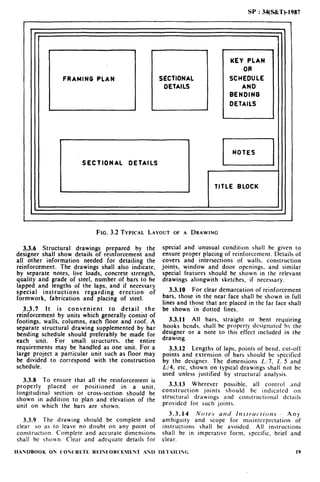
3.1.3 Luyostr -There cannot be a single
standard layout for the detailing of reinforced
concrete drawings. However,
practice to draw th
hand corner of the I
it is the usual
(key) plan in the upper left
eet, with the elevations and
details below and on to the right side of the plan.
Schedules and bending details are placed in the
upper right corner of the drawing. Figure ‘3.2
gives a broad outline of layout recommended. In
large projects, the bending schedule can be
omitted from individual drawings and a separate
bending schedule drawing may be prepared.
3.2 Scale of Drawing - Scales shall be so
chosen as to bring out the details clearly and to
keep the drawings within workable size. The
choice of scale will depend at the discretion of the
HANDljOOK ON CONCRETE REINFORCEMENT AND
detailerldesigner and no general recommenda-
tions can be given in this respect. Some
commonly used scales are given below as
examples:
Plan - 1 : 100, I : 50
Elevation.- I : 5, I : 30
Sections --1:50, 1 :30, 1 :25, I :20, I: 15,
I : IO
3.3 Information to be Shown on Structural
Drawings
3.3.1 The overall sizes of the concrete
members shall include the sizes of any necessary
chamfers and fillets at corners. Also, the exact
position, shape, size and spacing of the
reinforcement within concrete members, as well as
the required dimensions oi the concrete cover to
the reinforcement shall be given.
3.3.2 The position of any holes required in the
members for service pipes and details OCany pipes
or other fixings to be cast-in with the concrete,
and also, the position and details of construction
joints and special recesses, etc, shall be indicated.
3.3.3 When foundations or ground floor slabs
are detailed, information regarding the underside
conditions shall be shown, such as the use of
waterproof paper, the thickness of blinding (the
lean layer of concrete), if required.
3.3.4 Notes should be used freely on detailed
drawings. The most important being the ‘bar
marks’ which give information about each, or a
series of similar reinforcing bars. The notes
should be concise and precise, and shall not be
ambiguous. The notes which apply to the whole
drawings, such as the specifications of the
concrete to be used, size of chamfers and fillets,
and concrete cover, etc, can be placed under a
general heading at the bottom or side of the
drawing.
3.3.5 The beams, wall slabs, floor slabs and
columns, etc, the main dimensions of the
structure, such as the distances between columns,
heights between floors, beam and column sizes,
and floor and wall thicknesses, etc, as calculated
by the design engineer shall also be shown on the
drawings.
Sections shall be drawn to atleast twice the
scale of plans or elevations to which they refer,
while complicated joints such as may occur at the
intersections of columns and beams may be
detailed to larger scale, say I : 4.
DETAILING I5
Sl’ : 34(S&T)-1987
I I TITLE BLOCK
1 12 1 11 1 10 1 9 I 6 1 7 1 6 1 6 1 1 I
/MARGIN TRIMMED FOLDING MARK UNTRIMMED
All dimensions in milllmetrcs
3.18 Al SHEE-T LAYOII-r
,9,5, a _,5,5,
I
I I I
FOLDING
In I I I I I 1 _
u) Il6l7l6l6lbl3l2ll~
/ MARK
1 III, /
I I I
TITLE BLOCK IIL/
4 1 . 8
MARGIN
1  FOLDING MARK
All dimensions in miilimetres.
3.IC A2 SHEET LAYOUT
HANDBOOK ON CONCRETE REINFORCEMENT AND DETAILING
SP : 34(S&T)_1987
3.ID A3 SlZt 3.IE A4 SIZE
ra ra
--CUTSIZE
-UNCUT SUE
a
TITLE ELOCK
_,
DIVISION OF ZONES
SHEET SIZE
3.IF AS SIZE 3.IG DIVISION OF ZONES
All dimcnaions in nrillimctrcs.
FIG. 3.1 MARGINS AND DIVISION OF ZONES FOR DIFFERENT DRAWING SHEETS
.
18
SP : 34(.S&T)-1987
FRAMING PLAN
KEY PLAN
OR
SCHEDULE
AND
BENDINB
DETAILS
SECTIONAL DETAILS
I
’ I
TITLE BLOCK
FIG. 3.2 TYPICAL LAYOUT OF A DRAWING
3.3.6 Structural drawings pre ared by the
designer shall show details of rein orcement andP
all other information needed for detailing the
reinforcement. The drawings shall also indicate,
by separate notes, live loads, concrete strength,
quality and grade of steel, number of bars to be
lapped and lengths of the laps, and if necessary
special instructions regarding erection of
formwork, fabrication and placing of steel.
3.3.7 It is convenient to detail the
reinforcement by units which generally consist of
footings, walls, columns, each floor and roof. A
separate structural drawing supplemented by bar
bending schedule should preferably be made for
each unit. For small structures. the entire
requirements may be handled as one unit. For a
large project a particular unit such as floor may
be divided to correspond with the construction
schedule.
3.3.8 To ensure that all the reinforcement is
.
properly placed or positioned in a unit,
longitudinal section or cross-section should be
shown in addition to plan and elevation of the
unit on which the bars are shown.
3.3.9 The drawing should be complete and
clear so as to leave no doubt on any point of
construction. Complete and accurate dimensions
shall be shown. Clear and adequate details for
special and unusual condition shall be given to
ensure proper placing of reinforcement. Details of
covers and intersections of walls. construction
joints, window and door openings, and similar
special features should be shown in the relevant
drawings alongwith sketches, if necessary.
3.3.10 For clear demarcation of reinforcement
bars, those in the near face shall be shown in full
lines and those that are placed in the far face shall
be shown in dotted lines.
3.3.11 All bars, straight or bent requiring
hooks bends. shall be properly dcsignatcd h. the
designer or a note to this effect included in the
drawing.
3.3.12 Lengths of la
points and extension oP
s, points of bend. cut-off
bars should bc specified
by the designer. The dimensions L: 7, L, 5 and
L/4. etc. shown on typical drawings shall not be
used unless justified by structural analysis.
3.3.13 Wherever possible. all control and
construction joints should he indicated on
structural d.rawings and constructional details
provided for such joints.
3.3.14 Notes attd 1tlstrlrctiotl.s Any
ambiguity and scope for misinterpretation of
instructions shall be avoided. All instructions
shall be in imperative form. specific, brief and
clear.
19
SIP: 34(S&T)_19%7
3.3.1$ Schedules -The reinforcement details
of slabs, beams, columns and many other parts of
structures may be effectively shown on working
drawings in a tabular form, known as a schedule
(see Section 5).
3.4 SymJols and Abbreviations - Symbols and
abbreviations to be adopted in the drawings for
reinforced concrete construction are given in 3.4.1
to 3.5.6. All reinforcement bars used in the
structures shall be suitably designated and
numbered both on drawing and schedule.
3.4.1 S_smbols Relaring to Cross-Sectional
Shape and Size c$ Reicforcemenr
a) 4 plain round bar or diameter of plain
round bar;
b) 0 plain, square bar or side of plain square
bar; and
c) # deformed bar (including square twisted
bar) or nominal size (equivalent diameter
or side) of the deformed bar (see Note
under 3.4.5).
3.4.2 S.vmbols Relating 10 Shape qf the Bar
along its LRngrhs
Alt Alternate bar
Bt Bent bar
B Bottom bar
min Minimum
max Maximum
St Straight bar
stp Stirrup
SP Spiral
Ct Column tie
T Top bar
NOII. Altcrnaltvcl~. all sy~ihols way he in capitak.
3.4.3 S.vmbols Relaring to Position and
Direction
EW
@
Each way
Spacing centre-to-centre
Limit of area covered by
bars
/ ~ Direction ‘in which bars
extend
3.4.4 Symbols Relating IO Various Structural
Members
3m or B Beams
CVI Column(s)
Fg Footing(s)
GR Girders
JT Joints(s)
LL Lintel(s)
LB Lintel beam(s)
Sb or S Slab(s)
WL Longitudinal wall
wx Cross wall
E Centre line
No1t Alternatively, all symbols may be in cap~talb.
3.4.5 The symbols, abbreviations and notes
shall be used in a manner that will not create any
ambiguity. A few exzmples for representing
dia.meter, spacing,
illus!.rated below:
number of bars, etc. are
a) # 20@ 200 means 20 mm diametei
II)
‘L i
detormed bars spaceu at 200 mm centre-t&
centre.
20-# I2 means 20 numbers of I2 mm
dinmeter deformed bars.
&32-St-12 EW means 12 numbers of
32 mm diameter plain round straight bars m
each direction.
NOTE-- The symbol relating to cross-sectional shape and
size -- 4 or # is used on the left hand side of the
numerical value of the diameter to avoid confusion that it
mry be interpreted as the number of rimes the diameter if
used on the right hand side of the numerical value cf the
&meter.
3,4,6 The use of the same type of line for the
same purpose considerably enhances the clarity
and usefulness of the drawing. The following
graphical symbols are suggested:
symbol Designarion; Description
Concrete line (thin)
m-B-----
Unexposed concrete or masonry wall line (thin)
Reinforcement (thick)
---w---v- Reinforcement in a different layer (thick).
20
l Section of a reinforcing bar
-_-_-_-_ Centre line
HANDROOK Ok CONCRETE REINFORCEMENT AND DETAILING
Symbol
SP : 34(S&T)-1987
Designatiott/ llescripriotr
Dimension line
Concrete beam framing into column which
extends through floor
Concrete beam framing into column which
stops at floor
Bar shown bent at right angle to the paper
Bar with hooks
1 Bars shown separated on the drawing
One sheet of welded fabric on plan
Identical sheets of welded fabric in a row
Level mark in elevation
Level mark in plan
HA-NDBOOK ON CONCRETE REINFORCEMENT AND DETAILING
Bar with 90° bends
21
SI’ : 34(S&T)-1987
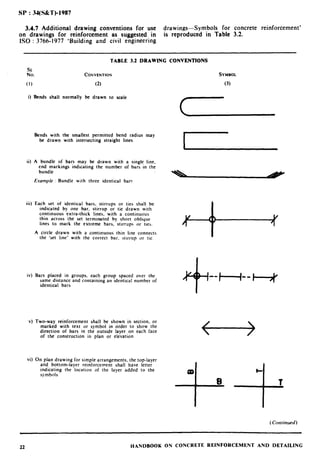
3.4.7 Additional drawing conventions for use drawings-Symbols for concrete reinforcement’
on drawings for reinforcement as suggested in is reproduced in Table 3.2.
IS0 : 3766-1977 ‘Building and civil engineering
TABLE 3.2 DRAWING CONVENTIONS
SL
NO. CONVENTION
(1) (2)
i) Bends shall normally be drawn to scale
Bends with the smallest permitted bend radius may
be drawn with intersecting straight lines
ii) A bundle of bars may be drawn with a single line.
end markings indicating the number of bars in the
bundle
Ermnpk : Bundle with three identical barn
iii)‘Each set of identical bars, stirrups or ties shall be
indicated by one bar. stirrup or tie drawn with
continuous extra-thick lines, with a continuous
thin across the set terminated by short oblique
lines to mark the extreme bars. stirrups or ties.
A circle drawn with a continuous thin line connects
the ‘set line’ with the correct bar, stirrup or tie.
iv) Bars placed in groups. each group spaced over the
same distance and containing an identical number of
identical bars
v) Two-way reinforcement shall be shown in section, or
marked with text or symbol in order to show the
direction of bars in the outside layer on each face
of the construction in plan or elevation
vi) On plan drawing for simple arrangements, the top-layer
and bottom-layer reinforcement shall have letter
indicating the location of the layer added to the
symbols
141--I-+- -
( Continued)
22 HANDBOOK ON CONCRETE REINFORCEMENT AND DETAILING
SP : 34(S&T)-1987
.
TABLE 3.2 DRAWING CONVENTIONS (ConId.)
SL.
No. CONVENTION
(1) (2)
If end marks are used, the end marks shall be 7
drawn upwards or to the left for the bottom-layer
and downwards or to the right for the toplayer PCI
(B - bottom T-top)

I
vii) On elevations of walls with reinforcement on both
faces, the reinforcement shall have letters added
to the symbols, indicating the location of the
layer
If end marks are used, the end marks shall be
drawn upwards or to the left for face reinforcement,
and downwards or to the right for near face
reinforcement.
(NF - near face FF - far face)
viii) If the arrangement of the reinforcement is not clearly
shown by the section, an additional sketch showing
the reinforcement may be drawn outside the
section.
ix) All the types of stirrups or ties present shall
bc indicated on the drawing. If the arrangement is
complicated, it may bc clarified by the aid of a
sketch in connection with the notation.
SYMROL
(3)
c
B, 1
-t
&IOR
I-I
0
HANDBOOK ON CONCRETE REINFORCEMENT AND DETAILING 23
SP : 34(S&T)-1987
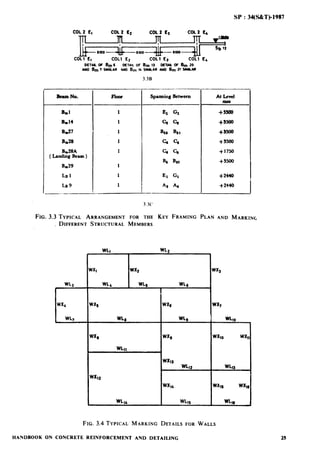
3.5 Marks for Parts of Buildings (that is, column for
3.5.1 Marks are used to designate the different
storey 2, or column
structural members of a structure. Different
between floor 2
structural members of a struCture shall be marked
and 3).
using symbols, abbreviations and notati&s 3.5.4 Beams, slabs and lintels, and tie beams
indicated in succeeding clauses and in the manner shall be consecutively numbered from left-hand
indicated in other clauses. top corner (see Fig. 3.3A).
3.5.2 A key framing plan shall be prepared to
ai convenient scale and the t AOaxes marked one
side with alphabets A, B, C, etc. and the other
with numbers (see Fig. 3.3). Normally with
rectangular pattern, the same key framing plan
may be used for all floors. However, if
arrangement of beams vary for different floors a
separate key framing plan with grid arrangement
and areas may be used for each of the floor. The
floors shall be .specified in accordance with the
requirements of IS : 2332-1973 ‘Specifications for
nomenclature of floors and storeys’ and
abbreviations BT and MZ shall be used for
basement and mezzanine, respectively, for
example:
B-I-
MZ
Floor I
‘Basement
Mezzanine
3.5.5 If longitudinal section of the beam is
shown, the grid of the column or number of the
column supporting the beam is being detailed
shall be as indicated as in fig. 3.3B and, if
possibie, inset on the drawing showing the key
framing plan. On the other hand if a beam
schedule is included, a table [see Fig. 3.3C] may
be prepared and inset on the drawing showing the
key framing plan [see Fig. 3.3A].
3.5.5.1 Beams or slabs that are similar may
be given in the same number.
3.5.6 Walls - Marking of walls shall be made
in the serial order starting from top left corner of
plan and proceeding towards the right, followed
by subsequent rows in order. Longitudinal walls
and cross-walls shall be marked separately (see
Fi .
f!
3.4) and identified in the drawing with
re erence to the serial number of the floor.
Floor 2
Example
3.5.3 Columns - Columns and foundations
2 WL - I Longitudinal wall No. 1
shall be specified by grid arrangement giving
at floor 2 (between
reference to the floor. for examole Isee Fie. 3.3Aj.
floor 2 and 3).
FG Col El
. .
Footing for Column El
4 WX - 3 Cross-wall No. 3 at
floor 4 (between floor 4
Co1 2EI Column El at floor 2 and 5).
33
n
FIG. 3.3 TYPICAL ARRANCXNENT FORTHE KEY FRAMING PLAN AND MARKING DIFFERENTSTRUCTURAL
MEMBERS(Continued)
24 HANDBOOK ON CONCRETE REINFORCEMENT AND DETAHJNG
COL2 E, COL2 L9 ml2 E9 coL2 El
lTl
I 8
l-y
(loo 6lOO 6100
COLl E, COLl E7 COLl Ey COLi E4
OETM OF B,6 OETAIL OF Bm I3 DIDAIL OF e, 20
MoB,,,‘~~LA~ woB,u~~bm~~f?woB,,,IrSYM
3.3B
Barn No. spuning Bmwxn At Luvd
%I
B-14
B.27
B-28 +3m
B.28A 1 Gc, +1750
(Lmding Beam)
8, Bm +3m
B-29 1
hl 1 I El G +2440
LB9 1 *a 4 +2440
__. -.~_I --
FIG. 3.3 TYPICAL ARRANGEMENT FOR THE KEY FRAMING PLAN AND MARKING
. DIFFERENT STRUCTURAL MEMBERS
WL3
cwx4
Wb
r
H
Y
v
v
L
IX’WL‘ I”‘g, WL9
YX9 wx9
WLO WL9
VX9 wx9
WLll
W&9
w2
w2
W&4
WLI4 WLlS
nx7
WLlO
JvXlO W&l
!
w,
W&9 W&9
w9
FIG. 3.4 TYPICAL MARKING DETAILS FOR WALLS
HANDBOOK ON CONCRETE REINFORCEMENT AND DETAILING
As in the Original Standard, this Page is Intentionally Left Blank
SECTION 4
General Detailing Requirements
As in the Original Standard, this Page is Intentionally Left Blank
SP : 34(!3&T)-1987
SECTION 4
GENERAL DETAILING REQUIREMENTS
4.1 Cover - Reinforcement shall have concrete
cover (nominal) and the thickness of such cover
(exclusive of plaster or other decorative finish)
shall be as follows:
4
b)
d
d)
d
At each end of reinforcing bar not less than
25 mm, or twice the diameter of such bar
whichever is greater;
For a longitudinal reinforcing bar in a
column not less than 40 mm or the diameter
of such bar whichever is greater. In the case
of columns with a minimum dimension of
20 mm or tinder, whose reinforcing bars do
not exceed 12 mm, the cover may be recluced
to 25 mm;
For longitudinal reinforcing bar in a beam
not less than 25 mm or the diameter of such
bar, whlchever is greater;
For tensile, compressive, shear or other
ieinforcement in a slab not less than I5 mm
or the diameter of such reinforcement,
whichever is greater; and
For any other reinforcement not less than
15 mm or the diameter of such reinforce-
ment, whichever is greater.
NOTE- The values of cover suggested are nominal cover
as specified in the drawings. The cover shall in no case be
reduced by more than one-third of the specified cover or
5 mm whichever is less. During construction it is
essential to ensure that these tolerances are met.
4.1.1 increased cover thickness may be
provided when the surfaces of concrete members
are exposed to the action of harmful chemicals (as
in the case of concrete in contact with earth
contaminated with such chemicals), acid, vapour,
saline atmosphere, sulphurous smoke (as in the
case of steam-operated railways), etc, and such
increase oi cdver may be between I5 and 50 mm
over the values given in 4.1 above as may be
specified by the Engineer-in-Charge. However, in
no case cover should exceed 75 mm.
4.1.2 For reimorced concrete members of
marine structures totally immersed in sea water,
the cover shall be 40 mm more than that specified
in 4.1, but total cover should not exceed 75 mm.
4.1.3 For reinforced concrete structures/
structural members, periodically immersed in sea
water or subject to sea spray, the cover of
concrete shall be 50 mm more than that specified
in 4.1, but total cover should not exceed 75 mm.
4.1.4 For concrete of grade M25 and above,
the additional thickness of cover specified in 4.1.1
to 4.1.3 may be reduced by half.
HANDBOOK ON CONCRETE REINFORCEXIENT AND
4.2 Development of Stress in ReinforcemuM
4.2.1 Development Length of Bars in Tension
or Compression - The calculated tension or
compression in any bar at any section shall be
developed on each side of the section by an
appropriate development length or end anchorage
or by a combination thereof.
NOTE---‘Development length is the embedded kngtb of
reinforcement required to develop the deriflst~0gth of the
reinforcement at a critical section. Critical sectioar for
development of reinforcement in flexural members are at
points of maximum stress and at points within the span
where adjacent reinforcement termin8te-s. or is bent.
Provisions of 4.6.3 (c) should be satisfied at simplesupports
and a1 points of inflection.
4.2.2 The development length b is given by:
~=!LZo.
4 Tbd
where
4 = nominal diameter of the bar,
(I, = stress in bar at the section considered at
design load, and
f,,,, = design bond stress for bars in tension
given in 4.2.2.1.
NOTE I - The development includes anchorage values of
hooks in tension reinforcement (see 4.3.1).
NOTE 2 - For bars of sections other than circular, the
development length should be sufficient lo develop the
stress in the bar by bond.
DETAILING 29
SP : 34(.s&T)4!%7
4.2.2.1 Design bond stress in limit state
design method for plain bars in tension shall be as
satisfied. Plain bars should nbt he normally
follows:
anchored through straight lengths alone and
should be provided with hooks.
Grade of
concrete
Ml5 M20 M23 M30 M35 M40
4.3.1.2 Bends tmd hooks
Design bond 1.0 1.2 1.4 I.5 I.7 1.9
stress
rbdt N/mm*
For deformed bars, these values shall be increased
by 60 percent. For bars in compression, the values
of bond stresses for bars in tension shall be
increased by 25 percent.
a) Bends - The anchorage vaiue of a standard
bend shall be taken as 4 times the diameter
of the bar for each 45’ bend subject to a
maximum of I6 times the diameter of the
bar.
4.3 Aneborhg Reinforcing Bars - It is
important to note that when a bar is subjected to
both tension and compression, the anchorage
valbe shouid correspond to the one which gives
the maximum value, and at the same time
individual requirements (with respect to tension
and compression) are also satisfied as specified in
4.3.1 to 4.3.3.
b) Hooks - The anchorage value of a standard
U-type hook shall be equal to 16 times the
diameter of the bar.
The anchorage values of standard hooks and
bends for different bar diameters are given in
Table 4.1.
4.3.1 Anchoring Bars m Tension
4.3.1.1 Deformed bars may be anchored in
straight lengths (withaut end anchorages),
provided the development length requirements are
4.3.2 Anchoring Bars in Compression - The
anchorage length of straight bar m compression
shall be equal to the development length of bars
in compression as specified in 4.2.2. The projected
length of hook.s, bends ’ and straight lengths
beyond bends, if provided for a bar in
compression, should be considered for
development length (see Fig. 4.1).
-
TABLE 4.1 ANCHORAGE VALUE OF HOOKS AND BENDS
BAR DIAMETER, mm 6 8 10 12 16 18 20 22 25 28 32 36
A~ic~ouaoa VALUE OF HOOK. cm 9.6 12.8 16.0 19.2 25.6 28.8 32.0 35.2 40.0 44.8 51.2 57.6
ANCHORAGE VALUE OF 90’ BEND, cm 4.8 6.2 8.0 9.6 12.8 14.4 16.0 17.6 20.0 22.4 25.6 28.8
4-d min.
STANDARD HOOK STANDARD
STANDARD HOOK AND BEND
Type of Steel Minimum Value of k
Mild steel 2
Cold-worked steel 4
NOTE I ---Table is applicable to all grades of teinforcement bars.
NOTE 2 -Hooks and bends shall conform to the details given above.
90” BEND
30 HANDBOOK ON CONCRETE REINFORCEMENT AND DETAILING
SP : 34(!3&T)_198~
CRITICAL SECTION J_8
Ld
NOTE- In compression hooks and bends are ineffective and cannot
be used as anchorage.
FIG. 4, I DEVELOPMENTLENGTH IN COMPRESSION*
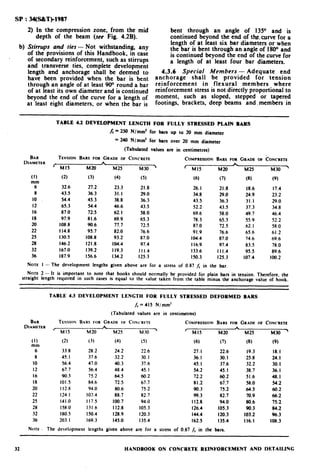
4.3.3 The deve opment length’ values for fully
stressed bars in rt nsion as well as compression
based on 4.2.2 are’given in Tables 4.2.4.3 and 4.4.
NOTE- If the amount of steel provided at a design
section is more than that required from design
consideration. ahe development length given in Tables 4.2,
4.3 and 4.4 may be modified as:
#l_& E +JT;s
I.
Unless otherwise specified. I& modified development kngtth
should be wed in deuiling rcinforoement.
43.4 Mechanical Devices for Anchorage -
Any mechanical or other device capable of
HANDBOOK ON CONCRETE REINFORCEMENT AND DETAILING 31
developing the strength of the bar without
damage to concrete may be used as anchorage
with the approval of the Engineer-in-Charge.
4.3.5 Am horing Shear Reinforcemen!
a) Inclined bars - The development length
shall be as far bars in tension; this length
shall be measured as under:
I) In tension zone. from the end of the slop-
ing or ilrclined portion of the bar ~SPP
Fig. 4.2A). and
SP : 34(!3&T~1987
2) In the compression zone, from the mid
depth of the beam (see Fig. 4.2B).
b) Stirrups and ties-Not withstanding, any
of the provisions of this Handbook, in case
of secondary reinforcement, such as stirrups
and transverse ties, complete development
length and anchorage shall be deemed to
have been provided when the bar is bent
through an angle of at least 90” round a bar
of at least its own diameter and is continued
beyond the end of the curve for a length of
at least eight diameters, or when the bar is
bent through an angle of 13Y and is
continued beyond the end of the-curve for a
length of at least six bar diameters or when
the bar is bent through an angle of 180° and
is continued beyond the end of the curve for
a length of at least four bar diameters.
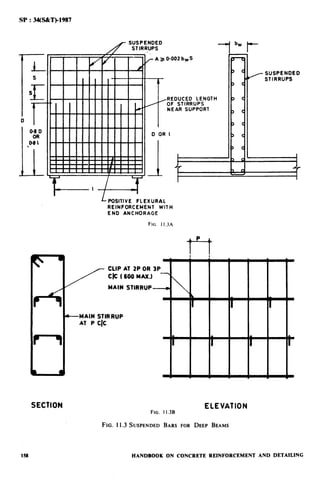
4.3.6 Special Members - Adequate end
anchorage shall be provided for tension
reinforcement in flexural members where
reinforcement stress is not directly proportional to
moment, such as sloped, stepped or tapered
footings, brackets, deep beams and .members in
TABLE 4.2 DEVELOPMENT LENGTH FOR FULLY STRESSED PLAIN BARS
x = 250 N/mm2 for bars up lo 20 mm diameter
= 240 N/mm’ for bars over 20 mm diameter
(Tabulated values are in centimctres)
BAR TENSION BARS FOR GRADE OF CONCRETE
DIAMETER
COMPRESSOF; BARS FOR GRADE OF CONCRETE
t MIS
n
M20 M25 M30 ’ r MIS
h
M20 M25 M30 ’
(1) (2) (3) (4) (5) (6) (7) (8) (9)
mm
6 32.6 27.2 23.3 21.8 26. I 21.8 18.6 17.4
8 43.5 36.3 31.1 29.0 34.8 29.0 24.9 23.2
IO 54.4 45.3 38.8 36.3 43.5 36.3 31.1 29.0
I2 65.3 54.4 46.6 43.5 52.2 43.5 37.3 34.8
I6 87.0 72.5 62. I 58.0 69.6 58.0 49.7 46.4
I8 97.9 81.6 69.9 65.3 78.3 65.3 55.9 52.2
20 108.8 90.6 77.7 72.5 87.0 72.5 62.1 58.0
22 114.8 95.7 82.0 76.6 91.9 76.6 65.6 61.2
25 130.5 108.8 93.2 87.0 104.4 87.0 74.6 69.6
28 146.2 121.8 104.4 97.4 116.9 97.4 83.5 78.0
32 167.0 139.2 119.3 III.4 133.6 III.4 95.5 89.6
36 187.9 156.6 134.2 125.3 150.3 125.3 107.4 100.2
NOTE I - The development lengths given above are for a stress of 0.87 /I in the bar,
NOTE 2 - It is important to note that hooks should normally be provided for plain bars in tension. Therefore. the
straight length required in such cases is equal lo the value taken from the table minus the anchorage value of hook.
TABLE 4.3 DEVELOPMENT LENGTH FOR FULLY STRESSED DEFORMED BARS
/, = 415 N/mm*
(Tabulated values are in centimetres)
BAR TENSIOS BARS FOR GRADE OF COWRETE COLIPRESSIONBARS FOR GRADE OF CONCRETE
DIAMETER
f MI5
& A
M20 M25 M30 ’ I- Ml5 M20 M25 M30 ’
(1) (2) (3) (4) (5) (6) (7) (8) (9)
mm
6 33.8 28.2 24.2 22.6 27. I 22.6 19.3 IS.1
8 45.1 37.6 32.2 30. I 36. I 30.1 25.8 24. I
IO 56.4 47.0 40.3 37.6 45.1 37.6 32.2 30. I
I2 67.7 56.4 48.4 45.1 54.2 45.1 38.7 36. I
I6 90.3 75.2 64.5 60.2 12.2 60.2 51.6 48.1
18 101.5 84.6 72.5 67.7 81.2 6j.7 58.0 54.2
20 I12.H 94.0 80.6 75.2 90.3 75.2 64.5 60.2
22 124.1 103.4 88.7 82.7 99.3 82.7 70.9 66.2
25 141.0 117.5 100.7 94.0 112.8 94.0 80.6 75.2
28 158.0 131.6 112.8 105.3 126.4 105.3 90.3 84.2
32 180.5 150.4 128.9 120.3 144.4 120.3 103.2 96.3
36 203. I 169.3 145.0 135.4 162.5 135.4 116.1 108.3
NOTE The development lengths given above are for a stress of 0.87 J, in the bars.
32 HANDBOOK ON CONCRETE REINFORCEMENT AND DETAILING
SP: 34(SdrT)-I987
TABLE 4.4 DEVELOPMENT LENGTH FOR FULLY STRESSED DEFORMED BARS
X = 500 N/mm*
(Tabulated values are in antimetm)
BAR TENSIONBARSFORGRADEOF CONCRETE COMPRESSION BARS FORGRADEOFCONCRE?E
DIAMETER A- A
’ MIS M20 M25 M30 ’ c MIS M20 M25 M30 ’
(1)
mm
6
8
IO
I2
I6
I8
20
22
25
28
32
36
(2) (3) (4) (9 (6) (7) (8) (9)
40.8 34.0 29.I 27.2 32.6 27.2 23.3 21.8
54.4 45.3 38.8 36.3 43.5 36.3 31.1 29.0
68.0 56.6 48.5 45.3 54.4 45.3 38.8 36.3
81.6 68.0 58.3 54.4 65.3 54.4 46.6 43.5
108.8 90.6 77.7 72.5 87.0 72.5 62.1 58.0
122.3 102.0 87.4 81.6 97.9 81.6 69.9 65.3
135.9 113.3 97,I 90.6 108.8 90.6 73.7 72.5
149.5 124.6 106.8 99.7 119.6 99.7 85.4 79.8
169.9 141.6 121.4 113.3 135.9 113.3 97.I 90.6
190.3 158.6 135.9 126.9 152.3 126.9 108.8 101.5
-217.5 181.3 155.4 145.0 174.0 145.0 124.3 116.0
244.1 203.9 174.8 163.1 195.8 163.1 139.8 130.5
NOTE-The development lengths given above are for a stress of 0.87 Jy in the bar.
THIS POINT IS TO BE
TREATED AS CUT-OFF
4.2A IN TENSION ZONE
I
I
THIS POINT IS TO BE
TREATED AS CUT-OFF
POINT FOR THE PURPOSE
OF DEVELOPMENT LENGTH
IN COMPRESSION ZONE
4.28 IN COMPRESSION ZONE
FIG. 4.2 ANCHORING INCLINED BENT-UP BARS
33~ANZCOOK ON CONCRETE REINFORCEMENT AND DETAILFNC;
sP : 34fM~)-1987
which the tension reinforcement is not parallel to
the compression face.
4.4 Reinforcement Splicing - Splicing is
required to transfer force from one bar -t,o
another. Methods of splicing include lapping (see
4.4.2), welding (see Appendix A) and mechanical
means (see -4.4.3).
4.4.1 Where splices are provided for
continuity in the reinforcing bars (tension bars in
beams), they shall be as far as possible away from
the sections of ,maximum stress and be staggered.
It is recommended that splice in flexural members
should not be at sections where the bending
moment is more thaa 50 percent of the moment of
resistance of the section. Not more than half the
bars shall & spliced at a section.
Where more than one half of the bars are
spll’ced at a section or where splices are made at
points of maximum stress, special precautions
shall be taken, such as increasing the length of lap
and/or using spirals or closely spaced stirrups
around the length of /the splice.
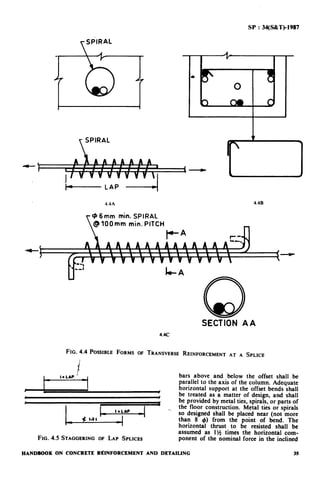
NATE l -The stirru s provided should be able to resist a
tension equal to the fu I tenstle force in the lapped bars andP
should be provided in the outer one-third of the lap length
at both etids with at least three stirrups on either side (see
Fig. 4.3). In case of thick bars (say 4 > 28 mm), lap splices
shoutd be completely enclosed by transverse reinforcement,
for example. in the form of small compact stirrups or spirats
[see Fig. 4.4 (A and B)].
NOTE 2 -Careful detailing is necessary when
reinforcements are to be spliced. Therefore location and
details of splices should be determined at the design stage
itself and indicated in the drawing. Preferably splicing
details should not be left to be decided at the site of
construction.
44.2 Lap Splices
a) Diameter of bars for lap splicing - Lap
splices shall not be used for bars larger than
36 mm. For larger diameters, bars may be
welded (see Appendix A).
34
b)
cl
In cases where welding is not practicable,
lapping of bars larger than 36 mm may be
permitted, in which case additikal spirals
should be provided around the lapped bars
(see Fig. 4.4A).
Staggering of lap splices - Lap splices
shall bc considered as staggered if the
centre-toxentre distance of the splices is not
less than 1.3 times the lap length (see Fig. 4.5)
calculated as given in (c) below. Bars
could be lapped vertically one above the
other or horizontally, depending upon the
space requirement.
Lup length in tension - Lap length includ-
ing anchorage value of hooks in flexural
tension shall be h or 30 4 whichever is
greater and for direct tension 2 Ld or 30 4
whichever is greater. The straight length
of the lap shall not be less than 15 4 or
200 mm, whichever is greater (see Fig. 4.6).
where
I,,, = development length
NOTE- Splices in direct tension members shall be
enclosed in spirals made of bars not less than 6 mm in dia-
meter with pitch not more than IO cm. Hooks/bends shall
bc provided at the end of bars in tension members (see
Fig. 4.4C).
d)
e)
Lap length in compression --The lap
length in compression shall be equal to the
development length in compression calcula-
ted as in 4.2.2 (see Tables 4.2, 4.3 and 4.4),
but not less than 24 4.
Requirement of splice in a column - In
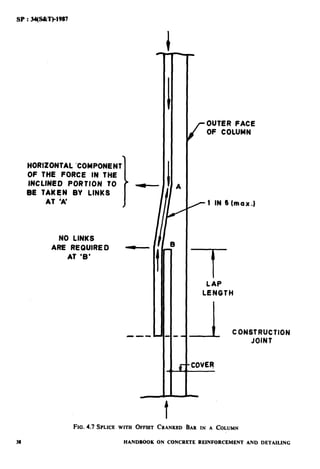
columns where longitudinal bars are offset
at a splice, the slope of the inclined portion
of the bar with the axis of the column shall
not exceed I in 6. and the portions of the
1
I
-5-
L
4 L-LAP
-P-’
c
FIG. 4.3 TRANSVERSE REINFORCEMENT AT A SPLICE
HANDBOOB ON CONCRETE REINFORCEMENT AND DETAILING
SP : 34(-T)-1987
4.4A
6mm min. SPIRAL
100 mm min. PITCH
SECTION AA
4.4C
FIG. 4.4 POSSIBLEFORMSOF TRANSVERSEREINFORCEMENTAT A SPLICE
m bars above and below the offset shall be
parallel to the axis of the column. Adequate
I
horizontal support at the offset bends shall
8 I be treated as a matter of design, and shall
)
w f-
be provided by metal ties, spirals, or parts of
the floor construction. Metal ties or spirals
so designed shall be placed near (not more
than 8 do) from the point of bend. The
horizontal thrust to be resisted shall be
assumed as 1IA times the horizontal com-
FIG. 4.5 STAGGERINGOF LAP SPLICES ponent of the nominal force in the inclined
HANDROOK ON CONCRETE RdINFORCEMENT AND DETAILING 3s
SP : 34(S&T)-1987
IN FLEXURAL TENS!ON WITHOUT HOOKS
I( ANCHORAGE VALUE DF HOOK OR
! BEND+ ST-RAIGHT LEN67H 1
c--v
RC Ld OR 304 jWHICHEVER IS
L--m GREATER.
t-
STRAIGHT LENGTH
1
--
--4 1%) OR 100
WHICHEVER IS GREATER
.N FLEXURAL TENSION WITH -HOOKS
0 IL DIAMETER OF SMALLER BAR
IN COMPRESSION
-4.6A BARS IN TENSION ANI) COMI’RI-SSLOS
HANDBOOK ON CONCRETE REINF0RWMC:N-T AND I~ET,II.IS~;36
SP : 34(S&T)-1987
ONE MESH+100 mm+ 2 END OVERHANGS ,
LAP TIP TO TIP OF WIRE
ANSVERSE WIRE
LONGITUDINAL WIRE
TRANSVERSE
WIRES
MORE THAN HALF STRESS END AND EDGE LAPS
/-ONE MESH + SO-mm ,
Lhl$ &;E’O TIP
ONGITUDINAL WIRES
HALF STRESS END LAP *
TRANSVERSE
HALF STRESS EDGE LAP
4.6H WEI.I)EI)WlKE FAHKIC
FIG. 4.6 LAP LENGTH
portion of the bar (see Fig. 4.7). Offset bars 4.4.2.1 Lup splices in welded wire Jabric
shall be bent before they-arc placed in the
forms. Where column facesare offset 75 mm a)
or more. splices oP’<‘erticaI bars adjacent to
the offset fact shall bc made by separatedowels
overlapped at specified about.
NoI+. It is IO bc noted that in Fig. 4.7. additional
stirrups will bc rcquircd only near the bottom crank.
The fabric is supplied in long mats/rolls and
it is rarely necessary to have a joint of the
main wires. The rigidly connected cross-
members provide mechanical anchorage.
Adequate lapping where necessary may be
provtded with a comparatively short lap
when cross wires occur within the lap.
In structural slabs, laps in regions of maxi-
mum stress shall be avoided. Such splices,
where used for either end or edge laps.
shall be made so that the distance between
f) Bars c?f d#t?retil dianrerers - When bars b)
of two different diameters are to be spliced,
the lap length shall be calculated on the
basis of diameter of the smaller bar.
HANDBOOK ON CONCRETE REISWR<‘EM):NT AND DETAILING 37
HORIZONTAL ‘COMPONENT
OF THE FORCE lN THE
INCLINED PORTION TO
BE TAKFN BY LINKS
AT ‘A’
NO LINKS
ARE REQUIRE 0
AT ‘0’
cOUTER FACE
OF COLUMN
rl IN 6tmax.)
-T-LAP
LENGTH
1 CONSTRUCTION
JOINT
FIG.4.7SPLICE WITH OFFSET CRANKED BAR IN A COLUMN
HANDBOOK ON CONCRETE REINFORCEMENT AND DETAILING
I
outermost cross wires is not less than the
spacing of the wire parallel to the lap plus
100 mm (see Fig. 4.6).
In other cases for end laps, welded wire
fabric shall be lapped not less than one mesh
plus 50 mm, that is, the length of the lap
shall be 50 mm greater than the spacing of
wires parallel to the lap. For edge laps, a
lap of 50 mm is sufficient (see Fig. 4.6).
These requirements for lapping should be
covered by suitable notes in the general
specifications. But whether specified by
wordings or shown on plans, certain dis-
tinction should be made between ‘edge laps’
and ‘end laps’.
The width of an edge lap shall be indicated
as the centre-to-centre distance between the
outside of longitudinal salvage wires of the
overlapping sheets as illustrated in Fig. 4.6.
The length of an end lap shall be indicated
as the top-to-top distance between the ends
of the longitudinal wires of the overlapping
sheets.
4.4.3 Welded S lices and Mechanical Con-
nections - Where Rt e strength of a welded splice
or mechanical connection has been proved by
tests to be at least as great as that of the parent
bai, the design strength of such connections shall
be taken as equal to 80 percent of the design
strength of the bar for tension splice and 100
percent of the design strength for the compression
splice. However, 100 percent of the design
strength may be assumed in tension when the
spliced area forms not more than 20 percent of
the total area of steel at the section and the splices
are staggered at least 600 mm centre-to-centre.
The choice of splicing method depends mainly
on the cost, the grade of steel, the type of
reinforcement, generally high bonding, the
possibility of transferring compressive and/ or
tensile stresses and the available space in the
section concerned. The designer shall specify the
splicing method and the conditions under which it
is to be carried out.
Mechanical coupling devices shall be arranged
so that as small a
single section. They hould, in addition, be placed
outside the most
d
umber as possible affect a
hly stressed sections.
4.4.3.1 Sleeve splicing - If correctly used,
sleeve connections may transmit the total
compressive or tensile stress. In general, the use of
these sleeves is governed by various conditions
laid down in the agreement for the method or, in
the absence of recommendations, by preliminary
testing.
During assembly, particular care shall be taken
to ensure that the lengths introduced into the
sleeve are sufficient.
SP : 34(55&T)-19%7
These lengths should be marked before hand on
the ends of the bars to be spliced except when a
visual check on penetration is possible (for
example, sleeve with a central sight hole):
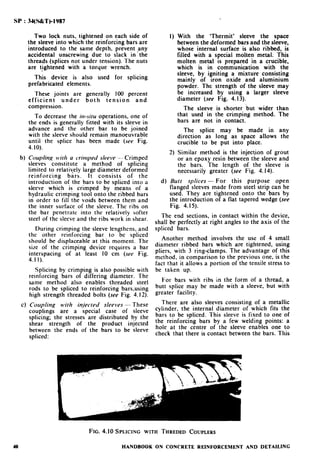
a) Threaded couplefs (see Fig. 4.8) - In order
to prevent any decrease in the end sections
of the bar as a result of threading (with V-
form or round threads), they can be:
FIG. 4.8 TH~EDEDCOUPLERS(THREADINGLIMITED
TO THE ENDS OF BARS)
1) upset;
2) for long units, fitted with larger section
threaded ends by flash welding; or
3) fitted with a threaded sleeve by crimp-
ing.
Another solution consists of threading the
ends but only taking into consideration the
nominal section of the threaded end, that is,
reducing the permissible stress in the
reinforcement.
The ends of the sleeve shall be slightly
reduced in section .in order to prevent
overstressing of the first few threads.
There are, at present, reinforcin bars
with oblique, discontinuous., spira f ribs,
allowing splicing with a specral sleeve with
internal threads.
This same process is used to splice
prestressing bars, and in order to prevent
confusion between reinforcing bars and
prestressing steels, the direction of threading
is reversed (see Fig. 4.9).
FIG. 4.9 COUPLERFOR REINFORCINGBARS
(420 To 428)
HANDBOOK ON CONCRETE REINFORCEMENT AND DETAILING 39
SP :
b)
Cl
Two lock nuts. tightened on each side of
the sleeve into which the reinforcing bars are
introduced to the same depth, prevent -any
accidental unscrewing due to slack in the
threads (splices not under tension). The nuts
are tightened with a torque wrench.
This device is also used for splicing
prefabricated elements.
These joints are generally 100 percent
efficient under both tension and
compression.
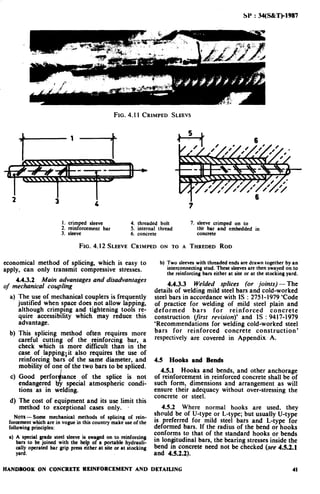
To decrease the itt-siru operations. one of
the ends is generally fitted with its sleeve in
advance and the other bar to be joined
with the sleeve should remainmanoeuvrable
until the splice has been made (sre Fig.
4. IO).
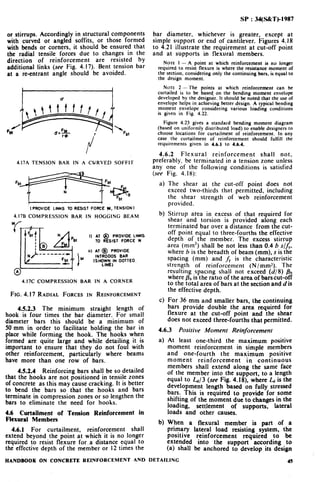
CouplittK c*itlt a crimped sleeve -- Crimped
sleeves constitute a method of splicing
limited to relatiyely large diameter deformed
reinforcing bars. It consists of the
introduction of the bars to be spliced into a
sleeve which is crimped by means of a
hydraulic crimping tool onto the ribbed bars
in order to fill the voids between them and
the’inner surface of the sleeve. The ribs on
the bar penetrate into the relatively softer
steel of the sleeve and the ribs work in shear.
During crimping the sleeve lengthens, and
the other reinforcing bar to be spliced
should be displaceable at this moment. The
sire of the crimping device requires a bar
interspacing of at least IO cm (see Fig.
4.1I).
Splicing by crimping is also possible with
reinforcing bars of differing diameter. The
same method also enables threaded steel
rods to be spliced to reinforcing barsusing
high strength threaded bolts (see Fig. 4.12).
Coupling n*irh injected sleeves - These
couplings are a special case of sleeve
splicing; the stresses are distributed by the
shear strength of the product injected
between the ends of the bars to be sleeve
spliced:
1)
2)
With the ‘Thermit’ sleeve the space
between the deformed bars and the sleeve,
whose internal surface is also ribbed, is
tilled with a special molten metal. This
molten metal is prepared in a crucible,
which is in communication with the
sleeve, by igniting a mixture consisting
mainly of iron oxide and aluminium
powder. The strength of the sleeve may
be increased by using a larger sleeve
diameter (see Fig. 4.13).
The sleeve is shorter ‘but wider than
that used in the crimping method. The
bars are not in contact.
The splice may be made in any
direction as long as space allows the
crucible to be put into place.
Similar method is the injection of grout
or an epoxy resin between the sleeve and
the bars. The length of the sleeve is
necessarily greater (see Fig. 4.14).
d) Butt splices - For this purpose open
flanged sleeves made from steel strip can be
used. They are tightened onto the bars by
the introduction of a flat tapered wedge (see
Fig. 4.15).
The end sections, in contact within the device,
shall be perfectly at right angles to the axis of the
spliced bars.
Another method involves the use of 4 small
diameter ribbed bars which are tightened, using
pliers, with 3 ring-clamps. The advantage of this
method, in comparison to the previous one, is the
fact that it allows a portion of the tensile stress to
be taken up.
For bars with ribs in the form of a thread, a
butt splice may be made with a sleeve, but with
greater facility.
There are also sleeves consisting of a metallic
cylinder, the internal diameter of which fits the
bars to be spliced. This sleeve is fixed to one of
the reinforcing bars by a few welding points: a
hole at the centre of the sleeve enables one to
check that there is contact between the bars. This
40
FIG. 4.10 SPLICING WITH THREDED COUPLERS
HANDBOOK ON CONCRETE REINFORCEMENT AND DETAILING
SP : 34(S&T)-1987
FIG. 4. I I CRIMPED
I. trim d sleeve 4. threaded bolt
2. rein orcement barfpe
7. sleeve crimped on to
5. internal thread th’e bar and embedded in
3. sleeve 6. concrete concrete
FIG. 4.12 SLEEVECRIMPEDON TO A THREDEDROD
economical method of splicing, which is easy to
apply, can only transmit compressive stresses.
4.4.3.2 Main advantages and disadvantages
of mechanical coupling
a)
W
c)
d)
The use of mechanical couplers is frequently
justified when space does-not allow lapping,
although crrmRmg and trghtenmg tools re-
quire accessibtlity which may reduce this
advantage.
This splicing method often requires more
careful cutting of the reinforcing bar, a
check which is more difficult than in the
case of 1apping;it also requires the use of
reinforcing bars of the same diameter, and
mobility of one of the two bars to be spliced.
Good perfor
di:
ante of the splice is not
endangered special atmospheric condi-
tions as in welding.
The cost of equipment and its use limit this
method to exceptional cases only. -
SLEEVS
b) Two sleeves with threaded ends are drawn together by an
interconnecting stud. These sleeves are then swayed on to
the reinforcing bars either at site or at the stocking yard.
4.4.3.3 Welded splices (or joints) - The
details of welding mild steel bars and cold-worked
steel bars in accordance with IS : 2751-1979 ‘Code
of practice for welding of mild steel plain and
deformed bars for reinforced concrete
construction yirst revision)’ and IS : 9417-1979
‘Recommendations for welding cold-worked steel
bars for reinforced concrete construction*
respectively are covered in Appendix A.
4.5 Hooks and Bends
4.5.1 Hooks and bends, and other anchorage
of reinforcement in reinforced concrete shall be of
such form, dimensions and arrangement as will
ensure their adequacy without over-stressing the
concrete or steel.
4.5.2 Where normal hooks are used. they
should be of U-type or L-type; but usually U-type
is preferred for mild steel bars and L-type for
deformed bars. If the radius of the bend or hooks
conforms to that of the standard hooks or bends
in longitudinal bars, the bearing stresses inside the
bend in concrete need not be checked (see 4.5.2.1
and 4.5.2.2).
NOTE- Some mechanical methods of splicing of rein-
forcement which are in vogue in this country make use of the
following principles:
a) A special grade steel sleeve is swaged on to reinforcing
bars to be joined with the help of a portabk hydrauli-
cally operated bar grip press either at site or at stocking
yard.
HANDBOOK ON CONCRETE REINFORCEMENT AND DETAiLINC 41
SP : 34(S&T)-I987
11
I. deformed bar 8. iron oxide-aluminium mixture
2. prefabricated element 9. plugging disc
3. thermit sleeve IO. spliced length (260 mm)
4. prefabricated element I I. thermit sleeve
5. Insulation (asbestos)
6. ignition device
12. bedding
13. asbestos
7. crucible
FIG. 4.13 THERMIT SLEEVE
4.5.2.1 Bearing stresses ut bends - The
bearing stress in concrete for bends/ hooks in
dangerous situation is that of a bar, the layout of
stirrups and ties conforming to 4.3.5(b) need not
which is parallel to a surface or wall. Safety can
be checked as there is a transverse bar at each
be substantially increased by inclining the curve
. zone towards the mass of concrete wherever
bend. The bearing stress inside a bend in all other possible, a condition which frequently occures in
cases should ureterably be calculated as given in anchorage. However, it may be noted that
the tollowing formula (see Fig. 4.16). The most IS : 456-1978 also exempts check for bearing
I. deformed bar 4. vent-hole
2. grout 5.
3.
injection pipe
sleeve 6. spacer plug
FIG. 4.14 SPLICING WITH GROUTED SLEEVES
FIG. 4.15 COUPLING WITH SLEEVE AND WEDGE
41 HANDBOOK ON CONCRETE REINFORCEMENT AND DETAILING
la ,(FOR INTERNAL BARS) x
.
SP : 34(S&T)-1987
1
c-i
a
FOR END BARS
SECTION-XX
4.16A BEARING STRESS AT BENDS
A
1
10..
Ii
-.4a 1 FOR END BARS 1
4 a 1FOR INTERMEDIATE BARS 1
-
SECTION-Y Y
4.168 MINIMUM INTERNAl. RADIUS OF BEND FOR EFFECTIVE
ANCHORAGE OF FULLY WRESSED TENSION BARS
FIG. 4.16 BEARING STRESS AT INTERNAL BENDS
HANDBOOK ON CONCRETE REINFORCEMENT AND DETAILING
SP : M@&T)-1987
sfress in concrete for standard hooks and bends
described in ‘Table 4.1.
33earingstress, u = 2
WA@%
& = tensile force due to design loads in a bar
or grip of bars (N);
r = interns! radius of the bend (mm); and
@= size sf the bar or, if in bundle, the size of
bar of equivalent area (mm).
For limit state method of design, this stress
1.5 fck
shall cot oxcecd _-
I+_?!&’
where fCk is the
a
~h~ra~t~~~ti~ strength of concrete and a, for a
particular bar or group of bars in contact shall be
taken as a centre-to-centre distance between bars
or groups of bars perpendicular to the plane of
the bend (mm); for a bar or group of bars
adjacent to the face of the member, a shall be
taken as the cover plus size of bar.
In other words, the minimum radius of the
bend, r, should be such that
r 2 0.4564 (i)( 1 + T)
When the large steel stresses need to be
developed il. ‘he bend, radial bearing stresses in
the concrete may become excessive. The above
equation controls the diameter of bend when
there is a combination of high tensile stress in the
bend. large bar diameter and low concrete
strength. To simplify the application of the above
formula minimum radius of bend is given in Table
4.5 for different grades of concrete and steel.
4.5.2.2 If a change in direction of tension or
compression reinforcement induces a resultant
force acting outward tending to split the concrete,
such force should be taken up by additional links
TABLE 4.5 MINlMUM RADIUS OF BEND FOR BARS FULLY STRESSED AT BENDS IN cm
20
415 15
20
300 15
20
u
cm
(3)
2.5
5.0
1::;
15.0
2.5
5.0
1.5
IO.0
15.0
::i
I;::
15.0
2.5
:.I:
1o:o
IS.0
2.5
5.0
I?:
15:o
(Chuse 4.5,2. I)
DIAMETER OF BAR IN mm
-10
L
12 I6 20
(4) (5) (6) (7) (8) (9)
13.7
10.6
;::
8.6
17.9 21.7 39.5 57.0 86.6
13.5 19.9 27.4 38.0 55.4
12.0 17.3 23.3 31.7 45.1
11.3 16.1 21.3 28.5 39.9
10.6 14.8 19.3 25.3 34.1
10.3 13.4 20.8
8.0 10.1 14.9
7.2 9.0 13.0
6.8 8.5 12.1
6.5 8.0 II.1
29.6
:t :t
16.0
14.7
42.8 65.0
28.5 41.6
23.8 33.8
21.4 29.9
19.0 26.0
22.7 29.7 46.0
17.7 22.4 33. I
16.0 20.0 28.8
15.1 18.8 26.6
14.3 17.6 24.5
::::
38.7
35.3
32.0
94.6
50.5
52.6
47.3
42.1
143.7
92.0
74.8
:: f
17.0 22.3 34.5 48.8 71.0 107.8
13.3 16.8 24.8 34.1 37.9 69.0
:2.0 15.0 21.6 29.0 39.5 56. I
II.3 14.1 20.0 26.5 35.5 49.7
10.7 13.2 18.4 24.0 31.6 43.2
21.4 35.8 55.5
21.3 27.0 39.9
19.3 24. I 34.7
18.2 22.6 32.1
17.2 21.2 29.5
79.0
z:
42:6
38.5.
114.0 173.2
76.0 110.9
63.3 90.2
57.0 79.8
50.7 69.4
20.6
16.0
14.5
t;:;
26.9 41.6 59.3 85.5 130.0
20.3 29.9 41.0 57.0 83.2
18.1 26.0 35.0 41.5 67.7
17.0 24. I 32.0 42.8 59.9
15.9 22. I 28.9 38.0 52.0
25 32 ’
NOTE- The minimum radius is based on the full design stress in steel at the bend. In the absence
of more precise calculations, it may be assumed that the tensile stress due to the anchorage at the source
of a hook is equa! to half the stress on the bar, by reasons of its mechanical strength.
44 HANDBOOK ON CONCRETE REINFORCEMENT AND DETAILING H
e
:;
SP : 34(S&T)-1987
or stirrups. Accordingly in structural components
with curved or angled soffits, or those formed
1’ ” iKith bends or corners, it should be ensured that
; the radial tensile forces due to changes in the
, direction of reinforcement are resisted by
1
additional links (see Fig. 4.17). Bent tension bar
, $ at a re-entrant angle should be avoided.
3
I c
‘” :;
‘..
t I
4.17A TENSION BAR IN A CURVED SOFFIT
I PROVIDE LINKS TO RESIST FORCE ?I. TENStON)
4.179 COMPRESSION BAR IN HOGGING BEAM
I) AT @ PROVIDE LINKS
TO RESIST FORCE N
ii1 AT @ PROVIDE
___ _.---
!,lN DOTTED
4.17C COMPRESSION BAR IN A CORNER
FIG. 4.17 RADIAL FORCES IN REINFORCEMENT
4.5.2.3 The minimum straight length of
hook is four times the bar diameter. For small
diameter bars this should be a minimum of
5O’mm in order to facilitate holding the bar in
place while forming the hook. The hooks when
formed are quite large and while detailing it is
important to ensure that they do not foul with
other reinforcement, particularly where beams
have more than one row of bars.
4.5.2.4 Reinforcing bars shall be so detailed
that the hooks are not positioned in tensile zones
of concrete as this may cause cracking. It is better
to bend the bars so that the hooks and bars
terminate in compression zones or so lengthen the
bars to eliminate the need for hooks.
4.4 Curtailment of Tension Reinforcement in
Flexural Members
4.6.1 For curtailment, reinforcement shall
extend beyond the point at which it is no longer
required to resist flexure for,a distance equal to
the effective depth of the member or 12 times the
bar diameter, whichever is greater, except at
simple support or end of cantilever. Figures 4.18
to 4.21 illustrate the requirement at cut-off point
and at supports in flexural members.
NOTE I - A point at which reinforcement is no longer
required to resist flexure is where the resistance moment of
the section, considering only the continuing bars, is equal to
the design moment.
NOTE 2--The points at which reinforcement can be
curtailed is to be based on the bending moment envelope
developed by the designer. It should be noted that the use of
envelope helps in achieving better design. A typical bending
moment envelope considering various loading conditions
is given in Fig. 4.22.
Figure 4.23 gives a standard bending moment diagram
(based on uniformly distributed load) to enable designers to
choose locations for curtailment of reinforcement. In any
case the curtailment of reinforcement should fulfill the
requirements given in 4.6.1 to 4.6.4.
4.6.2 Flexural reinforcement shall not,
preferably, be terminated in a tension zone unless
any one of the followina conditions is satisfied
(see
4
Fig. 4.18): y
b)
c)
The shear at the cut-off point does not
exceed two-thirds that permitted, including
the shear strength of web reinforcement
provided.
Stirrup area in excess of that required for
shear and torsion is provided along each
terminated bar over a distance from the cut-
off point equal to three-fourths the effective
depth of the member. The excess stirrup
area (mm’) shall be not less than 0.4 b s/f*,
where b is the breadth of beam (mm), s is the
spacing (mm) and fY is the characteristic
strength of reinforcement (N/mm”). The
resulting spacmg shall not exceed (d/8) &,
where /I&is the ratro of the area of bars cut-off
to the total area of bars at the section and d is
the effective depth.
For 36 mm and smaller bars, the continuing
bars provide double the area required for
flexure at the cut-off point and the shear
does not exceed three-fourths that permitted.
4.6.3 Positive Moment Reinforcement
a) At least one-third the maximum positive
moment reinforcement in simple members
and one-fourth the maximum positive
moment reinforcement in continuous
members shall extend along the same face
of the member into the support, to a length
equal to L,,/3 (see Fig. 4.18). where L is the
development length based on fully stressed
bars. This is required to provide for some
shifting of the moment due to changes in the
loading, settlement of supports, lateral
loads and other causes.
b) When a flexural member is part of a
primary lateral load resisting system, the
positive reinforcement required to be
extended into the support according to
(a) shall be anchored to develop its design
HANDBOOK ON CONCRETE REINFORCEMENT AND DETAILING IS
/
BARS SHOULD HAVE STANDARD 9$8END, IF
REQUIRED TO BE BENT TO ACHIEVE Ld/a
SUPPORT
*whichever is greater
A is the point at which certain amount of steel is no longer required
Any one of the conditions to be satisfied at the actual cut-off point, B:
_
MOMENT DIAGRAM
i) For bars <#36 , -A, 2 2Az and V. IP a V
3
ii) Excess stirrup area (than that is required from design) in a distance ofqd from the cut-off point along the terminated bar 0.46s
IIIJ v. I+ v
Q___._
h
with spacing &$A&
Notations : A, = positive moment steel as per actual design
& = development length based on fully stressed bars
V. = shear at the cut-off point
V = shear strength of the section
A, = the critical area of steel required at the cut-off point
A2 = area of continuing steel
S = spacing of stirrups without cutting of steel
” b = breadth of member
d = effective depth
/, = characteristic strength of reinforcement
&=
area of bars cut-off
Total area
FIG. 4.18 TENSILE DEVELOPMENT LENGTHS FOR POSITIVE MOMENT STEEL. IN SLAR~BEAM WITH ONE SIDE C~NTINU~LJS AND THE OTHER
DISCONTINUOUS
--.----._. ,-_____ --- --_-----____ ___~__ -----9w-_ . ,_____ c__.
4
stress (fully developed stress) in tension at
the face of the support (see Fig. 4.19).
This anchorage is to assure ductility of
response in the event of unexpected over-
stress such as from an earthquake. It is not
sufficient to use more reinforcement at lower
stresses. The full anchorage re uirement
does not apply to any excess rein orcement?
over and above that provided at the support.
At simple supports and at points of inflec-
tion, positive moment tension reinforcement
shall be limited to a diameter such that
Ld does not exceed (see Fig. 4.18)
where
M, = moment of resistance of the section
assuming all reinforcement at the section
to be stressed to fd;
fd = 0.87 fy in the case of limit state design;
Y = shear force at the section; and
L,, =,sum of the anchorage beyond the centre
of the support and the equivalent ancho-
rage value of any hook or mechanical
anchorage at simple support; and at a
point of inflection, L, is limited to
the effective depth of the members or
124~, whichever is greater.
The value of MI/ V in the above expression may
be increased by 30 percent when the ends of the
reinforcement are confined by a compressive
reaction. In routine design calculations, it may be
found that $> Ld, and hence no further check
need be made. When the requirement
is not satisfied, Jhe designer should either reduce
the diameter of bars, whereby & is reduced, or
SP : 34(SX:T)-1987
increase the area of positive reinforcement at the
section considered, whereby MI is increased, or
resort to botli the steps.
4.6.4 Negative Moment Reinforcement - At
least one-third of the total tension reinforcement
provided for negative moment at the support shall
extend beyond the point of inflection (PI) not less
than the effective depth of the member or 12 & or
one-sixteenth of the clear s an, whichever 1s
greater (see Fig. 4.20 and 4.!?I).
4.7 Spacing of Reinforcement ~~ For the
purpose of this clause, the diameter of’ a round
bar shall be its nominal diameter, and in the case
of bars which are not round or in the case of
deformed bars or crimped bars, the diameter shall
be taken as the diameter of a circle giving an
equivalent effective area. Where spacing
limitations and minimum concrete cover are
based on bar diameter, a group of bars bundled in
contact shall be treated as a single bal of diameter
derived from the total equlvalen! arca.
4.8 Bars Bundled in Contact
4.8.1 Genera/-- Bars in pairs, or in groups of
3 or 4 tied together and in contact side by side
(boundled bars) may be .Ised ir, beams and
columns. This has been the practice in USA for
many years, and is now permitted in most
countries including India.
As bundled bais provide more reinforcrment in
less space than do single bars, ir is possibie to ‘,
reinforce a member more heavily and still get
better compaction of concrete. Beam and column
sizes can thus often be reduced with saving in
cost.
Bundled bars shall not be used in members
without stirrups. Bundled bars shall be tied
together to ensure the bars remain together as a
bundle. Bars larger than 36 mm diameter shall not
be bundled except in columns.
Whenever bar spacing limitations, minimum
cover, tie size and spacing are based on bar
diameter, a group of bars bundled in contact shall
= EDGE COLUMN
A+
LIN’TERIOR COLUMN
L,, is development length based on fully strcs& bars.
FIG. 4.19 TENSILE ANCHORAGE OF POSITIVE MOMENT STEEL IN BEAMS (WHEN BEAMS ARE
PART OF A LATERAL LOAD RESISTING SYSTEM)
HANDBOOK ON CONCRETE REINFPRCEMENT AND DETAILING 41
SP:34(S&T)-1987
*whichever is greater
A is thecritical cut-off point at which certain amount of reinforcement is no longer required
,B is actual cut-off point
PI is point of infection
FIG. 4.20TENSILE DEVELOPMENT LENGTH FOR NEGATIVE MOMENT AT CONTINUOUS EDGE
1.
Y 124OR d*
y
Ast
4,
I
 -BEAM OR SLAB
*Whichever is greater
FIG. 4.21TENSILE DEVEI.OPMENT LENGTHS FOR POSITIVE MOMENT STEEL AT
DISCONTINUOUS ENDS
be treated as a single bar of diameter derived from
the total equivalent area (see Table 4.6).
However, the cover provided should be measured
from the actual outside contour of the bundle.
NOTE I - Unless patented splices are used, the bundling
of bars in columns is not recommended, as all joints have to
be staggered. However, even when patented splices are used
the necessary staggering of splices makes assembly difficult
and prefabrication cumbursome.
48 HANDBOOK
NOTE 2 --- It is recommended to limit the bundle only to
two bars or three bars as four bars many times do not tie
into a stable bundle.
4.82 Development Length - Ld of each bar
of bundled bars shall be that for the individual
bar, increased by IO percent for two bars in
contact, 20 percent for three bars in contact and
33 percent for four bars in contact. The
ON CONCRETE- REINFORCEMENT AND DETAILING
(PRISMATIC BEAM )
, MAX.LEFT MAX
I
4 SPANS PARTIAL LOADING
1 I
I i
REDISTRIBUTED MOMENTS (30%
FIG. 4.22 A TYPICAL BENDING MOMENT 1 ENVELOPE
BAR
SIZE
TABLE 4.6 EQUIVALENT BAR SIZE FOR BARS IN GROUPS
(Chuse 4.8. I)
BUNDLED BARS
(4)
2 BARS A --_
’ Area
A r
Equivalent ’
3 Bars 4 Bars
A 1
Size ’ Area Equivalent ’ c Area
size
Equivalent ’
size
(1) (2) ;3) (4) (5) (6) (7)
mm mm2 mm mm’ mm mm2 mm
IO 157 I4
12 226 I7
16 402 23
18 509 25
20 628 28
22 760 31
25 982 35
28 I.231 40
32 I 608 45
236 17 314 20
339 21 453 24
603 28 804 32
763 31 1017 36
942 35 I 257 40
I 140 38 I 520 44
I 473 43 lW3 50
I 847 50 2463 56
2412 55 3216 64
HANDBOoK ON CONCRETE REINFORCEMENT AND DETAILING
SP:34(S&T)-1987
anchorages of the bars of a bundle can only be 4.8.4 Splicing - In case of bundled bars,
straight anchorages. lapped splices of bundled bars shall be made by
.4.8.3 Curtailment - Bars in a bundle shall
splicing one bar at a time, such individual splices
terminate at different points spaced apart by not
within a bundle shall be staggered. For bundles of
less than 40 times the bar diameter except for
2, 3 or 4 bars, the staggering distance should be
bundles stopping at a support (see Fig. 4.24).
1.2, 1.3 and 1.4 times the anchorage length of the
individual bars respectively.
A
4.24A BiJNDLE OF BARS CARRIED TO A SUPPORT
4.248 BUNDLE TERMINATED AT THEORETICAL CUT
OFF POINT
STAGGERING ALL BARS
.4.24C BUNDLE TERMINATED AT THEORETICAL CUT
OFF POINT
LAST PAIR TERMINATED SIMULTANEOUSLY
.FIG.4.24 CURTAILMENT OF BUNDLED BARS
HANDBOOK ON CONCRETE REINFORCEMENT AND DETAILING
.
As in the Original Standard, this Page is Intentionally Left Blank
SECTION 5
Bar Bending Schedule
(Including Do’s and Dont’s in Detailing)
As in the Original Standard, this Page is Intentionally Left Blank
SP : 34(S&T)-1987
SECTION 5
BAR BENDING SCHEDULE (INCLUDING DO’S AND
DONT’S IN DETAILING)
5.1 Bar bending schedules are very im ortant
out of detailing and should give the fo lowingP
information:
a)
b)
cl
4
e)
f-l
.d
h)
j)
k)
5.2
Identification of the structural member(s),
Position of the bars in the structure,
The bar mark,
The diameter or size of bar,
The number of bars of dne type in each
structural member,
The total number of bars of each type,
The total straight length of the bar,
The shape and bending dimensions of the
bar,
The details of bar chairs can also be in-
cluded, and
Remarks, if any.
Schedules
5.2.1 The reinforcement of slabs, beams and
other parts of structures may be effectively shown
on working drawings in a tabular form, known as
a schedule. The schedule is a compact summary of
the dimensions of the concerned structural part,
all the bars complete with the number of pieces,
shape and size, lengths and bending details from
which fabrication details may be easily worked
out. The dimensioning procedure for different bar
shapes as shown in Tables 5.1 to 5.7 may be
followed.
NOTE- The value of length is the length of straight bar
from which the actual shatx will be bent or for a straight
bar. the length of that bar. This length will be equal-to
the sum of individual overall lengths of the straight
portions of each shape
5.2.2 A schedule shall be supplemented with
diagrams and sketches wherever necessary. Where
bars of different dimensions are used, the exact
arrangement of the reinforcement shall be shown
by means of clear diagrams. No abbreviation or
symbol shall be used in a schedule without proper
explanation.
5.2.3 For small structures detailed on a single
sheet, the schedule may be placed in the upper left
corner of the drawing. For larger structures
requiring more than one drawing, the complete
schedule may appear on the last sheet of the
details, or if the size of the strucutre warrants,
HANDBOOK ON CONCRETE REINFORCEMENT AND
separate schedules may be prepared for each unit
(foundation, abutements, piers, etc) on the
drawing covering that specific unit of the
structure.
5.3 ‘Beams, Girders and Joists - Details of rein-
forcement for beams, girders and joists are usually
shown in schedules. The schedules should show
the number, mark and location of member;
number, size, position and length of straight bars;
number, size, position, bending details and total
length of bent bars and stirrups; size, shape and
spacing of bar supports; and any other special
information necessary for proper fabrication and
placement of the reinforcement (see Table 5.8).
Care shall be taken not to omit any controlling
dimension such as overall length of the bar, height
of the bent bar and location of bar with respect to
supporting menibers where the bar is no1 placed
symmetrically. The schedule should also include
special notes on bending and any special
information, such as the requirements of laps, two
layers of steel, etc.
5.4 Slabs-The reinforcement for slabs is
generally indicated on the plan, with details for
the various types of bent bars shown in a schedule
(see Table 5.8). The schedule shall be similar to
that for bars in beams, except that the number of
bars may also be obtained from the plan. Panels
exactly alike shall be given an identifying mark or
so specified in the schedule.
5.4.1 In skewed panels, bars shall be fanned to
maintain given spacing in the mid span.
Additional bars for reinforcing the openings shall
be as shown on plan (see Section 9).
5.4.2 In case of welded wire fabric sheet in
slab panels, a schedule may also be included in
the structural drawing indicating the mesh sizes
(length and width) and fitting details for welded
wire fabric sheets for different slab panels. A
typical schedule is given in Table 5.9.
5.5 Walls - The reinforcement for walls shall be
indicated on the plan, elevation and section with
the details for various types of bent bars shown in
schedule in a manner similar to that for beams
and slabs.
5.6 Columns - The reinforcement for columns
may be shown in a column schedule. Piles and
pile caps should be treated as separate units and
separate details or schedule or both may be
provided. The main schedule may be
supplemented with a smaller schedule for ties and
DETAILINCs 55
SP : WS&T)-1987
TABLE 5.1MEASUREMENT OF BENDING DIMENSIONS OF
BARS FOR REINFORCED CONCRETE
(Chse 5.2.1)
R~F
No.
A
B
C
D
METHOD OF MEAsUREMENT’OF
BENDING DIMENSIONS
APPROX TOTAL
LENGTH OF
BAR (9 MEASURED
ALONG CENTRE
LINE
I
H2H
I+B
1+2B
SKETCH AND
DIMENSIONS~6 BE
GIVEN m SCHEDULE
STRAIGHT
NOII: I Where a hook/bend is to be formed at right angles to the plane in which the bending sketch of the bar is drawn
in the schedule. the hook/bend shall be indicated as below and marked either ‘hook/bend up’ or ‘hook/bend down’:
Bend Hook up / &ndiHook down _
NOII: 2 H and B refer to hook allowance anu bend allowance respectively,
HANDBOOK ON CONCRETE REINFORCEMENT AND DETAILING
REF
No.
A
B
C
SP : 34(S&T)-1987
TABLE 5.2 MEASUREMENT OF BENDING DIMENSIONS OF BARS
FOR REINFORCED CONCRETE
(Ckruw 5.2.1)
METHODOF MEASUREMENTOF
BENDING DIMENSIONS
APPROX TOTAL
LENGTH of BAR (L)
~@WJRED ALONG
CENTRELINE
Where C is more than
1D
A+C+E
If angle w$h horizontal
h 450or Icw, and R ia
12d or less
A+C+E+W or
1+2t?+c- J&77
(If I is specified. A or
E is omitted)
If angle with horizontal
is 45oor less. and R h
-12d or less
A+C,+Cz+E+F+W
or IfC,+CZ+2H
-~ccB--dC
(If I is specified, A, E
or F is omitted)
SKETCH AND
DIMENSIONS
To BE GIVEN
IN SCHEMJLE
A
--=sC
0
(see Note 2)
(we Note 2)
NI)ll, I Where a hook/bend is to be formed at right angles IO the plane in which the bending sketch of the bar is draw.
in the schedule, the hook/bend shall be indicated as below and marked either ‘hook/bend up’ or ‘hook/bend dowr
Hcnd Hook up / ; Bend/Hook down _
Nc~,rr:2 The internal radius R shall be specified if it is other than standard hook and b&d.
Nol-I: 3 -~H and B refer to hook allowance and bend allowance respectively.
HANDBOOK ON CONCRETE REINFORCEMENT AND DETAILING
SP : 34(S&Tj-1987
REF
No.
A
B
C
TABLE 5.3 MEASUREMENT OF BENDING DIMENSIONS OF BARS FOR
REINFORCED CONCRETE
(C/ruse 5.2.1)
METHOD OF MEASUREMEN’P oc
BENDING DIMENSIONS
rA
IL.L R
L-E-4
tB
L!Ll-A
R 7
B
I
C-------l
ri
LEAA
R
P
CI----E-4
APP~.OX TOTAL LENGTH OF
BAK iL) MEASURED ALONG
CENTRE LINE
A+E-1/R-d
At E-1/2R-d+25
A+ E-HR-d+ZH
SKETCH AND Di-
MENSIONS TO BE
GIVEN IN
SCHEDULE
A
I E
(See Notes 2
and 3)
A
LE
(See Notes 2
and 3)
A
cR
E
(See Noits 2
and 3)
N(YIV I - Where a hook; bend is to be formed at right angler to the plane in which the bending sketch of the bar IS drawn.
in the achcdulc. the hook:bend shall be indicated as below and marked either ‘hook/bend up’ or ‘hook/bend down’:
Hcnd Hook up / Bend, Hook down _
Nor,. 2 fhc internal radius R shall be specified if it is other than standard hook and bend.
NorI: 3 //. 5 and cl refer to hok allowance. bend allowance and nominal size of bar respectively.
ZIANDBOOY ON CONCRETE REINFORCEMENT AND DETAILING H
SP : 34(S&T)-1987
REF
No.
A
E
TABLE 5.4 MEASUREMENT OF BENDING DIMENSIONS OF BARS FOR
REINFORCED CONCRETE
(C/WC 5.2.1)
METHOD OF MEASUREMENT
OF BENDING DIhlENsloNs
.!!
TL
A
9!i=TD H
E
R
5-r
& LA_
A
R
w“
11
APPROX TOTAL LENGTH OF
BAR (15) MEASURED ALONG
CENTRE LINE
A+E+ ,f D+iH
If angle with horizontal is 45”
or less
A+E
II angle with horizontal is 45”
or less and R is 12d or less
A+E+2H
If angle is
R exceeds k
reater than 49 and
2d. I. to be
calculated
If angle with horizontal IS 45”
or less
A+B+C+t!-2(R+d)
II angle is greater than 45” and
H exceeds I2d. I_ to be
calculated
1+2H
SKETCH AND DI-
MENSIONS TO RE
GIVEN IN
SCHEDULE
fA 0
aE
__J-T
A-
C&e Note 2)
c&dA
(SW Note 2)
(See Note 21
I
(See Note 2)
No:1 I Where a hook !~nd is to be fo;med at right angles to the plane in which the bending sketch of bar is drawn in
the scl~cd~lc. the hook bend $hull be indicated as belo% and marked either ‘hook/bend up’ or ‘hook/bend down’:
lhnd Hook up L--_- Bend Hook down _.__7
OII 2 1.hc internal radius I< h;lli bc spcclficd if it is other than standard hook and bend.
%,I1 3 /I and B rclcr to hook allowance and bq,nd allowance respectively.
OII 4 I>iincnsion~ . ind )’ shou!d h; pl:c:icai dlmenblons to enable the angle 01 the bend to be determined.
-___I-
TABLE 5.5 MEASUREMENT OF BENDING DIMENSIONS OF BARS FOR
REINFORCED CONCRETE
. clause 5.2.1)
RFF
No.
A
E
c
D
I_
‘:L
F
M~rwn OF MEASUREMEN!
OF BFNCING DIMENSIONS
APPROX IOTAL LENGTH OF
BAR (L) MEASIWED ALONG
CENTRE LINE
A+ E+2S+ZH+d
E+Z(A-Z,+c+m
1+2C+ZH
2C+ZE,+l+2H
GKETCH ANDDIIEX-
.SIONS TO BE GtVEN
IN SctiEDtf~~
-rS
E
A
(See Notes I
and 2)
A
/sLL-z
(See Notes I
and 2)
(St-e Note 1)
c*r-f
‘x”2-i
(See Note 1)
R7
h-IE
t-ETl
?r’c-1
R---J-
(See Note I)
SI’ : 3YS&T)-IV87
TABLE 5.6 MEASIJREMENT OF BENDING DIMENSIONS FOR BINDERS,
STIRRUPS, LINKS AND THE LIKE FOR REINFORCED CONCRETE
(Clause 5.2.1)
REF
No.
G
METHOD OF MEASUREMENT
OF HESDING DIMENSIONS
ETLE *
a
C A
fsFR
E
SKETCH AKD LX-
MENSWNS TO BE
GIVEN IN SWEDULL
ElE
(See Notes I and 3)
0A
E
(See Notes I and 3)
0L
(See Notes I and 3)
APPRW TOTAL LESGTU OF
BAR (I!.) MEASURED ALONG
CXNTRC I IHE
2(A+tT+4d
2(A+.!3+20d
2(,4+0+2&f
2A+E+C+12d+5
+uA
E
(See Notes I and 2)
2A+E+C+9J+B
C
-IIA
E
(See Notes I and 3)
4c + 24d
c A
63(See Notes I and 3)
4C+ 20d
See Notes I and 3)
101,. I The Internal radius N of the corners of binders. stirrups. etc. shall be specified if it is other than standard how.
;ind hcnd.
NOII 2 If the form of the bar is hxh that thcrc ma) bc doubt ;t to which i lhc inside of the bar, arrow should he
hov.n on the hcnding schedule and the dimcnaion stat& with the suffin Of) or ID (outside or inside dimension).
OII. 3 5 and (/ refer IO bend allowance and nominal six of bar respectively.
HANDBOOK ON CONCRE-IE REINFORCEMEST X’iD D~:T.AII.ING 61
SP : 34wKT~1987
TABLE 5.7 MEASUREMENT OF BENDING DIMENSIONS FOR BINDERS, STIRRUPS, LINKS AND THE
LIKE FOR REINFORCED CONCRETE
(C/ruse 5.2.1)
REF No. METHOD OF
MEASI!REMENT oF
BEWIN(; DIMENSICNS
APPROX TOTAL LENGTHS OF
BAR (L) MEASURED ALONG
CENTR~ LINE
2A+3D+22d
2A+3D+22d
Where P is not greater than D/5
N ZT(D+d)+8d
N = number of complete and
fractional turns
D = internal dia
P= pitch of helix
d = size of bar
NwrF ~~d refers to nominal size of bar
SKETCH AND DIP~ENsIoN~ ~0 BE
GIVEN IN SCHEDULE
(See Note)
nA
D
(See Note)
bent bars, diagrams showing the arrangement and
bending of the ties, and any special feature of the
construction pertinent to the fabrication and
placing of the column reinforcement. In case of
rectangular column the reinforcement details may
be indicated with reference to framing plan. In
case of square columns designed for bending and
axial load with unequal reinforcement in two
directions, detailed plan should be given showing
the reinforcement. the beams framing into the
column, and other salient reference lines so that
the bars are placed in correct places.
In addition to showing size and normal spacing
of column ties, the designer shall also show any
additional ties required for special conditions such
as splices, offset bends, etc.
62 HASDBOOK
5.7 Dowels and Bar Supports -- Dowels and bar
supports, spacer bars, bar chairs, etc, should be
specifically listed on the structural drawing and
should be scheduled in that portion of the
structure in which they are first required so that
they can be delivered with the reinforcement and
are available for placement at proper time.
f Jotings dowels shalLbe scheduled with footings
rather than in column schedules.
5.8 Other Structures - On some types of
structures, such as bridges, tanks. sewers and
conduits, and certain components of buildings
such as stairs, special procedure may be used and
adopted to the particular structure. The principal
object is to show the reinforcement in a simple,
clear and easy manner. This may be accomplished
0% CONCRETE REINFORCEMENT AND DETAILING
,
5
TABLE 5.6 TYPICAL BAR BENDING SCHEDULE FOR BEAMS, SLABS AND COLUMNS
(Clause 5.3)
MARK AND DRAWING No. OF BAR BAR BAR CUTTING No. OF TOTAL TOTAL DETAILED REMARKS
LOCATION OF REFER- MEMBER TYPE No. SIZE BAR BARS PER No. OF WEIGHT
MEMRER ENCE LENGTH MEMRER BARS OF BARS
(DI;~;~o;ED)
(see Key Plan)
(1) (2)._ is) (4) t (5) (6) (7) (8) (9) (10) (II) (12)
St, 4 noo; I Drg No. 2 St@ 43 25 40 cm
and stc...
IO 1 20
I(
Sb 6
~_._ ~______
& 6 Floor I Drg No.
2:
SIC...
a:d
Bm IO
4 B,U 75 16 200 cm 8 32
S, = straight bars without hooks.
B, = Bent bar with hooks at both ends. .
J+
7
0
TABLE 5.9 TYPICAL SCHEDULE FOR SLAB USING WELDED WIRE FABRIC AS REINFORCEMENT
s
q
k.. MARK AND
%
,?
LOCATION
MFLBER
(1)
Mark
? ;I.
b
Location
tion
Floor 2
Sb 10 Floor 2
DRAWING
~EFERLNCE
F;f No.
..
F,” No.
...
No. OF
MEM-
BERS/
PANELS
(3)
2
1
--
FABRIC
DESIG-
NATION
No. AS
PER 1s:
(4)
42
-___
42
(Clause 5.4.2)
i-3 Fpm CUTTING REMARKS
Hard-drawn
steel wire
fabric confom-
ing to IS: 1566-
19x2
SP : 34(S&T)-1987
by a small detailed sketch of each bar or type of
bar with a table of dimensions.
5.9 Schedule Layout - k typical form of
schedule for beams, slabs and columns is shown
in Table 5.8 and Table 5.9 shows another typical
form schedule for slab using welded wire fabric as
reinforcement, Also an example of typical bar
bending schedule is given in Table 5.10.
5.9.1 lnternatioanal Standard ‘IS0 : 4066-
1977 ‘Building and civil engineering drawings-
Bar scheduling’ establishes a system of scheduling
of reinforcing bars comprising the following
aspects:
a) the method of Indicating dimensions;
b) a code system of bar shapes;
c) a list of preferred shapes; and
d) the bar schedule form.
This standard is reproduced in Appendix B as a
supplemem to the information contained in this
Section.
a)
b)
C)
d)
C)
h)
j)
k)
64
f’rcparc dr-awings properly and accurntelv.
lf possible label each bar and show iis
shape for clarity.
I’rcpare bar-bending schedule. il’ necessary.
lndicatc propc~- covc’r to reinforccmcnt,
Dccidc location oi‘ openings ‘hole and
supply adcqualc details for rcinforccment
aroulrd openings.
Commonly a~ailablc si/e of bars and spirals
shall be used for rcint’orcemcnt. For ;I single
structural member the number of different
si/cs of rcinf’orccmcnt bar should bc
minimum.
-1-hc grade of rcinforcemcnt bars shall be
clearly mcntioncd in the structural drawing.
For mild steel plain bars U-type, hooks and
for dcformcd bars L-type hooks may be
adopted. I)eformcd bars need not have
hook at their ends.
Bars shall have smooth curved edges at the
point of bend.
In case of bundled bars. lapped splice of
bundled bars shall be made by splicing one
bar at a time; such individual splices within
a bundle shall be staggered.
When reinforcement is left exposed for
future construction, it should be adequately
protected from corrosion and weathering
action.
Congestion of steel should be avoided at
points where members intersect and make
11)
P)
4)
r)
s)
certain that all reinforcement shown can be
properly placed.
Make sure that hooked and bent bars can
be placed and have adequate concrete
protection.
Make sure that bent bars are not so large
and unwieldly that they cannot be trans-
ported.
indicate all expansion, contraction and
construction joints on framing plans and
provide details for such joints.
Where a section is not on the same sheet as
the plan from which it is taken, use a clearly
defined system of cross-reference !‘or loca-
tions of sections and details.
Show enlarged details at corners, inter-
sections of walls. beam and column joint.
and at similar special situations.
5.10.2 Do k-Beams and Slabs
a)
b)
c)
d)
e)
0
g)
h)
9
k)
Where splices arc provided in reinforcing
bars, they shall be, as far as possible. away
from the sections of maximum stress and
shall be staggered.
Where the depth of a beam exceeds 750 mm
in case of beams without torsion and 450
mm with torsion, side face reinforcement
shall be provided.
In two-way slab. reinforcement parallel to
the short snan of the slab shall be olaced in
the bottom’layer at mid-span and ih the top
layer at support.
Ail spacing shall be centre-to-centre spacing
of bars.
Deflection in slabs beams mav be reduced
by providing compression rei;forcement.
Only closed stirrups shall be used for trans-
verse reinforcement for members subject to
torsion and for members likely to be sub-
jected to reversal of stress.
At beam-column intersections ensure that
the main beam bars avoid the main column
bars.
At beam-beam intersecticns, main reinforce-
ment may be so arranged that layers in
mutually perpendicular beams are at diffe-
rent levels.
To accommodate bottom bars, it is good
practice to make secondary beams shallower
than main beams, at least by 50 mm.
If it is required the beam cages may be pre-
assembled with splice bars.
510.3 Do b--Columns
a) A reinforced column shall have at least six
bars of longitudinal reinforcement for using
in transverse helical reinforcement.
HANDBOOK ON CONCRETE REINFORCEMENT AND DETAILING
SP : 34(.s&T)_1987
TABLE 5.10 TYPICAL EXAA1I’I.E OF A BAR RENDING S<‘HEDt’I.):
(Ck7u.w5.9)
HANDBOOK,ON CONCRETE REXNFORCEMEN’I AND DETAILING 65
SP :
b)
d
4
e)
r)
34(.S&T)-I 9g7
Spacing of longitudinal bars in column shall
be along the periphery of the column. as
far as practicable.
Column bars of diameters larger than
36 mm in compression can be sphced with
dowels at the footing w,ith bars of smaller
sizes and of necessary area.
A dowel shall extend into a column, a dis-
tance equal to the development length of the
column bar and into footing a distance
equal to development length of the dowel.
Kee outer dimensions of column constant,
as ar as possible, for re-use of forms.P
Preferably avoid use of two grades of verti-
cal bars in the same element.
5.10.4 Donr S-General
a)
b)
Reinforcement shall not extend across an
expansion joint and the break between the
sections shall be complete.
Flexural reinforcement, preferably, shall not
be terminated in a tension zone. If such case
a
d)
e)
Id
h)
is essential, the condition as given in Section
4 shall be satisfied.
Lap splices shall not be used for bars larger
than 36 mm diameter except where welded.
Bars larger than 36 mm diameter shall noI
be bundled.
Where dowels are provided their diameter
shall not exceed the diameter of the column
bars by more than 3 mm.
Where bent bars are provided, their contri-
bution towards shear resistance shall not be
more than half that of the total shear rein-
forcement.
Different types of reinforcing bars such as
deformed bars and plain bars and various
grades like 415 N/mm? and 215 N mm-‘
should not be used side by side as this prac-
tice would lead to confusion at site. How-
ever. secondary reinforcement such as links
ties and strirrups may be of mild steel
throughout, even though the main steel
may be of high strength deformed bars.
Under no circumstances should the bending
of bars at welds be permitted.
66 HANDBOOK ON CONCRETE REINFORCEMENT AND DETAILING
SECTION 6
Foundations
As in the Original Standard, this Page is Intentionally Left Blank
SP : 34(S&T)-1987
SECTION 6
FOUNDATIONS
6.1 Types of Foundations- The following are
types of reinforced concrete foundations, the
perticular type being chosen depending on the
magnitude and disposition of the structural loads,
and the bearing capacity of the ground.
a>
b)
cl
d)
e)
6.2
Individual Column Footing - Generally
square in plan but some times rectangular
or circular.
Combined Footing - Combined footing is a
common footing to two or more columns in
a line. The placing of reinforcement depends
on the shape of the bending moment and
shear force diagrams considering the soil
pressure and the column loads on the
footing.
Strip Footings - Under columns or walls.
Raft Foundation - Covering the whole plan
area of structure, detailing being similar to
2-way reinforced solid floor slabs or flat
slabs.
Pile Foundations - This includes detailing
of pile cap and pile portion.
Cover -The minimum thickness of cover to
main reinforcement shall not be less than 50 m.m
for surfaces in contact with earth face and not less
than 40 mm for external exposed face. However,
where the concrete is in direct contact with the
soil, for example, when a levelling course of lean
concrete is not used at the bottom of footing, it is
usual to specify a cover of 75 mm. This allows for
the uneven surface of the excavation. In case of
raft foundation, whether resting directly on soil or
on lean concrete, the cover for the reinforcement
shall not be less than 75 mm.
6.3 Minimum Reinforcement and Bar Diameter
-The minimum reinforcement according to slab
and beam elements as appro riate should be
followed, unless otherwise speci Pled. The diameter
of main reinforcing bars should be not less than
IO mm.
6.4 Detailing Methods - Foundations should
normally be detailed diagrammatically in plan
and elevation.
6.4.1 In case of plan, show diagrammatically
the location of foundation reinforcement (similar
to slabs) as well as starter bars and stirrups (as for
columns). It is preferable for column and wall
dqw_els (starter bars). and the foundatjon.
6.4.2 In case of elevation, show diagram-
matically the location of reinforcement as for
beams.
In case of pile foundation. detanling of pile is
similar to that of columns and detailing of the pile
cap supporting on piles is similar to that of
footing.
An indication of the type of soil and its
assumed bearing capacity may be specified in the
drawing.
6.5 Individual Footin s -.- individual footings
(see Fig. 6.1) are genera ly square and support a9
central column. Rectangular footings can be used
when the space is restricted in one direction.
Individual footings of circular and other shapes
can also be used. Figure 6. I gives typical details of
2 column footing.
6.5.1 Reir$orcement Requirements Total
tensile reinforcement shall be distributed across
the corresponding resisting section as given below:
4
b)
cl
In one-way reinforced footing. the reinforce-
ment shall be distributed uniformly ~CI‘OS!,
the full width of the footing.
In two-way reinforced square footing. the
reinforcement extending in each direction
shall be distributed uniformly across the full
width of the footing.
In two-way reinforced rectangular footing.
the reinforcement in the long direction shall
be distributed uniformly across the full
width of the footing. For reinforcement in
the short direction, a central band equal to
the width of the footing shall be marked
along the length of the footing and portion
of the reinforcement determined in accor-
dance with the equation given below shall be
uniformly distributed across the central
band:
Reinforcement in central band 2_
Total reinforcement in short direction (Y/x)+ 1
where y is the long side and x is the short side of
the footing.
The remainder of the reinforcement shall be
uniformly distributed in the outer portions of the
footing.
Figure 6.2 illustrates placing of transverse rein-
relntorcement to be shown on the same drawmg. forcement for 2 rectangular footing.
HANDBOOK ON CONCRETE REINFORCEMENT AND DETAILING 69
STARTER BARS
SECTION-BB
COLUMN BARS
COVER TOSlARfER(L0 1w NATURAL GROUND g
UNLESS SPECF4EO j LLEViLIiGw COURSE ABOVE SOIL
USE* 8@3OG
(3NOS.WIN.b
SECTION *AA
BAR DETAILS ALONG THIS LINE
PLAN
L = Effective development, lenth considering tension
L = Effective development length considering compression
*Use of starter @IX or continuous bars depends upon the distance between the first floor level and the level of foundation.
NOTE1- Provide ~mdard 90’ bend. if the bar is required to bc bent upwards to get the required development length.
NOTE2 -h case a pedestal is provided, the development length is to be considered from the top bvei of pedestal.
FIG. 6.1 TYPICAL DETAILS DF A COLUMN FOOTING
70 HAhrDBOOK Oh‘ CONCRETE REINFORCEMENT AND DETAILING
SP : 34(!3&T)-1987
PLAN
NOTE- Provide standard 90° bend, if the bar is required to be bent upwards to get required development
length.
FIG. 6.2 PLACING OF TRANSVERSE REINFORCEMENT FOR A RECTANGULAR FOOTING
6.5.1.1 Vertical reinforcement or dowels -
Extended vertical reinforcement or dowels of at
least 0.5 percent of the cross-sectional area of the
supported column or pedestal with a minimum of
4 bars of 12 mm diameter shall be provided.
Where dowels are used, their diameter shall not
exceed the diameter of column bars by more than
3 mm.
Column bars of diameter larger than 36 mm in
compression can be dowelled at the footings with
bars of smaller size oi the necessary area. The
dowel shall extend into the column a distance
equal to the development length of the column
bar, and into the footing a distance equal to the
development length of the dowel. The
development length shall be calculated in
accordance with 4.4 -2.
For method of detailing see Fig. 6.1.
NOTE- Where the depth of the footing or footing and
pedestal combined is less than the minimum development
length in compression required fol dowels (starter bars) of a
certain size,, the size of dowels (starter bars) may be suitably
decreased and the number of dowels increased to satisfy the
required area and development length.
6.5.1.2 To achieve economy, the footings
are sloped or stepped towards the edge satisfying
the requirements for bending and punching shear.
In sloped footing, the slope is generally restricted
such that top formwork is ‘not called for in
HANDBOOK ON CONCRETE REINFORCEMENT AND
construction. The thickness at the edges shall not
be less than I5 cm for footings on soils, nor less
than 30 cm above tops of piles in case of footing
on piles.
6.6 Combined Footings
6.6.1 Combined footings become necessary
where the external columns of the structure are
close to the boundry of an existing structure and
also where the footings of individual columns
overlap one another. Such foundations
(supporting more than one column/pedestal or a
continuous wall) shall be proportioned to resist
the design loads and individual reactions, in
accordance with appropriate design requirements.
The detailing requirements as specified in Section
4 for slabs and beams shall be followed as
appropriate.
6.6.2 Detailing - For combined footing,
detailing of longitudinal and transverse bars is
similar to that of beams.
6.6.2.1 Column on edges of footing- To
prevent shear failure along the inclined plane
(corbel type of failure) in footing, where a column
is located on the edge, it is advisable to provide
horizontal U-type bars around the vertical starter
bars. These bars shall be designed for every such
column (see Fig. 6.3).
DETAILING 71
SIB : 34(s8rT)-I987
VERTICALBAAS FORCOLUMN
REINFORCEMENT
PLANE OF SHEAR U-TYPE EARS
I
FAILURE
SECTION
DEVELOPMENT LENGTH
IN TENSION
t
PLAN
.6.6.2.2 Figure 6.4 (A, B and C) shows
typical arrangement of bars in combined footings.
6.7 Continuous Footing [Jnder Walls ~~In
continuous wall foundations, transverse
reinforcement should be provided when the
projection of the footing beyond the wall exceeds
the thickness of the footing (spe Fig. 6.5). It is also
recommended that longitudinal reinforcement be
provided wherever an abrupt change in the
magnitude of the load or variation in ground
support or local loose pockets may occur along
the footing.
6.8 Raft Foundations - A raft is a foundation
unit continuous in two directions, covering an
area equal to or greater than the base area of the
building. If the raft consists of several parts with
varying loads and heights, it is advisable to design
the raft with expansion joints between these parts.
Joints shall also be provided wherever there is a
change in the direction of the raft and should be
detalled on the drawing. The detailing
requirements as specified in Section 4 for beams
and columns may be followed as appropriate.
6.8.1 Minimum reinforcement in either
direction shall not be less than 0. I5 percent of the
gross sectional area for mild steel reinforcement
and 0.12 percent in case of high strength
deformed bars.
6.8.2 Detailing - For raft foundation, detail
both the longitudinal and transverse bars
generally in accordance with the rules for slabs
and beams except cover and bar supports. While
detailing reinforcement in raft foundation.
construction method and sequence of
construction are to be specified which should
include the following:
a) Position of construction joints.
b) Position of movement joints, and
c) Position of water bar joints.
The location of lap splices in raft should be
detailed with care as the direction of bending will
differ from suspended member-s.
6.8.3 Placing of Bar Suppcvts Where top
reinforcement is required, consideration should be
given to the method of supporting this with chairs
and edge U-bars. This must be carried out in
accordance with the specification ior the job and
should take into account construction sequence.
weight of top steel and depth of foundation. The
suggested spacing of supports i.s 30 times the
diameter of supporting bars using chairs having
diameter of at least 12 mm. I he diameter of
chairs should be such that the), do not bend or
buckle under the weight of reinforcement and
other incidental loads during construction.
6.8.4 Ducts and Trenches - Where ducts and
trenches occur in rafts, special attention should be
given to detailing continuity of top reinforcement.
specially where moment transfer is required (see
Fig. 6.6).
6.9 Pile Foundation
6.9.1 Driven Precast Concrete P&a
a) The longitudinal reinforcement shall be
provided in precast reinforced concrete piles
for the entire length. All the main long,itu-
dinal bars shall be of the same length with
lap welded at joints and should fit tightly
into the pile shoe if there is one. Shorter
rods to reGst local bending moments may
be added but the same should be careful11
detailed to avoid any sudden discontinuity
of the steel which may lead to cracks during
heavy driving. The area of main longitudinal
reinforcement shall not be less than the
following percentages of the cross-sectional
area of the piles:
I) .For piles with length less than 30 times
the least width- I.25 percent.
72 H.4NDBOOK ON CONCRETE REINFORCEMENT AND DET.AII.INC
KEEPING STIRRUPS SPYCINS
CONSTANT, VARY NO.OF LEGS
B
ELEVATION (2,L,C 1 OR KEEPING TWENO.
OF LEOS CONSTANT VARY
THE SPACINB.
SECTION -AA
‘. . .. _I l ’ ..: .,,.u c_; . ..1_
,.‘.. & . . .-..-+..*
SECTION -BB
6.4A COMRINEU COI.UMS FOO~I~ISG
B
COLUMN r
LSTIRRUPSAl SUITABLE SPACINO .
TRANSVERSE 8ENDlNG
REINFT. Al COLUMNS ONLY.
SECTION -AA SECTION -BE
6.4B STRIP FOOTING UNDER COLUMNS
Fig. 6.4 TYPICAL DETAILS OF CohlBlKED FOOTING (Continued)
HANDBOOK O CONCRETE REINFORCEMEST AND DETAILING
SP : 34(S&,T)-I987
COLUMN A COLUMN B
+=-
1 . ._ I I
;. . . ; _“.I: .,.‘.‘i,...r ,“.. ‘:. .. .., ‘; ~ ‘,* -1.. __.l
I 1 l I I
1
tq
i-LEVELING COURSE
SECTION-B8
r
BOTTOM STE,EL
UNDER COLUMN ‘A’
-
B
t
“A’N9~ENLoBs”RS 1
DISTRIBUTION BARS BOTTOM STEEL
B
-7
-1
1
PLAN- BOTTOM STEEL
UNDER COLUMN ‘8’
DISTRIBUTION BARS
PLAN- TOP STEEL
64C I’APERED COMBINFI, FOOI’IXG S-rIRCiPPS(NO’T SHOWK)
FIG. 6.4 TYPICAL DETAILS OF COMRISED FOOTINGS
HANDBOOK ON CONCRETE RElhFORCEMENT AND DETAILING
FIG. 6.5 STRIP ~KWNG UNDERWALLS
2) For piles with length 30 to 40 times the
least width- I.5 percent.
3) For piles with length ‘greater than 40
times the least width-2 percent.
b) The lateral reinforcement is of particular
importance in resisting the driving stresses
induced in the piks and should be in the
form of hoops or links and of diameter not
less than 6 mm. The volume of lateral rein-
forcement shall not be less than the
following (see Fig. 6.7):
I) At each end of the pile for a distance
of about 3 times the least width-not
less than 0.6 percent of the gross
volume of that part of the pile; and
2) In the body of the pile-not less than
0.2 percent of the gross volume ‘of
pile.
The spacing shall be such as to permit free flow
of concrete around it. The transition between the
close spacing of lateral reinforcement near the
ends and the maximum spacing shall be
over a length of 3 times the least width of
radually
the pile.
I I
FIG. 6.6 TYPICALDETAILSAROUND A TRENCHIN RAPT FOUNDATION
/ HANDBDDK ON CONCRETE REINFORCEMENT AND DETMLING 7s
SP : 34@&T)4987
The cover of concrete over all the reinforcement
including ties should not be kss than40 mm. But
where the piles are exposed to sea water or water
having other corrosive content, the cover should
be nowhere less than 50 mm.
Piles should be provided with flat or pointed
co-axial shoes if they are driven into or through
ground, such as rock, coarse gravel, clay with
cobbles and other soils liabk to damage the
concrete at the tip of the pile. The shoe may k of
steel or cast iron. Sha s and details of shoca
depend on the nature ofeground in which the pile
is driven. In uniform clay or sand the shoe may be
omitted.
Where jetting is necessary for concrete pilu, a
jet tube may be cast into the pile, the tube being
connected to the pik shoe which is provided with
jet holes. Generally, a central jet is inadvisabk, as
it is liable to become choked. At least two jet
holes will be necessary on opposite sides of the
shoe, four holes give best results. Alternatively,
two or more jet pipes may be attached to thesides
of the pile.
6.9.1 .I Reinforcemenf, requirement - A
pile shall be reinforced in the same wa as the
column, with the main bars on the perip L ry and
secondary bars (binders or links) around main
bars. In addition the main bars shall be bent
inwards at the lower end and welded to the shoe
made of chilled cast iron or steel.
6.9.1.2 Spucer hors -To ensure the
rigidity, pile spacer bars shall be used as shown in
Fig. 6.8. The spacer bars or forks ‘can be of cast
iron, pressed steel or a kngth of steel pipe with
slotted ends to fit the main reinforcing bars. They
can be detailed on the drawing, at I.5 m centres
along the full length of the pile. The fork may be
placed diagonally at each position across the
section as shown in Fig. 6.8.
SP:34($&T)-19$?
c _ 4&PACING O/2 in..., /
I
LQNOITUOINAL SlEEL,MINlMUM: b2SPERCENT FOR 1 < 300
1.5 PERCENT FOR 200 Q I < 400
2-O PERCENT FOR I =- 400
FIG. 6.7 MINIMIJM S.TEEL REQUIREMENTS OF PRECAST CONCRETE PILE
9 32, LIFTING
TO 140
kOmrn COVER
LONGITUDINAL SE CllON
+8 CLOSED
STEEL FORKS
IN FAIRS
l__
(SPACER BARS)
Q32, LIFT HOLE
MS STRAPS
76
SECTION A A TOE FOR PILE
(SUITABLE FOR GRAVEL AND SAND)
FIG. 6.8 TYPICAL DETAILS OF A PRECAST CONCRETE PILE
HANDBOOK ON CONC’RETE REINFORCEMENT AND DET4ILI(;
d
0
s
4
a
c
C
rl
C
0
a
P
a
t-l
I-
SI
;
Sl
Ci
st
a
SF
Ct
re
in
Fi:
an
be
ful
les
thi
les
mi
s”;
of
exe
of
stil
dia
8-r
reil
HAI
SP : 34(S&T)-1987
6.9.2 Casr-irr-situ Piles or Bored Piles
6.9.2.1 Hei~~orcemenr requirement - The
design of the remforcing cage vary depending
upon the driving and installation conditions, the
nature of the subsoil and the nature of load to be
transmitted by the shaft. that is. axial or
otherwise. The minimum area of longitudinal
reinforcement (mild steel or deformed bars)
within the pile shaft shall be 0.4 percent of the
sectional area calculated on the basis of outside
area of casing of the shaft.
The curtailment of reinforcement along the
depth of the pile. in general, depends on the type
of loading and subsoil strata. In case of piles
subject to compressive load only, the designed
quantity of reinforcement may be curtailed at
appropriate level according to the design
requirements. For piles subjected to uplift load,
lateral load and moments, separately or with
compressive loads. it may be necessary to provide
reinforcement for the full depth-of pile. In soft
clays or loose sands, or where there is likelihood
of danger to green concrete due to driving of
adjacent piles. the reinforcement should be
provided up to the full pile depth with lap welds
at joints iegardless of whether or not it is required
from uplift and lateral load considerations.
However, in all cases. the minimum reinforcement
should be provided in the full length of the pile.
Piles shall always be reinforced with a
minimum amount of reinforcement as dowels,
keeping the minimum bond length into the pile
shaft and with adequate projection into the pile
cap.
Clear cover to all main reinforcement in pile
shaft shall be not less than 50 mm. The laterals df
a reinforcing cage may be in the form of links or
spirals. The diameter and spacing of the same is
chosen to impart adequate rigidity to the
reinforcing cage during its handling and
installations. The minimum diameter of the links
or spirals shall be 6 mm and the spacing of the
links or spirals shall be not less than I50 mm.
6.9.3 L’nder-reamed Piles - The minimum
area of longitudinal reinforcement in stem should
be 0.4 percent. Reinforcement is to be provided in
full length. Transverse reinforcement shall not be
less than 6 mm diameter at a spacing of not more
than the s!em diam
less. In under-re med
$
ter or 300 mm, whichever is
compaction piles, a
minimum number f four l2-mm diameter bars
shall be provided. For piles of lengths exceeding
5 m and of 375 mm diameter, a minimum number
of six l2-mm bars shall be provided. For piles
exceeding 400 mm diameter, a minimum number
of six l2-mm bars shall be provided. The circular
stirr_ups for piles of lengths exceeding 5 m and
diameter exceeding 375 mm shall be minimum
8-mm diameter bars.
The minimum .clear cover over the longitudinal
reinforcement shall be 40 mm. In aggressive
environment of sulphatrs. etc. it may be increased
to 75 mm.
F,igure 6.9 gives typical details of a bored cast-
in-situ under-reamed pile foundation.
3A SECTION OF SING1.E 3B SECTION OF MULTI
UNI)ER-REAMEI) I’ILE UNDER-REAMED PILE.
$W= 45” (approx). 42 = 3tP-4S” (Approx)
D, = normally 2.50
FIG. 6.9 TYPICAL DETAILS OF BOREDCAST in-situ
UNDER-REAMED PILE FOUNDATION
6.9.4 Pile Caps
6.9.4.1 The pile cap usually supports
column and this is positioned at the ccntre of
gravity of the pile group, so the pile cap
incorporates column dowel bars in exactly the
same way as provided in column bases. Allowance
shall be made in length and width of the cap to
allow for piles being slightly out of true position
after being driven.
6.9.4.2 General consideration - The pile
cap alongwith the column pedestal shall be deep
enough to allow for the necessary anchorage of
the column and pile reinforcement. Although they
are assumed to act as a simply supported beam
and are designed for the usual conditions of
bending moment and shear force, there is a
tendency to fail in bursting due to high principal
tension. This should be resisted bv reinforcement
going around outer piles in the -group (usually
# I2 @ 150).
Generally adopted configuration for pile caps
alongwith plan arrangement of reinforcement
details are shown in Fig. 6.10.
6.9.4.3 The clear overhang of the pile cap
beyond the outermost pile in the group shall
normally be 100 to I50 mm, depending upon the
pile size.
HANDBOOK ON CONCRETE REINFORCEMENT AND DETAILING 77
SP : 34(s&‘r)-1907
HORIZONTAL TIES TO
RESIST BURSTINO
STEEL
FOR 2 PILES
For 4.5.6.6 and 9 PILES
FOR 7, PILES
’ MAIN STEEL
FOR 3 PILES --- NOMINAL STEEL
FIG. 6.10 GENERALLY ADOPTED CONFIG~JR.TION FOR PILE CAPS
(ALONG n'lT11PL-~N AKR-SG~SI~ST OF REISFORcxhlEST)
6.9.4.4 A levelling course of plain concrete
of about 80 mm thickness may be provided under
.the pile caps, as required.
6.9.4.5 The clear cover for the mair,
reinforcement for the bottom of cap shall not be
less than 60 mm.
6.9.4.6 The reinforcement from the pile
should be properly tied to the pile cap.
6.9.4.7 A typical arrangement of bars in a
pile cap supporting a column between two piles is
illustrated in Fig. 6.1 I and typical details of a pile
cap resting on 3 piles is illustrated in Fig. 6.12.
6.9.5 Grade Beams
6.9.5.1 The grade beams supporting the
walls shall be designed taking due account of
arching effect due to masonry above the beam.
The beam with masonry behaves as a deep beam
due to composite action.
7a HANDBOOK
6.9.5.2 The minimum overall depth of grade
beams shall be I50 mm. The reinforcement at the
bottom should be kept continuous and an equal
amount may be provided at top to a distance of
quarter span both ways from pile or footing
centres as the case may be. The longitudinal
reinforcement both at top and bottom should not
be less than three bars of IO mm diameter (mild
steel) and stirrups of 6 mm diameter bars spaced
at a maximum spacing of 300 mm (see Fig. 6.13).
6.9.5.3 In expansive soils, the grade beams
shall be kept a minimum of 80 mm clear off the
ground. In other soils.‘beams may rest on ground
over a levelling concrete coarse of about 80 mm
(see Fig. 6.14). ’
6.9.5.4 In case of exterior beams over piles
in expansive soils, a ledge projection of 75 mm
thickness and extending 80 mm into ground (see
Fig. 6.14), shall be provided on outer side of
beams.
ON CONCRETE REINFORCEMENT AND DETAILING
SP : 34lS&T)_l987
HORIZ6NlAL 18% TO
RESIST BURSlIN6
WSUALLY u 12b Iso) h
I I
i
l-d-
STARTERBAU
CLEAR OVERHANG
rGENERALLY IOOTOI!
bARS RENDAT STANDARD
~~%END fo GET REQUIRED
DEVELOPMENTLENGTH
SECTION- A A
_.SHEAR
REINR. I-
3:.%I;!
TOP STEEL
[IF REQUIRED1 BEAM
SECTION-B8
PLAN -BOTTOM STEEL
NOTE- In a t-pile system, sufficient care should be taken to transfer bending in the transvcrsc direction.
FIG. 6.1 I TYPICAL DETAILS OF A ~-PILE CAP
HANDROOK ON CONCRETE REINFORCEMENT AND DETAILING
SP : .U(SlrT)-1997
SECTION-BB
CLEAR OVERMAN9 n-h--
STARTER 6ARS
Iii“’-- I I I RI .
4
I I Ii .-SHEAR REINFT.
UIU 1b I I
III r 75 COVER
II” ’ II II 
ri I IHI LPAR BENT AT 90“ STANDARD
WEND TO GET THE REQUIRED
DEVELOPMENT LENGTH
5E LUNLESS SPACIFIEO
PIuJRI;~(L IE
rUlO(@#K)(3NOS.WIN.~
L ~W~LlN9 COURT- ’. --r.---~a,
k_
I? I
SECTION- A A
BINOINO STEElAROUND
PROJECtQD#lE8ARS
PLAN
FIG. 6.12 TYPICAL DETAILS OF A ~-PILE CAP
HANDBOOK ON CONCRETE RKINFORCKMKNT AND DETAILING
I L SPLICEA1CENTREOF SUPPORT
IF REWRED LUP SPLICES AT MID
I SPAW. IF REQUlREO FOOTINO
BRICK WALL
I
i- LEVELING COURSE
h.IJA I3l’AMS IN NON-I Sl’h?.SIVI: SOII S
I WIDTH OF WALL A A WIDTH OF WALL 1
1 1 1 7-
L SOmm THICK CONCRETE
OR BRICK ON EDGE
HANDBOOK ON CONCRETE REINFORCEMENT AND Dk:TAli.lNG XI
As in the Original Standard, this Page is Intentionally Left Blank
SECTION 7
Columns
As in the Original Standard, this Page is Intentionally Left Blank
SECTION 7
COLUMNS
7.0 GeneraI - Reinforced concrete columns are
used to transfer the load of the structure to its
foundations. These are reinforced by means of
main longitudinal bars to resist compression
and/or bending; and transverse steel (ties) to
resist bursting force.
The column or strut is a vertical compression
member, the effective length of which exceeds
three times its least lateral dimension.
7.1 LongItudInaI Reinforcement
7.1.1 In a reinforced column, the area of
longitudinal reinforcement shall not be less than
0.8 percent nor more than 6 percent of the gross
cross-sectional area of the column.
The area of longitudinal reinforcement should
normally not exceed 4
fe
rcent of the gross cross-
sectional area of the co umn. This percentage can.
be considered as the maximum from practical
considerations.
However where bars from one column have to
be lapped with those of another column above,
the total maximum percentage of 6 percent may
be allowed at the lapping. Proper placing and
compacting of concrete should be ensured at the
place of lapping.
7.1.2 A minimum number of 4 bars shall .be
provided in a column and six bars in a circular
column with helical reinforcement.
7.1.3 The bars shall be not less than 12 mm in
diameter and spacing of the bars along the
periphery of the column shall not exceed 300 mm.
7.1.4 In the case of pedestals in which the
longitudinal reinforcement is not taken -into
account in strength calculations, nominal
longitudinal reinforcement of not less than 0.15
percent of the gross cross-sectional area shall be
provided.
Note - Pedestal is a compression member. the effective
kn@h of which does not exceed 3 times the kast ktcral
dimension.
7.1.5 Dowels and Bar
ati bar supports, s
Sup OHS- Dowels
?a
cer bars, L r chairs, etc,
should be specifml y listed on the structural
drawing and should be schedukd in that portion
of the structure in which they are first required so
that they can,be delivered wtth reinforcement and
are available for placement in time. Footing
dowtls shall be scheduled with footings rather
than in column. scheduks (see Section 6 for
requirements of dowels in footing).
SP : 34(!wr)-1987
7.2 Transverse Reinlorcemer?
73.1 A reinforcement concrete compression
member shall have transverse or helical
reinforcement so disposed that every longitudinal
bar nearest to the compression face has effective
lateral support against buckling. The effective
lateral support is given b transverse reinforce-
ment either in the form oiycircular rings capabk
of taking up circumferential tension or by
polygonal links (lateral ties) with internal angIe
not exceeding 135O.
73.2 Arrangement of Transverse Reinforce-
ment - Where the longitudinal bars are ‘pot
spaced more than 75 mm on either side,
transverse reinforcement need only to go round
comer and alternate bars for the purpose of
providing effective supports (see Fig; 7.i).
FIG. 7.1
7.23 If the longitudinal bars spaced at a
distance not exceeding 48 times the diameter of
the tie are effectively tied in two directions,
additional longitudinal bars in between these-bars
:Ilf ,p tied in one direction by open ties (see
l-l&. I&J.
HANDBOOK ON CONCRETE @NFORCEMENT AND DETAILING
FIG. 7.2
SP : M(!i&T~l9111
7.2.4 Where the longitudinal reinforcing bars
in a compression member are placed in more than
one row, effective lateral support to the longitu-
dinal bars in the inner rows may be assumed to
have been provided if:
a)
b)
transverse reinforcement is provided for the
outermost row, and
no bar of the inner row is closer to the
nearest compression face than three times
the diameter of the largest bar in the inner
row (see Fig. 7.3).
3 a
Ln n
FIG. 7.3
73.5 Where the longitudinal reinforcing bars
in compression member are grouped (not in
contact) and each group adequately tied with
transverse reinforcement in accordance with 7.2.1,
the transverse reinforcement for the compression
member as a whole may be provided on the
assumption that each group is a single
longitudinal bar for purpose of determining the
pitch and diameter of the transverse reinforce-
ment in accordance with 7.2.1. The diameter of
such transverse reinforcement need not, however,
exceed 20 mm (see Fig. 7.4).
TRAMSVERSE REINFORCEMEMT
Y
L’INOIVIOUAL OROUPS
ho. 7.4
HANDROOK
A few examples of column ties are illustrated in
Fig. 7.5.
73.6 pirch and Diameter of Lateral Ties
7.2.6.1 Pitch-The. pitch of the transverse
reinforcement shall not be more than the least of
the following distahces (see Fig. 7.6A):
a) the least lateral dimension of the compres-
sion member,
b) sixteen times the smallest diameter of the
longitudinal reinforcing bar to be tied, and
c) forty eight times the diameter of the trans-
verse reinforcement.
7.2.6.2 Diameter -The diameter of the
polygonal links or lateral ties shall not be less
than one-fourth of diameter of the largest
longitudinal bar, and in no case less than 5 mm.
7.2.7 Helical Reinforcement (Spirally Rein-
forced) (see Fig. 7.6B).
7.2.7.1 Pitch - Helical reinforcement shall
be of regular formation with the turns of the helix
spaced evenly and its ends shall be anchored
properly by providing one and a half extra turns
of the spiral preferably with a 135” hook. The
pitch of the helical turns shall be not more than
75 rnrn or one-sixth of core diameter of the
column, nor less than 25 mm or 3 times the
diameter of steel bar forming helix. Tension lap
length shall be provided at lap splices.
NOTE- It is important to note that when the ratio of the
volume of helical reinforcement provided to the volume of
thecoreisgreaterthan0.36 (1- l)*,thestreng&
of the compression member may be increased by 1.05 times
the strength of similar member with lateral ties.
where
A, = gross area of the section,
A, = area of the corn of the helically reittforced column
measured to the outside diameter of the helix,
fa = characteristic compressive strength of the c011cteW.
and
x = characteristic strength of the helical reinforcement
but not exceeding 415 N/mm*.
73.73 Diameter -The diameter shall be
not less than one-fourth of the diameter of the
largest longitudinal bar, and in no case lessthan 5
mm.
7.2.8 Temporary Stirrups- At least two
tern
hols
orary fixmg sttrrups should be provided to
splices in position (see Fig. 7.7) or to stiffen
the helically bound columns during fabrication. It
is better to detail and schedule such stirrups in the
drawing. The stirrups coming above the floor
shall not be removed until the next column is
encted.
ON CONCRETE REINFORCEMENT AND DETAILING
SlMOlE IIE
SP : 34(S&T~1987
TWO TIES Om TIE AND TWO TIES AnD
ONE LINK Two lIWI(S
TWO TIES ONE TIE rw0 TWO TIES
Two 1lNKS
TMREETIES
TWO TIES THREE TIES
TWO TIES AND ONE LINK
FOUR TIES TNREE TIES
WA11 - LIKE COLUMN ‘WALL -LIKE COLUYW
c G4.h _I
CORNERCOLUMN CORNER COUUN
7.5A LATERAL TIES AND LINKS
FIG. 7.5 TYPICAL ARRANGEMENT OF COLUMN TIES (Conrim&
HANDBOOK ON CONCRETE REINFORCEMENT AND DETAILING
SP : 34WkT)_l987
,m
7.5H EXAMPLES OF AKKANCING BUNDLE RAKS IN COLUMNS
FIG. 7.5 TYPICAL ARRANGEMENT OF COLUMN TIES
a
7.6A RECTANGULAR COLUMN
*Cover can be reduced to 25mm when
aG200, bG200 and &= 12.
C
VER TO LONBITUOINAL
7 6B CIRCULAR COLUMN
*Cover can he reduced to 25 mm when
Db200 and #I= I2
FIG. 7.6 BAR SPACING REQUIREMENTS IN COLUMNS
HANDBOOK ON CONCRETE REINFORCEMENT AND DETAILING
SP : 34(s&T)-1987
TEMPORARY
FIXING SflRRuPs
to MAINTAIN BARS IN
POSITION OURlNG CASTING)
EXTRA STIRRUP$, IF NOT
WITHIN BEAM OR SLAB
DOUBLE STIRRUPS
Al CRANK
MAIN COLUMN BARS
MAIN COLUMN STIRRUPS
FIG. 7.7 TEMPORARYFIXING OF STIRRUPS
7.2.9 Large Columns - Where reinforcement lower column shall be offset to come within the
for very wide columns is to be fabricated ‘in
separate cages atid erected in sections, they should
upper column. or dowel shall be used. The slope
of the inclined portion shall not ex&ed I in 6. In
be held together by at least 12 mm diameter bars detailing offset column bars, a bar diameter
spaced at double the stirrup spacing (see Fig. 7.8). should be added to the desired offset; and in the
Special requirements, if any, should be indicated corner of the square columns, the bars should be
by the designer. offset along the diagonal.
7.3 Splieing of Column Reinforcement
7.3.1 General - Splicing is normally effected
by the lapping of bars. The lengths of laps in the
main bars shall conform to the values given in
Section 4 (Tables 4.2 to 4.4). The bottom of the
bars are normally t floor level. In exceptional
cases, the bars ma extend over more than one
storey, provided thi t check is made to ensure that
intersecting steel from beams, etc, can be placed
through the column without difficulty, that the
column reinforcement can be properly supported,
and the concrete can be properly placed. Some of
the bars terminating below floor level require
separate splicing (see also Section 4). Typical
splice details are shown in Fig. 7.9 (A to E) for
both internal and external columns.
7.3.2 Where a column at a particular floor is
smaller (in cross-section) than the column
immediately below it, the vertical bars from the
7.3.3 Longitudinal reinforcement bars in
square or rectangular columns should be offset
bent into the column above. Longitudinal bars in
round columns where the column size is not
changed should be offset bent if maximum
number of bars are desired in the column above.
The geniral practice is to sketch the offset for the
corner bars which should be bent diagonally and
make this the typical offset dimension for all the
bars in the column.
73.4 For offset between column faces up to a
maximum of 75 mm, the longitudinal bars should
be offset bent. When the offset exceeds 75 mm,
the longitudinal bars in the column below should
be terminated at the floor slab and separate
dowels used (see Fi& 7.9 Et and 7.9D).
73.5 Where adjoining beam is not provided,
the height of the column equal to say 75 mm
above the-floor level should be cast alon
f
with the
lower column so that a kicker can be ormed to
place the column shutters (see Fig. 7.9C).
HADBOOh ON CONCRETE REINFORCEMENT AND DETAILING
SP :34(S&T~l987
hEBARs (#12)
/

R

/
/
/
/


/
/
/

/
FIG. 7.8 REINFORCEMENT.‘i~ CAGES FOR LANG COLUMNS
n HANDRODK ON CONCRETE REINFORCEMENT AND DETAILING
0
Ei&il%CSoLUMN
- LOWERCOLUMN BARS
FIXING TIES CAN GE
REMOVEDBEFORE
ERECTING CAGE OVER
1 IN 6 (MAX.)
EXTRA TIES AT
THE POINTOF GE
ER BARS CRANKEO
THE POSITIONINSIDE
UPPER BARS
SF : 34(S&T)-1987
COLUMN BARS
V_DOWEL BARS
I
II ;r--+F-FIXING TIES TO BE
REMOVED BEFORE
ERECTING CAGE OVER
%%EEcksOSS SECTIONAL
AREA OF THE DOWELS
MUST BE SAME AS THE
BARS ON THE UPPER
IE
7.9/I SPLICE WITH LOWER BARS CRANKED IUiO
POSITION INSIDE UPPER BARS (INTERMEDI-
A.1.E FLOOR)
7.3.6 When the bar arrangement changes
between floors, bars may extend through, stop
off, or require separate dowels (Fig. 7.9B). Each
situation requires its own solution. Steel equal to
an area and bond capacity to that in the column
above shall be extended. Column bars shall be
spliced at the top of upstand beams, if available,
rather than at floor level.
7.3.7 Where. the column verticals are offset
bent, additional ties/spirals shall be provided (see
Fig. 7.10) and placed at a distance not more than
8 bar diameters from the point of the bend. For
practical purpose, 3 osely spaced ties are usually
used, one of which $
ay be part of the regularly
spaced ties plus two’extra ties. The designer shall
indicate on the drawing the general arrangement
of vertical bars and all tie arrangements.
The number of additional ties/spirals should be
designed on the assumption that the horizontal
thrust to be resisted shall be 1.5 times the
horizontal components of the normal stress in the
inclined portion of the bars.
7.3.8 Welded splice or other positive
connections may be used as butt splices for
HANDBOOK ON CONCRETE REINFORCEMI:hT rhit
11131
7.913 SI’l.ICIN(i A.1. -l-HI. FLOOR LEVEL WHEN ‘THE
REI.A-lIVl- DISP1.ACEMEN.T OF COLUMN FACES
IS MORE I-HAN 75 MM
vertical column bars instead of lapped splices. For
bars of size 32 mm and above, such splices or
connections may be used to avoid overcrowding
of the bars due to extremely long laps which
would otherwise be required. Special preparation
of the ends of the vertical bars is usually required.
Where bars are welded, the most common
practice is to provide a square-cut end at the top
and a double bevelled end on the bottom of the
upper bar to rest on the square cut end (see Fig.
7.1 I). This permits filling the resulting space with
weld metal to develop the splice. Where a welded
sleeve or a mechanical device is used, both ends of
the bar may be either square cut or standard shear
cut, depending upon the type of connection used.
Since the point of splice is to be staggered
between alternate vertica1 bars and the splice
location will depend upon the design
requirements, the designer should indicate the
types of splice permissible and their location on
the drawing.
7.4 Bundled bars shall be tied, wired or
otherwise fastened to ensure that they remain in
position. End-bearing compression splices should
DETAILING 91
SP : 34(S&T)_IY87
be held concentric, all bundles of column verticals
should be held by additional ties at each end of
end-bearing splices, and any short splice bars
added for tension should be tied as part of the
bundle within the limit of 4 bars in a bundle.: A
corner of a tie should be provided at each bundle.
7.5 Column in Flit Slabs - Mushroom heads
are normally cast with the columns, and the
details of reinforcement should be such that the
steel can be formed into a separate cage.
Therefore, it should be ensured that the column
stirrups end below the mushroom head to enable
a properly bonded cage to be positioned (see
Fig. 7.12).
NOTE- The designer shall determine the amount of steel
required in the mushroom to control cracks arising from the
out-of-balance moments.
7.6 Column-Beam Junction - Typical details of
a . column-beam junction are illustrated in
Fig. 7.13.
DOWELBAR
COLUMN BAR
FIXlN6 TIES TO BE
REMOVED BEFORE
ERECTING CAGE OVER
7.9C.SPl ICE WITH UPPER BARS CRANKED INTO
1’0511 ION IYSILIE LOWER BARS
At column-beam intersections, it is better to
avoid main beam bars clashing with main co!umn
bars.
If splice bars are used (see Fig. 7.13), the beam
cages may be prefabricated and splice bars placed
in position after the beam reinforcement has been
positioned in place. This also provides
considerable scope for positioning support bars
without resorting to cranking and avoiding
intersecting beam and column reinforcement.
However, this detail requires extra steel due to the
additional laps.
Where the beam does not frame into the
column on all four sides to approximately the full
width of the column, ensure that the stirrups are
provided in the column for the full depth of the
beam, or alternately, that special U-bars are
detailed with the beam to restrain the column bars
from buckling and to strengthen the concrete in
compression. This is especially important where
OOWEL BAR
-COLUMN BAR
REMOVED BEFORE
ERECTING CAGE OVER
I-- FIXING TIES TO BE
7.9D SPLICE WITH THE LOWER BARS CRANKED
INTO A POSITION INSIDE THE UPPER BARS
WHEN THE RELATIVE DISPLACEMENT OF
COLUMN FACES IS LESS THAN 75 MM
92 HANDBOOK ON CONCRETE REINFORCEMENT AND DETAILING
ESLOPE
1 IN 6
(max.)
FIXING TIES TO
BE RFMOVED
BEFORE ERECTING
1 1 STIRRUPS THROUGH
BEAM COLI
JUNCTION
UMN

(SEE CLAUSE 7.6)
SP : 34(S&1’)-1987
l C~LI#)NENT of THE FORCE
IN Tl4E INCUNEO PORTION
OF WE BAR TO BE TAKEN
BY AOOITIONAL TIES,
PLACEO )IDT MORE THAN
bil CROM TWi POINT OF
EEb40 AT @
AOOITIONAL
TIES TO BE
WITH IN THIS
ZONE
7.9E Splicing when the Lower Bars Cranked into a Position
inside the Upper Bars with Stepping of Columns on
One Side
NOTE- It is importa
%
t to note that splices should be
staggered within the c umn
,
Fig. 7.9 SPLICING OF COLUMN BARS AT
INTERMEDIATE FLOORS
the floor concrete is of a weaker grade than the
column concrete (see Fig. 7.14 and 7.15).
In general, it is advisable to use U-bars at the
non-continuous ends of beams of depth greater
than 600 mm.
NOTE- It is important lo note that a joint by itself
shall have a dependable strength sufficient to resist the
most adverse load combinations sustained by the adjoining
_
HANDBOOK ON CONCRETE REINFORCEMENT AND DETAILING 93
FIG. 7.10 SPLICE WITH OFFSET CHANKEI) BAR
IN A COLIJMN
.TWO ADDITIONAL
SETS OF TYPICAL
TIES PROVIDED
AT EACH END
A. END BEARING COMPRESSION B. WELDED BUTT SPLICE
SPLICE TENSION/COMPRESSION
FIG. 7.1 I TYPICAL DETAILS OF BI:TT SPLICES
members as specilied by the appropriate loading code. A
higher factor of safety is sometimes necessary for joints.
Design and detailing of the joint should bc done 1o satisfy
this condition.
7.7 Column with Corbel Joints
7.7.1 Corbels - A corbel is a short cantilever
beam (see Fig. 7.16) in which the principal load is
applied in such a way that the distance between
the line of action of the load and the face of the
supporting member is less than 0.6d and the depth
at the outer face of the bearing is greater than
one-half of the effective depth at the face of the
supporting member.
7.7.2 Main Reinforcement - The main
tension reinforcement in a corbel should be not
less than 0.4 percent and not more than 1.3
percent of the section at the face of the supporting
member, and should be adequately anchored.
SP : 34(!3&T)_1987
STIRRUP HANGER
OARS STOP SHORT
OF COLUMN FACE
94
cOWcRLlL CAST TO
WEREBEFOREPLACINO
YUSnROOYCASE
FIG.7.12 REINFORCEMENT OF MUSHROOM HEADS
COLUMN BARS STRAWHT
THROUGH JUNCTION
PRIMARY
BEAM
TOP BARS, PRIMARY
BEAM BARS PLACED
ABOVE SECONDARY
h BEAM
SECONDARY BEAM
1BOTTOM BARS STOP
SHORT OF COLUMNFACE
BOTTOM SUPPORT BARS
I IJ
IBOTTOM BARS STOP SHORT OF COLUMN FACE
FIG.7.13BEAM-COLUMN INTERSECTION
HANDBOOK ON CONCRETE REINFORCEMENT AND DETAILING
7.14AFIXED Elr;L)JOlNr IN A COI.UMN
LEVEL
7.14B OF COLUMN BARS INSIDE
Fig. 7.14 %&I;: DETAILS OF END JOWTS 1~ A
Anchor the reinforcement at the front face of the
corbel either by welding it to a transverse bar of
equal stength or by bending back the bars to form
loops; in either case, the-bearing area of the load
should not project beyond the straight portion of
the bars forming the main tension reinforcement
(see Fig. 7.17 and 7.18).
H.4NDBOOK OS COUCRETE REINFORCEMENT AhD
SP : 34(S&T)-1987
h-TYPE
BARS
DETAILING 05
SP : 34(S&T)-1987
NOTE- The limitation on reinforcement percentages
is based on the limited number of tests available.
7.7.3 Horizontal Force - When the corbel is
required to resist a horizontal force in direction H
applied to the bearing plate (see Fig. 7.19) because
of shringkage or temperature changes, provide
additional reinforcement to transmit this force in
its entirety. This reinforcement should be welded
to the bearing plate and adequately anchored
within the supporting member.
7.7.4 Shear Reinforcement - .Provide shear
reinforcement in the form of horizontal stirrups
distributed in the upper two-thirds of the effective
depth of the corbel at the column face. This
MAIN STEEL IN THE
FORM OF LOOPS
IA.
REINFORCEMENT
NOMINAL STEEL FOR
ANCMORING STIRRUPS
FIG. 7. I8
reinforcement should have an area of at least one-
half of the area of the main tension reinforcement
and should be adequately anchored (see Fig.
7.19).
7.8 Detailing of Reinforcement - Columns
should be detailed by means of enlarged views.
Indicate the levels of the bottom (top of bars at
floor level) and top of the column (at top of slab
or beam or upstand beam) and the floor height, if
necessary. Indicate on the schedule the positions
of all intermediate beams. Show each bar mark
once, and provide adequate sections showing all
main bars and the arrangement of stirrups. Keep
in view the effect of providing kickers on levels.
Ld IN
SHEAR
K MAIN STEEL
FIG. 7. 19
HANDBOOK ON CONCRETE REINFORCEMENT AND DETAILING
SECTION 8
Beams
As in the Original Standard, this Page is Intentionally Left Blank
SECTION 8
BEAMS
8.1 Arrangement of Bars - The main consider-
ation when arranging bars in beam is to obtain
the most economical layout to satisfy the design
requirements. It shall also satisfy the relevant
rules concerning horizontal and vertical spacing
of bars and required bottom and side covers.
While fixing the overall dimensions of beams,
slenderness limits for beams to ensure lateral
stability and span-to-depth ratios to control
deflection, shall be kept in view.
The following .points shall also be noted in
detailing (see Fig. 8.1).
a) The bars shall be symmetrically placed
about the vertical centre line of the beams.
b) Where there are only two bars in a row, these
shall be placed at the outer edges.
c) Where bars of different diameter are placed
in a single bottom row, the larger diameter
bars are placed on the outer side.
d) Where bars in different horizontal rows have
different diameter, the larger diameter bars
shall be placed in the bottom row.
8.2 Longitudinal Reinforcement
8.2.1. Minimum Distance Between Individual
Bars-The following rule shall apply:
a) the horizontal distance between two parallel
bars shall be usually not less than the
following:
1) diameter of the bar, if the diameters are
equal;
2) diameter of the larger bar, if the dia-
meters are unequal; and
3) 5 mm more than the nominal maximum
size of coarse aggregate.
NOTE-This does not preclude the use of larger size
aggregates beyond the congested reinforcement in the same
8,,A ’ * OR(~+Srnrn)m
X.IH
J
.
MIN. WRlZONTrS SPAEINO
= LARGERRAROIA.OR
KID ()h* 5ms.P
% - WHCWEVER It OREATER
# -DIAMETER OF TMt BAR
0 OOOQ: MIN. VERTICAL tpwrW
=+h.OR#OIIlSmm*
IN. WRIzo)sIAL SPAClN@
$-~N/wa~c.sizE w AOIME@ATE:
FIG. 8.1 MINIMUM CLEARANCE BETWEEN ~NDIWIXJAL BARS
HANDBOOK ON CONCRETE REINFORCEMENT AND DETAILING 99
SP : 34(S&Ttt987
mmkr, the size of aggrcytc mpy be reduced around where
congested reinforcementto comply with this provision.
b)
cl
Greater horizontal distance than the mini-
A, =
mum specified in (a) should be provided,
wherever possible. However, when neeitle b =
vibrators are employed, the horizontal dis-
tance between bars of a group may be
reducid to two-thirds of the nominal maxi- d =
mum size of aggregate, rovided vibrator
can be used without dd lculty.P fy=
minimum area of tension reinforce-
ment,
breadth of the beam or the breadth of
the web of T-beam,
effective depth, and
characteristic strength of reinforce-
ment in N/mm2.
Where there are two or more rows of bars,
the bars shall be vertically in line and the
8.2.2.2 Maximum rein orcement - The
minimum vertical distance between bars
maximum area of tension reinfforCement shall not
shall be 15 mm or two-thirds the nominal
exceed 0.04 bD, where b is the width of the beam
maximum size of a
V
regate or the maximum
rib or web and D is the total depth of the beam.
size of the bar, w lchever is the greatest. 8.2.2.3_ _ Faxiyum _distaye between bay in
*
The minimum spacin requirements of reinfor- lenSIOn
- Unless the calculation 01 crack wlatns
cing bars in beams is i lustratedL: in Fig. 8.1 and
shows that a greater spacing of bars is acceptable,
Fig. 8.2.
the following requirement should be fulfilled for
8.2.2 Tension Reinforcement
control of flexural cracking:
8.2.2.1 Minimum reinforcement - The
The horizontal distance between parallel
minimum area of tension reinforcement shall not
reinforcement bars, or groups near tension
be less than that given by the following:
face of a beam shall not be greater than the
value given in Table 8.1 depending on the
0.85 bd
A,,. Min = -
fr
100
amount of redistribution carried out in
analysis and the characteristic strength of
:he reinforcement (see Fig. 8.3).
1
I
.
I
YIN.COVER
=EQUIVAlENT DIAMETER
OR 25mm.WHlCHEVER
IS GREATER
I
8 8 8 ii.
VERTICAL SPACING _-d--t-~~oo 00 O” I
8 8 3 18’
‘-++ SPACING‘~oRIZ~WIAL SPACING
g.2A VERTICAL PAIRS
L
7
88 a6 88 a._ VERTICAL
SPACINO
8.2C BUNDLES
8.2B HORIZONTAL PAIRS
VERTICAL SPACING SHOULD
6E NOT LESS THAN 15 m m
OR 2/3 h, OR @ WHICHEVER
IS 6R EATER.
HORIZONTAL SPACING SHOULD
E NOT LESS THAN ( h,+ Smm)
OR EQUIVALENT DIAMETERS
h s NOM~NAL/UAX. SIZE Of AGGRE6AlE
g?~s EQUIVALENT DIAMETER OF BAR
FIG. 8.2 MINIMUM SPACING BETWEEN GROUPS OF BARS
HANDBOOK ON CONCRETE REINFORCEMENT AND DETAILING
ST’ : 3J(S&T)-I‘M7
SIDE FACE
REINFORCEMENT
(See clause 8.2.41
?
$3oOR b
PREFERABLY 4
WJTHIN 30 t
a l
I $300 ORb
*
J.
VNOT GREATER THAN THE
VALUES SPECIFIED IN TABLE 8-l
FIG. 8.3 REINFORCEMENT SPACING RULES FOR CRACK CONTROL
TABLE 8.1 MAXIMUM CLEAR DISTANCE BETWEEN
TENSION BARS
PERCENTAGEREDISTRILIUTIONTO OR FROM
SECTIONCONSIDERED
x _-30 I -15 0 +I5 +30
Clear Distance Between Bars
N/mm* mm mm mm mm mm
250 215 260 m 300 300
415 125 155 180 210 235
500 105 130 I50 175 195
NOTE- The Cpacingsgiven in the table are not applicable
to members subjected to particularly aggressive environ-
ments unless in the calculation of the moment of resistance,
h hu been limited to 300 N/mm* in limit state design.
8.2.3 CompreSsion Reinforcement - The
maximum area of compression reinforcement
shall not exceed 0.04 bD. Compression
reinforcement shall be enclosed by stirrups for
effective restraint. The anchorage length of
straight bars in compression shall be equal to the
development length of bars in compression.
11.2.4 Side Face Reinforcement - Where the
depth of the web in a beam exceeds 750 mm side
face reinforcement shall be provided along the
two faces. The total area of such reinforcement
shall be not less than 0.1 percent of the web area
and shall be distributed equally on two faces at a
HANDBOOK ON CONCRETE REINFORCEMENT AND
spacing not exceeding 300 mm or web thicknck.
whichever is less (see Fig. 8.4).
8.3 Detailing of Shear Reinforcement
a) A stirrup in the reinforced concrete beam
shall pass around or be otherwise adequately
secured to the outer most tension and
compression reinforcement, and such stir-
rups should have both its ends anchored
properly in any one of the fashion detailed
in Fig. 8.5. In T-beams and l-beams, such
reinforcement shall pass around longitudinal
bars located close to the outer face of the
flange.
FIG. 8.4 SIDE FACE REINFORCEMENT IN BEAMS
DETAILING 101
SP : 34(S&T)-I987
b)
102
FIG. 8.5 DIFFERENTWAYSOF Ah'cHOHING ENDS OF STIRRUPS
While adopting stirrups, different shapes
(stie Fig. 8.6) may be considered depending
on constructional requirements keeping in
view the end anchorage requirements. How-
ever, while choosing a particular shape for a
particular situation, its vqlidity should be
considered from structural point of view.
Bent-up Bars - Tensile reinforcement which
is inclined and carried through the depth of
beam can also be considered to act as shear
reinforcement provided it is anchored in
accordance with 4.35 (see Fig. 8.7).
Usually two bars are bent up at ? time at an
angle 45O to 60” to the longitudmal axis of
HANUBOOK
the beam but other angles can also be
adopted.
It is usual practice to combine bent up
bars and vertical stirrups to resist the
shear since some of the longitudinal bars
are bent up when they are no longer requi-
red at the bottom (see Fig. 8.7).
c) Maximum Spacing- The maximum s
ing of shear reinforcement measured a ongf
ac-
the axis of the member shall not exceed
0.75 d for vertical stirrups and d for inclined
stirrups at 45”. where d is the effective depth
of the section under consideration. In no
case shall it exceed 450 mm.
‘35 CONCRETE REINFORCElE~T AND DETAILIhG
SI’ : 34(S&T)-W87
lx30 0
0
L7
d) Use of Multi-hgged Stirrups - Muhi-leg-
ged sturups are required from the considera-
tion of shear stresses in the beam, or where
restraint against the buckling of bars in
compression is needed. The rules for stirrups
reinforcing steel in compression are the same
as those for columns. The vertical stirrups
may he provided as two-legged stirrups, four-
legged stirrups or six-legged stirrups at the
same section according to actual require-
ments (see Fig. 8.8). Open type stirrups as
shown in Fig. 8.9 may be used for beam-slab
construction where the width of rib is more
than 450 mm.
e) Stirhps in Edge Beams - Where designer
shows stirrups in any edge or spandrel
beam, these stirrups shall be closed and at
least one longitudinal bar shall be located
in each corner of the beam section, the size
of this bar is to be at least equal to the dia-
meter of the stirru but not less than 12 mm.
These details Psha 1 be clearly indicated by
the designer. Typical cross-sectional details
are shown in Fig. 8.10 for normal and up-
turned edge or spandrel beams. For easier
placing of the longitudinal bars in the beam,
details for two-piece closed stirrups are
also shown. For the same reason, 90” stirrup
hook is preferred.
Minimum Reinforcement - The minimum
shear reinforcement in the form of stirrups
shall not be less than the following (see
Fig. 8. I I).
NOTI- Preferred shapes for torsicn- 1.?,3,4.6,7,13 and 14
FIG. 8.6 DIFFERENT SHAPES OF STIRRUPS
*
1,)
f
r-
LINEOF POTENTIAL CRACK
I
I
djyd&cotaC
& r4i
‘IMAX. SPACING)
8.7A REQUIREMENTS FOR BENT-UP BARS
FIG. 8.7 BENT-UP BARS (Contmued)
HANDBOOK ON CONCRETE REINFORCEMENT AND DETAILING
SP : 34(S&T)-1987
RYEDlriTE SUPPORT
Y BARS AT SAME LEVEL
2 LEOBEDCLOSED
BENT UP BARS
SECiION-AA
X.?H TYPICAL ARRANGEMENT OF BENT-IJP BARS AND VERTlCAL STIRRUPS IN A CONTINUOUS HEAM
FIG. 8.7 BENT-UP BARS
8.8C
THIS ARRANGEMEKT
IN WHICH LINKS
z;;IDy’S SHOULD BE
FIG. 8.8 EXAMPLES OF MIJLTI~EGGED STIRRUPS
HANDBOOK ON CONCRETE REINFORCEMENT AND DETAILING
FIG. 8.9 MULTI-LEGGED OPEN TYPE STIRRUPS
.CROSS-SECTION OF A BROAD SHALLOW
BEAM WITH ~-LEGGED STIRRUPS
A,,, Min = y
Y
where la
A,, = total cross-sectiodal area of
stirrup legs effective in shear;
SP : 34(S;$rT)-1987
b = breadth of the beam or breadth
of the web of flanged beam; and
‘S, = stirrup spacing along the length
of the member;
fy = characteristic strength of the
stirrup reinforcement in N/mm*
which shall not be taken greater
than 415 N/mm2.
However, in members of minor structural
importance such a,slintels, or where the maxi-
mum shear stress calculated is less than
the permissible value, this provision
need not be complied with.
Beam o Varying Depth - Detail stirrup
sizes individually where beams have varying
depth. A range ot’ stirrup sizes nas to be
detailed (see fig. 8.12 and also 6.10).
4LLSTIRRUPS IN EDOE
BEAM SHALL BE,CLOSEO
-120M!N84RSCONTINUOUS
EXCEPT WHEN SPLICED 10
OTHER TOP STEEL. THESE
BARS SHALL BE OF SAME
SIZE AS STIRRUPS IF ST-
ARE LARGER THAN (16
CORNER BARS SHALL BE -W
ANCHORED AT SUPPORtS
STIRRUPS AS CLOSED TIE
*
wdNER BARS SHALL BE
~~PROPERLV ANCHORED AT
d
I I -!z
IL SUPPORTS
STIRRUPS AND TOP BARS
FORM CLOSED TIE
12@Ml”BARS‘CONTINUOUS -
rcI
GfHERTOPSTEEL
STRAMII BAR SWCE;
LAP LENQTH SPEClflED
WHERE REQUIRE0 BV oEsMR
-WHBTRUCTIon BREAR (IF REpufREO)
I
 .
a
CORNER BARS SMALL #
PROPERLY ANCHORED AT
SUPPORTS
TWO-PIECESTIRRUPSFDRMCLOSEDTIE
Audimc&oMinl&limetra.
FIG. 8.10 TYPICAL DETAILS OF REINFORCEMEVTIN EDGE AND SPANDREL BEAM
105HANDBOOK ON.CONCRETE REINFORCEMENT AND DETAILING
S!’ : 34(.S&T)-1987
LONGITUDINAL SECTION
COVER 10
STIRRUPS 1s
bv . AREA OF
XWP
COVERTOMAINSTEEL=
2Smm OR1OIAOFBARI#
WHICHEVERIS GREATER.
SECTION- AA
FIG. 8.1 I REINFORCEMENT REQUIREMENTS FOR BEAMS
SECTION-AA
CONCERTINA STIRRUPS
SIZE OF STIRRUPS TO
MAINTAIN SHAPE
Ah- B
ELEVATION SECTION-BB
FIG. 8.12 USE OF CONCERTINA STIRRUPS IN BEAMS OF VARYING DEPTH
W Force not Applied to Top of Beam - Where men. at the junction in the main beam in the
a load transfer is through the bottom or side form of stirrups to transfer the force to the
of a beam (for example, where one beam
frames into another), ensure that there is
top of the beam. If the load is large, bent-up
bars may also be used in addition to
sufficient suspension or hang-up reinforce- stirrups (see Fig. 8.13).
106 HANDBOOK OK COSCRETE REINFORCE~lENT .Sl) DET.4II,IKG I
)- SECONDARY SEAM
FIG.8.13
H.14A SHEAR AN
8.4 Torsion Reinforcement - When a member
is designed for torsion, reinforcement for the same
shall
a)
b)
Ge provided as follows (see Fig. 8.14A):
The transverse reinforcement for torsion
shall be rectangular closed stirrups placed
perpendicular_ to the axis of the member.
The spacing of the stirrups shall not exceed
the least of xl, (s, + d/4 and 300 mm,
where X, and yl are respecively the short
dnd long dimensions of the stirrup. In a
beam with multi-legged stirrup, only the
stirrup going around the outer face shall
be considered to resist torsional force. In
members having a complex cross-section
(such as 1 and T-sections), each part (flanges,
ribs, webs, etc.) should contain closed
stirrups of its own (see Fig. 8.14B and C).
Longitudinal reinforcement shall be placed
as close as is practicable to the corners of
the cross-section and in all cases there shall
be at least one longitudinal bar in each
corner of the ties.
c) When the cross-sectional dimensions of the
members exceeds 450 mm, additional longi-
tudinal reinforcements shall be provided at
the side faces and the total area of such
reinforcement shall be not less than 0.1
percent of the web area and shall be distri-
buted equally on two faces at a spacing not
exceeding 300 mm or web thickness which-
ever is lower.
8.5 Curtailmeht of Reinforcement - The extent
of curtailment of main reinforcement in beams
should be related to the.bending moment diagram
subject to the conditions specified in Section 4.
However, simplified urtailment rules illustrated in
Fig. 8.15, 8.16 a d
F
8.17 may be used for
continuous beams, simply supported beams and
cantilever beams, respectively under the following
circumstances:
a) the beams are designed for predominantly
uniformly distributed loads; and
b) in the case of continuous beams, the spans
are approximately equal (which do not
differ by more than I5 percent of the
longest).
SHALL SE PROPERLY
ANCHORED AT SUPPORT
ID TORSION REINFORCEMENT IN
BEAMS
8.148
1 1
8.14C
FIG.8.14 SEAR AND TORSIONREINFORCEMENTIN
RECTANGULAR AND FLANGED BEAMS
HANDBOOK ON ~0t~3E-f~ RIINFORCEMENT AND DETA~L~NC 107
SP : 34( S&T)-1 987
END SUPPORT
(RESTAINED)
EFFECTIVE SPAN 11 12
1
3
INTERMEDIATE SUPPORT
it 0% I1 SHOULD NOT BE LESS THAN La
No-l t Applicable lo continuous beams with approxrmakly equal spans (not differrng more than I5 percent)
and subjrcted to predominantly U.D.L.. and desrgned without comprcGon steel.
FIG. 8.15 SIMPI.IF1k.D CUKTAlI,MEN r Kl!l.ts FOR CONTINIK)I’S BEAMS
i r MINIMUM TWO BARS Jc !
*In cast partialI restrain: members,.35 percent of the. relnforcemen: shall albo be probided fo;. negative
momt’nt at the support and fully anchorrd.
rNOTLESS WAN *st
I 0.5 Ant --
:
10 25Afi (MIN.) SUBJECl 10 MINIMUM ‘I
OF Two BARS, IF NOT OESICNEO AS
A DOUBLY REINFORCED SECTION. i.- ,.
108 Ii I)BOOM
8.6 Edge and Spandrel Beam -- T-beams or L-
beams are usually designed as internal and
external beams supporting a floor slab; where
part ot the slab form the horizontal portions of
the T- or I.-beam.
Where the rcinforcemcnt oi a slab which is
considcrcd HIS the flange of T- or L.-beam, is
parallel to the beam. transverse reinforcement
extending to the lengths indicated in Fig. 8.18
shall be pro,ided. ii’ the quantity of such
transcrsc reinfor-cement is not specially
determined by calculations it shall not be less than
60 percent of main reiniorcement in the centre of
the span of slab constituting the flange.
8.7 Corners and Cranked Beams ~- Recommen-
dations’for various methods of reinforcing corners
are gi,ing herein based on reference 6. It is to be
noted that closing corners present no major,
O-25 AH 1MtU.) SUBJECT
TO MWMtM TWO BARS
SP : 34(!3&T)_1987
_
BARS TO HAVE
THE REQUIRED
ANCHORAGE
VALUE ON
BOTH’SIDES.
8 178CANTILEVER BEAM PROJECTING FROM A BEAM OVER A COLUMN
FIG. 8.17 SIMPLIFIED CURTAILMENT RULES FOR A CANTILEVER BEAM
__-_-_-
-a----
TXl
--.-
6’: .
;‘.. 4
I
-* .
1
. .‘b
l :
:.*C.
.
SECTION XX
FIG. 8.18TRANSVERSEREINFORCEMENTIN FLANGE OF T-BEAM WHEN MAIN REINFORCE-
MENT OF SLAB IS PARALLEL TO SEAM
HANDBCWK ON CONCRETE REINFORCEMENT AND DETAILING 109
ST’ : 34(S&T)-I987
problem, but opening corners require careful
detailing (see Fig. 8.l9 and Fig. 8.20).
RESUlTANtTENSILE
FORCE ACROSS -
FIG. 8.22 HAIRPIN WITH SPLAY REINFORCEMENT
FG 8.19 OPENING CORNER
COMPRESSwE
FORCE ACROSS
CORNER
FIG. 8.20 CLOSING CORNER
8.3.1 9Qo-Opening Corners With I Percent
Rein orcement or Less - Where the amount of
reinf/&cement in the beam is equal to or less than
1 percent, detail the reinforcement as shown in
Fig. 8.21 or Fig. 8.22, the splay steel being equal
to 50 percent of the main steel.
110
FIG. 8.21
8.7.2 900~Opening Corners With More Than 1
Percent Reinforcement - If the area of reinforce-
ment exceeds one percent. provide transverse steel
as well as splay steel as in Fig. 8.23. (The use of a
splay is also strongly recommended.)
FIG. 8.23
8.7.3 Cranked Beams - The recommended
methods of detailing are shown in Fig. 8.24, 8.25
and 8.26.
FIG. 8.24
HANDBOOK ON CONCRETE
FIG. 8.25
I
REINFORCEMENT AND DETAILING
SP : 34&S&T)-1987
F!G. 8.26
8,
COIL
rein
necc
stee
‘A Beam and Column Junclion - Where a
hn extends above a beam, bend the beam top
arcement down into the column but if it is
sary to bend the bars up, detail additional
as in Fig. 8.27.
FIG. 8.28
FIG.8.27
8.7.5 Closing Corners - At closing corners
provide adequate radii (equa! to at least 7.5 bar
diameters) and some additional reinforcement as
in Fig. 8.28.
8.8 Beam of D’ifferent Depths -- Typical
arrangements of reinforcement over the support
when the beam on either side of the support are of
different depths is shown in Fig. 8.29.
8.9 Tie Members - As a tie ’ is under pure
tension there is no tendency to burst like an
axially loaded column and therefore binders are
not required. But, in order to form the
longitudinal bars into a cage, a minimum number
of links is used. As there is theoretically no shear
or bending moment acting on a tie, only main
longitudinal reinforcement is required. The main
8.9.1 End Details -These shall provide
adequate anchors and correct bond lengths. In
FIG.8.29 BEAMS AT DIFFERENT DEPTHS
consideration is the end conditions where a
method should be devised to anchor the tie
and/or spread its axial load into the connecting
members.
practice a small splay at the ends of the tie is
made to allow for any slight moment that may be
induced at the ends. Simple end details for light
loading are shown in Fig. 8.30. The ties are shown
by the arrows.
HANDBOOK ON COSCRETE REINFORCEMENT AND DETAII.IN<; 111
SP:M@&T)-1987
NOMINAL LINKS
z
8.3OA
8.3OC
8.3aB
d
w8c b
112
FIG.8.30TIE END CONNECTIONS FOR LIGHT LOADING
11vDBnGK ON CONCRETE REINFORCEMENT AND DRTAILING
SI’ : 34(S&T)-1987
For heavier axial loading, the ends shall be
more splayed out to distribute * the load
adequately. Typical details are shown in Fig. 8.3 I.
In Fig. 8.31 (A and B) it will be seen that as the
splay is increased in size, the embedded and hence
bond length of the main tie bars is also increased.
8.3lA
In Fig. 8.31 C extra links or hoops shall be
provided as shown to resist the tendency of the
large loop to burst under axial load. In Fig. 8.31
the main bars have been shown with double lines
for clarity. When detailing they would be shown
thick lines in t.he norma! way.
8.3lR
8.3lC
FIG. 8.31 TIE END CONNECTIONS FOR HIGH LOADING
HANDBOOK ON CONCRETE REINFORCEMENT AND DETAILING
SP : 34&scT)-I987
8.10 Haunched Beam - In very heavily loaded
beams, for example a warehouse structure, the
shear stress and negative bending moment at the
supports will be high. An economical method of
overcoming this problems is to provide the beams
with haunches as shown in Fig. 8.32. There are-no
rules governing the size of haunches, but those
shown in Fig. 8.32 are considered ideal.
8.10.1 Main Reinforcement in haunches -
Figure 8.33 shows the typtcat main tensrle
reinforcement in an end external haunch. The
main bars are carried through the haunch as if it
did not exist, with pairs of bars Q, 6, c, etc,
stopped off in accordance with a’cut-off bending
moment diagram. Bars h are placed parallel to the
haunch to carry vertical links (omitted in the
figure for clarity).
A similar method of reinforcing to that shown
in Fig. 8.33 can also be used for internal
haunches. This is shown in Fig. 8.34.
.
4 I
HAUNCH
FIG. 8.32 BEAM HAUN(.HES
FIG.8.33 MAIN REINFORCEMENTIN END HAUNCHES (SW FIG. 8.33 FOR SECTIONxx)
FIG.8.34 MAIN REINFORCE~~ENTI& HAUNCHES (See FIG.8.37FOR SECTION xx)
II4 HANDBOOK ON CONCRETE REINFORCEMENT AND DETAILlirG
8.10.2 Stirrups in Haunches - The stirrups in
haunches can either be positioned normally to
the haunch as shown in Fig. 8.35A, or placed
vertically as in Fig. 8.358. Most designers prefer
method shown in Fig. 8.358.
LINK PLACED
NORMAL TO HAUNCH
8.358
FIG. 8.35 LINKS OR TIES IS HAL‘SCHS
If in Fig. 8.33 and 8.34, the h bars were placed
near the outside edge of the beam they would foul
the outside main horizontal bars. They should,
therefore, be placed on the inside as shown in
Fig. 8.36 so that two different sets of stirrups are
required throughout the whole length of the
haunch (see 8.10).
8.11 Beam of Varying Depth - Stirrups need to
be detailed individually wherever beams have
varying depths and a range of stirrup sizes have to
be adopted.
8.11.1 The different stirrup sizes may be
reduced in number by using concertina stirrups
(see Fig. 8.12) with the legs lapped with tension
lap length. The difference between the lengths of
successive groups should be at least 50 mm. In
order to maintain the correct size of the member,
use closed stirrups at centre-tocentre distances of
at least 1000 mm. Ensure that concertina stirrups
are properly tied and maintained in position
during concreting.
SP : 34(S&T)-1987
h h
SECTION X-X
FIG. 8.36 HAUNCH LINKS
8.12 Intersection of Beams
8.12.1 General - Ensure that, at beam-beam
intersections, reinforcement is so arranged that
layers in mutually perpendicular beams are at
different levels.
8.12.2 Top Steel- It is good practice, for the
following reasons, to pass the secondary beam
steel over the main beam steel:
a) secondary beam steel is usually of smaller
diameter and requires less cover, and
b) secondary beam top reinforcement is
available to act as a support for the slab top
reinforcement.
Where the main beam is very heavily stressed,
however, it may be more economical to pass the
main beam steel over the secondary
reinforcement.
8.12.3 Bottom Steel - To accommodate
bottom bars, it is good practice to make
secondary beams shallower than main beams,
even if by only 50 mm (see Fig. 8.37). Where
beam soffits are at the same level, the secondary
beam steel should pass over the main beam steel.
Unless the secondary beam span is short, bars of
diameter less than 25 mm be draped (see
Fig. 8.38). Cranking of bottom bars is usually not
necessary.
If it is required that the beam cages be pre-
assembled. provide splice bars 7.6).
8.13 Opnings in the Web - Adjacent openings
for services in the web of flexural members shall
be arranged so that no potential failure planes,
passing through several openings, can develop. In
considering this, the possible reversal of shear
HANDBOOK ON CONCRETE REINFORCEMENT AND DETAILING 115
SP : 34@&TH987
Secondary beam
beam
FIG. 8.37 FIG. 8.38
Draoed mam bar
(Tie to side of stirrup)
force, associated with the development of the
flexural overstrength of the members, should be
taken into account.
8.13.1 Small square or circular openings may
be @aced in the mid-depth of the web provided
that cover requirements to longitudinal and
transverse reinforcement are satisfied, and the
clear distance between such openings, measured
along the member, is npt less than 150 mm, The
area of small openings shall not exceed I 000 mm?
for members with an effective depth,d, less than
or equal to 500 mm, or 0.004 n* when the
effective depth IS more than 500 mm.
NOTE- Smal openings with areas not exceeding those
specified in 8113.l.are considered not to interfere with the
development of the strength of the member. However, such
openings must not encroach into the flexural compression
zone of the member. Therefore, the edge of a small opening
lould be no closer than 0.33 d, to the compression face of
the member. as required by[$.12.3. When two or more small
openings are placed transvertily in the web. the distance
between the outermost edges of the small openings should
be considered as being equivalent to the height of one large
opening and the member should be designed accordingly.
8.133 Webs with openings larger than that
permitted by 18.12.1 shall be subject to rational
design to ensure that the forces and moments are
adequately transferred in the vicinity of the
openings. This will require the design of
orthogonal or diagonal reinforcement around
such openings.
8.13.3, Whenever the largest dimension of an
opening exceed one-quarter of the effective depth
of the member, it is to be considered large. Such
openings shall not be placed in the web where
they could affect the flexural or shear capacity of
the member, nor where the total shear stress
exceed 0.36 a, or in potential plastic hinge
zones. In no case shall the height of the opening
exceed 0.4 d nor shall its edge be closer than
0.33 d to the compression face of the member to
ensure that the moments and shear forces can be
effectively transmitted by the compression zone of
the member.
11.13.4 For openings defined by 8.13.3,
longitudinal and transverse reinforcement shall be
placed in the compression side of the web to resist
one and one-half times the shear across the
opening. Shear transfer in the tension side of the
web shall be neglected.
NOTE-Only the part of the web above or below an
opening which is in compression should be considered to
transmit shear. The stiffness of the tension part is conside-
red to be negligible because of extensive cracking. The
amount, locatIon and anchorage of the longitudinal rein-
forcement in the compression part of the web above the
opening must be determined from first principles so as to
resist one and one-half times the moment induced by the
shear force across the opening. Similarly shear reinforce-
ment in the compression chord adjacent to the opening must
resist IS0 percent of the design shear force. This is to ensure
that no failure occurs as a result of the local weakening of
the member due to the opening. Effective diagonal rein-
forcement above or below the opening, resisting one and
one-half times the shear and moment, is also acceptable.
8.13.5 Transverse web reinforcement,
extendmg over the full depth of the web, shall be
placed adjacent to both sides of a large opening
over a distance not exceeding one-half of the
effective depth of the member to resist twice the
entire design shear across the opening.
NATE - At either side of an opening where the moments
and shear forces are introduced to the full section of a beam,
horizontal splitting or diagonal tension cracks are to be
expected. To control these cracks, transverse reinforcement
resisting at least twuze the design shear force,, must bc
provided on both sides of the opening. Such sturups can
be distributed over a length not exceeding 0.5 d at either
side immediately adjacent to the opening.
8.13.6 A typical detail of reinforcement
around a large opening in the web of a beam,
complying with the above requirements, are
Shown in Fig. 8.39.
116 HANDBOOK ON CONCRETE REINFORCEMENT AND DETAILING
‘d
t
SP :34(s&T)_1987
t rSftRRUPS 10 REStsr l-5 V,,
J
STlRRUF% TO
REStST TV,
1 jowsd! lwNOMtN*r STIRRUB
REOUIREMENTSAT A LARGEOPENINGIN THEWEB OF A BEAM
HANDBOOK ON CONCKKTKRKINFOKCKMKWTAND DefADJNG
As in the Original Standard, this Page is Intentionally Left Blank
SECTlON 9
Floor Slabs
As in the Original Standard, this Page is Intentionally Left Blank
9P : 34(S&T)-1987
SECTION 9
FLOOR SLABS
9.0 Solid Slabs-The requirements specified in
9.1 to 9.7.2.2 apply to solid slabs other than flat
slabs.
9.1 Minimum Reinlorcement - In solid
reinforced concrete slabs, the reinforcement in
either direction expressed as a percentage of the
gross-sectional area of the concrete shall not be
less than:
a) 0.15 percent where plain bars are used, and
b) 0.12 percent where high yield strength (hot
rolled and cold twisted) deformed bars or
welded wire fabric are used.
9.2 Spacing, Cover and Diameter
9.2.1 Spacing
a)
b)
The pitch of the bars for main tensile rein-
forcement in solid slab shall be not more
than thrice the effective depth of such slab
or 450 mm, whichever is smaller.
The pitch of the distribution bars or the
pitch of the bars provided against shrinkage
and temperature shall not be more than 5
times the effective depth of such slab or
450 mm, whichever is smaller. Table C-6
(see Appendix C) give area of bars for
different spacing and diameter of bars.
9.2.2 Cover
a) The cover at each end of reinforcing bar
shall be neither less than 25 mm nor less
than twice the diameter of such bar.
b) The minimum cover to reinforcement (ten-
sion, compression, shear) shall be not less
than 15 mm, nor less than the diameter of
bar.
9.2.3 Bar Diameters-The main bars in the
slab shall not be less than 8 mm (high yield
strength bars) or 10 mm (plain bars) and
distribution steel shall not be less than 6 mm
diameter bars. The dhmeter of the bar shall not
also be more thag one-eighth of the slab
thickness.
9.3 Simply Supported Slabs
9.3.1 Slabs Spanning in One Direction - A
slab that is supported on two opposite sides only
by either walls or beams is said to be spanning in
one direction. The s!ab is considered as spanning
in one direction even when the slab is supported
on all four sides if the effective length of the slab
exceeds two times its effective width. The shorter
span is to be considered for design.
HANDBOOK ON CONCRETE REINFORCEMENT AXD
Figure 9.1 shows the general details of slab
spanning in one direction. It clearly indicates the
size and thickness of the slab and reinforcement,
the cover and the spacing. Slab thickness shall be
indicated both in plan and section. Where series
of identical bars are used, it is customary to show
only one bar. The bars in the shorter direction
(main bars) are placed in the bottom layer. At
least 50 percent of main reinforcement provided
at mid span should extend to the supports. The
remaining 50 percent should extend to within 0.1 I
of the support.
The bars in longer direction of the slab are
called distribution or transverse steel. These assist
in distribution of the stresses caused by the
superimposed loading, temperature changes and
shrinkage during the hardening process. These
bars are placed in the upper layer and tied with
the main steel bars to keep them in correct
position during concreting.
9.3.2 Slabs Spanning in Two Directions - A
simple slab spanning in two directions (lY/lx < 2)
and supported on four brick walls is shown in
Fig. 9.2.
As the slab is spanning in both directions the
reinforcement in each direction shall be
considered as main reinforcement. The bars in the
shorter direction are generally placed in the
bottom layer and tied with the bars iti the longer
direction placed above at suitable intervals to
keep their relative positions intact during
concreting.
At least 50 percent of the tension reinforcement
provided at mid-span should extend to the
supports. The remaining 50 percent should extend
to within 0.1 I, or 0.1 I, of the support, as
appropriate, where I, and I, are effective spans in
the shorter direction and longer direction,
respectively.
9.4 Restrained Slabs - When the corners of a
slab are prevented from lifting, the following
simplified detailing rules may be applied,
provided the slab is designed for predominantly
uniformly distributed loads.
NOTE I - The analysis of uniformly distributed load and
concentrated loads may be done separately, and with
appropriate theories. The reinforcement quantities deter-
mined in this way should be superimposed.
NOTE2 -- If an end support is assumed to be a free support
in the analysis, but if the character of the structure is such
that restraint may nevertheless occur at the support, a
restraint moment equal lo half the mid-span moment in the
strip concerned may be adopted.
DETAILING 121
_-dC _-
-----------L ---I-____------_--
T
. DETAILS Of MAIN BARS ALONG 4
B z
THIS LINE
a
B
E3
f GW f
mz
253
ILm
OE
v)*
pciiizq
LDISTRIWTION BARS LMAIN BARS ( SEE NOTE 1) ’
( SEE NOTE 2 1
SECTION -88
i_------_-__ ---------------&-
4c -_-
I I
c
I
I
2
PLAN
Norm I -Diameter Q 8 mm for deformed bars; 10 mm for plain bars; Spacing P 3d or 450 mm
NOTE2 - Diameter Q 6 mm; Spacing IP Sd or 450 mm
FIG. 9.1 TYPICAL DETAILS OF A SLAB SPANNING IN ONE DIRECTION
1,
B
I+
t
i
-I
-I-------------~--~
1
I i
BARS IN SHORTER DIRECTION SHALL !
BE PLACED BELOW BARS PLACED IN
THE LONGER DIRECTION
;
i
DETAIL OF BARS IN SHORTER DIRECTION
- I
I
-1, I
I I
I
I.
I .
3 i
z
_- i
I
-.
-A-
I
--e---,--,----d
Bk- PLAN
--
2
A
-7
_.-
I I Ad/ DlSTRl8UTlON BARS (2 BARS MIN.)
FIG. 9.2 TYPICAL DETAILS OF A SLAB SPANNING
SECTION-AA
IN Two DIRECTIONS
-
SP : 34(S&T)-198’7
9.4.1 The slabs are considered as divided in
each direction int:o middle strips and edge strips
as shown in Fig. !9.3, the middle strip being three-
quarters of the width and each edge strip one-
eighth of the width.
9.4.2 The tension reinforcement provided at
mid-span in the imiddle strip shall extend in the
lower part of the slab to within 0.25 1 of a
continuous edge, or 0.15 I of a discontinuous
edge.
9.4.3 Over the continuous edges of a middle
strip, the n.ension reinforcement shall extend in the
upper p&n;of the ,slab a distance of 0.15 1from the
support, and at least 50 percent shall extend a
distance rif 0.30 1.
9.4.4 ,4t a discontinuous edge, negative
moments may arise. They depend on the fixity at
the cedge of the slab but, in general, tension
reinforcement equal to 50 percent of that
provided at mid-span extending 0.1 I into the span
will be sufficient.
9.43 Reinforcement in edge strip parallel to
the edge, shall comply with the minimum
reinforcement requirement (9.1) and the
requirements for torsion in 9.4.6. to 9.4.6.2.
9.4.6 torsional Reinforcement - Torsional
reinforcement shall be provided at any corner
where the slab is simply supported on both edges
meeting at that corner and is prevented from
lifting unless the consequences of cracking are
negligible. It sh;all consist of top and bottom
reinforcement, each with layer of bars placed
parallel t3 the sides of the slab and extending
from the edges a minimum distance of one-fifth of
the shorter span. The area of reinforcement per
unit widt’h in ea’ch of these four layers shall be
three-quarters of the ~area required for the
maximum mid-span moment per unit width in the
slab (see Fig. 9.4A).
9.4.6.1 Torsional reinforcement equal to
half that ‘described in 9.4.6 shall be provided at a
corner cointained by edges over only one of which
the slab is’continuous. (see Fig. 9.4B.)
9.4.6.2 Torsional reinforcement need not be
provided at any corner contained by edges over
both of which t.he slab is continuous.
9.4.7 .A slab shall be treated as spanning one
way (in the shorter direction) when ratio of
effective span in the longer direction to the
effective :span in. the shorter direction is greater
than 2.
9.4.8 Figure ‘9.5illustrates curtailment of bars
in a restrained slab spanning in two directions
based on the above rules using straight bars or
bent-up bars.
9.4.9 Re-entrant Corners- Diagonal rem-
forcement shall be placed at all re-&trant corners
to keep crack widths within limits (see Fig. 9.6).
9.5 Cantilever Slabs-The main reinforcement
shall be placed in the top of cantilever slab
extending to sufficient length over the support
and back into the normal span.Ttie method of
curtailment shall conform to the requirements
specified in Section 4.
Support to the top steel of cantilever slabs at
spacings -(for stools and chairs) should preferably
be specified in the detailing drawing. The bending
of the main bars should be such that they
contribute to the supporting of the steel, that is,
bars that extend to the end should have vertical
bends, with a fixing bar at the bend.
The secondary steel at right angles to fhe
support may be designed and -detailed to carry
construction loading in the propped condition, if
necessary.
The deflection in cantilever slabs can be
reduced by the addition of compression steel at
the bottom. This would also be . helpful in
counteracting possible reversal of bending
moments.
9.5.1 The simplified curtailment rules
illustrated in Fig. 9.7 may be used for cantilever
slabs when they are designed for predominantly
uniformly distributed loads.
9.5.2 Tie Backs and Counter Masses to
Cantilevers
9.5.2.1 Cantilever at the bottom of
beams- Ensure, when a cantilever is at the
bottom of a beam, the design of the stirrups in the
beam provides for moment, shear, hanging
tension and, if necessary, torsion. If possible,
provide in the detailing of this steel for placing of
the beam steel without the necessity of. the
threading of the main beam steel through the
cantilever anchorage loops. The details should
conform to the basic principles a plicable to
opening corner in retaining walls ans the beams.
Figure 9.8 provides three alternative methods of
anchoring bars in supporting beams.
NOTE- Note the special difficulty induced by bent-up
bars in the beam steel:
a) Curtailed bars going to the back of a beam may drift _
out of position during casting of concrete.
b) Hairpin type bars should be related to the horizontal
stirrup spacing, and this may cause difficulties.
c) Loops of 270° are difficult to bend and place in
position.
9.5.2.2 Cantilever at the top of bedms-
Where the weathering course is 30 mm -or less,
crank the-bars at a slope not exceeding 1 in 6 [see
Fig. ~9.9(A)]. Ensure that the combination of top
bars and stirrups is such as to provide the
required restraint. Note that if a bar is laced over
and under the beam bars, it is fully restrained
provided that the beam top bars are heavy enough
and a stirrup is within 50 mm of such bar- If the
bar is not so laced, detail the steel to ensure the
anchorage against bursting (see Fig. 9.9).
124 HANDBOOK ON CONCRETE REINFORCEMENT AND DETAILING
SP:34(S&T)_1987
1~ m SHORTER SPAN
9.4A Corner with Two Discontinuous Ends
9.48 Corner with One Discontinuous Ends
FIG. 9.4 TORSIONAL REINFORCEMENT IN SLABS
HANDBOOK ON CONCRETE REINFORCEMENT AND DETAILING
n
-3
I t 1  ‘
T 
I
A- USING BENT-UP BARS L INTERMEDIATE BEAM
EDGE BEAM
1! 0*2511 f ; O-25 12
I I I + T
h6E BEAM
B- USING STRAIGHT BARS
L INTERMEDIATE BEAM
FIG. 9.5 SIMPLIFIED RULES FOR CIJRTAILMENT OF BARS-SECTION THROUGH MIDDLE STRII~
-!
7
SP :31(s&'r)-l987
r
WA11 SUPPORT
I !
----1 l-----
I
I
I i
I
-------a
iF$La9SLAB
hDDITlONALDIAGONAL8ARS
(TOP ; BOTTOM1
SLAB
ADDITIONAL DIAGONAL
BARS ( TOP 4 BOTTOM I
BEAM !%Pf'O~
FIG.Y.6ADDITIONAL REINFORCEMENT AT RE-
ENTRANT CORNERS
9.5.3 Cantilevers Around Corners - Ensure
that, in a corner of a cantilever slab, the detailing
is such that tie-back loading and the deflections
that arise from this are accounted for. Avoid ‘fan’
type detailing. Take particular care with drainage
inlets.
9.6 Openings in Slab: -Special detailing for
openings for lift shafts, large service ducts, etc, in
the floors shall be given in the drawing. Such
openings shall be strengthened by special beams
or additional reinforcement around the openings.
Due regard shall be paid to the possibility of
diagonal cracks developing at the corners of the
openings.
NOTE - The number, sire and position of trimming bars
is a function of the design, and should be determined by the
designer.
9.6.1 Where openings are small and the slab is
not subjected to any special type loading or
vibration conditions, the following general
detailing rules may be followed around openings
(see Fig. 9.10 and 9.11):
a) At least one half the quantity of principal
steel intersected by the opening is to be
placed parallel to principal steel on each side
of the opening extending Ld beyond the
edges of the opening.
b) Diagonal stitching bars are put across the
corners of rectangular holes or so placed as
to frame circular openings. They should be
placed both at top and bottom if the thick-
ness of slab exceeds 150 mm.-The diameter
of these bars should be the same as that of,
the larger of the slab bars, and their length
should be about 80 diameters.
NOTE- In general openings of diameter less than 250 mm
or of size smaller than 200 X 200 mm may be treated as
insignificant openings.
9.7 Slabs with Welded Wire Fabric
9.7.1 General- Welded wire fabric is either
oblong mesh or square mesh arid is supplied in
either rolls or flat sheets. The details regarding
material, types and designation, dimensions, sizes
of sheets or rolls, weight, tolerance, mechanical
properties, etc, are all covered in IS : 1566-1982
‘Specification for hard-drawn steel wire fabric for
concrete reinforcement (second revision) ’(see also
Section 1).
9.7.2 Detailing
9.7.2.1 To ensure that correct size of fabric
is laid in right direction, small sketches should be
inserted on the plan to indicate the direction of
span of the fabric. Details at A and B in Fig. 9.12
indicate square and oblong welded wire fabric,
respectively, in plan view of slab.
9.7.2.2 The actual position of the welded
wire fabric sheet in slab panels may be shown by a
diagonal line together with the description of the
mesh used. Bottom sheets should be shown with
diagonal drawn from bottom left-hand corner to
the top right-hand corner. Top sheets should be
shown from top left-hand corner to the bottom
right-hand corner. A schedule may also be
included in the structural drawing indicating the
mesh sizes, length and width, and cutting details
for welded wire fabric sheets for different slabs
panels. A typical plan is illustrated in Fig. 9.13
(see Section 5 for schedule).
9.8 Flat Slabs
9.8.1 Genera/- The term flat slab means a
reinforced concrete slab with or without drops,
supported generally without beams, by columns
with or without flared column heads (see Fig.
9.14). A flat slab may be solid slab or may have
recesses formed on the soffit so that the soffit
comprises a series of ribs (waffles) in two
directions. The recesses may be formed by
removable or permanent filler blocks.
9.8.1.1 (see Fig. 9.15)
a) Cofumn strip -Column strip means a
design strip having a width of 0.25 12,but
not greater than 0.25 k on each side of the
column centre line, where II is the span in
the direction moments are being determined,
measured centre-to-centre of supports and 1,
is the span transverse to II, measured centre-
to-centre of supports.
128 HANDBOOK ON CONCRETE REINFORCEMENT AND DETAILING
SP:34(S&T)-1987
9.48
.
s
I
3CHAIRS NEAR
-fUPPOR7S
NOTE-Bottom bars left out for clarity
FIG. 9.8 CANTILEVER SLABS AT THE BOTTOM OF
BEAMS
‘ .I0
l“,“30 9.9A
3o<s<150
9.9B
--SOW ARCAOF CANTILCVLR
mwORCtYE*l
t
vDOlTtONAL RilNFORClNG BARS
FIG. 9.10 ADDITIONAL REINFORCEMENT AROUND
A RECTANGULAR A OPENING IN A SLAB
.
a0
< 
IIAOOITIONAl REINFORCING BARS
FIG. 9. II ADDITIONAL REINFORCEMENTAROUND
A CIRCULOR OPENING IN A SLAB
NOTE- Bottom bars left out for clarity
FIG. 9.9 CANTILEVER AT THE TOP OF BEAMS
FIG.9.12WELDED WIRE FABRIC IN PLAN VIEWOF
X
f
I%
1d
112
J
/
J
/
7

/
7

L
0

SP : 34(,c8;1’)-1987
l-
_..dP
I
.
I
5 2540
SECTION XX
2’111)-
FIG. 9.13 PLAN SHOWING TYPICAL DETAILS OF WELDED WIRE FABRIC
HANDBOOK ON CONCRETE-REINFORCEMENT AND DETAILING
SP : 34(S&T)-1987
CRITICAL SECTION Foa
SHEAR WMtO4A1tLY
116 SLAB WITH DROP L COLUMN
WITH COLUMN HEAD
11A SLAB WITHOUT OROP L COLUMN
WITHOUT COLUMN HEAO
CRITICAL SCclIoH
FOR SHEAR
ANY CONCRETE IN IHIS AREA
10 BE NEGLECTED IN THE
CALCULATIONS
.llC SLAB WITHOUT DROP 8 COLUMN
WITH COLUMN HEAD
NOTE-De is the diameter of column or column head to be considered for desgn and d is effective
depth of slab or drop as appropriate.
FIG. 9.14 CRITICAL SECTIONS FOR SHEAR IN FLAT SLABS
b) Middle strip - Middle strip means a design
strip bounded on each of its opposite sides
by tlie column strip.
c) Panel - Panel means that part of a slab
bounded on each of its four sides by the
Centre line of a column or centre line of
adjacent spans.
9.8.2 Proportioning
9.8.2.1 The minimum thickness of‘slab shall
be 125 mm.
9.8.2.2 Drops - The drops, when provided,
shall be rectangularcin plan and have a length in
each direction not less than one-third of the panel
length in that direction. For exterior panels, the
width of drops at right angles to the non-
continuous edge and measured from the centre
line of the columns shall be equal/to one-half the
width of drop for interior panels.
9.8.2.3 Column heads - Where column
heads are provided, that portion of a column head
which lies within the largest right circular cone or
pyramid that has a vertex angle of 90” and can be
included entirely within the outlines of the column
and the column head, shall be considered for
design purposes (see 9.13).
9.8.3 Slab Reinforcement
9.8.3.1 Spacing - The spacing of bars in a
flat slab shall not exceed twice the slab thickness,
except where a slab is of cellular or ribbed
construction.
9.8.3.2 Area of reinforcement - When drop
panels are used, the thickness of drop panel for
determination of area of reinforcement shall be
the lesser of the following:
a) Thickness of drop, and
b) Thickness of slab plus one-quarter the dis-
tance between edge of drop and edge of
capital.
9.8.3.3 Minimum length of reinforcement
4
b)
Reinforcement ih flat slabs shall have the
minimum lengths specified in Fig. 9.16.
Larger lengths of reinforcement shall be
provided when required by analysis.
Where adjacent spans are unequal, the
extension of negative reinforcement beyond
each face of the common column shall be
based on the longer span.
132 HANDBOOK ON CONCRETE REINFORCEMENT AND DETAILING
SP : 34(S&T)-1987
e 12, I_ 12b
I 1
OF PANEL-A
I f
.OF PANEL-B
COLUMN STRIP MIDDLESTRIP COLUMNSTRIP MIDDLE STRIP
I I I I
COLUMN STRIP
FIG. 9.15 PANELS, C~L~JMNSTRIPS AND MIDDLE STRIPS
9.8.3.4 Anchoring reinforcement
a) All slab reinforcement perpendicular to a
discontinuous edge shall have an anchorage
(straight, bent or otherwise anchored) past
the internal face of the spandrel beam, wall
or column of an amount:
1)
2)
for positive reinforcement - not less
than 15 cm xcept that with fabric rein-
forcement
?!
ving a fully welded trans-
verse wire irectly over the support, it
shall be permissible to reduce this length
to one-half of the width of the support or
5 cm, whichever is greater; and
for negative reinforcement - such that
the design stress is developed at the inter-
nal face, in accordance with Section 4.
b) Where the slab is not supported by a span-
drel beam or wall, or where the slab canti-
levers beyond the support, the anchorage
shall be obtained within the slab.
9.8.3.5 When the design is based on the
direct design method specified in IS : 456-1978,
simplified detailing rules as specified in Fig. 9.17
may be followed. A typical arrangement of bars in
a flat slab with drop panels is shown in Fig. 9.17.
9.8.4 Openings in Fiat Slabs - Openin s of
any size may be provided in the flat slab iP it is
shown by analysis that the requirements of
strength and serviceability are met. However, for
openings conforming to the following, no special
analysis is required (see also 9.6):
a)
b)
Openings of any size may be placed within
the middle half of the span in each direction,
provided the total amount of reinforcement
required for the pane1 without the opening is
maintained.
In the area common to two column strips,
not more than one-eighth of the width of strip
in either span shall be interrupted by the
openings. The equivalent of reinforcement
HANDBOOKON CONCRETEREINFORCEMENTAND DETAILING 133
SP : 34(S&T)-1987
134
E
I
---a
_ --
+
I
I
wwoul mop PANEL WIW DROP PANEL
(NO SLAe CONTINWY I (CONlINUITy PROVI~EO) (H, SLAB CONTINUITY J
c
BAR LENGTH FROM F~ca oc SWPORT
Minimum Length Maximum tngth
I Length 0'14 1. 0.20 1. 0.22 1. 0.30 1. O-S.9f. 0*2OI, 0.241,
Ilent bon at exterior rupport~ may be used if a general anrlysh is made.
Nm - D II the diameter of the column and the dimension of t& rcetmnular column in the
direction under consideration.
HANDBOOK ON CONCRETE REINFORCEMENT AND DETAILING
SP : 34(S&T)_1987
+4 COLUMN CAP
CUMNS~RI_P~MIDDLESIR
1
I
-_G INTERIOR PANELPLAN 4 EXTERIORPANEL 4
SUPPORT .
r-
r --_
I
I--- --
i-
e- _ .___-.- --
SECTION THROUGH COLUMN STRIP I
SECTION THROUGH MlDDLE STRfP
FIG. 9.17 TYPICAL ARRANGEMENTOF BARS IN A FLAT SLAB WITH DROP PANELS
HANDBOOK ON CONCRETE REINFORCEMENT AND DETAILING 135
SP : 34(S&T)-1987
interrupted shall be added on all sides of the
openings.
c) In the area common to one column strip and
one middle strip, not more than one-quarter
of the reinforcement in either strip shall be
interrupted by the openings. The equivalent
of reinforcement interrupted shall be added
on all sides of the openings.
9.8.5 Shear Reinforcement at Column Heads
and Dropped Panels - The best method of provi-
ding shear reinforcement for slabs at column
heads is to use beam cages in one direction and
bars in the other direction laid under and on top
of the steel in the cages (see Fig. 9.18). Other
methods such as the following may also be used
depending upon their suitability:
4
W
d
4
Half or open stirrups suspended from the
top steel;
Use of serpentine bars (see Fig. 9.19A).
Spiders made of bent bars (for deep slabs)
(see Fig. 9.19B).
Structural steel frames made of plate.
A few more methods of detailing shear
reinforcement in flat slabs are givenirr Fig. 9.20 to
9.22.
9.9 Waffle Slabs
9.9.1 Definition - A waffle flat slab is a two-
way joist system. The two-way joist portion may
be combined with a solid column head or with
solid wide beam sections on the column centre
lines for uniform depth construction.
9.9.2 Size of Waffles - Reusable forms of
standard size shall be used for economy. These
shall provide the width of rib at least 10 cm and
spaced not more than 100 cm clear, and depth not
more than 31/ times the minimum width.
Standard size may be adopted for these moulds as
50 X 50 cm, 60 X 60 cm, 80 X 80 cm, and 100 X
100 cm and depth as 15, 20, 25, 30, 35, 40, 45,
and 50 cm.
9.9.3 Detailing of Reinforcement in the
Waffle Slab (With Solid Head and Square
Interior Panel)- Ensure that at least 50 percent
of the total main tension steel in the ribs is carried
through at the bottom on to the support and
anchored (see Fig. 9.23).
HANDBOOK ON CONCRETE REINFORCEMENT AND DETAILING
sr : 34(su)-1987
PLAN
SECTION A-A
STIRRUP
1 LCOVER
SECTION
FIG.9.18 SHEAR REINFORCEMENT
HANDBOOK ON CONCRETE REINFORCEMENT AND
B-B
FOR SLAB AT COLUMN HEADS
DETAILING 137
SP : 34(S&T)-1987
138
9.19A 9.19B
FIG. 9.19 EXAMPLESOF SHEAR REINFORCEMENTFOR SLABS AT COLUMN HEADS
COLUMN
..
I
I -LINKSFIXED 10 SAME
CEVELS OF REINFORCEMENT
0 4
r;
PROVIDE FIXING BARS
WHERE MAIN BARS ARE
L NOT PRESENT
Y
SECTION -AA
LINKS (lYp.1
I
PLAN
f SHOWING POSITION OF LINKS 1
FIG. 9.20 STIRUPPS-VERTICAL LINKS
HANDBOOK ON CONCRETE REINFORCEMENT AND DETAILING
I 1 IY
SECilON
I
PROVIDE FIXING BARS
WHERE MAIN BARS ARE
NOT PRESENT
PLAN
FIG. 9.21 BEAM-CAGESTIRUPPS(SUPPLEMENTED BY ISOLATED STIRRUPS).
HANDBOOK ON CONCRETE REINFORCEMENT AND DETAILING
SI’ : 34(S&T)-1987
SP : 34(S&T)-1987
BENT UP BARS
SECTION
O-25d
PLAN
FIG.9.22 BEAM-CAGE STIRRUPS (SIJPPLEMENTEDRY BENT-IJPBARS).
HANDBOOK ON CONCRETE REINFORCEMENT AND DETAILING
HA
SP : 34(S&T)-1987
t,OF COLUMN
4
I
r-1 r-l
u_r:,r-1 r-1r-1 r v
LmJ ~-J&-I 1-l
r-9 r-1c-tr-3
I
I I
-a
I
-1
-1
I
-1
-J
_
I
I I
_ INTERIOR PANEL EXTERIOR PANEL
-4
LAYOUT PLAN
i. SUPPORT
SECTION. THROUGH MtDDLE STRIP
FIG. 9.23TYPICAL ARRANGEMENT OF BARS IN A WAFFLE SLAB
HANDBOOK ON CONCRETE REINFORCEMENT AND DETAII.Iiv<;
As in the Original Standard, this Page is Intentionally Left Blank
SECTlON 10
Stairs
As in the Original Standard, this Page is Intentionally Left Blank
.
SI’ : 34&Q-r)-19g7
SECTION 10
STAIRS
10.0 Introduction - Reinforced concrete stairs
are self-supporting or carried on beams or walls.
They are often built around open or lift wells
supported according to the type of structure.
Staircase with cantilevering treads from a column
or wall support are also commonly used for fire
escape stairs, etc.
NOTE - Minimum steel, bar spacin and cover should
conform to the requirements specs red for slabs and.f
beams as appropriate.
10.1 Flight Supported on Side Beams -The
reinforcement detail for a staircase supported by
edge beams along each edge is s@ilar to the one
supported along its edges b a brick wall. Figure
10.1 shows cross-sectional etails of a flight withcr
two types of arrangements.
rwcnl CLEAR SCAN I-
WIUN )0.11100451
1 1
.WIOTW
1
1
IO.IA
IO.18
FIG. 10.1 TYPICAL CROSS-SEC’TIONOF STAIRCASE
SUPPORTED ON SIDE BEAMS
10.2 Flight Supported on CcMml em -
Figure 10.2 shows the cross-sectronal detar! of a
typical staircase sup
beam. Each step
orted on a central (strmger)
oP the staircase is acttng as a
cantilever on both sides of the main beam.
FIG. 10.2 TYPICAL CROSS-SECTION OF A FLIGHT
WITH A CENTRAL BEAM
10.3 Fli hts and Landings Supported at Enda7
Figures I8.3 and .10.4 illustrate two types of stairs
with flight and landing supported at ends.
Figure 10.3 gives reinforcement details of a flight
spanning from outer edge to outer edge ot
landing. Figure 10.4 gives reinforcement detatls of
a flight together with its landings spanning from
inner edge to inner edge of landings.
10.3.1 Flight Supported on Brick WoN-
Figure 10.5 shows the elevation detail for a
straight stair flight with its landings at its ends
supported by brick walls.
10.4 Cranked Beams - Straight stairflights and
landings supported by side or centre beams as
shown in Fig. IO.1 to 10.3 will require cranked
beams. The elevation details of cranked beam is
shown in Fig. 10.6.
The method of reinforcing a cranked beam is
shown in Fig. 10.6. The bars at the intersections
shall be carried for development length past the
intersection, and one set of bars shall be cranked
inside the other because of fouling. To complete
the intersection extra bars, normal to the angle of
intersection, are usually added as shown by the
bars c and 5
10.5 Cantilever Stairs - A typrcal details of a
tread cantilevering from a wall is given in
Fig. 10.7. A typical detail of a staircase
CantikVCring from the side of a wall is shown in
Fig. 10.8.
10.6 Slableas Tread Riser Stairs- A. typical
detail of a slabless tread riser staircase is given in
Fig. 10.9.
HANDBOOK ON CONCRETE REINFORCEMENT ASD DETAILISG 14s
SP : 34(S&T)-1987
REINFT. IF REQUIRED
FROM B.M. CONSIDERAll
SLAB THICKNESS
REINFORCEMENT AS PER DESIGN
SLAB THICKNES
REINFT. AS PER 0
(WITH BRICK STEPS)
FIG. IO.3 STAIRS SUPPORTED AT ENDS OF LANDINGS-SHOWING POUTION OF MAlN
REINFORCEMENT
HANDBOOK ON CONCRETE REINFORCEMENT AND DETAILING
SP : 34(S&T)-1987
LENGTH
GREATER OF O.I!$lOR L,,
FIG. 10.4 STAIRS SUPPORTEDAT ENDS OF FLIGHTS-SHOWING MAIN REINFORCEMENT
HANDBOOK ON CONCRETE REINFORCEMENT AND DETAILING ll?
SP : 34(S&T)-1987
Jc= so lb UP TO o-25
soK UP TO 0.15
11
’-9uICtt WALL
FIG. lo.5 CROSS-SI:.<'TIONAL DETAILS OF A SINGLE SPAN STRAIGIIT FIXIIT S~;IW)KTI~DON
BRICK WALLS
e
a
FIG. 10.6 CRANKED BEAM
L IF REQUIRED
.
* 50 % OFMAIN REINFORCEMENT
CANBE CURYAILEDAl A
#STANCE QF O-5 1DA Ld FROU
THEFACE OF SUPPORT
FIG. 10.7 STEPS CANTILEVERING FROM A CONCRETE WALL
148 HANDBOOK ON CONCRETE REINFORCEMENT AND DETAILING
LIWS AT 300 mm
UNLESS OTHERWIS
SPEClFlEO
DlSTRleUTlON BARS A1
3OOmm UNLESS
OTHERWISE SPECIFIED
CORNER BAR DETAILED
-- -_5____
I
SECTION -AA
FIG. 10.8 TYPICAL DETAILS OF A STAIR CASE
CANTILEVERINGFROM THE SIDE OF A
WALL
10.7 Staircases are normally detailed
dia~rammz&ally in plan or section. This is best
done by arrafiging the placing detail and bending
schedule adjacent to one another on a single
drawing sheet (see Fig. 10.10).
10.8 Reentrant Comers - When tension bars
meeting at a corner produce a resultant force
resisted by the concrete cover, the bars shall be
crossed over and anchored on either side of the
cross-over by adequate anchorage length for
taking up the stresses in the bar (see Fig. 10.11).
10.9 Hand Rail Supports - The designer should
ensure that adequate consideration is given to the
reinforcement detailing for hand rail supports. If
pockets are left in the concrete into which the
hand rail posts are later concreted, the
reinforcement shall pass around Ithe pockets and
be anchored into the main body of the concrete. If
inserts are set into the concrete these should have
steel bars passing around them to have sufficient
anchorage ties build-in.
10.10 Where construction requires bars larger
than # 10 or C#J16 should not be detailed to be
rebend, but mild steel bars are iecbmmended if
rebending is unavailable.
HOLDING BARS
HANDBOOK ON CONCRETE REINFORCEMENT AND DE7
ALTERNATIVE-11
FIG. 10.9 TYPICAL DETA.ILSOF A SLABLESSTREAD
RISER STAIRUASE
SP :34(S&T);1987
11 ( MIN.)
FIG. 10.1 I REQUIREMENTSFOR TENSION BARS CROSSING EACH OTHER AT A POINT
HANDBOOK ON CONCRETE REINFORCEMENT AND DETAII.ING
As in the Original Standard, this Page is Intentionally Left Blank
SECTION 11
Special Structures-Deep Beams, Walls, Shells and Folded Plates,
Water Tanks, RC Hinges, Concrete Pipes, Machine Foundations, and
Shear Walls
As in the Original Standard, this Page is Intentionally Left Blank
SI’ : 34(S&T)-1917
SECTION 11
SPEClAL STRUCTURES - DEEP BEAMS, -WALLS, SHELLS AND
FOLDED PLATES WATER TANKS, RC HINGES, CONCRETE PIPES,
MACHINE FOUNDATIONS, AND SHEAR WALLS
11.1 Deep Beams-A beam shall be deemed
to be a deep beam when the ratio of effective
span to overall depth (r/D) is less than:
a) 2.0 for simply supported beam, and
b) 2.5 for a continuous beam.
11.1.1 Reinforcement
11.1.1.1 Positive reinforcement -The
tensile reinforcement required to resist positive
bending moment in any span of- a deep beam
shall:
a) extend without curtailment between
supports;
b) be embedded beyond the face of each
support so that, at the face of the support, it
shall have a development length not less
than 0.8 Ld; where Ld is the development
length for the design stress in the reinforce-
ment (Fig. 11.1);
NOMINAL HORIZONTAL
REINFORCEMENT PROVIDED
IN COMPRESSION ZONE
c) be placed within a zone of depth equal to
(0.25 D - 0.05 I) adjacent to the tension
face of the beam where D is the overall
depth and I is the effective span. The arran-
gement is illustrated in Fig. 1I. 1.
NOTE I - Ahchorage of positive reinforcement may be
achieved by bending of the bars in a horizontal plane (see
Fig. ll.IB).
NOTE 2 -The main reinforcement may be supplemented
by two layrrs of mesh ieinforcement provided near each of
the two faces; in which case the spacing between two
adjacent parallel bars must not exceed twice the thickness of
deep beam or 300 mm, whichever is greater.
11.l .1.2 Negative reinforcement
a) Termination of reinforcement - For tensile
reinforcement required to resist negative
bending moment over a support of a deep
beam:
I) it shall be permissible to terminate not
more than half of the reinforcement at a
NOMINAL VERTICAL
STIRRUPS
l- POSITIVE FLE XURAL
REINFORCEMENT 1 END BARS ARE TO BE
ANCHORED FW A
/-
AODll IONAL
REINFORCEMENT
NEAR SUPPORT
I I.IA
DISTANCE 3F 04ld
Al BOTH SUPPOR%
FIG. 11.1 REINFORCEMENT DETAILING IN SIMPLY SUPPORTED DEEP BEAMS (conrinupd)
Sk
HANDBOOK ON CONCRETE REINFORCEMENT AND DETAILING IS5
SP : 34@&T~1987
PLAN
FIG. lI.lB
FIG. I I.1 REINFOKCEMENT DETAILING IN SIMPLY
TS~~~p~)~~~~DEEP BEAMS
b)
distance of 0.5 D from the face of the
support; and
2) the remainder shall ‘extend over the full
span.
Distrihurion steel- When ratio of clear
span to overall depth is in the range 1.0 to
2.5, tensile reinforcement over a support of a
deep beam shall be placed in two zones
comprising:
I) a ~.onc of depth 0.2 I), adjacent to the
tension face, which shall contain a
proportion of the tension steel given by
os(A- 0.5)
where
I = clear span, and
D = overall depth.
2) a zone measuring 0.3
the mid-depth of the
D on either side of
beam, which shall
contain the remainder of the tension
steel, evenly distributed.
For’span to depth ratios kss than unity, the
steel shall be evenly distributed CIVETa depth of
0.8 D measured from the tension face. Figure 11.2
shows the disposition oi this reinforcement.
11.1.13 Vertical reinforcement - If forces
are applied to a deep beam in such a way that
hanging action is required, bars or suspension
stirrups shall be provided to carry all the forces
concerned (see Fig. 11.3A).
11.1.1.4 Side fuce reinfojcemenf -Side
face reinforcement shall comply with
requirements of minimum reinforcement for
walls.
11.1.1.5 Stirrups for deep beams-To
stiffen the legs of stirrups for deep beams against
buckling during construction, tie clips to the legs
and horizontal bars. Space the clips horizontally
at every second or third stirrup, s’ubject to a
maximum space of 600 mm, and vertically at
alternate intersections of horizontal bars (see
Fig. I 1.3B).
il.2 Walls -This clause deals with reinforced
concrete walls other than retaining walls.
NOTE- A wall. is a vertical structural element whose
length exceeds four times its thickness. A wail containing
only minimum reinfocement which is not considered in
design forms a plain concrete wall.
11.2.1 Walls to Carrv Vertical Loads-
Where reinforced concrete’walls are intended to
can-y vertical loads, they should be designed
generally in accordance with the recommenda-
tions given for columns. The provisions with
regard to transverse reinforcement to restrain the
vertical bars against buckling need not be applied
to walls in which the vertical bars are not assumed
to assist in resisting compression. The minimum
reinforcement shall be as specified in 11.2.1.1. The
minimum thickness of wall should not be less
than 100 mm.
11.2.1.1 Reinforcement -The minimum
reinforcement for walls shall be provided as given
below:
b)
cl
The minimum ratio of vertical reinforcement
to gross concrete area shall be 0.004 (irrespec-
tive of type and grade of steel).
Vertical reinforcement shall be spaced not
farther apart than three times the wall
thickness or 450 mm, whichever is less.
The minimum ratio of horizontal
reinforcement to gross concrete area <hall
be:
I) 0.002 0 for deformed bars not larger than
16 mm in diameter and with a
characteristic strength of 415 N/mm* or
greater.
2) 0.002 5 for other types of bars.
HANDBOOK ON CONCRETE REINFORCEMENT AND DETAILING
HA
SF : M(S&T)-1987
As2tNiL IN fti6 CASE)
I
I N ‘vI-------4---l---_-l
I1.2A CI.EAR SPAN OVERALI. IXP’I’H (6) =2-5
I I.28 CLEAR SPAN’OVERALL DEWH (A) ~1.5
r ALL BARS CONTINUING -Af-S
FIG. Il.2
i-----w---~--i
Il.2C CLEAR SPAN 0VERAI.I. I>El’ ICI (b 1 d loo
A. = AREA OF NEGATIVE REINFORCEMENT
DWXITION OF NEGATIVE REINFORCEMENT IN CONTINUOUS DEEP BEAMS
0.0012 for deformed bars not larger than
I6 mm in diameter and with a charac-
teristic strength of 415 N/mm-’ or greater.
0.0015 for other types of bars.
0.0012 for welded wire fabric not larger
than I6 mm in diameter.
d) Horizontal reinforcement shall be spaced
not farther apart than three times the wall
thickness or 450 mm.
e) In case of, plain concrete walls (where
vertical load IS not predominant) quanttty
2)
3)
of vertical reinforcement given in (a) shall be 11.2.2 Wails ro Resist Motqm and Sheat -
modifwd as follows: Horizontal wall reinforcement may be required
HANDROOK ON CONCRETE REINFORCEMENT AND DETAILING 157
3) 0.002 0 for’ welded wire fabric not larger
than I6 mm in diameter.
1)
I
SE’ : 3&3&T)-1987
SUSPENDED
STIRRUPS
I
1
S
S
II
I-o I
o-8D
OR
_I)81
L
,- A 3 0.002 bw S
-REDUCED LENGT
OF STIRRUPS
NEAR SUPPORT
/ SUSPENDED
STIRRUPS
f?!TqEyApPOSITIVE FL EXURAL
REINFORCEMENT WITH
END ANCHORAGE
FIG. I1.3A
P
-t-t
CLIP AT 2P OR 3P
Ck ( 600 MAX.1
MAIN STIRRUP
c-IUAIN STIRRUP
AT P cjc
SECTION ELEVATION
FIG. II.3B
FIG. Il.3 SUSPENDED BARS FOR DEEP BEAMS
HANDBOOK ON CONCRETE REINFORCEMENT AND DETAILING
SP : 34(S&T)-1987
by the designer to resist moment, shear or merely
changes in length due to temperature or
shrinkage. In any case, unless the designer
indicates a shrinkage control joint at this point,
all the horizontal bars in one or sometimes both
faces of a wall should be sufficiently extended
past a corner or intersection for development
length (see Fig. 11.4). Nevertheless it is necessary
for the designer to indicate which, if any,
horizontal reinforcement should be extended for
full development at intersections and corners of
walls and footings. Typical details are shown in
Fig. 11.4 for resistance against moment inward,
outward, or both with the reinforcement from the
appropriate face or faces anchored. Figure Il.5
shows a cross-section through floors and walls
indicating general arrangement of reinforcement.
11.2.3 Thin Walls - In case of thin walls,
reinforcement has to be detailed in such a way
that the concrete can be thoroughly compacted.
For walls of thickness 170 mm or less, where the
insertion of a vibrator may lead to difficulties, a
single layer of vertical and horizontal bars may be
provided at the centre of the wall and an external
vibrator may be used (see Fig. Il.6A).
11.2.4 Thick Walls - In case of walls of
thickness greater than 170 mm but less than or
equal to 220 mm, and also for walls of thickness
greater than 220 mm with more than nominal
reinforcement, provide two layers of rein-
forcement in both vertical and horizontal
directions, the former being placed on the inside
of the latter (see Fig. 11.6B). Clips should be
provided to restrain the vertical bars against
buckling, or displacement during concreting. In
walls of thickness greater than 220 mm with
nominal reinforcement, horizontal steel may be
placed inside the vertical steel to reduce the
possibility of the coarse aggregate being ‘hung-up’
on the horizontal bars (see Fig. I 1.6C).
I I.4A
THESETWOBARSREOUIREOFOR
WALL THICKNESS LESS THAN 300 mm
FOR WALL THICKNESS OREATER THAN
300 mm 4 BARS REPUIREO
Il.4B
I l.4D
FIG. Il.4 TYPICAL CORNER AND INTERSECTION DETAILS FOR REINFORCED CONCRETE WALLS
HANDBOOK ON CONCRETE REINFORCEMENT AND DETAILING IS’)
SP : 34(S&T)-1987
UP
Tll$
VERTICAL BARS
ON KICKER
LENOTt-
4L
75
..
I
KICKER
a b lr MUNMT~N
/
qb (I b
tkT’,
NOTE- Horimntal bars are placed outside vertical bars
FIG. Il.5 GENERAL CROSS-SECTIONAL DETAILS OF WALLS
11.2.4.1 Walls with vertical reinforcement
close
e) Preferably clips (alternately reversed) may
to or more than 0.4 percent of the plan area be used. or alternately, truss-type clips as
of concrete - In heavily reinforced walls (with indicated in Fig. 11.7 may also be used.
vertical reinforcement close to 0.4 percent of the
plan area of concrete), the following requirements
should be satisfied:
11.2.5 Splices at Top of Wall - Whenever a
slab is to be cast at the ton of a wall, detail the
a)
W
cl
d)
160
vertical continuity of steel from the wails into the
Ensure that chps are provided for vertical top of the slab as follows.
bars at a horizontal snacina not exceeding
twice the wall thickness. -
Vertical bars that are not fully restrained are
placed within a centre-to-cehtre distance of
200 mm.from a bar that is fullv restrained.
a) If the diameter of deformed bars is less than
or equa! to 10 mm, the straight bars can be
bent into the slab as shown in Fig. 11.8A.
.
Vertical spacing of clips should not exceed
I5 times the diameter of the vertical rein-
forcement or 300 mm whichever is the lesser.
b) If the diameter of deformed bars is greater
than 10 mm, the detatls shall be as shown in
Fig. 11.8B or 1l.K.
At all splices, the top of each lower bar c) If mild steel bars (any diameter) are used,
and the bottom of each upper
trained by means of clips.
bar are res- . they can be safely beni into the siab withoui
any damage.
HANDBOOKON CONCRETEREINFORCEMENTAND DETAILING
I I .h.
SP : 34S&T)-1987
,HORltOMTAlEkRS
TlEDTOVERTlCAl
,HORIZCWAL BARS
TIED TOVERTICAL
-CLIPS WNNECTING
THE TWO UYERS OF
V;i;p& REINFO-
CUPS CONNECTING
THE TWO LAYERSOF
HORIZONTAL REINF-
ORCEMENT.
VERTICAL BARS flEt
TOHORImNTAl. RAR!
A
I
I)
7-
WALLS OF THICKNESS Il.68
< 170 mm. REINFORCEMENT
IN CENTRE OF WALL (CONSIDERED
TO BE NOMINAL)
WALLS OF THICKNESS I1.6C WALI S OF THICKNESS
> 170 mm BUT ~220 mm >220 mm WITH NOMINAL
AND WALLS OF THICKNESS REINFORCEMENT
>220 mm WITH VERTICAL
REINFORCEMENT GREATER
THAN NOMINAL
NOTE- POSITION OF CLIPS TO
FIG. 11.6 VERTICAL
FIG. I 1.7 TRUSS-TYPE CLIPS IN ALTERNATE
LAYERS’ IN A WALL
11.2.6 Walls Constructed by Means of Sliding
or Climbing Shuttering - Detailing of walls to be
constructed by sliding or climbing shuttering is
affected by constructiop techniques that are often
unique to the system involved. These techniques
include, for example, the use of jacking rods and
spacers, are reliant on casting cycles, have
separation problems, and depend upon a variety
of factors that require special detailing, and
should thus be planned in conjunction with the
HANDBOOK ON CONCRETE REINFORCEMENT AND DETAILING 161
RF. INDICATED ON THE DRAWING
SECTIONS FOR WALLS
contractor. In general, connections to slabs and
beams are by means of chases or pockets (or
both) as it is not generally feasible to leave splice
bars protruding from the walls. Splice bars to be
bent out should normally be not larger than # IO
or 4 16. If heavier splices are re uired and it is
not possible to provide pockets o4 adequate size,
consider the use of mechanical splices or welding.
When sliding shuttering is used for walls,
vertical splices should preferably be staggered to
ease placing problems and to prevent the
displacement of reinforcement during sliding.
Placing details should call attention to adequate
wiring together of upper and lower reinforcement.
11.3 Retaining Walls - The shape of a retaining
wall is a function of various factors including the
natural and final ground profiles, the proximity of
and relationship to existing and proposed
buildings and services, the economics of cut and
fill, the properties of the filling material, external
and subsurface drainage, and vertical and
surcharge loads. As a result there are different
types of retaining walls, for example, cantilever
walls with L, T, and reversed L bases,
SP : 34(S&T)_1987
I
I
I
I-
I
I
I
cmm-9
.-__
*WALL
I
7-iSLAB
11.8A
w
--.
n
-
i
II.
U - TYPE BARS
FIG. 1I.,8 SPLICES AT TOP OF WALL
-
@-WALL
88
162 HANDBOOK ON CONCRETE REINFORCEMENT AND DETAILING
counterforted walls, crib walls, propped and
semipropped walls; each type of retaining wall
requtring its own individual reinforcing technique
(see Fig. 11.9 to 1I .12). However, the same
general principles apply to all, the more important
of which are as follows:
4
b)
4
4
So detail the reinforcement as to keep the
placing as simple as possible and to
minimize difficulties on site which are often
compounded by the conditions under which
the work is carried out.
So arrange the distribution of reinforcement
(which is governed by design) as to allow for
adequate continuity and to avoid abrupt
termination of steel by the staggering of
laps.
Carefully control the cover to steel on faces
adjacent to earth, This applies especially to
faces where concrete is to be cast against
excavation, for example in footings where
the use of levelling course is recommended.
So detail expansion joints in the wall as to
ensure that relative movements of
continuous sections are minimized by the
transfer of shear across joints.
e) Ensure that at joints steel detailing caters for
the incorporation of water-bars when
required.
(SEE CLAUSE11-2-21
g)
h)
3
k)
SP : 34@&T)_1987
Note that extra reinforcement may be
required to meet additional stresses induced
by heavy earth compaction and by shrinkage
in the- wall’ against the restraint of such
compacted earth especially between
counterforts.
Provide minimum horizontal reinforcement
as per 11.2.1.1 (c) and minimum vertical
reinforcement as per 11.2.1.1 (e).
The steel (indicated by a dotted line in Fig.
I1.9to I I .I I) facilitates the maintenance m
position of main bars during concreting.
Take account of the reduction of
effectiveness of reinforcing at corners,
especially at reentrant or opening corners.
The inclusion of fillets and splay bars in the
case of reversed L bases is recommended.
In the case of cantilever walls, place the
vertical steel on the outer layer to take
maximum advantage of the available lever
arm. Horizontal bars may be placed on
outside for exposed faces.
Ensure that provision is made for the
structure above or beyond the wall where
the required information relating to the
continuity . of the reinforcing must be
provided:
ii -REINFORCEMENTAl SAME PLANE
FIG. 11.9 L-WALLS (DISTRIBUTIONBARSOMITTED FIG. 11.10
FOR CLARITY)
T-WALLS (DISTRIBUTION BARS
OMITTED FOR CLARITY)
HANDBOOK ON CONCRETE RphNFORCEMENTAND DETAILING 163
SP : 34(S&T)-1987
0 RE’INFORCEMENTAl SAME PLANE
FIG.
m)
n)
P)
9)
I& REVERSED L-BASES (DISTRIRIJTION
BARS OMITTED FOR CLARITY)
Note that the radius of bends for the main
tensile bars is critical and should be at least
7.5 bar diameters.
If problems are encountered in the
accommodation of bars at the intersection
of the base and wall, consider reducing the
bar diameters and increasing the member
tliickness.
Kicker height below ground level should be
a minimum of 150 mm.
Full contraction joints should only be used
when it is predicted that shortening along
the full length of the wall will be cumulative.
Where necessary they should be detailed at
30 m centres. Movement joints should only
be used when there is a risk of differential
settlement between adjacent members.
11.3.1 Counterfort Nelaining Wall - Figure
I 1.I3 shows an elevation and section of a typical
counterfort retaining wall illustrating general
arrangement of reinforcement.
As with the wall part, the bars projecting from
the base into the counterfort act as starter bars
and must be of sufficient length to allow for
lapping. These bars will normally be U-shaped.
The wall is anchored to the counterfort by
extending the binders from the counterfort into
the wall. Opportunity has also been taken in Fig.
1I. I3 of showing the steel arrangement in the wall
where it is anchored to the counterfort. It will be
COLUMN
STARTERS
-COLUMN ABOVE
RCC SLAG
NOTE ~-. Precise layout of reinforcement depends upon full
analysis.
FIG. II.12 PR~WED RETAI~‘ING W;LLS
seen that the arrangement is exactly the same as
for a continuous floor slab supported on beams,
the beams being on the opposite side of the wall
to that of the counterforts.
11.4 Shell and Folded Plate Structures
11.4.1 Genera/ - Shells and folded plates
belong to the class of stressed skin structures
which, because of their geometry and small
flexural rigidity of the skin, tend to carry loads
primarily by direct stresses acting on their plane.
Different types of reinforced concrete shell and
folded plate structures are in use in present day
building practice for a variety of applications and
give roofing of large column-free areas.
Cylindrical type shells are relatively common
although shells of double curvature with the
exception of domes have been introduced lately
into building construction. However their use is
limited as they demand exceptionally high degree
of workmanship and costly formwork.
Folded plate structures are composed of
rectangular plates/ slabs connected along the
edges in such a way as to develop special rigidity
164 HANDBOOKON CONCRETEREINFORCEMENTAND DETAILING
SP : 34(S&T)-1987
of component parts. Their structural behaviour
consists of transverse slab action by which the
loads are carried to the joints, and longitudipal
plate action by which they are finally transmitted
to the transverses. Because of its great depth and
small thickness, each plate offers considerable
resistance to bending in its own plane.
Folded plates are often competitive with shells
for covering large column free areas. They usually
KEY -/
SECTION -AA
PLAN
FIG. Il.13 TYPICAL DETAILS OF A COUNTERFORT
RETAININGWALL
consume relatively more matertaLs compared to
shells, but this disadvantage is often offset by the
simpler formwork required for their constnictiow.
The added advantage of folded plate design is that
its analysis is simpler compared to that of shells.
For detailing of reinforcement in shells and
folded plates, the provisions of ‘IS : 2210-1962
Criteria for the design of reinforced concrete shell
structures and folded plates’ are normally
followed.
11.4.2 Diamerer and Spacing of Rein-
forcement - The following diameters of bars may
be provided in the body of the shell/plate. Large
diameters may be provided in the thickened
portions. Reinforcement in the form of welded
wire fabric may also be used to satisfy design
requirements:
a) Minimum diameter : 6 mm
b) Maximum diameter:
I) 10 mm for shells between 4 and 5 cm in
thickness,
2) 12 mm for shells between 5 and 6.5
cm in thickness, and
3) 16 mm for shells above 6.5 cm in
thickness.
The maximum spacing of reinforcement in any
direction in the body of the shell/plate shall be
limited to five times the thickness of the shell and
in the area of unreinforced panels to 15 times the
square of thickness.
The cover requirements to reinforcement shall
be as per slabs.
11.4.3 kfeinforcement in Shells - The ideal
arrangement would be to lay reinforce-
ment in the shell to follow isotatics, that
is, directions of the principal tensile stresses
assumed to act at the middle surface of the plate.
However, for practical purposes, one of the
following methods may be used:
One is the diagonal grid at 45* to the axes of
the shell, and in the,other the rectangular grid in
which the reinforcing bars run parallel to the
edges of the shell. The rectangular grid needs
additional reinforcement at 45” near the supports
to take up the tension due to shear.
11.4.3.1 In the design of the rectangular
grid for cylindrical shells, the reinforcement shall
be usually divided into the following three groups:
a) Longitudinal reinforcement to take up the
longitudinal stress T,;
b) Shear reinforcement to take up the principal
tension caused by shear S; and
c) Transverse reinforcement to resist Ty and
4.
HANDBOOK ON CONCRETE REINFORCEMENT AND DETAILING 165
SP : WS&T)-1987
11.4.3.2’ Longitudinal reinforcement shall
be provided at the junction of the shell and the
traverse to resist the logitudinal moment M,.
Where M, is ignored in the analysis, nominal
reinforcement shall be provided.
11.4.3.3 To ensure monolithic connection
between the shell and the edge members, the shell
reinforcement shall be adequately anchored into
the edge members and traverses or vice-versa by
provtdmg suitable dowel bars from the edge
members and traverses to lap with the shell
reinforcement.
11.4.3.4 Thickness -Thickness of shells
shall not be normally less than 50 mm if singly
curved and 40 mm if doubly curved. Shells are
usually thickned to some distance from their
junction with edge members and traverses. The
thickening is usually of the order of 30 percent of
the shell thickness. In the case of singly curved
shells. the distance over which the thickenin is
made should be between 0.38fland 0.76 paR
where R and d are the radius and thickness:
respectively. For double curved shells, this
distance will depend ‘upon the geometry of the
shell and boundry conditions.
11.4.4 Reinforcement in Folded Plates
11.4.4.1 Transverse reinforcement .-
Transverse reinforcement shall follow the cross-
section of the folded plate and shall be designed
to r:sist the transverse moment.
lJ.4.4.2 Longitudinal reinforckment -
Longrtudinal reinforcement, in general, may be
provtded to take up the longitudinal tensile
stresses in individual slabs. In folded plates which
are like beams, the longitudinal reinforcement
may be provided for the overall bending moment
on the span treating the folded plate as a beam.
The section of the concrete and transverse
reinforcement at the joint shah be checked for
shear stress caused by edge sheer forces.
11.4.4.3 Reinforcement bars shall prefer-
ably be placed, as close as possible so that the
steel is well distributed in the body of the slab.
Nominal reinforcement consisting of IOmm bars
may be provided in the compression zones at
about 20 cm centre-to-centre.
11.4.4.4 Thickness - The thickness of
folded plates shall not normally be less than 75
mm. It is sometimes advantageous, while using
the trough shape, to make the hortzontal plates
thicker than the inclined ones.
11.45 .T
in shells tJ
pica1details of placing reinforcement
a folded
to 11.17.
plates are shown in Fig. I I. I4
11.5 Reservoirs and Tanks - The reservoirs and
tanks for storage of liquids can be square,
rectangular, circular or hexagonal in plan with a
roof over them. One of the important detailing
considerations is the sealing of the construction
joints and the same should be detailed on the
drawing. The grade of concrete below M 20 shall
not be used for sections of thickness equal to or
less than 450 mm. Tanks shall generally be
designed as untracked section.
11.5.1 Cover - Minimum .cover to
reinforcement of members on faces either in
contact with the liquid or enclosing space above
the liquid (such as inner face of roof slab), should
be 25 mm or the diameter of the main bar,
whichever is greater. In the presence of sea water,
soils and water of corrosive character, the cover
shall be increased by 12 mm but this additional
cover should not be taken into account for design
calculations.
11.5.1.1 For faces away from the liquid and
for parts of the structure not in contact with the
liquid, the cover shall conform to requirements of
Section 4.
11.5.2 Minimum Reinforcement - The
minimum reinforcement in walls, floors and roofs
in each of two directions at right angles shall have
an area of 0.3 percent of the concrete section in
that direction for sections up to 100 mm thick.
For sections of thickness greater than 100 mm
and less than 450 mm the minimum reinforcement
in each of the two directions shall be’linearly
reduced from 0.3 percent for 100 mm thick
section to 0.2 percent for 450 mm thick section.
For sections of thickness greater than 450 mm,
minimum reinforcement m each of the two
directions shall be kept at 0.2 percent. In concrete
sections of thickness 225 mm or greater, two
layers of reinforcement shall be placed one near
each face of the section to make up the minimum
reinforcement.
11.5.2.1 The minimum reinforcement
specified in 11.5.2 may be decreased by 20 percent
in case of high strength deformed bars.
11.5.2.2 In special circumstances such as
tanks resting on ground floor slabs, percentage of
steel less than that specified above may be
provided.
11.5.3 Joints
11.5.3.1 General - This clause defines the
types of joint which may be required in liquid-
retaining structures. The types of joints are
rllustrated in Fig. I 1.18 and are only intended to
be diagrammatic. The location of all joints should
be decided by the engineer and shall be detailed
on the drawings.
ll.i.3.2 Types of joint
a) Construction joint - A construction joint
is a joint in the concrete introduced for
166 HANDBOOK ON CONCRETE REINFORCEMENT AND DETAILING
SP : 346&T)-1987
REINFORCEMENT OVER
ENTIRE SHELL
(SPACING VARIED ACCOROING
TO DESIGN )
TOP REINFORCEMENT AT ,
DIAPHRAGM ANCHORED
ACCORDING TO END CONDITION 
SQUARE MESH ALTERNATE
TO DIAGONAL BARS
LONGITUDINAL TENSILE
BARS IN THE EDGE MEMBER
ADDITIONAL DIAGONAL BARS ANCHORED
IN EDGE MEMBERS OR DIAPHRAGM
11.14A IS0 METRIC VIEW OF A BARREL SHELL
INTERMECNATE
11.14H REINFORCEMENT NEAR AN IN-I-ERMEDIATF EDGE.
INTERMEDIATE
DIAPHRAGM
MEMBER
I1.14C REINFORCEMENT NEAR AN INTERMEDIATE DIAPHRAGM
FIG. II.14 T~PICAI. MANAGEMENTOF BARS IN A LONG BARREL SHELL
HANDBOOK ON CONCRETE REINFORCEMENT AND DETAILING 167
SP : 34(S&T)-I!287
EDGE MEMBER
II.ISA AT EDGE MEMBERS
IA--l INTERMEDIATE
DIAPHRAGM
I l.ISB ABOVE INTERMEDIATE DIAPHRAGMS
FIG. I 1. IS TYPICAL DETAILS OF )I SIIOKI BAHWL SIIELI.
FIG. Il.16 REINIWRCEMEN~IN A Dorm
HANDROOK ON CONCRETE REINFORCEMENT AND DETAILING
SP:34(S&T)4987
ri‘TRANSVERSE STEEL ‘c’
112ta is0
ELEVATION SHOWING PRbFlLE
TRANSVERSE
r-
STEEL ‘d *
i
1
.
,.
’ 1
I
HALF PLAN OF FOLDED PLATE ROOF
HANDBOOK ON CONCRETE REINFORCEMENT AND DETAILING
SP:34(S&T)-1987
SECTIONAL ELEVATION OF DIAPHRAGM
6$22-
SIPS.
DETAIL AT- F SECTION- DO SECTION-E E
TRANSVERSE STEEL ‘c’
SECTION-AA
FIG. 11.17A
HANDBOOK ON CONCRETE REINFORCEMENT AND DETAILING170
SP:34(s&Tp87
SECTION -AA
TRANSVERSE SIEEL’ b'
SECTION -8 B
TRANSVERSE SlEa’ d
SECTION- CC
FIG. 11.17
b)
convemence in construction at which
measures are taken to achieve subsequent
continuity with no provision for further
relative moment. A typical application is
between two successive lifts in a tank wall
(see Fig. Il. 18A).
Movement joipt.-- A movement joint is a
specially formed joint intended to accom-
modate relative movement between adjoin-
ing parts of a structure, special provrsion
being made for maintaining the water-tight-
ness of the joint. Movement joints may be of
.the following types:
1) Contraction joint -This is a movement
joint which has a deliberate discontinuity
~DBOOY ON CONCRETE REINFORCEMENT AND
but no initial gap between the concrete
on both sides of the joint. The joint is
intended to permit contraction of the
COIlCEte.
A distinction should be made between
a complete contraction joint (see
Fig. I l.l8C), in which both the concrete
and reinforcement are interrupted, wand
a partial contraction joint (see Fig.
1.1.18B), in which only the concrete is
interrupted while the reinforcement is
continued through the joint.
2) Expan&rf' joint- This is a movement
joint Which has complete discontinuity in
DETAlblI’4G 171
SP : 34(S&T)-1987
3)
both reinforcement and concrete and 1s
intended to accommodate either expan-
sion or contraction of the structure (see
Fig. 11.18D).
Sliding joint -This is a movement joint
which has complete discontinuity in both
reinforcement and concrete. Special
provision is made to facilitate relative
moment in the plane of the joint. A typi-
cal application is between wall and floor
in some cylindrical tank designs.’
CONCRETEJOINTTOBE -
PREPAREDFOR
SUBSEQUENTCONTINUITY
11S.4 Rectangular Tanks
11.5.4.1 General - Rectangular water tanks
are generally analyzed in accordance with
IS : 3370 (Part 4)-1967 Code of practice for
concrete structures for storage of liquids: Part 4
Design tables’. This code gives tables for moment
coefficients and shear coefficients for fixed wall
panels along vertical edges but having different
end conditions at top and bottom. In arriving at
these coefficients, the slabs have been assumed,to
act as thin plates under various edge conditions
given in the code.
r SECONDSTAGE
STEEL CONTINUITY
FIG. 11.18AA CONSTRUCTIONJOINT
rN0 CONCRETE
JOINT SEALMG
COMPOUNO
CONTINUITYAND
NO INITIALGAP
II.188PARTIAL CONTRACTION JOINT
FIG. II.18 TYPES OF JOINTS
*
NO STEEL
CDNTINWTY
L WATERSTOP
Il.18CCOMPLETE CONTRACTION JOINT
(To ILLUSTRATEBASIC PRINCIPLES)(Continued)
HANDBOOK ON CONCRETE REINFORCEMENT AND DETAILING
1
pre
Fif
in
E
wil
f9,
tar
of
mc
exl
sla
rei
toI
cal
ful
wa
or
Pc
to
co
an
mc
the
nc
SP : 34S&T)-1987
JOINT FILLER7
rSEALlNG
No QTEEC’’
CONllNlIlTY ‘::
.I
It/;-~NI~IAc cw
-EXPANSION TV PE
WATERSTOP
II.180 EXPANSION JOINT
FIG. I I.I8 TYPES OF Jorw (To .ILLUSTRATE BASIC
In the plan, the corners ,restrain the walls under
pressure from their tendency to bend outward (see
Fig. I 1.19). This produces tension zones as shown
in Fig. I I. 19, at the middle of each outer face of
wall and on each side of corners on inner wall
faces. These tension portions shall be provided
with ~horizontal steel in addition to that required
to reinforce the vertical cantilever effect of walls.
The general arrangement of bars in a rectangular
tank resting on beams is shown in Fig. 11.20.
When the tank is below ground, the dispersion
of steel in the wall depends on the bending
moment diagram for internal water pressure and
external earth/ water pressure.
11.5.4.2 Base reinforcement - The bottom
slab of a tank resting on ground shall be doubly
reinforced with horizontal reinforcement at the
top and bottom of the slab. This is required to
cater for the downward pressure when reservoir is
full and upward ground pressure when empty. A
typical reinforoement detail is shown in Fig.
11.21. The use of dowel bars (starter bars) to the
walls shall depend on whether the tank is shallow
or. deep.
The main and dis ibution bars in the base shall
be placed as per sl
long then s
bs. If the walls are high and
counter-f rt or buttress walls shall be
Used.
11.5.4.3, Roof joint -To avoid the
possibility of sympathetic cracking, it is important
to ensure that movement joints in the roof
correspond with those in walls if roofs and walls
are monolithic. If, however, provision is made by
means of a sliding joint for movement between
the roof and the wall, correspondence of joints is
not so important.
Il.55 Circular
PRINCIPLES)
Tanks - Circular water tanks
are generally analyzed in accordance with
IS i 3370 (Part 4)-1967. This code gives tables for
moment coefficients and shear coefficients for
different end conditions at top and bottom.
11.5.5.1 Wall reinfor-cement - The
horizontal hoop reinforcement in ‘the circular
tanks are provided either in one layer (for small
tanks) or in two layers (for large tanks). Typical
details are shown in Fig. I 1.22.
The spacing of hoop reinforcement is increased
from bottom to top of the wall to allow for
reduction in pressure. Practically it can be varied
at every 1.0 to 1.2 m.
The maximum and minimum spacing. of the
hoop steel and the proportions of distribution
steel used will be similar to that of floor slab. The
wall thickness shall be taken as equivalent to the
floor thickness. The laps shall be provided in the
main hoop steel in accordance with Section 4. For
continuity of reinforcement between the base and
the wall diagonal corner reinforcement shall be
provided.
11.5.5.2 Base reinforcement - The base of.
the circular tank shall be doubly reinforced to
resist the downward pressure when full and
upward soil pressure when empty.
The best reinforcement for the base is a square
mesh fabric and this does not require a detailed
plan. When base reinforcement is provided with
corner bars, the details of reinforcement shall be
shown giving details of corner bars (see Fig.
I I .23).
It shall be advisable to specify that main bars in
the top layer shall be placed .at right angles to
HANDROOK ON CONCRETE REINFORCEMENT AND DETAILING 1?3
sp : 34(wr)-1987
FIG. 11.19 SKETCH SHOWING DEFORMATIONOF
RECTANGULORTANK UNDERINTERNAL
PRESSURE
those in the bottom layer and that the position of
overlaps, if required, will be staggered.
11.5.6 Overhead Tanks-- Circular and
Intze- A water tower is a typical type of the
overhead tank. The only difference between this
type of tank and one constructed at ground level,
is in the method of support.
11.5.6.1 Roofs-The reservoirs and tanks
shall be provided with roof and will be detailed as
a normal slab supported on beams and columns
or a flat slab supported on columns alone.
In a reservoir that is roofed over, it is possible
that the side walls may not act as a cantilever’
walls but as vertical slabs like basement walls.
Then the walls shall be detailed as a slab spanning
vertically between the reservoir base and roof.
Figure 11.24 shows the typical arrangement of
bars (cross-section) in a lntze tank.
11.6 Reinforced Concrete Ijinges - Many
reinforced concrete structures, such as bridges and
portal frames, are designed on the premise that
parts of the structure act as hinges. In very large
structures, the use of a normal metal hinge would
be very expensive and it is, therefore, more
ecionomical to form a hinge using reinforcing
bars. This is possible because the actual rotation
required to satisfy the condition is very small.
11.6.1 Figure II.25 gives details of three
typical RC hinges used at supports.
174 HANDBOOK
11.6.1.1 Figure Il.25A is a type of
reinforced concrete hinge suitable for a large
portal frame or vertical support to a long bridge.
The resilient material placed between the member
and its foundation can be bituminous felt, lead,
rubber or plastic. When the type of hinge is
detailed make sure that the hinge reinforcing bars
are adequately held in place by binders or hoops
as shown. Also the area of concrete marked A is
sufficient to transfer the whole of the compressive
force from the member to the foundation.
The Mesnager hinge showri in Fig. 11.25B has a
short portion reduced in cross-sectmn to about
one-third of the width. The narrow concrete
section is heavily reinforced, and provided with
closely spaced bmders or hoops. The considered
hinge has spiral reinforcement as shown in Fig.
I1.25C. If the section of the hinge is wide then
extra spirals must be detailed. The gap formed
between the abutment and the member is filled
with suitable flexible material.
11.6.2 Crown Hinges - These are inserted
into certain types of arch structures known as
three-hinges, or pinned arches. Figure 11.26 gives
general details for this type of hinge.
In the Mesnager hinge shown in Fig. I 1,26B,
the main reinforcement crosses at an angle of 60°
and the gap is filled with a waterproof, resilient
material. The joint develops considerable
resistance against thrust and shear, yet has little
resistance to rotation. Figure 11.26C shows a
modification to the Mesnager type of hinge-the
considered hinge. This only acts as a hinge during
the construction of the arch. When the formwork
is removed and the arch drops slightly under its
own action the main reinforcing bars are welded
together and the hinge is concreted in to form a
permanent joint.
11.7 Concrete Pipes - Reinforced cement
concrete pipes are widely used for water mains,
sewers, culverts and in irrigation. When used for
carrying highly acidic sewage or industrial wastes,
necessary precautions shall have to be taken
against chemical attack and corrosion.
Reinforced concrete pipes either spun or cast
shall be designed such that the maximum tensile
stress in the circumferential steel due to the
specified hydrostatic test pressure does not exceed
the limit of 125 N/mm* in the case of mild steel
rods, 140 N/mm* in the case of cold-drawn steel
wires and high strength deformed bars/wires.
The barrel thickness shall be such that under
the specified hydrostatic test pressure, the
maximum tensile stress in concrete when
considered as effective to take stress along with
the tensile reinforcement shall not exceed
2 N/mm* but the wall thickness shaI1 not be less
than those given in IS : 458-1971 ‘Specification
for precast concrete pipes (with and wlthout
reinforcement (second revision)‘.
ON CONCRETEREINFORCEMENTAND DETAILING
SP:34(S&T)-1987
1
.
.
.
.
.
a
1 I 1
c 1 1
1 I
SECTION -A A
.
,
SECTION- BB
I
AB
FIG. II.20RECTANGULAR TANK SUPPORTINGON BEAMS GENERAL ARRANGEMENT OF
REINFORCEMENT
HANDBOOK ON CONCRETE REINFORCEMENT AND DETAILING 175
SP : 34(S&T)-1987
FIG. 11.21 RECTANGULAR TANK RESTRAINED AT BASE WITH THICKENING AT THE BASE-
TYPICAL CROSS SECTION
MAIN HOOP
L
diY&%E
SPACING OR
REDUCE.
DIAMETER
WITH HEIGHT
11.22~ SECTION THROUGH A CIRCULAR TANK WII‘H HOOP REINFORCEMENT IN A SINGLE LANCER
DETAILS OF MAIN BARS
PlACED AL0116 HERE
176
I1.22B CIRCULAR SLABS FIG. Il.23 TYPICAL ARRANGEMENTOF BARS IN A
FIG. II.22 CIRCULAR TANK CIRCULAR BASE
HANDBOOK ON CONCRETE REINFORCEMENT AND DETAILING
rnoRlzDNlAL l&S
At lNltRvALs TO
YAIWIAIW COVLR
SP : 34@&T)-1987
11.7.1 Reinforcement - The reinforcement
(circumferential and longitudinal) shall extend
throughout the length of the pipe. The pitch of
the circumferential reinforcement shall be neither
more than 10 cm or four times the thickness of
barrel, whichever is less, nor less than the
maximum size of aggregate plus the diameter of
the bar used. There is no internationally accepted
design method for concrete pipes. Design had to
be based on both practical experience and theory.
Accordingly minimum quantity of steel has been
specified in IS : 458-1971. All pipes with wall
thickness 75 mm and above shall have double
reinforcement cage and the amount of hoop steel
in the outer cage shall be 75 percent of the mass
of the’ ho.op steel in inner cage.
NOTE-The ends of concrete pipes shall bc suitable
for butt, flush collar, spigot and socket. rebated or
flexible rubber ring joints. All pressure pipes shall
have flexible rubber ring ioint. Dimensions of collars
shall be according to IS : 458-1971. The reinforcement
for the collars shall be same as that provided in the
nearest nominal bore of the pipe and the longitudinal
reinforcement shall be proporttonal to the length of the
collar. The collars shall be spun up to 1200 mm diameter
pipes. Rebated joints shall be used in case of pipes having
wall thickness of I IO mm or more.
A typical arrangement of reinforcement is
shown in Fig. 11.27.
Fro. 11.24 TYPICAL ARRANGEMENT OF BAHS IN
A INTZE TANK
Nope .-.- Diagonal reinforcement may be provided at IS
percent of longitudinals in pipes for which the cages are
not welded so as to help in binding the cage securely.
rRESILIENT RElNFORCEMEh
MATERIAL
-
I1 *,__---A--CONFINING
REINFORCEMENT.-
FOUNDATION
ABUTMENT
J$
WINCE BARSWITH J
SPIRAL REINFORCEMENT I
( CONFINING REINFORCEMENT )
SP : 34(!3&T)-1987
I 1.26A
I I.268 il.26C
FIG. II.26 CROWN HINGES
11.7.2 Cover-Clear cover to any
reinforcement should not normally be less than
the following:
taken to provide a proper joint. The following
measures are recommended:
Barrel Thickness Nominal
Clear Cover
mm
Up to and including 25
mm
Over 25 up to and including 30 :
Over 30 up to and including 75
Over 75 :;
As spigot steps 6
NOTE- For class NP4 pipes (in accordance with IS :
458-1978, the mmimum cover shall be 20 mm.
Dowels of 12 or 16 mm diameter should be
embedded at 60 mm centres to a depth of at
least 300 mm at both sides of the joint. Before
placing the next layer’ of concrete, the
previously laid surface should be roughened,
thoroughly cleaned, washed by a jet of water
and then covered by a layer of rich 1 : 2 cement
grout (1 cement : 2 sand), 2 cm thick. Concrete
should be placed not later than 2 hours after
the grout is laid.
Il.8 Machine Foundations
11.8.1 Foundations for Impact Type Machines
(Hammer Foundations) [IS : 2974 (Part 2)1980
‘Code of Practice for Design and Construction of
Machine Foundations: Part 2 Foundarions for
Impact Type Machines(Second Revision)l’-The
foundation block should be made of reinforced
concrete. It is desirable to cast the entire
foundation block in ane operation. If a
construction joint is unavoidable, the plane of the
joint shall be horizontal and measures shall be
11.8.1.1 Reinforcement shall be placed
along the three axis and also diagonally to
prevent shear failure (see Fig. I 1.28). Additional
reinforcement shall be provided at the top side of
the foundation block than at the other sides.
Reinforcement at the top may be provided in the
form of layers of grills made of 16 mm diameter
bars suitably placed to allow easy pouring of
concrete. The topmost layers of reinforcement
shall be provided with a cover of at least 5 cm.
The reinforcement provided shall be at least 25
kg/m3 of concrete.
Figure I I.28 shows typical reinforcement details
of a hammer, foundation block.
178 HANDBOOK ON CONCRETE REINFORCEMENT AND DETAILING
SP : 34(S%T)_1987
I,100
r?ncH SL*
Il.27A SINGLE LAYER
SECTION AA
SECTION AA
DETAIL AT
AT SUITABLE
INTERVALS TO KEEP
THE CAGE IN POSITION
II.278 DOUBLE LAYER
FIG. 11.27TYPICAL DETAILS OF PIPES
11.8.2 Foundations forRotary Type Machines
of Low Frequency [IS : 2974(Part 4)1979] -The
base slab, 70 kg/m3 of concrete for columns and
amount of minimum reinforcement for block
90 kg/m3 of concrete for top slab.
foundation shall be 25 kg/m-’ of concrete. The
amount of minimum reinforcement for frame Stirrups suitably spaced shall be provided to tie
foundations shall be 40 kg/m3 of concrete for together the main longitudinal bars.
HANDBOOK ON CONCRETE REINFORCEMENT AND DETAILING 179
SP : 34(S&T)-1987
CUT-IN
L FOUNOATION BLOCK
FIG. II.28 TYPICAL REINFORCEMENTDETAIL
The minimum diameter of the mild steel bars
shall be 12 mm and the maximum spacing shall be
200 mm.
The concrete cover for protection of
reinforcement shall be 75 mm at the bottom, 50
mm on sides and 40 mm at the top.
Typical arrangement of reinforcements are
shown in Fig. I 1.29 to I I .31.
11.8.3 Foundations for Reciprocating Type
Machines [IS : 2974 (Part 1)1982].
11.8.3.1 Minimum reinforcement in block
foundations - Minimum remforcement in the
concrete block shall be not less than 25 kg/mJ.
For machines requiring special design
considerations of foundations, like machines
pumping explosive gases, the reinforcement shall
be not less than 40 kg/ m3.
The minimum reinforcement in the block shall
usually consist of 12 mm bars spaced at 2001250
mm centre-tocentre extending both vertically and
horizontally near all the faces of the foundation
block.
11.8.3.2 The following points shall be
considered while arranging the reinforcements:
a)
W
cl
4
A
The ends of mild steel (if used) shall always
be hooked irrespective of whether they are
designed for, tension or compression;
Reinforcement shall be used at all faces;
If the height of foundation block exceeds
one metre, shrinkage reinforcement shall be
placed at suitable spacing jn all three direc-
tions; and
Reinforcement shall be provided around all
pits and openings and shall be equivalent to
0.50 to 0.75 percent of the cross-sectional
area of the opening.
typical arrangement of reinforcement in a
reciprocating machine foundation is shown in
Fig. 11.32.
180 HANDBOOK
11.8.4 Foundations for Rotary Type
Machines (Medium and High Frequency)
g.SiiTn74 (Part 3)_1975 Code of Practice for
and Construction of Machine
Foundations: Part 3 Foundation for Rotary Type
of Machines (Medium and High Frequency)
(First Revision)].
11.8.4.1 The vertical reinforcing bars of the
column shall have sufficient embedment in the
base slab to deveiop the required stresses.
11.8.4.2 All units of foundation shall be
provided with double reinforcement.
Reinforcements shall be provided along the other
two sides of cross-sections of beams and columns,
even if they are not required by design
calculations so that symmetric reinforcement will
be ensured in opposite sides.
11.8.4.3 The amount of minimum rein-
forcement for major structures components of the
framework shall be as follows:
a) Base slab 40 kg/m3 of concrete
b) Columns 70 kg/m3 of concrete
c) Top table 90 kg/m3 of concrete
(slab and beam)
Typical arrangement of reinforcement is shown
in Fig. 11.33.
11.8.4.4 Stirrups suitably spaced shall be
provided to account for the entire shear in the
foundation elements.
11.8.4.5 The minimum diameter of
longitudinal steel for beams and columns should
be selected so that the maximum spacing of these
bars shall not be more than 150 mm.
11.8.4.6 Reinforcement cover - Unless
specified otherwise, the concrete cover for
reinforcement protection shall be as follows:
a) Base slab 100 mm for top,
bottom and sides
b) Columns and 50 mm on sides
pedestals
c) Beams 40 mm on sides
11.8.4.7 Minimum
B
rade of concrete for
foundation shall be not ess than M20.
11.8.4.8 Construction joints - The base
slab shall be cast in a single pour. A properly
designed construction joint shall be provided
between the base slab and the columns.
Wherever intermediate decks exist and
construction joints are to be provided, the
subsequent set of construction joints shall be
provided at the top of each such intermediate
deck:
In case there is no intermediate deck,
continuous concreting shall be done for the
columns and the upper deck.
ON CONCRETE REINFORCEMENT AND DETAILING
SP : 34(S&T)-1987
SECTION-AA
SECTION-BB SECTION -cc
FIG. II.29
11.9 Shear Watls - In tall buildings, rather than
relaying on columns alone for resisting moments
due to lateral forces, it is common practice to
provide a core of shear walls to take major part of
lateral force agamsr the building. Figure 11.32
shows the structural effects on the wall, and since
the wind can act in either direction, compression
bands occur at both ends of the wall.
The general principal being the cross-sectional
area of the concrete alone must resist the shear
forces imposed at joints with the slab whilst the
remainder acts like a beam on edge spanning
between floors.
Reinforcement in the compression band must
be tied in two directions as in the case of column
bars and compression beam steel.
HANDBOOK ON CONCRETE REINFORCEMENT AND DETAILING 181
SP:WS&T)-1987
SQ WCKEt FOR
ANCWOR BOLT
UNIT
TOP OFs;;R;CTURA~
7
ClRCULAR BINDERS
RADIAL BAR
1 f-SAND FILLIND
+
SEGt ION
(CONCRETE NOT
xx I
SNOWNI
FIG. 11.30 TYPICAL FOUNDATIONFOR CRUSTING MILL (PULVERIZERUNIT)
HANDROOK ON CONCRETE REINFORCEMENT AND DETAILING
SP : 34(S&T)-1987
4 OF OISCMAR~ OF PRIMARY
AIR FAN UNIT
F PRIMARY Ail? RETAINING WALL
FAN FOUNDATION
rCOVERED TRENCH
SECTION XX
(CONCRETE NOT SHOWN)
FIG. 11.jl TYPICAL FOUNDATION FOR PRINARY AIR FAN
HANDBOOK ON CONCRETE REINFORCEMENT AND DETAILING
SP : 34@&TJ-1987
FIG. 11.32 TYPICAL FOUNDATION FOR INSTRUMENT AIR COMPRESSOR
F%R FOR suPPoR1
of -al,
; OF lUR@tNL- i
11.33ATYPICAL LONGITUDINAL SECTION THROUGH A TURBO GENERATOR FOUNDATION
FIG. 11.33 TYPICAL DETAILS OF A TURBO GENERATOR FOUNDATION (Continufed)
I84 HANDBOOK ON CONCRETE REINFORCEMENT AND DETAILING
SP : 34(SLT)-lYN7
ENLARGED SECTION BB
ENLARGED SECTION DD
ENLARGED SECTION EE
ENLARGED SECTION CC
11.33BTYPICAL REINFORCEMENT OF BEAMS
I 1.32~ TYPICAL REINFORCEMENT OF COLUMNS
FIG. 11.33 TYPICAL DETAILS OF A TURBO GENERATOR FOUNDATION
HANDBOOK ON CONCRETE RhNFORCEMENT AND DETAILING
As in the Original Standard, this Page is Intentionally Left Blank
SECTION 12
Ductility Requirements of Earthquake Resistant Buildings
As in the Original Standard, this Page is Intentionally Left Blank
SP : 34(S&Tbl987
SECTION 12
DUCTILITY REQUIREMENTS OF EARTHQUAKE RESISTANT BUILDINGS
12.0 General -The primary members of struc-
ture such as beams and columns are subjected to
stress reversals from earthquake loads. The
reinforcement provided shall cater to the needs of
reversal of moments in beams and columns, and
at their junctions.
Earthquake motion often induces forces large
enough to cause inelastic deformations in the
structure. If the structure is brittle, sudden failure
could occur. But if the structure is made to
behave ductile, it will be able to sustain the
earthquake effects better with some deflection
(Am) larger than the yield deflection (Ay) by
absorption of energ . Therefore, besides the
design for strength orythe frame, ductility is also
required as an essential element for safety from
sudden collapse during severe shocks. It has also
been observed during past earthquakes that
structures designed and built for low seismic
coefficients survived severe earthquakes with little
damage because of energy absorption in plastic
deformations.
In zones where risk of major damage from
earthquake loads is possible, ductile frame is
reqmred m accordance with IS : 4326-1976 ‘Code
of practice for earthquake resistant design and
construction of buildings (first revision)‘. These
provisions are generally applicable to all seismic
zones but its importance is greater where severe
earthquake loadings will become much more
significant than other concurrent loads.
Accordingly the Code makes it obligatory that in
all cases where the design seismic coefficient [see
IS : 1893-1976 ‘Criteria for earthquake resistant
design of structures (third revision)‘] is 0.05 or
more (which invariably includes zones IV and V)
ductility provisions specified in IS : 43261976
shall be adopted. The ductility requirements will
be deemed to be satisfied if the conditions given in
the following clauses are achieved.
12.1 Flexural Members
12.1.1 The to
P
as well as bottom steel
reinforcement sha 1 consist of at least two bars
each throughout the length of the member, and
the steel ratio p on either face (both on
compression and tension face) shall not be less
than as given below:
For M 15 concrete and plain mild steel bars,
pmin= 0.003 5
For other concrete and steel reinforcement,ptii,
= 0.06 FJ F,
where
p = As/M,
F, = 28day cube crushing strength of concrete,
F, = yield stress of reinforcing steel,
A, = area of steel on a face,
b = breadth of beam web, and
d = effective depth of section.
12.1.2 The maximum tensile steel ratio on any
face at any section shall not exceed the following
For M 15 concrete and plain mild steel bars,
pmax = PC + 0.011
For other concrete and mild steel reinfora-
ment, pm, = pc + 0.19 FJF,
For concrete’ reinforced with coldworked
deformed bars, prmX= ps + 0.15 F,/ F,
where
PC = actual steel ratio on the compression face.
12.1.3 When a beam frames into a column,
both the top and bottom bars of the beam shall be
anchored into the column so as to .develop their
full tensile strength in bond beyond the section of
the beam at the face of the column. Where beams
exist on both sides of the column, both face bars
of beams shall be taken continuously through the
column.
NOTE- To avoid congestion of steel in a column in which
the beam frames on one side only, it will be preferable to use
U-type of bars spliced outside the column instead of
anchoring the bars in the column.
Figure 12.1 shows ,the typical detail for a beam
framing into column from one side -or two sides.
Such an arrangement will ensure a ductile
junction and provide adequate anchorage of beam
reinforcement into columns. Top and bottom
longitudinal steel for beams framing into both
sides of column should extend through the
column without splicing.
12.1.4 The tensile steel bars shall not be
spliced at sections of maximum tension and the
splice shall be contained within at least two closed
stirrups (see Fig. 12.2).
12.1.5 The web reinforcement in the form of
vertical stirrups shall be provided so as to develop
the vertical shears resulting from all ultimate
vertical loads acting on the beam plus those which
HANDBOOKON CONCRETEREINFORCEMENTAND DETAILING 189
SP : 34@&T)-1987
2 STIRRUPS t WIN.)
Designer should provide dimension A, S, d, anchorage length, cutoff points of discontinuous bars, etc.
*provide not kss than two stirrups throughout splice length.
A = distance to point of Section plus anchorage lengthbutnot kss than1./4. Designer may cut some
bars shorter than this but at kast one-third the area of bars at the face of column must extend this
distance
d = Effective’ depth of beam
IR = Internal radms = 4 db minimum, 6 db preferable
& = development kngth
C&= diameter of bar
FIG. 12.1 EXAMPLEOF TYPICAL BAR DETAILSFORSPECIALDUCTILEMOMENT KESISTING
FRAMES (COLUMN DETAILS EXCLUDED)
Od
FIG. 12.2 CLOSED STIRRUPS
h h FSINGLELOOP ,
FIG. 12.3 DIMENSION h IN RECTANGULARHOOP
can be produced by the plastic moment capacities
at the ends of the beam. The spacings of the
stirrups shall not exceed d/4 in a length equal to
2d near each end of the beam and d/2 in the
remaining length (see Fig. 12.1). It is important to
note that in no case shear failure should preceed
flexural failure.
12.1.6 Because of the possibility of reversal of
shears in the beams, the earthquake shears shall
be provided for by the vertical stirrups as they will
be effective both for upward and downword
shears. Where diagonal bars are also used, their
190 HANDBOOK
maximum shear carrying capacity will be
restricted below 50 percent of the design shear.
Closely spaced stirrups are preferable.
12.2 Columns. Subjected to Axial Load and
Bending
12.2.1 If the average axial stress P/A on the
column under earthquake condition is less than
0.1 F,, the column reinforcement will be designed
according to requirements of flexural members
given in 12.1. But if P/A 2 0.1 F,, special
confining reinforcement will be required at the
column ends as given in 12.2.2 to 12.2.4.
12.2.2 The cross-sectional area of the bar
forming circular hoops or a spiral used for
confinement of concrete will be :
where
Ash= area of bar cross-section,
s = pitch of spiral or spacing of hoops,
4, = diameter of core measured to’the outside
of the spiral or hoop,
F, = 28day cube crushing strength of concrete,
Fy = yield stress of reinforcing steel
(hoop or stirrups),
A ‘= gross concrete area of the column
section, and
Ak = area of core = Tdk.
ON CONCRETE REINFORCEMENTAND DETAlLlNG
In the case of rectangular closed stirrups used
in rectangular sections, the area of bar shall be:
where
h=
Ak =
longer dimension of the rectangular con-
fining stirrup, and
area of confined concrete core in the
rectangular stirrup measured to its out-
side dimensions.
NDTE - The dimension /I of the stirrup could be reduced
by introducing links at intermediate points as shown in
Fig. 12.3. In this case also Ar shall be measured as overall
core area regardless of the stirrup arrangement. Each end of
the intermediate tir shall engage the periphery hoop with
a standard semicircular hook and shall be secured to a
longitudinal bar to prevent displacement of the intermediate
tie during construction.
12.2.3 The special confining .steel, where
required, shall be provided above and below the
beam connections in a length 6f the column at
each end which shall be the largest of:
a) l/6 of clear height of the column,
b) larger lateral dimension of the column, and
c) 450 mm.
SP : 34(S&T)-1987
The spacing of the hoops or closed stirrups
used as special confining steel shall not exceed
10cm (see Fig. 12.4 and 12.5).
12.2.4 Shear reinforcement shall be provided
in the columr:s to resist the shear resulting from
the lateral ana vertical loads at ultimate load
condition of the frame. The specing of shear
reinfordement shall not exceed d/2, where d is the
effective depth of column measured from
compression fibre to the tension steel.
12.3 Beam-Column Connections - Joints
between exterior columns and adjoining flexural
members shall be confined by transverse column
reinforcement through the joint. Such
reinforcement shall consist of circuiar hoops or
spiral in .the case of circular co!umns and
rectangular closed stirrups in the case of
rectangular columns, as required at the column
ends. This is required because on exterior or
corner columns the joint core is not confined by
flexural members on all sides. To provide some
measure of confinement in these situations giving
some strength against brittle failure in the joint
core, transverse reinforcement as required at the
column ends is continued through the joint core
(see Fig. 12.4 and 12.5).
The transverse reinforcement is required at the
end of the column even if the column is confined
71 ! END REGION(See
tCOLUMN CORE* 1
IEND REGION ( See Claurr 12.2.3 1
COLUMN CORE HAS TO BE CONFINED
BY CIRCULAROR RECTANGULAR TIES
IN ACCOROAWCE WITH END REGION
FIG. 12.4 BEAM COLUMN JOINT AT EXTERNAL COLUMNS
HANDBOOK ON c0NcRE-w REINFORCEMENT AND DETAILING
SP : 34(S&T)-1987
by beams from all four sides. Ttie amount of
transverse reinforcement in this case may be
shaped ites (hair pin type), the length of the legs
beyond the columns being kept is dictated by
reduced to half the value. The tie reinforcement at bond requirements so as to develop full strength
beam-column joints may be provided by U- of the tie (see Section 7).
END
SRCINOASPER
D+b
FROM
SECTlOt AA
FIG. 12.5 SPACING OF SHEAR REINFORCEMENT IN COLUMNS
192 HANDBOOK ON CONCRETE REINFORCEMENT AND DETAILING
SECTION I3
Transport, Storage, Fabrication, Assembly and
Placing of Steel Reinforcement
As in the Original Standard, this Page is Intentionally Left Blank
SP : 34(S&T)-1987
SECTION 13
TRANSPORT, STORAGE, FABRICATION, ASSEMBLY AND PLACING OF STEEL
REINFORCEMENT
13.1 Tmnsport and Storage
134.1 Trunsporr - This clause only concerns
the transport of unshaped reinforcement.
Reinforcement is to be protected during loading,
unloading and transport. The following shall be
avoided:
a)
W
4
d)
Accidental damage or notches causing a
decrease in section.
Contact with other products liable to
deteriorate or to weaken the bonding of the
reinforcement.
Any permanent ‘bends in the reinforce-
ment, straightening being unadvisable.
Removal of any anticorrosive protection
present.
Care should be taken not to destroy the marking
or labelling of the products. In order to facilitate
any subsequent handling (unloading, distribution
in the stock), batches of identical reinforcement
should be grouped during transport.
13.1.1.1 Transport between the supplier
and the consumer-Transport is generally by
road. Wherever possible good accessibility to
bundles of reinforcement should be maintained to
allow rapid handling (separation timbers, slings).
Unloading should be carried out mechanically
wherever possible.
23J.1.2 Transport .on the fabrication
areu - The operation is generally expensive.
However, rationalization and industrialization
may lead to greater mass production which allows
better use of mechanical lifting methods and
reduces reliance on manual transport. Transport
between various shaping machines may be carried
out on tables fitted with rollers; these tables may
.be mobile and thus serve several production lines.
Transport by lifting necessitates the use of a hoist
fitted with several attachments for holding the
bundle and preventing any permanent
deformation in the reinforcement.
13.1.2 Storage - During storage, the
reinforcement elements should be carefully
indexed and classified according to their diameter,
typei grades, length and batch of origin.
When the design of ribs or the distribution of
the marking allows easy identification even for cut
lengths, accidental substitution is not frequent; on
the other hand, there is danger of confusion for
-plain reinforcement without markings or with
markings which are not repeated. It
necessary to use the entire length
reinforcement or the cut reinforcement
is thus
of the
bearing
c
the distinctive mark last of all. The cleanness or
the steel without stains, such as grease, oil, paint,
earth, non-adherent rust or any other substance
which is harmful to its good preservation and
bonding is important. The whole of protective
coating, if any, shall be protected during storage
and steel-fixing. When the reinforcement is
removed from store, the surface state should be
examined to ensure that the steel has not
undergone any harmful deterioration. If the
design engineer considers it necessary, the
manufacturer (or the fabricator) shall carry out
quality control tests.
This examination should be all the more
detailed the longer the storage period, the more
severe the environmental conditions, and
higher the grade of steel.
Both on site (as far as possible) and in the
works, a sufficient storge area should be provided
to facilitate handling to prevent any error or
confusion.
The storage area shall
the arrival of unbent rein orcement and be closeP
rovide free access for
to the measuring tables and other bending
equipment. When a fabrication post is set up on
site, but mainly during the design of larger
reinforced units, any handling which is not strictly
necessary shall be avoided wherever possible. As
commercial lengths are large, any rotation of the
reinforcement in a horizontal plane shall be
excluded. This i’spossible when the reinforcement
is stored in alignment or parallel to the measuring
tables and the cutting tables.
13.2 Cutting- The reinforcement is cut in
accordance with the cutting schedules. Cutting is
carried out with the aid of shears power-operated
or otherwise taking care not to damage the ribs in
the neighbourhood of the sheared section.
Flame cutting and electrode cutting is not
advised for reinforcement other than that in mild
steel. It may alter the properties of beat-treated
steel over a small length (a few diameters).
The cut lengths are generally measured. on a
measuring table; this ensures that flatness and
straightness of the reinforcement are checked
during measuring and the tolerances are complied
with more easily.
HANDBOOK ON CONCRETE REINFORCEMENT AND DETAILING 195
SP : 34(S&T)-1987
For repetitive series, that is generally in
factories, measuring tables are fitted with
detachable sto s, fixed in advance by the operator
to obtain Rt e desired lengths for several
reinforcing bars simultaneously. Reinforcement
on these measuring benches is transported by
means of rpllers, in some cases power-driven or
by winches.
Tolerances on cut lengths depend on the
tolerances for:
a) the concrete cover to the reinforcement,
b) the position of the reinforcement, and
c) the structural element (shuttering).
Other tolerances may be imposed by special
conditions:
a)‘orthogonality of the sheared section in
relation to the axis of the reinforce.
ment (flash welding, sleeve splice), and
b) absence of burns, (sleeve splice).
Depending on the criteria of use, one may
prefer one piece of cutting equipment to another
(cutting by shears, cutting by power saw, etc).
13.3 Fabrication
13.3.1 General - Fabrication involves
shaping of the reinforcement elements, that is,
bending and radiusing (that is, bending with a
large radius of curvature).
Fabrication is carried out in accordance with
the schedules. The schedules shall be followed as
strictly as possible; in fact, straightening is always
hazardous, systematic rebending should,
therefore, be avoided. It is advisable, if the
bending has to be corrected in-i/u, for this
operation to be carried out by accentuating the
bending rather than by straightening.
During fabrication, consideration shall be given
to the fact that due to the elastic return of a bent
bar, the real angle may (as function of the grade
and diameter) be greater than the angle of
rotation of the plate. The operator should
therefore, overbend.
The minimum diameter of the mandrel shall be
at least equal to the minimum diameter of the
bending-rebending test specified in the
Agreement, and shall be selected so as to avoid
crushing or splitting of the concrete under the
effect of the pressure which is exerted inside the
curve.
For anchor hooks at the ends of the
longitudinal bars, the minimum diameter of the
mandrel shall never be less than 5 4. The
fabricator shall ensure the quality of bending
(absence of cracks, etc) by a visual examination.
In general, tolerances are not fixed on bending
angles; on the other hand, it is important that the
overall dimensions of the fabricated reinforcement
conform to the plan (correct placing, sufficient
concrete cover, etc).
The bending speed depends on the nature of the
steels and the ambinet temperature: it shall be the
subject of a preliminary experimental
determination if it is not fixed in the Agreement
or by the regulations.
Bending and radiusing, which are similar
operations, are carried out cold. The use of a
torch to facilitate this operation is generally
prohibited, since it can, for exam le, alter the
mechanical properties of cold t:wor ed steel.
Fabrication, even when mechanized, requires
many operations: its relative importance in the
overall cost of reinforcement is high.
Rationalization of these operations and use to the
greatest possible extent of rectilinear
reinforcement are essential in order to reduce the
overall cost.
13.3.2 Equipment - Bending of bars may be
done either by improvised means or by hand-
operated machines (see Fig. 13.I, 13.2 and 13.3)
and by power-operated bender. For bars of I2
mm diameter and under, mechanical contrivances
of the type illustrated in Fig. 13.I may be
advantageously employed.
13.3.2.1 Two of the most common types of
bar-bending machines suitable for bending bars
cold are shown in Fig. 13.2 and 13.3. The essential
components of the machines are also illustrated in
the figures. The hand machine shown in Fig. 13.2
could be employed for bending bars up to 16 mm
diameter and for larger diameters geared bar
bender shown in Fig. 13.3 is required. Special
roller spindles may be necessary for bending
deformed and twisted bars.
13.3.2.2 Bending of bars of 36 mm diameter
am’ larger require special equipment, such as
blANOREL
FIG. 13.I BENDING OF BAR BY MEANS OF CLAW
1% HANDBOOK ON CONCRETE REINFORCEMENT AND DETAILING
SP : 34@&T)-1987
SOCKET.
HOLE
‘MANDREL
FIG. 13.2 SIMPLE BAR-BENDING. MACHINE
/-RATCHET LEVER
MANDREL
PLAIN ROLLER
GROOVED ROLLER
FIG. 13.3 GEARED BAR-BENDING MACHINE
power-operated benders. However, where only a
few bars are to be bent, easy bends may be
formed by jimcrow or rail bender, an appliance
comprising forged bow with a steel square
threaded screw.
Dimension Tolerance
For bent
bars
13.3.2.3 Where large quantities of bars are
to be bent, power-operated benders may be
advantageously used.
13.3.2.4 Operation -The hand-operated
benders are generally mounted on tables. Various
operations involved and the schematic way of
bending are illustrat d in Fig. 13.4. The bar to be
bent should be pla ed between two stops drivenI
into a steel or wooden table. The bar should be
held rigid at one of the stops by a roller sitting
over the mandrel. By using a tommy bar and
levering, the bar may be bent to the desired angle.
13.3.2.5 Special patented appliances for
bending bars into helical, rectangular and other
shapes are available and they may also be used.
13.3.3 Bending and Cutting Tokrances -
Where an overall or an internal dimension of the
bent bar is specified, the tolerance, unless
otherwise stated, should be as follows:
cm
< 75
> 75< IS0
> 150<250
> 250
For straight
bars
All lengths
mm
+3
-5
+5
- 10
+6
-IS
+7
-25
+25
-25
13.3.3.1 Any excess in length of bar
supplied over the total of lengths of the various
portions of the bar between bends, including the
specified tolerances or not, shall be taken up in
the end anchorages, or in that portion of the bar
which shall be indicated on the schedule. The
cutting lengths shall be specified to the next
greater whole 25 mm of the sum of the bending
dimensions and allowance.
HANDBOOK ON CONCRETE REINFORCEMENT AND DETAILING 197
SP : 34(S&T)-1983
r BODY OF MACHINE
CENTRE OF BAR TO START OF BEND
r STRAIGHT EDGE
‘V TO OBTAIN ANY DEPTH OF SET
PLACE BAR TOUCHING STOP
AND MANDREL. MEASURE THE
REQUIRED DISTANCE FROM A TO 6
- TO OBTAIN DESIRED DISTANCE FROM
BEND C TO INSIDE OF HOOK 0,
MEASURE FROM OPEN SET C TO FAR
SIDE OF MANDREL 0. FOR OVERALL
MEASUREMENT ADD THICKNESS OF BAR
BENT BAR
FIG. 13.4 BENDING OF BAR
13.3.3.2 The cutting tolerance for bars to be If assembly is not carried out at the spot where
bent shall be the tolerance given for straight bars. it is to be positioned, the accuracy of the assembly
To allow for this cutting tolerance when shall be closely monitored. Depending on the
dimensioning bent bars, at least one dimension assembly point and subsequent handling,
shall not be specified. various precautions have to be observed:
13.4 Assembly and Placing of the Reinforce-
ment Elements
13.4.1 General - This section covers the
partial or total (flat or spatial) assembly, in
accordance with the reinforcement drawings, of
the reinforcement elements. This assembly may be
carried out:
a) at the works,
b)
c)
conformity to the schedules, respect of
tolerances imposed, respect of spacing, cover
and lapping of the bars;
invariability of the position of the bars,
rigidity of the whole; and
possibihty of placing and compacting the
concrete (with a vibrating poker in many
cases).
b) at the fabrication location on site, and These problems shall be taken into account
c) at the immediate position of the component,
from the design stage onwards.
that is: These conditions can be satisfied by well-
I) in the shuttering, thought out design and careful assembly.
2) above the shuttering, and
For’assembly outside the shuttering, the fixer
uses gauges, trestles and special temporary
3) outside the shuttering. wooden supports (or steel in the works). These
198 HANDBOOK ON CONCRETE REINFORCEMENT AND DETAILING
devices can sometimes consists of auxiliary
reinforcing bars which do not play a part in
carr ing stresses. The placing of these bars shall
conPorm to the various regulations concerning the
concrete cover, distance between bars, etc.
In addition some auxiliary bars are? if
necessary, planned to prevent large deformations
in the reinforced and assembled structures.
Handling of prefabricated reinforcement requires
some care: any accidental displacement of a bar
or any permanent deformation should be avoided.
In some cases, and in particular for large
reinforced structures, hoisting equipment is fitted
,with a spreader bar hooked in several places to
the element to be positioned (see Fig. 13.5).
Assembly may involve cases where only partial
assembly can be carried out since the weight to be
lifted and/or the accessibility of the shuttering
and the possibility of making satisfactory joints
inside the formwgrk act as limits.
SPREADER
BAR
1. 1 1 _ .
!!-![IIrl I[-! [!!-I[
I. Bridle 2. Spreader Bar 3. Hooks
FIG. 13.5 HOISTINGEQUIPMENT
The various assembly operations shall take
account of the presence of elements such as
recesses and service pipes and conduits, etc,
embedded in the concrete of the structural
element.
Prefabricated reinforcement is fixed with ties,
couplers, welds or carefully arranged supports, of
suitable solidity and in sufficient number so that
they can be neither displaced nor deformed during
placing of the concrete or during transport and
placing of the reinforcement structure when it is
assembled outside the shuttering.
The cost of reinforcement may be broken down
as follows:
I - raw materials
cost
- production
- design costs - calculations
- drawings
- preparing schedules
- checking
SP : 34(S&T)-1987
Production costs (cutting, bending, transport,
assembly and fixing) may vary depending on the
product, preparation, design of the reinforcement,
from 4 to 5 manhours per tonne to 150 manhours
per tonne.
Examples
Reirzforcement of a Beam or Column (Outside
the Shuttering).
Cut and bent bars are stored nearby, sorted and
collected into bundles and labelled (these have
been produced either on site, or delivered cut and
bent by a reinforcement factory).
The fixer puts longitudinal bars on chair
supports (minimum 2 chairs). The position for
stirrups is measured and marked off. Each stirrup
by being moved slightly apart is introduced
around the bars. Angle bars are tied with a double
knot to the main upper bars. By separating
slightly either the chair, or the bars, the lower
bars are brought down; these are held by the
stirrups. The necessary intersections are tied up.
In some cases, dowel bars are introduced at the
ends of the cage. Removal of the whole after
labelling (if not to be used immediately).
Reinforcement qf a Slab :
-
-
-
-
-
-
-
marking off in chalk the distances between
axes;
placing of the main bars;
placing of the secondary reinforcement;
tying of intersections;
placing of the spacers for the lower bed;
placing of spacers between two layers;
placing of the distribution reinforcement on
the spacers, and other secondary reinforce-
ment on the lower bed;
placing of the main reinforcement; and
lifting of the secondary reinforcement and
tying.
Reinforcement of a Wall - In general, the wall
remains accessible from at least one side: rein-
forcement starts on the other:
-
-
-
-
fixing of vertical bars to the dowel bars and
the spacers;
positioning and tying of horizontal bars;
positioning of the horizontal dowel bars for
the front bed;
fixing of vertical bars and tying in horizon-
tal bars lifted as needed; and
placing of spacers between the two vertical
layers.
Assembly of Prefabricated Reinforcement -
Apart from the problem of deformability during
transport and handling, assembly is carried out in
the same way as above, but at the works. Fixing is
carried out by welding or tying. Units are limited
by the lifting capacity available on site and the
maximum dimensions authorised for the means of
transport anticipated.
The reinforcement factory decides on the
method of jointing reinforcement structures
HANDBOOK ON CONCRETE REINFORCEMENT AND DETAILING 199
SP:34(S&T)-1987
(independent bars to be drawn from the cages,
welding or mechanical coupling methods, etc).
13.4.2 Fixing - As regards assembly on site,
bars which touch while crossing are fixed
generally by very tight annealed wire ties of 1 to 2
mm, or sometimes by some special device.
13.4.2.1 Tying -Tying may, in order of
increasing resistance to slipping, be by means of a:
- single or snap tie (see Fig. 13.6)
SINGLE SADDLE FIGURE 8
FIN. 13.6
Recourse to stronger ties may enable the
number of nodes tied to be limited. It is, in any
event, recommended that the direction of single
knots be alternated so as to increase the rigidity of
the mesh (see Fig. 13.7).
FIG. 13.7 ALTERNATED TYING
The need to tie a certain percentage of the
nodes depends not only on the type of tie used,
but also on the diameter of the bars, their surface
shape (smooth or notched) and the rigidity which
one wishes to give to the reinforcement (handling,
transport, etc).
Tying wire is delivered in small coils.
Pieces of wire with two eyelets are also used,
tied with the aid of
This method is faster
(see Fig. 13.8).
With skilled fixers
jointing on site.
special -pliers with a hook.
with an unskilled workforce
tying is the best method of
FIG. 13.8 PREFABRICATED FIXING WIRE
m HANDBOOK
The bottom of the shuttering must be cleared of
any wire waste before concreting -to prevent it
causing rust stains and corrosion paths on the
surface from which the shuttering is to be
removed. For this purpose a magnet suspended at
the end of a chain which is taken along the
bottom of the shuttering, or even a jet of
compressed air, may be used.
13.4.3 Placing the Reinforcement - Correct
placing of reinforcement requires proper
maintainance of the distances between bars, and
concrete cover, that is, the exact’ placing of the
reinforcement in accordance with the drawings.
This is, in general, achieved by using spacers to
ensure that the reinforcement is kept in the
position allocated in the design, resisting the
actions to which it is subjected during placing.
The parts of spacers in contact with the shuttering
shall resist corrosion and shall not affect the
appearance of the concrete when the shuttering is
removed. When the concrete has hardened they
shall not cause cracking or infiltration of water,
which causes corrosion.
13.4.3.1 Distance between parallel rein-
forcement elements:
a) Between horizontal layers - The distance
between these layers 1s often ensured by
means of a bar (say I2 mm diameter) bent as
shown in Fig. 13.9.
b)
FIG. 13.9 LAYERSPACERS
This high chair, which is easy to make on
site, is fixed to the main reinforcement and
is never in direct contact with the shuttering.
Prefabricated’ devices such as those
indicated in Fig. 13.10 are also used, either
for isolated bars (bar chairs), or for heavy
layers (continuous chairs and bolsters).
Between’ vertical layers - The distance
between vertical layers of reinforcement (see
Fig. 13.11) is usually ensured by means of
straight bars, hooked bars or bars bent into,
a U, tied to the main reinforcement.
ON CONCRETE REINFORCEMENT AND DETAILING
SY : 34(S&T)-1987
13.10A FOR ISOLATED BARS (HIGH CHAIRS)
13.lOB FOR HEAVY LAYERS (COWI-INUOUS CHAIRS)
FIG. 13.IO CHAIRS
m d’
U-BAR
HOOKED BAR
STRAiGHT BAR
FIG. 13.I I SPACERS FOR VERTICAL LAYERS
Fixing by a straight bar can never be
correctly ensured.
Hooked bars do not prevent vertical
layers from moving closer together, there-
fore. tying is necessary.
Bars bent into a U may be easily and
correctly tied to the main reinforcement and
is the best solution.
There are metal devices ensurinq
simultaneously correct SpaCihR of th?
vertical bars (Fining bv griiping). the cover
reotiired and the distance between the walls
of ‘ihe shuttering. Plastic caps are fitted to
prevent corrosion of the metal piece on the
surface of the concrete (see Fig. 13.12).
r SHUllERlNG
bLASllC CAP
FIG. 13.12 SPACERS FOR REINFORCEMENT AND
SHUTTERING
c) In beatis and columns - In beams, columns
and other elements the main bars, which are
parallel, are connected by tying to the
stirrups in order to form a rigid cage.
13.4.4 Fixing Reinforcement in Relation lo
[he Shuttering - It is essential to maintain the
distance between the reinforcement and the
shuttering indicated on the drawing.
This is necessary to provide a uniform concrete
cover to the reinforcement so as to protect it from
corrosion.
13.4.4.1 Horizontal shutrering - In the case
of horizontal shuttering, the device used must be
able to support the following without risk of
piercing the shuttering:
- the weight of the reinforcement;
- supplementary loads resulting from the
placing of the concrets;
- supplementary loads due to movement of
workers over the reinforcement network.
In foundation pads, the layer of reinforcement
is placed on mortar or concrete blocks or on
strips of mortar cast in place between two joists.
These supports themselves rest either on blinding
concrete (general case) or directly on the ground
(see Fig. 13.13).
L( JOISTS (10 BE REMOVE6 BEFORE
CONCRETINGI
FIG. 13.13 STRIP OF MORTAR CAST ON THE
SHUTTERING (OR ON THE GROUND)
HANDBOOK ON CONCRETE REINFORCEMENT AND DETAILING 201
SP:34(S&T)-1987
The mortar should, of course, have hardened
sufficiently before the reinforcement is Place.
The disadvantages attributed to this system
arise from the haste in placing reinforcement
structures which are often very heavy on moriar
which is too fresh and which is then likely to
break.
At the bottom of the shuttering, continuous
metallic supports are also used, the feet of which
are sometimes fitted with plastic caps to prevent
rust stains on visible surfaces, or continous
supports entirely in plastic. The latter model
presents the disadvantage of not guaranteeing
correct filling of the lower part by the concrete
(see Fig. 13.14).
LIC
ORfS
PLASTIC
SUPPORT
FIG. 13.I4 CONTINUOUS SUPPORTS FORLAYERSOF
REINFORCEMENT
For layers of reinforcement for reinforced
concrete road surfaces in the USA, bent ribbed
sheet-metal supports placed directly on the
ground are very widely used.
There is a very wide variety of individual
supports which may, for greater ease, be classified
according to the constitutent material:
a) Mortar supports (see Fig. 13.15) - The
blocks of mortar are most often produced
on the site. The trend is, however, towards
an increasing use of prefabricated pieces, the
shape of which is sometimes more suitable
and the composition more homogeneous.
The blocks often have a tying wire in mild
annealed steel or in galvanised steel, or a
wire with two eyelets.
,The area of contact with the shuttering
may be reduced by giving a hemispherical or
cylindrical shape to the block. In this case
adequate cover of the block is not always
ensured if the concrete used is very dry or
has undergone little vibration.
FIG. 13.15 TYPES OF MORTAR BLOCK SUPPORT
The blocks or wedges of mortar are visible
after the shuttering has been removed if
their composition is differ*ht from that of
the concrete in the structure and if their.
porosity is likely to cause absorption of the
oil used for removal of the shuttering.
Bonding to the concrete is always well
assured, and no cracking is noted where the
block of mortar is located.
Rings of mortar through which the rein-
forcement is threaded are relatively fragile;
they can break when the reinforcement is
put in place in the shuttering.
NOTE- Mortarblocks as spacer blocks should not be
permitted on the faces in contact with the liquid in case
of reservoirs and tanks.
b) Asbestos-cement supports (Fig. 13.16) -
There are different forms, with or without
tying wire, which limit the area of contact
with the shuttering.
The mechanical strength is at least as
good as that of blocks of mortar; they are
less fragile and bond well with the concrete.
FIG. 13.16 TYPES OF ASBESTOS-CEMENT
SUPPORTS
c) Plastic supports-These are of two types;
(see Fig. 13.17).
a) Suppcrts of the ‘chair’ type on which the
bar is generally simply placed, some-
times gripped. They look like a cradle
resting on a cylindrical base or with
components which are either parallel or
crossed (cruciform contact with the
shuttering).
Supports of this type can generally
support heavy loads. They do on the
other hand have the disadvantage of
presenting a large area of contact with
the shuttering; some models have cavi-
ties, the complete filling of which with
concrete may create problem.
b) Supports of the ‘circular’ type which are
fixed to the reinforcement by gripping.
They are generally weaker and may give
way under’ the weight of heavy rein-
forcement.
They are certainly more suitable for
vertical reinforcement than for hori-
zontal reinforcement. The support must
be designed to allow good anchoring in
the concrete. while not constituting too
large a discontinuity in the section
passing through its plane.
202 HANDBOOK ON CONCRETE REINFORCEMENT AND DETAILING
of
di:
of
la
th
it!
m
et
(n
el
g’
e
t1;
th
HA
SP : 34(3&T)-1987
FIG. f3. I7 PLASTIC SUPPORTS
Contact with the shuttering is limited
to the ends of the spokes or a very
limited portion of rim.
13.4.4.2 Vertical shurrering - Here the role
of the spacer is basically to maintain the desired
distance between the reinforcement and the wall
of the shuttering; the spacer does not have to bear
large loads.
It must, on the o
i
her hand, be correctly fixed to
the reinforcement o that it does not move under
its own weight (vertical reinforcement), or at the
moment of concreting (fall of concrete, vibration,
etc).
This fixing is carried out either by binding
(mortar or asbestos cement blocks) or by the very
elasticity of the material (plastic spacers fixed by
gripping). The types listed in 13.4.4.1 may, in
eneral,
t
be suitable on condition that they are
txed correctly to the reinforcement.
In columns, in particular, it is better not to use
the circular type spacers on the vertical
reinforcement, since they constitute obstructions
when concreting; it is preferable to place them on
the horizontal reinforcement.
13.4.q.3 Upper reinforcement in slabs -
The upper network of remforcement in slabs or
floors usually rests on the lower network by
means of chairs (see Fig. 13.18).
The reinforcement network sometimes rests on
the bottom of the shuttering by means of high
blocks of mortar or concrete (up to 15 to 20 cm
high) which are in the form of a pyramid or a
truncated cone.
High metal chairs, individual or continuous, are
also used and sometimes fitted with plastic caps.
13.4.5 Factors Determining the Choice of a
Sysrem - Table 13. I presents the factors
governing the choice of reinforcement supports.
When two figures are given for a .single
characteristic, each concerns a support variant or
HANDBOOKON CONCRETEREINFORCEMENTAND DETAILING 203
SP : 34(S&T)-I987
FIG. 13.18 HIGH
a different method. It is necessary in this case to
refer to the corresponding comments.
It is obvious that some criteria may be essential,
for example, fiie resistance, and that the use of
-_ . _--__
METALLIC CHAIRS
the table shall be altered accordingly.
It is advisable to avoid the use of supports,
specially mortar supports which are left behind on
the inner face of water retaining structures.
- .-______ ~_
TABLE 13.1 THE CHOICE OF A SUPPORT
FACTORS_TOBECONSIDEWED GRADE OF APIJRE~IA~ION
f
Asbestos Plastic ’
Mor- Cem- ‘Chair Cir?
FACTORS TO BECONSIDERED GRADE OF APPRECIATION
/
Asbestos Plastic ’
Mor- Cem- Chair Cir- ’
(1)
Economic factors
Purchase price
Ease of storage
handling
Speed and ease
placing
tar
(2)
ent
(3) (4)
cular
(5)
I 2 2 2
and
3 2 I I
of
l-3 l-3 I 2
Techtticol factors osso-
baled Hi/h the device
ifself
Crushing strength l-2 2 3
Strain under load I I 3
Uniiormity of
dimensions 2-3 I
Use in cold weather I I : 3:
Scratching, scoring or
piercing of the
shuttering 3 3 2 2
I =excellent; 2= good; 3 = admissible; 4= not recommended.
(1)
Focrors associated with
the device placed in ihe
concrete
Thermal treatment of
the concrete
Facing concrete (imme-
diately after removal
of shuttering)
Treatment of the
concrete surface
Rond with the concrete
Corrosion of the rein-
forcement
Fire resistance
tar
(2)
ent
(3) (4)
cular
(5)
I I 3 3
2-3 2 4 3
2 2 4 3
l-2 2 3 3
2 2 3 3
I I 4 4
204 HANDBOOK ON CONCRETE REINFORCEMENT AND DETAILING
SECTION 14
Typical Structural Drawings
As in the Original Standard, this Page is Intentionally Left Blank
SP : 34(S&T)-1987
SECTlON 14
TYPICAL STRUCTURAL DRAWINGS
14.1 Some examples of structural drawings (see
pages 243-280) giving details of structural
elements-footings. columns. beams, slabs, etc.
are included. These are included for the purpose
of illustration only; they are not intended as
recommendations for design although they
generally meet the requirements of IS : 456-1978.
These drawings are intended to emphasize how
design information is represented on structural
engineering drawings. Specific locations of cut off
points, bends. amounts of steel, etc. are shown as
examples to convey necessary information
through the drawings. These are not to be
considered as standard methods of detailing for a
specific structure.
The above drawings are based on the drawings
of different projects from different organisations*
and each one gives only a part of the information
relating to each structure/project. These drawings
have been modified, wherever necessary, more or
less to suit the requirements of the Handbook.
Details of minor nature (as were relevant to the
situation) have also been deleted for the purpose
of this Handbook.
lBlS acknowledges with thanks the following organizations who
were helpful in providing the basic drawings on the basis of
which the present drawmgs have been included:
I. National Industrial Developmen Corporation
Limited, New Delhi;
2. Engineering .Consultants (India). New Delhi;
3. z;;tral Pubhc Works Department (CDO), New Delhi;
4. Bharat Heavy Electricals I_imited, New Delhi.
HANDBOOK ON CONCRETE RElNFORCEiHENT AND DETAILING
As in the Original Standard, this Page is Intentionally Left Blank
SP : 34(S&T)-1987
APPENDIX A
(CIuuse 4.4)
WELDING
A-O GENERAL -- Welded joints are permitted
in reinforcement (mild steel and deformed bars)
subject to the condition that in all cases of
important connections, tests shall be done to
prove that the joints are of the full strength of
bars connected.
A-l WELDING OF MILD STEEL PiAIN
AND HOT ROLLED DEFORMED BARS
A-1.0 The requirements for welding mild steel
round and deformed bars conforming to mild
steel, Grade I, conforming to IS : 432(Part l)-
1982 ‘Specification for mild steel and medium
tensile steel bars and hard-drawn steel wire for
concrete reinforcement: Part r Mild steel and
medium tensile steel bars (third revision)‘and hot
rolled deformed bars conforming to IS : 1786-
1985 ‘Specification for high strength deformed
steel bars and wires foi- concrete reinforcement
(fhird revision)‘are given in IS : 2751-1979 ‘Code
of practice for welding of mild steel plain and
deformed bars for reinforced concrete
construction yirst revision) ‘.
NOTE I - Hot roiled deformed bars/wires conforming to
IS : 1786-1985 will have their transverse and longitudinal ribs
in straight lengths.
NOTE 2 - For guaranteed weldability, the percentage of
carbon shall be restricted to 0.25 percent, maximum.
A-l.1 Electrodes and Filler Rods
A-l .1.1 Electordes - Covered electrodes for
manual metal arc welding shall conform to
IS : 814 (Part I)-1974 ‘Specification for covered
electrodes for metal arc. welding of structural
steel: Part I For welding products other than
sheets Vourth revision)’ and IS : 814 (Part 2)-
1974 ‘Specification for covered electrodes for
metal arc welding of structural steel: Part 2 For
welding sheets Vourrh revision)‘.
A-1.1.2 Filler Rods - Mild steel filler rods
for oxyacetylene welding shall conform to type
S-FS7 of IS : 1278-1972 ‘Specification for filler
rods and wires for
provided they are
f
as welding (second revision)’
apable of giving a minimum
butt weld tensile trength of 410 MPa.
A-1.1.3 Mixtures for thermit welding shall be
capable of yielding weld metal of the required
composition and the tensile strength shall be at
least 410 MPa.
A-1.2 Flash Butt Welding - Electric flash butt
welding may be adopted if a number of welds
have to be done at the same place and when the
electric supply is available of the required capacity
in respect of
maximum size
HANDBOOK ON
the cross-sectional area of the
of bar to be welded.
CONCRETE REINFORCEMENT AND
A-1.2.1 Preparation for Welding 2 The ends
of the bars to be welded shall be sheared off so
that fresh steel surfaces are available for welding.
The surfaces of the ends of the bars to be clamped
shall be cleaned free from rust to enable free flow
of electricity in the bars.
A-1.2.2 Procedure - The procedure for flash
butt welding shall generally be in accordance with
the ‘Indian Standard Recommended Procedure
for Flash Butt Welding’ (under print).
A-1.2.2.1 The ends of the bars to be welded
are placed in proper alignment in the clamps so
that bend or eccentric joints do not result. The
clamps should be cleaned before each welding
operation to avoid current losses and also to
eliminate harmful notches or grooves due to
burning in of spots of arcing.
A-1.2.2.2 Welding should be done without
any preheating of bars. The bar ends shall be
uniformly pushed against each other from the
moment of co’ntact up to the upsetting. The
transformer regulator should be so set that the
current at the contact area is between 85 and
90 A/mm2.
A-1.2.2.3 If the butt welding machine or the
available power is not sufficient to take the load
for welding the bar in the cold condition, welding
may be done after preheating. By repeated
making and breaking of the contact arc, heat can
be made to spread over the entire cross-section of
the bar. The number of short circuits (contacts
and reversing) should be kept to the minimum
possible so that the welding time and spread of
heat in the longitudinal directions in the bar is
minimum. Satisfactory joints with only slight
reduction in the original strength of the bar
can be achieved with current densities up to
25 A/mmz.
A-1.2.2.4 In automatic machines, the flash
rate should be so set that a continuous flash
without interruption can be achieved. If too high
a rate is set, then additional short circuits are
required leading to a heat spreading. If the rate is
too low, the flash ~111 be interrupted,
consequently air penetrating into the joint will
form oxides. If the machine is hand operated, the
flash should be maintained to avoid in’terruption.
A-1.2.2.5 Burn-off length - For bars with
sheared ends a burn-off (flash-off) length of about
IO mm is required, this length being practically
independent of the bar diameter. Very short burn-
off length leads to defective welding because all
the impurities will not have been removed from
the place of welding. Increase in the burn-off
DETAII.ING 209
SP : 34(S&T)-I987
length of the bar thus reducing the strength of the
bar.
A-1.2.2.6 Upsetting - The upsetting should
result from the burning off, that is, without
interruption in the rain of sparks. The electric
supply should be switched off about l/3 to I
second after the start of the upsetting or m the
case of automatic machine, after I to 3 minutes of
upset travel.
The voltage and frequency of the current
should be checked before commencing the
welding operation. Such deviations from the
nominal value or large fluctuations during the
operation may lead to gross defects in the
welding. Wherever possible, welding should be
done in periods of the day when the total load on
the network is fairly balanced.
A-4.3 Fusion Welding of Mild Steel Bars -~
Steel bars shall be either butt welded or lap
welded using any of the following
processes:
fusion welding
a) Manual metal-arc welding,
b) Oxy-acetylene welding,
c) Gas pressure welding, and
d) Thermit welding.
Thermit welding shall be_ generally in
accordance with the ‘Recommended practice for
fusion welding of ferrous metal by .alumino-
thermic process’ (under prim).
A-1.3.1 Butt Welding of Miid Steel Bars -
Bars may be spliced by butt welding them directly
or through a splice number such as angle, sleeve,
bars, etc.
A-1.3.1.1 The preparation of edges for
different types of butt welds shall be in
accordance with Table A-l.
-
I_
10.
n
I
-
2
-
3
-
4
-_
5
TABI.1’ A-l EDGE PREPARATION FOR MANUAL METAL ARC WELDING
( Clause A- I .3. I. I )
DI. I-All
kit=0 TO 13mm
5 I 1; I
LOTO3mm
TYPE OF JOINT
SYMROLIC
REPRESENTATION
I
f2225f_----_
SIZE
RANGE
(5)
20 to
25mm
Smal-
ler bar
20 to
25mm
weld-
ed to
larger
bar
20 to
5Omm
25 to
50mm
40 to
50mm
APPLICATION
(6)
Where the root IS
accessible for back-
chipping and appli-
:ation of a sealing
run.
Where the root is
accessible for back-
chipping and appli-
cation of a sealing
run.
Where access to the
root of the weld is
unobtainable.
Alternatively a rem-
ovable copper back-
ing bar may be used
in place of the
integral steel backing
shown.
For general use;
Horizontal bars
should be turned
for flat position
welding,wherever
possible.
Where access to
the root of the
weld is unobtainable.
210 HANDBOOK ON CONCRETE REINFORCEMENT AND DETAILING
SP : 34(S&T)-1987
TABLE A-l EDGE PREPARATION FOR MANUAL METAL ARC WELDING (Contd.)
((‘Iuuse A-3.1.1.1)
6
7
-
8
9
ID
SY h4~0Li~
REPRESENTATIONTYPE OF JOINT
iIZE
LANGE APPLICATIONDETAIL
40 to
50mm
(6)
For general use:
Horizontal bars
should be turned
for flat position
welding. wherever
possible.
40 to
50mm
Nhere access to the
oot of the weld is
mobtainable.
--!I-- 0 TO 13 mm
--O&ITO15mm Where the increased
difficulty of pre a-
ration will be P0 fset
by the reduction in
welding cost.
40 to
50mm
40 to
50mm
Where accessto
the root of the weld
is unobtainable.
Smal-
ler ba
over
ZSmm
weld-
ed to
larger
bar
For aeneral use:
HorGontal bars
should be turned
for flat position
for flat position
wherever possible.
A-1.3.1.2 The edges shall be prepared by
shearing, machining ‘or oxy-acetylene flame
cutting. Bevelling
P
ay be done by chipping,
machining grinding or oxygen cutting. The joint
faces and the sur ounding portion of the bars
shall be free from scale, dirt, grease, paint, rust
and contaminants.
A-1.3.1.3 When it is not possible to rotate
the bars for welding in fiat position, the axis of the
bars shall be horizontal and the respective axes of
welds shall be vertical, that is, welds being carried
out in the vertical position.
A-1.3.1.4 In the case of inclined bars, the
edge preparation shall be such that welding is
done only on sides (see Fig. A-l).
A-1.3.1.5 All the bars to be welded should
be aligned and set up in position with their axes in
one straight line. The joints may not be out of
alignment by more than 25 percent of the
thickness of the thinner material for material UP
to and including I2 mm thick, or by more than 3
mm for thicker material. Alignment may be
accomplished in a jig, or by means of a clamp or
by using guides. Rotation of the bars should be
avoided until they are adequately welded, so that
no disturbance to the alignment is caused and no
twist is introduced in the bars during the process
of welding.
A-1.3.1.6 In the case of details 4. 6. 7.8 and
10 of Table A-l, back chipping in the root is
HANDBOOK ON CONCRETE REINFORCEMENT AND DETAlLINC 211
SP : 34(S&T)-1987
INCLINATION
FIG. A-l EDGE PREPARATION OF INCLINED BARS
recommended before welding is commenced on
second side. The root run and one further run
should be deposited on the first side. Where
possible the back chipping and root run on the
second side should then follow and the remaining
runs should preferably be deposited on alternate
sides of the joint to assist in controlling distortion.
A-1.3.1.7 Indirect butt splices may be made
by weldirig bars to splice plate, angle, sleeve, etc.
using single or double fillet welds as shown in
Fig. A-2. The splice member used. that is, plate,
angle, bar, sleeve, etc. should have a cross-
sectional area such that its strength is at least 5
percent higher than the strength of the bars being
welded. The bars shall not be eccentric by more
than 3 percent of the bars joined. The angles when
used may be flattened to suit for welding higher
size bars.
A-1.3.2 Lap Welding of Mild Step1 Bars
A-1-.3.2.1 Edge preparation is not necessary
for lap welds. The length of bars to be welded
shou’ld be free from scale, dirt, grease, paint. rust
and contaminants.
A-1.3.2.2 The bars may be lap welded using
the details given in Fig. A-3. Detail given in Fig.
A-3(A) is used when the bars are in contact with
each others. If the bars are bent, the maximrlm
gap shall be 6 mm.
When the gap between bars is more than 6 mm
the joint should be made using a splice bar or
plate [set’ Fig. A-3 (A)]. The gap between the bal
and splice plate should not exceed 0.25 times the
diameter of the bar or 5 mm,whichever is less.
The area of the splice materiai shall be at least 5
percent more than the area of the higher size bar
being welded.
Some information regarding throat thickness
and reinforcement is given in Table A-2.
A-1.3.2.3 The dimensions of the fillet welds
(length and throat thickness) shall be capable of
developing the full strength of the bar. The
TABLE A-2 DLTAILS FOR LAP WELDED JOINTS
((‘hrsr A-1.3.2.2)
BAK DIAMI~H TIIIWAT GAP
TIIICKN’ESS HETWFFii
REINFOWCI~WNT
Min (AIVROS)
0, (2) (3)
mm mm mm
Up to 12 3 1.5
Over I? up to I6 3
Over 16 z 3
Non: I II 2,“) overhead weld is required. it
should be made prior to the flat welds.
Non: 2 If the bars are bent. the maximum gap should
MI exceed 6 mm.
eccentricity in the joint should be taken into
consideration in the design calculations.
A-1.3.3 Square Burr M’elds - Square butt
welds may be used for direct butt welding and
shall be made using hydrogen controlled
electrodes or the thermit welding process.
A-l.4 Selection of Welded Joints
A-1.4.1 Direct butt splices (Table A-I) and,
as a second choice indirect butt splices (see Fig.
A-I), should be specified for bars of diameter 20
mm and over in order to reduce effects of
eccentricity.
A-1.4.2 For bars of diameter up to 20 mm
indirect splicing (see Fig. A-l) may be used
although lap welds are normally adopted for such
bars.
A-I .4.3 Square Butt Welds - The bars may
he directly jointed with square butt welds provided
the welds are made using hydrogen controlled
electrodes or thermit welding process.
A-1.5 Location of Welded Joints - Welded
joints should be staggered in the length of the
212 HANDBOOK ON CONCRETE REINFORCEMENT AND DETAILING
SECTION AA A-l
A-2A lNDlRECT BUTT SPLICE USING A PLATE
HE ANGLE MAY BE
FLATTENED FOR
WELDING LARGE
DIAMETER BARS
A-28 INDIRECT BUTTSPLICE USING AN ANGLE
B EXTERNAL FILLET WELD
20 mm max.--l t p--_ .
I-- SECTION BB
8
A-2C INDIRECT BUTTSPLICE USING A SLEEVE
SECTION CC
ENLARGED
SECTION 00
A-2D INDIRECT BUTT SPLICE USING TWO BARS
FIG. A-2 INDIRECT BUTT SPLICES
HANDBOOK ON CONCRETE REINFORCEMENT AND DETAILING
213
SP : 34(S&T)-1987
014 20mm max.
A-3A LAP WELDING BARS IN CONTACT
A-3B LAP WEI.DING BARS WITH BARS SEPARA-rED
BY A DISTANCE
FIG A-3 LAP WEL.DING or‘ MII.D STEI:L BARS
reinforced concrete components. The joints
should also not be positioned in highly stressed
areas.
A-I.6 Quality Control Tests
A-1.6.1 Buff Welds - Test pieces containing
butt welds at the centre in the ‘as welded’
condition shall be selected at the rate of one for
tensile test and one for nick break test for every
500 joints.
A-1.6.1.1 Tensile test -The selected
pieces, when subjected to a tensile test, shall
have a tensile strength not less than 410 MPa
(42 kgi/ mm2).
A-1.6.1.2 Nick break test - The test specimen
shall be notched as given in Fig. A-4 and shall be
broken open along the weld, the fractured surface
visually examined for fusion, root penetration,
gas cavities and quality of weld metal. The surface
should be reasonably free from cavities,
inclusions, etc. There shall be no lack of fusion.
Small porosity may, however, be permitted.
A-1.6.1.3 Bend test - The specimen shall
be bent using any suitable jig. The weld ‘oint
should be capable of being bent to an angle of60”
around a mandrel of diameter equal to diameter
of bar before any crack appears.
A-1.6.2 Lap Joints - Test pieces containing
lap joints at their centre shall be selected at the
rate of I per 500 joints.
A-1.6.2.1 Tensile test - The load required
to shear the joint shall be at least equal. to the
tensile load required to fracture the ~bar.
NOTE-- When pulling lap weld specimens to determine
the tensile strength a jig should be used to prevent
distortion due to secondary stresses. The jig may be of
design and detail preferred by the testing agency but
should prevent change in geometry of the specimen as it is
being pulled.
A-l.7 Retests-Ii a sample selected for testing
fails to meet the requirements given under
A-1.6.1 or A~1.6.2, the purchaser or his
representative shall select two further samples
from the same lot. Ii on testing, either of the
samples fails to meet the specified requirements,
the whole lot shall be rejected.
A-1.8 Inspection - For purpose of inspection
reference shall be made to IS : 822-1970 ‘%ode of
procedure for inspection of welds’.
A-1.8.1 The weld size, length and location
shall be as stipulated in the drawings, and the
metal designated shall be tree from cracks,
excessive slag inclusions and excessive porosity.
A-1.8.2 The weld metal shall be properly
fused with the parent metal without overlapping
at the toes of the weld.
A-1.8.3 There shall be no cracks in the heat
affected zones of the reinforcing bars or splice
members
A-1.8.4 There shall be no serious undercuts in
joint subjected to tension.
A-1.8.5 All craters shall be filled to the cross-
section of the welds.
A-1.8.6 The visible surfaces of all welds shall
be free from entrapped slag and shall be regular’
and of consistently uniform contour.
214 HANDBOOK ON CONCRETE REINFORCEMENT AND DETAILING
SP : 34(S&T)-1987
--
FIG. A-4 NICK BREAK TEST SPECIMENS.
A-1.8.7 All direct butt welds shall be of full
cross-section with maximum reinforcement of
ia;rn and shall blend smoothly into the face of
.
A-2.8.8 The profile of fillet welds shall be
substantialiy flat or slightly convex.
A3 WELDING OF COLD-WORKED
STEEL BARS
A-2.0 The recommendation for welding cold-
worked steel bars conforming to IS : 1786-1985 is
given in IS : 9417-l-979 .
NOTE I -Cold-work deformed bars conforming to
IS : 17864985 will have ‘their longitudinal and transverse
ribs twisted and .not in straight lines.
Nom 2 - For guaranteed weldability, the percentage of
carbon shall be restrWed to 0.25 percent, maximum.
A-2.1 Electrodes - Electrodes used shall
conform to IS : 8~14(Part 1)-1974 and
IS : gl4(Part 2),-1974 .
A-2.2 Procedure - Cold-worked steel bars shall
be either butt-welded or lap-welded. Butt-welding
may be carried out either by resistance butt or
flash butt or by manual metal arc welding
process.
A.2.2.1 Resistance Butt Welding and Flash
Bu#t Welding of Cold- Worked Bars - Flash or
resistance butt welding may be adopted if a large
number
8
f welding has to be done at the same
place an when the electric supply is available of
the required capacity in respect of the cross-
sectional area of the maximum size of bar to be
welded.
A-2.2.1.1 Preparation for welding A The
ends of the bars and the extreme untwisted ends
of new bar shall be sheared off so that fresh steel
surfaces are available for welding. the surfaces of
the ends of the, bars to be clamped shall be
cleaned free from’ rust to unable free flow of
current in the bars.
A-2.2.1.2 Procedure - The ends of the bars
to be welded are placed in proper alignment in the
clamps so that bent or eccentric joints do not
result. The clamps should be cleaned before each
welding operations to avoid current loss and to
eliminate harmful notches or grooves due to
burning in of spots of arcing.
The bar ends shall be uniformly pushed against
each other from the moment of contact up to the
upsetting. The transformer regulator should be
HANDBOOK ON CONCRETE REINFORCEMENT AND
so set that the current at the contact area .is
between 85 and 90 A/,mm*.
If the capacity of butt welding,machine or the
available power is not sufficient to take the load
for welding from cold, welding may be done after
preheating. By making and bre_aking of the contact
arc repeatedly, heat can be made to spread over
the entire cross-sections of the bars. The number
of &short-circuits (contacts and reversing) should~
be kept to the minimum possible so that the
welding time and spread of heat in the
longitudinal direction in the bar is minimum.
Satisfactory joints with only slight reduction in
the original strength of the bar can be achieved
with a current densities up to 25 A/mm*.
In automatic machines the flash rate should be
so set that a continuous flash without interruption
can be achieved. If too high a rate is set, then
additional short-circuits are required leading_ to a
heat spreading. If the rate is too low, the flash will
be interrupted, consequently air penetrating into
the joint will form oxides. If the machineis hand-
operated, the flash should be maintained to avoid
interruption. Too long flashes lead to generation
of large quantities of heat thus removing the effect
of cold-working in .the bar.
Burn-offlength - For bars with.sheared ends, a
burn-off (flash-off) length of about 5 to 7 mm is
required, this length being practically independent
of the ‘bar diameter. Very short burn-off lengths
lead to defective welding because all the
impurities will not have been removed from the
place of welding. Increase in the burn-off length
will spread heat along the length of the bar thus
reducing the strength of the bar.
Upsetting - The upsetting should result from
the burning off, that is, without interruption in
the rain of sparks. The electric supply should be
switched off about l/3 to 1 second after the start
of the upsetting or in the case of automatic
machine after I to 3 mm of upset travel.
The voltage and frequency of the current
should be checked before commencing the
we!ding operation. .Such deviations from the
nominal value or large fluctuations during the
welding. Wherever possible, welding should be
welding. Wherever possible welding ,should be
done in periods of the day when the total load on
the network is fairly balanced,
A-2.2.2 Butt- Welding by Metal-Arc Welding
Process - Butt-welds are normally adopted to
DETAILMG 21s
SP : 34&S&T)-1987
join bars of thickness more than 20 mm. Welding
electrodes with flux covering of Type 3 or 6 (see
IS : 8 151974’Classification and coding of
covered electrodes for metal *arc 1.-Iding. of
structural steel (second revision) ’ are
recommended for better results depending on the
size of bar to be welded.
A-2.2.2.1 Preparation for welding
The preparation of the edges of the rods shall
be as shown in Fig. A-5. The edges shall be
prepared by shearing, machining or oxy-acetylene
flame cutting. Bevelling may be made by
machining, grinding or oxy-acetylene cutting. The
fusion faces and the surrounding material shall be
free from scale, dirt, grease, paint, rust and
contaminants.
when it is not possible to rotate the bars for
welding in flat position, the axis of the bars shall
be horizontal and the respective welding shall be
vertical, that is, the welds being carried out m the
vertical position.
In the case of non-rotatable inclined bars, the
edge preparation shall be such that welding is
done only on sides (see Fig. A-5).
All the bars to be butt welded should be aligned
and set up in position with their axis in one
straight line. This may be done in a jig or by
means of a clamp or by using guides. Rotation of
the bars should be avoided until they are
adequately welded, so that no disturbance to the
alignment is caused and no twist is introduced in
the bars during the process of welding. The joints
may not be out of alignment by more than 25
percent of the thickness of the thinner material up
to and including 12 mm thick, or by more than
3 mm or thicker material.
A-2.2.2.2 Electrodes -The electrodes shall
be so selected that relatively short beads can be
rapidly made, since with each bead only a small
quantity of heat is transferred to the steel which
the steel can conduct away without any harmful
effects on the material. If the electrodes move out
slowly, a concentration of heat takes place thus
removing the effects of cold-working on the bar.
The size of electrode depends upon the length
of the bead and thickness of the bar to be welded.
The root runs should be made with electrodes of
size 3.15 mm. With the number of beads the size
of electrode should be gradually increased from
3. I5 to a maximum size of 5 mm for the top bead.
A-2.2.2.3 Welding procedure und
technique-.-The sequence of welding beads is
shown in Fig. A-6 for information. The runs ! to
4 are made in the position of welding best suited
for the quality of the weld. Besides the
interruption in welding required for cleaning of
each bead, a pause shall be made after ever!’
second bead and the bar is allowed to cool down.
The temperature of the bars at a distance of about
20 mm from the joint shall not exceed 300°C
immediately after the bead is made. Before
commencing the next bead, the temperature shall
not exceed 250°C. The temperatures can be
checked approximately using temperature
indicating crayons.
FIG. A-5 EDGE PKEPAKATION OF INCLINED B:Ks

ANGLE OF
INCLINATION
SEQUENCE OF 4 g 3 2 1
FUSION FACES 10
216
FIG. A-6 SEQIIEM’E OF WELDING BLIX
HANDBOOK ON CONCRETE REINFORCEMENT AND DETAH.INC
SP : 34(S&T)-1987
Atter completing the bead 4, ‘.he bars are
rotated by 180° about therr axes, and the beads 5
to 8 are made in a manner described above. The
tinal bead 9 is made in the case of horizontal and
freely rotatable bars by weaving in the direction
of the bar periphery, the bars being continuously
rotated during welding.
In the case of vertical. inclined and non-
rotatable bars the beads 1 to 4 shall be made as
explained in this clause. The top bead is made by
making separate annular runs (see Fig. A-7), the
electrode being drawn up to the edge of the top
bead. The starting and withdrawal position of the
electrodes are shown in Fig. A-7. The top beads
are made by drawing the adjacent beads in the
longitudinal direction of the bar. The diameter
measured over the top of the butt welded joint
shall be equal to at least 1.2 times the diameter of
the bar.
A-2.2.3 hap Welding of Cold-Worked Bars -
Lap joints may be made in bars of all sizes and
qualities of cold-worked bars. They are preferred
when access ior welding is from only one side and
while connecting prefabricated units. Use of
electrodes with flux covering of type 3 or 6 are
recommended for better results depending on the
size of bar being welded.
A-2.2.3.1 Edge preparation is not necessary
for lap welds. The Joint faces and the surrounding
material shall be free from scale, dirt, grease,
paint, rust and contaminants.
A-2.2.3.2 Electrodes - The size of
electrodes according to the diameter of the bar to
be welded shall be as follows:
Size of &w Size of
Electrode,
h4in
mm mm
Up to and including 6
Over 6 up to and including 10 1::
Over 10 up to and including 14
Over 14 up to and including 20 :*:5
Over 20 4’
A-2.2.3:3 Procedure-The arc should be
struck as shown in Fig. A-Et somewhere in the
middle of the joint and not at its beginning.
The movement of the electrode for welding lap
joints in the horizontal and vertical position is
indicated in Fig. A-g.
In Fig. A-9 to A-12 are given the various lap
joints used to connect cold-worked bars.
A-2.3 Quality Control Tests
A-2.3.1 Butt Welds - Test pieces containing
butt welds at the centre in the as welding
condition shall be selected at the rate of one for
tensile test and one for bend test for every 500
joints.
A-2.3.1.1 Tensile test - The selected pieces,
when subjected to a tensile test, shall have a
tensile strength not less than 90 percent of the
actual tensile strength of the bar but in no case
less than the tensile strength of the bar specified in
IS : 1786-1985. The fracture shall take place away
from the weld.
A-2.3.1.2 Bend test-The welded joint
should be capable.of being bent to an angle of 60”
around a mandrel of diameter equal to diameter
of bar before any crack appears.
A-2.3.2 tap Joints - The pieces containing
lap joints at their centre shall be selected at the
rate of one in 500 joints. ’
A-2.3.2.1 Tensile test - The load required
to shear the lap joint shall be at least equal to the
tensile load required to fracture the bar.
A-2.4 Retests - If a sample selected for testing
fails to meet the requirements given under A-2.3.1
and A-2.3.2, the purchaser or his representative
shall take two further samples from the same lot.
If on testing either of the samples fails to meet the
specified requirements, the whole lot shall be
rejected.
FIG. A-7 MAKING OF TOP BEAD
HANDBOOK ON CONCRETE REINFORCEMENT AND DETAILING 217
SP : 34(S&T)-1987
HORIZONTAL
WELDING
~HDRAwLSTRIKING OF ARC
A-8A WELDING IN I-HE HORIZONTAL POSI-I-ION A-XH WELDING IN THE VERTICAL
FIG. A-8 WEI.IIIN<; OF LAP JOISIS
Strike the arc with the electrode; the arc striking point should lie in the gap
which is finally welded.
Welding dislocation.
Electrode withdrawal.
Bar to be spliced.
FIG. A-9 LAP JOINT USING STAGES
2 TO 3mm j--a - o*Z.d
FIG. A-IO L.-zP JOINT
Posinos
218 HANDBOOK ON CONCRETE REINFORCEMENT AND DETAILING
SF : 34(S&T)-1987
FIG. A-l I I.AP JOIST
FIG. A-12 L>P JOINI
HANDBOOK 0s CONCRETE REINFORCEMENT AND DETAILING
As in the Original Standard, this Page is Intentionally Left Blank
SP : 34(S&T)-1987
APPENDIX B
(Chuse 59.1)
IS0 4066-1977 BUILDING AND CIVIL ENGINEERING DRAWINGS-BAR SCHEDULING*
B-O. INTRODUCTION
The purpose of this International Standard is to
ensure uniformity of practice in the scheduling of
steel bars for the reinforcement of concrete. To
establish a clear and unambiguous system for
scheduling, it is necessary to specify the method of
indicating dimensions to be used and the order in
which the information is given on the bar
schedule.
As the use of preferred shapes is considered to
be very advantageous both for simplifying design
and manufacture and for the use of covputers,
the opportunity has been taken to include a list of
preferred shapes and a coding system; the layout
of the bar schedule is based on the use of
preferred shapes.
B-l. SCOPE
This International Standard establishes a system
for the scheduling of reinforcing bars, and
comprises
- the method of indicating dimensions;
- a coding system for bar shapes;
- a list of preferred shapes;
- the bar schedule.
B-2. FlELD OF APPLICATION
This International Standard applies to all types of
steel bar for the reinforcement of concrete.
Steel fabric and prestressing steel reinforcement
are excluded.
B-3. METHODS OF INDICATING
BENDING DIMENSIONS
The bending dimens’ ns
shown in Fig. B-l t
P
shall be indicated as
B-5.
Dimensions shall b’e outside dimensions except
for radii and the standard radius of bend shall be
the smallest radius permitted by national
standards or regulations.
The total length (cutting length) shall be
calculated on the basis of the appropriate bending
dimensions with corrections for bends and
allowances for anchorages.
*This IS0 standard is reproduced here in full as a supplement
to the information contained in this handbook.
HANDBOOK ON CONCRETE REINFORCEMENT AND
B-4. CODING SYSTEM FOR BAR SHAPES
The shape code number consists of two or, if
essential, three or four characters, as defined in
Table B-l.
B-S. LIST OF PREFERRED SHAPES
When a third character is used, the direction of
the end anchorages shall be as shown by the
dotted lines in the examples in Table B-2.
It is recognized that in some countries hooks
are used for end anchorages.
The letter symbols refer to the dimensions
which shall be given in the bar schedule.
B-6. BAR SCHEDULE
The bar schedule is the document used to
specify and identify reinforcing bars. The format
specified below incorporates the use of preferred
shapes.
B-6.1 Information content
A bar schedule shall contain the following
information in the sequence listed below:
a!
b)
cl
d)
e)
0
9)
h)
3
k)
m)
n)
P)
member - identification of the structural
member in which the bar is located;
bar mark-unique reference of the bar;
type of steel;
diameter of bar;
iength of each bar (cutting length, allowing
for loss or gain at bends, calculated from the
dimensions and radii given in (k); see B-3);
number of members;
number of bars in each member;
total number of bars [(f) X (g)];
total length [(e) X (h)];
shape code (as defined in B-5);
bending dimensions;
revision letter;
title block.
An example of a form of bar schedule is shown
on page 236.
DETAILING 221
SP : .34!McT)_1987
WI
she
Spi
B-c
Th
an
1
*
a
4
FIG. B-i
I
)
b
FIG. B-2
FIG. B-5
b
FIG. B-4
HANDBOOK ON CONCRETE REINFORCEMENT AND DETAILING
SP : 34@&3)-1987
B-6.2 Special shapes
When special shapes are required,
shown by a dimensioned sketch
space normally used for bending
B-6.3 Title Block
these shall be
drawn in the
dimensions.
The title block shall be placed below the schedule,
and shall contain the following information:
a) name of the structural designer;
b) title of the project;
c) date prepared
prepared by ...
checked by ...
d)
d
f-l
Id
B-7.
drawing number;
bar schedule reference;
revision letter and date of last revision;
and
a statement that the schedule has been pre-
pared in accordance with the requirements
of IS0 4066.
SUMMARY SHEET
If required, summary sheets may be used; separate
sheets shall be used for each type of stee!.
TABLE B-I CODE NUMBER COMPOSITION
0 - No bends (optional) 0 -~- Straight bars (optional) 0-- No end anchorage S -- Where a national standarc
(optional) specifies a special raditu
I -- I bend I - 90“ bend(s) of standard I -- End anchorage at one end, of bend (for example
radius all bent in the as defined in national stirrups. links) this shall
2-2 bends same direction standards be indicated by USC of
the charactrcr S.
3- 3 bends 2-90“ bend(s) of non- 2 --~ End anchorages at both
standard radius, all bent ends. as defined in
4-- 4 bends in the same direction national standards
5-5 bends
3 -- 180” bend(s) of non-
6 -- Arcs of circles
standard radius. all bent
in the same direction
7 - Helices
4--90° bends of standard
radius not all bent in the
same direction
5 - Bends<90°. all bent in
the same direction
6--- Bends <90”, not all bent
in the same direction
7 - Arcs or helices
--
El to 89 -- Shapes defined in national standards
99 - Special non-standard shapes defined by a sketch.
It is recommended that code shapes 99 for all
non-standard shapes be used. However, the
numbers 91 to 99 are available for countries which
require more than one number for special shapes.
NOTE -The table explains the logic behind the numbering of the shapes in Table H-2. It is not to be used for making
up codes for additional shapes.
HANDBOOK ON CONCRETE REINFORCEMENT AND DETAILING 223
SP : 34(S&T)-1987
TABLE B-2 PREFERRED SHAPE
SHAPE
CODE
SHAPES EXAMPLES
(Conhued)
224 HANDBOOK ON CONCRETE REINFORCEMENT AND DETAILING
SP : 34(S&T)-1987
TABLE B-2 PREFERRED SHAPES - Codwed
EXAMPLES
HANDBOOK ON CONCRETE REINFORCEMENT AND DETAILING
EXAMPLE OF IS0 BAR SCHEDULE
All dimensions in millimetres.
N r
garmar~ TY~~~,o~ Diameb ~a~~t~a~f.NutfkrpF:ktotal Total Shape
Bending dimensions
Revision
er ember m each number length code
’ member
a h C d elr
letter
I 1
i 1
-_._.-
I
i
I
.?_- -ww
I
I
Prepertiion d8t*
A. 9. CEO md PARTNERS
2 XY stmt. London WIA
mom :014o@oooO
(TITLE Of PROJECT!
L
Pr*pmred bv
Checked bv
This rhMu& hr bow prgwad in asaedma with the mquirWnU Of IS0 4OSS.
SP : 34(!3&T)-1987
APPENDIX C
DIMENSIONS AND PROPERTIES OF HARD DRAWN STEEL WIRE FABRIC AND
OTHER BARS
TABLE C-l DIMENSIONS AND PROPERTIES OF HARD-DRAWN STEEL WIRE FABRIC
(SQUARE AND OBLONG MESH)
SL MESH SIZE
No. (No;N;~~FH
(1) (2)
mm
A. Sqarc Mesh
I
:
4
2
8’
9
‘IO
II
I2
I3
I4
I5
16
I7
I!
::
::
z
26
:;
:t
31
32
::
::
37
38
s
41
loo
I50
I50
I50
I::
150
I50
I50
I50
1::
I50
I50
I50
I50
I50
I50
200
200
200
s
200
200
200
200
200
B. Oblong Mesh . ,
42 75 i 250
43 :: 250
z
::
250300
46 300
41 75 .uw)
48 :: _3oo
49 -100
z
75 300
75 z(w)
52
:
DIAMETER
OF WIRE
EACH WAY
(3)
mm
:I3.0
3.4
3.6
4.0
4.5
4.8
:::
5.8
6.5
7.0
8.0
3.15
3.6
4.0
4.5
4.75
:I!
5.6
5.8
t3
6:5
7.1
:I
9.0
10.0
4.0
4.5
4.8
;:;
;:;
8.0
9.0
10.0
5.0 4.2
4.2 4.2
6.0 5.0
3.15 2.65
3.55 2.65
4.0 2.65
4.0 3.0
4.5 3.15
4.1 3.15
4.8
:62
$8 5:o
3.15
NOMINAL Sl.
WEICIIT No.
(4) (1)
kg/ m2
2.220
3.560
6.160
I.430
!:%
2.530
2.840
3.080
::%
5.200
6.040
7.900
0.82
I.060
1.320
K
2.060
2.300
2.57
2.76O
:$O
3:480
4.14
4.62
5.260
6.660
8.220
0.980
I .260
I .420
I.740
2.080
2.6oo
3.02o
3.940
5.3oo
6.160
2.490
I.09
3.580
0.96
I.IX
I .45
I.510
1.870
2.o6
2.16o
2.420
::f”
:i
::
i!
8:
:65
2
68
69
70
::
73
:‘:
:;
:t
80
::
83
84
:z
87
::
z
92
93
94
95
z!
98
1:
IO1
I02
103
lo4
105
1:
IO8
lo9
II0
Ill
II2
MESH SIZE DIAMETIUt
(No;~ING~_FH OF WIRE
EACH WAY
(2) (3)
IM
I50
Iso
I50
ISO
I50
I::
I50
I50
250
:g
zz
300
g
E
300
zz
3oo
300
g
z
300
z
%
250
250
250
z
300
main
5.3
5.6
if
8::
;:8
9.0
10.0
9.0
9.5
10.0
8.0
7.5
7.1
6.3
4.2
4.5
4.6
4.8
::;
:.:
6:5
:.“z
5:o
:I
4:o
4.2
4.5
4.2
4.8
5.0
4.0
:z
t8
6:5
?oo
710
7.5
8.0
!:S
1:::
:::
8::
87::
cross
3.6
3.55
3.6
5.0
4.0
6.0
4.0
4.8
4.8
5.8
4.75
5.6
5.6
4.75
4.75
4.5
4.0
3.0
3.0
:z
3:o
3.6
::“6
4.0
4.0
4.2
4.2
4.2
z.8
5:o
::‘:
:.8
4:20
:i
::t
t :8
:.t
6:0
4.8
6.0
1:
iI”2
:3
NOMINAL
WEIGHT
(4)
b/m2
Z:EO
;:g
4:260
4.360
5.730
7.130
8.910
7.00
7.90
8.71
5.60
4.97
4.46
3.50
I.460
1.620
1.670
I.950
I.910
%
2:tQo
3.260
3.680
1.530
::z
3.640
I.180
I.640
I.440
1.450
i:g
I:730
z%
21730
2.9M
3.350
HANDBOOK DN CONCRETE ~GINFORCEMENT AND DETAILING 227
!SP: 34(S&T)-1987
TABLE c-2 P~ORCKMENT CHARACTBRISIICS_ AREA, WEIGHT AND PKRIMETER
SIZB
(0
mm
ARrnA WEIGHT
(2) (3)
tcm3 (kg/ mj
PERI- LENGTH
METER PER TONI&
(4) (9
(cm) (m)
SIZE
(0
mm
AREA
(2)
(cm?)
WEIGHT PERI- LENGTII
METER PER TONNE
(9 (4) (5)
Owl ml (cm) (ml
0.283
0.503
0.785
I.131
I.539
2.01I
2.545
3.142
0.222 I.89 4310
0.395 2.51 2332
0.617 3.14 1621
0.888 5.77 1125
I:% 4.405.03 829633
::it 6.285.65 z
::
3.801
4.909
28 6.157
32 8.042
36 10.179
40 12.566
45 15.904
50 19.635
2.980 6.91 336
3.854 1.85
4.830 1::: z
6.313 I59
i-z
11.3’1 I25
I2:490 12.5714.14 IOI
15.410 15.71 :i
228 HANDBOOK ON. CONCRETE REINFORCEMENT AND DETAILING
NUMBER
OF BARS I
TABLE C-3 AREAS OF GROUPS OF STANDARDS BARS (IN SQUARE CENTIMETRES)
BAR DIAMETERIN mm
6 a IO 12 14 16 18 20 22 25 28 32 36
0.28 0.50 0.79 I.13 1.54 2.01 3.14 3.80 4.9 I 6.16 IO.18
0.56 Ki 1.57 2.26 3.07 4.02 % 6.28 9.81 12.31 1:X 20.35
0.84
2:01
2.35 3.39 4.61 6.03 7163 9.42
IZ
14.72 18.47 24:12 30.53
I.13 3.14 4.52 6.15 8.04 IO.17 ‘12.56 IS:20 19.63 24.63 32.17 40.71
I.41 2.51 3.92
I.69 3.01 4.71
1.97 3.51 5.49
2.26 4.02 6.28
2.54 4.52 7.06
2.82 5.02 7.85
3.11 5.52 8.63
3.39 6.03 9.42
3.67 6.53 IO.21
3.95 7.03 10.99
4.24 7.54 I I.78
4.52 8.04 12.56
4.80 a.54 13.35
5.08 xz 14.13
5.37 14.92
5.65 lo:05 15.70
5.65 7.69
6.78 9.23
7.91 10.77
9.04 12.31
IO.17 13.85
I I.31 15.39
12.44 16.93
13.57 la.47
14.70
15.83
16.96
18.09
20.01
21.55
23.09
24.63
19.22
20.35
21.48
22.62
26.17
27.70
29.24
30.78
10.05
12.06
14.07
16.08
18.09
%.iO
22.I I
24.12
26.13 33.08 40.84
28.14 35.62 43.98
30.I5 38.17 47.12
32.17 40.71 50.26
34.I8 43.2b 53.40
36.19 45.80 56.54
38.20 48.34 59.69
40.21 50.89 62.83
12.72 15.70
15.26 18.85
17.81 21.99
20.35 25.13
22.90 28.27
25.44 31.41
27.99 34.55
30.53 37.69
19.00 24.54
22.80 29.45
26.60 34.36
30.41 39.27
34.21 44.17
38.01 49.08
41.81 53.99
45.61 58.90
49.41 63.81
53.21 68.72
57.02 73.63
60.82 78.54
64.62 83.44
!“2%
88.35
76:02
93.26
98.17
30. Id
36.94
43.10
49.26
55.41 72.33 91.60
61.57 80.42 101.78
67.75 88.46 IIl.96
73.89 96.51 122.14
80.04 104.55 132.32
86.20 112.59 142.50
92.36 120.63 152.68
98.52 128.68 162.86
104.67 136.72 173.03
110.83 144.76 183.21
116.99 152.80 193.39
123.15 160.85 203.57
40.21 5O.UY
48.25 61.07
56.29 71.25
64.34 8I.43
P
NL’MRER
TABLE C-1 PERIMETER OF GROUPS OF STANDARD BARS (IN CENTIMETERS)
BAR DIAMETFRIS mm
OF BAR,
IO
1:
I3
14
1:
1:19
20
6 8 *‘O 12 14 16 18 20 22 25 28 32 36
1.88
3.77
5.65
7.54
9.42
II.31
13.19
IS.08
16.96
18.85
20.73
22.62
24.50
26.38
28.27
30.15
32.04
33.92
35.81
37.69
2.51 3.14
5.02 6.28
7.54 9.42
10.05 12.56
12.56 15.70
15.08 18.85
17.59 21.99
20.10 25.13
22.62 28.27
25.13 31.41
27.64 34.55
30.15 37.69
32.67 40.84
35.18 43.98
37.69 47.12
40.21 SO.26
42.72 53.40
45.23 56.54
47.75 59.69
50.2c 62.83
3.77
1::3”:
15.08
18.85
22.62
26.38
30.15
33.92
37.69
41.46
45.23
49.00
52.77
56.54
60.31
64.08
67.95
71.62
75.39
4.40
8.79
13.19
17.59
21.99
26.38
30.78
35.18
39.58
43.98
48.38
52.77
57.17
61.57
65.97
70.37
74.77
79.16
83.56
87.96
5.03
10.05
15.08
20. IO
25.13
30.15
35.18
40.21
45.23
SO.26
55.29
60.31
65.34
70.37
75.39
80.42
85.45
90.47
95.50
100.53
5.65
I I.31
16.96
22.62
28.27
33.92
39.58
45.23
50.89
56.54
62.20
67.85
73.51
79.16
84.82
90.47
96.13
IK!
113.09
6.28
12.56
18.85
25.13
31.41
37.69
43.98
SO.26
56.54
62.83
69.I I
75.39
81.68
87.96
94.24
100.53
106.81
113.09
119.38
123.66
6.91
i3.82
20.73
27.64
34.55
41.46
48.38
55.29
62.20
69.1I
16.02
82.93
89.85
96.76
103.67
I IO.58
117.49
124.40
131.31
138.23
7.85
15.70
23.56
31.41
39.27
47.12
54.97
62.83
70.68
78.54
86.39
94.24
102.IO
109.95
117.81
125.66
133.51
141.37
149.22
157.08
8.80
17.59
26.38
35.18
43.98
52.77
61.57
70.37
79.I6
87.96
96.75
105.55
114.35
123.15
131.94
140.74
149.54
158.33
167.13
175.93
10.05
20.IO
30.15
40.2I
SO.26
60.31
70.37
80.42
90.47
100.53
I 10.59
120.63
130.69
140.74
150.79
160.85
170.90
180.95
191.00
201.06
I I.31
22.62
33.92
45.23
56.54
67.85
79.16
90.47
101.7x
I 13.09
111.40
135.71
147.02
158.33
169.64
180.95
192.26
203.57
214.88
226.I9
TABLE C-5 ARE&OF BARS IN SLABS (IN SQUARE CENTIMETRES PER METRE WIDTH)
BAR DIAMETER in mm
6 8 IO I2 14 16 18 20 22 25 28 32
5.65
4.71
4.04
3.53
3.14
2.83
2.57
2.36
2.17
2.02
1.88
1.77
I.66
1.57
I.49
I.41
I.35
1.28
1.23
I.18
1.13
1.09
I.05
I.01
0.97
0.94
0.88
0.83
0.78
0.74
0.71
10.05
8.38
7.18
6.28
5.58
5.03
4.57
4.19
3.87
3.59
3.35
3.14
2.96
2.79
2.65
2.51
2.39
2.28
2.18
xc
1:93
I.86
1.79
1.73
1.68
1.57
I.48
1.40
1.32
1.26
15.71
13.09
Il.22
9.82
8.73
7.85
7.14
6.54
6.04
5.61
5.24
4.9I
4.62
4.36
4.13
3.93
3.74
3.57
3.41
3.27
3.14
3.02
2.91
2.80
2.71
2.62
2.45
2.31
2.18
2.07
I.96
22.62
18.85
1x
l2:57
II.31
10.28
9.42
8.70
8.08
7.54
7.07
6.65
6.28
5.95
5.65
5.39
5.14
4.92
4.71
4.52
4.35
4.I9
4.04
::?t
3.53
3.33
3.14
2.98
2.83
30.79
25.66
21.99
19.24
17.10
15.39
13.99
12.83
Il.84
II.00
10.26
9.62
9.05
8.55
8.10
7.70
7.33
~~
6:4l
6.15
5.92
5.70
5.50
5.31
5.13
4.8I
4.53
4.28
4.05
3.85
40.21
33.51
28.72
25.13
22.34
20.I I
18.28
16.75
15.47
14.36
13.40
I:z
II:17
10.58
10.05
9.57
9.14
8.74
8.38
8.04
7.73
7.45
7.18
6.93
6.70
6.28
5.91
5.58
5.29
5.03
50.89
42.41
36.35
31.81
28.27
25.45
23.I3
21.21
19.57
18.18
16.96
15.90
14.97
14.44
13.39
12.72
12.12
II.57
II.06
10.60
IO.18
9.79
9.42
9.09
8.77
Ki
7148
7.07
6.70
6.36
62.83
52.36
44.88
39.27
34.91
31.42
28.56
26.18
24.17
22.44
20.94
19.63
18.48
17.45
16.53
15.71
14.96
14.28
13.66
13.09
12.57
12.08
II.64
II.22
10.83
10.47
9.82
9.24
8.73
8.27
7.85
76.03
63.36
it:
42.24
38.01
34.56
31.68
:;.:I:
25:34
23.76
22.36
21.12
20.01
19.01
18.10
17.28
16.53
I:z
l4:62
14.08
13.58
13.11
12.67
Il.88
It.18
10.56
10.00
9.50
98.17
81.81
70.12
61.36
54.54
49.09
44.62
40.91
37.76
35.06
32.72
30.68
28.87
27.27
25.84
24.54
23.37
22.31
21.34
20.54
19.63
18.88
18.18
17.53
16.93
16.36
l&5.34
14.44
13.63
12.92
12.27
123.15
102.68
87.96
76.97
68.42
61.57
55.98
51.31
47.37
43.98
41.05
38.48
36.22
34.21
32.41
30.79
29.32
27.99
26.77
25.66
24.63
23.68
22.81
21.99
21.23
20.52
19.24
18.11
17.10
16.20
15.39
160.85
134.04
114.89
100.53
89.36
80.42
73.1I
67.02
61.86
57.45
53.62
50.27
47.31
44.68
42.33
40.21
38.30
36.56
34.97
33.51
32.17
30.93
29.79
28.76
27.73
26.8I
25.13
23.65
22.34
21.15
20.I I
SP : 34(S&T)-1987
BIBLIOGRAPHY
1. IS : 456-1978 Code of practice for plain and reinforced concrete (third revision).
Indian Standards Institution
2. IS : 2502-1963 Code of practice for bending and fixing of bars for concrete reinforce-
ment. Indian Standards Institution
3. IS : 5525-1969 Recommendations for detailing of reinforcement in reinforced
concrete works. Indian Standards Institution
4. IS : 4326-1976 Code of practice for earthquake resistant design and construction of
buildings (fi’rsr revision). Indian Standards Institution
5. IS : 432 (Part I)-1982 s ecification of mild steel and medium tensile steel bars and
hard-drawn steel wire or concrete reinforcement: Part I Mild steel and mediumrp
tensile steel bars (third revision). Indian Standards lnstituticn
6. SABS : 1044-1978 Code of practice for detailing of steel reinforcement. South
African Bureau of Standards, Pretoria
7. IS : 1786-1979 Specification for cold-worked steel high strength deformed bars for
concrete reinforcement (second revision). Indian Standards institution
8. IS : 1566-1982 Specification for hard-drawn steel wire fabric for concrete reinforce-
ment (src~rd rrvision). Indian Standards Institution
9. IS : 962-1969 Code of practice for architectural and building drawings yirst revision).
I.ndian Standards Institution
IO. CEB Application Manual on Concrete Reinforcement Technology (Bulletin D’ Infor-
mation N” 140) December 1981 /September I9822 prepared by Euro lnternational
Committee for Concrete. Published by Georgi Publishing Company-CH 1813 Saint-
Saphorin, Switzerland.
1I. John A. Barker. Reinforced Concrete Detailing (second edirion). Oxford University
Press, London
12. IS : 1139-1966 Specification for hot-rolled mild steel, medium tensile steel and high
yield strength steel deformed bars for concrete reinforcement (revised). Indian
Standards Institution
13. IS0 3766-1977(E) Building and civil engineering drawings-Symbols for concrete
reinforcement. International Organization for Standardization (ISO).
14. IS0 4066-1977(E) Building and civil engineering drawings-Bar scheduling.lnter-
national Organization for Standardization.
15. AC1 Detailing Manual--l980 (Publication Sp-66). American Concrete Institute,
Detroit.
16. Reinforced Concrete Detailing Manual-----1975. Concrete Institute of Australia
232 HANDBOOK ON CONCRETE REINFORCEMENT AND DETAILING
ACKNOWLEDGEMENTS
The followihg clauses and figures in this publication are reproduced by permission from the
publications indicated against them.
Clauses - 8.9 to 8.10.2, 10.4 and I 1.6 Reinforced Concrete Detailing (second edition),
Figures --- X.29 to 8.36; 10.6, 11.19, 11.21, by John A. Barker. Published by Oxford
11.23, II.25 and Il.26 University Press, London, 198 I.
Clauses -- 13.1 to 13.3.1, 13.4 to 13.4.5, CEB Application Manual on Concrete Rein-
4.4.3.1, 4.4.3.2 forcement Technology (Bulletin D’
Figures ---4.8 lo 4.15, 13.5 to 13.18 Information No 140)
December 1981/September 1982-prepared by
Euro International Committee for Concrete,
Paris. Published by Georgi Publishing
Company --CH 18I3 Saint Saphorin,
Switzerland.
As in the Original Standard, this Page is Intentionally Left Blank
!I
‘k” t “.-. -
i
As in the Original Standard, this Page is Intentionally Left Blank
SP : 34@&T).1987
i
I
+---A-
ni
As in the Original Standard, this Page is Intentionally Left Blank
SP : 34(S&T)-1987
VIEWC-C DETAILS OF UNOERGIIOUNO
WATER TANK-OPEN AT TOP
As in the Original Standard, this Page is Intentionally Left Blank
Sp:34( S&T)-
AMENDMENT NO. 1 MARCH 1989
TO
1987 HANDBOOK ON CONCRETE REINFORCEMENT
AND DETAILING
(page30,clause 4.3.1.2)- Add the following matter at the end of the clause:
If for one bar size, straight anchorage length, Lat will develop the ‘tecsile desigo yield stress in
tension, then by bending a standard hook or bend at the end, a length ( Ldt - L, ) will develop the
design yield stress also. This aspect is illustrated in the figure given below, where L,.,,, is the develop
ment length in tension and L, is the anchorage value of hook/bend. In some cases the length
( & - ,L~) will have a negative value, io which case it shall be assumed that the hook/bend alone
provides an adequate development length.
When hooks/bends do not conform to standard bends/hooks giveo in Table 4.1, anchorage value
of hook,‘bznd shall be neglected and the total development length provided ( measured aloog bend/
hook ) shall be equal to the required development length ( Ldt ).
.A few examples concerning development length in tension’ are illustrated in the following figures:
J L22.- Available space for straight bar =
‘?
1400 - 25 = 1 375
Ldt required ( for # 28 ) = 1 580
.Straight # 28 will not fit
( Ldt - Le ) = 1 580 - 224 = 13%
:. # ZSBar with standard bend will tit
Available spacefor str&ht bar = 560
I dt requited ( for # 10 ) = 564
:. Straight bar # 10 will fit
)O_CUVER
Available space for straight bar = 560
&t required ( for # 12 ) = 677
Straight bar will not fit
( tit - Le ) = ( 677 - 192 ) = 485
:. # 12 with standard hook will easily fit
Available space for straight bar = 350
Ldt required ( for # 12 ) = 677
( Ltt - Le ) = ( 677 - 192 ) = 485
Straight bar with or without standard hook/bend
will not be suitable
Provide # 12 bar with full embedded length =
677 and also check for bearing stress at the end
( Page 4 1, clause 4.5.2 ) - Add the following at the end of the clause:
‘However this should be subject to the following conditions:
a) Where the bar does not .extend beyond a point four bar-diameters past the end of the bend; and
b) Where the bar is assumed not to be stressed beyond a point four bar-diameters past the end
cf the bend at the ultimate design stress, that is, where the length of the bar extends beyond
4 # from end of the bend, it is not considered for development length.’
( Page 46, Fig. 4.18 ) - Delete ‘STANDARD’ in the legends.
<Puge 47, Fig. 4.19 ) - Delete ‘STANDARD in the legends.
( Page 70, Fig. 6.1, Note 1 ) - Delete ‘standard’.
( Page 71, F/g. 6.2, Note ) - Delete ‘standard’.
( Page 79, Fig. 6.11, SECTION AA ) - Delete ‘STANDARD’in the legend.
2
( Puge 81, Fig. 6.13 ) - Substitute ‘LAP SPLICES AT MID SPAN, ii: REQUIRED’ for ‘LAP SPL,lCES
AT MID SPAW, IF REQUIRED” and the same should be referred to top steel instead of bottom steel as
shown by the arrow lime.
( Page 129,Fig. 9.7A ) - Delete ‘STANDARDin tlie legend.
( Puges 181fo 185,Fig. 11.29lo 11.33 ) - Change Fig. 11.29 to Fig. 11.32;Fig. 11.30to Fig. 11.29;
Fig. 11.31to Fig. 11.30;and Fig. 11:32to Fig. 11.31.
( Page 181, Claude11.9,line 5 ) - Substitute ‘ Fig. 11.34 ‘for 6 Fig. 11.32’
( Puge 185) - Add the following Fig. 11.34below Fig. 11.33:
1 VERTICAL FORCE
t_ ICENTRAL
SECTION ACTING
4s Di,4Piit?AGH
11.34A Forces in Shear Wall
/MAIN REINT.) (NOMINAL REIN1 .I
./
.
STRAIGHT BARS
11.34B Cross Section Showing Typical Details
FIG. 11.34 SHEAR WALL
( Page 227, Table C-l, Sl No. 3 ) - Substitute ‘5’0’for‘3.0’ in co1 3.
( Page 449, Sheet 8 ) - Substitute ‘( SEE SHEET 10 FOR REINFORCEMENT SCHEDULE )’ for ‘! See
SHEET 9 FOR REINFORCEMENT SCHEDULE )’ in the title block.
(, Page 253, Sheet 10) - Substitute I(REFER SHEET 8 FOR ARRANGEMENT OF REINFORCEMENT )’ for
‘(REFER SHEET 9 FOR ARRANGEMENT OF REINFORCEMENT )‘.
( SCIP)
3
printed at Nutan PrintersNEWOELHI

Sp34 str detailing

  • 2.
    HANDBOOK ON REINFORCEMENT AND DETNLING BUREAU OFINDIAN STANDARDS MANAK BHAVAN. 9 BAHADUR 8HAH 2AFAR MARG NEW DELHI110 002
  • 3.
    SP 34 :1987 FIRST PUBLISHED AUGUST 1987 FIRST REPRINT DECEMBER 1992 SECOND REPRINT NOVEMBER 1995 THIRD REPRINT DECEMBER 1996 FOURTH REPRINT JULY 1997 FIFTH REPRINT MARCH 1999 0 BUREAU OF INDIAN STAND.4RDS UDC 666.982.24(021) ISBN 81-7061-006-O PRICE Rs.600.00 t I PRINTED IN INDIA AT NUTAN PRINTERS, F-89/12, OKHLA INDUSTRIAL AREA, PHASE-I, NEW DELHI-110020 AND PUBLISHED KY BUREAU OF INDIAN STANDARDS, NEW DELHI-110 002
  • 4.
    FOREWORD Users of variouscivil engineering codes have been feeling the need for explanatory handbooks and other compilations based on Indian Standards. The need has been further emphasized in view of the publication of the National Building Code of India in 1970 and its implementation. The Expert Group set up in 1972 by the Department of Science and Technology, Government of India carried out in-depth studies in various areas of civil engineering and construction practices. During the preparation of the Fifth Five-Year Plan in 1975, the Group was assigned the task of producing a Science and Technology plan for research, development and extension work in the sector of housing and construction technology. One of the items of this plan was the production of design handbooks, explanatory handbooks and design aids based on the National Building Code and various Indian Standards and other activities in the promotion of the National Building Code. The Expert Group gave high priority to this item and on the recommendation of the Department of Science and Technology, the Planning Commission approved the following two projects which were assigned to the Bureau of Indian Standards : a) Development programmc on code implementation for building and civil engineering construction, and b) Typification for industrial buildings. A Special Committee for Implementation of Science and Technology Projects (SCIP) consisting of experts connected with different aspects was set up in 1974 to advise the BlS Directorate General in identification and for guiding the development of the work. Under the first programme, the Committee has so far identified subjects for several explanatory handbooks/compilations covering appropriate Indian Standards codes specifications which include the following : Design Aids for Reinforced Concrete to IS : 456-1978 (SP : 16-1980) Explanatory Handbook on Masonry Code (SP : 20-1981) Explanatory Handbook on Codes of Earthquake Engineering (IS : 1893-1975 and IS : 4326-1976) (SP : 22-1982) Handbook on Concrete Mixes (SP : 23-1982) Explanatory Handbook on Indian Standard Code of Practice for Plain and Reinforced Concrete (IS : 456-1978) (SP : 24-1983) Handbook ‘on Causes and Prevention of Cracks in Buildings (SP : 25-1984) Summaries of Indian Standards for Building Materials (SP : 2 -I 983) Functional Requirements of industrial Buildings (Lighting and Ventilation) (SP : 32-1986) ng (SP : 35-1987) Timber Engineering (SP : 33-1986) Water Supply and Drainage with Special Emphasis on Plumbir Functional Requirements of Buildings* Foundation of Buildings Steel Code (IS : 800-1984) Building Construction Practices Bulk St,orage Structures in Steel Formwork Fire Safety Construction Safety Practices (iii)
  • 5.
    Tall Buildings Loading Code ThisHandbook provides information on properties of reinforcing steel and &ta-iling requirements, including storage, fabrication, assembly, welding and placing of reinforce- ment in accordance with IS : 456-1978. ‘As a result of the introduction of limit state method ‘of design for reinforced concrete structures and the concept of development length, detailing has become extremely important as many of the design requirements are to be’met through detailing. This Handbook is expected to guide the designer in detailing which include correct positioning of bare for a particular type of structural element and preparation of bar bending schedule. The detailing requirements as specified in IS : 456- 1978 have. been brought out as applicable to different structural elements in a building and explamed, wherever necessary. The relevant Indian Standards and other literature available on the subject have been taken into consideration in preparing the Handbook. The Handbook will be useful to concrete design engineers, field engineers and students of civil engineering. Some of the important points to be kept in view in the use of the Handbook are : a) The reinforcement has to cater to forces (bending moment, shear force, direct compression or direct te,nsion) at sections consistant with development length re- quirements at the particular section. Sound engineering judgement shall be exerci- zed while applying the provisions herein and detailing should be such that the struc- tural element satisfies the requirements of performance for which it is meant. Typical detailing drawings are included to illustrate one possible method of arrangement of bars for a particular condition. They should not be construde as the only possible method. b) 4 Considering the importance of ductility requirements in structures subjected to severe earthquakes, a separate section is included on the detailing requirements for buildings in severe earthquake zones (Zones IV and V of IS : 1893-1984). International Standard IS0 4066-1977 ‘Buildings and civil engineering drawings--- Bar scheduling’ is reproduced in the Handbook. iri Appendix B as a supplement to what is contained 4 e) The Handbook does nor .forrn part CI/at?,* Indian SratdarJ OIIIhe srrhjwr ant/ does not have the status of an Indian Standard. In case o/‘&~pllte ahour A~rc~rpretarion or opinion expressed in the Handbook. the provisions o/‘relr~atlt Irdiatl Startckartjs only shall app!bP. The provisions yf’ the Hwdbo~~k I>nrricyrIarI,l,tho.s~~reIaritlSq I(. other literature should be considererl as on(,, .sy~i~t~~t)rc~,rtor1’ iflfi~rt~iuri~~ti The Handbook is expected to serve as a companion document to the three hand- books already published on the subject of reinforced concrete, namely, SP : 16-1980, SP : 23-1982 and SP : 24-1983. f) AlI dimensions are in mm unless otherwise specified. The Handbook is based on the first draft prepared by the Central Public Works Depart-ment, New Delhi. Shri B. R. Narayanappa. Deputy Director, and Shri P. S. Chadha, Officer on Special Duty, Bureau of Indian Standards (BIS). were associated with the work. The assistance rendered by Shri A. C. Gupta, Assistant Chief Design Engineer, National Thermal Pdwer Corporation (NTPC), New Delhi, in the preparation of this Handbook specially in the formulation of drawings is acknowledged. The draft Handbook was circulated for review to National Council for Cement and Building Materials, New Delhi; Structural Engineering Research Centre, Madras; Indian institute of Technology, Madras; Indian Institute of Technology, New Delhi; Andhra Pradesh Engineering Research Laboratories, Hyderabad; Engmeering Construction Corporation Ltd. Madras; Engineer-in-Chiefs Branch, Army Headquarters, New Delhi; Engmeering Consultants (India) Limited, New Delhi; Gammon lndia Ltd, Bombay; M/s C. R. Narayana Rae, Architects & Engineers, Madras; STUP Consultants Ltd, Bombay; Research, Design and Standards Organization, Ministry of Railways, Luclcnow; Irrigation Department, Government of Gujarat; M/s H. K. Sen and Associates, Calcutta; Siddharth Shankar and Associates (Consulting Engineers), New Delhi; Roy and Partners (Architects & Engineers), New Delhi; Shrish Malpani (Architects & Engineers), New Delhi; and the views received were taken into consideration while finalizing the Handbook. d
  • 6.
    CONTENTS Page Section 1 Steelfor reinforcement 1 Section 2 Detailing functions 9 Section 3 Structural drawing for detailing 13 Section 4 Gcncral detailing requirements 2? Section 5 Bar bending schcdulc (including do’s and doni’s in dclailing) 53 Section 6 Foundations 67 Section 7 Columns x3 Section 8 Beams 97 Section 9 Floor slabs 119 Section 10 Stairs 143 Section 11 Special structurcs--dccp beams, walls, shells and folded plates, water tanks, RC hinges, concrete pipes, machine foundations, and shear walls 153 Section 12 Ductility requirements of earthquake resistant building 187 Section I3 Transport, storage, fabrication, assembly and placing of steel reinforcement 193 Section 14 Typical strucrurai drawings 205 Appendix A Welding 209 Appendix B IS0 4066-1977 Building and civil cnginccring drawings-bar scheduling 221 Appendix C Dimensions and properties of hard-drawn steel wire fabric and other bars 227
  • 7.
    SECTION I Steel forReinforcement
  • 8.
    As in theOriginal Standard, this Page is Intentionally Left Blank
  • 9.
    SP : 34(!3&T)-1987 SE‘CTION1 STEEL FOR REINFORCEMENT 1.0 Reinforcing bars/ wires for concrete reinforcement shall be any of the following conforming to accepted standards: b) 4 Mild steel and medium tensile steel bars [IS : 432 (Part I)-1982 S cification for mild steel and medium tensi e steel bars andf” hard-drawn steel wire for concrete rein- forcement : Part I Mild steel and medium tensile steel bars (third revision)]. High strength deformed steel bars/ wires [IS : 1786-1985 Specification for high strength deformed steel bars and wires for concrete reinforcement (third revision). Hard-drawn steel wire fabric [IS : 1566-1982 Specification for hard-drawn steel wire fabric for concrete reinforcement (second re+ision)]. The requirements for manufacture and supply of different types of steel reinforcement are briefly highlighted in 1.1 to 13.43. NOTE- Different types of reinforcing bars, such as plain bars and deformed bars of various grades, say Fe415 (N/mm,) and Fe500 (N/mm*), should not be used side by side as this practice will lead to confusion and error at site. Howwcr.secondaryrcinforamcnt such as ties and stirrups, may be of’mild steel throughout even though the main steel may be of high strength deformed bars. 1.1 Mild Steel and Medium Tensile Steel Bars 11.1 Reinforcement supplied shall be classi- fied into the following types: a) mild steel bars, and b) medium tensile steel bars. 1.1.1.1 Mild steel bars shall be supplied in the following two grades: a) mild steel ba;s, Grade 1; and b) mild steel bars, Grade II. Non!- In all cases where the design seismic coefficient [src IS : 1893-1984 Critetja for earthquake resistant desir of structures ~ourrh rrvisiun)] chosenfor the structure is0. 3 or more (which include earthquake zanes IV and V) and for 8tructures subjected to dynamic loading. use of Grade II bars is not recommended. 1.1.2 Physical/ Mechanical Properties - The requirements for physical/ mechanical properties of mild steel and medium tensile steel bars are given in Table I. 1. 1.1.3 Tolerance - The rolling and cutting tolerances shall be as specified in 1.1.3.1 and 1.1.3.2. 1.1.3.1 Bars in straight lengths a) The tolerance on diameter shall be as follows: Diameter Tolerance, A r Over Up to and’ percent including mm mm mm - 25 kO.5 25 35 kO.6 35 50 kO.8 50 80 k1.0 80 100 f1.3 100 - + 1.6 b) The permissible ovality measured as the difference between the maximum and mini- mum diameter shall be 75 percent of the tolerance (k) specified on diameter. c) The tolerance on weight per m length shall be as follows: Diameter Tolerance, ’ Over A Up to and’ percent including mm mm - IO f7 10 16 +5 16 - f3 1J.3.2 Coiled bars a) The tolerance on diameter shall be kO.5 mm for diameters up to and including I2 mm. b) The difference between the maximum and minimum diameter at any cross-section shall not exceed 0.65 IW:. NATE- No weight tokrana is specified for coikd ban. 1.2 High Strength Deformed Steel Bars 13.1 Deformed steel bars/ wires for use as reinforcement in concrete shall be in the following three grades: a) Fkl5, b) Fe500, and c) Fe550. HANDBOOK ON CONCRETE REINFORCEMENT AND DETAILING
  • 10.
    TABLE 1.1 REQUIREMENTSFOR REINFORCING BARS (Clausfs 1.1.4. 1.2.2, 1.25 und 1.3.1) NOMINALSIZE OF BARS CHARACl?mlSTtC MINIMUM ULTIMAIX STRENGTH TENSILE ST& (Yield Stress or IS No. TYPE OF REINFORCEMENT CCN$QSQSE3 CONFORMING TO tS (6) MINIMUM ELONE ATION ON GUAGE LENGTH OF 5.65- (7) (percent) 23 2 Pegterc)ProoC t (4) (N/mm*) 250 . 240 1 225 215 I 350 1 340 330 415 (for Fe 415) g Fe SOD) (1) (2) (3) (mm) 5.6.8.10.12.16.20 22.25.28.32.36, 40.4550 5.6.8, IO.12.16.20 22.25.28.32.36, 40.4550 5,6.8.10,12,16 20.22.25.28.32 36.40.45.50 (5) (N/mmz) lS19~~~ (Part !)- Mild steel (Grade I) 410 370 IS : 2261975t Mild steel (Grade II) Fe 410.0 of IS : 1977-19753 23 Medium tensile steel Fe 540 W-HT of IS : 961-19750 20 540 510 do 20 IS : 1786l9tq High strenSth 4.5.6.7,8,10,12.16. dcformad bars/ 18.20,22.25,28.32. wim 36.40.45.50 IO pcrccnt more than the actual 0.2 percent proof stress but not less than 485.0 N/mm* : - 0.30 - 0.06 sp+P3!! C - 0.3 ; - 0.055 - 0.055 s+P-o.105 14.5 8 percent more than the actual 0.2 pcrccot proof stress but not less than 545.0 N/mm’ 12.0
  • 11.
    IS No. TYPEOF REINFORCEMENT CIIARACTERISTIC STRENGTH (YieldStress or (1) (2) 0) (mm) 2 Perrcets)Proof (4) (N/mm*) ;f: Fe 550) IS : r566-IWI “arrMl&tcc’ (See Note I) 480 MINIMUM ULTIMATE TENSILE STREET hdlNlMUM ELONG- ATION ON GUAGE 5.65 (5) (N/mm*) 6 g=n~~o;2~* rrcent proif stress ut not kss than 585 N/mmr 570 (6) (7) (percent) C - 0.3 : - 0.055 - 0.050 s + P - 0.10 8.0 S 1 t;: 7.5 P . (over 8 length oP.?$) NOTE 1--The mesh sixes 8nd sizes of wire for squsre as well as oblong welded wire fabric commonly manufactured in the country arc given in Appendix C . NOTE2-The might 8ttd area of different sizea of bars are given in Appendix C. NOTE3 -GcneraUy lv8ikbk ex stock: Mild sieel bars-#6,&O. 612, 416, #2O. #25, &32 Ddort& sted bus-Ml, #IO,112. #16. #20, #22. #25, #g. #32 The maximum kngth of t&forcing bars avaikbk ex stock is 13 m. NIP 4 - FW clrch bttndk/coil of ban/wires, a tag shall be attached indicating cast No./ lot No., grade and sire bf the manufacturer or the supplier. steel and medium tcnsik steel bars and harddrawn steel wit for concrete reinforcement:Part I Mild steel and medium tensik steel reinforcement (third’ revlcion). (seco& rev&ion). ln
  • 12.
    SP : 34(S&T)_1987 N?TE- >e figures following the symbol Fe indicates the. S Is”’ ud tmntmum 0.2 percent proof stress or yield stress in / mmz. 1.2.3 Tolerance 1.2.3.1. Cutting tolerance on length - The cutting tolerances on length shall be as specified below: a) When the specified length is +75 mm not stated to be either a -25 mm maximum or a minimum b) When the minimum length is +50 mm specified - 0 mm NOTE- These are tolerances for manufacture and supply and are not applicable for fabrication. For allowable toler- anees for bending and cutting during fabrication SPC Section 13. 1.2.3.2 Mass - For the purpose of checking the nominal mass, the density of steel shall be taken as 0.785 kg/cm* of the cross-sectional area per metre run. Toleran’ces on nominal mass shall be as follows: Nominal Size Tolerance on the Nominal Mass, mm Percent whex Checked in r Batch lndivi- Indivi- ’ (each dual dual Specimen Sample Sample not less (not less for than than Coils* 0.5 m) 0.5 m) Up to and f7 -8 *8 including 10 over 10 up to +5 -6 f6 and includ- ing 16 Over 16 +3 -4 24 I+4 Physicall Mechanical Properties - The requirement for physical/mechanical properties of high strength deformed steel bars are given in Table 1.1. NOTE I --the nominal diameter or size of a deformed bar/wire is equivalent diameter or size of a plain round bar/wire having the same mass per metre length as the deformed bar/ wire. NOTE 2-The effective diameter, #, of a deformed bar/wire is determined as follows, using a bar/ wire not less than 0.5 m in length: w = mass in kg weighed to a precision of +O.S percent, and L = length in m measured to a precision of f0.5 percent. *For coils. batch tolerance is not applicable. At least 2 samples of minimum one metre length shall be taken from each end of the coil. 1.3 Hard-drawn Steel Wire Fabric 1.3.1 General- Hard-drawn steel wire fabric consists of longitudinal and transverse wires (at right angles to one another) joined by resistance spot welding. Fabrication of wire fabric by welding has the quality of factory fabrication and reduces cost of labour and fabrication in the field. 1.3.2 Types - Hard-drawn steel wire fabric shall be made in the following two types: a) square mesh, and b) oblong mesh. ‘The diameter of wires in the square mesh varies from 3 to 10 mm; the diameter being same in both longitudinal and transverse directions. In this case both longitudinal and transverse bars may serve as main reinforcement. The diameter of wire in the oblong mesh varies from S to 8 mm in the longitudinal direction and 4.2 to 6 mm in the transverse direction. The wires in the direction of larger diameter can serve as main reinforcement and the wires in the cross direction can serve as distribution steel. 1.3.2.1 The maximum width of wire fabric in rolls is 3.5 m; the length of this type of fabric is limited by the weight of rolls which may range from 100 to 500 kg. The maximum width of fabric in the form of sheets is 2.5 m and the maximum length is 9.0 m. The dimension of width is to be taken as centre-to-centre distance between outside longitudinal wires. The width of wires fabric in rolls or sheets shall be such as to fit in with the modular size of IO cm module and length in suitable intervals (see Fig. (1.1). FIG. 1.1 WELDED WIRE FABRIC / I.IA Rolls I. IB Sheets 6 HANDBOOK ON CONCRETE REINFORCEMENT AND DETAILING
  • 13.
    SP : 34(S&T)-1987 1.3.2.2The fabric may be designated for total number of meshes contained in a sheet or ordering purposes by the number of the standard roll is not less than ih& determined by the and the reference number given as in the first column of Table C-l of Appendtx C, or nominal pitch. alternately a complete description of the fabric 1.3.4.2 Tolerance on size of sheet-when may be given. fabric is required to be cut to specified dimensions, the tolerance shall be as follows: When denoting the size of rolls or sheets of oblong mesh fabric, the first dimension shall be a) for dimensions of 25 mm under or over the length of the main wires. 5 m and under the specified dimensions Example : Hard-drawn steel wire fabric according to IS : 1566 corresponding to Sl No. 5 : 50 sheets of size 5 m X 2 m b) For dimensions over 5 m th percent under or over the specified dimension. 1.3.3 Mass-The nominal mass of fabric shall be calculated on the basis that steel weighs NOTE - These are tolerances for manufacture and supply 0.785 kg/cm* of nominal cross-sectional area per and are not applicable for fabrication. metre run. 1.3.4.3 Tolerance on weight of fabric - The 1.3.4 Tolerances tolerance on the weight of fabric shall be as follows: 1.3.4.1 Tolerance on size of mesh -The number of spaces between the external wires in a sheet or roll shall be determined by the nominal pitch, The centre-to-centre distance between two adjacent wires shall not vary by more than 7.5 percent from the nominal pitch. -The maximum variation in the size of any mesh shall be not more than 5 percent over or under the specified size, and the average mesh size shall be such that the a) b) c) When the specified weight +_6 percent is not stated to be either a maximum or a minimum When the specified weight +O is stated to be maximum - 12 percent When the specified weight - 12 percent is stated to be a minimum -0 HANDBOOK ON CONCRETE REINFORCEMENT AND DETAlLlNG
  • 14.
    As in theOriginal Standard, this Page is Intentionally Left Blank
  • 15.
  • 16.
    As in theOriginal Standard, this Page is Intentionally Left Blank
  • 17.
    DETAILING FUNCTIONS 2.1 General-In preparing drawings and bending schedules, the following factors shall be The system of bar-referencing should be coherent kept in view: and systematic, and should lend itself to easy identification and to use in computer systems, if a) The engineer’s design and the design necessary. requirements; 2.4 Placing and Wiring in Position - Ensure b) The cutting and bending of the rein- that drawings arc simple, pictorially clear, and forcement; adequately detaiied to enable the fixer to place c) The placing and wiring in position of rein- bars exactly where required. Avoid crowding forcement; drawings with information by detailing by components and also if necessary by preparing d) The maintaining of the position of rein- separate details for bottom and top steel in slabs. forcement; Ensure that reinforcing steel that connects elements to be cast at different times is so detailed e) The preassembly of cages; that it is included with the portion to be cast first, f) Concreting; for example, splice bars for columns. continuity reinforcing for beams and slabs to be cast in g) The accommodation of other trades and portions. If the order of casting is not clear, detail services; splices in one of the sections with suitable cross- h) The measurement of quantities; and references. Where the complexity of the detail is such that an, out of the ordinary sequence is j) Economy in the use of steel. required to place the reinforcement, ensure that such sequence is shown on the detail. 2.2 Design -The following requirements of the. .. . . . designer Shall be borne In mind: 2.5 Maintaining Position of Reinforcement - Reinforcement that has been placed and wired in 4 The quantity, location and cover of steel position should not be displaced before or during reinforcement should be simply, correctly the concreting operation. Ensure that bar and clearly shown. supports and cover b!ocks are so scheduled or b) specified as to maintain correct bottom and side The placing drawings and bending schedules should be adequately cross-referenced, easily cover and that high chairs and stools are detailed read and capable of easy checking to support upper reinforcement mats at the in the correct level. drawing office and on site. cl It should be possible to locate a detail 2.6 Preassembly of Cages and Mats - Where required, so detail the reinforcement to readily, should a doubt arrse. components such as columns, foundations, d) One detailer should be able to take over beams, and walls that it can be conveniently from another with a minimum of delay and preassembled before being placed in position. direction. Ensure that assembled units are sturdy enough to e) Detailing should be done in such a way that stand up to handling and erection, and that they secondary streses caused by support con- are not so heavy that they cannot be lifted by the ditions, shri kage, tempera:ure variations, men or equipment available for the work. bursting ef cts y” of laps i;nd splices, and 2.7 Concreting Ensure that the reinforcement stress conc,‘ntrations arising froirr hooks can be so spaced as to allow placing and efficient and bends are counteracted. consolidation of the concrete. 2.3 Cutting and Bending - Prepare bending 2.8 Other Trades and Services -- Take note of schedules on standard size sheets small enough to the positions of down pipes (especially inlets and facilitate handling by clerical, fabrication and outlets), sleeves, pipes, and electrical conduits, placing personnel. whether shown on the structural layout or not. To Standardize cutting lengths and ensure that avoid site difficulties, show them on the bending details are simple and easy to read. So reinforcement details where necessary. compile the schedules that delivery of the required reinforcement for each component can be effected 2;9 Measurement of Quantities -- It is without the need for abstracting from schedules. important that the quantity surveyor and the contractor should be able to compute the mass of SECTION 2 HANDBOOK ON CONCRETE REINFORCEMkINT AND DETAIIJNC; II SP : 34(S&T)-1987
  • 18.
    SP : 34(S&T)-11987 steelused at any stage in a contract. Bending schedules prepared as recommended in 2.3 will assist in meeting this requirement. Ensure that placing drawings and bending schedules are adequately cross-referenced and that all revisions are suitably recorded. If. in the case of a levision, there is any possibility of doubt, prepare separate schedules showing only the revision, with adequate cross-referencing. 2.10 Economy in Use of Steel -The type of steel used is generally specified by the designer but bear in mind that up to one-third of the mass of steel can be saved by using high tensile steel instead of mild steel. The saving can be considerable as the difference of cost between the rates for mild steel and high tensile steel placed in position is relatively small. Furthermore, as the rates for small diameters are higher than those for large diameters, it is desirabl! ‘9 USCthe largest available size of bar wlthln the design requirements. Larger bars also. produce Stiffer cages and are not easily displaced.
  • 19.
  • 20.
    As in theOriginal Standard, this Page is Intentionally Left Blank
  • 21.
    3.1 for for Size of Drawing- The structural drawing a large project should generally be of one size, convenience both in the drawing office and on the site. The preferred sizes of drawing sheets are given in Table 3.1. SP : 34(s&TH987 SECTION 3 STRUCTURAL DRAWING FOR DETAILING TABLE 3.1 DRAWING SHEET SIZES SL UNTRIMMED No. DESIGNATION TRIMMED SIZE SIZE (Min) (1) (2) (3) (4) mmxmm mmXmm i) A0 841 X 1189 ii) 2 594 X 841 “6;: :: iGo iii) 420 X 594 450 X 625 iv) A3 297 X 420 330 x 450 v) A4 210 X 297 240 X 330 vi) AS 148 X 210 165 X 240 3.1.1 The dimensions recommended for all margins and the divisions of drawing sheets into zones are given in Fig. 3.1 (A to F). 3.1.1.1 The title block is an important feature ih a drawing and should be placed at the bottom right-hand corner of the sheet, where it is readily seen when the prints are folded in the prescribed manner. The size of the title block recommended is 185 X 65 mm. 3.1.2 Separate sheets should be used for each type of structural member or unit so that a floor slab would be detailed on one sheet, beams on another, and columns on a further sheet, etc. Alternatively, for small jobs each standard size sheet could be used to detail one floor of the structure so that the ground floor slab, beams and columns could be detailed on one sheet and the first floor members on another. 3.1.3 Luyostr -There cannot be a single standard layout for the detailing of reinforced concrete drawings. However, practice to draw th hand corner of the I it is the usual (key) plan in the upper left eet, with the elevations and details below and on to the right side of the plan. Schedules and bending details are placed in the upper right corner of the drawing. Figure ‘3.2 gives a broad outline of layout recommended. In large projects, the bending schedule can be omitted from individual drawings and a separate bending schedule drawing may be prepared. 3.2 Scale of Drawing - Scales shall be so chosen as to bring out the details clearly and to keep the drawings within workable size. The choice of scale will depend at the discretion of the HANDljOOK ON CONCRETE REINFORCEMENT AND detailerldesigner and no general recommenda- tions can be given in this respect. Some commonly used scales are given below as examples: Plan - 1 : 100, I : 50 Elevation.- I : 5, I : 30 Sections --1:50, 1 :30, 1 :25, I :20, I: 15, I : IO 3.3 Information to be Shown on Structural Drawings 3.3.1 The overall sizes of the concrete members shall include the sizes of any necessary chamfers and fillets at corners. Also, the exact position, shape, size and spacing of the reinforcement within concrete members, as well as the required dimensions oi the concrete cover to the reinforcement shall be given. 3.3.2 The position of any holes required in the members for service pipes and details OCany pipes or other fixings to be cast-in with the concrete, and also, the position and details of construction joints and special recesses, etc, shall be indicated. 3.3.3 When foundations or ground floor slabs are detailed, information regarding the underside conditions shall be shown, such as the use of waterproof paper, the thickness of blinding (the lean layer of concrete), if required. 3.3.4 Notes should be used freely on detailed drawings. The most important being the ‘bar marks’ which give information about each, or a series of similar reinforcing bars. The notes should be concise and precise, and shall not be ambiguous. The notes which apply to the whole drawings, such as the specifications of the concrete to be used, size of chamfers and fillets, and concrete cover, etc, can be placed under a general heading at the bottom or side of the drawing. 3.3.5 The beams, wall slabs, floor slabs and columns, etc, the main dimensions of the structure, such as the distances between columns, heights between floors, beam and column sizes, and floor and wall thicknesses, etc, as calculated by the design engineer shall also be shown on the drawings. Sections shall be drawn to atleast twice the scale of plans or elevations to which they refer, while complicated joints such as may occur at the intersections of columns and beams may be detailed to larger scale, say I : 4. DETAILING I5
  • 23.
    Sl’ : 34(S&T)-1987 II TITLE BLOCK 1 12 1 11 1 10 1 9 I 6 1 7 1 6 1 6 1 1 I /MARGIN TRIMMED FOLDING MARK UNTRIMMED All dimensions in milllmetrcs 3.18 Al SHEE-T LAYOII-r ,9,5, a _,5,5, I I I I FOLDING In I I I I I 1 _ u) Il6l7l6l6lbl3l2ll~ / MARK 1 III, / I I I TITLE BLOCK IIL/ 4 1 . 8 MARGIN 1 FOLDING MARK All dimensions in miilimetres. 3.IC A2 SHEET LAYOUT HANDBOOK ON CONCRETE REINFORCEMENT AND DETAILING
  • 24.
    SP : 34(S&T)_1987 3.IDA3 SlZt 3.IE A4 SIZE ra ra --CUTSIZE -UNCUT SUE a TITLE ELOCK _, DIVISION OF ZONES SHEET SIZE 3.IF AS SIZE 3.IG DIVISION OF ZONES All dimcnaions in nrillimctrcs. FIG. 3.1 MARGINS AND DIVISION OF ZONES FOR DIFFERENT DRAWING SHEETS . 18
  • 25.
    SP : 34(.S&T)-1987 FRAMINGPLAN KEY PLAN OR SCHEDULE AND BENDINB DETAILS SECTIONAL DETAILS I ’ I TITLE BLOCK FIG. 3.2 TYPICAL LAYOUT OF A DRAWING 3.3.6 Structural drawings pre ared by the designer shall show details of rein orcement andP all other information needed for detailing the reinforcement. The drawings shall also indicate, by separate notes, live loads, concrete strength, quality and grade of steel, number of bars to be lapped and lengths of the laps, and if necessary special instructions regarding erection of formwork, fabrication and placing of steel. 3.3.7 It is convenient to detail the reinforcement by units which generally consist of footings, walls, columns, each floor and roof. A separate structural drawing supplemented by bar bending schedule should preferably be made for each unit. For small structures. the entire requirements may be handled as one unit. For a large project a particular unit such as floor may be divided to correspond with the construction schedule. 3.3.8 To ensure that all the reinforcement is . properly placed or positioned in a unit, longitudinal section or cross-section should be shown in addition to plan and elevation of the unit on which the bars are shown. 3.3.9 The drawing should be complete and clear so as to leave no doubt on any point of construction. Complete and accurate dimensions shall be shown. Clear and adequate details for special and unusual condition shall be given to ensure proper placing of reinforcement. Details of covers and intersections of walls. construction joints, window and door openings, and similar special features should be shown in the relevant drawings alongwith sketches, if necessary. 3.3.10 For clear demarcation of reinforcement bars, those in the near face shall be shown in full lines and those that are placed in the far face shall be shown in dotted lines. 3.3.11 All bars, straight or bent requiring hooks bends. shall be properly dcsignatcd h. the designer or a note to this effect included in the drawing. 3.3.12 Lengths of la points and extension oP s, points of bend. cut-off bars should bc specified by the designer. The dimensions L: 7, L, 5 and L/4. etc. shown on typical drawings shall not be used unless justified by structural analysis. 3.3.13 Wherever possible. all control and construction joints should he indicated on structural d.rawings and constructional details provided for such joints. 3.3.14 Notes attd 1tlstrlrctiotl.s Any ambiguity and scope for misinterpretation of instructions shall be avoided. All instructions shall be in imperative form. specific, brief and clear. 19
  • 26.
    SIP: 34(S&T)_19%7 3.3.1$ Schedules-The reinforcement details of slabs, beams, columns and many other parts of structures may be effectively shown on working drawings in a tabular form, known as a schedule (see Section 5). 3.4 SymJols and Abbreviations - Symbols and abbreviations to be adopted in the drawings for reinforced concrete construction are given in 3.4.1 to 3.5.6. All reinforcement bars used in the structures shall be suitably designated and numbered both on drawing and schedule. 3.4.1 S_smbols Relaring to Cross-Sectional Shape and Size c$ Reicforcemenr a) 4 plain round bar or diameter of plain round bar; b) 0 plain, square bar or side of plain square bar; and c) # deformed bar (including square twisted bar) or nominal size (equivalent diameter or side) of the deformed bar (see Note under 3.4.5). 3.4.2 S.vmbols Relating 10 Shape qf the Bar along its LRngrhs Alt Alternate bar Bt Bent bar B Bottom bar min Minimum max Maximum St Straight bar stp Stirrup SP Spiral Ct Column tie T Top bar NOII. Altcrnaltvcl~. all sy~ihols way he in capitak. 3.4.3 S.vmbols Relaring to Position and Direction EW @ Each way Spacing centre-to-centre Limit of area covered by bars / ~ Direction ‘in which bars extend 3.4.4 Symbols Relating IO Various Structural Members 3m or B Beams CVI Column(s) Fg Footing(s) GR Girders JT Joints(s) LL Lintel(s) LB Lintel beam(s) Sb or S Slab(s) WL Longitudinal wall wx Cross wall E Centre line No1t Alternatively, all symbols may be in cap~talb. 3.4.5 The symbols, abbreviations and notes shall be used in a manner that will not create any ambiguity. A few exzmples for representing dia.meter, spacing, illus!.rated below: number of bars, etc. are a) # 20@ 200 means 20 mm diametei II) ‘L i detormed bars spaceu at 200 mm centre-t& centre. 20-# I2 means 20 numbers of I2 mm dinmeter deformed bars. &32-St-12 EW means 12 numbers of 32 mm diameter plain round straight bars m each direction. NOTE-- The symbol relating to cross-sectional shape and size -- 4 or # is used on the left hand side of the numerical value of the diameter to avoid confusion that it mry be interpreted as the number of rimes the diameter if used on the right hand side of the numerical value cf the &meter. 3,4,6 The use of the same type of line for the same purpose considerably enhances the clarity and usefulness of the drawing. The following graphical symbols are suggested: symbol Designarion; Description Concrete line (thin) m-B----- Unexposed concrete or masonry wall line (thin) Reinforcement (thick) ---w---v- Reinforcement in a different layer (thick). 20 l Section of a reinforcing bar -_-_-_-_ Centre line HANDROOK Ok CONCRETE REINFORCEMENT AND DETAILING
  • 27.
    Symbol SP : 34(S&T)-1987 Designatiott/llescripriotr Dimension line Concrete beam framing into column which extends through floor Concrete beam framing into column which stops at floor Bar shown bent at right angle to the paper Bar with hooks 1 Bars shown separated on the drawing One sheet of welded fabric on plan Identical sheets of welded fabric in a row Level mark in elevation Level mark in plan HA-NDBOOK ON CONCRETE REINFORCEMENT AND DETAILING Bar with 90° bends 21
  • 28.
    SI’ : 34(S&T)-1987 3.4.7Additional drawing conventions for use drawings-Symbols for concrete reinforcement’ on drawings for reinforcement as suggested in is reproduced in Table 3.2. IS0 : 3766-1977 ‘Building and civil engineering TABLE 3.2 DRAWING CONVENTIONS SL NO. CONVENTION (1) (2) i) Bends shall normally be drawn to scale Bends with the smallest permitted bend radius may be drawn with intersecting straight lines ii) A bundle of bars may be drawn with a single line. end markings indicating the number of bars in the bundle Ermnpk : Bundle with three identical barn iii)‘Each set of identical bars, stirrups or ties shall be indicated by one bar. stirrup or tie drawn with continuous extra-thick lines, with a continuous thin across the set terminated by short oblique lines to mark the extreme bars. stirrups or ties. A circle drawn with a continuous thin line connects the ‘set line’ with the correct bar, stirrup or tie. iv) Bars placed in groups. each group spaced over the same distance and containing an identical number of identical bars v) Two-way reinforcement shall be shown in section, or marked with text or symbol in order to show the direction of bars in the outside layer on each face of the construction in plan or elevation vi) On plan drawing for simple arrangements, the top-layer and bottom-layer reinforcement shall have letter indicating the location of the layer added to the symbols 141--I-+- - ( Continued) 22 HANDBOOK ON CONCRETE REINFORCEMENT AND DETAILING
  • 29.
    SP : 34(S&T)-1987 . TABLE3.2 DRAWING CONVENTIONS (ConId.) SL. No. CONVENTION (1) (2) If end marks are used, the end marks shall be 7 drawn upwards or to the left for the bottom-layer and downwards or to the right for the toplayer PCI (B - bottom T-top) I vii) On elevations of walls with reinforcement on both faces, the reinforcement shall have letters added to the symbols, indicating the location of the layer If end marks are used, the end marks shall be drawn upwards or to the left for face reinforcement, and downwards or to the right for near face reinforcement. (NF - near face FF - far face) viii) If the arrangement of the reinforcement is not clearly shown by the section, an additional sketch showing the reinforcement may be drawn outside the section. ix) All the types of stirrups or ties present shall bc indicated on the drawing. If the arrangement is complicated, it may bc clarified by the aid of a sketch in connection with the notation. SYMROL (3) c B, 1 -t &IOR I-I 0 HANDBOOK ON CONCRETE REINFORCEMENT AND DETAILING 23
  • 30.
    SP : 34(S&T)-1987 3.5Marks for Parts of Buildings (that is, column for 3.5.1 Marks are used to designate the different storey 2, or column structural members of a structure. Different between floor 2 structural members of a struCture shall be marked and 3). using symbols, abbreviations and notati&s 3.5.4 Beams, slabs and lintels, and tie beams indicated in succeeding clauses and in the manner shall be consecutively numbered from left-hand indicated in other clauses. top corner (see Fig. 3.3A). 3.5.2 A key framing plan shall be prepared to ai convenient scale and the t AOaxes marked one side with alphabets A, B, C, etc. and the other with numbers (see Fig. 3.3). Normally with rectangular pattern, the same key framing plan may be used for all floors. However, if arrangement of beams vary for different floors a separate key framing plan with grid arrangement and areas may be used for each of the floor. The floors shall be .specified in accordance with the requirements of IS : 2332-1973 ‘Specifications for nomenclature of floors and storeys’ and abbreviations BT and MZ shall be used for basement and mezzanine, respectively, for example: B-I- MZ Floor I ‘Basement Mezzanine 3.5.5 If longitudinal section of the beam is shown, the grid of the column or number of the column supporting the beam is being detailed shall be as indicated as in fig. 3.3B and, if possibie, inset on the drawing showing the key framing plan. On the other hand if a beam schedule is included, a table [see Fig. 3.3C] may be prepared and inset on the drawing showing the key framing plan [see Fig. 3.3A]. 3.5.5.1 Beams or slabs that are similar may be given in the same number. 3.5.6 Walls - Marking of walls shall be made in the serial order starting from top left corner of plan and proceeding towards the right, followed by subsequent rows in order. Longitudinal walls and cross-walls shall be marked separately (see Fi . f! 3.4) and identified in the drawing with re erence to the serial number of the floor. Floor 2 Example 3.5.3 Columns - Columns and foundations 2 WL - I Longitudinal wall No. 1 shall be specified by grid arrangement giving at floor 2 (between reference to the floor. for examole Isee Fie. 3.3Aj. floor 2 and 3). FG Col El . . Footing for Column El 4 WX - 3 Cross-wall No. 3 at floor 4 (between floor 4 Co1 2EI Column El at floor 2 and 5). 33 n FIG. 3.3 TYPICAL ARRANCXNENT FORTHE KEY FRAMING PLAN AND MARKING DIFFERENTSTRUCTURAL MEMBERS(Continued) 24 HANDBOOK ON CONCRETE REINFORCEMENT AND DETAHJNG
  • 31.
    COL2 E, COL2L9 ml2 E9 coL2 El lTl I 8 l-y (loo 6lOO 6100 COLl E, COLl E7 COLl Ey COLi E4 OETM OF B,6 OETAIL OF Bm I3 DIDAIL OF e, 20 MoB,,,‘~~LA~ woB,u~~bm~~f?woB,,,IrSYM 3.3B Barn No. spuning Bmwxn At Luvd %I B-14 B.27 B-28 +3m B.28A 1 Gc, +1750 (Lmding Beam) 8, Bm +3m B-29 1 hl 1 I El G +2440 LB9 1 *a 4 +2440 __. -.~_I -- FIG. 3.3 TYPICAL ARRANGEMENT FOR THE KEY FRAMING PLAN AND MARKING . DIFFERENT STRUCTURAL MEMBERS WL3 cwx4 Wb r H Y v v L IX’WL‘ I”‘g, WL9 YX9 wx9 WLO WL9 VX9 wx9 WLll W&9 w2 w2 W&4 WLI4 WLlS nx7 WLlO JvXlO W&l ! w, W&9 W&9 w9 FIG. 3.4 TYPICAL MARKING DETAILS FOR WALLS HANDBOOK ON CONCRETE REINFORCEMENT AND DETAILING
  • 32.
    As in theOriginal Standard, this Page is Intentionally Left Blank
  • 33.
  • 34.
    As in theOriginal Standard, this Page is Intentionally Left Blank
  • 35.
    SP : 34(!3&T)-1987 SECTION4 GENERAL DETAILING REQUIREMENTS 4.1 Cover - Reinforcement shall have concrete cover (nominal) and the thickness of such cover (exclusive of plaster or other decorative finish) shall be as follows: 4 b) d d) d At each end of reinforcing bar not less than 25 mm, or twice the diameter of such bar whichever is greater; For a longitudinal reinforcing bar in a column not less than 40 mm or the diameter of such bar whichever is greater. In the case of columns with a minimum dimension of 20 mm or tinder, whose reinforcing bars do not exceed 12 mm, the cover may be recluced to 25 mm; For longitudinal reinforcing bar in a beam not less than 25 mm or the diameter of such bar, whlchever is greater; For tensile, compressive, shear or other ieinforcement in a slab not less than I5 mm or the diameter of such reinforcement, whichever is greater; and For any other reinforcement not less than 15 mm or the diameter of such reinforce- ment, whichever is greater. NOTE- The values of cover suggested are nominal cover as specified in the drawings. The cover shall in no case be reduced by more than one-third of the specified cover or 5 mm whichever is less. During construction it is essential to ensure that these tolerances are met. 4.1.1 increased cover thickness may be provided when the surfaces of concrete members are exposed to the action of harmful chemicals (as in the case of concrete in contact with earth contaminated with such chemicals), acid, vapour, saline atmosphere, sulphurous smoke (as in the case of steam-operated railways), etc, and such increase oi cdver may be between I5 and 50 mm over the values given in 4.1 above as may be specified by the Engineer-in-Charge. However, in no case cover should exceed 75 mm. 4.1.2 For reimorced concrete members of marine structures totally immersed in sea water, the cover shall be 40 mm more than that specified in 4.1, but total cover should not exceed 75 mm. 4.1.3 For reinforced concrete structures/ structural members, periodically immersed in sea water or subject to sea spray, the cover of concrete shall be 50 mm more than that specified in 4.1, but total cover should not exceed 75 mm. 4.1.4 For concrete of grade M25 and above, the additional thickness of cover specified in 4.1.1 to 4.1.3 may be reduced by half. HANDBOOK ON CONCRETE REINFORCEXIENT AND 4.2 Development of Stress in ReinforcemuM 4.2.1 Development Length of Bars in Tension or Compression - The calculated tension or compression in any bar at any section shall be developed on each side of the section by an appropriate development length or end anchorage or by a combination thereof. NOTE---‘Development length is the embedded kngtb of reinforcement required to develop the deriflst~0gth of the reinforcement at a critical section. Critical sectioar for development of reinforcement in flexural members are at points of maximum stress and at points within the span where adjacent reinforcement termin8te-s. or is bent. Provisions of 4.6.3 (c) should be satisfied at simplesupports and a1 points of inflection. 4.2.2 The development length b is given by: ~=!LZo. 4 Tbd where 4 = nominal diameter of the bar, (I, = stress in bar at the section considered at design load, and f,,,, = design bond stress for bars in tension given in 4.2.2.1. NOTE I - The development includes anchorage values of hooks in tension reinforcement (see 4.3.1). NOTE 2 - For bars of sections other than circular, the development length should be sufficient lo develop the stress in the bar by bond. DETAILING 29
  • 36.
    SP : 34(.s&T)4!%7 4.2.2.1Design bond stress in limit state design method for plain bars in tension shall be as satisfied. Plain bars should nbt he normally follows: anchored through straight lengths alone and should be provided with hooks. Grade of concrete Ml5 M20 M23 M30 M35 M40 4.3.1.2 Bends tmd hooks Design bond 1.0 1.2 1.4 I.5 I.7 1.9 stress rbdt N/mm* For deformed bars, these values shall be increased by 60 percent. For bars in compression, the values of bond stresses for bars in tension shall be increased by 25 percent. a) Bends - The anchorage vaiue of a standard bend shall be taken as 4 times the diameter of the bar for each 45’ bend subject to a maximum of I6 times the diameter of the bar. 4.3 Aneborhg Reinforcing Bars - It is important to note that when a bar is subjected to both tension and compression, the anchorage valbe shouid correspond to the one which gives the maximum value, and at the same time individual requirements (with respect to tension and compression) are also satisfied as specified in 4.3.1 to 4.3.3. b) Hooks - The anchorage value of a standard U-type hook shall be equal to 16 times the diameter of the bar. The anchorage values of standard hooks and bends for different bar diameters are given in Table 4.1. 4.3.1 Anchoring Bars m Tension 4.3.1.1 Deformed bars may be anchored in straight lengths (withaut end anchorages), provided the development length requirements are 4.3.2 Anchoring Bars in Compression - The anchorage length of straight bar m compression shall be equal to the development length of bars in compression as specified in 4.2.2. The projected length of hook.s, bends ’ and straight lengths beyond bends, if provided for a bar in compression, should be considered for development length (see Fig. 4.1). - TABLE 4.1 ANCHORAGE VALUE OF HOOKS AND BENDS BAR DIAMETER, mm 6 8 10 12 16 18 20 22 25 28 32 36 A~ic~ouaoa VALUE OF HOOK. cm 9.6 12.8 16.0 19.2 25.6 28.8 32.0 35.2 40.0 44.8 51.2 57.6 ANCHORAGE VALUE OF 90’ BEND, cm 4.8 6.2 8.0 9.6 12.8 14.4 16.0 17.6 20.0 22.4 25.6 28.8 4-d min. STANDARD HOOK STANDARD STANDARD HOOK AND BEND Type of Steel Minimum Value of k Mild steel 2 Cold-worked steel 4 NOTE I ---Table is applicable to all grades of teinforcement bars. NOTE 2 -Hooks and bends shall conform to the details given above. 90” BEND 30 HANDBOOK ON CONCRETE REINFORCEMENT AND DETAILING
  • 37.
    SP : 34(!3&T)_198~ CRITICALSECTION J_8 Ld NOTE- In compression hooks and bends are ineffective and cannot be used as anchorage. FIG. 4, I DEVELOPMENTLENGTH IN COMPRESSION* 4.3.3 The deve opment length’ values for fully stressed bars in rt nsion as well as compression based on 4.2.2 are’given in Tables 4.2.4.3 and 4.4. NOTE- If the amount of steel provided at a design section is more than that required from design consideration. ahe development length given in Tables 4.2, 4.3 and 4.4 may be modified as: #l_& E +JT;s I. Unless otherwise specified. I& modified development kngtth should be wed in deuiling rcinforoement. 43.4 Mechanical Devices for Anchorage - Any mechanical or other device capable of HANDBOOK ON CONCRETE REINFORCEMENT AND DETAILING 31 developing the strength of the bar without damage to concrete may be used as anchorage with the approval of the Engineer-in-Charge. 4.3.5 Am horing Shear Reinforcemen! a) Inclined bars - The development length shall be as far bars in tension; this length shall be measured as under: I) In tension zone. from the end of the slop- ing or ilrclined portion of the bar ~SPP Fig. 4.2A). and
  • 38.
    SP : 34(!3&T~1987 2)In the compression zone, from the mid depth of the beam (see Fig. 4.2B). b) Stirrups and ties-Not withstanding, any of the provisions of this Handbook, in case of secondary reinforcement, such as stirrups and transverse ties, complete development length and anchorage shall be deemed to have been provided when the bar is bent through an angle of at least 90” round a bar of at least its own diameter and is continued beyond the end of the curve for a length of at least eight diameters, or when the bar is bent through an angle of 13Y and is continued beyond the end of the-curve for a length of at least six bar diameters or when the bar is bent through an angle of 180° and is continued beyond the end of the curve for a length of at least four bar diameters. 4.3.6 Special Members - Adequate end anchorage shall be provided for tension reinforcement in flexural members where reinforcement stress is not directly proportional to moment, such as sloped, stepped or tapered footings, brackets, deep beams and .members in TABLE 4.2 DEVELOPMENT LENGTH FOR FULLY STRESSED PLAIN BARS x = 250 N/mm2 for bars up lo 20 mm diameter = 240 N/mm’ for bars over 20 mm diameter (Tabulated values are in centimctres) BAR TENSION BARS FOR GRADE OF CONCRETE DIAMETER COMPRESSOF; BARS FOR GRADE OF CONCRETE t MIS n M20 M25 M30 ’ r MIS h M20 M25 M30 ’ (1) (2) (3) (4) (5) (6) (7) (8) (9) mm 6 32.6 27.2 23.3 21.8 26. I 21.8 18.6 17.4 8 43.5 36.3 31.1 29.0 34.8 29.0 24.9 23.2 IO 54.4 45.3 38.8 36.3 43.5 36.3 31.1 29.0 I2 65.3 54.4 46.6 43.5 52.2 43.5 37.3 34.8 I6 87.0 72.5 62. I 58.0 69.6 58.0 49.7 46.4 I8 97.9 81.6 69.9 65.3 78.3 65.3 55.9 52.2 20 108.8 90.6 77.7 72.5 87.0 72.5 62.1 58.0 22 114.8 95.7 82.0 76.6 91.9 76.6 65.6 61.2 25 130.5 108.8 93.2 87.0 104.4 87.0 74.6 69.6 28 146.2 121.8 104.4 97.4 116.9 97.4 83.5 78.0 32 167.0 139.2 119.3 III.4 133.6 III.4 95.5 89.6 36 187.9 156.6 134.2 125.3 150.3 125.3 107.4 100.2 NOTE I - The development lengths given above are for a stress of 0.87 /I in the bar, NOTE 2 - It is important to note that hooks should normally be provided for plain bars in tension. Therefore. the straight length required in such cases is equal lo the value taken from the table minus the anchorage value of hook. TABLE 4.3 DEVELOPMENT LENGTH FOR FULLY STRESSED DEFORMED BARS /, = 415 N/mm* (Tabulated values are in centimetres) BAR TENSIOS BARS FOR GRADE OF COWRETE COLIPRESSIONBARS FOR GRADE OF CONCRETE DIAMETER f MI5 & A M20 M25 M30 ’ I- Ml5 M20 M25 M30 ’ (1) (2) (3) (4) (5) (6) (7) (8) (9) mm 6 33.8 28.2 24.2 22.6 27. I 22.6 19.3 IS.1 8 45.1 37.6 32.2 30. I 36. I 30.1 25.8 24. I IO 56.4 47.0 40.3 37.6 45.1 37.6 32.2 30. I I2 67.7 56.4 48.4 45.1 54.2 45.1 38.7 36. I I6 90.3 75.2 64.5 60.2 12.2 60.2 51.6 48.1 18 101.5 84.6 72.5 67.7 81.2 6j.7 58.0 54.2 20 I12.H 94.0 80.6 75.2 90.3 75.2 64.5 60.2 22 124.1 103.4 88.7 82.7 99.3 82.7 70.9 66.2 25 141.0 117.5 100.7 94.0 112.8 94.0 80.6 75.2 28 158.0 131.6 112.8 105.3 126.4 105.3 90.3 84.2 32 180.5 150.4 128.9 120.3 144.4 120.3 103.2 96.3 36 203. I 169.3 145.0 135.4 162.5 135.4 116.1 108.3 NOTE The development lengths given above are for a stress of 0.87 J, in the bars. 32 HANDBOOK ON CONCRETE REINFORCEMENT AND DETAILING
  • 39.
    SP: 34(SdrT)-I987 TABLE 4.4DEVELOPMENT LENGTH FOR FULLY STRESSED DEFORMED BARS X = 500 N/mm* (Tabulated values are in antimetm) BAR TENSIONBARSFORGRADEOF CONCRETE COMPRESSION BARS FORGRADEOFCONCRE?E DIAMETER A- A ’ MIS M20 M25 M30 ’ c MIS M20 M25 M30 ’ (1) mm 6 8 IO I2 I6 I8 20 22 25 28 32 36 (2) (3) (4) (9 (6) (7) (8) (9) 40.8 34.0 29.I 27.2 32.6 27.2 23.3 21.8 54.4 45.3 38.8 36.3 43.5 36.3 31.1 29.0 68.0 56.6 48.5 45.3 54.4 45.3 38.8 36.3 81.6 68.0 58.3 54.4 65.3 54.4 46.6 43.5 108.8 90.6 77.7 72.5 87.0 72.5 62.1 58.0 122.3 102.0 87.4 81.6 97.9 81.6 69.9 65.3 135.9 113.3 97,I 90.6 108.8 90.6 73.7 72.5 149.5 124.6 106.8 99.7 119.6 99.7 85.4 79.8 169.9 141.6 121.4 113.3 135.9 113.3 97.I 90.6 190.3 158.6 135.9 126.9 152.3 126.9 108.8 101.5 -217.5 181.3 155.4 145.0 174.0 145.0 124.3 116.0 244.1 203.9 174.8 163.1 195.8 163.1 139.8 130.5 NOTE-The development lengths given above are for a stress of 0.87 Jy in the bar. THIS POINT IS TO BE TREATED AS CUT-OFF 4.2A IN TENSION ZONE I I THIS POINT IS TO BE TREATED AS CUT-OFF POINT FOR THE PURPOSE OF DEVELOPMENT LENGTH IN COMPRESSION ZONE 4.28 IN COMPRESSION ZONE FIG. 4.2 ANCHORING INCLINED BENT-UP BARS 33~ANZCOOK ON CONCRETE REINFORCEMENT AND DETAILFNC;
  • 40.
    sP : 34fM~)-1987 whichthe tension reinforcement is not parallel to the compression face. 4.4 Reinforcement Splicing - Splicing is required to transfer force from one bar -t,o another. Methods of splicing include lapping (see 4.4.2), welding (see Appendix A) and mechanical means (see -4.4.3). 4.4.1 Where splices are provided for continuity in the reinforcing bars (tension bars in beams), they shall be as far as possible away from the sections of ,maximum stress and be staggered. It is recommended that splice in flexural members should not be at sections where the bending moment is more thaa 50 percent of the moment of resistance of the section. Not more than half the bars shall & spliced at a section. Where more than one half of the bars are spll’ced at a section or where splices are made at points of maximum stress, special precautions shall be taken, such as increasing the length of lap and/or using spirals or closely spaced stirrups around the length of /the splice. NATE l -The stirru s provided should be able to resist a tension equal to the fu I tenstle force in the lapped bars andP should be provided in the outer one-third of the lap length at both etids with at least three stirrups on either side (see Fig. 4.3). In case of thick bars (say 4 > 28 mm), lap splices shoutd be completely enclosed by transverse reinforcement, for example. in the form of small compact stirrups or spirats [see Fig. 4.4 (A and B)]. NOTE 2 -Careful detailing is necessary when reinforcements are to be spliced. Therefore location and details of splices should be determined at the design stage itself and indicated in the drawing. Preferably splicing details should not be left to be decided at the site of construction. 44.2 Lap Splices a) Diameter of bars for lap splicing - Lap splices shall not be used for bars larger than 36 mm. For larger diameters, bars may be welded (see Appendix A). 34 b) cl In cases where welding is not practicable, lapping of bars larger than 36 mm may be permitted, in which case additikal spirals should be provided around the lapped bars (see Fig. 4.4A). Staggering of lap splices - Lap splices shall bc considered as staggered if the centre-toxentre distance of the splices is not less than 1.3 times the lap length (see Fig. 4.5) calculated as given in (c) below. Bars could be lapped vertically one above the other or horizontally, depending upon the space requirement. Lup length in tension - Lap length includ- ing anchorage value of hooks in flexural tension shall be h or 30 4 whichever is greater and for direct tension 2 Ld or 30 4 whichever is greater. The straight length of the lap shall not be less than 15 4 or 200 mm, whichever is greater (see Fig. 4.6). where I,,, = development length NOTE- Splices in direct tension members shall be enclosed in spirals made of bars not less than 6 mm in dia- meter with pitch not more than IO cm. Hooks/bends shall bc provided at the end of bars in tension members (see Fig. 4.4C). d) e) Lap length in compression --The lap length in compression shall be equal to the development length in compression calcula- ted as in 4.2.2 (see Tables 4.2, 4.3 and 4.4), but not less than 24 4. Requirement of splice in a column - In columns where longitudinal bars are offset at a splice, the slope of the inclined portion of the bar with the axis of the column shall not exceed I in 6. and the portions of the 1 I -5- L 4 L-LAP -P-’ c FIG. 4.3 TRANSVERSE REINFORCEMENT AT A SPLICE HANDBOOB ON CONCRETE REINFORCEMENT AND DETAILING
  • 41.
    SP : 34(-T)-1987 4.4A 6mmmin. SPIRAL 100 mm min. PITCH SECTION AA 4.4C FIG. 4.4 POSSIBLEFORMSOF TRANSVERSEREINFORCEMENTAT A SPLICE m bars above and below the offset shall be parallel to the axis of the column. Adequate I horizontal support at the offset bends shall 8 I be treated as a matter of design, and shall ) w f- be provided by metal ties, spirals, or parts of the floor construction. Metal ties or spirals so designed shall be placed near (not more than 8 do) from the point of bend. The horizontal thrust to be resisted shall be assumed as 1IA times the horizontal com- FIG. 4.5 STAGGERINGOF LAP SPLICES ponent of the nominal force in the inclined HANDROOK ON CONCRETE RdINFORCEMENT AND DETAILING 3s
  • 42.
    SP : 34(S&T)-1987 INFLEXURAL TENS!ON WITHOUT HOOKS I( ANCHORAGE VALUE DF HOOK OR ! BEND+ ST-RAIGHT LEN67H 1 c--v RC Ld OR 304 jWHICHEVER IS L--m GREATER. t- STRAIGHT LENGTH 1 -- --4 1%) OR 100 WHICHEVER IS GREATER .N FLEXURAL TENSION WITH -HOOKS 0 IL DIAMETER OF SMALLER BAR IN COMPRESSION -4.6A BARS IN TENSION ANI) COMI’RI-SSLOS HANDBOOK ON CONCRETE REINF0RWMC:N-T AND I~ET,II.IS~;36
  • 43.
    SP : 34(S&T)-1987 ONEMESH+100 mm+ 2 END OVERHANGS , LAP TIP TO TIP OF WIRE ANSVERSE WIRE LONGITUDINAL WIRE TRANSVERSE WIRES MORE THAN HALF STRESS END AND EDGE LAPS /-ONE MESH + SO-mm , Lhl$ &;E’O TIP ONGITUDINAL WIRES HALF STRESS END LAP * TRANSVERSE HALF STRESS EDGE LAP 4.6H WEI.I)EI)WlKE FAHKIC FIG. 4.6 LAP LENGTH portion of the bar (see Fig. 4.7). Offset bars 4.4.2.1 Lup splices in welded wire Jabric shall be bent before they-arc placed in the forms. Where column facesare offset 75 mm a) or more. splices oP’<‘erticaI bars adjacent to the offset fact shall bc made by separatedowels overlapped at specified about. NoI+. It is IO bc noted that in Fig. 4.7. additional stirrups will bc rcquircd only near the bottom crank. The fabric is supplied in long mats/rolls and it is rarely necessary to have a joint of the main wires. The rigidly connected cross- members provide mechanical anchorage. Adequate lapping where necessary may be provtded with a comparatively short lap when cross wires occur within the lap. In structural slabs, laps in regions of maxi- mum stress shall be avoided. Such splices, where used for either end or edge laps. shall be made so that the distance between f) Bars c?f d#t?retil dianrerers - When bars b) of two different diameters are to be spliced, the lap length shall be calculated on the basis of diameter of the smaller bar. HANDBOOK ON CONCRETE REISWR<‘EM):NT AND DETAILING 37
  • 44.
    HORIZONTAL ‘COMPONENT OF THEFORCE lN THE INCLINED PORTION TO BE TAKFN BY LINKS AT ‘A’ NO LINKS ARE REQUIRE 0 AT ‘0’ cOUTER FACE OF COLUMN rl IN 6tmax.) -T-LAP LENGTH 1 CONSTRUCTION JOINT FIG.4.7SPLICE WITH OFFSET CRANKED BAR IN A COLUMN HANDBOOK ON CONCRETE REINFORCEMENT AND DETAILING I
  • 45.
    outermost cross wiresis not less than the spacing of the wire parallel to the lap plus 100 mm (see Fig. 4.6). In other cases for end laps, welded wire fabric shall be lapped not less than one mesh plus 50 mm, that is, the length of the lap shall be 50 mm greater than the spacing of wires parallel to the lap. For edge laps, a lap of 50 mm is sufficient (see Fig. 4.6). These requirements for lapping should be covered by suitable notes in the general specifications. But whether specified by wordings or shown on plans, certain dis- tinction should be made between ‘edge laps’ and ‘end laps’. The width of an edge lap shall be indicated as the centre-to-centre distance between the outside of longitudinal salvage wires of the overlapping sheets as illustrated in Fig. 4.6. The length of an end lap shall be indicated as the top-to-top distance between the ends of the longitudinal wires of the overlapping sheets. 4.4.3 Welded S lices and Mechanical Con- nections - Where Rt e strength of a welded splice or mechanical connection has been proved by tests to be at least as great as that of the parent bai, the design strength of such connections shall be taken as equal to 80 percent of the design strength of the bar for tension splice and 100 percent of the design strength for the compression splice. However, 100 percent of the design strength may be assumed in tension when the spliced area forms not more than 20 percent of the total area of steel at the section and the splices are staggered at least 600 mm centre-to-centre. The choice of splicing method depends mainly on the cost, the grade of steel, the type of reinforcement, generally high bonding, the possibility of transferring compressive and/ or tensile stresses and the available space in the section concerned. The designer shall specify the splicing method and the conditions under which it is to be carried out. Mechanical coupling devices shall be arranged so that as small a single section. They hould, in addition, be placed outside the most d umber as possible affect a hly stressed sections. 4.4.3.1 Sleeve splicing - If correctly used, sleeve connections may transmit the total compressive or tensile stress. In general, the use of these sleeves is governed by various conditions laid down in the agreement for the method or, in the absence of recommendations, by preliminary testing. During assembly, particular care shall be taken to ensure that the lengths introduced into the sleeve are sufficient. SP : 34(55&T)-19%7 These lengths should be marked before hand on the ends of the bars to be spliced except when a visual check on penetration is possible (for example, sleeve with a central sight hole): a) Threaded couplefs (see Fig. 4.8) - In order to prevent any decrease in the end sections of the bar as a result of threading (with V- form or round threads), they can be: FIG. 4.8 TH~EDEDCOUPLERS(THREADINGLIMITED TO THE ENDS OF BARS) 1) upset; 2) for long units, fitted with larger section threaded ends by flash welding; or 3) fitted with a threaded sleeve by crimp- ing. Another solution consists of threading the ends but only taking into consideration the nominal section of the threaded end, that is, reducing the permissible stress in the reinforcement. The ends of the sleeve shall be slightly reduced in section .in order to prevent overstressing of the first few threads. There are, at present, reinforcin bars with oblique, discontinuous., spira f ribs, allowing splicing with a specral sleeve with internal threads. This same process is used to splice prestressing bars, and in order to prevent confusion between reinforcing bars and prestressing steels, the direction of threading is reversed (see Fig. 4.9). FIG. 4.9 COUPLERFOR REINFORCINGBARS (420 To 428) HANDBOOK ON CONCRETE REINFORCEMENT AND DETAILING 39
  • 46.
    SP : b) Cl Two locknuts. tightened on each side of the sleeve into which the reinforcing bars are introduced to the same depth, prevent -any accidental unscrewing due to slack in the threads (splices not under tension). The nuts are tightened with a torque wrench. This device is also used for splicing prefabricated elements. These joints are generally 100 percent efficient under both tension and compression. To decrease the itt-siru operations. one of the ends is generally fitted with its sleeve in advance and the other bar to be joined with the sleeve should remainmanoeuvrable until the splice has been made (sre Fig. 4. IO). CouplittK c*itlt a crimped sleeve -- Crimped sleeves constitute a method of splicing limited to relatiyely large diameter deformed reinforcing bars. It consists of the introduction of the bars to be spliced into a sleeve which is crimped by means of a hydraulic crimping tool onto the ribbed bars in order to fill the voids between them and the’inner surface of the sleeve. The ribs on the bar penetrate into the relatively softer steel of the sleeve and the ribs work in shear. During crimping the sleeve lengthens, and the other reinforcing bar to be spliced should be displaceable at this moment. The sire of the crimping device requires a bar interspacing of at least IO cm (see Fig. 4.1I). Splicing by crimping is also possible with reinforcing bars of differing diameter. The same method also enables threaded steel rods to be spliced to reinforcing barsusing high strength threaded bolts (see Fig. 4.12). Coupling n*irh injected sleeves - These couplings are a special case of sleeve splicing; the stresses are distributed by the shear strength of the product injected between the ends of the bars to be sleeve spliced: 1) 2) With the ‘Thermit’ sleeve the space between the deformed bars and the sleeve, whose internal surface is also ribbed, is tilled with a special molten metal. This molten metal is prepared in a crucible, which is in communication with the sleeve, by igniting a mixture consisting mainly of iron oxide and aluminium powder. The strength of the sleeve may be increased by using a larger sleeve diameter (see Fig. 4.13). The sleeve is shorter ‘but wider than that used in the crimping method. The bars are not in contact. The splice may be made in any direction as long as space allows the crucible to be put into place. Similar method is the injection of grout or an epoxy resin between the sleeve and the bars. The length of the sleeve is necessarily greater (see Fig. 4.14). d) Butt splices - For this purpose open flanged sleeves made from steel strip can be used. They are tightened onto the bars by the introduction of a flat tapered wedge (see Fig. 4.15). The end sections, in contact within the device, shall be perfectly at right angles to the axis of the spliced bars. Another method involves the use of 4 small diameter ribbed bars which are tightened, using pliers, with 3 ring-clamps. The advantage of this method, in comparison to the previous one, is the fact that it allows a portion of the tensile stress to be taken up. For bars with ribs in the form of a thread, a butt splice may be made with a sleeve, but with greater facility. There are also sleeves consisting of a metallic cylinder, the internal diameter of which fits the bars to be spliced. This sleeve is fixed to one of the reinforcing bars by a few welding points: a hole at the centre of the sleeve enables one to check that there is contact between the bars. This 40 FIG. 4.10 SPLICING WITH THREDED COUPLERS HANDBOOK ON CONCRETE REINFORCEMENT AND DETAILING
  • 47.
    SP : 34(S&T)-1987 FIG.4. I I CRIMPED I. trim d sleeve 4. threaded bolt 2. rein orcement barfpe 7. sleeve crimped on to 5. internal thread th’e bar and embedded in 3. sleeve 6. concrete concrete FIG. 4.12 SLEEVECRIMPEDON TO A THREDEDROD economical method of splicing, which is easy to apply, can only transmit compressive stresses. 4.4.3.2 Main advantages and disadvantages of mechanical coupling a) W c) d) The use of mechanical couplers is frequently justified when space does-not allow lapping, although crrmRmg and trghtenmg tools re- quire accessibtlity which may reduce this advantage. This splicing method often requires more careful cutting of the reinforcing bar, a check which is more difficult than in the case of 1apping;it also requires the use of reinforcing bars of the same diameter, and mobility of one of the two bars to be spliced. Good perfor di: ante of the splice is not endangered special atmospheric condi- tions as in welding. The cost of equipment and its use limit this method to exceptional cases only. - SLEEVS b) Two sleeves with threaded ends are drawn together by an interconnecting stud. These sleeves are then swayed on to the reinforcing bars either at site or at the stocking yard. 4.4.3.3 Welded splices (or joints) - The details of welding mild steel bars and cold-worked steel bars in accordance with IS : 2751-1979 ‘Code of practice for welding of mild steel plain and deformed bars for reinforced concrete construction yirst revision)’ and IS : 9417-1979 ‘Recommendations for welding cold-worked steel bars for reinforced concrete construction* respectively are covered in Appendix A. 4.5 Hooks and Bends 4.5.1 Hooks and bends, and other anchorage of reinforcement in reinforced concrete shall be of such form, dimensions and arrangement as will ensure their adequacy without over-stressing the concrete or steel. 4.5.2 Where normal hooks are used. they should be of U-type or L-type; but usually U-type is preferred for mild steel bars and L-type for deformed bars. If the radius of the bend or hooks conforms to that of the standard hooks or bends in longitudinal bars, the bearing stresses inside the bend in concrete need not be checked (see 4.5.2.1 and 4.5.2.2). NOTE- Some mechanical methods of splicing of rein- forcement which are in vogue in this country make use of the following principles: a) A special grade steel sleeve is swaged on to reinforcing bars to be joined with the help of a portabk hydrauli- cally operated bar grip press either at site or at stocking yard. HANDBOOK ON CONCRETE REINFORCEMENT AND DETAiLINC 41
  • 48.
    SP : 34(S&T)-I987 11 I.deformed bar 8. iron oxide-aluminium mixture 2. prefabricated element 9. plugging disc 3. thermit sleeve IO. spliced length (260 mm) 4. prefabricated element I I. thermit sleeve 5. Insulation (asbestos) 6. ignition device 12. bedding 13. asbestos 7. crucible FIG. 4.13 THERMIT SLEEVE 4.5.2.1 Bearing stresses ut bends - The bearing stress in concrete for bends/ hooks in dangerous situation is that of a bar, the layout of stirrups and ties conforming to 4.3.5(b) need not which is parallel to a surface or wall. Safety can be checked as there is a transverse bar at each be substantially increased by inclining the curve . zone towards the mass of concrete wherever bend. The bearing stress inside a bend in all other possible, a condition which frequently occures in cases should ureterably be calculated as given in anchorage. However, it may be noted that the tollowing formula (see Fig. 4.16). The most IS : 456-1978 also exempts check for bearing I. deformed bar 4. vent-hole 2. grout 5. 3. injection pipe sleeve 6. spacer plug FIG. 4.14 SPLICING WITH GROUTED SLEEVES FIG. 4.15 COUPLING WITH SLEEVE AND WEDGE 41 HANDBOOK ON CONCRETE REINFORCEMENT AND DETAILING
  • 49.
    la ,(FOR INTERNALBARS) x . SP : 34(S&T)-1987 1 c-i a FOR END BARS SECTION-XX 4.16A BEARING STRESS AT BENDS A 1 10.. Ii -.4a 1 FOR END BARS 1 4 a 1FOR INTERMEDIATE BARS 1 - SECTION-Y Y 4.168 MINIMUM INTERNAl. RADIUS OF BEND FOR EFFECTIVE ANCHORAGE OF FULLY WRESSED TENSION BARS FIG. 4.16 BEARING STRESS AT INTERNAL BENDS HANDBOOK ON CONCRETE REINFORCEMENT AND DETAILING
  • 50.
    SP : M@&T)-1987 sfressin concrete for standard hooks and bends described in ‘Table 4.1. 33earingstress, u = 2 WA@% & = tensile force due to design loads in a bar or grip of bars (N); r = interns! radius of the bend (mm); and @= size sf the bar or, if in bundle, the size of bar of equivalent area (mm). For limit state method of design, this stress 1.5 fck shall cot oxcecd _- I+_?!&’ where fCk is the a ~h~ra~t~~~ti~ strength of concrete and a, for a particular bar or group of bars in contact shall be taken as a centre-to-centre distance between bars or groups of bars perpendicular to the plane of the bend (mm); for a bar or group of bars adjacent to the face of the member, a shall be taken as the cover plus size of bar. In other words, the minimum radius of the bend, r, should be such that r 2 0.4564 (i)( 1 + T) When the large steel stresses need to be developed il. ‘he bend, radial bearing stresses in the concrete may become excessive. The above equation controls the diameter of bend when there is a combination of high tensile stress in the bend. large bar diameter and low concrete strength. To simplify the application of the above formula minimum radius of bend is given in Table 4.5 for different grades of concrete and steel. 4.5.2.2 If a change in direction of tension or compression reinforcement induces a resultant force acting outward tending to split the concrete, such force should be taken up by additional links TABLE 4.5 MINlMUM RADIUS OF BEND FOR BARS FULLY STRESSED AT BENDS IN cm 20 415 15 20 300 15 20 u cm (3) 2.5 5.0 1::; 15.0 2.5 5.0 1.5 IO.0 15.0 ::i I;:: 15.0 2.5 :.I: 1o:o IS.0 2.5 5.0 I?: 15:o (Chuse 4.5,2. I) DIAMETER OF BAR IN mm -10 L 12 I6 20 (4) (5) (6) (7) (8) (9) 13.7 10.6 ;:: 8.6 17.9 21.7 39.5 57.0 86.6 13.5 19.9 27.4 38.0 55.4 12.0 17.3 23.3 31.7 45.1 11.3 16.1 21.3 28.5 39.9 10.6 14.8 19.3 25.3 34.1 10.3 13.4 20.8 8.0 10.1 14.9 7.2 9.0 13.0 6.8 8.5 12.1 6.5 8.0 II.1 29.6 :t :t 16.0 14.7 42.8 65.0 28.5 41.6 23.8 33.8 21.4 29.9 19.0 26.0 22.7 29.7 46.0 17.7 22.4 33. I 16.0 20.0 28.8 15.1 18.8 26.6 14.3 17.6 24.5 :::: 38.7 35.3 32.0 94.6 50.5 52.6 47.3 42.1 143.7 92.0 74.8 :: f 17.0 22.3 34.5 48.8 71.0 107.8 13.3 16.8 24.8 34.1 37.9 69.0 :2.0 15.0 21.6 29.0 39.5 56. I II.3 14.1 20.0 26.5 35.5 49.7 10.7 13.2 18.4 24.0 31.6 43.2 21.4 35.8 55.5 21.3 27.0 39.9 19.3 24. I 34.7 18.2 22.6 32.1 17.2 21.2 29.5 79.0 z: 42:6 38.5. 114.0 173.2 76.0 110.9 63.3 90.2 57.0 79.8 50.7 69.4 20.6 16.0 14.5 t;:; 26.9 41.6 59.3 85.5 130.0 20.3 29.9 41.0 57.0 83.2 18.1 26.0 35.0 41.5 67.7 17.0 24. I 32.0 42.8 59.9 15.9 22. I 28.9 38.0 52.0 25 32 ’ NOTE- The minimum radius is based on the full design stress in steel at the bend. In the absence of more precise calculations, it may be assumed that the tensile stress due to the anchorage at the source of a hook is equa! to half the stress on the bar, by reasons of its mechanical strength. 44 HANDBOOK ON CONCRETE REINFORCEMENT AND DETAILING H e :;
  • 51.
    SP : 34(S&T)-1987 orstirrups. Accordingly in structural components with curved or angled soffits, or those formed 1’ ” iKith bends or corners, it should be ensured that ; the radial tensile forces due to changes in the , direction of reinforcement are resisted by 1 additional links (see Fig. 4.17). Bent tension bar , $ at a re-entrant angle should be avoided. 3 I c ‘” :; ‘.. t I 4.17A TENSION BAR IN A CURVED SOFFIT I PROVIDE LINKS TO RESIST FORCE ?I. TENStON) 4.179 COMPRESSION BAR IN HOGGING BEAM I) AT @ PROVIDE LINKS TO RESIST FORCE N ii1 AT @ PROVIDE ___ _.--- !,lN DOTTED 4.17C COMPRESSION BAR IN A CORNER FIG. 4.17 RADIAL FORCES IN REINFORCEMENT 4.5.2.3 The minimum straight length of hook is four times the bar diameter. For small diameter bars this should be a minimum of 5O’mm in order to facilitate holding the bar in place while forming the hook. The hooks when formed are quite large and while detailing it is important to ensure that they do not foul with other reinforcement, particularly where beams have more than one row of bars. 4.5.2.4 Reinforcing bars shall be so detailed that the hooks are not positioned in tensile zones of concrete as this may cause cracking. It is better to bend the bars so that the hooks and bars terminate in compression zones or so lengthen the bars to eliminate the need for hooks. 4.4 Curtailment of Tension Reinforcement in Flexural Members 4.6.1 For curtailment, reinforcement shall extend beyond the point at which it is no longer required to resist flexure for,a distance equal to the effective depth of the member or 12 times the bar diameter, whichever is greater, except at simple support or end of cantilever. Figures 4.18 to 4.21 illustrate the requirement at cut-off point and at supports in flexural members. NOTE I - A point at which reinforcement is no longer required to resist flexure is where the resistance moment of the section, considering only the continuing bars, is equal to the design moment. NOTE 2--The points at which reinforcement can be curtailed is to be based on the bending moment envelope developed by the designer. It should be noted that the use of envelope helps in achieving better design. A typical bending moment envelope considering various loading conditions is given in Fig. 4.22. Figure 4.23 gives a standard bending moment diagram (based on uniformly distributed load) to enable designers to choose locations for curtailment of reinforcement. In any case the curtailment of reinforcement should fulfill the requirements given in 4.6.1 to 4.6.4. 4.6.2 Flexural reinforcement shall not, preferably, be terminated in a tension zone unless any one of the followina conditions is satisfied (see 4 Fig. 4.18): y b) c) The shear at the cut-off point does not exceed two-thirds that permitted, including the shear strength of web reinforcement provided. Stirrup area in excess of that required for shear and torsion is provided along each terminated bar over a distance from the cut- off point equal to three-fourths the effective depth of the member. The excess stirrup area (mm’) shall be not less than 0.4 b s/f*, where b is the breadth of beam (mm), s is the spacing (mm) and fY is the characteristic strength of reinforcement (N/mm”). The resulting spacmg shall not exceed (d/8) &, where /I&is the ratro of the area of bars cut-off to the total area of bars at the section and d is the effective depth. For 36 mm and smaller bars, the continuing bars provide double the area required for flexure at the cut-off point and the shear does not exceed three-fourths that permitted. 4.6.3 Positive Moment Reinforcement a) At least one-third the maximum positive moment reinforcement in simple members and one-fourth the maximum positive moment reinforcement in continuous members shall extend along the same face of the member into the support, to a length equal to L,,/3 (see Fig. 4.18). where L is the development length based on fully stressed bars. This is required to provide for some shifting of the moment due to changes in the loading, settlement of supports, lateral loads and other causes. b) When a flexural member is part of a primary lateral load resisting system, the positive reinforcement required to be extended into the support according to (a) shall be anchored to develop its design HANDBOOK ON CONCRETE REINFORCEMENT AND DETAILING IS
  • 52.
    / BARS SHOULD HAVESTANDARD 9$8END, IF REQUIRED TO BE BENT TO ACHIEVE Ld/a SUPPORT *whichever is greater A is the point at which certain amount of steel is no longer required Any one of the conditions to be satisfied at the actual cut-off point, B: _ MOMENT DIAGRAM i) For bars <#36 , -A, 2 2Az and V. IP a V 3 ii) Excess stirrup area (than that is required from design) in a distance ofqd from the cut-off point along the terminated bar 0.46s IIIJ v. I+ v Q___._ h with spacing &$A& Notations : A, = positive moment steel as per actual design & = development length based on fully stressed bars V. = shear at the cut-off point V = shear strength of the section A, = the critical area of steel required at the cut-off point A2 = area of continuing steel S = spacing of stirrups without cutting of steel ” b = breadth of member d = effective depth /, = characteristic strength of reinforcement &= area of bars cut-off Total area FIG. 4.18 TENSILE DEVELOPMENT LENGTHS FOR POSITIVE MOMENT STEEL. IN SLAR~BEAM WITH ONE SIDE C~NTINU~LJS AND THE OTHER DISCONTINUOUS --.----._. ,-_____ --- --_-----____ ___~__ -----9w-_ . ,_____ c__.
  • 53.
    4 stress (fully developedstress) in tension at the face of the support (see Fig. 4.19). This anchorage is to assure ductility of response in the event of unexpected over- stress such as from an earthquake. It is not sufficient to use more reinforcement at lower stresses. The full anchorage re uirement does not apply to any excess rein orcement? over and above that provided at the support. At simple supports and at points of inflec- tion, positive moment tension reinforcement shall be limited to a diameter such that Ld does not exceed (see Fig. 4.18) where M, = moment of resistance of the section assuming all reinforcement at the section to be stressed to fd; fd = 0.87 fy in the case of limit state design; Y = shear force at the section; and L,, =,sum of the anchorage beyond the centre of the support and the equivalent ancho- rage value of any hook or mechanical anchorage at simple support; and at a point of inflection, L, is limited to the effective depth of the members or 124~, whichever is greater. The value of MI/ V in the above expression may be increased by 30 percent when the ends of the reinforcement are confined by a compressive reaction. In routine design calculations, it may be found that $> Ld, and hence no further check need be made. When the requirement is not satisfied, Jhe designer should either reduce the diameter of bars, whereby & is reduced, or SP : 34(SX:T)-1987 increase the area of positive reinforcement at the section considered, whereby MI is increased, or resort to botli the steps. 4.6.4 Negative Moment Reinforcement - At least one-third of the total tension reinforcement provided for negative moment at the support shall extend beyond the point of inflection (PI) not less than the effective depth of the member or 12 & or one-sixteenth of the clear s an, whichever 1s greater (see Fig. 4.20 and 4.!?I). 4.7 Spacing of Reinforcement ~~ For the purpose of this clause, the diameter of’ a round bar shall be its nominal diameter, and in the case of bars which are not round or in the case of deformed bars or crimped bars, the diameter shall be taken as the diameter of a circle giving an equivalent effective area. Where spacing limitations and minimum concrete cover are based on bar diameter, a group of bars bundled in contact shall be treated as a single bal of diameter derived from the total equlvalen! arca. 4.8 Bars Bundled in Contact 4.8.1 Genera/-- Bars in pairs, or in groups of 3 or 4 tied together and in contact side by side (boundled bars) may be .Ised ir, beams and columns. This has been the practice in USA for many years, and is now permitted in most countries including India. As bundled bais provide more reinforcrment in less space than do single bars, ir is possibie to ‘, reinforce a member more heavily and still get better compaction of concrete. Beam and column sizes can thus often be reduced with saving in cost. Bundled bars shall not be used in members without stirrups. Bundled bars shall be tied together to ensure the bars remain together as a bundle. Bars larger than 36 mm diameter shall not be bundled except in columns. Whenever bar spacing limitations, minimum cover, tie size and spacing are based on bar diameter, a group of bars bundled in contact shall = EDGE COLUMN A+ LIN’TERIOR COLUMN L,, is development length based on fully strcs& bars. FIG. 4.19 TENSILE ANCHORAGE OF POSITIVE MOMENT STEEL IN BEAMS (WHEN BEAMS ARE PART OF A LATERAL LOAD RESISTING SYSTEM) HANDBOOK ON CONCRETE REINFPRCEMENT AND DETAILING 41
  • 54.
    SP:34(S&T)-1987 *whichever is greater Ais thecritical cut-off point at which certain amount of reinforcement is no longer required ,B is actual cut-off point PI is point of infection FIG. 4.20TENSILE DEVELOPMENT LENGTH FOR NEGATIVE MOMENT AT CONTINUOUS EDGE 1. Y 124OR d* y Ast 4, I -BEAM OR SLAB *Whichever is greater FIG. 4.21TENSILE DEVEI.OPMENT LENGTHS FOR POSITIVE MOMENT STEEL AT DISCONTINUOUS ENDS be treated as a single bar of diameter derived from the total equivalent area (see Table 4.6). However, the cover provided should be measured from the actual outside contour of the bundle. NOTE I - Unless patented splices are used, the bundling of bars in columns is not recommended, as all joints have to be staggered. However, even when patented splices are used the necessary staggering of splices makes assembly difficult and prefabrication cumbursome. 48 HANDBOOK NOTE 2 --- It is recommended to limit the bundle only to two bars or three bars as four bars many times do not tie into a stable bundle. 4.82 Development Length - Ld of each bar of bundled bars shall be that for the individual bar, increased by IO percent for two bars in contact, 20 percent for three bars in contact and 33 percent for four bars in contact. The ON CONCRETE- REINFORCEMENT AND DETAILING
  • 55.
    (PRISMATIC BEAM ) ,MAX.LEFT MAX I 4 SPANS PARTIAL LOADING 1 I I i REDISTRIBUTED MOMENTS (30% FIG. 4.22 A TYPICAL BENDING MOMENT 1 ENVELOPE BAR SIZE TABLE 4.6 EQUIVALENT BAR SIZE FOR BARS IN GROUPS (Chuse 4.8. I) BUNDLED BARS (4) 2 BARS A --_ ’ Area A r Equivalent ’ 3 Bars 4 Bars A 1 Size ’ Area Equivalent ’ c Area size Equivalent ’ size (1) (2) ;3) (4) (5) (6) (7) mm mm2 mm mm’ mm mm2 mm IO 157 I4 12 226 I7 16 402 23 18 509 25 20 628 28 22 760 31 25 982 35 28 I.231 40 32 I 608 45 236 17 314 20 339 21 453 24 603 28 804 32 763 31 1017 36 942 35 I 257 40 I 140 38 I 520 44 I 473 43 lW3 50 I 847 50 2463 56 2412 55 3216 64 HANDBOoK ON CONCRETE REINFORCEMENT AND DETAILING
  • 57.
    SP:34(S&T)-1987 anchorages of thebars of a bundle can only be 4.8.4 Splicing - In case of bundled bars, straight anchorages. lapped splices of bundled bars shall be made by .4.8.3 Curtailment - Bars in a bundle shall splicing one bar at a time, such individual splices terminate at different points spaced apart by not within a bundle shall be staggered. For bundles of less than 40 times the bar diameter except for 2, 3 or 4 bars, the staggering distance should be bundles stopping at a support (see Fig. 4.24). 1.2, 1.3 and 1.4 times the anchorage length of the individual bars respectively. A 4.24A BiJNDLE OF BARS CARRIED TO A SUPPORT 4.248 BUNDLE TERMINATED AT THEORETICAL CUT OFF POINT STAGGERING ALL BARS .4.24C BUNDLE TERMINATED AT THEORETICAL CUT OFF POINT LAST PAIR TERMINATED SIMULTANEOUSLY .FIG.4.24 CURTAILMENT OF BUNDLED BARS HANDBOOK ON CONCRETE REINFORCEMENT AND DETAILING .
  • 58.
    As in theOriginal Standard, this Page is Intentionally Left Blank
  • 59.
    SECTION 5 Bar BendingSchedule (Including Do’s and Dont’s in Detailing)
  • 60.
    As in theOriginal Standard, this Page is Intentionally Left Blank
  • 61.
    SP : 34(S&T)-1987 SECTION5 BAR BENDING SCHEDULE (INCLUDING DO’S AND DONT’S IN DETAILING) 5.1 Bar bending schedules are very im ortant out of detailing and should give the fo lowingP information: a) b) cl 4 e) f-l .d h) j) k) 5.2 Identification of the structural member(s), Position of the bars in the structure, The bar mark, The diameter or size of bar, The number of bars of dne type in each structural member, The total number of bars of each type, The total straight length of the bar, The shape and bending dimensions of the bar, The details of bar chairs can also be in- cluded, and Remarks, if any. Schedules 5.2.1 The reinforcement of slabs, beams and other parts of structures may be effectively shown on working drawings in a tabular form, known as a schedule. The schedule is a compact summary of the dimensions of the concerned structural part, all the bars complete with the number of pieces, shape and size, lengths and bending details from which fabrication details may be easily worked out. The dimensioning procedure for different bar shapes as shown in Tables 5.1 to 5.7 may be followed. NOTE- The value of length is the length of straight bar from which the actual shatx will be bent or for a straight bar. the length of that bar. This length will be equal-to the sum of individual overall lengths of the straight portions of each shape 5.2.2 A schedule shall be supplemented with diagrams and sketches wherever necessary. Where bars of different dimensions are used, the exact arrangement of the reinforcement shall be shown by means of clear diagrams. No abbreviation or symbol shall be used in a schedule without proper explanation. 5.2.3 For small structures detailed on a single sheet, the schedule may be placed in the upper left corner of the drawing. For larger structures requiring more than one drawing, the complete schedule may appear on the last sheet of the details, or if the size of the strucutre warrants, HANDBOOK ON CONCRETE REINFORCEMENT AND separate schedules may be prepared for each unit (foundation, abutements, piers, etc) on the drawing covering that specific unit of the structure. 5.3 ‘Beams, Girders and Joists - Details of rein- forcement for beams, girders and joists are usually shown in schedules. The schedules should show the number, mark and location of member; number, size, position and length of straight bars; number, size, position, bending details and total length of bent bars and stirrups; size, shape and spacing of bar supports; and any other special information necessary for proper fabrication and placement of the reinforcement (see Table 5.8). Care shall be taken not to omit any controlling dimension such as overall length of the bar, height of the bent bar and location of bar with respect to supporting menibers where the bar is no1 placed symmetrically. The schedule should also include special notes on bending and any special information, such as the requirements of laps, two layers of steel, etc. 5.4 Slabs-The reinforcement for slabs is generally indicated on the plan, with details for the various types of bent bars shown in a schedule (see Table 5.8). The schedule shall be similar to that for bars in beams, except that the number of bars may also be obtained from the plan. Panels exactly alike shall be given an identifying mark or so specified in the schedule. 5.4.1 In skewed panels, bars shall be fanned to maintain given spacing in the mid span. Additional bars for reinforcing the openings shall be as shown on plan (see Section 9). 5.4.2 In case of welded wire fabric sheet in slab panels, a schedule may also be included in the structural drawing indicating the mesh sizes (length and width) and fitting details for welded wire fabric sheets for different slab panels. A typical schedule is given in Table 5.9. 5.5 Walls - The reinforcement for walls shall be indicated on the plan, elevation and section with the details for various types of bent bars shown in schedule in a manner similar to that for beams and slabs. 5.6 Columns - The reinforcement for columns may be shown in a column schedule. Piles and pile caps should be treated as separate units and separate details or schedule or both may be provided. The main schedule may be supplemented with a smaller schedule for ties and DETAILINCs 55
  • 62.
    SP : WS&T)-1987 TABLE5.1MEASUREMENT OF BENDING DIMENSIONS OF BARS FOR REINFORCED CONCRETE (Chse 5.2.1) R~F No. A B C D METHOD OF MEAsUREMENT’OF BENDING DIMENSIONS APPROX TOTAL LENGTH OF BAR (9 MEASURED ALONG CENTRE LINE I H2H I+B 1+2B SKETCH AND DIMENSIONS~6 BE GIVEN m SCHEDULE STRAIGHT NOII: I Where a hook/bend is to be formed at right angles to the plane in which the bending sketch of the bar is drawn in the schedule. the hook/bend shall be indicated as below and marked either ‘hook/bend up’ or ‘hook/bend down’: Bend Hook up / &ndiHook down _ NOII: 2 H and B refer to hook allowance anu bend allowance respectively, HANDBOOK ON CONCRETE REINFORCEMENT AND DETAILING
  • 63.
    REF No. A B C SP : 34(S&T)-1987 TABLE5.2 MEASUREMENT OF BENDING DIMENSIONS OF BARS FOR REINFORCED CONCRETE (Ckruw 5.2.1) METHODOF MEASUREMENTOF BENDING DIMENSIONS APPROX TOTAL LENGTH of BAR (L) ~@WJRED ALONG CENTRELINE Where C is more than 1D A+C+E If angle w$h horizontal h 450or Icw, and R ia 12d or less A+C+E+W or 1+2t?+c- J&77 (If I is specified. A or E is omitted) If angle with horizontal is 45oor less. and R h -12d or less A+C,+Cz+E+F+W or IfC,+CZ+2H -~ccB--dC (If I is specified, A, E or F is omitted) SKETCH AND DIMENSIONS To BE GIVEN IN SCHEMJLE A --=sC 0 (see Note 2) (we Note 2) NI)ll, I Where a hook/bend is to be formed at right angles IO the plane in which the bending sketch of the bar is draw. in the schedule, the hook/bend shall be indicated as below and marked either ‘hook/bend up’ or ‘hook/bend dowr Hcnd Hook up / ; Bend/Hook down _ Nc~,rr:2 The internal radius R shall be specified if it is other than standard hook and b&d. Nol-I: 3 -~H and B refer to hook allowance and bend allowance respectively. HANDBOOK ON CONCRETE REINFORCEMENT AND DETAILING
  • 64.
    SP : 34(S&Tj-1987 REF No. A B C TABLE5.3 MEASUREMENT OF BENDING DIMENSIONS OF BARS FOR REINFORCED CONCRETE (C/ruse 5.2.1) METHOD OF MEASUREMEN’P oc BENDING DIMENSIONS rA IL.L R L-E-4 tB L!Ll-A R 7 B I C-------l ri LEAA R P CI----E-4 APP~.OX TOTAL LENGTH OF BAK iL) MEASURED ALONG CENTRE LINE A+E-1/R-d At E-1/2R-d+25 A+ E-HR-d+ZH SKETCH AND Di- MENSIONS TO BE GIVEN IN SCHEDULE A I E (See Notes 2 and 3) A LE (See Notes 2 and 3) A cR E (See Noits 2 and 3) N(YIV I - Where a hook; bend is to be formed at right angler to the plane in which the bending sketch of the bar IS drawn. in the achcdulc. the hook:bend shall be indicated as below and marked either ‘hook/bend up’ or ‘hook/bend down’: Hcnd Hook up / Bend, Hook down _ Nor,. 2 fhc internal radius R shall be specified if it is other than standard hook and bend. NorI: 3 //. 5 and cl refer to hok allowance. bend allowance and nominal size of bar respectively. ZIANDBOOY ON CONCRETE REINFORCEMENT AND DETAILING H
  • 65.
    SP : 34(S&T)-1987 REF No. A E TABLE5.4 MEASUREMENT OF BENDING DIMENSIONS OF BARS FOR REINFORCED CONCRETE (C/WC 5.2.1) METHOD OF MEASUREMENT OF BENDING DIhlENsloNs .!! TL A 9!i=TD H E R 5-r & LA_ A R w“ 11 APPROX TOTAL LENGTH OF BAR (15) MEASURED ALONG CENTRE LINE A+E+ ,f D+iH If angle with horizontal is 45” or less A+E II angle with horizontal is 45” or less and R is 12d or less A+E+2H If angle is R exceeds k reater than 49 and 2d. I. to be calculated If angle with horizontal IS 45” or less A+B+C+t!-2(R+d) II angle is greater than 45” and H exceeds I2d. I_ to be calculated 1+2H SKETCH AND DI- MENSIONS TO RE GIVEN IN SCHEDULE fA 0 aE __J-T A- C&e Note 2) c&dA (SW Note 2) (See Note 21 I (See Note 2) No:1 I Where a hook !~nd is to be fo;med at right angles to the plane in which the bending sketch of bar is drawn in the scl~cd~lc. the hook bend $hull be indicated as belo% and marked either ‘hook/bend up’ or ‘hook/bend down’: lhnd Hook up L--_- Bend Hook down _.__7 OII 2 1.hc internal radius I< h;lli bc spcclficd if it is other than standard hook and bend. %,I1 3 /I and B rclcr to hook allowance and bq,nd allowance respectively. OII 4 I>iincnsion~ . ind )’ shou!d h; pl:c:icai dlmenblons to enable the angle 01 the bend to be determined.
  • 66.
    -___I- TABLE 5.5 MEASUREMENTOF BENDING DIMENSIONS OF BARS FOR REINFORCED CONCRETE . clause 5.2.1) RFF No. A E c D I_ ‘:L F M~rwn OF MEASUREMEN! OF BFNCING DIMENSIONS APPROX IOTAL LENGTH OF BAR (L) MEASIWED ALONG CENTRE LINE A+ E+2S+ZH+d E+Z(A-Z,+c+m 1+2C+ZH 2C+ZE,+l+2H GKETCH ANDDIIEX- .SIONS TO BE GtVEN IN SctiEDtf~~ -rS E A (See Notes I and 2) A /sLL-z (See Notes I and 2) (St-e Note 1) c*r-f ‘x”2-i (See Note 1) R7 h-IE t-ETl ?r’c-1 R---J- (See Note I)
  • 67.
    SI’ : 3YS&T)-IV87 TABLE5.6 MEASIJREMENT OF BENDING DIMENSIONS FOR BINDERS, STIRRUPS, LINKS AND THE LIKE FOR REINFORCED CONCRETE (Clause 5.2.1) REF No. G METHOD OF MEASUREMENT OF HESDING DIMENSIONS ETLE * a C A fsFR E SKETCH AKD LX- MENSWNS TO BE GIVEN IN SWEDULL ElE (See Notes I and 3) 0A E (See Notes I and 3) 0L (See Notes I and 3) APPRW TOTAL LESGTU OF BAR (I!.) MEASURED ALONG CXNTRC I IHE 2(A+tT+4d 2(A+.!3+20d 2(,4+0+2&f 2A+E+C+12d+5 +uA E (See Notes I and 2) 2A+E+C+9J+B C -IIA E (See Notes I and 3) 4c + 24d c A 63(See Notes I and 3) 4C+ 20d See Notes I and 3) 101,. I The Internal radius N of the corners of binders. stirrups. etc. shall be specified if it is other than standard how. ;ind hcnd. NOII 2 If the form of the bar is hxh that thcrc ma) bc doubt ;t to which i lhc inside of the bar, arrow should he hov.n on the hcnding schedule and the dimcnaion stat& with the suffin Of) or ID (outside or inside dimension). OII. 3 5 and (/ refer IO bend allowance and nominal six of bar respectively. HANDBOOK ON CONCRE-IE REINFORCEMEST X’iD D~:T.AII.ING 61
  • 68.
    SP : 34wKT~1987 TABLE5.7 MEASUREMENT OF BENDING DIMENSIONS FOR BINDERS, STIRRUPS, LINKS AND THE LIKE FOR REINFORCED CONCRETE (C/ruse 5.2.1) REF No. METHOD OF MEASI!REMENT oF BEWIN(; DIMENSICNS APPROX TOTAL LENGTHS OF BAR (L) MEASURED ALONG CENTR~ LINE 2A+3D+22d 2A+3D+22d Where P is not greater than D/5 N ZT(D+d)+8d N = number of complete and fractional turns D = internal dia P= pitch of helix d = size of bar NwrF ~~d refers to nominal size of bar SKETCH AND DIP~ENsIoN~ ~0 BE GIVEN IN SCHEDULE (See Note) nA D (See Note) bent bars, diagrams showing the arrangement and bending of the ties, and any special feature of the construction pertinent to the fabrication and placing of the column reinforcement. In case of rectangular column the reinforcement details may be indicated with reference to framing plan. In case of square columns designed for bending and axial load with unequal reinforcement in two directions, detailed plan should be given showing the reinforcement. the beams framing into the column, and other salient reference lines so that the bars are placed in correct places. In addition to showing size and normal spacing of column ties, the designer shall also show any additional ties required for special conditions such as splices, offset bends, etc. 62 HASDBOOK 5.7 Dowels and Bar Supports -- Dowels and bar supports, spacer bars, bar chairs, etc, should be specifically listed on the structural drawing and should be scheduled in that portion of the structure in which they are first required so that they can be delivered with the reinforcement and are available for placement at proper time. f Jotings dowels shalLbe scheduled with footings rather than in column schedules. 5.8 Other Structures - On some types of structures, such as bridges, tanks. sewers and conduits, and certain components of buildings such as stairs, special procedure may be used and adopted to the particular structure. The principal object is to show the reinforcement in a simple, clear and easy manner. This may be accomplished 0% CONCRETE REINFORCEMENT AND DETAILING
  • 69.
    , 5 TABLE 5.6 TYPICALBAR BENDING SCHEDULE FOR BEAMS, SLABS AND COLUMNS (Clause 5.3) MARK AND DRAWING No. OF BAR BAR BAR CUTTING No. OF TOTAL TOTAL DETAILED REMARKS LOCATION OF REFER- MEMBER TYPE No. SIZE BAR BARS PER No. OF WEIGHT MEMRER ENCE LENGTH MEMRER BARS OF BARS (DI;~;~o;ED) (see Key Plan) (1) (2)._ is) (4) t (5) (6) (7) (8) (9) (10) (II) (12) St, 4 noo; I Drg No. 2 St@ 43 25 40 cm and stc... IO 1 20 I( Sb 6 ~_._ ~______ & 6 Floor I Drg No. 2: SIC... a:d Bm IO 4 B,U 75 16 200 cm 8 32 S, = straight bars without hooks. B, = Bent bar with hooks at both ends. . J+ 7 0 TABLE 5.9 TYPICAL SCHEDULE FOR SLAB USING WELDED WIRE FABRIC AS REINFORCEMENT s q k.. MARK AND % ,? LOCATION MFLBER (1) Mark ? ;I. b Location tion Floor 2 Sb 10 Floor 2 DRAWING ~EFERLNCE F;f No. .. F,” No. ... No. OF MEM- BERS/ PANELS (3) 2 1 -- FABRIC DESIG- NATION No. AS PER 1s: (4) 42 -___ 42 (Clause 5.4.2) i-3 Fpm CUTTING REMARKS Hard-drawn steel wire fabric confom- ing to IS: 1566- 19x2
  • 70.
    SP : 34(S&T)-1987 bya small detailed sketch of each bar or type of bar with a table of dimensions. 5.9 Schedule Layout - k typical form of schedule for beams, slabs and columns is shown in Table 5.8 and Table 5.9 shows another typical form schedule for slab using welded wire fabric as reinforcement, Also an example of typical bar bending schedule is given in Table 5.10. 5.9.1 lnternatioanal Standard ‘IS0 : 4066- 1977 ‘Building and civil engineering drawings- Bar scheduling’ establishes a system of scheduling of reinforcing bars comprising the following aspects: a) the method of Indicating dimensions; b) a code system of bar shapes; c) a list of preferred shapes; and d) the bar schedule form. This standard is reproduced in Appendix B as a supplemem to the information contained in this Section. a) b) C) d) C) h) j) k) 64 f’rcparc dr-awings properly and accurntelv. lf possible label each bar and show iis shape for clarity. I’rcpare bar-bending schedule. il’ necessary. lndicatc propc~- covc’r to reinforccmcnt, Dccidc location oi‘ openings ‘hole and supply adcqualc details for rcinforccment aroulrd openings. Commonly a~ailablc si/e of bars and spirals shall be used for rcint’orcemcnt. For ;I single structural member the number of different si/cs of rcinf’orccmcnt bar should bc minimum. -1-hc grade of rcinforcemcnt bars shall be clearly mcntioncd in the structural drawing. For mild steel plain bars U-type, hooks and for dcformcd bars L-type hooks may be adopted. I)eformcd bars need not have hook at their ends. Bars shall have smooth curved edges at the point of bend. In case of bundled bars. lapped splice of bundled bars shall be made by splicing one bar at a time; such individual splices within a bundle shall be staggered. When reinforcement is left exposed for future construction, it should be adequately protected from corrosion and weathering action. Congestion of steel should be avoided at points where members intersect and make 11) P) 4) r) s) certain that all reinforcement shown can be properly placed. Make sure that hooked and bent bars can be placed and have adequate concrete protection. Make sure that bent bars are not so large and unwieldly that they cannot be trans- ported. indicate all expansion, contraction and construction joints on framing plans and provide details for such joints. Where a section is not on the same sheet as the plan from which it is taken, use a clearly defined system of cross-reference !‘or loca- tions of sections and details. Show enlarged details at corners, inter- sections of walls. beam and column joint. and at similar special situations. 5.10.2 Do k-Beams and Slabs a) b) c) d) e) 0 g) h) 9 k) Where splices arc provided in reinforcing bars, they shall be, as far as possible. away from the sections of maximum stress and shall be staggered. Where the depth of a beam exceeds 750 mm in case of beams without torsion and 450 mm with torsion, side face reinforcement shall be provided. In two-way slab. reinforcement parallel to the short snan of the slab shall be olaced in the bottom’layer at mid-span and ih the top layer at support. Ail spacing shall be centre-to-centre spacing of bars. Deflection in slabs beams mav be reduced by providing compression rei;forcement. Only closed stirrups shall be used for trans- verse reinforcement for members subject to torsion and for members likely to be sub- jected to reversal of stress. At beam-column intersections ensure that the main beam bars avoid the main column bars. At beam-beam intersecticns, main reinforce- ment may be so arranged that layers in mutually perpendicular beams are at diffe- rent levels. To accommodate bottom bars, it is good practice to make secondary beams shallower than main beams, at least by 50 mm. If it is required the beam cages may be pre- assembled with splice bars. 510.3 Do b--Columns a) A reinforced column shall have at least six bars of longitudinal reinforcement for using in transverse helical reinforcement. HANDBOOK ON CONCRETE REINFORCEMENT AND DETAILING
  • 71.
    SP : 34(.s&T)_1987 TABLE5.10 TYPICAL EXAA1I’I.E OF A BAR RENDING S<‘HEDt’I.): (Ck7u.w5.9) HANDBOOK,ON CONCRETE REXNFORCEMEN’I AND DETAILING 65
  • 72.
    SP : b) d 4 e) r) 34(.S&T)-I 9g7 Spacingof longitudinal bars in column shall be along the periphery of the column. as far as practicable. Column bars of diameters larger than 36 mm in compression can be sphced with dowels at the footing w,ith bars of smaller sizes and of necessary area. A dowel shall extend into a column, a dis- tance equal to the development length of the column bar and into footing a distance equal to development length of the dowel. Kee outer dimensions of column constant, as ar as possible, for re-use of forms.P Preferably avoid use of two grades of verti- cal bars in the same element. 5.10.4 Donr S-General a) b) Reinforcement shall not extend across an expansion joint and the break between the sections shall be complete. Flexural reinforcement, preferably, shall not be terminated in a tension zone. If such case a d) e) Id h) is essential, the condition as given in Section 4 shall be satisfied. Lap splices shall not be used for bars larger than 36 mm diameter except where welded. Bars larger than 36 mm diameter shall noI be bundled. Where dowels are provided their diameter shall not exceed the diameter of the column bars by more than 3 mm. Where bent bars are provided, their contri- bution towards shear resistance shall not be more than half that of the total shear rein- forcement. Different types of reinforcing bars such as deformed bars and plain bars and various grades like 415 N/mm? and 215 N mm-‘ should not be used side by side as this prac- tice would lead to confusion at site. How- ever. secondary reinforcement such as links ties and strirrups may be of mild steel throughout, even though the main steel may be of high strength deformed bars. Under no circumstances should the bending of bars at welds be permitted. 66 HANDBOOK ON CONCRETE REINFORCEMENT AND DETAILING
  • 73.
  • 74.
    As in theOriginal Standard, this Page is Intentionally Left Blank
  • 75.
    SP : 34(S&T)-1987 SECTION6 FOUNDATIONS 6.1 Types of Foundations- The following are types of reinforced concrete foundations, the perticular type being chosen depending on the magnitude and disposition of the structural loads, and the bearing capacity of the ground. a> b) cl d) e) 6.2 Individual Column Footing - Generally square in plan but some times rectangular or circular. Combined Footing - Combined footing is a common footing to two or more columns in a line. The placing of reinforcement depends on the shape of the bending moment and shear force diagrams considering the soil pressure and the column loads on the footing. Strip Footings - Under columns or walls. Raft Foundation - Covering the whole plan area of structure, detailing being similar to 2-way reinforced solid floor slabs or flat slabs. Pile Foundations - This includes detailing of pile cap and pile portion. Cover -The minimum thickness of cover to main reinforcement shall not be less than 50 m.m for surfaces in contact with earth face and not less than 40 mm for external exposed face. However, where the concrete is in direct contact with the soil, for example, when a levelling course of lean concrete is not used at the bottom of footing, it is usual to specify a cover of 75 mm. This allows for the uneven surface of the excavation. In case of raft foundation, whether resting directly on soil or on lean concrete, the cover for the reinforcement shall not be less than 75 mm. 6.3 Minimum Reinforcement and Bar Diameter -The minimum reinforcement according to slab and beam elements as appro riate should be followed, unless otherwise speci Pled. The diameter of main reinforcing bars should be not less than IO mm. 6.4 Detailing Methods - Foundations should normally be detailed diagrammatically in plan and elevation. 6.4.1 In case of plan, show diagrammatically the location of foundation reinforcement (similar to slabs) as well as starter bars and stirrups (as for columns). It is preferable for column and wall dqw_els (starter bars). and the foundatjon. 6.4.2 In case of elevation, show diagram- matically the location of reinforcement as for beams. In case of pile foundation. detanling of pile is similar to that of columns and detailing of the pile cap supporting on piles is similar to that of footing. An indication of the type of soil and its assumed bearing capacity may be specified in the drawing. 6.5 Individual Footin s -.- individual footings (see Fig. 6.1) are genera ly square and support a9 central column. Rectangular footings can be used when the space is restricted in one direction. Individual footings of circular and other shapes can also be used. Figure 6. I gives typical details of 2 column footing. 6.5.1 Reir$orcement Requirements Total tensile reinforcement shall be distributed across the corresponding resisting section as given below: 4 b) cl In one-way reinforced footing. the reinforce- ment shall be distributed uniformly ~CI‘OS!, the full width of the footing. In two-way reinforced square footing. the reinforcement extending in each direction shall be distributed uniformly across the full width of the footing. In two-way reinforced rectangular footing. the reinforcement in the long direction shall be distributed uniformly across the full width of the footing. For reinforcement in the short direction, a central band equal to the width of the footing shall be marked along the length of the footing and portion of the reinforcement determined in accor- dance with the equation given below shall be uniformly distributed across the central band: Reinforcement in central band 2_ Total reinforcement in short direction (Y/x)+ 1 where y is the long side and x is the short side of the footing. The remainder of the reinforcement shall be uniformly distributed in the outer portions of the footing. Figure 6.2 illustrates placing of transverse rein- relntorcement to be shown on the same drawmg. forcement for 2 rectangular footing. HANDBOOK ON CONCRETE REINFORCEMENT AND DETAILING 69
  • 76.
    STARTER BARS SECTION-BB COLUMN BARS COVERTOSlARfER(L0 1w NATURAL GROUND g UNLESS SPECF4EO j LLEViLIiGw COURSE ABOVE SOIL USE* 8@3OG (3NOS.WIN.b SECTION *AA BAR DETAILS ALONG THIS LINE PLAN L = Effective development, lenth considering tension L = Effective development length considering compression *Use of starter @IX or continuous bars depends upon the distance between the first floor level and the level of foundation. NOTE1- Provide ~mdard 90’ bend. if the bar is required to bc bent upwards to get the required development length. NOTE2 -h case a pedestal is provided, the development length is to be considered from the top bvei of pedestal. FIG. 6.1 TYPICAL DETAILS DF A COLUMN FOOTING 70 HAhrDBOOK Oh‘ CONCRETE REINFORCEMENT AND DETAILING
  • 77.
    SP : 34(!3&T)-1987 PLAN NOTE-Provide standard 90° bend, if the bar is required to be bent upwards to get required development length. FIG. 6.2 PLACING OF TRANSVERSE REINFORCEMENT FOR A RECTANGULAR FOOTING 6.5.1.1 Vertical reinforcement or dowels - Extended vertical reinforcement or dowels of at least 0.5 percent of the cross-sectional area of the supported column or pedestal with a minimum of 4 bars of 12 mm diameter shall be provided. Where dowels are used, their diameter shall not exceed the diameter of column bars by more than 3 mm. Column bars of diameter larger than 36 mm in compression can be dowelled at the footings with bars of smaller size oi the necessary area. The dowel shall extend into the column a distance equal to the development length of the column bar, and into the footing a distance equal to the development length of the dowel. The development length shall be calculated in accordance with 4.4 -2. For method of detailing see Fig. 6.1. NOTE- Where the depth of the footing or footing and pedestal combined is less than the minimum development length in compression required fol dowels (starter bars) of a certain size,, the size of dowels (starter bars) may be suitably decreased and the number of dowels increased to satisfy the required area and development length. 6.5.1.2 To achieve economy, the footings are sloped or stepped towards the edge satisfying the requirements for bending and punching shear. In sloped footing, the slope is generally restricted such that top formwork is ‘not called for in HANDBOOK ON CONCRETE REINFORCEMENT AND construction. The thickness at the edges shall not be less than I5 cm for footings on soils, nor less than 30 cm above tops of piles in case of footing on piles. 6.6 Combined Footings 6.6.1 Combined footings become necessary where the external columns of the structure are close to the boundry of an existing structure and also where the footings of individual columns overlap one another. Such foundations (supporting more than one column/pedestal or a continuous wall) shall be proportioned to resist the design loads and individual reactions, in accordance with appropriate design requirements. The detailing requirements as specified in Section 4 for slabs and beams shall be followed as appropriate. 6.6.2 Detailing - For combined footing, detailing of longitudinal and transverse bars is similar to that of beams. 6.6.2.1 Column on edges of footing- To prevent shear failure along the inclined plane (corbel type of failure) in footing, where a column is located on the edge, it is advisable to provide horizontal U-type bars around the vertical starter bars. These bars shall be designed for every such column (see Fig. 6.3). DETAILING 71
  • 78.
    SIB : 34(s8rT)-I987 VERTICALBAASFORCOLUMN REINFORCEMENT PLANE OF SHEAR U-TYPE EARS I FAILURE SECTION DEVELOPMENT LENGTH IN TENSION t PLAN .6.6.2.2 Figure 6.4 (A, B and C) shows typical arrangement of bars in combined footings. 6.7 Continuous Footing [Jnder Walls ~~In continuous wall foundations, transverse reinforcement should be provided when the projection of the footing beyond the wall exceeds the thickness of the footing (spe Fig. 6.5). It is also recommended that longitudinal reinforcement be provided wherever an abrupt change in the magnitude of the load or variation in ground support or local loose pockets may occur along the footing. 6.8 Raft Foundations - A raft is a foundation unit continuous in two directions, covering an area equal to or greater than the base area of the building. If the raft consists of several parts with varying loads and heights, it is advisable to design the raft with expansion joints between these parts. Joints shall also be provided wherever there is a change in the direction of the raft and should be detalled on the drawing. The detailing requirements as specified in Section 4 for beams and columns may be followed as appropriate. 6.8.1 Minimum reinforcement in either direction shall not be less than 0. I5 percent of the gross sectional area for mild steel reinforcement and 0.12 percent in case of high strength deformed bars. 6.8.2 Detailing - For raft foundation, detail both the longitudinal and transverse bars generally in accordance with the rules for slabs and beams except cover and bar supports. While detailing reinforcement in raft foundation. construction method and sequence of construction are to be specified which should include the following: a) Position of construction joints. b) Position of movement joints, and c) Position of water bar joints. The location of lap splices in raft should be detailed with care as the direction of bending will differ from suspended member-s. 6.8.3 Placing of Bar Suppcvts Where top reinforcement is required, consideration should be given to the method of supporting this with chairs and edge U-bars. This must be carried out in accordance with the specification ior the job and should take into account construction sequence. weight of top steel and depth of foundation. The suggested spacing of supports i.s 30 times the diameter of supporting bars using chairs having diameter of at least 12 mm. I he diameter of chairs should be such that the), do not bend or buckle under the weight of reinforcement and other incidental loads during construction. 6.8.4 Ducts and Trenches - Where ducts and trenches occur in rafts, special attention should be given to detailing continuity of top reinforcement. specially where moment transfer is required (see Fig. 6.6). 6.9 Pile Foundation 6.9.1 Driven Precast Concrete P&a a) The longitudinal reinforcement shall be provided in precast reinforced concrete piles for the entire length. All the main long,itu- dinal bars shall be of the same length with lap welded at joints and should fit tightly into the pile shoe if there is one. Shorter rods to reGst local bending moments may be added but the same should be careful11 detailed to avoid any sudden discontinuity of the steel which may lead to cracks during heavy driving. The area of main longitudinal reinforcement shall not be less than the following percentages of the cross-sectional area of the piles: I) .For piles with length less than 30 times the least width- I.25 percent. 72 H.4NDBOOK ON CONCRETE REINFORCEMENT AND DET.AII.INC
  • 79.
    KEEPING STIRRUPS SPYCINS CONSTANT,VARY NO.OF LEGS B ELEVATION (2,L,C 1 OR KEEPING TWENO. OF LEOS CONSTANT VARY THE SPACINB. SECTION -AA ‘. . .. _I l ’ ..: .,,.u c_; . ..1_ ,.‘.. & . . .-..-+..* SECTION -BB 6.4A COMRINEU COI.UMS FOO~I~ISG B COLUMN r LSTIRRUPSAl SUITABLE SPACINO . TRANSVERSE 8ENDlNG REINFT. Al COLUMNS ONLY. SECTION -AA SECTION -BE 6.4B STRIP FOOTING UNDER COLUMNS Fig. 6.4 TYPICAL DETAILS OF CohlBlKED FOOTING (Continued) HANDBOOK O CONCRETE REINFORCEMEST AND DETAILING
  • 80.
    SP : 34(S&,T)-I987 COLUMNA COLUMN B +=- 1 . ._ I I ;. . . ; _“.I: .,.‘.‘i,...r ,“.. ‘:. .. .., ‘; ~ ‘,* -1.. __.l I 1 l I I 1 tq i-LEVELING COURSE SECTION-B8 r BOTTOM STE,EL UNDER COLUMN ‘A’ - B t “A’N9~ENLoBs”RS 1 DISTRIBUTION BARS BOTTOM STEEL B -7 -1 1 PLAN- BOTTOM STEEL UNDER COLUMN ‘8’ DISTRIBUTION BARS PLAN- TOP STEEL 64C I’APERED COMBINFI, FOOI’IXG S-rIRCiPPS(NO’T SHOWK) FIG. 6.4 TYPICAL DETAILS OF COMRISED FOOTINGS HANDBOOK ON CONCRETE RElhFORCEMENT AND DETAILING
  • 81.
    FIG. 6.5 STRIP~KWNG UNDERWALLS 2) For piles with length 30 to 40 times the least width- I.5 percent. 3) For piles with length ‘greater than 40 times the least width-2 percent. b) The lateral reinforcement is of particular importance in resisting the driving stresses induced in the piks and should be in the form of hoops or links and of diameter not less than 6 mm. The volume of lateral rein- forcement shall not be less than the following (see Fig. 6.7): I) At each end of the pile for a distance of about 3 times the least width-not less than 0.6 percent of the gross volume of that part of the pile; and 2) In the body of the pile-not less than 0.2 percent of the gross volume ‘of pile. The spacing shall be such as to permit free flow of concrete around it. The transition between the close spacing of lateral reinforcement near the ends and the maximum spacing shall be over a length of 3 times the least width of radually the pile. I I FIG. 6.6 TYPICALDETAILSAROUND A TRENCHIN RAPT FOUNDATION / HANDBDDK ON CONCRETE REINFORCEMENT AND DETMLING 7s SP : 34@&T)4987 The cover of concrete over all the reinforcement including ties should not be kss than40 mm. But where the piles are exposed to sea water or water having other corrosive content, the cover should be nowhere less than 50 mm. Piles should be provided with flat or pointed co-axial shoes if they are driven into or through ground, such as rock, coarse gravel, clay with cobbles and other soils liabk to damage the concrete at the tip of the pile. The shoe may k of steel or cast iron. Sha s and details of shoca depend on the nature ofeground in which the pile is driven. In uniform clay or sand the shoe may be omitted. Where jetting is necessary for concrete pilu, a jet tube may be cast into the pile, the tube being connected to the pik shoe which is provided with jet holes. Generally, a central jet is inadvisabk, as it is liable to become choked. At least two jet holes will be necessary on opposite sides of the shoe, four holes give best results. Alternatively, two or more jet pipes may be attached to thesides of the pile. 6.9.1 .I Reinforcemenf, requirement - A pile shall be reinforced in the same wa as the column, with the main bars on the perip L ry and secondary bars (binders or links) around main bars. In addition the main bars shall be bent inwards at the lower end and welded to the shoe made of chilled cast iron or steel. 6.9.1.2 Spucer hors -To ensure the rigidity, pile spacer bars shall be used as shown in Fig. 6.8. The spacer bars or forks ‘can be of cast iron, pressed steel or a kngth of steel pipe with slotted ends to fit the main reinforcing bars. They can be detailed on the drawing, at I.5 m centres along the full length of the pile. The fork may be placed diagonally at each position across the section as shown in Fig. 6.8.
  • 82.
    SP:34($&T)-19$? c _ 4&PACINGO/2 in..., / I LQNOITUOINAL SlEEL,MINlMUM: b2SPERCENT FOR 1 < 300 1.5 PERCENT FOR 200 Q I < 400 2-O PERCENT FOR I =- 400 FIG. 6.7 MINIMIJM S.TEEL REQUIREMENTS OF PRECAST CONCRETE PILE 9 32, LIFTING TO 140 kOmrn COVER LONGITUDINAL SE CllON +8 CLOSED STEEL FORKS IN FAIRS l__ (SPACER BARS) Q32, LIFT HOLE MS STRAPS 76 SECTION A A TOE FOR PILE (SUITABLE FOR GRAVEL AND SAND) FIG. 6.8 TYPICAL DETAILS OF A PRECAST CONCRETE PILE HANDBOOK ON CONC’RETE REINFORCEMENT AND DET4ILI(; d 0 s 4 a c C rl C 0 a P a t-l I- SI ; Sl Ci st a SF Ct re in Fi: an be ful les thi les mi s”; of exe of stil dia 8-r reil HAI
  • 83.
    SP : 34(S&T)-1987 6.9.2Casr-irr-situ Piles or Bored Piles 6.9.2.1 Hei~~orcemenr requirement - The design of the remforcing cage vary depending upon the driving and installation conditions, the nature of the subsoil and the nature of load to be transmitted by the shaft. that is. axial or otherwise. The minimum area of longitudinal reinforcement (mild steel or deformed bars) within the pile shaft shall be 0.4 percent of the sectional area calculated on the basis of outside area of casing of the shaft. The curtailment of reinforcement along the depth of the pile. in general, depends on the type of loading and subsoil strata. In case of piles subject to compressive load only, the designed quantity of reinforcement may be curtailed at appropriate level according to the design requirements. For piles subjected to uplift load, lateral load and moments, separately or with compressive loads. it may be necessary to provide reinforcement for the full depth-of pile. In soft clays or loose sands, or where there is likelihood of danger to green concrete due to driving of adjacent piles. the reinforcement should be provided up to the full pile depth with lap welds at joints iegardless of whether or not it is required from uplift and lateral load considerations. However, in all cases. the minimum reinforcement should be provided in the full length of the pile. Piles shall always be reinforced with a minimum amount of reinforcement as dowels, keeping the minimum bond length into the pile shaft and with adequate projection into the pile cap. Clear cover to all main reinforcement in pile shaft shall be not less than 50 mm. The laterals df a reinforcing cage may be in the form of links or spirals. The diameter and spacing of the same is chosen to impart adequate rigidity to the reinforcing cage during its handling and installations. The minimum diameter of the links or spirals shall be 6 mm and the spacing of the links or spirals shall be not less than I50 mm. 6.9.3 L’nder-reamed Piles - The minimum area of longitudinal reinforcement in stem should be 0.4 percent. Reinforcement is to be provided in full length. Transverse reinforcement shall not be less than 6 mm diameter at a spacing of not more than the s!em diam less. In under-re med $ ter or 300 mm, whichever is compaction piles, a minimum number f four l2-mm diameter bars shall be provided. For piles of lengths exceeding 5 m and of 375 mm diameter, a minimum number of six l2-mm bars shall be provided. For piles exceeding 400 mm diameter, a minimum number of six l2-mm bars shall be provided. The circular stirr_ups for piles of lengths exceeding 5 m and diameter exceeding 375 mm shall be minimum 8-mm diameter bars. The minimum .clear cover over the longitudinal reinforcement shall be 40 mm. In aggressive environment of sulphatrs. etc. it may be increased to 75 mm. F,igure 6.9 gives typical details of a bored cast- in-situ under-reamed pile foundation. 3A SECTION OF SING1.E 3B SECTION OF MULTI UNI)ER-REAMEI) I’ILE UNDER-REAMED PILE. $W= 45” (approx). 42 = 3tP-4S” (Approx) D, = normally 2.50 FIG. 6.9 TYPICAL DETAILS OF BOREDCAST in-situ UNDER-REAMED PILE FOUNDATION 6.9.4 Pile Caps 6.9.4.1 The pile cap usually supports column and this is positioned at the ccntre of gravity of the pile group, so the pile cap incorporates column dowel bars in exactly the same way as provided in column bases. Allowance shall be made in length and width of the cap to allow for piles being slightly out of true position after being driven. 6.9.4.2 General consideration - The pile cap alongwith the column pedestal shall be deep enough to allow for the necessary anchorage of the column and pile reinforcement. Although they are assumed to act as a simply supported beam and are designed for the usual conditions of bending moment and shear force, there is a tendency to fail in bursting due to high principal tension. This should be resisted bv reinforcement going around outer piles in the -group (usually # I2 @ 150). Generally adopted configuration for pile caps alongwith plan arrangement of reinforcement details are shown in Fig. 6.10. 6.9.4.3 The clear overhang of the pile cap beyond the outermost pile in the group shall normally be 100 to I50 mm, depending upon the pile size. HANDBOOK ON CONCRETE REINFORCEMENT AND DETAILING 77
  • 84.
    SP : 34(s&‘r)-1907 HORIZONTALTIES TO RESIST BURSTINO STEEL FOR 2 PILES For 4.5.6.6 and 9 PILES FOR 7, PILES ’ MAIN STEEL FOR 3 PILES --- NOMINAL STEEL FIG. 6.10 GENERALLY ADOPTED CONFIG~JR.TION FOR PILE CAPS (ALONG n'lT11PL-~N AKR-SG~SI~ST OF REISFORcxhlEST) 6.9.4.4 A levelling course of plain concrete of about 80 mm thickness may be provided under .the pile caps, as required. 6.9.4.5 The clear cover for the mair, reinforcement for the bottom of cap shall not be less than 60 mm. 6.9.4.6 The reinforcement from the pile should be properly tied to the pile cap. 6.9.4.7 A typical arrangement of bars in a pile cap supporting a column between two piles is illustrated in Fig. 6.1 I and typical details of a pile cap resting on 3 piles is illustrated in Fig. 6.12. 6.9.5 Grade Beams 6.9.5.1 The grade beams supporting the walls shall be designed taking due account of arching effect due to masonry above the beam. The beam with masonry behaves as a deep beam due to composite action. 7a HANDBOOK 6.9.5.2 The minimum overall depth of grade beams shall be I50 mm. The reinforcement at the bottom should be kept continuous and an equal amount may be provided at top to a distance of quarter span both ways from pile or footing centres as the case may be. The longitudinal reinforcement both at top and bottom should not be less than three bars of IO mm diameter (mild steel) and stirrups of 6 mm diameter bars spaced at a maximum spacing of 300 mm (see Fig. 6.13). 6.9.5.3 In expansive soils, the grade beams shall be kept a minimum of 80 mm clear off the ground. In other soils.‘beams may rest on ground over a levelling concrete coarse of about 80 mm (see Fig. 6.14). ’ 6.9.5.4 In case of exterior beams over piles in expansive soils, a ledge projection of 75 mm thickness and extending 80 mm into ground (see Fig. 6.14), shall be provided on outer side of beams. ON CONCRETE REINFORCEMENT AND DETAILING
  • 85.
    SP : 34lS&T)_l987 HORIZ6NlAL18% TO RESIST BURSlIN6 WSUALLY u 12b Iso) h I I i l-d- STARTERBAU CLEAR OVERHANG rGENERALLY IOOTOI! bARS RENDAT STANDARD ~~%END fo GET REQUIRED DEVELOPMENTLENGTH SECTION- A A _.SHEAR REINR. I- 3:.%I;! TOP STEEL [IF REQUIRED1 BEAM SECTION-B8 PLAN -BOTTOM STEEL NOTE- In a t-pile system, sufficient care should be taken to transfer bending in the transvcrsc direction. FIG. 6.1 I TYPICAL DETAILS OF A ~-PILE CAP HANDROOK ON CONCRETE REINFORCEMENT AND DETAILING
  • 86.
    SP : .U(SlrT)-1997 SECTION-BB CLEAROVERMAN9 n-h-- STARTER 6ARS Iii“’-- I I I RI . 4 I I Ii .-SHEAR REINFT. UIU 1b I I III r 75 COVER II” ’ II II ri I IHI LPAR BENT AT 90“ STANDARD WEND TO GET THE REQUIRED DEVELOPMENT LENGTH 5E LUNLESS SPACIFIEO PIuJRI;~(L IE rUlO(@#K)(3NOS.WIN.~ L ~W~LlN9 COURT- ’. --r.---~a, k_ I? I SECTION- A A BINOINO STEElAROUND PROJECtQD#lE8ARS PLAN FIG. 6.12 TYPICAL DETAILS OF A ~-PILE CAP HANDBOOK ON CONCRETE RKINFORCKMKNT AND DETAILING
  • 87.
    I L SPLICEA1CENTREOFSUPPORT IF REWRED LUP SPLICES AT MID I SPAW. IF REQUlREO FOOTINO BRICK WALL I i- LEVELING COURSE h.IJA I3l’AMS IN NON-I Sl’h?.SIVI: SOII S I WIDTH OF WALL A A WIDTH OF WALL 1 1 1 1 7- L SOmm THICK CONCRETE OR BRICK ON EDGE HANDBOOK ON CONCRETE REINFORCEMENT AND Dk:TAli.lNG XI
  • 88.
    As in theOriginal Standard, this Page is Intentionally Left Blank
  • 89.
  • 90.
    As in theOriginal Standard, this Page is Intentionally Left Blank
  • 91.
    SECTION 7 COLUMNS 7.0 GeneraI- Reinforced concrete columns are used to transfer the load of the structure to its foundations. These are reinforced by means of main longitudinal bars to resist compression and/or bending; and transverse steel (ties) to resist bursting force. The column or strut is a vertical compression member, the effective length of which exceeds three times its least lateral dimension. 7.1 LongItudInaI Reinforcement 7.1.1 In a reinforced column, the area of longitudinal reinforcement shall not be less than 0.8 percent nor more than 6 percent of the gross cross-sectional area of the column. The area of longitudinal reinforcement should normally not exceed 4 fe rcent of the gross cross- sectional area of the co umn. This percentage can. be considered as the maximum from practical considerations. However where bars from one column have to be lapped with those of another column above, the total maximum percentage of 6 percent may be allowed at the lapping. Proper placing and compacting of concrete should be ensured at the place of lapping. 7.1.2 A minimum number of 4 bars shall .be provided in a column and six bars in a circular column with helical reinforcement. 7.1.3 The bars shall be not less than 12 mm in diameter and spacing of the bars along the periphery of the column shall not exceed 300 mm. 7.1.4 In the case of pedestals in which the longitudinal reinforcement is not taken -into account in strength calculations, nominal longitudinal reinforcement of not less than 0.15 percent of the gross cross-sectional area shall be provided. Note - Pedestal is a compression member. the effective kn@h of which does not exceed 3 times the kast ktcral dimension. 7.1.5 Dowels and Bar ati bar supports, s Sup OHS- Dowels ?a cer bars, L r chairs, etc, should be specifml y listed on the structural drawing and should be schedukd in that portion of the structure in which they are first required so that they can,be delivered wtth reinforcement and are available for placement in time. Footing dowtls shall be scheduled with footings rather than in column. scheduks (see Section 6 for requirements of dowels in footing). SP : 34(!wr)-1987 7.2 Transverse Reinlorcemer? 73.1 A reinforcement concrete compression member shall have transverse or helical reinforcement so disposed that every longitudinal bar nearest to the compression face has effective lateral support against buckling. The effective lateral support is given b transverse reinforce- ment either in the form oiycircular rings capabk of taking up circumferential tension or by polygonal links (lateral ties) with internal angIe not exceeding 135O. 73.2 Arrangement of Transverse Reinforce- ment - Where the longitudinal bars are ‘pot spaced more than 75 mm on either side, transverse reinforcement need only to go round comer and alternate bars for the purpose of providing effective supports (see Fig; 7.i). FIG. 7.1 7.23 If the longitudinal bars spaced at a distance not exceeding 48 times the diameter of the tie are effectively tied in two directions, additional longitudinal bars in between these-bars :Ilf ,p tied in one direction by open ties (see l-l&. I&J. HANDBOOK ON CONCRETE @NFORCEMENT AND DETAILING FIG. 7.2
  • 92.
    SP : M(!i&T~l9111 7.2.4Where the longitudinal reinforcing bars in a compression member are placed in more than one row, effective lateral support to the longitu- dinal bars in the inner rows may be assumed to have been provided if: a) b) transverse reinforcement is provided for the outermost row, and no bar of the inner row is closer to the nearest compression face than three times the diameter of the largest bar in the inner row (see Fig. 7.3). 3 a Ln n FIG. 7.3 73.5 Where the longitudinal reinforcing bars in compression member are grouped (not in contact) and each group adequately tied with transverse reinforcement in accordance with 7.2.1, the transverse reinforcement for the compression member as a whole may be provided on the assumption that each group is a single longitudinal bar for purpose of determining the pitch and diameter of the transverse reinforce- ment in accordance with 7.2.1. The diameter of such transverse reinforcement need not, however, exceed 20 mm (see Fig. 7.4). TRAMSVERSE REINFORCEMEMT Y L’INOIVIOUAL OROUPS ho. 7.4 HANDROOK A few examples of column ties are illustrated in Fig. 7.5. 73.6 pirch and Diameter of Lateral Ties 7.2.6.1 Pitch-The. pitch of the transverse reinforcement shall not be more than the least of the following distahces (see Fig. 7.6A): a) the least lateral dimension of the compres- sion member, b) sixteen times the smallest diameter of the longitudinal reinforcing bar to be tied, and c) forty eight times the diameter of the trans- verse reinforcement. 7.2.6.2 Diameter -The diameter of the polygonal links or lateral ties shall not be less than one-fourth of diameter of the largest longitudinal bar, and in no case less than 5 mm. 7.2.7 Helical Reinforcement (Spirally Rein- forced) (see Fig. 7.6B). 7.2.7.1 Pitch - Helical reinforcement shall be of regular formation with the turns of the helix spaced evenly and its ends shall be anchored properly by providing one and a half extra turns of the spiral preferably with a 135” hook. The pitch of the helical turns shall be not more than 75 rnrn or one-sixth of core diameter of the column, nor less than 25 mm or 3 times the diameter of steel bar forming helix. Tension lap length shall be provided at lap splices. NOTE- It is important to note that when the ratio of the volume of helical reinforcement provided to the volume of thecoreisgreaterthan0.36 (1- l)*,thestreng& of the compression member may be increased by 1.05 times the strength of similar member with lateral ties. where A, = gross area of the section, A, = area of the corn of the helically reittforced column measured to the outside diameter of the helix, fa = characteristic compressive strength of the c011cteW. and x = characteristic strength of the helical reinforcement but not exceeding 415 N/mm*. 73.73 Diameter -The diameter shall be not less than one-fourth of the diameter of the largest longitudinal bar, and in no case lessthan 5 mm. 7.2.8 Temporary Stirrups- At least two tern hols orary fixmg sttrrups should be provided to splices in position (see Fig. 7.7) or to stiffen the helically bound columns during fabrication. It is better to detail and schedule such stirrups in the drawing. The stirrups coming above the floor shall not be removed until the next column is encted. ON CONCRETE REINFORCEMENT AND DETAILING
  • 93.
    SlMOlE IIE SP :34(S&T~1987 TWO TIES Om TIE AND TWO TIES AnD ONE LINK Two lIWI(S TWO TIES ONE TIE rw0 TWO TIES Two 1lNKS TMREETIES TWO TIES THREE TIES TWO TIES AND ONE LINK FOUR TIES TNREE TIES WA11 - LIKE COLUMN ‘WALL -LIKE COLUYW c G4.h _I CORNERCOLUMN CORNER COUUN 7.5A LATERAL TIES AND LINKS FIG. 7.5 TYPICAL ARRANGEMENT OF COLUMN TIES (Conrim& HANDBOOK ON CONCRETE REINFORCEMENT AND DETAILING
  • 94.
    SP : 34WkT)_l987 ,m 7.5HEXAMPLES OF AKKANCING BUNDLE RAKS IN COLUMNS FIG. 7.5 TYPICAL ARRANGEMENT OF COLUMN TIES a 7.6A RECTANGULAR COLUMN *Cover can be reduced to 25mm when aG200, bG200 and &= 12. C VER TO LONBITUOINAL 7 6B CIRCULAR COLUMN *Cover can he reduced to 25 mm when Db200 and #I= I2 FIG. 7.6 BAR SPACING REQUIREMENTS IN COLUMNS HANDBOOK ON CONCRETE REINFORCEMENT AND DETAILING
  • 95.
    SP : 34(s&T)-1987 TEMPORARY FIXINGSflRRuPs to MAINTAIN BARS IN POSITION OURlNG CASTING) EXTRA STIRRUP$, IF NOT WITHIN BEAM OR SLAB DOUBLE STIRRUPS Al CRANK MAIN COLUMN BARS MAIN COLUMN STIRRUPS FIG. 7.7 TEMPORARYFIXING OF STIRRUPS 7.2.9 Large Columns - Where reinforcement lower column shall be offset to come within the for very wide columns is to be fabricated ‘in separate cages atid erected in sections, they should upper column. or dowel shall be used. The slope of the inclined portion shall not ex&ed I in 6. In be held together by at least 12 mm diameter bars detailing offset column bars, a bar diameter spaced at double the stirrup spacing (see Fig. 7.8). should be added to the desired offset; and in the Special requirements, if any, should be indicated corner of the square columns, the bars should be by the designer. offset along the diagonal. 7.3 Splieing of Column Reinforcement 7.3.1 General - Splicing is normally effected by the lapping of bars. The lengths of laps in the main bars shall conform to the values given in Section 4 (Tables 4.2 to 4.4). The bottom of the bars are normally t floor level. In exceptional cases, the bars ma extend over more than one storey, provided thi t check is made to ensure that intersecting steel from beams, etc, can be placed through the column without difficulty, that the column reinforcement can be properly supported, and the concrete can be properly placed. Some of the bars terminating below floor level require separate splicing (see also Section 4). Typical splice details are shown in Fig. 7.9 (A to E) for both internal and external columns. 7.3.2 Where a column at a particular floor is smaller (in cross-section) than the column immediately below it, the vertical bars from the 7.3.3 Longitudinal reinforcement bars in square or rectangular columns should be offset bent into the column above. Longitudinal bars in round columns where the column size is not changed should be offset bent if maximum number of bars are desired in the column above. The geniral practice is to sketch the offset for the corner bars which should be bent diagonally and make this the typical offset dimension for all the bars in the column. 73.4 For offset between column faces up to a maximum of 75 mm, the longitudinal bars should be offset bent. When the offset exceeds 75 mm, the longitudinal bars in the column below should be terminated at the floor slab and separate dowels used (see Fi& 7.9 Et and 7.9D). 73.5 Where adjoining beam is not provided, the height of the column equal to say 75 mm above the-floor level should be cast alon f with the lower column so that a kicker can be ormed to place the column shutters (see Fig. 7.9C). HADBOOh ON CONCRETE REINFORCEMENT AND DETAILING
  • 96.
    SP :34(S&T~l987 hEBARs (#12) / R / / / / / / / / FIG.7.8 REINFORCEMENT.‘i~ CAGES FOR LANG COLUMNS n HANDRODK ON CONCRETE REINFORCEMENT AND DETAILING
  • 97.
    0 Ei&il%CSoLUMN - LOWERCOLUMN BARS FIXINGTIES CAN GE REMOVEDBEFORE ERECTING CAGE OVER 1 IN 6 (MAX.) EXTRA TIES AT THE POINTOF GE ER BARS CRANKEO THE POSITIONINSIDE UPPER BARS SF : 34(S&T)-1987 COLUMN BARS V_DOWEL BARS I II ;r--+F-FIXING TIES TO BE REMOVED BEFORE ERECTING CAGE OVER %%EEcksOSS SECTIONAL AREA OF THE DOWELS MUST BE SAME AS THE BARS ON THE UPPER IE 7.9/I SPLICE WITH LOWER BARS CRANKED IUiO POSITION INSIDE UPPER BARS (INTERMEDI- A.1.E FLOOR) 7.3.6 When the bar arrangement changes between floors, bars may extend through, stop off, or require separate dowels (Fig. 7.9B). Each situation requires its own solution. Steel equal to an area and bond capacity to that in the column above shall be extended. Column bars shall be spliced at the top of upstand beams, if available, rather than at floor level. 7.3.7 Where. the column verticals are offset bent, additional ties/spirals shall be provided (see Fig. 7.10) and placed at a distance not more than 8 bar diameters from the point of the bend. For practical purpose, 3 osely spaced ties are usually used, one of which $ ay be part of the regularly spaced ties plus two’extra ties. The designer shall indicate on the drawing the general arrangement of vertical bars and all tie arrangements. The number of additional ties/spirals should be designed on the assumption that the horizontal thrust to be resisted shall be 1.5 times the horizontal components of the normal stress in the inclined portion of the bars. 7.3.8 Welded splice or other positive connections may be used as butt splices for HANDBOOK ON CONCRETE REINFORCEMI:hT rhit 11131 7.913 SI’l.ICIN(i A.1. -l-HI. FLOOR LEVEL WHEN ‘THE REI.A-lIVl- DISP1.ACEMEN.T OF COLUMN FACES IS MORE I-HAN 75 MM vertical column bars instead of lapped splices. For bars of size 32 mm and above, such splices or connections may be used to avoid overcrowding of the bars due to extremely long laps which would otherwise be required. Special preparation of the ends of the vertical bars is usually required. Where bars are welded, the most common practice is to provide a square-cut end at the top and a double bevelled end on the bottom of the upper bar to rest on the square cut end (see Fig. 7.1 I). This permits filling the resulting space with weld metal to develop the splice. Where a welded sleeve or a mechanical device is used, both ends of the bar may be either square cut or standard shear cut, depending upon the type of connection used. Since the point of splice is to be staggered between alternate vertica1 bars and the splice location will depend upon the design requirements, the designer should indicate the types of splice permissible and their location on the drawing. 7.4 Bundled bars shall be tied, wired or otherwise fastened to ensure that they remain in position. End-bearing compression splices should DETAILING 91
  • 98.
    SP : 34(S&T)_IY87 beheld concentric, all bundles of column verticals should be held by additional ties at each end of end-bearing splices, and any short splice bars added for tension should be tied as part of the bundle within the limit of 4 bars in a bundle.: A corner of a tie should be provided at each bundle. 7.5 Column in Flit Slabs - Mushroom heads are normally cast with the columns, and the details of reinforcement should be such that the steel can be formed into a separate cage. Therefore, it should be ensured that the column stirrups end below the mushroom head to enable a properly bonded cage to be positioned (see Fig. 7.12). NOTE- The designer shall determine the amount of steel required in the mushroom to control cracks arising from the out-of-balance moments. 7.6 Column-Beam Junction - Typical details of a . column-beam junction are illustrated in Fig. 7.13. DOWELBAR COLUMN BAR FIXlN6 TIES TO BE REMOVED BEFORE ERECTING CAGE OVER 7.9C.SPl ICE WITH UPPER BARS CRANKED INTO 1’0511 ION IYSILIE LOWER BARS At column-beam intersections, it is better to avoid main beam bars clashing with main co!umn bars. If splice bars are used (see Fig. 7.13), the beam cages may be prefabricated and splice bars placed in position after the beam reinforcement has been positioned in place. This also provides considerable scope for positioning support bars without resorting to cranking and avoiding intersecting beam and column reinforcement. However, this detail requires extra steel due to the additional laps. Where the beam does not frame into the column on all four sides to approximately the full width of the column, ensure that the stirrups are provided in the column for the full depth of the beam, or alternately, that special U-bars are detailed with the beam to restrain the column bars from buckling and to strengthen the concrete in compression. This is especially important where OOWEL BAR -COLUMN BAR REMOVED BEFORE ERECTING CAGE OVER I-- FIXING TIES TO BE 7.9D SPLICE WITH THE LOWER BARS CRANKED INTO A POSITION INSIDE THE UPPER BARS WHEN THE RELATIVE DISPLACEMENT OF COLUMN FACES IS LESS THAN 75 MM 92 HANDBOOK ON CONCRETE REINFORCEMENT AND DETAILING
  • 99.
    ESLOPE 1 IN 6 (max.) FIXINGTIES TO BE RFMOVED BEFORE ERECTING 1 1 STIRRUPS THROUGH BEAM COLI JUNCTION UMN (SEE CLAUSE 7.6) SP : 34(S&1’)-1987 l C~LI#)NENT of THE FORCE IN Tl4E INCUNEO PORTION OF WE BAR TO BE TAKEN BY AOOITIONAL TIES, PLACEO )IDT MORE THAN bil CROM TWi POINT OF EEb40 AT @ AOOITIONAL TIES TO BE WITH IN THIS ZONE 7.9E Splicing when the Lower Bars Cranked into a Position inside the Upper Bars with Stepping of Columns on One Side NOTE- It is importa % t to note that splices should be staggered within the c umn , Fig. 7.9 SPLICING OF COLUMN BARS AT INTERMEDIATE FLOORS the floor concrete is of a weaker grade than the column concrete (see Fig. 7.14 and 7.15). In general, it is advisable to use U-bars at the non-continuous ends of beams of depth greater than 600 mm. NOTE- It is important lo note that a joint by itself shall have a dependable strength sufficient to resist the most adverse load combinations sustained by the adjoining _ HANDBOOK ON CONCRETE REINFORCEMENT AND DETAILING 93 FIG. 7.10 SPLICE WITH OFFSET CHANKEI) BAR IN A COLIJMN .TWO ADDITIONAL SETS OF TYPICAL TIES PROVIDED AT EACH END A. END BEARING COMPRESSION B. WELDED BUTT SPLICE SPLICE TENSION/COMPRESSION FIG. 7.1 I TYPICAL DETAILS OF BI:TT SPLICES members as specilied by the appropriate loading code. A higher factor of safety is sometimes necessary for joints. Design and detailing of the joint should bc done 1o satisfy this condition. 7.7 Column with Corbel Joints 7.7.1 Corbels - A corbel is a short cantilever beam (see Fig. 7.16) in which the principal load is applied in such a way that the distance between the line of action of the load and the face of the supporting member is less than 0.6d and the depth at the outer face of the bearing is greater than one-half of the effective depth at the face of the supporting member. 7.7.2 Main Reinforcement - The main tension reinforcement in a corbel should be not less than 0.4 percent and not more than 1.3 percent of the section at the face of the supporting member, and should be adequately anchored.
  • 100.
    SP : 34(!3&T)_1987 STIRRUPHANGER OARS STOP SHORT OF COLUMN FACE 94 cOWcRLlL CAST TO WEREBEFOREPLACINO YUSnROOYCASE FIG.7.12 REINFORCEMENT OF MUSHROOM HEADS COLUMN BARS STRAWHT THROUGH JUNCTION PRIMARY BEAM TOP BARS, PRIMARY BEAM BARS PLACED ABOVE SECONDARY h BEAM SECONDARY BEAM 1BOTTOM BARS STOP SHORT OF COLUMNFACE BOTTOM SUPPORT BARS I IJ IBOTTOM BARS STOP SHORT OF COLUMN FACE FIG.7.13BEAM-COLUMN INTERSECTION HANDBOOK ON CONCRETE REINFORCEMENT AND DETAILING
  • 101.
    7.14AFIXED Elr;L)JOlNr INA COI.UMN LEVEL 7.14B OF COLUMN BARS INSIDE Fig. 7.14 %&I;: DETAILS OF END JOWTS 1~ A Anchor the reinforcement at the front face of the corbel either by welding it to a transverse bar of equal stength or by bending back the bars to form loops; in either case, the-bearing area of the load should not project beyond the straight portion of the bars forming the main tension reinforcement (see Fig. 7.17 and 7.18). H.4NDBOOK OS COUCRETE REINFORCEMENT AhD SP : 34(S&T)-1987 h-TYPE BARS DETAILING 05
  • 102.
    SP : 34(S&T)-1987 NOTE-The limitation on reinforcement percentages is based on the limited number of tests available. 7.7.3 Horizontal Force - When the corbel is required to resist a horizontal force in direction H applied to the bearing plate (see Fig. 7.19) because of shringkage or temperature changes, provide additional reinforcement to transmit this force in its entirety. This reinforcement should be welded to the bearing plate and adequately anchored within the supporting member. 7.7.4 Shear Reinforcement - .Provide shear reinforcement in the form of horizontal stirrups distributed in the upper two-thirds of the effective depth of the corbel at the column face. This MAIN STEEL IN THE FORM OF LOOPS IA. REINFORCEMENT NOMINAL STEEL FOR ANCMORING STIRRUPS FIG. 7. I8 reinforcement should have an area of at least one- half of the area of the main tension reinforcement and should be adequately anchored (see Fig. 7.19). 7.8 Detailing of Reinforcement - Columns should be detailed by means of enlarged views. Indicate the levels of the bottom (top of bars at floor level) and top of the column (at top of slab or beam or upstand beam) and the floor height, if necessary. Indicate on the schedule the positions of all intermediate beams. Show each bar mark once, and provide adequate sections showing all main bars and the arrangement of stirrups. Keep in view the effect of providing kickers on levels. Ld IN SHEAR K MAIN STEEL FIG. 7. 19 HANDBOOK ON CONCRETE REINFORCEMENT AND DETAILING
  • 103.
  • 104.
    As in theOriginal Standard, this Page is Intentionally Left Blank
  • 105.
    SECTION 8 BEAMS 8.1 Arrangementof Bars - The main consider- ation when arranging bars in beam is to obtain the most economical layout to satisfy the design requirements. It shall also satisfy the relevant rules concerning horizontal and vertical spacing of bars and required bottom and side covers. While fixing the overall dimensions of beams, slenderness limits for beams to ensure lateral stability and span-to-depth ratios to control deflection, shall be kept in view. The following .points shall also be noted in detailing (see Fig. 8.1). a) The bars shall be symmetrically placed about the vertical centre line of the beams. b) Where there are only two bars in a row, these shall be placed at the outer edges. c) Where bars of different diameter are placed in a single bottom row, the larger diameter bars are placed on the outer side. d) Where bars in different horizontal rows have different diameter, the larger diameter bars shall be placed in the bottom row. 8.2 Longitudinal Reinforcement 8.2.1. Minimum Distance Between Individual Bars-The following rule shall apply: a) the horizontal distance between two parallel bars shall be usually not less than the following: 1) diameter of the bar, if the diameters are equal; 2) diameter of the larger bar, if the dia- meters are unequal; and 3) 5 mm more than the nominal maximum size of coarse aggregate. NOTE-This does not preclude the use of larger size aggregates beyond the congested reinforcement in the same 8,,A ’ * OR(~+Srnrn)m X.IH J . MIN. WRlZONTrS SPAEINO = LARGERRAROIA.OR KID ()h* 5ms.P % - WHCWEVER It OREATER # -DIAMETER OF TMt BAR 0 OOOQ: MIN. VERTICAL tpwrW =+h.OR#OIIlSmm* IN. WRIzo)sIAL SPAClN@ $-~N/wa~c.sizE w AOIME@ATE: FIG. 8.1 MINIMUM CLEARANCE BETWEEN ~NDIWIXJAL BARS HANDBOOK ON CONCRETE REINFORCEMENT AND DETAILING 99
  • 106.
    SP : 34(S&Ttt987 mmkr,the size of aggrcytc mpy be reduced around where congested reinforcementto comply with this provision. b) cl Greater horizontal distance than the mini- A, = mum specified in (a) should be provided, wherever possible. However, when neeitle b = vibrators are employed, the horizontal dis- tance between bars of a group may be reducid to two-thirds of the nominal maxi- d = mum size of aggregate, rovided vibrator can be used without dd lculty.P fy= minimum area of tension reinforce- ment, breadth of the beam or the breadth of the web of T-beam, effective depth, and characteristic strength of reinforce- ment in N/mm2. Where there are two or more rows of bars, the bars shall be vertically in line and the 8.2.2.2 Maximum rein orcement - The minimum vertical distance between bars maximum area of tension reinfforCement shall not shall be 15 mm or two-thirds the nominal exceed 0.04 bD, where b is the width of the beam maximum size of a V regate or the maximum rib or web and D is the total depth of the beam. size of the bar, w lchever is the greatest. 8.2.2.3_ _ Faxiyum _distaye between bay in * The minimum spacin requirements of reinfor- lenSIOn - Unless the calculation 01 crack wlatns cing bars in beams is i lustratedL: in Fig. 8.1 and shows that a greater spacing of bars is acceptable, Fig. 8.2. the following requirement should be fulfilled for 8.2.2 Tension Reinforcement control of flexural cracking: 8.2.2.1 Minimum reinforcement - The The horizontal distance between parallel minimum area of tension reinforcement shall not reinforcement bars, or groups near tension be less than that given by the following: face of a beam shall not be greater than the value given in Table 8.1 depending on the 0.85 bd A,,. Min = - fr 100 amount of redistribution carried out in analysis and the characteristic strength of :he reinforcement (see Fig. 8.3). 1 I . I YIN.COVER =EQUIVAlENT DIAMETER OR 25mm.WHlCHEVER IS GREATER I 8 8 8 ii. VERTICAL SPACING _-d--t-~~oo 00 O” I 8 8 3 18’ ‘-++ SPACING‘~oRIZ~WIAL SPACING g.2A VERTICAL PAIRS L 7 88 a6 88 a._ VERTICAL SPACINO 8.2C BUNDLES 8.2B HORIZONTAL PAIRS VERTICAL SPACING SHOULD 6E NOT LESS THAN 15 m m OR 2/3 h, OR @ WHICHEVER IS 6R EATER. HORIZONTAL SPACING SHOULD E NOT LESS THAN ( h,+ Smm) OR EQUIVALENT DIAMETERS h s NOM~NAL/UAX. SIZE Of AGGRE6AlE g?~s EQUIVALENT DIAMETER OF BAR FIG. 8.2 MINIMUM SPACING BETWEEN GROUPS OF BARS HANDBOOK ON CONCRETE REINFORCEMENT AND DETAILING
  • 107.
    ST’ : 3J(S&T)-I‘M7 SIDEFACE REINFORCEMENT (See clause 8.2.41 ? $3oOR b PREFERABLY 4 WJTHIN 30 t a l I $300 ORb * J. VNOT GREATER THAN THE VALUES SPECIFIED IN TABLE 8-l FIG. 8.3 REINFORCEMENT SPACING RULES FOR CRACK CONTROL TABLE 8.1 MAXIMUM CLEAR DISTANCE BETWEEN TENSION BARS PERCENTAGEREDISTRILIUTIONTO OR FROM SECTIONCONSIDERED x _-30 I -15 0 +I5 +30 Clear Distance Between Bars N/mm* mm mm mm mm mm 250 215 260 m 300 300 415 125 155 180 210 235 500 105 130 I50 175 195 NOTE- The Cpacingsgiven in the table are not applicable to members subjected to particularly aggressive environ- ments unless in the calculation of the moment of resistance, h hu been limited to 300 N/mm* in limit state design. 8.2.3 CompreSsion Reinforcement - The maximum area of compression reinforcement shall not exceed 0.04 bD. Compression reinforcement shall be enclosed by stirrups for effective restraint. The anchorage length of straight bars in compression shall be equal to the development length of bars in compression. 11.2.4 Side Face Reinforcement - Where the depth of the web in a beam exceeds 750 mm side face reinforcement shall be provided along the two faces. The total area of such reinforcement shall be not less than 0.1 percent of the web area and shall be distributed equally on two faces at a HANDBOOK ON CONCRETE REINFORCEMENT AND spacing not exceeding 300 mm or web thicknck. whichever is less (see Fig. 8.4). 8.3 Detailing of Shear Reinforcement a) A stirrup in the reinforced concrete beam shall pass around or be otherwise adequately secured to the outer most tension and compression reinforcement, and such stir- rups should have both its ends anchored properly in any one of the fashion detailed in Fig. 8.5. In T-beams and l-beams, such reinforcement shall pass around longitudinal bars located close to the outer face of the flange. FIG. 8.4 SIDE FACE REINFORCEMENT IN BEAMS DETAILING 101
  • 108.
    SP : 34(S&T)-I987 b) 102 FIG.8.5 DIFFERENTWAYSOF Ah'cHOHING ENDS OF STIRRUPS While adopting stirrups, different shapes (stie Fig. 8.6) may be considered depending on constructional requirements keeping in view the end anchorage requirements. How- ever, while choosing a particular shape for a particular situation, its vqlidity should be considered from structural point of view. Bent-up Bars - Tensile reinforcement which is inclined and carried through the depth of beam can also be considered to act as shear reinforcement provided it is anchored in accordance with 4.35 (see Fig. 8.7). Usually two bars are bent up at ? time at an angle 45O to 60” to the longitudmal axis of HANUBOOK the beam but other angles can also be adopted. It is usual practice to combine bent up bars and vertical stirrups to resist the shear since some of the longitudinal bars are bent up when they are no longer requi- red at the bottom (see Fig. 8.7). c) Maximum Spacing- The maximum s ing of shear reinforcement measured a ongf ac- the axis of the member shall not exceed 0.75 d for vertical stirrups and d for inclined stirrups at 45”. where d is the effective depth of the section under consideration. In no case shall it exceed 450 mm. ‘35 CONCRETE REINFORCElE~T AND DETAILIhG
  • 109.
    SI’ : 34(S&T)-W87 lx300 0 L7 d) Use of Multi-hgged Stirrups - Muhi-leg- ged sturups are required from the considera- tion of shear stresses in the beam, or where restraint against the buckling of bars in compression is needed. The rules for stirrups reinforcing steel in compression are the same as those for columns. The vertical stirrups may he provided as two-legged stirrups, four- legged stirrups or six-legged stirrups at the same section according to actual require- ments (see Fig. 8.8). Open type stirrups as shown in Fig. 8.9 may be used for beam-slab construction where the width of rib is more than 450 mm. e) Stirhps in Edge Beams - Where designer shows stirrups in any edge or spandrel beam, these stirrups shall be closed and at least one longitudinal bar shall be located in each corner of the beam section, the size of this bar is to be at least equal to the dia- meter of the stirru but not less than 12 mm. These details Psha 1 be clearly indicated by the designer. Typical cross-sectional details are shown in Fig. 8.10 for normal and up- turned edge or spandrel beams. For easier placing of the longitudinal bars in the beam, details for two-piece closed stirrups are also shown. For the same reason, 90” stirrup hook is preferred. Minimum Reinforcement - The minimum shear reinforcement in the form of stirrups shall not be less than the following (see Fig. 8. I I). NOTI- Preferred shapes for torsicn- 1.?,3,4.6,7,13 and 14 FIG. 8.6 DIFFERENT SHAPES OF STIRRUPS * 1,) f r- LINEOF POTENTIAL CRACK I I djyd&cotaC & r4i ‘IMAX. SPACING) 8.7A REQUIREMENTS FOR BENT-UP BARS FIG. 8.7 BENT-UP BARS (Contmued) HANDBOOK ON CONCRETE REINFORCEMENT AND DETAILING
  • 110.
    SP : 34(S&T)-1987 RYEDlriTESUPPORT Y BARS AT SAME LEVEL 2 LEOBEDCLOSED BENT UP BARS SECiION-AA X.?H TYPICAL ARRANGEMENT OF BENT-IJP BARS AND VERTlCAL STIRRUPS IN A CONTINUOUS HEAM FIG. 8.7 BENT-UP BARS 8.8C THIS ARRANGEMEKT IN WHICH LINKS z;;IDy’S SHOULD BE FIG. 8.8 EXAMPLES OF MIJLTI~EGGED STIRRUPS HANDBOOK ON CONCRETE REINFORCEMENT AND DETAILING
  • 111.
    FIG. 8.9 MULTI-LEGGEDOPEN TYPE STIRRUPS .CROSS-SECTION OF A BROAD SHALLOW BEAM WITH ~-LEGGED STIRRUPS A,,, Min = y Y where la A,, = total cross-sectiodal area of stirrup legs effective in shear; SP : 34(S;$rT)-1987 b = breadth of the beam or breadth of the web of flanged beam; and ‘S, = stirrup spacing along the length of the member; fy = characteristic strength of the stirrup reinforcement in N/mm* which shall not be taken greater than 415 N/mm2. However, in members of minor structural importance such a,slintels, or where the maxi- mum shear stress calculated is less than the permissible value, this provision need not be complied with. Beam o Varying Depth - Detail stirrup sizes individually where beams have varying depth. A range ot’ stirrup sizes nas to be detailed (see fig. 8.12 and also 6.10). 4LLSTIRRUPS IN EDOE BEAM SHALL BE,CLOSEO -120M!N84RSCONTINUOUS EXCEPT WHEN SPLICED 10 OTHER TOP STEEL. THESE BARS SHALL BE OF SAME SIZE AS STIRRUPS IF ST- ARE LARGER THAN (16 CORNER BARS SHALL BE -W ANCHORED AT SUPPORtS STIRRUPS AS CLOSED TIE * wdNER BARS SHALL BE ~~PROPERLV ANCHORED AT d I I -!z IL SUPPORTS STIRRUPS AND TOP BARS FORM CLOSED TIE 12@Ml”BARS‘CONTINUOUS - rcI GfHERTOPSTEEL STRAMII BAR SWCE; LAP LENQTH SPEClflED WHERE REQUIRE0 BV oEsMR -WHBTRUCTIon BREAR (IF REpufREO) I . a CORNER BARS SMALL # PROPERLY ANCHORED AT SUPPORTS TWO-PIECESTIRRUPSFDRMCLOSEDTIE Audimc&oMinl&limetra. FIG. 8.10 TYPICAL DETAILS OF REINFORCEMEVTIN EDGE AND SPANDREL BEAM 105HANDBOOK ON.CONCRETE REINFORCEMENT AND DETAILING
  • 112.
    S!’ : 34(.S&T)-1987 LONGITUDINALSECTION COVER 10 STIRRUPS 1s bv . AREA OF XWP COVERTOMAINSTEEL= 2Smm OR1OIAOFBARI# WHICHEVERIS GREATER. SECTION- AA FIG. 8.1 I REINFORCEMENT REQUIREMENTS FOR BEAMS SECTION-AA CONCERTINA STIRRUPS SIZE OF STIRRUPS TO MAINTAIN SHAPE Ah- B ELEVATION SECTION-BB FIG. 8.12 USE OF CONCERTINA STIRRUPS IN BEAMS OF VARYING DEPTH W Force not Applied to Top of Beam - Where men. at the junction in the main beam in the a load transfer is through the bottom or side form of stirrups to transfer the force to the of a beam (for example, where one beam frames into another), ensure that there is top of the beam. If the load is large, bent-up bars may also be used in addition to sufficient suspension or hang-up reinforce- stirrups (see Fig. 8.13). 106 HANDBOOK OK COSCRETE REINFORCE~lENT .Sl) DET.4II,IKG I
  • 113.
    )- SECONDARY SEAM FIG.8.13 H.14ASHEAR AN 8.4 Torsion Reinforcement - When a member is designed for torsion, reinforcement for the same shall a) b) Ge provided as follows (see Fig. 8.14A): The transverse reinforcement for torsion shall be rectangular closed stirrups placed perpendicular_ to the axis of the member. The spacing of the stirrups shall not exceed the least of xl, (s, + d/4 and 300 mm, where X, and yl are respecively the short dnd long dimensions of the stirrup. In a beam with multi-legged stirrup, only the stirrup going around the outer face shall be considered to resist torsional force. In members having a complex cross-section (such as 1 and T-sections), each part (flanges, ribs, webs, etc.) should contain closed stirrups of its own (see Fig. 8.14B and C). Longitudinal reinforcement shall be placed as close as is practicable to the corners of the cross-section and in all cases there shall be at least one longitudinal bar in each corner of the ties. c) When the cross-sectional dimensions of the members exceeds 450 mm, additional longi- tudinal reinforcements shall be provided at the side faces and the total area of such reinforcement shall be not less than 0.1 percent of the web area and shall be distri- buted equally on two faces at a spacing not exceeding 300 mm or web thickness which- ever is lower. 8.5 Curtailmeht of Reinforcement - The extent of curtailment of main reinforcement in beams should be related to the.bending moment diagram subject to the conditions specified in Section 4. However, simplified urtailment rules illustrated in Fig. 8.15, 8.16 a d F 8.17 may be used for continuous beams, simply supported beams and cantilever beams, respectively under the following circumstances: a) the beams are designed for predominantly uniformly distributed loads; and b) in the case of continuous beams, the spans are approximately equal (which do not differ by more than I5 percent of the longest). SHALL SE PROPERLY ANCHORED AT SUPPORT ID TORSION REINFORCEMENT IN BEAMS 8.148 1 1 8.14C FIG.8.14 SEAR AND TORSIONREINFORCEMENTIN RECTANGULAR AND FLANGED BEAMS HANDBOOK ON ~0t~3E-f~ RIINFORCEMENT AND DETA~L~NC 107
  • 114.
    SP : 34(S&T)-1 987 END SUPPORT (RESTAINED) EFFECTIVE SPAN 11 12 1 3 INTERMEDIATE SUPPORT it 0% I1 SHOULD NOT BE LESS THAN La No-l t Applicable lo continuous beams with approxrmakly equal spans (not differrng more than I5 percent) and subjrcted to predominantly U.D.L.. and desrgned without comprcGon steel. FIG. 8.15 SIMPI.IF1k.D CUKTAlI,MEN r Kl!l.ts FOR CONTINIK)I’S BEAMS i r MINIMUM TWO BARS Jc ! *In cast partialI restrain: members,.35 percent of the. relnforcemen: shall albo be probided fo;. negative momt’nt at the support and fully anchorrd. rNOTLESS WAN *st I 0.5 Ant -- : 10 25Afi (MIN.) SUBJECl 10 MINIMUM ‘I OF Two BARS, IF NOT OESICNEO AS A DOUBLY REINFORCED SECTION. i.- ,. 108 Ii I)BOOM 8.6 Edge and Spandrel Beam -- T-beams or L- beams are usually designed as internal and external beams supporting a floor slab; where part ot the slab form the horizontal portions of the T- or I.-beam. Where the rcinforcemcnt oi a slab which is considcrcd HIS the flange of T- or L.-beam, is parallel to the beam. transverse reinforcement extending to the lengths indicated in Fig. 8.18 shall be pro,ided. ii’ the quantity of such transcrsc reinfor-cement is not specially determined by calculations it shall not be less than 60 percent of main reiniorcement in the centre of the span of slab constituting the flange. 8.7 Corners and Cranked Beams ~- Recommen- dations’for various methods of reinforcing corners are gi,ing herein based on reference 6. It is to be noted that closing corners present no major,
  • 115.
    O-25 AH 1MtU.)SUBJECT TO MWMtM TWO BARS SP : 34(!3&T)_1987 _ BARS TO HAVE THE REQUIRED ANCHORAGE VALUE ON BOTH’SIDES. 8 178CANTILEVER BEAM PROJECTING FROM A BEAM OVER A COLUMN FIG. 8.17 SIMPLIFIED CURTAILMENT RULES FOR A CANTILEVER BEAM __-_-_- -a---- TXl --.- 6’: . ;‘.. 4 I -* . 1 . .‘b l : :.*C. . SECTION XX FIG. 8.18TRANSVERSEREINFORCEMENTIN FLANGE OF T-BEAM WHEN MAIN REINFORCE- MENT OF SLAB IS PARALLEL TO SEAM HANDBCWK ON CONCRETE REINFORCEMENT AND DETAILING 109
  • 116.
    ST’ : 34(S&T)-I987 problem,but opening corners require careful detailing (see Fig. 8.l9 and Fig. 8.20). RESUlTANtTENSILE FORCE ACROSS - FIG. 8.22 HAIRPIN WITH SPLAY REINFORCEMENT FG 8.19 OPENING CORNER COMPRESSwE FORCE ACROSS CORNER FIG. 8.20 CLOSING CORNER 8.3.1 9Qo-Opening Corners With I Percent Rein orcement or Less - Where the amount of reinf/&cement in the beam is equal to or less than 1 percent, detail the reinforcement as shown in Fig. 8.21 or Fig. 8.22, the splay steel being equal to 50 percent of the main steel. 110 FIG. 8.21 8.7.2 900~Opening Corners With More Than 1 Percent Reinforcement - If the area of reinforce- ment exceeds one percent. provide transverse steel as well as splay steel as in Fig. 8.23. (The use of a splay is also strongly recommended.) FIG. 8.23 8.7.3 Cranked Beams - The recommended methods of detailing are shown in Fig. 8.24, 8.25 and 8.26. FIG. 8.24 HANDBOOK ON CONCRETE FIG. 8.25 I REINFORCEMENT AND DETAILING
  • 117.
    SP : 34&S&T)-1987 F!G.8.26 8, COIL rein necc stee ‘A Beam and Column Junclion - Where a hn extends above a beam, bend the beam top arcement down into the column but if it is sary to bend the bars up, detail additional as in Fig. 8.27. FIG. 8.28 FIG.8.27 8.7.5 Closing Corners - At closing corners provide adequate radii (equa! to at least 7.5 bar diameters) and some additional reinforcement as in Fig. 8.28. 8.8 Beam of D’ifferent Depths -- Typical arrangements of reinforcement over the support when the beam on either side of the support are of different depths is shown in Fig. 8.29. 8.9 Tie Members - As a tie ’ is under pure tension there is no tendency to burst like an axially loaded column and therefore binders are not required. But, in order to form the longitudinal bars into a cage, a minimum number of links is used. As there is theoretically no shear or bending moment acting on a tie, only main longitudinal reinforcement is required. The main 8.9.1 End Details -These shall provide adequate anchors and correct bond lengths. In FIG.8.29 BEAMS AT DIFFERENT DEPTHS consideration is the end conditions where a method should be devised to anchor the tie and/or spread its axial load into the connecting members. practice a small splay at the ends of the tie is made to allow for any slight moment that may be induced at the ends. Simple end details for light loading are shown in Fig. 8.30. The ties are shown by the arrows. HANDBOOK ON COSCRETE REINFORCEMENT AND DETAII.IN<; 111
  • 118.
    SP:M@&T)-1987 NOMINAL LINKS z 8.3OA 8.3OC 8.3aB d w8c b 112 FIG.8.30TIEEND CONNECTIONS FOR LIGHT LOADING 11vDBnGK ON CONCRETE REINFORCEMENT AND DRTAILING
  • 119.
    SI’ : 34(S&T)-1987 Forheavier axial loading, the ends shall be more splayed out to distribute * the load adequately. Typical details are shown in Fig. 8.3 I. In Fig. 8.31 (A and B) it will be seen that as the splay is increased in size, the embedded and hence bond length of the main tie bars is also increased. 8.3lA In Fig. 8.31 C extra links or hoops shall be provided as shown to resist the tendency of the large loop to burst under axial load. In Fig. 8.31 the main bars have been shown with double lines for clarity. When detailing they would be shown thick lines in t.he norma! way. 8.3lR 8.3lC FIG. 8.31 TIE END CONNECTIONS FOR HIGH LOADING HANDBOOK ON CONCRETE REINFORCEMENT AND DETAILING
  • 120.
    SP : 34&scT)-I987 8.10Haunched Beam - In very heavily loaded beams, for example a warehouse structure, the shear stress and negative bending moment at the supports will be high. An economical method of overcoming this problems is to provide the beams with haunches as shown in Fig. 8.32. There are-no rules governing the size of haunches, but those shown in Fig. 8.32 are considered ideal. 8.10.1 Main Reinforcement in haunches - Figure 8.33 shows the typtcat main tensrle reinforcement in an end external haunch. The main bars are carried through the haunch as if it did not exist, with pairs of bars Q, 6, c, etc, stopped off in accordance with a’cut-off bending moment diagram. Bars h are placed parallel to the haunch to carry vertical links (omitted in the figure for clarity). A similar method of reinforcing to that shown in Fig. 8.33 can also be used for internal haunches. This is shown in Fig. 8.34. . 4 I HAUNCH FIG. 8.32 BEAM HAUN(.HES FIG.8.33 MAIN REINFORCEMENTIN END HAUNCHES (SW FIG. 8.33 FOR SECTIONxx) FIG.8.34 MAIN REINFORCE~~ENTI& HAUNCHES (See FIG.8.37FOR SECTION xx) II4 HANDBOOK ON CONCRETE REINFORCEMENT AND DETAILlirG
  • 121.
    8.10.2 Stirrups inHaunches - The stirrups in haunches can either be positioned normally to the haunch as shown in Fig. 8.35A, or placed vertically as in Fig. 8.358. Most designers prefer method shown in Fig. 8.358. LINK PLACED NORMAL TO HAUNCH 8.358 FIG. 8.35 LINKS OR TIES IS HAL‘SCHS If in Fig. 8.33 and 8.34, the h bars were placed near the outside edge of the beam they would foul the outside main horizontal bars. They should, therefore, be placed on the inside as shown in Fig. 8.36 so that two different sets of stirrups are required throughout the whole length of the haunch (see 8.10). 8.11 Beam of Varying Depth - Stirrups need to be detailed individually wherever beams have varying depths and a range of stirrup sizes have to be adopted. 8.11.1 The different stirrup sizes may be reduced in number by using concertina stirrups (see Fig. 8.12) with the legs lapped with tension lap length. The difference between the lengths of successive groups should be at least 50 mm. In order to maintain the correct size of the member, use closed stirrups at centre-tocentre distances of at least 1000 mm. Ensure that concertina stirrups are properly tied and maintained in position during concreting. SP : 34(S&T)-1987 h h SECTION X-X FIG. 8.36 HAUNCH LINKS 8.12 Intersection of Beams 8.12.1 General - Ensure that, at beam-beam intersections, reinforcement is so arranged that layers in mutually perpendicular beams are at different levels. 8.12.2 Top Steel- It is good practice, for the following reasons, to pass the secondary beam steel over the main beam steel: a) secondary beam steel is usually of smaller diameter and requires less cover, and b) secondary beam top reinforcement is available to act as a support for the slab top reinforcement. Where the main beam is very heavily stressed, however, it may be more economical to pass the main beam steel over the secondary reinforcement. 8.12.3 Bottom Steel - To accommodate bottom bars, it is good practice to make secondary beams shallower than main beams, even if by only 50 mm (see Fig. 8.37). Where beam soffits are at the same level, the secondary beam steel should pass over the main beam steel. Unless the secondary beam span is short, bars of diameter less than 25 mm be draped (see Fig. 8.38). Cranking of bottom bars is usually not necessary. If it is required that the beam cages be pre- assembled. provide splice bars 7.6). 8.13 Opnings in the Web - Adjacent openings for services in the web of flexural members shall be arranged so that no potential failure planes, passing through several openings, can develop. In considering this, the possible reversal of shear HANDBOOK ON CONCRETE REINFORCEMENT AND DETAILING 115
  • 122.
    SP : 34@&TH987 Secondarybeam beam FIG. 8.37 FIG. 8.38 Draoed mam bar (Tie to side of stirrup) force, associated with the development of the flexural overstrength of the members, should be taken into account. 8.13.1 Small square or circular openings may be @aced in the mid-depth of the web provided that cover requirements to longitudinal and transverse reinforcement are satisfied, and the clear distance between such openings, measured along the member, is npt less than 150 mm, The area of small openings shall not exceed I 000 mm? for members with an effective depth,d, less than or equal to 500 mm, or 0.004 n* when the effective depth IS more than 500 mm. NOTE- Smal openings with areas not exceeding those specified in 8113.l.are considered not to interfere with the development of the strength of the member. However, such openings must not encroach into the flexural compression zone of the member. Therefore, the edge of a small opening lould be no closer than 0.33 d, to the compression face of the member. as required by[$.12.3. When two or more small openings are placed transvertily in the web. the distance between the outermost edges of the small openings should be considered as being equivalent to the height of one large opening and the member should be designed accordingly. 8.133 Webs with openings larger than that permitted by 18.12.1 shall be subject to rational design to ensure that the forces and moments are adequately transferred in the vicinity of the openings. This will require the design of orthogonal or diagonal reinforcement around such openings. 8.13.3, Whenever the largest dimension of an opening exceed one-quarter of the effective depth of the member, it is to be considered large. Such openings shall not be placed in the web where they could affect the flexural or shear capacity of the member, nor where the total shear stress exceed 0.36 a, or in potential plastic hinge zones. In no case shall the height of the opening exceed 0.4 d nor shall its edge be closer than 0.33 d to the compression face of the member to ensure that the moments and shear forces can be effectively transmitted by the compression zone of the member. 11.13.4 For openings defined by 8.13.3, longitudinal and transverse reinforcement shall be placed in the compression side of the web to resist one and one-half times the shear across the opening. Shear transfer in the tension side of the web shall be neglected. NOTE-Only the part of the web above or below an opening which is in compression should be considered to transmit shear. The stiffness of the tension part is conside- red to be negligible because of extensive cracking. The amount, locatIon and anchorage of the longitudinal rein- forcement in the compression part of the web above the opening must be determined from first principles so as to resist one and one-half times the moment induced by the shear force across the opening. Similarly shear reinforce- ment in the compression chord adjacent to the opening must resist IS0 percent of the design shear force. This is to ensure that no failure occurs as a result of the local weakening of the member due to the opening. Effective diagonal rein- forcement above or below the opening, resisting one and one-half times the shear and moment, is also acceptable. 8.13.5 Transverse web reinforcement, extendmg over the full depth of the web, shall be placed adjacent to both sides of a large opening over a distance not exceeding one-half of the effective depth of the member to resist twice the entire design shear across the opening. NATE - At either side of an opening where the moments and shear forces are introduced to the full section of a beam, horizontal splitting or diagonal tension cracks are to be expected. To control these cracks, transverse reinforcement resisting at least twuze the design shear force,, must bc provided on both sides of the opening. Such sturups can be distributed over a length not exceeding 0.5 d at either side immediately adjacent to the opening. 8.13.6 A typical detail of reinforcement around a large opening in the web of a beam, complying with the above requirements, are Shown in Fig. 8.39. 116 HANDBOOK ON CONCRETE REINFORCEMENT AND DETAILING
  • 123.
    ‘d t SP :34(s&T)_1987 t rSftRRUPS10 REStsr l-5 V,, J STlRRUF% TO REStST TV, 1 jowsd! lwNOMtN*r STIRRUB REOUIREMENTSAT A LARGEOPENINGIN THEWEB OF A BEAM HANDBOOK ON CONCKKTKRKINFOKCKMKWTAND DefADJNG
  • 124.
    As in theOriginal Standard, this Page is Intentionally Left Blank
  • 125.
  • 126.
    As in theOriginal Standard, this Page is Intentionally Left Blank
  • 127.
    9P : 34(S&T)-1987 SECTION9 FLOOR SLABS 9.0 Solid Slabs-The requirements specified in 9.1 to 9.7.2.2 apply to solid slabs other than flat slabs. 9.1 Minimum Reinlorcement - In solid reinforced concrete slabs, the reinforcement in either direction expressed as a percentage of the gross-sectional area of the concrete shall not be less than: a) 0.15 percent where plain bars are used, and b) 0.12 percent where high yield strength (hot rolled and cold twisted) deformed bars or welded wire fabric are used. 9.2 Spacing, Cover and Diameter 9.2.1 Spacing a) b) The pitch of the bars for main tensile rein- forcement in solid slab shall be not more than thrice the effective depth of such slab or 450 mm, whichever is smaller. The pitch of the distribution bars or the pitch of the bars provided against shrinkage and temperature shall not be more than 5 times the effective depth of such slab or 450 mm, whichever is smaller. Table C-6 (see Appendix C) give area of bars for different spacing and diameter of bars. 9.2.2 Cover a) The cover at each end of reinforcing bar shall be neither less than 25 mm nor less than twice the diameter of such bar. b) The minimum cover to reinforcement (ten- sion, compression, shear) shall be not less than 15 mm, nor less than the diameter of bar. 9.2.3 Bar Diameters-The main bars in the slab shall not be less than 8 mm (high yield strength bars) or 10 mm (plain bars) and distribution steel shall not be less than 6 mm diameter bars. The dhmeter of the bar shall not also be more thag one-eighth of the slab thickness. 9.3 Simply Supported Slabs 9.3.1 Slabs Spanning in One Direction - A slab that is supported on two opposite sides only by either walls or beams is said to be spanning in one direction. The s!ab is considered as spanning in one direction even when the slab is supported on all four sides if the effective length of the slab exceeds two times its effective width. The shorter span is to be considered for design. HANDBOOK ON CONCRETE REINFORCEMENT AXD Figure 9.1 shows the general details of slab spanning in one direction. It clearly indicates the size and thickness of the slab and reinforcement, the cover and the spacing. Slab thickness shall be indicated both in plan and section. Where series of identical bars are used, it is customary to show only one bar. The bars in the shorter direction (main bars) are placed in the bottom layer. At least 50 percent of main reinforcement provided at mid span should extend to the supports. The remaining 50 percent should extend to within 0.1 I of the support. The bars in longer direction of the slab are called distribution or transverse steel. These assist in distribution of the stresses caused by the superimposed loading, temperature changes and shrinkage during the hardening process. These bars are placed in the upper layer and tied with the main steel bars to keep them in correct position during concreting. 9.3.2 Slabs Spanning in Two Directions - A simple slab spanning in two directions (lY/lx < 2) and supported on four brick walls is shown in Fig. 9.2. As the slab is spanning in both directions the reinforcement in each direction shall be considered as main reinforcement. The bars in the shorter direction are generally placed in the bottom layer and tied with the bars iti the longer direction placed above at suitable intervals to keep their relative positions intact during concreting. At least 50 percent of the tension reinforcement provided at mid-span should extend to the supports. The remaining 50 percent should extend to within 0.1 I, or 0.1 I, of the support, as appropriate, where I, and I, are effective spans in the shorter direction and longer direction, respectively. 9.4 Restrained Slabs - When the corners of a slab are prevented from lifting, the following simplified detailing rules may be applied, provided the slab is designed for predominantly uniformly distributed loads. NOTE I - The analysis of uniformly distributed load and concentrated loads may be done separately, and with appropriate theories. The reinforcement quantities deter- mined in this way should be superimposed. NOTE2 -- If an end support is assumed to be a free support in the analysis, but if the character of the structure is such that restraint may nevertheless occur at the support, a restraint moment equal lo half the mid-span moment in the strip concerned may be adopted. DETAILING 121
  • 128.
    _-dC _- -----------L ---I-____------_-- T .DETAILS Of MAIN BARS ALONG 4 B z THIS LINE a B E3 f GW f mz 253 ILm OE v)* pciiizq LDISTRIWTION BARS LMAIN BARS ( SEE NOTE 1) ’ ( SEE NOTE 2 1 SECTION -88 i_------_-__ ---------------&- 4c -_- I I c I I 2 PLAN Norm I -Diameter Q 8 mm for deformed bars; 10 mm for plain bars; Spacing P 3d or 450 mm NOTE2 - Diameter Q 6 mm; Spacing IP Sd or 450 mm FIG. 9.1 TYPICAL DETAILS OF A SLAB SPANNING IN ONE DIRECTION
  • 129.
    1, B I+ t i -I -I-------------~--~ 1 I i BARS INSHORTER DIRECTION SHALL ! BE PLACED BELOW BARS PLACED IN THE LONGER DIRECTION ; i DETAIL OF BARS IN SHORTER DIRECTION - I I -1, I I I I I. I . 3 i z _- i I -. -A- I --e---,--,----d Bk- PLAN -- 2 A -7 _.- I I Ad/ DlSTRl8UTlON BARS (2 BARS MIN.) FIG. 9.2 TYPICAL DETAILS OF A SLAB SPANNING SECTION-AA IN Two DIRECTIONS -
  • 130.
    SP : 34(S&T)-198’7 9.4.1The slabs are considered as divided in each direction int:o middle strips and edge strips as shown in Fig. !9.3, the middle strip being three- quarters of the width and each edge strip one- eighth of the width. 9.4.2 The tension reinforcement provided at mid-span in the imiddle strip shall extend in the lower part of the slab to within 0.25 1 of a continuous edge, or 0.15 I of a discontinuous edge. 9.4.3 Over the continuous edges of a middle strip, the n.ension reinforcement shall extend in the upper p&n;of the ,slab a distance of 0.15 1from the support, and at least 50 percent shall extend a distance rif 0.30 1. 9.4.4 ,4t a discontinuous edge, negative moments may arise. They depend on the fixity at the cedge of the slab but, in general, tension reinforcement equal to 50 percent of that provided at mid-span extending 0.1 I into the span will be sufficient. 9.43 Reinforcement in edge strip parallel to the edge, shall comply with the minimum reinforcement requirement (9.1) and the requirements for torsion in 9.4.6. to 9.4.6.2. 9.4.6 torsional Reinforcement - Torsional reinforcement shall be provided at any corner where the slab is simply supported on both edges meeting at that corner and is prevented from lifting unless the consequences of cracking are negligible. It sh;all consist of top and bottom reinforcement, each with layer of bars placed parallel t3 the sides of the slab and extending from the edges a minimum distance of one-fifth of the shorter span. The area of reinforcement per unit widt’h in ea’ch of these four layers shall be three-quarters of the ~area required for the maximum mid-span moment per unit width in the slab (see Fig. 9.4A). 9.4.6.1 Torsional reinforcement equal to half that ‘described in 9.4.6 shall be provided at a corner cointained by edges over only one of which the slab is’continuous. (see Fig. 9.4B.) 9.4.6.2 Torsional reinforcement need not be provided at any corner contained by edges over both of which t.he slab is continuous. 9.4.7 .A slab shall be treated as spanning one way (in the shorter direction) when ratio of effective span in the longer direction to the effective :span in. the shorter direction is greater than 2. 9.4.8 Figure ‘9.5illustrates curtailment of bars in a restrained slab spanning in two directions based on the above rules using straight bars or bent-up bars. 9.4.9 Re-entrant Corners- Diagonal rem- forcement shall be placed at all re-&trant corners to keep crack widths within limits (see Fig. 9.6). 9.5 Cantilever Slabs-The main reinforcement shall be placed in the top of cantilever slab extending to sufficient length over the support and back into the normal span.Ttie method of curtailment shall conform to the requirements specified in Section 4. Support to the top steel of cantilever slabs at spacings -(for stools and chairs) should preferably be specified in the detailing drawing. The bending of the main bars should be such that they contribute to the supporting of the steel, that is, bars that extend to the end should have vertical bends, with a fixing bar at the bend. The secondary steel at right angles to fhe support may be designed and -detailed to carry construction loading in the propped condition, if necessary. The deflection in cantilever slabs can be reduced by the addition of compression steel at the bottom. This would also be . helpful in counteracting possible reversal of bending moments. 9.5.1 The simplified curtailment rules illustrated in Fig. 9.7 may be used for cantilever slabs when they are designed for predominantly uniformly distributed loads. 9.5.2 Tie Backs and Counter Masses to Cantilevers 9.5.2.1 Cantilever at the bottom of beams- Ensure, when a cantilever is at the bottom of a beam, the design of the stirrups in the beam provides for moment, shear, hanging tension and, if necessary, torsion. If possible, provide in the detailing of this steel for placing of the beam steel without the necessity of. the threading of the main beam steel through the cantilever anchorage loops. The details should conform to the basic principles a plicable to opening corner in retaining walls ans the beams. Figure 9.8 provides three alternative methods of anchoring bars in supporting beams. NOTE- Note the special difficulty induced by bent-up bars in the beam steel: a) Curtailed bars going to the back of a beam may drift _ out of position during casting of concrete. b) Hairpin type bars should be related to the horizontal stirrup spacing, and this may cause difficulties. c) Loops of 270° are difficult to bend and place in position. 9.5.2.2 Cantilever at the top of bedms- Where the weathering course is 30 mm -or less, crank the-bars at a slope not exceeding 1 in 6 [see Fig. ~9.9(A)]. Ensure that the combination of top bars and stirrups is such as to provide the required restraint. Note that if a bar is laced over and under the beam bars, it is fully restrained provided that the beam top bars are heavy enough and a stirrup is within 50 mm of such bar- If the bar is not so laced, detail the steel to ensure the anchorage against bursting (see Fig. 9.9). 124 HANDBOOK ON CONCRETE REINFORCEMENT AND DETAILING
  • 132.
    SP:34(S&T)_1987 1~ m SHORTERSPAN 9.4A Corner with Two Discontinuous Ends 9.48 Corner with One Discontinuous Ends FIG. 9.4 TORSIONAL REINFORCEMENT IN SLABS HANDBOOK ON CONCRETE REINFORCEMENT AND DETAILING
  • 133.
    n -3 I t 1 ‘ T I A- USING BENT-UP BARS L INTERMEDIATE BEAM EDGE BEAM 1! 0*2511 f ; O-25 12 I I I + T h6E BEAM B- USING STRAIGHT BARS L INTERMEDIATE BEAM FIG. 9.5 SIMPLIFIED RULES FOR CIJRTAILMENT OF BARS-SECTION THROUGH MIDDLE STRII~ -! 7
  • 134.
    SP :31(s&'r)-l987 r WA11 SUPPORT I! ----1 l----- I I I i I -------a iF$La9SLAB hDDITlONALDIAGONAL8ARS (TOP ; BOTTOM1 SLAB ADDITIONAL DIAGONAL BARS ( TOP 4 BOTTOM I BEAM !%Pf'O~ FIG.Y.6ADDITIONAL REINFORCEMENT AT RE- ENTRANT CORNERS 9.5.3 Cantilevers Around Corners - Ensure that, in a corner of a cantilever slab, the detailing is such that tie-back loading and the deflections that arise from this are accounted for. Avoid ‘fan’ type detailing. Take particular care with drainage inlets. 9.6 Openings in Slab: -Special detailing for openings for lift shafts, large service ducts, etc, in the floors shall be given in the drawing. Such openings shall be strengthened by special beams or additional reinforcement around the openings. Due regard shall be paid to the possibility of diagonal cracks developing at the corners of the openings. NOTE - The number, sire and position of trimming bars is a function of the design, and should be determined by the designer. 9.6.1 Where openings are small and the slab is not subjected to any special type loading or vibration conditions, the following general detailing rules may be followed around openings (see Fig. 9.10 and 9.11): a) At least one half the quantity of principal steel intersected by the opening is to be placed parallel to principal steel on each side of the opening extending Ld beyond the edges of the opening. b) Diagonal stitching bars are put across the corners of rectangular holes or so placed as to frame circular openings. They should be placed both at top and bottom if the thick- ness of slab exceeds 150 mm.-The diameter of these bars should be the same as that of, the larger of the slab bars, and their length should be about 80 diameters. NOTE- In general openings of diameter less than 250 mm or of size smaller than 200 X 200 mm may be treated as insignificant openings. 9.7 Slabs with Welded Wire Fabric 9.7.1 General- Welded wire fabric is either oblong mesh or square mesh arid is supplied in either rolls or flat sheets. The details regarding material, types and designation, dimensions, sizes of sheets or rolls, weight, tolerance, mechanical properties, etc, are all covered in IS : 1566-1982 ‘Specification for hard-drawn steel wire fabric for concrete reinforcement (second revision) ’(see also Section 1). 9.7.2 Detailing 9.7.2.1 To ensure that correct size of fabric is laid in right direction, small sketches should be inserted on the plan to indicate the direction of span of the fabric. Details at A and B in Fig. 9.12 indicate square and oblong welded wire fabric, respectively, in plan view of slab. 9.7.2.2 The actual position of the welded wire fabric sheet in slab panels may be shown by a diagonal line together with the description of the mesh used. Bottom sheets should be shown with diagonal drawn from bottom left-hand corner to the top right-hand corner. Top sheets should be shown from top left-hand corner to the bottom right-hand corner. A schedule may also be included in the structural drawing indicating the mesh sizes, length and width, and cutting details for welded wire fabric sheets for different slabs panels. A typical plan is illustrated in Fig. 9.13 (see Section 5 for schedule). 9.8 Flat Slabs 9.8.1 Genera/- The term flat slab means a reinforced concrete slab with or without drops, supported generally without beams, by columns with or without flared column heads (see Fig. 9.14). A flat slab may be solid slab or may have recesses formed on the soffit so that the soffit comprises a series of ribs (waffles) in two directions. The recesses may be formed by removable or permanent filler blocks. 9.8.1.1 (see Fig. 9.15) a) Cofumn strip -Column strip means a design strip having a width of 0.25 12,but not greater than 0.25 k on each side of the column centre line, where II is the span in the direction moments are being determined, measured centre-to-centre of supports and 1, is the span transverse to II, measured centre- to-centre of supports. 128 HANDBOOK ON CONCRETE REINFORCEMENT AND DETAILING
  • 136.
    SP:34(S&T)-1987 9.48 . s I 3CHAIRS NEAR -fUPPOR7S NOTE-Bottom barsleft out for clarity FIG. 9.8 CANTILEVER SLABS AT THE BOTTOM OF BEAMS ‘ .I0 l“,“30 9.9A 3o<s<150 9.9B --SOW ARCAOF CANTILCVLR mwORCtYE*l t vDOlTtONAL RilNFORClNG BARS FIG. 9.10 ADDITIONAL REINFORCEMENT AROUND A RECTANGULAR A OPENING IN A SLAB . a0 < IIAOOITIONAl REINFORCING BARS FIG. 9. II ADDITIONAL REINFORCEMENTAROUND A CIRCULOR OPENING IN A SLAB NOTE- Bottom bars left out for clarity FIG. 9.9 CANTILEVER AT THE TOP OF BEAMS FIG.9.12WELDED WIRE FABRIC IN PLAN VIEWOF
  • 137.
    X f I% 1d 112 J / J / 7 / 7 L 0 SP : 34(,c8;1’)-1987 l- _..dP I . I 52540 SECTION XX 2’111)- FIG. 9.13 PLAN SHOWING TYPICAL DETAILS OF WELDED WIRE FABRIC HANDBOOK ON CONCRETE-REINFORCEMENT AND DETAILING
  • 138.
    SP : 34(S&T)-1987 CRITICALSECTION Foa SHEAR WMtO4A1tLY 116 SLAB WITH DROP L COLUMN WITH COLUMN HEAD 11A SLAB WITHOUT OROP L COLUMN WITHOUT COLUMN HEAO CRITICAL SCclIoH FOR SHEAR ANY CONCRETE IN IHIS AREA 10 BE NEGLECTED IN THE CALCULATIONS .llC SLAB WITHOUT DROP 8 COLUMN WITH COLUMN HEAD NOTE-De is the diameter of column or column head to be considered for desgn and d is effective depth of slab or drop as appropriate. FIG. 9.14 CRITICAL SECTIONS FOR SHEAR IN FLAT SLABS b) Middle strip - Middle strip means a design strip bounded on each of its opposite sides by tlie column strip. c) Panel - Panel means that part of a slab bounded on each of its four sides by the Centre line of a column or centre line of adjacent spans. 9.8.2 Proportioning 9.8.2.1 The minimum thickness of‘slab shall be 125 mm. 9.8.2.2 Drops - The drops, when provided, shall be rectangularcin plan and have a length in each direction not less than one-third of the panel length in that direction. For exterior panels, the width of drops at right angles to the non- continuous edge and measured from the centre line of the columns shall be equal/to one-half the width of drop for interior panels. 9.8.2.3 Column heads - Where column heads are provided, that portion of a column head which lies within the largest right circular cone or pyramid that has a vertex angle of 90” and can be included entirely within the outlines of the column and the column head, shall be considered for design purposes (see 9.13). 9.8.3 Slab Reinforcement 9.8.3.1 Spacing - The spacing of bars in a flat slab shall not exceed twice the slab thickness, except where a slab is of cellular or ribbed construction. 9.8.3.2 Area of reinforcement - When drop panels are used, the thickness of drop panel for determination of area of reinforcement shall be the lesser of the following: a) Thickness of drop, and b) Thickness of slab plus one-quarter the dis- tance between edge of drop and edge of capital. 9.8.3.3 Minimum length of reinforcement 4 b) Reinforcement ih flat slabs shall have the minimum lengths specified in Fig. 9.16. Larger lengths of reinforcement shall be provided when required by analysis. Where adjacent spans are unequal, the extension of negative reinforcement beyond each face of the common column shall be based on the longer span. 132 HANDBOOK ON CONCRETE REINFORCEMENT AND DETAILING
  • 139.
    SP : 34(S&T)-1987 e12, I_ 12b I 1 OF PANEL-A I f .OF PANEL-B COLUMN STRIP MIDDLESTRIP COLUMNSTRIP MIDDLE STRIP I I I I COLUMN STRIP FIG. 9.15 PANELS, C~L~JMNSTRIPS AND MIDDLE STRIPS 9.8.3.4 Anchoring reinforcement a) All slab reinforcement perpendicular to a discontinuous edge shall have an anchorage (straight, bent or otherwise anchored) past the internal face of the spandrel beam, wall or column of an amount: 1) 2) for positive reinforcement - not less than 15 cm xcept that with fabric rein- forcement ?! ving a fully welded trans- verse wire irectly over the support, it shall be permissible to reduce this length to one-half of the width of the support or 5 cm, whichever is greater; and for negative reinforcement - such that the design stress is developed at the inter- nal face, in accordance with Section 4. b) Where the slab is not supported by a span- drel beam or wall, or where the slab canti- levers beyond the support, the anchorage shall be obtained within the slab. 9.8.3.5 When the design is based on the direct design method specified in IS : 456-1978, simplified detailing rules as specified in Fig. 9.17 may be followed. A typical arrangement of bars in a flat slab with drop panels is shown in Fig. 9.17. 9.8.4 Openings in Fiat Slabs - Openin s of any size may be provided in the flat slab iP it is shown by analysis that the requirements of strength and serviceability are met. However, for openings conforming to the following, no special analysis is required (see also 9.6): a) b) Openings of any size may be placed within the middle half of the span in each direction, provided the total amount of reinforcement required for the pane1 without the opening is maintained. In the area common to two column strips, not more than one-eighth of the width of strip in either span shall be interrupted by the openings. The equivalent of reinforcement HANDBOOKON CONCRETEREINFORCEMENTAND DETAILING 133
  • 140.
    SP : 34(S&T)-1987 134 E I ---a _-- + I I wwoul mop PANEL WIW DROP PANEL (NO SLAe CONTINWY I (CONlINUITy PROVI~EO) (H, SLAB CONTINUITY J c BAR LENGTH FROM F~ca oc SWPORT Minimum Length Maximum tngth I Length 0'14 1. 0.20 1. 0.22 1. 0.30 1. O-S.9f. 0*2OI, 0.241, Ilent bon at exterior rupport~ may be used if a general anrlysh is made. Nm - D II the diameter of the column and the dimension of t& rcetmnular column in the direction under consideration. HANDBOOK ON CONCRETE REINFORCEMENT AND DETAILING
  • 141.
    SP : 34(S&T)_1987 +4COLUMN CAP CUMNS~RI_P~MIDDLESIR 1 I -_G INTERIOR PANELPLAN 4 EXTERIORPANEL 4 SUPPORT . r- r --_ I I--- -- i- e- _ .___-.- -- SECTION THROUGH COLUMN STRIP I SECTION THROUGH MlDDLE STRfP FIG. 9.17 TYPICAL ARRANGEMENTOF BARS IN A FLAT SLAB WITH DROP PANELS HANDBOOK ON CONCRETE REINFORCEMENT AND DETAILING 135
  • 142.
    SP : 34(S&T)-1987 interruptedshall be added on all sides of the openings. c) In the area common to one column strip and one middle strip, not more than one-quarter of the reinforcement in either strip shall be interrupted by the openings. The equivalent of reinforcement interrupted shall be added on all sides of the openings. 9.8.5 Shear Reinforcement at Column Heads and Dropped Panels - The best method of provi- ding shear reinforcement for slabs at column heads is to use beam cages in one direction and bars in the other direction laid under and on top of the steel in the cages (see Fig. 9.18). Other methods such as the following may also be used depending upon their suitability: 4 W d 4 Half or open stirrups suspended from the top steel; Use of serpentine bars (see Fig. 9.19A). Spiders made of bent bars (for deep slabs) (see Fig. 9.19B). Structural steel frames made of plate. A few more methods of detailing shear reinforcement in flat slabs are givenirr Fig. 9.20 to 9.22. 9.9 Waffle Slabs 9.9.1 Definition - A waffle flat slab is a two- way joist system. The two-way joist portion may be combined with a solid column head or with solid wide beam sections on the column centre lines for uniform depth construction. 9.9.2 Size of Waffles - Reusable forms of standard size shall be used for economy. These shall provide the width of rib at least 10 cm and spaced not more than 100 cm clear, and depth not more than 31/ times the minimum width. Standard size may be adopted for these moulds as 50 X 50 cm, 60 X 60 cm, 80 X 80 cm, and 100 X 100 cm and depth as 15, 20, 25, 30, 35, 40, 45, and 50 cm. 9.9.3 Detailing of Reinforcement in the Waffle Slab (With Solid Head and Square Interior Panel)- Ensure that at least 50 percent of the total main tension steel in the ribs is carried through at the bottom on to the support and anchored (see Fig. 9.23). HANDBOOK ON CONCRETE REINFORCEMENT AND DETAILING
  • 143.
    sr : 34(su)-1987 PLAN SECTIONA-A STIRRUP 1 LCOVER SECTION FIG.9.18 SHEAR REINFORCEMENT HANDBOOK ON CONCRETE REINFORCEMENT AND B-B FOR SLAB AT COLUMN HEADS DETAILING 137
  • 144.
    SP : 34(S&T)-1987 138 9.19A9.19B FIG. 9.19 EXAMPLESOF SHEAR REINFORCEMENTFOR SLABS AT COLUMN HEADS COLUMN .. I I -LINKSFIXED 10 SAME CEVELS OF REINFORCEMENT 0 4 r; PROVIDE FIXING BARS WHERE MAIN BARS ARE L NOT PRESENT Y SECTION -AA LINKS (lYp.1 I PLAN f SHOWING POSITION OF LINKS 1 FIG. 9.20 STIRUPPS-VERTICAL LINKS HANDBOOK ON CONCRETE REINFORCEMENT AND DETAILING
  • 145.
    I 1 IY SECilON I PROVIDEFIXING BARS WHERE MAIN BARS ARE NOT PRESENT PLAN FIG. 9.21 BEAM-CAGESTIRUPPS(SUPPLEMENTED BY ISOLATED STIRRUPS). HANDBOOK ON CONCRETE REINFORCEMENT AND DETAILING SI’ : 34(S&T)-1987
  • 146.
    SP : 34(S&T)-1987 BENTUP BARS SECTION O-25d PLAN FIG.9.22 BEAM-CAGE STIRRUPS (SIJPPLEMENTEDRY BENT-IJPBARS). HANDBOOK ON CONCRETE REINFORCEMENT AND DETAILING HA
  • 147.
    SP : 34(S&T)-1987 t,OFCOLUMN 4 I r-1 r-l u_r:,r-1 r-1r-1 r v LmJ ~-J&-I 1-l r-9 r-1c-tr-3 I I I -a I -1 -1 I -1 -J _ I I I _ INTERIOR PANEL EXTERIOR PANEL -4 LAYOUT PLAN i. SUPPORT SECTION. THROUGH MtDDLE STRIP FIG. 9.23TYPICAL ARRANGEMENT OF BARS IN A WAFFLE SLAB HANDBOOK ON CONCRETE REINFORCEMENT AND DETAII.Iiv<;
  • 148.
    As in theOriginal Standard, this Page is Intentionally Left Blank
  • 149.
  • 150.
    As in theOriginal Standard, this Page is Intentionally Left Blank
  • 151.
    . SI’ : 34&Q-r)-19g7 SECTION10 STAIRS 10.0 Introduction - Reinforced concrete stairs are self-supporting or carried on beams or walls. They are often built around open or lift wells supported according to the type of structure. Staircase with cantilevering treads from a column or wall support are also commonly used for fire escape stairs, etc. NOTE - Minimum steel, bar spacin and cover should conform to the requirements specs red for slabs and.f beams as appropriate. 10.1 Flight Supported on Side Beams -The reinforcement detail for a staircase supported by edge beams along each edge is s@ilar to the one supported along its edges b a brick wall. Figure 10.1 shows cross-sectional etails of a flight withcr two types of arrangements. rwcnl CLEAR SCAN I- WIUN )0.11100451 1 1 .WIOTW 1 1 IO.IA IO.18 FIG. 10.1 TYPICAL CROSS-SEC’TIONOF STAIRCASE SUPPORTED ON SIDE BEAMS 10.2 Flight Supported on CcMml em - Figure 10.2 shows the cross-sectronal detar! of a typical staircase sup beam. Each step orted on a central (strmger) oP the staircase is acttng as a cantilever on both sides of the main beam. FIG. 10.2 TYPICAL CROSS-SECTION OF A FLIGHT WITH A CENTRAL BEAM 10.3 Fli hts and Landings Supported at Enda7 Figures I8.3 and .10.4 illustrate two types of stairs with flight and landing supported at ends. Figure 10.3 gives reinforcement details of a flight spanning from outer edge to outer edge ot landing. Figure 10.4 gives reinforcement detatls of a flight together with its landings spanning from inner edge to inner edge of landings. 10.3.1 Flight Supported on Brick WoN- Figure 10.5 shows the elevation detail for a straight stair flight with its landings at its ends supported by brick walls. 10.4 Cranked Beams - Straight stairflights and landings supported by side or centre beams as shown in Fig. IO.1 to 10.3 will require cranked beams. The elevation details of cranked beam is shown in Fig. 10.6. The method of reinforcing a cranked beam is shown in Fig. 10.6. The bars at the intersections shall be carried for development length past the intersection, and one set of bars shall be cranked inside the other because of fouling. To complete the intersection extra bars, normal to the angle of intersection, are usually added as shown by the bars c and 5 10.5 Cantilever Stairs - A typrcal details of a tread cantilevering from a wall is given in Fig. 10.7. A typical detail of a staircase CantikVCring from the side of a wall is shown in Fig. 10.8. 10.6 Slableas Tread Riser Stairs- A. typical detail of a slabless tread riser staircase is given in Fig. 10.9. HANDBOOK ON CONCRETE REINFORCEMENT ASD DETAILISG 14s
  • 152.
    SP : 34(S&T)-1987 REINFT.IF REQUIRED FROM B.M. CONSIDERAll SLAB THICKNESS REINFORCEMENT AS PER DESIGN SLAB THICKNES REINFT. AS PER 0 (WITH BRICK STEPS) FIG. IO.3 STAIRS SUPPORTED AT ENDS OF LANDINGS-SHOWING POUTION OF MAlN REINFORCEMENT HANDBOOK ON CONCRETE REINFORCEMENT AND DETAILING
  • 153.
    SP : 34(S&T)-1987 LENGTH GREATEROF O.I!$lOR L,, FIG. 10.4 STAIRS SUPPORTEDAT ENDS OF FLIGHTS-SHOWING MAIN REINFORCEMENT HANDBOOK ON CONCRETE REINFORCEMENT AND DETAILING ll?
  • 154.
    SP : 34(S&T)-1987 Jc=so lb UP TO o-25 soK UP TO 0.15 11 ’-9uICtt WALL FIG. lo.5 CROSS-SI:.<'TIONAL DETAILS OF A SINGLE SPAN STRAIGIIT FIXIIT S~;IW)KTI~DON BRICK WALLS e a FIG. 10.6 CRANKED BEAM L IF REQUIRED . * 50 % OFMAIN REINFORCEMENT CANBE CURYAILEDAl A #STANCE QF O-5 1DA Ld FROU THEFACE OF SUPPORT FIG. 10.7 STEPS CANTILEVERING FROM A CONCRETE WALL 148 HANDBOOK ON CONCRETE REINFORCEMENT AND DETAILING
  • 155.
    LIWS AT 300mm UNLESS OTHERWIS SPEClFlEO DlSTRleUTlON BARS A1 3OOmm UNLESS OTHERWISE SPECIFIED CORNER BAR DETAILED -- -_5____ I SECTION -AA FIG. 10.8 TYPICAL DETAILS OF A STAIR CASE CANTILEVERINGFROM THE SIDE OF A WALL 10.7 Staircases are normally detailed dia~rammz&ally in plan or section. This is best done by arrafiging the placing detail and bending schedule adjacent to one another on a single drawing sheet (see Fig. 10.10). 10.8 Reentrant Comers - When tension bars meeting at a corner produce a resultant force resisted by the concrete cover, the bars shall be crossed over and anchored on either side of the cross-over by adequate anchorage length for taking up the stresses in the bar (see Fig. 10.11). 10.9 Hand Rail Supports - The designer should ensure that adequate consideration is given to the reinforcement detailing for hand rail supports. If pockets are left in the concrete into which the hand rail posts are later concreted, the reinforcement shall pass around Ithe pockets and be anchored into the main body of the concrete. If inserts are set into the concrete these should have steel bars passing around them to have sufficient anchorage ties build-in. 10.10 Where construction requires bars larger than # 10 or C#J16 should not be detailed to be rebend, but mild steel bars are iecbmmended if rebending is unavailable. HOLDING BARS HANDBOOK ON CONCRETE REINFORCEMENT AND DE7 ALTERNATIVE-11 FIG. 10.9 TYPICAL DETA.ILSOF A SLABLESSTREAD RISER STAIRUASE
  • 157.
    SP :34(S&T);1987 11 (MIN.) FIG. 10.1 I REQUIREMENTSFOR TENSION BARS CROSSING EACH OTHER AT A POINT HANDBOOK ON CONCRETE REINFORCEMENT AND DETAII.ING
  • 158.
    As in theOriginal Standard, this Page is Intentionally Left Blank
  • 159.
    SECTION 11 Special Structures-DeepBeams, Walls, Shells and Folded Plates, Water Tanks, RC Hinges, Concrete Pipes, Machine Foundations, and Shear Walls
  • 160.
    As in theOriginal Standard, this Page is Intentionally Left Blank
  • 161.
    SI’ : 34(S&T)-1917 SECTION11 SPEClAL STRUCTURES - DEEP BEAMS, -WALLS, SHELLS AND FOLDED PLATES WATER TANKS, RC HINGES, CONCRETE PIPES, MACHINE FOUNDATIONS, AND SHEAR WALLS 11.1 Deep Beams-A beam shall be deemed to be a deep beam when the ratio of effective span to overall depth (r/D) is less than: a) 2.0 for simply supported beam, and b) 2.5 for a continuous beam. 11.1.1 Reinforcement 11.1.1.1 Positive reinforcement -The tensile reinforcement required to resist positive bending moment in any span of- a deep beam shall: a) extend without curtailment between supports; b) be embedded beyond the face of each support so that, at the face of the support, it shall have a development length not less than 0.8 Ld; where Ld is the development length for the design stress in the reinforce- ment (Fig. 11.1); NOMINAL HORIZONTAL REINFORCEMENT PROVIDED IN COMPRESSION ZONE c) be placed within a zone of depth equal to (0.25 D - 0.05 I) adjacent to the tension face of the beam where D is the overall depth and I is the effective span. The arran- gement is illustrated in Fig. 1I. 1. NOTE I - Ahchorage of positive reinforcement may be achieved by bending of the bars in a horizontal plane (see Fig. ll.IB). NOTE 2 -The main reinforcement may be supplemented by two layrrs of mesh ieinforcement provided near each of the two faces; in which case the spacing between two adjacent parallel bars must not exceed twice the thickness of deep beam or 300 mm, whichever is greater. 11.l .1.2 Negative reinforcement a) Termination of reinforcement - For tensile reinforcement required to resist negative bending moment over a support of a deep beam: I) it shall be permissible to terminate not more than half of the reinforcement at a NOMINAL VERTICAL STIRRUPS l- POSITIVE FLE XURAL REINFORCEMENT 1 END BARS ARE TO BE ANCHORED FW A /- AODll IONAL REINFORCEMENT NEAR SUPPORT I I.IA DISTANCE 3F 04ld Al BOTH SUPPOR% FIG. 11.1 REINFORCEMENT DETAILING IN SIMPLY SUPPORTED DEEP BEAMS (conrinupd) Sk HANDBOOK ON CONCRETE REINFORCEMENT AND DETAILING IS5
  • 162.
    SP : 34@&T~1987 PLAN FIG.lI.lB FIG. I I.1 REINFOKCEMENT DETAILING IN SIMPLY TS~~~p~)~~~~DEEP BEAMS b) distance of 0.5 D from the face of the support; and 2) the remainder shall ‘extend over the full span. Distrihurion steel- When ratio of clear span to overall depth is in the range 1.0 to 2.5, tensile reinforcement over a support of a deep beam shall be placed in two zones comprising: I) a ~.onc of depth 0.2 I), adjacent to the tension face, which shall contain a proportion of the tension steel given by os(A- 0.5) where I = clear span, and D = overall depth. 2) a zone measuring 0.3 the mid-depth of the D on either side of beam, which shall contain the remainder of the tension steel, evenly distributed. For’span to depth ratios kss than unity, the steel shall be evenly distributed CIVETa depth of 0.8 D measured from the tension face. Figure 11.2 shows the disposition oi this reinforcement. 11.1.13 Vertical reinforcement - If forces are applied to a deep beam in such a way that hanging action is required, bars or suspension stirrups shall be provided to carry all the forces concerned (see Fig. 11.3A). 11.1.1.4 Side fuce reinfojcemenf -Side face reinforcement shall comply with requirements of minimum reinforcement for walls. 11.1.1.5 Stirrups for deep beams-To stiffen the legs of stirrups for deep beams against buckling during construction, tie clips to the legs and horizontal bars. Space the clips horizontally at every second or third stirrup, s’ubject to a maximum space of 600 mm, and vertically at alternate intersections of horizontal bars (see Fig. I 1.3B). il.2 Walls -This clause deals with reinforced concrete walls other than retaining walls. NOTE- A wall. is a vertical structural element whose length exceeds four times its thickness. A wail containing only minimum reinfocement which is not considered in design forms a plain concrete wall. 11.2.1 Walls to Carrv Vertical Loads- Where reinforced concrete’walls are intended to can-y vertical loads, they should be designed generally in accordance with the recommenda- tions given for columns. The provisions with regard to transverse reinforcement to restrain the vertical bars against buckling need not be applied to walls in which the vertical bars are not assumed to assist in resisting compression. The minimum reinforcement shall be as specified in 11.2.1.1. The minimum thickness of wall should not be less than 100 mm. 11.2.1.1 Reinforcement -The minimum reinforcement for walls shall be provided as given below: b) cl The minimum ratio of vertical reinforcement to gross concrete area shall be 0.004 (irrespec- tive of type and grade of steel). Vertical reinforcement shall be spaced not farther apart than three times the wall thickness or 450 mm, whichever is less. The minimum ratio of horizontal reinforcement to gross concrete area <hall be: I) 0.002 0 for deformed bars not larger than 16 mm in diameter and with a characteristic strength of 415 N/mm* or greater. 2) 0.002 5 for other types of bars. HANDBOOK ON CONCRETE REINFORCEMENT AND DETAILING HA
  • 163.
    SF : M(S&T)-1987 As2tNiLIN fti6 CASE) I I N ‘vI-------4---l---_-l I1.2A CI.EAR SPAN OVERALI. IXP’I’H (6) =2-5 I I.28 CLEAR SPAN’OVERALL DEWH (A) ~1.5 r ALL BARS CONTINUING -Af-S FIG. Il.2 i-----w---~--i Il.2C CLEAR SPAN 0VERAI.I. I>El’ ICI (b 1 d loo A. = AREA OF NEGATIVE REINFORCEMENT DWXITION OF NEGATIVE REINFORCEMENT IN CONTINUOUS DEEP BEAMS 0.0012 for deformed bars not larger than I6 mm in diameter and with a charac- teristic strength of 415 N/mm-’ or greater. 0.0015 for other types of bars. 0.0012 for welded wire fabric not larger than I6 mm in diameter. d) Horizontal reinforcement shall be spaced not farther apart than three times the wall thickness or 450 mm. e) In case of, plain concrete walls (where vertical load IS not predominant) quanttty 2) 3) of vertical reinforcement given in (a) shall be 11.2.2 Wails ro Resist Motqm and Sheat - modifwd as follows: Horizontal wall reinforcement may be required HANDROOK ON CONCRETE REINFORCEMENT AND DETAILING 157 3) 0.002 0 for’ welded wire fabric not larger than I6 mm in diameter. 1) I
  • 164.
    SE’ : 3&3&T)-1987 SUSPENDED STIRRUPS I 1 S S II I-oI o-8D OR _I)81 L ,- A 3 0.002 bw S -REDUCED LENGT OF STIRRUPS NEAR SUPPORT / SUSPENDED STIRRUPS f?!TqEyApPOSITIVE FL EXURAL REINFORCEMENT WITH END ANCHORAGE FIG. I1.3A P -t-t CLIP AT 2P OR 3P Ck ( 600 MAX.1 MAIN STIRRUP c-IUAIN STIRRUP AT P cjc SECTION ELEVATION FIG. II.3B FIG. Il.3 SUSPENDED BARS FOR DEEP BEAMS HANDBOOK ON CONCRETE REINFORCEMENT AND DETAILING
  • 165.
    SP : 34(S&T)-1987 bythe designer to resist moment, shear or merely changes in length due to temperature or shrinkage. In any case, unless the designer indicates a shrinkage control joint at this point, all the horizontal bars in one or sometimes both faces of a wall should be sufficiently extended past a corner or intersection for development length (see Fig. 11.4). Nevertheless it is necessary for the designer to indicate which, if any, horizontal reinforcement should be extended for full development at intersections and corners of walls and footings. Typical details are shown in Fig. 11.4 for resistance against moment inward, outward, or both with the reinforcement from the appropriate face or faces anchored. Figure Il.5 shows a cross-section through floors and walls indicating general arrangement of reinforcement. 11.2.3 Thin Walls - In case of thin walls, reinforcement has to be detailed in such a way that the concrete can be thoroughly compacted. For walls of thickness 170 mm or less, where the insertion of a vibrator may lead to difficulties, a single layer of vertical and horizontal bars may be provided at the centre of the wall and an external vibrator may be used (see Fig. Il.6A). 11.2.4 Thick Walls - In case of walls of thickness greater than 170 mm but less than or equal to 220 mm, and also for walls of thickness greater than 220 mm with more than nominal reinforcement, provide two layers of rein- forcement in both vertical and horizontal directions, the former being placed on the inside of the latter (see Fig. 11.6B). Clips should be provided to restrain the vertical bars against buckling, or displacement during concreting. In walls of thickness greater than 220 mm with nominal reinforcement, horizontal steel may be placed inside the vertical steel to reduce the possibility of the coarse aggregate being ‘hung-up’ on the horizontal bars (see Fig. I 1.6C). I I.4A THESETWOBARSREOUIREOFOR WALL THICKNESS LESS THAN 300 mm FOR WALL THICKNESS OREATER THAN 300 mm 4 BARS REPUIREO Il.4B I l.4D FIG. Il.4 TYPICAL CORNER AND INTERSECTION DETAILS FOR REINFORCED CONCRETE WALLS HANDBOOK ON CONCRETE REINFORCEMENT AND DETAILING IS’)
  • 166.
    SP : 34(S&T)-1987 UP Tll$ VERTICALBARS ON KICKER LENOTt- 4L 75 .. I KICKER a b lr MUNMT~N / qb (I b tkT’, NOTE- Horimntal bars are placed outside vertical bars FIG. Il.5 GENERAL CROSS-SECTIONAL DETAILS OF WALLS 11.2.4.1 Walls with vertical reinforcement close e) Preferably clips (alternately reversed) may to or more than 0.4 percent of the plan area be used. or alternately, truss-type clips as of concrete - In heavily reinforced walls (with indicated in Fig. 11.7 may also be used. vertical reinforcement close to 0.4 percent of the plan area of concrete), the following requirements should be satisfied: 11.2.5 Splices at Top of Wall - Whenever a slab is to be cast at the ton of a wall, detail the a) W cl d) 160 vertical continuity of steel from the wails into the Ensure that chps are provided for vertical top of the slab as follows. bars at a horizontal snacina not exceeding twice the wall thickness. - Vertical bars that are not fully restrained are placed within a centre-to-cehtre distance of 200 mm.from a bar that is fullv restrained. a) If the diameter of deformed bars is less than or equa! to 10 mm, the straight bars can be bent into the slab as shown in Fig. 11.8A. . Vertical spacing of clips should not exceed I5 times the diameter of the vertical rein- forcement or 300 mm whichever is the lesser. b) If the diameter of deformed bars is greater than 10 mm, the detatls shall be as shown in Fig. 11.8B or 1l.K. At all splices, the top of each lower bar c) If mild steel bars (any diameter) are used, and the bottom of each upper trained by means of clips. bar are res- . they can be safely beni into the siab withoui any damage. HANDBOOKON CONCRETEREINFORCEMENTAND DETAILING I I .h.
  • 167.
    SP : 34S&T)-1987 ,HORltOMTAlEkRS TlEDTOVERTlCAl ,HORIZCWALBARS TIED TOVERTICAL -CLIPS WNNECTING THE TWO UYERS OF V;i;p& REINFO- CUPS CONNECTING THE TWO LAYERSOF HORIZONTAL REINF- ORCEMENT. VERTICAL BARS flEt TOHORImNTAl. RAR! A I I) 7- WALLS OF THICKNESS Il.68 < 170 mm. REINFORCEMENT IN CENTRE OF WALL (CONSIDERED TO BE NOMINAL) WALLS OF THICKNESS I1.6C WALI S OF THICKNESS > 170 mm BUT ~220 mm >220 mm WITH NOMINAL AND WALLS OF THICKNESS REINFORCEMENT >220 mm WITH VERTICAL REINFORCEMENT GREATER THAN NOMINAL NOTE- POSITION OF CLIPS TO FIG. 11.6 VERTICAL FIG. I 1.7 TRUSS-TYPE CLIPS IN ALTERNATE LAYERS’ IN A WALL 11.2.6 Walls Constructed by Means of Sliding or Climbing Shuttering - Detailing of walls to be constructed by sliding or climbing shuttering is affected by constructiop techniques that are often unique to the system involved. These techniques include, for example, the use of jacking rods and spacers, are reliant on casting cycles, have separation problems, and depend upon a variety of factors that require special detailing, and should thus be planned in conjunction with the HANDBOOK ON CONCRETE REINFORCEMENT AND DETAILING 161 RF. INDICATED ON THE DRAWING SECTIONS FOR WALLS contractor. In general, connections to slabs and beams are by means of chases or pockets (or both) as it is not generally feasible to leave splice bars protruding from the walls. Splice bars to be bent out should normally be not larger than # IO or 4 16. If heavier splices are re uired and it is not possible to provide pockets o4 adequate size, consider the use of mechanical splices or welding. When sliding shuttering is used for walls, vertical splices should preferably be staggered to ease placing problems and to prevent the displacement of reinforcement during sliding. Placing details should call attention to adequate wiring together of upper and lower reinforcement. 11.3 Retaining Walls - The shape of a retaining wall is a function of various factors including the natural and final ground profiles, the proximity of and relationship to existing and proposed buildings and services, the economics of cut and fill, the properties of the filling material, external and subsurface drainage, and vertical and surcharge loads. As a result there are different types of retaining walls, for example, cantilever walls with L, T, and reversed L bases,
  • 168.
    SP : 34(S&T)_1987 I I I I- I I I cmm-9 .-__ *WALL I 7-iSLAB 11.8A w --. n - i II. U- TYPE BARS FIG. 1I.,8 SPLICES AT TOP OF WALL - @-WALL 88 162 HANDBOOK ON CONCRETE REINFORCEMENT AND DETAILING
  • 169.
    counterforted walls, cribwalls, propped and semipropped walls; each type of retaining wall requtring its own individual reinforcing technique (see Fig. 11.9 to 1I .12). However, the same general principles apply to all, the more important of which are as follows: 4 b) 4 4 So detail the reinforcement as to keep the placing as simple as possible and to minimize difficulties on site which are often compounded by the conditions under which the work is carried out. So arrange the distribution of reinforcement (which is governed by design) as to allow for adequate continuity and to avoid abrupt termination of steel by the staggering of laps. Carefully control the cover to steel on faces adjacent to earth, This applies especially to faces where concrete is to be cast against excavation, for example in footings where the use of levelling course is recommended. So detail expansion joints in the wall as to ensure that relative movements of continuous sections are minimized by the transfer of shear across joints. e) Ensure that at joints steel detailing caters for the incorporation of water-bars when required. (SEE CLAUSE11-2-21 g) h) 3 k) SP : 34@&T)_1987 Note that extra reinforcement may be required to meet additional stresses induced by heavy earth compaction and by shrinkage in the- wall’ against the restraint of such compacted earth especially between counterforts. Provide minimum horizontal reinforcement as per 11.2.1.1 (c) and minimum vertical reinforcement as per 11.2.1.1 (e). The steel (indicated by a dotted line in Fig. I1.9to I I .I I) facilitates the maintenance m position of main bars during concreting. Take account of the reduction of effectiveness of reinforcing at corners, especially at reentrant or opening corners. The inclusion of fillets and splay bars in the case of reversed L bases is recommended. In the case of cantilever walls, place the vertical steel on the outer layer to take maximum advantage of the available lever arm. Horizontal bars may be placed on outside for exposed faces. Ensure that provision is made for the structure above or beyond the wall where the required information relating to the continuity . of the reinforcing must be provided: ii -REINFORCEMENTAl SAME PLANE FIG. 11.9 L-WALLS (DISTRIBUTIONBARSOMITTED FIG. 11.10 FOR CLARITY) T-WALLS (DISTRIBUTION BARS OMITTED FOR CLARITY) HANDBOOK ON CONCRETE RphNFORCEMENTAND DETAILING 163
  • 170.
    SP : 34(S&T)-1987 0RE’INFORCEMENTAl SAME PLANE FIG. m) n) P) 9) I& REVERSED L-BASES (DISTRIRIJTION BARS OMITTED FOR CLARITY) Note that the radius of bends for the main tensile bars is critical and should be at least 7.5 bar diameters. If problems are encountered in the accommodation of bars at the intersection of the base and wall, consider reducing the bar diameters and increasing the member tliickness. Kicker height below ground level should be a minimum of 150 mm. Full contraction joints should only be used when it is predicted that shortening along the full length of the wall will be cumulative. Where necessary they should be detailed at 30 m centres. Movement joints should only be used when there is a risk of differential settlement between adjacent members. 11.3.1 Counterfort Nelaining Wall - Figure I 1.I3 shows an elevation and section of a typical counterfort retaining wall illustrating general arrangement of reinforcement. As with the wall part, the bars projecting from the base into the counterfort act as starter bars and must be of sufficient length to allow for lapping. These bars will normally be U-shaped. The wall is anchored to the counterfort by extending the binders from the counterfort into the wall. Opportunity has also been taken in Fig. 1I. I3 of showing the steel arrangement in the wall where it is anchored to the counterfort. It will be COLUMN STARTERS -COLUMN ABOVE RCC SLAG NOTE ~-. Precise layout of reinforcement depends upon full analysis. FIG. II.12 PR~WED RETAI~‘ING W;LLS seen that the arrangement is exactly the same as for a continuous floor slab supported on beams, the beams being on the opposite side of the wall to that of the counterforts. 11.4 Shell and Folded Plate Structures 11.4.1 Genera/ - Shells and folded plates belong to the class of stressed skin structures which, because of their geometry and small flexural rigidity of the skin, tend to carry loads primarily by direct stresses acting on their plane. Different types of reinforced concrete shell and folded plate structures are in use in present day building practice for a variety of applications and give roofing of large column-free areas. Cylindrical type shells are relatively common although shells of double curvature with the exception of domes have been introduced lately into building construction. However their use is limited as they demand exceptionally high degree of workmanship and costly formwork. Folded plate structures are composed of rectangular plates/ slabs connected along the edges in such a way as to develop special rigidity 164 HANDBOOKON CONCRETEREINFORCEMENTAND DETAILING
  • 171.
    SP : 34(S&T)-1987 ofcomponent parts. Their structural behaviour consists of transverse slab action by which the loads are carried to the joints, and longitudipal plate action by which they are finally transmitted to the transverses. Because of its great depth and small thickness, each plate offers considerable resistance to bending in its own plane. Folded plates are often competitive with shells for covering large column free areas. They usually KEY -/ SECTION -AA PLAN FIG. Il.13 TYPICAL DETAILS OF A COUNTERFORT RETAININGWALL consume relatively more matertaLs compared to shells, but this disadvantage is often offset by the simpler formwork required for their constnictiow. The added advantage of folded plate design is that its analysis is simpler compared to that of shells. For detailing of reinforcement in shells and folded plates, the provisions of ‘IS : 2210-1962 Criteria for the design of reinforced concrete shell structures and folded plates’ are normally followed. 11.4.2 Diamerer and Spacing of Rein- forcement - The following diameters of bars may be provided in the body of the shell/plate. Large diameters may be provided in the thickened portions. Reinforcement in the form of welded wire fabric may also be used to satisfy design requirements: a) Minimum diameter : 6 mm b) Maximum diameter: I) 10 mm for shells between 4 and 5 cm in thickness, 2) 12 mm for shells between 5 and 6.5 cm in thickness, and 3) 16 mm for shells above 6.5 cm in thickness. The maximum spacing of reinforcement in any direction in the body of the shell/plate shall be limited to five times the thickness of the shell and in the area of unreinforced panels to 15 times the square of thickness. The cover requirements to reinforcement shall be as per slabs. 11.4.3 kfeinforcement in Shells - The ideal arrangement would be to lay reinforce- ment in the shell to follow isotatics, that is, directions of the principal tensile stresses assumed to act at the middle surface of the plate. However, for practical purposes, one of the following methods may be used: One is the diagonal grid at 45* to the axes of the shell, and in the,other the rectangular grid in which the reinforcing bars run parallel to the edges of the shell. The rectangular grid needs additional reinforcement at 45” near the supports to take up the tension due to shear. 11.4.3.1 In the design of the rectangular grid for cylindrical shells, the reinforcement shall be usually divided into the following three groups: a) Longitudinal reinforcement to take up the longitudinal stress T,; b) Shear reinforcement to take up the principal tension caused by shear S; and c) Transverse reinforcement to resist Ty and 4. HANDBOOK ON CONCRETE REINFORCEMENT AND DETAILING 165
  • 172.
    SP : WS&T)-1987 11.4.3.2’Longitudinal reinforcement shall be provided at the junction of the shell and the traverse to resist the logitudinal moment M,. Where M, is ignored in the analysis, nominal reinforcement shall be provided. 11.4.3.3 To ensure monolithic connection between the shell and the edge members, the shell reinforcement shall be adequately anchored into the edge members and traverses or vice-versa by provtdmg suitable dowel bars from the edge members and traverses to lap with the shell reinforcement. 11.4.3.4 Thickness -Thickness of shells shall not be normally less than 50 mm if singly curved and 40 mm if doubly curved. Shells are usually thickned to some distance from their junction with edge members and traverses. The thickening is usually of the order of 30 percent of the shell thickness. In the case of singly curved shells. the distance over which the thickenin is made should be between 0.38fland 0.76 paR where R and d are the radius and thickness: respectively. For double curved shells, this distance will depend ‘upon the geometry of the shell and boundry conditions. 11.4.4 Reinforcement in Folded Plates 11.4.4.1 Transverse reinforcement .- Transverse reinforcement shall follow the cross- section of the folded plate and shall be designed to r:sist the transverse moment. lJ.4.4.2 Longitudinal reinforckment - Longrtudinal reinforcement, in general, may be provtded to take up the longitudinal tensile stresses in individual slabs. In folded plates which are like beams, the longitudinal reinforcement may be provided for the overall bending moment on the span treating the folded plate as a beam. The section of the concrete and transverse reinforcement at the joint shah be checked for shear stress caused by edge sheer forces. 11.4.4.3 Reinforcement bars shall prefer- ably be placed, as close as possible so that the steel is well distributed in the body of the slab. Nominal reinforcement consisting of IOmm bars may be provided in the compression zones at about 20 cm centre-to-centre. 11.4.4.4 Thickness - The thickness of folded plates shall not normally be less than 75 mm. It is sometimes advantageous, while using the trough shape, to make the hortzontal plates thicker than the inclined ones. 11.45 .T in shells tJ pica1details of placing reinforcement a folded to 11.17. plates are shown in Fig. I I. I4 11.5 Reservoirs and Tanks - The reservoirs and tanks for storage of liquids can be square, rectangular, circular or hexagonal in plan with a roof over them. One of the important detailing considerations is the sealing of the construction joints and the same should be detailed on the drawing. The grade of concrete below M 20 shall not be used for sections of thickness equal to or less than 450 mm. Tanks shall generally be designed as untracked section. 11.5.1 Cover - Minimum .cover to reinforcement of members on faces either in contact with the liquid or enclosing space above the liquid (such as inner face of roof slab), should be 25 mm or the diameter of the main bar, whichever is greater. In the presence of sea water, soils and water of corrosive character, the cover shall be increased by 12 mm but this additional cover should not be taken into account for design calculations. 11.5.1.1 For faces away from the liquid and for parts of the structure not in contact with the liquid, the cover shall conform to requirements of Section 4. 11.5.2 Minimum Reinforcement - The minimum reinforcement in walls, floors and roofs in each of two directions at right angles shall have an area of 0.3 percent of the concrete section in that direction for sections up to 100 mm thick. For sections of thickness greater than 100 mm and less than 450 mm the minimum reinforcement in each of the two directions shall be’linearly reduced from 0.3 percent for 100 mm thick section to 0.2 percent for 450 mm thick section. For sections of thickness greater than 450 mm, minimum reinforcement m each of the two directions shall be kept at 0.2 percent. In concrete sections of thickness 225 mm or greater, two layers of reinforcement shall be placed one near each face of the section to make up the minimum reinforcement. 11.5.2.1 The minimum reinforcement specified in 11.5.2 may be decreased by 20 percent in case of high strength deformed bars. 11.5.2.2 In special circumstances such as tanks resting on ground floor slabs, percentage of steel less than that specified above may be provided. 11.5.3 Joints 11.5.3.1 General - This clause defines the types of joint which may be required in liquid- retaining structures. The types of joints are rllustrated in Fig. I 1.18 and are only intended to be diagrammatic. The location of all joints should be decided by the engineer and shall be detailed on the drawings. ll.i.3.2 Types of joint a) Construction joint - A construction joint is a joint in the concrete introduced for 166 HANDBOOK ON CONCRETE REINFORCEMENT AND DETAILING
  • 173.
    SP : 346&T)-1987 REINFORCEMENTOVER ENTIRE SHELL (SPACING VARIED ACCOROING TO DESIGN ) TOP REINFORCEMENT AT , DIAPHRAGM ANCHORED ACCORDING TO END CONDITION SQUARE MESH ALTERNATE TO DIAGONAL BARS LONGITUDINAL TENSILE BARS IN THE EDGE MEMBER ADDITIONAL DIAGONAL BARS ANCHORED IN EDGE MEMBERS OR DIAPHRAGM 11.14A IS0 METRIC VIEW OF A BARREL SHELL INTERMECNATE 11.14H REINFORCEMENT NEAR AN IN-I-ERMEDIATF EDGE. INTERMEDIATE DIAPHRAGM MEMBER I1.14C REINFORCEMENT NEAR AN INTERMEDIATE DIAPHRAGM FIG. II.14 T~PICAI. MANAGEMENTOF BARS IN A LONG BARREL SHELL HANDBOOK ON CONCRETE REINFORCEMENT AND DETAILING 167
  • 174.
    SP : 34(S&T)-I!287 EDGEMEMBER II.ISA AT EDGE MEMBERS IA--l INTERMEDIATE DIAPHRAGM I l.ISB ABOVE INTERMEDIATE DIAPHRAGMS FIG. I 1. IS TYPICAL DETAILS OF )I SIIOKI BAHWL SIIELI. FIG. Il.16 REINIWRCEMEN~IN A Dorm HANDROOK ON CONCRETE REINFORCEMENT AND DETAILING
  • 175.
    SP:34(S&T)4987 ri‘TRANSVERSE STEEL ‘c’ 112tais0 ELEVATION SHOWING PRbFlLE TRANSVERSE r- STEEL ‘d * i 1 . ,. ’ 1 I HALF PLAN OF FOLDED PLATE ROOF HANDBOOK ON CONCRETE REINFORCEMENT AND DETAILING
  • 176.
    SP:34(S&T)-1987 SECTIONAL ELEVATION OFDIAPHRAGM 6$22- SIPS. DETAIL AT- F SECTION- DO SECTION-E E TRANSVERSE STEEL ‘c’ SECTION-AA FIG. 11.17A HANDBOOK ON CONCRETE REINFORCEMENT AND DETAILING170
  • 177.
    SP:34(s&Tp87 SECTION -AA TRANSVERSE SIEEL’b' SECTION -8 B TRANSVERSE SlEa’ d SECTION- CC FIG. 11.17 b) convemence in construction at which measures are taken to achieve subsequent continuity with no provision for further relative moment. A typical application is between two successive lifts in a tank wall (see Fig. Il. 18A). Movement joipt.-- A movement joint is a specially formed joint intended to accom- modate relative movement between adjoin- ing parts of a structure, special provrsion being made for maintaining the water-tight- ness of the joint. Movement joints may be of .the following types: 1) Contraction joint -This is a movement joint which has a deliberate discontinuity ~DBOOY ON CONCRETE REINFORCEMENT AND but no initial gap between the concrete on both sides of the joint. The joint is intended to permit contraction of the COIlCEte. A distinction should be made between a complete contraction joint (see Fig. I l.l8C), in which both the concrete and reinforcement are interrupted, wand a partial contraction joint (see Fig. 1.1.18B), in which only the concrete is interrupted while the reinforcement is continued through the joint. 2) Expan&rf' joint- This is a movement joint Which has complete discontinuity in DETAlblI’4G 171
  • 178.
    SP : 34(S&T)-1987 3) bothreinforcement and concrete and 1s intended to accommodate either expan- sion or contraction of the structure (see Fig. 11.18D). Sliding joint -This is a movement joint which has complete discontinuity in both reinforcement and concrete. Special provision is made to facilitate relative moment in the plane of the joint. A typi- cal application is between wall and floor in some cylindrical tank designs.’ CONCRETEJOINTTOBE - PREPAREDFOR SUBSEQUENTCONTINUITY 11S.4 Rectangular Tanks 11.5.4.1 General - Rectangular water tanks are generally analyzed in accordance with IS : 3370 (Part 4)-1967 Code of practice for concrete structures for storage of liquids: Part 4 Design tables’. This code gives tables for moment coefficients and shear coefficients for fixed wall panels along vertical edges but having different end conditions at top and bottom. In arriving at these coefficients, the slabs have been assumed,to act as thin plates under various edge conditions given in the code. r SECONDSTAGE STEEL CONTINUITY FIG. 11.18AA CONSTRUCTIONJOINT rN0 CONCRETE JOINT SEALMG COMPOUNO CONTINUITYAND NO INITIALGAP II.188PARTIAL CONTRACTION JOINT FIG. II.18 TYPES OF JOINTS * NO STEEL CDNTINWTY L WATERSTOP Il.18CCOMPLETE CONTRACTION JOINT (To ILLUSTRATEBASIC PRINCIPLES)(Continued) HANDBOOK ON CONCRETE REINFORCEMENT AND DETAILING 1 pre Fif in E wil f9, tar of mc exl sla rei toI cal ful wa or Pc to co an mc the nc
  • 179.
    SP : 34S&T)-1987 JOINTFILLER7 rSEALlNG No QTEEC’’ CONllNlIlTY ‘:: .I It/;-~NI~IAc cw -EXPANSION TV PE WATERSTOP II.180 EXPANSION JOINT FIG. I I.I8 TYPES OF Jorw (To .ILLUSTRATE BASIC In the plan, the corners ,restrain the walls under pressure from their tendency to bend outward (see Fig. I 1.19). This produces tension zones as shown in Fig. I I. 19, at the middle of each outer face of wall and on each side of corners on inner wall faces. These tension portions shall be provided with ~horizontal steel in addition to that required to reinforce the vertical cantilever effect of walls. The general arrangement of bars in a rectangular tank resting on beams is shown in Fig. 11.20. When the tank is below ground, the dispersion of steel in the wall depends on the bending moment diagram for internal water pressure and external earth/ water pressure. 11.5.4.2 Base reinforcement - The bottom slab of a tank resting on ground shall be doubly reinforced with horizontal reinforcement at the top and bottom of the slab. This is required to cater for the downward pressure when reservoir is full and upward ground pressure when empty. A typical reinforoement detail is shown in Fig. 11.21. The use of dowel bars (starter bars) to the walls shall depend on whether the tank is shallow or. deep. The main and dis ibution bars in the base shall be placed as per sl long then s bs. If the walls are high and counter-f rt or buttress walls shall be Used. 11.5.4.3, Roof joint -To avoid the possibility of sympathetic cracking, it is important to ensure that movement joints in the roof correspond with those in walls if roofs and walls are monolithic. If, however, provision is made by means of a sliding joint for movement between the roof and the wall, correspondence of joints is not so important. Il.55 Circular PRINCIPLES) Tanks - Circular water tanks are generally analyzed in accordance with IS i 3370 (Part 4)-1967. This code gives tables for moment coefficients and shear coefficients for different end conditions at top and bottom. 11.5.5.1 Wall reinfor-cement - The horizontal hoop reinforcement in ‘the circular tanks are provided either in one layer (for small tanks) or in two layers (for large tanks). Typical details are shown in Fig. I 1.22. The spacing of hoop reinforcement is increased from bottom to top of the wall to allow for reduction in pressure. Practically it can be varied at every 1.0 to 1.2 m. The maximum and minimum spacing. of the hoop steel and the proportions of distribution steel used will be similar to that of floor slab. The wall thickness shall be taken as equivalent to the floor thickness. The laps shall be provided in the main hoop steel in accordance with Section 4. For continuity of reinforcement between the base and the wall diagonal corner reinforcement shall be provided. 11.5.5.2 Base reinforcement - The base of. the circular tank shall be doubly reinforced to resist the downward pressure when full and upward soil pressure when empty. The best reinforcement for the base is a square mesh fabric and this does not require a detailed plan. When base reinforcement is provided with corner bars, the details of reinforcement shall be shown giving details of corner bars (see Fig. I I .23). It shall be advisable to specify that main bars in the top layer shall be placed .at right angles to HANDROOK ON CONCRETE REINFORCEMENT AND DETAILING 1?3
  • 180.
    sp : 34(wr)-1987 FIG.11.19 SKETCH SHOWING DEFORMATIONOF RECTANGULORTANK UNDERINTERNAL PRESSURE those in the bottom layer and that the position of overlaps, if required, will be staggered. 11.5.6 Overhead Tanks-- Circular and Intze- A water tower is a typical type of the overhead tank. The only difference between this type of tank and one constructed at ground level, is in the method of support. 11.5.6.1 Roofs-The reservoirs and tanks shall be provided with roof and will be detailed as a normal slab supported on beams and columns or a flat slab supported on columns alone. In a reservoir that is roofed over, it is possible that the side walls may not act as a cantilever’ walls but as vertical slabs like basement walls. Then the walls shall be detailed as a slab spanning vertically between the reservoir base and roof. Figure 11.24 shows the typical arrangement of bars (cross-section) in a lntze tank. 11.6 Reinforced Concrete Ijinges - Many reinforced concrete structures, such as bridges and portal frames, are designed on the premise that parts of the structure act as hinges. In very large structures, the use of a normal metal hinge would be very expensive and it is, therefore, more ecionomical to form a hinge using reinforcing bars. This is possible because the actual rotation required to satisfy the condition is very small. 11.6.1 Figure II.25 gives details of three typical RC hinges used at supports. 174 HANDBOOK 11.6.1.1 Figure Il.25A is a type of reinforced concrete hinge suitable for a large portal frame or vertical support to a long bridge. The resilient material placed between the member and its foundation can be bituminous felt, lead, rubber or plastic. When the type of hinge is detailed make sure that the hinge reinforcing bars are adequately held in place by binders or hoops as shown. Also the area of concrete marked A is sufficient to transfer the whole of the compressive force from the member to the foundation. The Mesnager hinge showri in Fig. 11.25B has a short portion reduced in cross-sectmn to about one-third of the width. The narrow concrete section is heavily reinforced, and provided with closely spaced bmders or hoops. The considered hinge has spiral reinforcement as shown in Fig. I1.25C. If the section of the hinge is wide then extra spirals must be detailed. The gap formed between the abutment and the member is filled with suitable flexible material. 11.6.2 Crown Hinges - These are inserted into certain types of arch structures known as three-hinges, or pinned arches. Figure 11.26 gives general details for this type of hinge. In the Mesnager hinge shown in Fig. I 1,26B, the main reinforcement crosses at an angle of 60° and the gap is filled with a waterproof, resilient material. The joint develops considerable resistance against thrust and shear, yet has little resistance to rotation. Figure 11.26C shows a modification to the Mesnager type of hinge-the considered hinge. This only acts as a hinge during the construction of the arch. When the formwork is removed and the arch drops slightly under its own action the main reinforcing bars are welded together and the hinge is concreted in to form a permanent joint. 11.7 Concrete Pipes - Reinforced cement concrete pipes are widely used for water mains, sewers, culverts and in irrigation. When used for carrying highly acidic sewage or industrial wastes, necessary precautions shall have to be taken against chemical attack and corrosion. Reinforced concrete pipes either spun or cast shall be designed such that the maximum tensile stress in the circumferential steel due to the specified hydrostatic test pressure does not exceed the limit of 125 N/mm* in the case of mild steel rods, 140 N/mm* in the case of cold-drawn steel wires and high strength deformed bars/wires. The barrel thickness shall be such that under the specified hydrostatic test pressure, the maximum tensile stress in concrete when considered as effective to take stress along with the tensile reinforcement shall not exceed 2 N/mm* but the wall thickness shaI1 not be less than those given in IS : 458-1971 ‘Specification for precast concrete pipes (with and wlthout reinforcement (second revision)‘. ON CONCRETEREINFORCEMENTAND DETAILING
  • 181.
    SP:34(S&T)-1987 1 . . . . . a 1 I 1 c1 1 1 I SECTION -A A . , SECTION- BB I AB FIG. II.20RECTANGULAR TANK SUPPORTINGON BEAMS GENERAL ARRANGEMENT OF REINFORCEMENT HANDBOOK ON CONCRETE REINFORCEMENT AND DETAILING 175
  • 182.
    SP : 34(S&T)-1987 FIG.11.21 RECTANGULAR TANK RESTRAINED AT BASE WITH THICKENING AT THE BASE- TYPICAL CROSS SECTION MAIN HOOP L diY&%E SPACING OR REDUCE. DIAMETER WITH HEIGHT 11.22~ SECTION THROUGH A CIRCULAR TANK WII‘H HOOP REINFORCEMENT IN A SINGLE LANCER DETAILS OF MAIN BARS PlACED AL0116 HERE 176 I1.22B CIRCULAR SLABS FIG. Il.23 TYPICAL ARRANGEMENTOF BARS IN A FIG. II.22 CIRCULAR TANK CIRCULAR BASE HANDBOOK ON CONCRETE REINFORCEMENT AND DETAILING
  • 183.
    rnoRlzDNlAL l&S At lNltRvALsTO YAIWIAIW COVLR SP : 34@&T)-1987 11.7.1 Reinforcement - The reinforcement (circumferential and longitudinal) shall extend throughout the length of the pipe. The pitch of the circumferential reinforcement shall be neither more than 10 cm or four times the thickness of barrel, whichever is less, nor less than the maximum size of aggregate plus the diameter of the bar used. There is no internationally accepted design method for concrete pipes. Design had to be based on both practical experience and theory. Accordingly minimum quantity of steel has been specified in IS : 458-1971. All pipes with wall thickness 75 mm and above shall have double reinforcement cage and the amount of hoop steel in the outer cage shall be 75 percent of the mass of the’ ho.op steel in inner cage. NOTE-The ends of concrete pipes shall bc suitable for butt, flush collar, spigot and socket. rebated or flexible rubber ring joints. All pressure pipes shall have flexible rubber ring ioint. Dimensions of collars shall be according to IS : 458-1971. The reinforcement for the collars shall be same as that provided in the nearest nominal bore of the pipe and the longitudinal reinforcement shall be proporttonal to the length of the collar. The collars shall be spun up to 1200 mm diameter pipes. Rebated joints shall be used in case of pipes having wall thickness of I IO mm or more. A typical arrangement of reinforcement is shown in Fig. 11.27. Fro. 11.24 TYPICAL ARRANGEMENT OF BAHS IN A INTZE TANK Nope .-.- Diagonal reinforcement may be provided at IS percent of longitudinals in pipes for which the cages are not welded so as to help in binding the cage securely. rRESILIENT RElNFORCEMEh MATERIAL - I1 *,__---A--CONFINING REINFORCEMENT.- FOUNDATION ABUTMENT J$ WINCE BARSWITH J SPIRAL REINFORCEMENT I ( CONFINING REINFORCEMENT )
  • 184.
    SP : 34(!3&T)-1987 I1.26A I I.268 il.26C FIG. II.26 CROWN HINGES 11.7.2 Cover-Clear cover to any reinforcement should not normally be less than the following: taken to provide a proper joint. The following measures are recommended: Barrel Thickness Nominal Clear Cover mm Up to and including 25 mm Over 25 up to and including 30 : Over 30 up to and including 75 Over 75 :; As spigot steps 6 NOTE- For class NP4 pipes (in accordance with IS : 458-1978, the mmimum cover shall be 20 mm. Dowels of 12 or 16 mm diameter should be embedded at 60 mm centres to a depth of at least 300 mm at both sides of the joint. Before placing the next layer’ of concrete, the previously laid surface should be roughened, thoroughly cleaned, washed by a jet of water and then covered by a layer of rich 1 : 2 cement grout (1 cement : 2 sand), 2 cm thick. Concrete should be placed not later than 2 hours after the grout is laid. Il.8 Machine Foundations 11.8.1 Foundations for Impact Type Machines (Hammer Foundations) [IS : 2974 (Part 2)1980 ‘Code of Practice for Design and Construction of Machine Foundations: Part 2 Foundarions for Impact Type Machines(Second Revision)l’-The foundation block should be made of reinforced concrete. It is desirable to cast the entire foundation block in ane operation. If a construction joint is unavoidable, the plane of the joint shall be horizontal and measures shall be 11.8.1.1 Reinforcement shall be placed along the three axis and also diagonally to prevent shear failure (see Fig. I 1.28). Additional reinforcement shall be provided at the top side of the foundation block than at the other sides. Reinforcement at the top may be provided in the form of layers of grills made of 16 mm diameter bars suitably placed to allow easy pouring of concrete. The topmost layers of reinforcement shall be provided with a cover of at least 5 cm. The reinforcement provided shall be at least 25 kg/m3 of concrete. Figure I I.28 shows typical reinforcement details of a hammer, foundation block. 178 HANDBOOK ON CONCRETE REINFORCEMENT AND DETAILING
  • 185.
    SP : 34(S%T)_1987 I,100 r?ncHSL* Il.27A SINGLE LAYER SECTION AA SECTION AA DETAIL AT AT SUITABLE INTERVALS TO KEEP THE CAGE IN POSITION II.278 DOUBLE LAYER FIG. 11.27TYPICAL DETAILS OF PIPES 11.8.2 Foundations forRotary Type Machines of Low Frequency [IS : 2974(Part 4)1979] -The base slab, 70 kg/m3 of concrete for columns and amount of minimum reinforcement for block 90 kg/m3 of concrete for top slab. foundation shall be 25 kg/m-’ of concrete. The amount of minimum reinforcement for frame Stirrups suitably spaced shall be provided to tie foundations shall be 40 kg/m3 of concrete for together the main longitudinal bars. HANDBOOK ON CONCRETE REINFORCEMENT AND DETAILING 179
  • 186.
    SP : 34(S&T)-1987 CUT-IN LFOUNOATION BLOCK FIG. II.28 TYPICAL REINFORCEMENTDETAIL The minimum diameter of the mild steel bars shall be 12 mm and the maximum spacing shall be 200 mm. The concrete cover for protection of reinforcement shall be 75 mm at the bottom, 50 mm on sides and 40 mm at the top. Typical arrangement of reinforcements are shown in Fig. I 1.29 to I I .31. 11.8.3 Foundations for Reciprocating Type Machines [IS : 2974 (Part 1)1982]. 11.8.3.1 Minimum reinforcement in block foundations - Minimum remforcement in the concrete block shall be not less than 25 kg/mJ. For machines requiring special design considerations of foundations, like machines pumping explosive gases, the reinforcement shall be not less than 40 kg/ m3. The minimum reinforcement in the block shall usually consist of 12 mm bars spaced at 2001250 mm centre-tocentre extending both vertically and horizontally near all the faces of the foundation block. 11.8.3.2 The following points shall be considered while arranging the reinforcements: a) W cl 4 A The ends of mild steel (if used) shall always be hooked irrespective of whether they are designed for, tension or compression; Reinforcement shall be used at all faces; If the height of foundation block exceeds one metre, shrinkage reinforcement shall be placed at suitable spacing jn all three direc- tions; and Reinforcement shall be provided around all pits and openings and shall be equivalent to 0.50 to 0.75 percent of the cross-sectional area of the opening. typical arrangement of reinforcement in a reciprocating machine foundation is shown in Fig. 11.32. 180 HANDBOOK 11.8.4 Foundations for Rotary Type Machines (Medium and High Frequency) g.SiiTn74 (Part 3)_1975 Code of Practice for and Construction of Machine Foundations: Part 3 Foundation for Rotary Type of Machines (Medium and High Frequency) (First Revision)]. 11.8.4.1 The vertical reinforcing bars of the column shall have sufficient embedment in the base slab to deveiop the required stresses. 11.8.4.2 All units of foundation shall be provided with double reinforcement. Reinforcements shall be provided along the other two sides of cross-sections of beams and columns, even if they are not required by design calculations so that symmetric reinforcement will be ensured in opposite sides. 11.8.4.3 The amount of minimum rein- forcement for major structures components of the framework shall be as follows: a) Base slab 40 kg/m3 of concrete b) Columns 70 kg/m3 of concrete c) Top table 90 kg/m3 of concrete (slab and beam) Typical arrangement of reinforcement is shown in Fig. 11.33. 11.8.4.4 Stirrups suitably spaced shall be provided to account for the entire shear in the foundation elements. 11.8.4.5 The minimum diameter of longitudinal steel for beams and columns should be selected so that the maximum spacing of these bars shall not be more than 150 mm. 11.8.4.6 Reinforcement cover - Unless specified otherwise, the concrete cover for reinforcement protection shall be as follows: a) Base slab 100 mm for top, bottom and sides b) Columns and 50 mm on sides pedestals c) Beams 40 mm on sides 11.8.4.7 Minimum B rade of concrete for foundation shall be not ess than M20. 11.8.4.8 Construction joints - The base slab shall be cast in a single pour. A properly designed construction joint shall be provided between the base slab and the columns. Wherever intermediate decks exist and construction joints are to be provided, the subsequent set of construction joints shall be provided at the top of each such intermediate deck: In case there is no intermediate deck, continuous concreting shall be done for the columns and the upper deck. ON CONCRETE REINFORCEMENT AND DETAILING
  • 187.
    SP : 34(S&T)-1987 SECTION-AA SECTION-BBSECTION -cc FIG. II.29 11.9 Shear Watls - In tall buildings, rather than relaying on columns alone for resisting moments due to lateral forces, it is common practice to provide a core of shear walls to take major part of lateral force agamsr the building. Figure 11.32 shows the structural effects on the wall, and since the wind can act in either direction, compression bands occur at both ends of the wall. The general principal being the cross-sectional area of the concrete alone must resist the shear forces imposed at joints with the slab whilst the remainder acts like a beam on edge spanning between floors. Reinforcement in the compression band must be tied in two directions as in the case of column bars and compression beam steel. HANDBOOK ON CONCRETE REINFORCEMENT AND DETAILING 181
  • 188.
    SP:WS&T)-1987 SQ WCKEt FOR ANCWORBOLT UNIT TOP OFs;;R;CTURA~ 7 ClRCULAR BINDERS RADIAL BAR 1 f-SAND FILLIND + SEGt ION (CONCRETE NOT xx I SNOWNI FIG. 11.30 TYPICAL FOUNDATIONFOR CRUSTING MILL (PULVERIZERUNIT) HANDROOK ON CONCRETE REINFORCEMENT AND DETAILING
  • 189.
    SP : 34(S&T)-1987 4OF OISCMAR~ OF PRIMARY AIR FAN UNIT F PRIMARY Ail? RETAINING WALL FAN FOUNDATION rCOVERED TRENCH SECTION XX (CONCRETE NOT SHOWN) FIG. 11.jl TYPICAL FOUNDATION FOR PRINARY AIR FAN HANDBOOK ON CONCRETE REINFORCEMENT AND DETAILING
  • 190.
    SP : 34@&TJ-1987 FIG.11.32 TYPICAL FOUNDATION FOR INSTRUMENT AIR COMPRESSOR F%R FOR suPPoR1 of -al, ; OF lUR@tNL- i 11.33ATYPICAL LONGITUDINAL SECTION THROUGH A TURBO GENERATOR FOUNDATION FIG. 11.33 TYPICAL DETAILS OF A TURBO GENERATOR FOUNDATION (Continufed) I84 HANDBOOK ON CONCRETE REINFORCEMENT AND DETAILING
  • 191.
    SP : 34(SLT)-lYN7 ENLARGEDSECTION BB ENLARGED SECTION DD ENLARGED SECTION EE ENLARGED SECTION CC 11.33BTYPICAL REINFORCEMENT OF BEAMS I 1.32~ TYPICAL REINFORCEMENT OF COLUMNS FIG. 11.33 TYPICAL DETAILS OF A TURBO GENERATOR FOUNDATION HANDBOOK ON CONCRETE RhNFORCEMENT AND DETAILING
  • 192.
    As in theOriginal Standard, this Page is Intentionally Left Blank
  • 193.
    SECTION 12 Ductility Requirementsof Earthquake Resistant Buildings
  • 194.
    As in theOriginal Standard, this Page is Intentionally Left Blank
  • 195.
    SP : 34(S&Tbl987 SECTION12 DUCTILITY REQUIREMENTS OF EARTHQUAKE RESISTANT BUILDINGS 12.0 General -The primary members of struc- ture such as beams and columns are subjected to stress reversals from earthquake loads. The reinforcement provided shall cater to the needs of reversal of moments in beams and columns, and at their junctions. Earthquake motion often induces forces large enough to cause inelastic deformations in the structure. If the structure is brittle, sudden failure could occur. But if the structure is made to behave ductile, it will be able to sustain the earthquake effects better with some deflection (Am) larger than the yield deflection (Ay) by absorption of energ . Therefore, besides the design for strength orythe frame, ductility is also required as an essential element for safety from sudden collapse during severe shocks. It has also been observed during past earthquakes that structures designed and built for low seismic coefficients survived severe earthquakes with little damage because of energy absorption in plastic deformations. In zones where risk of major damage from earthquake loads is possible, ductile frame is reqmred m accordance with IS : 4326-1976 ‘Code of practice for earthquake resistant design and construction of buildings (first revision)‘. These provisions are generally applicable to all seismic zones but its importance is greater where severe earthquake loadings will become much more significant than other concurrent loads. Accordingly the Code makes it obligatory that in all cases where the design seismic coefficient [see IS : 1893-1976 ‘Criteria for earthquake resistant design of structures (third revision)‘] is 0.05 or more (which invariably includes zones IV and V) ductility provisions specified in IS : 43261976 shall be adopted. The ductility requirements will be deemed to be satisfied if the conditions given in the following clauses are achieved. 12.1 Flexural Members 12.1.1 The to P as well as bottom steel reinforcement sha 1 consist of at least two bars each throughout the length of the member, and the steel ratio p on either face (both on compression and tension face) shall not be less than as given below: For M 15 concrete and plain mild steel bars, pmin= 0.003 5 For other concrete and steel reinforcement,ptii, = 0.06 FJ F, where p = As/M, F, = 28day cube crushing strength of concrete, F, = yield stress of reinforcing steel, A, = area of steel on a face, b = breadth of beam web, and d = effective depth of section. 12.1.2 The maximum tensile steel ratio on any face at any section shall not exceed the following For M 15 concrete and plain mild steel bars, pmax = PC + 0.011 For other concrete and mild steel reinfora- ment, pm, = pc + 0.19 FJF, For concrete’ reinforced with coldworked deformed bars, prmX= ps + 0.15 F,/ F, where PC = actual steel ratio on the compression face. 12.1.3 When a beam frames into a column, both the top and bottom bars of the beam shall be anchored into the column so as to .develop their full tensile strength in bond beyond the section of the beam at the face of the column. Where beams exist on both sides of the column, both face bars of beams shall be taken continuously through the column. NOTE- To avoid congestion of steel in a column in which the beam frames on one side only, it will be preferable to use U-type of bars spliced outside the column instead of anchoring the bars in the column. Figure 12.1 shows ,the typical detail for a beam framing into column from one side -or two sides. Such an arrangement will ensure a ductile junction and provide adequate anchorage of beam reinforcement into columns. Top and bottom longitudinal steel for beams framing into both sides of column should extend through the column without splicing. 12.1.4 The tensile steel bars shall not be spliced at sections of maximum tension and the splice shall be contained within at least two closed stirrups (see Fig. 12.2). 12.1.5 The web reinforcement in the form of vertical stirrups shall be provided so as to develop the vertical shears resulting from all ultimate vertical loads acting on the beam plus those which HANDBOOKON CONCRETEREINFORCEMENTAND DETAILING 189
  • 196.
    SP : 34@&T)-1987 2STIRRUPS t WIN.) Designer should provide dimension A, S, d, anchorage length, cutoff points of discontinuous bars, etc. *provide not kss than two stirrups throughout splice length. A = distance to point of Section plus anchorage lengthbutnot kss than1./4. Designer may cut some bars shorter than this but at kast one-third the area of bars at the face of column must extend this distance d = Effective’ depth of beam IR = Internal radms = 4 db minimum, 6 db preferable & = development kngth C&= diameter of bar FIG. 12.1 EXAMPLEOF TYPICAL BAR DETAILSFORSPECIALDUCTILEMOMENT KESISTING FRAMES (COLUMN DETAILS EXCLUDED) Od FIG. 12.2 CLOSED STIRRUPS h h FSINGLELOOP , FIG. 12.3 DIMENSION h IN RECTANGULARHOOP can be produced by the plastic moment capacities at the ends of the beam. The spacings of the stirrups shall not exceed d/4 in a length equal to 2d near each end of the beam and d/2 in the remaining length (see Fig. 12.1). It is important to note that in no case shear failure should preceed flexural failure. 12.1.6 Because of the possibility of reversal of shears in the beams, the earthquake shears shall be provided for by the vertical stirrups as they will be effective both for upward and downword shears. Where diagonal bars are also used, their 190 HANDBOOK maximum shear carrying capacity will be restricted below 50 percent of the design shear. Closely spaced stirrups are preferable. 12.2 Columns. Subjected to Axial Load and Bending 12.2.1 If the average axial stress P/A on the column under earthquake condition is less than 0.1 F,, the column reinforcement will be designed according to requirements of flexural members given in 12.1. But if P/A 2 0.1 F,, special confining reinforcement will be required at the column ends as given in 12.2.2 to 12.2.4. 12.2.2 The cross-sectional area of the bar forming circular hoops or a spiral used for confinement of concrete will be : where Ash= area of bar cross-section, s = pitch of spiral or spacing of hoops, 4, = diameter of core measured to’the outside of the spiral or hoop, F, = 28day cube crushing strength of concrete, Fy = yield stress of reinforcing steel (hoop or stirrups), A ‘= gross concrete area of the column section, and Ak = area of core = Tdk. ON CONCRETE REINFORCEMENTAND DETAlLlNG
  • 197.
    In the caseof rectangular closed stirrups used in rectangular sections, the area of bar shall be: where h= Ak = longer dimension of the rectangular con- fining stirrup, and area of confined concrete core in the rectangular stirrup measured to its out- side dimensions. NDTE - The dimension /I of the stirrup could be reduced by introducing links at intermediate points as shown in Fig. 12.3. In this case also Ar shall be measured as overall core area regardless of the stirrup arrangement. Each end of the intermediate tir shall engage the periphery hoop with a standard semicircular hook and shall be secured to a longitudinal bar to prevent displacement of the intermediate tie during construction. 12.2.3 The special confining .steel, where required, shall be provided above and below the beam connections in a length 6f the column at each end which shall be the largest of: a) l/6 of clear height of the column, b) larger lateral dimension of the column, and c) 450 mm. SP : 34(S&T)-1987 The spacing of the hoops or closed stirrups used as special confining steel shall not exceed 10cm (see Fig. 12.4 and 12.5). 12.2.4 Shear reinforcement shall be provided in the columr:s to resist the shear resulting from the lateral ana vertical loads at ultimate load condition of the frame. The specing of shear reinfordement shall not exceed d/2, where d is the effective depth of column measured from compression fibre to the tension steel. 12.3 Beam-Column Connections - Joints between exterior columns and adjoining flexural members shall be confined by transverse column reinforcement through the joint. Such reinforcement shall consist of circuiar hoops or spiral in .the case of circular co!umns and rectangular closed stirrups in the case of rectangular columns, as required at the column ends. This is required because on exterior or corner columns the joint core is not confined by flexural members on all sides. To provide some measure of confinement in these situations giving some strength against brittle failure in the joint core, transverse reinforcement as required at the column ends is continued through the joint core (see Fig. 12.4 and 12.5). The transverse reinforcement is required at the end of the column even if the column is confined 71 ! END REGION(See tCOLUMN CORE* 1 IEND REGION ( See Claurr 12.2.3 1 COLUMN CORE HAS TO BE CONFINED BY CIRCULAROR RECTANGULAR TIES IN ACCOROAWCE WITH END REGION FIG. 12.4 BEAM COLUMN JOINT AT EXTERNAL COLUMNS HANDBOOK ON c0NcRE-w REINFORCEMENT AND DETAILING
  • 198.
    SP : 34(S&T)-1987 bybeams from all four sides. Ttie amount of transverse reinforcement in this case may be shaped ites (hair pin type), the length of the legs beyond the columns being kept is dictated by reduced to half the value. The tie reinforcement at bond requirements so as to develop full strength beam-column joints may be provided by U- of the tie (see Section 7). END SRCINOASPER D+b FROM SECTlOt AA FIG. 12.5 SPACING OF SHEAR REINFORCEMENT IN COLUMNS 192 HANDBOOK ON CONCRETE REINFORCEMENT AND DETAILING
  • 199.
    SECTION I3 Transport, Storage,Fabrication, Assembly and Placing of Steel Reinforcement
  • 200.
    As in theOriginal Standard, this Page is Intentionally Left Blank
  • 201.
    SP : 34(S&T)-1987 SECTION13 TRANSPORT, STORAGE, FABRICATION, ASSEMBLY AND PLACING OF STEEL REINFORCEMENT 13.1 Tmnsport and Storage 134.1 Trunsporr - This clause only concerns the transport of unshaped reinforcement. Reinforcement is to be protected during loading, unloading and transport. The following shall be avoided: a) W 4 d) Accidental damage or notches causing a decrease in section. Contact with other products liable to deteriorate or to weaken the bonding of the reinforcement. Any permanent ‘bends in the reinforce- ment, straightening being unadvisable. Removal of any anticorrosive protection present. Care should be taken not to destroy the marking or labelling of the products. In order to facilitate any subsequent handling (unloading, distribution in the stock), batches of identical reinforcement should be grouped during transport. 13.1.1.1 Transport between the supplier and the consumer-Transport is generally by road. Wherever possible good accessibility to bundles of reinforcement should be maintained to allow rapid handling (separation timbers, slings). Unloading should be carried out mechanically wherever possible. 23J.1.2 Transport .on the fabrication areu - The operation is generally expensive. However, rationalization and industrialization may lead to greater mass production which allows better use of mechanical lifting methods and reduces reliance on manual transport. Transport between various shaping machines may be carried out on tables fitted with rollers; these tables may .be mobile and thus serve several production lines. Transport by lifting necessitates the use of a hoist fitted with several attachments for holding the bundle and preventing any permanent deformation in the reinforcement. 13.1.2 Storage - During storage, the reinforcement elements should be carefully indexed and classified according to their diameter, typei grades, length and batch of origin. When the design of ribs or the distribution of the marking allows easy identification even for cut lengths, accidental substitution is not frequent; on the other hand, there is danger of confusion for -plain reinforcement without markings or with markings which are not repeated. It necessary to use the entire length reinforcement or the cut reinforcement is thus of the bearing c the distinctive mark last of all. The cleanness or the steel without stains, such as grease, oil, paint, earth, non-adherent rust or any other substance which is harmful to its good preservation and bonding is important. The whole of protective coating, if any, shall be protected during storage and steel-fixing. When the reinforcement is removed from store, the surface state should be examined to ensure that the steel has not undergone any harmful deterioration. If the design engineer considers it necessary, the manufacturer (or the fabricator) shall carry out quality control tests. This examination should be all the more detailed the longer the storage period, the more severe the environmental conditions, and higher the grade of steel. Both on site (as far as possible) and in the works, a sufficient storge area should be provided to facilitate handling to prevent any error or confusion. The storage area shall the arrival of unbent rein orcement and be closeP rovide free access for to the measuring tables and other bending equipment. When a fabrication post is set up on site, but mainly during the design of larger reinforced units, any handling which is not strictly necessary shall be avoided wherever possible. As commercial lengths are large, any rotation of the reinforcement in a horizontal plane shall be excluded. This i’spossible when the reinforcement is stored in alignment or parallel to the measuring tables and the cutting tables. 13.2 Cutting- The reinforcement is cut in accordance with the cutting schedules. Cutting is carried out with the aid of shears power-operated or otherwise taking care not to damage the ribs in the neighbourhood of the sheared section. Flame cutting and electrode cutting is not advised for reinforcement other than that in mild steel. It may alter the properties of beat-treated steel over a small length (a few diameters). The cut lengths are generally measured. on a measuring table; this ensures that flatness and straightness of the reinforcement are checked during measuring and the tolerances are complied with more easily. HANDBOOK ON CONCRETE REINFORCEMENT AND DETAILING 195
  • 202.
    SP : 34(S&T)-1987 Forrepetitive series, that is generally in factories, measuring tables are fitted with detachable sto s, fixed in advance by the operator to obtain Rt e desired lengths for several reinforcing bars simultaneously. Reinforcement on these measuring benches is transported by means of rpllers, in some cases power-driven or by winches. Tolerances on cut lengths depend on the tolerances for: a) the concrete cover to the reinforcement, b) the position of the reinforcement, and c) the structural element (shuttering). Other tolerances may be imposed by special conditions: a)‘orthogonality of the sheared section in relation to the axis of the reinforce. ment (flash welding, sleeve splice), and b) absence of burns, (sleeve splice). Depending on the criteria of use, one may prefer one piece of cutting equipment to another (cutting by shears, cutting by power saw, etc). 13.3 Fabrication 13.3.1 General - Fabrication involves shaping of the reinforcement elements, that is, bending and radiusing (that is, bending with a large radius of curvature). Fabrication is carried out in accordance with the schedules. The schedules shall be followed as strictly as possible; in fact, straightening is always hazardous, systematic rebending should, therefore, be avoided. It is advisable, if the bending has to be corrected in-i/u, for this operation to be carried out by accentuating the bending rather than by straightening. During fabrication, consideration shall be given to the fact that due to the elastic return of a bent bar, the real angle may (as function of the grade and diameter) be greater than the angle of rotation of the plate. The operator should therefore, overbend. The minimum diameter of the mandrel shall be at least equal to the minimum diameter of the bending-rebending test specified in the Agreement, and shall be selected so as to avoid crushing or splitting of the concrete under the effect of the pressure which is exerted inside the curve. For anchor hooks at the ends of the longitudinal bars, the minimum diameter of the mandrel shall never be less than 5 4. The fabricator shall ensure the quality of bending (absence of cracks, etc) by a visual examination. In general, tolerances are not fixed on bending angles; on the other hand, it is important that the overall dimensions of the fabricated reinforcement conform to the plan (correct placing, sufficient concrete cover, etc). The bending speed depends on the nature of the steels and the ambinet temperature: it shall be the subject of a preliminary experimental determination if it is not fixed in the Agreement or by the regulations. Bending and radiusing, which are similar operations, are carried out cold. The use of a torch to facilitate this operation is generally prohibited, since it can, for exam le, alter the mechanical properties of cold t:wor ed steel. Fabrication, even when mechanized, requires many operations: its relative importance in the overall cost of reinforcement is high. Rationalization of these operations and use to the greatest possible extent of rectilinear reinforcement are essential in order to reduce the overall cost. 13.3.2 Equipment - Bending of bars may be done either by improvised means or by hand- operated machines (see Fig. 13.I, 13.2 and 13.3) and by power-operated bender. For bars of I2 mm diameter and under, mechanical contrivances of the type illustrated in Fig. 13.I may be advantageously employed. 13.3.2.1 Two of the most common types of bar-bending machines suitable for bending bars cold are shown in Fig. 13.2 and 13.3. The essential components of the machines are also illustrated in the figures. The hand machine shown in Fig. 13.2 could be employed for bending bars up to 16 mm diameter and for larger diameters geared bar bender shown in Fig. 13.3 is required. Special roller spindles may be necessary for bending deformed and twisted bars. 13.3.2.2 Bending of bars of 36 mm diameter am’ larger require special equipment, such as blANOREL FIG. 13.I BENDING OF BAR BY MEANS OF CLAW 1% HANDBOOK ON CONCRETE REINFORCEMENT AND DETAILING
  • 203.
    SP : 34@&T)-1987 SOCKET. HOLE ‘MANDREL FIG.13.2 SIMPLE BAR-BENDING. MACHINE /-RATCHET LEVER MANDREL PLAIN ROLLER GROOVED ROLLER FIG. 13.3 GEARED BAR-BENDING MACHINE power-operated benders. However, where only a few bars are to be bent, easy bends may be formed by jimcrow or rail bender, an appliance comprising forged bow with a steel square threaded screw. Dimension Tolerance For bent bars 13.3.2.3 Where large quantities of bars are to be bent, power-operated benders may be advantageously used. 13.3.2.4 Operation -The hand-operated benders are generally mounted on tables. Various operations involved and the schematic way of bending are illustrat d in Fig. 13.4. The bar to be bent should be pla ed between two stops drivenI into a steel or wooden table. The bar should be held rigid at one of the stops by a roller sitting over the mandrel. By using a tommy bar and levering, the bar may be bent to the desired angle. 13.3.2.5 Special patented appliances for bending bars into helical, rectangular and other shapes are available and they may also be used. 13.3.3 Bending and Cutting Tokrances - Where an overall or an internal dimension of the bent bar is specified, the tolerance, unless otherwise stated, should be as follows: cm < 75 > 75< IS0 > 150<250 > 250 For straight bars All lengths mm +3 -5 +5 - 10 +6 -IS +7 -25 +25 -25 13.3.3.1 Any excess in length of bar supplied over the total of lengths of the various portions of the bar between bends, including the specified tolerances or not, shall be taken up in the end anchorages, or in that portion of the bar which shall be indicated on the schedule. The cutting lengths shall be specified to the next greater whole 25 mm of the sum of the bending dimensions and allowance. HANDBOOK ON CONCRETE REINFORCEMENT AND DETAILING 197
  • 204.
    SP : 34(S&T)-1983 rBODY OF MACHINE CENTRE OF BAR TO START OF BEND r STRAIGHT EDGE ‘V TO OBTAIN ANY DEPTH OF SET PLACE BAR TOUCHING STOP AND MANDREL. MEASURE THE REQUIRED DISTANCE FROM A TO 6 - TO OBTAIN DESIRED DISTANCE FROM BEND C TO INSIDE OF HOOK 0, MEASURE FROM OPEN SET C TO FAR SIDE OF MANDREL 0. FOR OVERALL MEASUREMENT ADD THICKNESS OF BAR BENT BAR FIG. 13.4 BENDING OF BAR 13.3.3.2 The cutting tolerance for bars to be If assembly is not carried out at the spot where bent shall be the tolerance given for straight bars. it is to be positioned, the accuracy of the assembly To allow for this cutting tolerance when shall be closely monitored. Depending on the dimensioning bent bars, at least one dimension assembly point and subsequent handling, shall not be specified. various precautions have to be observed: 13.4 Assembly and Placing of the Reinforce- ment Elements 13.4.1 General - This section covers the partial or total (flat or spatial) assembly, in accordance with the reinforcement drawings, of the reinforcement elements. This assembly may be carried out: a) at the works, b) c) conformity to the schedules, respect of tolerances imposed, respect of spacing, cover and lapping of the bars; invariability of the position of the bars, rigidity of the whole; and possibihty of placing and compacting the concrete (with a vibrating poker in many cases). b) at the fabrication location on site, and These problems shall be taken into account c) at the immediate position of the component, from the design stage onwards. that is: These conditions can be satisfied by well- I) in the shuttering, thought out design and careful assembly. 2) above the shuttering, and For’assembly outside the shuttering, the fixer uses gauges, trestles and special temporary 3) outside the shuttering. wooden supports (or steel in the works). These 198 HANDBOOK ON CONCRETE REINFORCEMENT AND DETAILING
  • 205.
    devices can sometimesconsists of auxiliary reinforcing bars which do not play a part in carr ing stresses. The placing of these bars shall conPorm to the various regulations concerning the concrete cover, distance between bars, etc. In addition some auxiliary bars are? if necessary, planned to prevent large deformations in the reinforced and assembled structures. Handling of prefabricated reinforcement requires some care: any accidental displacement of a bar or any permanent deformation should be avoided. In some cases, and in particular for large reinforced structures, hoisting equipment is fitted ,with a spreader bar hooked in several places to the element to be positioned (see Fig. 13.5). Assembly may involve cases where only partial assembly can be carried out since the weight to be lifted and/or the accessibility of the shuttering and the possibility of making satisfactory joints inside the formwgrk act as limits. SPREADER BAR 1. 1 1 _ . !!-![IIrl I[-! [!!-I[ I. Bridle 2. Spreader Bar 3. Hooks FIG. 13.5 HOISTINGEQUIPMENT The various assembly operations shall take account of the presence of elements such as recesses and service pipes and conduits, etc, embedded in the concrete of the structural element. Prefabricated reinforcement is fixed with ties, couplers, welds or carefully arranged supports, of suitable solidity and in sufficient number so that they can be neither displaced nor deformed during placing of the concrete or during transport and placing of the reinforcement structure when it is assembled outside the shuttering. The cost of reinforcement may be broken down as follows: I - raw materials cost - production - design costs - calculations - drawings - preparing schedules - checking SP : 34(S&T)-1987 Production costs (cutting, bending, transport, assembly and fixing) may vary depending on the product, preparation, design of the reinforcement, from 4 to 5 manhours per tonne to 150 manhours per tonne. Examples Reirzforcement of a Beam or Column (Outside the Shuttering). Cut and bent bars are stored nearby, sorted and collected into bundles and labelled (these have been produced either on site, or delivered cut and bent by a reinforcement factory). The fixer puts longitudinal bars on chair supports (minimum 2 chairs). The position for stirrups is measured and marked off. Each stirrup by being moved slightly apart is introduced around the bars. Angle bars are tied with a double knot to the main upper bars. By separating slightly either the chair, or the bars, the lower bars are brought down; these are held by the stirrups. The necessary intersections are tied up. In some cases, dowel bars are introduced at the ends of the cage. Removal of the whole after labelling (if not to be used immediately). Reinforcement qf a Slab : - - - - - - - marking off in chalk the distances between axes; placing of the main bars; placing of the secondary reinforcement; tying of intersections; placing of the spacers for the lower bed; placing of spacers between two layers; placing of the distribution reinforcement on the spacers, and other secondary reinforce- ment on the lower bed; placing of the main reinforcement; and lifting of the secondary reinforcement and tying. Reinforcement of a Wall - In general, the wall remains accessible from at least one side: rein- forcement starts on the other: - - - - fixing of vertical bars to the dowel bars and the spacers; positioning and tying of horizontal bars; positioning of the horizontal dowel bars for the front bed; fixing of vertical bars and tying in horizon- tal bars lifted as needed; and placing of spacers between the two vertical layers. Assembly of Prefabricated Reinforcement - Apart from the problem of deformability during transport and handling, assembly is carried out in the same way as above, but at the works. Fixing is carried out by welding or tying. Units are limited by the lifting capacity available on site and the maximum dimensions authorised for the means of transport anticipated. The reinforcement factory decides on the method of jointing reinforcement structures HANDBOOK ON CONCRETE REINFORCEMENT AND DETAILING 199
  • 206.
    SP:34(S&T)-1987 (independent bars tobe drawn from the cages, welding or mechanical coupling methods, etc). 13.4.2 Fixing - As regards assembly on site, bars which touch while crossing are fixed generally by very tight annealed wire ties of 1 to 2 mm, or sometimes by some special device. 13.4.2.1 Tying -Tying may, in order of increasing resistance to slipping, be by means of a: - single or snap tie (see Fig. 13.6) SINGLE SADDLE FIGURE 8 FIN. 13.6 Recourse to stronger ties may enable the number of nodes tied to be limited. It is, in any event, recommended that the direction of single knots be alternated so as to increase the rigidity of the mesh (see Fig. 13.7). FIG. 13.7 ALTERNATED TYING The need to tie a certain percentage of the nodes depends not only on the type of tie used, but also on the diameter of the bars, their surface shape (smooth or notched) and the rigidity which one wishes to give to the reinforcement (handling, transport, etc). Tying wire is delivered in small coils. Pieces of wire with two eyelets are also used, tied with the aid of This method is faster (see Fig. 13.8). With skilled fixers jointing on site. special -pliers with a hook. with an unskilled workforce tying is the best method of FIG. 13.8 PREFABRICATED FIXING WIRE m HANDBOOK The bottom of the shuttering must be cleared of any wire waste before concreting -to prevent it causing rust stains and corrosion paths on the surface from which the shuttering is to be removed. For this purpose a magnet suspended at the end of a chain which is taken along the bottom of the shuttering, or even a jet of compressed air, may be used. 13.4.3 Placing the Reinforcement - Correct placing of reinforcement requires proper maintainance of the distances between bars, and concrete cover, that is, the exact’ placing of the reinforcement in accordance with the drawings. This is, in general, achieved by using spacers to ensure that the reinforcement is kept in the position allocated in the design, resisting the actions to which it is subjected during placing. The parts of spacers in contact with the shuttering shall resist corrosion and shall not affect the appearance of the concrete when the shuttering is removed. When the concrete has hardened they shall not cause cracking or infiltration of water, which causes corrosion. 13.4.3.1 Distance between parallel rein- forcement elements: a) Between horizontal layers - The distance between these layers 1s often ensured by means of a bar (say I2 mm diameter) bent as shown in Fig. 13.9. b) FIG. 13.9 LAYERSPACERS This high chair, which is easy to make on site, is fixed to the main reinforcement and is never in direct contact with the shuttering. Prefabricated’ devices such as those indicated in Fig. 13.10 are also used, either for isolated bars (bar chairs), or for heavy layers (continuous chairs and bolsters). Between’ vertical layers - The distance between vertical layers of reinforcement (see Fig. 13.11) is usually ensured by means of straight bars, hooked bars or bars bent into, a U, tied to the main reinforcement. ON CONCRETE REINFORCEMENT AND DETAILING
  • 207.
    SY : 34(S&T)-1987 13.10AFOR ISOLATED BARS (HIGH CHAIRS) 13.lOB FOR HEAVY LAYERS (COWI-INUOUS CHAIRS) FIG. 13.IO CHAIRS m d’ U-BAR HOOKED BAR STRAiGHT BAR FIG. 13.I I SPACERS FOR VERTICAL LAYERS Fixing by a straight bar can never be correctly ensured. Hooked bars do not prevent vertical layers from moving closer together, there- fore. tying is necessary. Bars bent into a U may be easily and correctly tied to the main reinforcement and is the best solution. There are metal devices ensurinq simultaneously correct SpaCihR of th? vertical bars (Fining bv griiping). the cover reotiired and the distance between the walls of ‘ihe shuttering. Plastic caps are fitted to prevent corrosion of the metal piece on the surface of the concrete (see Fig. 13.12). r SHUllERlNG bLASllC CAP FIG. 13.12 SPACERS FOR REINFORCEMENT AND SHUTTERING c) In beatis and columns - In beams, columns and other elements the main bars, which are parallel, are connected by tying to the stirrups in order to form a rigid cage. 13.4.4 Fixing Reinforcement in Relation lo [he Shuttering - It is essential to maintain the distance between the reinforcement and the shuttering indicated on the drawing. This is necessary to provide a uniform concrete cover to the reinforcement so as to protect it from corrosion. 13.4.4.1 Horizontal shutrering - In the case of horizontal shuttering, the device used must be able to support the following without risk of piercing the shuttering: - the weight of the reinforcement; - supplementary loads resulting from the placing of the concrets; - supplementary loads due to movement of workers over the reinforcement network. In foundation pads, the layer of reinforcement is placed on mortar or concrete blocks or on strips of mortar cast in place between two joists. These supports themselves rest either on blinding concrete (general case) or directly on the ground (see Fig. 13.13). L( JOISTS (10 BE REMOVE6 BEFORE CONCRETINGI FIG. 13.13 STRIP OF MORTAR CAST ON THE SHUTTERING (OR ON THE GROUND) HANDBOOK ON CONCRETE REINFORCEMENT AND DETAILING 201
  • 208.
    SP:34(S&T)-1987 The mortar should,of course, have hardened sufficiently before the reinforcement is Place. The disadvantages attributed to this system arise from the haste in placing reinforcement structures which are often very heavy on moriar which is too fresh and which is then likely to break. At the bottom of the shuttering, continuous metallic supports are also used, the feet of which are sometimes fitted with plastic caps to prevent rust stains on visible surfaces, or continous supports entirely in plastic. The latter model presents the disadvantage of not guaranteeing correct filling of the lower part by the concrete (see Fig. 13.14). LIC ORfS PLASTIC SUPPORT FIG. 13.I4 CONTINUOUS SUPPORTS FORLAYERSOF REINFORCEMENT For layers of reinforcement for reinforced concrete road surfaces in the USA, bent ribbed sheet-metal supports placed directly on the ground are very widely used. There is a very wide variety of individual supports which may, for greater ease, be classified according to the constitutent material: a) Mortar supports (see Fig. 13.15) - The blocks of mortar are most often produced on the site. The trend is, however, towards an increasing use of prefabricated pieces, the shape of which is sometimes more suitable and the composition more homogeneous. The blocks often have a tying wire in mild annealed steel or in galvanised steel, or a wire with two eyelets. ,The area of contact with the shuttering may be reduced by giving a hemispherical or cylindrical shape to the block. In this case adequate cover of the block is not always ensured if the concrete used is very dry or has undergone little vibration. FIG. 13.15 TYPES OF MORTAR BLOCK SUPPORT The blocks or wedges of mortar are visible after the shuttering has been removed if their composition is differ*ht from that of the concrete in the structure and if their. porosity is likely to cause absorption of the oil used for removal of the shuttering. Bonding to the concrete is always well assured, and no cracking is noted where the block of mortar is located. Rings of mortar through which the rein- forcement is threaded are relatively fragile; they can break when the reinforcement is put in place in the shuttering. NOTE- Mortarblocks as spacer blocks should not be permitted on the faces in contact with the liquid in case of reservoirs and tanks. b) Asbestos-cement supports (Fig. 13.16) - There are different forms, with or without tying wire, which limit the area of contact with the shuttering. The mechanical strength is at least as good as that of blocks of mortar; they are less fragile and bond well with the concrete. FIG. 13.16 TYPES OF ASBESTOS-CEMENT SUPPORTS c) Plastic supports-These are of two types; (see Fig. 13.17). a) Suppcrts of the ‘chair’ type on which the bar is generally simply placed, some- times gripped. They look like a cradle resting on a cylindrical base or with components which are either parallel or crossed (cruciform contact with the shuttering). Supports of this type can generally support heavy loads. They do on the other hand have the disadvantage of presenting a large area of contact with the shuttering; some models have cavi- ties, the complete filling of which with concrete may create problem. b) Supports of the ‘circular’ type which are fixed to the reinforcement by gripping. They are generally weaker and may give way under’ the weight of heavy rein- forcement. They are certainly more suitable for vertical reinforcement than for hori- zontal reinforcement. The support must be designed to allow good anchoring in the concrete. while not constituting too large a discontinuity in the section passing through its plane. 202 HANDBOOK ON CONCRETE REINFORCEMENT AND DETAILING of di: of la th it! m et (n el g’ e t1; th HA
  • 209.
    SP : 34(3&T)-1987 FIG.f3. I7 PLASTIC SUPPORTS Contact with the shuttering is limited to the ends of the spokes or a very limited portion of rim. 13.4.4.2 Vertical shurrering - Here the role of the spacer is basically to maintain the desired distance between the reinforcement and the wall of the shuttering; the spacer does not have to bear large loads. It must, on the o i her hand, be correctly fixed to the reinforcement o that it does not move under its own weight (vertical reinforcement), or at the moment of concreting (fall of concrete, vibration, etc). This fixing is carried out either by binding (mortar or asbestos cement blocks) or by the very elasticity of the material (plastic spacers fixed by gripping). The types listed in 13.4.4.1 may, in eneral, t be suitable on condition that they are txed correctly to the reinforcement. In columns, in particular, it is better not to use the circular type spacers on the vertical reinforcement, since they constitute obstructions when concreting; it is preferable to place them on the horizontal reinforcement. 13.4.q.3 Upper reinforcement in slabs - The upper network of remforcement in slabs or floors usually rests on the lower network by means of chairs (see Fig. 13.18). The reinforcement network sometimes rests on the bottom of the shuttering by means of high blocks of mortar or concrete (up to 15 to 20 cm high) which are in the form of a pyramid or a truncated cone. High metal chairs, individual or continuous, are also used and sometimes fitted with plastic caps. 13.4.5 Factors Determining the Choice of a Sysrem - Table 13. I presents the factors governing the choice of reinforcement supports. When two figures are given for a .single characteristic, each concerns a support variant or HANDBOOKON CONCRETEREINFORCEMENTAND DETAILING 203
  • 210.
    SP : 34(S&T)-I987 FIG.13.18 HIGH a different method. It is necessary in this case to refer to the corresponding comments. It is obvious that some criteria may be essential, for example, fiie resistance, and that the use of -_ . _--__ METALLIC CHAIRS the table shall be altered accordingly. It is advisable to avoid the use of supports, specially mortar supports which are left behind on the inner face of water retaining structures. - .-______ ~_ TABLE 13.1 THE CHOICE OF A SUPPORT FACTORS_TOBECONSIDEWED GRADE OF APIJRE~IA~ION f Asbestos Plastic ’ Mor- Cem- ‘Chair Cir? FACTORS TO BECONSIDERED GRADE OF APPRECIATION / Asbestos Plastic ’ Mor- Cem- Chair Cir- ’ (1) Economic factors Purchase price Ease of storage handling Speed and ease placing tar (2) ent (3) (4) cular (5) I 2 2 2 and 3 2 I I of l-3 l-3 I 2 Techtticol factors osso- baled Hi/h the device ifself Crushing strength l-2 2 3 Strain under load I I 3 Uniiormity of dimensions 2-3 I Use in cold weather I I : 3: Scratching, scoring or piercing of the shuttering 3 3 2 2 I =excellent; 2= good; 3 = admissible; 4= not recommended. (1) Focrors associated with the device placed in ihe concrete Thermal treatment of the concrete Facing concrete (imme- diately after removal of shuttering) Treatment of the concrete surface Rond with the concrete Corrosion of the rein- forcement Fire resistance tar (2) ent (3) (4) cular (5) I I 3 3 2-3 2 4 3 2 2 4 3 l-2 2 3 3 2 2 3 3 I I 4 4 204 HANDBOOK ON CONCRETE REINFORCEMENT AND DETAILING
  • 211.
  • 212.
    As in theOriginal Standard, this Page is Intentionally Left Blank
  • 213.
    SP : 34(S&T)-1987 SECTlON14 TYPICAL STRUCTURAL DRAWINGS 14.1 Some examples of structural drawings (see pages 243-280) giving details of structural elements-footings. columns. beams, slabs, etc. are included. These are included for the purpose of illustration only; they are not intended as recommendations for design although they generally meet the requirements of IS : 456-1978. These drawings are intended to emphasize how design information is represented on structural engineering drawings. Specific locations of cut off points, bends. amounts of steel, etc. are shown as examples to convey necessary information through the drawings. These are not to be considered as standard methods of detailing for a specific structure. The above drawings are based on the drawings of different projects from different organisations* and each one gives only a part of the information relating to each structure/project. These drawings have been modified, wherever necessary, more or less to suit the requirements of the Handbook. Details of minor nature (as were relevant to the situation) have also been deleted for the purpose of this Handbook. lBlS acknowledges with thanks the following organizations who were helpful in providing the basic drawings on the basis of which the present drawmgs have been included: I. National Industrial Developmen Corporation Limited, New Delhi; 2. Engineering .Consultants (India). New Delhi; 3. z;;tral Pubhc Works Department (CDO), New Delhi; 4. Bharat Heavy Electricals I_imited, New Delhi. HANDBOOK ON CONCRETE RElNFORCEiHENT AND DETAILING
  • 214.
    As in theOriginal Standard, this Page is Intentionally Left Blank
  • 215.
    SP : 34(S&T)-1987 APPENDIXA (CIuuse 4.4) WELDING A-O GENERAL -- Welded joints are permitted in reinforcement (mild steel and deformed bars) subject to the condition that in all cases of important connections, tests shall be done to prove that the joints are of the full strength of bars connected. A-l WELDING OF MILD STEEL PiAIN AND HOT ROLLED DEFORMED BARS A-1.0 The requirements for welding mild steel round and deformed bars conforming to mild steel, Grade I, conforming to IS : 432(Part l)- 1982 ‘Specification for mild steel and medium tensile steel bars and hard-drawn steel wire for concrete reinforcement: Part r Mild steel and medium tensile steel bars (third revision)‘and hot rolled deformed bars conforming to IS : 1786- 1985 ‘Specification for high strength deformed steel bars and wires foi- concrete reinforcement (fhird revision)‘are given in IS : 2751-1979 ‘Code of practice for welding of mild steel plain and deformed bars for reinforced concrete construction yirst revision) ‘. NOTE I - Hot roiled deformed bars/wires conforming to IS : 1786-1985 will have their transverse and longitudinal ribs in straight lengths. NOTE 2 - For guaranteed weldability, the percentage of carbon shall be restricted to 0.25 percent, maximum. A-l.1 Electrodes and Filler Rods A-l .1.1 Electordes - Covered electrodes for manual metal arc welding shall conform to IS : 814 (Part I)-1974 ‘Specification for covered electrodes for metal arc. welding of structural steel: Part I For welding products other than sheets Vourth revision)’ and IS : 814 (Part 2)- 1974 ‘Specification for covered electrodes for metal arc welding of structural steel: Part 2 For welding sheets Vourrh revision)‘. A-1.1.2 Filler Rods - Mild steel filler rods for oxyacetylene welding shall conform to type S-FS7 of IS : 1278-1972 ‘Specification for filler rods and wires for provided they are f as welding (second revision)’ apable of giving a minimum butt weld tensile trength of 410 MPa. A-1.1.3 Mixtures for thermit welding shall be capable of yielding weld metal of the required composition and the tensile strength shall be at least 410 MPa. A-1.2 Flash Butt Welding - Electric flash butt welding may be adopted if a number of welds have to be done at the same place and when the electric supply is available of the required capacity in respect of maximum size HANDBOOK ON the cross-sectional area of the of bar to be welded. CONCRETE REINFORCEMENT AND A-1.2.1 Preparation for Welding 2 The ends of the bars to be welded shall be sheared off so that fresh steel surfaces are available for welding. The surfaces of the ends of the bars to be clamped shall be cleaned free from rust to enable free flow of electricity in the bars. A-1.2.2 Procedure - The procedure for flash butt welding shall generally be in accordance with the ‘Indian Standard Recommended Procedure for Flash Butt Welding’ (under print). A-1.2.2.1 The ends of the bars to be welded are placed in proper alignment in the clamps so that bend or eccentric joints do not result. The clamps should be cleaned before each welding operation to avoid current losses and also to eliminate harmful notches or grooves due to burning in of spots of arcing. A-1.2.2.2 Welding should be done without any preheating of bars. The bar ends shall be uniformly pushed against each other from the moment of co’ntact up to the upsetting. The transformer regulator should be so set that the current at the contact area is between 85 and 90 A/mm2. A-1.2.2.3 If the butt welding machine or the available power is not sufficient to take the load for welding the bar in the cold condition, welding may be done after preheating. By repeated making and breaking of the contact arc, heat can be made to spread over the entire cross-section of the bar. The number of short circuits (contacts and reversing) should be kept to the minimum possible so that the welding time and spread of heat in the longitudinal directions in the bar is minimum. Satisfactory joints with only slight reduction in the original strength of the bar can be achieved with current densities up to 25 A/mmz. A-1.2.2.4 In automatic machines, the flash rate should be so set that a continuous flash without interruption can be achieved. If too high a rate is set, then additional short circuits are required leading to a heat spreading. If the rate is too low, the flash ~111 be interrupted, consequently air penetrating into the joint will form oxides. If the machine is hand operated, the flash should be maintained to avoid in’terruption. A-1.2.2.5 Burn-off length - For bars with sheared ends a burn-off (flash-off) length of about IO mm is required, this length being practically independent of the bar diameter. Very short burn- off length leads to defective welding because all the impurities will not have been removed from the place of welding. Increase in the burn-off DETAII.ING 209
  • 216.
    SP : 34(S&T)-I987 lengthof the bar thus reducing the strength of the bar. A-1.2.2.6 Upsetting - The upsetting should result from the burning off, that is, without interruption in the rain of sparks. The electric supply should be switched off about l/3 to I second after the start of the upsetting or m the case of automatic machine, after I to 3 minutes of upset travel. The voltage and frequency of the current should be checked before commencing the welding operation. Such deviations from the nominal value or large fluctuations during the operation may lead to gross defects in the welding. Wherever possible, welding should be done in periods of the day when the total load on the network is fairly balanced. A-4.3 Fusion Welding of Mild Steel Bars -~ Steel bars shall be either butt welded or lap welded using any of the following processes: fusion welding a) Manual metal-arc welding, b) Oxy-acetylene welding, c) Gas pressure welding, and d) Thermit welding. Thermit welding shall be_ generally in accordance with the ‘Recommended practice for fusion welding of ferrous metal by .alumino- thermic process’ (under prim). A-1.3.1 Butt Welding of Miid Steel Bars - Bars may be spliced by butt welding them directly or through a splice number such as angle, sleeve, bars, etc. A-1.3.1.1 The preparation of edges for different types of butt welds shall be in accordance with Table A-l. - I_ 10. n I - 2 - 3 - 4 -_ 5 TABI.1’ A-l EDGE PREPARATION FOR MANUAL METAL ARC WELDING ( Clause A- I .3. I. I ) DI. I-All kit=0 TO 13mm 5 I 1; I LOTO3mm TYPE OF JOINT SYMROLIC REPRESENTATION I f2225f_----_ SIZE RANGE (5) 20 to 25mm Smal- ler bar 20 to 25mm weld- ed to larger bar 20 to 5Omm 25 to 50mm 40 to 50mm APPLICATION (6) Where the root IS accessible for back- chipping and appli- :ation of a sealing run. Where the root is accessible for back- chipping and appli- cation of a sealing run. Where access to the root of the weld is unobtainable. Alternatively a rem- ovable copper back- ing bar may be used in place of the integral steel backing shown. For general use; Horizontal bars should be turned for flat position welding,wherever possible. Where access to the root of the weld is unobtainable. 210 HANDBOOK ON CONCRETE REINFORCEMENT AND DETAILING
  • 217.
    SP : 34(S&T)-1987 TABLEA-l EDGE PREPARATION FOR MANUAL METAL ARC WELDING (Contd.) ((‘Iuuse A-3.1.1.1) 6 7 - 8 9 ID SY h4~0Li~ REPRESENTATIONTYPE OF JOINT iIZE LANGE APPLICATIONDETAIL 40 to 50mm (6) For general use: Horizontal bars should be turned for flat position welding. wherever possible. 40 to 50mm Nhere access to the oot of the weld is mobtainable. --!I-- 0 TO 13 mm --O&ITO15mm Where the increased difficulty of pre a- ration will be P0 fset by the reduction in welding cost. 40 to 50mm 40 to 50mm Where accessto the root of the weld is unobtainable. Smal- ler ba over ZSmm weld- ed to larger bar For aeneral use: HorGontal bars should be turned for flat position for flat position wherever possible. A-1.3.1.2 The edges shall be prepared by shearing, machining ‘or oxy-acetylene flame cutting. Bevelling P ay be done by chipping, machining grinding or oxygen cutting. The joint faces and the sur ounding portion of the bars shall be free from scale, dirt, grease, paint, rust and contaminants. A-1.3.1.3 When it is not possible to rotate the bars for welding in fiat position, the axis of the bars shall be horizontal and the respective axes of welds shall be vertical, that is, welds being carried out in the vertical position. A-1.3.1.4 In the case of inclined bars, the edge preparation shall be such that welding is done only on sides (see Fig. A-l). A-1.3.1.5 All the bars to be welded should be aligned and set up in position with their axes in one straight line. The joints may not be out of alignment by more than 25 percent of the thickness of the thinner material for material UP to and including I2 mm thick, or by more than 3 mm for thicker material. Alignment may be accomplished in a jig, or by means of a clamp or by using guides. Rotation of the bars should be avoided until they are adequately welded, so that no disturbance to the alignment is caused and no twist is introduced in the bars during the process of welding. A-1.3.1.6 In the case of details 4. 6. 7.8 and 10 of Table A-l, back chipping in the root is HANDBOOK ON CONCRETE REINFORCEMENT AND DETAlLINC 211
  • 218.
    SP : 34(S&T)-1987 INCLINATION FIG.A-l EDGE PREPARATION OF INCLINED BARS recommended before welding is commenced on second side. The root run and one further run should be deposited on the first side. Where possible the back chipping and root run on the second side should then follow and the remaining runs should preferably be deposited on alternate sides of the joint to assist in controlling distortion. A-1.3.1.7 Indirect butt splices may be made by weldirig bars to splice plate, angle, sleeve, etc. using single or double fillet welds as shown in Fig. A-2. The splice member used. that is, plate, angle, bar, sleeve, etc. should have a cross- sectional area such that its strength is at least 5 percent higher than the strength of the bars being welded. The bars shall not be eccentric by more than 3 percent of the bars joined. The angles when used may be flattened to suit for welding higher size bars. A-1.3.2 Lap Welding of Mild Step1 Bars A-1-.3.2.1 Edge preparation is not necessary for lap welds. The length of bars to be welded shou’ld be free from scale, dirt, grease, paint. rust and contaminants. A-1.3.2.2 The bars may be lap welded using the details given in Fig. A-3. Detail given in Fig. A-3(A) is used when the bars are in contact with each others. If the bars are bent, the maximrlm gap shall be 6 mm. When the gap between bars is more than 6 mm the joint should be made using a splice bar or plate [set’ Fig. A-3 (A)]. The gap between the bal and splice plate should not exceed 0.25 times the diameter of the bar or 5 mm,whichever is less. The area of the splice materiai shall be at least 5 percent more than the area of the higher size bar being welded. Some information regarding throat thickness and reinforcement is given in Table A-2. A-1.3.2.3 The dimensions of the fillet welds (length and throat thickness) shall be capable of developing the full strength of the bar. The TABLE A-2 DLTAILS FOR LAP WELDED JOINTS ((‘hrsr A-1.3.2.2) BAK DIAMI~H TIIIWAT GAP TIIICKN’ESS HETWFFii REINFOWCI~WNT Min (AIVROS) 0, (2) (3) mm mm mm Up to 12 3 1.5 Over I? up to I6 3 Over 16 z 3 Non: I II 2,“) overhead weld is required. it should be made prior to the flat welds. Non: 2 If the bars are bent. the maximum gap should MI exceed 6 mm. eccentricity in the joint should be taken into consideration in the design calculations. A-1.3.3 Square Burr M’elds - Square butt welds may be used for direct butt welding and shall be made using hydrogen controlled electrodes or the thermit welding process. A-l.4 Selection of Welded Joints A-1.4.1 Direct butt splices (Table A-I) and, as a second choice indirect butt splices (see Fig. A-I), should be specified for bars of diameter 20 mm and over in order to reduce effects of eccentricity. A-1.4.2 For bars of diameter up to 20 mm indirect splicing (see Fig. A-l) may be used although lap welds are normally adopted for such bars. A-I .4.3 Square Butt Welds - The bars may he directly jointed with square butt welds provided the welds are made using hydrogen controlled electrodes or thermit welding process. A-1.5 Location of Welded Joints - Welded joints should be staggered in the length of the 212 HANDBOOK ON CONCRETE REINFORCEMENT AND DETAILING
  • 219.
    SECTION AA A-l A-2AlNDlRECT BUTT SPLICE USING A PLATE HE ANGLE MAY BE FLATTENED FOR WELDING LARGE DIAMETER BARS A-28 INDIRECT BUTTSPLICE USING AN ANGLE B EXTERNAL FILLET WELD 20 mm max.--l t p--_ . I-- SECTION BB 8 A-2C INDIRECT BUTTSPLICE USING A SLEEVE SECTION CC ENLARGED SECTION 00 A-2D INDIRECT BUTT SPLICE USING TWO BARS FIG. A-2 INDIRECT BUTT SPLICES HANDBOOK ON CONCRETE REINFORCEMENT AND DETAILING 213
  • 220.
    SP : 34(S&T)-1987 01420mm max. A-3A LAP WELDING BARS IN CONTACT A-3B LAP WEI.DING BARS WITH BARS SEPARA-rED BY A DISTANCE FIG A-3 LAP WEL.DING or‘ MII.D STEI:L BARS reinforced concrete components. The joints should also not be positioned in highly stressed areas. A-I.6 Quality Control Tests A-1.6.1 Buff Welds - Test pieces containing butt welds at the centre in the ‘as welded’ condition shall be selected at the rate of one for tensile test and one for nick break test for every 500 joints. A-1.6.1.1 Tensile test -The selected pieces, when subjected to a tensile test, shall have a tensile strength not less than 410 MPa (42 kgi/ mm2). A-1.6.1.2 Nick break test - The test specimen shall be notched as given in Fig. A-4 and shall be broken open along the weld, the fractured surface visually examined for fusion, root penetration, gas cavities and quality of weld metal. The surface should be reasonably free from cavities, inclusions, etc. There shall be no lack of fusion. Small porosity may, however, be permitted. A-1.6.1.3 Bend test - The specimen shall be bent using any suitable jig. The weld ‘oint should be capable of being bent to an angle of60” around a mandrel of diameter equal to diameter of bar before any crack appears. A-1.6.2 Lap Joints - Test pieces containing lap joints at their centre shall be selected at the rate of I per 500 joints. A-1.6.2.1 Tensile test - The load required to shear the joint shall be at least equal. to the tensile load required to fracture the ~bar. NOTE-- When pulling lap weld specimens to determine the tensile strength a jig should be used to prevent distortion due to secondary stresses. The jig may be of design and detail preferred by the testing agency but should prevent change in geometry of the specimen as it is being pulled. A-l.7 Retests-Ii a sample selected for testing fails to meet the requirements given under A-1.6.1 or A~1.6.2, the purchaser or his representative shall select two further samples from the same lot. Ii on testing, either of the samples fails to meet the specified requirements, the whole lot shall be rejected. A-1.8 Inspection - For purpose of inspection reference shall be made to IS : 822-1970 ‘%ode of procedure for inspection of welds’. A-1.8.1 The weld size, length and location shall be as stipulated in the drawings, and the metal designated shall be tree from cracks, excessive slag inclusions and excessive porosity. A-1.8.2 The weld metal shall be properly fused with the parent metal without overlapping at the toes of the weld. A-1.8.3 There shall be no cracks in the heat affected zones of the reinforcing bars or splice members A-1.8.4 There shall be no serious undercuts in joint subjected to tension. A-1.8.5 All craters shall be filled to the cross- section of the welds. A-1.8.6 The visible surfaces of all welds shall be free from entrapped slag and shall be regular’ and of consistently uniform contour. 214 HANDBOOK ON CONCRETE REINFORCEMENT AND DETAILING
  • 221.
    SP : 34(S&T)-1987 -- FIG.A-4 NICK BREAK TEST SPECIMENS. A-1.8.7 All direct butt welds shall be of full cross-section with maximum reinforcement of ia;rn and shall blend smoothly into the face of . A-2.8.8 The profile of fillet welds shall be substantialiy flat or slightly convex. A3 WELDING OF COLD-WORKED STEEL BARS A-2.0 The recommendation for welding cold- worked steel bars conforming to IS : 1786-1985 is given in IS : 9417-l-979 . NOTE I -Cold-work deformed bars conforming to IS : 17864985 will have ‘their longitudinal and transverse ribs twisted and .not in straight lines. Nom 2 - For guaranteed weldability, the percentage of carbon shall be restrWed to 0.25 percent, maximum. A-2.1 Electrodes - Electrodes used shall conform to IS : 8~14(Part 1)-1974 and IS : gl4(Part 2),-1974 . A-2.2 Procedure - Cold-worked steel bars shall be either butt-welded or lap-welded. Butt-welding may be carried out either by resistance butt or flash butt or by manual metal arc welding process. A.2.2.1 Resistance Butt Welding and Flash Bu#t Welding of Cold- Worked Bars - Flash or resistance butt welding may be adopted if a large number 8 f welding has to be done at the same place an when the electric supply is available of the required capacity in respect of the cross- sectional area of the maximum size of bar to be welded. A-2.2.1.1 Preparation for welding A The ends of the bars and the extreme untwisted ends of new bar shall be sheared off so that fresh steel surfaces are available for welding. the surfaces of the ends of the, bars to be clamped shall be cleaned free from’ rust to unable free flow of current in the bars. A-2.2.1.2 Procedure - The ends of the bars to be welded are placed in proper alignment in the clamps so that bent or eccentric joints do not result. The clamps should be cleaned before each welding operations to avoid current loss and to eliminate harmful notches or grooves due to burning in of spots of arcing. The bar ends shall be uniformly pushed against each other from the moment of contact up to the upsetting. The transformer regulator should be HANDBOOK ON CONCRETE REINFORCEMENT AND so set that the current at the contact area .is between 85 and 90 A/,mm*. If the capacity of butt welding,machine or the available power is not sufficient to take the load for welding from cold, welding may be done after preheating. By making and bre_aking of the contact arc repeatedly, heat can be made to spread over the entire cross-sections of the bars. The number of &short-circuits (contacts and reversing) should~ be kept to the minimum possible so that the welding time and spread of heat in the longitudinal direction in the bar is minimum. Satisfactory joints with only slight reduction in the original strength of the bar can be achieved with a current densities up to 25 A/mm*. In automatic machines the flash rate should be so set that a continuous flash without interruption can be achieved. If too high a rate is set, then additional short-circuits are required leading_ to a heat spreading. If the rate is too low, the flash will be interrupted, consequently air penetrating into the joint will form oxides. If the machineis hand- operated, the flash should be maintained to avoid interruption. Too long flashes lead to generation of large quantities of heat thus removing the effect of cold-working in .the bar. Burn-offlength - For bars with.sheared ends, a burn-off (flash-off) length of about 5 to 7 mm is required, this length being practically independent of the ‘bar diameter. Very short burn-off lengths lead to defective welding because all the impurities will not have been removed from the place of welding. Increase in the burn-off length will spread heat along the length of the bar thus reducing the strength of the bar. Upsetting - The upsetting should result from the burning off, that is, without interruption in the rain of sparks. The electric supply should be switched off about l/3 to 1 second after the start of the upsetting or in the case of automatic machine after I to 3 mm of upset travel. The voltage and frequency of the current should be checked before commencing the we!ding operation. .Such deviations from the nominal value or large fluctuations during the welding. Wherever possible, welding should be welding. Wherever possible welding ,should be done in periods of the day when the total load on the network is fairly balanced, A-2.2.2 Butt- Welding by Metal-Arc Welding Process - Butt-welds are normally adopted to DETAILMG 21s
  • 222.
    SP : 34&S&T)-1987 joinbars of thickness more than 20 mm. Welding electrodes with flux covering of Type 3 or 6 (see IS : 8 151974’Classification and coding of covered electrodes for metal *arc 1.-Iding. of structural steel (second revision) ’ are recommended for better results depending on the size of bar to be welded. A-2.2.2.1 Preparation for welding The preparation of the edges of the rods shall be as shown in Fig. A-5. The edges shall be prepared by shearing, machining or oxy-acetylene flame cutting. Bevelling may be made by machining, grinding or oxy-acetylene cutting. The fusion faces and the surrounding material shall be free from scale, dirt, grease, paint, rust and contaminants. when it is not possible to rotate the bars for welding in flat position, the axis of the bars shall be horizontal and the respective welding shall be vertical, that is, the welds being carried out m the vertical position. In the case of non-rotatable inclined bars, the edge preparation shall be such that welding is done only on sides (see Fig. A-5). All the bars to be butt welded should be aligned and set up in position with their axis in one straight line. This may be done in a jig or by means of a clamp or by using guides. Rotation of the bars should be avoided until they are adequately welded, so that no disturbance to the alignment is caused and no twist is introduced in the bars during the process of welding. The joints may not be out of alignment by more than 25 percent of the thickness of the thinner material up to and including 12 mm thick, or by more than 3 mm or thicker material. A-2.2.2.2 Electrodes -The electrodes shall be so selected that relatively short beads can be rapidly made, since with each bead only a small quantity of heat is transferred to the steel which the steel can conduct away without any harmful effects on the material. If the electrodes move out slowly, a concentration of heat takes place thus removing the effects of cold-working on the bar. The size of electrode depends upon the length of the bead and thickness of the bar to be welded. The root runs should be made with electrodes of size 3.15 mm. With the number of beads the size of electrode should be gradually increased from 3. I5 to a maximum size of 5 mm for the top bead. A-2.2.2.3 Welding procedure und technique-.-The sequence of welding beads is shown in Fig. A-6 for information. The runs ! to 4 are made in the position of welding best suited for the quality of the weld. Besides the interruption in welding required for cleaning of each bead, a pause shall be made after ever!’ second bead and the bar is allowed to cool down. The temperature of the bars at a distance of about 20 mm from the joint shall not exceed 300°C immediately after the bead is made. Before commencing the next bead, the temperature shall not exceed 250°C. The temperatures can be checked approximately using temperature indicating crayons. FIG. A-5 EDGE PKEPAKATION OF INCLINED B:Ks ANGLE OF INCLINATION SEQUENCE OF 4 g 3 2 1 FUSION FACES 10 216 FIG. A-6 SEQIIEM’E OF WELDING BLIX HANDBOOK ON CONCRETE REINFORCEMENT AND DETAH.INC
  • 223.
    SP : 34(S&T)-1987 Attercompleting the bead 4, ‘.he bars are rotated by 180° about therr axes, and the beads 5 to 8 are made in a manner described above. The tinal bead 9 is made in the case of horizontal and freely rotatable bars by weaving in the direction of the bar periphery, the bars being continuously rotated during welding. In the case of vertical. inclined and non- rotatable bars the beads 1 to 4 shall be made as explained in this clause. The top bead is made by making separate annular runs (see Fig. A-7), the electrode being drawn up to the edge of the top bead. The starting and withdrawal position of the electrodes are shown in Fig. A-7. The top beads are made by drawing the adjacent beads in the longitudinal direction of the bar. The diameter measured over the top of the butt welded joint shall be equal to at least 1.2 times the diameter of the bar. A-2.2.3 hap Welding of Cold-Worked Bars - Lap joints may be made in bars of all sizes and qualities of cold-worked bars. They are preferred when access ior welding is from only one side and while connecting prefabricated units. Use of electrodes with flux covering of type 3 or 6 are recommended for better results depending on the size of bar being welded. A-2.2.3.1 Edge preparation is not necessary for lap welds. The Joint faces and the surrounding material shall be free from scale, dirt, grease, paint, rust and contaminants. A-2.2.3.2 Electrodes - The size of electrodes according to the diameter of the bar to be welded shall be as follows: Size of &w Size of Electrode, h4in mm mm Up to and including 6 Over 6 up to and including 10 1:: Over 10 up to and including 14 Over 14 up to and including 20 :*:5 Over 20 4’ A-2.2.3:3 Procedure-The arc should be struck as shown in Fig. A-Et somewhere in the middle of the joint and not at its beginning. The movement of the electrode for welding lap joints in the horizontal and vertical position is indicated in Fig. A-g. In Fig. A-9 to A-12 are given the various lap joints used to connect cold-worked bars. A-2.3 Quality Control Tests A-2.3.1 Butt Welds - Test pieces containing butt welds at the centre in the as welding condition shall be selected at the rate of one for tensile test and one for bend test for every 500 joints. A-2.3.1.1 Tensile test - The selected pieces, when subjected to a tensile test, shall have a tensile strength not less than 90 percent of the actual tensile strength of the bar but in no case less than the tensile strength of the bar specified in IS : 1786-1985. The fracture shall take place away from the weld. A-2.3.1.2 Bend test-The welded joint should be capable.of being bent to an angle of 60” around a mandrel of diameter equal to diameter of bar before any crack appears. A-2.3.2 tap Joints - The pieces containing lap joints at their centre shall be selected at the rate of one in 500 joints. ’ A-2.3.2.1 Tensile test - The load required to shear the lap joint shall be at least equal to the tensile load required to fracture the bar. A-2.4 Retests - If a sample selected for testing fails to meet the requirements given under A-2.3.1 and A-2.3.2, the purchaser or his representative shall take two further samples from the same lot. If on testing either of the samples fails to meet the specified requirements, the whole lot shall be rejected. FIG. A-7 MAKING OF TOP BEAD HANDBOOK ON CONCRETE REINFORCEMENT AND DETAILING 217
  • 224.
    SP : 34(S&T)-1987 HORIZONTAL WELDING ~HDRAwLSTRIKINGOF ARC A-8A WELDING IN I-HE HORIZONTAL POSI-I-ION A-XH WELDING IN THE VERTICAL FIG. A-8 WEI.IIIN<; OF LAP JOISIS Strike the arc with the electrode; the arc striking point should lie in the gap which is finally welded. Welding dislocation. Electrode withdrawal. Bar to be spliced. FIG. A-9 LAP JOINT USING STAGES 2 TO 3mm j--a - o*Z.d FIG. A-IO L.-zP JOINT Posinos 218 HANDBOOK ON CONCRETE REINFORCEMENT AND DETAILING
  • 225.
    SF : 34(S&T)-1987 FIG.A-l I I.AP JOIST FIG. A-12 L>P JOINI HANDBOOK 0s CONCRETE REINFORCEMENT AND DETAILING
  • 226.
    As in theOriginal Standard, this Page is Intentionally Left Blank
  • 227.
    SP : 34(S&T)-1987 APPENDIXB (Chuse 59.1) IS0 4066-1977 BUILDING AND CIVIL ENGINEERING DRAWINGS-BAR SCHEDULING* B-O. INTRODUCTION The purpose of this International Standard is to ensure uniformity of practice in the scheduling of steel bars for the reinforcement of concrete. To establish a clear and unambiguous system for scheduling, it is necessary to specify the method of indicating dimensions to be used and the order in which the information is given on the bar schedule. As the use of preferred shapes is considered to be very advantageous both for simplifying design and manufacture and for the use of covputers, the opportunity has been taken to include a list of preferred shapes and a coding system; the layout of the bar schedule is based on the use of preferred shapes. B-l. SCOPE This International Standard establishes a system for the scheduling of reinforcing bars, and comprises - the method of indicating dimensions; - a coding system for bar shapes; - a list of preferred shapes; - the bar schedule. B-2. FlELD OF APPLICATION This International Standard applies to all types of steel bar for the reinforcement of concrete. Steel fabric and prestressing steel reinforcement are excluded. B-3. METHODS OF INDICATING BENDING DIMENSIONS The bending dimens’ ns shown in Fig. B-l t P shall be indicated as B-5. Dimensions shall b’e outside dimensions except for radii and the standard radius of bend shall be the smallest radius permitted by national standards or regulations. The total length (cutting length) shall be calculated on the basis of the appropriate bending dimensions with corrections for bends and allowances for anchorages. *This IS0 standard is reproduced here in full as a supplement to the information contained in this handbook. HANDBOOK ON CONCRETE REINFORCEMENT AND B-4. CODING SYSTEM FOR BAR SHAPES The shape code number consists of two or, if essential, three or four characters, as defined in Table B-l. B-S. LIST OF PREFERRED SHAPES When a third character is used, the direction of the end anchorages shall be as shown by the dotted lines in the examples in Table B-2. It is recognized that in some countries hooks are used for end anchorages. The letter symbols refer to the dimensions which shall be given in the bar schedule. B-6. BAR SCHEDULE The bar schedule is the document used to specify and identify reinforcing bars. The format specified below incorporates the use of preferred shapes. B-6.1 Information content A bar schedule shall contain the following information in the sequence listed below: a! b) cl d) e) 0 9) h) 3 k) m) n) P) member - identification of the structural member in which the bar is located; bar mark-unique reference of the bar; type of steel; diameter of bar; iength of each bar (cutting length, allowing for loss or gain at bends, calculated from the dimensions and radii given in (k); see B-3); number of members; number of bars in each member; total number of bars [(f) X (g)]; total length [(e) X (h)]; shape code (as defined in B-5); bending dimensions; revision letter; title block. An example of a form of bar schedule is shown on page 236. DETAILING 221
  • 228.
    SP : .34!McT)_1987 WI she Spi B-c Th an 1 * a 4 FIG.B-i I ) b FIG. B-2 FIG. B-5 b FIG. B-4 HANDBOOK ON CONCRETE REINFORCEMENT AND DETAILING
  • 229.
    SP : 34@&3)-1987 B-6.2Special shapes When special shapes are required, shown by a dimensioned sketch space normally used for bending B-6.3 Title Block these shall be drawn in the dimensions. The title block shall be placed below the schedule, and shall contain the following information: a) name of the structural designer; b) title of the project; c) date prepared prepared by ... checked by ... d) d f-l Id B-7. drawing number; bar schedule reference; revision letter and date of last revision; and a statement that the schedule has been pre- pared in accordance with the requirements of IS0 4066. SUMMARY SHEET If required, summary sheets may be used; separate sheets shall be used for each type of stee!. TABLE B-I CODE NUMBER COMPOSITION 0 - No bends (optional) 0 -~- Straight bars (optional) 0-- No end anchorage S -- Where a national standarc (optional) specifies a special raditu I -- I bend I - 90“ bend(s) of standard I -- End anchorage at one end, of bend (for example radius all bent in the as defined in national stirrups. links) this shall 2-2 bends same direction standards be indicated by USC of the charactrcr S. 3- 3 bends 2-90“ bend(s) of non- 2 --~ End anchorages at both standard radius, all bent ends. as defined in 4-- 4 bends in the same direction national standards 5-5 bends 3 -- 180” bend(s) of non- 6 -- Arcs of circles standard radius. all bent in the same direction 7 - Helices 4--90° bends of standard radius not all bent in the same direction 5 - Bends<90°. all bent in the same direction 6--- Bends <90”, not all bent in the same direction 7 - Arcs or helices -- El to 89 -- Shapes defined in national standards 99 - Special non-standard shapes defined by a sketch. It is recommended that code shapes 99 for all non-standard shapes be used. However, the numbers 91 to 99 are available for countries which require more than one number for special shapes. NOTE -The table explains the logic behind the numbering of the shapes in Table H-2. It is not to be used for making up codes for additional shapes. HANDBOOK ON CONCRETE REINFORCEMENT AND DETAILING 223
  • 230.
    SP : 34(S&T)-1987 TABLEB-2 PREFERRED SHAPE SHAPE CODE SHAPES EXAMPLES (Conhued) 224 HANDBOOK ON CONCRETE REINFORCEMENT AND DETAILING
  • 231.
    SP : 34(S&T)-1987 TABLEB-2 PREFERRED SHAPES - Codwed EXAMPLES HANDBOOK ON CONCRETE REINFORCEMENT AND DETAILING
  • 232.
    EXAMPLE OF IS0BAR SCHEDULE All dimensions in millimetres. N r garmar~ TY~~~,o~ Diameb ~a~~t~a~f.NutfkrpF:ktotal Total Shape Bending dimensions Revision er ember m each number length code ’ member a h C d elr letter I 1 i 1 -_._.- I i I .?_- -ww I I Prepertiion d8t* A. 9. CEO md PARTNERS 2 XY stmt. London WIA mom :014o@oooO (TITLE Of PROJECT! L Pr*pmred bv Checked bv This rhMu& hr bow prgwad in asaedma with the mquirWnU Of IS0 4OSS.
  • 233.
    SP : 34(!3&T)-1987 APPENDIXC DIMENSIONS AND PROPERTIES OF HARD DRAWN STEEL WIRE FABRIC AND OTHER BARS TABLE C-l DIMENSIONS AND PROPERTIES OF HARD-DRAWN STEEL WIRE FABRIC (SQUARE AND OBLONG MESH) SL MESH SIZE No. (No;N;~~FH (1) (2) mm A. Sqarc Mesh I : 4 2 8’ 9 ‘IO II I2 I3 I4 I5 16 I7 I! :: :: z 26 :; :t 31 32 :: :: 37 38 s 41 loo I50 I50 I50 I:: 150 I50 I50 I50 1:: I50 I50 I50 I50 I50 I50 200 200 200 s 200 200 200 200 200 B. Oblong Mesh . , 42 75 i 250 43 :: 250 z :: 250300 46 300 41 75 .uw) 48 :: _3oo 49 -100 z 75 300 75 z(w) 52 : DIAMETER OF WIRE EACH WAY (3) mm :I3.0 3.4 3.6 4.0 4.5 4.8 ::: 5.8 6.5 7.0 8.0 3.15 3.6 4.0 4.5 4.75 :I! 5.6 5.8 t3 6:5 7.1 :I 9.0 10.0 4.0 4.5 4.8 ;:; ;:; 8.0 9.0 10.0 5.0 4.2 4.2 4.2 6.0 5.0 3.15 2.65 3.55 2.65 4.0 2.65 4.0 3.0 4.5 3.15 4.1 3.15 4.8 :62 $8 5:o 3.15 NOMINAL Sl. WEICIIT No. (4) (1) kg/ m2 2.220 3.560 6.160 I.430 !:% 2.530 2.840 3.080 ::% 5.200 6.040 7.900 0.82 I.060 1.320 K 2.060 2.300 2.57 2.76O :$O 3:480 4.14 4.62 5.260 6.660 8.220 0.980 I .260 I .420 I.740 2.080 2.6oo 3.02o 3.940 5.3oo 6.160 2.490 I.09 3.580 0.96 I.IX I .45 I.510 1.870 2.o6 2.16o 2.420 ::f” :i :: i! 8: :65 2 68 69 70 :: 73 :‘: :; :t 80 :: 83 84 :z 87 :: z 92 93 94 95 z! 98 1: IO1 I02 103 lo4 105 1: IO8 lo9 II0 Ill II2 MESH SIZE DIAMETIUt (No;~ING~_FH OF WIRE EACH WAY (2) (3) IM I50 Iso I50 ISO I50 I:: I50 I50 250 :g zz 300 g E 300 zz 3oo 300 g z 300 z % 250 250 250 z 300 main 5.3 5.6 if 8:: ;:8 9.0 10.0 9.0 9.5 10.0 8.0 7.5 7.1 6.3 4.2 4.5 4.6 4.8 ::; :.: 6:5 :.“z 5:o :I 4:o 4.2 4.5 4.2 4.8 5.0 4.0 :z t8 6:5 ?oo 710 7.5 8.0 !:S 1::: ::: 8:: 87:: cross 3.6 3.55 3.6 5.0 4.0 6.0 4.0 4.8 4.8 5.8 4.75 5.6 5.6 4.75 4.75 4.5 4.0 3.0 3.0 :z 3:o 3.6 ::“6 4.0 4.0 4.2 4.2 4.2 z.8 5:o ::‘: :.8 4:20 :i ::t t :8 :.t 6:0 4.8 6.0 1: iI”2 :3 NOMINAL WEIGHT (4) b/m2 Z:EO ;:g 4:260 4.360 5.730 7.130 8.910 7.00 7.90 8.71 5.60 4.97 4.46 3.50 I.460 1.620 1.670 I.950 I.910 % 2:tQo 3.260 3.680 1.530 ::z 3.640 I.180 I.640 I.440 1.450 i:g I:730 z% 21730 2.9M 3.350 HANDBOOK DN CONCRETE ~GINFORCEMENT AND DETAILING 227
  • 234.
    !SP: 34(S&T)-1987 TABLE c-2P~ORCKMENT CHARACTBRISIICS_ AREA, WEIGHT AND PKRIMETER SIZB (0 mm ARrnA WEIGHT (2) (3) tcm3 (kg/ mj PERI- LENGTH METER PER TONI& (4) (9 (cm) (m) SIZE (0 mm AREA (2) (cm?) WEIGHT PERI- LENGTII METER PER TONNE (9 (4) (5) Owl ml (cm) (ml 0.283 0.503 0.785 I.131 I.539 2.01I 2.545 3.142 0.222 I.89 4310 0.395 2.51 2332 0.617 3.14 1621 0.888 5.77 1125 I:% 4.405.03 829633 ::it 6.285.65 z :: 3.801 4.909 28 6.157 32 8.042 36 10.179 40 12.566 45 15.904 50 19.635 2.980 6.91 336 3.854 1.85 4.830 1::: z 6.313 I59 i-z 11.3’1 I25 I2:490 12.5714.14 IOI 15.410 15.71 :i 228 HANDBOOK ON. CONCRETE REINFORCEMENT AND DETAILING
  • 235.
    NUMBER OF BARS I TABLEC-3 AREAS OF GROUPS OF STANDARDS BARS (IN SQUARE CENTIMETRES) BAR DIAMETERIN mm 6 a IO 12 14 16 18 20 22 25 28 32 36 0.28 0.50 0.79 I.13 1.54 2.01 3.14 3.80 4.9 I 6.16 IO.18 0.56 Ki 1.57 2.26 3.07 4.02 % 6.28 9.81 12.31 1:X 20.35 0.84 2:01 2.35 3.39 4.61 6.03 7163 9.42 IZ 14.72 18.47 24:12 30.53 I.13 3.14 4.52 6.15 8.04 IO.17 ‘12.56 IS:20 19.63 24.63 32.17 40.71 I.41 2.51 3.92 I.69 3.01 4.71 1.97 3.51 5.49 2.26 4.02 6.28 2.54 4.52 7.06 2.82 5.02 7.85 3.11 5.52 8.63 3.39 6.03 9.42 3.67 6.53 IO.21 3.95 7.03 10.99 4.24 7.54 I I.78 4.52 8.04 12.56 4.80 a.54 13.35 5.08 xz 14.13 5.37 14.92 5.65 lo:05 15.70 5.65 7.69 6.78 9.23 7.91 10.77 9.04 12.31 IO.17 13.85 I I.31 15.39 12.44 16.93 13.57 la.47 14.70 15.83 16.96 18.09 20.01 21.55 23.09 24.63 19.22 20.35 21.48 22.62 26.17 27.70 29.24 30.78 10.05 12.06 14.07 16.08 18.09 %.iO 22.I I 24.12 26.13 33.08 40.84 28.14 35.62 43.98 30.I5 38.17 47.12 32.17 40.71 50.26 34.I8 43.2b 53.40 36.19 45.80 56.54 38.20 48.34 59.69 40.21 50.89 62.83 12.72 15.70 15.26 18.85 17.81 21.99 20.35 25.13 22.90 28.27 25.44 31.41 27.99 34.55 30.53 37.69 19.00 24.54 22.80 29.45 26.60 34.36 30.41 39.27 34.21 44.17 38.01 49.08 41.81 53.99 45.61 58.90 49.41 63.81 53.21 68.72 57.02 73.63 60.82 78.54 64.62 83.44 !“2% 88.35 76:02 93.26 98.17 30. Id 36.94 43.10 49.26 55.41 72.33 91.60 61.57 80.42 101.78 67.75 88.46 IIl.96 73.89 96.51 122.14 80.04 104.55 132.32 86.20 112.59 142.50 92.36 120.63 152.68 98.52 128.68 162.86 104.67 136.72 173.03 110.83 144.76 183.21 116.99 152.80 193.39 123.15 160.85 203.57 40.21 5O.UY 48.25 61.07 56.29 71.25 64.34 8I.43
  • 236.
    P NL’MRER TABLE C-1 PERIMETEROF GROUPS OF STANDARD BARS (IN CENTIMETERS) BAR DIAMETFRIS mm OF BAR, IO 1: I3 14 1: 1:19 20 6 8 *‘O 12 14 16 18 20 22 25 28 32 36 1.88 3.77 5.65 7.54 9.42 II.31 13.19 IS.08 16.96 18.85 20.73 22.62 24.50 26.38 28.27 30.15 32.04 33.92 35.81 37.69 2.51 3.14 5.02 6.28 7.54 9.42 10.05 12.56 12.56 15.70 15.08 18.85 17.59 21.99 20.10 25.13 22.62 28.27 25.13 31.41 27.64 34.55 30.15 37.69 32.67 40.84 35.18 43.98 37.69 47.12 40.21 SO.26 42.72 53.40 45.23 56.54 47.75 59.69 50.2c 62.83 3.77 1::3”: 15.08 18.85 22.62 26.38 30.15 33.92 37.69 41.46 45.23 49.00 52.77 56.54 60.31 64.08 67.95 71.62 75.39 4.40 8.79 13.19 17.59 21.99 26.38 30.78 35.18 39.58 43.98 48.38 52.77 57.17 61.57 65.97 70.37 74.77 79.16 83.56 87.96 5.03 10.05 15.08 20. IO 25.13 30.15 35.18 40.21 45.23 SO.26 55.29 60.31 65.34 70.37 75.39 80.42 85.45 90.47 95.50 100.53 5.65 I I.31 16.96 22.62 28.27 33.92 39.58 45.23 50.89 56.54 62.20 67.85 73.51 79.16 84.82 90.47 96.13 IK! 113.09 6.28 12.56 18.85 25.13 31.41 37.69 43.98 SO.26 56.54 62.83 69.I I 75.39 81.68 87.96 94.24 100.53 106.81 113.09 119.38 123.66 6.91 i3.82 20.73 27.64 34.55 41.46 48.38 55.29 62.20 69.1I 16.02 82.93 89.85 96.76 103.67 I IO.58 117.49 124.40 131.31 138.23 7.85 15.70 23.56 31.41 39.27 47.12 54.97 62.83 70.68 78.54 86.39 94.24 102.IO 109.95 117.81 125.66 133.51 141.37 149.22 157.08 8.80 17.59 26.38 35.18 43.98 52.77 61.57 70.37 79.I6 87.96 96.75 105.55 114.35 123.15 131.94 140.74 149.54 158.33 167.13 175.93 10.05 20.IO 30.15 40.2I SO.26 60.31 70.37 80.42 90.47 100.53 I 10.59 120.63 130.69 140.74 150.79 160.85 170.90 180.95 191.00 201.06 I I.31 22.62 33.92 45.23 56.54 67.85 79.16 90.47 101.7x I 13.09 111.40 135.71 147.02 158.33 169.64 180.95 192.26 203.57 214.88 226.I9
  • 237.
    TABLE C-5 ARE&OFBARS IN SLABS (IN SQUARE CENTIMETRES PER METRE WIDTH) BAR DIAMETER in mm 6 8 IO I2 14 16 18 20 22 25 28 32 5.65 4.71 4.04 3.53 3.14 2.83 2.57 2.36 2.17 2.02 1.88 1.77 I.66 1.57 I.49 I.41 I.35 1.28 1.23 I.18 1.13 1.09 I.05 I.01 0.97 0.94 0.88 0.83 0.78 0.74 0.71 10.05 8.38 7.18 6.28 5.58 5.03 4.57 4.19 3.87 3.59 3.35 3.14 2.96 2.79 2.65 2.51 2.39 2.28 2.18 xc 1:93 I.86 1.79 1.73 1.68 1.57 I.48 1.40 1.32 1.26 15.71 13.09 Il.22 9.82 8.73 7.85 7.14 6.54 6.04 5.61 5.24 4.9I 4.62 4.36 4.13 3.93 3.74 3.57 3.41 3.27 3.14 3.02 2.91 2.80 2.71 2.62 2.45 2.31 2.18 2.07 I.96 22.62 18.85 1x l2:57 II.31 10.28 9.42 8.70 8.08 7.54 7.07 6.65 6.28 5.95 5.65 5.39 5.14 4.92 4.71 4.52 4.35 4.I9 4.04 ::?t 3.53 3.33 3.14 2.98 2.83 30.79 25.66 21.99 19.24 17.10 15.39 13.99 12.83 Il.84 II.00 10.26 9.62 9.05 8.55 8.10 7.70 7.33 ~~ 6:4l 6.15 5.92 5.70 5.50 5.31 5.13 4.8I 4.53 4.28 4.05 3.85 40.21 33.51 28.72 25.13 22.34 20.I I 18.28 16.75 15.47 14.36 13.40 I:z II:17 10.58 10.05 9.57 9.14 8.74 8.38 8.04 7.73 7.45 7.18 6.93 6.70 6.28 5.91 5.58 5.29 5.03 50.89 42.41 36.35 31.81 28.27 25.45 23.I3 21.21 19.57 18.18 16.96 15.90 14.97 14.44 13.39 12.72 12.12 II.57 II.06 10.60 IO.18 9.79 9.42 9.09 8.77 Ki 7148 7.07 6.70 6.36 62.83 52.36 44.88 39.27 34.91 31.42 28.56 26.18 24.17 22.44 20.94 19.63 18.48 17.45 16.53 15.71 14.96 14.28 13.66 13.09 12.57 12.08 II.64 II.22 10.83 10.47 9.82 9.24 8.73 8.27 7.85 76.03 63.36 it: 42.24 38.01 34.56 31.68 :;.:I: 25:34 23.76 22.36 21.12 20.01 19.01 18.10 17.28 16.53 I:z l4:62 14.08 13.58 13.11 12.67 Il.88 It.18 10.56 10.00 9.50 98.17 81.81 70.12 61.36 54.54 49.09 44.62 40.91 37.76 35.06 32.72 30.68 28.87 27.27 25.84 24.54 23.37 22.31 21.34 20.54 19.63 18.88 18.18 17.53 16.93 16.36 l&5.34 14.44 13.63 12.92 12.27 123.15 102.68 87.96 76.97 68.42 61.57 55.98 51.31 47.37 43.98 41.05 38.48 36.22 34.21 32.41 30.79 29.32 27.99 26.77 25.66 24.63 23.68 22.81 21.99 21.23 20.52 19.24 18.11 17.10 16.20 15.39 160.85 134.04 114.89 100.53 89.36 80.42 73.1I 67.02 61.86 57.45 53.62 50.27 47.31 44.68 42.33 40.21 38.30 36.56 34.97 33.51 32.17 30.93 29.79 28.76 27.73 26.8I 25.13 23.65 22.34 21.15 20.I I
  • 238.
    SP : 34(S&T)-1987 BIBLIOGRAPHY 1.IS : 456-1978 Code of practice for plain and reinforced concrete (third revision). Indian Standards Institution 2. IS : 2502-1963 Code of practice for bending and fixing of bars for concrete reinforce- ment. Indian Standards Institution 3. IS : 5525-1969 Recommendations for detailing of reinforcement in reinforced concrete works. Indian Standards Institution 4. IS : 4326-1976 Code of practice for earthquake resistant design and construction of buildings (fi’rsr revision). Indian Standards Institution 5. IS : 432 (Part I)-1982 s ecification of mild steel and medium tensile steel bars and hard-drawn steel wire or concrete reinforcement: Part I Mild steel and mediumrp tensile steel bars (third revision). Indian Standards lnstituticn 6. SABS : 1044-1978 Code of practice for detailing of steel reinforcement. South African Bureau of Standards, Pretoria 7. IS : 1786-1979 Specification for cold-worked steel high strength deformed bars for concrete reinforcement (second revision). Indian Standards institution 8. IS : 1566-1982 Specification for hard-drawn steel wire fabric for concrete reinforce- ment (src~rd rrvision). Indian Standards Institution 9. IS : 962-1969 Code of practice for architectural and building drawings yirst revision). I.ndian Standards Institution IO. CEB Application Manual on Concrete Reinforcement Technology (Bulletin D’ Infor- mation N” 140) December 1981 /September I9822 prepared by Euro lnternational Committee for Concrete. Published by Georgi Publishing Company-CH 1813 Saint- Saphorin, Switzerland. 1I. John A. Barker. Reinforced Concrete Detailing (second edirion). Oxford University Press, London 12. IS : 1139-1966 Specification for hot-rolled mild steel, medium tensile steel and high yield strength steel deformed bars for concrete reinforcement (revised). Indian Standards Institution 13. IS0 3766-1977(E) Building and civil engineering drawings-Symbols for concrete reinforcement. International Organization for Standardization (ISO). 14. IS0 4066-1977(E) Building and civil engineering drawings-Bar scheduling.lnter- national Organization for Standardization. 15. AC1 Detailing Manual--l980 (Publication Sp-66). American Concrete Institute, Detroit. 16. Reinforced Concrete Detailing Manual-----1975. Concrete Institute of Australia 232 HANDBOOK ON CONCRETE REINFORCEMENT AND DETAILING
  • 239.
    ACKNOWLEDGEMENTS The followihg clausesand figures in this publication are reproduced by permission from the publications indicated against them. Clauses - 8.9 to 8.10.2, 10.4 and I 1.6 Reinforced Concrete Detailing (second edition), Figures --- X.29 to 8.36; 10.6, 11.19, 11.21, by John A. Barker. Published by Oxford 11.23, II.25 and Il.26 University Press, London, 198 I. Clauses -- 13.1 to 13.3.1, 13.4 to 13.4.5, CEB Application Manual on Concrete Rein- 4.4.3.1, 4.4.3.2 forcement Technology (Bulletin D’ Figures ---4.8 lo 4.15, 13.5 to 13.18 Information No 140) December 1981/September 1982-prepared by Euro International Committee for Concrete, Paris. Published by Georgi Publishing Company --CH 18I3 Saint Saphorin, Switzerland.
  • 240.
    As in theOriginal Standard, this Page is Intentionally Left Blank
  • 242.
    As in theOriginal Standard, this Page is Intentionally Left Blank
  • 244.
    As in theOriginal Standard, this Page is Intentionally Left Blank
  • 246.
    As in theOriginal Standard, this Page is Intentionally Left Blank
  • 247.
  • 248.
    As in theOriginal Standard, this Page is Intentionally Left Blank
  • 250.
    As in theOriginal Standard, this Page is Intentionally Left Blank
  • 252.
    As in theOriginal Standard, this Page is Intentionally Left Blank
  • 254.
    As in theOriginal Standard, this Page is Intentionally Left Blank
  • 256.
    As in theOriginal Standard, this Page is Intentionally Left Blank
  • 258.
    As in theOriginal Standard, this Page is Intentionally Left Blank
  • 260.
    As in theOriginal Standard, this Page is Intentionally Left Blank
  • 262.
    As in theOriginal Standard, this Page is Intentionally Left Blank
  • 264.
    As in theOriginal Standard, this Page is Intentionally Left Blank
  • 265.
  • 266.
    As in theOriginal Standard, this Page is Intentionally Left Blank
  • 268.
    As in theOriginal Standard, this Page is Intentionally Left Blank
  • 270.
    As in theOriginal Standard, this Page is Intentionally Left Blank
  • 272.
    As in theOriginal Standard, this Page is Intentionally Left Blank
  • 274.
    As in theOriginal Standard, this Page is Intentionally Left Blank
  • 276.
    As in theOriginal Standard, this Page is Intentionally Left Blank
  • 277.
    SP : 34(S&T)-1987 VIEWC-CDETAILS OF UNOERGIIOUNO WATER TANK-OPEN AT TOP
  • 278.
    As in theOriginal Standard, this Page is Intentionally Left Blank
  • 280.
    As in theOriginal Standard, this Page is Intentionally Left Blank
  • 282.
    As in theOriginal Standard, this Page is Intentionally Left Blank
  • 284.
    Sp:34( S&T)- AMENDMENT NO.1 MARCH 1989 TO 1987 HANDBOOK ON CONCRETE REINFORCEMENT AND DETAILING (page30,clause 4.3.1.2)- Add the following matter at the end of the clause: If for one bar size, straight anchorage length, Lat will develop the ‘tecsile desigo yield stress in tension, then by bending a standard hook or bend at the end, a length ( Ldt - L, ) will develop the design yield stress also. This aspect is illustrated in the figure given below, where L,.,,, is the develop ment length in tension and L, is the anchorage value of hook/bend. In some cases the length ( & - ,L~) will have a negative value, io which case it shall be assumed that the hook/bend alone provides an adequate development length. When hooks/bends do not conform to standard bends/hooks giveo in Table 4.1, anchorage value of hook,‘bznd shall be neglected and the total development length provided ( measured aloog bend/ hook ) shall be equal to the required development length ( Ldt ). .A few examples concerning development length in tension’ are illustrated in the following figures: J L22.- Available space for straight bar = ‘? 1400 - 25 = 1 375 Ldt required ( for # 28 ) = 1 580 .Straight # 28 will not fit ( Ldt - Le ) = 1 580 - 224 = 13% :. # ZSBar with standard bend will tit
  • 285.
    Available spacefor str&htbar = 560 I dt requited ( for # 10 ) = 564 :. Straight bar # 10 will fit )O_CUVER Available space for straight bar = 560 &t required ( for # 12 ) = 677 Straight bar will not fit ( tit - Le ) = ( 677 - 192 ) = 485 :. # 12 with standard hook will easily fit Available space for straight bar = 350 Ldt required ( for # 12 ) = 677 ( Ltt - Le ) = ( 677 - 192 ) = 485 Straight bar with or without standard hook/bend will not be suitable Provide # 12 bar with full embedded length = 677 and also check for bearing stress at the end ( Page 4 1, clause 4.5.2 ) - Add the following at the end of the clause: ‘However this should be subject to the following conditions: a) Where the bar does not .extend beyond a point four bar-diameters past the end of the bend; and b) Where the bar is assumed not to be stressed beyond a point four bar-diameters past the end cf the bend at the ultimate design stress, that is, where the length of the bar extends beyond 4 # from end of the bend, it is not considered for development length.’ ( Page 46, Fig. 4.18 ) - Delete ‘STANDARD’ in the legends. <Puge 47, Fig. 4.19 ) - Delete ‘STANDARD in the legends. ( Page 70, Fig. 6.1, Note 1 ) - Delete ‘standard’. ( Page 71, F/g. 6.2, Note ) - Delete ‘standard’. ( Page 79, Fig. 6.11, SECTION AA ) - Delete ‘STANDARD’in the legend. 2
  • 286.
    ( Puge 81,Fig. 6.13 ) - Substitute ‘LAP SPLICES AT MID SPAN, ii: REQUIRED’ for ‘LAP SPL,lCES AT MID SPAW, IF REQUIRED” and the same should be referred to top steel instead of bottom steel as shown by the arrow lime. ( Page 129,Fig. 9.7A ) - Delete ‘STANDARDin tlie legend. ( Puges 181fo 185,Fig. 11.29lo 11.33 ) - Change Fig. 11.29 to Fig. 11.32;Fig. 11.30to Fig. 11.29; Fig. 11.31to Fig. 11.30;and Fig. 11:32to Fig. 11.31. ( Page 181, Claude11.9,line 5 ) - Substitute ‘ Fig. 11.34 ‘for 6 Fig. 11.32’ ( Puge 185) - Add the following Fig. 11.34below Fig. 11.33: 1 VERTICAL FORCE t_ ICENTRAL SECTION ACTING 4s Di,4Piit?AGH 11.34A Forces in Shear Wall /MAIN REINT.) (NOMINAL REIN1 .I ./ . STRAIGHT BARS 11.34B Cross Section Showing Typical Details FIG. 11.34 SHEAR WALL ( Page 227, Table C-l, Sl No. 3 ) - Substitute ‘5’0’for‘3.0’ in co1 3. ( Page 449, Sheet 8 ) - Substitute ‘( SEE SHEET 10 FOR REINFORCEMENT SCHEDULE )’ for ‘! See SHEET 9 FOR REINFORCEMENT SCHEDULE )’ in the title block. (, Page 253, Sheet 10) - Substitute I(REFER SHEET 8 FOR ARRANGEMENT OF REINFORCEMENT )’ for ‘(REFER SHEET 9 FOR ARRANGEMENT OF REINFORCEMENT )‘. ( SCIP) 3 printed at Nutan PrintersNEWOELHI