Institute of Technology of Cambodia
Department of Civil Engineering
Project: The process of making steel
Professor: M. LY Hav
Year: 2018-2019
Students:
1, KEO Sokheng e20160233
2, KER Monyrothana e20150265
3, KHANG Chhai Hok e20160238
4, KHEN Makara e20160245
5, KHENG Rady e20160249
6, KHIM Radya e20160252
7, KHLOEUN Lihong e20160256
8, KHUT Oddom e20160268
9, KREU Sopha e20160294
10, LACH Socheata e20181640
I3(A) GCI - GROUP 05
CONTENTS
1/ Introduction
2/ Process involved in manufacturing
2.1/ Raw materials
2.2/ Converter process
2.3/ Blasting process
2.4/ Primary steel making
2.5/ Basic oxygen furnace (BOF)
2.6/ Electric arc furnace (EAF)
2.7/ Secondary steel making
3/ Semi-products
4/ Final products
5/ Applications
1 INTRODUCTION
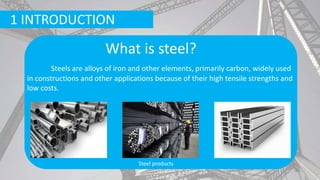
What is steel?
Steels are alloys of iron and other elements, primarily carbon, widely used
in constructions and other applications because of their high tensile strengths and
low costs.
Steel products
Typeofsteels:
Carbon steel
Stainless steel
Tools steel
Alloy steel
Low Carbon 0.04-0.30% of C
Medium Carbon 0.30-0.60% of C
High Carbon 0.60-1.50% of C
Low Alloy up to 5%
Medium Alloy up to 5-10%
High Alloy up to 10%
2 PROCESS INVOLVED IN MANUFACTURING
Carbonization of Coke
Blast Furnace
Basic Oxygen Furnace ( BOF )
Electric Arc Furnace ( EAF )
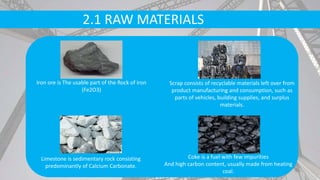
2.1 RAW MATERIALS
Iron ore is The usable part of the Rock of iron
(Fe2O3)
Limestone is sedimentary rock consisting
predominantly of Calcium Carbonate.
Coke is a fuel with few impurities
And high carbon content, usually made from heating
coal.
Scrap consists of recyclable materials left over from
product manufacturing and consumption, such as
parts of vehicles, building supplies, and surplus
materials.
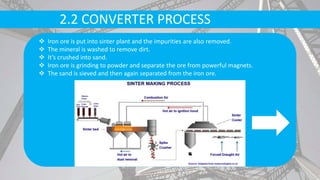
2.2 CONVERTER PROCESS
 Iron ore is put into sinter plant and the impurities are also removed.
 The mineral is washed to remove dirt.
 It’s crushed into sand.
 Iron ore is grinding to powder and separate the ore from powerful magnets.
 The sand is sieved and then again separated from the iron ore.
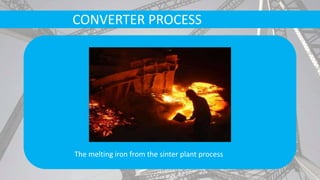
CONVERTER PROCESS
The melting iron from the sinter plant process
CONVERTER PROCESS
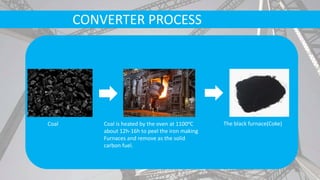
Coal is heated by the oven at 1100ᵒC
about 12h-16h to peel the iron making
Furnaces and remove as the solid
carbon fuel.
Coal The black furnace(Coke)
2.3 BLASTING PROCESS
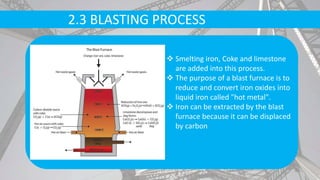
 Smelting iron, Coke and limestone
are added into this process.
 The purpose of a blast furnace is to
reduce and convert iron oxides into
liquid iron called "hot metal".
 Iron can be extracted by the blast
furnace because it can be displaced
by carbon
2.4 PRIMARY STEEL MAKING
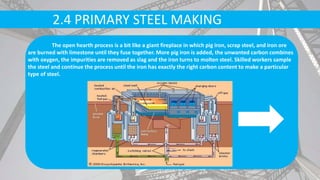
The open hearth process is a bit like a giant fireplace in which pig iron, scrap steel, and iron ore
are burned with limestone until they fuse together. More pig iron is added, the unwanted carbon combines
with oxygen, the impurities are removed as slag and the iron turns to molten steel. Skilled workers sample
the steel and continue the process until the iron has exactly the right carbon content to make a particular
type of steel.
2.5 BASIC OXYGEN FURNACE (BOF)
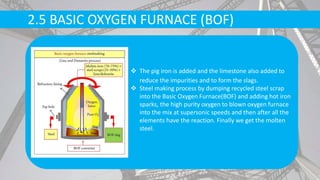
 The pig iron is added and the limestone also added to
reduce the impurities and to form the slags.
 Steel making process by dumping recycled steel scrap
into the Basic Oxygen Furnace(BOF) and adding hot iron
sparks, the high purity oxygen to blown oxygen furnace
into the mix at supersonic speeds and then after all the
elements have the reaction. Finally we get the molten
steel.
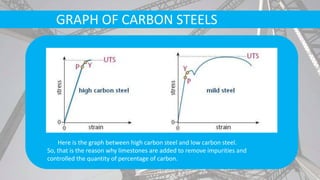
GRAPH OF CARBON STEELS
Here is the graph between high carbon steel and low carbon steel.
So, that is the reason why limestones are added to remove impurities and
controlled the quantity of percentage of carbon.
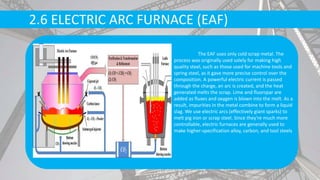
2.6 ELECTRIC ARC FURNACE (EAF)
The EAF uses only cold scrap metal. The
process was originally used solely for making high
quality steel, such as those used for machine tools and
spring steel, as it gave more precise control over the
composition. A powerful electric current is passed
through the charge, an arc is created, and the heat
generated melts the scrap. Lime and fluorspar are
added as fluxes and oxygen is blown into the melt. As a
result, impurities in the metal combine to form a liquid
slag. We use electric arcs (effectively giant sparks) to
melt pig iron or scrap steel. Since they're much more
controllable, electric furnaces are generally used to
make higher-specification alloy, carbon, and tool steels
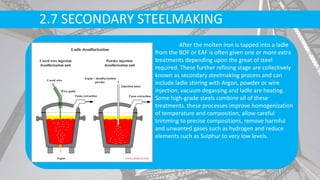
2.7 SECONDARY STEELMAKING
After the molten iron is tapped into a ladle
from the BOF or EAF is often given one or more extra
treatments depending upon the great of steel
required. These further refining stage are collectively
known as secondary steelmaking process and can
include ladle stirring with Argon, powder or wire
injection, vacuum degassing and ladle are heating.
Some high-grade steels combine all of these
treatments. these processes improve homogenization
of temperature and composition, allow careful
trimming to precise compositions, remove harmful
and unwanted gases such as hydrogen and reduce
elements such as Sulphur to very low levels.
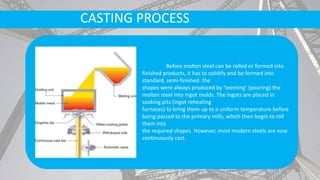
CASTING PROCESS
Before molten steel can be rolled or formed into
finished products, it has to solidify and be formed into
standard, semi-finished. the
shapes were always produced by ‘teeming’ (pouring) the
molten steel into ingot molds. The ingots are placed in
soaking pits (ingot reheating
furnaces) to bring them up to a uniform temperature before
being passed to the primary mills, which then begin to roll
them into
the required shapes. However, most modern steels are now
continuously cast.
HOT ROLLING PROCESS
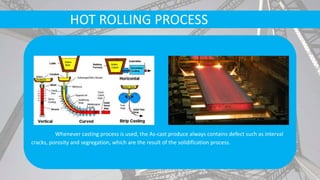
Whenever casting process is used, the As-cast produce always contains defect such as interval
cracks, porosity and segregation, which are the result of the solidification process.
3 SEMI-PRODUCTS
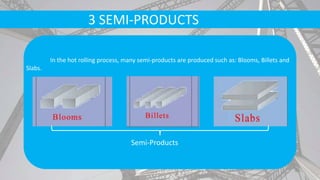
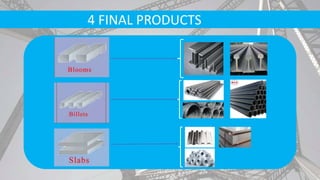
In the hot rolling process, many semi-products are produced such as: Blooms, Billets and
Slabs.
Semi-Products
ROLLING PROCESS
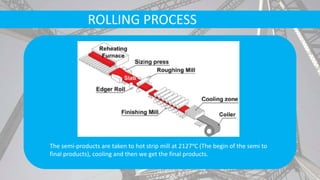
The semi-products are taken to hot strip mill at 2127ᵒC (The begin of the semi to
final products), cooling and then we get the final products.
4 FINAL PRODUCTS
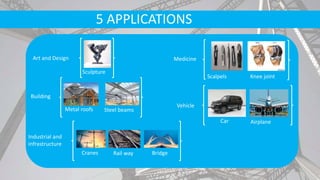
5 APPLICATIONS
Car
Metal roofs
Rail way Bridge
Sculpture
Cranes
Scalpels
Building
Steel beams
Vehicle
Art and Design Medicine
Industrial and
infrastructure
Knee joint
Airplane
Question and Answer

Steel making process assignment

  • 1.
    Institute of Technologyof Cambodia Department of Civil Engineering Project: The process of making steel Professor: M. LY Hav Year: 2018-2019 Students: 1, KEO Sokheng e20160233 2, KER Monyrothana e20150265 3, KHANG Chhai Hok e20160238 4, KHEN Makara e20160245 5, KHENG Rady e20160249 6, KHIM Radya e20160252 7, KHLOEUN Lihong e20160256 8, KHUT Oddom e20160268 9, KREU Sopha e20160294 10, LACH Socheata e20181640 I3(A) GCI - GROUP 05
  • 2.
    CONTENTS 1/ Introduction 2/ Processinvolved in manufacturing 2.1/ Raw materials 2.2/ Converter process 2.3/ Blasting process 2.4/ Primary steel making 2.5/ Basic oxygen furnace (BOF) 2.6/ Electric arc furnace (EAF) 2.7/ Secondary steel making 3/ Semi-products 4/ Final products 5/ Applications
  • 3.
    1 INTRODUCTION What issteel? Steels are alloys of iron and other elements, primarily carbon, widely used in constructions and other applications because of their high tensile strengths and low costs. Steel products
  • 4.
    Typeofsteels: Carbon steel Stainless steel Toolssteel Alloy steel Low Carbon 0.04-0.30% of C Medium Carbon 0.30-0.60% of C High Carbon 0.60-1.50% of C Low Alloy up to 5% Medium Alloy up to 5-10% High Alloy up to 10%
  • 5.
    2 PROCESS INVOLVEDIN MANUFACTURING Carbonization of Coke Blast Furnace Basic Oxygen Furnace ( BOF ) Electric Arc Furnace ( EAF )
  • 6.
    2.1 RAW MATERIALS Ironore is The usable part of the Rock of iron (Fe2O3) Limestone is sedimentary rock consisting predominantly of Calcium Carbonate. Coke is a fuel with few impurities And high carbon content, usually made from heating coal. Scrap consists of recyclable materials left over from product manufacturing and consumption, such as parts of vehicles, building supplies, and surplus materials.
  • 7.
    2.2 CONVERTER PROCESS Iron ore is put into sinter plant and the impurities are also removed.  The mineral is washed to remove dirt.  It’s crushed into sand.  Iron ore is grinding to powder and separate the ore from powerful magnets.  The sand is sieved and then again separated from the iron ore.
  • 8.
    CONVERTER PROCESS The meltingiron from the sinter plant process
  • 9.
    CONVERTER PROCESS Coal isheated by the oven at 1100ᵒC about 12h-16h to peel the iron making Furnaces and remove as the solid carbon fuel. Coal The black furnace(Coke)
  • 10.
    2.3 BLASTING PROCESS Smelting iron, Coke and limestone are added into this process.  The purpose of a blast furnace is to reduce and convert iron oxides into liquid iron called "hot metal".  Iron can be extracted by the blast furnace because it can be displaced by carbon
  • 11.
    2.4 PRIMARY STEELMAKING The open hearth process is a bit like a giant fireplace in which pig iron, scrap steel, and iron ore are burned with limestone until they fuse together. More pig iron is added, the unwanted carbon combines with oxygen, the impurities are removed as slag and the iron turns to molten steel. Skilled workers sample the steel and continue the process until the iron has exactly the right carbon content to make a particular type of steel.
  • 12.
    2.5 BASIC OXYGENFURNACE (BOF)  The pig iron is added and the limestone also added to reduce the impurities and to form the slags.  Steel making process by dumping recycled steel scrap into the Basic Oxygen Furnace(BOF) and adding hot iron sparks, the high purity oxygen to blown oxygen furnace into the mix at supersonic speeds and then after all the elements have the reaction. Finally we get the molten steel.
  • 13.
    GRAPH OF CARBONSTEELS Here is the graph between high carbon steel and low carbon steel. So, that is the reason why limestones are added to remove impurities and controlled the quantity of percentage of carbon.
  • 14.
    2.6 ELECTRIC ARCFURNACE (EAF) The EAF uses only cold scrap metal. The process was originally used solely for making high quality steel, such as those used for machine tools and spring steel, as it gave more precise control over the composition. A powerful electric current is passed through the charge, an arc is created, and the heat generated melts the scrap. Lime and fluorspar are added as fluxes and oxygen is blown into the melt. As a result, impurities in the metal combine to form a liquid slag. We use electric arcs (effectively giant sparks) to melt pig iron or scrap steel. Since they're much more controllable, electric furnaces are generally used to make higher-specification alloy, carbon, and tool steels
  • 15.
    2.7 SECONDARY STEELMAKING Afterthe molten iron is tapped into a ladle from the BOF or EAF is often given one or more extra treatments depending upon the great of steel required. These further refining stage are collectively known as secondary steelmaking process and can include ladle stirring with Argon, powder or wire injection, vacuum degassing and ladle are heating. Some high-grade steels combine all of these treatments. these processes improve homogenization of temperature and composition, allow careful trimming to precise compositions, remove harmful and unwanted gases such as hydrogen and reduce elements such as Sulphur to very low levels.
  • 16.
    CASTING PROCESS Before moltensteel can be rolled or formed into finished products, it has to solidify and be formed into standard, semi-finished. the shapes were always produced by ‘teeming’ (pouring) the molten steel into ingot molds. The ingots are placed in soaking pits (ingot reheating furnaces) to bring them up to a uniform temperature before being passed to the primary mills, which then begin to roll them into the required shapes. However, most modern steels are now continuously cast.
  • 17.
    HOT ROLLING PROCESS Whenevercasting process is used, the As-cast produce always contains defect such as interval cracks, porosity and segregation, which are the result of the solidification process.
  • 18.
    3 SEMI-PRODUCTS In thehot rolling process, many semi-products are produced such as: Blooms, Billets and Slabs. Semi-Products
  • 19.
    ROLLING PROCESS The semi-productsare taken to hot strip mill at 2127ᵒC (The begin of the semi to final products), cooling and then we get the final products.
  • 20.
  • 21.
    5 APPLICATIONS Car Metal roofs Railway Bridge Sculpture Cranes Scalpels Building Steel beams Vehicle Art and Design Medicine Industrial and infrastructure Knee joint Airplane
  • 22.