OPJITS
PREPARED BY: - A.Aditya Sharma
Aditya Pratap Singh
Anand Prakash Singh
Ankita Agrawal
Anurag Gupta
Bhupendra Kumhare
Deepak Patel
OPJITS
-: ACKNOWLEDGEMENT: -
I want to express my gratitude towards all the seniors
and associated members of SMS-2 who have given me
guidelines and their valuable times during my training
period.
Moreover, I want to thank all the persons of HRD
department of J.S.P.L. for such a wonderful
cooperation during this period.
Last but not the least, my thanks to all my dear batch
mates and all the people who have directly or indirectly
contributed towards successfully completion of this
report.
-: Contents: -
OPJITS
1. About JSPL
2. Function of SMS department
3.Equipments & Capacity of:- Electric arc Furnace
Ladle Refining Furnace
Vacuum Degasser & RH degasser
Casters {Billet, Combi, Slab}
4.SMS processes
5.Raw Materials
6. Different sections at SMS: -PQ Bay
Electric Arc Furnace:- Tapping
EAF processes
EAF Advantages
7.Ladle Refining Furnace:- LRF processes
8.Vacuum Degasser
9.RH Degasser
10.Continous Casting:- Billet Caster
Combi Caster
Slab Caster
OPJITS
ABOUT J.S.P.L: -
Corporate profile
Jindal Steel and Power Limited is the most valuable private steel
producer in India, with an annual turnover of over US $2.1 billion (Rs.
10,000 crore), Jindal Steel & Power Limited (JSPL) forms a part of the
US $12 billion (over Rs. 60,000 crore) Jindal Group. JSPL is a leading
player in Steel, Power, Mining, Oil & Gas and Infrastructure. Mr.
Naveen Jindal, the youngest son of the legendary late Shri. O P Jindal
drives JSPL and its group companies Jindal Power Ltd, Jindal
Petroleum Ltd., Jindal Cement Ltd. and Jindal Steel Bolivia with a
belief in the concept of self-sufficiency
Technical Profile
• 2 MTPA cement plant.
• Additional power generation of 540 MW.
• Medium structural mill.
• Pipe conveyor from mines to plant.
• Mini blast furnace up-gradation
• Fabrication unit in the industrial estate.
•
AWARDS: -
• JSPL India ‘s fastest growing large size company by dalal
street, 2006
• Gold prize –greenstick environmental excellence award 2006
• Golden peacock environmental award 2006
• IIM quality award 2002-2003, by the Indian institute of metals
OPJITS
National safety award2003-2004, by ministry of labour and many more
awards
Function Of Department...
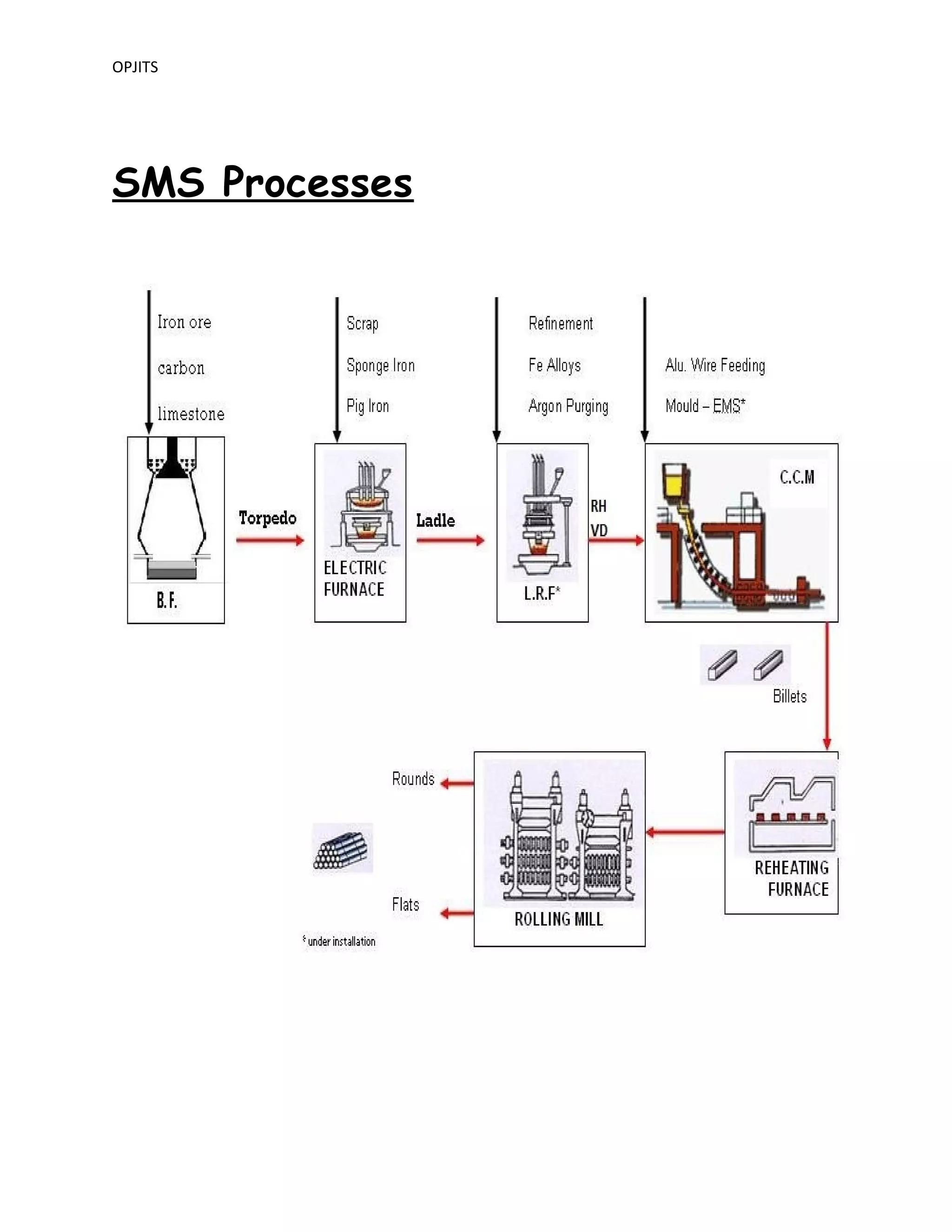
Steel Melting Shop: Pig iron, sponge iron, limes and ferroalloy is
charged from the top of Electric Arc Furnace. Arcing melt the
contents. Oxygen blowing is done. Steel is tapped and chemistry
correction is done in ladle refining furnace. Liquid steel is casted.
Slag is taken out from slag door.
The basic function of the Steel Melting Shop is the refining of
steel before casting. Basically the refining of steel in SMS can be
divided into two segments:
1. Primary Refining- It is done at Electric Arc Furnace, where the hot
metal is De-Phosphorised, De-carburized, and melted along with
charge (i.e. DRI, Lime and Dololime) and CPC (calcined petroleum
coke)
2. Secondary Refining- It is done at Ladle Refining Furnace, where the
molten steel from EAF is De-sulphurised, & De-oxidized, in an
oxidizing atmosphere
Electric Arc Furnace
EQUIPMENT CAPACITY
ELECTRIC ARC FURNACE ALTERNATING CURRENT By
DANIELI
TAPPING WEIGHT 100MT
TRANSFORMER
CAPACITY
100MVA
ACTIVE POWER INPUT 23MW
OPJITS
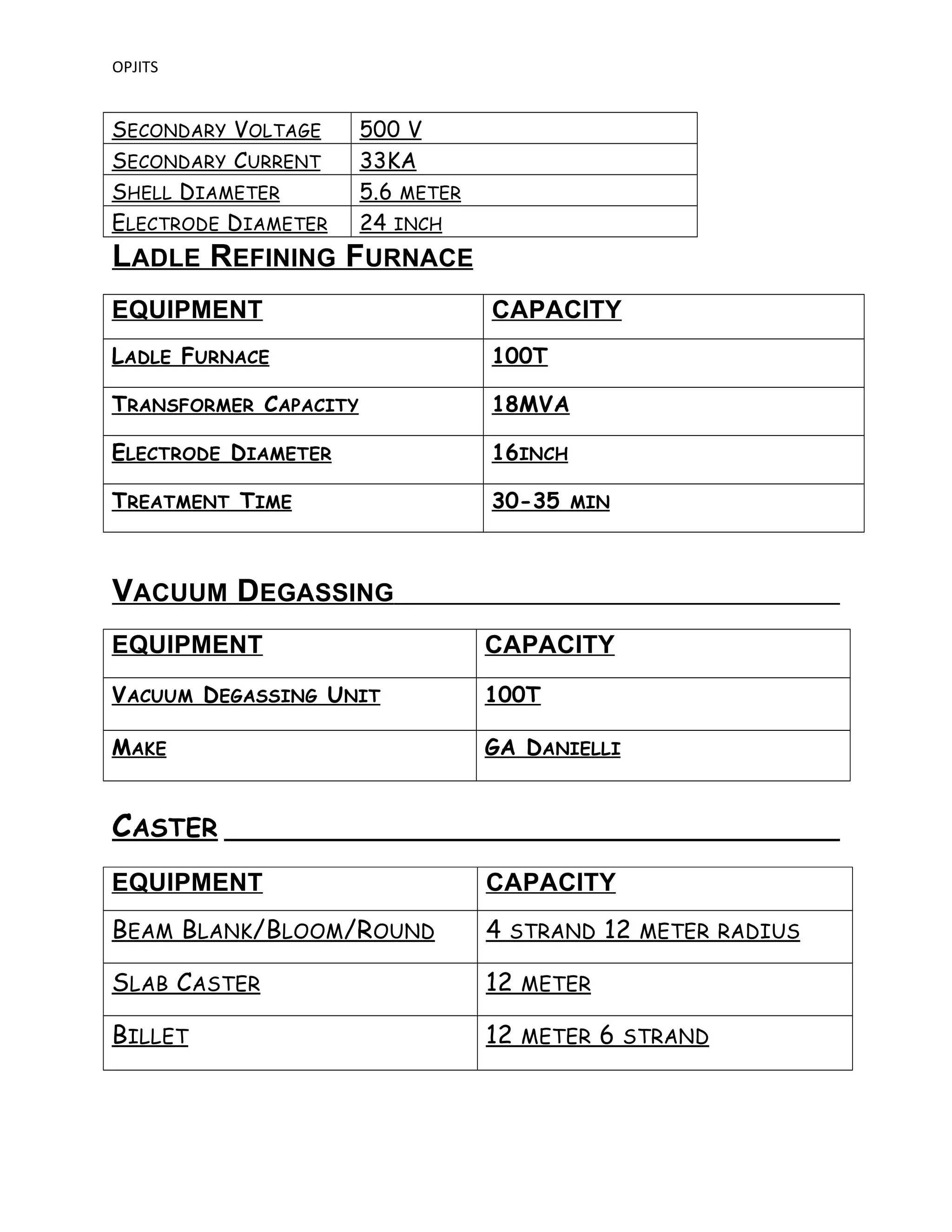
SECONDARY VOLTAGE 500 V
SECONDARY CURRENT 33KA
SHELL DIAMETER 5.6 METER
ELECTRODE DIAMETER 24 INCH
LADLE REFINING FURNACE
EQUIPMENT CAPACITY
LADLE FURNACE 100T
TRANSFORMER CAPACITY 18MVA
ELECTRODE DIAMETER 16INCH
TREATMENT TIME 30-35 MIN
VACUUM DEGASSING
EQUIPMENT CAPACITY
VACUUM DEGASSING UNIT 100T
MAKE GA DANIELLI
CASTER
EQUIPMENT CAPACITY
BEAM BLANK/BLOOM/ROUND 4 STRAND 12 METER RADIUS
SLAB CASTER 12 METER
BILLET 12 METER 6 STRAND
OPJITS
SMS Processes
OPJITS
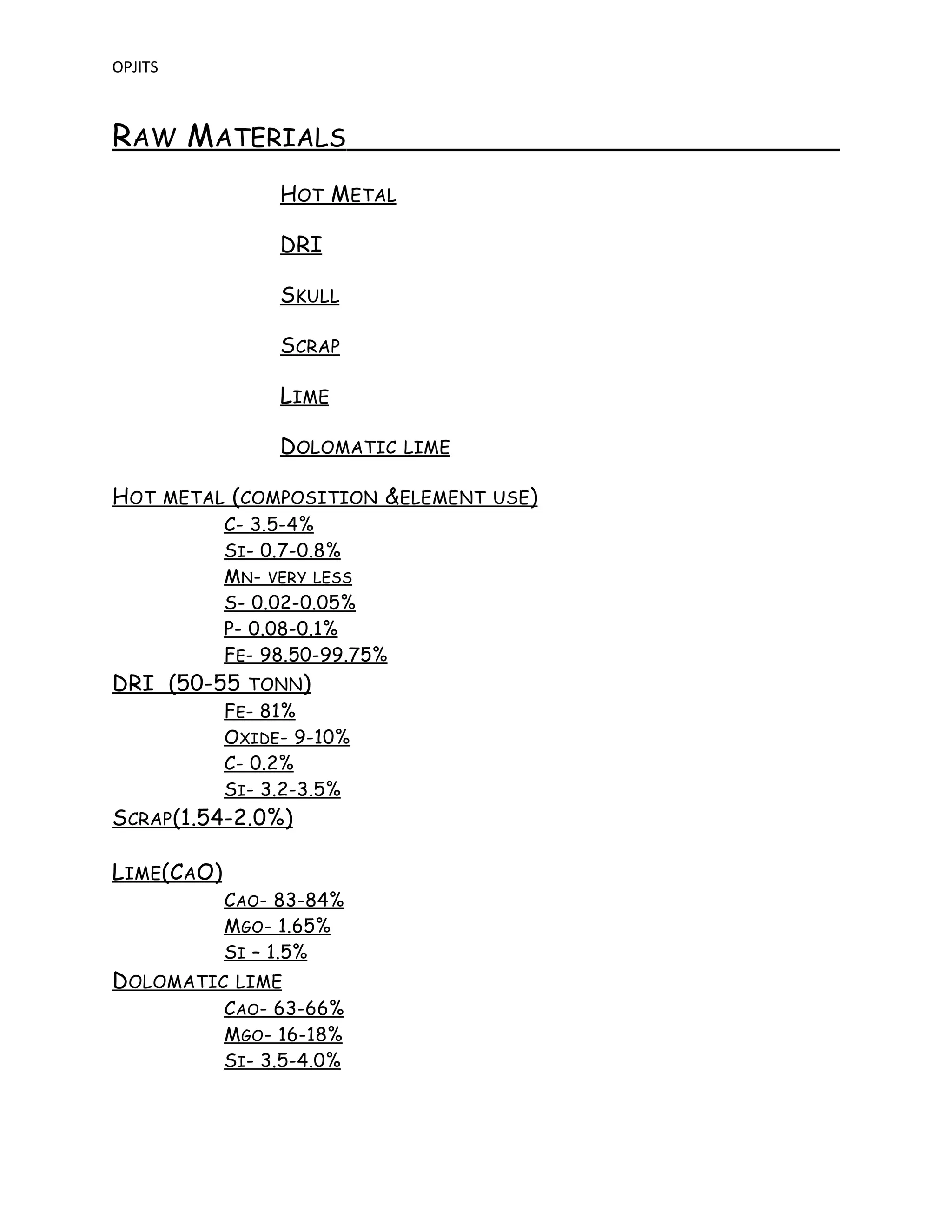
RAW MATERIALS
HOT METAL
DRI
SKULL
SCRAP
LIME
DOLOMATIC LIME
HOT METAL (COMPOSITION &ELEMENT USE)
C- 3.5-4%
SI- 0.7-0.8%
MN- VERY LESS
S- 0.02-0.05%
P- 0.08-0.1%
FE- 98.50-99.75%
DRI (50-55 TONN)
FE- 81%
OXIDE- 9-10%
C- 0.2%
SI- 3.2-3.5%
SCRAP(1.54-2.0%)
LIME(CAO)
CAO- 83-84%
MGO- 1.65%
SI – 1.5%
DOLOMATIC LIME
CAO- 63-66%
MGO- 16-18%
SI- 3.5-4.0%
OPJITS
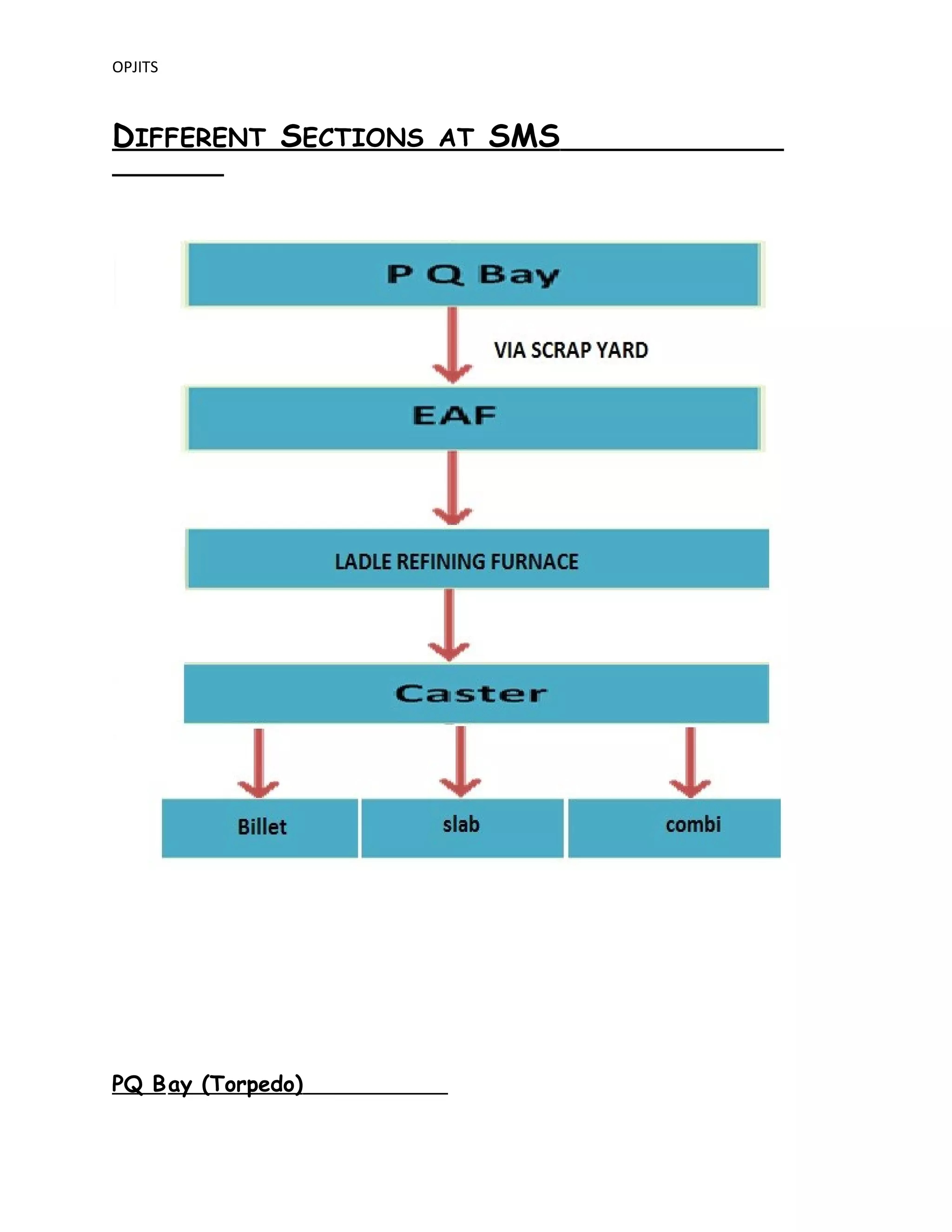
DIFFERENT SECTIONS AT SMS
PQ Bay (Torpedo)
OPJITS
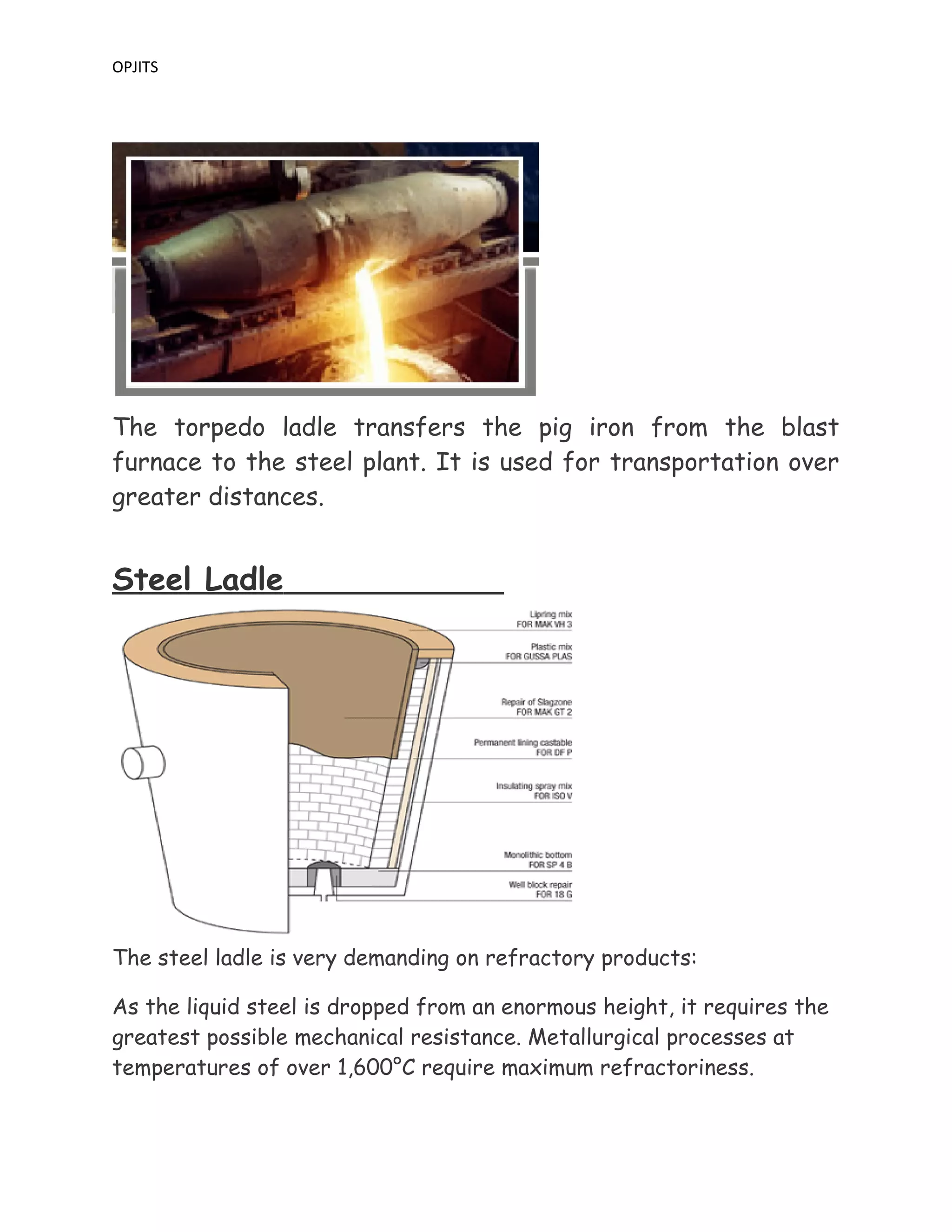
The torpedo ladle transfers the pig iron from the blast
furnace to the steel plant. It is used for transportation over
greater distances.
Steel Ladle
The steel ladle is very demanding on refractory products:
As the liquid steel is dropped from an enormous height, it requires the
greatest possible mechanical resistance. Metallurgical processes at
temperatures of over 1,600°C require maximum refractoriness.
OPJITS
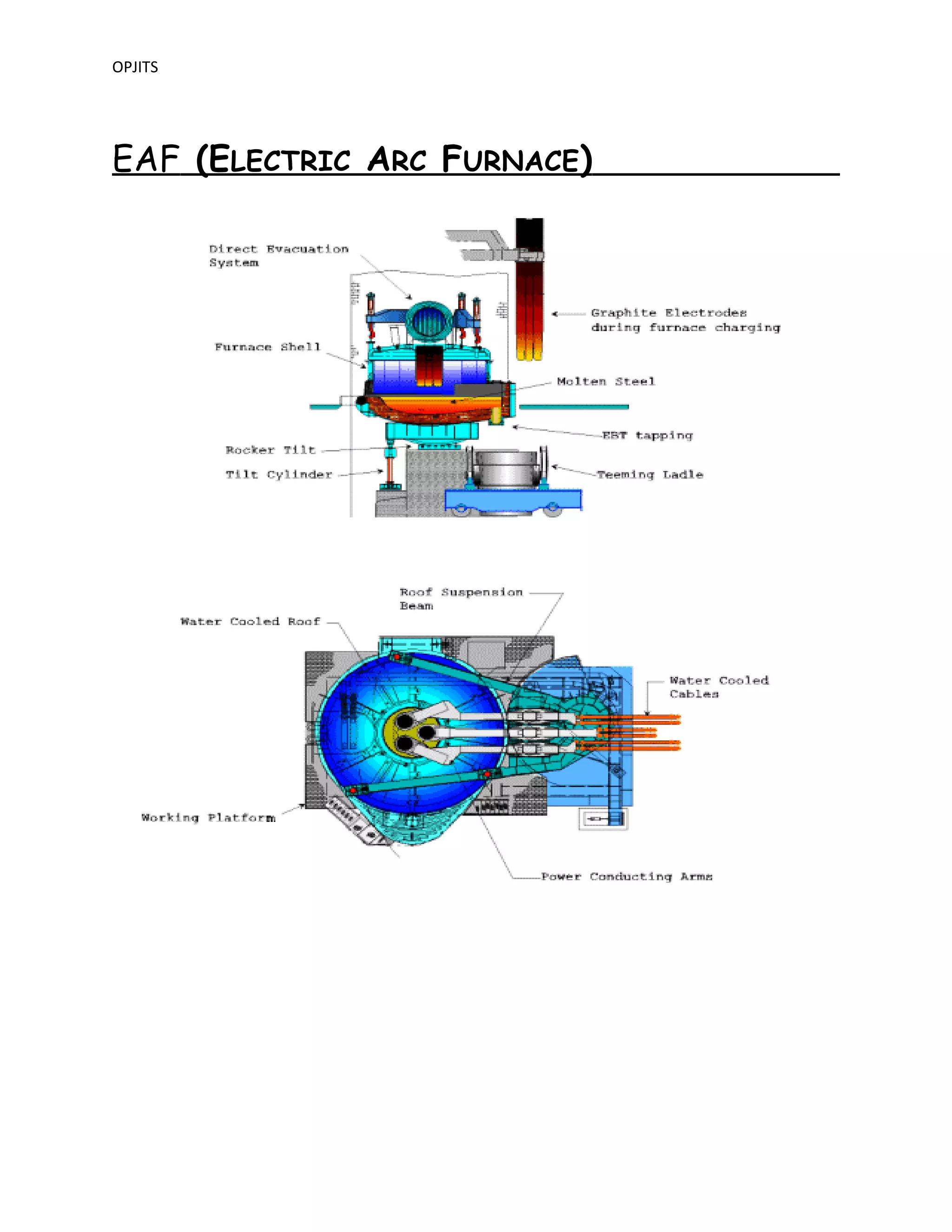
EAF (ELECTRIC ARC FURNACE)
OPJITS
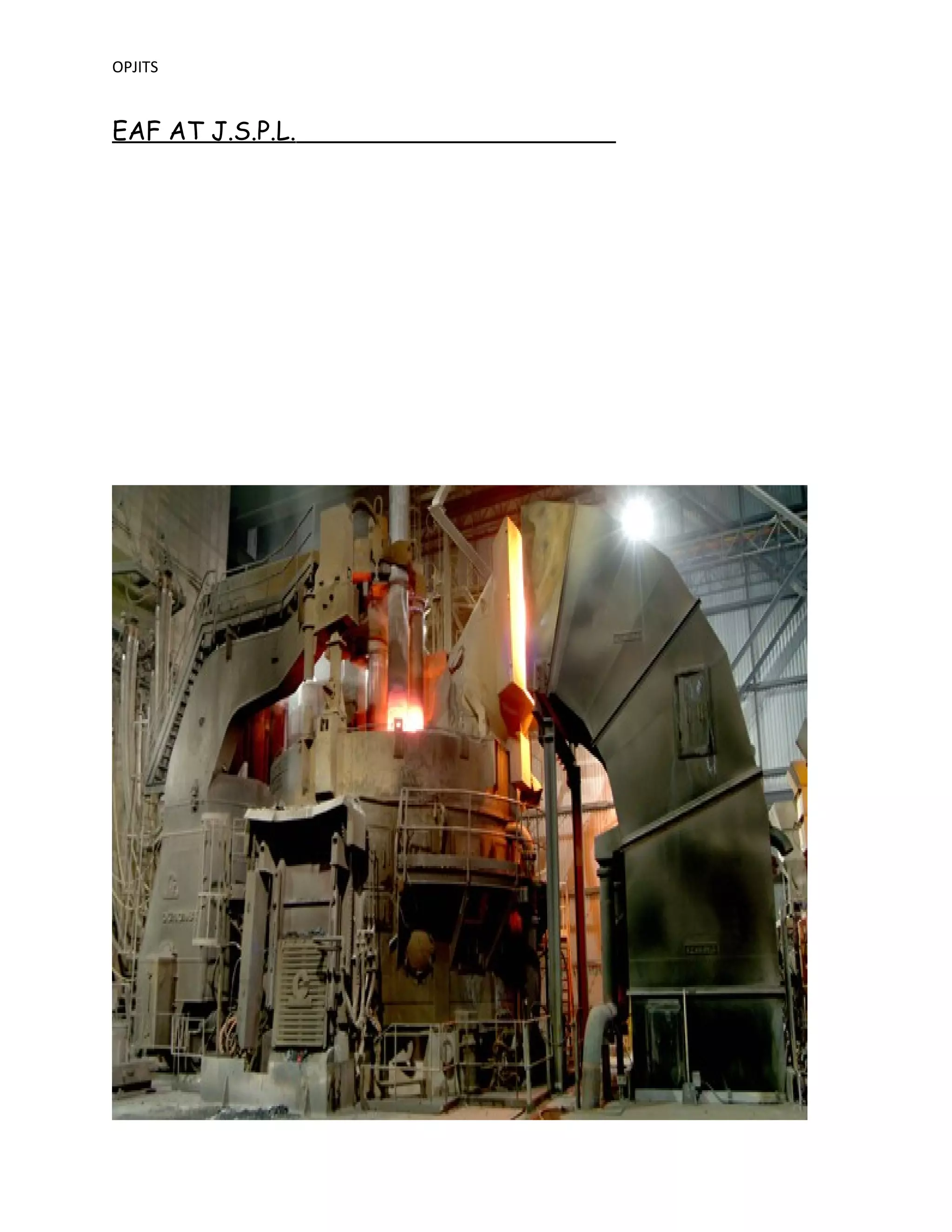
EAF AT J.S.P.L.
OPJITS
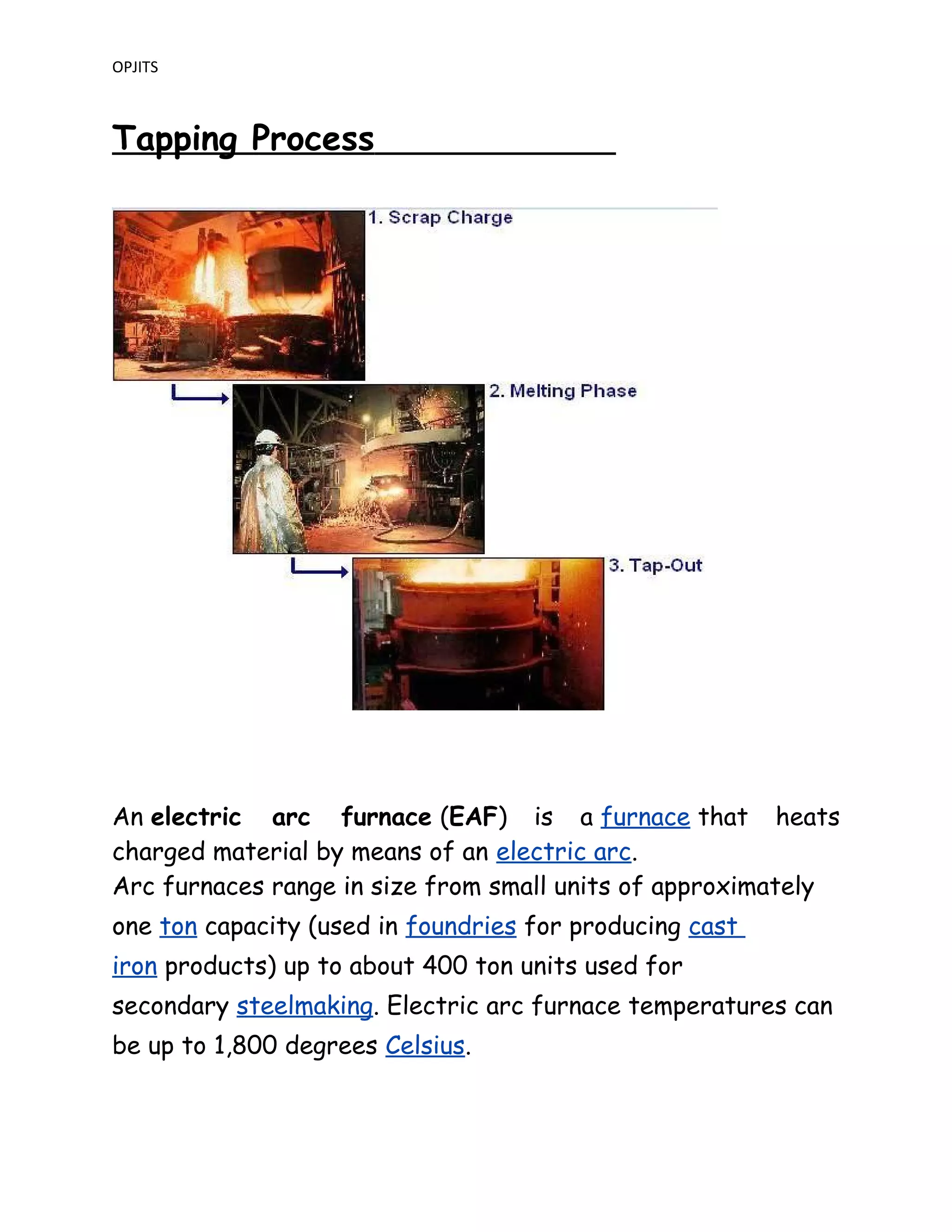
Tapping Process
An electric arc furnace (EAF) is a furnace that heats
charged material by means of an electric arc.
Arc furnaces range in size from small units of approximately
one ton capacity (used in foundries for producing cast
iron products) up to about 400 ton units used for
secondary steelmaking. Electric arc furnace temperatures can
be up to 1,800 degrees Celsius.
OPJITS
EAF Processes
Dephosphorization
Decarburization
Melting
Advantages of electric arc furnace
The use of EAFs allows steel to be made from a 100% scrap
metal feedstock, commonly known as 'cold ferrous feed' to
emphasize the fact that for an EAF, scrap is a regulated feed
material. The primary benefit of this is the large reduction in
specific energy (energy per unit weight) required to produce
the steel. Another benefit is flexibility: while blast furnaces
cannot vary their production by much and are never stopped,
EAFs can be rapidly started and stopped, allowing the steel
mill to vary production according to demand. Although
steelmaking arc furnaces generally use scraps steel as their
primary feedstock, if hot metal from a blast furnace or
direct-reduced iron is available economically, these can also be
used as furnace feed.
A typical steelmaking arc furnace is the source of steel for a
mini-mill, which may make bars or strip product. Mini-mills can
be sited relatively near to the markets for steel products, and
the transport requirements are less than for an integrated
OPJITS
mill, which would commonly be sited near a harbor for access.
to shipping
EAF Productivity
The EAF - productivity depends on:
Ö Metallic Input: - Hot Metal (60-65 tonn)
DRI (50-55 tonn)
Scrap (adequate(up to 5 tonn))
Ö Equipment (Transformer capacity 100MVA/T)
Ö Oxygen blowing
Ö CPC & Lime Addition
All these contributes to
Tap To Tap Time (Minimum- 40-50min(approximate))
Working Temperature (1550-1600˚C)
OPJITS
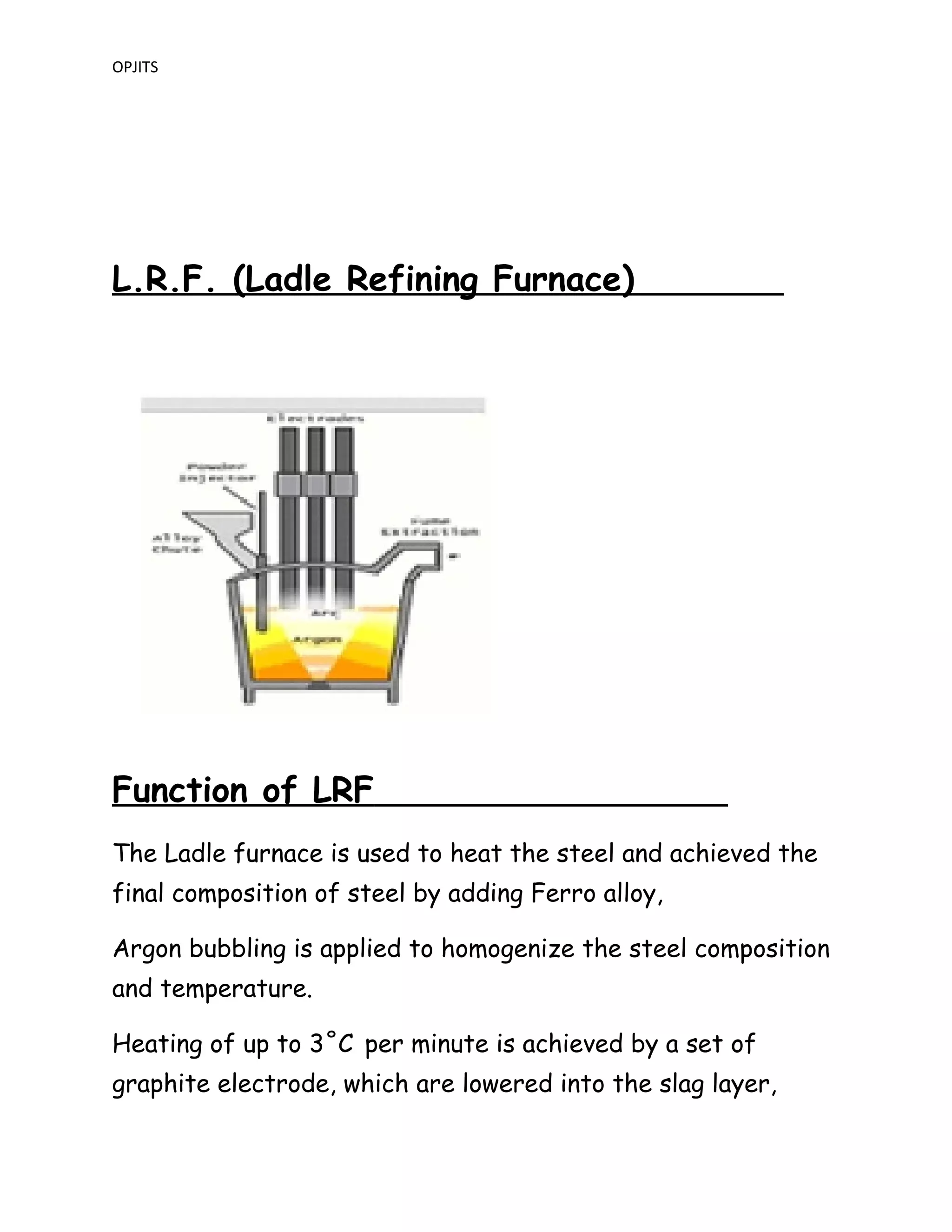
L.R.F. (Ladle Refining Furnace)
Function of LRF
The Ladle furnace is used to heat the steel and achieved the
final composition of steel by adding Ferro alloy,
Argon bubbling is applied to homogenize the steel composition
and temperature.
Heating of up to 3˚C per minute is achieved by a set of
graphite electrode, which are lowered into the slag layer,
OPJITS
Just above the molten steel surface
Another purpose of the ladle furnace is to act as a holding
furnace between the EAF and continuous casting machine.
LRF Processes
Deoxidization
Desulphurization (through lime addition)
Chemical Adjustments (through addition of Fe alloys)
Refining
Temperature Control
Homogenization of Compositions (through Argon Purging)
V.D. (Vacuum Degassing)
Function of V.D.
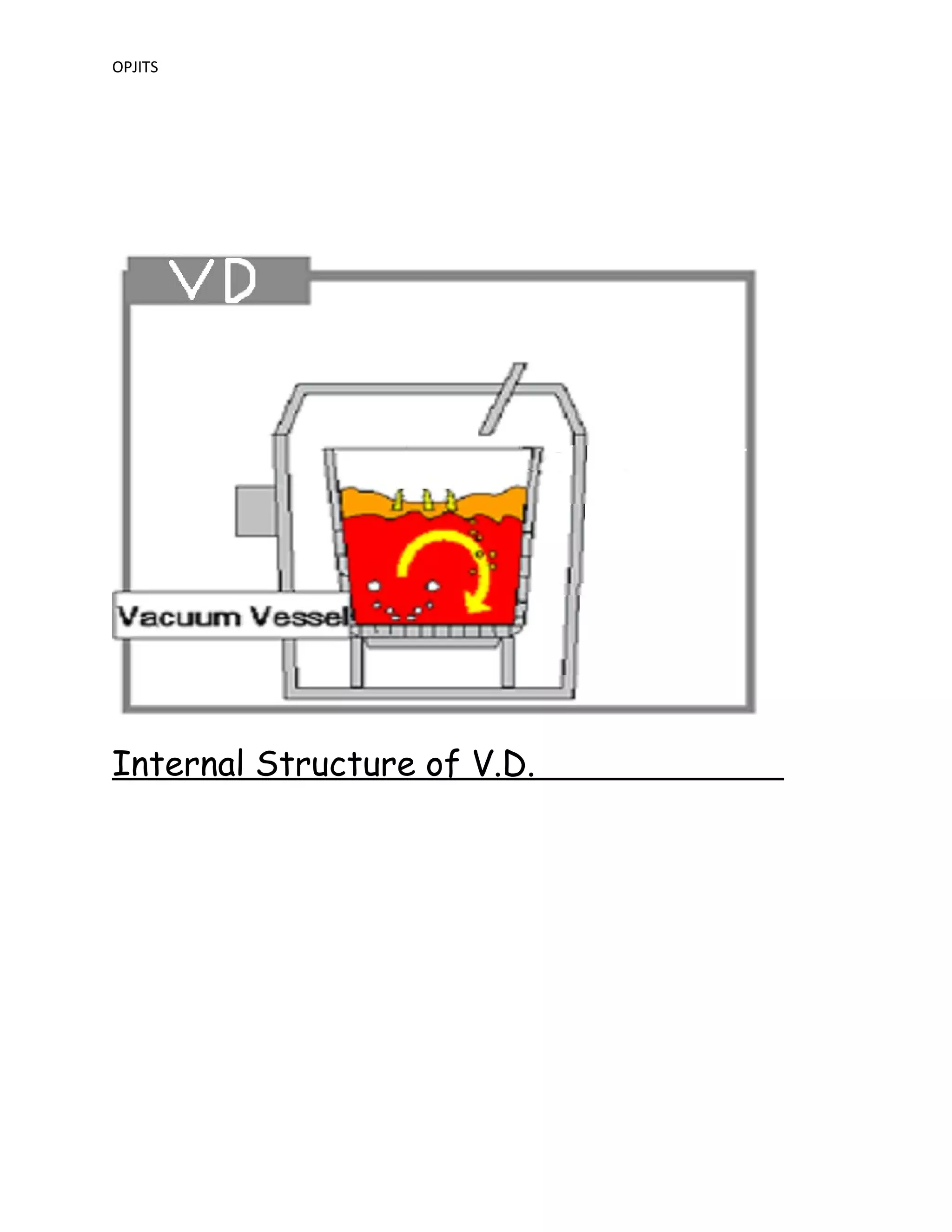
Vacuum treatment of the steel is the most important
secondary metallurgical process. The tank degasser is used to
remove gaseous element, non-metallic inclusion and Sulphur
from the steel. The removal of Non-metallic inclusion is
achieved through slag metal interactions, which are promoted
by strong argon flushing within the vacuum tank.
OPJITS
Internal Structure of V.D.
OPJITS
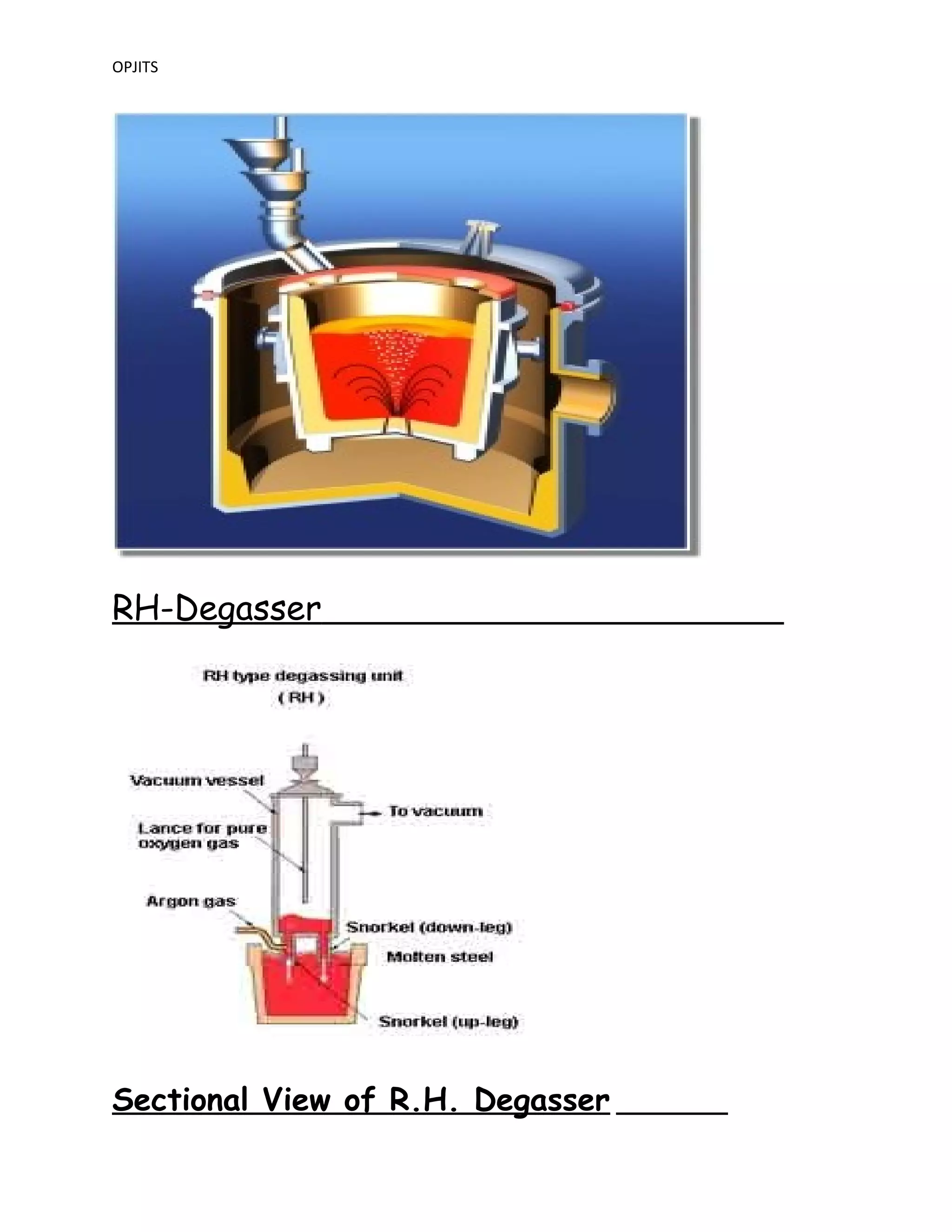
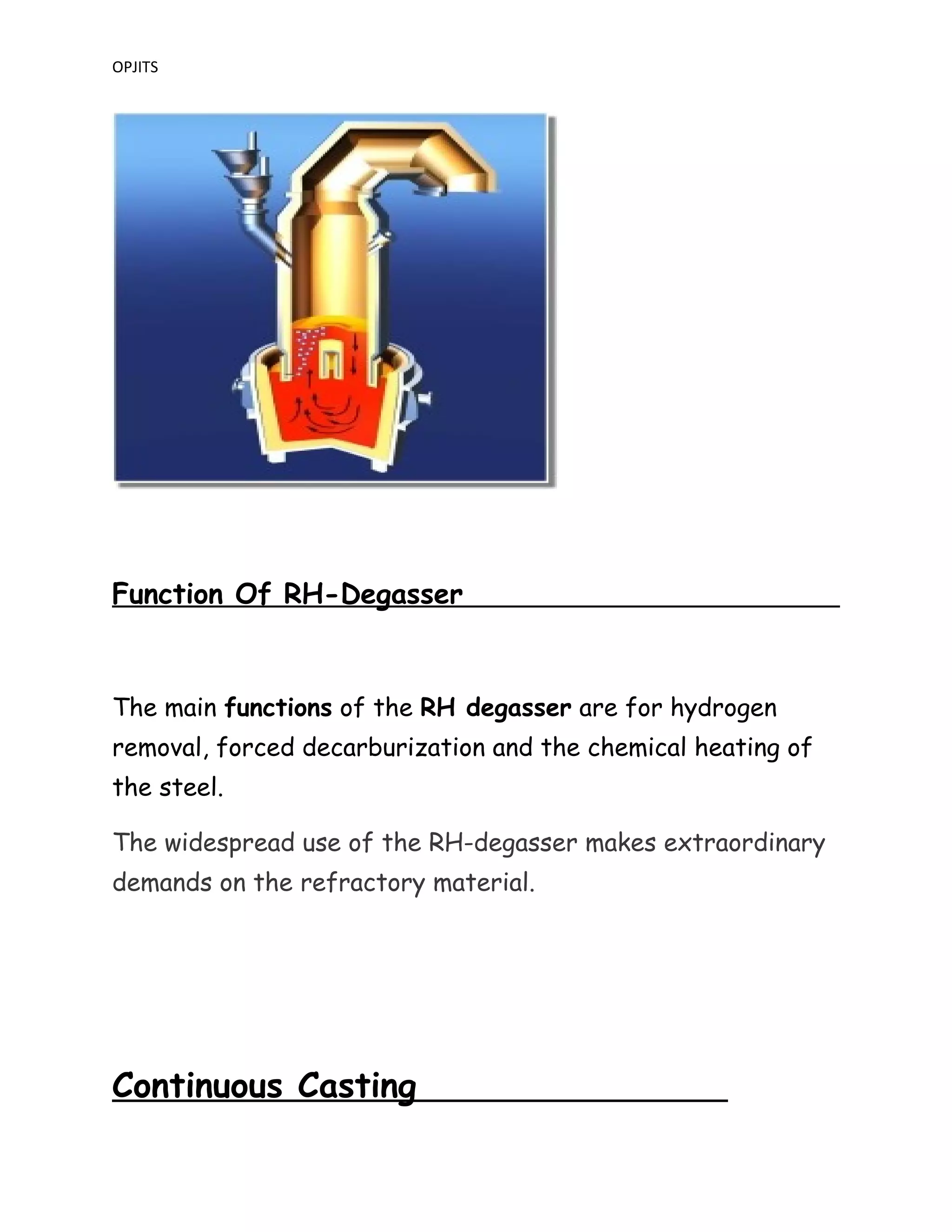
RH-Degasser
Sectional View of R.H. Degasser
OPJITS
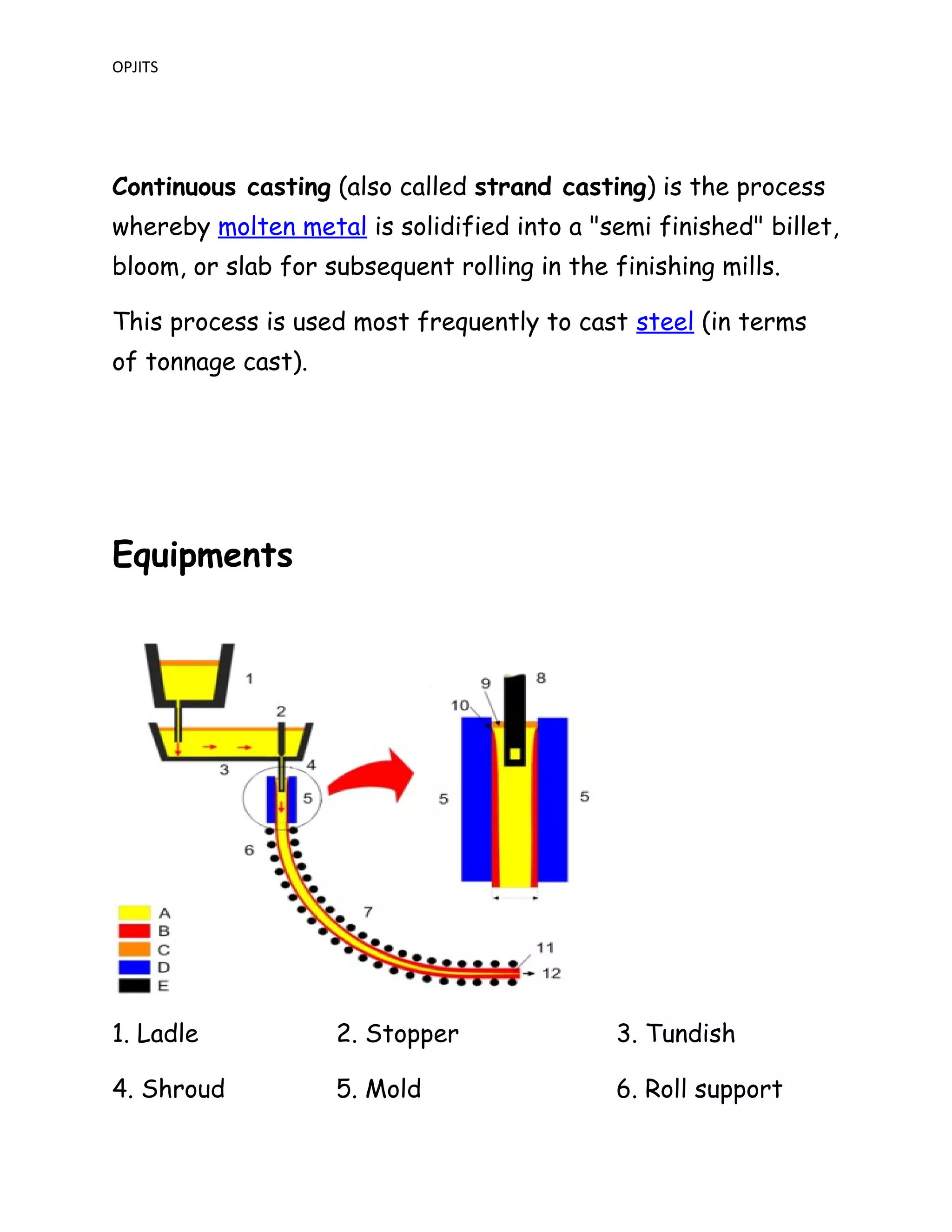
Function Of RH-Degasser
The main functions of the RH degasser are for hydrogen
removal, forced decarburization and the chemical heating of
the steel.
The widespread use of the RH-degasser makes extraordinary
demands on the refractory material.
Continuous Casting
OPJITS
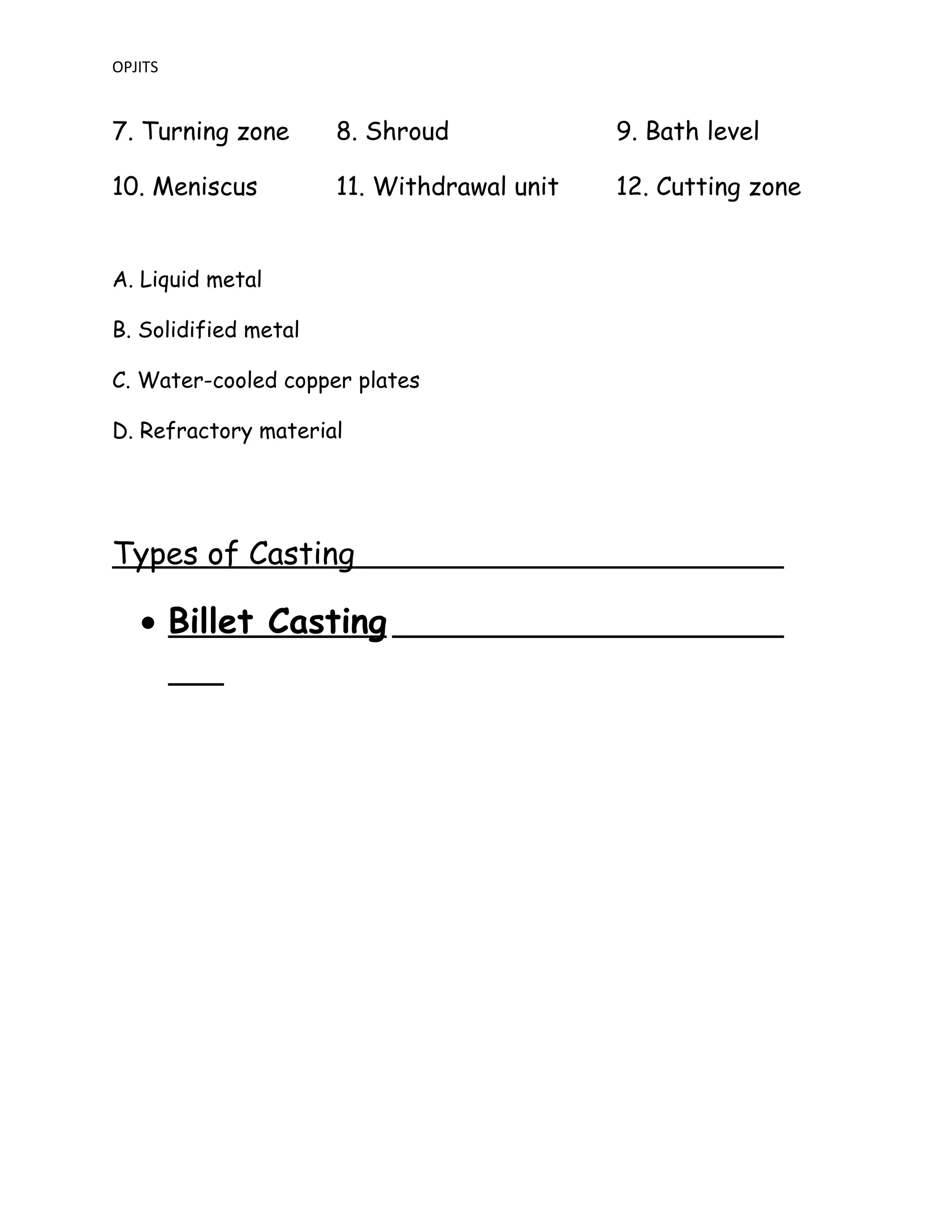
Continuous casting (also called strand casting) is the process
whereby molten metal is solidified into a "semi finished" billet,
bloom, or slab for subsequent rolling in the finishing mills.
This process is used most frequently to cast steel (in terms
of tonnage cast).
Equipments
1. Ladle 2. Stopper 3. Tundish
4. Shroud 5. Mold 6. Roll support
OPJITS
7. Turning zone 8. Shroud 9. Bath level
10. Meniscus 11. Withdrawal unit 12. Cutting zone
A. Liquid metal
B. Solidified metal
C. Water-cooled copper plates
D. Refractory material
Types of Casting
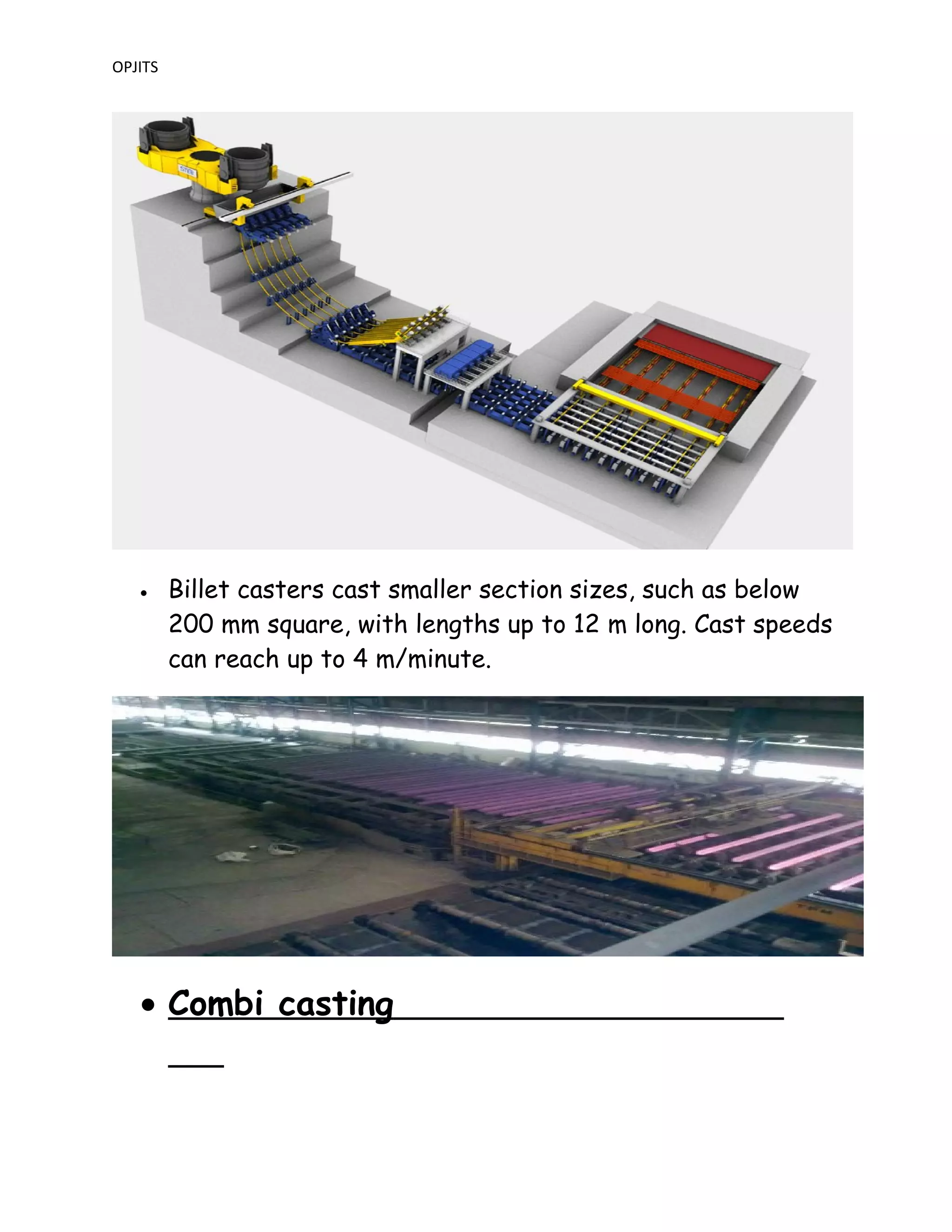
• Billet Casting
OPJITS
• Billet casters cast smaller section sizes, such as below
200 mm square, with lengths up to 12 m long. Cast speeds
can reach up to 4 m/minute.
• Combi casting
OPJITS
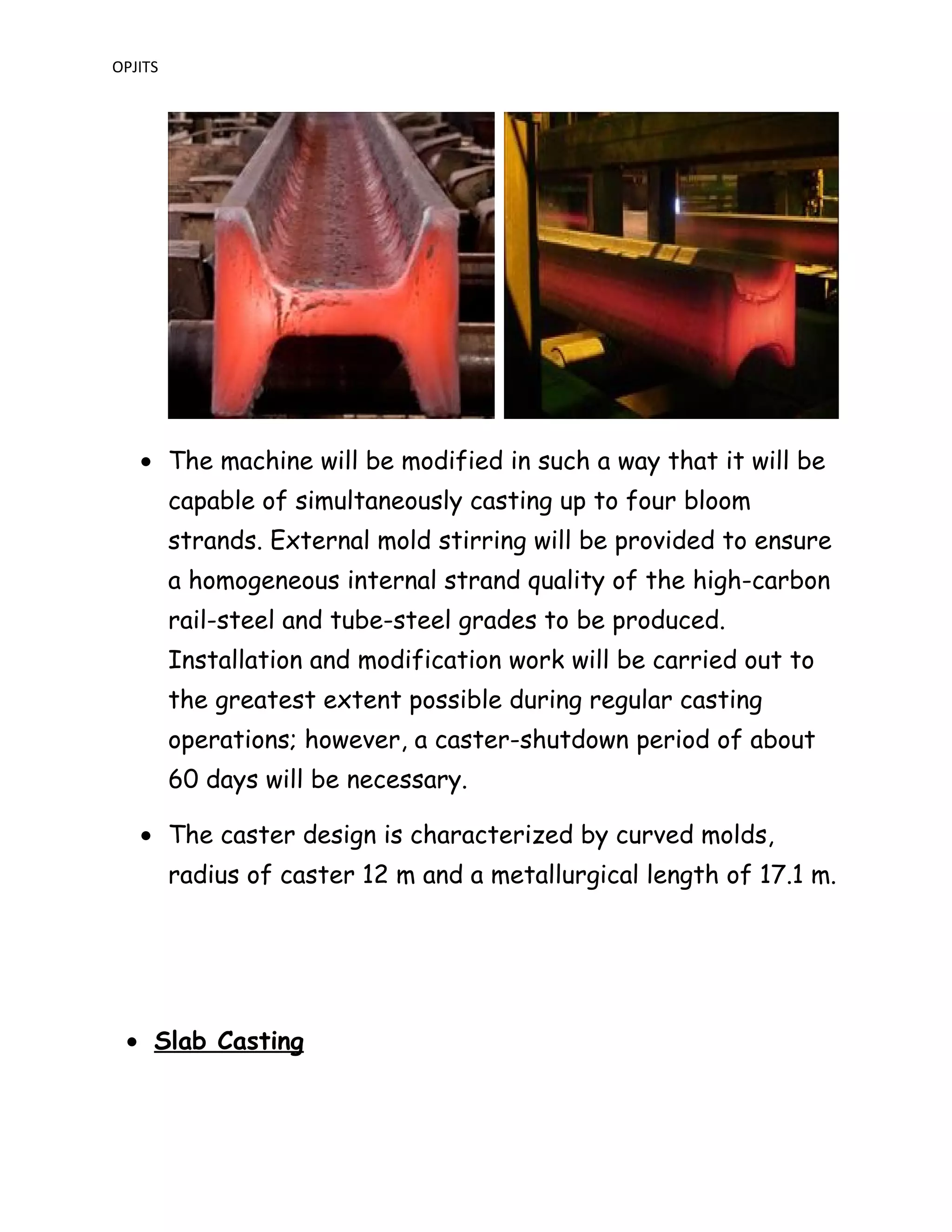
• The machine will be modified in such a way that it will be
capable of simultaneously casting up to four bloom
strands. External mold stirring will be provided to ensure
a homogeneous internal strand quality of the high-carbon
rail-steel and tube-steel grades to be produced.
Installation and modification work will be carried out to
the greatest extent possible during regular casting
operations; however, a caster-shutdown period of about
60 days will be necessary.
• The caster design is characterized by curved molds,
radius of caster 12 m and a metallurgical length of 17.1 m.
• Slab Casting
OPJITS
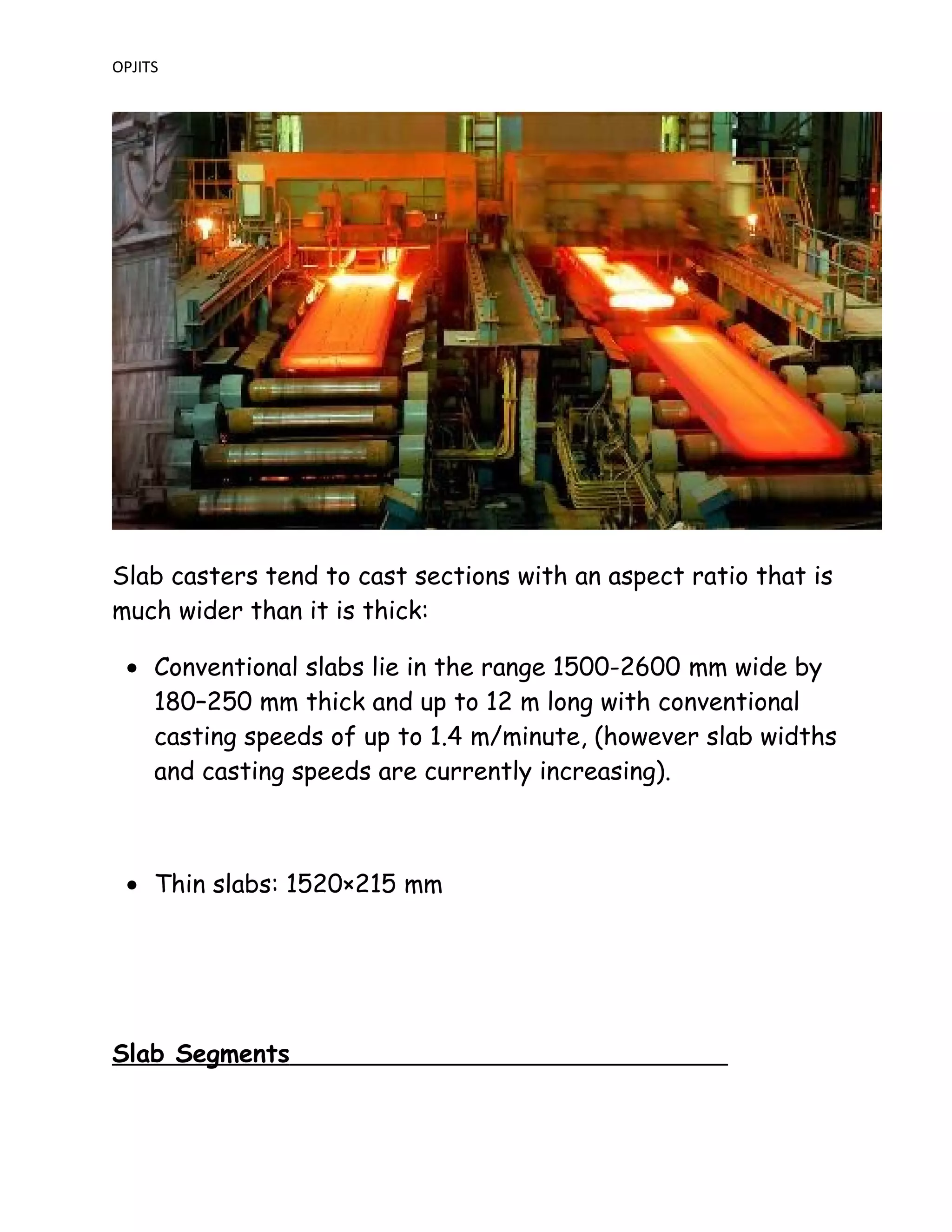
Slab casters tend to cast sections with an aspect ratio that is
much wider than it is thick:
• Conventional slabs lie in the range 1500-2600 mm wide by
180–250 mm thick and up to 12 m long with conventional
casting speeds of up to 1.4 m/minute, (however slab widths
and casting speeds are currently increasing).
• Thin slabs: 1520×215 mm
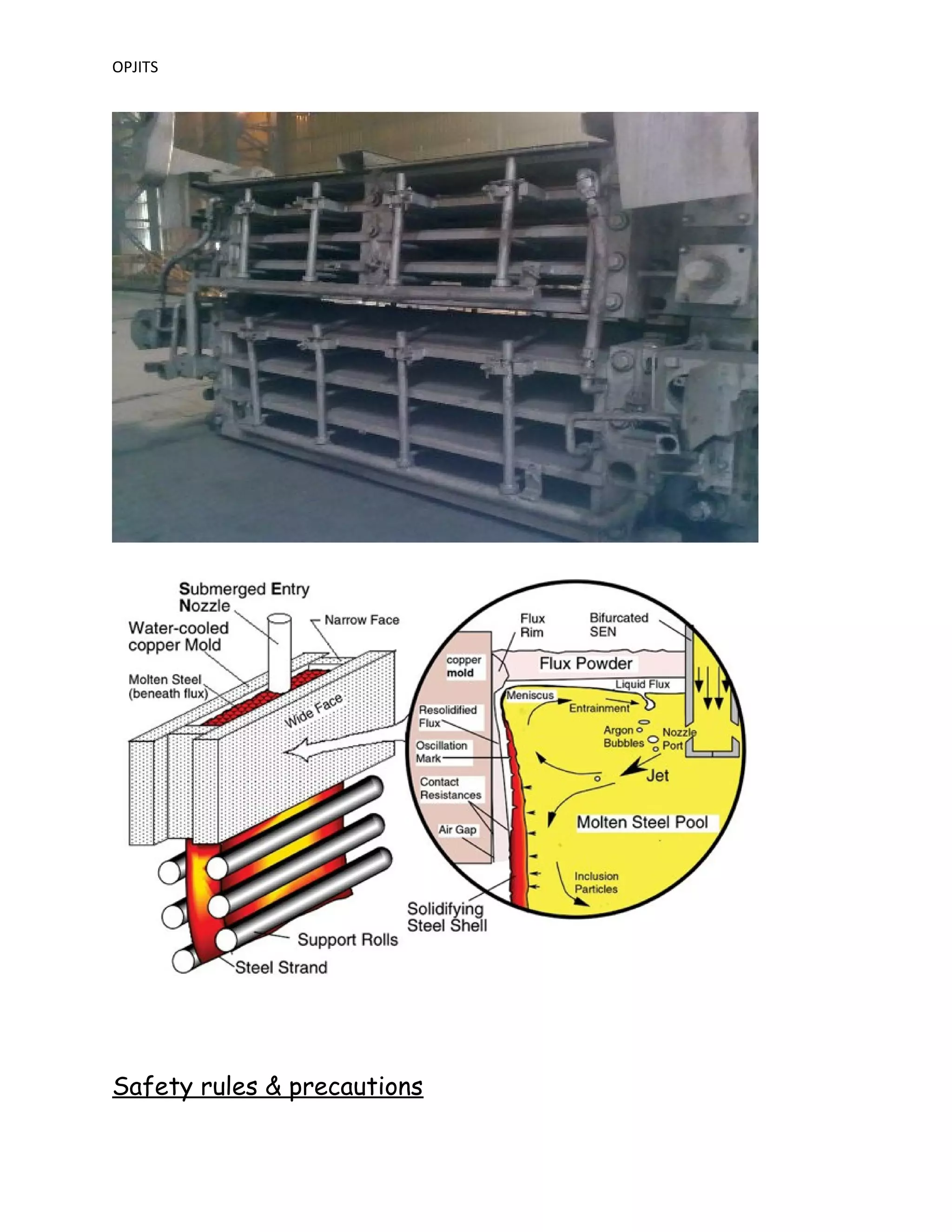
Slab Segments
OPJITS
Safety rules & precautions
OPJITS
• Wearing Helmet(ISI certified) properly is a must.
• Wearing Thick jeans Jacket for protecting body parts
• Roaming here and there inside the industry without
having proper guidance could be dangerous.
• Following the safety precautions written in every section
would be beneficial.
• Observing the surrounding changes by listening &
watching carefully could save us from any accident

SMS PROJECT

  • 1.
    OPJITS PREPARED BY: -A.Aditya Sharma Aditya Pratap Singh Anand Prakash Singh Ankita Agrawal Anurag Gupta Bhupendra Kumhare Deepak Patel
  • 2.
    OPJITS -: ACKNOWLEDGEMENT: - Iwant to express my gratitude towards all the seniors and associated members of SMS-2 who have given me guidelines and their valuable times during my training period. Moreover, I want to thank all the persons of HRD department of J.S.P.L. for such a wonderful cooperation during this period. Last but not the least, my thanks to all my dear batch mates and all the people who have directly or indirectly contributed towards successfully completion of this report. -: Contents: -
  • 3.
    OPJITS 1. About JSPL 2.Function of SMS department 3.Equipments & Capacity of:- Electric arc Furnace Ladle Refining Furnace Vacuum Degasser & RH degasser Casters {Billet, Combi, Slab} 4.SMS processes 5.Raw Materials 6. Different sections at SMS: -PQ Bay Electric Arc Furnace:- Tapping EAF processes EAF Advantages 7.Ladle Refining Furnace:- LRF processes 8.Vacuum Degasser 9.RH Degasser 10.Continous Casting:- Billet Caster Combi Caster Slab Caster
  • 4.
    OPJITS ABOUT J.S.P.L: - Corporateprofile Jindal Steel and Power Limited is the most valuable private steel producer in India, with an annual turnover of over US $2.1 billion (Rs. 10,000 crore), Jindal Steel & Power Limited (JSPL) forms a part of the US $12 billion (over Rs. 60,000 crore) Jindal Group. JSPL is a leading player in Steel, Power, Mining, Oil & Gas and Infrastructure. Mr. Naveen Jindal, the youngest son of the legendary late Shri. O P Jindal drives JSPL and its group companies Jindal Power Ltd, Jindal Petroleum Ltd., Jindal Cement Ltd. and Jindal Steel Bolivia with a belief in the concept of self-sufficiency Technical Profile • 2 MTPA cement plant. • Additional power generation of 540 MW. • Medium structural mill. • Pipe conveyor from mines to plant. • Mini blast furnace up-gradation • Fabrication unit in the industrial estate. • AWARDS: - • JSPL India ‘s fastest growing large size company by dalal street, 2006 • Gold prize –greenstick environmental excellence award 2006 • Golden peacock environmental award 2006 • IIM quality award 2002-2003, by the Indian institute of metals
  • 5.
    OPJITS National safety award2003-2004,by ministry of labour and many more awards Function Of Department... Steel Melting Shop: Pig iron, sponge iron, limes and ferroalloy is charged from the top of Electric Arc Furnace. Arcing melt the contents. Oxygen blowing is done. Steel is tapped and chemistry correction is done in ladle refining furnace. Liquid steel is casted. Slag is taken out from slag door. The basic function of the Steel Melting Shop is the refining of steel before casting. Basically the refining of steel in SMS can be divided into two segments: 1. Primary Refining- It is done at Electric Arc Furnace, where the hot metal is De-Phosphorised, De-carburized, and melted along with charge (i.e. DRI, Lime and Dololime) and CPC (calcined petroleum coke) 2. Secondary Refining- It is done at Ladle Refining Furnace, where the molten steel from EAF is De-sulphurised, & De-oxidized, in an oxidizing atmosphere Electric Arc Furnace EQUIPMENT CAPACITY ELECTRIC ARC FURNACE ALTERNATING CURRENT By DANIELI TAPPING WEIGHT 100MT TRANSFORMER CAPACITY 100MVA ACTIVE POWER INPUT 23MW
  • 6.
    OPJITS SECONDARY VOLTAGE 500V SECONDARY CURRENT 33KA SHELL DIAMETER 5.6 METER ELECTRODE DIAMETER 24 INCH LADLE REFINING FURNACE EQUIPMENT CAPACITY LADLE FURNACE 100T TRANSFORMER CAPACITY 18MVA ELECTRODE DIAMETER 16INCH TREATMENT TIME 30-35 MIN VACUUM DEGASSING EQUIPMENT CAPACITY VACUUM DEGASSING UNIT 100T MAKE GA DANIELLI CASTER EQUIPMENT CAPACITY BEAM BLANK/BLOOM/ROUND 4 STRAND 12 METER RADIUS SLAB CASTER 12 METER BILLET 12 METER 6 STRAND
  • 7.
  • 8.
    OPJITS RAW MATERIALS HOT METAL DRI SKULL SCRAP LIME DOLOMATICLIME HOT METAL (COMPOSITION &ELEMENT USE) C- 3.5-4% SI- 0.7-0.8% MN- VERY LESS S- 0.02-0.05% P- 0.08-0.1% FE- 98.50-99.75% DRI (50-55 TONN) FE- 81% OXIDE- 9-10% C- 0.2% SI- 3.2-3.5% SCRAP(1.54-2.0%) LIME(CAO) CAO- 83-84% MGO- 1.65% SI – 1.5% DOLOMATIC LIME CAO- 63-66% MGO- 16-18% SI- 3.5-4.0%
  • 9.
    OPJITS DIFFERENT SECTIONS ATSMS PQ Bay (Torpedo)
  • 10.
    OPJITS The torpedo ladletransfers the pig iron from the blast furnace to the steel plant. It is used for transportation over greater distances. Steel Ladle The steel ladle is very demanding on refractory products: As the liquid steel is dropped from an enormous height, it requires the greatest possible mechanical resistance. Metallurgical processes at temperatures of over 1,600°C require maximum refractoriness.
  • 11.
  • 12.
  • 13.
    OPJITS Tapping Process An electricarc furnace (EAF) is a furnace that heats charged material by means of an electric arc. Arc furnaces range in size from small units of approximately one ton capacity (used in foundries for producing cast iron products) up to about 400 ton units used for secondary steelmaking. Electric arc furnace temperatures can be up to 1,800 degrees Celsius.
  • 14.
    OPJITS EAF Processes Dephosphorization Decarburization Melting Advantages ofelectric arc furnace The use of EAFs allows steel to be made from a 100% scrap metal feedstock, commonly known as 'cold ferrous feed' to emphasize the fact that for an EAF, scrap is a regulated feed material. The primary benefit of this is the large reduction in specific energy (energy per unit weight) required to produce the steel. Another benefit is flexibility: while blast furnaces cannot vary their production by much and are never stopped, EAFs can be rapidly started and stopped, allowing the steel mill to vary production according to demand. Although steelmaking arc furnaces generally use scraps steel as their primary feedstock, if hot metal from a blast furnace or direct-reduced iron is available economically, these can also be used as furnace feed. A typical steelmaking arc furnace is the source of steel for a mini-mill, which may make bars or strip product. Mini-mills can be sited relatively near to the markets for steel products, and the transport requirements are less than for an integrated
  • 15.
    OPJITS mill, which wouldcommonly be sited near a harbor for access. to shipping EAF Productivity The EAF - productivity depends on: Ö Metallic Input: - Hot Metal (60-65 tonn) DRI (50-55 tonn) Scrap (adequate(up to 5 tonn)) Ö Equipment (Transformer capacity 100MVA/T) Ö Oxygen blowing Ö CPC & Lime Addition All these contributes to Tap To Tap Time (Minimum- 40-50min(approximate)) Working Temperature (1550-1600˚C)
  • 16.
    OPJITS L.R.F. (Ladle RefiningFurnace) Function of LRF The Ladle furnace is used to heat the steel and achieved the final composition of steel by adding Ferro alloy, Argon bubbling is applied to homogenize the steel composition and temperature. Heating of up to 3˚C per minute is achieved by a set of graphite electrode, which are lowered into the slag layer,
  • 17.
    OPJITS Just above themolten steel surface Another purpose of the ladle furnace is to act as a holding furnace between the EAF and continuous casting machine. LRF Processes Deoxidization Desulphurization (through lime addition) Chemical Adjustments (through addition of Fe alloys) Refining Temperature Control Homogenization of Compositions (through Argon Purging) V.D. (Vacuum Degassing) Function of V.D. Vacuum treatment of the steel is the most important secondary metallurgical process. The tank degasser is used to remove gaseous element, non-metallic inclusion and Sulphur from the steel. The removal of Non-metallic inclusion is achieved through slag metal interactions, which are promoted by strong argon flushing within the vacuum tank.
  • 18.
  • 19.
  • 20.
    OPJITS Function Of RH-Degasser Themain functions of the RH degasser are for hydrogen removal, forced decarburization and the chemical heating of the steel. The widespread use of the RH-degasser makes extraordinary demands on the refractory material. Continuous Casting
  • 21.
    OPJITS Continuous casting (alsocalled strand casting) is the process whereby molten metal is solidified into a "semi finished" billet, bloom, or slab for subsequent rolling in the finishing mills. This process is used most frequently to cast steel (in terms of tonnage cast). Equipments 1. Ladle 2. Stopper 3. Tundish 4. Shroud 5. Mold 6. Roll support
  • 22.
    OPJITS 7. Turning zone8. Shroud 9. Bath level 10. Meniscus 11. Withdrawal unit 12. Cutting zone A. Liquid metal B. Solidified metal C. Water-cooled copper plates D. Refractory material Types of Casting • Billet Casting
  • 23.
    OPJITS • Billet casterscast smaller section sizes, such as below 200 mm square, with lengths up to 12 m long. Cast speeds can reach up to 4 m/minute. • Combi casting
  • 24.
    OPJITS • The machinewill be modified in such a way that it will be capable of simultaneously casting up to four bloom strands. External mold stirring will be provided to ensure a homogeneous internal strand quality of the high-carbon rail-steel and tube-steel grades to be produced. Installation and modification work will be carried out to the greatest extent possible during regular casting operations; however, a caster-shutdown period of about 60 days will be necessary. • The caster design is characterized by curved molds, radius of caster 12 m and a metallurgical length of 17.1 m. • Slab Casting
  • 25.
    OPJITS Slab casters tendto cast sections with an aspect ratio that is much wider than it is thick: • Conventional slabs lie in the range 1500-2600 mm wide by 180–250 mm thick and up to 12 m long with conventional casting speeds of up to 1.4 m/minute, (however slab widths and casting speeds are currently increasing). • Thin slabs: 1520×215 mm Slab Segments
  • 26.
  • 27.
    OPJITS • Wearing Helmet(ISIcertified) properly is a must. • Wearing Thick jeans Jacket for protecting body parts • Roaming here and there inside the industry without having proper guidance could be dangerous. • Following the safety precautions written in every section would be beneficial. • Observing the surrounding changes by listening & watching carefully could save us from any accident