
Behaviourally Anchored Rating
Scales (BARS) are designed to bring the
benefits of both qualitative and
quantitative data to the employee
appraisal process. BARS compare an
individual’s performance against specific
examples of behaviour that are anchored
to numerical ratings.
The behavioural examples used as anchor
points are often collected using Critical
Incident Techniques (CIT), which are
procedures used for documenting human
behaviour that have significance in a
particular area.
BARS was originally developed to counteract
the perceived subjectivity in using basic
ratings scales to judge performance,
although BARS is still subject to criticism. It is
often accused of being subject to unreliability
and leniency error.
Smith & Kendall developed the original
behaviorally anchored rating scales. These
scales are a combination critical incidents &
rating scales. BARS are also known as
behavioral expectation scales.
The development of BARS involves the
following steps:
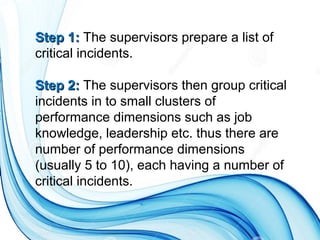
Step 1:Step 1: The supervisors prepare a list of
critical incidents.
Step 2:Step 2: The supervisors then group critical
incidents in to small clusters of
performance dimensions such as job
knowledge, leadership etc. thus there are
number of performance dimensions
(usually 5 to 10), each having a number of
critical incidents.
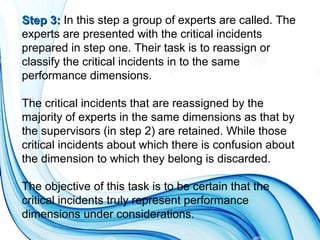
Step 3:Step 3: In this step a group of experts are called. The
experts are presented with the critical incidents
prepared in step one. Their task is to reassign or
classify the critical incidents in to the same
performance dimensions.
The critical incidents that are reassigned by the
majority of experts in the same dimensions as that by
the supervisors (in step 2) are retained. While those
critical incidents about which there is confusion about
the dimension to which they belong is discarded.
The objective of this task is to be certain that the
critical incidents truly represent performance
dimensions under considerations.
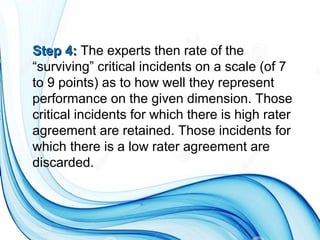
Step 4:Step 4: The experts then rate of the
“surviving” critical incidents on a scale (of 7
to 9 points) as to how well they represent
performance on the given dimension. Those
critical incidents for which there is high rater
agreement are retained. Those incidents for
which there is a low rater agreement are
discarded.
Step 5:Step 5: the final form of BARS consists of
critical incidents that are survived step 3 & 4.
These incidents serve as behavioral anchors
for the performance dimension scales. Thus
the BARS instrument consists of a series of
scales (one for each dimension) anchored by
the critical incidents.
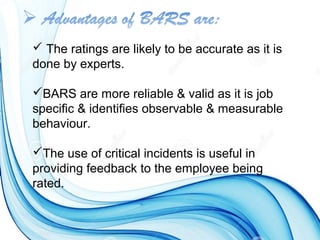
 The ratings are likely to be accurate as it is
done by experts.
BARS are more reliable & valid as it is job
specific & identifies observable & measurable
behaviour.
The use of critical incidents is useful in
providing feedback to the employee being
rated.
 The development of BARS is time-
consuming.
BARS are job specific. A different
behaviorally anchored rating scale has to
be developed for every job.
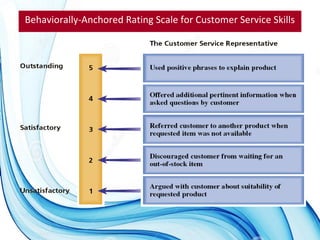
Behaviorally-Anchored Rating Scale for Customer Service Skills

Methods of appraisal

  • 2.
    Behaviourally Anchored Rating Scales(BARS) are designed to bring the benefits of both qualitative and quantitative data to the employee appraisal process. BARS compare an individual’s performance against specific examples of behaviour that are anchored to numerical ratings.
  • 3.
    The behavioural examplesused as anchor points are often collected using Critical Incident Techniques (CIT), which are procedures used for documenting human behaviour that have significance in a particular area.
  • 4.
    BARS was originallydeveloped to counteract the perceived subjectivity in using basic ratings scales to judge performance, although BARS is still subject to criticism. It is often accused of being subject to unreliability and leniency error.
  • 5.
    Smith & Kendalldeveloped the original behaviorally anchored rating scales. These scales are a combination critical incidents & rating scales. BARS are also known as behavioral expectation scales. The development of BARS involves the following steps:
  • 6.
    Step 1:Step 1:The supervisors prepare a list of critical incidents. Step 2:Step 2: The supervisors then group critical incidents in to small clusters of performance dimensions such as job knowledge, leadership etc. thus there are number of performance dimensions (usually 5 to 10), each having a number of critical incidents.
  • 7.
    Step 3:Step 3:In this step a group of experts are called. The experts are presented with the critical incidents prepared in step one. Their task is to reassign or classify the critical incidents in to the same performance dimensions. The critical incidents that are reassigned by the majority of experts in the same dimensions as that by the supervisors (in step 2) are retained. While those critical incidents about which there is confusion about the dimension to which they belong is discarded. The objective of this task is to be certain that the critical incidents truly represent performance dimensions under considerations.
  • 8.
    Step 4:Step 4:The experts then rate of the “surviving” critical incidents on a scale (of 7 to 9 points) as to how well they represent performance on the given dimension. Those critical incidents for which there is high rater agreement are retained. Those incidents for which there is a low rater agreement are discarded.
  • 9.
    Step 5:Step 5:the final form of BARS consists of critical incidents that are survived step 3 & 4. These incidents serve as behavioral anchors for the performance dimension scales. Thus the BARS instrument consists of a series of scales (one for each dimension) anchored by the critical incidents.
  • 10.
     The ratingsare likely to be accurate as it is done by experts. BARS are more reliable & valid as it is job specific & identifies observable & measurable behaviour. The use of critical incidents is useful in providing feedback to the employee being rated.
  • 11.
     The developmentof BARS is time- consuming. BARS are job specific. A different behaviorally anchored rating scale has to be developed for every job.
  • 12.
    Behaviorally-Anchored Rating Scalefor Customer Service Skills