Induction Training for
Hospital infection Control
Presented by;
Ms.Shradhashree Behera
Standard Precautions
• A set of infection control practices:
• Used to prevent transmission of diseases that can be acquired
by contact with blood, body fluids, non-intact skin (including
rashes), and mucous membranes
• Followed with
ALL Individuals,
ALL Specimens and
ALL Needle and Sharps.
Universal Precautions
• Infection control practices to avoid contact with patient’s body
fluids, by means of wearing the non-porous articles such as
medical gloves, goggles, and face shields
• Replaced by Standard Precautions
• In addition
• Measures to prevent contact (i.e. skin and mucosal)
transmission
Components of Standard Precautions
• Hand hygiene
• Personal protective equipment
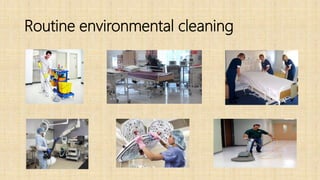
• Routine environmental cleaning
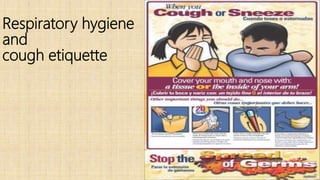
• Respiratory hygiene and cough etiquette
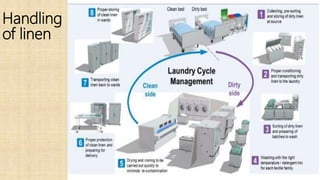
• Appropriate handling of linen
• Biomedical waste management
• Safe use and disposal of sharps
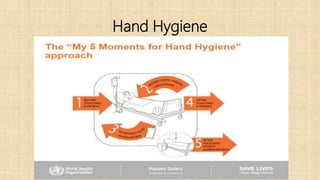
Hand Hygiene
1. HAND RUB (Indications)
• Routine clinical rounds
and handling the patient
• Hands not visibly dirty,
not contaminated with blood/ body fluids
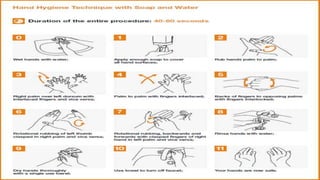
2. HAND WASH (Indications)
• Visibly dirty, contaminated with blood/ body fluids
• Exposure to Spore forming organisms, Nonenveloped viruses
• Handling patients having diarrhoea
• After using restroom
• Before handling Medication/ Food
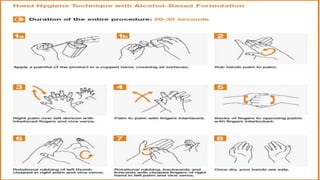
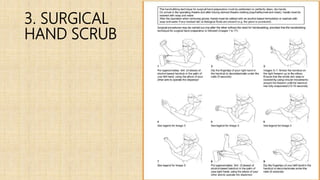
3. SURGICAL
HAND SCRUB
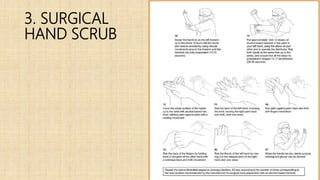
3. SURGICAL
HAND SCRUB
Personal protective equipment
• Specialized clothing or equipment worn by HCW for
protection against infectious materials
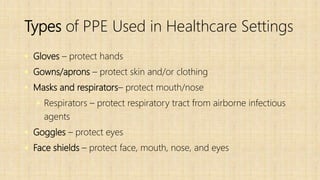
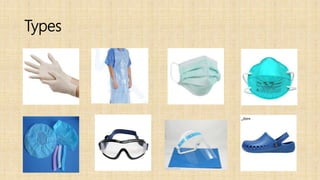
Types of PPE Used in Healthcare Settings
 Gloves – protect hands
 Gowns/aprons – protect skin and/or clothing
 Masks and respirators– protect mouth/nose
 Respirators – protect respiratory tract from airborne infectious
agents
 Goggles – protect eyes
 Face shields – protect face, mouth, nose, and eyes
Types
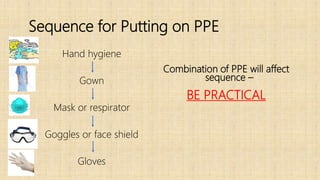
Sequence for Putting on PPE
Hand hygiene
Gown
Mask or respirator
Goggles or face shield
Gloves
Combination of PPE will affect
sequence –
BE PRACTICAL
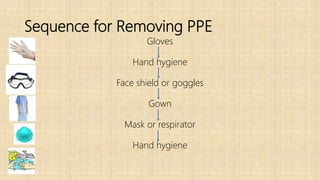
Sequence for Removing PPE
Gloves
Hand hygiene
Face shield or goggles
Gown
Mask or respirator
Hand hygiene
Routine environmental cleaning
Respiratory hygiene
and
cough etiquette
Handling
of linen
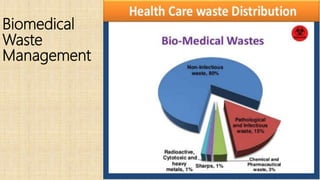
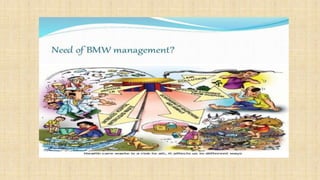
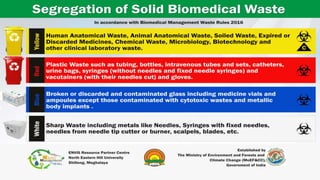
Biomedical
Waste
Management
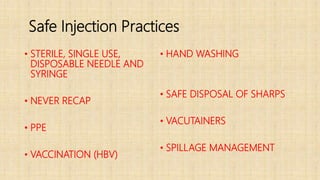
Safe Injection Practices
• STERILE, SINGLE USE,
DISPOSABLE NEEDLE AND
SYRINGE
• NEVER RECAP
• PPE
• VACCINATION (HBV)
• HAND WASHING
• SAFE DISPOSAL OF SHARPS
• VACUTAINERS
• SPILLAGE MANAGEMENT
Needle Stick Injury management
An occupational exposure is defined as
1. Percutaneous injury (e.g., needle stick or cut with a sharp instrument)
2. Splash injury
• Contact with the mucous membrane of the eye or mouth
• Contact with non-intact skin (particularly when the exposed skin is chapped,
abraded, or afflicted with dermatitis);
• Contact with the intact skin when the contact duration is prolonged (e.g., several
minutes or more) with blood or other potentially infectious body fluids.
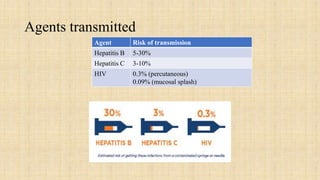
Agents transmitted
Agent Risk of transmission
Hepatitis B 5-30%
Hepatitis C 3-10%
HIV 0.3% (percutaneous)
0.09% (mucosal splash)
Prevention of occupational
exposure
General measures:
Apply standard infection control precautions-
• Use appropriate PPEs
• Avoid wearing open footwear in high risk areas
• Adhere to hand hygiene
• Cover existing wounds, skin lesions, and all breaks
• HCWs with chronic skin disease (e.g. eczema) should avoid invasive
procedures
• Work surfaces disinfected: with 0.1 percent sodium hypochlorite solution.
• Clear up spillage
Precautions while handling Needle:
• Avoid unnecessary use
• Handle hollow bore needles with care
• Disposable needles should be used.
• Never recap needles- If unavoidable, use single hand-scoop tech.
• Never break/bend needles by hand
• Never pass the syringe in hand directly (use kidney tray)
• Dispose – in sharp box (white PPC) containing 10% sodium
hypochlorite
• Needles/sharps should not be left on trolleys and bed side tables
Needle Stick Injury Management
DO’s DON’Ts
Remove gloves Panic
Wash exposure site thoroughly with
running water
Put pricked finger in mouth
Irrigate with water/saline if
eyes/mouth have been exposed
Squeeze wound to bleed it
Wash skin with soap and water Use bleach, chlorine, alcohol,
betadine, iodine on the wound
Steps to be followed after NSI:
1. First aid
2. Report to designated nodal centre
3. Take first dose of PEP for HIV
4. Testing for HIV, HBV and HCV for both source and exposed
5. Risk assessment (based on type of injury and source status)
6. Decision on prophylactic treatment for HIV and HBV
7. Monitoring and follow up of HIV, HBV, and HCV status
8. Documentation and recording of exposure
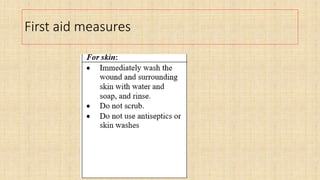
First aid measures
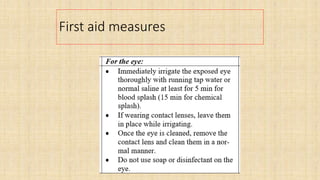
First aid measures
First aid measures
Spill Management
• Blood & Body fluid spill
• Chemical spill
• Major spill (>30 ml)
• Minor spill (<30 ml)
Spill management
• Identify the spill.
• Put caution board.
• Declare CODE BROWN (call to 333) in case of major spill.
• Bring spill kit
• Wear PPE/gloves & mask.
• Use disposable paper towels or tissue papers to cover the spill.
• Pour disinfectant over the entire area of the spillage & let it remain for a contact time
period.
• The absorbent paper picked up & placed in the yellow bag with the help of forcep & label it
which type of spill.
• Carefully clean the spill site of any visible material from the edges of the spill to the center
with an aqueous detergent solution.
• Rinse the spill site with soap & water & air dry.
• Discard the PPE items & wash hand.
• Handed over to house keeping department & fill up incident form if needed.
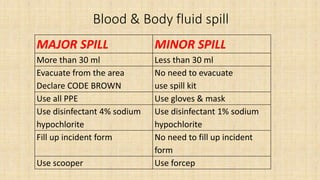
MAJOR SPILL MINOR SPILL
More than 30 ml Less than 30 ml
Evacuate from the area
Declare CODE BROWN
No need to evacuate
use spill kit
Use all PPE Use gloves & mask
Use disinfectant 4% sodium
hypochlorite
Use disinfectant 1% sodium
hypochlorite
Fill up incident form No need to fill up incident
form
Use scooper Use forcep
Blood & Body fluid spill
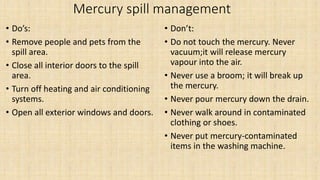
Mercury spill management
• Do’s:
• Remove people and pets from the
spill area.
• Close all interior doors to the spill
area.
• Turn off heating and air conditioning
systems.
• Open all exterior windows and doors.
• Don’t:
• Do not touch the mercury. Never
vacuum;it will release mercury
vapour into the air.
• Never use a broom; it will break up
the mercury.
• Never pour mercury down the drain.
• Never walk around in contaminated
clothing or shoes.
• Never put mercury-contaminated
items in the washing machine.
• Evacuate area
• Put on PPE
• Locate mercury beads: Never touch with hands. Cardboard sheets should be
‘used to push the spilled beads of mercury together’
• Use syringe without a needle/eyedropper and sticky tape: to suck the beads
of mercury. Collected mercury needs to be placed slowly and carefully into an
unbreakable plastic container/glass bottle with an airtight lid half filled with
water.
• Collection in leak-proof bag or container: Place all the materials used during
the clean-up, including gloves, mercury spills collected from the spill area into
a leak-proof plastic bag or container with lid and seal properly and label.
• Hand over to Biomedical engineering department.
• Clear the spill area.
• Incident form has to be filled up.
TAKE CARE
and
THANK YOU

Induction training for hospital infection control

  • 1.
    Induction Training for Hospitalinfection Control Presented by; Ms.Shradhashree Behera
  • 3.
    Standard Precautions • Aset of infection control practices: • Used to prevent transmission of diseases that can be acquired by contact with blood, body fluids, non-intact skin (including rashes), and mucous membranes • Followed with ALL Individuals, ALL Specimens and ALL Needle and Sharps.
  • 4.
    Universal Precautions • Infectioncontrol practices to avoid contact with patient’s body fluids, by means of wearing the non-porous articles such as medical gloves, goggles, and face shields • Replaced by Standard Precautions • In addition • Measures to prevent contact (i.e. skin and mucosal) transmission
  • 5.
    Components of StandardPrecautions • Hand hygiene • Personal protective equipment • Routine environmental cleaning • Respiratory hygiene and cough etiquette • Appropriate handling of linen • Biomedical waste management • Safe use and disposal of sharps
  • 6.
  • 7.
    1. HAND RUB(Indications) • Routine clinical rounds and handling the patient • Hands not visibly dirty, not contaminated with blood/ body fluids
  • 9.
    2. HAND WASH(Indications) • Visibly dirty, contaminated with blood/ body fluids • Exposure to Spore forming organisms, Nonenveloped viruses • Handling patients having diarrhoea • After using restroom • Before handling Medication/ Food
  • 11.
  • 12.
  • 13.
    Personal protective equipment •Specialized clothing or equipment worn by HCW for protection against infectious materials
  • 14.
    Types of PPEUsed in Healthcare Settings  Gloves – protect hands  Gowns/aprons – protect skin and/or clothing  Masks and respirators– protect mouth/nose  Respirators – protect respiratory tract from airborne infectious agents  Goggles – protect eyes  Face shields – protect face, mouth, nose, and eyes
  • 15.
  • 16.
    Sequence for Puttingon PPE Hand hygiene Gown Mask or respirator Goggles or face shield Gloves Combination of PPE will affect sequence – BE PRACTICAL
  • 17.
    Sequence for RemovingPPE Gloves Hand hygiene Face shield or goggles Gown Mask or respirator Hand hygiene
  • 18.
  • 19.
  • 20.
  • 21.
  • 24.
    Safe Injection Practices •STERILE, SINGLE USE, DISPOSABLE NEEDLE AND SYRINGE • NEVER RECAP • PPE • VACCINATION (HBV) • HAND WASHING • SAFE DISPOSAL OF SHARPS • VACUTAINERS • SPILLAGE MANAGEMENT
  • 25.
  • 26.
    An occupational exposureis defined as 1. Percutaneous injury (e.g., needle stick or cut with a sharp instrument) 2. Splash injury • Contact with the mucous membrane of the eye or mouth • Contact with non-intact skin (particularly when the exposed skin is chapped, abraded, or afflicted with dermatitis); • Contact with the intact skin when the contact duration is prolonged (e.g., several minutes or more) with blood or other potentially infectious body fluids.
  • 28.
    Agents transmitted Agent Riskof transmission Hepatitis B 5-30% Hepatitis C 3-10% HIV 0.3% (percutaneous) 0.09% (mucosal splash)
  • 29.
  • 30.
    General measures: Apply standardinfection control precautions- • Use appropriate PPEs • Avoid wearing open footwear in high risk areas • Adhere to hand hygiene • Cover existing wounds, skin lesions, and all breaks • HCWs with chronic skin disease (e.g. eczema) should avoid invasive procedures • Work surfaces disinfected: with 0.1 percent sodium hypochlorite solution. • Clear up spillage
  • 31.
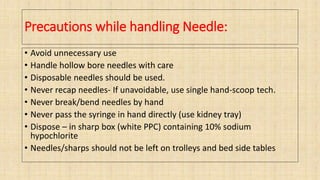
    Precautions while handlingNeedle: • Avoid unnecessary use • Handle hollow bore needles with care • Disposable needles should be used. • Never recap needles- If unavoidable, use single hand-scoop tech. • Never break/bend needles by hand • Never pass the syringe in hand directly (use kidney tray) • Dispose – in sharp box (white PPC) containing 10% sodium hypochlorite • Needles/sharps should not be left on trolleys and bed side tables
  • 32.
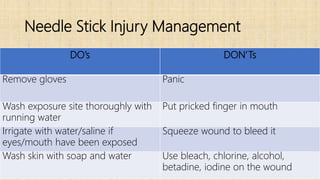
    Needle Stick InjuryManagement DO’s DON’Ts Remove gloves Panic Wash exposure site thoroughly with running water Put pricked finger in mouth Irrigate with water/saline if eyes/mouth have been exposed Squeeze wound to bleed it Wash skin with soap and water Use bleach, chlorine, alcohol, betadine, iodine on the wound
  • 33.
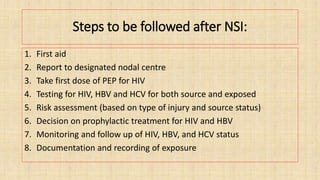
    Steps to befollowed after NSI: 1. First aid 2. Report to designated nodal centre 3. Take first dose of PEP for HIV 4. Testing for HIV, HBV and HCV for both source and exposed 5. Risk assessment (based on type of injury and source status) 6. Decision on prophylactic treatment for HIV and HBV 7. Monitoring and follow up of HIV, HBV, and HCV status 8. Documentation and recording of exposure
  • 34.
  • 35.
  • 36.
  • 37.
    Spill Management • Blood& Body fluid spill • Chemical spill • Major spill (>30 ml) • Minor spill (<30 ml)
  • 38.
    Spill management • Identifythe spill. • Put caution board. • Declare CODE BROWN (call to 333) in case of major spill. • Bring spill kit • Wear PPE/gloves & mask. • Use disposable paper towels or tissue papers to cover the spill. • Pour disinfectant over the entire area of the spillage & let it remain for a contact time period. • The absorbent paper picked up & placed in the yellow bag with the help of forcep & label it which type of spill. • Carefully clean the spill site of any visible material from the edges of the spill to the center with an aqueous detergent solution. • Rinse the spill site with soap & water & air dry. • Discard the PPE items & wash hand. • Handed over to house keeping department & fill up incident form if needed.
  • 39.
    MAJOR SPILL MINORSPILL More than 30 ml Less than 30 ml Evacuate from the area Declare CODE BROWN No need to evacuate use spill kit Use all PPE Use gloves & mask Use disinfectant 4% sodium hypochlorite Use disinfectant 1% sodium hypochlorite Fill up incident form No need to fill up incident form Use scooper Use forcep Blood & Body fluid spill
  • 40.
    Mercury spill management •Do’s: • Remove people and pets from the spill area. • Close all interior doors to the spill area. • Turn off heating and air conditioning systems. • Open all exterior windows and doors. • Don’t: • Do not touch the mercury. Never vacuum;it will release mercury vapour into the air. • Never use a broom; it will break up the mercury. • Never pour mercury down the drain. • Never walk around in contaminated clothing or shoes. • Never put mercury-contaminated items in the washing machine.
  • 41.
    • Evacuate area •Put on PPE • Locate mercury beads: Never touch with hands. Cardboard sheets should be ‘used to push the spilled beads of mercury together’ • Use syringe without a needle/eyedropper and sticky tape: to suck the beads of mercury. Collected mercury needs to be placed slowly and carefully into an unbreakable plastic container/glass bottle with an airtight lid half filled with water. • Collection in leak-proof bag or container: Place all the materials used during the clean-up, including gloves, mercury spills collected from the spill area into a leak-proof plastic bag or container with lid and seal properly and label. • Hand over to Biomedical engineering department. • Clear the spill area. • Incident form has to be filled up.
  • 42.