INFECTION CONTROL,
STANDARD PRECAUTIONS,
BIOMEDICAL WASTE MANAGEMENT
Vidya V S
MSc Nursing 1st year
Introduction
• “The very first requirement in a hospital that it should do
the sick no harm" - Florence Nightingale
• Health care associated infections(HCAI)- economic loss
prolonged hospital stay & adverse patient outcomes.
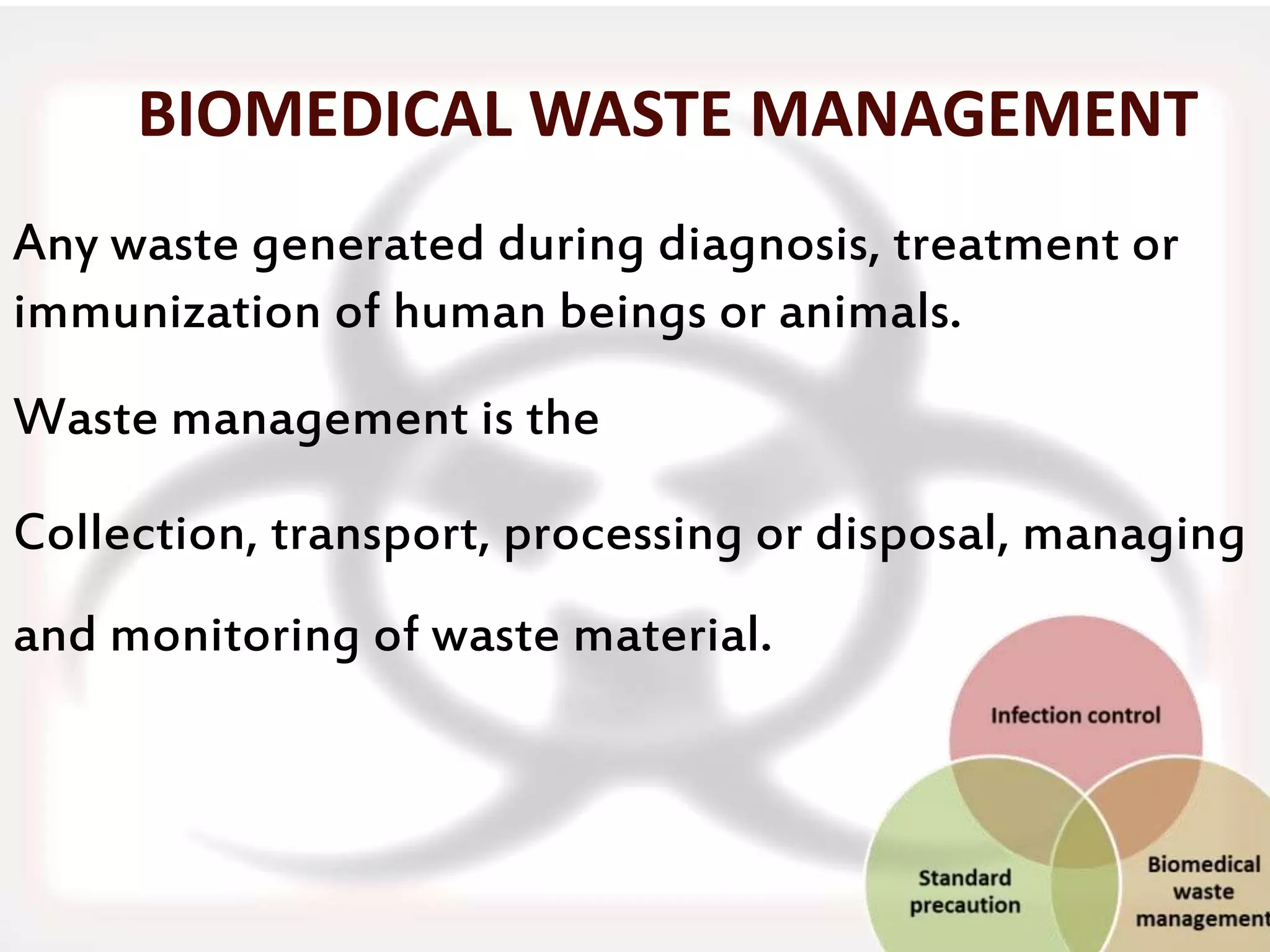
Infection control
Biomedical
waste
management
Standard
precaution
Health care associated infections(HCAI)
• Infections that are acquired by the patients
while he is in the hospital either from other
patients, the environment or members of
hospital staff.
Health Care Associated Infections
Commonly occurring types
• Urinary tract infections.
• Surgical wound infections.
• Respiratory tract infections.
• Catheter related blood stream infections.
• Meningitis.
• Gastroenteritis.
Common organisms
• Staphylococcus aureus
• Enterococcus
• Pseudomonas aeruginosa
• Klebsiella
• E- coli
• HIV
• HBV
• HCV
• CMV
• candidia
• Low resistance of patient to infections.
• Invasive procedures/interventions.
• Inappropriate anti-microbial usage.
• Drug resistance of endemic microbes.
• Contaminated environment.
Risk due to
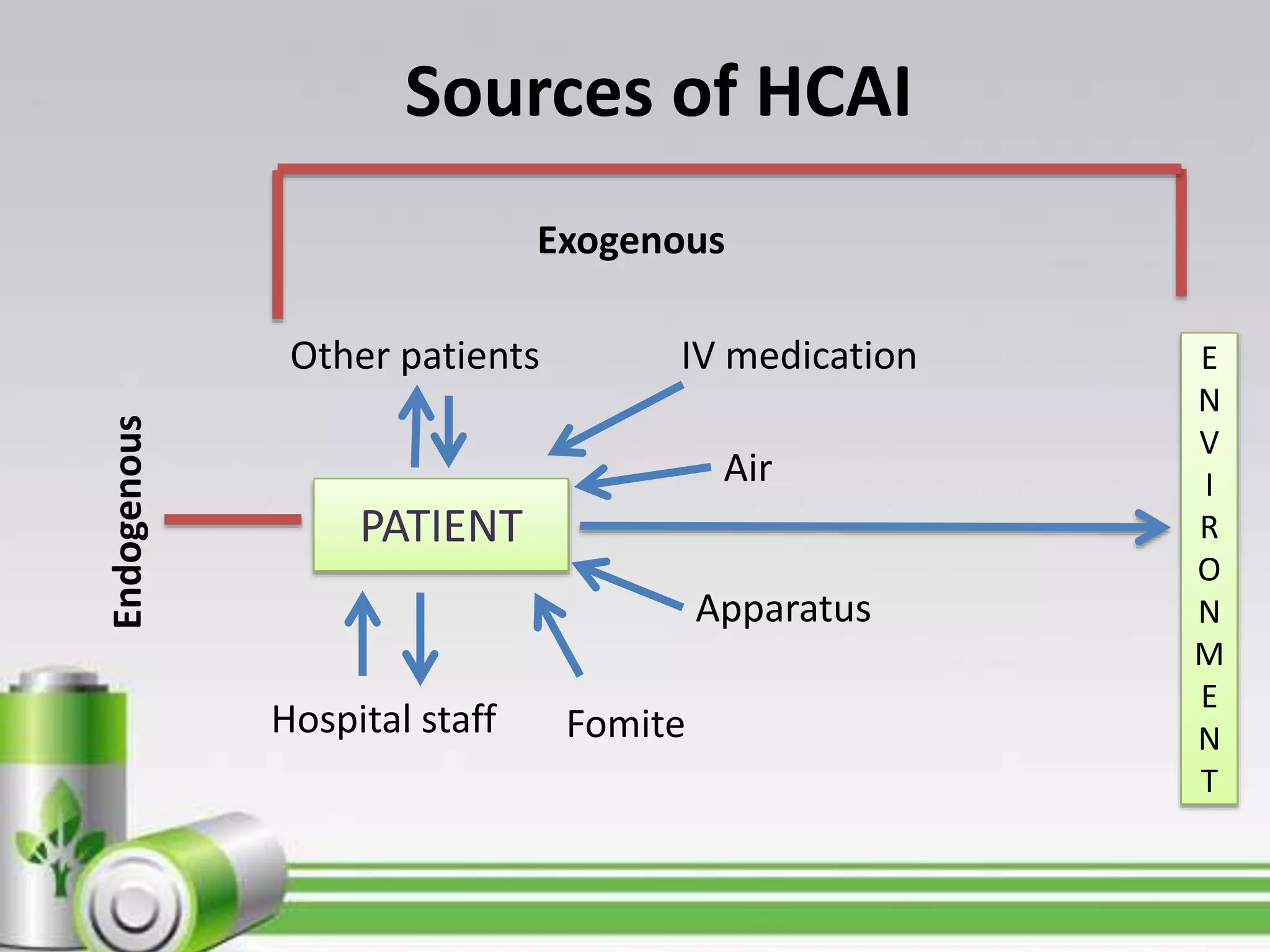
Sources of HCAI
PATIENT
E
N
V
I
R
O
N
M
E
N
T
Exogenous
IV medicationOther patients
Endogenous
Air
Hospital staff Fomite
Apparatus
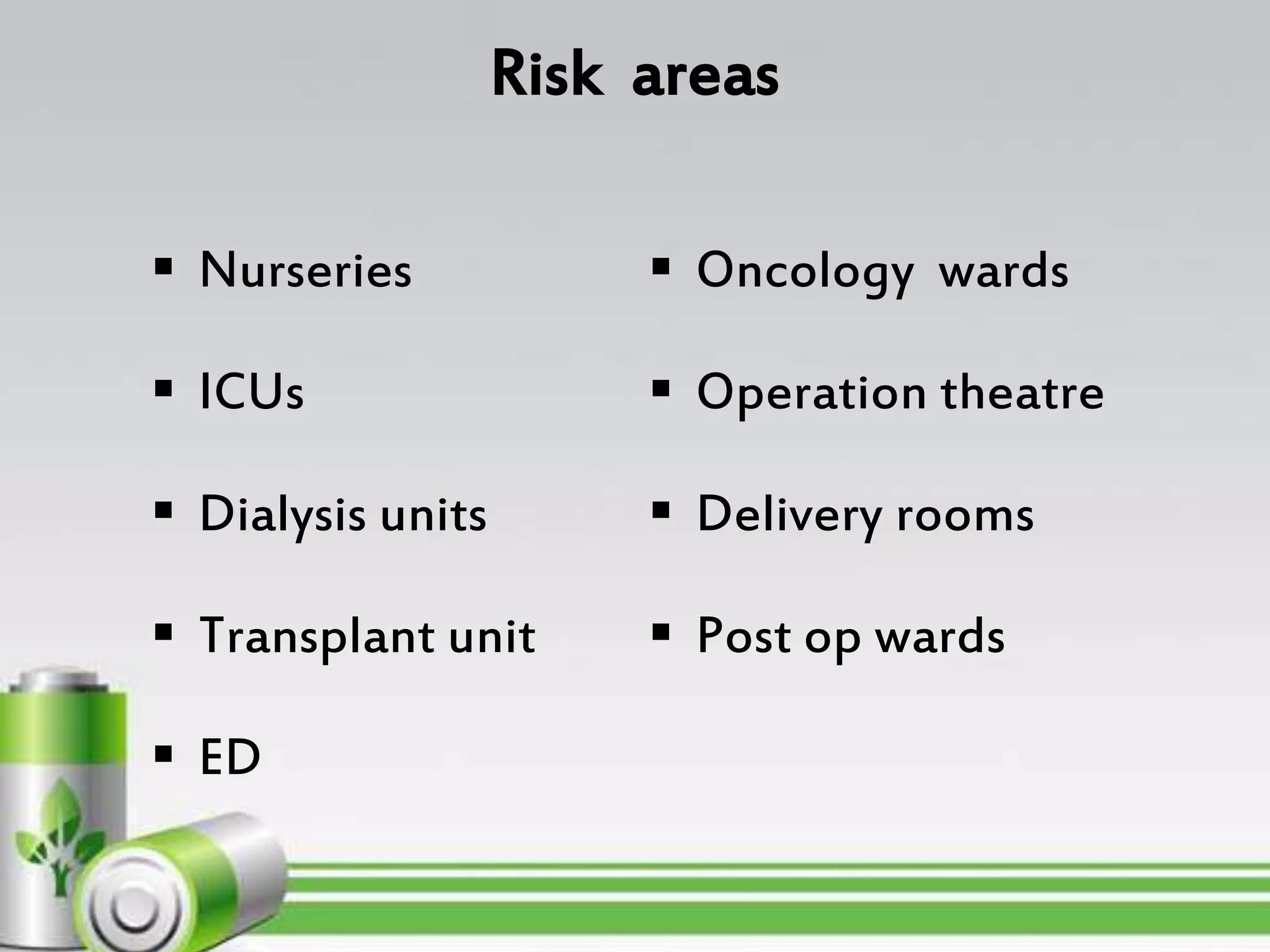
Risk areas
 Nurseries
 ICUs
 Dialysis units
 Transplant unit
 ED
 Oncology wards
 Operation theatre
 Delivery rooms
 Post op wards
Infection control
• What is an Infection ?
• What is Control ?
• Infection control ?
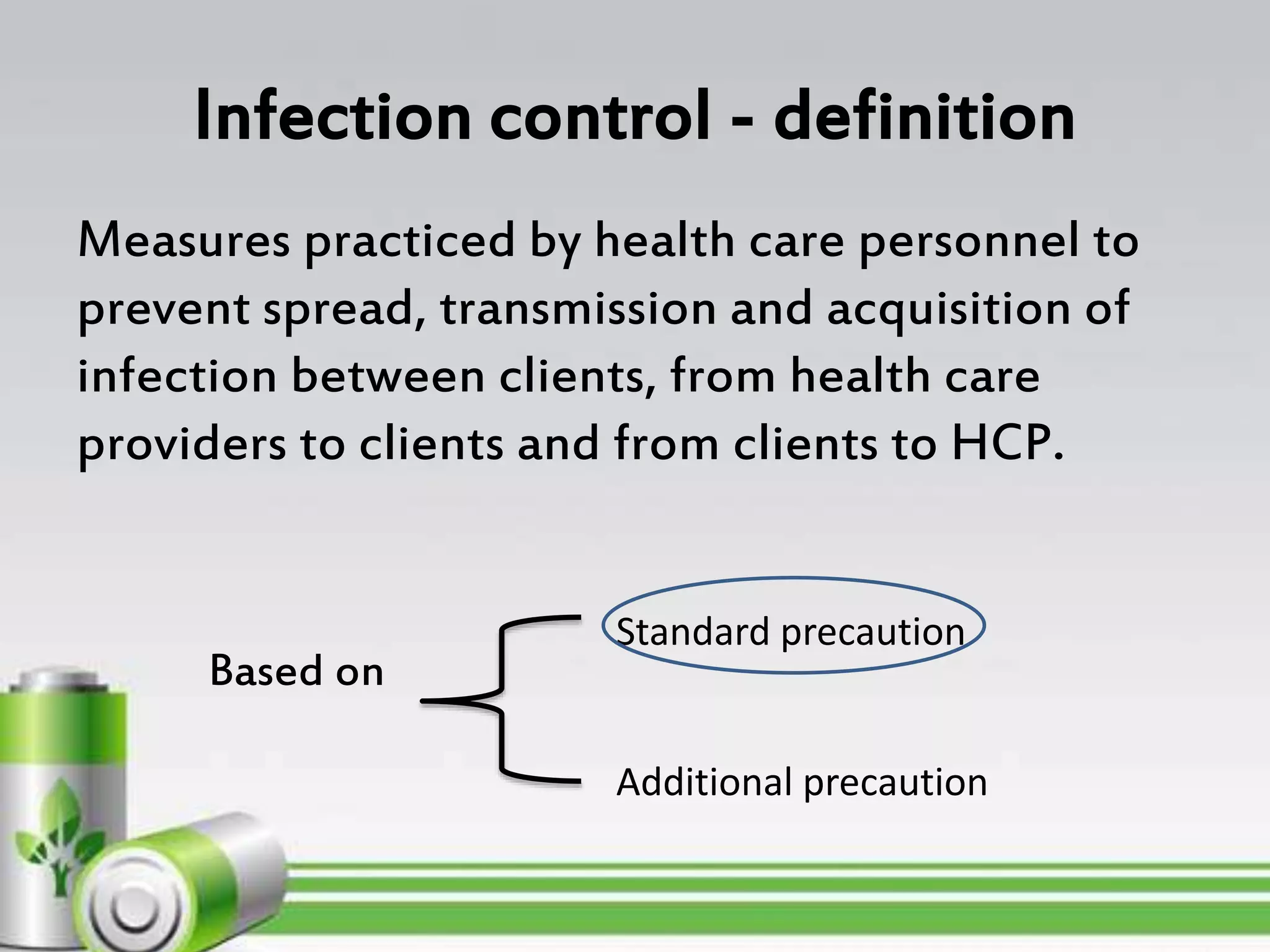
Measures practiced by health care personnel to
prevent spread, transmission and acquisition of
infection between clients, from health care
providers to clients and from clients to HCP.
Based on
Infection control - definition
Standard precaution
Additional precaution
Breaking the Chain of infection
Aseptic practices
• Hand washing.
• Use of barrier nursing –gloves, gown, mask,
goggles etc.
• Adopting universal and standard precautions.
• Care of indwelling devices.
Aseptic practices(contd…)
• Proper decontamination, disinfection
and sterilization of equipment.
• Isolation of infected patients.
• Environmental cleaning.
• Proper disposal of hospital waste.
Hand washing
• Social/routine Hand washing
• Aseptic Hand washing
• Surgical Hand washing
Hand washing Vs Hand rub
Hand washing
• Hands visibly soiled.
• Before eating or handling food.
• After handling contaminated linens ,
equipment, organic material.
• Entering and exiting from clinical setting.
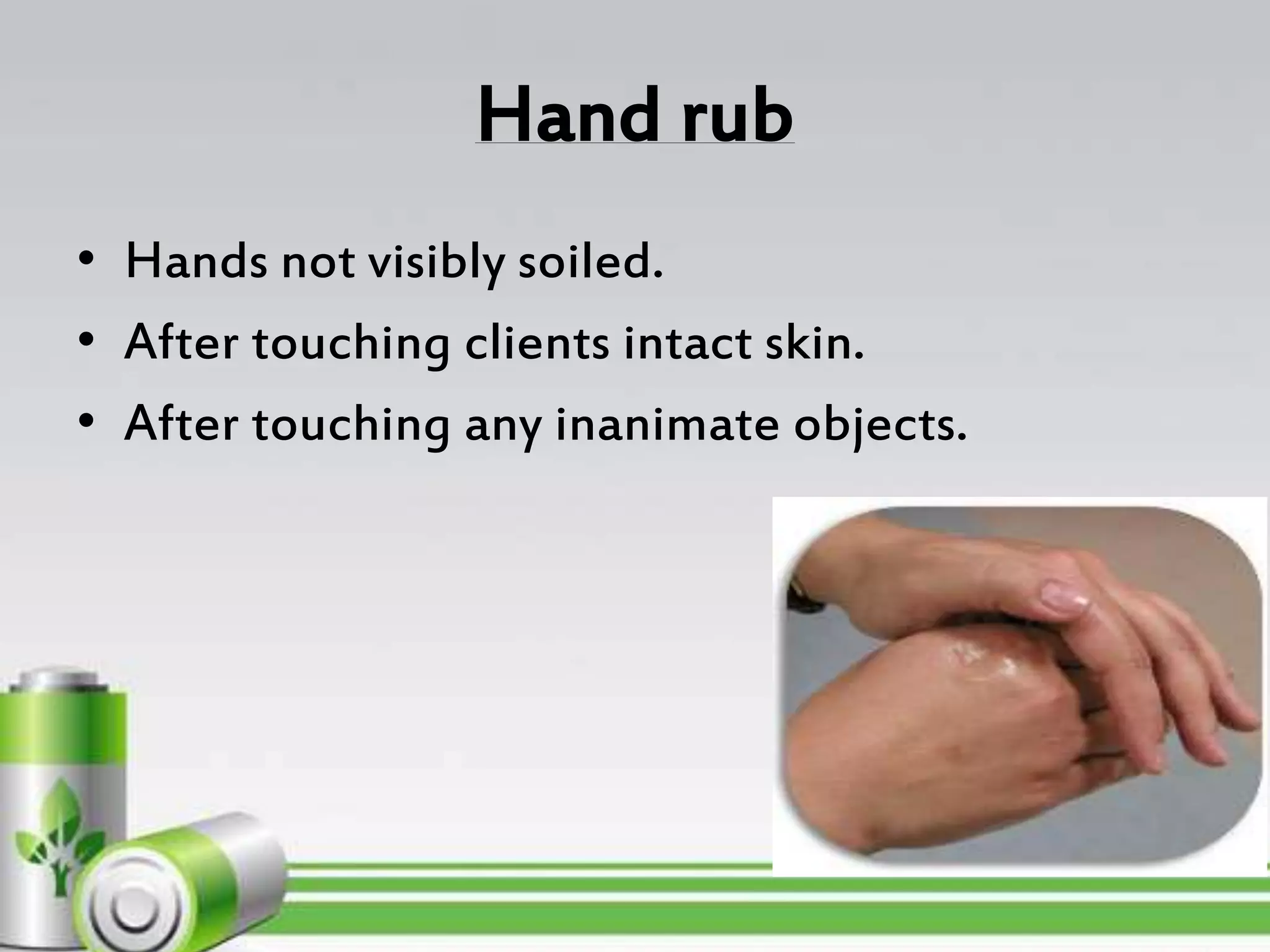
Hand rub
• Hands not visibly soiled.
• After touching clients intact skin.
• After touching any inanimate objects.
How to Handwash?
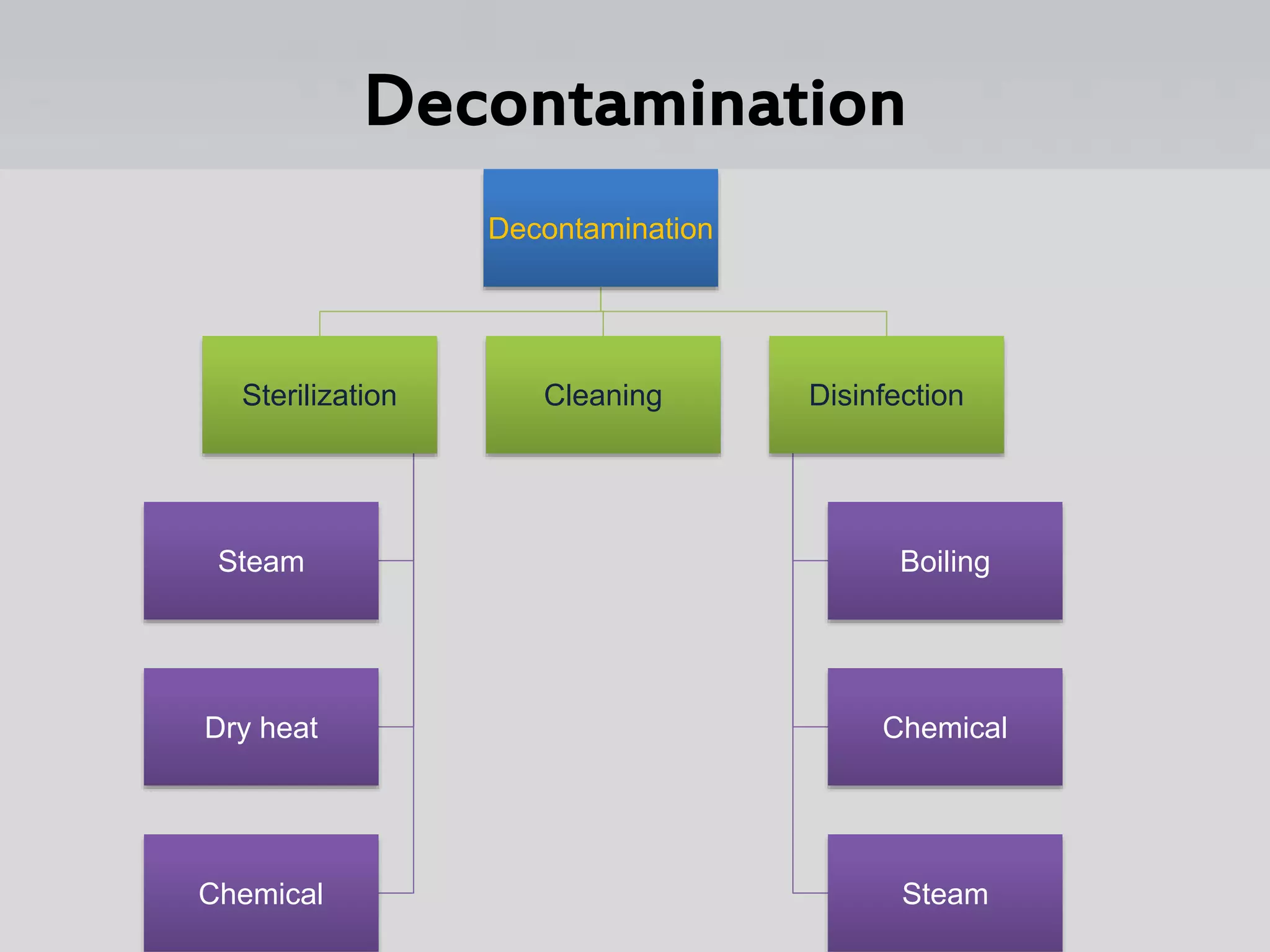
Decontamination
Decontamination
Sterilization
Steam
Dry heat
Chemical
Cleaning Disinfection
Boiling
Chemical
Steam
Disinfection and Sterilization
Disinfection : Reduce the number of microorganisms
on an object or surface but not the complete
destruction of all microorganisms or spores.
Sterilization : Procedures, which would remove all
microorganisms, including spores, from an object.
Disinfectants commonly used
• 2% glutaraldehyde (cidex)
• 5% phenol
• Isopropyl alcohol (bacillol)
• Hydrogen peroxide
• 1% sodium hypochlorite solution
• Calcium hypochlorite (bleaching powder)
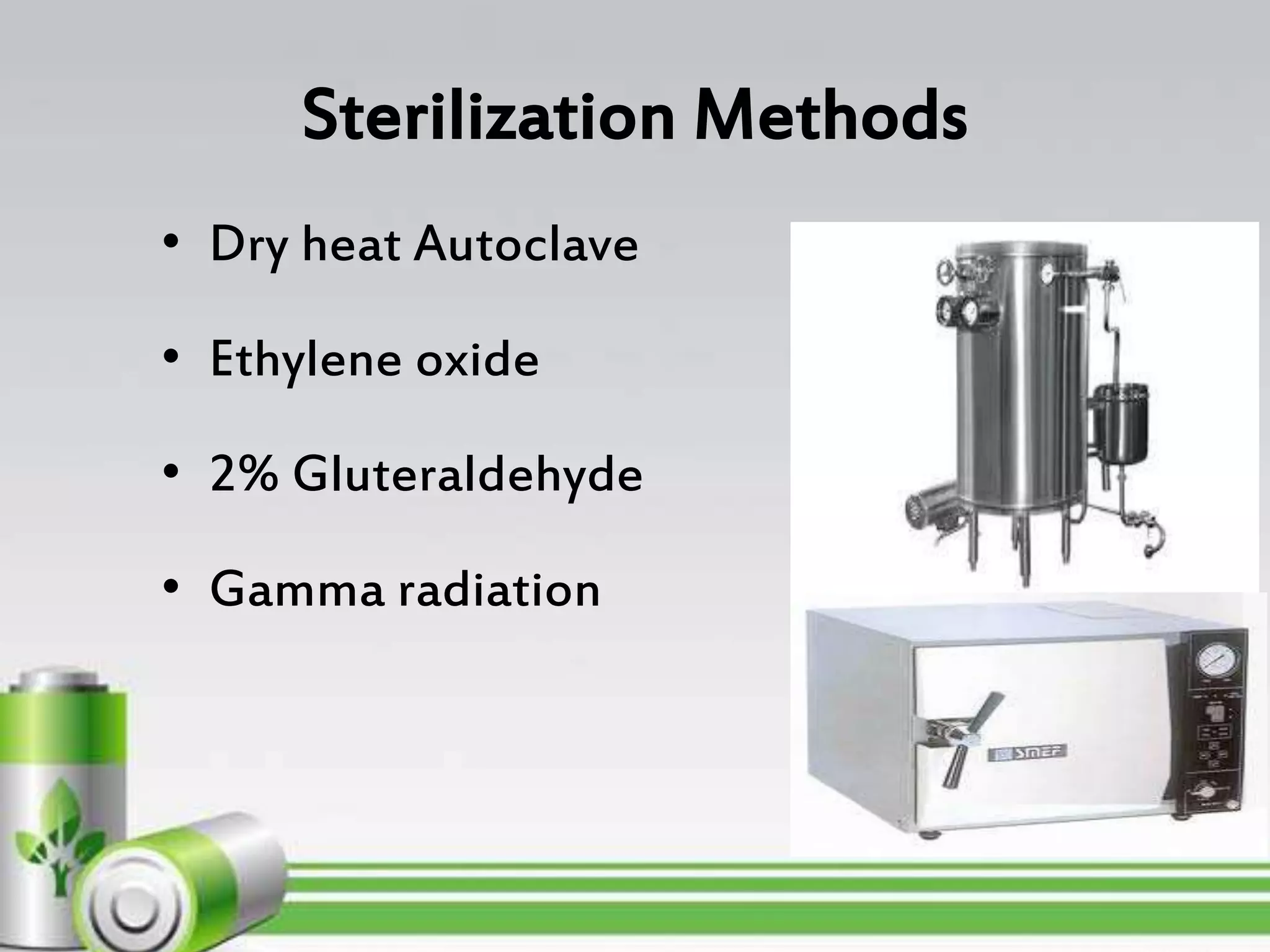
Sterilization Methods
• Dry heat Autoclave
• Ethylene oxide
• 2% Gluteraldehyde
• Gamma radiation
Changes observed over a period of time
• A switch over to digital thermometers from
clinical thermometers.
• Using distilled H2O ampoules to dissolve
injections rather than using common stock
solutions.
Current trends(contd…..)
• Wet mopping over dry sweeping.
• Revised steps of Hand washing.
• No more fumigation with formaldehyde.
• Dry bottles for Cheatle forceps rather
antiseptic solution filled bottles.
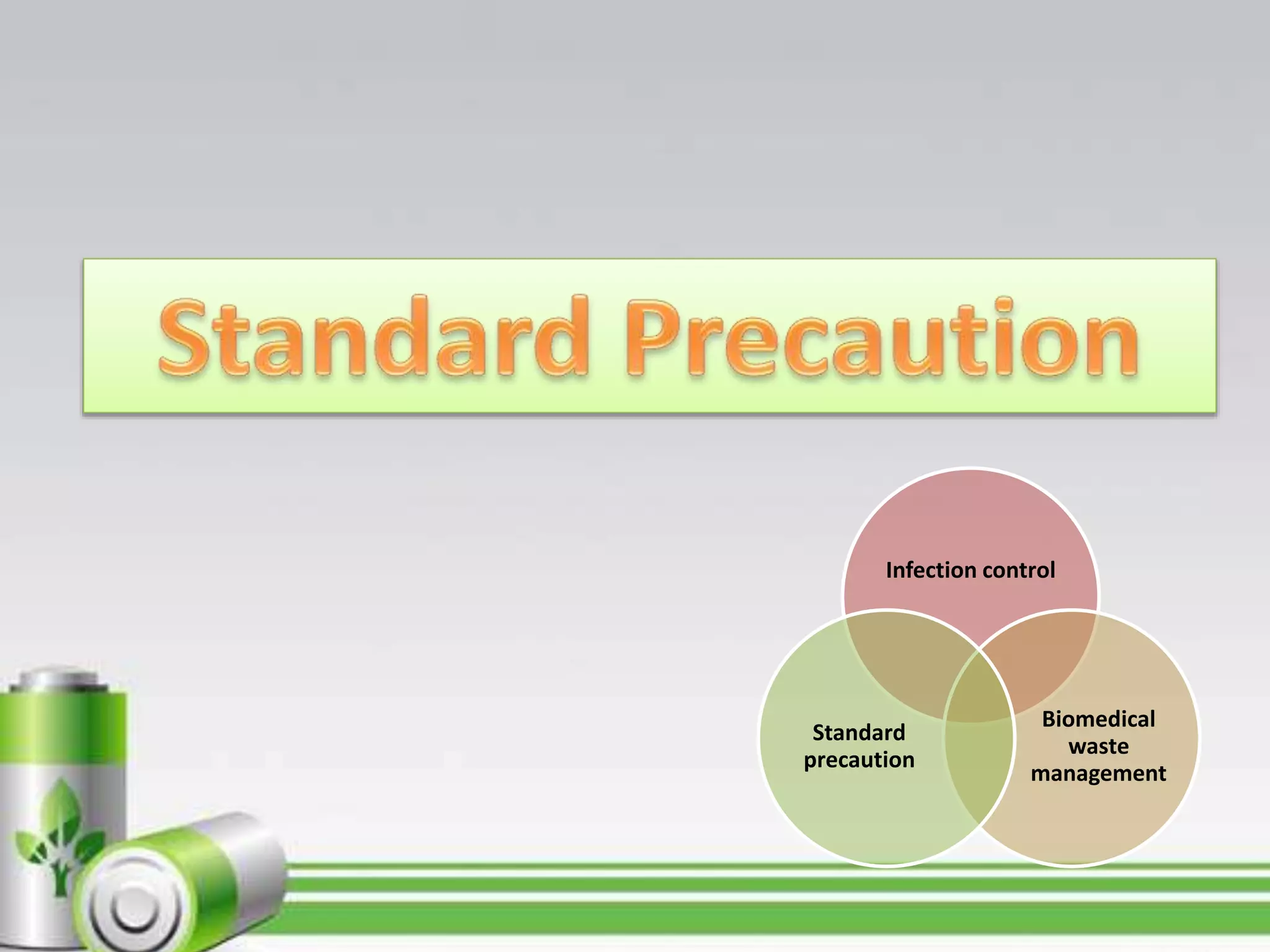
Infection control
Biomedical
waste
management
Standard
precaution
Standard Precaution
As defined by CDC
“ Set of practices designed to prevent the
transmission of HIV, Hepatitis B and other blood
borne pathogens (bacteria & virus). ”
Blood & other body fluids of all persons are
considered potentially infectious.
Body fluids include
• Blood
• Vomit
• Saliva
• Feces
• Drainage
• Secretions from
mucous membrane
• Semen
Sweat and tear mixed with blood
Standard precaution steps
• Hand washing
• Personal protective equipment
• Decontamination
• Waste disposal
Hand hygiene
Hand washing is the single most effective
measure in infection control.
80% of the diseases are spread through hands.
Personal protective equipment
• Gloves
• Gown
• Mask
• Protective eye wear
• Face shield
• Apron
Prevention & management of
Sharp injury and Spillage
• Never recap the needles.
• Cannulas with safety needle guards.
• Post exposure prophylaxis treatment.
• Use of PPE.
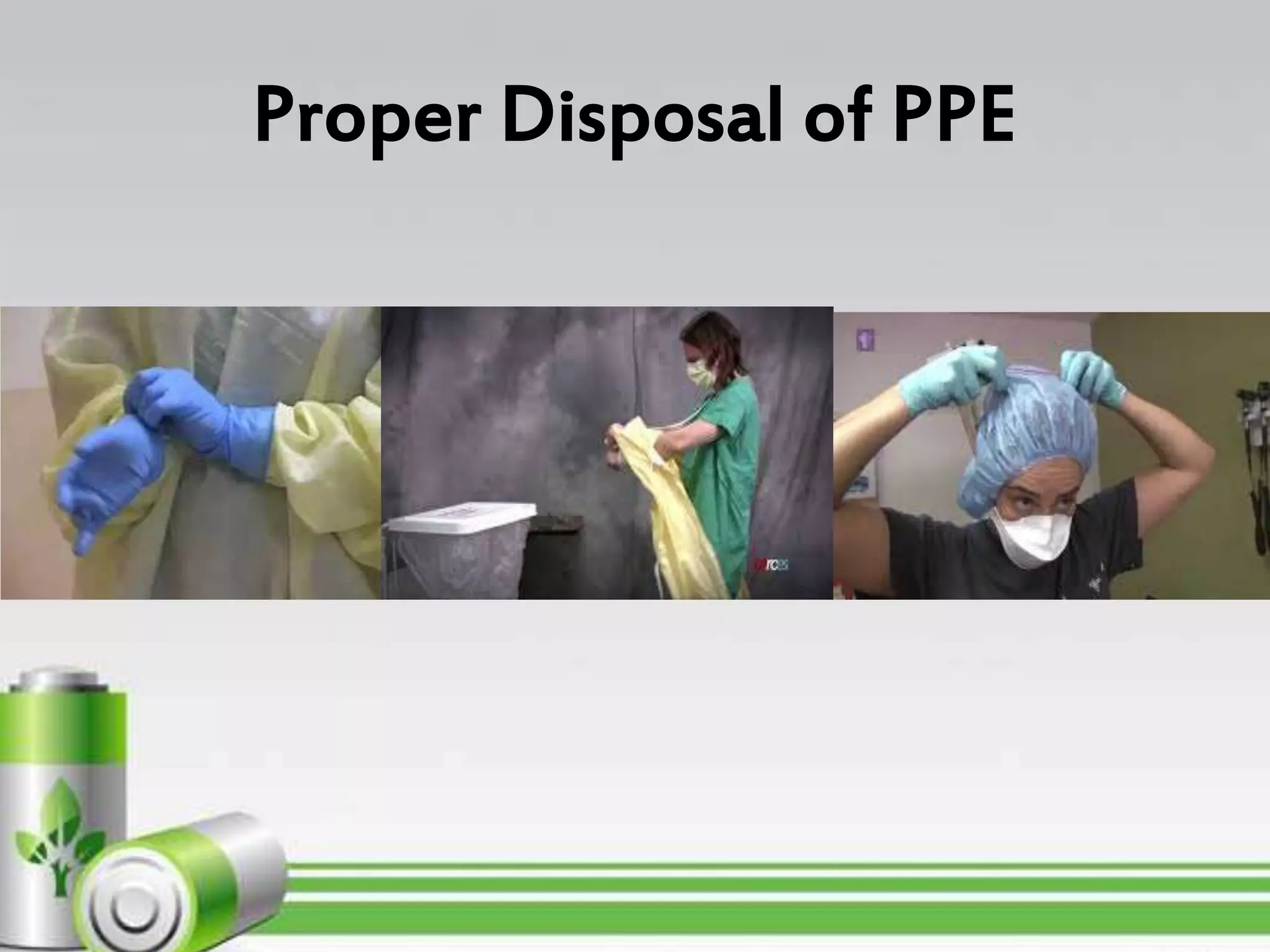
Proper Disposal of PPE
Any waste generated during diagnosis, treatment or
immunization of human beings or animals.
Waste management is the
Collection, transport, processing or disposal, managing
and monitoring of waste material.
BIOMEDICAL WASTE MANAGEMENT
Sources-health care waste
 Government and Private hospitals
 Nursing homes
 Physician’s office/clinics
 Dispensaries
 Primary Health Centers
 Medical research and training establishments
 Mortuaries
Hazards
• Organic portion ferments and attracts fly
breeding.
• Injuries from sharps - health care personnel and
waste handlers.
• Risk of infections to medical, nursing and other
hospital staff.
• Development of resistant strains of
microorganisms.
• Increase in risk associated with hazardous
chemicals and drugs to persons handling
wastes.
• Poor waste management encourages
unscrupulous persons to repacking and
reselling.
• Poor infection control - nosocomial infections in
patients (HIV, Hepatitis B & C).
Hazards(contd….)
 To reduce hazardous nature of waste.
 To reduce volume of waste.
 To prevent misuse or abuse of waste.
 To ensure occupational safety and health.
 To consider aesthetics.
Purposes of waste disposal
Principles of waste management
• Segregate the waste.
• Disinfect and mutilate sharps.
• Adopt safer technologies as autoclave and
microwave.
• Don’t burn chlorinated plastics.
Principles of waste management(contd..)
• Prevent reuse of disposables.
• Motivate and train all hospital personnel.
• Practice universal precaution.
• Follow the biomedical waste rules.
Waste management
3 R’s
recycle
reuse
reduce
Waste Hierarchy
Steps - Waste Management
Handling
Segregation
Mutilation
DisinfectionStorage
Transportation
Final disposal
Handling & Segregation
Rules and regulations governing the disposal of wastes
The Government of India – The Biomedical Waste
(Management and Handling) Rules 1998.
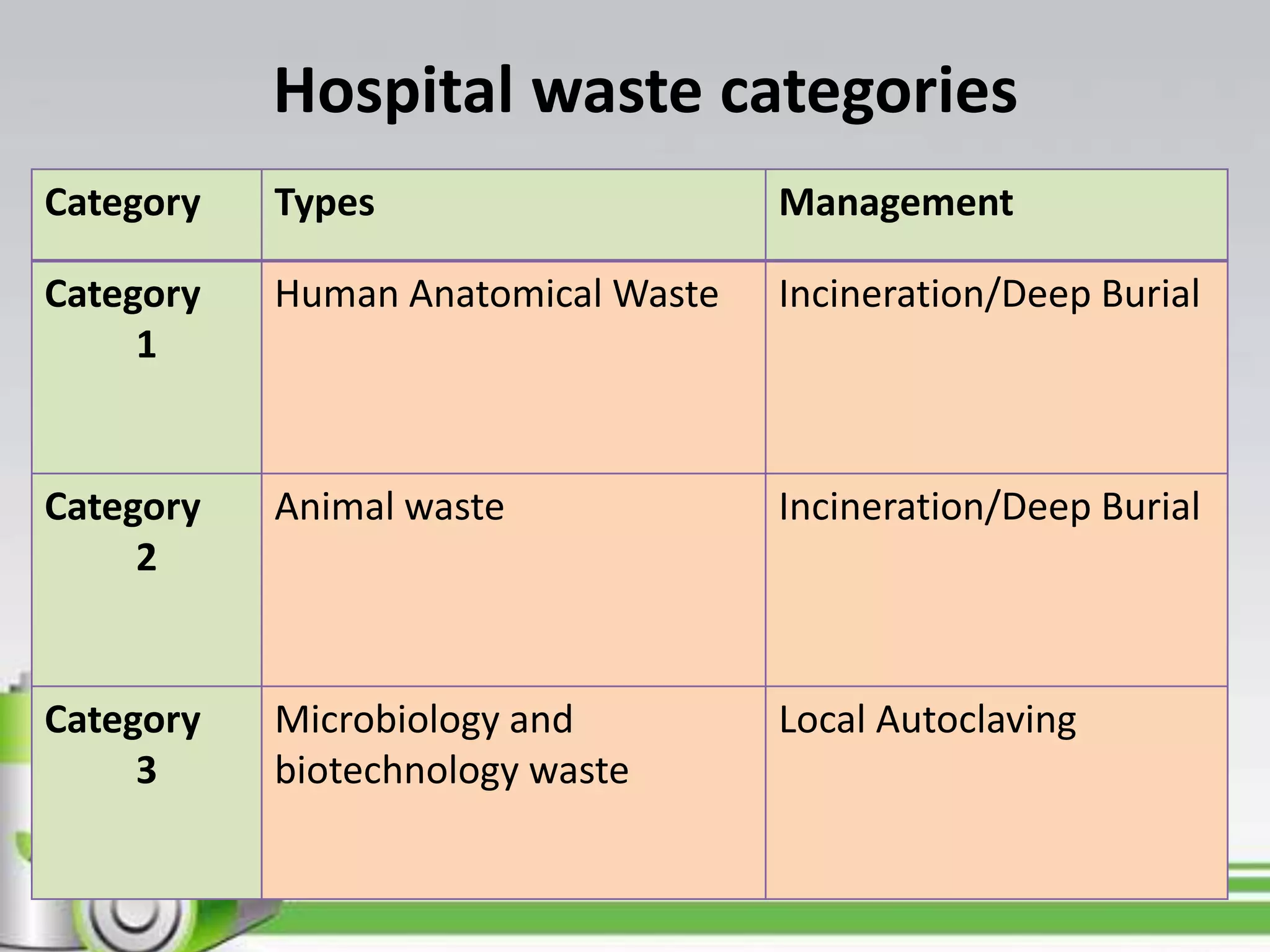
Category Types Management
Category
1
Human Anatomical Waste Incineration/Deep Burial
Category
2
Animal waste Incineration/Deep Burial
Category
3
Microbiology and
biotechnology waste
Local Autoclaving
Hospital waste categories
Hospital waste categories(contd..)
Category Types Management
Category
4
Waste Sharps Chemical Disinfection
Autoclaving/ Microwaving,
Mutilation and Shredding
Category
5
Discarded medicines and
cytotoxic drugs
Incineration/Destruction
and
disposal in land fills
Category
6
Soiled waste (contaminated
with blood and body fluids
including cotton, dressings,
soiled plasters)
Autoclaving/ Microwaving/
Incineration
Hospital waste categories(contd..)
Category types management
Category
7
Solid waste (tubes,
catheters, IV sets)
Chemical
Disinfection/Autoclaving/
Microwaving, Mutilation and
Shredding
Category
8
Liquid waste (Waste
generated from
laboratory
and washing, cleaning,
disinfection)
Disinfection by chemical
treatment and discharge into
the drains
Category
9
Incineration ash Land fills
Category
10
Chemical waste Chemical disinfection and
discharge into the drains
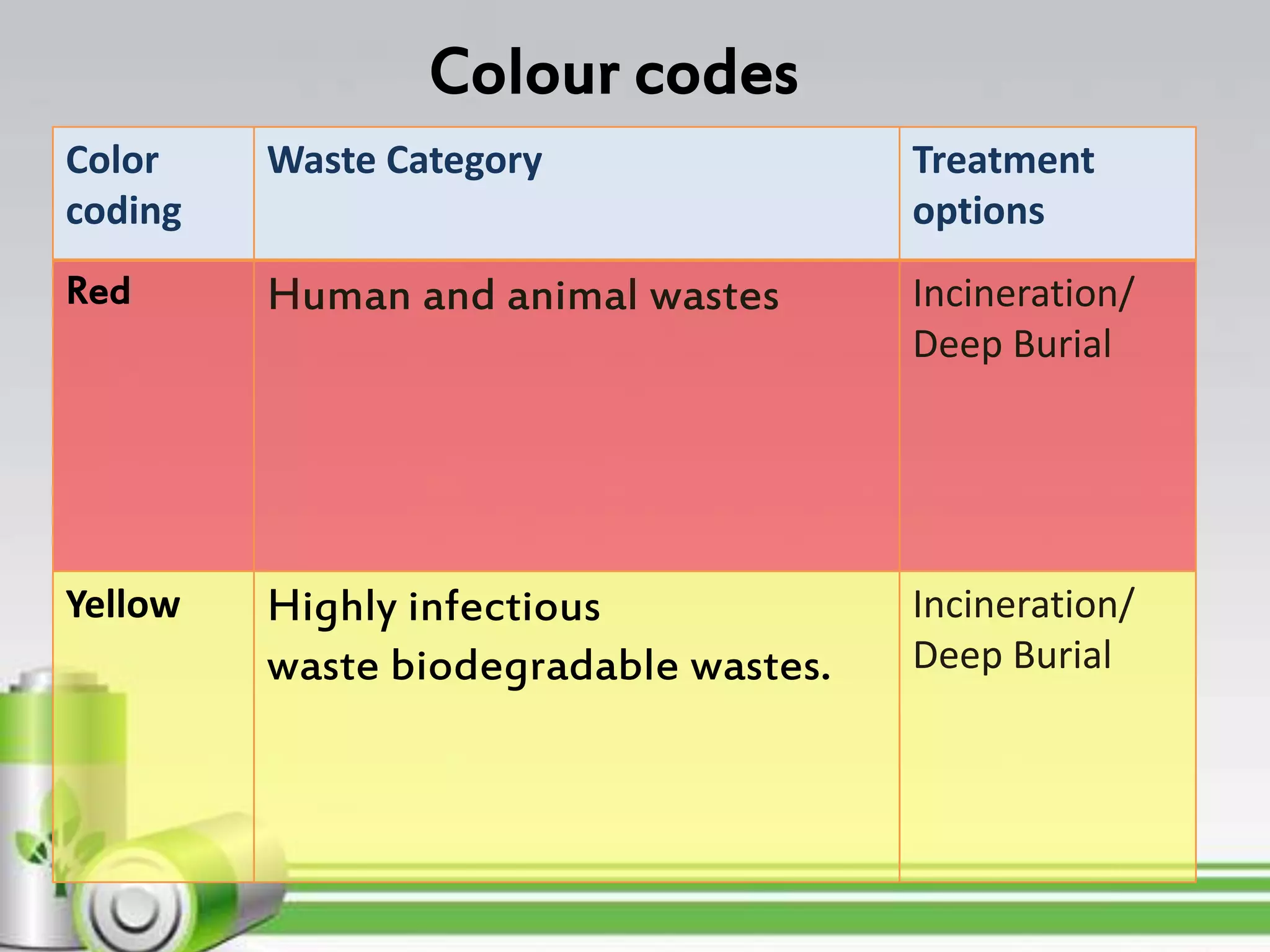
Colour codes
Color
coding
Waste Category Treatment
options
Red Human and animal wastes Incineration/
Deep Burial
Yellow Highly infectious
waste biodegradable wastes.
Incineration/
Deep Burial
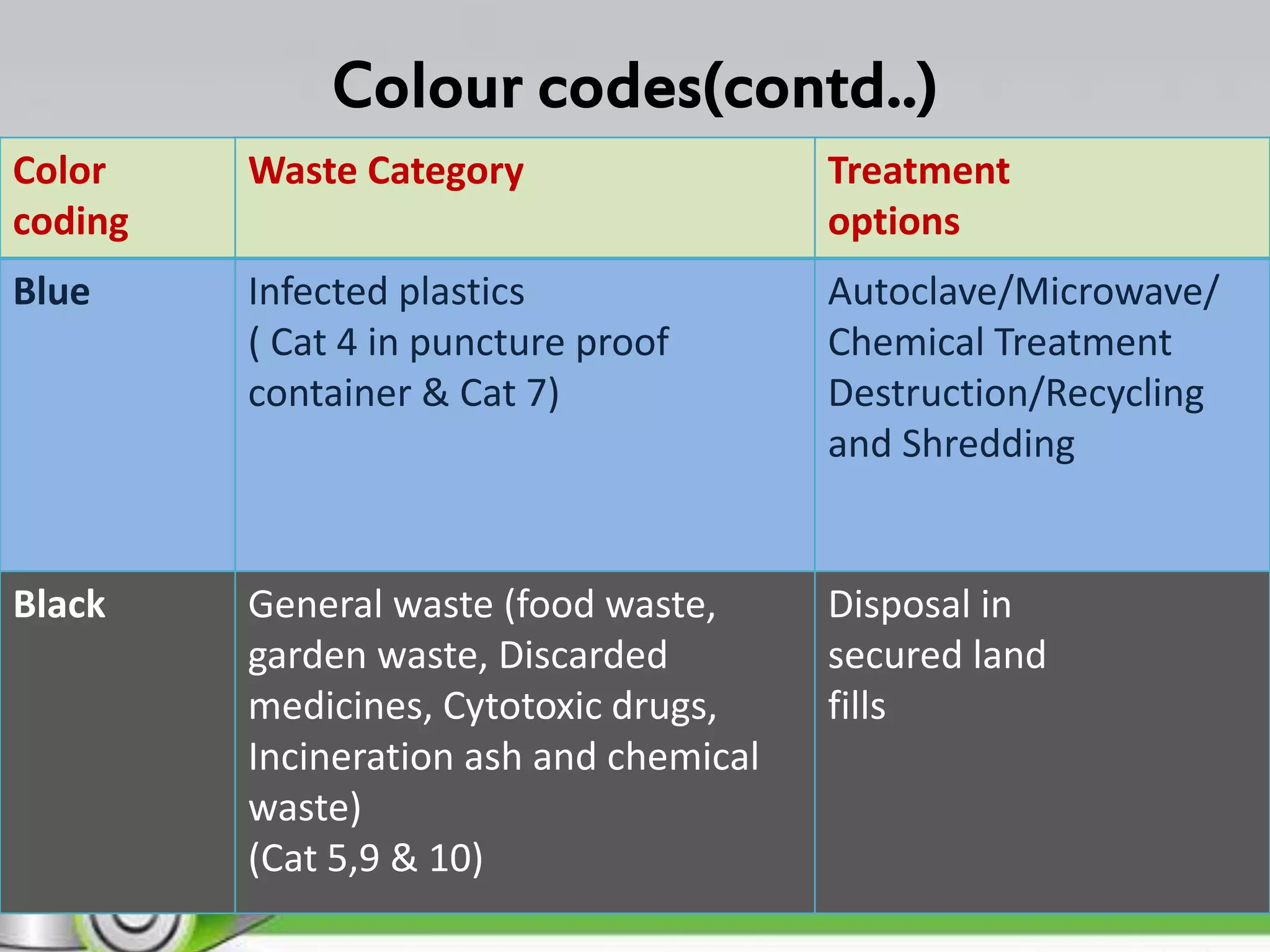
Colour codes(contd..)
Color
coding
Waste Category Treatment
options
Blue Infected plastics
( Cat 4 in puncture proof
container & Cat 7)
Autoclave/Microwave/
Chemical Treatment
Destruction/Recycling
and Shredding
Black General waste (food waste,
garden waste, Discarded
medicines, Cytotoxic drugs,
Incineration ash and chemical
waste)
(Cat 5,9 & 10)
Disposal in
secured land
fills
Colour coding
Waste storage
Storage facility should have sufficient capacity.
 location - within hospital premises.
Radioactive waste must be stored separately.
Untreated biomedical waste not to be kept beyond 48
hrs (Permission required for >48 hrs).
Protect human health & environment.
Waste transportation
Points to be remembered:
Before taking the bags it should be tied and
labeled.
 Waste handlers should not touch any other
articles.
 A covered cart with biohazard symbol to carry
the waste to the central area of collection.
Waste Treatment and Disposal
Available Treatment and Disposal Methods
 Chemical Technology
 Thermal Technology
 Autoclave
 Hydroclave
 Incinerator
 Microwave
Waste Treatment and Disposal(contd..)
 Mechanical Technology
Compaction
Grinding/ Shredding
 Plasma torch Technology
 Deep burial
Waste Treatment and Disposal(contd..)
 Biological Method
 Land filling
 Open dumps
 Sanitary land fill
 Worm composting
Final disposal
 Black bags
 Disposed along with other municipal waste.
 Yellow bags
 Incinerated & resultant ash collected to be
used in land fills.
 Blue bags
 Autoclaved, shredded & finally dispensed.
Specific wastes
• Dead fetus
• Mutilated organs
• Placenta
• Dead bodies
• Cytotoxic drugs
• Radio active substances
• Expired countable drugs & sutures
• Immunization vials
Staff safety considerations
 Separate trolleys for transporting waste within the
hospital.
 All workers involved in the work are aware of the
hazardous nature of the work.
 Provided with all protective equipment.
 Immunized against tetanus and hepatitis B.
Training on biomedical waste management
Overall aim of training:
• To develop awareness of health, safety and
environmental issues relating to health care waste.
• Roles & responsibilities of health care personnel in
overall management program should be
highlighted.
Four main categories for which separate
training activities are designed
 Hospital managers & administrative staff
 Medical doctors
 Nurses
 Cleaners, porters, auxiliary staff &waste handlers
Biomedical waste management issues
Implementation of bio-medical waste regulation -
unsatisfactory.
 Lack of segregation practices.
 Incorrect methods of waste disposal.
Dumping of waste in river and sea.
Recycling of disposables without even being washed.
Biomedical waste management issues..
Using same wheel barrow for all categories of waste.
 Trolley movement around patient care units.
 No mechanism for ensuring waste treatment
within prescribed time limits.
 No proper training of employees in some hospitals.
Responsibilities of health care Institutions
• Set up biomedical waste treatment facilities -
incinerators, autoclave and microwave system.
• Make an application to the concerned authorities
for grant of authorization.
• Report immediately any accident to the prescribed
authority.
Responsibilities of health care
Institutions (contd…)
• Maintain records about the generation, collection
reception, storage, transportation, treatment, disposal
and/or any form of handling bio medical waste.
• Submit a report during the preceding year by 31 Jan
every year.
Role of infection control nurses
• Visits all wards and high risk units.
• Checking nursing supervisor’s register and
records for cases suggestive of infection.
• Collection of sample from different areas of the
hospitals & sending them to the lab.
Role of infection control nurses(contd..)
• Daily visit to microbiology lab to ascertain results
of sample collected.
• Monitoring & supervision of infection among
hospital staffs.
• Training of nursing & paramedical personnel on
correct hygiene practices & aseptic technique.
Infection control,BMW management,standard precaution

Infection control,BMW management,standard precaution

  • 1.
    INFECTION CONTROL, STANDARD PRECAUTIONS, BIOMEDICALWASTE MANAGEMENT Vidya V S MSc Nursing 1st year
  • 2.
    Introduction • “The veryfirst requirement in a hospital that it should do the sick no harm" - Florence Nightingale • Health care associated infections(HCAI)- economic loss prolonged hospital stay & adverse patient outcomes. Infection control Biomedical waste management Standard precaution
  • 3.
    Health care associatedinfections(HCAI) • Infections that are acquired by the patients while he is in the hospital either from other patients, the environment or members of hospital staff.
  • 4.
    Health Care AssociatedInfections Commonly occurring types • Urinary tract infections. • Surgical wound infections. • Respiratory tract infections. • Catheter related blood stream infections. • Meningitis. • Gastroenteritis.
  • 5.
    Common organisms • Staphylococcusaureus • Enterococcus • Pseudomonas aeruginosa • Klebsiella • E- coli • HIV • HBV • HCV • CMV • candidia
  • 6.
    • Low resistanceof patient to infections. • Invasive procedures/interventions. • Inappropriate anti-microbial usage. • Drug resistance of endemic microbes. • Contaminated environment. Risk due to
  • 7.
    Sources of HCAI PATIENT E N V I R O N M E N T Exogenous IVmedicationOther patients Endogenous Air Hospital staff Fomite Apparatus
  • 8.
    Risk areas  Nurseries ICUs  Dialysis units  Transplant unit  ED  Oncology wards  Operation theatre  Delivery rooms  Post op wards
  • 9.
    Infection control • Whatis an Infection ? • What is Control ? • Infection control ?
  • 10.
    Measures practiced byhealth care personnel to prevent spread, transmission and acquisition of infection between clients, from health care providers to clients and from clients to HCP. Based on Infection control - definition Standard precaution Additional precaution
  • 11.
    Breaking the Chainof infection
  • 12.
    Aseptic practices • Handwashing. • Use of barrier nursing –gloves, gown, mask, goggles etc. • Adopting universal and standard precautions. • Care of indwelling devices.
  • 13.
    Aseptic practices(contd…) • Properdecontamination, disinfection and sterilization of equipment. • Isolation of infected patients. • Environmental cleaning. • Proper disposal of hospital waste.
  • 14.
    Hand washing • Social/routineHand washing • Aseptic Hand washing • Surgical Hand washing
  • 16.
    Hand washing VsHand rub Hand washing • Hands visibly soiled. • Before eating or handling food. • After handling contaminated linens , equipment, organic material. • Entering and exiting from clinical setting.
  • 17.
    Hand rub • Handsnot visibly soiled. • After touching clients intact skin. • After touching any inanimate objects.
  • 18.
  • 20.
  • 21.
    Disinfection and Sterilization Disinfection: Reduce the number of microorganisms on an object or surface but not the complete destruction of all microorganisms or spores. Sterilization : Procedures, which would remove all microorganisms, including spores, from an object.
  • 22.
    Disinfectants commonly used •2% glutaraldehyde (cidex) • 5% phenol • Isopropyl alcohol (bacillol) • Hydrogen peroxide • 1% sodium hypochlorite solution • Calcium hypochlorite (bleaching powder)
  • 23.
    Sterilization Methods • Dryheat Autoclave • Ethylene oxide • 2% Gluteraldehyde • Gamma radiation
  • 24.
    Changes observed overa period of time • A switch over to digital thermometers from clinical thermometers. • Using distilled H2O ampoules to dissolve injections rather than using common stock solutions.
  • 25.
    Current trends(contd…..) • Wetmopping over dry sweeping. • Revised steps of Hand washing. • No more fumigation with formaldehyde. • Dry bottles for Cheatle forceps rather antiseptic solution filled bottles.
  • 26.
  • 27.
    Standard Precaution As definedby CDC “ Set of practices designed to prevent the transmission of HIV, Hepatitis B and other blood borne pathogens (bacteria & virus). ” Blood & other body fluids of all persons are considered potentially infectious.
  • 28.
    Body fluids include •Blood • Vomit • Saliva • Feces • Drainage • Secretions from mucous membrane • Semen Sweat and tear mixed with blood
  • 29.
    Standard precaution steps •Hand washing • Personal protective equipment • Decontamination • Waste disposal
  • 30.
    Hand hygiene Hand washingis the single most effective measure in infection control. 80% of the diseases are spread through hands.
  • 31.
    Personal protective equipment •Gloves • Gown • Mask • Protective eye wear • Face shield • Apron
  • 32.
    Prevention & managementof Sharp injury and Spillage • Never recap the needles. • Cannulas with safety needle guards. • Post exposure prophylaxis treatment. • Use of PPE.
  • 33.
  • 34.
    Any waste generatedduring diagnosis, treatment or immunization of human beings or animals. Waste management is the Collection, transport, processing or disposal, managing and monitoring of waste material. BIOMEDICAL WASTE MANAGEMENT
  • 35.
    Sources-health care waste Government and Private hospitals  Nursing homes  Physician’s office/clinics  Dispensaries  Primary Health Centers  Medical research and training establishments  Mortuaries
  • 36.
    Hazards • Organic portionferments and attracts fly breeding. • Injuries from sharps - health care personnel and waste handlers. • Risk of infections to medical, nursing and other hospital staff. • Development of resistant strains of microorganisms.
  • 37.
    • Increase inrisk associated with hazardous chemicals and drugs to persons handling wastes. • Poor waste management encourages unscrupulous persons to repacking and reselling. • Poor infection control - nosocomial infections in patients (HIV, Hepatitis B & C). Hazards(contd….)
  • 38.
     To reducehazardous nature of waste.  To reduce volume of waste.  To prevent misuse or abuse of waste.  To ensure occupational safety and health.  To consider aesthetics. Purposes of waste disposal
  • 39.
    Principles of wastemanagement • Segregate the waste. • Disinfect and mutilate sharps. • Adopt safer technologies as autoclave and microwave. • Don’t burn chlorinated plastics.
  • 40.
    Principles of wastemanagement(contd..) • Prevent reuse of disposables. • Motivate and train all hospital personnel. • Practice universal precaution. • Follow the biomedical waste rules.
  • 41.
  • 42.
  • 43.
    Steps - WasteManagement Handling Segregation Mutilation DisinfectionStorage Transportation Final disposal
  • 44.
    Handling & Segregation Rulesand regulations governing the disposal of wastes The Government of India – The Biomedical Waste (Management and Handling) Rules 1998.
  • 45.
    Category Types Management Category 1 HumanAnatomical Waste Incineration/Deep Burial Category 2 Animal waste Incineration/Deep Burial Category 3 Microbiology and biotechnology waste Local Autoclaving Hospital waste categories
  • 46.
    Hospital waste categories(contd..) CategoryTypes Management Category 4 Waste Sharps Chemical Disinfection Autoclaving/ Microwaving, Mutilation and Shredding Category 5 Discarded medicines and cytotoxic drugs Incineration/Destruction and disposal in land fills Category 6 Soiled waste (contaminated with blood and body fluids including cotton, dressings, soiled plasters) Autoclaving/ Microwaving/ Incineration
  • 47.
    Hospital waste categories(contd..) Categorytypes management Category 7 Solid waste (tubes, catheters, IV sets) Chemical Disinfection/Autoclaving/ Microwaving, Mutilation and Shredding Category 8 Liquid waste (Waste generated from laboratory and washing, cleaning, disinfection) Disinfection by chemical treatment and discharge into the drains Category 9 Incineration ash Land fills Category 10 Chemical waste Chemical disinfection and discharge into the drains
  • 48.
    Colour codes Color coding Waste CategoryTreatment options Red Human and animal wastes Incineration/ Deep Burial Yellow Highly infectious waste biodegradable wastes. Incineration/ Deep Burial
  • 49.
    Colour codes(contd..) Color coding Waste CategoryTreatment options Blue Infected plastics ( Cat 4 in puncture proof container & Cat 7) Autoclave/Microwave/ Chemical Treatment Destruction/Recycling and Shredding Black General waste (food waste, garden waste, Discarded medicines, Cytotoxic drugs, Incineration ash and chemical waste) (Cat 5,9 & 10) Disposal in secured land fills
  • 50.
  • 51.
    Waste storage Storage facilityshould have sufficient capacity.  location - within hospital premises. Radioactive waste must be stored separately. Untreated biomedical waste not to be kept beyond 48 hrs (Permission required for >48 hrs). Protect human health & environment.
  • 52.
    Waste transportation Points tobe remembered: Before taking the bags it should be tied and labeled.  Waste handlers should not touch any other articles.  A covered cart with biohazard symbol to carry the waste to the central area of collection.
  • 53.
    Waste Treatment andDisposal Available Treatment and Disposal Methods  Chemical Technology  Thermal Technology  Autoclave  Hydroclave  Incinerator  Microwave
  • 54.
    Waste Treatment andDisposal(contd..)  Mechanical Technology Compaction Grinding/ Shredding  Plasma torch Technology  Deep burial
  • 55.
    Waste Treatment andDisposal(contd..)  Biological Method  Land filling  Open dumps  Sanitary land fill  Worm composting
  • 56.
    Final disposal  Blackbags  Disposed along with other municipal waste.  Yellow bags  Incinerated & resultant ash collected to be used in land fills.  Blue bags  Autoclaved, shredded & finally dispensed.
  • 57.
    Specific wastes • Deadfetus • Mutilated organs • Placenta • Dead bodies • Cytotoxic drugs • Radio active substances • Expired countable drugs & sutures • Immunization vials
  • 58.
    Staff safety considerations Separate trolleys for transporting waste within the hospital.  All workers involved in the work are aware of the hazardous nature of the work.  Provided with all protective equipment.  Immunized against tetanus and hepatitis B.
  • 59.
    Training on biomedicalwaste management Overall aim of training: • To develop awareness of health, safety and environmental issues relating to health care waste. • Roles & responsibilities of health care personnel in overall management program should be highlighted.
  • 60.
    Four main categoriesfor which separate training activities are designed  Hospital managers & administrative staff  Medical doctors  Nurses  Cleaners, porters, auxiliary staff &waste handlers
  • 61.
    Biomedical waste managementissues Implementation of bio-medical waste regulation - unsatisfactory.  Lack of segregation practices.  Incorrect methods of waste disposal. Dumping of waste in river and sea. Recycling of disposables without even being washed.
  • 62.
    Biomedical waste managementissues.. Using same wheel barrow for all categories of waste.  Trolley movement around patient care units.  No mechanism for ensuring waste treatment within prescribed time limits.  No proper training of employees in some hospitals.
  • 63.
    Responsibilities of healthcare Institutions • Set up biomedical waste treatment facilities - incinerators, autoclave and microwave system. • Make an application to the concerned authorities for grant of authorization. • Report immediately any accident to the prescribed authority.
  • 64.
    Responsibilities of healthcare Institutions (contd…) • Maintain records about the generation, collection reception, storage, transportation, treatment, disposal and/or any form of handling bio medical waste. • Submit a report during the preceding year by 31 Jan every year.
  • 65.
    Role of infectioncontrol nurses • Visits all wards and high risk units. • Checking nursing supervisor’s register and records for cases suggestive of infection. • Collection of sample from different areas of the hospitals & sending them to the lab.
  • 66.
    Role of infectioncontrol nurses(contd..) • Daily visit to microbiology lab to ascertain results of sample collected. • Monitoring & supervision of infection among hospital staffs. • Training of nursing & paramedical personnel on correct hygiene practices & aseptic technique.

Editor's Notes

  • #22 Disinfection and sterilization are important procedures in biosafety.
  • #23 H2O2 3%
  • #29 sweat
  • #35 Biodegradable and non biodegradable wastes
  • #38  recycle disposables and disposed drugs for
  • #45 (hospitals, nursing homes, clinics, dispensaries, veterinary institutions, animal houses, pathological laboratories and blood banks) Applicable to all persons who generate, collect, receive, store, transport, treat, dispose or handle biomedical wastes.
  • #65 .(regarding categories and quantities of biomedical wastes handled).