Equilibrium
Constant
Reaction
Quotient
Expression for Equilibrium Constant
Consider the following equilibrium system:
wA + xB ⇄ yC + zD
Kc =
• The numerical value of Kc is calculated using the
concentrations of reactants and products that exist at
equilibrium.
xw
z
[B][A]
[D][C]y
Expression for Equilibrium Constant
• Examples:
N2(g) + 3H2(g) ⇄ 2NH3(g); Kc =
PCl5(g) ⇄ PCl3(g) + Cl2(g); Kc =
CH4(g) + H2(g) ⇄ CO(g) + 3H2(g);
Kc =
3
22
2
3
]][H[N
][NH
][PCl
]][Cl[PCl
5
23
O]][H[CH
][CO][H
24
3
2
Calculating Equilibrium Constant
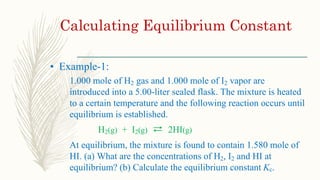
• Example-1:
1.000 mole of H2 gas and 1.000 mole of I2 vapor are
introduced into a 5.00-liter sealed flask. The mixture is heated
to a certain temperature and the following reaction occurs until
equilibrium is established.
H2(g) + I2(g) ⇄ 2HI(g)
At equilibrium, the mixture is found to contain 1.580 mole of
HI. (a) What are the concentrations of H2, I2 and HI at
equilibrium? (b) Calculate the equilibrium constant Kc.
Calculating Equilibrium Constant
for reaction: H2(g) + I2(g) ⇄ 2HI(g)
• ————————————————————————————
• H2(g) + I2(g) ⇄ 2 HI(g)
• ————————————————————————————
• Initial [ ], M: 0.200 0.200 0.000
• Change in [ ], M: -0.158 -0.158 + 0.316
• Equilibrium [ ], M 0.042 0.042 0.316
• ————————————————————————————
Kc = = = 57
]][I[H
[HI]
22
2
2
)(0.042
(0.316) 2
Calculating Equilibrium Constant
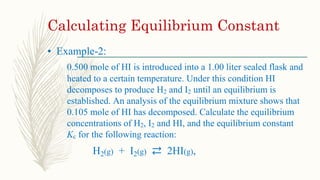
• Example-2:
0.500 mole of HI is introduced into a 1.00 liter sealed flask and
heated to a certain temperature. Under this condition HI
decomposes to produce H2 and I2 until an equilibrium is
established. An analysis of the equilibrium mixture shows that
0.105 mole of HI has decomposed. Calculate the equilibrium
concentrations of H2, I2 and HI, and the equilibrium constant
Kc for the following reaction:
H2(g) + I2(g) ⇄ 2HI(g),
Calculating Equilibrium Constant
• The reaction: H2(g) + I2(g) ⇄ 2HI(g), proceeds from right to left.
• ————————————————————————————
• H2(g) + I2(g) ⇄ 2HI(g)
• ————————————————————————————
• Initial [ ], M: 0.000 0.000 0.500
• Change in [ ], M: +0.0525 +0.0525 -0.105
• Equil’m [ ], M 0.0525 0.0525 0.395
• ————————————————————————————
Kc = = 56.62
2
(0.0525)
(0.395)
Equilibrium Constant Expression
for Concentration (Kc)
At equilibrium, the concentration in moles/L of N2,
H2, and NH3 at 300°C are 0.25, 0.15, and 0.90,
respectively. Find the KC for the reaction
N2 (g) + 3H2 (g) 2NH3 (g)
Equilibrium Constant Expression for
Concentration (Kc)
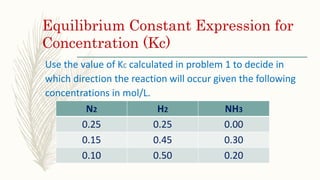
Use the value of KC calculated in problem 1 to decide in
which direction the reaction will occur given the following
concentrations in mol/L.
N2 H2 NH3
0.25 0.25 0.00
0.15 0.45 0.30
0.10 0.50 0.20
Predicting the Direction of a
Reaction
At any one point during the course of a reaction
(nonequilibrium state), it is possible to determine the
concentration ratio of the products and reactants using
the same form as the equilibrium constant expression.
This ratio is called the reaction quotient designated by
the symbol Q. The computed values of Q are compared
with KC.
Predicting the Direction of a
Reaction
Reaction Quotient (QC)
• The quantity obtained by substituting the initial
concentrations into the equilibrium constant
expression
Predicting the Direction of a
Reaction
When Q < Kc, the reaction proceeds forward
( )
When Q > Kc, the reaction proceeds backward
( )
When Q = Kc, the system at equilibrium
Predicting the Direction of a
Reaction
Consider the following reaction and concentration
data at 445°C.
H2 (g) + I2 (g) 2HI (g) Kc = 50.2 at 445°C
Predicting the Direction of a
Reaction
Experiment Initial Concentration
H2 (g) I2 (g) HI (g) Q
1 1.5 x 10 -3 1.5 x 10⁻³ 0 0
2 1.5 x 10 -3 1.5 x 10⁻³ 1.5 x 10⁻³ 1
Predicting the Direction of a
Reaction
The composition of PCl5 is shown below.
PCl5(g) PCl3(g) + Cl2(g) Kc = 0.029 at 85°C
Find out if the reaction proceeds forward, backward,
or if the system is at equilibrium when 1.0 L
container is filled with 0.400 mole PCl5, 0.500 mole
PCl3, and 0.200 mole Cl2.

Equilibrium constant-presentation

  • 1.
  • 2.
    Expression for EquilibriumConstant Consider the following equilibrium system: wA + xB ⇄ yC + zD Kc = • The numerical value of Kc is calculated using the concentrations of reactants and products that exist at equilibrium. xw z [B][A] [D][C]y
  • 3.
    Expression for EquilibriumConstant • Examples: N2(g) + 3H2(g) ⇄ 2NH3(g); Kc = PCl5(g) ⇄ PCl3(g) + Cl2(g); Kc = CH4(g) + H2(g) ⇄ CO(g) + 3H2(g); Kc = 3 22 2 3 ]][H[N ][NH ][PCl ]][Cl[PCl 5 23 O]][H[CH ][CO][H 24 3 2
  • 4.
    Calculating Equilibrium Constant •Example-1: 1.000 mole of H2 gas and 1.000 mole of I2 vapor are introduced into a 5.00-liter sealed flask. The mixture is heated to a certain temperature and the following reaction occurs until equilibrium is established. H2(g) + I2(g) ⇄ 2HI(g) At equilibrium, the mixture is found to contain 1.580 mole of HI. (a) What are the concentrations of H2, I2 and HI at equilibrium? (b) Calculate the equilibrium constant Kc.
  • 5.
    Calculating Equilibrium Constant forreaction: H2(g) + I2(g) ⇄ 2HI(g) • ———————————————————————————— • H2(g) + I2(g) ⇄ 2 HI(g) • ———————————————————————————— • Initial [ ], M: 0.200 0.200 0.000 • Change in [ ], M: -0.158 -0.158 + 0.316 • Equilibrium [ ], M 0.042 0.042 0.316 • ———————————————————————————— Kc = = = 57 ]][I[H [HI] 22 2 2 )(0.042 (0.316) 2
  • 6.
    Calculating Equilibrium Constant •Example-2: 0.500 mole of HI is introduced into a 1.00 liter sealed flask and heated to a certain temperature. Under this condition HI decomposes to produce H2 and I2 until an equilibrium is established. An analysis of the equilibrium mixture shows that 0.105 mole of HI has decomposed. Calculate the equilibrium concentrations of H2, I2 and HI, and the equilibrium constant Kc for the following reaction: H2(g) + I2(g) ⇄ 2HI(g),
  • 7.
    Calculating Equilibrium Constant •The reaction: H2(g) + I2(g) ⇄ 2HI(g), proceeds from right to left. • ———————————————————————————— • H2(g) + I2(g) ⇄ 2HI(g) • ———————————————————————————— • Initial [ ], M: 0.000 0.000 0.500 • Change in [ ], M: +0.0525 +0.0525 -0.105 • Equil’m [ ], M 0.0525 0.0525 0.395 • ———————————————————————————— Kc = = 56.62 2 (0.0525) (0.395)
  • 8.
    Equilibrium Constant Expression forConcentration (Kc) At equilibrium, the concentration in moles/L of N2, H2, and NH3 at 300°C are 0.25, 0.15, and 0.90, respectively. Find the KC for the reaction N2 (g) + 3H2 (g) 2NH3 (g)
  • 9.
    Equilibrium Constant Expressionfor Concentration (Kc) Use the value of KC calculated in problem 1 to decide in which direction the reaction will occur given the following concentrations in mol/L. N2 H2 NH3 0.25 0.25 0.00 0.15 0.45 0.30 0.10 0.50 0.20
  • 10.
    Predicting the Directionof a Reaction At any one point during the course of a reaction (nonequilibrium state), it is possible to determine the concentration ratio of the products and reactants using the same form as the equilibrium constant expression. This ratio is called the reaction quotient designated by the symbol Q. The computed values of Q are compared with KC.
  • 11.
    Predicting the Directionof a Reaction Reaction Quotient (QC) • The quantity obtained by substituting the initial concentrations into the equilibrium constant expression
  • 12.
    Predicting the Directionof a Reaction When Q < Kc, the reaction proceeds forward ( ) When Q > Kc, the reaction proceeds backward ( ) When Q = Kc, the system at equilibrium
  • 13.
    Predicting the Directionof a Reaction Consider the following reaction and concentration data at 445°C. H2 (g) + I2 (g) 2HI (g) Kc = 50.2 at 445°C
  • 14.
    Predicting the Directionof a Reaction Experiment Initial Concentration H2 (g) I2 (g) HI (g) Q 1 1.5 x 10 -3 1.5 x 10⁻³ 0 0 2 1.5 x 10 -3 1.5 x 10⁻³ 1.5 x 10⁻³ 1
  • 15.
    Predicting the Directionof a Reaction The composition of PCl5 is shown below. PCl5(g) PCl3(g) + Cl2(g) Kc = 0.029 at 85°C Find out if the reaction proceeds forward, backward, or if the system is at equilibrium when 1.0 L container is filled with 0.400 mole PCl5, 0.500 mole PCl3, and 0.200 mole Cl2.