Submitted By: Abdul Wahab Baig F2017214017
Asra Hafeez F2017214008
Muhammad Ali Babar F2017214021
Wahaj Mehmood F2017214004
Zaigham Ali Mehdi F2017214035
Submitted To: Dr. Hamid Shah
Presentation No: 02
Submission Date: 30-10-2019
Topic: Transportation
Department of City and Regional Planning
School of Architecture and Planning
University of Management and Technology, Lahore
Spring, 2019
LAHORE METRO
BUS SYSTEM
Lahore is the second largest city of Pakistan with
estimated population of approximately 10 million.
The transport demand estimated by Japanese
International Co-operation Agency ( JICA) is 12
million trips, which includes 4 million short
walking trips and 8 million motorized trips, on a
usual weekday. The number of vehicles registered
in Lahore increased sharply from 95 vehicles in
2001 to 238 vehicles in 2008; per 1000 population.
However, motorcycles make up for more than half
(57%) of all the registered vehicles, whereas cars
represent one third of the registered vehicles in
Lahore.
Year 2017 Bus Vans
Coaster/
Mazda
4 Stroke 2 Stroke Quinchi Misc. Total
Challenged 4201 19932 5749 67365 105 65058 1009 164219
Impounded 73 1040 157 7245 10 10263 43 18831
Total 4274 20972 5906 74610 115 75321 1852 183050
Punjab Mass transit Authority(PMA) has
established Bus Rapid Transit System in Lahore
knowns as Lahore Metro bus System. The Metro
bus System (MBS) Line-1 from Gajjumata to Shah
Dara, established in Lahore, is the first system
operated by PMA.
The Lahore Metro bus System has the following
main features are:
 Two Lane - Limited Access Corridor
 Gajjumata to Shah Dara (27 Km)
 27 Stations (Two Curb-side platforms each with
three docking bays and level boarding) (18 at-
grade and 9 elevated)
 Platform Sliding doors
 Escalators
 Portion from Canal to Data Darbar is elevated (8.3 kms)
 Automated Fare Collection System with off Board Ticketing
 Bus Scheduling System
 Vehicle Location System
 Passenger Information System (PIS)
 Intelligent Transportation System for Signal Operations along with
the Corridor
 64 Articulated Air Conditioned Buses
Chungi Amar
Sidhu Metro Bus
Station
LAHORE
TRANSPORT
COMPANY
Enforcement wing of Lahore Transport Company retains backbone
in organization. Enforcement wing was established after the
commencement of Lahore Transport Company in 2009 with the
mandate to:
 Discipline the PSV Traffic within the premises of Lahore
 Enforce the Motor Vehicle Ordinance 1965 MVO. Regulations
 Eliminate the illegal means of Transport on LOV/HOV. Routes
 Enforce Government policies on PSVs.
 Ensure Bus Stop/ Bus Bay Clearance
 Streamline passenger pick 'n drop from bus stops
 Eliminate illegal Bus stops
Enforcement wing is playing a vital role for Urban Transport
Discipline Management which contributes not only in the socio
economic development of smart cities by saving precious time of
commuters; reduce distances and by up-gradation the standard
of living of incumbents of Lahore but also indirectly a reason to
increase in the GDP of the country.
FACILITATION CENTRE &
LOGISTICS
LTC Facilitation Centre are Operational for General Public at
following locations:
 Gulberg office
 Railway Station
 Green Town
(a) Chief Minister of the Punjab; Chairperson
(b) Vice Chairperson to be nominated by the
Government on such terms and conditions
as it may determine;
Vice Chairperson
(c) Minister for Transport of the Government; Member
(d) Four members of Provincial Assembly of
the Punjab including at least one female
member of the Assembly and two members
of National Assembly of Pakistan
nominated by the Government;
Members
(e) Three persons including at least one
woman from the private sector nominated
by the Government;
Members
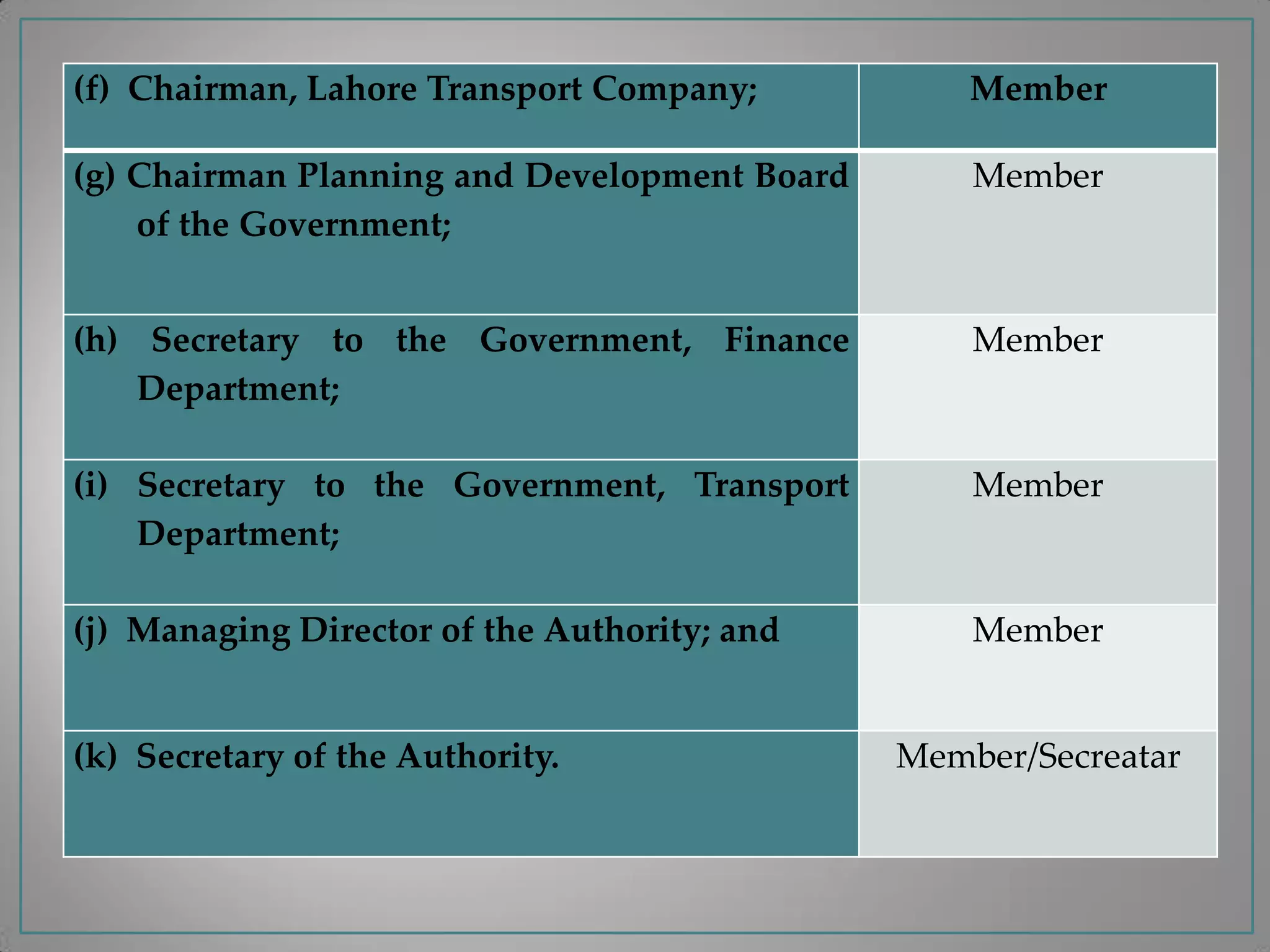
(f) Chairman, Lahore Transport Company; Member
(g) Chairman Planning and Development Board
of the Government;
Member
(h) Secretary to the Government, Finance
Department;
Member
(i) Secretary to the Government, Transport
Department;
Member
(j) Managing Director of the Authority; and Member
(k) Secretary of the Authority. Member/Secreatar
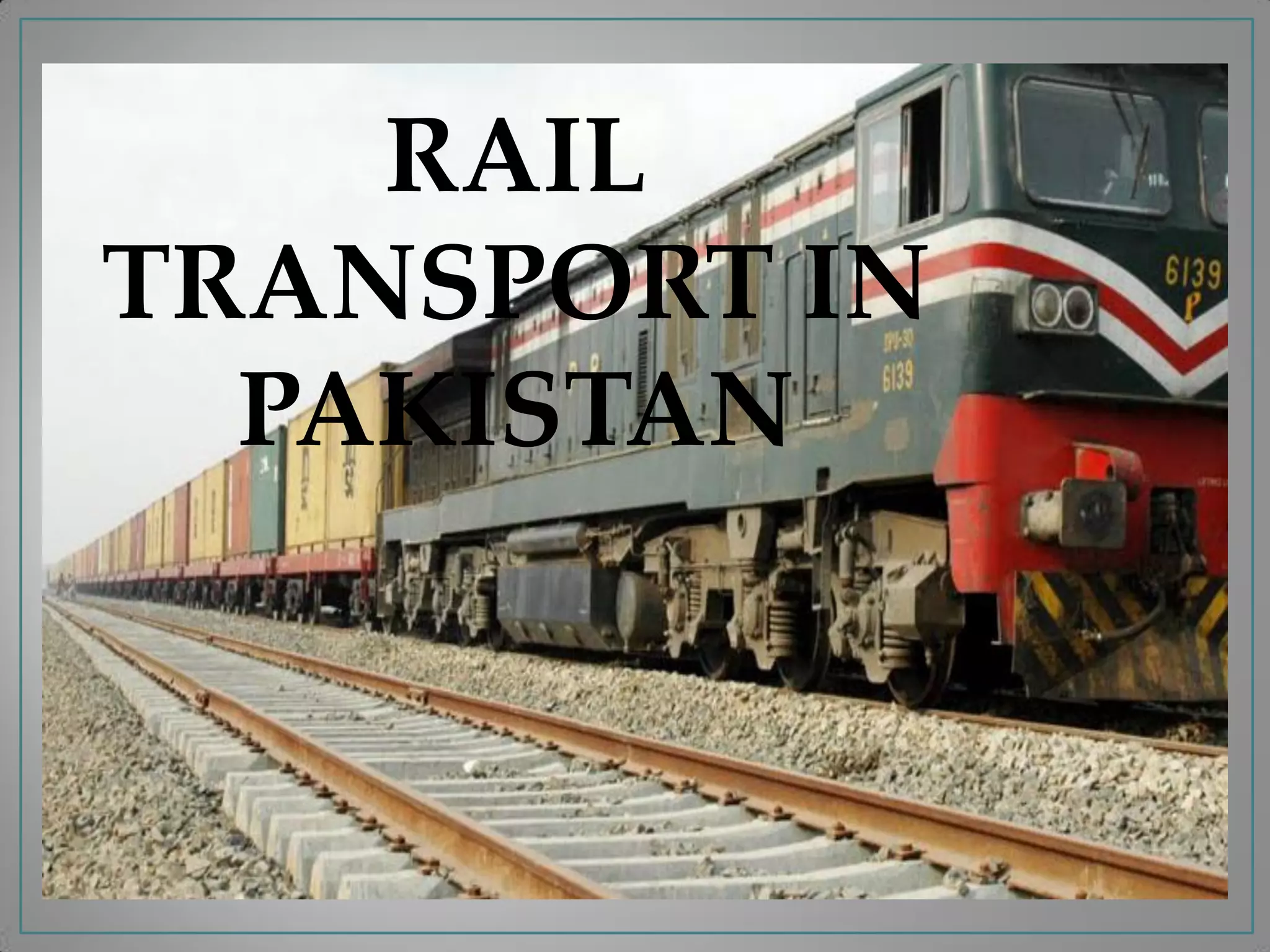
RAIL
TRANSPORT IN
PAKISTAN
RAIL TRANSPORT
Conveyance of passengers and goods by way of wheeled vehicles
running on rail tracks. And it is categorized as primary mode of
conveyance. Its Consisted on: Freight & Passenger.
HISTORY OF RAILWAYS IN SUB-CONTINENT
1847 Sir Henry Edward Frere, appointed as the Commissioner of
Sindh , sought permission from Lord Dalhousie to begin a survey
for a Karachi Seaport and a railway line in 1858. The proposed
railway line would be laid from Karachi (city) to Kotri. In 1861 the
first railway line was opened to the public, between Karachi (city)
and Kotri, with a total distance of 169 km.
HISTORY OF RAILWAYS IN PAKISTAN
In 1947, 3,133 km of North Western Railways were transferred to
India, leaving 8,122 km route to Pakistan. Of this 6,880 km route
were Broad gauge, 506 km were Meter gauge, & 736 km were
Narrow gauge. In 1954, the railway line was extended to Mardan
and Charsada, and in 1956 the Jacobabad Kashmore 2 ft. 6 in
(762 mm) gauge line was converted into broad gauge. In 1961,
the Pakistani portion of North Western Railways was renamed
Pakistan Railways. The Kot Adu-Kashmore line was constructed
between 1969 & 1973. In 2006, Mirpur Khas-Khokhrapar 126 km
meter gauge railway line was converted to broad gauge.
 The Pakistan Railways is a Federal Government Department
under Ministry of Railways.
 Railway Minister - Khawaja Saad Rafique
 Founded: 14- August, 1947
 Head quarter in Lahore.
 82,176 Person Employed up to Jun, 2012
 Route wise Pakistan standing on 27 number out of 151 countries
 558 Railways Stations/Junctions up to 2012
 522 Locomotives up to 2012
 1584 Passenger Wagons up to 2012
 17,611 Freight/Cargo wagons up to 2012
 In 2011-2012 → Pakistan Railways carried 41,097,192 passengers
wagons.
 In 2011-2012 → 1,323,000 tons of freight carried during 2011-2012
& 61,392 freight wagons.
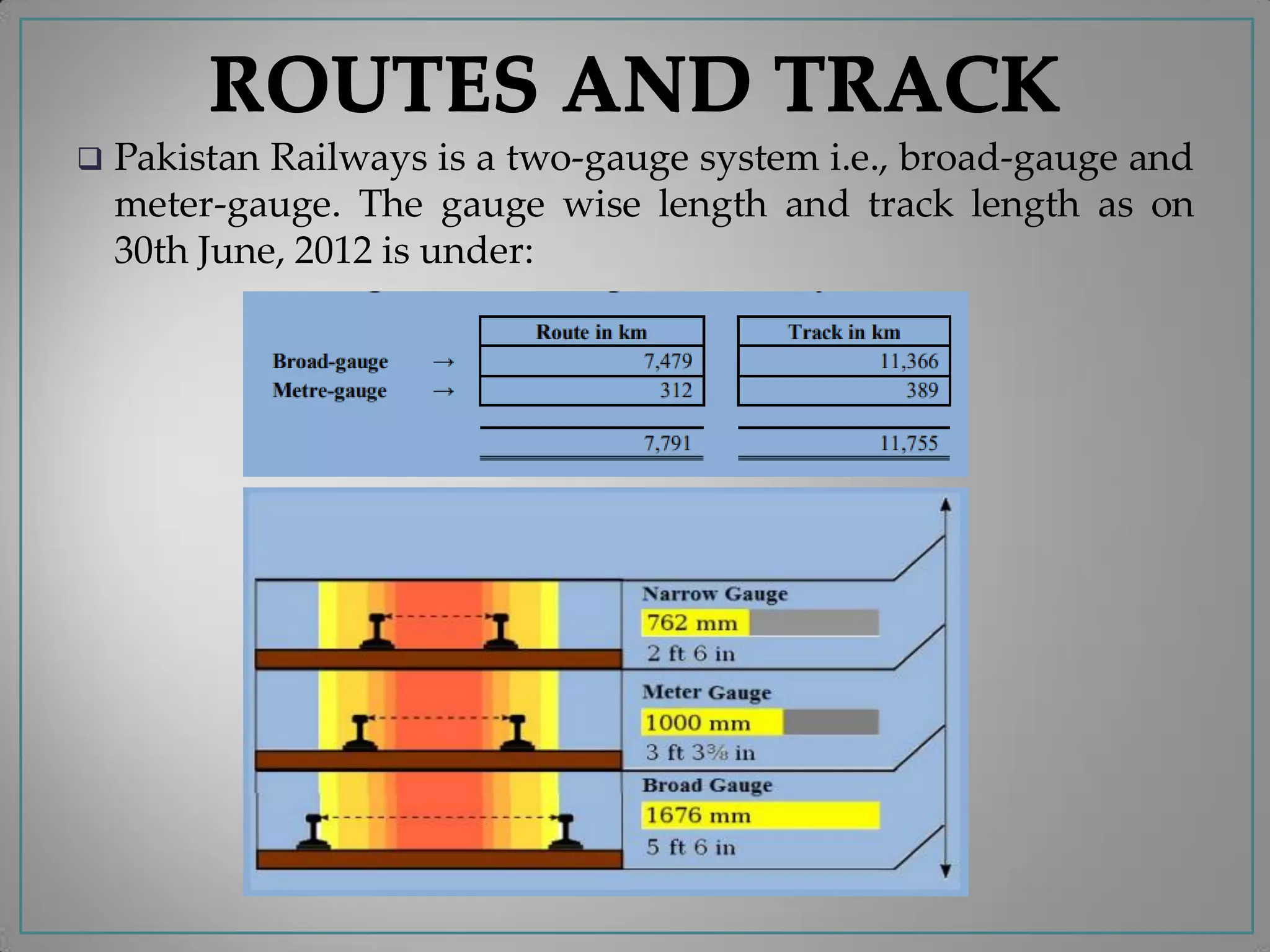
 At the end of the year 2012, the Pakistan Railways had a total of
7,791 km route. This kilometer age consists of two different
gauges, i.e., 7,479 km of broad-gauge & 312 km of meter gauge.
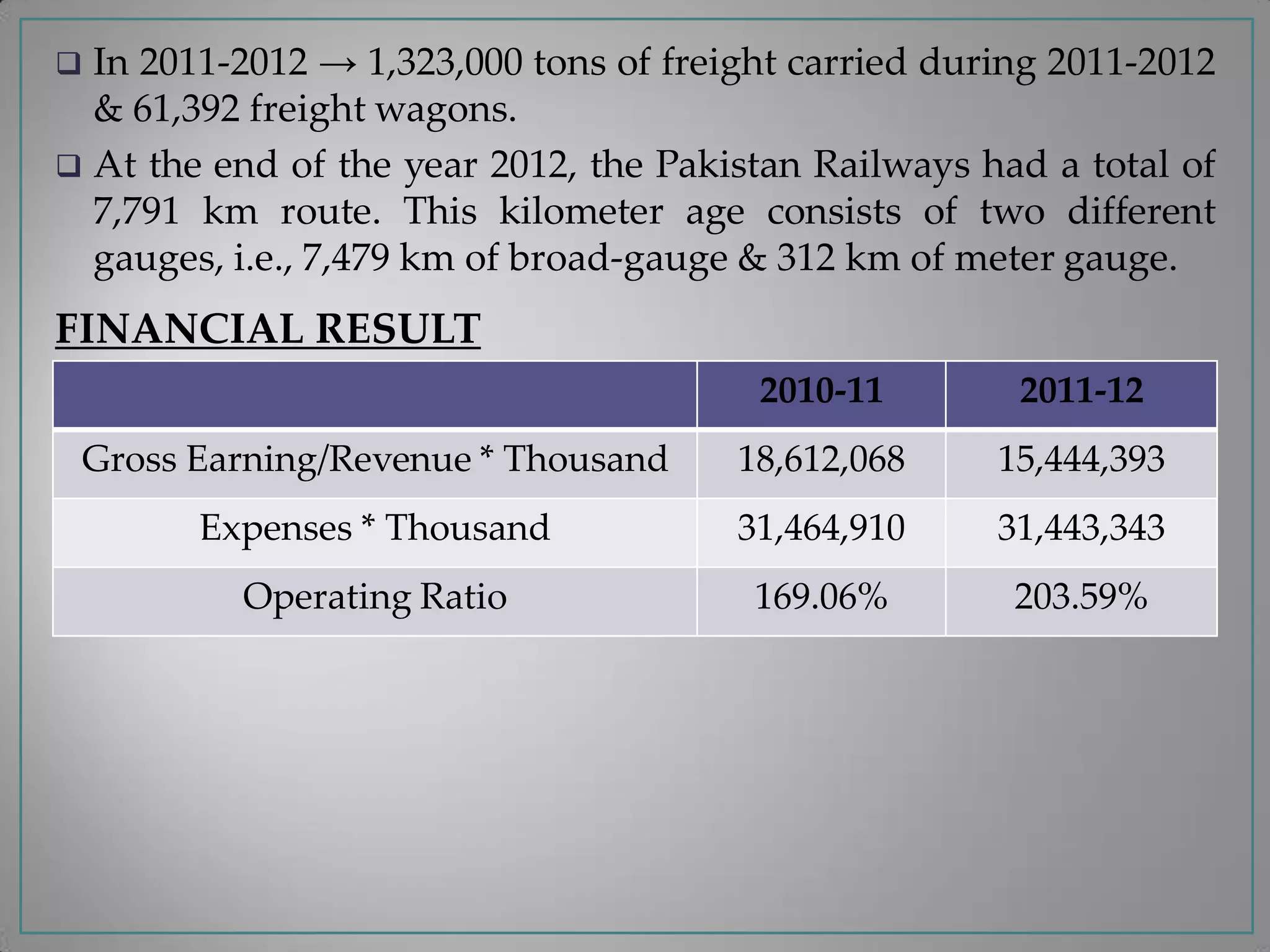
2010-11 2011-12
Gross Earning/Revenue * Thousand 18,612,068 15,444,393
Expenses * Thousand 31,464,910 31,443,343
Operating Ratio 169.06% 203.59%
FINANCIAL RESULT
• Railway Division is responsible for overall control of Pakistan
Railways as well as to guide the overall policy.
• All matters pertaining to Pakistan Railways.
• Maintenance of Railway lines for strategic reasons.
• Negotiations with International Organizations and other
Countries and implementation of agreements, with them.
• Coordination of Development Projects.
• Overall efficiency and safety of Railways.
• Coordination of Rail movements into and from Ports.
 Pakistan Railways is a two-gauge system i.e., broad-gauge and
meter-gauge. The gauge wise length and track length as on
30th June, 2012 is under:
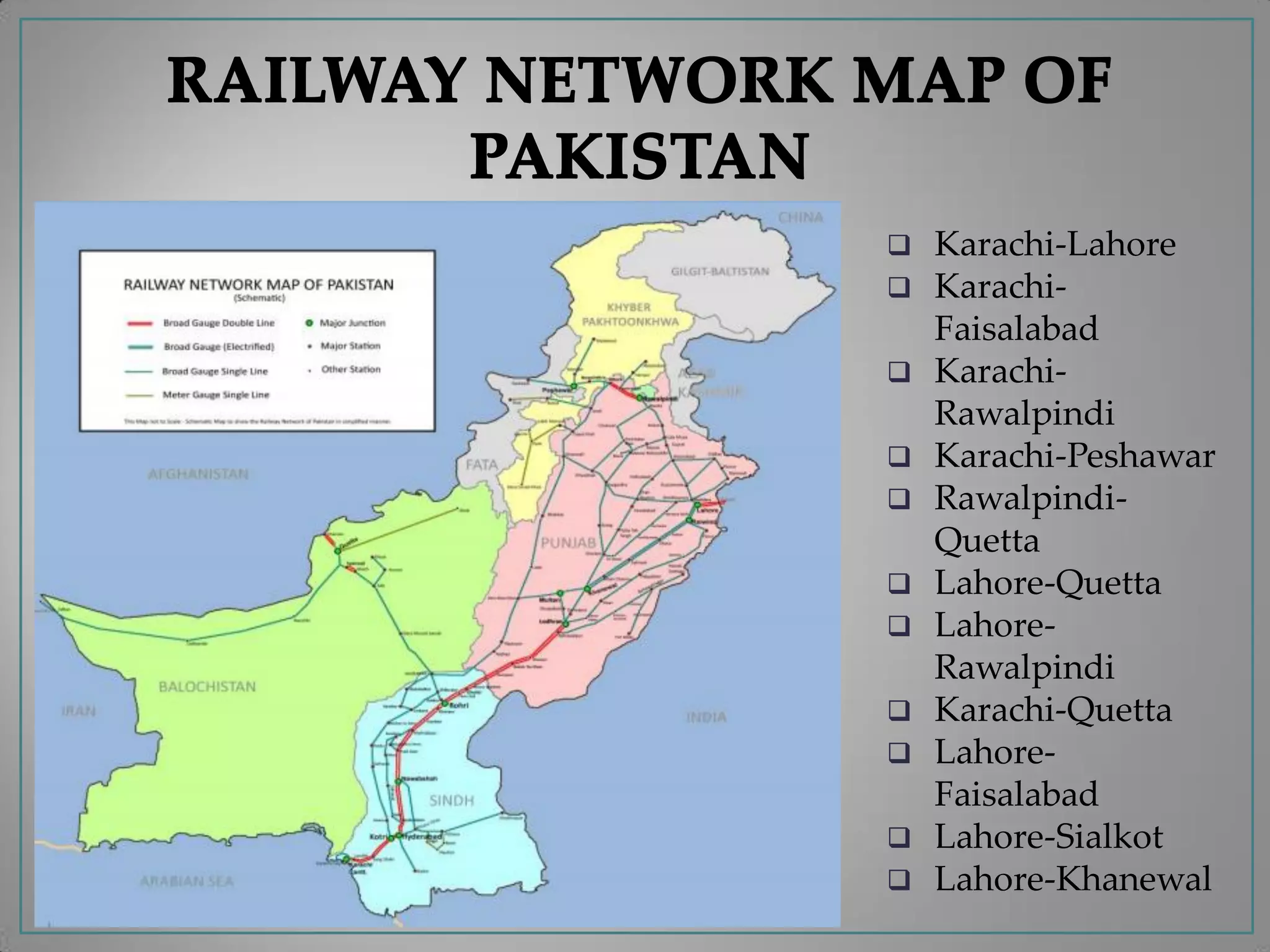
 Karachi-Lahore
 Karachi-
Faisalabad
 Karachi-
Rawalpindi
 Karachi-Peshawar
 Rawalpindi-
Quetta
 Lahore-Quetta
 Lahore-
Rawalpindi
 Karachi-Quetta
 Lahore-
Faisalabad
 Lahore-Sialkot
 Lahore-Khanewal
Decline Of Pakistan Railways Over the years, lack of attention,
poor policies, increasing expenditures, misappropriation of
funds, pilferage, nepotism . PR is facing losses due to
mismanagement, poor maintenance and weak ticket checks that
allow people to get away with not paying for their tickets.
Railways destroying by support of Transport Mafia. Corruption
is playing major part decline of Rail Transport In Pakistan.
First of all government should eliminate corruption in railways
sector. Government should ask Chinese for help in order to make
it profitable organization because China has made wonderful
progress in railway industry. Another best solution of this
problem is the privatization of Pakistan Railway. We can take the
example of PTCL; before privatization PTCL's monthly losses
were in billions. Today it is not only a profitable organization but
also providing excellent services to the customers. Corruption in
Pakistan Railways can only be removed by privatization of
Pakistan Railways.
AIRPORT
SYSTEM IN
PAKISTAN
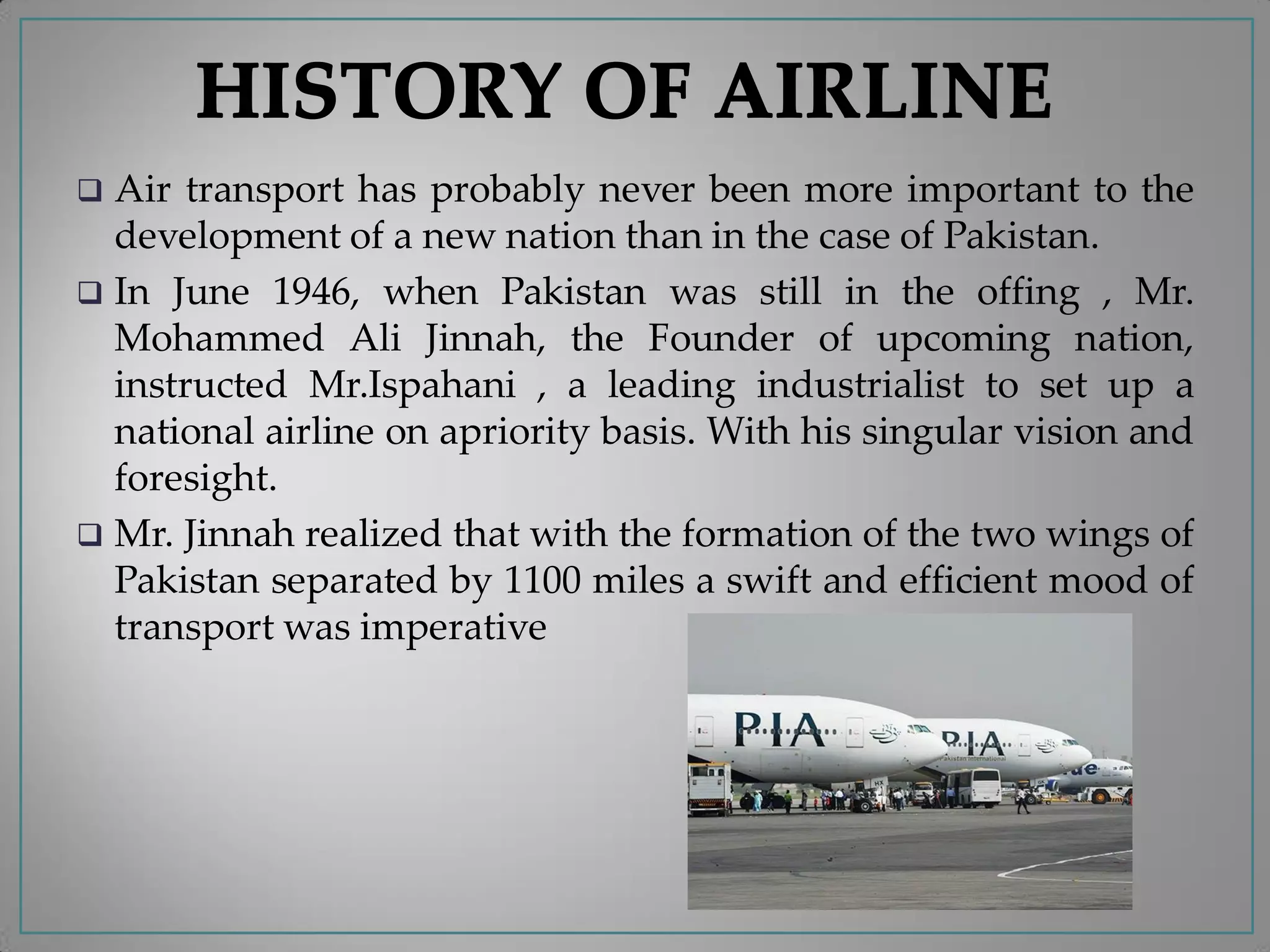
 Air transport has probably never been more important to the
development of a new nation than in the case of Pakistan.
 In June 1946, when Pakistan was still in the offing , Mr.
Mohammed Ali Jinnah, the Founder of upcoming nation,
instructed Mr.Ispahani , a leading industrialist to set up a
national airline on apriority basis. With his singular vision and
foresight.
 Mr. Jinnah realized that with the formation of the two wings of
Pakistan separated by 1100 miles a swift and efficient mood of
transport was imperative
Contributes to sustainable development by:
 Facilitating Tourism & Trade
 Generating Economic Growth
 Creating Jobs
 Increasing Tax Revenues
 Facilitates the delivery of emergency and humanitarian aid
relief.
 Pakistan International Airline(PIA) is the national flag carrier
of Pakistan.
 National airline and main cargo service around the world.
 Central points of activity are as:
1. Jinnah International Airport Karachi
2. Allama Iqbal Airport in Lahore
3. Islamabad International Airport
PIA CARGO SERVICE
 Commencement of operations
 Freight up network
 Boost to Exports
 Cargo services
 Rapid increase in fuel prices, labor cost, navigation and airport
charges
 Taxation
 Effect of politics
 International Airlines operating in Pakistan
 Poor management
 Low or Poor maintenance
 Over staffing
 Corruptions
 Flight delays and cancellations
Crashes and emergency landings due to:
 Landing gear crumbling
 Fuel leakage
 Incapable pilots or junior staff
 Physical defects
 No incorporation of new technology
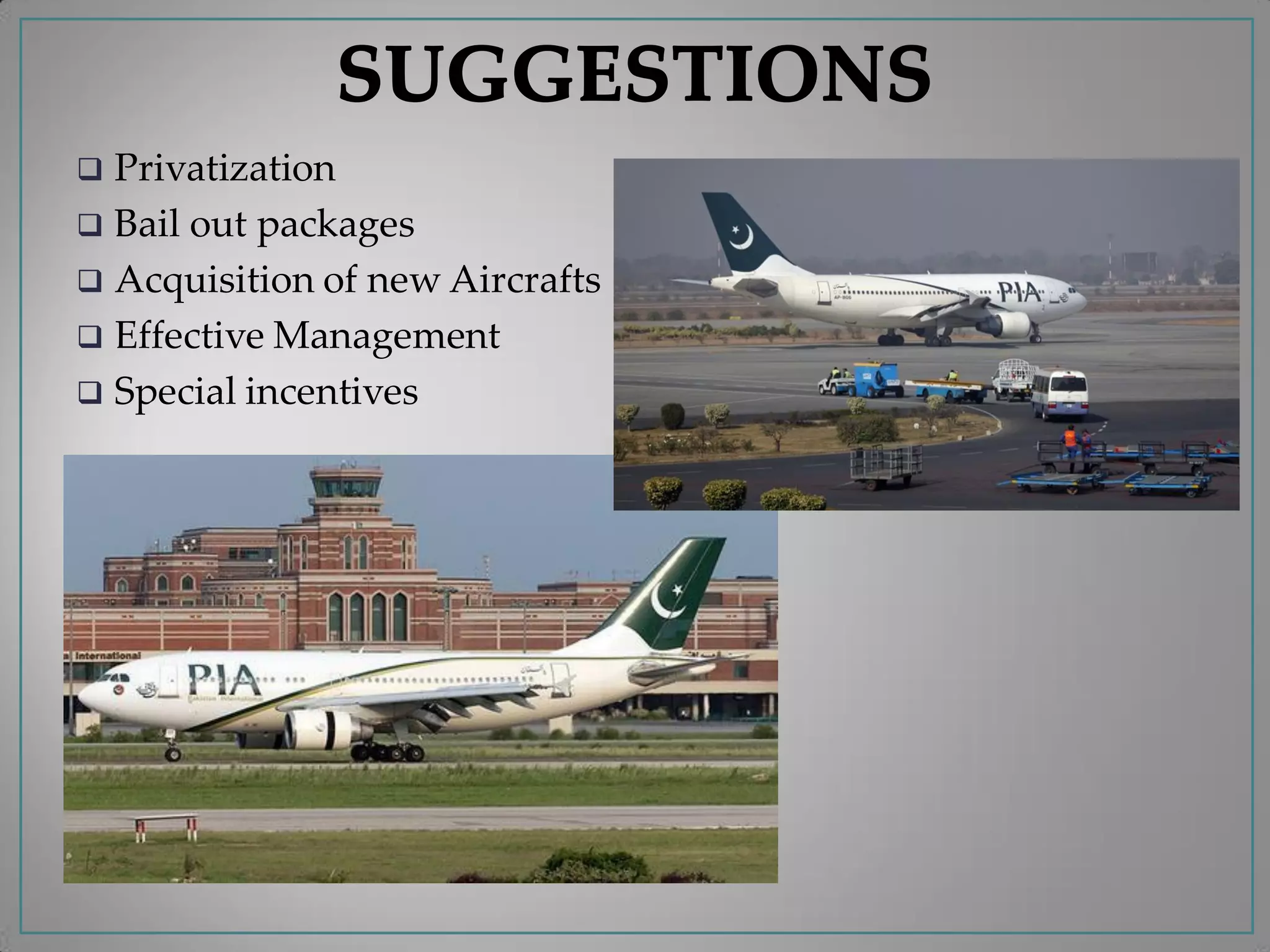
 Privatization
 Bail out packages
 Acquisition of new Aircrafts
 Effective Management
 Special incentives
WATER
TRANSPORT
SYSTEM IN
PAKISTAN
 It is the process of moving people, goods by barge, boat, ship
or sailboat over sea, ocean, lake, canal, river etc.
 Cheapest Way
 It is the only suitable mode of transportation for carrying
heavy and bulky goods to distant places.
 The waterway network in Pakistan is in its infancy with
Karachi being the only major city suited next to the Arabian
Sea.
 Still plans are being purposed for development of the
waterways in the country along the Indus river and through
Punjab as it would boost employment
 Opportunities and the economic and social development in
Pakistan.
 Port of Gawadar –(Gawadar, Baluchistan)
 Port of Karachi-Karachi(City center),Sindh
 Karachi International Container Terminal(KICT)
 Pakistan International Container Terminal
 Port Qasim-East Karachi (Sindh)
 Port of Pasni-Pasni, Baluchistan
 It is incorporated under companies ordinance 1984,section 42
its equity of being Rs.200 million is provided by the
government of Punjab and its authorized capital is Rs.500
million.
 Operational facilities are provided at daudkhel and at the field
camps along the Indus.
 The survey of the Indus River Channel was carried out with
the support of Pakistan Navy with funding by a group of
entrepreneurs as a private sector initiative to evaluate the
feasibility of this channel.
 The Phase-I Project of transporting goods and passengers to
and from Daudkhel to Attock besides commercial advantages
will be the impetus for extending the regime throughout the
province of Punjab.
 The saving in fuel and in foreign exchange is phenomenal and
permanently recurring.
 Cost of goods transport by water is cheap, less than half that
by road
 Cost of developing waterways is 80% lower than cost of
constructing highways
 Cost of maintaining waterways is marginal as compared to
maintaining roads and railways
 Immense potential of creating new zones for industry and
tourism
 No major land acquisition is required due to availability of
river and canal corridors.
 Environmentally more friendly than road and rail network
due to fuel usage and other related reasons.
 Major impetus in providing investments and job opportunities
in a huge new industry related to riverine transport needs and
social uplift.
 Physical and social integration of the country which cannot be
cost accounted.
Transportation system in pakistan

Transportation system in pakistan

  • 2.
    Submitted By: AbdulWahab Baig F2017214017 Asra Hafeez F2017214008 Muhammad Ali Babar F2017214021 Wahaj Mehmood F2017214004 Zaigham Ali Mehdi F2017214035 Submitted To: Dr. Hamid Shah Presentation No: 02 Submission Date: 30-10-2019 Topic: Transportation Department of City and Regional Planning School of Architecture and Planning University of Management and Technology, Lahore Spring, 2019
  • 3.
  • 4.
    Lahore is thesecond largest city of Pakistan with estimated population of approximately 10 million. The transport demand estimated by Japanese International Co-operation Agency ( JICA) is 12 million trips, which includes 4 million short walking trips and 8 million motorized trips, on a usual weekday. The number of vehicles registered in Lahore increased sharply from 95 vehicles in 2001 to 238 vehicles in 2008; per 1000 population. However, motorcycles make up for more than half (57%) of all the registered vehicles, whereas cars represent one third of the registered vehicles in Lahore.
  • 5.
    Year 2017 BusVans Coaster/ Mazda 4 Stroke 2 Stroke Quinchi Misc. Total Challenged 4201 19932 5749 67365 105 65058 1009 164219 Impounded 73 1040 157 7245 10 10263 43 18831 Total 4274 20972 5906 74610 115 75321 1852 183050
  • 6.
    Punjab Mass transitAuthority(PMA) has established Bus Rapid Transit System in Lahore knowns as Lahore Metro bus System. The Metro bus System (MBS) Line-1 from Gajjumata to Shah Dara, established in Lahore, is the first system operated by PMA. The Lahore Metro bus System has the following main features are:  Two Lane - Limited Access Corridor  Gajjumata to Shah Dara (27 Km)  27 Stations (Two Curb-side platforms each with three docking bays and level boarding) (18 at- grade and 9 elevated)  Platform Sliding doors
  • 7.
     Escalators  Portionfrom Canal to Data Darbar is elevated (8.3 kms)  Automated Fare Collection System with off Board Ticketing  Bus Scheduling System  Vehicle Location System  Passenger Information System (PIS)  Intelligent Transportation System for Signal Operations along with the Corridor  64 Articulated Air Conditioned Buses
  • 8.
  • 9.
  • 10.
    Enforcement wing ofLahore Transport Company retains backbone in organization. Enforcement wing was established after the commencement of Lahore Transport Company in 2009 with the mandate to:  Discipline the PSV Traffic within the premises of Lahore  Enforce the Motor Vehicle Ordinance 1965 MVO. Regulations  Eliminate the illegal means of Transport on LOV/HOV. Routes  Enforce Government policies on PSVs.  Ensure Bus Stop/ Bus Bay Clearance  Streamline passenger pick 'n drop from bus stops  Eliminate illegal Bus stops
  • 11.
    Enforcement wing isplaying a vital role for Urban Transport Discipline Management which contributes not only in the socio economic development of smart cities by saving precious time of commuters; reduce distances and by up-gradation the standard of living of incumbents of Lahore but also indirectly a reason to increase in the GDP of the country. FACILITATION CENTRE & LOGISTICS LTC Facilitation Centre are Operational for General Public at following locations:  Gulberg office  Railway Station  Green Town
  • 13.
    (a) Chief Ministerof the Punjab; Chairperson (b) Vice Chairperson to be nominated by the Government on such terms and conditions as it may determine; Vice Chairperson (c) Minister for Transport of the Government; Member (d) Four members of Provincial Assembly of the Punjab including at least one female member of the Assembly and two members of National Assembly of Pakistan nominated by the Government; Members (e) Three persons including at least one woman from the private sector nominated by the Government; Members
  • 14.
    (f) Chairman, LahoreTransport Company; Member (g) Chairman Planning and Development Board of the Government; Member (h) Secretary to the Government, Finance Department; Member (i) Secretary to the Government, Transport Department; Member (j) Managing Director of the Authority; and Member (k) Secretary of the Authority. Member/Secreatar
  • 15.
  • 16.
    RAIL TRANSPORT Conveyance ofpassengers and goods by way of wheeled vehicles running on rail tracks. And it is categorized as primary mode of conveyance. Its Consisted on: Freight & Passenger. HISTORY OF RAILWAYS IN SUB-CONTINENT 1847 Sir Henry Edward Frere, appointed as the Commissioner of Sindh , sought permission from Lord Dalhousie to begin a survey for a Karachi Seaport and a railway line in 1858. The proposed railway line would be laid from Karachi (city) to Kotri. In 1861 the first railway line was opened to the public, between Karachi (city) and Kotri, with a total distance of 169 km.
  • 17.
    HISTORY OF RAILWAYSIN PAKISTAN In 1947, 3,133 km of North Western Railways were transferred to India, leaving 8,122 km route to Pakistan. Of this 6,880 km route were Broad gauge, 506 km were Meter gauge, & 736 km were Narrow gauge. In 1954, the railway line was extended to Mardan and Charsada, and in 1956 the Jacobabad Kashmore 2 ft. 6 in (762 mm) gauge line was converted into broad gauge. In 1961, the Pakistani portion of North Western Railways was renamed Pakistan Railways. The Kot Adu-Kashmore line was constructed between 1969 & 1973. In 2006, Mirpur Khas-Khokhrapar 126 km meter gauge railway line was converted to broad gauge.
  • 18.
     The PakistanRailways is a Federal Government Department under Ministry of Railways.  Railway Minister - Khawaja Saad Rafique  Founded: 14- August, 1947  Head quarter in Lahore.  82,176 Person Employed up to Jun, 2012  Route wise Pakistan standing on 27 number out of 151 countries  558 Railways Stations/Junctions up to 2012  522 Locomotives up to 2012  1584 Passenger Wagons up to 2012  17,611 Freight/Cargo wagons up to 2012  In 2011-2012 → Pakistan Railways carried 41,097,192 passengers wagons.
  • 19.
     In 2011-2012→ 1,323,000 tons of freight carried during 2011-2012 & 61,392 freight wagons.  At the end of the year 2012, the Pakistan Railways had a total of 7,791 km route. This kilometer age consists of two different gauges, i.e., 7,479 km of broad-gauge & 312 km of meter gauge. 2010-11 2011-12 Gross Earning/Revenue * Thousand 18,612,068 15,444,393 Expenses * Thousand 31,464,910 31,443,343 Operating Ratio 169.06% 203.59% FINANCIAL RESULT
  • 20.
    • Railway Divisionis responsible for overall control of Pakistan Railways as well as to guide the overall policy. • All matters pertaining to Pakistan Railways. • Maintenance of Railway lines for strategic reasons. • Negotiations with International Organizations and other Countries and implementation of agreements, with them. • Coordination of Development Projects. • Overall efficiency and safety of Railways. • Coordination of Rail movements into and from Ports.
  • 21.
     Pakistan Railwaysis a two-gauge system i.e., broad-gauge and meter-gauge. The gauge wise length and track length as on 30th June, 2012 is under:
  • 22.
     Karachi-Lahore  Karachi- Faisalabad Karachi- Rawalpindi  Karachi-Peshawar  Rawalpindi- Quetta  Lahore-Quetta  Lahore- Rawalpindi  Karachi-Quetta  Lahore- Faisalabad  Lahore-Sialkot  Lahore-Khanewal
  • 23.
    Decline Of PakistanRailways Over the years, lack of attention, poor policies, increasing expenditures, misappropriation of funds, pilferage, nepotism . PR is facing losses due to mismanagement, poor maintenance and weak ticket checks that allow people to get away with not paying for their tickets. Railways destroying by support of Transport Mafia. Corruption is playing major part decline of Rail Transport In Pakistan.
  • 24.
    First of allgovernment should eliminate corruption in railways sector. Government should ask Chinese for help in order to make it profitable organization because China has made wonderful progress in railway industry. Another best solution of this problem is the privatization of Pakistan Railway. We can take the example of PTCL; before privatization PTCL's monthly losses were in billions. Today it is not only a profitable organization but also providing excellent services to the customers. Corruption in Pakistan Railways can only be removed by privatization of Pakistan Railways.
  • 25.
  • 26.
     Air transporthas probably never been more important to the development of a new nation than in the case of Pakistan.  In June 1946, when Pakistan was still in the offing , Mr. Mohammed Ali Jinnah, the Founder of upcoming nation, instructed Mr.Ispahani , a leading industrialist to set up a national airline on apriority basis. With his singular vision and foresight.  Mr. Jinnah realized that with the formation of the two wings of Pakistan separated by 1100 miles a swift and efficient mood of transport was imperative
  • 27.
    Contributes to sustainabledevelopment by:  Facilitating Tourism & Trade  Generating Economic Growth  Creating Jobs  Increasing Tax Revenues  Facilitates the delivery of emergency and humanitarian aid relief.
  • 29.
     Pakistan InternationalAirline(PIA) is the national flag carrier of Pakistan.  National airline and main cargo service around the world.  Central points of activity are as: 1. Jinnah International Airport Karachi 2. Allama Iqbal Airport in Lahore 3. Islamabad International Airport PIA CARGO SERVICE  Commencement of operations  Freight up network  Boost to Exports  Cargo services
  • 30.
     Rapid increasein fuel prices, labor cost, navigation and airport charges  Taxation  Effect of politics  International Airlines operating in Pakistan  Poor management  Low or Poor maintenance  Over staffing  Corruptions  Flight delays and cancellations
  • 31.
    Crashes and emergencylandings due to:  Landing gear crumbling  Fuel leakage  Incapable pilots or junior staff  Physical defects  No incorporation of new technology
  • 32.
     Privatization  Bailout packages  Acquisition of new Aircrafts  Effective Management  Special incentives
  • 33.
  • 34.
     It isthe process of moving people, goods by barge, boat, ship or sailboat over sea, ocean, lake, canal, river etc.  Cheapest Way  It is the only suitable mode of transportation for carrying heavy and bulky goods to distant places.
  • 35.
     The waterwaynetwork in Pakistan is in its infancy with Karachi being the only major city suited next to the Arabian Sea.  Still plans are being purposed for development of the waterways in the country along the Indus river and through Punjab as it would boost employment  Opportunities and the economic and social development in Pakistan.
  • 36.
     Port ofGawadar –(Gawadar, Baluchistan)  Port of Karachi-Karachi(City center),Sindh  Karachi International Container Terminal(KICT)  Pakistan International Container Terminal  Port Qasim-East Karachi (Sindh)  Port of Pasni-Pasni, Baluchistan
  • 37.
     It isincorporated under companies ordinance 1984,section 42 its equity of being Rs.200 million is provided by the government of Punjab and its authorized capital is Rs.500 million.  Operational facilities are provided at daudkhel and at the field camps along the Indus.
  • 38.
     The surveyof the Indus River Channel was carried out with the support of Pakistan Navy with funding by a group of entrepreneurs as a private sector initiative to evaluate the feasibility of this channel.  The Phase-I Project of transporting goods and passengers to and from Daudkhel to Attock besides commercial advantages will be the impetus for extending the regime throughout the province of Punjab.
  • 39.
     The savingin fuel and in foreign exchange is phenomenal and permanently recurring.  Cost of goods transport by water is cheap, less than half that by road  Cost of developing waterways is 80% lower than cost of constructing highways  Cost of maintaining waterways is marginal as compared to maintaining roads and railways  Immense potential of creating new zones for industry and tourism
  • 40.
     No majorland acquisition is required due to availability of river and canal corridors.  Environmentally more friendly than road and rail network due to fuel usage and other related reasons.  Major impetus in providing investments and job opportunities in a huge new industry related to riverine transport needs and social uplift.  Physical and social integration of the country which cannot be cost accounted.