Logical
Framework
Analysis
(LFA)
Wetted by Jc Lohith Shetty, Asst Professor, St Aloysius College (Autonomous),
President 2014, JCI Mangalore
Logical frame work
Analysis
• What is Logical Framework Analysis?
• The Logical Framework Approach (LFA) is a
management tool mainly used in the design,
monitoring and evaluation of
international development projects. It is also
widely known as Goal Oriented Project Planning
(GOPP) or Objectives Oriented Project Planning
(OOPP).

Wetted by Jc Lohith Shetty, Asst Professor, St Aloysius College (Autonomous),
President 2014, JCI Mangalore
LFA: What is it all about?

• Used as a tool to convert problems/
objectives into a project. It links the goal
and objectives of a project to its inputs
and outputs.
• Helps in developing objective indicators
for all stages of the project and means of
verification for the indicators; overall
assumptions and risk factors which have a
bearing on the success / failure of the
project.
• Also helps in collecting data required for
monitoring and assessing the impact of
the project.
Wetted by Jc Lohith Shetty,
Asst Professor, St Aloysius
LFA IS A TOOL FOR IMPROVING THE

QUALITY OF PROJECTS
The Logical Framework Approach is
analytical tool for objectives- oriented project
planning and management
The key words are:
•
•
•
•

Objectives oriented
Target group oriented
Participatory
Clearly stating the Assumptions
Wetted by Jc Lohith Shetty,
Asst Professor, St Aloysius
LFA
I
Preparatory Phase
II
Analysis Phase
III
Planning Phase

Wetted by Jc Lohith Shetty,
Asst Professor, St Aloysius
I. Preparatory Phase
A.
•
•
•

Determine the Focus Area
Determine the focus area to be analyzed
Study the focus area
Present results of fact finding in short
report
B. Analyze Stakeholders involved
• Identify all stakeholders who have a
relation to the focus area
• Identify what the most important
stakeholders contribute to and benefit
from the focus area.
Wetted
Shetty,
invite to the
• Determine who to by Jc LohithAloysius workshop
Asst Professor, St
II. Analysis Phase
A. Analyze the problems
•
•
•
•
•
•
•
•
•
•

Formulate problems from point of view of the
identified Stakeholders.
Check whether all relevant problems of stakeholders
are included
Check that problems are understood
Select a tentative “starter” problem
Identify direct causes of starter problem
Identify direct effects of starter problem
Continue identifying cause-effect relationships
Check completeness of the diagram
Add additional problems if necessary
Draw connecting lines to make “Problem Tree”
Wetted by Jc Lohith Shetty,
Asst Professor, St Aloysius
B. Analyze the Objectives
•
•
•
•

Restate problems as positive statements,
“reached” situations (objectives)
Compare problems and objectives. Discuss
the formulations.
Examine the “means-end” relationships
and adjust chart if needed
Draw connecting lines (“Objective Tree”)

C. Clustering
•
•

Identify clusters of related objectives in
terms
of
expertise
required/
commonality/ theme/ affinity
Give a name to each cluster
Wetted by Jc Lohith Shetty,
Asst Professor, St Aloysius
III. Planning Phase
A. Scope the project
•
•
•

Identify which clusters are outside of
project responsibility/resources
Determine willingness to contribute by
stakeholders to clusters.
Determine the priority ranking for
addressing the different objective
clusters.
Wetted by Jc Lohith Shetty,
Asst Professor, St Aloysius
Checklist of Criteria
Relationship with state/ national policies/ MDGs
Attractiveness to target groups
Contribution to other clusters
Probability of success
Side effects: Positive/Negative
Urgency
Resource availability
- Funds
- Counterpart institutions
- Expertise required/available
- Time horizon
• History of the project
• Sustainability
• Etc….
•
•
•
•
•
•
•

Wetted by Jc Lohith Shetty,
Asst Professor, St Aloysius
B. Determine Intervention Logic and
External Factors
• Identify Overall Goal from the
objective tree
• Select Project Objectives/Purpose
from objective tree
outputs/results
that
• Identify
contribute to achieving the project
objectives/purpose.
Wetted by Jc Lohith Shetty,
Asst Professor, St Aloysius
LFA – Project Planning
Matrix
Col I
Project Structure

Goal ( Overall
Programme goal)
Purpose (Objectives
short term and long
term.)
Outputs (results)

Activities (Inputs)

Col II

Col III

Objectively variable
indicators (OVI)

Means of
verification (MV)

Col IV
Assumption risks

Overall goal hypothesis.

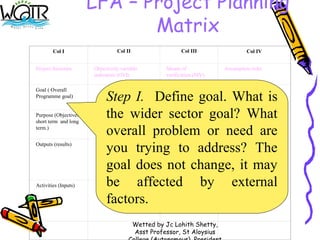
Step I. Define goal. What is
the wider sector goal? What
overall problem or need are
you trying to address? The
goal does not change, it may
be affected by external
factors.
Purpose / objective
assumptions

Output assumptions.

Activity and input
assumption.

Wetted by Jc Lohith Shetty,
Asst Professor, St Aloysius
LFA – Project Planning
Matrix
Col I
Project Structure

Goal ( Overall
Programme goal)
Purpose (Objectives
short term and long
term.)
Outputs (results)

Activities (Inputs)

Col II

Col III

Objectively variable
indicators (OVI)

Means of
verification (MV)

Col IV
Assumption risks

Overall goal hypothesis.

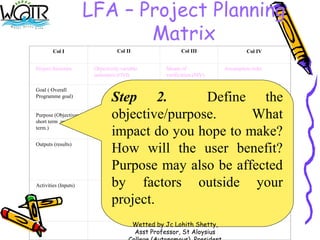
Step 2.
Define the
objective/purpose.
What
impact do you hope to make?
How will the user benefit?
Purpose may also be affected
by factors outside your
project.
Purpose / objective
assumptions

Output assumptions.

Activity and input
assumption.

Wetted by Jc Lohith Shetty,
Asst Professor, St Aloysius
LFA – Project Planning
Matrix
Col I
Project Structure

Goal ( Overall
Programme goal)
Purpose (Objectives
short term and long
term.)
Outputs (results)

Activities (Inputs)

Col II

Col III

Objectively variable
indicators (OVI)

Means of
verification (MV)

Col IV
Assumption risks

Overall goal hypothesis.

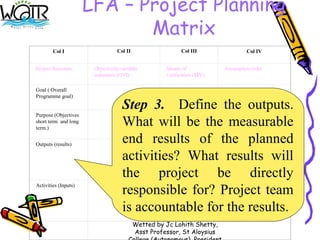
Step 3. Define the outputs.
What will be the measurable
end results of the planned
activities? What results will
the project be directly
responsible for? Project team
is accountable for the results.
Purpose / objective
assumptions

Output assumptions.

Activity and input
assumption.

Wetted by Jc Lohith Shetty,
Asst Professor, St Aloysius
LFA – Project Planning
Matrix
Col I
Project Structure

Goal ( Overall
Programme goal)
Purpose (Objectives
short term and long
term.)
Outputs (results)

Activities (Inputs)

Col II

Col III

Objectively variable
indicators (OVI)

Means of
verification (MV)

Col IV
Assumption risks

Overall goal hypothesis.

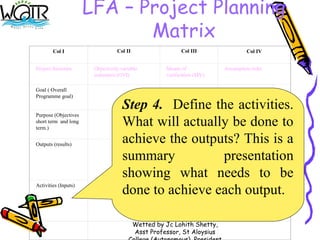
Step 4. Define the activities.
What will actually be done to
achieve the outputs? This is a
summary
presentation
showing what needs to be
done to achieve each output.
Purpose / objective
assumptions

Output assumptions.

Activity and input
assumption.

Wetted by Jc Lohith Shetty,
Asst Professor, St Aloysius
LFA – Project Planning
Matrix
Col I
Project Structure

Col II

Col III

Objectively variable
indicators (OVI)

Means of
verification (MV)

Goal ( Overall
Programme goal)
Purpose (Objectives
short term and long
term.)
Outputs (results)

Activities (Inputs)

Col IV
Assumption risks

Overall goal hypothesis.

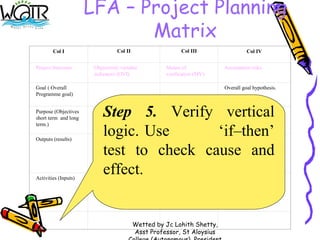
Step 5. Verify vertical
logic. Use
‘if–then’
test to check cause and
effect.
Purpose / objective
assumptions

Output assumptions.

Activity and input
assumption.

Wetted by Jc Lohith Shetty,
Asst Professor, St Aloysius
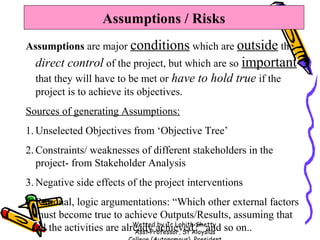
Assumptions / Risks
Assumptions are major conditions which are outside the

direct control of the project, but which are so important
that they will have to be met or have to hold true if the
project is to achieve its objectives.
Sources of generating Assumptions:
1. Unselected Objectives from ‘Objective Tree’
2. Constraints/ weaknesses of different stakeholders in the
project- from Stakeholder Analysis
3. Negative side effects of the project interventions
4. Rational, logic argumentations: “Which other external factors
must become true to achieve Outputs/Results, assuming that
Wetted by Jc Lohith Shetty,
all the activities are already achieved?” and so on..
Asst Professor, St Aloysius
LFA – Project Planning
Matrix
Col I

Col II

Col III

Col IV

Project Structure

Objectively variable
indicators (OVI)

Means of
verification (MV)

Assumption risks

Goal ( Overall
Programme goal

Step 7a. What will indicate
whether the goal has been
achieved?

Step 8a. How will
you verify goal
OVIs.

Overall goal hypothesis.

Purpose (Objectives
short term and long
term.)

Step 7b.
What will
indicate
whether
the
purpose or objective has
been achieved?

Step 8b. How will
you verify purpose
OVIs ?

Purpose / objective
assumptions

Outputs (results)

Step 7c. What will indicate
that the outputs have been
achieved? This indicators
define terms of reference
and the deliverables of the
project.

Step 8c. How will
you verify output
OVIs?

Output assumptions.

Activities (Inputs)

Step 7d
What project
Step 8d. How will
inputs and budget will be
you verify activity
the main OVIs here. What
OVIs. The project
inputs are needed to
accounts will be a
carryout the activities?
major MOV here.
Staff, transport, material,
finance etc. Wetted by Jc Lohith Shetty,

Step 6a. Define the
assumptions.
Include
here
anything that must
happens before the
project commence.
Asst Professor, St Aloysius

Activity and input
assumption.

Critical conditions
LFA – Project Planning
Matrix
Col I
Project Structure

Goal ( Overall
Programme goal)
Purpose (Objectives
short term and long
term.)
Outputs (results)

Activities (Inputs)

Col II
Objectively variable
indicators (OVI)

Col III
Means of
verification (MV)

Col IV
Assumption risks

Overall goal hypothesis.

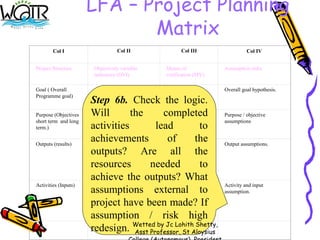
Step 6b. Check the logic.
Will
the
completed
activities
lead
to
achievements
of
the
outputs? Are all the
resources
needed
to
achieve the outputs? What
assumptions external to
project have been made? If
assumption / risk high
redesign. Wetted by Jc Lohith Shetty,
Asst Professor, St Aloysius

Purpose / objective
assumptions

Output assumptions.

Activity and input
assumption.
LFA – Project Planning
Matrix
Col I
Project Structure

Goal ( Overall
Programme goal)
Purpose (Objectives
short term and long
term.)
Outputs (results)

Activities (Inputs)

Col II
Objectively variable
indicators (OVI)

Col III
Means of
verification (MV)

Col IV
Assumption risks

Overall goal hypothesis.

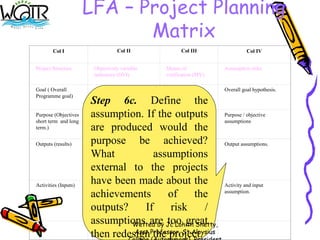
Step 6c. Define the
assumption. If the outputs
are produced would the
purpose be achieved?
What
assumptions
external to the projects
have been made about the
achievements
of
the
outputs?
If
risk
/
assumptions are Jc Lohith Shetty,
Wetted by too great
Asst the project.
then redesignProfessor, St Aloysius

Purpose / objective
assumptions

Output assumptions.

Activity and input
assumption.
LFA – Project Planning
Matrix
Col I
Project Structure

Goal ( Overall
Programme goal)
Purpose (Objectives
short term and long
term.)
Outputs (results)

Activities (Inputs)

Col II
Objectively variable
indicators (OVI)

Col III
Means of
verification (MV)

Step 6d. Define the
assumptions. If the
project purpose is
achieved, will this
contribute to solving
the problem – need. If
no, then redesign the
project.
If
yes,
mention
the
Wetted by Jc Lohith Shetty,
Asst Professor, St Aloysius
assumptions.

Col IV
Assumption risks

Overall goal hypothesis.

Purpose / objective
assumptions

Output assumptions.

Activity and input
assumption.
LFA – Project Planning
Matrix
Col I

Col II

Col III

Col IV

Project Structure

Objectively variable
indicators (OVI)

Means of
verification (MV)

Assumption risks

Goal ( Overall
Programme goal

Step 7a. What will indicate
whether the goal has been
achieved?

Step 8a. How will
you verify goal
OVIs.

Overall goal hypothesis.

Purpose (Objectives
short term and long
term.)

Step 7b.
What will
indicate
whether
the
purpose or objective has
been achieved?

Step 8b. How will
you verify purpose
OVIs ?

Purpose / objective
assumptions

Outputs (results)

Step 7c. What will indicate
that the outputs have been
achieved? This indicators
define terms of reference
and the deliverables of the
project.

Step 8c. How will
you verify output
OVIs?

Output assumptions.

Activities (Inputs)

Step 7d
What project
Step 8d. How will
inputs and budget will be
you verify activity
the main OVIs here. What
OVIs. The project
inputs are needed to
accounts will be a
carryout the activities?
major MOV here.
Staff, transport, material,
finance etc. Wetted by Jc Lohith Shetty,

Step 6e. Define the
assumptions. What
external factors are
needed for, or may
prevent the long
term sustainability
of the project.
Asst Professor, St Aloysius

Activity and input
assumption.

Critical conditions
LFA – Project Planning
Matrix
Col I
Project Structure

Goal ( Overall
Programme goal)
Purpose (Objectives
short term and long
term.)
Outputs (results)

Col II

Col III

Objectively variable
indicators (OVI)

Means of
verification (MV)

Col IV
Assumption risks

Step 7a. What will
indicate
whether
the goal has been
achieved?

Activities (Inputs)

Wetted by Jc Lohith Shetty,
Asst Professor, St Aloysius
LFA – Project Planning
Matrix
Col I
Project Structure

Col II

Col III

Objectively variable
indicators (OVI)

Means of
verification (MV)

Col IV
Assumption risks

Goal ( Overall
Programme goal)
Purpose (Objectives
short term and long
term.)
Outputs (results)

Activities (Inputs)

Step 7b. What will
indicate
whether
the purpose or
objective has been
achieved?
Wetted by Jc Lohith Shetty,
Asst Professor, St Aloysius

Critical conditions
LFA – Project Planning
Matrix
Col I
Project Structure

Goal ( Overall
Programme goal)
Purpose (Objectives
short term and long
term.)
Outputs (results)

Activities (Inputs)

Col II

Col III

Objectively variable
indicators (OVI)

Means of
verification (MV)

Col IV
Assumption risks

Step 7c.
What will
indicate that the outputs
have been achieved?
This indicators define
terms of reference and
the deliverables of the
project.
Wetted by Jc Lohith Shetty,
Asst Professor, St Aloysius
LFA – Project Planning
Matrix
Col I
Project Structure

Goal ( Overall
Programme goal)
Purpose (Objectives
short term and long
term.)
Outputs (results)

Activities (Inputs)

Col II

Col III

Objectively variable
indicators (OVI)

Means of
verification (MV)

Col IV
Assumption risks

Step 7d What project
inputs and budget will
be the main OVIs here.
What inputs are needed
to
carryout
the
activities?
Staff,
transport,
material,
finance etc.
Wetted by Jc Lohith Shetty,
Asst Professor, St Aloysius
LFA – Project Planning
Matrix
Col I

Col II

Col III

Col IV

Project Structure

Objectively variable
indicators (OVI)

Means of
verification (MV)

Assumption risks

Goal ( Overall
Programme goal

Step 7a. What will indicate
whether the goal has been
achieved?

Step 8a. How will
you verify goal
OVIs.

Overall goal hypothesis.

Purpose (Objectives
short term and long
term.)

Step 7b.
What will
indicate
whether
the
purpose or objective has
been achieved?

Step 8b. How will
you verify purpose
OVIs ?

Purpose / objective
assumptions

Outputs (results)

Step 7c. What will indicate
that the outputs have been
achieved? This indicators
define terms of reference
and the deliverables of the
project.

Step 8c. How will
you verify output
OVIs?

Output assumptions.

Activities (Inputs)

Step 7d
What project
Step 8d. How will
inputs and budget will be
you verify activity
the main OVIs here. What
OVIs. The project
inputs are needed to
accounts will be a
carryout the activities?
major MOV here.
Staff, transport, material,
finance etc.
Wetted by Jc Lohith Shetty,

Step 8a. How
will you verify
goal OVIs.

Asst Professor, St Aloysius

Activity and input
assumption.

Critical conditions
LFA – Project Planning
Matrix
Col I

Col II

Col III

Col IV

Project Structure

Objectively variable
indicators (OVI)

Means of
verification (MV)

Assumption risks

Goal ( Overall
Programme goal

Step 7a. What will indicate
whether the goal has been
achieved?

Step 8a. How will
you verify goal
OVIs.

Overall goal hypothesis.

Purpose (Objectives
short term and long
term.)

Step 7b.
What will
indicate
whether
the
purpose or objective has
been achieved?

Step 8b. How will
you verify purpose
OVIs ?

Purpose / objective
assumptions

Outputs (results)

Step 7c. What will indicate
that the outputs have been
achieved? This indicators
define terms of reference
and the deliverables of the
project.

Step 8c. How will
you verify output
OVIs?

Output assumptions.

Activities (Inputs)

Step 8b. How
will you verify
purpose OVIs ?

Step 7d
What project
Step 8d. How will
inputs and budget will be
you verify activity
the main OVIs here. What
OVIs. The project
inputs are needed to
accounts will be a
carryout the activities?
major MOV here.
Staff, transport, material,
finance etc. Wetted by Jc Lohith Shetty,

Asst Professor, St Aloysius

Activity and input
assumption.

Critical conditions
LFA – Project Planning
Matrix
Col I

Col II

Col III

Col IV

Project Structure

Objectively variable
indicators (OVI)

Means of
verification (MV)

Assumption risks

Goal ( Overall
Programme goal

Step 7a. What will indicate
whether the goal has been
achieved?

Step 8a. How will
you verify goal
OVIs.

Overall goal hypothesis.

Purpose (Objectives
short term and long
term.)

Step 7b.
What will
indicate
whether
the
purpose or objective has
been achieved?

Step 8b. How will
you verify purpose
OVIs ?

Purpose / objective
assumptions

Outputs (results)

Step 7c. What will indicate
that the outputs have been
achieved? This indicators
define terms of reference
and the deliverables of the
project.

Step 8c. How will
you verify output
OVIs?

Output assumptions.

Activities (Inputs)

Step 7d
What project
Step 8d. How will
inputs and budget will be
you verify activity
the main OVIs here. What
OVIs. The project
inputs are needed to
accounts will be a
carryout the activities?
major MOV here.
Staff, transport, material,
finance etc. Wetted by Jc Lohith Shetty,

Step 8c. How will you
verify output OVIs?

Asst Professor, St Aloysius

Activity and input
assumption.

Critical conditions
LFA – Project Planning
Matrix
Col I

Col II

Col III
Means of
verification (MV)

Col IV

Project Structure

Objectively variable
indicators (OVI)

Goal ( Overall
Programme goal

Step 7a. What will indicate
whether the goal has been
achieved?

Step 8a. How will
you verify goal
OVIs.

Overall goal hypothesis.

Purpose (Objectives
short term and long
term.)

Step 7b.
What will
indicate
whether
the
purpose or objective has
been achieved?

Step 8b. How will
you verify purpose
OVIs ?

Purpose / objective
assumptions

Outputs (results)

Step 7c. What will indicate
that the outputs have been
achieved? This indicators
define terms of reference
and the deliverables of the
project.

Step 8c. How will
you verify output
OVIs?

Output assumptions.

Activities (Inputs)

Step 7d
What project
Step 8d. How will
inputs and budget will be
you verify activity
the main OVIs here. What
OVIs. The project
inputs are needed to
accounts will be a
carryout the activities?
major MOV here.
Staff, transport, material,
finance etc. Wetted by Jc Lohith Shetty,

Step 8d. How will
you verify activity
OVIs. The project
accounts will be a
major MOV here

Asst Professor, St Aloysius

Assumption risks

Activity and input
assumption.

Critical conditions
LFA – Project Planning
Matrix
Col I

Col II

Col III

Col IV

Project Structure

Objectively variable
indicators (OVI)

Means of
verification (MV)

Assumption risks

Goal ( Overall
Programme goal

Step 7a. What will indicate
whether the goal has been
achieved?

Step 8a. How will
you verify goal
OVIs.

Overall goal hypothesis.

Purpose (Objectives
short term and long
term.)

Step 7b.
What will
indicate
whether
the
purpose or objective has
been achieved?

Step 8b. How will
you verify purpose
OVIs ?

Purpose / objective
assumptions

Outputs (results)

Step 7c. What will indicate
that the outputs have been
achieved? This indicators
define terms of reference
and the deliverables of the
project.

Step 8c. How will
you verify output
OVIs?

Output assumptions.

Activities (Inputs)

Step 7d
What project
inputs and budget will be
the main OVIs here. What
inputs are needed to
carryout the activities?
Staff, transport, material,
finance etc.
Wetted by

Step 8d. How will
you verify activity
OVIs. The project
accounts will be a
major MOV here.

Activity and input
assumption.

Jc Lohith Shetty,
Asst Professor, St Aloysius

Critical conditions
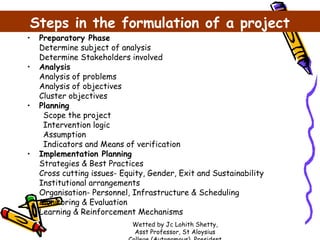
Steps in the formulation of a project
•
•

•

•

Preparatory Phase
Determine subject of analysis
Determine Stakeholders involved
Analysis
Analysis of problems
Analysis of objectives
Cluster objectives
Planning
Scope the project
Intervention logic
Assumption
Indicators and Means of verification
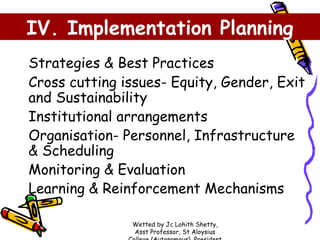
Implementation Planning
Strategies & Best Practices
Cross cutting issues- Equity, Gender, Exit and Sustainability
Institutional arrangements
Organisation- Personnel, Infrastructure & Scheduling
Monitoring & Evaluation
Learning & Reinforcement Mechanisms
Wetted by Jc Lohith Shetty,
Asst Professor, St Aloysius
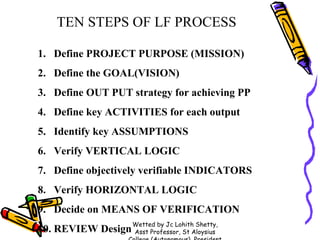
TEN STEPS OF LF PROCESS
1. Define PROJECT PURPOSE (MISSION)
2. Define the GOAL(VISION)
3. Define OUT PUT strategy for achieving PP
4. Define key ACTIVITIES for each output
5. Identify key ASSUMPTIONS
6. Verify VERTICAL LOGIC
7. Define objectively verifiable INDICATORS
8. Verify HORIZONTAL LOGIC
9. Decide on MEANS OF VERIFICATION
10. REVIEW Design

Wetted by Jc Lohith Shetty,
Asst Professor, St Aloysius
IV. Implementation Planning
Strategies & Best Practices
Cross cutting issues- Equity, Gender, Exit
and Sustainability
Institutional arrangements
Organisation- Personnel, Infrastructure
& Scheduling
Monitoring & Evaluation
Learning & Reinforcement Mechanisms
Wetted by Jc Lohith Shetty,
Asst Professor, St Aloysius
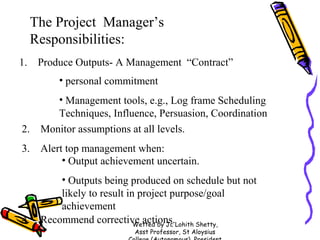
The Project Manager’s
Responsibilities:
1.

Produce Outputs- A Management “Contract”
• personal commitment

2.
3.

4.

• Management tools, e.g., Log frame Scheduling
Techniques, Influence, Persuasion, Coordination
Monitor assumptions at all levels.
Alert top management when:
• Output achievement uncertain.
• Outputs being produced on schedule but not
likely to result in project purpose/goal
achievement
Recommend corrective actions.Lohith Shetty,
Wetted by Jc
Asst Professor, St Aloysius

Lfa Logical Framework Analysis

  • 1.
    Logical Framework Analysis (LFA) Wetted by JcLohith Shetty, Asst Professor, St Aloysius College (Autonomous), President 2014, JCI Mangalore
  • 2.
    Logical frame work Analysis •What is Logical Framework Analysis? • The Logical Framework Approach (LFA) is a management tool mainly used in the design, monitoring and evaluation of international development projects. It is also widely known as Goal Oriented Project Planning (GOPP) or Objectives Oriented Project Planning (OOPP). Wetted by Jc Lohith Shetty, Asst Professor, St Aloysius College (Autonomous), President 2014, JCI Mangalore
  • 3.
    LFA: What isit all about? • Used as a tool to convert problems/ objectives into a project. It links the goal and objectives of a project to its inputs and outputs. • Helps in developing objective indicators for all stages of the project and means of verification for the indicators; overall assumptions and risk factors which have a bearing on the success / failure of the project. • Also helps in collecting data required for monitoring and assessing the impact of the project. Wetted by Jc Lohith Shetty, Asst Professor, St Aloysius
  • 4.
    LFA IS ATOOL FOR IMPROVING THE QUALITY OF PROJECTS The Logical Framework Approach is analytical tool for objectives- oriented project planning and management The key words are: • • • • Objectives oriented Target group oriented Participatory Clearly stating the Assumptions Wetted by Jc Lohith Shetty, Asst Professor, St Aloysius
  • 5.
    LFA I Preparatory Phase II Analysis Phase III PlanningPhase Wetted by Jc Lohith Shetty, Asst Professor, St Aloysius
  • 6.
    I. Preparatory Phase A. • • • Determinethe Focus Area Determine the focus area to be analyzed Study the focus area Present results of fact finding in short report B. Analyze Stakeholders involved • Identify all stakeholders who have a relation to the focus area • Identify what the most important stakeholders contribute to and benefit from the focus area. Wetted Shetty, invite to the • Determine who to by Jc LohithAloysius workshop Asst Professor, St
  • 7.
    II. Analysis Phase A.Analyze the problems • • • • • • • • • • Formulate problems from point of view of the identified Stakeholders. Check whether all relevant problems of stakeholders are included Check that problems are understood Select a tentative “starter” problem Identify direct causes of starter problem Identify direct effects of starter problem Continue identifying cause-effect relationships Check completeness of the diagram Add additional problems if necessary Draw connecting lines to make “Problem Tree” Wetted by Jc Lohith Shetty, Asst Professor, St Aloysius
  • 8.
    B. Analyze theObjectives • • • • Restate problems as positive statements, “reached” situations (objectives) Compare problems and objectives. Discuss the formulations. Examine the “means-end” relationships and adjust chart if needed Draw connecting lines (“Objective Tree”) C. Clustering • • Identify clusters of related objectives in terms of expertise required/ commonality/ theme/ affinity Give a name to each cluster Wetted by Jc Lohith Shetty, Asst Professor, St Aloysius
  • 9.
    III. Planning Phase A.Scope the project • • • Identify which clusters are outside of project responsibility/resources Determine willingness to contribute by stakeholders to clusters. Determine the priority ranking for addressing the different objective clusters. Wetted by Jc Lohith Shetty, Asst Professor, St Aloysius
  • 10.
    Checklist of Criteria Relationshipwith state/ national policies/ MDGs Attractiveness to target groups Contribution to other clusters Probability of success Side effects: Positive/Negative Urgency Resource availability - Funds - Counterpart institutions - Expertise required/available - Time horizon • History of the project • Sustainability • Etc…. • • • • • • • Wetted by Jc Lohith Shetty, Asst Professor, St Aloysius
  • 11.
    B. Determine InterventionLogic and External Factors • Identify Overall Goal from the objective tree • Select Project Objectives/Purpose from objective tree outputs/results that • Identify contribute to achieving the project objectives/purpose. Wetted by Jc Lohith Shetty, Asst Professor, St Aloysius
  • 12.
    LFA – ProjectPlanning Matrix Col I Project Structure Goal ( Overall Programme goal) Purpose (Objectives short term and long term.) Outputs (results) Activities (Inputs) Col II Col III Objectively variable indicators (OVI) Means of verification (MV) Col IV Assumption risks Overall goal hypothesis. Step I. Define goal. What is the wider sector goal? What overall problem or need are you trying to address? The goal does not change, it may be affected by external factors. Purpose / objective assumptions Output assumptions. Activity and input assumption. Wetted by Jc Lohith Shetty, Asst Professor, St Aloysius
  • 13.
    LFA – ProjectPlanning Matrix Col I Project Structure Goal ( Overall Programme goal) Purpose (Objectives short term and long term.) Outputs (results) Activities (Inputs) Col II Col III Objectively variable indicators (OVI) Means of verification (MV) Col IV Assumption risks Overall goal hypothesis. Step 2. Define the objective/purpose. What impact do you hope to make? How will the user benefit? Purpose may also be affected by factors outside your project. Purpose / objective assumptions Output assumptions. Activity and input assumption. Wetted by Jc Lohith Shetty, Asst Professor, St Aloysius
  • 14.
    LFA – ProjectPlanning Matrix Col I Project Structure Goal ( Overall Programme goal) Purpose (Objectives short term and long term.) Outputs (results) Activities (Inputs) Col II Col III Objectively variable indicators (OVI) Means of verification (MV) Col IV Assumption risks Overall goal hypothesis. Step 3. Define the outputs. What will be the measurable end results of the planned activities? What results will the project be directly responsible for? Project team is accountable for the results. Purpose / objective assumptions Output assumptions. Activity and input assumption. Wetted by Jc Lohith Shetty, Asst Professor, St Aloysius
  • 15.
    LFA – ProjectPlanning Matrix Col I Project Structure Goal ( Overall Programme goal) Purpose (Objectives short term and long term.) Outputs (results) Activities (Inputs) Col II Col III Objectively variable indicators (OVI) Means of verification (MV) Col IV Assumption risks Overall goal hypothesis. Step 4. Define the activities. What will actually be done to achieve the outputs? This is a summary presentation showing what needs to be done to achieve each output. Purpose / objective assumptions Output assumptions. Activity and input assumption. Wetted by Jc Lohith Shetty, Asst Professor, St Aloysius
  • 16.
    LFA – ProjectPlanning Matrix Col I Project Structure Col II Col III Objectively variable indicators (OVI) Means of verification (MV) Goal ( Overall Programme goal) Purpose (Objectives short term and long term.) Outputs (results) Activities (Inputs) Col IV Assumption risks Overall goal hypothesis. Step 5. Verify vertical logic. Use ‘if–then’ test to check cause and effect. Purpose / objective assumptions Output assumptions. Activity and input assumption. Wetted by Jc Lohith Shetty, Asst Professor, St Aloysius
  • 17.
    Assumptions / Risks Assumptionsare major conditions which are outside the direct control of the project, but which are so important that they will have to be met or have to hold true if the project is to achieve its objectives. Sources of generating Assumptions: 1. Unselected Objectives from ‘Objective Tree’ 2. Constraints/ weaknesses of different stakeholders in the project- from Stakeholder Analysis 3. Negative side effects of the project interventions 4. Rational, logic argumentations: “Which other external factors must become true to achieve Outputs/Results, assuming that Wetted by Jc Lohith Shetty, all the activities are already achieved?” and so on.. Asst Professor, St Aloysius
  • 18.
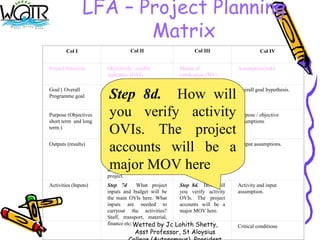
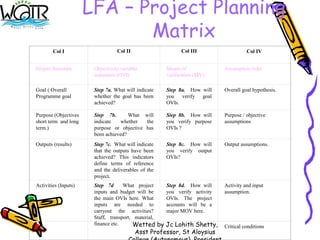
    LFA – ProjectPlanning Matrix Col I Col II Col III Col IV Project Structure Objectively variable indicators (OVI) Means of verification (MV) Assumption risks Goal ( Overall Programme goal Step 7a. What will indicate whether the goal has been achieved? Step 8a. How will you verify goal OVIs. Overall goal hypothesis. Purpose (Objectives short term and long term.) Step 7b. What will indicate whether the purpose or objective has been achieved? Step 8b. How will you verify purpose OVIs ? Purpose / objective assumptions Outputs (results) Step 7c. What will indicate that the outputs have been achieved? This indicators define terms of reference and the deliverables of the project. Step 8c. How will you verify output OVIs? Output assumptions. Activities (Inputs) Step 7d What project Step 8d. How will inputs and budget will be you verify activity the main OVIs here. What OVIs. The project inputs are needed to accounts will be a carryout the activities? major MOV here. Staff, transport, material, finance etc. Wetted by Jc Lohith Shetty, Step 6a. Define the assumptions. Include here anything that must happens before the project commence. Asst Professor, St Aloysius Activity and input assumption. Critical conditions
  • 19.
    LFA – ProjectPlanning Matrix Col I Project Structure Goal ( Overall Programme goal) Purpose (Objectives short term and long term.) Outputs (results) Activities (Inputs) Col II Objectively variable indicators (OVI) Col III Means of verification (MV) Col IV Assumption risks Overall goal hypothesis. Step 6b. Check the logic. Will the completed activities lead to achievements of the outputs? Are all the resources needed to achieve the outputs? What assumptions external to project have been made? If assumption / risk high redesign. Wetted by Jc Lohith Shetty, Asst Professor, St Aloysius Purpose / objective assumptions Output assumptions. Activity and input assumption.
  • 20.
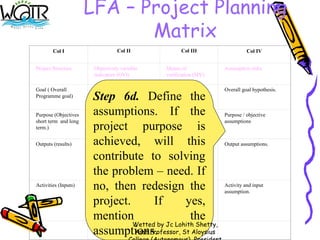
    LFA – ProjectPlanning Matrix Col I Project Structure Goal ( Overall Programme goal) Purpose (Objectives short term and long term.) Outputs (results) Activities (Inputs) Col II Objectively variable indicators (OVI) Col III Means of verification (MV) Col IV Assumption risks Overall goal hypothesis. Step 6c. Define the assumption. If the outputs are produced would the purpose be achieved? What assumptions external to the projects have been made about the achievements of the outputs? If risk / assumptions are Jc Lohith Shetty, Wetted by too great Asst the project. then redesignProfessor, St Aloysius Purpose / objective assumptions Output assumptions. Activity and input assumption.
  • 21.
    LFA – ProjectPlanning Matrix Col I Project Structure Goal ( Overall Programme goal) Purpose (Objectives short term and long term.) Outputs (results) Activities (Inputs) Col II Objectively variable indicators (OVI) Col III Means of verification (MV) Step 6d. Define the assumptions. If the project purpose is achieved, will this contribute to solving the problem – need. If no, then redesign the project. If yes, mention the Wetted by Jc Lohith Shetty, Asst Professor, St Aloysius assumptions. Col IV Assumption risks Overall goal hypothesis. Purpose / objective assumptions Output assumptions. Activity and input assumption.
  • 22.
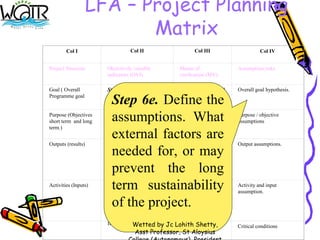
    LFA – ProjectPlanning Matrix Col I Col II Col III Col IV Project Structure Objectively variable indicators (OVI) Means of verification (MV) Assumption risks Goal ( Overall Programme goal Step 7a. What will indicate whether the goal has been achieved? Step 8a. How will you verify goal OVIs. Overall goal hypothesis. Purpose (Objectives short term and long term.) Step 7b. What will indicate whether the purpose or objective has been achieved? Step 8b. How will you verify purpose OVIs ? Purpose / objective assumptions Outputs (results) Step 7c. What will indicate that the outputs have been achieved? This indicators define terms of reference and the deliverables of the project. Step 8c. How will you verify output OVIs? Output assumptions. Activities (Inputs) Step 7d What project Step 8d. How will inputs and budget will be you verify activity the main OVIs here. What OVIs. The project inputs are needed to accounts will be a carryout the activities? major MOV here. Staff, transport, material, finance etc. Wetted by Jc Lohith Shetty, Step 6e. Define the assumptions. What external factors are needed for, or may prevent the long term sustainability of the project. Asst Professor, St Aloysius Activity and input assumption. Critical conditions
  • 23.
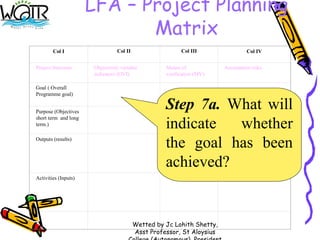
    LFA – ProjectPlanning Matrix Col I Project Structure Goal ( Overall Programme goal) Purpose (Objectives short term and long term.) Outputs (results) Col II Col III Objectively variable indicators (OVI) Means of verification (MV) Col IV Assumption risks Step 7a. What will indicate whether the goal has been achieved? Activities (Inputs) Wetted by Jc Lohith Shetty, Asst Professor, St Aloysius
  • 24.
    LFA – ProjectPlanning Matrix Col I Project Structure Col II Col III Objectively variable indicators (OVI) Means of verification (MV) Col IV Assumption risks Goal ( Overall Programme goal) Purpose (Objectives short term and long term.) Outputs (results) Activities (Inputs) Step 7b. What will indicate whether the purpose or objective has been achieved? Wetted by Jc Lohith Shetty, Asst Professor, St Aloysius Critical conditions
  • 25.
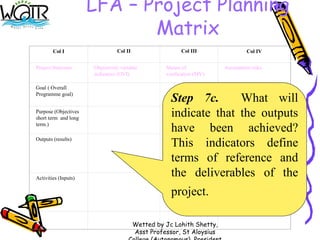
    LFA – ProjectPlanning Matrix Col I Project Structure Goal ( Overall Programme goal) Purpose (Objectives short term and long term.) Outputs (results) Activities (Inputs) Col II Col III Objectively variable indicators (OVI) Means of verification (MV) Col IV Assumption risks Step 7c. What will indicate that the outputs have been achieved? This indicators define terms of reference and the deliverables of the project. Wetted by Jc Lohith Shetty, Asst Professor, St Aloysius
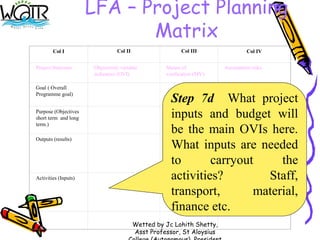
  • 26.
    LFA – ProjectPlanning Matrix Col I Project Structure Goal ( Overall Programme goal) Purpose (Objectives short term and long term.) Outputs (results) Activities (Inputs) Col II Col III Objectively variable indicators (OVI) Means of verification (MV) Col IV Assumption risks Step 7d What project inputs and budget will be the main OVIs here. What inputs are needed to carryout the activities? Staff, transport, material, finance etc. Wetted by Jc Lohith Shetty, Asst Professor, St Aloysius
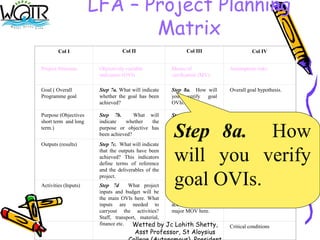
  • 27.
    LFA – ProjectPlanning Matrix Col I Col II Col III Col IV Project Structure Objectively variable indicators (OVI) Means of verification (MV) Assumption risks Goal ( Overall Programme goal Step 7a. What will indicate whether the goal has been achieved? Step 8a. How will you verify goal OVIs. Overall goal hypothesis. Purpose (Objectives short term and long term.) Step 7b. What will indicate whether the purpose or objective has been achieved? Step 8b. How will you verify purpose OVIs ? Purpose / objective assumptions Outputs (results) Step 7c. What will indicate that the outputs have been achieved? This indicators define terms of reference and the deliverables of the project. Step 8c. How will you verify output OVIs? Output assumptions. Activities (Inputs) Step 7d What project Step 8d. How will inputs and budget will be you verify activity the main OVIs here. What OVIs. The project inputs are needed to accounts will be a carryout the activities? major MOV here. Staff, transport, material, finance etc. Wetted by Jc Lohith Shetty, Step 8a. How will you verify goal OVIs. Asst Professor, St Aloysius Activity and input assumption. Critical conditions
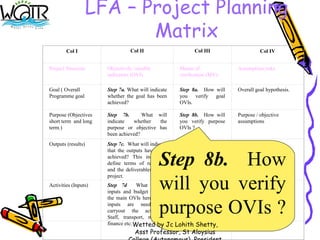
  • 28.
    LFA – ProjectPlanning Matrix Col I Col II Col III Col IV Project Structure Objectively variable indicators (OVI) Means of verification (MV) Assumption risks Goal ( Overall Programme goal Step 7a. What will indicate whether the goal has been achieved? Step 8a. How will you verify goal OVIs. Overall goal hypothesis. Purpose (Objectives short term and long term.) Step 7b. What will indicate whether the purpose or objective has been achieved? Step 8b. How will you verify purpose OVIs ? Purpose / objective assumptions Outputs (results) Step 7c. What will indicate that the outputs have been achieved? This indicators define terms of reference and the deliverables of the project. Step 8c. How will you verify output OVIs? Output assumptions. Activities (Inputs) Step 8b. How will you verify purpose OVIs ? Step 7d What project Step 8d. How will inputs and budget will be you verify activity the main OVIs here. What OVIs. The project inputs are needed to accounts will be a carryout the activities? major MOV here. Staff, transport, material, finance etc. Wetted by Jc Lohith Shetty, Asst Professor, St Aloysius Activity and input assumption. Critical conditions
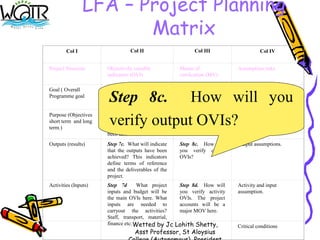
  • 29.
    LFA – ProjectPlanning Matrix Col I Col II Col III Col IV Project Structure Objectively variable indicators (OVI) Means of verification (MV) Assumption risks Goal ( Overall Programme goal Step 7a. What will indicate whether the goal has been achieved? Step 8a. How will you verify goal OVIs. Overall goal hypothesis. Purpose (Objectives short term and long term.) Step 7b. What will indicate whether the purpose or objective has been achieved? Step 8b. How will you verify purpose OVIs ? Purpose / objective assumptions Outputs (results) Step 7c. What will indicate that the outputs have been achieved? This indicators define terms of reference and the deliverables of the project. Step 8c. How will you verify output OVIs? Output assumptions. Activities (Inputs) Step 7d What project Step 8d. How will inputs and budget will be you verify activity the main OVIs here. What OVIs. The project inputs are needed to accounts will be a carryout the activities? major MOV here. Staff, transport, material, finance etc. Wetted by Jc Lohith Shetty, Step 8c. How will you verify output OVIs? Asst Professor, St Aloysius Activity and input assumption. Critical conditions
  • 30.
    LFA – ProjectPlanning Matrix Col I Col II Col III Means of verification (MV) Col IV Project Structure Objectively variable indicators (OVI) Goal ( Overall Programme goal Step 7a. What will indicate whether the goal has been achieved? Step 8a. How will you verify goal OVIs. Overall goal hypothesis. Purpose (Objectives short term and long term.) Step 7b. What will indicate whether the purpose or objective has been achieved? Step 8b. How will you verify purpose OVIs ? Purpose / objective assumptions Outputs (results) Step 7c. What will indicate that the outputs have been achieved? This indicators define terms of reference and the deliverables of the project. Step 8c. How will you verify output OVIs? Output assumptions. Activities (Inputs) Step 7d What project Step 8d. How will inputs and budget will be you verify activity the main OVIs here. What OVIs. The project inputs are needed to accounts will be a carryout the activities? major MOV here. Staff, transport, material, finance etc. Wetted by Jc Lohith Shetty, Step 8d. How will you verify activity OVIs. The project accounts will be a major MOV here Asst Professor, St Aloysius Assumption risks Activity and input assumption. Critical conditions
  • 31.
    LFA – ProjectPlanning Matrix Col I Col II Col III Col IV Project Structure Objectively variable indicators (OVI) Means of verification (MV) Assumption risks Goal ( Overall Programme goal Step 7a. What will indicate whether the goal has been achieved? Step 8a. How will you verify goal OVIs. Overall goal hypothesis. Purpose (Objectives short term and long term.) Step 7b. What will indicate whether the purpose or objective has been achieved? Step 8b. How will you verify purpose OVIs ? Purpose / objective assumptions Outputs (results) Step 7c. What will indicate that the outputs have been achieved? This indicators define terms of reference and the deliverables of the project. Step 8c. How will you verify output OVIs? Output assumptions. Activities (Inputs) Step 7d What project inputs and budget will be the main OVIs here. What inputs are needed to carryout the activities? Staff, transport, material, finance etc. Wetted by Step 8d. How will you verify activity OVIs. The project accounts will be a major MOV here. Activity and input assumption. Jc Lohith Shetty, Asst Professor, St Aloysius Critical conditions
  • 32.
    Steps in theformulation of a project • • • • Preparatory Phase Determine subject of analysis Determine Stakeholders involved Analysis Analysis of problems Analysis of objectives Cluster objectives Planning Scope the project Intervention logic Assumption Indicators and Means of verification Implementation Planning Strategies & Best Practices Cross cutting issues- Equity, Gender, Exit and Sustainability Institutional arrangements Organisation- Personnel, Infrastructure & Scheduling Monitoring & Evaluation Learning & Reinforcement Mechanisms Wetted by Jc Lohith Shetty, Asst Professor, St Aloysius
  • 33.
    TEN STEPS OFLF PROCESS 1. Define PROJECT PURPOSE (MISSION) 2. Define the GOAL(VISION) 3. Define OUT PUT strategy for achieving PP 4. Define key ACTIVITIES for each output 5. Identify key ASSUMPTIONS 6. Verify VERTICAL LOGIC 7. Define objectively verifiable INDICATORS 8. Verify HORIZONTAL LOGIC 9. Decide on MEANS OF VERIFICATION 10. REVIEW Design Wetted by Jc Lohith Shetty, Asst Professor, St Aloysius
  • 34.
    IV. Implementation Planning Strategies& Best Practices Cross cutting issues- Equity, Gender, Exit and Sustainability Institutional arrangements Organisation- Personnel, Infrastructure & Scheduling Monitoring & Evaluation Learning & Reinforcement Mechanisms Wetted by Jc Lohith Shetty, Asst Professor, St Aloysius
  • 35.
    The Project Manager’s Responsibilities: 1. ProduceOutputs- A Management “Contract” • personal commitment 2. 3. 4. • Management tools, e.g., Log frame Scheduling Techniques, Influence, Persuasion, Coordination Monitor assumptions at all levels. Alert top management when: • Output achievement uncertain. • Outputs being produced on schedule but not likely to result in project purpose/goal achievement Recommend corrective actions.Lohith Shetty, Wetted by Jc Asst Professor, St Aloysius