Strategies
in Action
Chapter Five
Copyright ©2017 Pearson Education, Inc. 5-1
Long-Term Objectives
The results expected from
pursuing certain strategies
2-to-5 year timeframe
Copyright ©2017 Pearson Education, Inc. 5-2
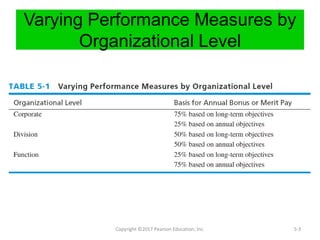
Varying Performance Measures by
Organizational Level
Copyright ©2017 Pearson Education, Inc. 5-3
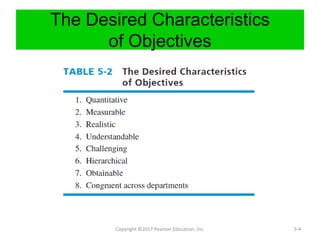
The Desired Characteristics
of Objectives
Copyright ©2017 Pearson Education, Inc. 5-4
The Nature of Long-Term
Objectives
Objectives
provide direction
allow synergy
assist in evaluation
establish priorities
reduce uncertainty
minimize conflicts
stimulate exertion
aid in both the allocation of resources and the
design of jobs
Copyright ©2017 Pearson Education, Inc. 5-5
Financial versus Strategic
Objectives
 Financial objectives include growth in revenues,
growth in earnings, higher dividends, larger profit
margins, greater return on investment, higher
earnings per share, a rising stock price, improved
cash flow, and so on.
 Strategic objectives include a larger market
share, quicker on-time delivery than rivals, shorter
design-to-market times than rivals, lower costs
than rivals, higher product quality than rivals,
wider geographic coverage than rivals, achieving
technological leadership, consistently getting new
or improved products to market ahead of rivals,
and so on.
Copyright ©2017 Pearson Education, Inc. 5-6
Types of Strategies
 Most organizations simultaneously pursue a
combination of two or more strategies, but a
combination strategy can be exceptionally
risky if carried too far.
 No organization can afford to pursue all the
strategies that might benefit the firm.
 Difficult decisions must be made and
priorities must be established.
Copyright ©2017 Pearson Education, Inc. 5-7
Varying Performance Measures by
Organizational Level
Copyright ©2017 Pearson Education, Inc. 5-3
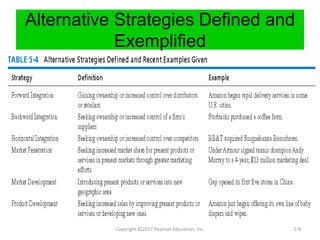
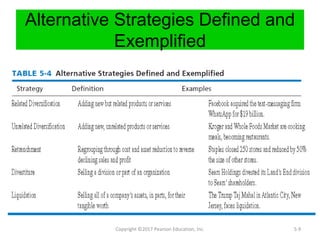
Alternative Strategies Defined and
Exemplified
Copyright ©2017 Pearson Education, Inc. 5-9
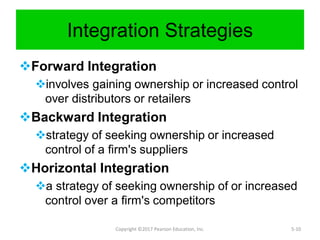
Integration Strategies
Forward Integration
involves gaining ownership or increased control
over distributors or retailers
Backward Integration
strategy of seeking ownership or increased
control of a firm's suppliers
Horizontal Integration
a strategy of seeking ownership of or increased
control over a firm's competitors
Copyright ©2017 Pearson Education, Inc. 5-10
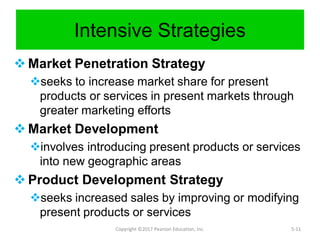
Intensive Strategies
 Market Penetration Strategy
seeks to increase market share for present
products or services in present markets through
greater marketing efforts
 Market Development
involves introducing present products or services
into new geographic areas
 Product Development Strategy
seeks increased sales by improving or modifying
present products or services
Copyright ©2017 Pearson Education, Inc. 5-11
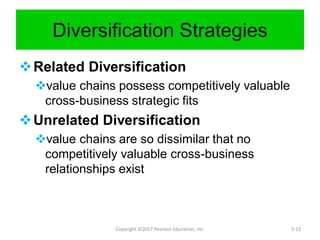
Diversification Strategies
Related Diversification
value chains possess competitively valuable
cross-business strategic fits
Unrelated Diversification
value chains are so dissimilar that no
competitively valuable cross-business
relationships exist
Copyright ©2017 Pearson Education, Inc. 5-12
Defensive Strategies
 Retrenchment
Regroups through cost and asset reduction to reverse
declining sales and profits
 Divestiture
Selling a division or part of an organization
Often used to raise capital for further strategic
acquisitions or investments
 Liquidation
Selling all of a company’s assets, in parts, for their
tangible worth
Copyright ©2017 Pearson Education, Inc. 5-13
Defensive Strategies
Retrenchment
occurs when an organization regroups
through cost and asset reduction to reverse
declining sales and profits
also called a turnaround or reorganizational
strategy
designed to fortify an organization’s basic
distinctive competence
Copyright ©2017 Pearson Education, Inc. 5-14
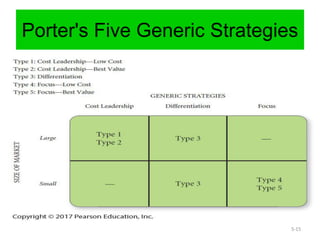
Porter's Five Generic Strategies
5-15
The Desired Characteristics
of Objectives
Copyright ©2017 Pearson Education, Inc. 5-4
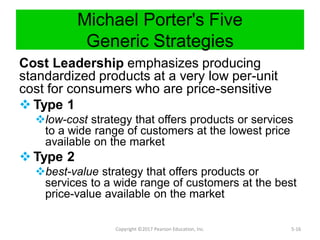
Michael Porter's Five
Generic Strategies
Type 3
Differentiation is a strategy aimed at
producing products and services considered
unique industry-wide and directed at
consumers who are relatively price-insensitive
Copyright ©2017 Pearson Education, Inc. 5-17
Michael Porter's Five
Generic Strategies
Type 4
low-cost focus strategy that offers products or
services to a niche group of customers at the
lowest price available on the market
Type 5
best-value focus strategy that offers products
or services to a small range of customers at
the best price-value available on the market
Copyright ©2017 Pearson Education, Inc. 5-18
Strategy
Analysis
and Choice
Chapter Six
Copyright ©2017 Pearson Education, Inc. 6-19
The Process of Generating and
Selecting Strategies
A manageable set of the most attractive
alternative strategies must be developed.
The advantages, disadvantages, trade-
offs, costs, and benefits of these
strategies should be determined.
Copyright ©2017 Pearson Education, Inc. 6-20
The Process of Generating and
Selecting Strategies
Identifying and evaluating alternative
strategies should involve many of the
managers and employees who earlier
assembled the organizational vision and
mission statements, performed the
external audit, and conducted the internal
audit.
Copyright ©2017 Pearson Education, Inc. 6-21
The Process of Generating and
Selecting Strategies
 Alternative strategies proposed by
participants should be considered and
discussed in a series of meetings.
 Proposed strategies should be listed in
writing.
 When all feasible strategies identified by
participants are given and understood, the
strategies should be ranked in order of
attractiveness.
Copyright ©2017 Pearson Education, Inc. 6-22
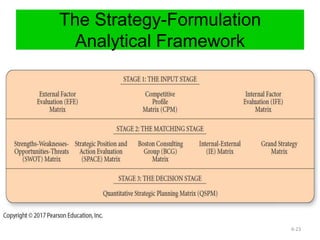
The Strategy-Formulation
Analytical Framework
6-23
The Nature of Long-Term
Objectives
Objectives
provide direction
allow synergy
assist in evaluation
establish priorities
reduce uncertainty
minimize conflicts
stimulate exertion
aid in both the allocation of resources and the
design of jobs
Copyright ©2017 Pearson Education, Inc. 5-5
A Comprehensive Strategy-
Formulation Framework
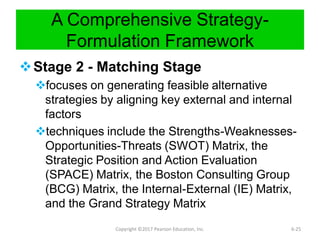
Stage 2 - Matching Stage
focuses on generating feasible alternative
strategies by aligning key external and internal
factors
techniques include the Strengths-Weaknesses-
Opportunities-Threats (SWOT) Matrix, the
Strategic Position and Action Evaluation
(SPACE) Matrix, the Boston Consulting Group
(BCG) Matrix, the Internal-External (IE) Matrix,
and the Grand Strategy Matrix
Copyright ©2017 Pearson Education, Inc. 6-25
A Comprehensive Strategy-
Formulation Framework
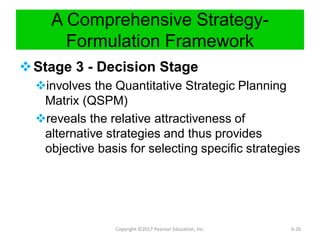
Stage 3 - Decision Stage
involves the Quantitative Strategic Planning
Matrix (QSPM)
reveals the relative attractiveness of
alternative strategies and thus provides
objective basis for selecting specific strategies
Copyright ©2017 Pearson Education, Inc. 6-26
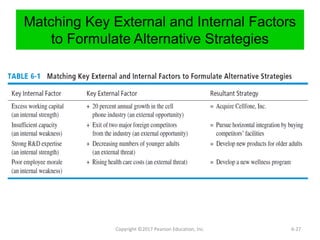
Matching Key External and Internal Factors
to Formulate Alternative Strategies
Copyright ©2017 Pearson Education, Inc. 6-27
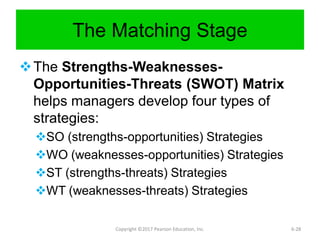
The Matching Stage
The Strengths-Weaknesses-
Opportunities-Threats (SWOT) Matrix
helps managers develop four types of
strategies:
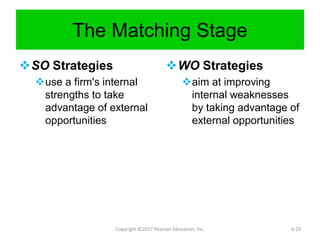
SO (strengths-opportunities) Strategies
WO (weaknesses-opportunities) Strategies
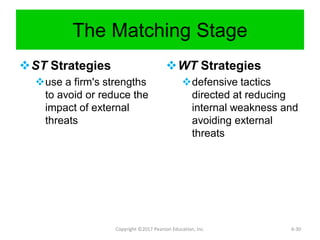
ST (strengths-threats) Strategies
WT (weaknesses-threats) Strategies
Copyright ©2017 Pearson Education, Inc. 6-28
Financial versus Strategic
Objectives
 Financial objectives include growth in revenues,
growth in earnings, higher dividends, larger profit
margins, greater return on investment, higher
earnings per share, a rising stock price, improved
cash flow, and so on.
 Strategic objectives include a larger market
share, quicker on-time delivery than rivals, shorter
design-to-market times than rivals, lower costs
than rivals, higher product quality than rivals,
wider geographic coverage than rivals, achieving
technological leadership, consistently getting new
or improved products to market ahead of rivals,
and so on.
Copyright ©2017 Pearson Education, Inc. 5-6
The Matching Stage
ST Strategies
use a firm's strengths
to avoid or reduce the
impact of external
threats
WT Strategies
defensive tactics
directed at reducing
internal weakness and
avoiding external
threats
Copyright ©2017 Pearson Education, Inc. 6-30
SWOT Matrix
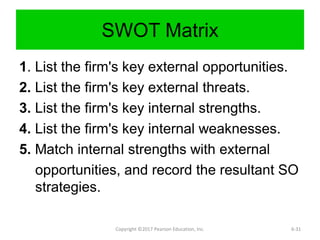
1. List the firm's key external opportunities.
2. List the firm's key external threats.
3. List the firm's key internal strengths.
4. List the firm's key internal weaknesses.
5. Match internal strengths with external
opportunities, and record the resultant SO
strategies.
Copyright ©2017 Pearson Education, Inc. 6-31
SWOT Matrix (cont.)
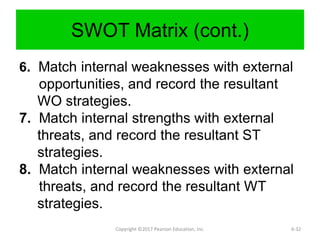
6. Match internal weaknesses with external
opportunities, and record the resultant
WO strategies.
7. Match internal strengths with external
threats, and record the resultant ST
strategies.
8. Match internal weaknesses with external
threats, and record the resultant WT
strategies.
Copyright ©2017 Pearson Education, Inc. 6-32
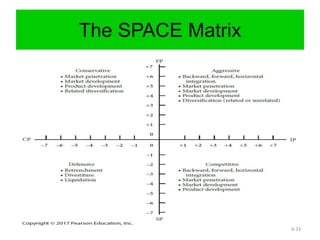
The SPACE Matrix
6-33
Types of Strategies
 Most organizations simultaneously pursue a
combination of two or more strategies, but a
combination strategy can be exceptionally
risky if carried too far.
 No organization can afford to pursue all the
strategies that might benefit the firm.
 Difficult decisions must be made and
priorities must be established.
Copyright ©2017 Pearson Education, Inc. 5-7
The SPACE Matrix
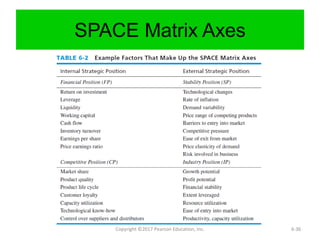
Two internal dimensions (financial position
[FP] and competitive position [CP])
Two external dimensions (stability position
[SP] and industry position [IP])
Most important determinants of an
organization's overall strategic position
Copyright ©2017 Pearson Education, Inc. 6-35
SPACE Matrix Axes
Copyright ©2017 Pearson Education, Inc. 6-36
Steps to Develop a SPACE Matrix
1. Select a set of variables to define
financial position (FP), competitive position
(CP), stability position (SP), and industry
position (IP).
Copyright ©2017 Pearson Education, Inc. 6-37
Steps to Develop a SPACE Matrix
2. Assign a numerical value ranging from +1
(worst) to +7 (best) to each of the
variables that make up the FP and IP
dimensions.
Assign a numerical value ranging from –1
(best) to –7 (worst) to each of the
variables that make up the SP and CP
dimensions.
Copyright ©2017 Pearson Education, Inc. 6-38
Steps to Develop a SPACE Matrix
3. Compute an average score for FP, CP, IP,
and SP.
4. Plot the average scores for FP, IP, SP, and
CP on the appropriate axis.
5. Add the two scores on the x-axis and plot
the resultant point on X. Add the two scores
on the y-axis and plot the resultant point on
Y. Plot the intersection of the new xy point.
Copyright ©2017 Pearson Education, Inc. 6-39
Steps to Develop a SPACE Matrix
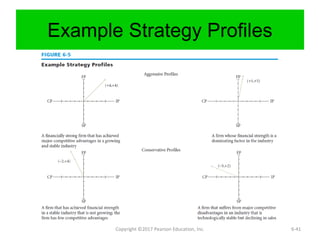
6. Draw a directional vector from the origin
of the SPACE Matrix through the new
intersection point.
► This vector reveals the type of strategies
recommended for the organization:
aggressive, competitive, defensive, or
conservative
Copyright ©2017 Pearson Education, Inc. 6-40
Alternative Strategies Defined and
Exemplified
Copyright ©2017 Pearson Education, Inc. 5-8
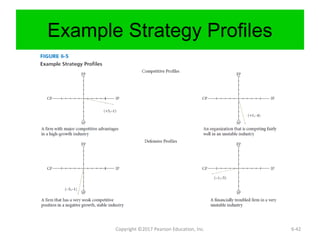
Example Strategy Profiles
Copyright ©2017 Pearson Education, Inc. 6-42
The Boston Consulting Group
(BCG) Matrix
BCG Matrix
graphically portrays differences among
divisions in terms of relative market share
position and industry growth rate
allows a multidivisional organization to
manage its portfolio of businesses by
examining the relative market share position
and the industry growth rate of each division
relative to all other divisions in the
organization
Copyright ©2017 Pearson Education, Inc. 6-43
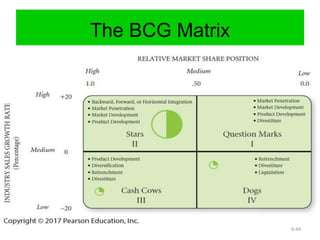
The BCG Matrix
6-44
The BCG Matrix
Question Marks – Quadrant I
Organization must decide whether to
strengthen them by pursuing an intensive
strategy (market penetration, market
development, or product development) or to
sell them
Stars – Quadrant II
represent the organization’s best long-run
opportunities for growth and profitability
Copyright ©2017 Pearson Education, Inc. 6-45
The BCG Matrix
Cash Cows – Quadrant III
generate cash in excess of their needs
should be managed to maintain their strong
position for as long as possible
Dogs – Quadrant IV
compete in a slow- or no-market-growth
industry
businesses are often liquidated, divested, or
trimmed down through retrenchment
Copyright ©2017 Pearson Education, Inc. 6-46
The BCG Matrix
The major benefit of the BCG Matrix is
that it draws attention to the cash flow,
investment characteristics, and needs of
an organization's various divisions.
Copyright ©2017 Pearson Education, Inc. 6-47
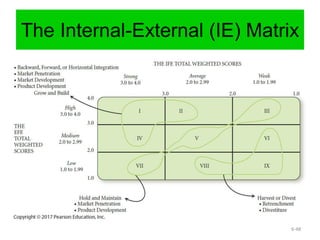
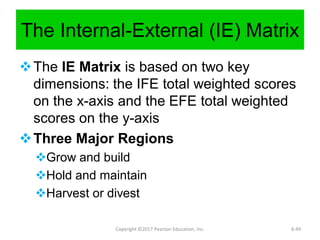
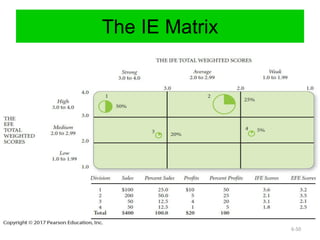
The Internal-External (IE) Matrix
6-48
Alternative Strategies Defined and
Exemplified
Copyright ©2017 Pearson Education, Inc. 5-9
The IE Matrix
6-50
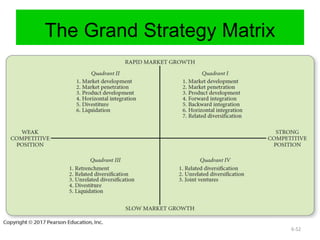
The Grand Strategy Matrix
Grand Strategy Matrix
based on two evaluative dimensions:
competitive position and market (industry)
growth
Copyright ©2017 Pearson Education, Inc. 6-51
The Grand Strategy Matrix
6-52
The Grand Strategy Matrix
Quadrant I
continued concentration on current markets
(market penetration and market development)
and products (product development) is an
appropriate strategy
Quadrant II
unable to compete effectively
need to determine why the firm's current
approach is ineffective and how the company can
best change to improve its competitiveness
Copyright ©2017 Pearson Education, Inc. 6-53
The Grand Strategy Matrix
Quadrant III
must make some drastic changes quickly to avoid
further decline and possible liquidation
Extensive cost and asset reduction
(retrenchment) should be pursued first
Quadrant IV
have characteristically high cash-flow levels and
limited internal growth needs and often can
pursue related or unrelated diversification
successfully
Copyright ©2017 Pearson Education, Inc. 6-54
The Quantitative Strategic Planning
Matrix (QSPM)
Quantitative Strategic Planning Matrix
(QSPM)
objectively indicates which alternative
strategies are best
uses input from Stage 1 analyses and
matching results from Stage 2 analyses to
decide objectively among alternative
strategies
Copyright ©2017 Pearson Education, Inc. 6-55
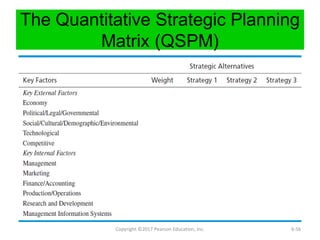
The Quantitative Strategic Planning
Matrix (QSPM)
Copyright ©2017 Pearson Education, Inc. 6-56
Integration Strategies
Forward Integration
involves gaining ownership or increased control
over distributors or retailers
Backward Integration
strategy of seeking ownership or increased
control of a firm's suppliers
Horizontal Integration
a strategy of seeking ownership of or increased
control over a firm's competitors
Copyright ©2017 Pearson Education, Inc. 5-10
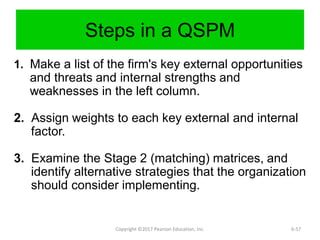
Steps in a QSPM (cont.)
4. Determine the Attractiveness Scores (AS).
5. Compute the Total Attractiveness Scores.
6. Compute the Sum Total Attractiveness
Score.
Copyright ©2017 Pearson Education, Inc. 6-58
Positive Features of the QSPM
Sets of strategies can be examined
sequentially or simultaneously
Requires strategists to integrate pertinent
external and internal factors into the
decision process
Can be adapted for use by small and
large for-profit and nonprofit organizations
Copyright ©2017 Pearson Education, Inc. 6-59
Limitations of the QSPM
Always requires informed judgments
It is only as good as the prerequisite
information and matching analyses on
which it is based
Copyright ©2017 Pearson Education, Inc. 6-60
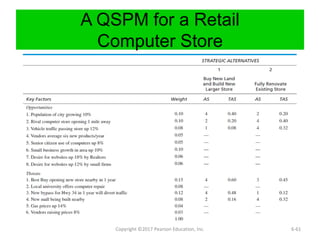
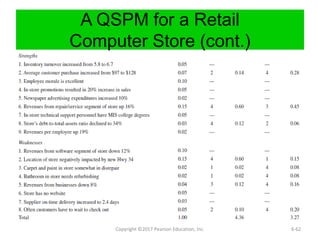
A QSPM for a Retail
Computer Store
Copyright ©2017 Pearson Education, Inc. 6-61
Intensive Strategies
 Market Penetration Strategy
seeks to increase market share for present
products or services in present markets through
greater marketing efforts
 Market Development
involves introducing present products or services
into new geographic areas
 Product Development Strategy
seeks increased sales by improving or modifying
present products or services
Copyright ©2017 Pearson Education, Inc. 5-11

Strategic management.Chapter 2

  • 1.
    Strategies in Action Chapter Five Copyright©2017 Pearson Education, Inc. 5-1
  • 2.
    Long-Term Objectives The resultsexpected from pursuing certain strategies 2-to-5 year timeframe Copyright ©2017 Pearson Education, Inc. 5-2
  • 3.
    Varying Performance Measuresby Organizational Level Copyright ©2017 Pearson Education, Inc. 5-3
  • 4.
    The Desired Characteristics ofObjectives Copyright ©2017 Pearson Education, Inc. 5-4
  • 5.
    The Nature ofLong-Term Objectives Objectives provide direction allow synergy assist in evaluation establish priorities reduce uncertainty minimize conflicts stimulate exertion aid in both the allocation of resources and the design of jobs Copyright ©2017 Pearson Education, Inc. 5-5
  • 6.
    Financial versus Strategic Objectives Financial objectives include growth in revenues, growth in earnings, higher dividends, larger profit margins, greater return on investment, higher earnings per share, a rising stock price, improved cash flow, and so on.  Strategic objectives include a larger market share, quicker on-time delivery than rivals, shorter design-to-market times than rivals, lower costs than rivals, higher product quality than rivals, wider geographic coverage than rivals, achieving technological leadership, consistently getting new or improved products to market ahead of rivals, and so on. Copyright ©2017 Pearson Education, Inc. 5-6
  • 7.
    Types of Strategies Most organizations simultaneously pursue a combination of two or more strategies, but a combination strategy can be exceptionally risky if carried too far.  No organization can afford to pursue all the strategies that might benefit the firm.  Difficult decisions must be made and priorities must be established. Copyright ©2017 Pearson Education, Inc. 5-7
  • 8.
    Varying Performance Measuresby Organizational Level Copyright ©2017 Pearson Education, Inc. 5-3
  • 9.
    Alternative Strategies Definedand Exemplified Copyright ©2017 Pearson Education, Inc. 5-9
  • 10.
    Integration Strategies Forward Integration involvesgaining ownership or increased control over distributors or retailers Backward Integration strategy of seeking ownership or increased control of a firm's suppliers Horizontal Integration a strategy of seeking ownership of or increased control over a firm's competitors Copyright ©2017 Pearson Education, Inc. 5-10
  • 11.
    Intensive Strategies  MarketPenetration Strategy seeks to increase market share for present products or services in present markets through greater marketing efforts  Market Development involves introducing present products or services into new geographic areas  Product Development Strategy seeks increased sales by improving or modifying present products or services Copyright ©2017 Pearson Education, Inc. 5-11
  • 12.
    Diversification Strategies Related Diversification valuechains possess competitively valuable cross-business strategic fits Unrelated Diversification value chains are so dissimilar that no competitively valuable cross-business relationships exist Copyright ©2017 Pearson Education, Inc. 5-12
  • 13.
    Defensive Strategies  Retrenchment Regroupsthrough cost and asset reduction to reverse declining sales and profits  Divestiture Selling a division or part of an organization Often used to raise capital for further strategic acquisitions or investments  Liquidation Selling all of a company’s assets, in parts, for their tangible worth Copyright ©2017 Pearson Education, Inc. 5-13
  • 14.
    Defensive Strategies Retrenchment occurs whenan organization regroups through cost and asset reduction to reverse declining sales and profits also called a turnaround or reorganizational strategy designed to fortify an organization’s basic distinctive competence Copyright ©2017 Pearson Education, Inc. 5-14
  • 15.
    Porter's Five GenericStrategies 5-15
  • 16.
    The Desired Characteristics ofObjectives Copyright ©2017 Pearson Education, Inc. 5-4
  • 17.
    Michael Porter's Five GenericStrategies Type 3 Differentiation is a strategy aimed at producing products and services considered unique industry-wide and directed at consumers who are relatively price-insensitive Copyright ©2017 Pearson Education, Inc. 5-17
  • 18.
    Michael Porter's Five GenericStrategies Type 4 low-cost focus strategy that offers products or services to a niche group of customers at the lowest price available on the market Type 5 best-value focus strategy that offers products or services to a small range of customers at the best price-value available on the market Copyright ©2017 Pearson Education, Inc. 5-18
  • 19.
    Strategy Analysis and Choice Chapter Six Copyright©2017 Pearson Education, Inc. 6-19
  • 20.
    The Process ofGenerating and Selecting Strategies A manageable set of the most attractive alternative strategies must be developed. The advantages, disadvantages, trade- offs, costs, and benefits of these strategies should be determined. Copyright ©2017 Pearson Education, Inc. 6-20
  • 21.
    The Process ofGenerating and Selecting Strategies Identifying and evaluating alternative strategies should involve many of the managers and employees who earlier assembled the organizational vision and mission statements, performed the external audit, and conducted the internal audit. Copyright ©2017 Pearson Education, Inc. 6-21
  • 22.
    The Process ofGenerating and Selecting Strategies  Alternative strategies proposed by participants should be considered and discussed in a series of meetings.  Proposed strategies should be listed in writing.  When all feasible strategies identified by participants are given and understood, the strategies should be ranked in order of attractiveness. Copyright ©2017 Pearson Education, Inc. 6-22
  • 23.
  • 24.
    The Nature ofLong-Term Objectives Objectives provide direction allow synergy assist in evaluation establish priorities reduce uncertainty minimize conflicts stimulate exertion aid in both the allocation of resources and the design of jobs Copyright ©2017 Pearson Education, Inc. 5-5
  • 25.
    A Comprehensive Strategy- FormulationFramework Stage 2 - Matching Stage focuses on generating feasible alternative strategies by aligning key external and internal factors techniques include the Strengths-Weaknesses- Opportunities-Threats (SWOT) Matrix, the Strategic Position and Action Evaluation (SPACE) Matrix, the Boston Consulting Group (BCG) Matrix, the Internal-External (IE) Matrix, and the Grand Strategy Matrix Copyright ©2017 Pearson Education, Inc. 6-25
  • 26.
    A Comprehensive Strategy- FormulationFramework Stage 3 - Decision Stage involves the Quantitative Strategic Planning Matrix (QSPM) reveals the relative attractiveness of alternative strategies and thus provides objective basis for selecting specific strategies Copyright ©2017 Pearson Education, Inc. 6-26
  • 27.
    Matching Key Externaland Internal Factors to Formulate Alternative Strategies Copyright ©2017 Pearson Education, Inc. 6-27
  • 28.
    The Matching Stage TheStrengths-Weaknesses- Opportunities-Threats (SWOT) Matrix helps managers develop four types of strategies: SO (strengths-opportunities) Strategies WO (weaknesses-opportunities) Strategies ST (strengths-threats) Strategies WT (weaknesses-threats) Strategies Copyright ©2017 Pearson Education, Inc. 6-28
  • 29.
    Financial versus Strategic Objectives Financial objectives include growth in revenues, growth in earnings, higher dividends, larger profit margins, greater return on investment, higher earnings per share, a rising stock price, improved cash flow, and so on.  Strategic objectives include a larger market share, quicker on-time delivery than rivals, shorter design-to-market times than rivals, lower costs than rivals, higher product quality than rivals, wider geographic coverage than rivals, achieving technological leadership, consistently getting new or improved products to market ahead of rivals, and so on. Copyright ©2017 Pearson Education, Inc. 5-6
  • 30.
    The Matching Stage STStrategies use a firm's strengths to avoid or reduce the impact of external threats WT Strategies defensive tactics directed at reducing internal weakness and avoiding external threats Copyright ©2017 Pearson Education, Inc. 6-30
  • 31.
    SWOT Matrix 1. Listthe firm's key external opportunities. 2. List the firm's key external threats. 3. List the firm's key internal strengths. 4. List the firm's key internal weaknesses. 5. Match internal strengths with external opportunities, and record the resultant SO strategies. Copyright ©2017 Pearson Education, Inc. 6-31
  • 32.
    SWOT Matrix (cont.) 6.Match internal weaknesses with external opportunities, and record the resultant WO strategies. 7. Match internal strengths with external threats, and record the resultant ST strategies. 8. Match internal weaknesses with external threats, and record the resultant WT strategies. Copyright ©2017 Pearson Education, Inc. 6-32
  • 33.
  • 34.
    Types of Strategies Most organizations simultaneously pursue a combination of two or more strategies, but a combination strategy can be exceptionally risky if carried too far.  No organization can afford to pursue all the strategies that might benefit the firm.  Difficult decisions must be made and priorities must be established. Copyright ©2017 Pearson Education, Inc. 5-7
  • 35.
    The SPACE Matrix Twointernal dimensions (financial position [FP] and competitive position [CP]) Two external dimensions (stability position [SP] and industry position [IP]) Most important determinants of an organization's overall strategic position Copyright ©2017 Pearson Education, Inc. 6-35
  • 36.
    SPACE Matrix Axes Copyright©2017 Pearson Education, Inc. 6-36
  • 37.
    Steps to Developa SPACE Matrix 1. Select a set of variables to define financial position (FP), competitive position (CP), stability position (SP), and industry position (IP). Copyright ©2017 Pearson Education, Inc. 6-37
  • 38.
    Steps to Developa SPACE Matrix 2. Assign a numerical value ranging from +1 (worst) to +7 (best) to each of the variables that make up the FP and IP dimensions. Assign a numerical value ranging from –1 (best) to –7 (worst) to each of the variables that make up the SP and CP dimensions. Copyright ©2017 Pearson Education, Inc. 6-38
  • 39.
    Steps to Developa SPACE Matrix 3. Compute an average score for FP, CP, IP, and SP. 4. Plot the average scores for FP, IP, SP, and CP on the appropriate axis. 5. Add the two scores on the x-axis and plot the resultant point on X. Add the two scores on the y-axis and plot the resultant point on Y. Plot the intersection of the new xy point. Copyright ©2017 Pearson Education, Inc. 6-39
  • 40.
    Steps to Developa SPACE Matrix 6. Draw a directional vector from the origin of the SPACE Matrix through the new intersection point. ► This vector reveals the type of strategies recommended for the organization: aggressive, competitive, defensive, or conservative Copyright ©2017 Pearson Education, Inc. 6-40
  • 41.
    Alternative Strategies Definedand Exemplified Copyright ©2017 Pearson Education, Inc. 5-8
  • 42.
    Example Strategy Profiles Copyright©2017 Pearson Education, Inc. 6-42
  • 43.
    The Boston ConsultingGroup (BCG) Matrix BCG Matrix graphically portrays differences among divisions in terms of relative market share position and industry growth rate allows a multidivisional organization to manage its portfolio of businesses by examining the relative market share position and the industry growth rate of each division relative to all other divisions in the organization Copyright ©2017 Pearson Education, Inc. 6-43
  • 44.
  • 45.
    The BCG Matrix QuestionMarks – Quadrant I Organization must decide whether to strengthen them by pursuing an intensive strategy (market penetration, market development, or product development) or to sell them Stars – Quadrant II represent the organization’s best long-run opportunities for growth and profitability Copyright ©2017 Pearson Education, Inc. 6-45
  • 46.
    The BCG Matrix CashCows – Quadrant III generate cash in excess of their needs should be managed to maintain their strong position for as long as possible Dogs – Quadrant IV compete in a slow- or no-market-growth industry businesses are often liquidated, divested, or trimmed down through retrenchment Copyright ©2017 Pearson Education, Inc. 6-46
  • 47.
    The BCG Matrix Themajor benefit of the BCG Matrix is that it draws attention to the cash flow, investment characteristics, and needs of an organization's various divisions. Copyright ©2017 Pearson Education, Inc. 6-47
  • 48.
  • 49.
    Alternative Strategies Definedand Exemplified Copyright ©2017 Pearson Education, Inc. 5-9
  • 50.
  • 51.
    The Grand StrategyMatrix Grand Strategy Matrix based on two evaluative dimensions: competitive position and market (industry) growth Copyright ©2017 Pearson Education, Inc. 6-51
  • 52.
    The Grand StrategyMatrix 6-52
  • 53.
    The Grand StrategyMatrix Quadrant I continued concentration on current markets (market penetration and market development) and products (product development) is an appropriate strategy Quadrant II unable to compete effectively need to determine why the firm's current approach is ineffective and how the company can best change to improve its competitiveness Copyright ©2017 Pearson Education, Inc. 6-53
  • 54.
    The Grand StrategyMatrix Quadrant III must make some drastic changes quickly to avoid further decline and possible liquidation Extensive cost and asset reduction (retrenchment) should be pursued first Quadrant IV have characteristically high cash-flow levels and limited internal growth needs and often can pursue related or unrelated diversification successfully Copyright ©2017 Pearson Education, Inc. 6-54
  • 55.
    The Quantitative StrategicPlanning Matrix (QSPM) Quantitative Strategic Planning Matrix (QSPM) objectively indicates which alternative strategies are best uses input from Stage 1 analyses and matching results from Stage 2 analyses to decide objectively among alternative strategies Copyright ©2017 Pearson Education, Inc. 6-55
  • 56.
    The Quantitative StrategicPlanning Matrix (QSPM) Copyright ©2017 Pearson Education, Inc. 6-56
  • 57.
    Integration Strategies Forward Integration involvesgaining ownership or increased control over distributors or retailers Backward Integration strategy of seeking ownership or increased control of a firm's suppliers Horizontal Integration a strategy of seeking ownership of or increased control over a firm's competitors Copyright ©2017 Pearson Education, Inc. 5-10
  • 58.
    Steps in aQSPM (cont.) 4. Determine the Attractiveness Scores (AS). 5. Compute the Total Attractiveness Scores. 6. Compute the Sum Total Attractiveness Score. Copyright ©2017 Pearson Education, Inc. 6-58
  • 59.
    Positive Features ofthe QSPM Sets of strategies can be examined sequentially or simultaneously Requires strategists to integrate pertinent external and internal factors into the decision process Can be adapted for use by small and large for-profit and nonprofit organizations Copyright ©2017 Pearson Education, Inc. 6-59
  • 60.
    Limitations of theQSPM Always requires informed judgments It is only as good as the prerequisite information and matching analyses on which it is based Copyright ©2017 Pearson Education, Inc. 6-60
  • 61.
    A QSPM fora Retail Computer Store Copyright ©2017 Pearson Education, Inc. 6-61
  • 62.
    Intensive Strategies  MarketPenetration Strategy seeks to increase market share for present products or services in present markets through greater marketing efforts  Market Development involves introducing present products or services into new geographic areas  Product Development Strategy seeks increased sales by improving or modifying present products or services Copyright ©2017 Pearson Education, Inc. 5-11