Pl.Path.(505)DETECTION AND
DIAGNOSIS OF PLANT
DISEASES
Presented by
Ankita
H-2016-70-M
M.Sc (plant pathology)
1st year
• Submitted to- Dr. I.M. Sharma
Dr. Monica Sharma
STAINING IN PATHOGEN
DIAGNOSIS
Staining – auxiliary technique
increases the visibility
generate extra information regarding cell
Stains are used to
• Define and examine bulk tissues for highlighting
(for example- sieve tubes of phloem, xylem vessels)
•Cell populations (classifying different bacterial cells, for
instance)
•Organelles within individual cells.
Stains- chemical substances used to stain cells are organic
compound containing a benzene ring, a chromophore and an
auxochrome group.
•Types-
1. Acidic- Anionic
Used to stain basic component of cell like
cytoplasmic component. Eg. Picric acid, acid fuchsin,
eosin etc.
2. Basic – Cationic
Used to stain acidic component of cell like
nucleic acid. Eg. Methylene blue, crystal violet, safranin
etc.
3. Neutral – Having no charge
Made by mixing aqueous solution of certain
acidic and basic dyes.
Staining techniques
Direct staining - The organism is stained and background is left
unstained
Negative staining - The background is stained and the organism
is left unaltered.
Stains are classified as
• Simple stain
• Differential stain
• Structural or special stains
Simple Staining
•The staining process involves immersing the sample (before
or after fixation and mounting) in dye solution, followed by
rinsing and observation.
•Simple staining is one step method using only one dye.
• Basic dyes are used in direct stain and acidic dye is used in
negative stain.
•Used to study the morphology better, to show the nature of the
cellular contents of the exudates and also to study the
intracellular location of the bacteria
Commonly used simple stains are
􀁺 Methylene blue
􀁺 Dilute carbol fuchsin
􀁺 Polychrome methylene blue
Differential staining
•Differential stains use two or more stains and allow the cells
to be categorized
into various groups or types.
• It usually provides more information about the
characteristics of the cell wall (thickness).
•Two step method.
•It includes-
1)Gram staining
2)Acid fast staining
GRAM STAINING
Gram staining Principles
•Gram staining is used to determine gram status to classify
bacteria broadly.
• It is based on the composition of their cell wall.
• Gram staining uses crystal violet to stain cell walls, iodine as
a mordant, and acid fuchsin or safranin counterstain to mark all
bacteria
•Gram-positive bacteria stain dark blue or violet.
•Their cell wall is typically rich with peptidoglycan and lacks
the secondary membrane and lipopolysaccharide layer found
in Gram-negative bacteria
Gram Staining Technique
1. Crystal violet acts as the primary stain.
2. Gram’s iodine acts as a mordant (Helps to fix the primary
dye to the cell wall).
3. Decolorizer(acetone or ethanol) is used next to remove the
primary stain (crystal violet) from Gram Negative bacteria.
4. Finally, a counter stain (Safranin), is applied to stain those
cells (Gram Negative) that have lost the primary stain as a
result of decolorization
Gram Reaction-
•Gram-positive bacteria are those that are stained dark blue or
violet by Gram staining.
•Where Gram-negative bacteria, which cannot retain the
crystal violet stain, instead taking up the counter stain
(safranin or fuchsine) and appearing red or pink.
•Gram-positive organisms are able to retain the crystal violet
stain because of the high amount of peptidoglycan in the cell
wall.
•Grampositive cell walls typically lack the outer membrane
found in Gram-negative bacteria.
•Gram-negative bacteria are those bacteria that do not retain
crystal violet dye
in the Gram-staining protocol.
ACID-FAST REACTION
•The Ziehl–Neelsen stain, also known as the acid-fast stain,
widely used differential staining procedure.
•In this type some bacteria resist decolourization by both acid and
alcohol and hence they are referred as acid-fast organisms.
•Ziehl- Neelsen Procedure
1. Make a smear. Air Dry. Heat Fix.
2. Flood smear with Carbol Fuchsin stain
(Carbol Fuchsin is a lipid soluble, phenolic compound, which is
able to penetrate the cell wall)
3. Cover flooded smear with filter paper
4. Steam for 10 minutes. Add more Carbol Fuchsin stain as
needed
5. Cool slide
6. Rinse with distilled water
SPECIAL STAINS (kind of differential stain)
• Stain for endospores
• Stain for capsules
• Stain for flagella
•Stain for bacterial nucleus
Capsule staining
•The purpose of the capsule stain is to reveal the presence
of the bacterial capsule.
•Capsule may appear as clear halo when a fresh sample is
stained by Grams or Leishman stain.
•Generally we are using Negative stains like - India ink or
Nigrosin
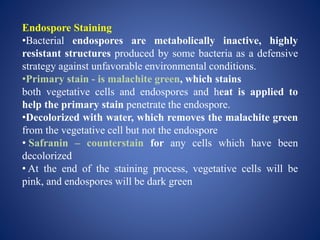
Endospore Staining
•Bacterial endospores are metabolically inactive, highly
resistant structures produced by some bacteria as a defensive
strategy against unfavorable environmental conditions.
•Primary stain - is malachite green, which stains
both vegetative cells and endospores and heat is applied to
help the primary stain penetrate the endospore.
•Decolorized with water, which removes the malachite green
from the vegetative cell but not the endospore
• Safranin – counterstain for any cells which have been
decolorized
• At the end of the staining process, vegetative cells will be
pink, and endospores will be dark green
Flagella stain
•They are very fragile
• Here staining is preeceded by using of some precipitating
agent like tannic acid or iron chloride
•Liefson’s stain, Carbol fuchsin or Fontana’s solution is used
to demonstrate the flagella
Nucleus staining of bacteria
•Here nuclear material is present in a region called nucleoid,
devoid of nuclear membrane.
•Since cytoplasm has a strong affinity for most stains and it
may interfere with observation of nuclear material
•It should be hydrolysed first with HCl
•Later stained with Giemsa stain
•Nuclear bodies will appear purple coloured
Lactophenol cotton blue staining in fungi
•It’s a rapid and routine examination of all types of fungi.
•It stains the fungal cytoplasm and provides a light blue
background, against which walls of hyphae can be seen as non-
stained region.
•It contains four components-
a)Phenol serves as a fungicide
b)Lactic acid act as a clearing agent
c)Cotton blue stains cytoplasm
d)Glycerine gives a semipermanent preparation
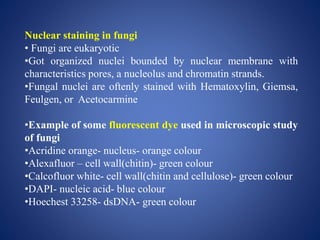
Nuclear staining in fungi
• Fungi are eukaryotic
•Got organized nuclei bounded by nuclear membrane with
characteristics pores, a nucleolus and chromatin strands.
•Fungal nuclei are oftenly stained with Hematoxylin, Giemsa,
Feulgen, or Acetocarmine
•Example of some fluorescent dye used in microscopic study
of fungi
•Acridine orange- nucleus- orange colour
•Alexafluor – cell wall(chitin)- green colour
•Calcofluor white- cell wall(chitin and cellulose)- green colour
•DAPI- nucleic acid- blue colour
•Hoechest 33258- dsDNA- green colour
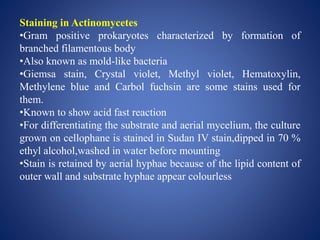
Staining in Actinomycetes
•Gram positive prokaryotes characterized by formation of
branched filamentous body
•Also known as mold-like bacteria
•Giemsa stain, Crystal violet, Methyl violet, Hematoxylin,
Methylene blue and Carbol fuchsin are some stains used for
them.
•Known to show acid fast reaction
•For differentiating the substrate and aerial mycelium, the culture
grown on cellophane is stained in Sudan IV stain,dipped in 70 %
ethyl alcohol,washed in water before mounting
•Stain is retained by aerial hyphae because of the lipid content of
outer wall and substrate hyphae appear colourless
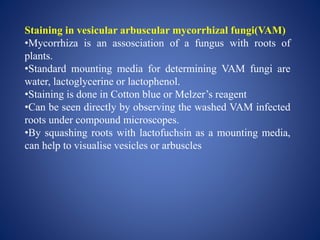
Staining in vesicular arbuscular mycorrhizal fungi(VAM)
•Mycorrhiza is an assosciation of a fungus with roots of
plants.
•Standard mounting media for determining VAM fungi are
water, lactoglycerine or lactophenol.
•Staining is done in Cotton blue or Melzer’s reagent
•Can be seen directly by observing the washed VAM infected
roots under compound microscopes.
•By squashing roots with lactofuchsin as a mounting media,
can help to visualise vesicles or arbuscles
Staining in Phytoplasma
•They are different from other bacteria by the absence
of cell wall
•Highly pleomorphic and sensitive to osmotic lysis so
known to present in phloem cells.
•Most reliable method for demonstrating the presence
of phytoplasma or MLO’s is electron microscopy.
•Under low–power light microscopy, we can go for
using Dienes’ stain
•Composition of Dienes’ stain-Methylene blue, Azure
II, Maltose, Sodium carbonate and Distilled water.
•Cells with infection appears blue

Staining

  • 1.
    Pl.Path.(505)DETECTION AND DIAGNOSIS OFPLANT DISEASES Presented by Ankita H-2016-70-M M.Sc (plant pathology) 1st year
  • 2.
    • Submitted to-Dr. I.M. Sharma Dr. Monica Sharma STAINING IN PATHOGEN DIAGNOSIS
  • 3.
    Staining – auxiliarytechnique increases the visibility generate extra information regarding cell Stains are used to • Define and examine bulk tissues for highlighting (for example- sieve tubes of phloem, xylem vessels) •Cell populations (classifying different bacterial cells, for instance) •Organelles within individual cells. Stains- chemical substances used to stain cells are organic compound containing a benzene ring, a chromophore and an auxochrome group.
  • 4.
    •Types- 1. Acidic- Anionic Usedto stain basic component of cell like cytoplasmic component. Eg. Picric acid, acid fuchsin, eosin etc. 2. Basic – Cationic Used to stain acidic component of cell like nucleic acid. Eg. Methylene blue, crystal violet, safranin etc. 3. Neutral – Having no charge Made by mixing aqueous solution of certain acidic and basic dyes.
  • 6.
    Staining techniques Direct staining- The organism is stained and background is left unstained Negative staining - The background is stained and the organism is left unaltered. Stains are classified as • Simple stain • Differential stain • Structural or special stains
  • 7.
    Simple Staining •The stainingprocess involves immersing the sample (before or after fixation and mounting) in dye solution, followed by rinsing and observation. •Simple staining is one step method using only one dye. • Basic dyes are used in direct stain and acidic dye is used in negative stain. •Used to study the morphology better, to show the nature of the cellular contents of the exudates and also to study the intracellular location of the bacteria
  • 8.
    Commonly used simplestains are 􀁺 Methylene blue 􀁺 Dilute carbol fuchsin 􀁺 Polychrome methylene blue
  • 9.
    Differential staining •Differential stainsuse two or more stains and allow the cells to be categorized into various groups or types. • It usually provides more information about the characteristics of the cell wall (thickness). •Two step method. •It includes- 1)Gram staining 2)Acid fast staining
  • 10.
    GRAM STAINING Gram stainingPrinciples •Gram staining is used to determine gram status to classify bacteria broadly. • It is based on the composition of their cell wall. • Gram staining uses crystal violet to stain cell walls, iodine as a mordant, and acid fuchsin or safranin counterstain to mark all bacteria •Gram-positive bacteria stain dark blue or violet. •Their cell wall is typically rich with peptidoglycan and lacks the secondary membrane and lipopolysaccharide layer found in Gram-negative bacteria
  • 11.
    Gram Staining Technique 1.Crystal violet acts as the primary stain. 2. Gram’s iodine acts as a mordant (Helps to fix the primary dye to the cell wall). 3. Decolorizer(acetone or ethanol) is used next to remove the primary stain (crystal violet) from Gram Negative bacteria. 4. Finally, a counter stain (Safranin), is applied to stain those cells (Gram Negative) that have lost the primary stain as a result of decolorization
  • 12.
    Gram Reaction- •Gram-positive bacteriaare those that are stained dark blue or violet by Gram staining. •Where Gram-negative bacteria, which cannot retain the crystal violet stain, instead taking up the counter stain (safranin or fuchsine) and appearing red or pink. •Gram-positive organisms are able to retain the crystal violet stain because of the high amount of peptidoglycan in the cell wall. •Grampositive cell walls typically lack the outer membrane found in Gram-negative bacteria. •Gram-negative bacteria are those bacteria that do not retain crystal violet dye in the Gram-staining protocol.
  • 13.
    ACID-FAST REACTION •The Ziehl–Neelsenstain, also known as the acid-fast stain, widely used differential staining procedure. •In this type some bacteria resist decolourization by both acid and alcohol and hence they are referred as acid-fast organisms. •Ziehl- Neelsen Procedure 1. Make a smear. Air Dry. Heat Fix. 2. Flood smear with Carbol Fuchsin stain (Carbol Fuchsin is a lipid soluble, phenolic compound, which is able to penetrate the cell wall) 3. Cover flooded smear with filter paper 4. Steam for 10 minutes. Add more Carbol Fuchsin stain as needed 5. Cool slide 6. Rinse with distilled water
  • 14.
    SPECIAL STAINS (kindof differential stain) • Stain for endospores • Stain for capsules • Stain for flagella •Stain for bacterial nucleus Capsule staining •The purpose of the capsule stain is to reveal the presence of the bacterial capsule. •Capsule may appear as clear halo when a fresh sample is stained by Grams or Leishman stain. •Generally we are using Negative stains like - India ink or Nigrosin
  • 15.
    Endospore Staining •Bacterial endosporesare metabolically inactive, highly resistant structures produced by some bacteria as a defensive strategy against unfavorable environmental conditions. •Primary stain - is malachite green, which stains both vegetative cells and endospores and heat is applied to help the primary stain penetrate the endospore. •Decolorized with water, which removes the malachite green from the vegetative cell but not the endospore • Safranin – counterstain for any cells which have been decolorized • At the end of the staining process, vegetative cells will be pink, and endospores will be dark green
  • 16.
    Flagella stain •They arevery fragile • Here staining is preeceded by using of some precipitating agent like tannic acid or iron chloride •Liefson’s stain, Carbol fuchsin or Fontana’s solution is used to demonstrate the flagella Nucleus staining of bacteria •Here nuclear material is present in a region called nucleoid, devoid of nuclear membrane. •Since cytoplasm has a strong affinity for most stains and it may interfere with observation of nuclear material •It should be hydrolysed first with HCl •Later stained with Giemsa stain •Nuclear bodies will appear purple coloured
  • 17.
    Lactophenol cotton bluestaining in fungi •It’s a rapid and routine examination of all types of fungi. •It stains the fungal cytoplasm and provides a light blue background, against which walls of hyphae can be seen as non- stained region. •It contains four components- a)Phenol serves as a fungicide b)Lactic acid act as a clearing agent c)Cotton blue stains cytoplasm d)Glycerine gives a semipermanent preparation
  • 18.
    Nuclear staining infungi • Fungi are eukaryotic •Got organized nuclei bounded by nuclear membrane with characteristics pores, a nucleolus and chromatin strands. •Fungal nuclei are oftenly stained with Hematoxylin, Giemsa, Feulgen, or Acetocarmine •Example of some fluorescent dye used in microscopic study of fungi •Acridine orange- nucleus- orange colour •Alexafluor – cell wall(chitin)- green colour •Calcofluor white- cell wall(chitin and cellulose)- green colour •DAPI- nucleic acid- blue colour •Hoechest 33258- dsDNA- green colour
  • 19.
    Staining in Actinomycetes •Grampositive prokaryotes characterized by formation of branched filamentous body •Also known as mold-like bacteria •Giemsa stain, Crystal violet, Methyl violet, Hematoxylin, Methylene blue and Carbol fuchsin are some stains used for them. •Known to show acid fast reaction •For differentiating the substrate and aerial mycelium, the culture grown on cellophane is stained in Sudan IV stain,dipped in 70 % ethyl alcohol,washed in water before mounting •Stain is retained by aerial hyphae because of the lipid content of outer wall and substrate hyphae appear colourless
  • 20.
    Staining in vesiculararbuscular mycorrhizal fungi(VAM) •Mycorrhiza is an assosciation of a fungus with roots of plants. •Standard mounting media for determining VAM fungi are water, lactoglycerine or lactophenol. •Staining is done in Cotton blue or Melzer’s reagent •Can be seen directly by observing the washed VAM infected roots under compound microscopes. •By squashing roots with lactofuchsin as a mounting media, can help to visualise vesicles or arbuscles
  • 21.
    Staining in Phytoplasma •Theyare different from other bacteria by the absence of cell wall •Highly pleomorphic and sensitive to osmotic lysis so known to present in phloem cells. •Most reliable method for demonstrating the presence of phytoplasma or MLO’s is electron microscopy. •Under low–power light microscopy, we can go for using Dienes’ stain •Composition of Dienes’ stain-Methylene blue, Azure II, Maltose, Sodium carbonate and Distilled water. •Cells with infection appears blue