GRAM STAINING METHOD
FOR BACTERIA
Gram staining is a method of differentiating
bacterial species into two large groups (Gram-
positive and Gram-negative).
It is a valuable diagnostic tool in both clinical and
research settings, not all bacteria can be definitively
classified by this technique.
This gives rise to Gram-variable and Gram
indeterminate groups as well.
The method is named after its inventor, the Danish
scientist Hans Christian Gram (1853–1938), who
developed the technique while working with Carl
Friedländer in the morgue of the city hospital in Berlin
in 1884.
In 1884, while examining lung tissue from patients who
had died of pneumonia, Gram had discovered that
certain stains were preferentially taken up and retained
by bacterial cells.
Gram did not use a counterstain in his procedure.
It was a few years later, that the German
pathologist Carl Weigert(1845-1904) from
Frankfurt, added a final step of staining with
Safranin.
Gram himself never used the red counterstaining
in order to visualize the gram negative bacteria
Methylene blue or basic fuchsin are used
They provide colour contrast but impart the
same colour to all bacteria
Indian ink or nigrosin are used.
They produce uniformly coloured background against
which the unstained bacteria stand out in contrast.
Particularly useful in the demonstration of bacterial
capsule which do not take simple stain and also for
spirochetes.
These stains impart different colours to different
bacteria or bacterial structures
Primary staining is done by one dye
Counter staining is done by a different dye of
contrasting colour
Example- Gram stain and Ziehl-Neelsen stain
 Silver impregnation method
 Used for structures and cells too thin to be seen under
the ordinary microscope like spirochetes and bacterial
flagella
 They may be rendered visible if they are thickened by
impregnation of silver on their surface
 Example- Fontana’s and Levaditi’s methods of staining
Bacteria All Bacteria will be stained Purple
Cells will be
Decolourized Stain will be fixed due to formation of
complex of Crystal Violet & Iodine
Saffranin
Cells retain the color of primary stain are gram positive
Cells do not retain color of primary stain are gram positive but takes up the
color of counter stain are gram negative
Stained with
Crystal Violet
Gram Iodine
solution
Alcohol or
Acetone
Applying a primary stain (Crystal Violet) to a
heat-fixed mear of a bacterial culture.
The addition of Grams Iodine, which binds to
crystal violet and traps it in the cell.
Decolourization with Alcohol or Acetone, and
Counter staining with Safranin
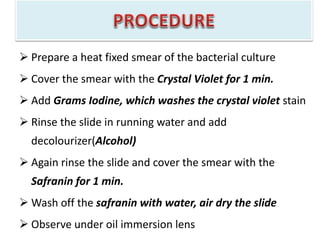
 Prepare a heat fixed smear of the bacterial culture
 Cover the smear with the Crystal Violet for 1 min.
 Add Grams Iodine, which washes the crystal violet stain
 Rinse the slide in running water and add
decolourizer(Alcohol)
 Again rinse the slide and cover the smear with the
Safranin for 1 min.
 Wash off the safranin with water, air dry the slide
 Observe under oil immersion lens
We know that Gram positivity is restricted almost
exclusively to the bacteria, with only a few other
groups, such as the yeasts, exhibiting this reaction.
THANK YOU
FOR
ATTENTION

Gram staining method for Bacteria

  • 1.
  • 2.
    Gram staining isa method of differentiating bacterial species into two large groups (Gram- positive and Gram-negative). It is a valuable diagnostic tool in both clinical and research settings, not all bacteria can be definitively classified by this technique. This gives rise to Gram-variable and Gram indeterminate groups as well.
  • 3.
    The method isnamed after its inventor, the Danish scientist Hans Christian Gram (1853–1938), who developed the technique while working with Carl Friedländer in the morgue of the city hospital in Berlin in 1884. In 1884, while examining lung tissue from patients who had died of pneumonia, Gram had discovered that certain stains were preferentially taken up and retained by bacterial cells.
  • 4.
    Gram did notuse a counterstain in his procedure. It was a few years later, that the German pathologist Carl Weigert(1845-1904) from Frankfurt, added a final step of staining with Safranin. Gram himself never used the red counterstaining in order to visualize the gram negative bacteria
  • 6.
    Methylene blue orbasic fuchsin are used They provide colour contrast but impart the same colour to all bacteria
  • 7.
    Indian ink ornigrosin are used. They produce uniformly coloured background against which the unstained bacteria stand out in contrast. Particularly useful in the demonstration of bacterial capsule which do not take simple stain and also for spirochetes.
  • 8.
    These stains impartdifferent colours to different bacteria or bacterial structures Primary staining is done by one dye Counter staining is done by a different dye of contrasting colour Example- Gram stain and Ziehl-Neelsen stain
  • 9.
     Silver impregnationmethod  Used for structures and cells too thin to be seen under the ordinary microscope like spirochetes and bacterial flagella  They may be rendered visible if they are thickened by impregnation of silver on their surface  Example- Fontana’s and Levaditi’s methods of staining
  • 10.
    Bacteria All Bacteriawill be stained Purple Cells will be Decolourized Stain will be fixed due to formation of complex of Crystal Violet & Iodine Saffranin Cells retain the color of primary stain are gram positive Cells do not retain color of primary stain are gram positive but takes up the color of counter stain are gram negative Stained with Crystal Violet Gram Iodine solution Alcohol or Acetone
  • 13.
    Applying a primarystain (Crystal Violet) to a heat-fixed mear of a bacterial culture. The addition of Grams Iodine, which binds to crystal violet and traps it in the cell. Decolourization with Alcohol or Acetone, and Counter staining with Safranin
  • 14.
     Prepare aheat fixed smear of the bacterial culture  Cover the smear with the Crystal Violet for 1 min.  Add Grams Iodine, which washes the crystal violet stain  Rinse the slide in running water and add decolourizer(Alcohol)  Again rinse the slide and cover the smear with the Safranin for 1 min.  Wash off the safranin with water, air dry the slide  Observe under oil immersion lens
  • 15.
    We know thatGram positivity is restricted almost exclusively to the bacteria, with only a few other groups, such as the yeasts, exhibiting this reaction.
  • 16.