Dyes
INTRODUCTION:
• Microbial Staining – giving colour to microbes.
• Because microbes are colourless and highly
transparent structures and there Refractive Index same
as air.
• Staining – process in which microbes are stained.
• Stains are used for
 To keep m.o. , microscopic & semitransparent structure
visible.
 To study morphology ( size, shape and arrangement of
microbes.
 To observe internal & external structures of m.o.

•The term stain and dyes are generally used interchangeably but
not same.
•Colouring agent used for general purpose called dye and used for
biological is called a stain.
•Stain contains both auxochrome and chromophore linked to
benzene ring.
•Chromophore- Colour, but any compound which contains
chromophore is not stain
• To act like stain it have affinity to cell
•Auxochrome having affinity to cell and imparts Colour to cell
with chromophore.
•Depend on presence of +ve and –ve charge on chromosome
there are two types of stain
• Based on the charges:
• Basic stain/dyes – stain with +ve charge.
• Acidic stain/dyes – stain with –ve charge.
 Basicdyes:
 Inwhichchromogenisthepositiveion(cation).
 Affinitytowards–vechargecellconstituents.
 Basicdyehastheform:dye+
Cl-
 examplesincludecrystalviolet,methyleneblueandsafranin.
 Acidicdyes:
 Inwhichchromogenisthenegativeion(anion).
 Affinitytowards+vechargecellconstituents.
 Acidicdyehastheform:Na+
dye-
 Examplesincludenigrosinand Congored.
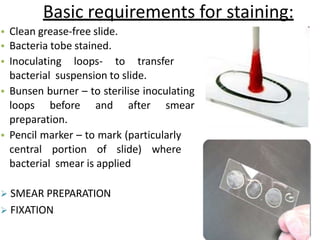
• Clean grease-free slide.
• Bacteria tobe stained.
• Inoculating loops- to transfer
bacterial suspension to slide.
• Bunsen burner – to sterilise inoculating
loops before and after smear
preparation.
• Pencil marker – to mark (particularly
central portion of slide) where
bacterial smear is applied
 SMEAR PREPARATION
 FIXATION
Basic requirements for staining:
Common steps involve in staining
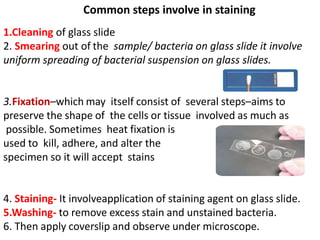
1.Cleaning of glass slide
2. Smearing out of the sample/ bacteria on glass slide it involve
uniform spreading of bacterial suspension on glass slides.
3.Fixation–which may itself consist of several steps–aims to
preserve the shape of the cells or tissue involved as much as
possible. Sometimes heat fixation is
used to kill, adhere, and alter the
specimen so it will accept stains
4. Staining- It involveapplication of staining agent on glass slide.
5.Washing- to remove excess stain and unstained bacteria.
6. Then apply coverslip and observe under microscope.
Simple( Monochrome) Staining
• Requirements
• Culture- E.coli, B.substilis, or S.aureus
• Stains- Methylene blue, Carbol fuchsin
Principle-
• Here we use only one stain to give Colour to bacteria called
monochrome staining.(mono-single, chrome-colour)
• Surface of bacterial cell has acidic characteristics because of
large amount of carboxyl group deposited on cell surface due
to acidic amino acid.
• Therefore, when ionization of carboxyl group takes place it
imparts –ve charge to bacterial cell.
COOH ionization COO- + H+
• In nature H+ replace by another positive charge ion. e.g. Na+,
+ +
• Basic dyes are commonly used for monochrome staining.
These dyes available as salt of acid e. g. methylene blue
chloride.( MBCl)
It ionizes to form methylene blue & chloride ion.
MBCl ionization MB++ Cl-
On addition of methylene blue for staining exchange of MB+
with Na+ on bacterial cell surface occurs
Result in ionic bond formation between MB+ and cell surface.
Thus coloring agent form ionic bond with cell. Result in staining
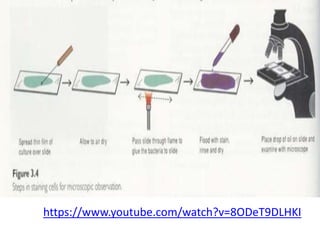
Procedure Simple staining
• https://www.youtube.com/watch?v=sxa46xKfIOY
https://www.youtube.com/watch?v=8ODeT9DLHKI
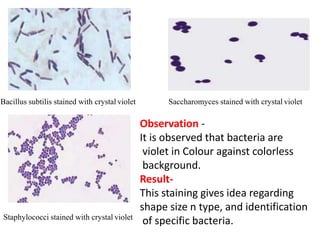
Bacillus subtilis stained with crystal violet Saccharomyces stained with crystal violet
Staphylococci stained with crystal violet
Observation -
It is observed that bacteria are
violet in Colour against colorless
background.
Result-
This staining gives idea regarding
shape size n type, and identification
of specific bacteria.
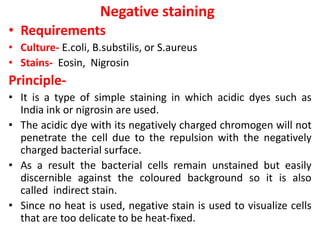
Negative staining
• Requirements
• Culture- E.coli, B.substilis, or S.aureus
• Stains- Eosin, Nigrosin
Principle-
• It is a type of simple staining in which acidic dyes such as
India ink or nigrosin are used.
• The acidic dye with its negatively charged chromogen will not
penetrate the cell due to the repulsion with the negatively
charged bacterial surface.
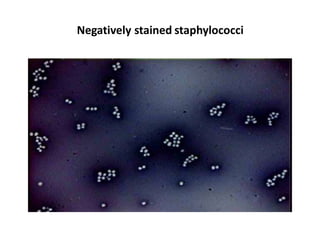
• As a result the bacterial cells remain unstained but easily
discernible against the coloured background so it is also
called indirect stain.
• Since no heat is used, negative stain is used to visualize cells
that are too delicate to be heat-fixed.
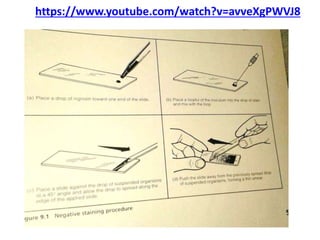
https://www.youtube.com/watch?v=avveXgPWVJ8
Negatively stained staphylococci
DIFFERENTIAL STAINING
Grams Staining
• Requirements
• Culture- E.coli, B.substilis, or S.aureus
• Stains- Crystal violet , safaranin
• Reagent- Grams iodine (mordant) , Alcohol
DIFFERENTIAL STAINING
 More than one dye is used-
 Used for Differentiation among bacteria is possible- Eg. Gram’s
staining & Acid-faststaining
 It allows the observation of cell morphology, or shape, but usually
provides more information about the characteristics of the cell wall
(Thickness).
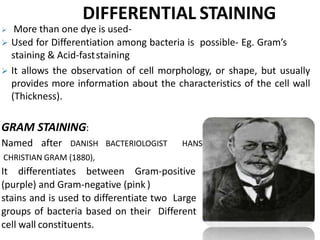
GRAM STAINING:
Named after DANISH BACTERIOLOGIST HANS
CHRISTIAN GRAM (1880),
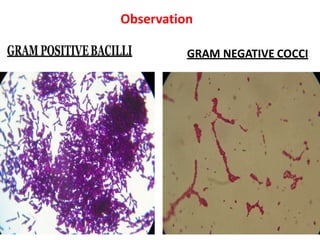
It differentiates between Gram-positive
(purple) and Gram-negative (pink )
stains and is used to differentiate two Large
groups of bacteria based on their Different
cell wall constituents.
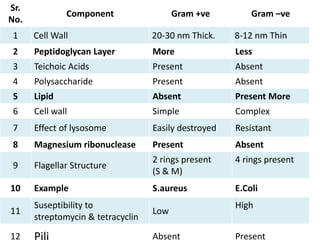
Sr.
No.
Component Gram +ve Gram –ve
1 Cell Wall 20-30 nm Thick. 8-12 nm Thin
2 Peptidoglycan Layer More Less
3 Teichoic Acids Present Absent
4 Polysaccharide Present Absent
5 Lipid Absent Present More
6 Cell wall Simple Complex
7 Effect of lysosome Easily destroyed Resistant
8 Magnesium ribonuclease Present Absent
9 Flagellar Structure
2 rings present
(S & M)
4 rings present
10 Example S.aureus E.Coli
11
Suseptibility to
streptomycin & tetracyclin
Low
High
12 Absent Present
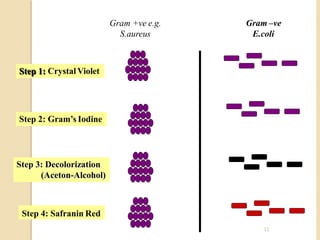
STEPS & Principle OF GRAM STAINING
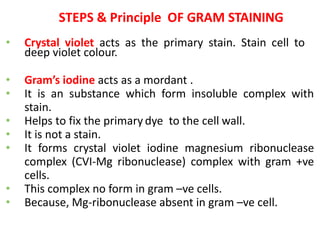
• Crystal violet acts as the primary stain. Stain cell to
deep violet colour.
• Gram’s iodine acts as a mordant .
• It is an substance which form insoluble complex with
stain.
• Helps to fix the primary dye to the cell wall.
• It is not a stain.
• It forms crystal violet iodine magnesium ribonuclease
complex (CVI-Mg ribonuclease) complex with gram +ve
cells.
• This complex no form in gram –ve cells.
• Because, Mg-ribonuclease absent in gram –ve cell.
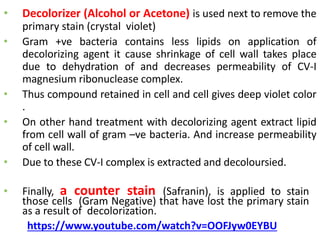
• Decolorizer (Alcohol or Acetone) is used next to remove the
primary stain (crystal violet)
• Gram +ve bacteria contains less lipids on application of
decolorizing agent it cause shrinkage of cell wall takes place
due to dehydration of and decreases permeability of CV-I
magnesium ribonuclease complex.
• Thus compound retained in cell and cell gives deep violet color
.
• On other hand treatment with decolorizing agent extract lipid
from cell wall of gram –ve bacteria. And increase permeability
of cell wall.
• Due to these CV-I complex is extracted and decoloursied.
• Finally, a counter stain (Safranin), is applied to stain
those cells (Gram Negative) that have lost the primary stain
as a result of decolorization.
https://www.youtube.com/watch?v=OOFJyw0EYBU
11
Gram +ve e.g.
S.aureus
Gram –ve
E.coli
Step 1: Crystal Violet
Step 2: Gram’s Iodine
Step 3: Decolorization
(Aceton-Alcohol)
Step 4: Safranin Red
GRAM NEGATIVE COCCI
Observation
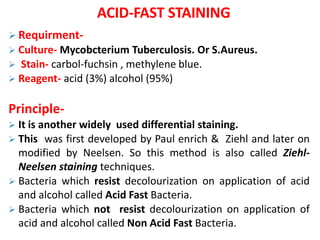
ACID-FAST STAINING
 Requirment-
 Culture- Mycobcterium Tuberculosis. Or S.Aureus.
 Stain- carbol-fuchsin , methylene blue.
 Reagent- acid (3%) alcohol (95%)
Principle-
 It is another widely used differential staining.
 This was first developed by Paul enrich & Ziehl and later on
modified by Neelsen. So this method is also called Ziehl-
Neelsen staining techniques.
 Bacteria which resist decolourization on application of acid
and alcohol called Acid Fast Bacteria.
 Bacteria which not resist decolourization on application of
acid and alcohol called Non Acid Fast Bacteria.
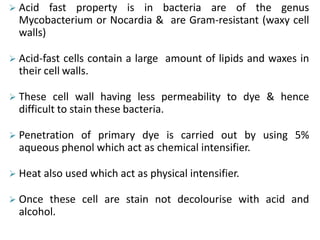
 Acid fast property is in bacteria are of the genus
Mycobacterium or Nocardia & are Gram-resistant (waxy cell
walls)
 Acid-fast cells contain a large amount of lipids and waxes in
their cell walls.
 These cell wall having less permeability to dye & hence
difficult to stain these bacteria.
 Penetration of primary dye is carried out by using 5%
aqueous phenol which act as chemical intensifier.
 Heat also used which act as physical intensifier.
 Once these cell are stain not decolourise with acid and
alcohol.
1. Carbol fuchsin ( Primary Stain)-
• It is an phenolic stain soluble in lipid which is major constituent
of M. tuberculosis cell wall
• Due application of phenolic stain it penetrate into cell wall of
M. tuberculosis & retain red colour.
• Penetration is further increase by application of heat , which
pass carbol fuschin into inner lipoid cell wall and cytoplasm.
• All cell observe red in colour after application of these stain.
2. Decolourising agent ( 3 % acid + 95% alcohol)-
• Smear cooled before decolourization which allow the waxy cells
to harden. On application of decolourising agent cell resist to
decolourisation .
• Primary stain more soluble in waxes on species M. tuberculosis.
• Resist decolourisation & remains red in colour.
• Non acid fast bacteria having lack of waxes.
• Primary stain is easily removed by application of
decolouriser and bacteria observe colorless.
3. Counter stain (Methylene Blue) –
• Non acid fast bacteria absorb counter stain & appear
blue colour .
• https://www.youtube.com/watch?v=YzTgHU-aCqo
Acid fast staining Procedure
• Prepare a smear of the microorganism on a clean slide.
• Allow the smear to air-dry then fix it by flaming.
• Place the slide over a steam bath and flood the smear with
strong carbol fuchsin and keep it for 5 mins.
• (Caution :don,t allow stain to dry; replenish stain as needed.
also, prevent stain from boiling by adjusting the temperature
applied.)
• Allow to cool and then wash with tap water.
• Decolourize with acid alcohol, till the effluent runs almost clear
with a slight red tinge.
• Wash with tap water
• Counterstain with methylene blue for 2 mins.
• Wash smear with tap water.
• Blot dry and examine with a microscope.
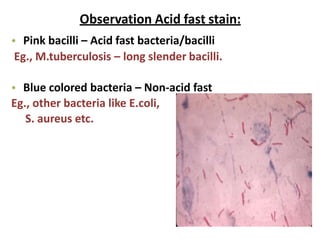
• Pink bacilli – Acid fast bacteria/bacilli
Eg., M.tuberculosis – long slender bacilli.
• Blue colored bacteria – Non-acid fast
Eg., other bacteria like E.coli,
S. aureus etc.
Observation Acid fast stain:
•Thank You

All staining techniques

  • 1.
  • 2.
    INTRODUCTION: • Microbial Staining– giving colour to microbes. • Because microbes are colourless and highly transparent structures and there Refractive Index same as air. • Staining – process in which microbes are stained. • Stains are used for  To keep m.o. , microscopic & semitransparent structure visible.  To study morphology ( size, shape and arrangement of microbes.  To observe internal & external structures of m.o. 
  • 3.
    •The term stainand dyes are generally used interchangeably but not same. •Colouring agent used for general purpose called dye and used for biological is called a stain. •Stain contains both auxochrome and chromophore linked to benzene ring. •Chromophore- Colour, but any compound which contains chromophore is not stain • To act like stain it have affinity to cell •Auxochrome having affinity to cell and imparts Colour to cell with chromophore. •Depend on presence of +ve and –ve charge on chromosome there are two types of stain • Based on the charges: • Basic stain/dyes – stain with +ve charge. • Acidic stain/dyes – stain with –ve charge.
  • 4.
     Basicdyes:  Inwhichchromogenisthepositiveion(cation). Affinitytowards–vechargecellconstituents.  Basicdyehastheform:dye+ Cl-  examplesincludecrystalviolet,methyleneblueandsafranin.  Acidicdyes:  Inwhichchromogenisthenegativeion(anion).  Affinitytowards+vechargecellconstituents.  Acidicdyehastheform:Na+ dye-  Examplesincludenigrosinand Congored.
  • 5.
    • Clean grease-freeslide. • Bacteria tobe stained. • Inoculating loops- to transfer bacterial suspension to slide. • Bunsen burner – to sterilise inoculating loops before and after smear preparation. • Pencil marker – to mark (particularly central portion of slide) where bacterial smear is applied  SMEAR PREPARATION  FIXATION Basic requirements for staining:
  • 6.
    Common steps involvein staining 1.Cleaning of glass slide 2. Smearing out of the sample/ bacteria on glass slide it involve uniform spreading of bacterial suspension on glass slides. 3.Fixation–which may itself consist of several steps–aims to preserve the shape of the cells or tissue involved as much as possible. Sometimes heat fixation is used to kill, adhere, and alter the specimen so it will accept stains 4. Staining- It involveapplication of staining agent on glass slide. 5.Washing- to remove excess stain and unstained bacteria. 6. Then apply coverslip and observe under microscope.
  • 7.
    Simple( Monochrome) Staining •Requirements • Culture- E.coli, B.substilis, or S.aureus • Stains- Methylene blue, Carbol fuchsin Principle- • Here we use only one stain to give Colour to bacteria called monochrome staining.(mono-single, chrome-colour) • Surface of bacterial cell has acidic characteristics because of large amount of carboxyl group deposited on cell surface due to acidic amino acid. • Therefore, when ionization of carboxyl group takes place it imparts –ve charge to bacterial cell. COOH ionization COO- + H+ • In nature H+ replace by another positive charge ion. e.g. Na+, + +
  • 8.
    • Basic dyesare commonly used for monochrome staining. These dyes available as salt of acid e. g. methylene blue chloride.( MBCl) It ionizes to form methylene blue & chloride ion. MBCl ionization MB++ Cl- On addition of methylene blue for staining exchange of MB+ with Na+ on bacterial cell surface occurs Result in ionic bond formation between MB+ and cell surface. Thus coloring agent form ionic bond with cell. Result in staining
  • 9.
    Procedure Simple staining •https://www.youtube.com/watch?v=sxa46xKfIOY https://www.youtube.com/watch?v=8ODeT9DLHKI
  • 10.
    Bacillus subtilis stainedwith crystal violet Saccharomyces stained with crystal violet Staphylococci stained with crystal violet Observation - It is observed that bacteria are violet in Colour against colorless background. Result- This staining gives idea regarding shape size n type, and identification of specific bacteria.
  • 11.
    Negative staining • Requirements •Culture- E.coli, B.substilis, or S.aureus • Stains- Eosin, Nigrosin Principle- • It is a type of simple staining in which acidic dyes such as India ink or nigrosin are used. • The acidic dye with its negatively charged chromogen will not penetrate the cell due to the repulsion with the negatively charged bacterial surface. • As a result the bacterial cells remain unstained but easily discernible against the coloured background so it is also called indirect stain. • Since no heat is used, negative stain is used to visualize cells that are too delicate to be heat-fixed.
  • 12.
  • 13.
  • 14.
    DIFFERENTIAL STAINING Grams Staining •Requirements • Culture- E.coli, B.substilis, or S.aureus • Stains- Crystal violet , safaranin • Reagent- Grams iodine (mordant) , Alcohol
  • 15.
    DIFFERENTIAL STAINING  Morethan one dye is used-  Used for Differentiation among bacteria is possible- Eg. Gram’s staining & Acid-faststaining  It allows the observation of cell morphology, or shape, but usually provides more information about the characteristics of the cell wall (Thickness). GRAM STAINING: Named after DANISH BACTERIOLOGIST HANS CHRISTIAN GRAM (1880), It differentiates between Gram-positive (purple) and Gram-negative (pink ) stains and is used to differentiate two Large groups of bacteria based on their Different cell wall constituents.
  • 16.
    Sr. No. Component Gram +veGram –ve 1 Cell Wall 20-30 nm Thick. 8-12 nm Thin 2 Peptidoglycan Layer More Less 3 Teichoic Acids Present Absent 4 Polysaccharide Present Absent 5 Lipid Absent Present More 6 Cell wall Simple Complex 7 Effect of lysosome Easily destroyed Resistant 8 Magnesium ribonuclease Present Absent 9 Flagellar Structure 2 rings present (S & M) 4 rings present 10 Example S.aureus E.Coli 11 Suseptibility to streptomycin & tetracyclin Low High 12 Absent Present
  • 17.
    STEPS & PrincipleOF GRAM STAINING • Crystal violet acts as the primary stain. Stain cell to deep violet colour. • Gram’s iodine acts as a mordant . • It is an substance which form insoluble complex with stain. • Helps to fix the primary dye to the cell wall. • It is not a stain. • It forms crystal violet iodine magnesium ribonuclease complex (CVI-Mg ribonuclease) complex with gram +ve cells. • This complex no form in gram –ve cells. • Because, Mg-ribonuclease absent in gram –ve cell.
  • 18.
    • Decolorizer (Alcoholor Acetone) is used next to remove the primary stain (crystal violet) • Gram +ve bacteria contains less lipids on application of decolorizing agent it cause shrinkage of cell wall takes place due to dehydration of and decreases permeability of CV-I magnesium ribonuclease complex. • Thus compound retained in cell and cell gives deep violet color . • On other hand treatment with decolorizing agent extract lipid from cell wall of gram –ve bacteria. And increase permeability of cell wall. • Due to these CV-I complex is extracted and decoloursied. • Finally, a counter stain (Safranin), is applied to stain those cells (Gram Negative) that have lost the primary stain as a result of decolorization. https://www.youtube.com/watch?v=OOFJyw0EYBU
  • 19.
    11 Gram +ve e.g. S.aureus Gram–ve E.coli Step 1: Crystal Violet Step 2: Gram’s Iodine Step 3: Decolorization (Aceton-Alcohol) Step 4: Safranin Red
  • 20.
  • 21.
    ACID-FAST STAINING  Requirment- Culture- Mycobcterium Tuberculosis. Or S.Aureus.  Stain- carbol-fuchsin , methylene blue.  Reagent- acid (3%) alcohol (95%) Principle-  It is another widely used differential staining.  This was first developed by Paul enrich & Ziehl and later on modified by Neelsen. So this method is also called Ziehl- Neelsen staining techniques.  Bacteria which resist decolourization on application of acid and alcohol called Acid Fast Bacteria.  Bacteria which not resist decolourization on application of acid and alcohol called Non Acid Fast Bacteria.
  • 22.
     Acid fastproperty is in bacteria are of the genus Mycobacterium or Nocardia & are Gram-resistant (waxy cell walls)  Acid-fast cells contain a large amount of lipids and waxes in their cell walls.  These cell wall having less permeability to dye & hence difficult to stain these bacteria.  Penetration of primary dye is carried out by using 5% aqueous phenol which act as chemical intensifier.  Heat also used which act as physical intensifier.  Once these cell are stain not decolourise with acid and alcohol.
  • 23.
    1. Carbol fuchsin( Primary Stain)- • It is an phenolic stain soluble in lipid which is major constituent of M. tuberculosis cell wall • Due application of phenolic stain it penetrate into cell wall of M. tuberculosis & retain red colour. • Penetration is further increase by application of heat , which pass carbol fuschin into inner lipoid cell wall and cytoplasm. • All cell observe red in colour after application of these stain. 2. Decolourising agent ( 3 % acid + 95% alcohol)- • Smear cooled before decolourization which allow the waxy cells to harden. On application of decolourising agent cell resist to decolourisation . • Primary stain more soluble in waxes on species M. tuberculosis. • Resist decolourisation & remains red in colour.
  • 24.
    • Non acidfast bacteria having lack of waxes. • Primary stain is easily removed by application of decolouriser and bacteria observe colorless. 3. Counter stain (Methylene Blue) – • Non acid fast bacteria absorb counter stain & appear blue colour . • https://www.youtube.com/watch?v=YzTgHU-aCqo
  • 25.
    Acid fast stainingProcedure • Prepare a smear of the microorganism on a clean slide. • Allow the smear to air-dry then fix it by flaming. • Place the slide over a steam bath and flood the smear with strong carbol fuchsin and keep it for 5 mins. • (Caution :don,t allow stain to dry; replenish stain as needed. also, prevent stain from boiling by adjusting the temperature applied.) • Allow to cool and then wash with tap water. • Decolourize with acid alcohol, till the effluent runs almost clear with a slight red tinge. • Wash with tap water • Counterstain with methylene blue for 2 mins. • Wash smear with tap water. • Blot dry and examine with a microscope.
  • 26.
    • Pink bacilli– Acid fast bacteria/bacilli Eg., M.tuberculosis – long slender bacilli. • Blue colored bacteria – Non-acid fast Eg., other bacteria like E.coli, S. aureus etc. Observation Acid fast stain:
  • 27.