IOSR Journal of Pharmacy
Vol. 2, Issue 3, May-June, 2012, pp.374-379


         Synthesis and Pharmacological Screening of Some Benzoxazole
                    Derivatives as Anti-inflammatory Agents
          Mohammed Rageeb Mohammed Usman*,Rana Sohil D1,Md. Abullais Md.
                    Usman1,Shaikh TanverY2,Sayad Imran wahab3
  *1
    Assistant Professor, Department of Pharmacognosy, Smt. S. S. Patil College of Pharmacy, Chopda, Maharashtra, India
   2
     Assistant Professor, Department of Pharmaceutics, Smt. S. S. Patil College of Pharmacy, Chopda, Maharashtra, India
 3
   Lecturer, Department of Pharmaceutical Chemistry, Y. B. Chavan College of Pharmacy, Aurangabad, Maharashtra, India


ABSTRACT
A series of some new 5-substituted benzoxazoles were synthesized and were characterized by different methods like IR,
1
  HNMR and MASS spectra. After conformation of structure assigned, these compounds were screened for its anti-
inflammatory activity.

Keywords: Benzoxazole, Anti-inflammatory, Pharmacological, Derivatives, Phytochemical.

INTRODUCTION
Inflammation evidence of many diseases is major concern for physicians throughout the word. The single most important
event in this process is accumulation of large number of phagocytic cells of the site of the inflammation. Tissue injury caused
by introduction of a foreign antigen, trauma, or local exposure to certain chemicals triggers complex processes of
inflammation. This may consists of a fluid stasis as well as the accumulation of several cellular and no cellular elements of
the immune response [1-6].
 In most of these cases, it has been proved that the 5-substituted benzoxazole [7], substituted sulfonyl derivatives [8] and
carbohydrazides [9], have promising anti-inflammatory activity. Also benzoxazole at its 5th position [10], is more prone for
its lipophilic action and therefore we go the substitution at 5 th position of benzoxazole. Hence, it was planned to synthesize
the N`[substituted sulfonyl]-1,3-benzoxazole-5-carbohydrazide to get good antiinflammatory activity.
In the present investigation, series of N`[substituted sulfonyl]-1,3-benzoxazole-5-carbohydrazide, were synthesized using
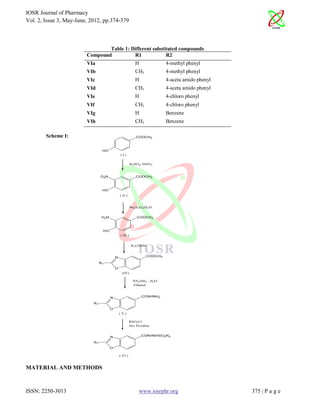
appropriate synthetic route (Scheme: I page no.3) and were screened for its antiinflammatory activity (VIa-VIh).
4-Hydroxy-3-nitro-benzoic acid methyl ester (II) was synthesized in an excellent yield by electrophilic substitution, nitration
on p-hydroxy methyl benzoate (I) by concentrated nitric acid and concentrated sulfuric acid. Compound (II) on reduction
with the help of reducing agent like sodium dithionate [11], with alcohol afforded 3-amino-4-hydroxy-benzoic acid methyl
ester (III). Reaction of compound (III) with two appropriate aliphatic acids such as, formic acid and acetic acid gives
corresponding 2-subtituted benzoxazole-5-carboxylic acid methyl esters (IVa and IVb). The reaction of compounds (IV) with
hydrazine hydrate in ethanol on refluxing gives the corresponding 2-substituted benzoxazole-5-carboxylic acid hydrazides
(Va and Vb) is the nucleophilic substitution type reaction. On further reaction of compounds (V) with the different
nucleophilic substitution of substituted sulfonyl chloride derivatives afforded the corresponding eight N`[substituted
sulfonyl]-1,3-benzoxazole-5-carbohydrazide (VIa-VIh).
The purity and homogeneity of compounds synthesized were determined by their sharp melting points, TLC, IR spectra.
Preliminary pharmacological screening was performed, which includes approximate toxicity testing (LD50) [13] and
antiinflammatory activity [14]. The LD50 of the test compounds performed on the rats as per the OECD 423 guidelines for
selection of dose.
                                                                   O
                                                                              H    O
                                                                   C          N
                                             N
                                                                         N         S      R2
                                  R1                                     H
                                                                                   O
                                             O
                        Figure 1: N`[substituted sulfonyl]-1,3-benzoxazole-5-carbohydrazide (VI)


ISSN: 2250-3013                                       www.iosrphr.org                                       374 | P a g e
IOSR Journal of Pharmacy
Vol. 2, Issue 3, May-June, 2012, pp.374-379


                                 Table 1: Different substituted compounds
                         Compound          R1             R2
                         VIa                                  H               4-methyl phenyl
                         VIb                                  CH3             4-methyl phenyl
                         VIc                                  H               4-aceta amido phenyl
                         VId                                  CH3             4-aceta amido phenyl
                         VIe                                  H               4-chloro phenyl
                         VIf                                  CH3             4-chloro phenyl
                         VIg                                  H               Benzene
                         VIh                                  CH3             Benzene

        Scheme I:                                              COOCH3


                                  HO
                                                 (I)


                                                           H2SO 4, HNO 3


                                 O2N                           COOCH3


                                  HO
                                                 ( II )


                                                           Na2S2O 4/H 2O


                                  H2 N                         COOCH3


                                  HO
                                                 ( III )


                                                            R1COOH


                                             N                       COOCH3

                                 R1
                                             O
                                                  (IV)

                                                             NN 2NH2 , H 2O
                                                             Ethanol


                                         N                        CONHNH2

                            R1
                                         O
                                                 (V)

                                                           RSO2Cl
                                                           Dry Pyridine


                                         N                        CONHNHSO2R2

                            R1
                                         O

                                                 ( VI )


MATERIAL AND METHODS


ISSN: 2250-3013                                                 www.iosrphr.org                      375 | P a g e
IOSR Journal of Pharmacy
Vol. 2, Issue 3, May-June, 2012, pp.374-379


All chemicals were used as purchased pure from Hi-Media, E-Merck. p-hydroxy methyl benzoate (I) was used as starting
material undergoes electrophilic substitution reaction, nitration by using concentrated nitric acid and concentrated sulphuric
acid gives 4-Hydroxy-3-nitro-benzoic acid methyl ester (II) this reaction is carried out at 0-10°C and recrystallised by
methanol. Compound (II) undergoes reduction by using sodium dithionate as reducing agent in mixture with methanol gives
good yield of 3-amino-4-hydroxy-benzoic acid methyl ester (III). This was recrystallised by using methanol. On further
reaction of compound (III) with aliphatic acid like formic and acetic acid gives corresponding compounds 2-subtituted
benzoxazole-5-carboxylic acid methyl ester (IVa-IVb). Both these products were recrystallised from alcohol. Compounds
(IVa-IVb) on reaction with hydrazine hydrate and mixture with ethanol gives corresponding 2-substituted benzoxazole-5-
carboxylic acid hydrazides (Va-Vb) also both these products was recrystallised from alcohol. And finally compounds (Va-
Vb) on further reaction with substituted sulfonyl chlorides by using pyridine as catalyst which traps HCl gas in compounds
gives corresponding N`[substituted sulfonyl]-1,3-benzoxazole-5-carbohydrazide (VIa-VIh) compounds. Finally these eight
compounds were recrystallised by ethanol give pure compounds.
The melting points of the compounds were determined in open capillary method which was uncorrected.
Porous silica gel plates activated at 110°C for 30 min. were used for thin layer chromatography (TLC) and were developed
with iodine vapours. IR spectra of compounds were recorded using KBr pellets on FTIR. 1H-NMR spectra (solvents) were
recorded on Varian EM 390 spectra (chemicals shift in  ppm). Mass Spectra of the synthesized compounds were recorded
on (FAB-MS) [11-12].

RESULT AND DISCUSSION
                                                                  O
                                                                             H     O
                                                                   C         N
                                             N
                                                                        N          S     R2
                                  R1                                    H
                                                                                   O
                                             O


                       Figure 2: N`[substituted sulfonyl]-1,3-benzoxazole-5-carbohydrazide (VI)


                                       Table 2: The results studies are summarized as

                                                                         Mp (0C)
Compound No.           R2                   Molecular Formula                                   Yield (%)       Rf Value
                                                                         uncorrected

VIa                    Tosyl                C15H13N3O4S                  72-74                  38%             0.63

VIb                    Tosyl                C16H15N3O4S                  78-80                  57%             0.60

VIc                    p-aceta amido        C16H14N4O5S                  92-94                  72%             0.57

VId                    p-aceta amido        C17H16N4O5S                  88-90                  40%             0.54

VIe                    p-chloro             C14H10ClN3O4S                110-112                75%             0.53

VIf                    p-chloro             C15H12ClN3O4S                102-104                72%             0.64

VIg                    Benzene              C14H11N3O4S                  69-70                  30%             0.62

VIh                    Benzene              C15H13N3O4S                  66-68                  40%             0.72


Elemental analysis of the given compounds is summarized below.


ISSN: 2250-3013                                      www.iosrphr.org                                        376 | P a g e
IOSR Journal of Pharmacy
Vol. 2, Issue 3, May-June, 2012, pp.374-379


All products were isolated and characterized by spectrometric methods ( 1H NMR, IR and mass spectra). A detailed IR, NMR
and mass analysis is explained below:

Compound VIa (C15H13N3O4S)
IR (KBr) cm-1: 3390 (-NH-str.), 1315 and 1398 (-S-O str.), 1730 (-CO-str.), 1625 (C-N str.), 3085 (Ar–H str.), 835 (C=C
bending), 1165 cm-1 (ether group in ring);
1
  H NMR: (CDCl3)  7.34-7.95 (m, Ar-H, 4H×2),  8.0 (s, NH, 2H),  2.35 (d, CH3, 3H).
FAB-MS: (m/z, 100%): 331 ([M+], (100%)
Elemental analysis (%): Calculated: C: 52.9, H: 4.04, N: 13.08,
                              Found: C: 52.5, H: 4.04, N: 13.12.
Compound VIb (C16H15N3O4S)
IR (KBr) cm-1: 3319 (-NH- str.), 1315 (-S-O str.), 1730 (-CO- str.), 1625 (C=N str.), 3010 (Ar–H str.), 2230 (C-C str.)
1
  H NMR: (CDCl3)  7.34-7.95 (m, Ar-H, 4H+3H),  8.0 (s, NH, 2H),  2.35 (d, CH3, 3H×2).
FAB-MS: (m/z, 100%): 345 ([M+], (100%)
Elemental analysis (%): Calculated: C: 55.6, H: 4.34, N: 12.07,
                              Found: C: 55.5, H: 4.38, N: 12.10.
Compound VIc (C16H14N4O5S)
IR (KBr) cm-1: 3327 (-NH- str.), 1352 (-S-O str.), 1730 (-CO- str.), 1116 and1172 cm-1 (CONH str.), 3010 cm-1 (Ar–H str.).
1
  H NMR: (CDCl3)  7.44-7.95(m, Ar-H, 4H×2),  8.0 (s, NH, 3H),  2.02 (d, CH3, 3H).
FAB-MS: (m/z, 100%): 374 ([M+], (100%)
Elemental analysis (%): Calculated: C: 53.63, H: 3.91, N: 15.64,
                              Found: C: 53.65, H: 3.87, N: 15.76.
Compound VId (C17H16N4O5S)
IR (KBr) cm-1: 3324 (-NH- str.), 1322 (-S-O str.), 1730 (-CO- str.), 1629 (C=N str.), 3110 (Ar–H str.), 3180 (CONH str.).
1
  H NMR: (CDCl3)  7.44-7.95 (m, Ar-H, 4H+3H),  8.0 (s, NH, 3H),  2.02 and 2.35 (d, CH3, 3H×2).
FAB-MS: (m/z, 100%): 388 ([M+], (100%)
Elemental analysis (%): Calculated: C: 52.57, H: 4.12, N: 14.43,
                              Found: C: 52.560, H: 4.16, N: 14.47.
Compound VIe (C14H10ClN3O4S)
IR (KBr) cm-1: 3216 (-NH- str.), 1339 (-S-O str.), 3090 (Ar–H str.), 772 (C-Cl str.)
1
  H NMR: (CDCl3)  7.44-7.95 (m, Ar-H, 4H×2),  8.0 (s, NH, 2H).
FAB-MS: (m/z, 100%): 351.50 ([M+], 100%)
Elemental analysis (%): Calculated: C: 45.94, H: 2.94, N: 12.37,
                              Found: C: 45.97, H: 2.98, N: 12.40.

Compound VIf (C15H12ClN3O4S)
IR (KBr) cm-1: 3204 (-NH- str.), 1354 and 1329 (-S-O str.), 1730 (-CO- str.), 3180 (CONH str.), 3097 (Ar–H str.), 767 (C-Cl
str.),
1
  H NMR: (CDCl3)  7.44-7.95 (m, Ar-H, 4H+3H),  8.0 (s, NH, 2H),  2.35 (d, CH3, 3H)
FAB-MS: (m/z, 100%): 317.50 ([M+], 100%)
Elemental analysis (%): Calculated: C: 47.81, H: 3.73, N: 11.81,
                            Found: C: 47.78, H: 3.75, N: 11.84.
Compound VIg (C14H11N3O4S)
IR (KBr) cm-1: 3350 (-NH- str.), 1329 (-S-O str.), 1730 1 (-CO- str.), 3174 (CONH str.), 3097 (Ar–H str.), 674 (C-C
bending)
1
  H NMR: (CDCl3)  7.03-7.95 (m, Ar-H, 5H+4H),  8.0 (s, NH, 2H).
FAB-MS: (m/z, 100%): 317 ([M+], 100%)
Elemental analysis (%): Calculated: C: 51.31, H: 3.28, N: 13.81,
                            Found: C: 51.33, H: 3.32, N: 13.85.
Compound VIh (C15H13N3O4S)
IR (KBr) cm-1: 3204 (-NH- str.), 1346 (-S-O str.), 1730 (-CO- str.), 1625 (C=N str.), 3085 (Ar–H str.), 2990 (C-C str.).
1
  H NMR: (CDCl3)  7.03-7.95 (m, Ar-H, 4H×2),  8.0 (s, NH, 2H),  2.35 (d, CH3, 3H).
FAB-MS: (m/z, 100%): 331 ([M+], 100%)
Elemental analysis (%): Calculated: C: 53.31, H: 3.75, N: 13.12,
                            Found: C: 53.34, H: 3.77, N: 13.16.


ISSN: 2250-3013                                     www.iosrphr.org                                      377 | P a g e
IOSR Journal of Pharmacy
Vol. 2, Issue 3, May-June, 2012, pp.374-379


Pharmacological Screening
LD50
LD50 of test compounds was performed in National Toxicological Center, Pune and determined on mice as per the OECD
Guidelines 423. 2000 mg/kg dose was considered as LD50. 1/10th of the LD50 was considered as an effective dose i.e.200
mg/kg.

Anti-Inflammatory Activity
The anti-inflammatory activities of these compounds were done by using carrageenan induced rat paw edema method
described by Winter et al (1962) [10].

                        Table 4: Anti-inflammatory activity of Some Benzoxazole Derivatives
       Group        Test Material (dose)       Mean increase in paw volume and % inhibition

                                                1 hr.                  2 hr.                3 hr.

       1.           Control                     1.29 + 0.152           1.73 + 0.200         1.90 + 0.116
       2.           Standard(Ibuprofen          0.95 + 0.158           1.09 + 0.178         1.03 + 0.163
                    50mg/kg)                    (26.35%)               (36.99%)             (45.78%)


       3.           VIa                         1.06 + 0.116           1.38 + 0.019         1.66 + 0.168
                    200 mg/kg                   (17.82%)               (20.23%)             (18.63%)


       4.           VIb                         1.13 + 0.212           1.38 + 0.200         1.51 + 0.292
                    200 mg/kg                   (12.40%)               (20.23%)             (20.52%)


       5.           VIc                         1.19 + 0.364           1.24 + 0.167         1.50 + 0.342
                    200 mg/kg                   (7.75%)                (14.45%)             (21.05%)


       6.           VId                         1.22 + 0.0740          1.58 + 0.081         1.68 + 0.223
                    200 mg/kg                   (5.42%)                (12.45%)             (11.57%)


       7.           VIe                         1.28 + 0.98            1.48 + 0.305         1.50 + 0.340
                    200 mg/kg                   (0.77%)                (14.45%)             (21.05%)


       8.           VIf                         1.09 + 0.0659          1.35 + 0.100         1.22 + 0.189
                    200 mg/kg                   (15.50%)               (21.96%)             (30.78%)


       9.           VIg                         1.47 + 0.285           0.57 + 0.158         1.07 + 0.328
                    200 mg/kg                   (21.63%)               (26.35%)             (40.05%)


       10.          VIh                         1.10 + 0.0815          1.22 + 0.169         1.00 + 0.145
                    200 mg/kg                   (14.72%)               (35.78%)             (42.19%)


ISSN: 2250-3013                                   www.iosrphr.org                                    378 | P a g e
IOSR Journal of Pharmacy
Vol. 2, Issue 3, May-June, 2012, pp.374-379


                                                            Histogram 1

                             50
                             45
                                                                                                                  std.
                             40
                                                                                                                  Via
                             35                                                                                   Vib
              % Inhibition


                             30                                                                                   Vic
                             25                                                                                   Vid
                             20                                                                                   Vie
                             15                                                                                   Vif
                                                                                                                  Vig
                             10
                                                                                                                  Vih
                              5
                              0
                                        1 hour                   2 hour                    3 hour
                                                              Time (Hour)

                                  Figure 3: Anti-inflammatory activity of Some Benzoxazole Derivatives

CONCLUSION
5-substituted benzoxazole has proved to be a promising moiety for antiinflammatory activity. The test compounds (VIa-VIh)
showed significant antiinflammatory activity compared with the standard drug Ibuprofen. Among these compounds VId and
VIe possesses good and compound VIb, VIc and VIf possess moderate antiinflammatory activity. All the significant
compounds also possess antiinflammatory activity with reduced toxicity.
The compounds can be further exploited for testing other pharmacological activities. QSAR parameters can be added in the
present study shall help to as certain proposed and observed activity.

REFERENCES
        1.             M. J. Brown, and Bennet DN, Clinical pharmacology, 2003, 276-280.
        2.             Goodman, and G. J. Hardman, Pharmacological Basis of Therapeutics 2001. 687.
        3.             J. G. Lombardino, Non steroidal anti-inflammatory Drugs, John Wiley and Sons. Inc. (Ltd), 781, 1985, 116-
                       128.
        4.             H. Mohan, Text book of pathology, 4, New Delhi, 2000, 132.
        5.             C. A. Gyton, and J. E. Hall, Textbook of Medical Physiology, 9, 1996, 439.
        6.             M. Koksal, N. Ghokhan, and E. Kupeli, Arch. Pharm (Weinheim) 3, 2005, 117-25.
        7.             A. Mohd, S. Kumar, Indian Drugs, 42(2), 2005, 73-77.
        8.             krapcho John, United States Patent, 4156079, 1979.
        9.             Y. Sato, M. Yamada, and K. Kobayashi, Chem. Pharm. Bull, 46(3), 1998, 445-451.
        10.            M. Peter, and Pojer, Aust. J. Chem., 32, 1979, 201-4.
        11.            B. Gopalkrishna, N. Raghunandan, and V, Rao, Indian drugs, 42, 2005, 369-374.
        12.            B. Furniss, Vogel's text book of Practical Organic Chemistry, 5, 2004, 1071.
        13.            Guidelines Document: Testing and Assessment no. AOT 425, 2001.
        14.            C. A. Winter, E. Risely, and E. Nuss, Proc. Soc. Exp. Bio & Med., 111, 1962, 544.


ISSN: 2250-3013                                             www.iosrphr.org                                     379 | P a g e

IOSRPHR(www.iosrphr.org) IOSR Journal of Pharmacy

  • 1.
    IOSR Journal ofPharmacy Vol. 2, Issue 3, May-June, 2012, pp.374-379 Synthesis and Pharmacological Screening of Some Benzoxazole Derivatives as Anti-inflammatory Agents Mohammed Rageeb Mohammed Usman*,Rana Sohil D1,Md. Abullais Md. Usman1,Shaikh TanverY2,Sayad Imran wahab3 *1 Assistant Professor, Department of Pharmacognosy, Smt. S. S. Patil College of Pharmacy, Chopda, Maharashtra, India 2 Assistant Professor, Department of Pharmaceutics, Smt. S. S. Patil College of Pharmacy, Chopda, Maharashtra, India 3 Lecturer, Department of Pharmaceutical Chemistry, Y. B. Chavan College of Pharmacy, Aurangabad, Maharashtra, India ABSTRACT A series of some new 5-substituted benzoxazoles were synthesized and were characterized by different methods like IR, 1 HNMR and MASS spectra. After conformation of structure assigned, these compounds were screened for its anti- inflammatory activity. Keywords: Benzoxazole, Anti-inflammatory, Pharmacological, Derivatives, Phytochemical. INTRODUCTION Inflammation evidence of many diseases is major concern for physicians throughout the word. The single most important event in this process is accumulation of large number of phagocytic cells of the site of the inflammation. Tissue injury caused by introduction of a foreign antigen, trauma, or local exposure to certain chemicals triggers complex processes of inflammation. This may consists of a fluid stasis as well as the accumulation of several cellular and no cellular elements of the immune response [1-6]. In most of these cases, it has been proved that the 5-substituted benzoxazole [7], substituted sulfonyl derivatives [8] and carbohydrazides [9], have promising anti-inflammatory activity. Also benzoxazole at its 5th position [10], is more prone for its lipophilic action and therefore we go the substitution at 5 th position of benzoxazole. Hence, it was planned to synthesize the N`[substituted sulfonyl]-1,3-benzoxazole-5-carbohydrazide to get good antiinflammatory activity. In the present investigation, series of N`[substituted sulfonyl]-1,3-benzoxazole-5-carbohydrazide, were synthesized using appropriate synthetic route (Scheme: I page no.3) and were screened for its antiinflammatory activity (VIa-VIh). 4-Hydroxy-3-nitro-benzoic acid methyl ester (II) was synthesized in an excellent yield by electrophilic substitution, nitration on p-hydroxy methyl benzoate (I) by concentrated nitric acid and concentrated sulfuric acid. Compound (II) on reduction with the help of reducing agent like sodium dithionate [11], with alcohol afforded 3-amino-4-hydroxy-benzoic acid methyl ester (III). Reaction of compound (III) with two appropriate aliphatic acids such as, formic acid and acetic acid gives corresponding 2-subtituted benzoxazole-5-carboxylic acid methyl esters (IVa and IVb). The reaction of compounds (IV) with hydrazine hydrate in ethanol on refluxing gives the corresponding 2-substituted benzoxazole-5-carboxylic acid hydrazides (Va and Vb) is the nucleophilic substitution type reaction. On further reaction of compounds (V) with the different nucleophilic substitution of substituted sulfonyl chloride derivatives afforded the corresponding eight N`[substituted sulfonyl]-1,3-benzoxazole-5-carbohydrazide (VIa-VIh). The purity and homogeneity of compounds synthesized were determined by their sharp melting points, TLC, IR spectra. Preliminary pharmacological screening was performed, which includes approximate toxicity testing (LD50) [13] and antiinflammatory activity [14]. The LD50 of the test compounds performed on the rats as per the OECD 423 guidelines for selection of dose. O H O C N N N S R2 R1 H O O Figure 1: N`[substituted sulfonyl]-1,3-benzoxazole-5-carbohydrazide (VI) ISSN: 2250-3013 www.iosrphr.org 374 | P a g e
  • 2.
    IOSR Journal ofPharmacy Vol. 2, Issue 3, May-June, 2012, pp.374-379 Table 1: Different substituted compounds Compound R1 R2 VIa H 4-methyl phenyl VIb CH3 4-methyl phenyl VIc H 4-aceta amido phenyl VId CH3 4-aceta amido phenyl VIe H 4-chloro phenyl VIf CH3 4-chloro phenyl VIg H Benzene VIh CH3 Benzene Scheme I: COOCH3 HO (I) H2SO 4, HNO 3 O2N COOCH3 HO ( II ) Na2S2O 4/H 2O H2 N COOCH3 HO ( III ) R1COOH N COOCH3 R1 O (IV) NN 2NH2 , H 2O Ethanol N CONHNH2 R1 O (V) RSO2Cl Dry Pyridine N CONHNHSO2R2 R1 O ( VI ) MATERIAL AND METHODS ISSN: 2250-3013 www.iosrphr.org 375 | P a g e
  • 3.
    IOSR Journal ofPharmacy Vol. 2, Issue 3, May-June, 2012, pp.374-379 All chemicals were used as purchased pure from Hi-Media, E-Merck. p-hydroxy methyl benzoate (I) was used as starting material undergoes electrophilic substitution reaction, nitration by using concentrated nitric acid and concentrated sulphuric acid gives 4-Hydroxy-3-nitro-benzoic acid methyl ester (II) this reaction is carried out at 0-10°C and recrystallised by methanol. Compound (II) undergoes reduction by using sodium dithionate as reducing agent in mixture with methanol gives good yield of 3-amino-4-hydroxy-benzoic acid methyl ester (III). This was recrystallised by using methanol. On further reaction of compound (III) with aliphatic acid like formic and acetic acid gives corresponding compounds 2-subtituted benzoxazole-5-carboxylic acid methyl ester (IVa-IVb). Both these products were recrystallised from alcohol. Compounds (IVa-IVb) on reaction with hydrazine hydrate and mixture with ethanol gives corresponding 2-substituted benzoxazole-5- carboxylic acid hydrazides (Va-Vb) also both these products was recrystallised from alcohol. And finally compounds (Va- Vb) on further reaction with substituted sulfonyl chlorides by using pyridine as catalyst which traps HCl gas in compounds gives corresponding N`[substituted sulfonyl]-1,3-benzoxazole-5-carbohydrazide (VIa-VIh) compounds. Finally these eight compounds were recrystallised by ethanol give pure compounds. The melting points of the compounds were determined in open capillary method which was uncorrected. Porous silica gel plates activated at 110°C for 30 min. were used for thin layer chromatography (TLC) and were developed with iodine vapours. IR spectra of compounds were recorded using KBr pellets on FTIR. 1H-NMR spectra (solvents) were recorded on Varian EM 390 spectra (chemicals shift in  ppm). Mass Spectra of the synthesized compounds were recorded on (FAB-MS) [11-12]. RESULT AND DISCUSSION O H O C N N N S R2 R1 H O O Figure 2: N`[substituted sulfonyl]-1,3-benzoxazole-5-carbohydrazide (VI) Table 2: The results studies are summarized as Mp (0C) Compound No. R2 Molecular Formula Yield (%) Rf Value uncorrected VIa Tosyl C15H13N3O4S 72-74 38% 0.63 VIb Tosyl C16H15N3O4S 78-80 57% 0.60 VIc p-aceta amido C16H14N4O5S 92-94 72% 0.57 VId p-aceta amido C17H16N4O5S 88-90 40% 0.54 VIe p-chloro C14H10ClN3O4S 110-112 75% 0.53 VIf p-chloro C15H12ClN3O4S 102-104 72% 0.64 VIg Benzene C14H11N3O4S 69-70 30% 0.62 VIh Benzene C15H13N3O4S 66-68 40% 0.72 Elemental analysis of the given compounds is summarized below. ISSN: 2250-3013 www.iosrphr.org 376 | P a g e
  • 4.
    IOSR Journal ofPharmacy Vol. 2, Issue 3, May-June, 2012, pp.374-379 All products were isolated and characterized by spectrometric methods ( 1H NMR, IR and mass spectra). A detailed IR, NMR and mass analysis is explained below: Compound VIa (C15H13N3O4S) IR (KBr) cm-1: 3390 (-NH-str.), 1315 and 1398 (-S-O str.), 1730 (-CO-str.), 1625 (C-N str.), 3085 (Ar–H str.), 835 (C=C bending), 1165 cm-1 (ether group in ring); 1 H NMR: (CDCl3)  7.34-7.95 (m, Ar-H, 4H×2),  8.0 (s, NH, 2H),  2.35 (d, CH3, 3H). FAB-MS: (m/z, 100%): 331 ([M+], (100%) Elemental analysis (%): Calculated: C: 52.9, H: 4.04, N: 13.08, Found: C: 52.5, H: 4.04, N: 13.12. Compound VIb (C16H15N3O4S) IR (KBr) cm-1: 3319 (-NH- str.), 1315 (-S-O str.), 1730 (-CO- str.), 1625 (C=N str.), 3010 (Ar–H str.), 2230 (C-C str.) 1 H NMR: (CDCl3)  7.34-7.95 (m, Ar-H, 4H+3H),  8.0 (s, NH, 2H),  2.35 (d, CH3, 3H×2). FAB-MS: (m/z, 100%): 345 ([M+], (100%) Elemental analysis (%): Calculated: C: 55.6, H: 4.34, N: 12.07, Found: C: 55.5, H: 4.38, N: 12.10. Compound VIc (C16H14N4O5S) IR (KBr) cm-1: 3327 (-NH- str.), 1352 (-S-O str.), 1730 (-CO- str.), 1116 and1172 cm-1 (CONH str.), 3010 cm-1 (Ar–H str.). 1 H NMR: (CDCl3)  7.44-7.95(m, Ar-H, 4H×2),  8.0 (s, NH, 3H),  2.02 (d, CH3, 3H). FAB-MS: (m/z, 100%): 374 ([M+], (100%) Elemental analysis (%): Calculated: C: 53.63, H: 3.91, N: 15.64, Found: C: 53.65, H: 3.87, N: 15.76. Compound VId (C17H16N4O5S) IR (KBr) cm-1: 3324 (-NH- str.), 1322 (-S-O str.), 1730 (-CO- str.), 1629 (C=N str.), 3110 (Ar–H str.), 3180 (CONH str.). 1 H NMR: (CDCl3)  7.44-7.95 (m, Ar-H, 4H+3H),  8.0 (s, NH, 3H),  2.02 and 2.35 (d, CH3, 3H×2). FAB-MS: (m/z, 100%): 388 ([M+], (100%) Elemental analysis (%): Calculated: C: 52.57, H: 4.12, N: 14.43, Found: C: 52.560, H: 4.16, N: 14.47. Compound VIe (C14H10ClN3O4S) IR (KBr) cm-1: 3216 (-NH- str.), 1339 (-S-O str.), 3090 (Ar–H str.), 772 (C-Cl str.) 1 H NMR: (CDCl3)  7.44-7.95 (m, Ar-H, 4H×2),  8.0 (s, NH, 2H). FAB-MS: (m/z, 100%): 351.50 ([M+], 100%) Elemental analysis (%): Calculated: C: 45.94, H: 2.94, N: 12.37, Found: C: 45.97, H: 2.98, N: 12.40. Compound VIf (C15H12ClN3O4S) IR (KBr) cm-1: 3204 (-NH- str.), 1354 and 1329 (-S-O str.), 1730 (-CO- str.), 3180 (CONH str.), 3097 (Ar–H str.), 767 (C-Cl str.), 1 H NMR: (CDCl3)  7.44-7.95 (m, Ar-H, 4H+3H),  8.0 (s, NH, 2H),  2.35 (d, CH3, 3H) FAB-MS: (m/z, 100%): 317.50 ([M+], 100%) Elemental analysis (%): Calculated: C: 47.81, H: 3.73, N: 11.81, Found: C: 47.78, H: 3.75, N: 11.84. Compound VIg (C14H11N3O4S) IR (KBr) cm-1: 3350 (-NH- str.), 1329 (-S-O str.), 1730 1 (-CO- str.), 3174 (CONH str.), 3097 (Ar–H str.), 674 (C-C bending) 1 H NMR: (CDCl3)  7.03-7.95 (m, Ar-H, 5H+4H),  8.0 (s, NH, 2H). FAB-MS: (m/z, 100%): 317 ([M+], 100%) Elemental analysis (%): Calculated: C: 51.31, H: 3.28, N: 13.81, Found: C: 51.33, H: 3.32, N: 13.85. Compound VIh (C15H13N3O4S) IR (KBr) cm-1: 3204 (-NH- str.), 1346 (-S-O str.), 1730 (-CO- str.), 1625 (C=N str.), 3085 (Ar–H str.), 2990 (C-C str.). 1 H NMR: (CDCl3)  7.03-7.95 (m, Ar-H, 4H×2),  8.0 (s, NH, 2H),  2.35 (d, CH3, 3H). FAB-MS: (m/z, 100%): 331 ([M+], 100%) Elemental analysis (%): Calculated: C: 53.31, H: 3.75, N: 13.12, Found: C: 53.34, H: 3.77, N: 13.16. ISSN: 2250-3013 www.iosrphr.org 377 | P a g e
  • 5.
    IOSR Journal ofPharmacy Vol. 2, Issue 3, May-June, 2012, pp.374-379 Pharmacological Screening LD50 LD50 of test compounds was performed in National Toxicological Center, Pune and determined on mice as per the OECD Guidelines 423. 2000 mg/kg dose was considered as LD50. 1/10th of the LD50 was considered as an effective dose i.e.200 mg/kg. Anti-Inflammatory Activity The anti-inflammatory activities of these compounds were done by using carrageenan induced rat paw edema method described by Winter et al (1962) [10]. Table 4: Anti-inflammatory activity of Some Benzoxazole Derivatives Group Test Material (dose) Mean increase in paw volume and % inhibition 1 hr. 2 hr. 3 hr. 1. Control 1.29 + 0.152 1.73 + 0.200 1.90 + 0.116 2. Standard(Ibuprofen 0.95 + 0.158 1.09 + 0.178 1.03 + 0.163 50mg/kg) (26.35%) (36.99%) (45.78%) 3. VIa 1.06 + 0.116 1.38 + 0.019 1.66 + 0.168 200 mg/kg (17.82%) (20.23%) (18.63%) 4. VIb 1.13 + 0.212 1.38 + 0.200 1.51 + 0.292 200 mg/kg (12.40%) (20.23%) (20.52%) 5. VIc 1.19 + 0.364 1.24 + 0.167 1.50 + 0.342 200 mg/kg (7.75%) (14.45%) (21.05%) 6. VId 1.22 + 0.0740 1.58 + 0.081 1.68 + 0.223 200 mg/kg (5.42%) (12.45%) (11.57%) 7. VIe 1.28 + 0.98 1.48 + 0.305 1.50 + 0.340 200 mg/kg (0.77%) (14.45%) (21.05%) 8. VIf 1.09 + 0.0659 1.35 + 0.100 1.22 + 0.189 200 mg/kg (15.50%) (21.96%) (30.78%) 9. VIg 1.47 + 0.285 0.57 + 0.158 1.07 + 0.328 200 mg/kg (21.63%) (26.35%) (40.05%) 10. VIh 1.10 + 0.0815 1.22 + 0.169 1.00 + 0.145 200 mg/kg (14.72%) (35.78%) (42.19%) ISSN: 2250-3013 www.iosrphr.org 378 | P a g e
  • 6.
    IOSR Journal ofPharmacy Vol. 2, Issue 3, May-June, 2012, pp.374-379 Histogram 1 50 45 std. 40 Via 35 Vib % Inhibition 30 Vic 25 Vid 20 Vie 15 Vif Vig 10 Vih 5 0 1 hour 2 hour 3 hour Time (Hour) Figure 3: Anti-inflammatory activity of Some Benzoxazole Derivatives CONCLUSION 5-substituted benzoxazole has proved to be a promising moiety for antiinflammatory activity. The test compounds (VIa-VIh) showed significant antiinflammatory activity compared with the standard drug Ibuprofen. Among these compounds VId and VIe possesses good and compound VIb, VIc and VIf possess moderate antiinflammatory activity. All the significant compounds also possess antiinflammatory activity with reduced toxicity. The compounds can be further exploited for testing other pharmacological activities. QSAR parameters can be added in the present study shall help to as certain proposed and observed activity. REFERENCES 1. M. J. Brown, and Bennet DN, Clinical pharmacology, 2003, 276-280. 2. Goodman, and G. J. Hardman, Pharmacological Basis of Therapeutics 2001. 687. 3. J. G. Lombardino, Non steroidal anti-inflammatory Drugs, John Wiley and Sons. Inc. (Ltd), 781, 1985, 116- 128. 4. H. Mohan, Text book of pathology, 4, New Delhi, 2000, 132. 5. C. A. Gyton, and J. E. Hall, Textbook of Medical Physiology, 9, 1996, 439. 6. M. Koksal, N. Ghokhan, and E. Kupeli, Arch. Pharm (Weinheim) 3, 2005, 117-25. 7. A. Mohd, S. Kumar, Indian Drugs, 42(2), 2005, 73-77. 8. krapcho John, United States Patent, 4156079, 1979. 9. Y. Sato, M. Yamada, and K. Kobayashi, Chem. Pharm. Bull, 46(3), 1998, 445-451. 10. M. Peter, and Pojer, Aust. J. Chem., 32, 1979, 201-4. 11. B. Gopalkrishna, N. Raghunandan, and V, Rao, Indian drugs, 42, 2005, 369-374. 12. B. Furniss, Vogel's text book of Practical Organic Chemistry, 5, 2004, 1071. 13. Guidelines Document: Testing and Assessment no. AOT 425, 2001. 14. C. A. Winter, E. Risely, and E. Nuss, Proc. Soc. Exp. Bio & Med., 111, 1962, 544. ISSN: 2250-3013 www.iosrphr.org 379 | P a g e